Lavrov Says Russia Received No Serious Proposals From US on Talks, Calls US Remarks Lies

Samizdat – 11.10.2022
MOSCOW – Russian Foreign Minister Sergey Lavrov slammed on Tuesday US statements that Russia left unanswered Washington’s proposals on negotiations on Ukraine as lies, noting that Moscow received no serious proposals.
“This is a lie [that Russia refuses to negotiate]. We did not receive any serious proposals to enter into contact. There were some not very serious calls, to which we also did not respond negatively, but offered to formulate specific proposals, with which some people want to contact us through indirect contacts. And in this case, we did not receive more specific explanations from anyone,” Lavrov told the Rossiya 1 broadcaster.
US National Security Council spokesman John Kirby said on Monday that a way out of the situation around Ukraine should be sought through diplomacy. At the same time, he noted that Washington did not see Russia’s serious intentions to negotiate with Kiev.
Moscow is not aware of details of Ankara’s new initiative to organize talks between Russia and several Western states on the situation in Ukraine, Sergey Lavrov said.
“It is obvious to me that if the Turkish colleagues have thought about this, then they will have a great opportunity this week during the meeting of presidents [Recep Tayyip] Erdogan and [Vladimir] Putin, who will be together at the events in Astana, to raise such issues. We haven’t heard anything other than public announcements,” Lavrov said.
Ukrainian President Volodymyr Zelensky’s decision not to engage in dialogue with Russia may change depending on his mood and the West’s position, Lavrov said.
“I do not rule out that he, as he forbade himself [to talk with Russia], will then forget about it, depending on his mood when he gets up in the morning and what he does. Well, or he will receive an order from Washington, from London – he will say ‘Yes’ and figure out how to explain all this so as not to lose face,” Lavrov stressed.
On October 10, Russian President Vladimir Putin, at a meeting with the Russian Security Council, said Moscow has made precision strikes on infrastructure facilities across Ukraine in the morning. Putin called the recent blast on Russia’s Crimean Bridge a Ukrainian terrorist attack aimed at destroying Russian civilian infrastructure. According to him, Kiev has put itself on a par with the most odious terrorist groups, and it is impossible to leave the crimes of the Kiev regime unanswered any longer.
Russia launched its special military operation in Ukraine on February 24, after the Donetsk and Lugansk people’s republics appealed for help in defending themselves against Ukrainian provocations. In response to Russia’s operation, Western countries have rolled out a comprehensive sanctions campaign against Moscow and have been supplying weapons to Ukraine.
Qatari and US gas won’t save Europe
By Vladimir Danilov – New Eastern Outlook – 11.10.2022
Experts estimate that in order to avoid a catastrophic fall in GDP and the risk of a prolonged economic depression, the total public spending by European countries to mitigate the energy collapse unleashed by Washington will have to exceed €1 trillion! A crisis of this magnitude would result in more bankruptcies and a domino effect in the finance sector, the scaling back of investment programs by businesses and a drop in consumer demand. The main negative effect will be that a number of the most energy-intensive industries will become uncompetitive due to gas shortages and rising energy costs. Depending on what scenario will unfold, such industries would be forced to reduce production by up to 60% compared to 2021. In turn, the shutdown would result in job cuts that could affect upwards of 1.5 million people.
Under these circumstances, objective No. 1 for Europe is to make its way out of the energy crisis as quickly as possible along with finding gas suppliers to the EU market that are not affected by the anti-Russian sanctions imposed by the Europeans themselves.
Under pressure from Washington, Europe has ditched cheap and guaranteed pipeline gas supplied via Nord Streams 1 and 2. It even acquiesced to the terrorist attack by the US and its accomplices to undermine the two pipelines in the Baltic Sea. Under these circumstances, the EU has been forced to turn its attention to global LNG suppliers in the hope of improving its disastrous energy supply situation by increasing cooperation with them.
Qatar is famously the world’s leading LNG market now, accounting for 26.5% of all shipments. Australia is in second place with 26%, while the US (14.7%) and Russia (10%) are in third and fourth place, respectively.
However, the US, despite its pompous declaration when initiating the gas war with Russia that it would provide Europe with gas, after the Europeans did expel Russia from their market, has already declared that it in fact cannot provide the EU with gas. US shale investors have admitted that the amount of production they have so far is all they can hope for. Therefore, as The Financial Times reported, US shale oil and gas producers have already warned that they will not be able to increase production to help Europe deal with the energy crisis this winter.
As for Qatar, this small state in the Middle East prefers to trade gas with Asia rather than with Europe for a number of reasons. First, because there is a smaller shipment distance. And second, the Qatari leadership is highly sensitive to political demands from the EU regarding energy exporters. In addition, it is also important that China, the main consumer of Qatari gas, pays a premium for every 1,000 cubic meters of LNG.
Against this background, as well as the imposition of sanctions against Russia and a significant reduction in Russian fuel supplies, the cost of gas in Europe continues to rise at a galloping rate. To do something about the rise, the EU has made the utopian decision of reducing gas consumption by 15% from August 1, 2022 to the end of March 2023, even though many Europeans refuse to do so. In addition, the European Commission head Ursula von der Leyen, who is far removed, among other things, from the economic laws in force in the world, has announced that the EU will consider introducing a ceiling price for imported Russian gas amid the energy crisis. However, as might be expected, so far the EU member states have not been able to agree on this measure, which runs counter to any supplier of goods, and indeed to WTO rules.
Under these circumstances, European leaders doubled down on their attempts to, at least on the individual country level, reach an agreement with Qatar on additional gas supplies. For this reason, a number of European politicians of various ranks have already paid repeated visits to Qatar over the past six months.
The US has become involved in persuading Qatar to supply more gas to Europe, including at the expense of its commitments to provide gas to Asia. According to “Washington’s strategists,” it is not difficult for the US to put pressure on Qatar, considering that the largest US military base in the entire Middle East is stationed in that country. This means there is no need to smuggle in, similar to the terrorist attacks against North Streams 1 and 2, appropriate “saboteurs,” explosives, organize the operation, etc. Furthermore, it was with the aim of fully tying Qatar to the US that, during the visit of the Emir of Qatar Tamim bin Hamad Al Thani to the White House in early February this year, US President Joe Biden called Qatar a “major non-NATO ally” and the Emir a “good friend and a reliable and capable partner.” In addition, the US leader promised that Qatar would soon be assigned a “major non-NATO ally” status.
Right now Qatar sells about 5-10 million tons of LNG to Europe. Over the next 5 to 10 years, as Saad al-Kaabi, Qatari Minister of Energy, promised at the Energy intelligence forum conference in London, 12-15 million tons of Qatari natural gas will flow steadily into Europe if the situation remains as it is and if European countries continue to struggle with other sources of energy. For its part, however, Qatar is demanding that the EU sign a long-term contract for LNG supplies, which Doha was encouraged to do by a recent 15-year agreement Germany signed on LNG supplies from the US. Doha is also being persuaded by Europe’s plans to find an alternative to gas from Russia, in which Qatar, with its plans to invest tens of billions of dollars in boosting production over the next five years, could be a key part of the solution. At the same time, Qatar imposes rather stringent conditions, giving buyers little scope to divert supplies, unlike contracts with the US. However, EU leaders have been demanding shorter contracts, demagogically explaining their position by the desire to reduce pollution, which has already brought negotiations on import deadlines to a standstill since March. And as for the EU’s “drive to reduce pollution,” this demagogy by European leaders is nothing short of hilarious, given that more and more EU countries are actively switching to coal.
In a bid to reach a gas deal with Europe, the Emir of Qatar, Sheikh Tamim bin Hamad Al Thani, came to the Czech Republic on October 5 at an official invitation from President Miloš Zeman. This meeting with the Emir of Qatar was important for the Czech and European authorities at large, as the EU hoped that, if the negotiations turned out to be successful, they could establish alternative routes for gas supplies amid the energy crisis. Alternative to Russia, that is. In this regard, the Qatari leader was also scheduled to speak at an informal meeting with EU member state leaders on October 7, and the visit itself was to last several days. However, the meeting turned into a major scandal: on October 5 the sheikh only had time to meet with Miloš Zeman immediately after his arrival in the country and Prime Minister Petr Fialla, before his plane left Prague. As Czech diplomatic sources explained, “the Qatari side has put forward demands that the Czech side cannot meet.”
To further clarify the situation, it should be recalled that Qatar’s geographical location gives it leeway in terms of gas supply channels. Today, up to 68% of Qatar’s LNG production is destined for Asia and 27% for Europe. Europe consumes about 450 billion cubic meters of gas a year, and Russia used to supply about half that volume. Therefore, the US proposal of 15 billion cubic meters of LNG (at higher prices than pipeline Russian gas) as an alternative to Russian gas, made back when starting the gas war in the European market, can only be regarded as a mockery and as a clear non-competitive struggle for the European gas market. Thus, it was already back then clear to everyone, except for some EU leaders like Ursula von der Leyen, Charles Michel and Josep Borrell who are explicitly subsidized by the US, that the US was firmly putting the EU on the line by forcing it to give up Russian gas altogether.
It is also no secret that Russia has been supplying LNG by tankers to the very Klaipeda, Lithuania, which claims it is receiving Qatari gas. In reality, however, Russia and Qatar have a very simple agreement – Russia supplies LNG from Yamal to Lithuania and it is considered Qatari, while Qatar supplies its LNG to China and it is considered Russian. The scheme benefits Qatar because it saves on transport costs and, in these circumstances, Doha will not abandon it for the “noble idea” of saving Europe.
Furthermore, it should not be forgotten that the average volume of standard gas carriers used to transport liquefied gas over long distances is 145,000 cubic meters. From this volume of LNG, 90 million cubic meters of gas are produced after regasification. Each shipping voyage lasts up to 14 days. However, one gas carrier can only make one voyage per month, and the transport itself costs several hundred thousand dollars, which includes fuel, crew salaries and the ship’s rent.
The US does not have that many specialized tankers in principle to at least compensate the EU for Nord Stream 2. Therefore, the people of Europe need to seriously investigate this shady deal by the US to initiate an energy crisis in Europe, namely who was the executor of these blatantly anti-European plans of Washington and how much personal profit have they made from the poverty and misery of ordinary Europeans.
Ukraine halts electricity exports to EU
Samizdat | October 11, 2022
Damage to energy infrastructure caused by Moscow’s air strikes has forced Ukraine’s government to cut off electricity exports to the European Union, taking away a supply source that Kiev claims helped its partners reduce their reliance on power generated with Russian natural gas.
“Today’s missile strikes, which hit the thermal generation and electrical substations, forced Ukraine to suspend electricity exports from October 11, 2022, to stabilize its own energy system,” the Ukrainian energy ministry said on Monday in a statement.
The ministry noted that even after losing control of the Zaporozhye nuclear power plant to Russian forces in March, Kiev had been able to meet its export commitments to European partners, but Monday’s attacks were the largest of the entire conflict. “The cynicism is that the entire supply chain has been hit,” Energy Minister German Galushchenko said. “It’s both electricity distribution systems and generation. The enemy’s goal is to make it difficult to reconnect electricity supplies from other sources.”
Russian President Vladimir Putin said Monday’s air strikes on Kiev and other major Ukrainian cities – targeting military, energy and communications infrastructure – came in response to Ukraine’s attack on the strategic Crimean Bridge on Saturday.
“If there are further attempts to conduct terrorist attacks on our soil, Russia will respond firmly and on a scale corresponding to the threats created against Russia,” Putin announced.
Galushchenko, however, accused Moscow of waging “energy terror” in retaliation for Kiev helping other countries reduce their dependence on Russia. After joining European energy system ENTSO-E back in June, Kiev said it expected to earn some €1.5 billion from electricity exports to the EU by the end of the year.
“That is why Russia is destroying our energy system, killing the very possibility of exporting electricity from Ukraine,” the energy minister claimed.
Ukrenergo, the national power grid operator, claimed its specialists have been “engaging backup supply schemes” and repaired some of the damage by Monday night.
In the meantime the ministry urged “all citizens of Ukraine to unite” and minimize their energy use during the peak demand hours, arguing that not only Ukraine is implementing measures to reduce power consumption, but the “whole of Europe is doing this now.”
It’s Time To Tell Biden We Say ‘NO!’ To Nuclear War!
By Ron Paul | October 10, 2022
Last week the New York Times ran a shocking article claiming that the US intelligence community believes the Ukrainian government to be responsible for the August attack that killed Darya Dugina, the daughter of a prominent Russian philosopher.
Surely the established narrative that Ukraine is a model western democracy standing strong for our shared values against an aggressive Russian invader is damaged with reporting that Kiev conducted an al-Qaeda style attack on an innocent civilian inside Russia. The murder of Dugina was a textbook definition of terrorism, which is, “the use of violence or the threat of violence, especially against civilians, in the pursuit of political goals.”
Just over a month later, the Nordstream pipelines were blown up, seemingly ending at least in the near term the possibility that Germany may find a way to save its economy by mending fences with its main energy supplier. A leading Polish politician thanked the US for doing the job.
Then over the weekend, the bridge connecting mainland Russia to Crimea was bombed, killing at least six civilians and leaving part of the bridge under water. Traffic was restored hours after the attack, but Russian President Vladimir Putin placed the blame on Ukraine’s intelligence service. We all know that Ukraine relies on its US masters, so we can assume the US provided the intelligence allowing the targeting of the bridge.
There is a pattern here. More and more brazen attacks are being launched against Russia and Washington is doing little to hide US fingerprints. Why?
The Biden Administration seems to be moving us closer to nuclear war over Ukraine and Biden himself seems to know it. Last week he said, Putin “is not joking when he talks about potential use of tactical nuclear weapons or biological or chemical weapons…” For the “first time since the Cuban missile crisis, we have a direct threat of the use [of nuclear weapons] if in fact things continue down the path they are going.”
So the question is if he knows that his proxy war against Russia is moving us closer to the unthinkable – nuclear annihilation – why does his Administration persist in crossing red line after red line? Apparently, Biden’s “experts” believe that Putin is bluffing and will do nothing about the Dugina assassination, the Nordstream pipeline sabotage, and the Kerch Bridge attack.
But what if they’re wrong?
Normally foreign policy action should be weighed on a cost/benefit basis. Will adopting one particular policy benefit the United States more than the risks involved? In this case there is absolutely nothing on the positive side of the ledger. Will the security and prosperity of the United States benefit more from regime change in Russia than it would suffer should nuclear war break out?
It doesn’t seem all that hard. No.
So what’s going on here? Why does the US Administration – with the support of most Republicans in Congress – continue to send tens of billions of dollars in military aid and move us toward nuclear war over a conflict that has nothing at all to do with the United States?
The time to end US participation in this war is yesterday. And if it takes millions of Americans in the streets peacefully protesting while demanding that their representatives stop this madness, then bring it on. Tomorrow may be too late.
Copyright © 2022 by RonPaul Institute.
UAE President to visit Russia for bilateral talks
The Cradle | October 10, 2022
The President of the United Arab Emirates, Sheikh Mohamed bin Zayed al-Nahyan, will visit Russia on 11 October to discuss a series of national and international topics with his Russian counterpart Vladimir Putin.
The bilateral talks were announced by the Russian Presidential Spokesman Dimitry Peskov on 10 October.
The visit comes less than a week after OPEC+ member and nonmember states decided to cut oil production output by 2 million barrels per day, defying the hopes and expectations of the Biden administration to curb rising energy prices.
White House Press Secretary Karine Jean-Pierre accused OPEC+ on 5 October of “aligning with Russia,” and claimed their decision “is shortsighted while the global economy is dealing with the continued negative impact of [Russia’s] invasion of Ukraine,” in reference to the crisis caused by western sanctions imposed on Russia’s energy sector and attacks on Russian energy infrastructure.
Jean-Pierre added that President Joe Biden is consulting with congress “on additional tools and authorities to reduce OPEC’s control over energy prices.”
In May of this year, the US Senate approved the No Oil Producing and Exporting Cartels (NOPEC) Act, which could open OPEC member states and their partners to antitrust lawsuits for “orchestrating supply cuts that raise global crude prices.”
The bipartisan legislation would modify US antitrust law to revoke the sovereign immunity that protects sovereign states from lawsuits. This, in turn, would give the US attorney general the ability to sue OPEC+ members like Saudi Arabia, the UAE, or Russia in federal court.
According to the New York Times, analysts have argued that Saudi Arabia is determined to bring the price back above the $90 benchmark.
However, the chief of Saudi Aramco’s operations, Amin Nasser, said that the move to lower output was a decision made based on the international energy markets and fears over a looming recession.
“Even if we decide we are going to increase investment, it is going to be difficult; it will take a number of years,” Nasser said as he warned that the world could experience a serious supply crisis in the energy sectors.
Crimean Bridge reopens for traffic after explosion
Samizdat | October 8, 2022
Road traffic on the Crimean Bridge, which was damaged by a truck explosion earlier on Saturday, has partly resumed, and trains are expected to start moving later in the evening.
“The movement of vehicles along the Crimean Bridge has resumed. At the moment, traffic is open to cars and buses with a full inspection procedure,” the head of the Republic of Crimea, Sergey Aksyonov, announced on Telegram.
Truck drivers are advised to use the Kerch ferry crossing, he added.
Russia’s Transport Ministry said that road traffic was reopened on the bridge, with one lane available for traffic, alternating in both directions.
Following an initial assessment of the damage to the bridge’s railway, the ministry said the “organization of the movement of the first trains will be ensured by 20:00 Moscow time.”
Earlier on Saturday, Russia’s Investigative Committee said the explosion of a truck on the bridge caused seven fuel tanks of a train heading towards Crimea to ignite. Three people are believed to have died as a result of the incident.
The All-Russian Union of Insurers has estimated the damage done to the bridge at 200-500 million rubles ($3.2 to 8 million).
Kiev, despite top officials celebrating the blast, stopped short of claiming responsibility. Nevertheless, Estonian Foreign Minister Urmas Reinsalu congratulated the “Ukrainian special operations units who are believed to be behind this operation.”
Since the launch of Russia’s military operation in Ukraine in late February, various Ukrainian officials have vowed to attack the Crimean Bridge. Kiev views the peninsula as its own territory which was illegally “annexed,” in spite of the fact that the region voted overwhelmingly to reunite with Russia following the 2014 Maidan coup in Kiev.
Kiev amasses troops on Donbass border – official
Samizdat | October 8, 2022
Kiev has deployed some 40,000 troops to the border with the Lugansk People’s Republic (LPR), which recently became part of Russia, the LPR’s top representative in Moscow, Rodion Miroshnik, has said.
“In the areas where attempts of a breakthrough are being made [by Kiev’s forces], large quantities of manpower and hardware have been concentrated on the Ukrainian side,” Miroshnik said during an appearance on the Soloviev Live program on YouTube on Friday.
According to estimates by the LPR’s forces, “we’re talking about 40,000 men,” the official added.
Kiev’s troops have been gathering to the north and northwest of the LPR, as well as in the area around the town of Krasny Liman in the Donetsk People’s Republic, from where Russian forces withdrew a week ago amid a Ukrainian offensive, Miroshnik added.
On Wednesday, President Vladimir Putin signed into law unification treaties with the Donetsk and Lugansk People’s Republics, as well as Kherson and Zaporozhye Regions, officially making them part of Russia. The four territories overwhelmingly supported the move during referendums in late September.
Russia sent troops into Ukraine on February 24, citing Kiev’s failure to implement the Minsk agreements, designed to give the regions of Donetsk and Lugansk special status within the Ukrainian state. The protocols, brokered by Germany and France, were first signed in 2014. Former Ukrainian President Pyotr Poroshenko has since admitted that Kiev’s main goal was to use the ceasefire to buy time and “create powerful armed forces.”
In February 2022, the Kremlin recognized the Donbass republics as independent states and demanded that Ukraine officially declare itself a neutral country that will never join any Western military bloc. Kiev insists the Russian offensive was completely unprovoked.
NORDSTREAM SABOTAGE: A NEW LOW FOR WESTERN MAINSTREAM MEDIA
By Dimitri Lascaris | October 7, 2022
The Guardian’s coverage of the recent Nord Stream sabotage highlights the increasingly absurd lengths to which Western media will go to promote the U.S. government’s hegemonic agenda.
Guardian coverage of this portentous event has included at least three, shameless exercises in propaganda-masquerading-as-journalism.
On September 28 – two days after natural gas began belching into the Baltic Sea due to multiple blasts targeting Nord Stream – the Guardian published an article by Philip Oltermann, the Guardian’s Berlin bureau chief, entitled “Nord Stream blasts could herald new phase of hybrid war, say EU politicians”.
By focusing attention on the perspective of EU politicians, the title of Oltermann’s article left no doubt as to its bias: E.U. governments have flooded Ukraine with weapons and have imposed sanctions on Russia that were plainly designed to destroy its economy. None of the E.U. officials quoted in the article can plausibly claim to be independent, objective arbiters of the debate over who attacked the Nord Stream pipelines.
According to Oltermann:
Roderich Kiesewetter, a member of parliament for the conservative Christian Democratic Union (CDU), told the Guardian the pipeline attack had the hallmarks of the “hybrid warfare approach” Russia has pursued for the last decade, with the aim of “dividing the European Union not by military but through social and diplomatic means”.
“We have to ask who has an interest in destroying this infrastructure,” said Kiesewetter, a member of the Bundestag’s committee on foreign affairs. While it was in the interest of the US, states in central and eastern Europe and the Baltics that Nord Stream 2 would never be activated, he argued that an act of state-sponsored sabotage by a Nato ally would have come attached with too large a risk of a political backlash.
“Russia, on the other hand, has an interest in sending us a signal: to threaten it could cause similar damage to pipelines between Algeria and France, to our power lines or submarine fibre-optic cables […] I consider it likely that Russia was behind this attack.”
What does Keisewetter mean by “hybrid warfare approach”, and why is this approach uniquely that of Russia? For decades, the U.S. military has degraded and destroyed the civilian infrastructure of its official enemies – for example, in Iraq and Libya. Therefore, one could just as easily argue that this act of sabotage has all “the hallmarks” of U.S. aggression.
Keisewetter does acknowledge that the U.S. (as well as certain unnamed European states) had an interest in killing the Nord Stream pipelines (more on that later), but he claims that the political backlash from their sabotage of Nord Stream would constitute “too large a risk”.
Yet, if recent history teaches us anything about relations between the United States and the E.U., it’s that the U.S. can get away with just about any betrayal of the E.U.’s trust.
In 2014, the Guardian and other Western media outlets revealed, thanks to whistleblower Edward Snowden, that the U.K. intelligence agency, GCHQ, had tapped into fibre-optic cables carrying global communications, and that GCHQ had shared vast amounts of data with its U.S. counterpart, the NSA. The targeted fibre-optic cables included three undersea cables with terminals in Italy.
The Snowden documents also disclosed that the U.S. had spied on E.U. internal computer networks in Washington and the E.U.’s United Nations office in New York, and that the NSA had conducted an electronic eavesdropping operation in a building in Brussels, where the E.U. Council of Ministers and the European Council were located.
At the time, Western media outlets also reported that the U.S. had secretly intercepted and monitored cell phone conversations of Angela Merkel, who was then Germany’s Chancellor.
What was the “backlash” resulting from U.S. spying on Merkel and other top E.U officials? What price did the U.S. government pay for undermining the integrity of telecommunications infrastructure in the E.U.?
Apart from a few theatrical, you-hurt-our-feelings protestations from E.U. leaders — for example, Merkel’s pathetic complaint to Obama that U.S. spying on her cell phone conversations was “completely unacceptable” — there was no meaningful “backlash”.
The E.U. imposed no sanctions on the U.S. It did not sever diplomatic relations with the U.S.. It did not close down a single U.S. military base. Indeed, since the Snowden revelations emerged, U.S.-E.U. relations have been conducted essentially on a business-as-usual basis.
Predictably, Oltermann mentions none of these facts in his article of September 28. In fact, Oltermann evinces no scepticism that the political backlash would be too great if, indeed, the U.S. and/or its proxies had sabotaged Nord Stream.
Oltermann continues:
Nord Stream has been at the heart of a standoff between Russia and Europe over energy supplies since the start of the Kremlin’s war in Ukraine, but it is not immediately clear who stands to benefit from the destruction of the gas infrastructure.
Several paragraphs earlier, Oltermann had revealed that a member of the Bundestag’s Foreign Affairs Committee had acknowledged that the U.S. and certain European states had an interest in preventing the activation of Nord Stream, yet it was “not immediately clear” to Oltermann who stands to benefit from the destruction of that infrastructure?
Oltermann then acknowledges that, in Germany, there had been calls recently “to open the pipeline as an energy crisis looms over Europe”, but he dismisses those calls as having come from “political parties on the far right and the far left.”
The reality is that, due to the inaccessibility of affordable Russian gas, Germany’s economy is now on the verge of collapse. That is why, immediately prior to the sabotage of Nord Stream, German protesters took to the streets to demand that Nord Stream be reopened and that a peaceful resolution of the Ukraine war be pursued.
Oltermann evidently believes that only Germans on the “far right” and “far left” are alarmed about the immense hardships that Germany’s economic collapse will inflict upon their families and millions of ordinary Germans.
On September 29, the day after the Guardian published Oltermann’s article, it published an editorial focused on the Russian Federation’s just-completed annexation of four Ukrainian oblasts. In that editorial, the Guardian’s editors wrote:
The annexations come alongside the mobilisation order, and, many believe, the damage to the Nord Stream pipelines (while Russia clearly appears the most plausible culprit, US intelligence has been notably cautious about ascribing blame).
Nowhere in the editorial, however, does the Guardian explain the basis for its claim that “Russia clearly appears the most plausible culprit”. Its editors do not offer a scintilla of evidence or logic to support their eye-popping claim that Russia may have blown up its own pipelines. Nor do they explain why U.S. intelligence would hesitate to accuse Russia of sabotage if Russia “clearly” was “the most plausible culprit”. When has U.S. intelligence been reluctant to level evidence-free accusations of criminality at Russia’s government?
Finally, on September 30, the Guardian published an article by Kate Connolly, the Guardian’s Berlin correspondent, entitled “Size of Nord Stream blasts equal to large amount of explosive, UN told”. Connolly wrote:
Intelligence sources quoted in the news magazine Spiegel believe the pipelines were hit in four places by explosions using 500kg of TNT, the equivalent to the explosive power of a heavy aircraft bomb. German investigators have undertaken seismic readings to calculate the power of the blasts.
The first signs of explosions were registered on Monday morning by a Danish earthquake station after suspicious activity in the waters of the Baltic Sea. A monitoring station on the Danish island of Bornholm measured severe tremors.
A representative of the Swedish coastguard told AFP: “There are two leaks on Swedish territory and two on the Danish side.”
It remains a mystery as to how the explosives reached the pipeline. According to initial reports, the explosions happened at depths of between 70 and 90 metres.
There has been speculation that mini submarines might have been used to deliver the explosives. However, the amount of explosives that would have been necessary to cause such large blasts make this theory increasingly unlikely.
Instead, experts are suggesting that maintenance robots operating within the pipeline structure may have planted the bombs during repair works.
If this theory proves to be right, the sophisticated nature of the attack as well as the power of the blast would add weight to suspicions that the attacks were carried out by a state power, with fingers pointed at Russia. Moscow has repeatedly underlined its capability to disrupt Europe’s energy infrastructure.
On Friday, Vladimir Putin blamed the US and its allies for blowing up the pipelines, raising the temperature in the crisis. Offering no evidence for his claim, the Russian president said in a speech to mark the annexation of four Ukrainian regions: “The sanctions were not enough for the Anglo-Saxons: they moved on to sabotage. It is hard to believe but it is a fact that they organised the blasts on the Nord Stream international gas pipelines.”
Three elements of Connolly’s report merit commentary.
First, who are “the experts” who suggest that maintenance robots operating within the pipeline may have planted bombs during maintenance? Connolly doesn’t tell us, nor does she explain why she omitted to reveal their identities. Are they government “experts”? Were they not authorized to speak publicly? If they were government experts, to what governments do they belong? Without this information, Connolly’s readers are unable to assess whether her sources do indeed have relevant expertise and are truly objective.
Second, Connolly claims that Moscow has repeatedly “underlined” its capability to disrupt Europe’s energy infrastructure. Really? I have never seen a threat from the Russian government to disrupt Europe’s energy infrastructure. If indeed the Russian government ever issued such a threat, then why doesn’t Connolly tell us when, how and by whom that threat was issued?
By contrast, the President of the United States explicitly threatened earlier this year to “bring an end” to Nord Stream if Russia invaded Ukraine. That threat was issued in a press conference with German Chancellor Olaf Scholtz:
What is most damning about Biden’s threat is his response to a reporter’s question about Germany. When the reporter points out to Biden that Germany – a supposedly key ally of the United States – is part-owner of Nord Stream, Biden doesn’t flinch. He simply disregards Germany’s stake in the project and declares (with the hapless, weak-kneed Scholz standing near him) “I promise you, we will be able” to bring Nord Stream to an end.
For the sake of appearances and diplomacy, Biden could have dissembled. He could have said something like “of course, we will consult with our German partners before taking any action to end Nord Stream” or “the decision about ending Nord Stream will be made jointly with the German government”. Yet Biden said no such thing, evidently believing that the whole world should know that Germany’s view of the matter was irrelevant to the U.S. government.
Connolly says nothing in her article about Biden’s recent, explicit threat to ‘bring an end’ to Nord Stream, but she does make an unsubstantiated claim that Moscow had “underlined” its capacity to disrupt Europe’s energy infrastructure.
Finally, Connolly reports that Putin blames “the Anglo-Saxons” – presumably, the British and Americans – for the Nord Stream sabotage.
Let us contemplate that fact for a moment.
If in fact Russia did not blow up its own pipelines, and if the Russian government is convinced that the British and Americans sabotaged Nord Stream, the world is likely heading toward a very dark place, both figuratively and literally. The Russian government is not likely to tolerate Western attacks on vitally important Russian energy infrastructure. Somehow, at some point, Russia is liable to retaliate against the West’s energy infrastructure. The disabling of key energy infrastructure may well have dire consequences for Western economies that are already reeling from a global energy crisis.
If one or more Western governments are behind the sabotage of Nord Stream, they have crossed a red line that will expose Western economies and citizens to heightened energy insecurity in the months and years ahead. They may well have hurt the West far more than they have hurt Russia.
The Case Against Russia
I am a lawyer. I was first called to the bar in the State of New York thirty years ago. For most of my career, I have specialized in class action litigation. Typically, on behalf of my clients, I’ve prosecuted claims of fraud and other forms of corporate wrongdoing. Often, the claims I advance involve potential criminality. The complex evidence underlying these claims must be assessed and interpreted with meticulous attention to detail, but also with a healthy dose of scepticism and common sense.
Like any case of potential criminality, I approach the question of who sabotaged Nord Stream like a lawyer. I bring to bear my experience litigating claims of wrongdoing. Among other things, I ask: who possessed a motive to commit the crime? Who had both the ability and the opportunity to carry it out? Are the protagonists and the witnesses marshalled for and against those protagonists credible? What do qualified experts say? Are those experts unbiased? Taking into account these and other considerations, what are the most rational inferences to be drawn from all available evidence?
Certainly, the Russian military possessed the capacity to destroy the Nord Stream pipelines, but what possible motive would it have to do so?
Gazprom, a fossil fuels behemoth that is controlled by the Russian state, invested over US$5 billion in Nord Stream 2. Moreover, had Russia wanted to stop the flow of gas to Europe through Nord Stream, all it had to do was turn off the gas taps in Russia. There was no need for Russia to destroy those pipelines and jeopardize a state-owned entity’s multi-billion-dollar investment.
As long as Nord Stream remained functional, the Russian government was able to offer an enticement to Germany to remove sanctions on Russia. As long as Nord Stream remains non-functional, Russia’s leverage over Germany is diminished considerably.
Moreover, it is questionable whether the Russian military had the opportunity to commit this sabotage.
The explosions occurred near Bornholm, a Danish island in the Baltic Sea. Bornholm is surrounded by states that are either members of NATO or have applied to join NATO (Sweden, Denmark, Germany and Poland). It is only 100 km from the Polish coastline.

NATO heavily monitors and effectively controls the western Baltic Sea, where the sabotage occurred. How could Russian saboteurs execute this challenging operation while escaping detection by NATO?
The Case Against the United States
Arguably, no government had a greater motivation to destroy Nord Stream than the United States government.
Joe Biden was by no means the first U.S. politician to express a desire to see Nord Stream terminated. For years, U.S. government officials have condemned Nord Stream 2 and have pressured Germany’s government to abandon the project.
Here are but a few examples.
In 2014, former U.S. Secretary of State and unrepentant war criminal Condoleeza Rice gave an interview in which she was asked whether Germany had been sufficiently “aggressive” with Russia. In response, Rice expressed her desire that Europe “depend more on the North American energy platform” and “the tremendous bounty of oil and gas we are finding in North America.” “You want to have pipelines that don’t go through Ukraine and Russia,” she added. “For years, we’ve tried to get the Europeans to be interested in different pipeline routes. It’s time to do that.”
In December 2021, as fears of a Russian invasion of Ukraine intensified, Victoria Nuland, Undersecretary of State for Political Affairs, was questioned by Republican Senator Ron Johnson about the Biden administration’s plans for sanctioning Russia. Johnson prefaced his questions by noting that, despite their differences, Republicans and Democrats were united in their hostility to Russia. Johnson also stated that it was important to make Vladimir Putin understand how “harmful” U.S. sanctions would be to the “Russian people”. Then, after noting the Senate’s strong support for sanctions on Nord Stream, Johnson asked Nuland whether the Biden administration was contemplating sanctions that “would prevent Nord Stream 2 from ever being completed.” Nuland replied “absolutely”.
If Victoria Nuland is familiar to you, that might be due to her infamous 2014 conversation with U.S. Ambassador to Ukraine, Geoffrey Pyatt. A leaked recording of that conversation revealed that the U.S. government had handpicked the next Prime Minister of Ukraine in advance of a coup that overthrew Ukraine’s democratically elected President, Viktor Yanukovych. In Nuland’s conversation with Pyatt, Pyatt noted that E.U. officials did not agree with Washington’s choice for Ukraine’s next PM. In response, Nuland said to Pyatt “fuck the E.U.”
One cannot overstate the U.S. government’s contempt for the priorities of its European allies vassals.
Despite the extensive and unambiguous record of U.S. government hostility to Nord Stream, U.S. Secretary of State Antony Blinken laughably claimed, on the day after the sabotage, that the destruction of Nord Stream was in “no one’s interest”. If that were true, why would anyone destroy it?
It took the dim-witted Blinken less than one week to publicly contradict himself. On October 2, he giddily declared in a press conference with Canadian Foreign Minister Melanie Joly that the destruction of Nord Stream presented to the United States a “strategic” and “tremendous opportunity” to end Europe’s dependence on Russian gas.
Even in the absence of these and similar statements by U.S. officials, it would be obvious that the U.S. government has a motive to “bring an end” to Nord Stream.
The neocons who control U.S. government foreign policy covet, above all else, global hegemony. Maintaining U.S. global hegemony requires that the U.S. effect regime change in Russia and that it replace Russia’s nationalist government with a Yeltsin-like buffoon who will slavishly do the bidding of his American handlers. Only then will it be possible for the U.S. to isolate and ‘contain’ China, whose growing wealth and power is the primary impediment to U.S. hegemony. As long as the powerful German economy is closely intertwined with that of Russia, the U.S. government’s ability to undermine Russia’s economy will be limited.
Quite apart from that, the U.S. fossil fuels industry stands to gain enormously from the E.U.’s rejection of Russian fossil fuels. As Blinken acknowledged, U.S. gas producers are undoubtedly licking their chops at the “tremendous opportunity” created by Nord Stream’s destruction.
Not only did the U.S. have the motive to destroy Nord Stream, it had both the technological capability and the opportunity to do so.
The site of the sabotage lies in waters that are effectively controlled by NATO.
According to Flightradar24 data, U.S. military helicopters habitually and on numerous occasions circled for hours over the site of the Nord Stream sabotage near Bornholm Island earlier in September.
Moreover, in June of this year, the U.S. military conducted the BALTOPS naval exercise off the coast of Bornholm to demonstrate NATO’s mine hunting capabilities. According to an official publication of the Navy League of the United States, this exercise was used as “an opportunity to test emerging technology”:
In support of BALTOPS, U.S. Navy 6th Fleet partnered with U.S. Navy research and warfare centers to bring the latest advancements in unmanned underwater vehicle mine hunting technology to the Baltic Sea to demonstrate the vehicle’s effectiveness in operational scenarios.
Experimentation was conducted off the coast of Bornholm, Denmark, with participants from Naval Information Warfare Center Pacific, Naval Undersea Warfare Center Newport, and Mine Warfare Readiness and Effectiveness Measuring all under the direction of U.S. 6th Fleet Task Force 68.
By contrast, I’m aware of no reports of the presence of Russian military assets at or near the site of sabotage in the months leading up to the incident. (If you have seen such reports, I encourage you to share them with me.)
Immediately before the explosions that disabled Nord Stream, German protesters had taken to the streets to call for the reopening of Nord Stream in the face of skyrocketing energy bills. What better way to prevent the German government from acceding to public pressure than making it impossible for Nord Stream to deliver gas to Germany?
Of course, this circumstantial evidence does not prove definitively that the U.S. military or a proxy acting with the consent and support of the U.S. government sabotaged Nord Stream, nor does it disprove definitively that Russia sabotaged its own pipelines.
Nonetheless, the totality of the circumstantial evidence makes a mockery of claims by the Guardian and other pro-NATO, Western media outlets that Russia is ‘the most plausible culprit’.
By any rational measure, the United States government is, by a wide margin, ‘the most plausible culprit’.
Another plausible culprit is Poland.
Not only is Poland closer to the site of the sabotage than Russia, Poland’s government is intensely hostile to Russia.
Poland’s government detests the Nord Stream pipelines. Using highly undiplomatic language against a fellow NATO and E.U. member, the Polish government has repeatedly castigated Germany’s government for the Nord Stream project. In 2021, for example, it accused Germany of forming a “brutal alliance” with Russia against the interests of other European states.
Shortly after the sabotage was revealed, Radek Sikorski, the former foreign and defence minister of Poland, tweeted an image of natural gas spewing from the site of the Nord Stream sabotage, along with the words “Thank you, USA.” He quickly deleted the tweet after it went viral.

It may well be that Poland played a role in the attacks on Nord Stream, but it is difficult to imagine that it would commit a crime of this magnitude without the consent and support of the U.S. government, NATO’s dominant member.
Where do we go from here?
Danish and Swedish authorities are reportedly conducting an investigation into the Nord Stream attacks. The Kremlin claims that it has not been invited to participate in the investigation, while Nord Stream operators say that they were unable to inspect the damaged sections of the pipelines because of restrictions imposed by Danish and Swedish authorities who had cordoned off the area.
Denmark is a member of NATO, while Sweden has applied for NATO membership.
If Germany was a truly sovereign state, its government would demand an independent, international investigation into the attacks on Nord Stream.
Moreover, no investigation supervised by a NATO or a wannabe-NATO government could be truly independent, especially if Russian authorities have been excluded from the investigation. All NATO states, and particularly NATO’s most powerful member (the U.S.), have a strong interest in pointing the finger at Russia.
The fact that Germany’s government has not demanded a truly independent investigation speaks volumes about Germany’s supposed sovereignty, but the German government’s feeble response should surprise no one. At the behest of their masters in Washington, German ‘leaders’ committed their country to economic suicide months ago.
Sooner or later, however, the truth about Nord Stream may well emerge. If it is ultimately demonstrated that the United States or a U.S. proxy attacked Nord Stream, and did so at a moment when Germany’s economy is collapsing under the weight of an energy crisis, the consequences will be enormous, not only for Russia’s relations with the West, but also for Germany’s (and the E.U.’s) relations with the United States and NATO.
Indeed, the Nord Stream sabotage may ultimately prove to be one of the most consequential crimes of the twenty-first century. If the U.S. committed the crime, Western media will have played a key role in protecting the criminals who did it.
I leave you with this video clip of an October 3, 2022 interview of Professor Jeffrey Sachs, former director of the Earth Institute at Columbia University. When Dr. Sachs has the temerity to suggest that the U.S. government is behind the Nord Stream sabotage, two Bloomberg reporters freak out and attempt, unsuccessfully, to shut him down. (Check out his priceless facial expression when the Bloomberg reporters lose it.)
Preliminary investigation shows that three people were killed as a result of Crimean Bridge blast
Samizdat – October 8, 2022
Saturday’s explosion on the Crimean Bridge, which connects the peninsula with Russia’s Krasnodar Region, claimed the lives of three people, the country’s Investigative Committee said in a statement, citing preliminary data.
“These are, presumably, those riding in a car that was next to the blown-up truck,” the committee said.
It also revealed that the bodies of two of the victims, a man and a woman, have already been recovered from the water and their identities are being established.
According to the investigators, the explosion on the part of the bridge used by automobiles caused the ignition of seven fuel tanks of a train that was heading toward Crimea. The truck was owned by a resident of Russia’s Krasnodar Region, the committee said. A search of the owner’s residence is now underway.
“The route of the car and the corresponding documentation are being studied,” the statement reads.
Earlier on Saturday, the All-Russian Union of Insurers estimated the damage caused to the bridge at 200-500 million rubles ($3.2-8 million).
Since the launch of Russia’s military operation in Ukraine in late February, various Ukrainian officials have promised to attack the Crimean Bridge, which is the only one connecting mainland Russia with Crimea. Kiev views the peninsula as its own territory that was illegally “annexed” by Russia.
Ukraine has stopped short of claiming responsibility for the explosion, but an aide to President Vladimir Zelensky, Mikhail Podoliak, warned on Twitter that what happened on Saturday was “just the beginning.”
Lavrov explains why Russia sees Ukraine as a threat
Samizdat | October 7, 2022
A call by Ukrainian President Vladimir Zelensky for NATO members to deploy nuclear weapons against Russia is a reminder of why Moscow launched military action against his country, Russian Foreign Minister Sergey Lavrov has said.
“Yesterday, Zelensky called on his Western masters to deliver a preemptive nuclear strike on Russia,” Moscow’s top diplomat stated during a media conference on Wednesday.
In doing so, the Ukrainian leader “showed to the entire world the latest proof of the threats that come from the Kiev regime.” Lavrov said Russia’s special military operation had been launched to neutralize those threats.
He dismissed as “laughable” an attempt to downplay Zelensky’s words made by his press secretary, Sergey Nikoforov.
“We all remember how [Zelensky] declared in January Ukraine’s intention to acquire nuclear weapons. Apparently, this idea has long been stuck in his mind,” the Russian minister said.
On Thursday, Zelensky told the Australian Lowy Institute that NATO must carry out preemptive strikes against Russia so that it “knows what to expect” if it uses its nuclear arsenal. He claimed that such action would “eliminate the possibility of Russia using nuclear weapons,” before recalling how he urged other nations to preemptively punish Russia before it launched its military action against his country.
“I once again appeal to the international community, as it was before February 24: Preemptive strikes so that [the Russians] know what will happen to them if they use it, and not the other way around,” he said.
His spokesman then claimed that people interpreting Zelensky’s words as a call for a preemptive nuclear strike were wrong, and that Ukraine would never use such rhetoric.
EU must decide where it stands on Ukraine – Kremlin
Samizdat – October 6, 2022
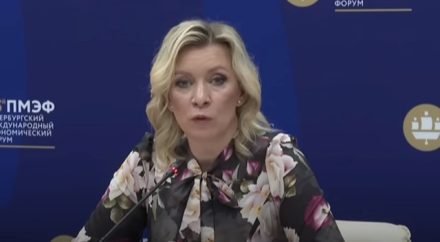
The European Union must decide whether it wants the Ukraine conflict to be resolved diplomatically or in a violent manner, Russian Foreign Ministry spokeswoman Maria Zakharova said at a briefing on Thursday.
Asked to comment on Austria’s reported proposal to host de-escalation talks, Zakharova said Moscow could only contemplate such initiatives after the EU figures out what it stands for regarding Ukraine.
“First of all, the EU should make up its mind about itself,” Zakharova said, urging the EU to decide whether it is pursuing a unified foreign policy or if decisions are handled by individual member states.
Russia, she said, has repeatedly heard “contradicting statements” coming from the EU. Zakharova noted that many supposed initiatives had been put forward by member states and were later retracted or never followed-up on because they were not approved by Brussels.
“Secondly, the EU also needs to make up its mind whether they support the talks [on Ukraine], or the battlefield solution, as [EU foreign policy chief Josep] Borrell had put it,” she said.
Zakharova’s comment comes after Borrell signaled on Wednesday that the EU was ready to seek a “diplomatic solution” to the conflict in Ukraine, but vowing that the bloc would continue to provide Kiev with military and financial support while ramping up pressure on Russia through sanctions.
However, in April Borrell issued a much different statement, claiming then that the conflict in Ukraine “will be won on the battlefield.”
Russia sent troops into Ukraine on February 24, citing Kiev’s failure to implement the Minsk agreements, designed to give the regions of Donetsk and Lugansk special status within the Ukrainian state. The protocols, brokered by Germany and France, were first signed in 2014. Former Ukrainian President Pyotr Poroshenko has since admitted that Kiev’s main goal was to use the ceasefire to buy time and “create powerful armed forces.”
During referendums that took place in late September, the two Donbass republics, along with Zaporozhye and Kherson Regions, overwhelmingly voted to join Russia. On Wednesday, Russian President Vladimir Putin signed into law unification treaties with former Ukrainian territories, officially making them part of Russia. Prior to this, the Russian leader vowed to use “all means” necessary to defend the country’s territorial integrity in the face of external threats.
US imports from Russia up despite sanctions
Samizdat – October 6, 2022
US imports from Russia reached $522.1 million in August, 7.7% more than the July total of $484.8 million, marking the first monthly increase since April, according to a report released on Wednesday by the US Census Bureau.
The growth comes despite US President Joe Biden’s pledge to deal a “crushing blow” to Moscow through restrictions on commodity trade.
According to analysts, Washington continues to benefit from the anti-Russia sanctions. While pressuring the EU to give up supplies from Russia, the US continues to buy hundreds of unsanctioned types of goods.
“There is a tacit agreement between the US government and business: we puff our cheeks, and you trade with Russia if it suits you. Their words don’t meet their actions,” Aleksandr Razuvaev, a member of the supervisory council at Moscow’s Guild of Financial Analysts, told Russian state media on Wednesday.
Meanwhile, exports of American goods to Russia slumped by 19% to $66.8 million in August from $82.5 million in July. In June, Russia imported goods worth $58 million, down from $77.4 million in May, and $89.1 million in April.
The data shows that in total from January to August the US imported goods from Russia worth $12.1 billion, while exports stood at just $1.3 billion.
Featured Video

Death Spikes & Rising Cancer In Our Youth Explained
or go to
Aletho News Archives – Video-Images
From the Archives
Politicians lie
By Mazin Qumsiyeh | Popular Resistance | August 18, 2013
There is no way to say this truth nicely: Politicians lie. That includes Japanese, American, Egyptian, Israeli, and Palestinian politicians! Is there something more common sense than that? Yet, so many citizens around the world believe their own politicians or wistfully acknowledge lies but think it is part of the job needed to run things. They believe even when politicians contradict themselves blatantly. This phenomenon is rather remarkable. It is a dissonance and disconnect from reality that many seem oblivious to. It is very dangerous because it can lead to accepting rationales for going to war. These can be deadly wars that lead to millions of lives lost as happened in what was called World War 1 and WW2. Even when incredible and declassified evidence abound, politicians continue to lie and old mythologies refuse to die. Here are just a few of the countless lies told to us over the past few decades… continue
Blog Roll
 Aletho News
- RSF military group defects, joins Sudanese army: State media
- Ireland goalkeeper refuses to play ‘Israel’ as squad weighs boycott
- China pushes back against US on Cuba, Iran
- Ukrainian Soldiers, Potential Mercenaries: Have Gun, Will Travel!
- Burnham’s UN debut… A masterclass in British disinformation
- Iran flights continue despite US aviation sanctions
- Global Tipping Points Lead the World Into a State of Entropy
- The day-after at the White House: USA and Xi Jinping
- The Geopolitical Balance in the Red Sea: The UAE Being Displaced by New Players
- Iraqi resistance group vows to stage airport sit-ins over Iran aerial blockade
- If Americans Knew
- Deconstructing Netanyahu’s pants-on-fire UN rant – Daily Update
- Trump betrayed voters with his campaign lies and prioritized a foreign country once he took office
- Netanyahu calls Israel’s war in Gaza ‘opposite of genocide’ in UN speech to near-empty hall
- Settler Kidnappings: Torture, Sexual Abuse and Terrorisation of Palestinian Abductees as Israel Deepens Annexation of West Bank
- Gaza winter nears as 162,000 tents become unusable, raising fears of humanitarian crisis
- Netanyahu says, “It’s the opposite of genocide”; UN says Gaza economy is world’s ‘most severe crisis on record’ – Daily Update
- Israel’s US-Backed Assault on Gaza Has Created the ‘World’s Most Severe Economic Crisis on Record’: UN
- ‘Protecting U.S. Citizens’… From Israel
- ‘This is where I live now, the back of a truck’: a day in the life of a grandmother in Gaza
- In UN Speech, Iran’s President Displays Pictures of Children Killed by US, Brings Attention to Israel’s Nuclear Arsenal
- No Tricks Zone
- New Study: Earth And Venus Surface Warmth Largely Explained By Convection And Lapse Rate, Not CO2 Or Radiation
- 2025 Nature Paper Claiming Worsening Global Drought Gets RETRACTED …Heavily Flawed
- New Study: ‘Global Drought Shows No Detectable Recent Acceleration Under Climate Warming’
- Economic Masterminds: German Socialists Suggest Taxing Productivity Gains Stemming From Using AI
- The South China Sea Has Not Been Cooperating With The Climate Change Narrative
- Energy Crisis: Germany Enters Heating Season With Historically Low Gas Reserve Fill Levels
- New Study: The Antarctic Ice Sheet Gained Mass From 2020-2024 Due To Staggering Snow And Ice Accumulation
- Study: Ocean Heating Rates From Thousands Of Years Ago ‘Dwarf’ Modern Ocean Heating Rates
- Climate Extremists Target, Attack Large-Scale Power Grid Infrastructure In Germany!
- New Study: Antarctic Ice Melt Has Contributed Less Than 1 Centimeter To Sea Level Rise In The Last 30 Years

