Putin and Clausewitz
Politics By Other Means
By Big Serge | October 5, 2022
With the sole possible exception of the great Sun Tzu and his “Art of War”, no military theorist has had such an enduring philosophical impact as the Prussian General Carl Philipp Gottfried von Clausewitz. A participant in the Napoleonic Wars, Clausewitz in his later years dedicated himself to the work that would become his iconic achievement – a dense tome titled simply “Vom Kriege” – On War. The book is a meditation on both military strategy and the socio-political phenomenon of war, which is heavily laced with philosophical rumination. Though On War has had an enduring and indelible impact on the study of military arts, the book itself is at times a rather difficult thing to read – a fact that stems from the great tragedy that Clausewitz was never actually able to finish it. He died in 1831 at the age of only 51 with his manuscript in an unedited disorder; and it fell upon his wife to attempt to organize and publish his papers.
Clausewitz, more than anything, is famous for his aphorisms – “Everything is very simple in war, but the simplest thing is difficult” – and his vocabulary of war, which includes terms such as “friction” and “culmination.” Among all his eminently quotable passages, however, one is perhaps the most famous: his claim that “War is a mere continuation of politics by other means.”
It is on this claim that I wish to fixate for the moment, but first, it may be worthwhile to read the entirety of Clausewitz’s passage on the subject:
“War is the mere continuation of politics by other means. We see, therefore, that War is not merely a political act, but also a real political instrument, a continuation of political commerce, a carrying out of the same by other means. All beyond this which is strictly peculiar to War relates merely to the peculiar nature of the means which it uses. That the tendencies and views of policy shall not be incompatible with these means, the Art of War in general and the Commander in each particular case may demand, and this claim is truly not a trifling one. But however powerfully this may react on political views in particular cases, still it must always be regarded as only a modification of them; for the political view is the object, War is the means, and the means must always include the object in our conception.”
On War, Volume 1, Chapter 1, Section 24
Once we cut through Clausewitz’s dense and verbose style, the claim here is relatively simple: war-making always exists in reference to some greater political goal, and it exists on the political spectrum. Politics lies at every point along the axis: war is begun in response to some political need, it is maintained and continued as an act of political will, and it ultimately hopes to achieve political aims. War cannot be separated from politics – indeed, it is the political aspect that makes it war. We may even go further and state that war in the absence of the political superstructure ceases to be war, and instead becomes raw, animalistic violence. It is the political dimension that makes war recognizably distinct from other forms of violence.
Let us contemplate Russia’s war-making in Ukraine in these terms.
It is often the case that the most consequential men in the world are poorly understood in their time – power enshrouds and distorts the great man. This was certainly the case of Stalin and Mao, and it is equally true of both Vladimir Putin and Xi Jinping. Putin in particular is viewed in the west as a Hitlerian demagogue who rules with extrajudicial terror and militarism. This could hardly be farther from the truth.
Almost every aspect of the western caricature of Putin is deeply misguided – though this recent profile by Sean McMeekin comes much closer than most. To begin with, Putin is not a demagogue – he is not a naturally charismatic man, and though he has over time greatly improved his skills as a retail politician, and he is capable of giving impactful speeches when needed, he is not someone who relishes the podium. Unlike Donald Trump, Barack Obama, or even – God forbid – Adolf Hitler, Putin is simply not a natural crowd pleaser. In Russia itself, his imagine is that of a fairly boring but level headed career political servant, rather than a charismatic populist. His enduring popularity in Russia is far more linked to his stabilization of the Russian economy and pension system than it is to pictures of him riding a horse shirtless.
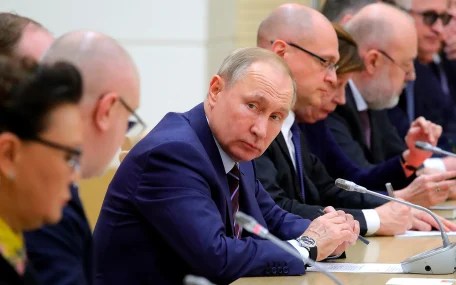
Trust the plan, even when the plan is slow moving and boring
Furthermore, Putin – contrary to the view that he wields unlimited extralegal authority – is rather a stickler for proceduralism. Russia’s government structure expressly empowers a very strong presidency (this was an absolute necessity in the wake of total state collapse in the early 1990’s), but within these parameters Putin is not viewed as a particularly exciting personality prone to radical or explosive decision making. Western critics may claim that there is no ruleof law in Russia, but at the very least, Putin governs by law, with bureaucratic mechanisms and procedures forming the superstructure within which he acts.
This was made vividly apparent in recent days. With Ukraine advancing on multiple fronts, a fresh cycle of doom and triumph was set in motion: pro-Ukrainian figures exult in the apparent collapse of the Russian army, while many in the Russian camp bemoan leadership which they conclude must be criminally incompetent. With all of this underway on the military side, Putin has calmly ushered the annexation process through its legal mechanisms – first holding referendums, then signing treaties on entry in the Russian Federation with the four former Ukrainian oblasts, which were then sent to the State Duma for ratification, followed by the Federation Council, followed again by signature and verification by Putin. As Ukraine throws its summer accumulations into the fight, Putin appears to be mired in paperwork and procedure. The treaties were even reviewed by the Russian constitutional court, and deadlines were set to end the Ukrainian hryvnia as legal tender and replace it with the ruble.
This is a strange spectacle. Putin is plodding his way through the boring legalities of annexation, seemingly deaf to the chorus which is shouting at him that his war is on the verge of total failure. The implacable calm radiating – at least publicly – from the Kremlin seems at odds with events at the front.
So, what really is going on here? Is Putin truly so detached from events on the ground that he is unaware that his army is being defeated? Is he planning to use nuclear weapons in a fit of rage? Or could this be, as Clausewitz says, the mere continuation of politics by other means?
Of all the phantasmagorical claims that have been made about the Russo-Ukrainian War, few are as difficult to believe as the claim that Russia intended to conquer Ukraine with fewer than 200,000 men. Indeed, a central truth of the war that observers simply must come to grasps with is the fact that the Russian army has been badly outnumbered from day one, despite Russia having an enormous demographic advantage over Ukraine itself. On paper, Russia has committed an expeditionary force of less than 200,000 men, though of course that full amount has not been on the frontline in active combat lately.
The light force deployment is related to Russia’s rather unique service model, which has combined “contract soldiers” – the professional core of the army – with a reservist pool that is generated with an annual conscription wave. Russia consequentially has a two-tiered military model, with a world class professional ready force and a large pool of reserve cadres that can be dipped into, augmented with auxiliary forces like BARS (volunteers), Chechens, and LNR-DNR militia.
This two-tiered, mixed service model reflects, in some ways, the geostrategic schizophrenia that plagued post-Soviet Russia. Russia is an enormous country with potentially colossal, continent spanning security commitments, which inherited a Soviet legacy of mass. No country has ever demonstrated a capacity for wartime mobilization on a scale to match the USSR. The transition from a Soviet mobilization scheme to a smaller, leaner, professional ready force was part and parcel of Russia’s neoliberal austerity regime throughout much of the Putin years.
It is important to understand that military mobilization, as such, is also a form of political mobilization. The ready contract force required a fairly low level of political consensus and buy-in from the bulk of the Russian population. This Russian contract force can still accomplish a great deal, militarily speaking – it can destroy Ukrainian military installations, wreak havoc with artillery, bash its way into urban agglomerations in the Donbas, and destroy much of Ukraine’s indiginous war-making potential. It cannot, however, wage a multi-year continental war against an enemy which outnumbers it by at least four to one, and which is sustained with intelligence, command and control, and material which are beyond its immediate reach – especially if the rules of engagement prevent it from striking the enemy’s vital arteries.
More force deployment is needed. Russia must transcend the neoliberal austerity army. It has the material capacity to mobilize the needed forces – it has many millions in its reservist pool, enormous inventories of equipment, and indigenous production capacity undergirded by the natural resources and production potential of the Eurasian bloc that has closed ranks around it. But remember – military mobilization is also political mobilization.
The Soviet Union was able to mobilize tens of millions of young men to blunt, swamp, and eventually annihilate the German land army because it wielded two powerful political instruments. The first was the awesome and far reaching power of the Communist Party, with its ubiquitous organs. The second was the truth – German invaders had come with genocidal intent (Hitler at one point mused that Siberia could be turned into a Slav reservation for the survivors, which could be bombed periodically to remind them who was in charge).
Putin lacks a coercive organ as powerful as the Communist Party, which had both astonishing material power and a compelling ideology which promised to bring about an accelerated path to non-capitalist modernity. Indeed, no country today has a political apparatus like that splendid communist machine, save perhaps China and North Korea. So, in the absence of a direct lever to create political – and hence military – mobilization, Russia must find an alternative route to creating a political consensus to wage a higher form of war.
This has now been accomplished, courtesy of western Russophobia and Ukraine’s penchant for violence. A subtle, but profound transformation of the Russian socio-political body is underway.
Putin and those around him conceived of the Russo-Ukrainian War in existential terms from the very beginning. It is unlikely, however, that most Russians understood this. Instead, they likely viewed the war the same way Americans viewed the war in Iraq and Ukraine – as a justified military enterprise that was nevertheless merely a technocratic task for the professional military; hardly a matter of life and death for the nation. I highly doubt that any American ever believed that the fate of the nation hinged on the war in Afghanistan (Americans have not fought an existential war since 1865), and judging by the recruitment crisis plaguing the American military, it does not seem like anyone perceives a genuine foreign existential threat.
What has happened in the months since February 24 is rather remarkable. The existential war for the Russian nation has been incarnated and made real for Russian citizens. Sanctions and anti-Russian propaganda – demonizing the entire nation as “orcs” – has rallied even initially skeptical Russians behind the war, and Putin’s approval rating has soared. A core western assumption, that Russians would turn on the government, has reversed. Videos showing the torture of Russian POWs by frothing Ukrainians, of Ukrainian soldiers calling Russian mothers to mockingly tell them their sons are dead, of Russian children killed by shelling in Donetsk, have served to validate Putin’s implicit claim that Ukraine is a demon possessed state that must be exorcised with high explosives. Amidst all of this – helpfully, from the perspective of Alexander Dugin and his neophytes – American pseudo-intellectual “Blue Checks” have publicly drooled over the prospect of “decolonizing and demilitarizing” Russia, which plainly entails the dismemberment of the Russian state and the partitioning of its territory. The government of Ukraine (in now deleted tweets) publicly claimed that Russians are prone to barbarism because they are a mongrel race with Asiatic blood mixing.
Simultaneously, Putin has moved towards – and ultimately achieved – his project of formal annexation of Ukraine’s old eastern rim. This has also legally transformed the war into an existential struggle. Further Ukrainian advances in the east are now, in the eyes of the Russian state, an assault on sovereign Russian territory and an attempt to destroy the integrity of the Russian state. Recent polling shows that a supermajority of Russians support defending these new territories at any cost.
All domains now align. Putin and company conceived of this war from the beginning as an existential struggle for Russia, to eject an anti-Russian puppet state from its doorstep and defeat a hostile incursion into Russian civilizational space. Public opinion is now increasingly in agreement with this (surveys show that Russian distrust of NATO and “western values” have skyrocketed), and the legal framework post-annexation recognizes this as well. The ideological, political, and legal domains are now united in the view that Russia is fighting for its very existence in Ukraine. The unification of the technical, ideological, political, and legal dimensions was, just moments ago, described by the head of Russia’s communist party, Gennady Zyuganov:
“So, the President signed decrees on the admission of the DPR, LPR, Zaporozhye and Kherson regions into Russia. Bridges are burned . What was clear from the moral and statist points of view has now become a legal fact: on our land there is an enemy, he kills and maims the citizens of Russia. The country demands the most decisive action to protect compatriots. Time does not wait.”
A political consensus for higher mobilization and greater intensity has been achieved. Now all that remains is the implementation of this consensus in the material world of fist and boot, bullet and shell, blood and iron.
One of the peculiarities of European history is the truly shocking extent to which the Romans were far ahead of their time in the sphere of military mobilization. Rome conquered the world largely because it had a truly exceptional mobilization capacity, for centuries consistently generating high levels of mass military participation from the male population of Italy. Caesar brought more than 60,000 men to the Battle of Alesia when he conquered Gaul – a force generation that would not be matched for centuries in the post-Roman world.
After the fall of the Western Roman Empire, state capacity in Europe deteriorated rapidly. Royal authority in both France and Germany was curtailed as the aristocracy and urban authorities grew in power. Despite the stereotype of despotic monarchy, political power in the middle ages was highly fragmented, and taxation and mobilization were highly localized. The Roman capacity to mobilize large armies that were centrally controlled and financed was lost, and warfare became the domain of a narrow fighting class – the petty gentry, or knights.
Consequentially, medieval European armies were shockingly small. At pivotal English-French battles like Agincourt and Crecy, English armies numbered less than 10,000, and the French no more than 30,000. The world historical Battle of Hastings – which sealed the Norman conquest of Britain – pitted two armies of fewer than 10,000 men against each other. The Battle of Grunwald – in which a Polish-Lithuanian coalition defeated the Teutonic Knights – was one of the largest battles in Medieval Europe and still featured two armies that numbered at most 30,000.
European mobilization powers and state capacity were shockingly low in this era compared to other states around the world. Chinese armies routinely numbered in the low hundreds of thousands, and the Mongols, even with significantly lower bureaucratic sophistication, could field 80,000 men.
The situation began to shift radically as intensified military competition – in particular the savage 30 years’ war – forced European states to at last begin a shift back towards centralized state capacity. The model of military mobilization shifted at last from the servitor system – where a small, self-funded military class provided military service – to the fiscal military state, where armies were raised, funded, directed, and sustained through the fiscal-bureaucratic systems of centralized governments.
Through the early modern period, military service models acquired a unique admixture of conscription, professional service, and the servitor system. The aristocracy continued to provide military service in the emerging officer corps, while conscription and impressment were used to fill out the ranks. Notably, however, conscripts were inducted into very long terms of service. This reflected the political needs of monarchy in the age of absolutism. The army was not a forum for popular political participation in the regime – it was an instrument for the regime to defend itself from both foreign enemies and peasant jacqueries. Therefore, conscripts were not rotated back into society. It was necessary to turn the army into a distinct social class with some element of remoteness from the population at large – this was a professional military institution that served as an internal bulwark of the regime.
The rise of nationalistic regimes and mass politics allowed the scale of armies to increase much further. Governments in the late 19th century now had less to fear from their own populations than did the absolute monarchies of the past – this changed the nature of military service and at last returned Europe to the system that the Romans had in millennia past. Military service was now a form of mass political participation – this allowed for conscripts to be called up, trained, and rotated back into society – the reserve cadre system that characterized armies in both of the world wars.
In sum, the cycle of military mobilization systems in Europe is a mirror of the political system. Armies were very small during the era where there was little to no mass political participation with the regime. Rome fielded large armies because there was significant political buy-in and a cohesive identity in the form of Roman citizenship. This allowed Rome to generate high military participation, even in the Republican era where the Roman state was very small and bureaucratically sparse. Medieval Europe had fragmented political authority and an extremely low sense of cohesive political identity, and consequently its armies were shockingly small. Armies began to grow in size again as the sense of national identity and participation grew, and it is no coincidence that the largest war in history – the Nazi-Soviet War – was fought between two regimes that had totalizing ideologies that generated an extremely high level of political participation.
That brings us to today. In the 21st century, with its interconnectedness and crushing availability of both information and misinformation, the process of generating mass political – and hence military – participation is much more nuanced. No country wields a totalizing utopian vision, and it is inarguable that the sense of national cohesion is significantly lower now than it was one hundred years ago.
Putin, very simply, could not have conducted a large scale mobilization at the onset of the war. He possessed neither a coercive mechanism nor the manifest threat to generate mass political support. Few Russians would have believed that there was some existential threat lurking in the shadow – they needed to be shown, and the west has not disappointed. Likewise, few Russians would likely have supported the obliteration of Ukrainian infrastructure and urban utilities in the opening days of the war. But now, the only vocal criticism of Putin within Russia is on the side of further escalation. The problem with Putin, from the Russian perspective, is that he has not gone far enough. In other words – mass politics have already moved ahead of the government, making mobilization and escalation politically trivial. Above all, we must remember that Clausewitz’s maxim remains true. The military situation is merely a subset of the political situation, and military mobilization is also political mobilization – a manifestation of society’s political participation in the state.
Ukraine’s offensive phase continues on multiple fronts. They are pushing into northern Lugansk, and after weeks of banging their heads against a wall in Kherson, they have finally made territorial progress. Yet, just today, Putin said that it is necessary to conduct medical examinations of the children in the newly admitted oblasts and rebuild school playgrounds. What is going on? Is he totally detached from events at the front?
There are really only two ways to interpret what is happening. One is the western spin: the Russian army is defeated and depleted and is being driven from the field. Putin is deranged, his commanders are incompetent, and Russia’s only card left to play is to throw drunk, untrained conscripts into the meat grinder.
The other is the interpretation that I have advocated, that Russia is massing for a winter escalation and offensive, and is currently engaged in a calculated trade wherein they give up space in exchange for time and Ukrainian casualties. Russia continues to retreat where positions are either operationally compromised or faced with overwhelming Ukrainian numbers, but they are very careful to extract forces out of operational danger. In Lyman, where Ukraine threatened to encircle the garrison, Russia committed mobile reserves to unblock the village and secure the withdrawal of the garrison. Ukraine’s “encirclement” evaporated, and the Ukrainian interior ministry was bizarrely compelled to tweet (and then delete) video of destroyed civilian vehicles as “proof” that the Russian forces had been annihilated.
Russia will likely continue to pull back over the coming weeks, withdrawing units intact under their artillery and air umbrella, grinding down Ukrainian heavy equipment stocks and wearing away their manpower. Meanwhile, new equipment continues to congregate in Belgorod, Zaporizhia, and Crimea. My expectation remains the same: episodic Russian withdrawal until the front stabilizes roughly at the end of October, followed by an operational pause until the ground freezes, followed by escalation and a winter offensive by Russia once they have finished amassing sufficient units.
There is an eerie calm radiating from the Kremlin. Mobilization is underway – 200,000 men are currently undergoing refresher training at ranges around Russia. Trainloads of military equipment continue to flood across the Kerch bridge, but Ukraine’s offensive plods on with no Russian reinforcements to be seen at the front. The disconnect between the Kremlin’s stoicism and the deterioration of the front are striking. Perhaps Putin and the entire Russian general staff really are criminally incompetent – perhaps the Russian reserves really are nothing but a bunch of drunks. Perhaps there is no plan.
Or perhaps, Russia’s sons will answer the call of the motherland again, as they did in 1709, in 1812, and in 1941.
As the wolves once more prowl at the door, the old bear rises again to fight.
Kiev Offers Biden Targeting Control, Seeks Longer Range Weapons
By Kyle Anzalone and Connor Freeman | The Libertarian Institute | October 3, 2022
The Ukrainian government is prepared to give the Joe Biden administration virtual control over its selection of Russian targets. Kiev made the proposal in a bid to receive longer-range weapons from the White House, according to multiple sources speaking with CNN.
Ukrainian President Volodymyr Zelensky will provide a full list of possible targets while allowing the White House to veto any of the potential sites. Kiev is hoping the increased transparency will pave the path to Biden authorizing more weapons transfers. Zelensky made the offer to Washington to alleviate concerns in the Biden administration that new weapons will be used to target Russian territory.
However, Kiev, Washington and Moscow currently have different views on what is Russian versus Ukrainian territory. After a 2014 coup in Ukraine that saw US-backed elements overthrow a democratically elected government, Russia annexed the Crimea peninsula. Last week, Moscow claimed four additional regions of Ukraine as its own.
Russian President Vladimir Putin has vowed to defend all of his country’s territory with the full arsenal at his disposal. The Kremlin stated that it considers its newly added regions as it would the rest of Russia. On Sunday, Secretary of Defense Lloyd Austin acknowledged the possibility that Putin could order a nuclear strike in Ukraine, defending these new regions. The Pentagon chief then vowed Washington would support Kiev’s “efforts” for “as long as it takes” to “take back all of the territories” within its “sovereign borders.”
Concurrently, Moscow claims there has been an increase in Ukrainian attacks within Russia proper, encouraged by NATO. During a recent press conference, Putin publicly noted, for the first time, attempted Ukrainian attacks on Russia’s nuclear power plants.
The US has provided Ukraine with 16 High Mobility Artillery Rocket Systems (HIMARS), and authorized sending over a dozen more to Kiev in an arms package last week. So far, the White House has only sent Ukraine with munitions for HIMARS that can travel 50 miles. Kiev is seeking Army Tactical Missile Systems (ATACMS) surface-to-surface missiles that can fly around 200 miles by the HIMARS. When the Biden administration began providing HIMARS to Ukraine, it was insisted that Kiev had provided “assurances” that these weapons would not be used to target Russian territory. In June, Antiwar.com contacted the State Department to ask if this condition applied to the Crimean Peninsula, a department spokesman replied “Crimea is Ukraine.”
The White House has made clear that they will not recognize the new Russian territories, and NATO has said they will escalate their support for the proxy war.
Russian Foreign Minister Sergei Lavrov has previously said that if the West provides Kiev with longer-range weapons, then the Kremlin would expand its war goals in Ukraine. In July, Lavrov wrote an article claiming NATO was already on the battlefield coordinating attacks on Russian targets using the rocket systems. “NATO instructors and Multiple Launch Rocket Systems aimers are, apparently, already directing the actions of the Ukrainian Armed Forces and nationalist battalions on the ground,” Lavrov said.
In addition to the CIA presence on the ground in Ukraine, NATO commandos from Lithuania, Canada, Britain, and France are also present. Notably, there are several Donald Trump-aligned Republicans in the legislature, including Rep. Mike Waltz (R-FL) eager to “[go] for the kill” and overtly deploy American military advisors to Ukraine. Former US special operators are already on the ground near the contact line, training Kiev’s forces and developing battle plans.
Harry Kazianis wrote in Responsible Statecraft that in multiple war game simulations, Washington sending advanced weapons led to nuclear war.
I have fought more than thirty combat simulations in wargames under my own direction for a private defense contract… In every scenario I tested, the Biden Administration slowly gives Ukraine ever more advanced weapons like ATACMS, F-16s, and other platforms that Russia has consistently warned pose a direct military threat… In fact, in 28 of the thirty scenarios I have run since the war began, some sort of nuclear exchange occurs.
Kazianis does report that in some of the war games, diplomacy, rather than escalation prevailed, and nuclear conflict was averted.
The good news is there is a way out of this crisis — however imperfect it may be. In the two scenarios where nuclear war was averted, direct negotiations led to a ceasefire. The Biden Administration and its NATO allies should be testing Putin’s recent comments about a ceasefire to test his seriousness.
Secretary of State Antony Blinken, America’s top diplomat, has declared Washington’s goal is to see Russia suffer a “strategic defeat” in Ukraine. During the war, he spoke to Lavrov once and for only 25 minutes, they merely discussed a potential bilateral prisoner exchange. Likewise, UK Prime Minister Liz Truss has ruled out diplomacy until Moscow is “defeated.”
Elon Musk suggests Ukraine peace plan
Samizdat | October 3, 2022
SpaceX and Tesla CEO Elon Musk has proposed a plan to end the conflict in Ukraine. The billionaire suggested that new elections be held in the four regions that recently voted to join Russia, while Ukraine would commit to neutrality and relinquish its claim to Crimea.
Musk posted an outline of his plan on Twitter on Monday, suggesting that Russia “redo elections of annexed regions under UN supervision,” with Moscow withdrawing from these areas if voters choose.
Crimea would be declared “formally part of Russia, as it has been since 1783,” until Soviet Premier Nikita Khrushchev gifted the peninsula to the Ukrainian SSR in 1954.
Musk, whose text messages revealed him to be an occasional reader of RT, called Khrushchev’s decision a “mistake.”
The billionaire then suggested that Ukraine commit to neutrality – as Russia had requested long before it launched its military operation in February – and guarantee the supply of water to Crimea. Ukraine shut down the supply in 2014 after Crimeans overwhelmingly voted to rejoin the Russian Federation. Shortly after the launch of Russia’s operation in Ukraine, the supply was restored.
“This is highly likely to be the outcome in the end,” Musk commented on his suggestion, adding that it is “just a question of how many people die before then.”
The plan is unlikely to find fans in Kiev. Ukrainian President Vladimir Zelensky has vowed not to negotiate with his Russian counterpart, Vladimir Putin, and to seize the entirety of the territory Kiev claims as its own – including the Donbass republics and Crimea – by force. Furthermore, Zelensky sent an application for membership to the NATO alliance last week.
Residents of Donetsk, Lugansk, Kherson, and Zaporozhye would likely vote in overwhelming numbers to join Russia if the recent referendums in these territories were held again. All of these regions have a high percentage of Russian speakers and have historically voted for pro-Russian candidates while part of Ukraine.
However, Putin has already signed treaties to accede these territories into the Russian Federation, and has vowed to defend them with Russia’s full military capabilities.
At the time of writing, nearly 60% of respondents on Twitter backed Musk’s idea. That ratio is likely to change, however, as pro-Ukrainian Twitter users in the comments have called on ‘#NAFO’ trolls to swing the poll in their favor. In a follow-up post, Musk said that “the bot attack on this poll is strong!”
Kiev’s counter attacks on Kherson have failed – top official
Samizdat | October 3, 2022
Attempts by Ukrainian forces to break through Russia’s defenses in Kherson Region have been thwarted, the deputy head of the local administration, Kirill Stremousov, has said.
In a Telegram post on Monday, Stremousov stated that “everything is under control in the Nikolayev direction,” despite Kiev’s efforts to retake the region. He noted that Ukraine’s forces had advanced southward along the Dnieper River to the village of Dudchany before “taking a beating” from Russian Aerospace Forces.
The official admitted that the Ukrainians were able to advance a little bit, but noted that the region’s defense systems were working and that “at the moment, the situation is completely under control.”
Stremousov concluded by urging people not to give in to panic because of what they hear and read on social media. “This is not Kharkov, this is not [Krasny] Liman, we are holding the fence,” he proclaimed.
Russia’s Defense Ministry has also confirmed repelling the attack, stating that over 400 Ukrainian servicemen, 43 tanks and 89 units of special military equipment were eliminated in the Nikolayev-Krivoy Rog area.
The announcement comes as Kiev’s forces have mounted large-scale offensives along several points of engagement with Russia. On Saturday, Russian troops were forced to withdraw from their defensive positions in the town of Krasny Liman in the Donetsk People’s Republic after they were nearly encircled by Ukrainian forces, which had brought in reserves and reached a “considerable superiority in men and material.”
It has been noted, however, that the Ukrainian side has been suffering significant casualties in the offensive, having reportedly lost over 500 soldiers (200 dead, 320 injured), as well as ten tanks and 25 infantry fighting vehicles during the attack on Krasny Liman, according to the Russian Defense Ministry.
Kiev’s offensive comes after President Vladimir Putin signed treaties on the accession of the Donetsk and Lugansk People’s Republics, as well as the Russian-held regions of Kherson and Zaporozhye, into the Russian Federation on Friday. The move came after the four territories overwhelmingly voted in favor of joining Russia in referendums held between September 23 and 27.
Ukraine and Western nations have refused to recognize the results of the referendums and have vowed to never acknowledge the regions as being part of Russia.
US is recalibrating the power dynamic in East Mediterranean. Can South Asia be far behind?

File Photo
BY M. K. BHADRAKUMAR | INDIAN PUNCHLINE | OCTOBER 2, 2022
A mild flutter ensued after External Affairs Minister S Jaishankar’s recent meeting with his Turkiye counterpart Mevlut Cavusoglu on the sidelines of the UN General Assembly session in New York on September 21 when it came to be known that Cyprus figured in their discussion. Jaishankar highlighted it in a tweet.
The Indian media instinctively related this to Turkish President Recep Erdogan making a one-line reference to the Kashmir issue earlier that day in his address to the UN GA. But Jaishankar being a scholar-diplomat, would know that Cyprus issue is in the news cycle and the new cold war conditions breathe fresh life into it, as tensions mount in the Turkish-Greek rivalry, which often draws comparison with the India-Pakistan animosity, stemming from another historical “Partition” — under the Treaty of Lausanne (1923) that ended the Ottoman Empire.
The beauty about peace treaties is that they have no ‘expiration date’ but the Treaty of Lausanne was signed for a period of a hundred years between Turkiye on one side and Britain, France, Italy, Greece, and their allies on the other. The approaching date heightens the existential predicament at the heart of Turkiye’s foreign policy.
The stunning reality is that by 24th July 2023, Turkey’s modern borders become “obsolete”. The secret articles of the 1923 Treaty, signed by Turkish and British diplomats, provide for a chain of strange happenings — British troops will reoccupy the forts overlooking the Bosphorus; the Greek Orthodox Patriarch will resurrect a Byzantine mini state within Istanbul’s city walls; and Turkey will finally be able to tap the forbidden vast energy resources of the East Mediterranean (and, perhaps, regain Western Thrace, a province of Greece.)
Of course, none of that can happen and they remain conspiracy theories. Nonetheless, the “end-of-Lausanne” syndrome remains a foundational myth and weaves neatly into the historical revisionism that Ataturk should have got a much better deal from the Western powers.
All this goes to underline the magnitude of the current massively underestimated drama, of which Cyprus is at the epicentre. Suffice to say, Turkey’s geometrically growing rift with Greece and Cyprus over the offshore hydrocarbon reserves and naval borders must be properly understood in terms of the big picture.
Turkiye’s ruling elite believe that Turkey was forced to sign the Treaty of Sevres in 1920 and the “Treaty of Lausanne” in 1923 and thereby concede vast tracts of land under its domain. Erdogan rejects any understanding of history that takes 1919 as the start of the 1,000-year history of his great nation and civilisation. “Whoever leaves out our last 200 years, even 600 years together with its victories and defeats, and jumps directly from old Turkish history to the Republic, is an enemy of our nation and state,” he once stated.
The international community has begun to pay attention as Turkiye celebrates its centenary next year, which also happens to be an election year for Erdogan. In a typical first shot, the US State Department announced on September 16 — just five days before Jaishankar met Cavusoglu — that Washington is lifting defence trade restrictions on the Greek Cypriot administration for the 2023 fiscal year.
Spokesman Ned Price said, “Secretary of State Antony J. Blinken determined and certified to Congress that the Republic of Cyprus has met the necessary conditions under relevant legislation to allow the approval of exports, re-exports, and transfers of defence articles.”
The US move comes against the backdrop of a spate of recent arms deals by Cyprus and Greece, including a deal to purchase attack helicopters from France and efforts to procure missile and long-range radar systems. Turkiye called on the US “to reconsider this decision and to pursue a balanced policy towards the two sides on the Island.” It has since announced a beefing up of its military presence in Northern Cyprus.
To be sure, the unilateral US move also means indirect support for the maritime claims by Greece and the Greek Cypriot administration, which Turkiye, with the longest continental coastline in the Eastern Mediterranean, rejects as excessive and violates its sovereign rights and that of Turkish Cypriots.
Whether these developments figured in Jaishankar’s discussion with Cavusoglu is unclear, but curiously, India too is currently grappling with a similar US decision to offer a $450 million military package to Pakistan to upgrade its nuclear-capable F-16 aircraft.
Indeed, the US-Turkey-Cyprus triangle has some striking similarities with the US-India-Pakistan triangle. In both cases, the Biden administration is dealing with friendly pro-US governments in Nicosia and Islamabad but is discernibly unhappy with the nationalist credo of the leaderships in Ankara and New Delhi.
Washington is annoyed that the governments in Ankara and New Delhi preserve their strategic autonomy. Most important, the US’ attempt to isolate Russia weakening due to the refusal by Turkiye and India to impose sanctions against Moscow.
The US is worried that India and Turkiye, two influential regional powers, pursue foreign policies promoting multipolarity in the international system, which undermines US’ global hegemony. Above all, it is an eyesore for Washington that Erdogan and Prime Minister Modi enjoy warm trustful personal interaction with Russian President Vladimir Putin.
The photo beamed from Samarkand during the recent SCO summit showing Erdogan arm in arm with Putin must have infuriated President Biden. Modi too displayed a rare moment of surging emotions when he told Putin at Samarkand on September 16,
“The relationship between India and Russia has deepened manifold. We also value this relationship because we have been such friends who have been with each other every moment for the last several decades and the whole world also knows how Russia’s relationship with India has been and how India’s relationship with Russia has been and therefore the world also knows that it is an unbreakable friendship. Personally speaking, in a way, the journey for both of us started at the same time. I first met you in 2001, when you were working as the head of the government and I had started working as head of the state government. Today, it has been 22 years, our friendship is constantly growing, we are constantly working together for the betterment of this region, for the well-being of the people. Today, at the SCO Summit, I am very grateful to you for all the feelings that you have expressed for India.”
Amazingly, the western media censored this stirring passage in its reports on the Modi-Putin meeting!
Notably, following the meeting between Modi and Erdogan in Samarkand on Sept. 16, a commentary by the state-owned TRT titled Turkiye-India ties have a bright future ahead signalled the Erdogan government’s interest to move forward in relations with India.
India’s ties with Turkiye deserve to be prioritised, as that country is inching toward BRICS and the SCO and is destined to be a serious player in the emerging multipolar world order. Symptomatic of the shift in tectonic plates is the recent report that Russia might launch direct flights between Moscow and the Turkish Republic of Northern Cyprus, a state supported and recognised only by Ankara. (Incidentally, one “pre-condition” set by the Biden administration to resume military aid to Cyprus was that Nicosia should roll back its relations with Moscow!)
Without doubt, the US and the EU are recalibrating the power dynamics in the Eastern Mediterranean by building up the Cyprus-Greece axis and sending a warning to Turkiye to know its place. In geopolitical terms, this is another way of welcoming Cyprus into NATO. Thus, it becomes part of the new cold war.
Can South Asia’s future be any different? Turkiye has so many advantages over India, having been a longstanding cold-war era ally of the US. It hosts Incirlik Air Base, one of the US’ major strategically located military bases. Kurecik Radar Station partners with the US Air Force and Navy in a mission related to missile interception and defence. Turkey is a NATO power which is irreplaceable in the alliance’s southern tier. Turkey controls the Bosphorus Straits under the Montreux Convention (1936).
Yet, the US is unwilling to have a relationship of mutual interest and mutual respect with Turkiye. Pentagon is openly aligned with the Kurdish separatists. The Obama administration made a failed coup attempt to overthrow Erdogan.
Nord Stream pipelines can be restored – Moscow
Samizdat | October 2, 2022
Russia may be able to fix the Nord Stream 1 and 2 pipelines, which were damaged earlier this week, Deputy Prime Minister Aleksandr Novak said on Sunday.
“There are technical possibilities to restore the infrastructure, it requires time and appropriate funds. I am sure that appropriate opportunities will be found,” Novak told Russia 1 TV.
According to the official, however, the first step should be to determine who is behind the incident.
“As of today, we proceed from the fact that it is necessary, first of all, to figure out who did it, and we are sure that certain countries, which had expressed their positions before, were interested in it. Both the US and Ukraine, as well as Poland at one time said that this infrastructure is not going to work, that they will do everything to make sure of it, so, of course, it is necessary to seriously look into it,” Novak stated.
Citing German security services, Der Tagesspiegel newspaper earlier reported that the damaged routes could be permanently out of use if they are not repaired quickly, as salt water could cause corrosion.
The Danish authorities reported leaks on both the Nord Stream 1 and 2 pipelines on Monday after a local pipeline operator noted a loss of pressure following a series of undersea explosions in the area. The Danish Energy Agency reported earlier on Sunday that the pressure on the Nord Stream 1 is stable and the gas leakage is over, while on Saturday, it said the Nord Stream 2 also stopped leaking gas.
The incident is widely considered to be the result of sabotage. Russia has called it a terrorist attack. While those behind it have not yet been identified, Moscow has blamed the US.
Russian hypersonic missiles superior to anything NATO has: Le Figaro
Samizdat – 02.10.2022
Russian hypersonic missile systems are more advanced than anything being fielded by the North Atlantic Alliance today, France’s Le Figaro has reported, echoing sentiments expressed by Russia’s president in a speech last week.
The French newspaper characterized Russia’s hypersonic weaponry as its main strategic asset, capable of flying at incredible speeds and maneuvering while in flight. It pointed specifically to the Avangard hypersonic glide vehicle – a weapon deployable as a part of a multiple independently targetable reentry vehicle (MIRV) payload aboard Russian intercontinental ballistic missiles.
“In this specific area, Russia is indeed one step ahead of its NATO adversaries,” the Gaullist newspaper conceded. The paper added that Russia and China proceeded to develop hypersonic missiles in response to NATO’s efforts to construct a missile defense shield.
“Russia undoubtedly has more modern weapons than the NATO countries. The United States has lagged behind in the field of hypersonic missiles, and Moscow’s nuclear arsenal is being replenished with more powerful and destructive projectiles,” Igor Delanoe, deputy director of the Moscow-based Franco-Russian Observatory, said.
In his speech announcing partial mobilization last month, Vladimir Putin accused Western officials of discussing “the possibility and admissibility of using weapons mass destruction – nuclear weapons – against Russia.”
“I would like to remind those who make such statements regarding Russia that our country has different types of weapons as well, and some of them are more modern than the weapons NATO countries have. In the event of a threat to the territorial integrity of our country and to defend Russia and our people, we will certainly make use of all weapon systems available to us. This is not a bluff,” Putin said.
The Russian president unveiled five new strategic weapons in a speech to lawmakers in 2018, among them the Kinzhal and the Avangard, plus the Poseidon nuclear-powered and nuclear-armed drone submarine, and the 9M730 Burevestnik (‘Petrel’) nuclear-powered, nuclear-armed cruise missile.
The Chinese military also possesses hypersonic weapons. In August, Russian-Indian defense joint venture BrahMos announced that it may create a hypersonic missile by 2027 or 2028. North and South Korea, France, Japan, Australia and India are also researching the cutting-edge class of weaponry.
The Pentagon has tasked US defense contractors with developing at least six hypersonic weapons designs for the Army, Navy, Air Force, and DARPA’s Operational Fires program, but to date none have been fielded. The US military has also pitched laser and dust-firing flak guns meant to defeat Russian and Chinese hypersonics, as well as the use of stratospheric balloons to monitor and track their launch.
Russia got a head start on its hypersonics program thanks to Soviet-era research in the field starting in the early 2000s, after the Bush administration unilaterally scrapped of the Anti-Ballistic Missile Treaty – a 1972 Soviet-US agreement which placed severe limitations on the creation of anti-ballistic missile defenses and intended to stop the arms race.
Russia’s military doctrine forbids nuclear weapons from being used unless the country is targeted by enemy nuclear attack first, or a conventional attack so severe that it is deemed to threaten the existence of the state. The United States does not place such restrictions on its nukes, and “reserves the right to use” them on a preemptive basis, even against non-nuclear armed adversaries.
Putin names orchestrator of Nord Stream blasts
Samizdat | September 30, 2022
The US orchestrated the blasts on the Nord Stream 1 and 2 gas pipelines in the Baltic Sea, which delivered Russian natural gas to Germany, because they “obviously” benefit from it, President Vladimir Putin said on Friday.
Putin accused Washington of trying to pressure the EU into banning Russian supplies to “completely get their hands on the European market.”
“But the sanctions are no longer enough for the Anglo-Saxons,” he said, using Russian shorthand for the US-UK transatlantic alliance. “They have turned to sabotage – it’s unbelievable, but it’s a fact – by organizing the explosions on the Nord Stream international gas pipelines,” the president stated.
“They de facto began the destruction of the common European energy infrastructure. It’s obvious to everyone who benefits from it. Those who benefit are the ones who have done it.”
US Secretary of State Antony Blinken denounced Putin’s statement as part of “outrageous misinformation and disinformation campaigns” coming from Moscow.
“I really have nothing to say to the absurd allegation from President Putin that we are or other partners or allies are somehow responsible for this,” Blinken said, according to AFP.
Putin was speaking at the Kremlin ahead of signing treaties on the inclusion of the two Donbass republics, as well as Kherson and Zaporozhye Regions, which declared independence from Ukraine, into the Russian Federation.
Ukrainian shelling of refugee convoy leaves 24 people dead – local authorities
Samizdat | September 30, 2022
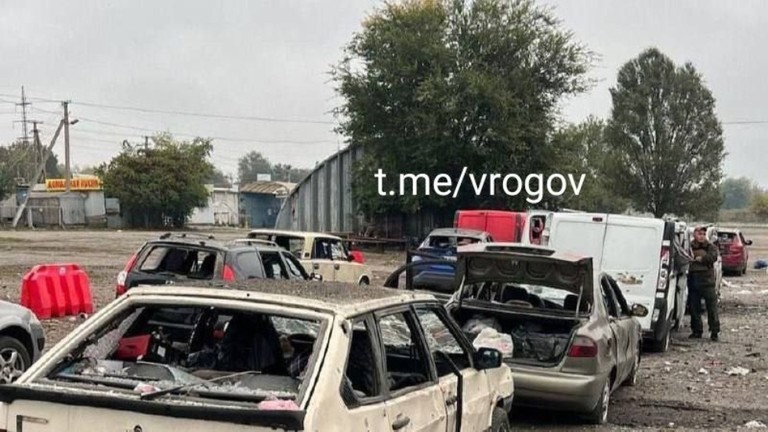
At least 24 people were killed and 36 wounded when Ukrainian forces struck a refugee convoy on Friday, Vladimir Rogov, a senior Russian-appointed official in Zaporozhye Region, has said.
Rogov wrote on Telegram that the attack targeted a convoy of cars that was traveling from Ukrainian-controlled territory to Zaporozhye Region, which declared independence from Kiev and was recognized as a separate state by Russia on Thursday.
“It happened at a car market on the Orekhovskoe highway where convoys are being formed to enter the region,” he wrote.
“24 people, including 11 men and 13 women were killed, 36 were wounded including a child,” the official said.
According to Rogov, the people, who were targeted, had protested and blocked roads earlier this week, demanding that Ukrainian authorities allow them to enter the Russian-held part of the region. “After that they were approached by the Security Service of Ukraine (SBU) and the police, who openly threatened them and said that they’ll be sorry for what they were doing,” he wrote.
The head of the administration accused Ukrainian President Vladimir Zelensky of “trying to take revenge on the residents of Zaporozhye Region after they chose to join Russia during the referendum” by ordering the strike.
Rogov insisted the Ukrainian attack on the convoy was carried out with the aim of pinning the blame on Russia.
Kiev’s governor of Zaporozhye Region claimed that Russian forces were behind the shelling. While the head of a Ukrainian bomb disposal unit, police colonel Sergey Ujryumov told Reuters that the Russians “know that columns are formed here to go to the occupied territories… It’s not a coincidental strike. It’s perfectly deliberate.” According to Ujryumov, S-300 missiles were used in the attack on the convoy.
Voting on joining Russia ended in Zaporozhye and Kherson Regions as well as in the two republics in Donbass on Monday, with residents in all territories overwhelmingly supporting the move. The official ceremony, in which President Vladimir Putin is expected to sign treaties on incorporating the new areas into the Russian state, is scheduled to take place in Moscow later on Friday.
A similar attack by Ukrainian forces happened in the eastern region of Kharkov on Thursday. At least 30 people, including children, were killed after a convoy of refugees, which tried to enter the People’s Republic of Lugansk, came under intense artillery bombardment, LPR authorities said.
IS RUSSIA REALLY LOSING IN UKRAINE?
By Drago Bosnic | September 29, 2022
After Russia launched its counteroffensive against NATO aggression, the state and corporate-run mainstream media of the political West started spreading multiple false narratives about it. One of the most common themes was that the Russian military supposedly “failed” because the Kiev regime didn’t collapse in a matter of days.
In the following months, especially after the Russian forces withdrew from northern areas of Ukraine, this was used to further reinforce the narrative that the Russian military was somehow “defeated”. However, the truth lies in the Russian military and geopolitical nomenclature regarding the events in Ukraine. While the political West is unanimous in calling it “an unprovoked, brutal invasion”, the Russian side calls it a special military operation.
Although the wording may seem irrelevant, it does have serious implications. The whole operation has been limited from the start. As Russian President Vladimir Putin himself stated, Moscow didn’t really show more than a fraction of its capabilities. And indeed, given the number of Russian troops initially engaged in the special military operation, which was approximately 100-150 thousand, versus more than 200,000 troops of the Kiev regime, it’s clear that Moscow never expected to take control of the entire territory of Ukraine. In addition, the Kiev regime forces exponentially grew in size after the forced mobilization of hundreds of thousands of Ukrainian men. And although Western media are trying to downplay it, multiple estimates put the number of conscripted personnel anywhere between several hundred thousand and nearly a million soldiers.
For its part, Russia decided not to increase the number of troops engaged in the special military operation. What’s more, with troop rotation, the true number of Russian soldiers actively engaged in combat operations was much lower, most likely standing between 50 and 100 thousand, stretching for well over a thousand kilometers from the northern areas of the Kharkov, through Donbass, Zaporozhye and Kherson regions all the way to the Black Sea coast. These forces have consistently been outnumbered by the Kiev regime troops for over 7 months now and have stood their ground.
And although this could be attributed to the Russian military’s vast technological and numerical superiority, especially in terms of artillery and air dominance, it can only be considered a remarkable achievement from a purely military standpoint. This also explains the Kiev regime’s reaction to Moscow’s recent low-level mobilization announcement, which will increase the number of Russian troops engaged in the special military operation by 300,000, pushing the total to well over 400,000 soldiers.
As per usual, the mainstream media in the United States and other countries of the political West have been trying to portray this as a sign of Russia’s supposed “weakness”. However, the Pentagon’s and NATO’s reaction speaks volumes of how the political West really feels about the mobilization. With Western Military Industrial Complexes already working at maximum capacity to supply the Kiev regime forces with additional weapons, having a twofold or threefold increase in the number of Russian troops is the last thing they needed (at least in the short term). If the Russian military was able to conduct successful offensive operations for months, while being outnumbered, what could one expect when Moscow decides to exponentially increase the size of its forces engaged in the special military operation?
In the meantime, the Western press and other media are constructing the narrative that millions of Russian men are supposedly trying to flee the country in order to avoid mobilization. Naturally, they are ignoring the fact that the Russian Ministry of Defense registered nearly 900,000 requests for joining the armed forces, with many regions and federal subjects in the country providing several times more troops than they’re required to. The most prominent example of this is Chechnya, which overshot its mobilization quota by over 250%. And yet, the Western media keep insisting that there’s supposed “widespread opposition to Putin’s war”. In reality, the fact that the Russian police arrested several hundred protesters in a country of approximately 150 million shows just how truly “widespread” the opposition to mobilization is.
Expectedly, the propaganda war isn’t only limited to the supposed “failures” of the Russian military, but also its leadership. Recent speculation that Vladimir Putin is ill, on the verge of death or losing power, while ignoring the rapidly deteriorating mental and physical health of Joe Biden serves as a testament to that. To make matters worse, the attempts by the so-called “fact-checkers” to whitewash Biden’s string of dementia-induced gaffes can only be described as comical. And while the political West’s propaganda machine works round the clock to create an alternate reality that doesn’t exist past a TV or smartphone screen, the economic and social unraveling resulting from the failed economic siege of Russia has been affecting hundreds of millions around the world and is only bound to get worse.
Drago Bosnic is an independent geopolitical and military analyst.
Who wins from demolishing the EU’s gas lifelines?
By Rachel Marsden | Samizdat | September 29, 2022
Speculation abounds since both Nord Stream 1 and 2 pipelines, designed to carry cheap Russian gas to Europe, were damaged this week in what officials widely describe as deliberate acts of sabotage. Who could be responsible? Incidents buried in the past may provide a clue.
Speculation abounds, and typically in a direction colored by the preexisting biases of the person speculating – which is hardly helpful.
Let’s start with the end result and work backwards. The outcome ultimately means that Europe’s economic impetus for ever seeking peace with Russia has been seriously undermined, if not literally destroyed. Someone has taken it upon themselves to demolish the remaining bridges between the two. Until now, there was always a chance of reconciliation. Russian President Vladimir Putin said himself recently that all the EU needed to do to pull itself out of its self-imposed energy crisis was to push the button on its gas supply from Russia and drop the anti-Russian sanctions that prevent it from doing so.
People in the streets of German cities protesting against Berlin’s blind following of Brussels’ anti-Russia sanctions also knew that was the answer. But now that option has been taken off the table. The EU is now adrift amid a deepening energy crisis and someone burned its last sails. It’s clear that Europe itself wouldn’t benefit from that. Nor does it benefit at all from any of its own anti-Russian sanctions. But who gave Brussels that idea, to harm its own economy in the first place?
At the onset of the Ukrainian conflict, it was Washington that egged on the EU to mirror measures that Washington itself had adopted in an effort to deprive Moscow of revenues to fuel its interests and objectives in Ukraine. The problem is that the EU’s economy was far more entwined with Russia’s than America’s. Any sense that US President Joe Biden and his administration may have given EU leaders, that they’d be there to help the bloc soften the blow of its self-sacrificial sanctions, has since been replaced by a harsh, pragmatic reality. US shale executives have explained to Western media that they simply lack the capacity to ramp up production for Europe’s winter crunch, even amid the growing rationing, deindustrialization, and risk of blackouts.
So, pressure has recently been increasing on EU member states to achieve a rapid diplomatic, peaceful resolution. But any reconnection of Nord Stream gas would have been a blow to US economic ambitions, which eventually include turning the EU into a dependent liquefied natural gas client. To that end, US officials have even tried to market their natural gas in the past as “freedom molecules,” in contrast to the “authoritarian” Russian gas.
Biden himself said of Nord Stream 2 during a press conference on February 7, before the Ukraine conflict had even popped off, that “we will bring an end to it,” despite it being out of American control. But even long before that, the US was sanctioning and bullying European companies into halting construction on Nord Stream 2 under the pretext of saving Europe from Russia. It’s worth noting that Europe didn’t really have problems with Russia this century until the US decided to make Ukraine an outpost for the State Department.
Not only did Gazprom, Russia’s state-owned operator of the pipeline, persist against all odds to finish it, but it’s really the only leverage that Moscow has in Europe. Attributing to Moscow the recent sabotage of their own economic interests in Europe seems absurd. The damage done to the pipelines now means that to prevent them from being completely filled with sea water and destroyed, Russia is forced to keep pumping gas through them and into the sea at their own expense. What exactly does Moscow gain from any of this? Conversely, what does Washington gain? Nothing less than Brussels’ full dependence, which proved elusive when Europe could split its interests between the east and west.
As for who possesses the technical ability to execute underwater pipeline sabotage, both Russia and the US do. Much has been made in the past of the potential for cutting undersea cables – defined as an act of war by UK defense chief Admiral Sir Tony Radakin. The US actually has a history in such operations, having tapped into undersea cables to spy on the Soviet Union in the 1970s Operation Ivy Bells, according to public records about Operation Ivy Bells. Washington also has sabotaged Soviet gas pipelines before, albeit indirectly – according to Thomas C. Reed, a former Air Force secretary who served on the National Security Council in 1982, when then-US President Ronald Reagan allegedly approved a plan for the CIA to sabotage components of a pipeline operated by the Soviet Union. The objective was to prevent Western Europe from importing natural gas from the Soviets. Sound familiar?
Time and inquiry will uncover the culprit eventually – if we’re lucky. EU officials are vowing to get to the bottom of it. “All available information indicates leaks are the result of a deliberate act. Deliberate disruption of European energy infrastructure is utterly unacceptable and will be met with a robust and united response,” Tweeted the bloc’s chief diplomat, Josep Borrell. Perhaps investigators could pay a visit to Radoslaw Sikorski, European Parliament member and former Polish foreign minister, who tweeted a photo of the disaster aftermath along with the note, “Thank you, USA.”
But if it indeed turns out that Washington committed what some consider to be an act of war against Europe’s economy, will Brussels have the heart to really confront it? Or will Brussels continue to find justifications to remain complicit in its own demise?
Rachel Marsden is a columnist, political strategist, and host of independently produced talk-shows in French and English. rachelmarsden.com
Featured Video

Death Spikes & Rising Cancer In Our Youth Explained
or go to
Aletho News Archives – Video-Images
From the Archives
Politicians lie
By Mazin Qumsiyeh | Popular Resistance | August 18, 2013
There is no way to say this truth nicely: Politicians lie. That includes Japanese, American, Egyptian, Israeli, and Palestinian politicians! Is there something more common sense than that? Yet, so many citizens around the world believe their own politicians or wistfully acknowledge lies but think it is part of the job needed to run things. They believe even when politicians contradict themselves blatantly. This phenomenon is rather remarkable. It is a dissonance and disconnect from reality that many seem oblivious to. It is very dangerous because it can lead to accepting rationales for going to war. These can be deadly wars that lead to millions of lives lost as happened in what was called World War 1 and WW2. Even when incredible and declassified evidence abound, politicians continue to lie and old mythologies refuse to die. Here are just a few of the countless lies told to us over the past few decades… continue
Blog Roll
 Aletho News
- RSF military group defects, joins Sudanese army: State media
- Ireland goalkeeper refuses to play ‘Israel’ as squad weighs boycott
- China pushes back against US on Cuba, Iran
- Ukrainian Soldiers, Potential Mercenaries: Have Gun, Will Travel!
- Burnham’s UN debut… A masterclass in British disinformation
- Iran flights continue despite US aviation sanctions
- Global Tipping Points Lead the World Into a State of Entropy
- The day-after at the White House: USA and Xi Jinping
- The Geopolitical Balance in the Red Sea: The UAE Being Displaced by New Players
- Iraqi resistance group vows to stage airport sit-ins over Iran aerial blockade
- If Americans Knew
- Deconstructing Netanyahu’s pants-on-fire UN rant – Daily Update
- Trump betrayed voters with his campaign lies and prioritized a foreign country once he took office
- Netanyahu calls Israel’s war in Gaza ‘opposite of genocide’ in UN speech to near-empty hall
- Settler Kidnappings: Torture, Sexual Abuse and Terrorisation of Palestinian Abductees as Israel Deepens Annexation of West Bank
- Gaza winter nears as 162,000 tents become unusable, raising fears of humanitarian crisis
- Netanyahu says, “It’s the opposite of genocide”; UN says Gaza economy is world’s ‘most severe crisis on record’ – Daily Update
- Israel’s US-Backed Assault on Gaza Has Created the ‘World’s Most Severe Economic Crisis on Record’: UN
- ‘Protecting U.S. Citizens’… From Israel
- ‘This is where I live now, the back of a truck’: a day in the life of a grandmother in Gaza
- In UN Speech, Iran’s President Displays Pictures of Children Killed by US, Brings Attention to Israel’s Nuclear Arsenal
- No Tricks Zone
- New Study: Earth And Venus Surface Warmth Largely Explained By Convection And Lapse Rate, Not CO2 Or Radiation
- 2025 Nature Paper Claiming Worsening Global Drought Gets RETRACTED …Heavily Flawed
- New Study: ‘Global Drought Shows No Detectable Recent Acceleration Under Climate Warming’
- Economic Masterminds: German Socialists Suggest Taxing Productivity Gains Stemming From Using AI
- The South China Sea Has Not Been Cooperating With The Climate Change Narrative
- Energy Crisis: Germany Enters Heating Season With Historically Low Gas Reserve Fill Levels
- New Study: The Antarctic Ice Sheet Gained Mass From 2020-2024 Due To Staggering Snow And Ice Accumulation
- Study: Ocean Heating Rates From Thousands Of Years Ago ‘Dwarf’ Modern Ocean Heating Rates
- Climate Extremists Target, Attack Large-Scale Power Grid Infrastructure In Germany!
- New Study: Antarctic Ice Melt Has Contributed Less Than 1 Centimeter To Sea Level Rise In The Last 30 Years

