Finnish Prime Minister Declares Transition to ‘War Economy’ Amid Energy Crunch
By Ilya Tsukanov – Samizdat – 01.09.2022
Finland has joined its European Union allies in shooting itself in the foot economically by unilaterally slashing energy purchases from Russia. Helsinki added to its troubles by restricting visas for Russians – who ordinarily make up a big chunk of the country’s income from tourism.
Finnish Prime Minister Sanna Marin has compared the exceptional energy crisis being faced by her country to a “war economy.”
“We seem to be living in a war economy. This is not a normal economic situation,” Marin said, adding that the current crunch is the third calamity faced by her government since she came into office in 2019.
Marin laid the blame for the crisis at Russian President Vladimir Putin’s feet.
“The first [crisis] was the pandemic, the second was the tide of war coming in Europe, and the third is the energy crisis, which both Finland and all other European countries in the grip of, due to the war and the fact that Putin is using energy as a weapon against Europe,” Marin said.
The Finnish prime minister did not elaborate on how the Russian president, who has repeatedly said that Moscow remains ready to sign new long-term gas contracts with European countries, is responsible for the energy crunch pummeling the Nordic nation.
Economists expect the Finnish economy to slide into a recession in 2023 amid a downturn caused in part by a spike in energy prices and the country’s rejection of low-priced and reliable Russian supplies after refusing to pay in rubles.
Before the escalation of the Ukrainian crisis, Finland depended on Russia for nearly 70 percent of its natural gas and 35 percent of its oil, as well as 14 percent of its electricity. Along with the halt in imports of Russian gas, Helsinki joined its EU partners in banning Russian oil.
Tourism Losses
Helsinki poured salt on its economic wounds by placing restrictions on Russian tourists by cutting visa applications in half from an average of 1,000 per day to 500 per day starting September 1, and setting quotas on tourism visas to about 100, with the rest reserved for family ties, work and study.
Finnish authorities sounded the alarm about the potential implications of the loss of Russian tourists at the beginning of the summer. Russians typically make up about 20 percent of the country’s tourism earnings and its 15 billion euros-a-year in revenue. Earlier this year, Travel/Visit Finland director Kristiina Hietasaari estimated that the sector could lose over 600 million euros without Russian travelers.
In addition to curbing Russian energy purchases and cutting access to Russian tourists, Finland has applied for NATO membership, and is expected to become a formal member of the bloc together with Sweden if and when all 30 of the alliance’s current members ratify the Nordic nations’ bids for entry. Russian officials have emphasized that Moscow has no qualms with either Finland or Sweden when it comes to security matters, but warned that if NATO infrastructure was deployed near Russia, Moscow would respond in kind to “create the same threats in the territories from which they threaten us.”
Russia warns G7 about oil supplies
Samizdat – September 1, 2022
Russia will embargo countries that support the Washington-proposed price cap on its oil, Deputy Prime Minister Alexander Novak said on Thursday.
“In my opinion, this is a complete absurdity… To those companies or countries that will impose restrictions, we will not supply our oil and oil products, because we are not going to work under non-market conditions,” he told reporters, commenting on a plan to limit prices on Russian oil currently being discussed by the Group of Seven (G7) countries.
Establishing a price ceiling on Russian oil is conceived as a means of slashing Moscow’s revenues from exporting the commodity while avoiding shutting the country’s crude out of the market. The proposal is due to be discussed at a meeting of G7 finance ministers on Friday.
According to Novak, such a plan would jeopardize the market mechanisms of “such an important industry as oil,” and could only lead to the destabilization of both the industry and the oil market.
“And European and American consumers will be the first to pay for it, while they are already paying high prices today because of the destabilizing measures [their governments] are implementing. In particular, the sanctions restrictions,” Novak said.
The official added that Russia is currently pumping as much oil as it has the ability to produce and sell at the moment, but if global market conditions stabilize and Russian producers could be confident in finding buyers, output could be raised. He noted that Russian oil producers are preparing for the upcoming EU oil embargo due to take effect in December, but they plan to maintain current levels of production regardless.
‘Ukrainian troops captured during raid on nuclear plant’
Samizdat – September 1, 2022
Three Ukrainian soldiers, who participated in a botched attempt to capture the Russian-controlled Zaporozhye Nuclear Power Plant on Thursday morning, have been taken alive, Vladimir Rogov, a council member in the Moscow-allied administration of Ukraine’s Zaporozhye Region, has claimed.
Of the three, two have been injured and are in serious condition, the official said in an interview with Russian television. Doctors are fighting to save them, he added. An estimated 12 Ukrainian troops are still fighting against Russian forces, he claimed.
The Russian Defense Ministry previously claimed that early in the morning, Kiev launched an operation apparently aimed at taking the nuclear site ahead of an inspection by the International Atomic Energy Agency (IAEA).
Some of the Ukrainian troops failed to reach the southern bank of the Dnepr when their vessels were hit and sank, the ministry stated. Up to 60 commandos used speedboats to make a landing, before Russian forces engaged them, the report said.
The power plant and the surrounding city of Energodar have been under Russian control since March. Throughout August, it came under regular fire, which Kiev and Moscow blamed on each other. Ukrainian officials also accused Russia of stationing heavy weapons at the nuclear facility.
The IAEA’s fact-finding mission is expected to arrive in Energodar later in the day, though there were reports that their progress was interrupted by military activity. Russia and Ukraine have accused each other of attempting to derail the inspection.
Macron Reportedly Asks Iran to Mediate in Ukraine War
Al-Manar | August 31, 2022
An Iranian news source on Wednesday reported that French President Emmanuel Macron wants Iran to mediate in Ukraine’s crisis.
Mohammad Jamshidi, the director of the Iranian president’s office for political affairs, early Wednesday in a tweet announced that one of the senior leaders of Western Europe had requested the Iranian President to help mediate the war in Europe.
After a series of consultations, a peace initiative was sent to Moscow along with an important message by the Iranian Foreign Minister Hussein Amir-Abdollahian, Jamshidi added.
After Jamshidi posted the tweet, ISNA News Agency reported that the senior European official who requested the mediation of the President of Iran is Emmanuel Macron, the President of France.
Amir-Abdollahian, who left for Moscow on Tuesday night to meet with Lavrov, held a meeting with the Russian Minister of Foreign Affairs on Wednesday.
Iranian Foreign Minister before his departure to Moscow said that trying to solve the crisis in Ukraine is the main purpose of his visit.
The main purpose of the trip to Moscow is to try to solve the crisis in Ukraine based on the request made from the Islamic Republic of Iran, he said, adding that some Western parties want Tehran to play an active role in this regard.
Russia has enough gas for at least 100 years – Gazprom
Samizdat | August 31, 2022
Russia has huge natural gas reserves that could last for more than a century, the head of state-owned Gazprom, Alexey Miller, said on Wednesday at the International Business Congress.
“Our consumers, Russian citizens, will have access to [this] cheap, reliable energy resource. It is especially important to note that they could be optimistic about the country’s gas future. Why? Because we are provided with reserves for 100 years ahead,” Miller said, noting that some of Gazprom’s fields will still be providing gas even in 2120.
The energy giant’s chief executive attributed such an optimistic forecast to the development of the vast resources in Russia’s northern Yamal Peninsula, adding that Gazprom is currently preparing to launch the Kharasavey gas field and has also started developing the deep deposits of the Bovanenkovo field.
Russia holds the world’s largest natural gas reserves, estimated at 48 trillion cubic meters.
Washington doubles down on Iranian drone delivery claim
Samizdat – August 31, 2022
Iran has delivered two types of combat drones to Russia this month, the White House said on Tuesday. Moscow had previously dismissed such reports.
“What we’re assessing is that Russia has received both Mohajer-6 and Shahed-series UAVs from Iran over the course of several days in August,” White House spokeswoman Karine Jean-Pierre told reporters aboard Air Force One en route to Wilkes-Barre, Pennsylvania.
“Russian aircraft loaded the UAV equipment at an airfield in Iran and subsequently flew from Iran to Russia,” Jean-Pierre added.
The statement came after the Washington Post reported, citing unnamed US officials and intelligence, that the first drone shipment from Iran to Russia was carried out earlier this month. The Kremlin insisted that the report was false.
It was not the first time US officials warned that Moscow might receive battle UAVs from Tehran to boost its forces amid the military operation in Ukraine.
In July, US National Security Advisor Jake Sullivan claimed that Washington has evidence that Iran was preparing to deliver “several hundred” drones to Russia.
However, National Security Council spokesman John Kirby clarified later that month that the authorities had “seen no indications” of the delivery or purchase of Iranian UAVs by Russia.
The Iranian Foreign Ministry accused Sullivan of “distorting the truth.”
Both Mohajer-6 and Shahed drones can be used for surveillance and carrying out airstrikes.
Ukraine Independence Day: Is Ukraine Killing her Own People?
By Peter Koenig | Dissident Voice | August 26, 2022
On 24 August Ukraine celebrated her Independence Day. It also marked the dubious anniversary of 6 months of war; a war that could have been drastically shortened, tens of thousands of lives saved and peace installed hadn’t it been for the relentless western / NATO provocations, and billions worth of western weapons deliveries to Ukraine. The west pretends these killer weapons are destined to create Peace, and would you believe the media are able to make most of the western world population believe in this nonsense.
It is literally George Orwell’s 1984: “Peace is War and War is Peace;” Orwell’s classical Doublespeak, a language that deliberately obscures, disguises, distorts, or reverses the truth.
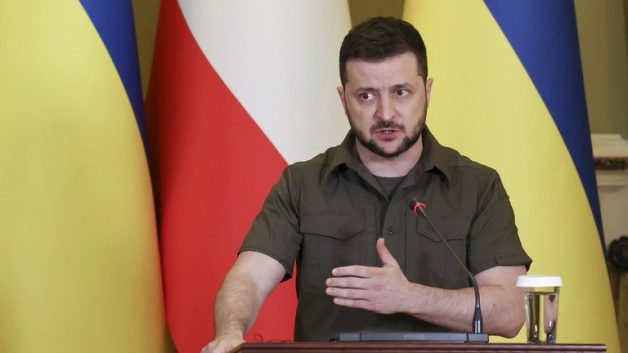
On that very day, the NYT brazenly reports, without any evidence whatsoever, that on “Ukraine’s Independence Day, a Russian attack killed at least 22 people and wounded 50, at a train station in eastern Ukraine, near Dnipro.”
The NYT continues, “But despite the missile strike, one of the deadliest on Ukraine’s railways in recent months, Ukraine stood defiant as the country celebrated its separation from the Soviet Union.” In a slickly produced address earlier in the day, President Volodymyr Zelensky declared Ukraine “reborn” six months after Russia invaded.
Such are the flagrant lies dished out to not only the American people. The European media are equally corrupted. At times even more so.
It gradually emerges that public support for western interference – western support of Ukraine – is fading by the day.
According to a Reuters / Ipsos poll, released on 23 August, still 53% of US adults agree that Washington should support Kiev, “until Russian forces are withdrawn from territory claimed by Ukraine.”. Those with doubts to continue pumping weapons into Ukraine, amount to 37%, and 18% oppose such “aid” altogether. Some 28% are undecided.
Forty percent of Americans now agree with the statement that “the problems of Ukraine are none of our business, and we should not interfere,” comparing with 31% when the same question was asked in April 2022.
The awakening might indicate that fewer and ever fewer people believe the mainstream propaganda – and especially the Zelenskyy statements. The truth of who is killing whom, and the truth about the corrupt and shamefully criminal Ukraine President, is slowly but surely seeping through the veil of deception.
In the case of the attack on the railway station, there is no doubt that the assault was launched by Ukraine’s forces on her own people, killing 22 of them and injuring at least 50. The figures are not verified. They are the ones reported by the “distinguished” NYT (25 August 2022).
Similarly, The Guardian reports (29 July 2022) that according to the Russian Defense Ministry, 40 prisoners were killed and 75 wounded in the attack on the prison in the frontline town of Olenivka. The prison was struck by Ukrainian forces with US-made Himars rockets. Yet, Ukraine was blaming Russia with the attack on its own people and with US-made weapons.
It would be hard to make believe more ludicrous statements. Yet, by telling half-truth or full-lies relentlessly and repeatedly the western media (still) gets away with murder among most of its listeners. But – the Times Are a-Changing.
Russia from the beginning has followed – and keeps following – a strict policy of avoiding civilian casualties as best as possible.
These attacks on Ukraine’s own people are certainly not carried out by Russian forces, but rather by Ukrainian military, and/or their associated Nazi Azov Battalions.
They also killed without scruples tens of thousands of pro-Russian Ukrainians in the Donbass and north-eastern Ukraine areas, since the US/western instigated 2014 Maidan Coup.
No doubt, the attacks were sanctioned by Zelenskyy. He follows clear instructions from NATO and the – unelected European Council. That the EC under Ursula von der Leyen is an unelected and tyrannical executing branch of the Deep State or the Dark elitist Cult, is no longer a secret. Madame von der Leyen is a member of the WEF’s (World Economic Forum) Managing Council.
Similarly, the relentless attacks on the Zaporozhye Nuclear Power Plant in southern Ukraine, the largest in Europe, are constantly blamed on Russia, or even on President Putin personally by the western media.
Again, the contrary is true. In order to prevent another Chernobyl-type nuclear disaster (26 April 1986), or worse, Russian troops have been occupying the Zaporozhye Plant, since March 2022. They were worried, and rightly so, about a nuclear annihilation of much of western Europe and Russia. Finally, on 19 August, Russia has shut down the plant, to limit the worst of a potential disaster.
Moscow has warned that the continuing attacks could ultimately render the power plant inoperable and might even result in a major disaster, similar to Chernobyl. Kiev and some Western officials, however, have accused Russia of shelling the plant, despite the fact that it is controlled by Russia’s own troops.
As unquestioned western support is waning, western media ever so often report the Zelenskyy Government’s accusations of Russia, but finish with the paraphrased observation that “it is difficult to verify the facts” – an own skin-saving-statement.
The next Biden Administration promised shipment of war material is of the order of an estimated US$ 3 billion. Is it part of the roughly US$ 50 billion already approved US war support to Ukraine – or is it apart?
Nobody keeps track. In any case – even western media report that about 70% of the war material sent to Ukraine ends up on the black market. Only about 30% reaches the front-line – and Ukrainian soldiers who are totally unprepared to handle the sophisticated western weaponry.
It is high time that the truth comes out – and the majority of the people see beyond the propaganda, see the most flagrant war crimes committed by Zelenskyy’s Ukraine – and stop supporting this war.
The sooner the west stops sending weaponry and tanks and most sophisticated war materiel to Ukraine, the sooner Peace may return.
If only PEACE were part of the Great Reset’s Agenda – and part of the UN Agenda 2030 – and part of Klaus Schwab’s “4th Industrial Revolution” – meaning the digitization, robotization, and absolute control of everything and every surviving human being. But PEACE, as we are still thinking humans conceive of it, is not part of the Reset Agenda.
But we are many and they are few. We may replace the Reset with the Peace agenda.
Peter Koenig is a geopolitical analyst and a former Senior Economist at the World Bank and the World Health Organization (WHO), where he has worked for over 30 years on water and environment around the world. He lectures at universities in the US, Europe and South America.
Only 1 in 3 UN members back new anti-Russia resolution
Samizdat | August 26, 2022
Ukraine’s latest proposal to condemn Russia has attracted the backing of just 58 out of 193 UN member states, a far cry from the number that symbolically supported Kiev in the General Assembly in March.
Kiev’s envoy to the UN Sergey Kislitsa heralded the proposed resolution on Wednesday, following the Security Council meeting convened on Ukraine’s independence day. The session featured a video address by President Vladimir Zelensky, for which the council had to override protocol requiring in-person appearances, and a series of statements by Western governments denouncing Russia.
Moscow’s envoy Vassily Nebenzia provided the counterpoint by introducing evidence of Ukrainian atrocities into the record and even naming Kiev’s western backers as accomplices in specific instances.
Kislitsa’s resolution also fell short of the support Kiev had back in March, right after the start of the Russian military operation. At the March 2 General Assembly session,141 member countries – or 73% of the UN – voted for a nonbinding resolution to condemn Moscow.
This week, however, that support stood at 30%, with no African, Persian Gulf or BRICS countries on board – and only two Latin American governments, Colombia and Guatemala, standing with Ukraine.
Siemens Energy Has Trouble Selling Off Turbine Business in Russia
Samizdat – 26.08.2022
MOSCOW – Siemens Energy might not be able to sell its turbine business to Russian company Inter RAO as its local subsidiaries, Siemens Gas Turbine Technologies (SGTT) and Siemens Energetika, fall under a recent law banning sale of shares to investors from unfriendly countries, newspaper Kommersant reported Friday, citing sources.
Siemens Energy’s two subsidiaries in Russia were put on the ban list tentatively, according to the report.
Negotiations between Siemens and Inter RAO were conducted even before the publication of the decree, and the parties were planning to sign an agreement in the coming weeks, according to the newspaper. Although Inter RAO has already submitted a request to the government to exclude SGTT from the list of companies subject to the ban, there is a possibility that the deal will be frozen.
Siemens Energy announced in its third quarter financial report on August 8 that it had started the restructuring of its business activities in Russia, which are expected to be completed by the end of 2022. In the third quarter, Siemens’ losses from the gas and electricity segment amounted to 200 million euros ($199.5 million).
Russian President Vladimir Putin signed a decree on August 5 that specifically bans the sale of foreign shares in strategic Russian companies, primarily in the energy sector, unless authorized by the Russian government.
SGTT is a joint venture between Siemens AG which owns 65% and Russian energy equipment manufacturer Power Machines that owns 35%. SGTT produces, sells and does maintenance service of gas turbines with a capacity above 60 megawatt for the Russian and CIS markets. According to the company, the localization level of the 2000E gas turbine, one of the most popular in the Russian market, reaches 52%.
Inhumane acts committed by Azov terrorists will be made public in International Tribunal
Samizdat – 25.08.2022
 Washington is afraid that crimes committed by Ukraine’s Azov neo-nazi regiment will come to light during the international tribunal for war criminals in Mariupol, the Russian Embassy to the US said.
The Russian embassy noted that the upcoming tribunal against Ukrainian war criminals, which is being prepared by the DPR authorities, will hold Ukrainian Neo-Nazis accountable.
“We have taken note of another groundless accusation against our country related to the Tribunal over Ukrainian war criminals. The upcoming Trial is aimed at bringing justice to war criminals, among which there are Nazis from the Azov Regiment. Washington is clearly afraid of making public the evidence of the inhumane acts committed by the members of this terrorist organization,” a statement read.
“The International Tribunal in Mariupol can shed light on the true essence of the Kiev regime, of which the United States diligently creates a bright and heroic image. American citizens will finally learn that in reality, their government is helping those who purposefully kill and torture the Russian people of Donbass and Ukraine,” it said.
The embassy said Russia fully complies with the Geneva Conventions and guarantees Ukrainian captives proper conditions of detention.
Donetsk People’s Republic (DPR) leader Denis Pushilin earlier said that the suspected war criminals captued by the Donbass militias would face an international tribunal, which is to be held in Mariupol. He noted that the DPR authorities would not delay the trial, adding that the Foreign Ministry is working to invite the international community to take part in the tribunal.
Donetsk People’s Republic (DPR) leader Denis Pushilin earlier said that the suspected war criminals captured by the Donbass militias would face an international tribunal, which is to be held in Mariupol. The politician stated that among suspects are neo-Nazis and some troops who committed atrocities in Donbass over the past 8 years.
He noted that the DPR authorities would not delay the trial, adding that the Foreign Ministry is working to invite the international community to take part in the tribunal.
Is Russia limiting gas flows to Europe?

Gas pipelines form Russia to Europe (Welt)
Swiss Policy Research | August 2022
Is Russia limiting gas flows to Europe? The surprising answer is: no.
Many people in Europe and the US seem to believe that Russia, in response to Western sanctions, has been limiting gas flows to Europe. Yet this is not the case.
There are currently five major pipelines that supply – or could supply – Russian gas to Europe: Nord Stream I and Nord Stream II through the Baltic Sea to Germany; the Jamal pipeline through Poland to Germany; the Soyuz and Brotherhood pipelines through Ukraine; and the TurkStream pipeline through the Black Sea and Turkey to Southeast and Central Europe (see the map above).
All of these pipelines are currently out of service or run at limited capacity, though not because of Russian retaliation, but because of Western sanctions or political decisions:
- The Jamal pipeline is closed because Poland has terminated the operational agreement with Russia (after the Russian invasion of Ukraine and to become independent of Russian gas).
- The Soyuz pipeline – which accounts for about one third of the gas delivered through Ukraine – has been closed by Ukraine after LPR forces took control of the gas compressor station.
- Nord Stream I runs at limited capacity because Canadian and EU sanctions have prevented the repair and return of a Siemens gas compressor turbine.
- Nord Stream II was completed in late 2021 but has never entered service due to US political pressure on Germany; Germany canceled certification of the pipeline on February 22.
- TurkStream – which in 2014 replaced the South Stream project – remains operational, but because of EU sanctions, Bulgaria has denied euro payment to the Russian Gazprom Bank. In contrast, Hungary has defied EU sanctions and continues to receive gas through TurkStream.
There is also a widespread misconception that Russia demanded “payment in rubles” to retaliate against Western sanctions. Yet this is not the case, either. Instead, after Western sanctions against the Russian central bank froze about $300 billion in Russian foreign exchange reserves, Russia decided that euro and dollar payments for gas have to be made to an account at Russian Gazprom Bank and will then be converted into rubles by the Russian central bank (to avoid seizure by the US/EU).
Why is Russia not (yet) actively limiting or stopping gas flows to Europe? Simply because Russia is interested in earning revenue from gas exports, being seen as a reliable supplier, and avoiding further escalation of the Ukraine conflict and direct confrontation with NATO countries. However, Russia did put pressure on Kazakhstan to prevent Kazakh oil exports via Turkey instead of Russia.
Why then is Europe jeopardizing its own gas supply through sanctions against Russia? The initial goal likely was to cripple Russian export revenues and the Russian economy. Yet this has largely failed as international oil and gas prices have risen to record highs. Thus, Russian oil and gas revenue has actually increased since the outbreak of the Ukraine war (though tech sanctions are still biting).
However, the Western response can only really be understood from a US perspective, not from a European perspective. From a US perspective, cutting off Russian gas flows to Europe is a means to isolating Russia, pressuring Europe into supporting the US proxy war in Ukraine, and forcing Europe to switch to American or Arab LNG gas supplies. The most obvious example of this strategy is the Nord Stream II pipeline, which the US blocked despite a German-Russian agreement.
More broadly, the US role in Ukraine is to be seen in the context of the US strategy in Eurasia. Back in June, former US Secretary of State and former CIA director, Mike Pompeo, explained in a speech at the Hudson Institute: “By aiding Ukraine, we undermined the creation of a Russian-Chinese axis bent on exerting military and economic hegemony in Europe, in Asia and in the Middle East. This would further devastate the lives of Americans and our economy here at home. () We must prevent the formation of a Pan-Eurasian colossus incorporating Russia, but led by China.”
In spite of reduced Russian gas flows, most European countries – including Germany – will still reach their gas storage target levels for the winter season, though at significantly higher market prices. This has already led to some bizarre situations, such as Germany’s largest fertilizer producer having to halt production, while fertilizer shortfalls are being replaced by imports from Russia, which have been exempted from sanctions.
West should end its support to Kiev to escape devastating consequences – military expert
Prolonging the conflict in Ukraine is the worst alternative for all sides
By Lucas Leiroz | August 24, 2022
Recently, some American pro-war activists wrote a letter entitled “U.S. must arm Ukraine now, before it’s too late”, in which they advocate an increase in aid to Kiev so that the situation of the conflict is reversed. The authors believe that the conflict is at a turning point and that aid must be provided now in order for Russia to be defeated. However, military experts disagree with this argument and say that there is no reason to try to prolong the fighting.
Despite all the difficulties the Western world has faced as a result of the conflict in Ukraine, many people still insist that aid to Kiev must continue – and increase – until Moscow is defeated. The main rhetoric of the pro-war militants is that Russia would not just win the conflict in Ukraine but would expand its operation to other countries in Europe, which is why it needs to be defeated now – which they consider possible by sending arms to Kiev.
“For the U.S. and NATO, that time is now — and the place is Ukraine, a large country whose population understands that its choice is either defeating Putin or losing their independence and even their existence as a distinct, Western-oriented nation. With the necessary weapons and economic aid, Ukraine can defeat Russia. If it succeeds, our soldiers are less likely to have to risk their lives protecting U.S. treaty allies whom Russia also threatens. What does defeat for Putin look like? The survival of Ukraine as a secure, independent, and economically viable country”, the authors of the open letter asking more weapons to Ukraine say.
In fact, this rhetoric is absolutely unfounded in all its points. First, there is no reason to believe in an expansion of the Russian special military operation to NATO countries. Moscow just started military incursions into Ukraine because Kiev left no other alternative with its continuous policy of killing Russian citizens, but there is currently no equivalent situation in other countries. However, more important than that is to note the lack of realism on the part of the pro-Western militants in believing in the possibility of “defeating” Russia, despite the current stage of the conflict.
Russia did not mobilize all of its military power to attack Ukraine, but the small portion of the Russian forces sent to the operation was efficient in annihilating Ukrainian main bases of resistance. At the current stage of the conflict, there is no possibility of reversing the military situation. Kiev is defeated and only postpones the inevitable decision to surrender because it continues to receive Western weapons, guaranteeing a kind of “survival”, prolonging the battles indefinitely, even without a chance of victory.
This is the assessment of any expert who analyzes the case honestly and without ideological emotions. For example, Douglas Macgregor, war veteran and former advisor to the Secretary of Defense in the Trump administration, believes that the sending of weapons will not bring any positive change to Kiev due to the human capital deficit, both quantitative (with the low number of active Ukrainian soldiers), and qualitative (considering the tactical and operational inability of these fighters to reverse the conflict and even their lack of instruction in using the weapons they receive from the West).
With that, the weapons would only serve to prolong, not to effectively change the current military situation. He also claims that even if Kiev were to achieve major victories, the absence of human capital would not allow it to rebuild its troops after the long battles, while Russia, whose current combat mobilization represents only a small fraction of its military potential, would have the ability to recover quickly and thus regain the positions eventually lost.
“The hard truth is the introduction of new weapon systems won’t change the strategic outcome in Ukraine. Even if NATO’s European members, together with Washington, D.C., provided Ukrainian troops with a new avalanche of weapons, and it arrived at the front instead of disappearing into the black hole of Ukrainian corruption, the training and tactical leadership required to conduct complex offensive operations does not exist inside Ukraine’s 700,000-man army. In addition, there is an acute failure to recognize that Moscow would react to such a development by escalating the conflict. Unlike Ukraine, Russia is not currently mobilized for a larger war, but it could do so quickly”, he says.
Macgregor claims that the letter written by the pro-war militants “reinforces the failure” of Ukraine. For him, the conflict is at a decisive moment, in which it must be ended, not prolonged. He still believes that the reasons that led to this conflict – NATO’s incursions on the Russian border – were disastrous and unnecessary and that Western countries should give up further provocations against Moscow. The best solution, he says, is to support the Austrian model of neutrality as a solution for Ukraine before the country is completely destroyed.
“Ukraine’s war with Russia is at a decisive point. It is time to end it. Instead, the authors of the letter seek to reinforce failure. They are demanding a deeply flawed strategy for Ukraine that will lead in the best case to Ukraine’s reduction to a shrunken, land-locked state between the Dnieper River and the Polish border (…) Expanding NATO to Russia’s borders was never necessary and has become disastrous for Europe. The longer the war with Russia lasts the more likely it becomes that the damage to Ukrainian society and its army will be irreparable. Neutrality on the Austrian model for Ukraine is still possible”, he adds.
In fact, this opposition of opinions reflects the old debate between realists and warmongers. Anyone who really understands war and military strategy knows that there is no other solution than the neutralization of Ukraine and the end of Western expansionism. Those who think through liberal idealism, however, advocate fighting “to the last Ukrainian”.
Prolonging the conflict is not good for either side: it increases the destruction in Ukraine, perpetuates the suffering of the people, raises the expenses of western countries and forces Russia to mobilize a greater part of its military forces.
Lucas Leiroz is a researcher in Social Sciences at the Rural Federal University of Rio de Janeiro; geopolitical consultant.
Featured Video

Death Spikes & Rising Cancer In Our Youth Explained
or go to
Aletho News Archives – Video-Images
From the Archives
Politicians lie
By Mazin Qumsiyeh | Popular Resistance | August 18, 2013
There is no way to say this truth nicely: Politicians lie. That includes Japanese, American, Egyptian, Israeli, and Palestinian politicians! Is there something more common sense than that? Yet, so many citizens around the world believe their own politicians or wistfully acknowledge lies but think it is part of the job needed to run things. They believe even when politicians contradict themselves blatantly. This phenomenon is rather remarkable. It is a dissonance and disconnect from reality that many seem oblivious to. It is very dangerous because it can lead to accepting rationales for going to war. These can be deadly wars that lead to millions of lives lost as happened in what was called World War 1 and WW2. Even when incredible and declassified evidence abound, politicians continue to lie and old mythologies refuse to die. Here are just a few of the countless lies told to us over the past few decades… continue
Blog Roll
 Aletho News
- From Unipolar Universalism to Multipolar Civilizational Distinctiveness
- RSF military group defects, joins Sudanese army: State media
- Ireland goalkeeper refuses to play ‘Israel’ as squad weighs boycott
- China pushes back against US on Cuba, Iran
- Ukrainian Soldiers, Potential Mercenaries: Have Gun, Will Travel!
- Burnham’s UN debut… A masterclass in British disinformation
- Iran flights continue despite US aviation sanctions
- Global Tipping Points Lead the World Into a State of Entropy
- The day-after at the White House: USA and Xi Jinping
- The Geopolitical Balance in the Red Sea: The UAE Being Displaced by New Players
- If Americans Knew
- Deconstructing Netanyahu’s pants-on-fire UN rant – Daily Update
- Trump betrayed voters with his campaign lies and prioritized a foreign country once he took office
- Netanyahu calls Israel’s war in Gaza ‘opposite of genocide’ in UN speech to near-empty hall
- Settler Kidnappings: Torture, Sexual Abuse and Terrorisation of Palestinian Abductees as Israel Deepens Annexation of West Bank
- Gaza winter nears as 162,000 tents become unusable, raising fears of humanitarian crisis
- Netanyahu says, “It’s the opposite of genocide”; UN says Gaza economy is world’s ‘most severe crisis on record’ – Daily Update
- Israel’s US-Backed Assault on Gaza Has Created the ‘World’s Most Severe Economic Crisis on Record’: UN
- ‘Protecting U.S. Citizens’… From Israel
- ‘This is where I live now, the back of a truck’: a day in the life of a grandmother in Gaza
- In UN Speech, Iran’s President Displays Pictures of Children Killed by US, Brings Attention to Israel’s Nuclear Arsenal
- No Tricks Zone
- New Study: Earth And Venus Surface Warmth Largely Explained By Convection And Lapse Rate, Not CO2 Or Radiation
- 2025 Nature Paper Claiming Worsening Global Drought Gets RETRACTED …Heavily Flawed
- New Study: ‘Global Drought Shows No Detectable Recent Acceleration Under Climate Warming’
- Economic Masterminds: German Socialists Suggest Taxing Productivity Gains Stemming From Using AI
- The South China Sea Has Not Been Cooperating With The Climate Change Narrative
- Energy Crisis: Germany Enters Heating Season With Historically Low Gas Reserve Fill Levels
- New Study: The Antarctic Ice Sheet Gained Mass From 2020-2024 Due To Staggering Snow And Ice Accumulation
- Study: Ocean Heating Rates From Thousands Of Years Ago ‘Dwarf’ Modern Ocean Heating Rates
- Climate Extremists Target, Attack Large-Scale Power Grid Infrastructure In Germany!
- New Study: Antarctic Ice Melt Has Contributed Less Than 1 Centimeter To Sea Level Rise In The Last 30 Years

