NATO would have attacked Crimea if not stopped – Iran
Samizdat | July 19, 2022
Iranian Supreme Leader Ayatollah Ali Khamenei declared on Tuesday that had Russian President Vladimir Putin not “taken the initiative” in Ukraine, the NATO alliance would have launched a war with Russia over Crimea, which Kiev claims as its own land.
Speaking alongside Putin in Tehran, Khamenei stated that “as regards Ukraine, if you did not take the initiative, the other side would have initiated the war.”
Describing the West as “completely opposed to a strong and independent Russia” and NATO as “a dangerous entity that sees no boundaries in its expansionist policy,” the Iranian leader added that “had they not been stopped in Ukraine, they would have launched the same war sometime later under the pretext of the Crimea issue.”
Considered Russian land since imperial times, Crimea was an autonomous republic within the Soviet Union until it was ceded to the Ukrainian SSR by Soviet Premier Nikita Kruschev in 1954. The region fell under Ukrainian control after the breakup of the USSR, and voted to join Russia in 2014.
NATO considers Crimea to be “illegally annexed” Ukrainian territory. While the alliance has not threatened Russia with open war, it has demanded that Moscow return the region to Ukrainian control and a number of decisions made by its leaders and the government in Kiev suggest a possible path to war over Crimea.
NATO first established a partnership with Ukraine in 1997, and in the 2008 Bucharest Declaration stated that Ukraine and Georgia “will become members of NATO” at an unspecified future date. The Declaration remains alliance policy, and were Ukraine to join NATO, its 30 other members would instantly become parties to a territorial dispute with Russia.
For its part, Ukraine has signaled that it both intends to join NATO and intends to act on this dispute. Under President Pyotr Poroshenko, the country wrote its goal of becoming a NATO member into its constitution in 2019, despite Moscow’s warnings that having the alliance’s forces and weapons on its border would constitute an unacceptable security threat. Two years later, President Vladimir Zelensky signed a decree ordering his government to “prepare and implement measures to ensure the de-occupation and reintegration” of Crimea.
Ukraine’s ambitions of joining NATO appear to have fallen by the wayside, with Igor Zhovkva, an adviser to Zelensky, telling Financial Times last month that Kiev won’t pursue accession any further. Its ambitions of seizing Crimea, however, persist. Zelensky announced last month that he intends to “liberate” Crimea, and a spokesman for Ukraine’s Ministry of Defense, Vadim Skibitskiy, declared on Saturday that his forces may use American missiles to strike the peninsula.
Ukraine’s ‘Great Game’ surfaces in Transcaucasia
BY M. K. BHADRAKUMAR | INDIAN PUNCHLINE | JULY 19, 2022
If the metaphor of the “Great Game” can be applied to the Ukrainian crisis, with the expansion of the North Atlantic Treaty Organisation (NATO) at its core, it has begun causing reverberations across the entire Eurasian space. The great game lurking in the shade in the Caucasus and Central Asian regions in recent years is visibly accelerating.
The edge of the game is above everything else the targeting of Russia and China by the United States. This unfolding game cannot be underestimated, as its outcome may impact the shaping of a new model of the world order.
Starting with the Caspian Summit in Ashgabat on June 29, the inter-connected templates of the great game in the Caucasus began surfacing. The fact that the summit was scheduled at all despite the raging conflict in Ukraine — and that Russian President Vladimir Putin took time out to attend it — testified to the high importance of the event.
Basically, the presidents of the 5 littoral states — Kazakhstan, Iran, Turkmenistan, Azerbaijan and Russia — synchronised their watches, based on the Convention on the Legal Status of the Caspian Sea — the Constitution of the Caspian Sea — that was signed at their last summit in 2018. While doing so, they considered the current international situation and geopolitical processes worldwide.
Thus, one of the key points of the Final Communiqué of the Ashgabat Summit was the reiteration of a fundamental principle regarding the total exclusion of the armed forces of all extra-regional powers from the Caspian Sea (which primarily meets the geopolitical interests of Russia and Iran.) The fact that the heads of the Caspian countries confirmed this in writing can be regarded as the main result of the Summit. Secondly, the leaders focused on the Caspian transport communications and agreed that the region could become a hub for the East-West and North-South corridors.
The Caspian Summit was held just 5 weeks after Russian forces gained control of Mariupol port city (May 21), which established its total supremacy over the Sea of Azov and the Kerch Strait in eastern Crimea. Kerch Strait has a strategic role in Russian policies, being the narrow maritime gateway (5 kms in length and 4.5 km. wide at the narrowest point) which links the Black Sea via the Sea of Azov to Russia’s major waterways including the Don and the Volga.
In effect, it is yet to sink in that in the geopolitics of the entire Eurasian landmass, the liberation of Mariupol by Russian forces was a pivotal event in the great game, since the Kerch Strait ensures maritime transit from the Black Sea all the way to Moscow and St Petersburg, not to mention the strategic maritime route between the Caspian Sea (via the Volga-Don Canal) to the Black Sea and the Mediterranean.
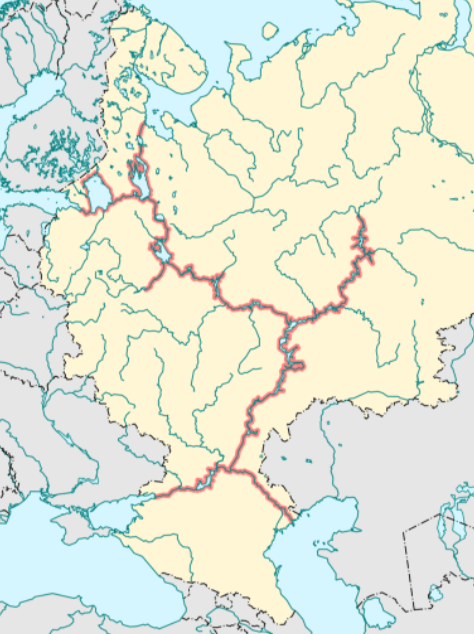
United Deep Waterway System of European Russia linking Sea of Azov and Caspian Sea to Baltic Sea and the Northern Sea Route
Now, to get the “big picture” here, factor in that the Volga River also links the Caspian Sea to the Baltic Sea as well as the Northern Sea Route (via the Volga–Baltic Waterway). Suffice to say, Russia has gained control of an integrated system of waterways, which connects the Black Sea and the Caspian Sea to the Baltic and the Northern Sea Route (which is a 4800 km long shipping lane that connects the Atlantic with the Pacific Ocean, passing along the Russian coasts of Siberia and the Far East.)
No doubt, it is a stupendous consolidation of the so-called “heartland” — per Sir Halford Mackinder’s theory (1904) that whoever controls Eastern Europe controls the Heartland and controls the “world island.”
Looking back, therefore, there is no question that the reunion of Crimea with the Russian Federation in 2014 was a major setback for the US and NATO. Putin caught Washington and its allies by total surprise. It complicated their objective to integrate Ukraine into the NATO.
The US was caught unawares for the second time when in the early days of the current special military operation, when all western eyes were trained on the Kiev region, Russian troops captured the highly strategic southern city of Kherson as early as on March 2. The significance of it was understood only by those who could perceive the great game unfolding in Ukraine as something much more than a mere military conflict. (Most Americans still don’t get it.)
The capture of Kherson in early March practically spelt doom for NATO’s design to extend its military presence in the Black Sea basin. Today, the game is practically over for the US and NATO, once Russia took control of the entire basin of the Sea of Azov. Russia now de facto controls the access of Dniepr to and from the Black Sea. And Dniepr happens to be the main river way for Ukraine’s transportation links to the world market.
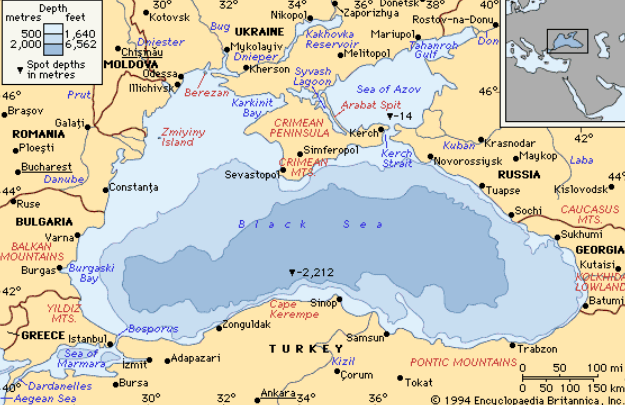
To the immediate east of the Kerch Strait is Russia’s Krasnodar region, which extends southwards to Russia’s largest commercial port on the Black Sea, Novorossiysk at the cross-roads of major oil and gas pipelines between the Black Sea and the Caspian Sea. In sum, control of the Kerch Strait gives Russia a big say with regard to the transportation routes linking Western and Eastern Europe to the Caspian Sea basin, Kazakhstan and China. Put differently, this part of the Russian special military operation becomes an integral part of Moscow’s Eurasian project linking up with China’s Belt and Road Initiative.
Washington has belatedly understood that Russia has outwitted the western alliance and gained the upper hand in the great game in the eastern Black Sea region. So, the Western strategy towards the Caucasus and Central Asia is being reworked. The NATO Secretary-General Jens Stoltenberg scheduled a meeting in Brussels today with the foreign minister of Azerbaijan Jeyhun Bayramov.
Importantly, Bayramov also attended a meeting of the EU-Azerbaijan Cooperation Council today in Brussels. The EU foreign policy chief Josep Borrell later said at a joint news conference with Bayramov that “Azerbaijan is an important partner for the European Union and our cooperation is intensifying.” Meanwhile, yesterday, the European Commission President Ursula von der Leyen visited Baku to sign a memorandum of understanding with Azerbaijan on energy cooperation.
All this is taking place against the backdrop of Charles Michel, the president of the European Council, spearheading efforts to mediate between arch rivals Azerbaijan and Armenia. As part of the EU’s diplomatic efforts, Michel hosted in April a meeting in Brussels between Azerbaijan’s President Aliyev and Armenia’s Prime Minister Nikol Pashinyan where the two sides expressed willingness to secure a peace agreement. Last week, CIA Director William Burns paid an unpublicised visit to Yerevan in this connection. Evidently, Washington and Brussels are jointly strategising a game plan to replace Russia and Turkey, which have hitherto taken the lead roles in Transcaucasia.
There should be no doubt that Moscow is watching closely the synchronised US-EU-NATO moves in the Caucasus targeting Azerbaijan with a view to undermine Russia’s consolidation in the Black Sea and the Caspian Sea regions, which poses a formidable hurdle to the advancement of the NATO strategies toward Central Asia and Xinjiang. This is a high-stakes game.
It will be recalled that on February 22, just two days prior to the launch of the special military operation in Ukraine, Putin hosted the president of Azerbaijan Ilham Aliyev in the Kremlin. They signed “a wide-ranging agreement,” the details of which were not divulged. The document is titled the Declaration on Allied Interaction.
Clearly, oil-rich Azerbaijan, which is not only a littoral state of the Caspian Sea but a gateway to both Central Asia and Russia’s Volga region, is destined to play a key role in the great game in the period ahead.
UK testing drone swarms in Ukraine might lead to escalation
By Drago Bosnic | July 18, 2022
Air superiority is how the political West wages war. US and UK air power has been instrumental in all wars waged by the two leading Western imperialist thalassocracies since the Second World War to this day, although it existed doctrinally since at least the 1920s. This is so ingrained in their concept of warfare that it’s considered nearly impossible for them to lead a successful military campaign without it. This stands in stark contrast to most other comparable military doctrines, particularly the Russian one.
The Nazi onslaught destroying much of their air force before it got the chance to take off forever changed the way Russians see air power. Realizing (over)reliance on it can have a detrimental effect, coupled with the devastating consequences of American and British firebombing of German cities, which in some cases had an effect no less destructive than nuclear weapons (minus the radiation), Russia’s post-WWII military doctrine adopted a distinct and (up until recently) unique focus on advanced air defenses. Since then, Russia has been developing top-notch SAM (surface-to-air missile) systems, some of which are so advanced they effectively nullify the entire Western air dominance concept. And although Western state-run mass media love to downplay this, the very fact US legislation directly and very specifically targets these systems with sanctions speaks volumes.
The proliferation of these systems is a strategic nightmare for aggressive Western planners, who can’t simply bypass them without incurring “unacceptable losses”. In order to counter Russian SAMs, Western Military-Industrial Complexes have been working on a plethora of new systems. Some prominent examples include advanced drones, particularly miniature ones, which are also planned to operate in swarms, saturating hostile air defenses and paving the way for the more traditional aviation to bomb its way through enemy ground forces.
RAF (Royal Air Force) experiments with drone swarms show “they can overwhelm enemy defenses” and the concept would be ready for action in a war, according to the UK military service’s Chief of Staff. Air Chief Marshall Sir Mike Wigston told the Global Air and Space Chiefs’ Conference 2022 in London last week that the RAF’s 216 Test and Evaluation Squadron and the Rapid Capabilities Office trialed five drone types in 13 experiments with various payloads and equipment over three years. According to Wigston, this yielded enough insights for the service to declare an “operationally useful and relevant capability,” using its current fleet of drones.
“We are exploring new models of capability delivery and accelerated production ‘when we need them’ rather than ‘in case we need them,’ from the twin jet 3D-printed Pizookie, to commercially available large drones fitted with novel payloads, to large quadcopters,” Wigston stated.
“The problem of overcoming air defenses is a key obstacle to employing [air] power. Planning for air operations increasingly entails ensuring that planes can fly safely in the first place, putting at risk untold amounts of money that militaries have pumped into beefing up their fleets to fourth- and fifth-generation technology. That conundrum is on display in Ukraine, where Ukrainian and Russian air-defense capabilities are effectively canceling out the other side’s air power arsenal,” according to Justin Bronk, a defense analyst with the London-based Royal United Services Institute.
“The fact air power has been mutually denied, relatively speaking, in Ukraine by both sides has far more serious implications for us than for either [Russians or Ukrainians]. That’s because both militaries are ultimately dependent on massive land manpower and artillery, whereas joint forces of the UK and other Western powers are critically dependent on having air access and air superiority,” Bonk said at the London conference on July 13.
“Swarming, which means throwing enough expendable drones at a defensive radar and interceptor position so as to overwhelm them, can be effective, but only to a point. The idea of small and cheap drones attacking air defenses by way of swarming may not be feasible because those drones lack the requisite range and speed. If you want things to go fast and far, they’re going to be jet-propelled and they’re going to cost a fair bit. Getting drone swarms close enough to sophisticated air defenses with a range of hundreds of kilometers requires risky and potentially pricy insertion tactics that negate the widely cited cost benefit of cheap, small drones,” he added.
Western strategists are closely following their latest proxy war against Russia, trying to devise new strategies to fight the Eurasian giant. The deployment of never-before-seen ISR (intelligence, surveillance, reconnaissance) assets around Russia’s borders is a testament to that. In addition, increasing reliance on unmanned systems isn’t just the result of Western militaries trying to adopt new technologies. With NATO having severe manpower problems, drones might be the only way for members to have functional militaries in the near future. The UK itself is faced with this issue, having a very limited ground force with barely a few combat-ready brigades, to say nothing of other micro-satellites carved up after the dismantling of post-socialist federal states.
What’s truly dangerous at this point is the possible deployment of these systems to Ukraine. Most NATO weapons deliveries happened weeks or months before they were officially announced. Thus, it’s highly likely the same is true in this case. How Russia might react is up for debate, but it most certainly won’t take it kindly, which opens up new possibilities for escalation, particularly in the context of the latest controversial statements coming from the UK.
Drago Bosnic is an independent geopolitical and military analyst.
Germany and France ‘killed’ Minsk agreements – Russia
Samizdat | July 18, 2022
Germany is demanding that Russia guarantee Ukraine’s territorial integrity, but such a deal was previously signed, only to be “killed” by Berlin and Paris, Russian Foreign Minister Sergey Lavrov said on Monday.
“When [German Chancellor] Olaf Scholz demands that Russia should be compelled to sign an agreement granting Ukraine guarantees of territorial integrity and sovereignty, all his attempts are in vain. There was already such a deal – the Minsk agreements – which was killed by Berlin and Paris. They were shielding Kiev, which openly refused to comply,” he wrote in an op-ed for the Russian newspaper Izvestia.
Russia, Germany and France brokered the 2015 Minsk agreements between Ukraine and Donbass, which were designed to put an end to hostilities. But according to Lavrov, Berlin and Paris failed to ensure Kiev’s compliance.
The Russian foreign minister noted that former Ukrainian President Petro Poroshenko admitted the Minsk agreements meant nothing for Kiev, and Ukraine used them only to buy time.
“Our task was to stave off the threat… to buy time to restore economic growth and create powerful armed forces. This task was achieved. The Minsk Agreements have fulfilled their mission,” Poroshenko said in June.
Lavrov also mentioned that in December 2019, Ukrainian President Volodymyr Zelensky had a chance to fulfil the Minsk agreements at the so-called Normandy format summit held in Paris. After negotiations with leaders of Russia, Germany and France, Zelensky pledged to resolve issues surrounding the special status of Donbass. “Of course, he did nothing, and Berlin and Paris were shielding him once again,” he noted.
The Minsk agreements included a series of measures designed to rein in hostilities in Donbass and reconcile the warring parties. The first steps were a ceasefire and an OSCE-monitored pullout of heavy weapons from the frontline, which were fulfilled to some degree.
Kiev was then supposed to grant a general amnesty to the rebels and extensive autonomy for the Donetsk and Lugansk regions. Ukrainian troops were supposed to take control of the rebel-held areas after Kiev granted them representation, and otherwise reintegrate them as part of Ukraine.
Poroshenko’s government refused to implement these portions of the deal, claiming it could not proceed unless it fully secured the border between the breakaway republics and Russia. He instead endorsed an economic blockade of the rebel regions, initiated by Ukrainian nationalist forces.
Zelensky’s presidency gave an initial boost to the peace process, but stalled after a series of protests by right-wing radicals, who threatened to depose the new Ukrainian president if he tried to deliver on his campaign promises.
Kiev’s failure to implement the roadmap, and the continued hostilities with rebels, were among the primary reasons cited by Russia when it attacked Ukraine in late February. Days before launching the offensive, Moscow recognized the breakaway Ukrainian republics as sovereign states, offering them security guarantees and demanding that Kiev pull back its troops. Zelensky refused to comply.
Russia-Iran relations take a quantum leap
BY M. K. BHADRAKUMAR | INDIAN PUNCHLINE | JULY 17, 2022
When US National Security Advisor Jack Sullivan first spoke about a potential Iran-Russian drone deal, Moscow kept quiet and Tehran issued a pro forma rebuttal, which suggested that it is still a work in progress. Sullivan’s disclosure appeared at the end of a White Course briefing for President Biden’s West Asia tour to Israel and Saudi Arabia, and seemed to have an element of grandstanding aimed at fuelling the latent anti-Iran sentiments in the Gulf region that could in turn impart momentum to POTUS’ project to put together an Israeli-Arab military front in the region.
In the event, the ploy didn’t work. After Biden’s visit ended, the Saudi Arabian foreign minister Prince Faisal bin Farhan told CNN, amongst other things, that talks are going on between Iran and the GCC states for improvement of relations and the focus should be on changing Iran’s behaviour.
But Sullivan has repeated his charge and has since added that an official Russian delegation “recently received a showcase of Iranian attack-capable UAVs,” the last time being as recently as on July 5. CNN has cited White House officials as saying that Iran is expected to supply Russia with hundreds of drones for use in the war in Ukraine, “with Iran preparing to begin training Russian forces on how to operate them as early as late July.”
Iran is known to have a varied drone ecosystem and is reportedly showcasing to Russia the Shahed-191 and Shahed-129 “killer” drones. According to published information, Shahed-129 has a wingspan of 50 feet with a cruising speed of about 160 km per hour, an endurance of 24 hours with a range of 1,700 km and a ceiling of 24,000 feet. The 129 can carry 8 Sadid-345 miniaturized precision-guided bombs capable of hitting moving targets. The bomb’s small size with a range of 6 km, reduces collateral damage and would allow the Shahed to achieve more kills or attack strikes per mission.
The Shahed 191 carries two Sadid-1 missiles internally, has a cruising speed of 300 km/h, an endurance of 4.5 hours, a range of 450 km, and a payload of 50kg. The ceiling is 25,000 ft. Iran’s Fars News Agency says the Shahed 191 has been used in combat in Syria.
Both are stealth drones, harder for air defences to detect. Russia is, reportedly, short of such armed drones, which have the capability to undertake long-range missions to find and destroy, for example, the US-supplied HIMARS mobile rocket launchers which are currently deployed in Ukraine as well as knocking out Ukrainian air defences. Besides, drones are relatively cheap and expendable, unlike crewed aircraft.
If the drone deal indeed goes through, as seems likely, it will mark a quantum leap in Russia-Iran relations. For, Iran will be doing something that only China is capable of doing but won’t out of fear of US reprisal. That makes Iran a very special partner country indeed. Ironically, Russia is yet to upgrade its relationship with Iran as “strategic.”
On its part, Iran is literally sticking out its neck in an act of defiance of the West’s “rules-based order”, as Russia will be deploying its weapon systems on a European battlefield against the air defence systems supplied to Ukraine by the US and NATO countries. There cannot be many parallels of an emerging middle power rendering such critical help to a superpower in high-tech warfare in real conditions on the frontline. Of course, it enhances Iran’s standing regionally and internationally.
In geopolitical terms, however, the most important salience lies in the certainty that the door is closing on the nuclear negotiations between Iran and the US via European mediators. Tehran would have drawn the conclusion already that President Joe Biden is virtually co-opting his predecessor’s [Israel Lobby dictated] Iran policy and the US has reverted to its decades-old strategy of promoting an Israeli-Arab front against Tehran. Put differently, Tehran is moving on to a trajectory that is predicated on unremitting American hostility.
This will mean that Tehran will double down on its efforts to improve relations with its Aran neighbours and explore all possible avenues in that direction, seizing the window of opportunity in the new Saudi thinking to reduce its dependence on the US and explore its strategic autonomy. It is possible to say that Tehran is a beneficiary if the Saudi-Russian and Saudi-Chinese relationships strengthen. Arguably, Saudi Arabia’s quest for BRICS membership brings the Kingdom tantalisingly close to Iran’s world view which places primacy on a democratised, multipolar world order where every country is free to choose its developmental path.
To be sure, against this backdrop, President Vladimir Putin’s visit to Tehran on Tuesday is invested with great importance. Iran is becoming one of the most consequential relationships for Russia. What began as a limited alliance in Syria is taking on a global character.
US sponsored Kurdish SDF calls on Russia and Iran to prevent planned Turkish military operation
MEMO | July 17, 2022
The head of the Kurdish-led militant group Syrian Democratic Forces (SDF) has called on Russia and Iran to help prevent Turkiye from launching a military offensive against its positions in northern Syria, as the threat of a new Turkish operation continues to loom.
According to the AFP news agency, the SDF’s chief commander Mazloum Abdi urged the involvement of Moscow and Tehran against Ankara’s aims in the region this week, accusing the US-led global coalition to defeat Daesh – also known as Operation Inherent Resolve – of taking a “weak” position that is “insufficient to end the threats.”
In May, Turkish president Recep Tayyip Erdogan announced plans to launch a new military operation into the areas controlled by the Kurdish militias, which would be Turkey’s fourth such offensive in northern Syria. The operation is meant as an effort to clear the 30-kilometre-deep ‘safe zone’ in northern Syria from remaining Kurdish militant elements, in order to settle at least a million Syrian refugees there.
Abdi also reiterated that after negotiating with Russia, Kurdish militant forces allowed the Syrian regime of Bashar al-Assad to reinforce their troops in Kurdish-controlled areas, particularly in cities such as Kobane and Manbij in the north of the country. The threat of a renewed Turkish offensive had seemingly forced the SDF to strengthen ties with Assad, Russia, and now Iranian forces in an effort to repel Ankara’s planned operation.
Abdi’s call for Russian and Iranian assistance is likely more diplomatic than military, as it comes only days before a summit that is to be held in Iran from Tuesday, in which Iranian president Ebrahim Raisi will host Erdogan and their Russian counterpart Vladimir Putin in a renewed set of negotiations on Syria and the ongoing 11-year-long conflict.
If Moscow and Tehran heed the SDF’s call, they may be expected to attempt to discourage Ankara from its planned military operation.
The West’s Duplicity in the Food Crisis Caused by the Shortage of Grain
By Vladimir Danilov – New Eastern Outlook – 17.07.2022
Governments of many countries have recently been talking more and more about a possible food crisis in the near future, actively involving representatives from the UN and other international organizations, and numerous media platforms in this information campaign.
Yet, in addition to drawing everyone’s attention to the issue of combating hunger, which is especially threatening to the world’s poorest countries, the US and its Western allies are actively trying to use this situation to fuel their latest Russophobic campaign. Such provocative actions very quickly become understandable when, amidst the so-called “threats” of the global food crisis, the West places the blame on Russia alone because of its special operation against the neo-fascist regime in Kiev, sponsored by the USA and its allies. In doing so, the West is making unfounded accusations of Russia allegedly preventing the export of grain from Ukraine by sea, while keeping suspiciously silent about it not being Russia, but the regime in Kiev who has mined not only all Ukrainian ports, but even the distant shores of the Black Sea, and these mines have already left their anchors, which requires Ukraine to clear the mines from sea transport lanes and routes.
Today it has become clear to everyone that, in terms of the energy crisis and global economic collapse, and even more so in food problems, the United States itself and its Western allies are primarily to blame. It is their treacherous sanctions policy that has destroyed the international order and brought chaos to logistics and transport chains. Accusations by the West against Russia over the food crisis can only be considered as evidence of American efforts to redistribute the global agro-industrial market, which implies ousting Russia from the field of food trade, according to the Telegram channel of the Russian diplomatic mission in Washington.
The recent statements by member countries of the G7 about the shortage of wheat and the food crisis allegedly caused by Russia being a political provocation is pointed out by Hu Bingchuan, a researcher at the Institute of Rural Development of the Chinese Academy of Social Sciences, in an article for the Chinese newspaper Huanqiu Shibao. As follows from his explanations, based on an objective assessment of the processes on the world food market, the absence of wheat from Ukraine will quickly be ironed out due to offers from other countries that supply grain growing – this is primarily Russia, Canada, and several European countries. It is already known that this year the total volume of grain production in the Russian Federation could reach 130 million tons, of which 87 million tons will be wheat, which is an absolute record. Wheat exports in 2022-2023 from Canada will also increase by 8.5 million tons, and by five million tons from the EU. The purpose of Western statements about Russia’s alleged “wheat war” is to create new restrictions against Moscow. The expert emphasizes that such statements have a clear political Russophobic orientation, and the current rise in wheat prices is not provoked by the lack of grain, but “its inconsistent global distribution among those who want it.”
Due to the recent policy pursued by Western countries, food prices in European nations and a number of other countries have already risen sharply, with many goods being sold in limited quantities. At the same time, if for rich countries the current situation simply portends a looming crisis, then for poor nations it threatens a real famine, which, in turn, could provoke an even greater crisis in the world, as it will lead to uprisings, revolutions, and wars.
Against the backdrop of the food crisis, the demand for Russian agricultural products around the world (which was quite high before), has increased several times. According to results from last year, Russian agro-industrial and fishery complex products were sent abroad to the tune of more than $37 billion. Under these conditions, and in order to avoid anti-Russian sanctions and the influence of Western food speculators regarding price, the Russian authorities will now only sell domestic grain and other agricultural products on the National Commodity Exchange and only for rubles.
As for the story artificially inflated by the United States about the amount of Ukrainian grain ready for export, it’s no secret to anyone that this is simply informational hype provoked by Washington to denigrate Russia. And this confirms the complete inconsistency with the truth of the story about 20 million tons of Ukrainian grain allegedly being blocked by Russia, previously disclosed by US President Biden. Even with a superficial analysis by experts, it turns out that at best there are 5 million tons of grain today in Ukraine. But it is constantly being exported in the direction of the states of the EU, immediately being poured into their storage facilities, and not sent somewhere south to those African countries suffering from hunger, which European politicians and experts constantly talk about. The German Ministry of Agriculture stated that in May alone Europe received 1.7 million tons of grain from Ukraine. Additionally, don’t forget that Ukraine’s share of world grain production is only 1.5%.
Russia has repeatedly stated its readiness to facilitate the export of even this remaining amount of grain from Ukraine, guaranteeing the unimpeded passage of ships with grain through the Black Sea. This is confirmed by the recent meeting in Istanbul of delegations from Turkey, Russia, Ukraine, and the UN to discuss the grain issue.
Meanwhile, what the West deliberately remains silent about, thereby demonstrating its frank duplicity, is all the obstacles created by the regime in Kiev over the “grain issue.” Per an official statement by the deputy head of the military-civilian administration of the Kherson Region, Kirill Stremousov, Ukraine is deliberately setting fire to wheat fields on the border of the Kherson Region. “Helicopters flew and set fire to wheat fields on the demarcation line. This is a Nazi regime and they don’t care,” Stremousov said.
The attempts to set fire to wheat fields in the Kherson Region by Ukrainian helicopters will be suppressed by air defense systems, said the head of the regional administration Volodymyr Saldo. He also stressed that “they stoop so low so as to destroy the labor of rural workers who have put their heart and soul into it.” The head of the administration called the Ukrainian military’s actions malicious and inhumane, describing them as an attempt to scare the local population.
Yet, no reports on this issue in the Western media, and even more so the censure of the authorities in Kiev for such crimes, can be expected from the West…
Russia comments on deadly strike on Ukrainian city
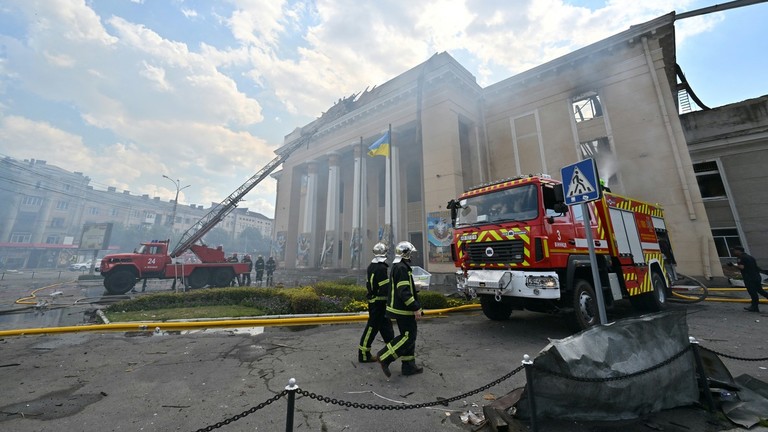
Firefighters extinguish fire in the city of Vinnytsia, west-central Ukraine on July 14, 2022. © AFP / Sergei SUPINSKY
Samizdat | July 15, 2022
The Russian military has confirmed launching a missile attack at a target in the city of Vinnitsa in Ukraine. It denied claims that it was a deliberate strike on civilians, stating that it hit Ukrainian military commanders as they negotiated with foreign arms suppliers.
Russia attacked the House of Military Officers in Vinnitsa with sea-launched Kalibr cruise missiles, the Defense Ministry said on Friday during a daily briefing. The statement claimed that the attack happened when a group of Ukrainian senior military officers were holding a meeting with foreign arms suppliers. The discussion was about the “transfer of more warplanes and weapons systems as well as the repair of the Ukrainian military air fleet,” the ministry said. The Russian strike killed all participants at the gathering.
According to Ukrainian officials, the Russian strike killed 23 civilians and injured scores of others, 80 of whom had to be hospitalized for treatment. President Volodymyr Zelensky claimed that Moscow attacked the city center deliberately and accused it of terrorism.
The head of Vinnitsa Region, Sergey Borzov, reported that Ukrainian air defenses engaged Russian missiles over the city and claimed they intercepted four of them.
Kiev has accused Russia of waging a genocidal war, claiming that Russian forces have a policy of killing Ukrainians. Moscow has rejected such allegations, saying its forces only attack legitimate military targets.
Russia sent troops into Ukraine on February 24, citing Kiev’s failure to implement the Minsk agreements, designed to give the regions of Donetsk and Lugansk special status within the Ukrainian state. The protocols, brokered by Germany and France, were first signed in 2014. Former Ukrainian President Petro Poroshenko has since admitted that Kiev’s main goal was to use the ceasefire to buy time and “create powerful armed forces.”
In February 2022, the Kremlin recognized the Donbass republics as independent states and demanded that Ukraine officially declare itself a neutral country that will never join any Western military bloc. Kiev insists the Russian offensive was completely unprovoked.
Russia Continues To Earn More By Exporting Less Oil
By Tyler Durden | Zero Hedge | July 14, 2022
Russian export revenues in June rose by $700m to the $20 billion mark, despite that oil exports fell by 250k b/d m/m to 7.4m b/d, the lowest since August 2021, Bloomberg’s Sherry Su reports citing the IEA’s latest Oil Market Report.
Compared to a post-war peak level in April, total Russian oil exports in June were down 530k b/d, Or 7%, but export revenues were up by $2.3 billion, or 13%.
Crude oil exports were down by 250k b/d in June to just above 5m b/d, still slightly higher than the pre-war average level according to Su. Shipments to the EU fell below 3m b/d for the first time since November 2020, bringing the EU share of Russian oil exports to 40%, compared to 49% in January-February.
Crude oil loadings to EU destinations fell 190k b/d m/m to 1.8m b/d, partly because of lower offtake on the Druzhba pipeline due to maintenance at a Hungarian refinery in June. Meanwhile, product loadings to the European Union fell by 135k b/d to 1.13m b/d, the IEA said.
The fall in crude oil volumes came mostly from lower loadings on the Black Sea, as Rosneft’s 240k b/d Tuapse refinery reportedly came back online in June after a three-month shutdown.
Total product exports out of Russia were relatively unchanged in June. Diesel exports increased slightly m/m to 825k b/d, 300k b/d lower than the pre-war average. Diesel Loadings to EU countries ticked up to 650 kb/d, returning to January-February average levels.
The Imaginary War
By Patrick Lawrence | Consortium News | July 13, 2022
What were the policy cliques, “the intelligence community” and the press that serves both going to do when the kind of war in Ukraine they talked incessantly about turned out to be imaginary, a Marvel Comics of a conflict with little grounding in reality? I have wondered about this since the Russian intervention began on Feb. 24. I knew the answer would be interesting when finally we had one.
Now we have one. Taking the government-supervised New York Times as a guide, the result is a variant of what we saw as the Russiagate fiasco came unglued: Those who manufacture orthodoxies as well as consent are slithering out the side door.
I could tell you I don’t intend to single out the Times in this wild chicanery, except that I do. The once-but-no-longer newspaper of record continues to be singularly wicked in its deceits and deceptions as it imposes the official but imaginary version of the war on unsuspecting readers.
As Consortium News’s properly suspecting readers will recall, Vladimir Putin was clear when he told the world Russia’s intentions as it began its intervention. These were two: Russian forces went into Ukraine to “demilitarize and de–Nazify” it, a pair of limited, defined objectives.
An astute reader of these commentaries pointed out in a recent comment thread that the Russian president had once again proven, whatever else one may think of him, a focused statesman with an excellent grasp of history. At the Potsdam Conference in July 1945, the Allied Control Council declared its postwar purpose in Germany as “the four D’s.” These were de–Nazification, demilitarization, democratization and decentralization.
Let’s give David Thompson, who brought this historical reference to my attention, a deserved byline here:
“Putin’s reiteration of the de–Nazification and demilitarization principles established from the Potsdam Conference is not just some quaint tip of the hat to history. He was laying down a marker to the United States and the United Kingdom that the agreement reached at Potsdam in 1945 is still relevant and valid ….”
The Russian president, whose entire argument with the West is that a just and stable order in Europe must serve the security interests of all sides, was simply restating objectives the trans–Atlantic alliance had once signed on to accomplish. In other words, he was pointing out said alliance’s gross hypocrisy as it arms the ideological descendants of German Nazis.
I dwell on this matter because the imaginary war began with the Biden regime’s and the press’s quite irresponsible misrepresentations of the Russian Federation’s aims in Ukraine. All else has flowed from it.
You remember: Russian forces were going to “conquer” the whole of the nation, wipe out the Kiev regime, install a puppet government and then drive on to Poland, the Baltic states, Transnistria and the rest of Moldova, and who could imagine what after that. De–Nazification, we can now read, is a phony Kremlin dodge.
Next Edition
Having lied outright on this score, the next edition of the comic went onto the market. Russia is failing to achieve its imaginary objectives. Low morale, desertions, poorly trained troops with not enough to eat, logistical failures, lousy artillery, inadequate ordnance, incompetent officers: The Russians were riding for a fall on Ukrainian soil.
The corollary here was the heroism, courage and battlefield grit of Ukrainian troops, least of all, the Azov Battalion, who were not any longer neo–Nazis. Never mind the Times, The Guardian, the BBC and various other mainstream publications and broadcasters had earlier told us about these ideological fanatics. That was then, this is now.
The problem at this point was there were no battlefield successes to report. The defeats, indeed, had begun. In May, roughly when the Azov Battalion, heroic and democratic as it is, was forced to surrender in Mariupol, it was time for — this just had to be — Russian atrocities.
We had the theater and the maternity hospital in Mariupol, we had the infamous slaughter in Bucha, the Kiev suburb; various others have followed. Just what happened in these cases has never been established by credible, disinterested investigators; plentiful evidence that Ukrainian forces bear responsibility is dismissed out of hand. But who needs investigations and evidence when the brutal, criminal, indiscriminately ruthless Rrrrusssians, must be culpable if the imaginary war is to proceed?
My unchallenged favorites in this line come courtesy of CNN, which went long this spring on allegations — Ukrainian allegations, of course — that Russian soldiers were raping young girls and young boys right down to months-old infants. Three such specimens are here, here and here.
The network abruptly dropped this line of inquiry after the senior Ukrainian official disseminating these allegations was removed from office because the charges are fabrications. A wise move on CNN’s part, I think: Propaganda does not have to be very subtle, as history shows, but it does have its limits.
Just after the atrocities narrative had ripened, the Russians-are-stealing-Ukrainian-grain theme began. The BBC offered an especially wonderful account of this. Look at this video and text presentation and tell me it isn’t the cutest thing you’ve ever seen, as many holes in it as my Irish grandma’s lace curtains.
But at this point, problems. Russian forces, with their desertions, antiquated guns, and dumb generals, were taking one city after another in eastern Ukraine. These were not — the fly in the ointment — imaginary victories.
Out with the war-is-going-well theme and in with the brutal Russians’ indiscriminate use of artillery. This was a “primitive strategy,” the Times wanted us to know. In the awfulness of war, you simply don’t shell an enemy position as a preliminary to taking it. Medieval.
Lately, there’s another problem for the conjurors of imaginary war. This is the death toll. The U.N. Human Rights Monitoring Mission reported May 10 that the casualty count to date was in excess of 3,380 civilian fatalities, bumped up in June to 4,509, and 3,680 civilians injured. (And both sides shoot and kill in a war.)
Goddamn it, they exclaimed on Eighth Avenue. That is nowhere near enough in the imaginary war. Desperate for a gruesomely high death toll, the Times, on June 18, published “Death in Ukraine: A Special Report.” What a read. There is nothing in it other than innuendo and weightless surmise. But the imaginary war must grind on.
The Times’s “special report”— dum-da-da-dum — rests on phrases such as “witness testimony and other evidence” and “the thousands believed killed.” The evidence, to be noted, derives almost entirely from Ukrainian officials — as does an inordinate amount of what the Times publishes.
There is a great quotation: “People are killed indiscriminately or suddenly or without rhyme or reason.” Wow. Is this damning or what?
But another problem. This observation comes from one Richard Kohn, who is emeritus at the University of North Carolina. I hope the professor is having a good summer down in Chapel Hill.
In late June, Sievierodonetsk fell — or rose, depending on your point of view — and in short order so did Lysychansk and the whole of Luhansk province. Now come the ’fessing up stories, here and there. The Ukrainian forces are so discombobulated they are shooting one another, we read. They can’t operate their radios and — an artful back flip here — they are running out of food and ammunition and morale. Untrained soldiers who signed up to patrol their neighborhoods are deserting the front lines.
Holdouts
There are the holdouts. The Times reported last week that the Ukrainians, done for in Luhansk, are planning a counteroffensive in the south to reclaim lost territory. We all need our dreams, I suppose.
To the surprise of many, Patrick Lang, the ordinarily astute observer of military matters, published “Unable to even fix its own tanks, Russia’s humiliation is now complete” on his Turcopolier last Friday. The retired colonel predicts the Russians are in for “a sudden reversal of fortunes.” No, I’m not holding my breath.
Have you had enough of the imaginary war? I have. I read this junk daily as a professional obligation. Some of it I find amusing, but in the main it sickens when I think of what the American press has done to itself and to its readers.
For the record, it is hard to tell exactly what occurs on Ukraine’s tragic fields of war. As noted previously in this space, we have very little coverage from professional, properly disinterested correspondents. But I offer here my surmise, and it is nothing more.
This war has proceeded, more or less inexorably, in one direction: In the real war, the Ukrainians have been on a slow march to defeat from the first. They are too corrupt, too mesmerized by their fanatical Russophobia to organize an effective force or even to see straight.
This is not a grinding war of attrition, as we are supposed to think. It has proceeded slowly because Russian forces appear to be taking care to limit casualties — their own and among Ukrainian civilians. I put more faith in the U.N.’s numbers than in that silly, nothing-in-it “special report” the Times just published.
I do not know why Russian forces approached the outskirts of Kiev from the north early in the conflict and then withdrew, but there is no indication they intended to take the capital. There were battles, but they were certainly not “beaten back.” That is sheer nonsense.
I await proper investigations — admittedly unlikely — of the atrocities that have certainly occurred but without, so far, any conclusive indication of culpability.
Avril Haines, the director of national intelligence, remarked recently Russia’s objective remains to take most of Ukraine. In a speech at the end of June in Ashgabat, the Turkmenistan capital, Putin appeared notably at ease and asserted, “Everything is going according to plan. Nothing has changed.” The objective, he said, remained “to liberate Donbass, to protect these people, and to create conditions that would guarantee the safety of Russia itself. That’s it.”
Putting these two statements side by side, there is vastly more evidence supporting Putin’s than there is for Haines.
Intentionally or otherwise — and I often have the impression the Times does not grasp the implications of what it publishes — the paper put out a story Sunday headlined, “Ukraine and the Contest of Global Stamina.” The outcome of this conflict, it reported, now depends on “whether the United States and its allies can maintain their military, political and financial commitments to holding off Russia.”
Can they possibly not understand down on Eighth Avenue that they have just described Ukraine as a basket-case client? Do they know they have just announced that the imaginary war they have waged these past four and some months is ending in defeat, given there is no one in Ukraine to win it?
Patrick Lawrence, a correspondent abroad for many years, chiefly for the International Herald Tribune, is a columnist, essayist, author and lecturer. His most recent book is Time No Longer: Americans After the American Century. His web site is Patrick Lawrence. Support his work via his Patreon site.
Putin’s summits next week will strengthen ties with Iran, Turkey
BY M. K. BHADRAKUMAR | INDIAN PUNCHLINE | JULY 14, 2022
Kremlin spokesman Dmitry Peskov announced in Moscow on Tuesday that President Vladimir Putin will travel to Tehran on July 19, to take part in a tripartite meeting with his Iranian and Turkish counterparts as part of the Astana peace process to end the war in Syria as well as hold a bilateral meeting with Turkish President Recep Erdogan.
Such a summit was long expected but the pandemic and the Ukraine conflict delayed matters. The current impasse in Syria is fraught with risks. Turkey has plans to launch another military incursion into Syria’s northern border regions that are under the control of Kurdish groups, who, Ankara alleges, are linked to the separatist PKK and also happen to be Pentagon’s inseparable allies.
Damascus, Moscow and Tehran — and Washington — disfavour the Turkish move as potentially destabilising, but Erdogan is keeping plans in a state of suspended animation, while tactfully dialling down the threatening rhetoric and acknowledging he’s “in no rush.”
For want of green lights from its Astana partners, presumably, Erdogan is unlikely to launch the military incursion, but Russia and Iran are wary that the incursion could complicate their presence and political influence in Syria and risk confrontation between Turkish troops and Syrian government forces.
However, Syria apart, Putin’s trip has much wider ramifications. What transpires in his bilateral meetings with Erdogan and Iranian leaders are certainly the more important templates to watch. Clearly, Turkey and Iran are emerging as two of the most consequential relationships of Russian foreign policies and diplomacy. And Putin’s visit comes at a highly transformative period in the US’ approach toward both Turkey and Iran.
Erdogan’s hopes of a rapprochement with the US have been dashed as Greek Prime Minister Kyriakos Mitsotakis told reporters on June 30 that Athens had submitted a letter of request “in recent days” to the US government for a squadron of 20 F-35s, with options to buy an additional squadron. The Greek announcement came just a day after President Joe Biden had assured Erdogan on the sidelines of the NATO summit in Madrid that he backed the latter’s pending request for F-16s to Turkey.
Erdogan should have known that Biden’s long, successful career has been inextricably linked with the powerful Greek lobby in America, which is a big source of election funding for aspiring politicians. Therefore, Greece’s F-35 deal is certain to be approved and it could further drive a wedge between the already strained relationship of the US and Turkey — and will only reinforce Ankara’s suspicion that Washington is using Greece as a pawn to control Turkey. Conceivably, the deal could change the military balance in the Eastern Mediterranean, taking into account Greece’s alliance with Cyprus and Israel as well.
Suffice to say, Putin’s conversation with Erdogan comes at a time of uncertainties in Turkish-American relations. In immediate terms, therefore, the circumstances are most conducive for establishing a Black Sea naval corridor to export grain from Ukraine. There is a strategic convergence between Moscow’s keenness to prove it has not caused the global grain crisis, and Turkey’s desire to project its strategic autonomy, although a NATO member country.
Turkish defence minister Akar announced on July 13 that a consensus has been reached on the establishment of a coordination centre in Istanbul with the participation of all the parties, and the Russian and Ukrainian sides also agreed on joint control of the ships in both entering and exiting the ports as well as on maritime security. It is a signal victory for Turkish mediation. In the process, we may trust the strong relationship between Erdogan and Putin to harness fresh energy for deepening Turkish-Russian political-economic relations. Turkey has a unique role to play, as Moscow navigates its way around the western sanctions.
Equally, Putin’s talks with the Iranian leadership also have a big geopolitical setting. US President Joe Biden will have just finished his trip to Saudi Arabia, an event that impacts Iran’s core interests at a crucial juncture when the nuclear negotiations are adrift and Teheran-Riyadh normalisation talks have made progress.
US National Security Advisor Jack Sullivan’s theatrical disclosure on Monday of Iran supplying “several hundred UAVs, including weapons-capable UAVs on an expedited timeline” and of Russian personnel undergoing training in Iran in this connection, etc. appear to have been timed carefully.
The important thing to be noted here is that Sullivan’s story overlaps secret parleys reportedly between Riyadh and Jerusalem on defence technology exchanges, specifically related to Saudi concerns about Iranian drones!
Furthermore, Sullivan’s loose talk comes against the backdrop of the announcement by Israel last month of the formation of a mutual air defence coalition that is expected to involve, among others, the UAE and Saudi Arabia.
To be sure, Sullivan’s revelation right before Biden’s trip to Riyadh comes with a political aspect, as it puts pressure on Saudi Arabia to rethink both its blossoming relationship with Russia as well as its normalisation talks with Iran.
Moscow understands that Biden’s primary purpose in the Middle eastern tour is to put together a front against Russia and China. Indeed, Biden wrote in an op-Ed in the Washington Post last week on his Middle East tour, “We need to counter Russian aggression, be in a better position to win the competition with China, and work to strengthen stability in an important region of the world. To do this, we need to interact directly with countries that can influence the results of such work. Saudi Arabia is one of those countries.”
Biden hopes to bring Saudi Arabia into some sort of format with Israel beneath an overarching binding strategic defence cooperation pact that goes beyond anything the US has agreed to before. This, inevitably, requires the demonising of Iran as a common threat. Simply put, Biden is reviving a failed American strategy — namely, organising the region around the goal of isolating and containing Iran.
Indeed, if history is any guide, Biden’s idea of creating a collective security system is doomed to fail. Such attempts previously met with fierce resistance from regional states. Also, Russia has certain advantages here, having pursued a diplomacy with the regional states that is firmly anchored in mutual respect and mutual benefit, and predictability and reliability. During Foreign Minister Sergey Lavrov’s recent visit to Saudi Arabia, a certain understanding was reached, which Riyadh is unlikely to disown.
Indeed, Saudi Arabia and Russia have a convergence of interests with regard to the oil market. At any rate, expert opinion is that both Saudi Arabia and the UAE have very limited spare capacity. The expectation is that Saudi Arabia will most likely agree to loosen the oil taps on the back of the Biden visit, but the leadership will still strive to find a way to do it within the context of the current OPEC+ agreement (with Russia) that extends through December by, say, compensating for the production underperformance of struggling OPEC states such as Nigeria and Angola. (The OPEC+ capacity is already well below the level implied in the agreement.)
Fundamentally, as the executive president of Quincy Institute Trita Parsi noted recently, “any reduction in tensions between Saudi Arabia and Iran is a threat to the durability of the Abraham Accords… That means in order for Israel and Saudi Arabia and the UAE to continue to have enough strategic incentives to collaborate and have relations and all jointly forget about Palestinian suffering, there needs to be a threat from Iran. Otherwise the whole house of cards falls apart.”
Iran understands that the JCPOA talks are neither dead nor alive but in a comatose state, which may perish soon unless salvaged — depending on the degree of success or failure of Biden’s talks in Saudi Arabia. But all signs are that Tehran is pressing the pedal on strengthening the ties with Moscow. Its SCO membership is through, while it is now seeking BRICS membership. The compass for Iran’s foreign policy trajectory is set. Surely, from such a perspective, Putin has a lot to discuss in Tehran with the Iranian leadership as the new world order is taking shape.
Even with regard to Sullivan’s drone story, although Iran has issued a pro forma rebuttal, we may not have heard the last word. The fact of the matter is that Iran is among the top five world leaders in the development and production of UAVs that may interest Russia — Shahed strike systems, Mohajer tactical drones, various versions of Karrar reconnaissance and strike UAVs with range of 500-1000 kms, Arash kamikaze drones, etc. Interestingly, Iran’s MFA spokesman alluded to the existing framework of Iran-Russia military-technical cooperation that predates the war in Ukraine.
US provides Kiev with intelligence on Donbass targets – Moscow
Samizdat | July 14, 2022
Washington has not only supplied long-range High Mobility Artillery Rocket Systems (HIMARS) to Kiev, but is also providing intelligence on targets in Donbass and has even “unofficially” sent instructors to Ukraine to help with the hardware, the Russian Foreign Ministry claimed on Thursday.
Moscow alleges that the Ukrainian government has ordered troops to shell civilians in the Lugansk and Donetsk People’s Republics with the help of the US-made weapons.
Speaking at a media briefing in Moscow, Russian Foreign Ministry spokeswoman, Maria Zakharova, said that Ukrainian forces “have used US-supplied multiple-launch rocket systems HIMARS on all fronts” of late. She added that Washington has been actively sharing intelligence on targets with Kiev, and has even “unofficially dispatched instructors, who were helping representatives of the Kiev regime to aim correctly.”
Zakharova linked the recent uptick in Ukrainian shelling with the delivery of the US-made rocket systems.
She noted that the Ukrainian military “has apparently been ordered by Kiev to use the said launchers against civilians without any hesitation.”
Also on Thursday, Russia’s Foreign Ministry issued a statement, saying that Moscow’s “operation will continue despite attempts by the US and its allies to ‘strengthen the security’ of Ukraine.”
Featured Video

AIDS Inc. by Gary Null (2007)
or go to
Aletho News Archives – Video-Images
From the Archives
Clash of Civilization, Iran Part II
By Jamal Kanj – Intifada-Palestine.com – January 14, 2011
Israel’s survival kit is: perpetuate conflict, insecurity to rationalize collective hate and finally playing victim.
Devoid of conflict, Israel implodes internally; without hate, Zionism loses its justification; and playing eternal victim to continue blackmailing the West. Absence of this holy trinity, Israel ceases to exist.
From its inception, the house of Zion has mastered exploiting adversarial powers to advance Israel’s cause. For instance, their influence over the Democratic Party in the US began with President Truman’s bid for 2nd term election in 1948.
Responding to strong opposition from Secretary of State General George Marshall and Department experts urging against recognition of Israel, President Truman replied: “I’m sorry gentlemen but I have to answer to hundreds of thousands [Jewish voters] who are anxious for the success of Zionism. I do not have hundreds of thousands of [voting] Arabs among my constituents”
Zionists influence over liberal American politics was matched with the doctrinal school of Conservative theoreticians aligning the Republican Party’s platform with Israel’s objectives. The Neoconservative Zionists, coined Zioncons, invented the “Clash of Civilization” concept to fight Israel’s wars. … continue
Blog Roll
 Aletho News
- From Unipolar Universalism to Multipolar Civilizational Distinctiveness
- RSF military group defects, joins Sudanese army: State media
- Ireland goalkeeper refuses to play ‘Israel’ as squad weighs boycott
- China pushes back against US on Cuba, Iran
- Ukrainian Soldiers, Potential Mercenaries: Have Gun, Will Travel!
- Burnham’s UN debut… A masterclass in British disinformation
- Iran flights continue despite US aviation sanctions
- Global Tipping Points Lead the World Into a State of Entropy
- The day-after at the White House: USA and Xi Jinping
- The Geopolitical Balance in the Red Sea: The UAE Being Displaced by New Players
- If Americans Knew
- Israel forces Gazans to live in constant peril – Daily Update
- Deconstructing Netanyahu’s pants-on-fire UN rant – Daily Update
- Trump betrayed voters with his campaign lies and prioritized a foreign country once he took office
- Netanyahu calls Israel’s war in Gaza ‘opposite of genocide’ in UN speech to near-empty hall
- Settler Kidnappings: Torture, Sexual Abuse and Terrorisation of Palestinian Abductees as Israel Deepens Annexation of West Bank
- Gaza winter nears as 162,000 tents become unusable, raising fears of humanitarian crisis
- Netanyahu says, “It’s the opposite of genocide”; UN says Gaza economy is world’s ‘most severe crisis on record’ – Daily Update
- Israel’s US-Backed Assault on Gaza Has Created the ‘World’s Most Severe Economic Crisis on Record’: UN
- ‘Protecting U.S. Citizens’… From Israel
- ‘This is where I live now, the back of a truck’: a day in the life of a grandmother in Gaza
- No Tricks Zone
- New Study: Earth And Venus Surface Warmth Largely Explained By Convection And Lapse Rate, Not CO2 Or Radiation
- 2025 Nature Paper Claiming Worsening Global Drought Gets RETRACTED …Heavily Flawed
- New Study: ‘Global Drought Shows No Detectable Recent Acceleration Under Climate Warming’
- Economic Masterminds: German Socialists Suggest Taxing Productivity Gains Stemming From Using AI
- The South China Sea Has Not Been Cooperating With The Climate Change Narrative
- Energy Crisis: Germany Enters Heating Season With Historically Low Gas Reserve Fill Levels
- New Study: The Antarctic Ice Sheet Gained Mass From 2020-2024 Due To Staggering Snow And Ice Accumulation
- Study: Ocean Heating Rates From Thousands Of Years Ago ‘Dwarf’ Modern Ocean Heating Rates
- Climate Extremists Target, Attack Large-Scale Power Grid Infrastructure In Germany!
- New Study: Antarctic Ice Melt Has Contributed Less Than 1 Centimeter To Sea Level Rise In The Last 30 Years

