Moscow reveals target of strike on key Ukrainian port
Samizdat | July 24, 2022
The Russian Ministry of Defense has confirmed striking targets in the major Ukrainian port of Odessa on Saturday, revealing that its missiles hit military infrastructure and arms stockpiles.
“In the seaport of Odessa, on the territory of a shipyard, a docked Ukrainian warship and a warehouse of Harpoon anti-ship missiles, supplied by the US to the Kiev regime, have been destroyed by sea-based high-precision long-range missiles,” the ministry said on Sunday.
The attack also crippled a repair facility where vessels of the Ukrainian navy have been fixed, it added.
The strike on the target in Odessa, which is a major trade hub in the southwest of Ukraine, came a day after the signing of a UN-brokered deal to unblock grain exports from Ukrainian ports.
During the conflict that has been underway since February 24, Moscow has insisted that its troops only fire at Ukrainian forces and military infrastructure, not civilian facilities.
According to Kiev officials, four cruise missiles were used in the attack on the port of Odessa, allegedly targeting grain silos located there. Two of the missiles were intercepted and two made it through, but failed to inflict significant damage, they said.
Ukrainian leader Vladimir Zelensky described the strike as “barbarism” and insisted “Russian Kalibr missiles destroyed the very possibility of statements” on the need for dialogue and any agreements with Moscow.
UN Secretary-General Antonio Guterres “unequivocally condemns” the attack on the port of Odessa, his spokesman said. According to Guterres, “the full implementation [of the deal] by Russia, Ukraine and Turkey is imperative” because the products that are covered by it are “desperately needed to address the global food crisis and ease the suffering of millions of people in need around the globe,” he added.
The Russia-Ukraine agreement, which had been agreed on Friday with the mediation of Turkey and the UN, sets out a framework for resuming Ukrainian grain exports via the Black Sea ports, which had been disrupted by the fighting.
In addition, Russia and the United Nations signed a memorandum providing for the UN’s involvement in lifting international sanctions on the export of Russian grain and fertilizers to world markets.
Orban: Sanctions Made No Change in Moscow’s Course, Europe Lost Four Governments
Samizdat – 23.07.2022
Russia-related sanctions have not shattered Moscow’s resolve, while Europe has already lost four governments amid economic and political crises, Hungarian Prime Minister Viktor Orban said on Saturday.
“The West’s strategy is like a car with flat tires on all four wheels… The sanctions did not destabilize Moscow. Europe is in trouble, economically and politically, and four governments have become victims: UK, Bulgarian, Italian and Estonian… People will face a sharp increase in prices. And the better part of the world deliberately did not support us as well — China, India, Brazil, South Africa, the Arab world, Africa — everybody is aloof from this conflict, they are interested in their own affairs,” Orban said, delivering a speech in the Romanian city of Baile Tusnad.
Orban further noted that the Ukrainian conflict is likely to “put an end to the Western hegemony, which could unite the world against someone,” and that a “multipolar global order will knock on the door.”
Hungarian Prime Minister Viktor Orban said on Saturday that Europe needs a new strategy aimed at peace in the Ukrainian conflict.
“Hungary should not be under the illusion that we can influence the strategy of the West. Nevertheless, it is a matter of honor and morality for us to state our position that a new strategy is needed, the goal of which would be peace and the formulation of a good proposal for peace. The task of the European Union is not to take sides, but to stand between Russia and Ukraine,” Orban said in the Romanian city of Baile Tusnad.
Orban noted that for the first time since World War II, Europe again has no say in important security issues as decisions are made by the United States and Russia.
Peace in Ukraine may be established only after the negotiations between Russia and the United States, and Europe has lost its chance at mediation since it failed to ensure the fulfillment of the Minsk agreements, Hungarian Prime Minister Viktor Orban said on Saturday.
“When we are talking about the war, it begs the question: what should we do? Peace talks between Russia and Ukraine will not take place. People who are waiting for them, they are waiting in vain. Russia wants security guarantees, that is why only the talks between Russia and the US can end this war. Until Russian-American negotiations take place, there will be no peace,” Orban said, delivering a speech in the Romanian city of Baile Tusnad.
Orban noted that Europeans cannot mediate the process anymore as Moscow is not willing to listen to the EU after the failure of the Minsk agreements.
“We lost it after 2014 when we could not ensure the fulfillment of the Minsk agreements containing the guarantees from France and Germany. And the Russians do not want to conduct talks with us anymore,” he added.
On February 24, Russia began a military operation in Ukraine responding to calls for help from the breakaway republics of Donetsk and Lugansk. The United States and its allies responded by imposing comprehensive sanctions against Russia while also ramping up their military support for Ukraine.
UK pumping more arms into Ukraine
Samizdat | July 21, 2022
The UK will send Ukraine anti-tank weapons, drones, artillery guns and tens of thousands of rounds of ammunition, Defense Secretary Ben Wallace told Parliament on Thursday. Ukraine will receive more than 20 M109 and 26 L119 artillery guns, as well as counter-battery radar systems and more than 50,000 rounds of ammunition for its existing Soviet-era artillery systems.
The UK will also send 1,600 anti-tank weapons as well as drones, including hundreds of “loitering aerial munitions,” more commonly known as “suicide drones.”
The arms will be sent to Ukraine in the coming weeks, and Wallace’s announcement comes several weeks after outgoing Prime Minister Boris Johnson pledged an additional £1 billion ($1.2bn) in military support to Vladimir Zelensky’s government. In total, the UK has spent £2.3 billion on weapons and training for Kiev’s military since Russia’s military operation in Ukraine began in February.
This money has already paid for nearly 7,000 NLAW, Javelin and other anti-tank missiles, 16,000 artillery rounds, six mobile anti-air missile launchers, as well as a number of M270 rocket artillery systems and 120 armored vehicles.
The impact of these shipments on the battlefield, however, has been debatable. Captured Ukrainian troops have described the Javelin missile launchers – sent by both the UK and the US – as “completely useless” in urban combat, while soldiers are reportedly encountering battery issues with the NLAW “making it impossible to use.” Russia’s military doctrine also favors heavy artillery bombardment of enemy positions from far beyond the NLAW’s 600 meter range.
Both sides have leaned heavily on artillery as fighting rages on in eastern Ukraine and the Republics of Donetsk and Lugansk. Utilizing superior firepower, Russian and allied troops recently brought the entirety of the Lugansk People’s Republic under their control and seized operational control of Seversk, which is within striking distance of the major cities of Slavyansk and Kramatorsk.
Ukraine has received a dozen M142 HIMARS rocket artillery systems from the US. While US Defense Secretary Lloyd Austin described these weapons as making “such a difference on the battlefield,” Ukrainian Defense Minister Alexey Reznikov claimed this week that his forces need at least 50 of the systems to hold back Russia’s advances and 100 – around a third of the US’ entire stockpile – to conduct a counteroffensive.
In terms of conventional artillery, the 50,000 shells promised by Wallace is enough to keep Ukraine’s guns firing for roughly eight days. As of last month, Ukraine’s deputy head of military intelligence estimated that his forces were expending 6,000 shells per day, and that Ukraine has one artillery gun for every 15 fielded by Russia.
Meanwhile, a report by the Royal United Services Institute, a British think tank, claims that Russia is firing approximately 20,000 artillery shells per day.
Iran eyes 5.7 mln bpd of oil output by 2029
Press TV – July 21, 2022
Iran plans to attract around $160 billion worth of domestic and foreign investment to its petroleum sector until 2029 to significantly increase its production of oil and gas, according to a new report.
The Thursday report by the official IRNA news agency said that the National Iranian Oil Company (NIOC) has outlined a seven-year investment plan under which Iran’s production of crude oil will reach 5.7 million barrels per day by 2029.
Iran’s current oil output capacity is just over 3.8 million bpd although actual production has dropped to nearly 2.6 million bpd mainly because of American sanctions that hamper direct exports of Iranian crude.
It added that Iran also seeks to meet a natural gas production target of 1.5 billion cubic meters (bcm) per day by 2029, up from a current output of just over 1 bcm per day.
The IRNA analysis said a current administrative government in Tehran, which may remain in office until 2029 under a second four-year term, has already secured nearly $50 billion worth of investment for development projects in the Iranian petroleum sector.
It said the commitments include a memorandum of understanding reached earlier this week between the NIOC and Russia’s state petroleum company Gazprom for up to $40 billion worth of investment in oil and gas projects.
Others include contracts signed in early July with a consortium of Iranian banks and energy companies to carry out development projects in oilfields shared with Iraq in southwestern Iran.
The report also said that the NIOC had signed a $500-million contract in March with a foreign company, whose name it said would remain confidential because of US sanctions, to develop the oil layer of the South Pars gas field in the Persian Gulf.
Russia, Iran and Turkey agree the US troops must leave Syria
By Steven Sahiounie | MIDEAST DISCOURSE | July 20, 2022
President Recep Tayyip Erdogan of Turkey, President Vladimir Putin of Russia, and President Ebrahim Raisi of Iran held talks yesterday in Tehran at the 7th Astana summit for peace in Syria, stressing the need for respecting Syria’s national sovereignty and territorial integrity.
The summits date from January 2017, and are named for the Kazakhstan capital they were first held at. The trio of leaders decided the next meeting will be held in Moscow before the end of the year.
The Syrian Foreign Minister, Faisal Mekdad, arrived in Tehran late on Tuesday to be briefed about the latest decisions following the meeting of the presidents.
The joint conclusions
Many important issues were discussed by the trio concerning the situation in Syria, which has developed into a stalemate. Global media has stopped covering Syria since 2019 when the battlefields went silent, but a political solution has been elusive.
One point that Turkey, Russia and Iran agreed upon was the need for the US occupation troops to leave Syria, and their unified opposition to the Biden administration policy in Syria, which includes the need to lift US sanctions on Syria which are oppressing the Syrian people.
“We have certain differences concerning what is happening on the Euphrates eastern bank. But we have a shared position that American troops must leave this territory,” Putin said while adding, “They must stop robbing the Syrian state, Syrian people, illegally exporting oil from there.”
The trio affirmed that there was “no military solution” to the conflict in Syria, and agreed on the need to eliminate terrorism and opposed any attempts to divide the country.
The three leaders also jointly condemned Israel’s ongoing attacks on civilian targets in Syria, and agreed that the crisis in Syria could only be resolved peacefully and by the Syrians themselves.
Raisi said, “The international community bears the responsibility to solve the crisis of the displaced and Syrian refugees, and we will support any initiative to do so.”
The Turkish position
For at least two months, Erdogan has threatened to conduct a fourth military invasion into northern Syria. Analysts had thought the summit would be used by Iran and Russia to convince Turkey a new attack on the US-sponsored SDF in the northeastern Kurdish region would be a destabilizing event for the region. It appears that Turkey was able to get assurances from Iran and Russia that the SDF would not present a border terrorist threat to Turkey.
The US, Russia and Iran had all shared the view that Turkey should not begin a new military attack in northern Syria.
Turkey and US are NATO members and had been allies. But, the US chose to partner with the SDF, who are a separatist group in Syria led by Kurds who are following a socialist political ideology based on the communist framework of the PKK, an internationally outlawed terrorist group who have killed thousands in Turkey over three decades.
The trio agreed that terrorism must be eradicated everywhere, and there cannot be “good terrorists” who are used by the US, while others are deemed “bad terrorists” such as ISIS and Al Qaeda.
US President Obama began the US-NATO attack on Syria in 2011 for ‘regime change’. He failed. The US used the Muslim Brotherhood in the Middle East, as well as global Al Qaeda branches which were transported into northern Syria from their base in southern Turkey, were the CIA operated a terrorist headquarters which was finally shut down in 2017 by President Trump.
Erdogan is a Muslim Brotherhood follower, and his AKP party is aligned with the international terrorist group banned in Egypt, Russia, Syria, Saudi Arabia and the UAE.
The US position
The Biden administration has made no changes to US policy in Syria since taking office. The US is not present in any Syrian peace talks. Obama started the destruction in Syria, but Biden is not offering any solution. The US sanctions have prevented any reconstruction from beginning, and the Syrian people have been struggling under hyper-inflation, with no end in sight.
Russia, Turkey and Iran agreed the US-EU sanctions should be lifted and described them as being “in contravention of international law, international humanitarian law and the UN Charter including, among other things, any discriminatory measures through waivers for certain regions which could lead to this country’s disintegration by assisting separatist agendas.”
Trump had ordered the withdrawal of US troops from Syria, but the Pentagon insisted that they stay in support of the SDF who steal the oil from the main oil field in Syria and sell the oil to support their socialist administration. That oil is the property of Syria, and because they are refused access to the oil, the Syrian people live with just two hours of electricity per day.
Damascus considers the US troops in Syria as a military occupation force which destabilizes the country and is against the UN charter and international law.
US raids on terrorists in Idlib
Idlib is the last remaining terrorist controlled area in Syria. Hayat Tahrir al-Sham is the Radical Islamic terrorist group who keep about three million persons as human hostages. Turkey protects the terrorists and keeps Russian and Syrian military from attacking Idlib, while the UN and other humanitarian groups keep the terrorists, their families, and civilians fed. The US has also been very vocal and has accused the Syrian and Russian military for attacking terrorists in Idlib.
In a double-faced US policy in Idlib, the US has continued to kill ISIS leaders in Idlib, including the first assassination of the ISIS Calipha Baghdadi ordered by Trump. Since then, another five ISIS leaders have been killed by the US in Idlib. The US know that the terrorists in control in Idlib are allies of ISIS, and yet the US policy is to protect Idlib from being cleared of terrorists.
In 2015, Russia was asked to enter Syria as the Al Qaeda affiliate Jibhat al-Nusra was threatening to create an Islamic State in Syria. Putin recalled at the summit, “We broke the backbone of international terrorism there.”
Grain crisis discussion
Putin and Erdogan discussed the supply of grain from Russia and Ukraine to world markets. Putin thanked Erdogan for his efforts “to mediate by providing Turkey with a platform for negotiating food issues and grain exports across the Black Sea.” Putin called on the US to lift all restrictions on grain exports from Russia to improve the global food market situation.
Erdogan has been leading efforts to broker a deal to allow thousands of tons of grain that is being blockaded by Russia to leave Ukraine’s ports. Turkey has responsibility under the 1936 Montreux convention for naval traffic entering the Black Sea, and is proposing that Russia allow Ukrainian grain ships to leave Odesa on designated routes.
Steven Sahiounie is a journalist and political commentator.
Hungary Wants to Buy Additional Natural Gas From Russia: Lavrov

By Ilya Tsukanov – Samizdat – 21.07.2022
Hungary has asserted an independent policy unique in the European Union in relation to the Ukrainian crisis, refusing to slap sanctions on Russian energy, and refusing to allow its territory to be used by NATO to transfer weapons to Kiev.
Russia and Hungary are intent on advancing their bilateral cooperation, notwithstanding EU sanctions, and are looking to implement major projects, including in the energy sector, Russian Foreign Minister Sergei Lavrov has indicated.
“Despite the difficult international situation, despite the desire of some of our partners to increase sanctions pressure against Russia, our interaction continues, and last year we managed to overcome the recession caused by the pandemic and to achieve growth of over 25 percent in our trade turnover,” Lavrov said, speaking to his Hungarian counterpart Peter Szijjarto in Moscow on Thursday.
“We note the mutual commitment of the Russian and Hungarian governments to promote our interaction, our partnership, including in the implementation of major projects in energy, transport and other areas,” Lavrov said.
The Russian foreign minister indicated that Budapest has expressed interest in buying additional gas supplies from Russia, and that Moscow would consider this request immediately.
Hungary imports approximately 65 percent of its oil and some 80 percent of its gas from Russia, and recently refused to cut down amid Brussels’ attempts to force a “phase out” of Russian crude supplies.
“I consider your visit very timely, including for the continuation of our trust-based exchange of views on regional and international issues,” Lavrov said.
“I know that you are closely following the situation in Ukraine as it develops, including from the point of view of the Hungarian national minority, and today we will be prepared to give you our vision of how our special military operation is developing and about the prospects for resolving this serious crisis,” he said.
Hungary has refused to toe the line set by its NATO and EU allies amid the Ukraine crisis, calling for an immediate ceasefire as the only possible chance to avoid a steep economic crisis in Europe. Budapest has also been critical of Brussels’ tough sanctions against Moscow, saying they threaten to undermine Hungary’s own economic and energy security.
Last week, Hungarian Prime Minister Viktor Orban suggested that Europe had “shot itself in the lungs” with sanctions, and was now paying the price.
“At first I thought we just shot ourselves in the foot, but the European economy shot itself in the lungs and is gasping for air,” he said. “There are countries committed to the sanctions policy, but Brussels must admit that it was a mistake, that it has not fulfilled its purpose and has even had the opposite effect,” Orban added, suggesting that restrictions were hurting the EU much more than Russia.
Hungary’s relations with Ukraine worsened dramatically after the 2014 coup in Kiev, and the new Ukrainian government’s legislative efforts to deprive the community of 150,000 ethnic Hungarian-Ukrainians living in the country’s Zakarpattia region of the right to receive a public education in their native tongue.
Following the escalation of the Ukraine crisis in February, tensions have degenerated into a bitter war of words, including mutual recriminations about the state of Ukrainian and Hungarian officials’ mental health.
In May, an advisor to Ukraine’s energy minister suggested that “something” should happened to the Soviet-era Druzhba (‘Friendship’) oil pipeline carrying Russian crude through Ukraine to Hungary to speak to Orban “in the language he understands.” The same month, Orban’s name was added to a notorious Security Service of Ukraine-curated website containing the personal information of so-called “enemies of Ukraine.” Several individuals listed on the website have subsequently been killed.
Kremlin Says Western Restrictions to Blame for Technical Problems With Russian Gas Deliveries
By Ilya Tsukanov – Samizdat – 21.07.2022
Russian gas deliveries via the Nord Stream 1 pipeline were resumed on Thursday morning following scheduled maintenance work. Last month, Gazprom was forced to cut supplies sent through the network to about 40 percent of capacity due a refusal by Canada to send a Siemens turbine used by Nord Stream 1 to Russia due to sanctions.
All technical problems related to the delivery of Russian gas to Europe are the result of various restrictions Western countries themselves have placed on Russian energy exports, Kremlin spokesman Dmitry Peskov has indicated.
“I suggest that you carefully reread the statement made by the [Russian] president in Tehran. He explained in great detail how many compressor stations there are, what kinds of problems have been recorded by Siemens – and in connection with this, what type of situation is occurring where it is impossible to build pressure up to 100 percent. These are technical reasons connected to the impossibility of proper technical maintenance,” Peskov said, speaking to reporters on Thursday.
“Any technical difficulties associated with this stem from the restrictions that European states and the European Union themselves have introduced… It is these restrictions which do not allow for the repair of equipment, including turbines operating at compressor stations. And it is these restrictions which lead to the fact that some units cannot currently receive the necessary maintenance,” he stressed.
Peskov indicated that Gazprom remains committed to fulfilling its obligations in full, and rejected recent statements made by Western officials and media about alleged Russian attempts to “pressure or blackmail” Europe in the energy sector. “These are absolutely false statements and we categorically deny them,” he said.
Asked to comment on Wednesday’s remarks by State Department spokesman Ned Price that the resumption of Nord Stream 1’s operation would be “an important element” in ensuring Europe’s security, Peskov said Moscow was “no longer surprised” by anything Washington says. “As for the energy security factor, yes, we agree – we constantly say that Russia, as a supplier of energy resources, is very important and integral factor for European energy security. This is true,” he said.
Nord Stream 1, which has become Gazprom’s central gas supply route to Europe amid machinations by Poland and Ukraine, resumed operations on Thursday morning following scheduled summer maintenance work, and is now expected to resume operations at about 40 percent of its capacity of 55 billion cubic meters of gas per year. Gazprom was forced to reduce shipments via the network in mid-June over delays in the repair of a Siemens-built high-pressure gas pumping turbine in Canada. Ottawa deliberately delayed the return of the turbine, which had undergone maintenance work, back to Europe, citing anti-Russian sanctions. Last week, amid pressure from Germany, Ottawa relented, with the turbine now thought to be on route back to Europe for installation at Gazprom’s Portovaya Compression Station on the Russian Baltic Sea coast. Ukrainian authorities blasted Canada over the move, vowing that Kiev would “never accept” Ottawa’s decision.
President Putin commented on the European energy crisis in remarks to reporters at the conclusion of his working visit to Iran on Tuesday, indicating that the EU and its allies in Kiev are wholly responsible for current situation regarding gas deliveries from Russia.
“Until recently, we supplied… around 30 billion cubic meters [of gas] a year to Turkey, and 170 billion to Europe, 55 billion of that via Nord Stream 1, and, if memory serves, 33 billion via Yamal-Europe, through two strings running through Ukraine. And about 12 billion to Europe through Turkey via Turkstream,” Putin said.
“Ukraine suddenly announced that it was going to close one of the two routes on its territory, allegedly because the gas pumping station is not under its control but on the territory of the Lugansk People’s Republic. It found itself under the control of the LPR several months earlier, but they closed it just recently without any grounds,” he said.
After that, Putin said, Poland imposed sanctions on the Soviet-era Yamal-Europe network, first shutting it down and then turning it back on in reverse mode to send about 32 million cubic meters of gas per day from Germany eastward.
“Where is the gas from Germany coming from? It is our Russian gas. Why from Germany? Because it turned out to be cheaper for the Poles. They used to get it from us at a very high price, closer to the market price, whereas Germany gets it from us 3-4 times cheaper than the market price under long-term contracts,” he explained.
“So, first one of the routes in Ukraine was shut down, then Yamal-Europe was shut down; now Nord Stream 1, which is one of the main routes – we pump 55 billion cubic meters a year through it,” Putin said.
The Russian president noted that there are five Siemens-built gas compressor turbines used by Nord Stream 1, plus one more on standby. One turbine was sent out for repairs to a Siemens plant in Canada, but was slapped with sanctions by Ottawa. On top of that, another turbine at Portovaya is out of order due to technical problems, leaving two operational units currently pumping 60 million cubic meters of gas per day.
“So, if one more is delivered, fine, we will have two in operation. But if it is not, only one will be left, and it will pump only 30 million cubic meters per day. You can imagine how much time it will take to pump the rest. How is this Gazprom’s responsibility? What does Gazprom even have to do with this? [The West] cut off one route, then another, and sanctioned this gas pumping equipment. Gazprom is ready to pump as much gas as necessary. But they have shut everything down,” Putin stressed.
The Russian president added that the new Nord Stream 2 pipeline network, which could double the Nord Stream network’s capacity to 110 billion cubic meters of gas per year over the long term, remains ready for launch, but has been frozen by Germany.
European economies are bracing for a cold winter and rushing to fill up underground gas storage facilities amid the largely self-inflicted energy crisis brought on by sanctions and Brussels’ push to “phase out” or restrict purchases of Russian oil, gas and coal to “punish” Moscow over its military operation in Ukraine. This week, the International Monetary Fund predicted that some countries’ economic output could fall up to 6 percent in the event of a total shutoff of Russian gas. Business leaders in Germany, the EU’s main industrial powerhouse, have warned that the country could face its gravest economic crisis since the Second World War amid the tensions over Russian gas deliveries.
Russia teaches Europe ABCs of gas trade
BY M. K. BHADRAKUMAR | INDIAN PUNCHLINE | JULY 20, 2022
The unthinkable is happening for the second time in five months: Russian gas giant Gazprom writes to German gas companies announcing force majeure effective from June 14, exonerating it from any compensation for shortfalls since then.
The first time shock and awe appeared in German-Russian relations this year was on February 22 when Chancellor Olaf Shloz surprised even hardened political observers by freezing approval process for the newly-constructed Nord Stream 2 gas pipeline. The $11 billion pipeline beneath the Baltic Sea would have doubled the volume of gas sent directly from Russia to Germany, but Scholz instead blocked its commissioning. Those were halcyon days when Berlin talked of “defeating” Russia.
Scholz’s move was in reaction to Moscow’s decision on February 21 to recognise two breakaway regions of Ukraine as independent republics. Russia hawks in Germany applauded his decision. Acclaim came pouring in. Jana Puglierin, head of the European Council on Foreign Relations in Berlin, praised Scholz, saying he was “raising the bar for all other EU countries… this is real leadership at a crucial moment.”
However, in Moscow, which has a thorough understanding of the German energy market, Scholz’s move was seen as an act of deliberate self-harm. Moscow reacted with a flash of sardonic humour. Dmitry Medvedev, former president and deputy head of Russia’s Security Council, tweeted, “Welcome to the brave new world where Europeans will soon be paying €2,000 per 1,000 cubic meters of gas!”
He was alluding to the grim reality that gas accounted for a quarter of Germany’s energy mix, and more than half of it came from Russia. Indeed, it was plain to see that Germany’s reliance on gas could only rise having decided to shelve nuclear power in the aftermath of the 2011 Fukushima disaster in Japan and committed to phasing out coal-fired power by 2030.
But Scholz insisted that Germany would expand solar and wind power capacity “so we can produce steel, cement and chemicals without using fossil fuels.” His confidence actually stemmed from the fact that Germany had a long-term contract with Russia to supply gas at a friendly price via Nord Stream 1.
The first indication that something was going horribly wrong was when the influential Russian daily Izvestia wrote on July 11 quoting industry experts in Moscow that the scheduled routine stoppage of NS1 for annual servicing and repairs from July 11-21 might continue due to Canada holding back, under sanctions against Russia, the turbine that had gone for repair.
The daily went on to forecast that Gazprom might announce force majeure because of western sanctions, as Siemens twice already failed to return equipment to Gazprom after repairs in Canada, which resulted in a reduction in the gas flow from the planned 167 million cubic meters.m to 67 million cubic meters.m per day.
Izvestia noted that the situation would lead to a spike in spot market price for LNG upward of $2,000 per 1,000 cubic meters — perhaps, “even more — up to $ 3,500” — from the July 8 price level of $1800.
Acting on an urgent request from Berlin and recommendation for Washington for waiver of sanctions, Canada since agreed, but, according to Izvestia, even after Siemens returns the turbines to Gazprom, “there will be a long period of testing the turbines to find out how correctly they were repaired. No one wants to install turbines that are at risk of failure after being repaired in an unfriendly country. So the real time for launching turbines and returning SP-1 (NS1) to its design capacity is two to three months.”
That is, gas may flow through NS1 earliest only by September/October. Even then, Gazprom may not be able to utilise more than 60 percent of its capacity, since overhauls are overdue for two more turbines.
Therefore, the experts told Izvestia that problems with gas shortages in the European Union would persist for the next few winters and authorities may have to “limit the supply of hot water, dim street lights, close swimming pools and turn off energy-consuming equipment” and, furthermore, instead of green energy, switch to coal.
Kommersant newspaper reported today that while classic force majeure events could be natural disasters, fires, etc., in the case of Gazprom, “we are talking about a technical malfunction of equipment,” which may lead to litigation — and, “what will be decisive will be whether Gazprom’s actions to cut gas supplies were proportionate to the real scale of the technical problems.”
Evidently, Gazprom is well-prepared. Germans suspect that Gazprom’s alibi of non-delivery of gas turbines from Canada, et al, is bogus. And Kommersant foresees a “lengthy trial.” Now, the catch is, in the long run, we are all dead.
For Germany, however, this is a grave situation, as many industries may have to shut down, and there could be serious social unrest. Germans are convinced that Moscow is resorting to the “nuclear option.” The big question is whether Germany’s solidarity with Ukraine will survive a cold winter.
Scholz’s confidence was predicated on the belief that Russia desperately needed the income from gas exports. But then, Moscow is today generating more income from less exports. Arguably, Russia’s best strategy today would be to reduce gas deliveries without ending them altogether, as even if Russia sells only a third of the gas it sold previously, its revenues do not get affected, since the shortage of LNG globally has exponentially spiked the market price. It’s a fair bet that’s what Gazprom would do.
Putin once disclosed that under the long-term contracts, Russia sold gas to Germany at ridiculously low price — $280 per thousand cubic meters — and Germany was even reselling Russian gas to other customers for a tidy profit!
Where it hurts Germany most is that this is not only about freezing homes, but the implosion of its entire economic model that is over-reliant on industrial exports, thanks to imports of cheap fossil fuels from Russia. German industry is responsible for 36 percent of its gas use.
Germany behaved in an unprincipled way on all aspects of the Ukraine crisis. It pretended to support Zelensky but shied away from giving military support, triggering a nasty diplomatic spat between Kiev and Berlin. On the other hand, when Moscow introduced the new payment scheme for gas exports, making it mandatory to pay in rubles, Germany was the first country to fall in line, knowing well that the new regime undercut EU sanctions.
Thus, Moscow insists that German gas buyers keep euro and dollar accounts at Gazprombank (which is not subject to EU sanctions) and convert the currencies into rubles, since the Russian central bank is subject to western sanctions and can no longer transact in foreign exchange markets!
Russians have made monkeys out of Europeans. Clearly, it is impossible to sanction a country that is sitting on valuable commodities. Russia is the world’s second largest exporter of oil, the largest exporter of gas, and the largest exporter of wheat and fertilisers — plus the range of rare earth metals like palladium.
Both Boeing and Airbus have complained of risks in their supply chain. Airbus imports large quantities of titanium where about 65 percent of the supply of the metal comes from Russia. It has publicly requested the EU not to impose restrictions on the material, which is used to manufacture critical components of aircraft.
Thus, it comes as no surprise that the EU is slowing down the pace of sanctions against Russia. The bureaucrats in Brussels have exhausted the potential for increasing sanctions and the political elites admit that the sanctions were a mistake.
The consequences for European economies are already extremely serious. The rising energy prices are fuelling inflation in all EU countries. According to forecasts, in France inflation will reach 7% this year; in Germany – 8.5-9%; and in Italy – 10%. And this is just the beginning. Most countries will also face a serious drop in GDP next year — from 2 to 4 percent.
US and UK want ‘real war’ between Russia and EU – Lavrov
Samizdat | July 20, 2022
The US and UK want to escalate the Russia-Ukraine conflict into a larger confrontation between Moscow and members of the European Union, Russian Foreign Minister Sergey Lavrov said on Wednesday in an interview with RT and Sputnik.
“Our American counterparts, British counterparts… with active support from Germans, the Polish and the Baltic states, they really want to turn this war into a real war and start a confrontation between Russia and European states,” Lavrov told RT’s editor-in-chief, Margarita Simonyan.
The Western governments are “keeping Ukraine from any constructive steps” towards a peace settlement, Lavrov argued. “[Ukraine is] not just [being] pumped with weapons. They are forced to use these weapons in an increasingly riskier way.”
Russia launched its military operation in the neighboring country in late February. Many countries, including NATO members, imposed sweeping sanctions on Moscow and have been supplying Kiev with heavy weapons. The latest deliveries include US-made M142 HIMARS multiple rocket launchers and M777 howitzers.
Lavrov claimed that the US and Britain were acting to their own advantage in the conflict between Russia and the EU because the economies of the bloc’s members are bearing the brunt of the sanctions. He added that the US has been acting “irresponsibly” by stoking tensions with Russia.
They are playing a very dangerous game. I don’t think they understand it themselves. But then, in Europe, a lot of people are starting to understand that.
US President Joe Biden said last week that Russia must suffer “a strategic failure” in Ukraine and vowed more support for Kiev.
Russia sent troops into Ukraine on February 24, citing Kiev’s failure to implement the Minsk agreements, designed to give the regions of Donetsk and Lugansk special status within the Ukrainian state. The protocols, brokered by Germany and France, were first signed in 2014. Former Ukrainian President Pyotr Poroshenko has since admitted that Kiev’s main goal was to use the ceasefire to buy time and “create powerful armed forces.”
In February 2022, the Kremlin recognized the Donbass republics as independent states and demanded that Ukraine officially declare itself a neutral country that will never join any Western military bloc. Kiev insists the Russian offensive was completely unprovoked.
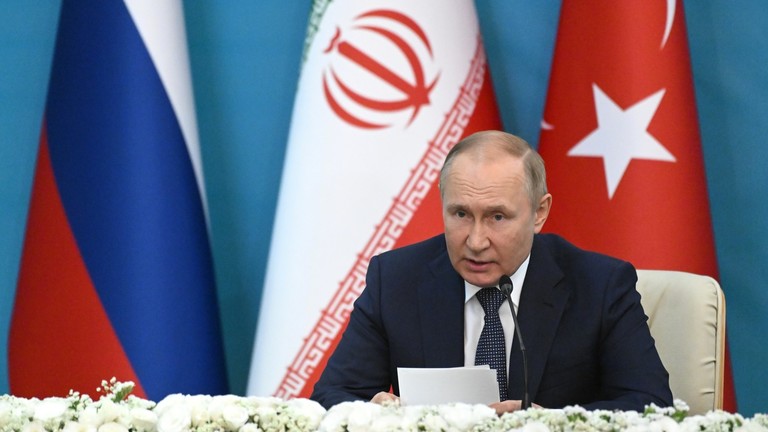
Putin tells US to stop ‘looting’ Syria
Samizdat | July 19, 2022
The US needs to stop “stealing” the oil from the Syrian people and state, Russian President Vladimir Putin said on Tuesday, after meeting with his Iranian and Turkish counterparts in Tehran. The three guarantors of the “Astana process” also agreed that the US should leave the trans-Euphrates, and stop making the humanitarian crisis in Syria worse with their unilateral sanctions.
American troops must leave the territory east of the Euphrates river and “stop robbing the Syrian state, the Syrian people, exporting oil illegally,” Putin told reporters on Tuesday evening. He said this was a “common position” of Russia, Iran and Turkey.
Several hundred US troops are illegally present in Syria, mainly controlling the oil wells and wheatfields in the country’s northeast, controlled by the Syrian Democratic Forces (SDF) militia since the defeat of Islamic State (IS, formerly ISIS) terrorists. The US-backed SDF has refused to reintegrate with the government in Damascus, which Washington wishes to see overthrown.
Since 2019, the US has sought to punish anyone trying to assist the reconstruction of war-torn Syria via the “Caesar Syria Civilian Protection Act,” accusing the government of President Bashar Assad of war crimes and blocking all assistance to Damascus.
Putin said on Tuesday that such sanctions have had “disastrous results” and that humanitarian aid to Syria “should not be politicized.”
During Tuesday’s summit in Tehran, Putin met with Iranian President Ebrahim Raisi and Turkey’s Recep Tayyip Erdogan. In a joint declaration, the three presidents confirmed their conviction that “there can be no military solution to the Syrian conflict,” only a political one under the leadership of the UN. They also condemned “unilateral sanctions violating international law” that are exacerbating the serious humanitarian situation in Syria, urging the UN and other international organizations to “increase assistance to all Syrians, without discrimination, politicization and preconditions.”
Russia sent an expeditionary force to Syria in September 2015, at the request of Damascus, to help defeat IS and other terrorist groups. In January 2017, Moscow, Ankara and Tehran launched the “Astana process” – named after the capital of Kazakhstan – to resolve the conflict in Syria, which began in 2011.
China blames US for Ukraine conflict
Samizdat | July 19, 2022
A spokesman for the Chinese Foreign Ministry accused the US of starting the crisis in Ukraine and fueling the conflict. Zhao Lijian told reporters at a regular press briefing on Tuesday that Washington should stop playing “world police” and work on creating conditions for peace talks instead.
Zhao was asked about the recent remarks by US State Department spokesperson Ned Price, who once again threatened China with a “very steep cost” should Beijing help Moscow evade Western sanctions – even though there was no evidence China was actually doing so.
Accusing Price of sounding “as if the US were the world police,” Zhao said that China “takes an objective and fair stance and stands on the side of peace and justice” when it comes to Ukraine.
“As the one who started the Ukraine crisis and the biggest factor fueling it, the US needs to deeply reflect on its erroneous actions of exerting extreme pressure and fanning the flame on the Ukraine issue.”
“We firmly oppose any unwarranted suspicion, threat and pressure targeting China. We are also firmly against unilateral illegal sanctions and long-arm jurisdiction with no basis in international law,” Zhao said.
Washington needs to “stop playing up bloc confrontation and creating a new Cold War by taking advantage of the situation,” Zhao added, urging the US to instead “facilitate a proper settlement of the crisis in a responsible way and create the environment and conditions needed for peace talks between parties concerned.”
This is not the first time China has pushed back on US pressure to side with the West against Russia in the matter of Ukraine. Last month, Zhao’s colleague Wang Wenbin also chided Washington for fueling the conflict and wanting to “fight to the last Ukrainian” while Beijing wanted a negotiated peace. He stopped short of blaming the US for starting the current military confrontation, however.
At the end of June, NATO Secretary General Jens Stoltenberg told reporters the alliance had been “preparing for this since 2014,” referring to the US-backed government in Kiev which came to power after the coup ousted the elected president and triggered the crisis with Crimea and Donbass.
At Tuesday’s press conference, Zhao also rejected US accusations that China was contributing to food shortages in Africa, pointing the finger back at Washington.
“It is quite clear to the world who exactly is causing the global food crisis,” he said. “We hope that the US will seriously reflect on its disreputable role in the global food crisis and stop smearing and making groundless accusations against China.”
Russia sent troops into Ukraine on February 24, citing Kiev’s failure to implement the Minsk agreements, designed to give the regions of Donetsk and Lugansk special status within the Ukrainian state. The protocols, brokered by Germany and France, were first signed in 2014. Former Ukrainian president Pyotr Poroshenko has since admitted that Kiev’s main goal was to use the ceasefire to buy time and “create powerful armed forces.”
In February 2022, the Kremlin recognized the Donbass republics as independent states and demanded that Ukraine officially declare itself a neutral country that will never join any Western military bloc. Kiev insists the Russian offensive was completely unprovoked.
Featured Video

AIDS Inc. by Gary Null (2007)
or go to
Aletho News Archives – Video-Images
From the Archives
Clash of Civilization, Iran Part II
By Jamal Kanj – Intifada-Palestine.com – January 14, 2011
Israel’s survival kit is: perpetuate conflict, insecurity to rationalize collective hate and finally playing victim.
Devoid of conflict, Israel implodes internally; without hate, Zionism loses its justification; and playing eternal victim to continue blackmailing the West. Absence of this holy trinity, Israel ceases to exist.
From its inception, the house of Zion has mastered exploiting adversarial powers to advance Israel’s cause. For instance, their influence over the Democratic Party in the US began with President Truman’s bid for 2nd term election in 1948.
Responding to strong opposition from Secretary of State General George Marshall and Department experts urging against recognition of Israel, President Truman replied: “I’m sorry gentlemen but I have to answer to hundreds of thousands [Jewish voters] who are anxious for the success of Zionism. I do not have hundreds of thousands of [voting] Arabs among my constituents”
Zionists influence over liberal American politics was matched with the doctrinal school of Conservative theoreticians aligning the Republican Party’s platform with Israel’s objectives. The Neoconservative Zionists, coined Zioncons, invented the “Clash of Civilization” concept to fight Israel’s wars. … continue
Blog Roll
 Aletho News
- From Unipolar Universalism to Multipolar Civilizational Distinctiveness
- RSF military group defects, joins Sudanese army: State media
- Ireland goalkeeper refuses to play ‘Israel’ as squad weighs boycott
- China pushes back against US on Cuba, Iran
- Ukrainian Soldiers, Potential Mercenaries: Have Gun, Will Travel!
- Burnham’s UN debut… A masterclass in British disinformation
- Iran flights continue despite US aviation sanctions
- Global Tipping Points Lead the World Into a State of Entropy
- The day-after at the White House: USA and Xi Jinping
- The Geopolitical Balance in the Red Sea: The UAE Being Displaced by New Players
- If Americans Knew
- Deconstructing Netanyahu’s pants-on-fire UN rant – Daily Update
- Trump betrayed voters with his campaign lies and prioritized a foreign country once he took office
- Netanyahu calls Israel’s war in Gaza ‘opposite of genocide’ in UN speech to near-empty hall
- Settler Kidnappings: Torture, Sexual Abuse and Terrorisation of Palestinian Abductees as Israel Deepens Annexation of West Bank
- Gaza winter nears as 162,000 tents become unusable, raising fears of humanitarian crisis
- Netanyahu says, “It’s the opposite of genocide”; UN says Gaza economy is world’s ‘most severe crisis on record’ – Daily Update
- Israel’s US-Backed Assault on Gaza Has Created the ‘World’s Most Severe Economic Crisis on Record’: UN
- ‘Protecting U.S. Citizens’… From Israel
- ‘This is where I live now, the back of a truck’: a day in the life of a grandmother in Gaza
- In UN Speech, Iran’s President Displays Pictures of Children Killed by US, Brings Attention to Israel’s Nuclear Arsenal
- No Tricks Zone
- New Study: Earth And Venus Surface Warmth Largely Explained By Convection And Lapse Rate, Not CO2 Or Radiation
- 2025 Nature Paper Claiming Worsening Global Drought Gets RETRACTED …Heavily Flawed
- New Study: ‘Global Drought Shows No Detectable Recent Acceleration Under Climate Warming’
- Economic Masterminds: German Socialists Suggest Taxing Productivity Gains Stemming From Using AI
- The South China Sea Has Not Been Cooperating With The Climate Change Narrative
- Energy Crisis: Germany Enters Heating Season With Historically Low Gas Reserve Fill Levels
- New Study: The Antarctic Ice Sheet Gained Mass From 2020-2024 Due To Staggering Snow And Ice Accumulation
- Study: Ocean Heating Rates From Thousands Of Years Ago ‘Dwarf’ Modern Ocean Heating Rates
- Climate Extremists Target, Attack Large-Scale Power Grid Infrastructure In Germany!
- New Study: Antarctic Ice Melt Has Contributed Less Than 1 Centimeter To Sea Level Rise In The Last 30 Years

