Russia dismisses US abuse allegations
Samizdat | July 14, 2022
Moscow has dismissed American claims that it forced up to 1.6 million Ukrainians to move to Russia, was confiscating Ukrainian identification documents, and issuing Russian passports instead.
The accusations, which were made by US Secretary of State Antony Blinken on Wednesday, are “poor quality Western disinformation,” the Russian embassy in Washington said.
The top US diplomat accused Russia of abusing Ukrainian citizens in various ways. He cited estimates by sources that “indicate that Russian authorities have interrogated, detained, and forcibly deported [to Russia] between 900,000 and 1.6 million Ukrainian citizens, including 260,000 children.”
He was apparently referring to the evacuation of civilians from Eastern Ukraine and Donbass republics. Hundreds of thousands of people fled to Russia before and during the ongoing military conflict. Kiev claimed that those refugees were Russian “hostages.”
Blinken further claimed that Russian forces were “separating families, in an apparent effort to change the demographic makeup of parts of Ukraine.”
Moscow has offered Ukrainian citizens a simplified path to Russian citizenship, should they want it. Initially only residents of the Donetsk and Lugansk People’s Republics, which Russia recognized as sovereign states in February, were eligible for the scheme, but it was later extended to all Ukrainians.
The US also claimed that Russia was “deliberately separating Ukrainian children from their parents and abducting others from orphanages before putting them up for adoption inside Russia.” Blinken cited “eyewitnesses, survivors, and Ukraine’s General Prosecutor” as his source for these and other serious accusations.
Maria Zakharova, the spokeswoman for the Russian Foreign Ministry, commented on Blinken’s remarks, suggesting that “a case like this must have been described” somewhere in a medical encyclopedia.
When she discussed the allegations on Thursday on Russian TV, she said they were meant for consumption by a US audience. Blinken’s claims were as “absurd” as Washington’s “mantra” that Russian President Vladimir Putin had imposed “a tax” and driven American gas prices up, she added.
EU clarifies stance on Russian exclave blockade
Samizdat – July 13, 2022
No “sanctioned goods” are allowed to be transported by Russian operators through EU territory by roads, the EU Commission has said in its fresh “additional guidance” on the transit of Russian goods. The document published on Wednesday comes amid tensions around the Russian Kaliningrad exclave. Lithuania had previously blocked the shipment of goods to the region via its territory to comply with EU sanctions against Russia.
Transit via rail is still allowed, according to the document, but only as long as the EU member states “perform effective controls.” The bloc’s nations should “check whether transit volumes remain within the historical averages of the last three years” as well as whether they reflect “the real demand for essential goods at the destination,” the guidelines say.
The transit of sanctioned military and dual use goods and technology is fully prohibited, the document says, adding that any “unusual flows or trade patterns” could potentially be suspected of giving “rise to circumvention” of anti-Russian sanctions.
The document specifically notes that the EU members “are obliged to prevent all possible forms of circumvention of EU restrictive measures.” The EU Commission also pointed to the “importance of monitoring the two-way trade flows between Russia and Kaliningrad” aimed at ensuring that “sanctioned goods cannot enter the EU customs territory.”
The document comes just hours after the Russian newspaper Izvestia reported that the EU is in talks with Lithuania on lifting sanctions on the transit of goods to Russia’s exclave. The media outlet also claimed that the EU had sent a draft document to Moscow in early July outlining that the transit of goods by both rail and road from mainland Russia to Kaliningrad would be removed from sanctions.
The EU, however, has denied this information. “There were no talks between the EU and Russia on the issue you’re talking about, contrary to the reports you are citing,” Eric Mamer, the EU Commission chief spokesman, told the RIA news agency when asked to comment on the reports.
The Russian Foreign Ministry previously threatened Lithuania with “tough measures” if it continued to block Russian transit to the exclave. The response measures have already been prepared, the ministry’s spokeswoman, Maria Zakharova, said on Sunday. “The European Commission, the EU must understand that the clock is ticking,” she warned.
Lithuania blocked the transit of goods by rail to Kaliningrad through its territory on June 18, with the restrictions affecting about 30% of deliveries to the Russian exclave. Moscow called the measures unprecedented and illegal, as they affect Russia’s access to part of its own territory.
Following the release of the document, Russia’s Foreign Ministry replied that it would closely monitor how the EU’s new guidelines were put into practice.
On Tuesday, Lithuania’s Customs Department reported it had stopped 34 trucks trying to cross its border from Kaliningrad and Belarus because they were transporting “sanctioned goods.” The trucks were forced to return to the Russian and Belarusian territories, it added. The vehicles were transporting car parts, furniture, glass, and alcohol, it revealed.
Moscow and Kiev agree to create a “coordination center” on grain exports in Istanbul
Samizdat | July 13, 2022
Russia and Ukraine have agreed to establish a joint coordination center on grain exports in Istanbul that will include representatives from all parties, Turkish Defense Minister Hulusi Akar told local media following the four-way talks that also involved Turkey and the UN.
On Wednesday, negotiators from Russia, Ukraine, Turkey and the UN met in the Turkish city to discuss the situation regarding the held-up Ukrainian exports.
Ahead of the meeting, Ukraine’s Foreign Minister Dmitry Kuleba said that Kiev and Moscow had been close to breaking the impasse on the issue.
“An agreement has been reached on technical issues such as joint controls at the destination points and … the safety of navigation on the transfer routes,” Akar told journalists. Russian and Ukrainian delegations “should meet again in Turkey next week,” he said, adding that the parties would “review all the details once again” during that meeting.
Ukraine is one of the world’s leading grain exporters. Yet, it has been unable to export its grain by sea due to the ongoing conflict with Russia. Kiev and Western nations have accused Moscow of preventing Ukrainian grain shipments from leaving the nation’s Black Sea ports. Russia has denied such accusations and, in turn, blamed Kiev for the crisis, arguing that its forces mined the Black Sea waters, thus creating a threat to the cargo ships.
The West has also accused Moscow of attempting to cause a global food crisis by supposedly blocking shipments of Ukrainian grain and “using hunger as a weapon.”
Last month, President Vladimir Putin said that Russia was not impeding exports and criticized the West for its “cynical attitude” towards the food supply of developing nations, which have been the most affected by the soaring prices. Moscow is ready to provide free passage to international waters for ships carrying grain, he added.
Iran responds to US claims of drone shipments to Russia
Samizdat | July 13, 2022
Tehran will not help either side in the Russia-Ukraine conflict, Iranian Foreign Minister Hossein Amir-Abdollahian has said in response to White House claims the Islamic Republic was planning to deliver “hundreds of drones” to Russia.
“We have different kinds of cooperation with Russia, including in the defense sector. But we are not going to help either side in this conflict because we believe that it has to be stopped,” Amir-Abdollahian told Italian newspaper la Repubblica on Wednesday.
“The current problem with the conflict is that some Western countries, including the United States, have arms manufacturers who are trying to sell their products,” he said, adding that Tehran “will avoid any action that could lead to escalation” but we will work to stop the conflict.
On Monday, US National Security Adviser Jake Sullivan told reporters that Iran was “preparing to provide Russia with up to several hundred UAVs,” including combat drones.
Many Western countries, including the US, are supplying Kiev with heavy weaponry, such as missile launchers, armored vehicles and combat drones. Moscow insists that “flooding” Ukraine with weapons will only exacerbate the conflict.
Meanwhile Russian President Vladimir Putin will travel to Tehran on July 19 and meet with his counterparts Ebrahim Raisi of Iran and Recep Tayyip Erdogan of Turkey, according to the Kremlin.
Kremlin spokesman Dmitry Peskov said on Wednesday that Putin will not discuss possible drone supply during his trip to Tehran.
Russia’s oil earnings continue to soar – IEA
Samizdat | July 13, 2022
Russia’s oil export revenue surged above $20 billion in June thanks to rising energy prices and despite lower shipments abroad, the International Energy Agency (IEA) said in its monthly oil market report on Wednesday.
The agency’s statistics showed an increase of $700 million in June from the previous month, even as Russia’s daily exports of crude oil and products fell by 250,000 barrels to 7.4 million barrels, the lowest since August.
The country’s drop in exports last month was led by crude oil, which fell to just above 5 million barrels per day, according to the IEA. Daily flows to the EU fell below 3 million barrels, which is the lowest since November.
Meanwhile, global oil prices have been surging on strong demand and tight supply. The Brent benchmark averaged more than $117 a barrel last month, while Russia’s Urals rose 10.7% from May to average $87.25 a barrel.
Oil and gas revenue accounted for nearly half of Russia’s federal budget in 2021, according to IEA estimates.
Moscow said earlier it expects up to 1 trillion rubles (over $17 billion) in additional oil and gas revenues this year.
Putin vs. Big Pharma: The ultimate smackdown
Is Putin plotting to purge the pill peddlers? If so, we have some suggestions.

By Riley Waggaman | OffGuardian | July 12, 2022
Is Vladimir Putin preparing to cleanse Russia of Big Pharma shills (his entire cabinet)? Some seem to think so and there is certainly evidence that some kind of anti-shill crackdown is coming.
Let’s explore this intriguing news item together.
Take the wheel, TASS :
Russian President Vladimir Putin has criticized foreign drug companies for pushing their products through local medical institutions and via doctors in Russia using their deep-pocketed resources.
“Unfortunately, foreign pharmaceutical companies attracted some heads of our medical institutions, and medical workers in 30 regions. And they pushed their medicines [on to the Russian market], paying quite a lot of money for it. We saw that under just one scheme they doled out 500 million [rubles],” he said at a meeting with Yury Chikhanchin, Head of the Federal Financial Monitoring Service.
Putin noted that such practice also exists in the EU and worldwide.
“They do it everywhere. They do it in Europe and overseas too. This is how they operate,” he said.
Chikhanchin responded by saying his agency was working with the FSB to root out gratuitous Big Pharma grifting.
First of all: At the very least Putin deserves a golf clap for saying rude things about Big Pharma. No one loses points for doing that. So we salute you, Vladimir Putin. Keep it up.
At the same time: talk is cheap. If you’re going to launch a Novichok rocket at Big Pharma for “pushing their products through local medical institutions” (as TASS summarized) in 30 regions… this doesn’t exactly sound like the cleansing enema that Russia so desperately needs.
If Putin is sincere about expelling degenerate pill pushers from Russia, how far is he willing to go? Because in order to have a meaningful impact he’ll have to go pretty far. All the way, actually.
You need to cut the head off the snake. And the snake lives in Moscow. The snake has wrapped its slimly reptile-bod around various federal ministries. The snake is suffocating Russia at the highest levels of government.
That’s just a fact.

Maybe it’s time for a “performance review” at the Ministry of Health? (source)
If tomorrow the FSB announces it bagged the deputy director of a village clinic in Potato-Patch, Yakutia, this will not qualify as a successful crackdown on Big Pharma’s nefarious influence in Russia. It will qualify as a massive fail.
So which Big Pharma Strumpets should be Gitmo’d by the FSB? We’re so glad you asked.
All of the Important Russians who partied with Tedros and Big Pharma at the St. Petersburg International Economic Forum — straight to the gulag for some desperately needed rehabilitation.
And of course, no Big Pharma smackdown would be complete without frog-marching Madame Arbidol to the most remote Siberian penal colony. Sorry, we don’t make the rules.
Russia’s largest pharmaceutical firms also need to be put in the crosshairs. As we saw with Sputnik V, Russian drug companies enthusiastically collaborate with western pharmaceuticals to create horrific poisons for the masses. And the Russian government is invested in this gross cooperation — which is slightly discouraging?
Furthermore, the worst medicine-related grifting involves government contracts. And also: a lot of the pill peddling and unethical contracting is done legally.
As Tsargrad explained in an article unpacking Putin’s comments:
Putin demanded action against Western pharmaceutical companies that bribe our doctors. Tsargrad examined the problem and found out that this bribery is most often completely legal. To change the situation, you need to change the laws. […]
The peculiarity of Russia lies in the active participation of the state in the market of medical services. It is more profitable to get a big contract and relax than to work painstakingly with doctors, although this is not neglected either. Therefore, our “favorite” form of illegal cooperation of pharmaceutical companies with the heads of institutions and officials is to ensure victory in the auction.
So, for example, at the end of 2019, the head doctor of the republican oncological dispensary of the Ministry of Health of the Republic of North Ossetia-Alania was caught red-handed while receiving a bribe on an especially large scale. A few days before that, the head physician of the Penza Regional Oncology Center received a five-year sentence (as did the director of the pharmaceutical company who gave him the bribe). There are other precedents, many of them. […]
Of course, the problem raised by Chikhanchin and Putin concerns not only Western companies — the domestic pharmaceutical industry has adopted the worst habits of its “big brothers” and interacts with medical personnel no less successfully.
That sums up the situation pretty well, we think.
We welcome any and all efforts to make Russian healthcare less scammy and more healthy.
But let’s not forget that after two years of “public health measures” — two years of non-stop grifting and murderous lies — Russia now finds itself in a very, very deep hole — a hole dug by the Russian government. Go figure.
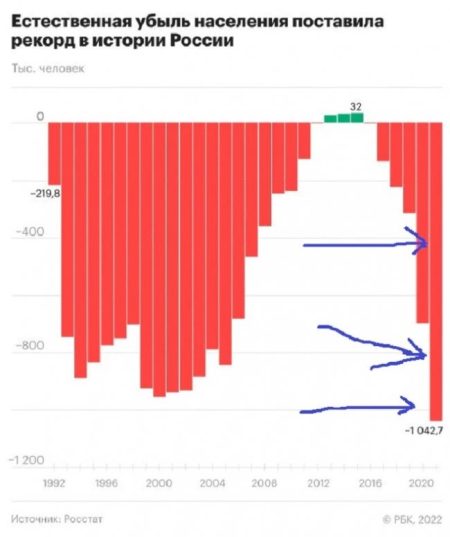
A population decline of more than 1 million people in 2021. The largest decline in decades. (source)
We should add that there are rumors on the Russian interwebz that several high ranking officials are under investigation as part of this alleged Big Pharma crackdown. We haven’t found anything substantial to support this claim but… fingers crossed?
Let’s see what the FSB cooks up. It’s 2022. Anything is possible.
Even atonement.
Riley Waggaman is your humble Moscow correspondent. He worked for RT, Press TV, Russia Insider, yadda yadda. In his youth, he attended a White House lawn party where he asked Barack Obama if imprisoned whistleblower Bradley Manning (Chelsea was still a boy back then) “had a good Easter.” Good times good times. You can subscribe to his Substack here, or follow him on twitter or Telegram.
For those who don’t follow Riley on Telegram, he has recently been purged from PayPal – no doubt because he’s wrong about everything, and no threat to the establishment at all.
WHO Wants To Run the World?
By Paul Frijters, Gigi Foster, Michael Baker | Brownstone Institute | July 11, 2022
In Geneva in late May at the 75th meeting of the WHO’s decision-making body, the World Health Assembly (WHA), amendments to its International Health Regulations (IHRs) were debated and voted upon. If passed, they would grant the WHO the right to exert unconscionable pressure on countries to accept the WHO’s authority and health policy actions if the WHO decides that there is a public health threat that might spread beyond a country’s borders.
As Ramesh Thakur, the second man at the UN for years, noted, the amendments would mean “the rise of an international bureaucracy whose defining purpose, existence, powers and budgets will depend on outbreaks of pandemics, the more the better.”
This is the first clear instance of a globalist coup attempt. It would subvert national sovereignty worldwide by putting real power into the hands of an international group of bureaucrats. It has long been suspected that the authoritarian elites arisen during covid times would try to strengthen their positions by undermining nation states, and the this 75th jamboree is the first solid evidence of this being true.
What an opportunity then to see who is in the conspiring club. Who drafted the amendments? What was in them? Which individuals supported them or spoke out against them?
WHO were the conspirators?
The amendments on the table at the May WHA meeting had been transmitted to the WHO by the US Department of Health and Human Services on January 18, circulated by WHO to its member states (‘States Parties’) on January 20 and formally introduced to the WHA on April 12.
The proposals, according to an announcement on January 26, were co-sponsored by 19 countries plus the European Union. Even if some co-sponsors had little direct involvement in drafting them, they all would have approved in principle the overarching goal of tightening up the WHO’s authority over member states in the face of a public health event.
Loyce Pace, the HHS’s Assistant Secretary for Global Affairs – the leading US official nominally responsible for the proposed amendments – arrived at the Biden administration fresh from a stint as executive director of an advocacy organization called the Global Health Council.
That council receives funding from the Bill & Melinda Gates Foundation and its members include Eli Lilly, Merck, Pfizer, Abbott Labs, and Johnson & Johnson. You get the idea. Via one of the foxes-turned-chicken-guard, it appears the HHS ‘worked closely’ on these amendments with large pharmaceutical companies, who will be chomping at the bit for a more proactive (read: profitable) response to any public health emergency, real or imagined.
So the conspiring club consists primarily of the US government and its Western allies in lockstep with Big Pharma, and they are looking to undermine both the sovereignty of their own governments and that of other countries, presumably with the idea that the Western elites would do the running.
What was in them? A blizzard of acronyms and euphemisms
To understand what the US proposed at the WHA, we need first to understand how things have worked in the WHO to this point.
The IHRs in their current form have been in force as international law since June 2007. Among other things, they impose requirements on countries to detect, report and respond to ‘public health events of international concern,’ or PHEICs. The WHO Director-General consults with the state where a possible public health event has occurred, and within 48 hours they are meant to come to a mutual agreement on whether or not it actually is a PHEIC, whether or not it needs to be announced to the world as such, and what counter-measures, if any, should be taken. It’s essentially an early-warning system on major health crises. This is a good thing if it’s run by people you can trust and if it has checks and balances to rein in expansionary tendencies.
The proposed amendments would greatly strengthen the power of the WHO relative to this baseline, in a number of ways.
First, they lower the threshold for the WHO to declare a public health emergency by empowering its Regional Directors to declare a ‘public health event of regional concern’ (PHERC, italics ours) and for the WHO to put out a new thing called an ‘intermediate public health alert.’
Second, they permit the WHO to consider allegations about a public health event from non-official sources, meaning sources other than the government of the state concerned, and allow that government only 24 hours to confirm the allegations and a further 24 hours to accept the WHO’s offer of ‘collaboration.’
Collaboration is essentially a euphemism for on-site assessment by teams of WHO investigators, and concomitant pressure at the whim of WHO personnel to enact potentially far-reaching measures such as lockdowns, movement restrictions, school closures, consumption of medicines, administration of vaccines and any or all of the other social, economic, and health paraphernalia that we have come to associate with the covid circus.
Should the state’s government acceptance of the WHO’s ‘offer’ not be forthcoming, the WHO is empowered to disclose the information it has to the other 194 WHO countries, while continuing to pressure the state to yield to the WHO’s invitation to ‘collaborate.’ A non-collaborating country would risk becoming a pariah.
Third, the proposal includes a new Chapter IV, which would establish a ‘Compliance Committee’ consisting of six government-appointed experts from each WHO region tasked with permanently nosing around to ensure the member states are complying with IHR regulations.
There are more crossings-out of the existing IHR language and new language added in, but the flavour of what the US-led alliance is shooting for is a WHO that can unilaterally decide whether there is a problem and what to do about it, and can isolate countries that disagree.
Compliant WHO member states could act as a supporting cast in the isolation effort, through the distribution of their own health budgets and their ‘health-related’ policies, which would include travel and trade restrictions. The WHO would become a kind of command-and-control center for globalist agendas, pushing the produce of (Western) Big Pharma.
Why and how would this work?
We learned during covid times why it would make sense that the US and its allies are insisting on these amendments.
Lowering the bar for declaring a global (or regional) public health threat triggers a huge opportunity for Western pharmaceutical companies. As legal experts have observed: “WHO emergency declarations can trigger the fast-track development and subsequent global distribution and administration of unlicensed investigational diagnostics, therapeutics and vaccines.
This is done via the WHO’s Emergency Use Listing Procedure (EULP). The introduction of an ‘intermediate public health alert’ in particular will also further incentivise the pharmaceutical industry’s move to activate domestic fast-track emergency trial protocols as well as for advance purchase, production and stockpile agreements with governments before the existence of a concrete health threat to the world’s population has been detected, as is already the case under WHO’s EULP via the procedures developed for a ‘pre-public health emergency phase’.”
You can bet that the WHO ‘expert teams’ sent in to make on-the-ground assessments, under the banner of ‘collaboration’ with the host country experiencing the health event, will be chock-a-block with operatives from the CDC and who knows what other Western agencies, all poking around potentially sensitive facilities that a host government might justifiably claim a sovereign right to keep to itself. Likewise with the ‘Compliance Committee’ proposed by the US under the new Chapter IV of the IHRs: its government-appointed members have an open-ended brief, enshrined in international law, to be busybodies.
In layman’s terms, the WHO would be turned into an international thug, with its member states offered the role of backyard gang members.
As a bonus for Western elites, the proposals are a sneaky form of rewriting history. By cementing authority within an international organisation to determine the existence of public health crises and direct potentially draconian emergency responses, Western governments would get to enshrine and legitimise their own extreme responses to the covid outbreak, as we have pointed out previously. Their backsides would thereby be given some protection from legal challenges.
The refusniks: Developing countries
The proposals were pushed primarily by Western countries: the US was joined by Australia, the UK and the EU in arguing for passage. The resistance was led by developing countries who saw it as a colonialist ambush in which their ability to set policy and respond to health threats in a manner commensurate with their domestic situations would be overridden.
Brazil reportedly went so far as to threaten to withdraw from the WHO, and the African group of almost 50 countries, along with India, argued that the amendments were being rushed through without adequate consultation. Russia, China and Iran also objected.
Failure on the first try, but the US and its allies in the West will get more shots to push it through.
How do we expect them to do this? Well, when a proposal gets bogged down inside a giant bureaucratic machine like the WHO, the inevitable response is to set up committees to work in the background and circle back with a new set of proposals to be presented at a future meeting. True to form, a ‘working group’ and ‘expert committee’ are being assembled to accept member state proposals on IHR reform by the end of September this year. These will be ‘sifted through’ and reports will be prepared for review by the WHO’s executive board in January next year. The objective is to have a fresh set of proposals on the table when the WHA convenes for the 77th time in 2024.
Not all was lost
Salvaging something from the fact that the WHA failed to get a consensus around its biggest agenda item, the US and its allies got a small victory on the point of when they can try again – though in their desperation they needed to violate the IHRs’ own rules to accomplish it. Article 55 of the IHRs states unambiguously that a four-month notice period is required for any amendments.
In this instance, revised amendments were presented on May 24, the same day that the first lot were rejected. These were discussed, further amended on May 27 and then adopted on the same day. The approved amendments halve the two-year period for any (further) approved amendments to the IHRs to take effect. (The IHRs that came into force in 2007 were agreed to in 2005 – but under the new resolution, anything agreed to in 2024 would come into effect in 2025 rather than 2026.)
Yet, what was achieved in terms of fast-tracking the force of new amendments was lost in slow-tracking their implementation. Nations would have up to 12 months – double the previous suggestion of six months – to implement any IHR amendments that newly enter into force of law.
State of play
Where is all this going?
If the WHO takes the reins on decisions about what constitutes a health crisis, and can pressure every country into a one-size-fits-all set of responses that it, the WHO, also determines, that’s bad enough. But what about if its invitation to ‘collaborate’ with countries is backed up with teeth, such as sanctions against those who demur? And what about if it then broadens the definition of ‘public health’ by, for example, declaring that climate change falls under that definition? Or racism? Or discrimination against LBTQIA+ people? The possibilities thereby opened up for running the world are endless.
A global ‘health’ empire would bring huge harms to humanity, but a lot of power and money is pushing for it. Don’t think it can’t happen.
Paul Frijters is a Professor of Wellbeing Economics at the London School of Economics: from 2016 through November 2019 at the Center for Economic Performance, thereafter at the Department of Social Policy
Over 300 Trucks From Kaliningrad Region Queue at Border With Lithuania
Samizdat – 11.07.2022
KALININGRAD, Russia – More than 300 trucks are queuing at the Russian-Lithuanian border attempting to exit the Russian exclave region of Kaliningrad, with another 200 trucks awaiting entry into the region, Kaliningrad customs service said on Monday.
“As of 9 a.m. on July 11, in the past 24 hours employees of Chernyshevskoe checkpoint processed 200 heavy trucks heading to the Republic of Lithuania and 298 trucks arriving to the territory of the Kaliningrad region. Departure from the Russian Federation is expected by 310 vehicles, entry – by 200 trucks,” the custom said.
Kaliningrad trucker drivers complain about spending days in queues, while lacking access to basic necessities.
“People [truck drivers] basically have no food, not everyone can buy it in stores, and you still have to drive to them, not everyone has euros. No toilets, no showers, they just stand in the woods in Lithuania and wait,” one of the truck drivers told Sputnik.
Queues of trucks at the Russian-Lithuanian border in Kaliningrad region at Chernyshevskoye checkpoint appeared in late June and since then their intensity has been escalating. On June 23, 150 trucks were waiting to leave the region, on June 25 their number increased to 250 trucks. Kaliningrad custom service said that the number of trucks allowed out of the region decreased because of the breakdown at Lithuanian customs.
The European Union banned Russia-registered trucks in early April but made an exemption for those transiting to Kaliningrad, which is located on the Baltic Sea coast. The current restrictions on the transit of Russian goods, announced by Lithuania, apply to all transit of goods sanctioned by the EU. Lithuanian Railways notified the Kaliningrad region’s railway of halting the transit of a number of goods subject to EU sanctions on June 18.
Kremlin spokesman Dmitry Peskov said that Russia is considering various options for responding to Lithuania’s “unfriendly” move. Kaliningrad Region Governor Anton Alikhanov said that the restrictions would not affect transit of oil products at least until August 10 and that the region would mobilize its ferry fleet to compensate for railroad cargo cuts.
U.S. Drug-War Hypocrisy in Russia
By Jacob G. Hornberger | FFF | July 11, 2022
The drug-war hypocrisy of President Biden and the mainstream press are on full display in Russia, specifically in the case of Brittney Griner, the renowned W.N.B.A. basketball star. Griner was caught with a small amount of hashish oil in her luggage upon arriving in Russia to play for a Russian basketball team during the offseason. She has been detained by Russian authorities for drug-war violations since February 17 of this year. She faces a possible 10-year jail sentence.
Imbued with their extreme anti-Russia animus, Biden and the mainstream press have gone ballistic, accusing Russian authorities of illegitimately detaining Griner. They have been maintaining that Russian authorities should release her immediately and permit her to return to the United States without any further delay.
For example, here is an editorial from the Los Angeles Times entitled “Free Brittney Griner,” in which the Times writes, “We don’t know if Griner brought contraband into Russia or if she’s being framed by an adversarial government with an unjust legal system. At this point, it really doesn’t matter. This punishment does not fit the alleged crime, and it’s clear that Griner is essentially a political hostage. She must be freed.”
Consider this op-ed in the New York Times in which a Times sports columnist named Kurt Streeter repeatedly repeats the phrase “141 days,” to depict what he considers to be an excessively long period of time for Griner to be held on drug charges.
Meanwhile, after these pieces were written, Griner decided to plead guilty to the charges. So far, there is no allegation by either newspaper that the Russians forced her to plead guilty.
For his part, Biden is steadfastly maintaining that despite Griner’s guilty plea, the Russians are still holding Griner illegitimately. Unfortunately, he failed to provide any explanation for his reasoning, most likely because he doesn’t have one. White House Press Secretary Karine Jean-Pierre confirmed this when she stated, “We believe that the Russian Federation has wrongfully detained Brittney Griner, and she is in intolerable circumstances right now. We are going to do everything that we can — the president has this top of mind — to make sure that we get Brittney home safely.”
Of course, there is one great big elephant in the room that none of these people dares to confront and address: drug laws. Russia has drug laws, just like the United States does.
Now, think about that: Russia is an authoritarian state, one that has drug laws as part of its legal structure. In fact, think about China, a totalitarian communist state, one that also has drug laws as part of its system.
Given such, what does that say about the United States, given that it too has drug laws as part of its system. In fact, both the federal government and the state governments have brutally enforced drug laws for decades, as thousands of people who have been prosecuted and incarcerated can attest.
Streeter laments, repeatedly, that Griner has been in jail for “141 days.” Sure, three months is a long time, given that no one should should ever be detained at all for possessing drugs. But what Streeter omits from his lamentations is that 141 days is nothing compared to the years-long and decades-long jail sentences that American citizens have received at the hands of not the Russians but rather at the hands of their very own government officials — just for possessing or distributing drugs.
Just a few weeks ago, a festival organized by a group called the Rainbow Family was held in a national forest in Colorado. A U.S. magistrate popped in and opened up a makeshift courtroom in the middle of the forest. And guess why he did that. So that he could arraign people who were charged with possession of marijuana and other minor offenses. You can catch a photograph of this guy in this Washington Post article. He is quoted as saying, “Have you ever been in a more beautiful courtroom?”
It’s worth noting that Griner is black. Why is that important? Because it helps to remind us of the racist nature of America’s drug laws. The people who are serving the longest jail sentences here in the United States for drug-war violations are black. In fact, America’s drug war is without a doubt the most racist government program since segregation.
The Wall Street Journal, citing NORML, states that Griner’s possession of a small quantity of hashish oil would have been legal in Arizona and 18 other states. That’s only partially true. It’s legal under state law, but not federal law. The federal government continues to make possession of illicit drugs, including marijuana and hashish oil, illegal in every state, just as Russia does.
There is, of course, another lesson to be learned here. The more that the Pentagon, by itself or through NATO, incites foreign crises or creates official enemies in order to justify the continuation of its massive and ever-increasing taxpayer-funded largess, it makes it much more unsafe for Americans to travel overseas.
Brittney Griner’s arrest and detention for drug-war violations in Russia puts a needed mirror on America’s war on drugs. The best thing U.S. officials could do to help others around the world who are victimized for drug-war violations is by ending its own drug-war tyranny here at home. That means legalization of all drugs, both at the federal and state levels. It also means immediately releasing every person from every state and federal prison who has been incarcerated for a non-violent drug offense. It’s always best to lead by example, as compared to engaging in hypocritical tirades against foreign regimes that are enforcing the same drug-war tyranny that U.S. officials are enforcing here at home.
Stocks of Western-supplied missiles destroyed in Ukraine – Moscow
Samizdat | July 11, 2022
Russian warships have destroyed stocks of US-supplied ammunition, by striking arms depots in Ukraine’s central Dnepropetrovsk Region with Kalibr cruise missiles, the defense ministry said on Monday.
“Stores of ammunition for US-delivered HIMARS multiple rocket launchers and M772 howitzers, as well as for 2S7 Pion self-propelled guns have been destroyed,” Defense Ministry spokesman Lieutenant General Igor Konashenkov said during his daily press briefing.
Konashenkov added that Russian aircraft hit the bases of “nationalist battalions and foreign mercenaries” in the eastern city of Kharkov, killing around 250 fighters and destroying up to 25 military vehicles.
The US promised this month to supply Kiev with four additional HIMARS launchers, bringing the total number sent to Ukraine to 12. Speaking to the Wall Street Journal on Sunday, Ukrainian Defense Minister Alexey Reznikov called them a “game-changer” on the battlefield.
Last week, the Russian Defense Ministry claimed that it had wiped out two HIMARS launchers and two ammunition depots. The Ukrainian military dismissed the report as “fake,” insisting that the US-made launchers were inflicting “colossal” damage and casualties on the “occupying forces.”
India to boost Sakhalin-1 oil output
BY M. K. BHADRAKUMAR | INDIAN PUNCHLINE | JULY 10, 2022
After Sakhalin-2, Moscow also plans to nationalise Sakhalin-1 oil and gas development project by ousting US and Japanese shareholders. But Moscow will make an exception for India so that OVL which holds 20% stake will remain & continue to work. Moscow grapevine is that while Rosneft will continue to hold controlling share, more Indian companies may be inducted to replace US & Japan and thereby also ensure a sales market in India.
The Sakhalin-1 is located off the coast of Sakhalin Island in the Russian Far East. It comprises three offshore fields — namely, Chayvo, Odoptu, and Arkutun-Dagi. Until recently, the Sakhalin-1 project was operated by a Russian subsidiary of the American major ExxonMobil known as Exxon Neftegaz, which owns 30% of the shares. In addition, 20% is owned by the Russian state, 30% by the Japanese company Sodeco, and 20% by the Indian ONGC Videsh. Whereas Sakhalin-2 specialises in the export of liquefied natural gas, Sakhalin-1 is in the export of Sokol oil.
The capacity of Sakhalin-1 is quite impressive. There was a time before OPEC+ set limits on production level, when Russia extracted as much as 400,000 barrels per day, but the recent production level has been about 220,000 barrels per day. The abrupt departure of the Americans following the US sanctions against Russia has caused the production to plummet to just 10,000 barrels. Russians hope that with the replacement by more Indian companies, the production level can be restored to the previous level. Indeed, the hope is that Indian ONGC Videsh will pull up the production level of Sakhalin-1 project relatively quickly by bringing in own technologies.
The overall trend of nationalising the holdings of American, British, Japanese and European capital in Russia’s strategic sectors of economy is crystallising as the new policy — the Russian version of India’s AatmaNirbhar Bharat (“Self-reliant India” campaign.) Cleansing of the Russian economy, freed of Western capital, is expected to accelerate in the period ahead. India has seamless opportunities here to make investments and reap windfall profits. In strategic terms, India’s energy security will also be guaranteed for decades to come.
Moscow was well aware of the predatory character of Western capital in Russia’s oil sector — a legacy of the Boris Yeltsin era — but had to live with the exploitation as it didn’t want to antagonise other potential western investors. But that is history now. The souring of relations with the West to almost breaking point rids Moscow of such archaic inhibitions.
Indeed, the new policy to replace western capital from the commanding heights of Russian economy is not without risks, but Moscow is confident that it is on the right track and must do what it takes. Also, the decrease in production in the Sakhalin-1, unless addressed soon, may negatively affect the very characteristics of the oil fields in the Russian Far East, if the oil recovery factor decreases over time and a lot of oil is left to remain in the reservoirs.
The development of the fields had depended on Western equipment and technologies. Now Russia has lost both. On the other hand, the departure of the Americans will leave Russia with no easy route but to have its own technologies.
On balance, however, Americans stand to lose heavily too, as the production sharing arrangements dating back to the Yeltsin era had been forced out of the Russian government when it was in dire economic straits during the transition from the Soviet period and was in no position to negotiate optimal deals. Come to think of it, something like 262 such so-called production sharing agreements (PSAs) were squeezed out of the Russian government by western oil companies by the time Yeltsin retired.
After coming to power in 1999, President Vladimir Putin set about the mammoth task of cleaning up the Aegean stables of Russia’s foreign collaboration in the oil sector. The “decolonisation” process was excruciatingly difficult, but Putin pulled through it and got rid of as many as 260 (out of 262) PSAs. In fact, Sakhalin-1 and Sakhalin-2 are the very last remaining two PSAs harking back to post-Soviet Russia’s decade of humiliation under Yeltsin.
Any surprises why the Biden Administration hates Putin so much and wants him out of power in Moscow?
Legend is that when the Soviet Communist Party Secretary Nikita Khrushchev paid his pathbreaking visit to India in 1955, then Prime Minister Nehru, amongst other “talking points”, referred to Soviet Union’s great reservoir of expertise in the oil sector, while complaining that the West refused help for anything in India’s state sector.
The folklore is that Khrushchev instinctively reacted in positive terms to Nehru’s request for help and no sooner than his return to Moscow, deputed a famous Soviet expert / geologist to India to prospect for oil — whose fame was such that he could apparently smell oil lying untapped deep in the bowels of the earth! Thus was born the ONGC in 1956, which is now heading for Sakhalin Island on a similar mission!
Biden is Right… Inflation Crisis Is Not Inevitable, So End the Reckless U.S.-Led Warmongering
Strategic Culture Foundation | July 8, 2022
It’s rare for Strategic Culture Foundation to find itself in agreement with pronouncements made by American President Joe Biden. This week, Biden asserted once again that economic inflation and recession hitting the American economy are “not inevitable”. He is correct – at least in part. Although not for reasons that he would ever admit.
Of course, Biden is trying to obscure the grim reality of economic crisis that is afflicting not just the American economy but also the European Union. Inflation of living costs for ordinary citizens in the U.S. and EU are at record highs not seen in decades. There is a sense of calamity in social conditions from mass poverty amid grotesque super-rich inequality. A major input to the general inflation is the soaring price of energy.
The global impact is causing food prices to escalate putting millions of people at risk of hunger, especially in Africa and other low-income nations.
The impending crisis is on an unprecedented scale. Yet, it is not inevitable. But what is making it unavoidable is the warmongering policy of the U.S. and its European NATO allies towards Russia and China. This week saw outlandish American and British efforts to label China along with Russia as an existential threat to “global peace”. The bitter irony of these two rogue Western states casting aspersions on any other nation is too much for words.
The world is being thrown into chaos, insecurity and uncertainty by reckless stoking of war in Ukraine by the Western powers who are funneling tens of billions of dollars-worth of military weapons to that country. This week saw US-supplied HIMARS artillery hitting cities in the Donbass breakaway republics. Where are the Western efforts to mediate a diplomatic end to that war? There are none. Russian President Vladimir Putin reiterated this week that Moscow would like to find a long-term peaceful settlement. The harsh and despicable truth is that the U.S. and its Western allies are incapable of seeking a political solution. They are willing to fight to the last Ukrainian.
Blaming Russia for that conflict is a fallacy. The war has been deliberately stoked by the United States and its NATO accomplices as part of their geopolitical objective of subjugating Russia and China to their hegemonic agenda.
Western sanctions against Russia have created a global energy crisis that is boomeranging on the economies of the United States and Europe as well as the wider world. Biden is trying to scapegoat Moscow for imposing price hikes and taxes on his nation. The reality is it is his administration and its European lackeys who are imposing hardships on their own citizens from a madcap policy of warmongering.
There is a straightforward way out of the abysmal situation. The U.S. and its NATO allies should halt all weapons supplies to the Nazi regime in Kiev. They should also reverse the draconian economic sanctions on Russia. They should pursue diplomatic relations to end the conflict in Ukraine that they have instigated. They should normalize relations with Russia and China instead of relentlessly pushing Cold War-style confrontation.
But that is unlikely to happen under prevailing circumstances. Because the United States and its NATO minions have locked themselves into a deceptive paradigm of hostility. This, in turn, is because of futile ambitions for hegemonic dominance and intrinsic opposition to the emergence of a multipolar world.
Demonizing and antagonizing Russia and China is the real agenda for U.S.-led global imperialism. That criminal policy is covered up with cynical and absurd claims about defending “rules-based order” and democracy in Ukraine, Taiwan and elsewhere.
Nevertheless, the Empire of Lies is running out of credibility and false pretexts. What is becoming more and more evident is the awful reality. The U.S.-led collective West is one predicated on warmongering to preserve its waning global power and privileges.
Russia and China have repeatedly appealed for the existence of a multilateral global order that is consistent with the vision of the United Nations that was set up in the aftermath of World War Two. The United States and its imperial surrogates have continually attacked and undermined that vision with unilateral violations of international law and the sovereignty of countless nations. The U.S. avowed “rules-based order” is synonymous with war, war, war. Decades of relentless U.S.-driven wars – albeit under specious guises and pretenses – prove that.
Today we are witnessing the historic endgame playing out. The current war in Ukraine is but one malignant manifestation.
When asked how long Americans (and presumably Europeans) will have to endure economic pain, Biden retorted, “As long as it takes”. As long as it takes for what? To defeat Russia, China and whomever other nation the U.S.-led imperial axis deems necessary to be subjugated? That’s not going to happen. Those days are over.
Russia and China are too strong militarily and economically for the U.S.-led axis to vanquish. The world is being driven to war, potentially a catastrophic one, by American death throes in the face of reality. In the meantime, American, European and other peoples are being assailed with economic misery as a result of this criminal warmongering for the sake of empire. That is, the crumbling, bankrupt empire of U.S.-dominated Western capitalism and its imperial roguery.
The appalling state of world affairs is not inevitable. But due to the depraved and implacable pursuit of hostility towards Russia and China by the U.S. and its servile European elite, the world is – for now at least – held hostage by these psychopathic Western politicians and their corporate paymasters. That, however, is changing as people realize more and more the real nature and perpetrators of their captive condition.
The giant Western charade is no longer sustainable. From European colonialism to American imperialism, the charade has indeed had a long run. Now, though, it is in tatters from its own inherent corruption and lies. The ignominious downfall this week of Boris Johnson, Britain’s clown prime minister, is just a bit-part of the collapsing Western axis of evil. That collapse is inevitable.
Featured Video

AIDS Inc. by Gary Null (2007)
or go to
Aletho News Archives – Video-Images
From the Archives
Clash of Civilization, Iran Part II
By Jamal Kanj – Intifada-Palestine.com – January 14, 2011
Israel’s survival kit is: perpetuate conflict, insecurity to rationalize collective hate and finally playing victim.
Devoid of conflict, Israel implodes internally; without hate, Zionism loses its justification; and playing eternal victim to continue blackmailing the West. Absence of this holy trinity, Israel ceases to exist.
From its inception, the house of Zion has mastered exploiting adversarial powers to advance Israel’s cause. For instance, their influence over the Democratic Party in the US began with President Truman’s bid for 2nd term election in 1948.
Responding to strong opposition from Secretary of State General George Marshall and Department experts urging against recognition of Israel, President Truman replied: “I’m sorry gentlemen but I have to answer to hundreds of thousands [Jewish voters] who are anxious for the success of Zionism. I do not have hundreds of thousands of [voting] Arabs among my constituents”
Zionists influence over liberal American politics was matched with the doctrinal school of Conservative theoreticians aligning the Republican Party’s platform with Israel’s objectives. The Neoconservative Zionists, coined Zioncons, invented the “Clash of Civilization” concept to fight Israel’s wars. … continue
Blog Roll
 Aletho News
- 12 Things Your Psychiatrist Was Trained Not to Tell You
- From Unipolar Universalism to Multipolar Civilizational Distinctiveness
- RSF military group defects, joins Sudanese army: State media
- Ireland goalkeeper refuses to play ‘Israel’ as squad weighs boycott
- China pushes back against US on Cuba, Iran
- Ukrainian Soldiers, Potential Mercenaries: Have Gun, Will Travel!
- Burnham’s UN debut… A masterclass in British disinformation
- Iran flights continue despite US aviation sanctions
- Global Tipping Points Lead the World Into a State of Entropy
- The day-after at the White House: USA and Xi Jinping
- If Americans Knew
- Israel forces Gazans to live in constant peril – Daily Update
- Deconstructing Netanyahu’s pants-on-fire UN rant – Daily Update
- Trump betrayed voters with his campaign lies and prioritized a foreign country once he took office
- Netanyahu calls Israel’s war in Gaza ‘opposite of genocide’ in UN speech to near-empty hall
- Settler Kidnappings: Torture, Sexual Abuse and Terrorisation of Palestinian Abductees as Israel Deepens Annexation of West Bank
- Gaza winter nears as 162,000 tents become unusable, raising fears of humanitarian crisis
- Netanyahu says, “It’s the opposite of genocide”; UN says Gaza economy is world’s ‘most severe crisis on record’ – Daily Update
- Israel’s US-Backed Assault on Gaza Has Created the ‘World’s Most Severe Economic Crisis on Record’: UN
- ‘Protecting U.S. Citizens’… From Israel
- ‘This is where I live now, the back of a truck’: a day in the life of a grandmother in Gaza
- No Tricks Zone
- New Study: Earth And Venus Surface Warmth Largely Explained By Convection And Lapse Rate, Not CO2 Or Radiation
- 2025 Nature Paper Claiming Worsening Global Drought Gets RETRACTED …Heavily Flawed
- New Study: ‘Global Drought Shows No Detectable Recent Acceleration Under Climate Warming’
- Economic Masterminds: German Socialists Suggest Taxing Productivity Gains Stemming From Using AI
- The South China Sea Has Not Been Cooperating With The Climate Change Narrative
- Energy Crisis: Germany Enters Heating Season With Historically Low Gas Reserve Fill Levels
- New Study: The Antarctic Ice Sheet Gained Mass From 2020-2024 Due To Staggering Snow And Ice Accumulation
- Study: Ocean Heating Rates From Thousands Of Years Ago ‘Dwarf’ Modern Ocean Heating Rates
- Climate Extremists Target, Attack Large-Scale Power Grid Infrastructure In Germany!
- New Study: Antarctic Ice Melt Has Contributed Less Than 1 Centimeter To Sea Level Rise In The Last 30 Years

