Kremlin: Russia’s offensive to end as soon as Ukraine forces lay down weapons
Press TV – June 28, 2022
The Kremlin says Russia will halt its months-long military offensive in neighboring Ukraine as soon as Ukrainian forces surrender.
Kremlin spokesman Dmitry Peskov told reporters on Tuesday that hostilities in Ukraine could end “before the end of today” if Kiev orders the nationalists to lay down their weapons and Moscow’s demands are met.
“The Ukrainian side can end all this before the end of today; an order is necessary for the nationalist units to lay down their weapons, an order is necessary for the Ukrainian military to lay down their weapons; and they must fulfill all Russia’s demands. Then everything will be over before the day ends,” Peskov said.
“Everything else are just speculations of the Ukrainian head of state,” he added. “We are guided by the statements of our President Vladimir Putin that the special military operation is going according to plan and achieving its goals.”
Asked whether the Russian side had any approximate timeframe for the end of the offensive in Ukraine, the Kremlin spokesman responded in the negative.
Peskov made the comment while reacting to Ukrainian President Vladimir Zelensky’s remark that he would like to end the hostilities before the end of the year.
Zelensky urged world powers on Monday to do their utmost to help end Russia’s offensive before the cold season, also saying that the time was not ripe for holding talks with Russia as Kiev was seeking to consolidate its positions.
In a statement on Monday, the Group of Seven (G7) countries expressed full support for Ukraine in the conflict with Russia, pledging to further tighten sanctions on Moscow.
Addressing G7 leaders at their summit in the Bavarian Alps via video link, the Ukrainian president called for arms supplies and air defenses to gain the upper hand in the conflict.
Since the start of Russia’s military strikes on February 24, the US and its Western allies have been imposing sanctions against Moscow. More than four months after the Kremlin launched its offensive against Ukraine, Russian troops have taken control of nearly the entire Donbass region, focusing their military attention on northeastern Ukraine.
In a separate development on Tuesday, G7 leaders in a statement denounced Russia’s offensive as “illegal and unjustifiable.”
“We, the leaders of the Group of Seven … were joined by the leaders of Argentina, India, Indonesia, Senegal and South Africa, as well as Ukraine,” they said in their draft final statement. “We re-emphasize our condemnation of Russia’s illegal and unjustifiable war of aggression against Ukraine.”
The G7 leaders also agreed to explore imposing a ban on transporting Russian oil that had been sold above a certain price, ramping up pressure on Moscow over the soaring global inflation and energy shortages fueled by the country’s offensive in Ukraine.
German Chancellor Olaf Scholz said an oil price cap would ratchet up the existing Western pressure on Russia, stressing that the sanctions would stay until Moscow accepted failure in Ukraine.
“There is only one way out: for Putin to accept that his plans in Ukraine will not succeed,” Scholz told a closing news conference at the three-day G7 summit, adding that the aim of the ban was to tie financial services, insurance, and the shipping of oil cargoes to a price ceiling. “We invite all like-minded countries to consider joining us in our actions.”
The International Energy Agency announced in its June monthly report that the revenues from Russian oil export had soared in May even as volumes had fallen.
The Kremlin said on Tuesday that Russian gas giant Gazprom could seek to change the terms of its delivery contracts if Western governments implemented a price cap on Russian gas.
Russia comments on alleged mall strike in Ukraine
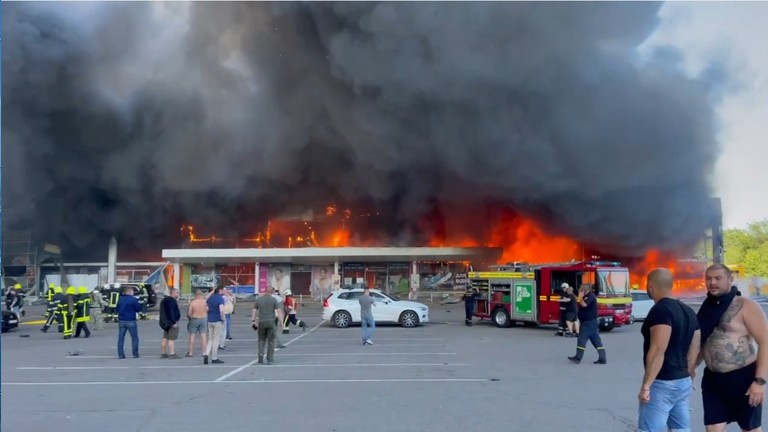
Fire at the Amstor shopping center in Kremenchug. Screenshot from footage published by Volodymyr Zelensky.
Samizdat | June 28, 2022
The Russian military has confirmed an airstrike on the Ukrainian city of Kremenchug on Monday, but claimed it targeted a stockpile of Western weapons. The detonation caused damage to a nearby non-functioning shopping mall, Tuesday’s report said. Kiev had claimed that Russia attacked the shopping center, killing and injuring many civilians.
The Russian Defense Ministry said the location of the arms stockpile was near the Kredmash factory. The Amstor Mall, where a fire was reported by Ukrainian sources on Monday, is right next to it. The military claimed that the Western munitions detonated and caused a fire at the facility, which was no longer operating.
Ukrainian officials claim that the mall was packed with people at the moment Russia allegedly attacked it. However, video showed that the car park outside was almost empty.
According to the latest casualty report, 18 people were killed and 59 injured in the incident, with 25 of the wounded taken to the hospital for treatment.
Ukrainian President Volodymyr Zelensky described the incident in Kremenchug as “one of the most blatant terrorist attacks in European history.” He stated that the site posed no threat to the Russian military and had no strategic value.
Kremenchug is a city in central Ukraine around 250km southeast from Kiev. The Russian military had previously attacked a major oil refinery in the city, denying the Ukrainian military fuel for their vehicles.
Russia strikes Kiev rocket plant
Samizdat | June 27, 2022
Russia’s Ministry of Defense reported on Monday that it successfully carried out a missile strike on a rocket manufacturing plant in Kiev, which was being used to produce ammunition for multiple launch rocket systems.
The strike was carried out on Sunday with four high precision missiles, all of which reached the Artyom rocket-manufacturing plant, located in the Shevchenkovskiy district of Kiev, without damaging civilian infrastructure in the city, the ministry reports.
The authorities in Kiev reportedly tried to intercept the Russian high precision missiles using anti-aircraft weapons stationed around the city, including S-300 and Buk M1 anti-aircraft missile systems, which reportedly launched 10 rockets during the strike.
The ministry also noted that due to the apparent lack of communication between the anti-aircraft defense systems located in the city, two S-300 rockets were shot down by Ukrainian Buks, one of which fell on a residential building.
Western media outlets, including NPR and AP, reported on Sunday that it was Russian missiles that fell on “at least two” apartment buildings in the Ukrainian capital, according to Kiev Mayor Vitaly Klitschko, who called the attack symbolic, ahead of this week’s NATO summit in Madrid.
Klitschko wrote on his Telegram channel on Sunday that one person died and four people were hospitalized as a result of the incident, while 24 other residents were evacuated from the building.
A spokesperson for the Ukrainian Air Force claimed that Russian aircraft had launched up to six missiles at Kiev on Sunday and that two of them were intercepted mid-air.
Russia attacked the neighboring state in late February, following Ukraine’s failure to implement the terms of the Minsk agreements, first signed in 2014, and Moscow’s eventual recognition of the Donbass republics of Donetsk and Lugansk. The German- and French-brokered protocols were designed to give the breakaway regions special status within the Ukrainian state.
The Kremlin has since demanded that Ukraine officially declare itself a neutral country that will never join the US-led NATO military bloc. Kiev insists the Russian offensive was completely unprovoked and has denied claims it was planning to retake the two republics by force.
US government openly advocates destroying Russia
By Drago Bosnic | June 27, 2022
Last week, on June 23, a United States government agency under the name Commission on Security and Cooperation in Europe, better known as the Helsinki Commission, held a Congressional briefing titled “Decolonizing Russia”. Democrat representative from Tennessee (D-TN) Steve Cohen opened up the presentation, during which he claimed that the Russians “have in essence colonized their own country,” arguing that Russia is “not a strict nation, in the sense that we’ve known in the past.” Casey Michel, who authored an opinion piece in The Atlantic last month, titled “Decolonize Russia”, was also present at the meeting. His op-ed seems to have been the impetus for the highly controversial briefing. According to Michel, “decolonizing Russia” is not solely about “partitioning” and “dismembering” the Russian Federation, but about an “authentic commitment to anti-imperialism.”
The panel discussion participants urged the US to give more support (clearly implying actual support currently exists already) to separatist movements inside Russia and in the diaspora, and specifically mentioned Chechnya, Tatarstan, Dagestan, and Circassia as the possible candidates for “decolonization”. Siberia was discussed separately and, according to the Commission, it is to be divided into several republics. During the (First) Cold War, the US, a premier imperialist power, sponsored numerous separatist groups inside the USSR. Thus, this is most certainly not the first time prominent figures in the political West have adopted a hard line towards the Russian Federation, seeking ways to dismantle the Eurasian giant, just as the political West did the same to Yugoslavia over 30 years ago.
What is significantly different nowadays is the blatantly open and public call to do so. Apart from being highly controversial and dangerous, as Russia isn’t yet another helpless country the political West can destroy and kill millions of its inhabitants with impunity, but a military superpower which can easily turn its rivals into a radioactive wasteland in minutes, to suggest Russia should be “decolonized” is exceptionally hypocritical, especially coming from the pillar of (neo)colonialism, the US itself. Since its unfortunate inception, the belligerent imperialist thalassocracy invaded and dismantled numerous countries, reducing them to rubble and turning them into almost perpetually failed states.
After the dismantling of the Soviet Union, the infamous Bush-era Vice President Dick Cheney was seeking to carve up Russia and divide it into several smaller states. In 1997, former Reagan-era US National Security Advisor Zbigniew Brzezinski even published an article in the Foreign Affairs magazine, proposing to create a “loosely confederated Russia — composed of a European Russia, a Siberian Republic, and a Far Eastern Republic.” Thus, once again, this isn’t a new state of affairs. Prominent political figures from the US have been advocating this for decades. The issue is, while they’ve been doing it on a personal basis, not in their capacity as government officials, in this particular case, we have a US government commission openly calling for war, as their blatantly bellicose statements can only be interpreted as such.
Michel, the author whose op-ed inspired the panel discussion, stated that “Russia continues to oversee what is in many ways a traditional European empire, only that instead of colonizing nations and peoples overseas, it instead colonized nations and peoples over land”. He lamented the US failed to use the break-up of the USSR to dismantle Russia itself, complaining Western support for separatist movements in the Russian Federation “did not go far enough”.
“These are colonized nations that we consider to be part of Russia proper, even though, again, these are non-Russian nations themselves that remain colonized by, as we’ve seen yet again, another dictatorship in the Kremlin,” Michel said.
Once again, he insisted that the meeting was not simply about advocating for the “dismemberment and partition” of Russia, but was supposedly motivated by “genuine opposition to colonialism and imperialism”. The very idea Michel supports “genuine opposition to colonialism and imperialism” is deeply comical, as he has spent years smearing the anti-imperialist movement in the US, while ridiculing and (ab)using the term to demonize the governments of Cuba, Venezuela, Nicaragua, and Bolivia, all of which have spent decades fighting off a very real US aggression. Still, Michel brazenly styles himself one of the world’s most vocal supporters of a unique form of “anti-imperialism” that just so happens to advance the interests of the genuinely imperialist political West, in particular the US.
Naturally, none of the participants mentioned anything about the fact the Russian population, although mainly composed of ethnic Russians, still has around 20% of numerous other ethnic (Tatars, Buryats, Kalmyks, Bashkirs, etc) and regional identity (Cossacks) groups, who have been living side-by-side for well over a millennium, that is, several times longer than the US has existed. Also, unlike the US, which occupies the land entirely conquered from numerous Native peoples, tens of millions of which have been slaughtered, precisely in order to steal their lands (with their descendants now living in reservations), Russia kept the indigenous populations it incorporated (usually peacefully, again, in stark contrast to the US) intact, with their lifestyle, religion and cultural heritage shielded by the government.
Drago Bosnic is an independent geopolitical and military analyst.
A pivotal moment in eastern Ukraine
BY M. K. BHADRAKUMAR | INDIAN PUNCHLINE | JUNE 26, 2022
The retreat of Ukrainian troops from Severodonetsk city in the Luhansk Oblast of the country is a pivotal moment in the ongoing conflict. The Russian forces are now almost in total control over the Luhansk region. The latest reports from front lines say Russian forces entered the last remaining city of Lysychansk in Luhansk on June 25.
In a briefing today, the Russian Ministry of Defence announced in Moscow: “On June 25, the cities of Severodonetsk and Borovskoye, the settlements of Voronovo and Sirotino passed under control of the Lugansk People’s Republic. The localities liberated… are inhabited by about 108,000 people. Total area of the liberated territory is about 145 square kilometres.
“Success of the Russian army… considerably diminishes the morale and psychological condition of the Ukrainian army personnel. In 30th Mechanised Brigade deployed near Artyomovsk, there are mass cases of alcohol abuse, drug use and unauthorised abandonment of combat positions.”
However, peace is a long way off — several months away, perhaps. In the speech by Russian President Vladimir Putin last week at the SPIEF in St. Petersburg, he made no references to peace negotiations. Putin hardly referred to the fighting.
Meanwhile, three highly provocative moves by the opposing side within the past week are significant markers indicating that the conflict may aggravate. If the missile strike at a Russian oil rig in the Black Sea has been an act of provocation, the US supply of High Mobility Artillery Rocket Systems (HIMARS), a powerful long-range weapon system is intended as a potential game changer that can help Kiev turn the tide of the conflict, and, third, the bizarre move by Lithuania to block Russia’s rail transit to Kaliningrad is a reckless escalation of tensions.
On the arrival of the HIMARS, Ukraine Defence Minister Oleksiy Reznikov ecstatically wrote wrote on Twitter on Thursday, “HIMARS have arrived to Ukraine. Thank you to my colleague and friend @SecDef Lloyd J. Austin III for these powerful tools! Summer will be hot for russian occupiers. And the last one for some of them.”
Washington claims it has received assurances from Kiev that HIMARS would not be used to attack Russian territory. Moscow has warned it will attack targets in Ukraine that it has “not yet been hitting” if the West supplies longer-range missiles to Ukraine for use in high-precision mobile rocket systems.
The Lithuanian move is a blatant violation of international law and Vilnius would only have acted on the basis of prior consultation with the US and NATO to test the Russian reaction. Kaliningrad is a major Russian base with nuclear missiles, where its Baltic Fleet is headquartered, apart being the only Russian port on the Baltic that is ice-free throughout the year. Evidently, there are some insane fellows in the NATO camp who are itching to climb the escalatory ladder.
For Russia too, there is “unfinished business” ahead insofar as it holds roughly the same amount of territory in Donetsk only as the separatists controlled in February before the special military operation began. Now, seizing the administrative territories of the Donbass is only Moscow’s minimal goal. There is going to be a sprawling battlefield in the next phase, stretching from Kharkiv in the northeast to Mykolaiv and Odessa in the southwest. Much fighting lies ahead.
The New York Times reported that “Pentagon officials expect that the arrival of more long-range artillery systems will change the battlefield in Donetsk.” Gen. Mark A. Milley, the chairman of the US Joint Chiefs of Staff told reporters recently, “If they (Kiev) use it properly, practically, then they’re going to have very, very good effects on the battlefield.”
The Russian military approach doctrinally is centred on attrition warfare, which aims to grind the way toward incremental territorial gains. Therefore, the advantage goes to the side which has greater staying power on the battlefield. In a sustained war of attrition, one military is ultimately going to be depleting the capability of the other. This is where the fault lines in the western unity come into play if the current traces of “war fatigue” in Europe turns into “solidarity fatigue.”
Ukraine’s ability to shift the military balance depends critically on sustained military support from the US and other European countries. That, of course, hinges on political will and cohesiveness of the western allies. As for Russia, it is not only committed to a protracted war but also has the capacity to sustain it.
Unlike the case with Ukraine, Russia is not dependent on any other country for boosting its military capability or training and advising its military. Also, historically speaking, a defining characteristic of the Russian military is its incredible endurance and ability to sustain prolonged attrition.
The US is still betting that the Russian economy cannot hold out for a long time, since the full impact of sanctions and export controls is yet to be felt. In this calculus, the rebound of the ruble currency is seen as largely due to the strict government controls on capital flows and plummeting imports into Russia. Equally, the US has convinced itself that the restrictions on technology exports to Russia will gradually stunt the growth of its industries. Thus, the focus of the G7 summit in Germany currently under way (June 26-28) is on new plans to further “tighten the screws” on Russia’s economy.
But not much Russian budget data is available to make such daring assumptions and it is even harder to quantify how much Moscow is spending on the war in Ukraine. Certainly, there is no evidence to suggest that the Kremlin’s ability to finance the war effort is coming under pressure from sanctions.
While President Biden boasted in March that sanctions were “crushing the Russian economy” and that “the ruble is reduced to rubble,” the exact opposite has happened. Russian oil revenues have set new records and the ruble hit a 7-year high this week against the dollar. Expert opinion is also that Russia’s financial system is back to business as usual after a few weeks of severe bank runs.
Going forward, Biden must retain control over the Congress in the midterm elections in which Republicans are sure to capitalise on the rising cost of living. As for Europe, cooler temperatures in the coming months will raise alarms about energy shortages as Moscow has cut down natural gas supplies to Europe, which would aggravate the economic pressure they now are experiencing.
Therefore, the big question is, whether the desire to resist Russia will be sustainable as the war itself grinds away. The matrix has changed. After all, Biden uttered the following about Putin as recently as in end-March: “For God’s sake, this man cannot remain in power.” But in 3 months’ time, today, Biden only says he is striving to help Ukraine negotiate optimally with Russia for a settlement. Here too, Biden needs to make sure Russia is losing ground, while also constantly weighing that new weapons do not escalate the conflict too fast.
Admittedly, Biden is under little political pressure at home to back away. And the crack in western unity is, arguably, not to be construed as amounting to anything like a rift in the fundamental strategy towards Russia and the Ukraine conflict. That said, the bottom line is that this is also a perilous moment for the global economy.
Post-pandemic economic recovery, supply-chain disruptions, rapid price increases, infrastructure investment, trade practices, global oil prices, world’s food supply, recession — these issues surely impact the western leaders’ standing in the polls. It means economic and political pain is coalescing.
The Fantasy of Fanaticism
Despite what some “defense analysts” may be telling Western media, the longer the war continues, the more Ukrainians will die and the weaker NATO will become.
By Scott Ritter | Consortium News | June 25, 2022
For a moment in time, it looked as if reality had managed to finally carve its way through the dense fog of propaganda-driven misinformation that had dominated Western media coverage of Russia’s “Special Military Operation” in Ukraine.
In a stunning admission, Oleksandr Danylyuk, a former senior adviser to the Ukrainian Ministry of Defense and Intelligence Services, noted that the optimism that existed in Ukraine following Russia’s decision to terminate “Phase One” of the SMO (a major military feint toward Kiev), and begin “Phase Two” (the liberation of the Donbass), was no longer warranted. “The strategies and tactics of the Russians are completely different right now,” Danylyuk noted. “They are being much more successful. They have more resources than us and they are not in a rush.”
“There’s much less space for optimism right now,” Danylyuk concluded.
In short, Russia was winning.
Danylyuk’s conclusions were not derived from some esoteric analysis drawn from Sun Tzu or Clausewitz, but rather basic military math. In a war that had become increasingly dominated by the role of artillery, Russia simply was able to bring to bear on the battlefield more firepower than Ukraine.
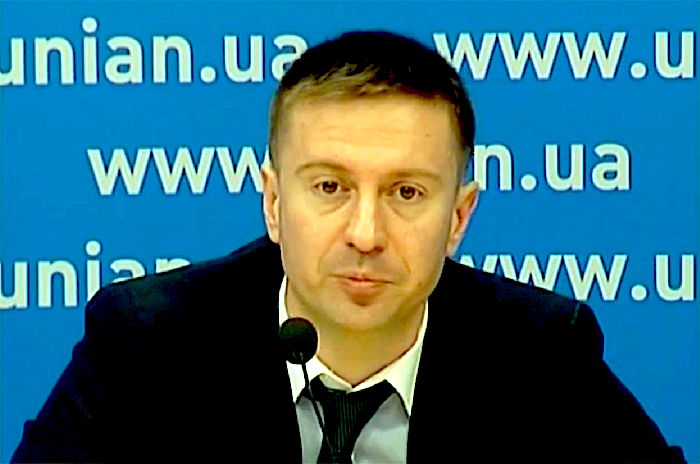
Oleksandr Danylyuk in 2015. (CC BY 3.0, Wikimedia Commons)
Ukraine started the current conflict with an artillery inventory that included 540 122mm self-propelled artillery guns, 200 towed 122mm howitzers, 200 122mm multiple-rocket launch systems, 53 152mm self-propelled guns, 310 towed 152mm howitzers, and 96 203mm self-propelled guns, for approximately 1,200 artillery and 200 MLRS systems.
For the past 100-plus days, Russia has been relentlessly targeting both Ukraine’s artillery pieces and their associated ammunition storage facilities. By June 14, the Russian Ministry of Defense claimed that it had destroyed “521 installation of multiple launch rocket systems” and “1947 field artillery guns and mortars.”
Even if the Russian numbers are inflated (as is usually the case when it comes to wartime battle damage assessments), the bottom line is that Ukraine has suffered significant losses among the very weapons systems — artillery — which are needed most in countering the Russian invasion.
But even if Ukraine’s arsenal of Soviet-era 122mm and 152mm artillery pieces were still combat-worthy, the reality is that, according to Danylyuk, Ukraine has almost completely run out of ammunition for these systems and the stocks of ammunition sourced from the former Soviet-bloc Eastern European countries that used the same family of weapons have been depleted.
Ukraine is left doling out what is left of its former Soviet ammunition while trying to absorb modern Western 155mm artillery systems, such as the Caesar self-propelled gun from France and the U.S.-made M777 howitzer.
But the reduced capability means that Ukraine is only able to fire some 4,000-to-5,000 artillery rounds per day, while Russia responds with more than 50,000. This 10-fold disparity in firepower has proven to be one of the most decisive factors when it comes to the war in Ukraine, enabling Russia to destroy Ukrainian defensive positions with minimal risk to its own ground forces.
Casualties
This has led to a second level of military math imbalances, that being casualties.
Mykhaylo Podolyak, a senior aid to Ukrainian President Volodymyr Zelensky, recently estimated that Ukraine was losing between 100 and 200 soldiers a day on the frontlines with Russia, and another 500 or so wounded. These are unsustainable losses, brought on by the ongoing disparity in combat capability between Russia and Ukraine symbolized, but not limited to, artillery.
In recognition of this reality, NATO Secretary General Jen Stoltenberg announced that Ukraine will more than likely have to make territorial concessions to Russia as part of any potential peace agreement, asking,
“what price are you willing to pay for peace? How much territory, how much independence, how much sovereignty… are you willing to sacrifice for peace?”
Stoltenberg, speaking in Finland, noted that similar territorial concessions made by Finland to the Soviet Union at the end of the Second World War was “one of the reasons Finland was able to come out of the Second World War as an independent sovereign nation.”
To recap — the secretary general of the trans-Atlantic alliance responsible for pushing Ukraine into its current conflict with Russia is now proposing that Ukraine be willing to accept the permanent loss of sovereign territory because NATO miscalculated and Russia —instead of being humiliated on the field of battle and crushed economically — is winning on both fronts.
Decisively.
That the secretary general of NATO would make such an announcement is telling for several reasons.
Stunning Request
First, Ukraine is requesting 1,000 artillery pieces and 300 multiple-launch rocket systems, more than the entire active-duty inventory of the U.S. Army and Marine Corps combined. Ukraine is also requesting 500 main battle tanks — more than the combined inventories of Germany and the United Kingdom.
In short, to keep Ukraine competitive on the battlefield, NATO is being asked to strip its own defenses down to literally zero.
More telling, however, is what the numbers say about NATO’s combat strength versus Russia. If NATO is being asked to empty its armory to keep Ukraine in the game, one must consider the losses suffered by Ukraine up to that point and that Russia appears able to sustain its current level of combat activity indefinitely. That’s right — Russia just destroyed the equivalent of NATO’s main active-duty combat power and hasn’t blinked.
One can only imagine the calculations underway in Brussels as NATO military strategists ponder the fact that their alliance is incapable of defeating Russia in a large-scale European conventional land war.
But there is another conclusion that these numbers reveal — that no matter what the U.S. and NATO do in terms of serving as Ukraine’s arsenal, Russia is going to win the war. The question now is how much time the West can buy Ukraine, and at what cost, in a futile effort to discover Russia’s pain threshold in order to bring the conflict to an end in a manner that reflects anything but the current path toward unconditional surrender.
The only questions that need to be answered in Brussels, apparently, are how long can the West keep the Ukrainian Army in the field, and at what cost? Any rational actor would quickly realize that any answer is an unacceptable answer, given the certainty of a Russian victory, and that the West needs to stop feeding Ukraine’s suicidal fantasy of rearming itself to victory.
Enter The New York Times, stage right. While trying to completely reshape the narrative regarding the fighting in the Donbass after the damning reality check would be a bridge too far for even the creative minds at the Gray Lady — the writing equivalent of trying to put toothpaste back in the tube. But the editors were able to interview a pair of erstwhile “military analysts” who cobbled together a scenario that transformed Ukraine’s battlefield humiliation.
‘Military Analysts’
They described a crafty strategy designed to lure Russia into an urban warfare nightmare where, stripped of its advantages in artillery, it was forced to sacrifice soldiers in an effort to dig the resolute Ukrainian defenders from their hardened positions located amongst the rubble of a “dead” city — Severodonetsk. [Ukraine forces withdrew from the city Friday.]

Gustav Gressel in Berlin in February 2020
According to Gustav Gressel, a former Austrian military officer turned military analyst, “If the Ukrainians succeed in trying to drag them [the Russians] into house-to-house combat, there is a higher chance of inducing casualties on the Russians they cannot afford.”
According to Mykhailo Samus, a former Ukrainian naval officer turned think-tanks analyst, the Ukrainian strategy of dragging Russia into an urban combat nightmare is to buy time for rearming with the heavy weapons provided by the West, to “exhaust, or reduce, the enemy’s [Russia’s] offensive capabilities.”
The Ukrainian operational concepts in play in Severodonetsk, these analysts claim, have their roots in past Russian urban warfare experiences in Aleppo, Syria and Mariupol. What escapes the attention of these so-called military experts, is that both Aleppo and Mariupol were decisive Russian victories; there were no “excessive casualties,” no “strategic defeat.”
Had The New York Times bothered to check the resumes of the “military exerts” it consulted, it would have found two men so deeply entrenched into the Ukrainian propaganda mill as to make their respective opinions all but useless to any journalistic outlet possessing a modicum of impartiality. But this was The New York Times.
Gressel is the source of such wisdom as:
“If we stay tough, if the war ends in defeat for Russia, if the defeat is clear and internally painful, then next time he will think twice about invading a country. That is why Russia must lose this war.”
And:
“We in the West… all of us, must now turn over every stone and see what can be done to make Ukraine win this war.”
Apparently, the Gressel playbook for Ukrainian victory includes fabricating a Ukrainian strategy from whole cloth to influence perceptions regarding the possibility of a Ukrainian military victory.
Samus likewise seeks to transform the narrative of the Ukrainian frontline forces fighting in Severodonetsk. In a recent interview with the Russian-language journal Meduza, Samus declares that:
“Russia has concentrated a lot of forces [in the Donbass]. The Ukrainian armed forces are gradually withdrawing to prevent encirclement. They understand that the capture of Severodonetsk doesn’t change anything for the Russian or the Ukrainian army from a practical point of view. Now, the Russian army is wasting tremendous resources to achieve political objectives and I think they will be very difficult to replenish… [f]or the Ukrainian army, defending Severodonetsk isn’t advantageous. But if they retreat to Lysychansk they’ll be in more favorable tactical conditions. Therefore, the Ukrainian army is gradually withdrawing or leaving Severodonetsk, and upholding the combat mission. The combat mission is to destroy enemy troops and carry out offensive operations.”
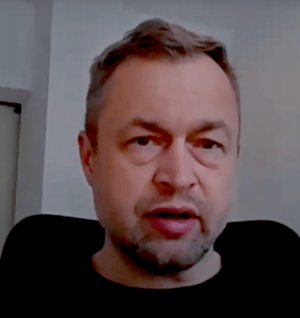
Mykhailo Samus on March 27. (YouTube still)
The truth is, there is nothing deliberate about the Ukrainian defense of Severodonetsk. It is the byproduct of an army in full retreat, desperately trying to claw out some defensive space, only to be crushed by the brutal onslaught of superior Russian artillery-based firepower.
To the extent Ukraine is seeking to delay the Russian advance, it is being done by the full-scale sacrifice of the soldiers at the front, thousands of people thrown into battle with little or no preparation, training, or equipment, trading their lives for time so that Ukrainian negotiators can try to convince NATO countries to mortgage their military viability on the false promise of a Ukrainian military victory.
This is the ugly truth about Ukraine today — the longer the war continues, the more Ukrainians will die, and the weaker NATO will become. If left to people like Samus and Gressel, the result would be hundreds of thousands of dead Ukrainians, the destruction of Ukraine as a viable nation-state, and the gutting of NATO’s front-line combat capability, all sacrificed without meaningfully altering the inevitability of a strategic Russian victory.
Hopefully sanity will prevail, and the West will wean Ukraine off the addiction of heavy weaponry, and push it to accept a peace settlement which, although bitter to the taste, will leave something of Ukraine for future generations to rebuild.
Russian drilling rig shelled again
Samizdat | June 26, 2022
A Russian offshore drilling rig in the Black Sea has been shelled, in the second similar attack in less than a week, a spokesperson for Crimea’s emergency services told TASS on Sunday, blaming the strike on the Ukrainian military.
Earlier, the Baza Telegram channel, citing its own sources, reported that a projectile which had hit the Chernomorneftegaz-owned Tavrida floating drilling rig overnight, left a hole in the platform’s helipad.
“This is shelling by the Armed Forces of Ukraine, there are no casualties,” the region’s emergency services spokesman said without providing further details.
On June 20, the head of Crimea, Sergey Aksyonov, revealed that Ukraine had shelled Chernomorneftegaz drilling platforms 71km from Odessa.
Three platforms were damaged, including the Tavrida. One of the platforms (BK-1) was completely destroyed. Seven people are missing, and three sustained injuries. In total, there were 109 people on the platform, with the majority of them subsequently evacuated.
The Russian Investigative Committee opened a criminal case in relation to the June 20 shelling.
Earlier this month, the Ukrainian presidential representative for Crimea, Tamila Tasheva, said Kiev is now relying on military means to ‘return’ Crimea to Ukraine, and that Russia’s military campaign prompted Kiev to largely abandon diplomacy regarding the peninsula’s ‘de-occupation’.
Ukrainian troops have been losing territory to Russia and allied forces in Donbass, even as Western nations supply more sophisticated weapons to Kiev. Several Ukrainian officials have stated that the pledge to not use foreign weapons to attack targets in Russia does not apply to Crimea, which Kiev considers part of its territory.
Russia attacked the neighboring state in late February, following Ukraine’s failure to implement the terms of the Minsk agreements, first signed in 2014, and Moscow’s eventual recognition of the Donbass republics of Donetsk and Lugansk. The German- and French-brokered protocols were designed to give the breakaway regions special status within the Ukrainian state.
The Kremlin has since demanded that Ukraine officially declare itself a neutral country that will never join the US-led NATO military bloc. Kiev insists the Russian offensive was completely unprovoked and has denied claims it was planning to retake the two republics by force.
An Iron Curtain descends on Europe and the USA
By Gilbert Doctorow | June 26, 2022
In recent weeks, I have received a number of complimentary emails from readers of my essays who took note of what they consider my even-handed approach to the ongoing Russian-Ukrainian military conflict which is at variance with the fired-up Russophile and Russophobe positions that we find daily in alternative and mainstream media respectively. Some have gone on to say that they have profited from my reporting on the content and changing views aired on Russian political talk shows these past few months, all of which is rarely featured in mainstream Western news and analysis. My intent in such reporting was to ensure that at least some people here understand what Ukraine and its Western backers are up against, so as to better understand the course of the fighting on the ground and who may be winning.
In this context, I announce with sadness that the job of even-handed reporting has just become much more difficult as a result of Eutelsat’s implementation yesterday of a policy decision announced just over a month ago, but which went unnoticed by most everyone, myself included.
I quote from Google Search:
“Eutelsat to remove banned Russian channels. Eutelsat ready to immediately stop the rebroadcasting of the Russian channels RTR Planeta and Rossiya 24 on its satellites on June 25. 13 May 2022”
Indeed, the main state news channels of the Russian Federation can now no longer be received via satellite antennas here in Belgium or elsewhere on the Continent. They are partially and sporadically accessible on the internet via www.smotrim.ru but the level of interference from Western censors makes such viewing a dismal exercise. “Freezing” of frames seems to be most common with respect to the talk shows “Sixty Minutes” and “Evening with Solovyov,” two programs which I had been following and reporting on most regularly. However, it also is applied against Russian shows which might be characterized as being simply entertainment, such as the currently running historical serial about the life and times of the 18th century tsarina Elizabeth. I dare anyone to get more than a minute or two into the broadcast before the curtain comes down, so to speak.
The curtain in question is an updated Iron Curtain, which this time has been dropped on our heads by the powers that be in Washington. After all, it is Washington that pressured the French controlled Eutelsat rebroadcaster of television channels that dominates the European and other global markets to throw out the Russians.
The argument behind that demand was to exclude “Russian propaganda” from the airwaves.
In the spirit of fairmindedness with which I opened this essay, I agree that Russian state television is practicing propagandistic methods insofar as it withholds certain information from viewers while promoting other information favorable to its paymasters. For example, on Russian state television news you will not find a word about the civilian casualties and damage to residential buildings of Russian artillery and rocket attacks on Kharkov. You are shown only the civilian casualties and damage to residential buildings in Donetsk and towns of the Donbas caused by Ukrainian artillery and rocket strikes.
On the other hand, however, European and U.S. newscasts feature the damage caused by Russian strikes on Ukrainian towns while saying not a word about the sufferings of the Donbas population from military assaults by Ukrainian forces. Just as they have been entirely silent about such suffering and death among the Donbas population that Kiev has inflicted on them for the past eight years, since the outbreak of the civil war in 2014.
Each side in the Ukrainian conflict accuses the other side of using cluster bombs and other internationally prohibited weapons against civilian populations. These accusations are put on air by Russian and Western news programs only as they are set out by their favored respective side.
My point is very simple: by silencing the so-called Russian propagandists, Western propagandists have the field to themselves here in Belgium, in the broader European Union and in North America. The possibilities for the public to form an independent view of what is going on are choked off, and with that there is no basis for informed policy discussion in the expert community. As The Washington Post so nicely puts it: democracy dies in darkness.
And what about the Russian side? Are they also cut off and ignorant as my remarks on coverage of casualties above might suggest? I commented on this question in my travel report on my six week stay in Petersburg that began in May: Western news channels have been removed from the cable television distributors in the city. For this I blame not Russian government prohibitions but the commercial decisions of Western content providers who terminated their contracts with Russian distributors just as did the Hollywood studios. Meanwhile, Western stations remain accessible on the internet without interference and they remain accessible on satellite television.
At my dacha, I had no difficulty receiving the BBC and Bloomberg for free courtesy of my parabolic antenna. How long this will be the case given the tit-for-tat nature of the relationship between the West and Russia generally I cannot say. But if someone does pull the plug on Western ‘propaganda’ in Russia, it will be in response to the West’s dropping the Iron Curtain on Russia, not the other way around.
It is sad that Western leaders are destroying with their own hands the underpinnings of democracy at home through this censorship. The only likely result will be total shock and surprise throughout the Western world when the Russians complete their liberation of Donbas, take the Ukrainian Black Sea coast including Odessa and declare victory over what will by then be an utterly destroyed Ukrainian army.
In the meantime, under greatly constrained conditions, I will try my best to follow the Russian side of the story on talk shows, on news reports of Russian war correspondents embedded with their forces on the front lines, and to share with readers what appears to be afoot on the other side of the barricades.
©Gilbert Doctorow, 2022
Lithuania clarifies stance on Kaliningrad transit
Samizdat | June 26, 2022
Lithuania will maintain the ban on the transit of sanctioned goods between Kaliningrad Region and mainland Russia, President Gitanas Nauseda has said.
“It is absolutely clear that Lithuania must and will implement EU sanctions,” Nauseda wrote in a Facebook post on Saturday.
“Lithuania must and will maintain control over the goods passing through its territory, and there cannot be any ‘corridors’, nor can there be any appeasement of Russia in response to the Kremlin’s threats. I have made clear to the president of the European Commission how Lithuania sees the situation.”
Kaliningrad Region is a small Russian exclave nestled between Lithuania and Poland. A week ago, Lithuania’s national rail operator suspended the transit of sanctions goods between Kaliningrad and the rest of Russia, citing instructions from Brussels.
Since the EU closed its airspace to Russian planes in February, the only option for the authorities in Kaliningrad now is to ferry goods to and from mainland Russia via the Baltic Sea.
The EU imposed sweeping sanctions on Moscow in response to the military campaign in Ukraine launched in late February.
Nauseda reiterated on Saturday that Vilnius was acting in accordance with the EU’s fourth package of restrictions, which was adopted “with Lithuania’s active participation.”
The EU earlier backed Lithuania in its move to partially ban the transit of Russian goods.
Russia has argued that the disruption of transit is illegal under international law and threatened to retaliate.
The Times reported on Thursday that Italy and several other European governments asked the European Commission to defuse the crisis.
Petras Austrevicius, a European Parliament member from Lithuania, said on Friday that an unnamed EU member state proposed that the Commission allow Russia-to-Russia transit of sanctioned goods. Austrevicius urged Brussels not to “succumb to pressure from the aggressor and create extraterritorial exemptions and concessions.”
Kremlin spokesman Dmitry Peskov expressed hope that the decision to partially ban the transit could be reversed. “Let’s hope for the best, but prepare for the worst. Which is what we do all the time,” he told reporters on Friday.
Belarus’ Lukashenko Calls Lithuania’s Blockade of Kaliningrad ‘De Facto Declaration of War’
Samizdat – 25.06.2022
Belarus’ President Alexander Lukashenko has condemned Lithuania’s move to block all ground communications between Russia and its exclave of Kaliningrad, calling it a “de facto declaration of war”.
“Recently, there has been increasingly more information emerging about [Lithuania’s] plan to stop transit from Russia through Belarus to Kaliningrad. It’s like declaring some kind of war. This is unacceptable in today’s environment,” Lukashenko said.
He added that he had grown concerned with the confrontational rhetoric of some of Belarus’ neighbors, namely Poland and Lithuania, as well as NATO nuclear-capable aircraft flights near the Belarussian borders. Lukashenko stated that Belarus should be ready for anything, including to use the “most serious weapons” available to defend the Union State of Russia and Belarus.
In light of this, the Belarus president asked his Russian counterpart to help modernize the country’s aircraft to be able to carry nuclear bombs. Russian President Vladimir Putin, in turn, notified Lukashenko that Russia decided to ship several 9M723 Iskander-M (NATO reporting name SS-26 Stone) mobile short-range ballistic missile systems.
Iskander launchers can handle both conventional and nuclear short-range missiles. However, Putin did not specify which ammunition will be supplied with the Iskander-M’s shipped to Belarus.
Russia earlier harshly condemned Lithuania’s announcement of plans to cut all goods transit from Russia to Kaliningrad in reported accordance with EU sanctions. The move leaves Russia with a maritime route to reach its exclave.
The Kremlin slammed the decision as a “blockade” and vowed to respond in kind and decisively, but has not elaborated on the measures yet. Moscow also reminded Lithuania that it was bound by an agreement with Russia that mandates that it must allow Russian goods to flow unimpeded to Kaliningrad.
Ukraine won’t pursue NATO membership – Zelensky adviser
Samizdat | June 25, 2022
Ukraine has accepted that NATO membership is off the table, and will not take any further steps toward joining the US-led military alliance, Igor Zhovkva, an adviser to President Volodymyr Zelensky, told the Financial Times on Saturday. Nevertheless, Kiev wants a say in NATO’s policies.
NATO leaders are set to meet in the Spanish capital of Madrid next week, and during two days of meetings and consultations, the alliance will unveil its Strategic Concept – a document that outlines the alliance’s mission and stance toward non-members, including China and Russia.
Zhovkva told the Financial Times that Zelensky’s government wants the alliance to acknowledge that Ukraine is “a cornerstone of European security,” and to reaffirm its partnership with Kiev, first established in 1997.
However, he said that Ukraine will not push to become a member of NATO.
“Nato members have declined our aspirations. We will not do anything else in this regard,” he said.
Ukraine’s prospective membership in the alliance was a key factor behind the current conflict with Russia. Ukraine wrote its goal of becoming a NATO member into its constitution in 2019, despite Moscow’s warnings that having the alliance’s forces and weapons on its border would constitute an unacceptable security threat.
NATO Secretary General Jens Stoltenberg has insisted that the alliance’s membership books remain open for interested nations, but has not promised or ruled out membership for Ukraine in the near term. Under the 2008 Bucharest Declaration, NATO’s official position is that Georgia and Ukraine “will become members of NATO” at an unspecified future date.
NATO’s Strategic Concept has not been updated since 2010, with that version of the document stating that the alliance seeks “a true strategic partnership” with Russia.
Zhovkva wants NATO to purge any mention of Russia as a “partner” from the coming update.
“We expect in the Nato strategic concept . . . there will be more strict and severe warnings to the Russian aggressor,” he said, urging the alliance “Don’t be shy” in inserting anti-Russian text.
Furthermore, Zhovkva said that he wants the Ukrainian conflict to be described in the strategy document, arguing “it’s not enough just to cross out the word ‘partner.’”
Strategic city in Donbass ‘freed’ – Russia, France 24
Samizdat – June 25, 2022
The major city of Severodonetsk has come under the full control of the Lugansk People’s Republic, Russian military spokesman, Lieutenant General Igor Konashenkov, said in a statement on Saturday.
He said the LPR cities of Severodonetsk and Borovskoye, along with the settlements of Voronovo and Sirotino, had been “completely liberated” following “successful offensive operations” by republic’s forces, which were supported by Russian troops.
Today’s announcement means “the entire left-bank territory of the Seversky Donets river within the borders of the Lugansk People’s Republic has come under its full control,” the spokesperson added.
Earlier this month, Ukrainian President Volodymyr Zelensky called Severodonetsk “an epicenter of the confrontation in the Donbass.”
“In many ways, the fate of our Donbass is being decided there,” he claimed.
On Friday, Sergey Gaidai, whom Ukraine considers to be the head of Lugansk Region, announced that the country’s troops had been ordered to leave Severodonetsk. Earlier, he said that 90% of the city had been destroyed.
With the war in Ukraine passing the four-month mark on Friday, Russian forces continue to seize territory in Donbass.
Featured Video

AIDS Inc. by Gary Null (2007)
or go to
Aletho News Archives – Video-Images
From the Archives
Clash of Civilization, Iran Part II
By Jamal Kanj – Intifada-Palestine.com – January 14, 2011
Israel’s survival kit is: perpetuate conflict, insecurity to rationalize collective hate and finally playing victim.
Devoid of conflict, Israel implodes internally; without hate, Zionism loses its justification; and playing eternal victim to continue blackmailing the West. Absence of this holy trinity, Israel ceases to exist.
From its inception, the house of Zion has mastered exploiting adversarial powers to advance Israel’s cause. For instance, their influence over the Democratic Party in the US began with President Truman’s bid for 2nd term election in 1948.
Responding to strong opposition from Secretary of State General George Marshall and Department experts urging against recognition of Israel, President Truman replied: “I’m sorry gentlemen but I have to answer to hundreds of thousands [Jewish voters] who are anxious for the success of Zionism. I do not have hundreds of thousands of [voting] Arabs among my constituents”
Zionists influence over liberal American politics was matched with the doctrinal school of Conservative theoreticians aligning the Republican Party’s platform with Israel’s objectives. The Neoconservative Zionists, coined Zioncons, invented the “Clash of Civilization” concept to fight Israel’s wars. … continue
Blog Roll
 Aletho News
- 12 Things Your Psychiatrist Was Trained Not to Tell You
- From Unipolar Universalism to Multipolar Civilizational Distinctiveness
- RSF military group defects, joins Sudanese army: State media
- Ireland goalkeeper refuses to play ‘Israel’ as squad weighs boycott
- China pushes back against US on Cuba, Iran
- Ukrainian Soldiers, Potential Mercenaries: Have Gun, Will Travel!
- Burnham’s UN debut… A masterclass in British disinformation
- Iran flights continue despite US aviation sanctions
- Global Tipping Points Lead the World Into a State of Entropy
- The day-after at the White House: USA and Xi Jinping
- If Americans Knew
- Israel forces Gazans to live in constant peril – Daily Update
- Deconstructing Netanyahu’s pants-on-fire UN rant – Daily Update
- Trump betrayed voters with his campaign lies and prioritized a foreign country once he took office
- Netanyahu calls Israel’s war in Gaza ‘opposite of genocide’ in UN speech to near-empty hall
- Settler Kidnappings: Torture, Sexual Abuse and Terrorisation of Palestinian Abductees as Israel Deepens Annexation of West Bank
- Gaza winter nears as 162,000 tents become unusable, raising fears of humanitarian crisis
- Netanyahu says, “It’s the opposite of genocide”; UN says Gaza economy is world’s ‘most severe crisis on record’ – Daily Update
- Israel’s US-Backed Assault on Gaza Has Created the ‘World’s Most Severe Economic Crisis on Record’: UN
- ‘Protecting U.S. Citizens’… From Israel
- ‘This is where I live now, the back of a truck’: a day in the life of a grandmother in Gaza
- No Tricks Zone
- New Study: Earth And Venus Surface Warmth Largely Explained By Convection And Lapse Rate, Not CO2 Or Radiation
- 2025 Nature Paper Claiming Worsening Global Drought Gets RETRACTED …Heavily Flawed
- New Study: ‘Global Drought Shows No Detectable Recent Acceleration Under Climate Warming’
- Economic Masterminds: German Socialists Suggest Taxing Productivity Gains Stemming From Using AI
- The South China Sea Has Not Been Cooperating With The Climate Change Narrative
- Energy Crisis: Germany Enters Heating Season With Historically Low Gas Reserve Fill Levels
- New Study: The Antarctic Ice Sheet Gained Mass From 2020-2024 Due To Staggering Snow And Ice Accumulation
- Study: Ocean Heating Rates From Thousands Of Years Ago ‘Dwarf’ Modern Ocean Heating Rates
- Climate Extremists Target, Attack Large-Scale Power Grid Infrastructure In Germany!
- New Study: Antarctic Ice Melt Has Contributed Less Than 1 Centimeter To Sea Level Rise In The Last 30 Years

