Russia, Iran hold major economic forum to expand ties
Press TV – April 7, 2022
Russia has hosted a major economic forum attended by a large Iranian delegation as the two countries seek to expand their trade and economic cooperation.
Iran’s official IRNA news agency said in a Thursday report that representatives from more than 300 Russian businesses and companies had attended the gathering held earlier in the day at the conference hall of the Chamber of Commerce and Industry of the Russian Federation (TPPRF) in Moscow.
An Iranian economic delegation attended the meeting which authorities said was aimed at studying new capacities for economic and trade cooperation between Iran and Russia, said the report.
It said that more than 53 Iranian private businesses were represented in the forum where TPPRF President Sergey Katyrin highlighted the importance of the close cooperation between Iran and Russia in light of the current political and economic circumstances in the region.
Russia has been facing a raft of economic sanctions from the US and European countries since it started a military operation in Ukraine in February.
The sanctions are much similar to a series of bans imposed on Iran by the United States since 2018 when Washington pulled out of an international deal on Iran’s nuclear program and started a campaign of maximum economic pressure on Tehran.
Iran decided to increase its trade ties with Russia since US sanctions were imposed through signing an agreement with the Russia-led EAEU bloc of Eurasian economies.
Trade ties between Iran and Russia exceeded $4 billion in value terms over the Iranian calendar year to March. However, the two countries have insisted the figure could more than double because of new geopolitical situation in the region.
“The goal of the Islamic Republic of Iran is to increase our trade turnover to at least $10 billion in the short-term,” Iranian deputy trade minister Alireza Peymanpak said on Wednesday while addressing Iranian and Russian delegates in Moscow.
US withdraws from cybersecurity dialogue – Russia
Samizdat – April 7, 2022
The United States has unilaterally closed communication channels with Russia regarding cybersecurity, Russian Security Council Deputy Secretary Oleg Khramov has said.
The two nations previously exchanged lists of critical internet infrastructure under the auspices of the Russian Security Council and the US National Security Council, after Moscow sent Washington proposals aimed at taking joint measures to protect both countries’ critical infrastructure from cyberattacks.
“The White House has now notified us that it is unilaterally withdrawing from the negotiation process and closing the communication channel,” Khramov announced.
Russia and the US previously agreed that it was “critically important” for the two countries to work together and “combine our efforts to fight cybercrime instead of barking at one another like dogs,” Russian President Vladimir Putin said after his summit with US President Joe Biden last summer.
Khramov claims that US Cyber Command is being actively pumped up with taxpayer dollars and intends to launch a preemptive cyberattack against Russia.
Washington previously accused Moscow of planning cyberattacks against the US out of “revenge” for the West’s sanctions; however, Khramov said Russia’s doctrine prevents it from carrying out these attacks, and that it is in fact the US that has forward “cyberbases” in countries such as Germany and the Baltic states, where he said there are hundreds of professional hackers working for the US.
Khramov also quoted a statement from the chief of the US Central Security Service, who stated that the US must “defend forward” and take the cyberspace war to the adversary, as is the case with traditional warfare, adding that “Persistent engagement of our adversaries in cyberspace cannot be successful if our actions are limited to DOD networks.”
Interpreting The US’ Threat Of “Significant & Long-Term Consequences” For India
By Andrew Korybko | One World Press | April 7, 2022
Director of the White House National Economic Council Brian Deese told reporters on Wednesday that there will be “significant and long-term consequences” if his country assesses that India has engaged in a so-called “more explicit strategic alignment” with Russia. New Delhi has thus far impressively practiced a policy of principled neutrality towards Moscow’s ongoing special military operation in Ukraine and the New Cold War more broadly between the US on one hand and Russia and China on the other. This South Asian state is the world’s largest and most important non-aligned country that’s setting a proud example for the rest of its Global South peers. The US is afraid that countless more countries will follow India’s lead by continuing to bravely defy Washington’s unilateral hegemonic pressure to sanction Russia.
Deese’s remarks represent the most ominous American threat to India yet since ties between these two Great Powers became complicated from summer 2020 onwards into the present day. Considering the context of the rolling “South Asian Spring” regime change scenario that the US simultaneously activated against Pakistan and Sri Lanka over the weekend, his statement adds credence to suspicions that India is actually the ultimate target of this campaign. It’s unclear what “significant and long-term consequences” will befall Indian-American relations, but it certainly seems like their ties will at the very least continue deteriorating if the US continues aggressively pressuring India to sacrifice its objective national interests for its supposed partner’s sake.
The sudden onset of regional stability along India’s periphery is intended to destabilize that country itself, both immediately and over time. In the event that the Pakistan and/or Sri Lanka’s multipolar governments are replaced by American puppets, then US bases might pop up in those neighboring countries. The so-called “anti-Indian hawks” in Islamabad’s “establishment” might become emboldened to violate the year-long ceasefire with New Delhi in order to punish that country by proxy at Washington’s behest for its policy of principled neutrality. With respect to Colombo, a US naval base could threaten India’s Sea Lines Of Communication (SLOC). Washington might even use the island as a base to encourage separatist movements in Southern India.
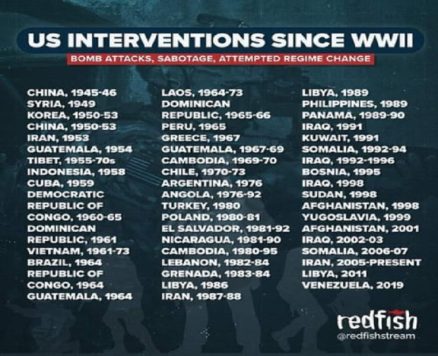
To be absolutely clear, India is not engaging in a so-called “explicit strategic alignment” with Russia, it’s simply advancing its objective national interests by remaining neutral in the Ukrainian Conflict and refusing to sacrifice its own for America’s sake. By default, however, the zero-sum unipolar hegemonic perspective embraced by US strategists influences them to regard this balanced policy as supposedly “taking Russia’s side” in the New Cold War. This false assessment is then in turn incorporated into its policy formulation towards that country, thus resulting in Deese’s ominous threat. Given the US’ decades-long track record of betraying former partners in the worst ways possible by orchestrating regime changes and even waging Hybrid Wars against them, India should be very concerned by what he just said.
America seems to be preparing for a fundamental change in its relationship with India, which will certainly affect the balance of interests in Eurasia. Thus far, New Delhi has been doing its utmost to retain that balance between itself, Russia, and China, ergo its policy of principled neutrality in order to ensure that Moscow doesn’t become disproportionately dependent on Beijing in response to the US-led West’s unprecedented pressure campaign. Nevertheless, India also hoped to retain excellent relations with the US at the same time in order to further synchronize the geo-economic aspects of their respective Indo-Pacific strategies. This grand strategic balancing act is now at risk of becoming unbalanced if the US unilaterally decides to worsen relations with India.
The form that this could take remains unclear, but the reader should remember that an intensification of information warfare against India as well as potential economic warfare and possibly even other more dangerous forms of Hybrid Warfare can’t be discounted due to the US’ track record. Security threats will spike in the event that the Pakistani and/or Sri Lankan governments are overthrown throughout the course of the ongoing “South Asian Spring” regime change campaign that the US has unleashed throughout the region. With these forecasts in mind, it’s of the highest importance that the South Asian states seriously consider reviving the South Asian Association for Regional Cooperation (SAARC) in order to advance “regional solutions for regional problems” and thus thwart the US’ plots.
Andrew Korybko is an American political analyst.
Russia responds to Human Rights council expulsion threat
Samizdat | April 7, 2022
The possible suspension of Russia from the UN Human Rights Council threatens to destroy “the basement of current multilateral system,” First Deputy Permanent Representative to the UN Dmitry Polyanskiy said ahead of Thursday’s vote by the organisation’s General Assembly (UNGA) on the matter.
Polyanskiy wrote on Telegram that this is a “premeditated tactical move” which, in his opinion, has nothing to do either Russia’s attack on Ukraine nor with alleged human rights violations by Moscow, as these claims “are far from being verified and proven.” However, he warned, the motion, if accepted, “risks devastating consequences for the UN System.”
“Russia plays an important ballancing role, its removal from HRC will deprive developing countries of a vocal and powerful defender. That’s why Western countries are keen to do it and strike the ballance [sic] in their favor,” the official explained.
In Polyanskiy’s words, the West is trying “to undermine UN institutions behind the smokescreen of punishing Russia.” “By doing so they risk to destroy the basement of current multilateral system which emerged after WW2 and has been saving the world from WW3,” he underlined.
He also pointed out to the fact that in 2018, during Donald Trump’s presidency, the US withdrew from the council and “consistently belittled its role.”
Therefore, Polyanskiy argues, Washington “can’t be considered a champion of the body.
“And knowing the bleak US human rights record and the shameful practice [of] blackmailing [the] ICC (International Criminal Court ) for trying to make US soldiers accountable for their heinous crimes abroad, Washington is the last one to be moralizing others on Human Rights,” he wrote.
Moscow’s diplomat expressed hope that during the upcoming “extremely hypocritical” show Russia’s colleagues from, what he called, the “remaining independent countries” would remember about all these facts.
The move to expel Russia from the council came shortly after Kiev published images of dead bodies in the Ukrainian town of Bucha, northwest of the capital and called them evidence of genocide perpetrated by Russian troops. Moscow denied the allegations and said the Ukrainian government was manipulating public opinion with staged scenes.
The resolution which was endorsed by Western nations before any independent investigation could take place, expresses “grave concern at the ongoing human rights and humanitarian crisis in Ukraine, particularly at the reports of violations and abuses of human rights and violations of international humanitarian law by the Russian Federation, including gross and systematic violations and abuses of human rights.”
To suspend a state from the UN Human Rights Council a two-thirds majority vote by the 193-member General Assembly is needed. Russia’s envoy to the UN Vassily Nebenzia during a UN Security Council meeting on Tuesday called the suggestion to kick Russia out from the council “unbelievable” and expressed hope that “UN colleagues will not allow themselves to be manipulated and will not play along with Washington in its extremely dangerous undertaking.”
The Kremlin’s spokesperson Dmitry Peskov, in his turn, said that the work of the council and UN institutions is “unthinkable without the participation of Russia.”
Moscow attacked its neighbor in late February, following Ukraine’s failure to implement the terms of the Minsk agreements signed in 2014, and Russia’s eventual recognition of the Donbass republics of Donetsk and Lugansk. The German and French brokered protocols had been designed to regularize the status of those regions within the Ukrainian state.
Russia has now demanded that Ukraine officially declare itself a neutral country that will never join the US-led NATO military bloc. Kiev insists the Russian offensive was completely unprovoked and has denied claims it was planning to retake the two republics by force.
Russia willing to investigate Bucha’s tragedy
By Lucas Leiroz | April 5, 2022
The alleged massacre of civilians in Bucha is one of the most talked about topics around the world in recent hours. Russia has been repeatedly accused by Western governments and mainstream media, and there are already calls for Russian President Vladimir Putin to be prosecuted for war crimes and human rights violations. However, there is a series of controversies in the case, from possible falsifications in the images released by Ukrainian forces to incoherent information about the dates of the massacre, which demands a deep investigation.
According to the official Kremlin’s position, the Russian government categorically denies any involvement by its forces in operations that killed civilians in Bucha. Spokesperson Dmistry Peskov stated on Monday, April 4, about the case, making it clear that Moscow, in addition to denying participation in the massacre, supports the immediate launch of high-level investigations on the occurrence. The Russian authorities also committed to take the discussion forward to the UN Security Council in order conduct an international investigation in the grave tragedy.
Furthermore, Peskov made it clear that the Russian government does not trust the veracity of all the information contained in the videos and photos of dead civilians released by the Ukrainian government. There are reports from Russian experts pointing out possible forgeries and frauds in the content of the videos. Other Russian officials also commented on the case, pointing out that there is evidence that the videos were forged or performed. Russian Foreign Minister Sergei Lavrov, for example, claimed during a meeting with UN Under-Secretary-General for Humanitarian Affairs Martin Griffiths that the Ukrainian press had released fake videos about Russian operations in Bucha, and that there had been a staging organized by Kiev’s forces in the region days after the departure of Russian troops.
In the same vein, the official representative of the Russian Ministry of Foreign Affairs, Maria Zakharova, said that the videos and photos released by the Ukrainian press and the Western statements about them appear to be a “custom-made story”. Defense Minister Sergei Shoigu also spoke out, claiming that the case is a production by the Kiev regime for Western media that sounds like a provocation against Russia. Finally, the head of the Russian Investigative Committee, Alexander Bastrykin, also expressed distrust about the veracity of the material released by Kiev and requested a procedural assessment on the possible massacre of civilians.
Despite the distrust, which seems justified in the face of a long history of fake news and information warfare on the part of the NATO-Kiev axis, Moscow seems open to hearing contrary opinions, which is precisely why the government seems so interested in launching an investigation, both using its official experts and international agents convoked by the UNSC. It is possible that, in addition to the obviously fake and staged videos, there is also real material, with actual images of dead people. The Kremlin’s main point is that, regardless of whether the videos and photos are real or not, there is no Russian involvement in cases of massacre of civilians.
Considering the evident victory of the Special Operation in Bucha region, there would be no strategic advantage for the Russian military to shoot civilians, which would cause unnecessary harm to the country. Now, Zelensky, Biden and other Western leaders are calling for Putin to be condemned by international courts and planning an increase in sanctions. So, it does not seem at all reasonable that Russian forces would have deliberately planned and carried out a massacre of civilians, considering that these would be the obvious consequences of such acts.
Another point that needs to be mentioned is that there is an evident time lapse in the case. The Russians withdrew from Bucha on 30 March. The Ukrainians entered Bucha on March 31, and the “retake” of the city was announced by the mayor on the same day. Azov’s paramilitaries entered the city only on April 1. So how were the “bodies in the streets” found only on April 3?
If international society is really interested in the truth, it must heed the Russian request for an investigation at the UNSC. If Western governments refuse to cooperate with the investigation, it will be possible to conclude that they have something to hide. The UN must remain neutral and commit itself to the search for the truth of the facts, even if this truth is unpleasant for the West.
Lucas Leiroz is a researcher in Social Sciences at the Rural Federal University of Rio de Janeiro; geopolitical consultant.
Russia blasts ‘shameless US interference’ in Pakistan’s affairs
Press TV – April 5, 2022
Russia has blasted “another attempt of shameless interference” by the United States in the internal affairs of Pakistan, saying that Washington sought to punish a “disobedient” Prime Minister Imran Khan following his visit to Moscow on February 23-24.
The spokesperson for Russia’s Ministry of Foreign Affairs Maria Zakharova said in a statement issued on Monday that the political development in Pakistan “leaves no doubt” that the United States plotted to topple the government of Prime Minister Khan.
The Russian foreign office condemned the United States over its involvement in an alleged conspiracy to overthrow the Pakistani government.
“Immediately after the announcement of the working visit of Imran Khan to Moscow on February 23-24 this year, the Americans and their Western associates began to exert rude pressure on the prime minister, demanding an ultimatum to cancel the trip,” Zakharova said.
The Russian foreign office stated that US Deputy Secretary of State for South Asia Donald Lu called upon the Pakistani ambassador in Washington and subsequently called upon Ambassador Asad Majid to “condemn the balanced reaction of the Pakistani leadership to the events in Ukraine,” as evidence of American interference in Pakistan’s affairs.
“When he [Khan] nevertheless came to us, [Lu] called the Pakistani ambassador in Washington and demanded that the visit be immediately interrupted, which was also rejected,” she stated.
“According to the Pakistani media, on March 7 this year, in a conversation with Pakistani Ambassador Asad Majid, a high-ranking American official (presumably the same Donald Lu) sharply condemned the balanced reaction of the Pakistani leadership to the events in Ukraine and made it clear that partnerships with the United States are possible only if Imran Khan is removed from power,” Zakharova said.
She added that further development of the situation in Pakistan left no doubt that Washington “decided to punish the ‘disobedient’ Imran Khan,” for not condemning the Russian military action in Ukraine as was demanded by the US.
“This is another attempt of shameless US interference in the internal affairs of an independent state for its own selfish purposes. The above facts eloquently testify to this,” Zakharova said.
“The [Pakistan] prime minister himself has repeatedly stated that the conspiracy against him was inspired and financed from abroad. We hope that Pakistani voters will be informed about these circumstances when they come to the elections, which should be held within 90 days after the dissolution of the National Assembly,” she said.
Addressing a large rally in the capital Islamabad last week, Prime Minister Khan accused an unnamed “foreign power” – in a clear reference to the United States – of funding a “conspiracy” to topple his democratically-elected government.
He said the “foreign power” sent millions of dollars to opposition parties to launch a no-confidence vote against him in the parliament.
On Sunday, members of Pakistan’s parliament chanted “Death to America” as they rejected a no-confidence vote, which sought to oust Khan, saying “foreign powers” were interfering in the country’s democratic process.
The National Assembly deputy speaker dismissed the no-trust move against the prime minister, terming it as “contradictory” to Article 5 of Pakistan’s Constitution.
Suri said that the motion was presented on March 8 and should be conducted according to the law and the Constitution, stressing, “No foreign power shall be allowed to topple an elected government through a conspiracy.”
The Pakistani president later dissolved the National Assembly on Khan’s advice.
Washington nudges Moscow toward default
Samizdat | April 5, 2022
The US authorities have stopped the Russian government from paying holders of its sovereign debt more than $600 million from reserves frozen in American bank accounts.
“Russia must choose between draining remaining valuable dollar reserves or new revenue coming in, or default,” a US Treasury spokesperson said on Monday as the largest of the payments came due, including a $552.4 million principal payment on a maturing bond.
An $84 million coupon payment was due on the same day on a 2042 sovereign dollar bond.
JPMorgan, which had been processing payments as a correspondent bank heretofore, was stopped by the US regulator, according to a source familiar with the issue, as cited by Reuters. Now Russia has a 30-day grace period to make the payment.
Russia’s foreign currency reserves held by the country’s central bank at US financial institutions had been previously frozen as part of Western sanctions imposed on Moscow over its military operation in Ukraine.
However, the country was allowed to use the funds to make coupon payments on dollar-denominated sovereign debt on a case-by-case basis. Since February 24, when the operation was launched, Russia managed to make as many as five bond payments, having averted the default that was predicted by international rating agencies.
Moscow was last allowed to make a $447 million coupon payment on a 2030 sovereign dollar bond on March 31.
The sanctions-hit country has a total of 15 international bonds outstanding with a face value of around $40 billion.
Ukraine stages more ‘killings’ of civilians: Russia
Samizdat | April 5, 2022
Ukrainian security services have staged more ‘killings’ of civilians in several towns and villages to make headlines in the Western media and accuse Moscow of war crimes, Russia’s Defense Ministry claimed on Tuesday.
Moscow insists that the same tactics have been used by Kiev to blame Russian forces for atrocities in the town of Bucha last week.
“The troops of the 72nd Ukrainian Main Center for Psychological Operations conducted another staged filming of civilians allegedly killed by violent actions of the Russian armed forces in order for it to be distributed through the Western media,” the ministry’s spokesman Major General Igor Konashenkov said during a briefing.
According to “confirmed information,” the filming took place in the village of Moschun some 23km northwest of the Ukrainian capital Kiev on Monday, he stated.
Similar false flag operations have been carried out by the Ukrainian side in the cities of Sumy, Konotop and elsewhere, Konashenkov added.
On Saturday, Ukraine distributed graphic footage of multiple corpses lying in the streets of the suburban town of Bucha northwest of Kiev, saying that they were executed by Russian troops.
Moscow, which insists that it is not targeting civilians during its operation in Ukraine, has rejected those accusations as a provocation and a false flag operation by Kiev.
It pointed out numerous inconsistencies in the Ukrainian story, including the fact that the video emerged several days after the Russian forces withdrew from Bucha, and that the local mayor didn’t mention any killings in his video address declaring the “liberation” of the city.
Despite Russian arguments and Moscow’s attempt to call a UN Security Council session, the West has immediately picked, who to blame for the purported atrocities. US President Joe Biden has demanded a “war crimes trial” for his Russian counterpart Vladimir Putin and the EU promised to send its experts to aid Ukrainian authorities in collecting evidence at the site.
Fake news in Kiev heralds cruel April
BY M. K. BHADRAKUMAR | INDIAN PUNCHLINE | APRIL 4, 2022
An indignant Moscow has angrily demanded a United Nations Security Council meeting on Monday over the allegations of atrocities by Russian troops in areas around Kiev through the past month. Prima facie, this allegation is fake news but it can mould misperceptions by the time it gets exposed as disinformation.
A Tass report says: “The Russian Defense Ministry said on Sunday that the Russian Armed Forces had left Bucha, located in the Kiev region, on March 30, while “the evidence of crimes” emerged only four days later, after Ukrainian Security Service officers had arrived in the town. The ministry stressed that on March 31, the town’s Mayor Anatoly Fedoruk had confirmed in a video address that there were no Russian troops in Bucha. However, he did not say a word about civilians shot dead on the street with their hands tied behind their backs.”
Even more surprising is that within minutes of the “breaking news”, western leaders — heads of state, foreign ministers, former politicians — popped up with statements duly kept ready and only based on the videos, seconds-long videos and a clutch of photos, ready to pour accusations. No expert opinion was sought, no forensic work was done, no opportunity given to the accused to be heard.
French President Emmanuel Macron broke his election campaign where he’s in a dead heat with Marine Le Pen for reelection in next Sunday’s poll to brand the alleged Russian atrocities as “war crime”. So did German Chancellor Olaf Scholz who is in big trouble too as Germany is posting inflation at +7.3 percent in March.
There’s nothing unusual about beleaguered politicians catching hold of bogeymen. Intelligent minds like Macron and Scholz’s must be realising by now their flawed policies leading inexorably to such a strategic defeat at the hands of Russia. But the big question is: Why such theatrics just at this point?
The fake news surfaced even as the Phase 2 of Russia’s special operation is slated to begin within the week in the eastern Donbass region. Something like 60-80000 Ukrainian troops, rated to be the best units of the armed forces, have been encircled in Donbass.
The Russian feint paid off in pinning down the Ukrainian forces in Kiev through past month. By the time the truth dawned on the Kiev set-up (and their western “advisors), the damage was done. The enormity of the resultant situation needs some explanation.
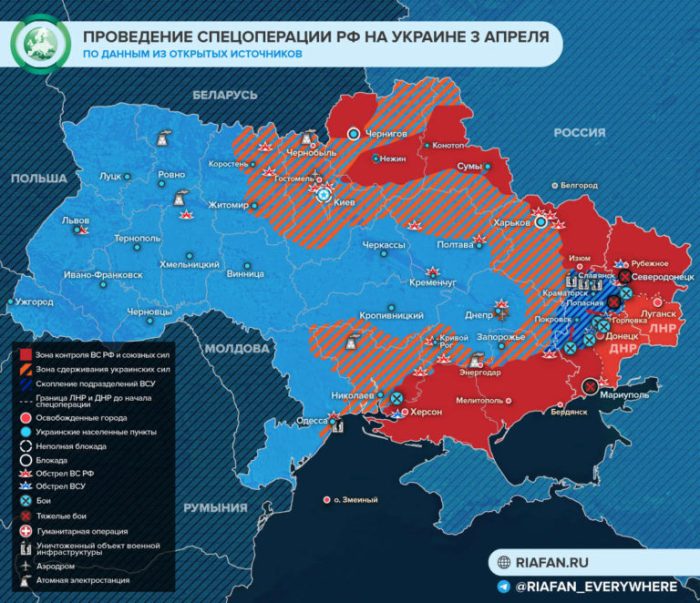
The above map reproduced from the Novosti (unfortunately, in Russian language) on the exact ground situation as of April 3 and the commentary by Ivan Andreev, an experienced war correspondent who covered the Russian operations in Syria, gives the salience of the cauldron in Donbass where the crème de la crème of the Ukrainian forces numbering several divisions are entrapped, isolated by opposing forces from their logistical base and other friendly forces.
The cauldron is fairly large, marked in blue and black stripes on the map in the upper reaches of the Donbass region in the direction of Kharkiv. The massive Russian column that retreated from the Kiev region a week ago is manoeuvring in a big arc toward that cauldron bypassing Chernihiv in the north and the cities of Sumy and Kharkiv (near the Russian border in the northeast).
The Ukrainian forces are well-armed and have fortified themselves heavily but are unable to escape from the entrapment. Nor is it feasible for Kiev to send reinforcements as the countryside to the west consists of largely open farmlands (all the way to the Dniepr River). The Russians have air supremacy and it is impossible to hide any enemy movements from their roving eyes.
The Russian forces have put out of action all nearby airports and destroyed the nearby Ukrainian oil reserves systematically through Phase 1 of the operation. As I wrote in a previous blog, three days ago, Russian forces dealt a devastating blow: “Notably, the Mirgorod military airfield in central Poltava Region, a strategically important hub, has been taken out of action and several Ukrainian combat helicopters and aircraft found in its camouflaged car parks, as well as fuel and aviation weapons depots have been destroyed.”
Equally, Kharkiv has been surrounded and “in a high-precision strike with the Iskander operational-tactical missiles on the defence headquarters in the city on Thursday, more than 100 nationalists and mercenaries from Western countries were confirmed as killed.”
Nonetheless, the Ukrainian forces are expected to put up a good fight rather than surrender — although surrounded, without air cover, and having no scope to rotate forces or enough fuel to engage in maneuver warfare and with ammunition running out.
To be sure, a major battle is approaching, the most decisive in the entire Russian special operation so far. The catch is, the cauldron also has plentiful settlements of ethnic Russian population (including Russian passport holders) and the offensive will be a long grind patiently executed to avoid civilian casualty or destruction of civilian infrastructure.
That is to say, Phase 2 may last anywhere up to a month or so to be completed. Make no mistake, the Russians have to win here (which they will) as they will also be breaking the back of the Ukrainian armed forces. Despite all the bluster by Zelensky, Kiev will realise the enormity of the defeat and his western mentors will see the writing on the wall too.
To be sure, a whole month lies ahead where the western strategy will be to incessantly manufacture fake news, intensify the information war. Even some false flag operation may be staged under the supervision of western intelligence operatives.
In a worst case scenario, Kiev may even play its last card — chemical weapons. Russia has publicised details of locations where Ukraine has kept stockpiles of chemical weapons. The US is known to have supplied as military aid special gear (gas masks, protective clothing, etc.) to cope with chemical weapons and given special training for collective protection.
The alacrity with which Macron and Scholz consumed the fake news is a harbinger of a new phase in the information war. Succinctly put, there is a sober awakening in Paris and Berlin that the Russian operation is successfully meeting the set objectives.
“April”, TS Eliot wrote in his masterpiece The Wasteland, “is the cruellest month, breeding Lilacs out of the dead land, mixing Memory and desire, stirring Dull roots with spring rain.” But the dark irony of this year’s “Aprilness” is going to be that the fecundity and renewal here will be about Russia’s regeneration in a world of both history and the myths spawned by quarantined western minds.
Russia demands UN Security Council meeting over Bucha massacre
Samizdat | April 3, 2022
Moscow will convene an extraordinary meeting of the UN Security Council over the incident in the Ukrainian town of Bucha, Russia’s deputy permanent representative with the organization, Dmitry Polyansky said Sunday. Ukraine has accused Russia of massacring civilians in the town, while Moscow dismissed the incident as staged by the Kiev forces.
“In light of the blatant provocation by Ukrainian radicals in Bucha, Russia has demanded a meeting of the UN Security Council to be convened on Monday, April 4. We will bring to light the presumptuous Ukrainian provocateurs and their Western patrons,” Polyansky said in a Telegram post.
Graphic footage from Bucha, a town to the northwest of Kiev, emerged over the weekend, showing multiple bodies clad in civilian clothing scattered around. Kiev was quick to blame Russian military for the incident, with Ukrainian foreign minister Dmytro Kuleba alleging it was a “deliberate massacre”.
“The Bucha massacre was deliberate. Russians aim to eliminate as many Ukrainians as they can. We must stop them and kick them out. I demand new, devastating G7 sanctions NOW,” Kuleba said on Twitter.
Top Western politicians were quick to back and amplify Kiev’s claims, with NATO chief Jens Stoltenberg branding the incident “a brutality against civilians we haven’t seen in Europe for decades.”
“And it’s horrific, and it’s absolutely unacceptable that civilians are targeted and killed, and it just underlines the importance of, that this war must end. And that is President Putin’s responsibility, to stop the war,” Stoltenberg told CNN.
Similar stance has been voiced by many other officials, with some explicitly pinning the blame for the ‘massacre’ on Moscow. French President Emmanuel Macron said, for instance, that “Russian authorities will have to answer for these crimes”.
Moscow, however, has firmly rejected any involvement, accusing Kiev of staging the whole affair to frame Russian troops. The country’s Defense Ministry said that Russian troops pulled out of the town on March 30, with local mayor confirming it in a video address a day after without mentioning “any local residents laying shot in the streets.” The purported “evidence” of the incident emerged only four days after the withdrawal, when Ukrainian intelligence and “representatives of Ukrainian television arrived in the town,” the military added, stressing that multiple inconsistencies show that the affair “has been staged by the Kiev regime for Western media.”
NATO reveals scale of its involvement in training Ukrainian troops
Samizdat | April 3, 2022
Several NATO states have been providing military training to the Ukrainian army “for years” prior to Russia’s military campaign against the eastern European country, the alliance’s secretary general has said.
Speaking to CNN’s Dana Bash on Sunday, Jens Stoltenberg said that “NATO allies have supported Ukraine for many, many years,” adding that military aid has been “stepped up over the last weeks since the invasion.” The official clarified that “NATO allies like the United States, but also the United Kingdom and Canada and some others, have trained Ukrainian troops for years.”
According to Stoltenberg’s estimates, “tens of thousands of Ukrainian troops” had received such training, and are now “at the front fighting against invading Russian forces.” The secretary general went on to credit the Brussels-based alliance with the fact that the “Ukrainian armed forces are much bigger, much better equipped, much better trained and much better led now than ever before.”
In fact, Stoltenberg’s remark came after the host asked him to comment on recent reports that the alliance was allegedly planning to provide Ukraine with “Soviet-era tanks,” despite French President, Emmanuel Macron last month describing such a move as a “red line” which could potentially make NATO a “co-belligerent in the war.” When asked the same question again directly, the NATO chief refused to either confirm or deny the claims, adding that it would be unwise for him to go into detail regarding the kind of military aid the alliance was supplying Ukraine with.
Stoltenberg simply noted that “allies provide support with modern advanced weapons systems,” which are “making a difference on the battlefield every day.” The official emphasized that it was thanks to the “systems they receive from NATO allies” that the Ukrainian military was “able to take out Russian armored vehicles, Russian planes.” He also noted that NATO member states had confirmed, during the March 24 summit in Brussels, their commitment to providing support to Kiev.
Since February 24, when Russian forces crossed the Ukrainian border, several NATO member states, including the US, UK, Germany and a few others, have been delivering large amounts of ammunition and lethal weapons to Ukraine, including anti-tank and anti-aircraft missile systems.
Following the coup in 2014, several consecutive administrations in Kiev had pronounced NATO membership as one of the key foreign-policy objectives of Ukraine. The country’s military has participated in a number of joint military drills with alliance forces.
Russia considers the prospect of NATO military bases popping up on its border as a threat to its security.
Ukraine has now apparently given up on its NATO aspirations, as members of both Russian and Ukrainian negotiating teams have revealed that the two warring nations agreed in principle to a future neutral status for Ukraine, akin to those of Austria and Sweden.
Featured Video

AIDS Inc. by Gary Null (2007)
or go to
Aletho News Archives – Video-Images
From the Archives
Clash of Civilization, Iran Part II
By Jamal Kanj – Intifada-Palestine.com – January 14, 2011
Israel’s survival kit is: perpetuate conflict, insecurity to rationalize collective hate and finally playing victim.
Devoid of conflict, Israel implodes internally; without hate, Zionism loses its justification; and playing eternal victim to continue blackmailing the West. Absence of this holy trinity, Israel ceases to exist.
From its inception, the house of Zion has mastered exploiting adversarial powers to advance Israel’s cause. For instance, their influence over the Democratic Party in the US began with President Truman’s bid for 2nd term election in 1948.
Responding to strong opposition from Secretary of State General George Marshall and Department experts urging against recognition of Israel, President Truman replied: “I’m sorry gentlemen but I have to answer to hundreds of thousands [Jewish voters] who are anxious for the success of Zionism. I do not have hundreds of thousands of [voting] Arabs among my constituents”
Zionists influence over liberal American politics was matched with the doctrinal school of Conservative theoreticians aligning the Republican Party’s platform with Israel’s objectives. The Neoconservative Zionists, coined Zioncons, invented the “Clash of Civilization” concept to fight Israel’s wars. … continue
Blog Roll
 Aletho News
- Merck Virologists Admitted to Falsely Certifying Vaccine Efficacy
- Mandatory Folic Acid for every man, woman & child
- Pro-Palestine protesters arrested outside UK’s ruling Labour Conference in Liverpool
- Mauritius denies landing permit to flight from Israel, forcing cancellation: Tour operator
- Israeli finance minister calls for genocidal war on West Bank, annexation of south Lebanon
- 12 Things Your Psychiatrist Was Trained Not to Tell You
- From Unipolar Universalism to Multipolar Civilizational Distinctiveness
- RSF military group defects, joins Sudanese army: State media
- Ireland goalkeeper refuses to play ‘Israel’ as squad weighs boycott
- China pushes back against US on Cuba, Iran
- If Americans Knew
- Israel forces Gazans to live in constant peril – Daily Update
- Deconstructing Netanyahu’s pants-on-fire UN rant – Daily Update
- Trump betrayed voters with his campaign lies and prioritized a foreign country once he took office
- Netanyahu calls Israel’s war in Gaza ‘opposite of genocide’ in UN speech to near-empty hall
- Settler Kidnappings: Torture, Sexual Abuse and Terrorisation of Palestinian Abductees as Israel Deepens Annexation of West Bank
- Gaza winter nears as 162,000 tents become unusable, raising fears of humanitarian crisis
- Netanyahu says, “It’s the opposite of genocide”; UN says Gaza economy is world’s ‘most severe crisis on record’ – Daily Update
- Israel’s US-Backed Assault on Gaza Has Created the ‘World’s Most Severe Economic Crisis on Record’: UN
- ‘Protecting U.S. Citizens’… From Israel
- ‘This is where I live now, the back of a truck’: a day in the life of a grandmother in Gaza
- No Tricks Zone
- New Study: Earth And Venus Surface Warmth Largely Explained By Convection And Lapse Rate, Not CO2 Or Radiation
- 2025 Nature Paper Claiming Worsening Global Drought Gets RETRACTED …Heavily Flawed
- New Study: ‘Global Drought Shows No Detectable Recent Acceleration Under Climate Warming’
- Economic Masterminds: German Socialists Suggest Taxing Productivity Gains Stemming From Using AI
- The South China Sea Has Not Been Cooperating With The Climate Change Narrative
- Energy Crisis: Germany Enters Heating Season With Historically Low Gas Reserve Fill Levels
- New Study: The Antarctic Ice Sheet Gained Mass From 2020-2024 Due To Staggering Snow And Ice Accumulation
- Study: Ocean Heating Rates From Thousands Of Years Ago ‘Dwarf’ Modern Ocean Heating Rates
- Climate Extremists Target, Attack Large-Scale Power Grid Infrastructure In Germany!
- New Study: Antarctic Ice Melt Has Contributed Less Than 1 Centimeter To Sea Level Rise In The Last 30 Years

