Red Alert: What seeing the war in Syria taught me about US/Western government and media propaganda
By Janice Kortkamp | Ron Paul Institute | March 29, 2022
The Syrian war was the first fully observed conflict on social-media and the ability to connect directly with Syrians real time as they were experiencing the crisis was unprecedented. This created a unique opportunity to get unfiltered information directly from all sides of the conflict to gain insights and understanding. The results have helped shake off the control by conventional news media over foreign events reporting and analysis. While this has created some chaos, valuable lessons have been (or should have been) learned.
I began researching Syria and the war there in late 2012, and have made seven extended journeys traveling around during the war from 2016 through 2019, meeting with hundreds of Syrians from different backgrounds, walks of life, and opinions as a 100 percent non-affiliated, unpaid, and self/crowd-funded, independent citizen-journalist.
It became clear that what’s been happening in Syria was not a spontaneous, organic, popular uprising against a tyrant, but a proxy regime-change attempt war in the works since the mid 2000’s against the quite popular Assad. This effort was spearheaded by the US, UK, France, and Israel, using Sunni violent fundamentalists and extremists (unpopular with the majority of Syria’s Sunni population as well as minority groups) armed and funded by the West and regional allies of Saudi Arabia, Turkey, and Qatar to start the violence and do the dirty work. The basic character of the rebel groups was apparent from the beginning: Syrian and non-Syrian fighters most Westerners would call terrorists and be screaming for their government to crush if the same heavily armed groups had taken over their cities, towns, and suburbs by massacring, beheading, torturing, kidnapping, and raping.
Syrians often remarked to me that before the war their country was “almost a paradise.” The middle class was the largest economic sector and growing. Religious harmony was the norm and Christians there were doing well. International investment was increasing as were the tourists. Women were equal or outnumbering men in the universities and present in leadership roles in nearly all aspects of society. Syria had made the “Top 5” list of the world’s most personally safe countries. President Assad had brought the Internet into the country and kept it open throughout the war and the people there knew all that was being said in the West about the crisis.
This doesn’t mean Syria was perfect and Assad beloved by all Syrians. There were and are many problems there which are directly attributed to the government with corruption always being number one on the list of grievances. These internal issues have been exacerbated by the war.
Now, after 11 years of war, 90 percent of Syrians are poor, many are starving; the economy is shattered. Between the fighting, US/Western sanctions, loss of production capability (though an impressive number of factories have been rebuilt), shortages of electricity and fuel, the black market and smuggling, dearth of employment opportunities, Covid-19, and the economic meltdown in Lebanon, the situation seems destined to remain desperate for the foreseeable future. The pressure by the US and most allies continues including increased sanctions, and three on-going illegal occupations: US has seized control over 1/3 of the country (the part with the richest oil fields); Turkey holds much of the north; and Israel is still occupying the Golan while making routine air strikes in Syria with no condemnation. There are numerous terrorist groups including ISIS cells and Hay’at Tahrir al-Sham (HTS, formerly Jabhat al-Nusra, the al Qaeda affiliate) to get rid of in the northeast and Idlib.
As for Russia’s role in Syria, I’ve watched it closely – including observing some Russian military operations personally in Deir Ezzor, Homs, and Palmyra. Russia and Iran are in Syria legally, asked to join in the fight against ISIS and al Nusra by the Syrian government.
From 2011 through 2015 the situation was dire. In 2012 the US resolution at the UN called for President Assad to step down and both Russia and China vetoed it. The US and UK responded with “fury” according to The Guardian, while Syrians were out in the streets cheering. When Russian troops came in September of 2015, the priority was to put a stop to ISIS operations in the northeast. Massive ISIS oil convoys were taking the stolen oil up to Turkey, bringing the terrorist army equally massive amounts of money to use for their rampages while, according to a leaked, verified audio tape of John Kerry speaking with the Syrian opposition, the US was “watching ISIS grow” hoping the pressure would get Assad to negotiate. Instead, an appeal was made to Putin and answered. Within a few months, the ISIS oil convoys had been reduced significantly, cutting that cash flow.
By the end of 2016 total chaos had been replaced with more established battle lines and though violence was still occurring everywhere, there was some order. Palmyra was liberated from ISIS in the spring of 2016, after which the Russians and Syrians put on an orchestra concert to rededicate the spectacular archaeological site to culture; Western governments and media were not enthusiastic. It fell again to ISIS and many of the most important buildings were destroyed by the terrorists. The battles for Palmyra would have been the perfect opportunity to actually use chemical weapons – to protect that prized site and with ISIS forces isolated in the desert, however the fighting raged with conventional weapons and casualties were very high. In December 2016, Aleppo was freed from the terrorist groups that had been holding the eastern half of the city for years by the Syrian Army and its allies – with the ones fighting the terrorists being treated as though they were worse than ISIS in western media. The terrorist groups backed by the US and allies included the likes of Nour al din al Zenki that grabbed the young boy, Abdullah Issa, out of hospital with the IV still in his arm and beheaded him in the back of a truck on video while laughing. Al Zenki had received advanced weapons and other support by the US.
By October of 2017 when I was in Palmyra, Deir Ezzor and al Mayadeen, most of that area was freshly liberated from ISIS by the combined Syrian, Russian, Iranian, Iraqi, and Hezbollah forces. ISIS was still all around but its backbone of cities down the Euphrates had been severed. In Homs, I observed the transportation of armed groups twice from the Al-Waer suburb, overseen by the Russians. In addition, Russian de-mining efforts have insured relative safety for civilians returning to their homes after areas have been liberated.
To summarize, in my experience the Russians have indeed been effective in the fight against ISIS and al Qaeda while displaying professionalism, precision, and minimizing civilian casualties. The US has been using ISIS as a pretext for its own completely illegal occupation of the entire northeast third of Syrian lands, and has often been helping or working directly on behalf of the al Qaeda affiliate and similar terrorist groups.
However, the US/Western media is still saying the same things they’ve said since 2012, if anything entrenching deeper in the assertions of the US and other western governments. All major articles and stories are still about “the tyrant Assad killing his own people”; and the great majority of the Syrian people who supported their leader and army were made invisible. That support ranged from total devotion to begrudging acceptance because the alternative, Syria falling to the terrorists promoted by the West, was unthinkable. Anyone offering evidence and opinion different from that of the accepted narratives isn’t just ignored – they’re treated as enemies and attacked by the media.
The Russian invasion of Ukraine is still in the early stages and although I’ve been tracking the situation since 2014, I certainly don’t to know all of what’s happening or will happen. To sort fact from fiction from all sides will be a painstakingly long process yet there is great urgency to avoid as much devastation as possible. War is painful, the most painful thing. It truly does hollow out souls as it lays waste to lands and lives and I hate it all, but I’ve seen the wall go up already which prohibits looking at the other side, hearing what their grievances and concerns are. That wall protects the easy to memorize, constantly repeated, approved talking points: “pre-meditated”, “unprovoked”, “unjustified” and that wall is already considerably taller, deeper, and wider than it’s been about Syria. For me, this is when the red light starts flashing, the alarm begins sounding, and I’m on full alert for more gross oversimplifications, exaggerations, unproven allegations, and outright falsehoods.
Copyright © 2022 by Ron Paul Institute
Sanctioning Russia could topple the West
A new Cold War would cripple the American empire
BY THOMAS FAZI | UnHerd | March 22, 2022
The West, following the lead of the United States, has reacted to Russia’s invasion of Ukraine by introducing a “crippling” regime of sanctions. It is a “total economic and financial war” aimed at “caus[ing] the collapse of the Russian economy”, the French finance minister Bruno Le Maire candidly admitted. And yet many of the current sanctions appear to be run-of-the-mill restrictions used against several countries in the past. A number of them — including export bans and the freezing of certain assets — have been imposed on Russia since its annexation of Crimea in 2014. Even the much-discussed exclusion of a number of Russian banks from the main international banking message system, SWIFT, is not new, having already been used against Iran, with mixed results.
The most controversial aspect of the new sanctions regime is without a doubt the freezing of Russia’s offshore gold and foreign-exchange reserves — about half of its overall reserves — but even this is not unprecedented: last year, the US froze foreign reserves held by Afghanistan’s central bank in order to prevent the Taliban from accessing its funds; the US has also previously frozen the foreign-exchange reserves of Iran, Syria, and Venezuela.
So, taken individually, these measures are not as exceptional as they’ve been portrayed. However, never before have so many sanctions been deployed at once: there are already 6,000 various Western sanctions imposed on Russia, which is more than those in existence against Iran, Syria and North Korea put together. Even more importantly, none of the previous targets of sanctions were remotely as powerful as Russia — a member of the G20, and the world’s largest nuclear power.
Likewise, none of the 63 central banks that are members of the Bank for International Settlements (BIS) in Basel — known as the central bank of central banks — has ever been the target of financial sanctions. The BIS itself has even joined in on the sanctions in order to prevent Russia’s access to its offshore reserves. This really is unprecedented: since its establishment in 1931, the BIS had never taken such a measure, not even during World War II.
So what should we expect from the sanctions? Western pundits and commentators have little doubt: the sanctions will hamstring the Russian economy, sow discontent among the Russian people and elites alike, and possibly even cause the downfall of the Putin regime. At the very least, we’re told, they will hinder Russia’s war efforts. But history suggests otherwise: see Iraq, or more recently Iran. Far more likely is that this turns out to be the latest Western strategic miscalculation in a long list of strategic blunders, of which the United States’ inglorious withdrawal from Afghanistan is just the most recent example.
After all, Russia has been preparing for this moment for quite some time. Following the first wave of Western sanctions, in 2014, and partly in retaliation against them, Putin embarked on what analysts have dubbed a “Fortress Russia” strategy, building up the country’s international reserves and diversifying them away from US dollars and British pounds, reducing its foreign exposure, boosting its economic cooperation with China, and pursuing import substitution strategies in several industries, including food, medicine and technology, in an effort to insulate Russia as much as possible from external shocks.
True, Putin made the mistake of leaving around half of those reserves parked in foreign central banks, resulting in these now being confiscated. But nonetheless Russia still has access to more than $300 billion in gold and foreign-exchange reserves — more than most countries in the world and more than enough to cushion any short-term fall in exports, or prop up the rouble (for a while).
Moreover, the Russian central bank reacted to the sanctions by stopping capital flows out of Russia and nationalising the foreign exchange earnings of major exporters, requiring Russian firms to convert 80% of their dollar and euro earnings into roubles. It also raised interest rates to 20% in an effort to attract foreign capital. These measures are aimed at bolstering the rouble’s value and providing a flow of foreign exchange into the country. They appear to be working: while the rouble is around 40% of its value since the start of the conflict, the Russian currency’s free-fall seems to have come to a halt for now, even registering an uptick over the past two weeks. For the time being, Russia’s financial account — the difference between the money flowing in and out of the country — is far from disastrous.
Let’s not forget that the main source of Russia’s foreign-exchange reserves — oil and gas exports — has been excluded from the sanctions, for obvious reasons: for most European countries, Russia accounts for a huge part of their oil and gas imports (and other staple commodities), and there’s simply no way of replacing those energy sources from one day to the next.
In short, Russia runs no risk, in the short term, of running out of reserves and not being able to pay for its imports. But even assuming that the West decided to put a stop to all its imports from Russia overnight, there’s no reason to believe that this would bring the Russian military machine to a halt. The notion that “we are financing Russia’s war by purchasing gas and oil”, as the Finnish prime minister recently stated, is fundamentally misplaced.
As the economist Dirk Ehnts has observed, the Russian military machine, for the most part, doesn’t rely on imports (if anything, Russia is an arms exporter). It is sourced domestically and, like the salaries of its soldiers, is paid for in roubles, which the Russian central bank can create in an unlimited quantity, just as the Bank of England does when it comes to pounds.
Equally unfounded are rumours of an impending Russian default. In recent years, the Russian government has taken steps to reduce its foreign liabilities: its foreign currency-denominated debt amounts today to about $40 billion — a tiny amount compared with the size of Russia’s yearly exports of more than $200 billion in oil and gas. Any decision to default would be entirely political. We mustn’t forget that the very creditors expecting to be paid back in dollars are the same that have just confiscated a good part of Russia’s dollars — if the latter were to default on their payments, it would be an even bigger problem for their Western creditors. As with Russia’s oil exports, hurting Russia inevitably means hurting ourselves as well.
Moreover, thanks to the Russian government’s successful efforts at boosting domestic agricultural production, domestic food production now accounts for more than 80% of retail sales, up from 60% in 2014. This means Russia is largely self-sufficient food-wise. So even if its export revenues were to plummet (which is unlikely), the country wouldn’t go hungry — unlike the rest of the world — and would most likely be able to continue to finance its war efforts.
Might a selective ban on exports of specific high-tech Western components, some of which are bound to be used in Russia’s defence industry, prove more effective? Possibly. But Russia has been reducing the dependence of its military-industrial apparatus on foreign components and technologies for years. More importantly, both hypotheses — that Russia’s economy and military can be brought to their knees through export and/or import bans — rest on the flawed assumption that the whole world is on board with the sanctions. But that is far from the case.
While most of the world’s nations — 143 out of 193 — voted for a resolution in the UN’s General Assembly condemning Russia, the 35 countries that abstained include China, India, Pakistan and South Africa, as well as several African and Latin American states. These and many more countries — including several that voted in favour of the resolution, such as Brazil — have strongly criticised the sanctions against Russia and can be expected to continue trading with Putin. It’s frankly very hard to call Russia isolated when some of the world’s largest economies have refused to support the West’s sanctions regime.
China, in particular, has been very vocal in its support of Russia. Beijing is already the Kremlin’s main trading partner, and it alone can absorb huge quantities of Russian energy and commodities, as well as provide Russia with basically any industrial and consumer goods that the latter currently imports from the West. China also operates an alternative to the Western-managed SWIFT system called CIPS to manage cross-border transactions in yuan, which could allow Russia to partially circumvent the West’s financial blockade. Even though the yuan still makes up a small percentage of international transactions, its role is bound to grow rapidly in the coming years (consider the news that Saudi Arabia may start pricing its oil sales to China in the latter’s currency). All this helps explain why even Western financial analysts, such as Goldman Sachs and JP Morgan, predict a year-on-year contraction for the Russian economy of about 7% — bad, but hardly catastrophic (Covid caused a much larger drop in GDP for most countries).
However, much will depend on the policy response of the Russian government. Obviously, the withdrawal of many foreign firms and decline in foreign investments will increase unemployment. But the Russian government can cushion the blow by resorting to a “Keynesian” expansionary fiscal policy aimed at boosting domestic investment and supporting incomes. If ever there were a time for Russia to abandon its historically ultra-tight fiscal policy, as several Russian economists have been arguing for some time, it is now.
Two weeks ago, I suggested that, in the short term at least, the US will benefit from the conflict in Ukraine. In the long term, however, it is slowly becoming clear that US-led global Western order will suffer. The West’s imposition of sanctions — involving not only governments, but also private companies and even allegedly apolitical organisations such as central banks — has sent a clear message to the countries of the world: the West will stop at nothing to punish countries that step out of line. If this can happen to Russia, a major power, it can happen to anyone. “We will [never again] be under the slightest illusion that the West could be a reliable partner,” the Russian foreign minister Sergey Lavrov has said. “We will do everything so as never, in any way, to be dependent on the West in those areas of our life which have a decisive significance for our people.”
Those words are bound to reverberate across the world, with dramatic implications for the West. As Wolfgang Münchau has warned: “For a central bank to freeze the accounts of another central bank is a really big deal… As a direct result of these decisions, we have turned the dollar and the euro, and everything that is denominated in those currencies, into de facto risky assets”. At the very least, it will inevitably push countries to diversify their reserves and increase their yuan holdings, in order to loosen the West’s grip on their economies and bolster their economic resilience and self-sufficiency. Even if it doesn’t push countries straight into Beijing’s arms, as is already happening with Russia, it will likely lead to the emergence of two increasingly insulated blocs: a US-dominated Western bloc and a China-dominated East-Eurasian one.
In this new pseudo-Cold War, “non-aligned” countries could find that they are in a better position to assert their sovereignty than they were under the American global empire. Forget “the collapse of the Russian economy” — this could be the result of the West’s new economic war.
Russia states position on West’s mediation in Ukraine talks
Samizdat | March 28, 2022
Moscow is eager for a diplomatic solution to the conflict in Ukraine, but it won’t be needing any Western mediation during its talks with Kiev, Russian Foreign Minister Sergey Lavrov has said.
“We’re ready to give diplomacy a chance. That’s why we agreed to the talks, which are resuming in Istanbul,” Lavrov said during a video conference on Monday with the Serbian media. The discussions are scheduled to continue on Tuesday.
The Turkish government, which has good ties with both Russia and Ukraine, has been putting a great deal of effort into getting the two sides around the negotiating table. But there’s no need to include the EU or the US – which support Kiev in the conflict – in the peace process, according to the minister.
“There are many examples of times when the achievements of diplomacy were shattered by Western colleagues. They can’t be trusted anymore,” Lavrov opined.
“I wouldn’t want to see any shuttle diplomacy from our Western partners, because they’ve already done their ‘shuttling’ – in February 2014 in Ukraine and in February 2015 in Minsk,” he added.
In February 2014, the EU became the guarantor of the agreements between Ukraine’s then-president Viktor Yanukovych and the Maidan protesters in Kiev, Lavrov reminded viewers. “It was a pinnacle of diplomacy. But, the next morning, the opposition spat on that diplomacy, and the EU had to swallow it.”
Yanukovich ended up being deposed after violent clashes and fleeing the country, and the new Ukrainian authorities soon sent its military to the eastern regions of Donetsk and Lugansk, where most of the population refused to recognize the coup in the capital.
In September of the same year, the Minsk I agreement between the breakaway republics and the government in Kiev was achieved in the Belarusian capital of that name, having been negotiated by Ukraine, Russia, Germany, and France in the so-called Normandy Format. The deal called on the two sides to stop fighting, organize prisoner exchanges, allow deliveries of humanitarian aid, and withdraw heavy weaponry.
“The diplomacy then reached new heights in February 2015, when the agreements that were signed in Minsk ended the war in eastern Ukraine and opened the way to restoring Ukraine’s territorial integrity by granting a special status to the Donbass,” the minister continued.
The second agreement, Minsk II, introduced another ceasefire and paved the way for administrative and political reform in Ukraine as well as for autonomy and local elections in the Donbass republics. However, Kiev’s Western backers were subsequently unable to persuade the Ukrainian government to fulfil its promises.
“The European Union has proven its incompetence as an organization that is capable of fulfilling the agreements being reached,” Lavrov said.
Russia sent its troops into Ukraine over a month ago, following a seven-year standoff over Kiev’s failure to implement the terms of the Minsk agreements, and Russia’s eventual recognition of the Donbass republics of Donetsk and Lugansk.
Moscow has now demanded that Ukraine officially declare itself a neutral country that will never join the US-led NATO military bloc. Kiev insists the Russian offensive was completely unprovoked and has denied claims it had been planning to retake the two republics by force.
RAND Report Prescribed US Provocations Against Russia and Predicted Russia Might Retaliate in Ukraine
By Rick Sterling | Global Research | March 28, 2022
According to a 2019 Rand report titled “Overextending and Unbalancing Russia”, the US goal is to undermine Russia just as it did the Soviet Union in the cold war. Rather than “trying to stay ahead” or trying to improve the US domestically or in international relations, the emphasis is on efforts and actions to undermine the designated adversary Russia. Rand is a quasi-US governmental think tank that receives three-quarters of its funding from the US military.
The report lists anti-Russia measures divided into the following areas: economic, geopolitical, ideological/informational, and military. They are assessed according to the perceived risks, benefits and “likelihood of success”.
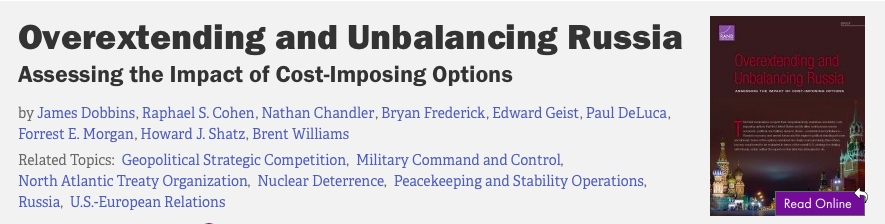
Screenshot from RAND
The report notes that Russia has “deep seated” anxieties about western interference and potential military attack. These anxieties are deemed to be a vulnerability to exploit. There is no mention of the cause of the Russian anxieties: they have have been invaded multiple times and had 27 million deaths in WW2.
Significance of Ukraine
Ukraine is important to Russia. The two countries share much common heritage and a long common border. One of the most important leaders of the Soviet Union, Nikita Khrushchev, was Ukrainian. During WW2, Ukraine was one of Hitler’s invasion routes and there was a small but active number of Ukrainian collaborators with Nazi Germany. The distance from the capital of Ukraine, Kiev, to Moscow is less than 500 miles.
For these same reasons of geography and history, Ukraine is a major component of a US/NATO effort to undermine Russia. Current Under Secretary for Political Affairs, Victoria Nuland, said that over 20 years the US invested $5 billion in the project to turn Ukraine. The culmination was a violent coup in February 2014. Since 2015, the US has been training ultra nationalist and Neo-Nazi militias. This has been documented in articles such as “U.S. House admits Nazi role in Ukraine” (Robert Parry, 2015), “The US is arming and assisting neo-nazis in Ukraine while the House debates prohibition”(Max Blumenthal, 2018), “Neo Nazis and the far right are on the march in Ukraine” (Lev Golinken in 2019) and “The CIA may be breeding Nazi terror in Ukraine” (Branko Marcetic Jan. 2022).
Rand suggested provocations
Prior to 2018, the US only provided “defensive” military weaponry to Ukraine. The Rand report assesses that providing lethal (offensive) military aid to Ukraine will have a high risk but also a high benefit. Accordingly, US lethal weaponry skyrocketed from near zero to $250M in 2019, to $303M in 2020, to $350M in 2021. Total military aid is much higher. A few weeks ago, The Hill reported, “The U.S. has contributed more than $1 billion to help Ukraine’s military over the past year”.
The Rand report lists many techniques and “measures” to provoke and threaten Russia. Some of the steps include:
- Repositioning bombers within easy striking range of key Russian strategic targets
- Deploying additional tactical nuclear weapons to locations in Europe and Asia
- Increasing US and allied naval force posture and presence in Russia’s operating areas (Black Sea)
- Holding NATO war exercises on Russia’s borders
- Withdrawing from the Intermediate Nuclear Forces (INF) Treaty
These and many other provocations suggested by Rand have, in fact, been implemented. For example, NATO conducted massive war exercises dubbed “Defender 2021” right up to Russia’s border. NATO has started “patrolling” the Black Sea and engaging in provocative intrusions into Crimean waters. The US has withdrawn from the INF Treaty.
Since 2008, when NATO “welcomed” the membership aspirations of Ukraine and Georgia, Russia has said this would cross a red line and threaten its security. In recent years NATO has provided advisers, training and ever increasing amounts of military hardware. While Ukraine is not a formal member of NATO, it has increasingly been treated like one. The full Rand report says “While NATO’s requirement for unanimity makes it unlikely that Ukraine could gain membership in the foreseeable future, Washington’s pushing this possibility could boost Ukrainian resolve while leading Russia to redouble its efforts to forestall such a development.”
The alternative, which could have prevented or at least forestalled the current Russian intervention in Ukraine, would have been to declare Ukraine ineligible for NATO. But this would have been contrary to the US intention of deliberately stressing, provoking and threatening Russia.
Ukraine as US client
In November 2021, the US and Ukraine signed a Charter on Strategic Partnership. This agreement confirmed Ukrainian aspirations to join NATO and rejection of the Crimean peoples decision to re-unify with Russia following the 2014 Kiev coup. The agreement signaled a consolidation of Washington’s economic, political and military influence.
December 2021 Russia red lines followed by military action
In December 2021, Russia proposed a treaty with the US and NATO. The central Russian proposal was a written agreement that Ukraine would not join the NATO military alliance.
When the proposed treaty was rebuffed by Washington, it seems the die was cast. On February 21, Putin delivered a speech detailing their grievances. On February 24, Putin delivered another speech announcing the justification and objectives of the military intervention to “demilitarize” and “denazify” Ukraine.
As Russian Foreign Minister Lavrov later said, “This is not about Ukraine. This is the end result of a policy that the West has carried out since the early 1990’s.”
Afghanistan again?
As earlier indicated, the Rand report assesses the costs and benefits of various US actions. It is considered a “benefit” if increased US assistance to Ukraine results in the loss of Russian blood and resources. Speculating on the possibility of Russian troop presence in Ukraine, the report suggests that it could become “quite controversial at home, as it did when the Soviets invaded Afghanistan.” (p 99 of full report)
That historical reference is significant. Beginning in 1979, the US and Saudi Arabia funded and trained sectarian foreign fighters to invade and destabilize the progressive Afghan government. The goals were to overthrow the socialist inclined government and lure the Soviet Union into supporting the destabilized government. It achieved these Machiavellian goals at the cost of millions of Afghan citizens whose country has never been the same.
It appears that Ukrainian citizens are similarly being manipulated to serve US goals.
A “disadvantageous peace settlement”
The Rand report says, “Increasing U.S. military aid would certainly drive up the Russian costs, but doing so could also increase the loss of Ukrainian lives and territory or result in a disadvantageous peace settlement.”
But who would a peace settlement be “disadvantageous” for? Ukrainian lives and territory are currently being lost. Over fourteen thousand Ukrainian lives have been lost in the eastern Donbass region since the 2014 coup.
A peace settlement that guaranteed basic rights for all Ukrainians and state neutrality in the rivalry of big powers, would be advantageous to most Ukrainians. It is only the US foreign policy establishment including the US military media industrial complex and Ukrainian ultra-nationalists who would be “disadvantaged”.
Since Ukraine is a multi-ethnic state, it would seem best to accept that reality and find a compromise national solution which facilitates all Ukrainians. Being a client of a distant foreign power is not in Ukraine’s national best interest.
The Rand report shows how US policy focuses on actions to hurt Russia and manipulates third party countries (Ukraine) toward that task.
*
Rick Sterling is an independent journalist based in the San Francisco Bay Area. He can be contacted at rsterling1@protonmail.com.
UAE: There is no substitute for Russian oil
Samizdat | March 28, 2022
The world’s energy markets need Russian oil and no producer can replace it, United Arab Emirates (UAE) Minister of Energy Suhail al-Mazrouei said on Monday.
Russia produces some 10 million barrels of oil a day, which makes it a critical member of the OPEC+ energy alliance, al-Mazrouei explained during an energy forum in Dubai.
“Leaving the politics aside, that volume is needed today,” he insisted, adding that “unless someone is willing to come and deliver that amount, we don’t see that someone can substitute Russia.”
Russia is the world’s second biggest crude exporter after Saudi Arabia. Following Russia’s military operation in Ukraine, some nations, led by the US, have pledged to stop buying Russian oil and gas. The United States, Europe, and others have been calling on Gulf Arab oil producers to ramp up production and help bring down crude prices, which at one point shot above $120 a barrel.
The International Energy Agency announced earlier this month that it had decided to release 60 million barrels of oil from its emergency reserves, saying that global oil markets were already tight with highly volatile prices and commercial inventories at their lowest level since 2014.
Many have expressed doubts, however, about whether it was possible to ditch Russia’s energy resources.
Last week, the EU stepped back from imposing an embargo on Russian crude and petroleum products, despite pressure from the US. An immediate embargo on Russia’s fossil fuels “from one day to the next would mean plunging our country and the whole of Europe into a recession,” German Chancellor Olaf Scholz said last week. Europe gets nearly 30% of its crude and roughly 50% of its petroleum products from Russia.
Reducing dependence on natural gas – something that the EU hopes to achieve over the next few years – may prove difficult as well. Qatar – which holds the third-largest natural gas reserves in the world – said last week that it was practically impossible to replace Russian gas on the European market, as between 30 and 40% of the total volume of gas supplied to the world market comes from Russia.
G7 rejects Russian demand to pay for gas in rubles
Samizdat | March 28, 2022
The Group of Seven major economies have collectively agreed to reject Moscow’s demand to pay for energy imports from Russia in rubles, according to German Energy Minister Robert Habeck.
“All G7 ministers agreed completely that this [would be] a one-sided and clear breach of the existing contracts,” Habeck told journalists on Monday.
The minister added that “payment in rubles is not acceptable” and that the nations will urge the companies affected “not to follow” the demand issued by Russian President Vladimir Putin last week.
On Monday, Putin ordered the government, the central bank, and Gazprombank to develop the necessary tools to switch all payments for Russian natural gas from “unfriendly states” to rubles from March 31.
This includes countries that have targeted Russia’s financial system and seized its foreign reserves in response to the crisis in Ukraine.
Kremlin spokesperson Dmitry Peskov said Russia will stop shipping natural gas to countries that reject the demand.
Biden’s Reckless Words Underscore the Dangers of the U.S.’s Use of Ukraine As a Proxy War
By Glenn Greenwald | March 27, 2022
As grave of a threat as deliberate war is, unintended escalation from miscommunication and misperception can be as bad. Biden is the perfect vessel for such risks.
The central question for Americans from the start of the war in Ukraine was what role, if any, should the U.S. government play in that war? A necessarily related question: if the U.S. is going to involve itself in this war, what objectives should drive that involvement?
Prior to the U.S.’s jumping directly into this war, those questions were never meaningfully considered. Instead, the emotions deliberately stoked by the relentless media attention to the horrors of this war — horrors which, contrary to the West’s media propaganda, are common to all wars, including its own — left little to no space for public discussion of those questions. The only acceptable modes of expression in U.S. discourse were to pronounce that the Russian invasion was unjustified, and, using parlance which the 2011 version of Chris Hayes correctly dismissed as adolescent, that Putin is a “bad guy.” Those denunciation rituals, no matter how cathartic and applause-inducing, supplied no useful information about what actions the U.S. should or should not take when it came to this increasingly dangerous conflict.
That was the purpose of so severely restricting discourse to those simple moral claims: to allow policymakers in Washington free rein to do whatever they wanted in the name of stopping Putin without being questioned. Indeed, as so often happens when war breaks out, anyone questioning U.S. political leaders instantly had their patriotism and loyalty impugned (unless one was complaining that the U.S. should become more involved in the conflict than it already was, a form of pro-war “dissent” that is always permissible in American discourse).
With these discourse rules firmly implanted, those who attempted to invoke former President Obama’s own arguments about a conflict between Russia and Ukraine — namely, that “Ukraine is a core Russian interest but not an American one” and therefore the U.S. should not risk confrontation with Moscow over it — were widely maligned as Kremlin assets if not agents. Others who urged the U.S. to try to avert war through diplomacy — by, for instance, formally vowing that NATO membership would not be offered to Ukraine and that Kyiv would remain neutral in the new Cold War pursued by the West with Moscow — faced the same set of accusations about their loyalty and patriotism.
Most taboo of all was any discussion of the heavy involvement of the U.S. in Ukraine beginning in 2014 up to the invasion: from micro-managing Ukrainian politics, to arming its military, to placing military advisers and intelligence officers on the ground to train its soldiers how to fight (something Biden announced he was considering last November) — all of which amounted to a form of de facto NATO expansion without the formal membership. And that leaves to the side the still-unanswered yet supremely repressed question of what Undersecretary of State Victoria Nuland referred to as the Ukrainians’ “biological research facilities” so dangerous and beyond current Russian bio-research capabilities that she gravely feared they would “fall into Russian hands.”
As a result of the media’s embracing of moral righteousness in lieu of debating these crucial geopolitical questions, the U.S. government has consistently and aggressively escalated its participation in this war with barely any questioning let alone opposition. U.S. officials are boastfully leading the effort to collapse the Russian economy. Along with its NATO allies, the U.S. has flooded Ukraine with billions of dollars of sophisticated weaponry, with at least some of those arms ending up in the hands of actual neo-Nazi battalions integrated into the Ukrainian government and military. It is providing surveillance technology in the form of drones and its own intelligence to enable Ukrainian targeting of Russian forces. President Biden threatened Russia with a response “in kind” if Russia were to use chemical weapons. Meanwhile, reports The New York Times, “C.I.A. officers are helping to ensure that crates of weapons are delivered into the hands of vetted Ukrainian military units.”
The U.S. is, by definition, waging a proxy war against Russia, using Ukrainians as their instrument, with the goal of not ending the war but prolonging it. So obvious is this fact about U.S. objectives that even The New York Times last Sunday explicitly reported that the the Biden administration “seeks to help Ukraine lock Russia in a quagmire” (albeit with care not to escalate into a nuclear exchange). Indeed, even “some American officials assert that as a matter of international law, the provision of weaponry and intelligence to the Ukrainian Army has made the United States a cobelligerent,” though this is “an argument that some legal experts dispute.” Surveying all this evidence as well as discussions with his own U.S. and British sources, Niall Ferguson, writing in Bloomberg, proclaimed: “I conclude that the U.S. intends to keep this war going.” UK officials similarly told him that “the U.K.’s No. 1 option is for the conflict to be extended and thereby bleed Putin.”
In sum, the Biden administration is doing exactly that which former President Obama warned in 2016 should never be done: risking war between the world’s two largest nuclear powers over Ukraine. Yet if any pathology defines the last five years of U.S. mainstream discourse, it is that any claim that undercuts the interests of U.S. liberal elites — no matter how true — is dismissed as “Russian disinformation.”
As we witnessed most vividly in the run-up to the 2020 election — when that label was unquestioningly yet falsely applied by the union of the CIA, corporate media and Big Tech to the laptop archive revealing Joe Biden’s political and financial activities in Ukraine and China — any facts which establishment power centers want to demonize or suppress are reflexively labelled “Russian disinformation.” Hence, the DNC propaganda arm Media Matters now lists as “pro-Russian propaganda” the indisputable fact that the U.S. is not defending Ukraine but rather exploiting and sacrificing it to fight a proxy war with Moscow. The more true a claim is, the more likely it is to receive this designation in U.S. establishment discourse.
That there are few if any risks graver or more reckless than a direct U.S./Russia military confrontation should be too obvious to require explanation. Yet that seems to have been completely forgotten in the zeal, arousal, purpose and excitement which war always triggers. It takes little to no effort to recognize the current emergence of the dynamic about which Adam Smith so fervently warned 244 years ago in Wealth of Nations:
In great empires the people who live in the capital, and in the provinces remote from the scene of action, feel, many of them scarce any inconveniency from the war; but enjoy, at their ease, the amusement of reading in the newspapers the exploits of their own fleets and armies. To them this amusement compensates the small difference between the taxes which they pay on account of the war, and those which they had been accustomed to pay in time of peace. They are commonly dissatisfied with the return of peace, which puts an end to their amusement, and to a thousand visionary hopes of conquest and national glory, from a longer continuance of the war.
The grave dangers of the world’s two largest nuclear-armed powers acting on opposite sides of a hot war extend far beyond any intention by the U.S. to deliberately engage Russia directly. Such a war, even with the U.S. waging it “only” through its proxies, severely escalates tensions, distrust, hostilities, and a climate of paranoia. That is particularly true given that — ever since Democrats decided to blame Putin for Hillary’s 2016 loss — at least half of Americans have been feeding on a non-stop, toxic diet of anti-Russian hatred under the guise of “Russiagate.” As recently as 2018, 2/3 of Democrats believed that Russia hacked into voting machines and altered the 2016 vote count to help Trump win. This cultivation of extreme anti-Russian animus in Washington has been made even more dangerous by the virtual prohibition on dialogue with Russian officials, which during Russiagate was deemed inherently suspect if not criminal.
And all of those preexisting dangers are, in turn, severely exacerbated by an American president who so often is too age-addled to speak clearly or predictably. That condition is inherently dangerous, made all the more so by the fact that it leaves him vulnerable to manipulation by the Democratic Party’s national security advisers who will never forget 2016 and seem more intent than ever on finally attaining vengeance against Putin, no matter the risks. Speaking to U.S. troops in Poland on Friday, a visibly exhausted and rambling President Biden — after extensive travel, time-zone hopping, protracted meetings and speeches — appeared to tell U.S. troops that they were on their way to see first-hand the resistance of Ukrainians, meaning they were headed into Ukraine:
It seems clear that this was not some planned decision to have the U.S. president casually announce his intention to send U.S. troops to fight Russians in Ukraine. This was, instead, an old man, more tired, unpredictable and incoherent than usual due to intense overseas travel, accidentally mumbling out various phrases that could be and almost certainly were highly alarming to Moscow and other countries.
But accidental or unintentional escalation — from misperception or miscommunication — is always at least as serious a danger for war as the deliberate intention to directly engage militarily. In January of this year, the Bulletin of Atomic Scientists announced that its so-called “doomsday clock” was set to 100 seconds before midnight, the metaphorical time they used to signify an extinction-level event for humanity. They warned that the prospect of a cataclysmic nuclear exchange among the U.S., Russia and/or China was dangerously possible, and specifically warned: “Ukraine remains a potential flashpoint, and Russian troop deployments to the Ukrainian border heighten day-to-day tensions.”
In 2018, when the clock was “only” at two minutes before midnight, they emphasized tensions between Russia and the U.S. as one of the primary causes: “The United States and Russia remained at odds, continuing military exercises along the borders of NATO, undermining the Intermediate-Range Nuclear Forces Treaty (INF), upgrading their nuclear arsenals, and eschewing arms control negotiations.” They urged recognition of this specific danger: “Major nuclear actors are on the cusp of a new arms race, one that will be very expensive and will increase the likelihood of accidents and misperceptions.”
That Biden’s “gaffe” about U.S. troops headed into Ukraine could generate exactly this sort of “misperception” seems self-evident. So do the grave dangers from Biden’s sudden yet emphatic declaration on Saturday that Putin “cannot remain in power” — the classic language of declared U.S. policy of regime change:
That clear declaration of regime change as the U.S. goal for Putin was quickly walked back by Biden’s aides, who absurdly claimed he only meant that Putin cannot remain in power in Ukraine and other parts of Eastern Europe, not that he can no longer govern Russia. But this episode marked at least the third time in the past couple weeks that White House officials had to walk back Biden’s comments, following his clear decree that U.S. troops would soon be back in Ukraine and his prior warning that the U.S. would use chemical weapons against Russia if they used them first.
That Biden seems to be stumbling and bumbling rather than following scripted recklessness seems likely in some of these cases but not all. The White House’s vehement denial, in the wake of Biden’s speech, that regime change in Russia is its goal was contradicted by Ferguson’s reporting in Bloomberg last week:
Reading this carefully, I conclude that the U.S. intends to keep this war going… I have evidence from other sources to corroborate this. “The only end game now,” a senior administration official was heard to say at a private event earlier this month, “is the end of Putin regime”… I gather that senior British figures are talking in similar terms. There is a belief that “the U.K.’s No. 1 option is for the conflict to be extended and thereby bleed Putin.” Again and again, I hear such language. It helps explain, among other things, the lack of any diplomatic effort by the U.S. to secure a cease-fire. It also explains the readiness of President Joe Biden to call Putin a war criminal.
Whether deliberate or unintentional, these escalatory statements — particularly when combined with the U.S.’s escalatory actions — are dangerous beyond what can be described. As an Australian news outlet reported on Sunday, “Russia has launched a missile strike near Poland in what appears to be a deadly warning to the United States.” The accompanying video shows at least three long-range cruise missiles, launched from a Russian submarine in the Black Sea, precisely striking targets in western Ukraine, near to where Biden was in Poland. That missile launch, the outlet reasonably concluded, “appears to be a deadly warning to the United States.”
Whatever else is true, the U.S. and Russia are now in waters uncharted since the Cuban missile crisis. Even the savage US/USSR proxy wars of the 1980s in Latin America and Afghanistan did not entail these sorts of rapidly escalating threats. A Russian president who, validly or not, feels threatened by NATO expansion in the region and driven by questions of his legacy, on the other side of a U.S. president with a long record of hawkishness and war fever which is now hobbled by the carelessness and infirmities of old age, is a remarkably volatile combination. As former Greek finance minister Yanis Varoufakis put it on Saturday: “A U.S. President who, during an atrocious war, does not mean what he says on matters of War and Peace, and must be corrected by his hyperventilating staff, is a clear and present danger to all.”
Hovering above all of these grave dangers is the question of why? What interests does the U.S. have in Ukraine that are sufficiently vital or substantial to justify trifling with risks of this magnitude? Why did the U.S. not do more to try to diplomatically avert this horrific war, instead seemingly opting for the opposite: namely, discouraging Ukrainian President Zelensky from pursuing such talks on the alleged grounds of futility and rewarding Russian aggression, and not even exploring whether a vow of non-NATO-membership for Ukraine would suffice? How does growing U.S. involvement in this war benefit the people of the United States, particularly as they were already — before this war — weighed down by the dual burdens of pandemic-based economic depravations and rapidly escalating inflation?
These are precisely the questions that a healthy nation discusses and examines before jumping head-first into a major war. But these were precisely the questions declared to be unpatriotic, proof of one’s status as a traitor or pro-Russia propagandist, as the hallmark of being pro-Putin. These are the standard tactics used to squash dissent or questioning when war breaks out. That neocons, who perfected these smear tactics, are back in the saddle as discourse and policy leaders — due to their six-year project of ingratiating themselves back into American liberalism with performative anti-Trump agitprop — makes it inevitable that such sleazy attacks will prevail.
As a result, the U.S. now finds itself more deeply enmeshed than ever in the most dangerous war it has fought in years if not decades. It may be too late for those questions to be meaningfully examined. But given the stakes, this is as clear a case of better late than never as one will ever encounter.
Biden’s reality check in Europe
BY M. K. BHADRAKUMAR | INDIAN PUNCHLINE | MARCH 26, 2022
The takeaway from the US President Joe Biden’s European tour on March 25-26 is measly. Dissenting voices are rising in Europe as western sanctions against Russia start backfiring with price hikes and shortages of fuel and electricity. And this is only the beginning, as Moscow is yet to announce any retaliatory measures as such.
The unkindest cut of it all is that the Russian Defence Ministry chose Biden’s trip as the perfect backdrop to frame the true proportions of success of its special operation in Ukraine. The US and NATO’s credibility is perilously close to being irreparably damaged, as the Russian juggernaut rolls across Ukraine with the twin objectives of ‘demilitarisation’ and ‘denazification’ in its sights.
The Russian General Staff disclosed on Friday that the hyped up Ukrainian Armed Forces, trained by NATO and the US, have sustained crippling losses: Ukrainian air force and air defence is almost completely destroyed, while the country’s Navy no longer exists and about 11.5% of the entire military personnel have been put out of action. (Ukraine doesn’t have organised reserves.)
According to the Russian General Staff’s deputy head Colonel General Sergey Rudskoy, Ukraine has lost much of its combat vehicles (tanks, armoured vehicles, etc.), one-third of its multiple launch rocket systems, and well over three-fourths of its missile air defence systems and Tochka-U tactical missile systems.
Sixteen main military airfields in Ukraine have been put out of action, 39 storage bases and arsenals destroyed (which contained up to 70% of all stocks of military equipment, materiel and fuel, and more than 1,054,000 tons of ammunition.)
Interestingly, following the intense high-precision strikes on the bases and training camps, foreign mercenaries are leaving Ukraine. During the past week, 285 mercenaries escaped into Poland, Hungary and Romania. Russian forces are systematically destroying the Western shipment of weapons.
Most important, the mission to liberate Donbass is about to be accomplished. Simply put, the main objectives of the first phase of the operation have been achieved.
Apart from Kiev, Russian troops have blocked the northern and eastern cities of Chernigov, Sumy, Kharkov and Nikolaev, while in the south, Kherson and most of Zaporozhye region are under full control — the intention being to not only to shackle Ukrainian forces but to prevent their grouping in Donbass region. (See my article Dissecting Ukraine imbroglio, Tribune, March 21, 2022)
“We did not plan to storm these cities from the start, in order to prevent destruction and minimise losses among personnel and civilians,” Rudskoy said. But, he added, such an option is not ruled out either in the period ahead.
It stands to reason that Washington and European capitals are well aware that the Russian operation is proceeding as scheduled and there is no stopping it. Thus, NATO’s extraordinary summit on March 24 confirmed that the alliance is unwilling to get into a military confrontation with the Russian Army.
Instead, the summit decided to strengthen the defence of its own territories! Four additional multinational NATO combat groups of 40,000 troops will be deployed in Bulgaria, Hungary, Romania and Slovakia on a permanent basis. Poland’s proposal to deploy NATO military units in Ukraine was outright rejected.
However, Poland has certain other plans, namely, to deploy contingents to the western regions of Ukraine to support the ‘fraternal Ukrainian people” with the unspoken agenda of reclaiming control over the historically disputed territories in the those regions. What Faustian deal has been struck in Warsaw on March 25 between Biden and his Polish counterpart Duda remains unclear. Clearly, vultures are circling Ukraine’s skies. (See my blog Biden wings his way to the borderlands of Ukraine, March 24, 2022)
Indeed, if Poland makes a bid for Ukrainian territory (with Biden’s tacit support), would Belarus be far behind to take control of the regions of Polesie and Volyn in Ukraine? Possibly not. Suffice to say, in the period since the CIA-backed coup in Kiev in 2014 when the US moved into the driving seat, Ukraine has lost its sovereignty and is now perilously close to vanishing altogether from Europe’s map!
Washington — Biden personally, having been the Obama administration’s point person in Kiev in 2014 — should carry this heavy cross in history books.
As for European leaders, they find themselves in a surreal world, out of touch with the stunning realities of a new world order. Eighty-year old Biden with limited grasp of the torrential flow of events, made an astounding proposal in his press conference in Brussels on Thursday that Ukraine should replace Russia in the G20!
But Biden has a soulmate in the European Commission chief Ursula von der Leyen whose latest threat is that Russian oil and gas companies “will not be allowed to demand payment for fuel in rubles.” She is blissfully unaware that the EU has no more effective means to pressure Russian companies!
Russian President Vladimir Putin caught the western leaders huddled in Brussels by surprise with his announcement that Russia will promptly start charging “unfriendly” countries in rubles for gas supplies. There are over 45 unfriendly countries on the list — the US and EU members plus the UK, Australia, Canada, Singapore, Montenegro and Switzerland. (See the RT’s explainer What buying gas in rubles means for Russia and the West.)
Effectively, Moscow is on the one hand strengthening the weakened ruble, while on the other hand, messaging that it is pioneering a new wave internationally to bypass the dollar as commodity currency.
Yet, Moscow is also continuing to routinely supply Russian gas for transit to Europe through Ukraine to meet the requests of European consumers (109.5 mln cubic meters as of March 26!) The point is, despite rhetoric and grandstanding, Europe recently increased its gas purchases from Russia significantly against the backdrop of astronomically high spot prices!
The European Council meet at Brussels on March 25 with Biden in attendance failed to adopt any concrete measures to address the energy price growth, and could not come up with a unified approach to Russia’s decision to receive payments for its gas only in rubles.
Apropos the European Commission’s proposal to establish a new system of common purchase of gas to prevent outbidding, the final statement of the European Council merely says that the leaders agreed to “work together on voluntary common purchase of gas, LNG and hydrogen,” meaning that common purchases may be carried out only by those EU countries who are willing to unite. [Emphasis added.]
It is a long haul for Europe to dispense with Russian gas. Serbian President Aleksandar Vucic said yesterday: “There are gas shortages, and that is why we need to talk to Russians. Europe will move towards reducing its dependence on the Russian gas, but can this happen in the coming years? This is very difficult.”
“Europe consumes 500 billion cubic meters of gas, while America and Qatar can offer 15 billion, up to the last molecule… That is why German and Austrian politicians told me: “We cannot just destroy ourselves. If we impose sanctions on Russia in the oil and gas domain, we will destroy ourselves. It’s like shooting yourself in the foot before rushing into a fight. This is how certain rational people in the West see it today.”
With the doomsday predictions of Russian military failure in Ukraine coming unstuck and the blowback from Russia sanctions beginning to bite, Europeans are caught in a bind. They will be resentful as time passes.
Featured Video

AIDS Inc. by Gary Null (2007)
or go to
Aletho News Archives – Video-Images
From the Archives
Clash of Civilization, Iran Part II
By Jamal Kanj – Intifada-Palestine.com – January 14, 2011
Israel’s survival kit is: perpetuate conflict, insecurity to rationalize collective hate and finally playing victim.
Devoid of conflict, Israel implodes internally; without hate, Zionism loses its justification; and playing eternal victim to continue blackmailing the West. Absence of this holy trinity, Israel ceases to exist.
From its inception, the house of Zion has mastered exploiting adversarial powers to advance Israel’s cause. For instance, their influence over the Democratic Party in the US began with President Truman’s bid for 2nd term election in 1948.
Responding to strong opposition from Secretary of State General George Marshall and Department experts urging against recognition of Israel, President Truman replied: “I’m sorry gentlemen but I have to answer to hundreds of thousands [Jewish voters] who are anxious for the success of Zionism. I do not have hundreds of thousands of [voting] Arabs among my constituents”
Zionists influence over liberal American politics was matched with the doctrinal school of Conservative theoreticians aligning the Republican Party’s platform with Israel’s objectives. The Neoconservative Zionists, coined Zioncons, invented the “Clash of Civilization” concept to fight Israel’s wars. … continue
Blog Roll
 Aletho News
- Merck Virologists Admitted to Falsely Certifying Vaccine Efficacy
- Mandatory Folic Acid for every man, woman & child
- Pro-Palestine protesters arrested outside UK’s ruling Labour Conference in Liverpool
- Mauritius denies landing permit to flight from Israel, forcing cancellation: Tour operator
- Israeli finance minister calls for genocidal war on West Bank, annexation of south Lebanon
- 12 Things Your Psychiatrist Was Trained Not to Tell You
- From Unipolar Universalism to Multipolar Civilizational Distinctiveness
- RSF military group defects, joins Sudanese army: State media
- Ireland goalkeeper refuses to play ‘Israel’ as squad weighs boycott
- China pushes back against US on Cuba, Iran
- If Americans Knew
- Israel forces Gazans to live in constant peril – Daily Update
- Deconstructing Netanyahu’s pants-on-fire UN rant – Daily Update
- Trump betrayed voters with his campaign lies and prioritized a foreign country once he took office
- Netanyahu calls Israel’s war in Gaza ‘opposite of genocide’ in UN speech to near-empty hall
- Settler Kidnappings: Torture, Sexual Abuse and Terrorisation of Palestinian Abductees as Israel Deepens Annexation of West Bank
- Gaza winter nears as 162,000 tents become unusable, raising fears of humanitarian crisis
- Netanyahu says, “It’s the opposite of genocide”; UN says Gaza economy is world’s ‘most severe crisis on record’ – Daily Update
- Israel’s US-Backed Assault on Gaza Has Created the ‘World’s Most Severe Economic Crisis on Record’: UN
- ‘Protecting U.S. Citizens’… From Israel
- ‘This is where I live now, the back of a truck’: a day in the life of a grandmother in Gaza
- No Tricks Zone
- New Study: Earth And Venus Surface Warmth Largely Explained By Convection And Lapse Rate, Not CO2 Or Radiation
- 2025 Nature Paper Claiming Worsening Global Drought Gets RETRACTED …Heavily Flawed
- New Study: ‘Global Drought Shows No Detectable Recent Acceleration Under Climate Warming’
- Economic Masterminds: German Socialists Suggest Taxing Productivity Gains Stemming From Using AI
- The South China Sea Has Not Been Cooperating With The Climate Change Narrative
- Energy Crisis: Germany Enters Heating Season With Historically Low Gas Reserve Fill Levels
- New Study: The Antarctic Ice Sheet Gained Mass From 2020-2024 Due To Staggering Snow And Ice Accumulation
- Study: Ocean Heating Rates From Thousands Of Years Ago ‘Dwarf’ Modern Ocean Heating Rates
- Climate Extremists Target, Attack Large-Scale Power Grid Infrastructure In Germany!
- New Study: Antarctic Ice Melt Has Contributed Less Than 1 Centimeter To Sea Level Rise In The Last 30 Years

