Senator Rand Paul, supported by a number of other congressmen, has demanded that the 28 pages of the 9/11 Commission Report that explored the Saudi Arabian role in the terrorist attack be made public. The redacted section of the report, which apparently concluded that the Saudi government itself played no direct role in 9/11, nevertheless contained considerable evidence suggesting that wealthy Saudis and even members of the Royal Family had been supporting and funding al-Qaeda. Some who have actually read the 28 pages were reported to be shocked by what was revealed.
Recent comments by presidential aspirant Donald Trump indicating that he was aware of people celebrating the terrorist attack in New Jersey, whom he described as “Muslims” numbering in their thousands, might well be regarded as misremembering events that took place over fourteen years ago. Or it could just possibly be part of a deliberate scheme to establish a false narrative that would fit nicely with Trump’s stated desire to surveil mosques, waterboard suspects and subject all Muslims to extraordinary scrutiny by the police.
The Trump over-the-top comments were greeting with disbelief and debunked by many media pundits. They were even denounced by some Republicans competing with him for the GOP nomination. But what is really astonishing about the reaction was the failure to connect the dots with what actually happened on 9/11. There were indeed people celebrating as the Twin Towers were burning and collapsing, but they were not Muslims. They were Israelis.
If the Saudi role in 9/11 is still classified secret it is regrettable, but the Israeli role, insofar as can be determined, was never seriously investigated at all and any conclusions, if there were any, were never included in the final report. This time around with the story being resurfaced by Trump one would think that a journalist or two just might be able to make the connection and realize that Donald may have actually been referring to a reported incident involving Israelis rather than Arabs and that he is possibly confusing one with the other.
But of course no one in the mainstream media did pick up on the connection, inhibited no doubt by the understanding that there are some things that one just does not write about Israel if one hopes to remain employed. That is true in spite of the fact that the Israeli angle to 9/11 is without a doubt a good story, one that has never been satisfactorily explored, but it is a tale that will have to remain mired in the alternative media where it can be marginalized by critics as a conspiracy theory or the product of anti-Semitism.
So for the benefit of Mr. Trump and for anyone else who might be interested, I will take it upon myself to relate what happened. Quite possibly Senator Paul will read this and decide that giving billions of dollars in aid annually to a country that just might have been linked to what occurred on 9/11 might no longer be a good idea. He might even demand an inquiry or a commission to look into it and determine what exactly the U.S. government does and does not know. That would be very interesting.
In the year 2001 Israel was running a massive spying operation directed against Muslims either resident or traveling in the United States. The operation included the creation of a number of cover companies in New Jersey, Florida and also on the west coast that served as spying mechanisms for Mossad officers. The effort was supported by the Mossad Station in Washington D.C. and included a large number of volunteers, the so-called “art students” who traveled around the U.S. selling various products at malls and outdoor markets. The FBI was aware of the numerous Israeli students who were routinely overstaying their visas and some in the Bureau certainly believed that they were assisting their country’s intelligence service in some way, but it proved difficult to actually link the students to actual undercover operations, so they were regarded as a minor nuisance and were normally left to the tender mercies of the inspectors at the Bureau of Customs and Immigration.
American law enforcement was also painfully aware that the Israelis were running more sophisticated intelligence operations inside the United States, many of which were focused on Washington’s military capabilities and intentions. Some specialized intelligence units concentrated on obtaining military and dual use technology. It was also known that Israeli spies had penetrated the phone systems of the U.S. government, to include those at the White House to include those at the White House.
In its annual classified counterespionage review, the FBI invariably places Israel at the top for “friendly” countries that spy on the U.S. In fact, the pre-9/11 Bureau did its best to stay on top of the problem, but it rarely received any political support from the Justice Department and White House if an espionage case involved Israelis. By one estimate, more than 100 such cases were not prosecuted for political reasons. Any Israeli caught in flagrante would most often be quietly deported and most Americans who were helping Israel were let off with a slap on the wrist.
But the hands-off attitude towards Israel shifted dramatically when, on September 11, 2001, a New Jersey housewife saw something from the window of her apartment building, which overlooked the World Trade Center. She watched as the buildings burned and crumbled but also noted something strange. Three young me were kneeling on the roof of a white transit van parked by the water’s edge, making a movie in which they featured themselves high fiving and laughing in front of the catastrophic scene unfolding behind them. The woman wrote down the license plate number of the van and called the police, who responded quickly and soon both the local force and the FBI began looking for the vehicle, which was subsequently seen by other witnesses in various locations along the New Jersey waterfront, its occupants “celebrating and filming.”
The license plate number revealed that the van belonged to a New Jersey registered company called Urban Moving Systems. At 4 p.m. the vehicle was spotted and pulled over. Five men between the ages of 22 and 27 years old emerged. They were detained at gunpoint and handcuffed. They were all Israelis. One of them had $4,700 in cash hidden in his sock and another had two foreign passports. Bomb sniffing dogs reacted to the smell of explosives in the van.
According to the initial police report, the driver identified as Sivan Kurzberg, stated “We are Israeli. We are not your problem. Your problems are our problems. The Palestinians are the problem.” The four other passengers were Sivan’s brother Paul, Yaron Shmuel, Oded Ellner and Omer Marmari. The men were detained at the Bergen County jail in New Jersey before being transferred the FBI’s Foreign Counterintelligence Section, which handles allegations of spying.
After the arrest, the FBI obtained a warrant to search Urban Moving System’s Weehawken, N.J., offices. Papers and computers were seized. The company owner Dominick Suter, also an Israeli, answered FBI questions but when a follow-up interview was set up a few days later it was learned that he had fled the country for Israel, putting both his business and home up for sale. The office space and warehouse were abandoned. It was later learned that Suter has been associated with at least fourteen businesses in the United States, mostly in New Jersey and New York but also in Florida. Suter and his wife Omit Levinson Suter were the owners of 1 Stop Cleaner located in Wellington Florida and Dominick was also associated with Basia McDonnell, described as a Polish “holocaust survivor,” as a business partner in yet another business called Value Ad. Florida was a main focus for the Israeli intelligence operation in the U.S. that was directed against Arabs.
The five Israelis were held in Brooklyn, initially on charges relating to visa fraud. FBI interrogators questioned them for more than two months. Several were held in solitary confinement so they could not communicate with each other and two of them were given repeated polygraph exams, which they failed when claiming that they were nothing more than students working summer jobs. The two men that the FBI focused on most intensively were believed to be Mossad staff officers and the other three were volunteers helping with surveillance.
The Israelis were not exactly cooperative, but the FBI concluded from documents obtained at their office in Weehawken that they were targeting Arabs in New York and New Jersey, most particularly in the Paterson N.J. area, which has the second largest Muslim population in the U.S. They were particularly interested in local groups possibly linked to Hamas and Hezbollah as well as in charities that might be used for fund raising. The FBI also concluded that there was a distinct possibility that the Israelis had actually monitored the activities of at least two of the 9/11 hijackers.
To be sure, working on an intelligence operation does not necessarily imply participation in either the planning or execution of something like 9/11, but there are Israeli fingerprints all over the place, with cover companies and intelligence personnel often intersecting with locations frequented by the hijackers. And even possessing bits and pieces relating to the plot does not necessarily imply significant prior knowledge of it.
Apart from the interrogations of the five men from Weehawken, the U.S. government has apparently never sought to find out what else the Israelis might have known or were up to in September 2011. There are a lot a dots that might well have been connected once upon a time, but the trail has grown cold. Police records in New Jersey and New York where the men were held have disappeared and FBI interrogation reports are inaccessible. Media coverage of the case also died, though the five were referred to in the press as the “dancing Israelis” and by some, more disparagingly, as the “dancing Shlomos.”
Inevitably, the George W. Bush White House intervened. After 71 days in detention, the five Israelis were released from prison, put on a plane, and deported. Two of the men later spoke about their unpleasant experience in America on an Israeli talk show, one explaining that their filming the fall of the Twin Towers was to “document the event.” In 2004 the five men sued the United States government for damages, alleging “that their detention was illegal and that their civil rights were violated, suffering racial slurs, physical violence, religious discrimination, rough interrogations, deprivation of sleep, and many other offenses.” They were represented by Nitsana Darshan-Leitner, who in the previous year had founded the Shurat HaDin Israel Law Center which seeks to bankrupt groups that Israel considers to be “terrorists.” Shurat HaDin is closely tied to the Israeli government.
Now it is just possible that the Urban Moving Israelis were indeed uninvolved in 9/11 but nevertheless working for Mossad, which one has to suspect is the case. More than fourteen years later it is perhaps past time to reveal what exactly the FBI knew and currently knows about both the scale and modus operandi of Israeli espionage in the United States. Did Israel have critical intelligence either in broad outline or possibly in specific detail about 9/11 and let it happen to bind Washington more closely to it in a “global war on terror?” If Senator Rand Paul wants to learn more about the Saudis, it is fair to ask “What about Israel?” If Donald Trump wants to pillory fictional celebrating Muslims it is perhaps appropriate that he begin to take note of the actual celebrating Israelis who were caught in the act on 9/11.
December 1, 2015
Posted by aletho |
Deception, False Flag Terrorism, Islamophobia, Timeless or most popular, Wars for Israel | 9/11, Israel, Saudi Arabia, United States |
Leave a comment
Released a day before Thanksgiving, the U.S. Department of State disclosed its annual list of gifts from foreign governments to federal employees. Although the State Department publicly condemned Saudi Arabia for numerous human rights violations, the Saudi king gave President Obama and his family roughly $1.35 million in gifts last year.
According to the Office of the Federal Register, many world leaders offered the president and multiple other federal employees lavish gifts throughout 2014. While British Prime Minister David Cameron gave Obama a photograph and facsimile telegram from Winston Churchill estimated at $440, Saudi King Abdullah bin Abdulaziz Al-Saud offered First Lady Michelle Obama $1.13 million in jewelry sets. As Prince William pompously gave the president a signed photographic portrait of Prince William valued at $888, the Saudi King sent $80,000 jewelry sets to Obama’s daughters.
The Saudi government also gave the president two gold wristwatches valued at $85,240. Leading the international community in attempting to whore out our commander-in-chief, the Saudi king also presented Obama with a gold-plated brass replica of the Makkah Clock Tower on marble base estimated at $57,000.
Israeli Prime Minister Benjamin Netanyahu offered a $440 photograph of the first American consulate in Jerusalem circa 1888, while Palestinian President Dr. Mahmoud Abbas gave Obama an ornate metallic disc plaque valued at $625. The Iraqi government sent a vase worth $430.
Instead of giving alms to the poor, Pope Francis presented Obama with a bronze medal valued at $1,015. His Eminence Cardinal Pietro Parolin, Secretary of State of the Holy See, gave the president a folio of lithographs worth $1,707.
On January 5, 2014, the Saudi king gave a $19,628 silver wristwatch to White House Staff Member Prem Kumar. He also sent $8,170 gold wristwatches to White House Staff Members Philip Gordon, Rob Malley, and Ben Rhodes. With no sense of dignity or integrity, the Saudi government also gave Dr. Susan Rice a gold wristwatch and figurine valued at $6,340.
Before passing away earlier this year, King Abdullah reportedly spent over $9.8 million on U.S. lobbyists in 2013. According to the State Department’s 2014 human rights report, the Saudi government physically abuses detainees, holds political prisoners, denies due process, commits arbitrary arrests, and restricts freedom of expression. While allowing corrupt government officials to operate with impunity, the Saudis also beheaded Mohammad bin Bakr al-Alawi, a Saudi national, for practicing sorcery.
Although the State Department listed several gifts to CIA Director John Brennan and multiple anonymous agency employees, the donors’ names have been redacted because “such information could adversely affect United States intelligence sources or methods.” Besides receiving a $10,000 Omega men’s watch, Brennan was also given a $7,500 decorative rug. While world leaders openly gave the president books, a CIA employee received an unidentified series of children’s books valued at $832.13. For some reason, the kid’s books were “retained for official use.”
Fortunately, the First Family cannot keep any of these gifts without paying market value for them when Obama leaves office. According to U.S. law, the president must pay for the gifts/bribes or turn them over to the National Archives or other organizations for storage or display. According to the State Department, non-acceptance of the gifts “would cause embarrassment to the donor and U.S. Government.”
November 30, 2015
Posted by aletho |
Corruption, Progressive Hypocrite | Human rights, Obama, Saudi Arabia, United States |
Leave a comment
US and British leaders love to invoke the concept of human rights when promoting their latest neoliberal crusade. UN Ambassador Samantha Power’s career has consisted almost entirely of this strategy: creating human rights propaganda, demonizing countries that assert their independence and justifying the next NATO bombing campaign.
One great example of the human rights hypocrisy of western leaders can be found in the Kingdom of Bahrain. Bahrain is not a democracy, but an autocratic monarchy. The constitution ensures members of the ruling Al-Khalifa family the final say on all matters. The country is rated by Human Rights Watch, Amnesty International, and other humanitarian and international legal organizations as one of the most repressive societies on earth. According to Human Rights Watch, “Torture is a regular part of the legal process in Bahrain.”
Half of Bahrain’s population are not citizens, and have no rights at all. Guest workers from the Philippines and Southeast Asia live as modern-day slaves. Even among the Bahraini citizens, there are conditions described in testimony to the US House of Representatives as similar to apartheid. Shia Muslims, who constitute a 70% majority of the country’s population, are routinely discriminated against.
In 2011, when people in Bahrain revolted as part of the Arab Spring, they were rounded up and tortured. After Saudi Arabia sent in its troops to defend the monarchy and put down the mass uprising demanding democracy, a number of Bahraini dissidents were “disappeared” and later killed without even a trial.
A Hotbed of Terrorism and Hate
The crimes of the Al-Khalifa family that rules Bahrain are not only domestic. Bahrain has a made a point of sending weapons and funding to anti-government fighters in Syria. As Syria grows more unstable, and ISIS has emerged, horrifying the world with its criminal acts of terrorism, the Bahraini autocracy continues to send weapons and money to jihadist groups.
Abdul Rahman al-Hamd, a leading influential Bahraini Salafist religious leader, relocated to Syria in 2013 in order to join anti-government terrorism. Members of the Bahraini parliament have very publicly delivered funds and money to armed Salafi terrorists in Syria on multiple occasions. It has been established that training camps for Salafi terrorist groups exist within Bahrain itself.
A significant number of Bahrainis are known to be members of ISIS. Abu Hamza al-Bahraini, a 23-year-old Bahraini also known as Ali Yusuf, very publicly participates in ISIS terrorism on social media. Social media has also widely circulated a photo of an ISIS flag being displayed at the largest mosque in Bahrain on the Islamic Holiday of Eid.
The repression of the majority Shia population in Bahrain, universally condemned by the world, is consistent with the Bahraini foreign policy of supporting Salafi terrorists. In Saudi Arabia and the aligned surrounding countries including Bahrain, children are taught to view Shia Islam as a “Jewish Conspiracy Against The King.” The jihadists in Syria, including the Al-Nusra Front and ISIS, call for slaughter of the “Shia apostates.”
Takfiri fighters, armed with weapons manufactured in the United States and supplied by Saudi Arabia, Bahrain, Turkey, and Jordan, openly intend to slaughter Shia Muslims. Many takfiri, Salafi, and Wahhabi fighters believe that if they kill seven Shias they will be guaranteed admission to paradise.
The primary ideological motivation for the amassing of takfiri terrorists in Syria is contempt for the country’s Alawite religious minority. Bashar Assad and many leading members of the ruling Baath Arab Socialist Party in Syria are Alawites. Takfiris, Wahhabis, and Salafis consider Alawites to be “Shia apostates” worthy of execution.
A Terror-Linked Apartheid Regime
The Kingdom of Bahrain hosts of the Fifth Fleet of the US Navy. When Baghdad was ripped to shreds with “shock and awe,” the cruise missiles were fired from aircraft carriers that had docked in Bahrain. The Pentagon’s forces of destruction, no longer officially operating within the borders of Saudi Arabia, are stationed in the tiny Kingdom of Bahrain.
The British Navy has announced that it is also setting up shop in the terrorism-linked autocracy. Soon, the US Fifth Fleet will be joined by a division of Her Majesty’s Navy.
Extremely anti-democratic practices, hatred and repression of Shia Muslims, and violent terrorism are not things that western leaders proclaim to believe in. As they seek to isolate and attack countries like Syria, Venezuela, Cuba, People’s Korea, China, Russia, and Iran, they pretend to be believers in “freedom,” “human rights,” and “equality.” Furthermore, they claim to be fighting a “war against terrorism,” and seek to protect their citizens and the world from the menace of takfiri terrorists like ISIS.
However, western leaders have done everything they can to prop up the terrorism supporting the repressive, autocratic, apartheid regime in Bahrain.
Consider these facts the next time you see western leaders on TV, lecturing the world about human rights and terrorism.
Caleb Maupin is a political analyst and activist based in New York. He studied political science at Baldwin-Wallace College.
November 29, 2015
Posted by aletho |
Civil Liberties, Deception, Mainstream Media, Warmongering, Subjugation - Torture, Timeless or most popular | Bahrain, Human rights, ISIS, Jordan, Saudi Arabia, Turkiye, UK, United States |
Leave a comment
The shooting down of a Russian fighter bomber by Turkish war planes this week throws into stark relief the complex multiple games being played by Turkey and its NATO allies. The incident further highlights the misuse and misquotation of international law by apologists for the US and its allies. It is also a further study on the highly selective nature of Australian mainstream media reporting and its invariable pro-US stance.
It is not in dispute that two F16 fighter aircraft of the Turkish air force attacked a Russian fighter-bomber. As a result the Russian plane was destroyed. The wreckage landed well inside Syrian territory. The pilot and navigator aboard the Russian plane ejected safely. Whilst parachuting to the ground they were fired upon by Turkmen militia members, killing the pilot. The navigator was able to avoid capture and was subsequently rescued.
None of that is in contention. There are however, some areas of dispute, most notably whether or not the Turkish military authorities warned the pilot to change direction while still in Syrian air space. The Turkish authorities have released what they say are recordings of multiple warnings. That is something that is capable of independent verification, including from Russian and American satellites. The Russians flatly deny such warnings were given.
The second major area of dispute is whether or not the Russian fighter-bomber did traverse Turkish territory. The territory in question is a very narrow (3km wide) finger of land that juts from Turkey into Syria. The Russian navigator on board the plane flatly denies that his aircraft was in Turkish air space. Again, that is something that is capable of independent verification.
On the Turkish account the Russian plane spent a total of 17 seconds in Turkish air space. That length of time would be broadly consistent with the plane’s reported speed and the width of territory traversed.
Both Turkey and the US have advanced the justification that Turkey was entitled to defend itself. As a general proposition that is true. The question however, is whether self-defence actually arose, and if it did was the Turkish response appropriate.
Article 51 of the UN Charter provides that a country may defend itself against armed attack. It has been held in multiple international law cases that the attack must be actual or imminent. Even then, the response must be proportionate to the threat.
Not even the Turks have claimed that they were being attacked by the Russian fighter-bomber, or that an attack was imminent. To shoot down a non-threatening plane, that even on the Turkish account was in Turkish air space for no more than a few seconds while heading elsewhere, cannot on any reasonable interpretation of international law be reasonable or justified.
The real reason for the shoot down therefore had nothing to do with self-defence. Some inferences as to the real motives may be drawn from the available evidence. Turkey was outspokenly angry about Russian military fighters and bombers attacking militias whom Turkey supported as part of the ambition to overthrow the Assad government. The Turkmen who killed the pilot and then another Marine in a helicopter coming to the rescue are just such a Turkish controlled militia.
The Turkish government is also one of the principal supporters, financiers and armorers of the ISIS terror group. At the recent G20 meeting President Putin made a presentation of satellite and other data showing that stolen Syrian oil was being transported to Turkey where its sale is a significant source of ISIS financing. Mr Putin referred specifically to members of the G20 being backers of ISIS. It is hardly a secret that he was alluding to Turkey, Saudi Arabia and the US among likely others.
The Russian intervention since 30 September 2015 at the invitation of the Syrian government has been devastatingly effective. For the first time in more than three years the Syrian Army has regained the initiative. It is to be contrasted with the pseudo efforts of the US and its erstwhile allies such as Australia who claim to have been attacking ISIS when manifestly they have not, or supporting so-called and non-existent “moderates.”
A further factor is that Turkey has for decades fought against the aspirations of its significant Kurdish minority for autonomy. Those aspirations, combining as they are with those of the Iraqi, Syrian and Iranian Kurds for similar autonomy, are bitterly opposed by President Erdogan. The failure of the Turkish backed militias to overthrow the Assad regime has given fresh impetus to hopes for Kurdish autonomy.
Turkey would not, as a member of the US controlled NATO, have risked a war with Russia unless it had the backing of the US government. American foreknowledge of the shoot down, which as a matter of timing alone must have been planned, is to be inferred from the ludicrous statements emanating from the White House.
One such ludicrous defence of the Turkmen militia came from a US government spokesman who when asked about the shooting of the pilot from the downed Russian jet said that the Turkmen militia “were entitled to defend themselves.”
This would be almost funny were it not for the alarming ignorance of international law that such a remark displays. Article 42 of the Geneva Conventions of 1949, which both Turkey and the US have signed and ratified, and Protocol 1 of the 1977 amendments to the Convention, specifically provides as follows:
- No person parachuting from an aircraft in distress shall be made the object of attack during his descent.
- Upon reaching the ground in territory controlled by an adverse Party, a person who has parachuted from an aircraft in distress shall be given the opportunity to surrender before being made the object of attack….
The Russian pilot in question, on the unqualified boasting of the militiamen who killed him, had no such opportunity. The killing of the pilot was therefore a war crime.
It is the latest illustration of where criminal acts carried out in pursuit of geo-political objectives are given the courtesy of not even being discussed in the mainstream media. Instead, prominence is given in the media to ludicrous and self-serving statements by politicians and their official spokespersons.
The silence of the Australian government in the face of these latest outrages is nothing less than shameful.
James O’Neill is an Australian-based Barrister at Law.
November 28, 2015
Posted by aletho |
Mainstream Media, Warmongering, War Crimes | Russia, Saudi Arabia, Turkiye, United States |
Leave a comment
The war drums are getting louder in the aftermath of ISIS attacks in Paris, as Western countries gear up to launch further airstrikes in Syria. But obscured in the fine print of countless resolutions and media headlines is this: the West has no legal basis for military intervention. Their strikes are illegal.
“It is always preferable in these circumstances to have the full backing of the United Nations Security Council (UNSC) but I have to say what matters most of all is that any actions we would take would… be legal,” explained UK Prime Minister David Cameron to the House of Commons last Wednesday.
Legal? No, there’s not a scrap of evidence that UK airstrikes would be lawful in their current incarnation.
Then just two days later, on Friday, the UN Security Council unanimously adopted Resolution 2249, aimed at rallying the world behind the fairly obvious notion that ISIS is an “unprecedented threat to international peace and security.”
“It’s a call to action to member states that have the capacity to do so to take all necessary measures against (ISIS) and other terrorist groups,” British UN Ambassador Matthew Rycroft told reporters.
The phrase “all necessary measures” was broadly interpreted – if not explicitly sanctioning the “use of force” in Syria, then as a wink to it.
Let’s examine the pertinent language of UNSCR 2249:
The resolution “calls upon Member States that have the capacity to do so to take all necessary measures, in compliance with international law, in particular with the United Nations Charter…on the territory under the control of ISIL also known as Da’esh, in Syria and Iraq.”
Note that the resolution demands “compliance with international law, in particular with the UN Charter.” This is probably the most significant explainer to the “all necessary measures” phrase. Use of force is one of the most difficult things for the UNSC to sanction – it is a last resort measure, and a rare one. The lack of Chapter 7 language in the resolution pretty much means that ‘use of force’ is not on the menu unless states have other means to wrangle “compliance with international law.”
What you need to know about international law
It is important to understand that the United Nations was set up in the aftermath of World War 2 expressly to prevent war and to regulate and inhibit the use of force in settling disputes among its member states. This is the UN’s big function – to “maintain international peace and security,” as enshrined in the UN Charter’s very first article.
There are a lot of laws that seek to govern and prevent wars, but the Western nations looking to launch airstrikes in Syria have made things easy for us – they have cited the law that they believe justifies their military intervention: specifically, Article 51 of the UN Charter. It reads, in part:
“Nothing in the present Charter shall impair the inherent right of individual or collective self-defense if an armed attack occurs against a Member of the United Nations, until the Security Council has taken measures necessary to maintain international peace and security.”
So doesn’t France, for instance, enjoy the inherent right to bomb ISIS targets in Syria as an act of self-defense – in order to prevent further attacks?
And don’t members of the US-led coalition, who cite the “collective self-defense” of Iraq (the Iraqi government has formally made this request), have the right to prevent further ISIS attacks from Syrian territory into Iraqi areas?
Well, no. Article 51, as conceived in the UN Charter, refers to attacks between territorial states, not with non-state actors like ISIS or Al-Qaeda. Syria, after all, did not attack France or Iraq – or Turkey, Australia, Jordan or Saudi Arabia.
And here’s where it gets interesting.
Western leaders are employing two distinct strategies to obfuscate the lack of legal justification for intervention in Syria. The first is the use of propaganda to build narratives about Syria that support their legal argumentation. The second is a shrewd effort to cite legal “theory” as a means to ‘stretch’ existing law into a shape that supports their objectives.
The “Unwilling and Unable” Theory – the “Unable” argument
The unwilling and unable theory – as related to the Syria/ISIS situation – essentially argues that the Syrian state is both unwilling and unable to target the non-state actor based within its territory (ISIS, in this case) that poses a threat to another state.
Let’s break this down further.
Ostensibly, Syria is ‘unable’ to sufficiently degrade or destroy ISIS because, as we can clearly see, ISIS controls a significant amount of territory within Syria’s borders that its national army has not been able to reclaim.
This made some sense – until September 30 when Russia entered the Syrian military theater and began to launch widespread airstrikes against terrorist targets inside Syria.
As a major global military power, Russia is clearly ‘able’ to thwart ISIS –certainly just as well as most of the Western NATO states participating in airstrikes already. Moreover, as Russia is operating there due to a direct Syrian government appeal for assistance, the Russian military role in Syria is perfectly legal.
This development struck a blow at the US-led coalition’s legal justification for strikes in Syria. Not that the coalition’s actions were ever legal – “unwilling and unable” is merely a theory and has no basis in customary international law.
About this new Russian role, Major Patrick Walsh, associate professor in the International and Operational Law Department at the US Army’s Judge Advocate General’s Legal Center and School in Virginia, says:
“The United States and others who are acting in collective defense of Iraq and Turkey are in a precarious position. The international community is calling on Russia to stop attacking rebel groups and start attacking ISIS. But if Russia does, and if the Assad government commits to preventing ISIS from attacking Syria’s neighbors and delivers on that commitment, then the unwilling or unable theory for intervention in Syria would no longer apply. Nations would be unable to legally intervene inside Syria against ISIS without the Assad government’s consent.”
In recent weeks, the Russians have made ISIS the target of many of its airstrikes, and are day by day improving coordination efficiency with the ground troops and air force of the Syrian Arab Army (SAA) and its allies -Iran, Hezbollah and other foreign groups who are also in Syria legally, at the invitation of the Syrian state.
Certainly, the balance of power on the ground in Syria has started to shift away from militants and terrorist groups since Russia launched its campaign seven weeks ago – much more than we have seen in a year of coalition strikes.
The “Unwilling and Unable” Theory – the “Unwilling” argument
Now for the ‘unwilling’ part of the theory. And this is where the role of Western governments in seeding ‘propaganda’ comes into play.
The US and its allies have been arguing for the past few years that the Syrian government is either in cahoots with ISIS, benefits from ISIS’ existence, or is a major recruiting magnet for the terror group.
Western media, in particular, has made a point of underplaying the SAA’s military confrontations with ISIS, often suggesting that the government actively avoids ISIS-controlled areas.
The net result of this narrative has been to convey the message that the Syrian government has been ‘unwilling’ to diminish the terror group’s base within the country.
But is this true?
ISIS was born from the Islamic State of Iraq (ISI) in April, 2013 when the group’s leader Abu Bakr al-Baghdadi declared a short-lived union of ISI and Syria’s Al-Qaeda branch, Jabhat al-Nusra. Armed militants in Syria have switched around their militia allegiances many times throughout this conflict, so it would be disingenuous to suggest the Syrian army has not fought each and every one of these groups at some point since early 2011.
If ISIS was viewed as a ‘neglected’ target at any juncture, it has been mainly because the terror group was focused on land grabs for its “Caliphate” in the largely barren north-east areas of the country – away from the congested urban centers and infrastructure hubs that have defined the SAA’s military priorities.
But ISIS has always remained a fixture in the SAA’s sights. The Syrian army has fought or targeted ISIS, specifically, in dozens of battlefields since the organization’s inception, and continues to do so. In Deir Hafer Plains, Mennagh, Kuweires, Tal Arn, al-Safira, Tal Hasel and the Aleppo Industrial District. In the suburbs and countryside of Damascus – most famously in Yarmouk this year – where the SAA and its allies thwarted ISIS’ advance into the capital city. In the Qalamun mountains, in Christian Qara and Faleeta. In Deir Ezzor, where ISIS would join forces with the US-backed Free Syrian Army (FSA): al-Husseiniyeh, Hatla, Sakr Island, al-Hamadiyah, al-Rashidiyah, al-Jubeileh, Sheikh Yasseen, Mohassan, al-Kanamat, al-Sina’a, al-Amal, al-Haweeqa, al-Ayyash, the Ghassan Aboud neighborhood, al-Tayyim Oil Fields and the Deir ez-Zor military airport. In Hasakah Province – Hasakah city itself, al-Qamishli, Regiment 121 and its environs, the Kawkab and Abdel-Aziz Mountains. In Raqqa, the Islamic State’s capital in Syria, the SAA combatted ISIS in Division 17, Brigade 93 and Tabaqa Airbase. In Hama Province, the entire al-Salamiyah District – Ithriyah, Sheikh Hajar, Khanasser. In the province of Homs, the eastern countryside: Palmyra, Sukaneh, Quraytayn, Mahin, Sadad, Jubb al-Ahmar, the T-4 Airbase and the Iraqi border crossing. In Suweida, the northern countryside.
If anything, the Russian intervention has assisted the Syrian state in going on the offensive against ISIS and other like-minded terror groups. Before Russia moved in, the SAA was hunkering down in and around key strategic areas to protect these hubs. Today, Syria and its allies are hitting targets by land and air in the kinds of coordinated offensives we have not seen before.
Seeding ‘propaganda’
The role of propaganda and carefully manipulated narratives should not be underestimated in laying the groundwork for foreign military intervention in Syria.
From “the dictator is killing his own people” to the “regime is using chemical weapons” to the need to establish “No Fly Zones” to safeguard “refugees fleeing Assad”… propaganda has been liberally used to build the justification for foreign military intervention.
Article 2 of the UN Charter states, in part:
“All Members shall refrain in their international relations from the threat or use of force against the territorial integrity or political independence of any state, or in any other manner inconsistent with the purposes of the United Nations.”
It’s hard to see how Syria’s sovereignty and territorial integrity has not been systematically violated throughout the nearly five years of this conflict, by the very states that make up the US-led coalition. The US, UK, France, Saudi Arabia, Turkey, Qatar, the UAE and other nations have poured weapons, funds, troops and assistance into undermining a UN member state at every turn.
“Legitimacy” is the essential foundation upon which governance rests. Vilify a sitting government, shut down multiple embassies, isolate a regime in international forums, and you can destroy the fragile veneer of legitimacy of a king, president or prime minister.
But efforts to delegitimize the government of Syrian President Bashar al-Assad have also served to lay the groundwork for coalition airstrikes in Syria.
If Assad is viewed to lack “legitimacy,” the coalition creates the impression that there is no real government from which it can gain the necessary authority to launch its airstrikes.
This mere ‘impression’ provided the pretext for Washington to announce it was sending 50 Special Forces troops into Syria, as though the US wasn’t violating every tenet of international law in doing so. “It’s okay – there’s no real government there,” we are convinced.
Media reports repeatedly highlight the ‘percentages’ of territory outside the grasp of Syrian government forces – this too serves a purpose. One of the essentials of a state is that it consists of territory over which it governs.
If only 50 percent of Syria is under government control, the argument goes, “then surely we can just walk into the other ‘ungoverned’ parts” – as when US Ambassador to Syria Robert Ford and US Senator John McCain just strolled illegally across the border of the sovereign Syrian state.
Sweep aside these ‘impressions’ and bury them well. The Syrian government of Bashar al-Assad is viewed by the United Nations as the only legitimate government in Syria. Every official UN interaction with the state is directed at this government. The Syrian seat at the UN is occupied by Ambassador Bashar al-Jaafari, a representative of Assad’s government. It doesn’t matter how many Syrian embassies in how many capitals are shut down – or how many governments-in-exile are established. The UN only recognizes one.
As one UN official told me in private: “Control of surface territory doesn’t count. The government of Kuwait when its entire territory was occupied by Iraq – and it was in exile – was still the legitimate government of Kuwait. The Syrian government could have 10 percent of its surface left – the decision of the UN Security Council is all that matters from the perspective of international law, even if other governments recognize a new Syrian government.”
Countdown to more illegal airstrikes?
If there was any lingering doubt about the illegality of coalition activities in Syria, the Syrian government put these to rest in September, in two letters to the UNSC that denounced foreign airstrikes as unlawful:
“If any State invokes the excuse of counter-terrorism in order to be present on Syrian territory without the consent of the Syrian Government whether on the country’s land or in its airspace or territorial waters, its action shall be considered a violation of Syrian sovereignty.”
Yet still, upon the adoption of UNSC Resolution 2249 last Friday, US Deputy Representative to the United Nations Michele Sison insisted that “in accordance with the UN Charter and its recognition of the inherent right of individual and collective self-defense,” the US would use “necessary and proportionate military action” in Syria.
The website for the European Journal of International Law (EJIL) promptly pointed out the obvious:
“The resolution is worded so as to suggest there is Security Council support for the use of force against IS. However, though the resolution, and the unanimity with which it was adopted, might confer a degree of legitimacy on actions against IS, the resolution does not actually authorize any actions against IS, nor does it provide a legal basis for the use of force against IS either in Syria or in Iraq.”
On Thursday, UK Prime Minister David Cameron plans to unveil his new “comprehensive strategy” to tackle ISIS, which we are told will include launching airstrikes in Syria.
We already know the legal pretext he will spin – “unwilling and unable,” Article 51, UN Charter, individual and collective self-defense, and so forth.
But if Cameron’s September 7 comments at the House of Commons are any indication, he will use the following logic to argue that the UK has no other choice than to resort to ‘use of force’ in Syria. In response to questions about two illegal drone attacks targeting British nationals in Syria, the prime minister emphasized:
“These people were in a part of Syria where there was no government, no one to work with, and no other way of addressing this threat… When we are dealing with people in ISIL-dominated Syria—there is no government, there are no troops on the ground—there is no other way of dealing with them than the route that we took.”
But Cameron does have another route available to him – and it is the only ‘legal’ option for military involvement in Syria.
If the UK’s intention is solely to degrade and destroy ISIS, then it must request authorization from the Syrian government to participate in a coordinated military campaign that could help speed up the task.
If Western (and allied Arab) leaders can’t stomach dealing with the Assad government on this issue, then by all means work through an intermediary – like the Russians – who can coordinate and authorize military operations on behalf of their Syrian ally.
The Syrian government has said on multiple occasions that it welcomes sincere international efforts to fight terrorism inside its territory. But these efforts must come under the direction of a central legal authority that can lead a broad campaign on the ground and in the air.
The West argues that, unlike in Iraq, it seeks to maintain the institutions of the Syrian state if Assad were to step down. The SAA is one of these ‘institutions’ – why not coordinate with it now?
But after seven weeks of Russian airstrikes coordinated with extensive ground troops (which the coalition lacks), none of these scenarios may even be warranted. ISIS and other extremist groups have lost ground in recent weeks, and if this trend continues, coalition states should fall back and focus on other key ISIS-busting activities referenced in UNSCR 2249 – squeezing terror financing, locking down key borders, sharing intelligence…”all necessary measures” to destroy this group.
If the ‘international community’ wants to return ‘peace and stability’ to the Syrian state, it seems prudent to point out that its very first course of action should be to stop breaking international law in Syria.
Sharmine Narwani is a commentator and analyst of Middle East geopolitics. She is a former senior associate at St. Antony’s College, Oxford University and has a master’s degree in International Relations from Columbia University. Sharmine has written commentary for a wide array of publications, including Al Akhbar English, the New York Times, the Guardian, Asia Times Online, Salon.com, USA Today, the Huffington Post, Al Jazeera English, BRICS Post and others. You can follow her on Twitter at @snarwani
November 25, 2015
Posted by aletho |
Illegal Occupation, Militarism, War Crimes | Cameron, Da’esh, France, Qatar, Russia, Saudi Arabia, Syria, Turkiye, UAE, UK |
Leave a comment
Prime Minister David Cameron must examine financial links between UK-allied Gulf regimes and terror groups, or risk facing awkward questions about Conservative Party links to “rich Arab Gulf individuals,” says former Liberal Democrat leader Paddy Ashdown.
Speaking on ITV’s Lorraine program on Tuesday, Ashdown – who is also a former soldier and has served as an ambassador to Afghanistan and Bosnia – said he is deeply concerned about how terrorism and Islamic State (IS, formerly ISIS/ISIL) are being funded, and the UK government’s response to this.
“Who is arming ISIS, who is providing safe havens for ISIS? To get there you have to ask questions about the arms everyone’s sold in the region, the role of Saudi Arabia in this. I think there are some very big questions and we have to be careful,” Ashdown said.
He said there had been a “failure to put pressure on the Gulf states, especially Saudi Arabia and Qatar, to stop funding the Salafists and Wahhabists,” and said he is worried “about the closeness of the Conservative Party and rich Arab Gulf individuals.”
He hinted the strategic priorities of the UK in Syria are the wrong way around. “I think we should be impatient about the removal of ISIL and I think we should be more patient about the removal of Assad.”
Ashdown’s calls for a proper investigation into terror funding by the West’s Arab allies echo, to some extent, those of Labour Party leader Jeremy Corbyn.
Speaking to the House of Commons last Wednesday, the Labour leader urged Parliament to take more action to clamp down on institutions which provide “vital infrastructure” to the terror group in Syria and Iraq.
Corbyn said one of the main ways to stop IS from functioning is to cut off its resources, suggesting the EU would also need to play a part in suffocating the organization.
“Surely a crucial way to help defeat ISIL is to cut off its funding, its supply of arms, and its trade,” Corbyn said during prime minister’s questions (PMQs).
“Can I press the prime minister to ensure that our allies in the region, indeed all countries in the region, are doing all they can to clamp down on individuals and institutions in their countries who are providing ISIL with vital infrastructure?”
November 24, 2015
Posted by aletho |
War Crimes | ISIL, ISIS, Jeremy Corbyn, Qatar, Saudi Arabia, Syria, Turkiye, UK |
Leave a comment
A Russian Mi-8 helicopter came under attack while conducting a search and rescue operation, searching for the crew of the downed Su-24 in Syria. One naval infantry soldier was reported killed, the helicopter destroyed by mortar fire.
The Russian General Staff said that two Mi-8s were involved in the operation to save the crew of the downed Su-24.
One helicopter has been shot down, its crew evacuated to the Russian base at Hmeymim.
“A search and rescue operation involving two Mi-8 helicopters was carried out, charged with evacuating the pilots from the landing site. During the operation, as a result of small-arms fire, one of the helicopters was damaged, and forced to make a landing on neutral territory. One naval infantry soldier was killed,” Lieutenant-General Sergei Rudskoi, the head of the Main Operations Directorate of the General Staff of the Russian Armed Forces, told reporters on Tuesday.
The officer noted that the “personnel from the search and rescue team and the helicopter’s crew have been evacuated and are now located at the Hmeymim air base. The downed helicopter was destroyed by mortar fire from territory controlled by armed gangs.”
“The search and rescue operation tasked with finding the crew of the downed Russian bomber continues,” Rudskoi added, emphasizing that the territories in which the operation was conducted is believed to be controlled by radical rebel groups.
A Russian Su-24 Fencer jet crashed in Syria earlier in the day with two people aboard. Ankara claims that its F-16s shot down the plane because it violated the country’s airspace. Russia has countered Turkey’s accusations, President Vladimir Putin saying that the aircraft was 0.6 miles away from the Turkish border when it was shot down.
According to the Russian leader, the crashed aircraft was not posing any threat to Turkey when it was struck by an air-to-air missile from the Turkish jet.
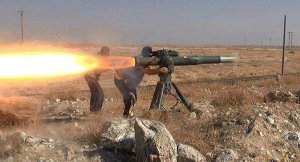 The Al-Nusra Front, Al-Qaeda’s affiliate in Syria, has released a grateful video, where they openly thank the Free Syrian Army (FSA), which the US has touted as a “moderate opposition group”, for supplying them with US-made anti-tank TOW missiles (“Tube-launched, Optically tracked, Wire-guided”).
A recently released video shows an Al-Nusra Front field commander thanking the FSA commanders for giving his forces TOW missiles, according to a report released by the Iranian news agency FARS.
The agency reminds readers that the two groups, the Al-Nusra and the FSA, formed an alliance in March, the Army of Conquest, or Jaish al-Fatah in Arabic, to fight against the forces of President Assad.
Since then, they have fought together “at almost every single battle in Aleppo, Lattakia, Hama, and Idlib Governorates of Syria.”
Through this alliance several militant groups like the Al-Nusra Front and the Ahrar al-Sham movement have been given access to FSA’s US-made heavy weaponry, which has been supplied to the militant group by the US, Saudi Arabia and Qatar.
According to the agency’s estimates, Saudi Arabia sent 500 TOW missiles to Al-Nusra directly last month.
The US, however, claims that it is just supplying aid and weapons to FSA or the so-called moderate militant groups in Syria.
The BGM-71 TOW is one of the most widely-used guided anti-tank missiles. The weapon is used in anti-armor, anti-bunker, anti-fortification and anti-amphibious landing roles.
TOW missiles are used by the armed forces of more than 40 countries and are integrated in over 15,000 ground, vehicle and helicopter platforms worldwide.
November 24, 2015
Posted by aletho |
War Crimes | Al-Nusra, Qatar, Russia, Saudi Arabia, Syria, Turkiye, United States |
Leave a comment
The problem with America’s “anti-ISIS coalition” is not a matter of poor planning or a lack of resources. It is not a matter of lacking leadership or military might. The problem with America’s “anti-ISIS coalition” is that it never existed in the first place. There is no US-led war on ISIS, and what’s worse, it appears that the US, through all of its allies, from across the Persian Gulf to Eastern Europe and even within Washington itself, are involved in feeding ISIS, not fighting it.
Going from Syria itself, outward according to geographical proximity, we can trace ISIS’ support all the way back to Washington itself. And as we do, efforts like the “talks” in Vienna, and all the non-solutions proposed by the US and its allies, appear ever more absurd while the US itself is revealed not as a stabilizing force in a chaotic world, but rather the very source of that chaos.
In Syria
Within Syria itself, it is no secret that the US CIA is arming, training, funding and equipping militant groups, groups the US now claims Russia is bombing instead of “ISIS.” However, upon reading carefully any report out of newspapers in the US or its allies it becomes clear that these “rebels” always seem to be within arms reach of listed terrorist organizations, including Jabhat al Nusra.
Al Nusra is literally Al Qaeda in Syria. Not only that, it is the terrorist organization from which ISIS allegedly split from. And while the US has tried to add in a layer of extra plausible deniability to its story by claiming Nusra and ISIS are at odds with one another, the fact is Nusra and ISIS still fight together on the same battlefield toward the same objectives.
And while we’ll get to who is propping up these two terrorist groups beyond Syria’s borders, it should be noted that the US and European media itself has reported a steady flow of weapons and fighters out from its own backed “rebel” groups and into the ranks of Nusra and ISIS.
Articles like Reuters’ “U.S.-trained Syrian rebels gave equipment to Nusra: U.S. military” give at least one explanation as to where ISIS is getting all of its brand new Toyota trucks from:
Syrian rebels trained by the United States gave some of their equipment to the al Qaeda-linked Nusra Front in exchange for safe passage, a U.S. military spokesman said on Friday, the latest blow to a troubled U.S. effort to train local partners to fight Islamic State militants.
The rebels surrendered six pick-up trucks and some ammunition, or about one-quarter of their issued equipment, to a suspected Nusra intermediary on Sept. 21-22 in exchange for safe passage, said Colonel Patrick Ryder, a spokesman for U.S. Central Command, in a statement.
Before this, defections of up to 3,000 so-called “Free Syrian Army” (FSA) “rebels” had been reported, even by the London Guardian which claimed in its article “Free Syrian Army rebels defect to Islamist group Jabhat al-Nusra” that:
Abu Ahmed and others say the FSA has lost fighters to al-Nusra in Aleppo, Hama, Idlib and Deir al-Zor and the Damascus region. Ala’a al-Basha, commander of the Sayyida Aisha brigade, warned the FSA chief of staff, General Salim Idriss, about the issue last month. Basha said 3,000 FSA men have joined al-Nusra in the last few months, mainly because of a lack of weapons and ammunition. FSA fighters in the Banias area were threatening to leave because they did not have the firepower to stop the massacre in Bayda, he said. Advertisement
The FSA’s Ahrar al-Shimal brigade joined al-Nusra en masse while the Sufiyan al-Thawri brigade in Idlib lost 65 of its fighters to al-Nusra a few months ago for lack of weapons. According to one estimate the FSA has lost a quarter of all its fighters.
Al-Nusra has members serving undercover with FSA units so they can spot potential recruits, according to Abu Hassan of the FSA’s al-Tawhid Lions brigade.
Taken together, it is clear to anyone that even at face value the US strategy of arming “moderate rebels” is a complete failure and that to continue proposing such a failed strategy is basically an admission that (in fact) the US seeks to put weapons and trained fighters directly into the ranks of Al Nusra and other hardcore terrorist groups. Of course, in reality, that was the plan all along. So even before our journey leaves Syria, we see how the US is feeding, not fighting terrorism, completely and intentionally.
Turkey
And of course, before many of the fighters even reach the battlefield in Syria, they have spent time training, arming up and staging in Turkey and Jordan. There has been a lot of talk in Washington, London and Brussels about establishing safe havens in Syria itself for this army of rebel-terrorists, but in reality, Turkey and Jordan have served this purpose since the war began in 2011. All the US and its allies want to do now is extend these safe havens deeper into Syrian territory.
But before that, a steady stream of supplies, weapons and fighters have been pouring over the border, provided by the Persian Gulf monarchies (Saudi Arabia and Qatar in particular) and with the explicit complicity of the Turkish government.
German broadcaster Deutsche Welle videotaped hundreds of trucks pouring over the Turkish border, bound for ISIS in Syria as part of its story, “ISIS and Turkey’s porous borders” (video here). It was not a scene one would describe as “smuggling” behind the back of Turkish authorities, but rather a scene reminiscent of the Iraq War where fleets of trucks openly supported the full-scale invasion of Iraq by America’s military.
Turkey’s borders aren’t merely porous, they are wide open, with the Turkish government itself clearly involved in filling up the fleets of supply trucks bound for ISIS on a daily basis.
In recent days, as Russia has begun decimating fleets of these trucks, and in particular, oil tankers that, instead of bringing supplies into Syria, are stealing oil for export beyond Syria’s borders, there has been talk about just who this oil is being sold to. Turkey’s name comes up yet again.
Business Insider in its article “Here’s How ISIS Keeps Selling So Much Oil Even While Being Bombed And Banned By The West” reveals:
Most of the oil is bought by local traders and covers the domestic needs of rebel-held areas in northern Syria. But some low-quality crude has been smuggled to Turkey where prices of over $350 a barrel, three times the local rate, have nurtured a lucrative cross-border trade.
And if some readers don’t find the argument that ISIS sustains itself from within Turkish territory entirely convincing, perhaps a direct admission from the US State Department itself might help. Its Voice of America media network recently reported in an article titled “US, Turkey Poised for Joint Anti-ISIS Operation, Despite Differences” that:
Some have even suspected the Turkish government of cooperating with IS, making allegations that range from weapons transfers to logistical support to financial assistance and the provision of medical services. The Cumhuriyet daily this week published stories that alleged Turkish Intelligence was working hand-in-hand with IS. A former IS spy chief told the paper that during the siege of the Syrian city of Kobani last year, Turkish Intelligence served McDonald’s hamburgers to IS fighters brought in from Turkey.
Some analysts say the pending border operation could help silence some of the criticism.
That the US is still working openly with Turkey despite increasing evidence that Turkey itself is sustaining ISIS in Syria, indicates that the US itself is also interested in perpetuating the terrorist group’s activities for as long as possible/plausible.Eastern Europe
 Those nations in Eastern Europe who have either joined NATO or now aspire to, also appear to be directly involved. The large torrent of weapons needed to sustain ISIS’ terrorism within Syria cannot, as a matter of managing public perception, appear to be coming entirely from US arsenals themselves (though hundreds of TOW missile systems and M16s do regularly show up in the hands of Nusra, ISIS and other terrorists organizations). Instead, Soviet bloc weapons are needed and to get them, the US has tapped NATO members like Croatia and aspiring NATO member Ukraine to help arm its ISIS legions.
In 2013 it was revealed by the New York Times in their article Arms Airlift to Syria Rebels Expands, With Aid From C.I.A. that:
Although rebel commanders and the data indicate that Qatar and Saudi Arabia had been shipping military materials via Turkey to the opposition since early and late 2012, respectively, a major hurdle was removed late last fall after the Turkish government agreed to allow the pace of air shipments to accelerate, officials said.
Simultaneously, arms and equipment were being purchased by Saudi Arabia in Croatia and flown to Jordan on Jordanian cargo planes for rebels working in southern Syria and for retransfer to Turkey for rebels groups operating from there, several officials said.
One wonders how many of these weapons “coincidentally” ended up in Nusra or ISIS’ hands.
More recently, the NATO-installed junta in Ukraine has been implicated not in supplying weapons to ISIS by proxy, but supplying them to ISIS much more directly after a high-profile bust was made in Kuwait implicating Kiev.
International Business Times reported in its article “Ukraine Weapons To ISIS? Kiev Denies Charge After Islamic State Terrorists Caught In Kuwait” that:
The Ukrainian military has denied knowledge of how its weapons made it into the hands of Islamic State group terrorists. Lebanese citizen Osama Khayat, who was arrested this week in Kuwait with other suspects, said he purchased arms in Ukraine that were meant to be delivered to the militant group in Syria via smuggling routes in Turkey.
Perhaps readers notice a pattern. Washington is using its vast global network and allies to arm and fund terrorists in Syria, supported by massive logistical networks flowing through Turkey and to a lesser extent, Jordan. Everyone from America’s allies in Kiev and Zagreb, to Riyad and Doha, to Ankara and Amman are involved which goes far in explaining just how ISIS got so powerful, and why it still remains so powerful despite its widening war on what appears to be the entire world.
The United States
And all of this brings us back to Washington itself. Surely Washington notices that each and every single one of its allies is involved in feeding, not fighting ISIS. When each and every one of its allies from Kiev to Ankara are involved in arming and supplying ISIS, Washington not only knows, it is likely orchestrating it all to begin with.
And proving this is not a matter of deduction or mere implications. Proving this requires simply for one to read a 2012 Department of Intelligence Agency (DIA) report (.pdf) which openly admitted:
If the situation unravels there is the possibility of establishing a declared or undeclared Salafist principality in eastern Syria (Hasaka and Der Zor), and this is exactly what the supporting powers to the opposition want, in order to isolate the Syrian regime, which is considered the strategic depth of the Shia expansion (Iraq and Iran).
If, at this point, one is unclear on just who these “supporting powers to the opposition” are, the DIA report itself reveals it is the West, NATO (including Turkey) and its allies in the Persian Gulf.
This Salafist (Islamic) principality (state), or ISIS for short, was not an indirect consequence of US foreign policy, it was (and still very much is) a concerted conspiracy involving multiple states spanning North America, Europe, and the Middle East. It could not exist otherwise.
While Russia attempts to reach westward to piece together an inclusive coalition to finally put an end to ISIS, it is clear that it does so in vain. Washington, Brussels and their regional allies in the Middle East have no intention of putting an end to ISIS. Even today, this very moment, the US and its allies are doing everything within their power to ensure the survival of their terrorist armies inside of Syria for as long as possible before any ceasefire is agreed to. And even if a peace settlement of some sort is struck, all it will do is buy Syria time. No matter how much damage Russia and its genuine coalition consisting of Iran, Iraq and Lebanon deal ISIS within Syria, the networks that fed it from Turkey, Jordan, the Persian Gulf, Eastern Europe and Washington itself remain intact.
One hopes that these networks can be diminished through the principles of multipolarism within the time being bought for Syria through the blood, sacrifice and efforts of Syrian soldiers and Russian airmen.
Ulson Gunnar is a New York-based geopolitical analyst and writer.
November 24, 2015
Posted by aletho |
Deception, Militarism, War Crimes | Iraq, ISIS, Jordan, Middle East, NATO, Qatar, Russia, Saudi Arabia, Syria, Turkiye, Ukraine, Zionism |
Leave a comment
Commenting on the origins of the Islamist terrorism plaguing the Middle East, Syrian President Bashar al-Assad noted that terror groups including Al-Qaeda and ISIL have been able to find fertile soil in Iraq as a result of US interventionism, with Saudi oil money and their poisonous Wahhabi ideology nurturing the groups and helping them grow.
Interviewed by Italy’s RAI UNO television, Assad was asked to respond to accusations made by some Western analysts that his government was at least partly responsible for ISIL’s creation.
“Actually,” the president retorted, “according to what some American officials, including Hillary Clinton, have said, Al-Qaeda was created by the Americans with the help of Saudi Wahhabi money and ideology. Of course, many other [US] officials said the same… ISIL and al-Nusra are offshoots of Al-Qaeda. Regarding ISIL, it started in Iraq; it was established in Iraq in 2006… and the leader of ISIL today – Abu Bakr al-Baghdadi – he was in American prisons, and he was put in New York in their prisons, and then he was released. So it wasn’t in Syria; it didn’t start in Syria. It started in Iraq, and it started before that in Afghanistan… And Tony Blair recently said that yes, the Iraq War helped to create ISIL. Their confession is the most important evidence regarding your question.”
Moreover, according to Assad, ISIL has no natural incubator in Syria, given the country’s long-standing ideology of secular nationalism, religious tolerance and ethnic and religious co-existence prior to the war.
“If you want to talk about the strength of Daesh,” the president noted, “the first thing you have to ask is how much of an incubator, a real, natural incubator, you have in a certain society. Up to this moment, I can tell you that Daesh does not have a natural incubator, a social incubator, within Syria.”
At the same time, Assad warned, if ISIL’s poisonous ideology grows roots and becomes chronic, “this kind of ideology can change the society.” In the president’s words, the terrorists, who have been “supported…in different ways since the beginning of the crisis” by Turkey, Saudi Arabia and Qatar, “and of course the Western policy that supported [them] in different ways since the beginning of the crisis,” will lose their strength once they lose the support of their benefactors.
“They can be strong as long as they have strong support from different states, whether in the Middle East or the West,” Assad suggested.
Asked to comment on the deadly attacks which took place in Paris earlier this month, the president once again sent his condolences, condemning the “horrible crime” and noting that Syrians like few others can understand the terror of seeing “innocents being killed without any reason and for nothing…. We’ve been suffering from that for the past five years.”
Assad emphasized that “we feel for the French as we feel for the Lebanese a few days before that, and for the Russians regarding the airplane that’s been shot down over Sinai, and for the Yemenis.” At the same time, the president voiced his hope that the Western world would find compassion for the victims of terror from all these attacks, and not “only for the French.”
Political Settlement Requires an Accurate Definition of the Opposition
Commenting on the potential for a political settlement to the Syrian crisis, the president emphasized that there could be no discussions on any timetable for settlement so long as the terrorist threat was not dealt with. Otherwise, Assad noted that a year and a half to two years would be enough to create mechanisms for a new political system, including a new constitution, and guidelines on referendums, parliamentary and presidential elections.
Regarding disagreements with Western powers over who can be defined as the legitimate opposition, Assad explained that people who hold machineguns in their hand cannot be considered legitimate opposition. “That’s the case in every other country. Whoever holds a machinegun and terrorizes people and destroys private or public property or kills innocents –he is not the opposition. Opposition is a political term. Opposition can be defined not through your own opinion; it can be defined only through elections –through the ballot box.”
According to the president, only the Syrian people, via elections, can determine who they consider the real opposition. “If you want to talk about my own opinion, you can be opposition when you have Syrian grassroots, when you belong only to your country. You cannot be opposition while you are formed as a person or as an entity in the foreign ministry of another country or in an intelligence office of another country. You cannot be a puppet; you cannot be a surrogate mercenary; you can only be a real Syrian.”
Refugee Crisis Hitting Syria Just as Hard as Its Hitting Europe
Asked to comment on the hundreds of thousands of Syrians who have fled Syria for Europe in recent months, Assad emphasized that “everyone who leaves this country is a loss to Syria… We feel the suffering, because every refugee in Syria has a long story of suffering within Syria, and that’s what we should deal with by asking the question: ‘Why did they leave?'”
According to the president, Syrians leave “for many reasons. The first one [is] the direct threat by terrorists. The second is the influence of terrorists in destroying infrastructure and affecting the livelihood of those people. But the third one, which is as important as the influence of terrorists, is the Western embargo on Syria.” Assad emphasized that many people would go back to Syria in a heartbeat, “but how can he go back… while the basics of his life, his livelihood, has been affected dramatically?… The Western embargo and terrorism have put these people between the devil and the deep blue sea.”
Asked by his interviewer whether he considered the Syrian war to be a religious war, the president made clear that this was actually a war with “people who have deviated from real religion; mainly, of course, from Islam, toward extremism, which we don’t consider as part of our religion. It’s a war between the real Muslims and the extremists. Of course, [the radicals] give it different titles –a war against Christians, a war against other sects…but the real issue is the war between them and the rest of the Muslims, the majority of whom are moderates.”
November 22, 2015
Posted by aletho |
Timeless or most popular, War Crimes | Al-Nusra, Da’esh, ISIL, Middle East, Qatar, Saudi Arabia, Syria, Turkiye |
Leave a comment
By John Chuckman | Aletho News | November 19, 2015
Mass murder, as that which just occurred in Paris, is always distressing, but that does not mean we should stop thinking.
Isn’t it rather remarkable that President Hollande, immediately after the event, declared ISIS responsible? How did he know that? And if he was aware of a serious threat from ISIS, why did he not take serious measures in advance?
Within days of Friday 13, French forces assaulted an apartment with literally thousands of bullets being fired, killing a so-called mastermind, Abdelhamid Abaaoud. Just how are you instantly elevated to the rank of “mastermind”? And if security people were previously aware of his exalted status, why did they wait until after a disaster to go after him?
Well, the ugly underlying truth is that, willy-nilly, France for years has been a supporter of ISIS, even while claiming to be fighting it. How do I know that? Because France’s foreign policy has virtually no independence from America’s. It could be described as a subset of American foreign policy. Hollande marches around with his head held stiffly up after getting off the phone at the Élysée Palace, having received the day’s expectations from Washington. He has been a rather pathetic figure.
So long as it is doing work the United States wishes done, ISIS remains an American protectorate, and regardless of Hollande’s past rhetoric, he has acted according to that reality. But something may just have changed now.
It is important to note the disproportionate attention in the West to events in Paris. I say disproportionate because there are equally ugly things going on in a number of places in the Middle East, but we do not see the coverage given to Paris. We have bombs in Lebanon and Iraq. We have daily bombings and shootings in Syria. We have cluster bombs and other horrors being used by Saudi Arabia in Yemen. And of course, there are the ongoing horrors of Israel against Palestinians.
We have endless interviews with ordinary people in Paris, people who know nothing factual to help our understanding, about their reaction to the terror, but when was the last time you saw personal reactions broadcast from Gaza City or Damascus? It just does not happen, and it does raise the suspicion that the press’s concern with Paris is deliberately out of proportion. After all, Israel killed about twenty times as many people in Gaza not very long ago, and the toll was heavily weighted with children, many hundreds of them. Events in Paris clearly are being exploited for highly emotional leverage.
Leverage against what? Arabs in general and Muslims in particular, just part of the continuing saga of deliberately-channeled hate we have experienced since a group of what proved (after their arrest) to be Israeli spies were reported on top of a truck, snapping pictures and high-fiving each other as the planes hit the World Trade Center in 2001. What those spies were doing has never been explained to the public. I’m not saying Israel is responsible for 9/11, but clearly some Israeli government interests were extremely happy about events, and we have been bombarded ever since with hate propaganda about Muslims, serving as a kind of constant noise covering the crimes Israel does commit against Palestinians and other neighbors.
It is impossible to know whether the attack in Paris was actually the work of ISIS or a covert operation by the secret service of an ISIS supporter. The point is a bit like arguing over angels on a pinhead. When you are dealing with this kind of warfare – thugs and lunatics of every description lured into service and given deadly toys and lots of encouragement to use them – things can and do go wrong. But even when nothing goes wrong in the eyes of sponsors for an outfit like ISIS, terrible things are still happening. It’s just that they’re happening where the sponsors want them to happen and in places from which our press carefully excludes itself. Terrible things, for example, have been happening in the beautiful land of Syria for four or five years, violence equivalent to about two hundred Paris attacks, causing immense damage, the entire point of which is to topple a popularly-supported president and turn Syria into the kind of rump states we see now in Iraq.
A covert operation in the name of ISIS is at least as likely as an attack by ISIS. The United States, Israel, Turkey, and France are none of them strangers to violent covert activities, and, yes, there have been instances before when a country’s own citizens were murdered by its secret services to achieve a goal. The CIA pushed Italian secret services into undertaking a series of murderous attacks on their own people during the 1960s in order to shake up Italy’s “threatening” left-wing politics. It was part of something called Operation Gladio. Operation Northwoods, in the early 1960s, was a CIA-planned series of terrorist acts on American civilians to be blamed on Cuba, providing an excuse for another invasion. It was not carried out, but that was not owing to any qualms in the CIA about murdering their own, otherwise no plan would have ever existed. The CIA was involved in many other operations inside the United States, from experiments with drugs to ones with disease, using innocent people as its subject-victims.
There have been no differences worth mentioning between Hollande’s France and America concerning the Middle East. Whatever America wants, America gets, unlike the days when Jacques Chirac opposed the invasion of Iraq, or earlier, when de Gaulle removed France’s armed forces from integration within NATO or bravely faced immense hostility, including a coup attempt undertaken by French military with CIA cooperation, when he abandoned colonialism in Algeria.
If anything, Hollande has been as cloyingly obsequious towards America’s chief interest in the Middle East, Israel, as a group of Republican Party hopefuls at a Texas barbecue fund-raiser sniffing out campaign contributions. After the Charlie Hebdo attack, Hollande honored four Jewish victims of the thugs who attacked a neighborhood grocery store with France’s highest honor, the Legion of Honor. I don’t recall the mere fact of being murdered by thugs ever before being regarded as a heroic distinction. After all, in the United States more than twenty thousand a year suffer that fate without recognition.
Israel’s Netanyahu at the time of the Charlie Hebdo attack actually outdid himself in manic behavior. He barged into France against a specific request that he stay home and pushed himself, uninvited, to the front row of the big parade down the Champs-Élysées which was supposed to honor free speech. He wanted those cameras to be on him for voters back home watching.
Free speech, you might ask, from the leaders of Egypt, Turkey, the UAE, and Israel, who all marched in front? Well, after the free-speech parody parade, the Madman of Tel Aviv raced around someone else’s country making calls and speeches for Jewish Frenchmen to leave “dangerous” France and migrate “home” to Israel. It would in fact be illegal in Israel for someone to speak that way in Israel to Israelis, but illegality has never bothered Netanyahu. Was he in any way corrected for this world-class asinine behavior? No, Hollande just kept marching around with his head stiffly up. I guess he was trying to prove just how free “free speech” is in France.
But speech really isn’t all that free in France, and the marching about free speech was a fraud. Not only is Charlie Hebdo, the publication in whose honor all the tramping around was done, not an outlet for free speech, being highly selective in choosing targets for its obscene attacks, but many of the people marching at the head of the parade were hardly representatives of the general principle.
France itself has outlawed many kinds of free speech. Speech and peaceful demonstrations which advocate a boycott of Israel are illegal in France. So a French citizen today cannot advocate peacefully against a repressive state which regularly abuses, arrests, and kills some of the millions it holds in a form of bondage. And Hollande’s France enforces this repressive law with at least as much vigor as Israel does with its own version, in a kind of “Look, me too,” spirit. France also has a law which is exactly the equivalent of a law against anyone’s saying the earth is flat: a law against denying or questioning the Holocaust. France also is a country, quite disgracefully, which has banned the niqab.
Now, America’s policy in the Mideast is pretty straightforward: subsidize and protect its colony Israel and never criticize it even on the many occasions when it has committed genuine atrocities. American campaign finance laws being what the are, politics back home simply permits no other policy. The invasion of Iraq, which largely was intended to benefit Israel through the elimination of a major and implacable opponent, has like so many dark operations backfired. I call the invasion a dark operation because although the war was as public as could be, all of America’s, and Britain’s, supposed intelligence about Iraq was crudely manufactured and the reasons for undertaking an act which would kill a million people and cripple an entire country were complete lies.
America’s stupid invasion created new room for Iran to exert its influence in the region – hence, the endless noise in Israel and Saudi Arabia about Iran – and it led directly to the growth of armed rabble groups like ISIS. There were no terrorists of any description in Saddam’s Iraq, just as there were no terrorists in Gadhafi’s Libya, a place now so infested with them that even an American ambassador is not safe.
Some Americans assert that ISIS happened almost accidentally, popping out of the dessert when no one was looking, a bit like Athena from the head of Zeus, arising from the bitterness and discontents of a splintered society, but that view is fatuous. Nothing, absolutely nothing, happens by accident in this part of the world. Israel’s spies keep informed of every shadowy movement, and America always listens closely to what they say.
It is silly to believe ISIS just crept up on America, suddenly a huge and powerful force, because ISIS was easy for any military to stop at its early stages, as when it was a couple of thousand men waving AK-47s from the backs of Japanese pick-up trucks tearing around Iraq. Those pick-up trucks and those AK-47s and the gasoline and the ammunition and the food and the pay required for a bunch of goons came from somewhere, and it wasn’t from Allah.
A corollary to America’s first principle about protecting Israel is that nothing, absolutely nothing, happens in Israel’s neighborhood that is not approved, at least tacitly, by the United States. So whether,
in any given instance of supply and support for ISIS, it was Israel or Saudi Arabia or Turkey or America – all involved in this ugly business – is almost immaterial. It all had to happen with American approval. Quite simply, there would be hell to pay otherwise.
As usual in the region, Saudi Arabia’s role was to supply money, buying weapons from America and others and transshipping them to ISIS. Ever since 9/11, Saudi Arabia has been an almost pathetically loyal supporter of America, even to the extent now of often cooperating with Israel. That couldn’t happen before an event in which the majority of perpetrators proved to be Saudi citizens and which led to the discovery that large amounts of Saudi “go away” money had been paid to Osama bin Laden for years. But after 9/11, the Saudis feared for the continuation of their regime and now do what they are told. They are assisted in performing the banking function by Qatar, another wealthy, absolute state aligned with the United States and opposing the rise of any possibly threatening new forces in its region.
Of course, it wasn’t just the discoveries of 9/11 that motivated Saudi Arabia. It intensely dislikes the growing influence of Iran, and Iran’s Shia Muslim identity is regarded by Sunni sects in Saudi Arabia in much the way 17th century Protestantism was viewed by an ultramontane Catholic state like Spain. The mass of genuine jihadists fighting in Syria – those who are not just mercenaries and adventurers or agents of Israel or Turkey or the Saudis – are mentally-unbalanced Sunni who believe they are fighting godlessness. The fact that Assad keeps a secular state with religious freedom for all just adds to their motivation.
ISIS first achievement was toppling an Iraqi government which had been excessively friendly to Iran in the view of Israel, and thereby the United States. Iraq’s army could have stopped them easily early on but was bribed to run away, leaving weapons such as tanks behind. Just two heavy tanks could have crushed all the loons in pick-up trucks. That’s why there was all the grotesque propaganda about beheadings and extreme cruelty to cover the fact of modern soldiers running from a mob. ISIS gathered weapons, territory, and a fierce reputation in an operation which saw President al-Maliki – a man disliked by the United States for his associations with Iran and his criticism of American atrocities – hurriedly leave office.
From that base, ISIS was able to gain sufficient foothold to begin financing itself through, for example, stolen crude sold at a discount or stolen antiquities. The effective splitting up of Iraq meant that its Kurdish population in the north could sell, as it does today, large volumes of oil to Israel, an unheard of arrangement in Iraq’s past. ISIS then crossed into Syria in some force to go after Assad. The reasons for this attack were several: Assad runs a secular state and defends religious minorities but mainly because the paymasters of ISIS wanted Assad destroyed and Syria reduced in the fashion of Iraq.
Few people in the press seem to have noted that ISIS never attacks Israel or Israeli interests. Neither does it attack the wheezingly-corrupt rulers of Saudi Arabia, the Islamic equivalent of ancient Rome’s Emperor Nero. Yet those are the very targets a group of genuine, independent warrior-fundamentalists would attack. But ISIS is not genuine, being supplied and bankrolled by people who do not want to see attacks on Israel or Saudi Arabia, including, notably, Israel and Saudi Arabia. ISIS also is assisted, and in some cases led, by foreign covert operators and special forces.
There does seem to be a good deal of news around the idea of France becoming serious in fighting ISIS, but I think we must be cautious about accepting it at face value. Putin is reported as telling ship commanders in the Mediterranean to cooperate and help cover the French aircraft carrier approaching. Hollande keeps calling for American cooperation too, as Putin has done for a very long time, but America’s position remains deliberately ambiguous. A new American announcement of cooperation with Turkey in creating a “safe zone” across the border with northern Syria is a development with unclear intentions. Is this to stop the Kurds Erdogan so despises fighting in the north of Syria from establishing themselves and controlling the border or is it a method for continued support of ISIS along the that border? Only time will tell.
I do think it at least possible Hollande may have come around to Putin’s view of ISIS, but America has not, and the situation only grows more fraught with dangerous possibilities. I’ve long believed that likely America, in its typically cynical fashion, planned to destroy ISIS, along with others like al-Nusra, once they had finished the dirty work of destroying Syria’s government and Balkanizing the country. In any event, Israel – and therefore, automatically, America – wants Assad destroyed, so it would be surprising to see America at this point join honestly with Putin and Hollande.
America has until now refused Russia any real support, including such basic stuff as sharing intelligence. It cooperates only in the most essential matters such avoiding attacks on each other’s planes. It also has made some very belligerent statements about what Russia has been doing, some from the America’s Secretary of Defense sounding a lot like threats. Just the American establishment’s bully-boy attitude about doing anything which resembles joining a Russian initiative does not bode well.
After all, Putin has been portrayed as a kind of Slavic Satan by American propaganda cranking stuff out overtime in support of Ukraine’s incompetent coup-government and with the aim of terrifying Eastern Europe into accepting more American weapons and troops near Russia’s border, this last having nothing to do with any Russian threat and everything to do with America’s aggressive desire to shift the balance of power. How do you turn on a dime and admit Putin is right about Syria and follow his lead?
And there are still the daily unpleasant telephone calls from Israel about Assad. How do you manoeuvre around that when most independent observers today recognize Assad as the best alternative to any other possible government. He has the army’s trust, and in the end it is the Syrian army which is going to destroy ISIS and the other psychopaths. Air strikes alone can never do that. The same great difficulty for Hollande leaves much ambiguity around what he truly means by “going to war against ISIS.”
It is an extremely complicated world in which we live with great powers putting vast resources towards destroying the lives of others, almost killing thousands on a whim, while pretending not to be doing so. We live in an era shaped by former CIA Director Allen Dulles, a quiet psychopath who never saw an opportunity for chaos he did not embrace.
The only way to end terror is to stop playing with the lives of tens of millions in the Middle East, as America has done for so long, and stop supporting the behaviors of a repressive state which has killed far greater numbers than the madmen of ISIS could dream of doing, demanding instead that that state make peace and live within its borders. But, at least at this stage, that is all the stuff of dreams.
November 19, 2015
Posted by aletho |
False Flag Terrorism, Timeless or most popular, War Crimes, Wars for Israel | Central Intelligence Agency, CIA, France, Gaza, Iraq, ISIS, Israel, Lebanon, Libya, Middle East, NATO, Palestine, Saudi Arabia, Syria, Turkiye, United States, Yemen |
Leave a comment
I generally feel that the questioning by Amy Goodman on Democracy Now could be a lot stronger, but today, she did ask a good question of Rep. Barbara Lee: “The U.S. has just sealed, the Obama administration, yet another arms deal with Saudi Arabia, in the last year signed the biggest arms deals in the history of the world with Saudi Arabia, Saudi Arabia behind a lot of the militant activism from al-Qaeda to ISIS. Do you condemn these sales?”
This is Lee’s full response: “Well, first, we need to reduce the sale of arms throughout the world. Also, I think when you look at the—for example, trying to rid Iran of the ability to develop nuclear weapons, we engaged in a strong, robust diplomatic effort. Many years ago, I introduced the first resolution calling for the end of no contact policy, for a special envoy and for us to begin to negotiate with Iran the elimination of their program of developing nuclear weapons. So far, those negotiations and that Iranian deal has worked. And so I think that we need to move in that direction in terms of diplomacy, in terms of trying to seek global peace and security without selling arms to all countries, because what you will have is an arms buildup throughout the world, and then weapons will be pointed at—each country will have weapons—of course, a nuclear weapon is the ultimate weapon—pointed in all directions. And so, we need to determine ways, as the president has done with regard to Iran, ways in which to engage to reduce the threats and to reduce the sale and the use of force and armaments and military weapons, because these can only make the world more dangerous.”
Notice Lee does not condemn the weapons sales to Saudi Arabia. Indeed, she doesn’t utter the word “Saudi”. Instead, she talks about alleged Iranian nuclear weapons designs — a total staple of officialdom — and speaks generally against arms sales.
Nor do the hosts highlight this. Juan Gonzalez, who I think often asks more probing questions that Goodman, immediately proceeded to ask a somewhat fawning question: “And I’m wondering what advice you might have to parliamentarians in France now, as France is going through the same kind of crisis that this country went through after the attacks of 2001. The president is now seeking authorization from the French Parliament for extraordinary measures in his country. What advice might you give to the parliamentarians of France?”
We’re not going to get very far if we’re looking to politicos for leadership who can’t condemn policies like the U.S. government has to the Saudis. And we’re not going to get very far if presumably tough, independent programs like “Democracy Now” can’t keep officials accountable about that.
November 18, 2015
Posted by aletho |
Deception, Progressive Hypocrite, War Crimes | Democracy Now!, Saudi Arabia, United States, Yemen |
Leave a comment



 Aletho News