Bahrain suspends ‘independent’ news network for ‘failing to fight terrorism’
RT | February 9, 2015
Bahrain has justified shutting down a new pan-Arabic news channel, saying it had no license and gave a voice to terrorists. Al-Arab was taken off the air last week after it broadcast an interview with an opposition politician hours after its launch.
“The Information Affairs Authority (IAA) announces the suspension of Al-Arab satellite channel following its failure to obtain the required licensing approval to commence broadcasting in Bahrain,” said a statement about the Saudi-owned operation. “The IAA emphasizes that the channel had also failed to match the standards of regional and international practice agreements, to take account of efforts aimed at stemming the tide of extremism and terrorism throughout the region and the wider world.”
The state’s media watchdog insisted that “the decision has no impact upon principles of media freedom and it is strictly based on the government’s commitment to ensuring the diversity and impartiality of media outlets in the kingdom.”
The channel stopped broadcasting hours after it was officially launched on February 1, citing “technical and administrative reasons.” The programming was interrupted soon after Al-Arab interviewed Khalil Al-Marzooq from the opposition Al Wefaq Shiite party, whose leader Sheikh Ali Salman was arrested late last year. Al-Marzooq spent his appearance criticizing the government for stripping the citizenship of 72 Bahrainis the day before, for alleged terrorist activity. Marzooq claimed the decision was politically motivated and made without a fair trial.
The state-approved Akhbar Al-Khaleej newspaper wrote a scathing editorial against Al-Arab on Monday, timed to coincide with the suspension.
“Resorting to muscle flexing and allegations in the name of freedom of speech or free broadcasting will harm you in the eyes of Arab spectators faster than you can imagine. More than that, it could signal that your failure began when you were born,” read the text in the country’s oldest news outlet.
Al-Arab was established by Prince Al-Waleed Bin Talal Al-Saud, a US-educated member of Saudi Arabia’s ruling clan, who has a Forbes-estimated fortune of $23.5 billion – much of it invested in Western stocks, such as News Corp and Citigroup. In what may have been a miscalculation, Riyadh’s ally, Bahrain, was chosen as the broadcasting site due to its relatively more liberal media regime, compared to Saudi Arabia – where the prince is regarded as something of an iconoclast, and independent channels are forbidden.
Even after the interruption of the initial broadcast, officials at Bahrain’s information ministry said there were “ongoing” negotiations to resume the broadcasts of the lavishly funded channel, which planned to employ 280 editorial staff and operate 30 bureaus around the world. It is still possible that Al-Arab will return to the screen, even if not with its original editorial team, as no term has been stipulated for the suspension.
Al-Waleed Bin Talal and members of his channel’s editorial team have not publicly responded to media requests to clarify the future of Al-Arab.
Bahrain, a small island that has been ruled by the Sunni House of Khalifa from the 18th century onwards, has been plagued by instability since 2011, with many of the simmering protests coming from the politically underrepresented Shia majority.
Al-Qaeda, Saudi Arabia and Israel
By Robert Parry | Consortium News | February 4, 2015
The disclosure that convicted al-Qaeda operative Zacarias Moussaoui has identified leading members of the Saudi government as financers of the terrorist network potentially reshapes how Americans will perceive events in the Middle East and creates a risk for Israel’s Likud government which has forged an unlikely alliance with some of these same Saudis.
According to a story in the New York Times on Wednesday, Moussaoui said in a prison deposition that he was directed in 1998 or 1999 by Qaeda leaders in Afghanistan to create a digital database of the group’s donors and that the list included Prince Turki al-Faisal, then Saudi intelligence chief; Prince Bandar bin Sultan, longtime Saudi ambassador to the United States; Prince al-Waleed bin Talal, a prominent billionaire investor; and many leading clerics.
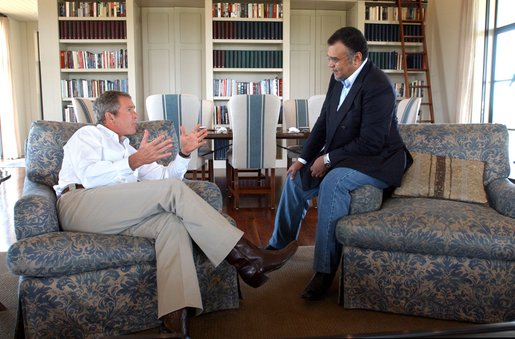
Prince Bandar bin Sultan, then Saudi ambassador to the United States, meeting with President George W. Bush in Crawford, Texas. (White House photo)
“Sheikh Osama wanted to keep a record who give money,” Moussaoui said in imperfect English — “who is to be listened to or who contributed to the jihad.”
Although Moussaoui’s credibility came under immediate attack from the Saudi kingdom, his assertions mesh with accounts from members of the U.S. Congress who have seen a secret portion of the 9/11 report that addresses alleged Saudi support for al-Qaeda.
Further complicating the predicament for Saudi Arabia is that, more recently, Saudi and other Persian Gulf oil sheikdoms have been identified as backers of Sunni militants fighting in Syria to overthrow the largely secular regime of President Bashar al-Assad. The major rebel force benefiting from this support is al-Nusra Front, al-Qaeda’s affiliate in Syria.
In other words, the Saudis appear to have continued a covert relationship with al-Qaeda-connected jihadists to the present day.
The Israeli Exposure
And, like the Saudis, the Israelis have sided with the Sunni militants in Syria because the Israelis share the Saudi view that Iran and the so-called “Shiite crescent” – reaching from Tehran and Baghdad to Damascus and Beirut – is the greatest threat to their interests in the Middle East.
That shared concern has pushed Israel and Saudi Arabia into a de facto alliance, though the collaboration between Jerusalem and Riyadh has been mostly kept out of the public eye. Still, it has occasionally peeked out from under the covers as the two governments deploy their complementary assets – Saudi oil and money and Israeli political and media clout – in areas where they have mutual interests.
In recent years, these historic enemies have cooperated in their joint disdain for the Muslim Brotherhood government in Egypt (which was overthrown in 2013), in seeking the ouster of the Assad regime in Syria, and in pressing for a more hostile U.S. posture toward Iran.
Israel and Saudi Arabia also have collaborated in efforts to put the squeeze on Russia’s President Vladimir Putin, who is deemed a key supporter of both Iran and Syria. The Saudis have used their power over oil production to drive down prices and hurt Russia’s economy, while U.S. neoconservatives – who share Israel’s geopolitical world view – were at the forefront of the coup that ousted Ukraine’s pro-Russian President Viktor Yanukovych in 2014.
The behind-the-scenes Israeli-Saudi alliance has put the two governments – uncomfortably at times – on the side of Sunni jihadists battling Shiite influence in Syria, Lebanon and even Iraq. On Jan. 18, 2015, for instance, Israel attacked Lebanese-Iranian advisers assisting Assad’s government in Syria, killing several members of Hezbollah and an Iranian general. These military advisors were engaged in operations against al-Qaeda’s Nusra Front.
Meanwhile, Israel has refrained from attacking Nusra Front militants who have seized Syrian territory near the Israeli-occupied Golan Heights. One source familiar with U.S. intelligence information on Syria told me that Israel has a “non-aggression pact” with these Nusra forces.
An Odd Alliance
Israel’s odd-couple alliances with Sunni interests have evolved over the past several years, as Israel and Saudi Arabia emerged as strange bedfellows in the geopolitical struggle against Shiite-ruled Iran and its allies in Iraq, Syria and southern Lebanon. In Syria, for instance, senior Israelis have made clear they would prefer Sunni extremists to prevail in the civil war rather than Assad, who is an Alawite, a branch of Shiite Islam.
In September 2013, Israel’s Ambassador to the United States Michael Oren, then a close adviser to Israeli Prime Minister Benjamin Netanyahu, told the Jerusalem Post that Israel favored the Sunni extremists over Assad.
“The greatest danger to Israel is by the strategic arc that extends from Tehran, to Damascus to Beirut. And we saw the Assad regime as the keystone in that arc,” Oren told the Jerusalem Post in an interview. “We always wanted Bashar Assad to go, we always preferred the bad guys who weren’t backed by Iran to the bad guys who were backed by Iran.” He said this was the case even if the “bad guys” were affiliated with al-Qaeda.
And, in June 2014, speaking as a former ambassador at an Aspen Institute conference, Oren expanded on his position, saying Israel would even prefer a victory by the brutal Islamic State over continuation of the Iranian-backed Assad in Syria. “From Israel’s perspective, if there’s got to be an evil that’s got to prevail, let the Sunni evil prevail,” Oren said.
Skepticism and Doubt
In August 2013, when I first reported on the growing relationship between Israel and Saudi Arabia in an article entitled “The Saudi-Israeli Superpower,” the story was met with much skepticism. But, increasingly, this secret alliance has gone public.
On Oct. 1, 2013, Israeli Prime Minister Netanyahu hinted at it in his United Nations General Assembly speech, which was largely devoted to excoriating Iran over its nuclear program and threatening a unilateral Israeli military strike.
Amid the bellicosity, Netanyahu dropped in a largely missed clue about the evolving power relationships in the Middle East, saying: “The dangers of a nuclear-armed Iran and the emergence of other threats in our region have led many of our Arab neighbors to recognize, finally recognize, that Israel is not their enemy. And this affords us the opportunity to overcome the historic animosities and build new relationships, new friendships, new hopes.”
The next day, Israel’s Channel 2 TV news reported that senior Israeli security officials had met with a high-level Gulf state counterpart in Jerusalem, believed to be Prince Bandar, the former Saudi ambassador to the United States who was then head of Saudi intelligence.
The reality of this unlikely alliance has now even reached the mainstream U.S. media. For instance, Time magazine correspondent Joe Klein described the new coziness in an article in the Jan. 19, 2015 issue.
He wrote: “On May 26, 2014, an unprecedented public conversation took place in Brussels. Two former high-ranking spymasters of Israel and Saudi Arabia – Amos Yadlin and Prince Turki al-Faisal – sat together for more than an hour, talking regional politics in a conversation moderated by the Washington Post’s David Ignatius.
“They disagreed on some things, like the exact nature of an Israel-Palestine peace settlement, and agreed on others: the severity of the Iranian nuclear threat, the need to support the new military government in Egypt, the demand for concerted international action in Syria. The most striking statement came from Prince Turki. He said the Arabs had ‘crossed the Rubicon’ and ‘don’t want to fight Israel anymore.’”
Though Klein detected only the bright side of this détente, there was a dark side as well, as referenced in Moussaoui’s deposition, which identified Prince Turki as one of al-Qaeda’s backers. Perhaps even more unsettling was his listing of Prince Bandar, who had long presented himself as a U.S. friend, so close to the Bush Family that he was nicknamed “Bandar Bush.”
Moussaoui claimed that he discussed a plan to shoot down Air Force One with a Stinger missile with a staff member at the Saudi Embassy in Washington, at a time when Bandar was the ambassador to the United States.
According to the New York Times article by Scott Shane, Moussaoui said he was assigned to “find a location where it may be suitable to launch a Stinger attack and then, after, be able to escape,” but that he was arrested on Aug. 16, 2001, before he could carry out the reconnaissance mission.
The thought of anyone in the Saudi embassy, then under the control of “Bandar Bush,” scheming with al-Qaeda to shoot down George W. Bush’s Air Force One is shocking, if true. The notion would have been considered unthinkable even after the 9/11 attacks, which involved 15 Saudis among the 19 hijackers.
After those terror attacks which killed nearly 3,000 Americans, Bandar went to the White House and persuaded Bush to arrange for the rapid extraction of bin Laden’s family members and other Saudis in the United States. Bush agreed to help get those Saudi nationals out on the first flights allowed back into the air.
Bandar’s intervention undercut the FBI’s chance to learn more about the ties between Osama bin Laden and the 9/11 perpetrators by giving FBI agents only time for cursory interviews with the departing Saudis.
Bandar himself was close to the bin Laden family and acknowledged having met Osama bin Laden in the context of bin Laden thanking Bandar for his help financing the jihad project in Afghanistan during the 1980s. “I was not impressed, to be honest with you,” Bandar told CNN’s Larry King about bin Laden. “I thought he was simple and very quiet guy.”
The Saudi government claimed to have broken ties with bin Laden in the early 1990s when he began targeting the United States because President George H.W. Bush had stationed U.S. troops in Saudi Arabia, but – if Moussaoui is telling the truth – al-Qaeda would have still counted Bandar among its supporters in the late 1990s.
Bandar and Putin
Bandar’s possible links to Sunni terrorism also emerged in 2013 during a confrontation between Bandar and Putin over what Putin viewed as Bandar’s crude threat to unleash Chechen terrorists against the Sochi Winter Olympics if Putin did not reduce his support for the Syrian government.
According to a leaked diplomatic account of a July 31, 2013 meeting in Moscow, Bandar informed Putin that Saudi Arabia had strong influence over Chechen extremists who had carried out numerous terrorist attacks against Russian targets and who had since deployed to join the fight against the Assad regime in Syria.
As Bandar called for a Russian shift toward the Saudi position on Syria, he reportedly offered guarantees of protection from Chechen terror attacks on the Olympics. “I can give you a guarantee to protect the Winter Olympics in the city of Sochi on the Black Sea next year,” Bandar reportedly said. “The Chechen groups that threaten the security of the games are controlled by us.”
Putin responded, “We know that you have supported the Chechen terrorist groups for a decade. And that support, which you have frankly talked about just now, is completely incompatible with the common objectives of fighting global terrorism.”
Bandar’s Mafia-like threat toward the Sochi games – a version of “nice Olympics you got here, it’d be a shame if something terrible happened to it” – failed to intimidate Putin, who continued to support Assad.
Less than a month later, an incident in Syria almost forced President Barack Obama’s hand in launching U.S. air strikes against Assad’s military, which would have possibly opened the path for the Nusra Front or the Islamic State to capture Damascus and take control of Syria. On Aug. 21, 2013, a mysterious sarin attack outside Damascus killed hundreds and, in the U.S. media, the incident was immediately blamed on the Assad regime.
American neocons and their allied “liberal interventionists” demanded that Obama launch retaliatory air strikes even though some U.S. intelligence analysts doubted that Assad’s forces were responsible and suspected that the attack was carried out by extremist rebels trying to pull the U.S. military into the civil war on their side.
Yet, pushed by the neocons and liberal war hawks, Obama nearly ordered a bombing campaign designed to “degrade” the Syrian military but called it off at the last minute. He then accepted Putin’s help in reaching a diplomatic solution in which Assad agreed to surrender his entire chemical weapons arsenal, while still denying any role in the sarin attack.
Later, the Assad-did-it case crumbled amid new evidence that Sunni extremists, supported by Saudi Arabia and Turkey, were the more likely perpetrators of the attack, a scenario that became increasingly persuasive as Americans learned more about the cruelty and ruthlessness of many Sunni jihadists fighting in Syria. [See Consortiumnews.com’s “The Mistaken Guns of Last August.”]
Targeting Putin
Putin’s cooperation with Obama to head off a U.S. military strike in Syria made the Russian president more of a target for the American neocons who thought they finally had reached the cusp of their long-desired “regime change” in Syria only to be blocked by Putin. By late September 2013, a leading neocon, National Endowment for Democracy President Carl Gershman, announced the goal of challenging Putin and recognizing his sore point in Ukraine.
Taking to the Washington Post’s op-ed page on Sept. 26, 2013, Gershman called Ukraine “the biggest prize” and an important step toward ultimately ousting Putin. Gershman wrote, “Ukraine’s choice to join Europe will accelerate the demise of the ideology of Russian imperialism that Putin represents. … Russians, too, face a choice, and Putin may find himself on the losing end not just in the near abroad but within Russia itself.” [See Consortiumnews.com’s “Neocons’ Ukraine-Syria-Iran Gambit.“]
However, in early 2014, Putin was obsessed with Bandar’s implicit threat of terrorism striking the Sochi Olympics, thus distracting him from the “regime change” – being pushed by NED and neocon Assistant Secretary of State for European Affairs Victoria Nuland – next door in Ukraine.
On Feb. 22, 2014, putschists, spearheaded by well-organized neo-Nazi militias, drove elected President Viktor Yanukovych and his government from power. Putin was caught off-guard and, in the resulting political chaos, agreed to requests from Crimean officials and voters to accept Crimea back into Russia, thus exploding his cooperative relationship with Obama.
With Putin the new pariah in Official Washington, the neocon hand also was strengthened in the Middle East where renewed pressure could be put on the “Shiite crescent” in Syria and Iran. However, in summer 2014, the Islamic State, which had splintered off from al-Qaeda and its Nusra Front, went on a rampage, invading Iraq where captured soldiers were beheaded. The Islamic State then engaged in gruesome videotaped decapitations of Western hostages inside Syria.
The Islamic State’s brutality and the threat it posed to the U.S.-backed, Shiite-dominated government of Iraq changed the political calculus. Obama felt compelled to launch airstrikes against Islamic State targets in both Iraq and Syria. American neocons tried to convince Obama to expand the Syrian strikes to hit Assad’s forces, too, but Obama realized such a plan would only benefit the Islamic State and al-Qaeda’s Nusra Front.
In effect, the neocons were showing their hand – much as Israeli Ambassador Oren had done – favoring the Sunni extremists allied with al-Qaeda over Assad’s secular regime because it was allied with Iran. Now, with Moussaoui’s deposition identifying senior Saudi officials as patrons of al-Qaeda, another veil seems to have dropped.
Complicating matters further, Moussaoui also claimed that he passed letters between Osama bin Laden and then Crown Prince Salman, who recently became king upon the death of his brother King Abdullah.
But Moussaoui’s disclosure perhaps cast the most unflattering light on Bandar, the erstwhile confidant of the Bush Family who — if Moussaoui is right — may have been playing a sinister double game.
Also facing potentially embarrassing questions is Israeli Prime Minister Netanyahu, especially if he goes through with his planned speech before a joint session of Congress next month, attacking Obama for being soft on Iran.
And, America’s neocons might have some explaining to do about why they have carried water not just for the Israelis but for Israel’s de facto allies in Saudi Arabia.
~
Investigative reporter Robert Parry broke many of the Iran-Contra stories for The Associated Press and Newsweek in the 1980s. You can buy his latest book, America’s Stolen Narrative, either in print here or as an e-book (from Amazon and barnesandnoble.com).
Congress Seeks Netanyahu’s Direction
By Robert Parry | Consortium News | January 22, 2015
Showing who some in Congress believe is the real master of U.S. foreign policy, House Speaker John Boehner has invited Israel’s Prime Minister Benjamin Netanyahu to address a joint session and offer a rebuttal to President Barack Obama’s comments on world affairs in his State of the Union speech.
Boehner made clear that Netanyahu’s third speech to a joint session of the U.S. Congress – scheduled for Feb. 11 – was meant to counter Obama’s assessments. “There is a serious threat in the world, and the President last night kind of papered over it,” Boehner said on Wednesday. “And the fact is that there needs to be a more serious conversation in America about how serious the threat is from radical Islamic jihadists and the threat posed by Iran.”
The scheduling of Netanyahu’s speech caught the White House off-guard, since the Israeli prime minister had apparently not bothered to clear his trip with the administration. The Boehner-Netanyahu arrangement demonstrates a mutual contempt for this President’s authority to conduct American foreign policy as prescribed by the U.S. Constitution.
In the past when Netanyahu has spoken to Congress, Republicans and Democrats have competed to show their devotion by quickly and frequently leaping to their feet to applaud almost every word out of the Israeli prime minister’s mouth. By addressing a joint session for a third time, Netanyahu would become only the second foreign leader to do so, joining British Prime Minister Winston Churchill who never used the platform to demean the policies of a sitting U.S. president.
Besides this extraordinary recognition of another country’s leader as the true definer of U.S. foreign policy, Boehner’s move reflects an ignorance of what is actually occurring on the ground in the Middle East. Boehner doesn’t seem to realize that Netanyahu has developed what amounts to a de facto alliance with extremist Sunni forces in the region.
Not only is Israel now collaborating behind the scenes with Saudi Arabia’s Wahhabist leadership but Israel has begun taking sides militarily in support of the Nusra Front, al-Qaeda’s affiliate in the Syrian civil war. A source familiar with U.S. intelligence information on Syria said Israel has a “non-aggression pact” with Nusra forces that control territory adjacent to the Israeli-occupied Golan Heights.
The quiet cooperation between Israel and al-Qaeda’s affiliate was further underscored on Sunday when Israeli helicopters attacked and killed advisers to the Syrian military from Lebanon’s Hezbollah and Iran. In other words, Israel has dispatched its forces into Syria to kill military personnel helping to fight al-Nusra. Iran later confirmed that one of its generals had died in the Israeli strike.
Israel’s tangled alliances with Sunni forces have been taking shape over the past several years, as Israel and Saudi Arabia emerged as strange bedfellows in the geopolitical struggle against Shiite-ruled Iran and its allies in Iraq, Syria and southern Lebanon. Both Saudi and Israeli leaders have talked with growing alarm about this “Shiite crescent” stretching from Iran through Iraq and Syria to the Hezbollah strongholds in Lebanon.
Favoring Sunni Extremists
Senior Israelis have made clear they would prefer Sunni extremists to prevail in the Syrian civil war rather than President Bashar al-Assad, who is an Alawite, a branch of Shiite Islam. Assad’s relatively secular government is seen as the protector of Shiites, Christians and other minorities who fear the vengeful brutality of the Sunni jihadists who now dominate the anti-Assad rebels.
In one of the most explicit expressions of Israel’s views, its Ambassador to the United States Michael Oren, a close adviser to Netanyahu, told the Jerusalem Post in September 2013 that Israel favored the Sunni extremists over Assad.
“The greatest danger to Israel is by the strategic arc that extends from Tehran, to Damascus to Beirut. And we saw the Assad regime as the keystone in that arc,” Oren told the Jerusalem Post in an interview. “We always wanted Bashar Assad to go, we always preferred the bad guys who weren’t backed by Iran to the bad guys who were backed by Iran.” He said this was the case even if the “bad guys” were affiliated with al-Qaeda.
Saudi Arabia shares Israeli’s strategic view that “the Shiite crescent” must be broken and has thus developed a rapport with Netanyahu’s government in a kind of “enemy of my enemy is my friend” relationship. But some rank-and-file Jewish supporters of Israel have voiced concerns about Israel’s new-found alliance with the Saudi monarchy, especially given its adherence to ultraconservative Wahhabi Islam and its embrace of a fanatical hatred of Shiite Islam, a sectarian conflict between Sunnis and Shiites that dates back 1,400 years.
Though President Obama has repeatedly declared his support for Israel, he has developed a contrary view from Netanyahu’s regarding what is the gravest danger in the Middle East. Obama considers the radical Sunni jihadists, associated with al-Qaeda and the Islamic State, to be the biggest threat to Western interests and U.S. national security.
That has put him in a different de facto alliance – with Iran and the Syrian government – since they represent the strongest bulwarks against Sunni jihadists who have targeted Americans and other Westerners for death.
What Boehner doesn’t seem to understand is that Israel and Saudi Arabia have placed themselves on the side of the Sunni jihadists who now represent the frontline fight against the “Shiite crescent.” If Netanyahu succeeds in enlisting the United States in violently forcing Syrian “regime change,” the U.S. government likely would be facilitating the growth in power of the Sunni extremists, not containing them.
But the influential American neoconservatives want to synch U.S. foreign policy with Israel’s and thus have pressed for a U.S. bombing campaign against Assad’s forces (even if that would open the gates of Damascus to the Nusra Front or the Islamic State). The neocons also want an escalation of tensions with Iran by sabotaging an agreement to ensure that its nuclear program is not used for military purposes.
The neocons have long wanted to bomb-bomb-bomb Iran as part of their “regime change” strategy for the Middle East. That is why Obama’s openness to a permanent agreement for tight constraints on Iran’s nuclear program is seen as a threat by Netanyahu, the neocons and their congressional allies – because it would derail hopes for militarily attacking Iran.
In his State of the Union address on Tuesday, Obama made clear that he perceives the brutal Islamic State, which he calls “ISIL” for the Islamic State of Iraq and the Levant, as the principal current threat to Western interests in the Middle East and the clearest terror threat to the United States and Europe. Obama proposed “a smarter kind of American leadership” that would cooperate with allies in “stopping ISIL’s advance” without “getting dragged into another ground war in the Middle East.”
Working with Putin
Thus, Obama, who might be called a “closet realist,” is coming to the realization that the best hope for blocking the advances of Sunni jihadi terror and minimizing U.S. military involvement is through cooperation with Iran and its regional allies. That also puts Obama on the same side with Russian President Vladimir Putin who has faced Sunni terrorism in Chechnya and is supporting both Iran’s leaders and Syria’s Assad in their resistance to the Islamic State and al-Qaeda’s Nusra Front.
Obama’s “realist” alliance, in turn, presents a direct threat to Netanyahu’s insistence that Iran represents an “existential threat” to Israel and that the “Shiite crescent” must be destroyed. There is also fear among Israeli right-wingers that an effective Obama-Putin collaboration could ultimately force Israel into accepting a Palestinian state.
So, Netanyahu and the U.S. neocons believe they must do whatever is necessary to shatter this tandem of Obama, Putin and Iran. That is one reason why the neocons were at the forefront of fomenting “regime change” against Ukraine’s elected pro-Russian President Viktor Yanukovych last year. By splintering Ukraine on Russia’s border, the neocons drove a wedge between Obama and Putin. [See Consortiumnews.com’s “Neocons’ Ukraine-Syria-Iran Gambit.”]
Even the slow-witted mainstream U.S. media has begun to pick up on the story of the emerging Israeli-Saudi alliance. In the Jan. 19 issue of Time magazine, correspondent Joe Klein noted the new coziness between top Israeli and Saudi officials.
He wrote: “On May 26, 2014, an unprecedented public conversation took place in Brussels. Two former high-ranking spymasters of Israel and Saudi Arabia – Amos Yadlin and Prince Turki al-Faisal – sat together for more than an hour, talking regional politics in a conversation moderated by the Washington Post’s David Ignatius.
“They disagreed on some things, like the exact nature of an Israel-Palestine peace settlement, and agreed on others: the severity of the Iranian nuclear threat, the need to support the new military government in Egypt, the demand for concerted international action in Syria. The most striking statement came from Prince Turki. He said the Arabs had ‘crossed the Rubicon’ and ‘don’t want to fight Israel anymore.’”
Not only did Prince Turki offer an olive branch to Israel, he indicated agreement on what the two countries consider their most pressing strategic interests: Iran’s nuclear program and Syria’s civil war. In other words, in noting this extraordinary meeting, Klein had stumbled upon the odd-couple alliance between Israel and Saudi Arabia – though he didn’t fully understand what he was seeing.
On Tuesday, the New York Times reported that Obama had shifted his position on Syria as the West made a “quiet retreat from its demand” that Assad “step down immediately.” The article by Anne Barnard and Somini Sengupta noted that the Obama administration still wanted Assad to exit eventually “but facing military stalemate, well-armed jihadists and the world’s worst humanitarian crisis, the United States is going along with international diplomatic efforts that could lead to more gradual change in Syria.”
At the center of that diplomatic initiative was Russia, again reflecting Obama’s recognition of the need to cooperate with Putin on resolving some of these complex problems (although Obama did include in his speech some tough-guy rhetoric against Russia over Ukraine, taking some pleasure in how Russia’s economy is now “in tatters”).
But the underlying reality is that the United States and Assad’s regime have become de facto allies, fighting on the same side in the Syrian civil war, much as Israel had, in effect, sided with al-Qaeda’s Nusra Front by killing Hezbollah and Iranian advisers to the Syrian military.
The Times article noted that the shift in Obama’s position on Syrian peace talks “comes along with other American actions that Mr. Assad’s supporters and opponents take as proof Washington now believes that if Mr. Assad is ousted, there will be nothing to check the spreading chaos and extremism.
“American planes now bomb the Islamic State group’s militants in Syria, sharing skies with Syrian jets. American officials assure Mr. Assad, through Iraqi intermediaries, that Syria’s military is not their target. The United States still trains and equips Syrian insurgents, but now mainly to fight the Islamic State, not the government.”
Yet, as Obama adjusts U.S. foreign policy to take into account the complex realities in the Middle East, he now faces another front in this conflict – from the U.S. Congress, which has long been held in thrall by the Israel lobby.
Not only has Speaker Boehner appealed to Netanyahu to deliver what amounts to a challenge to President Obama’s foreign policy but congressional neocons are even accusing Obama’s team of becoming Iranian stooges. Sen. Robert Menendez of New Jersey, a Democratic neocon, said, “The more I hear from the administration and its quotes, the more it sounds like talking points that come straight out of Tehran.”
If indeed Netanyahu does end up addressing a joint session of the U.S. Congress, its members would face a stark choice of either embracing Israel’s foreign policy as America’s or backing the decisions made by the elected President of the United States.
~
Investigative reporter Robert Parry broke many of the Iran-Contra stories for The Associated Press and Newsweek in the 1980s. You can buy his latest book, America’s Stolen Narrative, either in print here or as an e-book (from Amazon and barnesandnoble.com).
Applauding Israel’s Transgressions
By AHMAD BARQAWI | CounterPunch | January 21, 2015
So after “headlining” that anti-terrorism joke of a parade last week and basking in the Parisian sun of selective humanitarianism and international solidarity with freedom of speech; the first order of (shoddy) business for Israeli Prime Minister Benyamin Netanyahu was lambasting the International Criminal Court, for merely entertaining the (anti-Semitic?) notion of investigating “possible” Israeli war crimes in Gaza (how dare they?), going as far as threatening to lobby member-states and allies to cut off funding for the tribunal and practically pull a repeat of the UNESCO farce when the Obama Administration, at the behest and for the benefit of its darling Israel, froze funding for the cultural organization, after granting the Palestinians full membership into the agency, plunging the UN body into the worst financial dire strait in its history.
It is more than likely that Netanyahu will get his way this time too.
The second order of business, however, was sending a military helicopter gunship over to Syrian territory and bombing a convoy belonging to the Lebanese Resistance Movement Hezbollah, killing six operatives including the son of assassinated leader Imad Mughnyyieh and field commander Mohammad Issa in addition to one Iranian General, in the Syrian village of Quneitra close to the border area with Lebanon in the Golan heights.
Business as usual for humanitarian extraordinaire Bibi and Co.
Of course this was no terrorist attack, at least not according to the mainstream media; so you won’t be seeing #jesuishizbollah anywhere on social media and no solidarity marches in real life, just another daily recount of internationally tolerable Israeli shenanigans in the region.
Evidently, unless it involves scraggy young men with weird, unpronounceable Middle Eastern names, wearing Keffiyehs, wielding shabby Kalashnikovs and storming the streets of a western city then it’s not terrorism, and in the case of the latest Israel airstrike in the Syrian Golan heights; it was just a military operation, clean and surgical, according to the BBC at least; not forgetting of course to tail the news with the little tidbit that this is not the first time Israel has conducted air strikes inside Syria, to “prevent the transfer of stockpiles of weapons from Syria to Hezbollah”. So, all should be fine and dandy then.
You see it’s completely acceptable for the BBC to venture justifications on behalf of the Israeli army for its various terrorist operations and transgressions in the region, we’ve seen it before in Palestine, Syria and Lebanon; covering Israeli crimes in the complacent mainstream media usually comes with peppered excuses and rationalizations that supposedly give some sort of subtle credence to any act of aggression committed by the Zionist entity, wrapping it with the usual, tattered caveat of “self-defense”; the AP’s report on the latest attack, for instance, highlighted the fact that Hezbollah had recently boasted of its “ability to hit any part of the Jewish state” with rockets, in reference to Hezbollah leader Hassan Nasrallah’s recent interview. Imagine the outrage!
Whereas if one so much as dared to attempt a mildly rational and lucid reading of the Charlie Hebdo massacre; he’d be immediately castigated at best and lumped into the same category as the Kouachi brothers as an Al Qaida sympathizer at worst; that’s the freedom of speech they were marching for in Paris I guess.
Speaking of Al Qaida; do you know who were rubbing their hands with ecstatic glee over the Israeli airstrike against Hezbollah? None other than Al Qaida’s very own Al Nusra Front (or the moderate Syrian opposition force worthy of caches of weapons and funding, according to the west) and other rag-tag, ideologically like-minded militant groups whose evident ironclad alliance with Israel has transcended the widely reported medical assistance and treatment of the injured in Israeli hospitals into providing direct military backing and air cover when needed especially in areas where the Syrian opposition’s tenuous grab is slipping in favor of the Syrian Army along with Hezbollah forces. Areas such as Al Quneitra.
In a sense this latest Israeli attack against a Hezbollah target in Syria serves as a perfect cliff note for the uninitiated to disentangle this seemingly complicated cobweb of alliances in the Syrian war. On the one side you have the Syrian Government of Bashar Al Assad backed by Hezbollah and Iran, while on the other you have a who’s who of the region’s nastiest terrorists; from the mismatched posses of Islamic extremists fighting under the Islamic Army moniker, to ISIS and Al Nusra Front, backed by the deep-pocketed Gulf monarchies along with Erdogan’s Turkey and the U.S., with Netanyahu’s Israel added to the mix for good measure. Talk about a true rogues gallery.
A cursory glance over GCC media and social networks is more than enough to note a certain air of unabashed exuberance over the Israeli airstrike; Syrian “revolutionaries” along with their GCC sponsors could not contain their jubilation as soon as news of the bombing broke; gloating over the assassination and mocking Hezbollah’s rhetoric of vowing vengeance for its slain operatives “at the time and place of its choosing”.
The rotten logic of the “lesser of two evils”, in reference to the Zionist regime, has become such a stable in the armory of the anti-Hezbollah/anti-Iran crowd in the Arab World, invoked every time the Israeli terrorist army commits a new atrocity to soften the impact of its crimes and desensitize the public to Israel’s parasitic existence on Arab lands. And this time was no different; with many reveling in the claim that Hezbollah “had it coming” for backing the government of Bashar Al Assad.
In an article confessedly titled “How Did We End up Applauding for Israel”, published in the Saudi-financed, crude Arabic daily Al-Sharq Al-Awsat, which by the way, itself exhibited an unmistakable celebratory tone while covering the latest Israel strike especially over the slain Iranian General, Saudi writer Abdel Rahman al-Rashed actually “laments” the fact that there are growing cheerleading voices in the Arab world for Israel and that (some) Arabs have become increasingly more vocal in their support for the Zionist entity just out of sheer “spite” for Hezbollah and Iran, especially on social media websites and even among supporters of Islamic Jihadi groups.
Nonetheless, al-Rashed places the brunt of the blame on… yes you guessed it… Hezbollah, Israel’s arch enemy, for ostensibly transforming poor, gullible Arabs en masse into hordes of hardcore Israel-enthusiasts, through its alleged role in the assassination of former Lebanese Prime Minister Rafiq Al Hariri (according to a sham international tribunal anyway), and the Lebanese party’s military involvement in the Syrian civil war. Talk about connecting all the wrong dots.
Never mind that the Lebanese movement has been the subject of an unrelenting smear campaign steeped in vile sectarianism, all manner of character assassination and outright fabrications targeting its leaders, and discrediting its military achievements against Israel ever since 2005, courtesy of Saudi Arabia along with the rest of the GCC club (aka Al Rashed’s sole meal tickets) and their labyrinthine network of media outlets including Al Sharq Al Awsat newspaper where anti-Shiite sentiments run amok and distinct pro-Israel bias reigns supreme.
Never mind the fact that the Arab public has been bombarded with a nonstop barrage of demonization and vilification sprees directed not only at Hezbollah, but also at any movement, party or political group which just so happens to adopt an anti-Israel stance and/or rhetoric, including the Palestinian movements of Hamas and the Islamic Jihad, only with the sole endgame of reshuffling the public’s priorities to accommodate the West’s political agenda in our region where Israel gets to sit snugly and comfortably in our midst all the while Iran is being touted and over-hyped as the biggest threat to the stability of the Arab world.
It’s true; we do applaud for Israel. Its transgressions and air strikes on Arab soil no longer provoke a sense of outrage or even the merest of condemnations, but we only have the GCC to thank for that.
US to Deploy 400 Troops to Train Syria Militants
Al-Akhbar | January 16, 2015
Defense officials of the United States said on Thursday the US will deploy about 400 troops in countries neighboring Syria to train “moderate” opposition fighters.
The US military has not yet identified where it will draw its forces from for the training mission, expected to begin in the spring. Turkey, Qatar and Saudi Arabia have offered to host the training.
The training program is a part of the US’ plan to field local forces in Syria. The Pentagon has estimated that it can train more than 5,000 recruits in the first year and that up to 15,000 will be needed to retake areas of eastern Syria controlled by the Islamic State of Iraq and Syria (ISIS).
Since the start of the Syrian civil war, Western powers, and some regional countries have supported rebels by arming, financing and politically empowering militant groups in the country.
On January 5, a senior Turkish foreign ministry official said that Turkey and the US aim to finalize an agreement on equipping and training “moderate” Syrian rebels until the end of January. However, this support has backfired as many of the weapons provided have ended in the hands of ISIS fighters, who have been targeted by a US-led coalition in an air raid campaign since August.
“Around 1,500 to 2,000 people are expected to be trained in Turkey (in the first year),” the official said, adding that a “limited number” of US soldiers would come to Turkey to help carry out the training jointly with Turkish colleagues.
The US decision to train and equip rebel groups in Syria was criticized by several renowned officials who warned of dire consequences.
Former US Congressman Ron Paul denounced in an interview with Russia Today the plans, noting that these Western-backed forces have been helpful to ISIS, which since August has captured swathes of lands in Iraq and Syria.
“The Free Syrian Army (FSA) turned over the weapons, that we (the US) sent them, to ISIS,” Paul said. “It is pretty well recorded that for $50,000 the FSA turned over one of the two American journalists to ISIS.”
Meanwhile, Gulf state Qatar, with the help of the US, has already been covertly training “moderate” Syrian rebels to fight the Syrian army and ISIS, as well as other extremist groups for over a year, sources claimed in November.
The camp, south of Doha between Saudi Arabia’s border and Udeid area, the largest US air base in the Middle East, is being used to train the FSA militants and other rebels, the sources said.
In September a report by the London-based small-arms research organization Conflict Armament Research revealed that ISIS jihadists in Syria as well appear to be using US military-issued arms and weapons supplied to rebels by Saudi Arabia.
The report said the jihadists disposed of “significant quantities” of US-made small arms including M-16 assault rifles and included photos showing the markings “Property of US Govt.”
It also found that anti-tank rockets used by ISIS in Syria were “identical to M79 rockets transferred by Saudi Arabia to forces operating under the Free Syrian Army umbrella in 2013.”
(Reuters, Al-Akhbar)
Saudi Arabia Adds 5 Years to Human Rights Lawyer’s Prison Sentence
Al-Akhbar | January 13, 2015
A Saudi judge has sentenced a prominent human rights lawyer to an additional five years in jail, after he refused to show remorse or recognize the court that handed down his original 10-year term for sedition.
Waleed Abu al-Khair, founder and director of watchdog group Monitor of Human Rights in Saudi Arabia (MHRSA), was sentenced last year to 10 years in jail on charges that included breaking his allegiance to King Abdullah, showing disrespect for the authorities and creating an unauthorized association.
The Specialized Criminal Court in Riyadh also gave Abu al-Khair a five-year suspended sentence, fined him 200,000 riyals ($53,300), banned him from leaving the kingdom for a further 15 years after his eventual release, and shut down all his websites.
Abu al-Khair’s wife, rights activist Samar Badawi, said the court had decided on Monday to increase his sentence after an appeal by the public prosecutor, who had argued that the lawyer had failed to retract his views or express remorse over them. The judge accepted the request and increased the sentence to 15 years of imprisonment.
Badawi said her husband, who is 35, had long objected to the tribunal set up in 2008 to try terrorism suspects. It has since been used to send rights campaigners to prison.
“Waleed sees this court as lacking basic international standards for any tribunal and had objected to trying even terrorists in it, let alone rights activists,” she said.
Abu al-Khair has also been critical of a Saudi anti-terrorism law passed in early 2014, which is widely seen by activists as a tool to stifle dissent.
The anti-terrorism law says terrorist crimes include any act that “disturbs public order, shakes the security of society or subjects its national unity to danger, or obstructs the primary system of rule or harms the reputation of the state.” … Full article
US, allies must be held accountable for ISIL terrorism: Analyst
Press TV – January 9, 2015
The United States and its allies should be held responsible for the ongoing ISIL terror activities in various parts of the world, the Imam of Masjid al-Islam in Washington tells Press TV.
Imam Abdul Alim Musa, who is a strong critic of US support for terrorism, said in an interview with Press TV that the American administration, the Israeli regime and the Al Saud monarchy must held accountable for ISIL terror operations because “they created these groups from very beginning.”
The analyst further stressed that the American Central Intelligence Agency (CIA), Israel’s Mossad spy agency and the Saudi regime have been deeply involved in creation of the ISIL Takfiri group.
Musa further said the US and its western allies were using Zionist and Wahhabi ideologies to fuel terrorism, adding, “The origin of these groups is mainly Saudi Arabia.”
The analyst added that the Western countries have a long history of supporting the terrorists fighting against the government of President Bashar al-Assad in Syria.
The backers and controllers of the ISIL extremist group are using it to “promote Islamophobia” and “launch invasions,” the analyst said.
The ISIL militants have seized large swathes of land in Syria and Iraq. They have been carrying out heinous crimes against all communities in both neighboring Arab states.
Commenting on a recent terrorist attack targeting a French magazine, the Muslim scholar said the French support for anti-Syria militants and Paris’ pro-invasion policies were partly to blame for the deadly raid.
On Wednesday, masked gunmen stormed into the Parisian headquarters of the satirical weekly, Charlie Hebdo, gunning down a dozen people, including eight journalists, two police officers, a maintenance worker and a visitor.
Paris has been among the staunch supporters of the Takfiri militants operating against the Damascus government since March 2011.
Glimpse into 2014 struggles draws image of upcoming year
By Roqayah Chamseddine | Al-Akhbar | December 31, 2014
This year was a powerful amalgamation of torment, dissent, and small victories – a mixture of struggles, oftentimes intersecting, which will shape the new year.
Resistance across Egypt, against the torrent of brutal authoritarianism, is ongoing, and the battle that is being waged against the Sisi regime, which is still netting protesters and attempting to expand its security forces, has not dimmed. This week, 24 protesters, including Yara Sallam, Transitional Justice Officer at the Egyptian Initiative for Personal Rights (EIPR), were sentenced to two years imprisonment after being charged under Egypt’s restrictive assembly law. This signifies not a deviation from the Mubarak-era suppression but a sustained follow-through, and arguably at times the actions of Abdel Fattah el-Sisi’s illegitimate government have outdone even Mubarak’s. Under the current regime a more brazenly Zionist Egypt has taken center stage, making life for Palestinians in Gaza, many of whom are internally displaced, a living nightmare as they watch another Arab regime collude with the occupier, preventing them from having access to education, healthcare and going as far as to plan the demolition of 1,000 homes in order to expand the Rafah border, forcing many, who are still healing from the latest Gaza war, deeper into the throes of despair.
The displacement of the Palestinians converges with another cruelty – the displacement of the Syrian people. Syrians have been forced into refugee tents by unwavering violence, not only from inside and above but from host countries who are preventing them from having access to proper medical care, work and housing. Lebanon, which is now home to the largest Syrian refugee presence, over 1.1 million according to UNHCR, has unleashed its own brutality against the Syrian people; from the sexual abuse of Syrian women, violence against Syrian workers, to incomprehensible living arrangements by greedy landlords who are looking to profit off misery. To make matters worse, Syrians are also facing ISIS, which threatens to destroy any viable resolution to the conflict, and seeks to expand a violent pseudo-state by indiscriminately targeting anyone deemed a threat, as ISIS is composed of equal opportunity destroyers.
In Bahrain the long shadow of despotism reaches far into the streets, generously filling the jail cells with people like women’s rights activist Zainab al-Khawaja, recently sentenced to three years in prison after she ripped up a photo of King Hamad bin Isa al-Khalifa, and Ghada Jamsheer, head of the Women’s Petition Committee, who has been under house arrest since December 19, facing at least 12 charges. Al-Khawaja and Jamsheer are not the only women in the region facing an all-encompassing totalitarian state. In Saudi Arabia, 25-year-old Loujain al-Hathloul, who called for women to join the October 26 movement to end, among other things, the absurd restrictions on driving by taking to the roads, was arrested for doing just that. Al-Hathloul and 33-year-old Maysa al-Amoudi were arrested November 30, al-Hathloul for attempting to drive from the United Arab Emirates to Saudi Arabia and al-Amoudi after she arrived to support her.
At the forefront of the greater campaign for women’s rights are organizations in the region that challenge patriarchy, heteronormativity, and imperialism such as Beirut-based Nasawiya and Lebanon’s secular Lebanese civil society organization KAFA (Enough). Nasawiya, working alongside other local groups, have been involved in the fight against Lebanon’s nationality laws, sectarianism, and domestic violence. A domestic violence law, the first of its kind in Lebanon, passed by Lebanon’s parliament on April 1, after a strong, year-long campaign lead by KAFA. KAFA, which works tirelessly to not only provide domestic abuse victims and abusers with counseling, but child protection services, has criticized legislators for not focusing more on women, though despite the laws shortcomings many are calling this a step forward and women’s right activists in Lebanon are promising to continue the fight so as to bring about even more impactful, long-lasting change.
Nasawiya and KAFA have long challenged local discourse regarding not only Lebanese women but migrant domestic workers in Lebanon, and provide migrants with social and legal counseling. A recent publication by KAFA, “If Not For The System,” reveals the stories of women migrant workers in Lebanon, in both English and Arabic, and the exploitation they face as they navigate the oftentimes racist and abusive landscape. Lebanon’s migrant workers, who already face physical abuse at the hands of those they work for, are now struggling even harder to make a living if they are found to be Syrian, as many Syrians are now facing the obstacle of a war being waged against their identities, as they are being senselessly blamed for violent extremism in the country. In Qatar we also see the horrific crimes being committed against migrant workers. In a report released in May the Qatari government admitted to some 1,000 migrant deaths, at least one a day, in the last two years alone. Six months after this report was published, and after promising to reform its abominable system, “only a handful of the limited measures announced in May have even been partially implemented,” according to Sherif Elsayid-Ali, Amnesty International’s head of refugee and migrant rights.
It is difficult to read into the future, despite the imprints left behind this year, like a constellation of stains on the inside of a coffee cup. But one can hope that the minor victories for rights that were attained this year – despite the major setbacks – can set the tone for the coming years and forge a more auspicious new year for all.
Roqayah Chamseddine is a Sydney based Lebanese-American journalist and commentator. She tweets @roqchams and writes ‘Letters From the Underground.‘
Reconciliation of political rivals in Lebanon
Press TV | December 25, 2014
Ever since the end of former president, Michel Sleiman’s tenure in May 2014, Lebanon has continued to function without a head of state.
The country is grappling with turmoil on its border with Syria due to different factors including the presence of foreign-backed Takfiri militants, a Syrian refugee crisis, and a spillover of the war in Syria.
Amid all this, Hezbollah and Saudi-backed Sa’ad Hariri’s Future Movement have held talks to try and diffuse tensions and pave the way for a joint fight against terrorism.
An atmosphere of cautious optimism prevailed over Lebanon after the resistance movement Hezbollah and the western and Saudi-backed March 14 Future Movement held their first dialogue session in over four years. The step has been praised by various Lebanese officials who have indicated that the dialogue process has got off to a good start. Hezbollah, in its first comments on the issue, highlighted the necessity of such a step as a means to strengthen the country against the menace of Takfiri terror.
To discuss Lebanon’s current political developments, Press TV has conducted an interview with Sukant Chandan, who is the co-founder of The Tricontinental from London, and Salah Takieddine, with Lebanon Future Movement from Beirut.
The Debate – Rivals Reconciliation (P.1)
The Debate – Rivals Reconciliation (P.2)
Israeli official: Strategic cooperation with Riyadh is growing

Director of Institute for Policy and Strategy, and Chair of Atlantic Forum of Israel Prof. Uzi Arad
MEMO | December 8, 2014
Strategic and security cooperation between Saudi Arabia and Israel is growing at an unprecedented rate, Israel’s former National Security Adviser Uzi Arad said.
During his participation at the Energy 2015 Conference, Arad said that Israel takes advantage of Saudi Arabia’s role as a counterweight in the face of Iran which makes it play a central and effective role in Israel’s strategic plans.
Arad warned of the consequences of betting on the survival of an allied regime in Egypt, pointing out that Egypt is going through a very sensitive stage and things could turn upside down at any moment.
With regards to Jordan, Arad said: “About Jordan, we cross our fingers. No one knows what will happen there in five years. One must hope that things there will be stable. Who says the wave sweeping Iraq and Syria will not arrive to Jordan?”
Arad said the Palestinian Authority currently represents a partner for Israel in the face of many challenges.
Israel will not tolerate Iran turning into a state with nuclear capabilities, he stressed, pointing out that if the world and regional powers accept this, Israel will turn to the military option. He said: “For a long time now, there have been plans in Mossad about a situation in which another country around us has nuclear weapons. Such discussions begun in the 80s. Responses were prepared in advance. If you see a new submarine enter the port of Haifa, it does not take a genius to figure out what it signifies.”
Commenting on the relationship with Turkey, Arad said the most important research centre in Israel said the reality and the future of these relations do not bode well.
Israel is facing growing international isolation which, he warned, will affect the Israeli military and the country’s economic interests.
Arad noted that Israel benefits from the EU funded research projects, pointing out that they have strengthened the position of Israel as a great technological power.
He warned that the upcoming early elections in Israel will only contribute to the decline in Israel’s status.
QUESTIONS FOR JEREMY SCAHILL, AUTHOR OF “DIRTY WARS, The World is a Battlefield”
Australians for Reconciliation in Syria
Ford served as the Political Officer at the U.S. embassy in Baghdad from 2004 to 2006 under Ambassador John Negroponte, the U.S. ambassador to Honduras from 1981 to 1985. Negroponte was a key figure in the covert U.S. program to arm the Nicaraguan contras and his support for vicious paramilitary units in El Salvador and Honduras earned him the nickname of “Mr. Death Squad.”
Another element of the dirty war against Syria has been the co-opting of NGOs to support the established narrative on the crisis in Syria. So, for example, Amnesty International from almost the beginning of the crisis focused on condemning the government of Syria based on the claims of activists who supported a violent insurgency and refused to report on the killings of civilians by armed gangs early in the crisis, a key aspect of the escalating violence. From Jan 2012 – Jan 2013, Amnesty International USA was headed by Suzanne Nossel, a former State Department official and author of “Smart Power”. Robert Ford reportedly gave the key note address at an Amnesty International General Meeting in Colorado in early 2012.
For the people of Syria and the wider region, America’s dirty war against their countries is much dirtier than you present it, and for the wars to be successfully pursued many in the administration, media, NGOs, academia, diplomatic corps must be complicit to some extent or other in order for there to be a very muted response to the wars.
Your book was published in 2013. Could you please explain why you have given no attention at all to the role of Robert Ford in Syria’s crisis? (He is not listed in the index at all.) There are two brief references to John Negroponte in your book, on pages 186 and 207. They are both relatively benign and forgettable, despite Negroponte’s being the US director of national intelligence and his earlier suspect diplomatic service in Honduras. One would expect him to figure largely in the US dirty war. Why is Negroponte almost invisible in your book?
There is also only a passing reference (on page 186) to Saudi Prince Bandar bin Sultan, someone known to have very close connections with the Bush family, something you mention in your book. In any serious discussion of the US dirty wars in the Middle East, one would expect much more attention given Prince Bandar. Like Negroponte, Prince Bandar has links to the dirty wars in Central America, since he arranged financial support for the Nicaraguan Contras. Bandar more recently has been an intelligence chief in Saudi Arabia and more recently an adviser to the King on ISIS. Prince Bandar is reported to have said to the head of M16 in 2001,“The time is not far off in the Middle East, Richard, when it will be literally ‘God help the Shia’. More than a billion Sunnis have simply had enough of them.”
Why do you give such a brief, innocuous mention to Prince Bandar in “Dirty Wars” when he has been so closely connected to US administrations and US dirty wars for decades?
How can your book, “Dirty Wars” contribute to a clean peace in the Middle East if major players and key aspects of the dirty wars are not exposed?
Riyadh nips Hezbollah-Future Movement dialogue in the bud
Al-Akhbar | November 21, 2014
Riyadh has ‘red-lighted’ the planned dialogue between Hezbollah and the Future Movement before it even began. The Saudi call for Hezbollah to be put on the list of terrorist organizations made at the United Nations threatens to renew tension between the two sides, following an undeclared truce in the media that did not last for more than a few days.
Is there a fixed Saudi, and consequently Gulf policy, vis-à-vis Lebanon? Are these countries really keen on the stability of this country, as they claim, when they hardly spare any occasion to exacerbate its divisions? These questions and others are being asked after the new Saudi escalation against Hezbollah, which is likely to aggravate the already complex situation in Lebanon and the region.
Saudi Arabia’s ambassador to the United Nations Abdallah al-Mouallimi called on the UN Security Council on Wednesday to place the Resistance Party on the list of terrorist organizations. In a special session on terrorism, Mouallimi called for punishing Hezbollah and other groups including the Abu al Fadl al Abbas Brigade, the League of the Righteous, and other “terrorist organizations fighting in Syria.”
Al-Akhbar learned that as a result of the new Saudi position, contacts will be made with Riyadh over the next few days to contain possible reactions. Well-placed sources warned against negative repercussions from the Saudi move over the ‘preliminary dialogue’ between Hezbollah and the Future Movement.
The sources expressed concern that this could put an end to the de-escalation that begun when Hezbollah Secretary General Sayyed Hassan Nasrallah, speaking during the Shia Muslim commemorations of Ashura, welcomed dialogue with the Future Movement. The sources told Al-Akhbar that the Saudi move, in addition to the sudden re-activation of the Special Tribunal for Lebanon (STL) after a long period of inactivity, by summoning political witnesses, will create tensions in the country, and are indicative of a Saudi veto on dialogue between the Future Movement and Hezbollah.
The sources asked, “How do the Saudis explain their position when barely two months have passed since their ambassador in Beirut Ali Awad Asiri celebrated his country’s National Day surrounded by deputies from Hezbollah? Why has Saudi Arabia made this call two days after the GCC summit, and as the UAE – which is influenced to a large extent by Riyadh’s position – placed a number of organizations on its terror list not including Hezbollah?”
The sources deduced that the Saudi policy is not yet ready to restore its balance in Lebanon and the region. The sources also had questions about Saudi-Israeli ‘intersection’ over trying to smear Hezbollah’s image as a resistance movement and link it to terrorism, something that Tel Aviv has sought for very long.
The sources described Mouallimi’s speech at the UN as a ‘sound bubble’ that will have no results, recalling Nasrallah’s declaration that Hezbollah will be where it has to be in Syria. They said the Saudi UN envoy’s move “demonstrates real disappointment in the ranks of the Saudi leadership over the failure of its project in Syria, with [Saudi]… making random accusations right and left.”
The sources pointed out that the Saudi envoy, in the course of justifying his call, cited the emergence of terror groups like ISIS and others, which he linked to the “practices of the Syrian regime” and the “sectarian policies of some countries,” rather than Saudi and Gulf support for these groups. The sources added, “Saudi Arabia is among the top supporters of terrorist Takfiri groups in Syria, which makes its talk about fighting terrorism lacking in any seriousness.”
The sources then linked the Saudi position to “growing concerns in the ranks of the Saudi leadership over the nuclear negotiations with Iran, and real fear from the possibility of the parties reaching an agreement that would undermine the Saudi leadership’s hopes to step up the siege on Iran.”
The sources ruled out any practical effect of the Saudi position in light of the current balance of power in the international organization, and in light of the responses the Saudi envoy heard regarding his proposal.
Iran’s envoy at the United Nations Gholam Hossein Dehghani had responded to Mouallimi’s call by emphasizing the need to make a distinction between legitimate resistance and terrorism, and the need to support the resistance. He also criticized regional countries for failing to match their words with deeds, and said that few governments in the region have taken the threat seriously, while the rest did not control their borders, did not stop ISIS from recruiting, and did not stop the flow of financial support to these “criminal organizations.”
For his part, Syria’s ambassador to the United Nations Bashar Jaafari accused Saudi Arabia of backing terrorism in the region, denouncing the inconsistencies in its diagnosis of the roots of terrorism. He said that al-Qaeda and its ilk had all grown thanks to Saudi patronage in Afghanistan. Jaafari also said that the carnage in Syria is supported by Saudi Arabia and Qatar, citing the call by 72 Saudi clerics for people to go for “jihad” in Syria, and wondered whether the Saudi government was serious about fighting terrorism.
Featured Video

HE SAVED LIVES. NOW HE FACES PRISON.
or go to
Aletho News Archives – Video-Images
From the Archives
NATO Sanctions and the Coming Global Diesel Fuel Disaster
By F. William Engdahl – New Eastern Outlook – 11.04.2022
Amid the ongoing global inflation crisis, NATO heads of state and mainstream media repeat a mantra that high energy prices are a direct result of Putin’s actions in Ukraine since end of February. The reality is that it is the western sanctions that are responsible. Those sanctions including cutting SWIFT interbank access for key Russian banks and some of the most severe sanctions ever imposed, are hardly having an impact on the military actions in Ukraine. What many overlook is the fact that they are increasingly impacting the economies of the West, especially the EU and USA. A closer look at the state of the global supply of diesel fuel is alarming. But Western sanctions planners at the US Treasury and the EU know fully well what they are doing. And it bodes ill for the world economy.
While most of us rarely think about diesel fuel as anything other than a pollutant, in fact it is essential to the entire world economy in a way few energy sources are. The director general of Fuels Europe, part of the European Petroleum Refiners Association, stated recently, “… there is a clear link between diesel and GDP, because almost everything that goes into and out of a factory goes using diesel.” … continue
Blog Roll
 Aletho News
- Trita Parsi: Middle East Unraveling — Are We on the Path to World War?
- Iran FM meets with US envoy on UN meeting’s sidelines at American side’s insistence: Report
- Qatar PM calls for Gulf security framework with Iran, says war must be ‘wake-up call’
- China condemns US extortion of Iranian airlines, rejects Washington’s ‘illegal’ sanctions threats
- Italy to move military personnel from Taif base after missile strike
- Finland’s Stubb tells European leaders to calm down
- Defeating Russia on battlefield impossible – Fico
- Finland’s Gender Clinic Reversal
- Massachusetts Wants Mental Health Visits, Why Does Government Use ‘Health’ to Enter Our Homes & Families?
- US lawmaker admits American people footing bill for Trump’s failed aggression against Iran
- If Americans Knew
- Sanctions are collective punishment: immoral and self-defeating
- Phosphorus Munitions Fired by Israel Burn Groves, Orchards in Southern Lebanon
- Israel Carries Out New Ceasefire Violations Across Gaza
- AI – Emphasis on the ‘I’: Israel Is Funding AI Chatbot Propaganda
- Israel Blocking Hundreds of Wheelchairs for Injured Children From Entering Gaza
- Israel Is Expanding and Upgrading Compounds for Palestinian Militias in Gaza
- The Palestinian-American Residents of This West Bank Town Are Wondering: Where Is Trump?
- Gaza desperately needs tents, wheelchairs, fuel… and everything else (Israel blocks it all) – Daily Update
- Israeli Attacks in Gaza Kill at Least Seven Palestinians Over Three Days, including Woman and Child
- Trump’s militarization of Washington DC as he pursues Israel’s war against Iran
- No Tricks Zone
- 2025 Nature Paper Claiming Worsening Global Drought Gets RETRACTED …Heavily Flawed
- New Study: ‘Global Drought Shows No Detectable Recent Acceleration Under Climate Warming’
- Economic Masterminds: German Socialists Suggest Taxing Productivity Gains Stemming From Using AI
- The South China Sea Has Not Been Cooperating With The Climate Change Narrative
- Energy Crisis: Germany Enters Heating Season With Historically Low Gas Reserve Fill Levels
- New Study: The Antarctic Ice Sheet Gained Mass From 2020-2024 Due To Staggering Snow And Ice Accumulation
- Study: Ocean Heating Rates From Thousands Of Years Ago ‘Dwarf’ Modern Ocean Heating Rates
- Climate Extremists Target, Attack Large-Scale Power Grid Infrastructure In Germany!
- New Study: Antarctic Ice Melt Has Contributed Less Than 1 Centimeter To Sea Level Rise In The Last 30 Years
- Fear Of Debate: Alarmist German Climate Scientist Calls On Mainstream Media To Discredit Skeptic Voices

