Irene Gendzier makes two main claims about US Middle East policy in the late 1940s in her book Dying to Forget. Oil, Power, Palestine and the Foundations of U.S. Policy in the Middle East. One is that there was no contradiction between US support for Zionism and its goal of establishing a Jewish state in Arab Palestine, and US interest in the region’s oil reserves. This claim is based on heretofore unexamined contacts between Max Ball, who headed the Oil and Gas Division of the U.S. Department of the Interior, and Eliahu Epstein, Washington representative of the Jewish Agency, the Jewish state in the making in Palestine. Gendzier argues that these contacts, outside official foreign policy, enabled the Jewish Agency to address US concerns about the impact of Zionism on US oil interests, and to insert its arguments into the discussion in the Truman White House. The “encounter between Max Ball and Eliahu Epstein in 1948 forms the basis of the ‘oil connection’ discussed in this book. The encounter. . . revealed that major U.S. oil executives were pragmatic in their approach to the Palestine conflict and were prepared to engage with the Jewish Agency and later with Israeli officials, albeit within existing constraints.” (xxi)
The second is that Israel’s military prowess in the 1948 war showed the Pentagon that Israel had changed the regional balance of power, and should be included in US military planning, and oriented toward the West and away from the Soviet Union. The USSR had supported partition of Palestine into Arab and Jewish states, and Czechoslovakia in the emerging Soviet bloc had supplied Israel with arms. These “strategic” concerns about Israel’s potential role, Gendzier claims, outweighed US concerns for the effects of the war that established Israel: the destruction of Arab Palestine, the creation of a large refugee population, the antagonism of the Arab world, and potential “instability,” the hegemon’s bugbear, with consequences for US interests. The Pentagon’s judgment about Israel’s military ability has been noted by other writers, but Gendzier makes stronger claims. These “strategic reasons,” she argues, “undermined Washington’s critical position on Israeli policy toward refugee repatriation and territorial expansion. These vital factors in the conflict between Israel-Palestine and the Arab world thereby assumed a subordinate position.” (xxii)
Here, then, is the logic of U.S. oil policy, which was responsible for the increasing deference to Israeli policies whose purpose was to ensure that Israel turned toward the United States and away from the USSR. This objective, in turn, was allied to Washington’s principal goal in the Middle East—protection of its untrammeled access and control of oil. (xxii)
Observers of US politics recognize the US-Israel “special relationship,” and the “strategic asset” and “Israel Lobby” conceptions of it. The “asset” concept holds that the relationship expresses fundamental “US interests” that are independent of any Lobby influence, that the Lobby is powerful only when it promotes those interests. The Lobby proponents see a quasi-sovereign force capable of defining or undermining US interests. This book is clearly intended to enhance the “strategic asset” view.
The first chapter is entitled “The Primacy of Oil,” and “oil” is a primary, even the dominant theme of the book. For all this emphasis, Gendzier does not fully address the nexus of US oil interests, Zionism, and Arab resistance. She overlooks pre-war Arab and oil industry opposition, an “oil connection” that predates hers, and doesn’t do justice to the Trans-Arabia Pipeline (Tapline), a key postwar project and US policy instrument. She depicts a natural, inevitable synthesis of Zionism and US oil interests that was disproven by events she omits.
In 1933 Saudia Arabia awarded an oil concession to Standard Oil of California, through a subsidiary, California Arabian Standard Oil Company, Casoc. Standard of California was eventually joined by three other major US oil companies. In 1938 oil in commercial quantities was found. The Saudi monarch, Abd al Aziz ibn Saud, decided to award another concession, and Casoc again won the bidding.
The potential conflict between American support for Zionism and US oil interests arose in 1936 and later, following increased Jewish immigration to Palestine, and ruthless British suppression of the Palestinian Arab revolt against British rule. This elicited strong protest, from Arabs to US diplomats, from at least one oil industry executive, and from King Saud himself. “King Ibn Saud of Saudi Arabia made an eloquent appeal to President Roosevelt in a letter of November 29 [1938] criticizing the main points in the Zionist argument and pleading for justice for the Palestinian Arabs on the basis of self-determination.” Gendzier omits all of this.
World War II consolidated the position of Casoc and the US in Saudi Arabia, against potential British influence. The US extended Lend-Lease to Saudi Arabia to ease the financial crisis of the war, upgraded its diplomatic representation, and developed an air base at Dhahran near the oil fields. Casoc renamed itself Arabian American Oil Company, Aramco, and expanded the small oil refinery it had built.
Building a pipeline from the oil fields in eastern Saudi Arabia to the eastern Mediterranean was discussed during the war. Postwar, the Trans-Arabian Pipeline (Tapline) became a major instrument of US policy; it would support Saudi Arabia, assist the economies of the transit countries, fuel the recovery in western Europe, enhance “stability,” diminish Soviet influence, and profit the oil companies. Tapline was delayed and almost cancelled due to political complications in the Middle East, and also, despite its strategic importance, in the US.
The direct pipeline route led through Jordan and Palestine to the oil refinery and tanker terminal at Haifa, which was precluded by emphatic opposition from King Saud. The alternative led through Jordan, Syria and Lebanon. Terms were readily agreed with the Christian Maronite government in Lebanon, and with King Abdullah in Jordan, despite strong public opposition to Zionism.
In Syria, opposition was stronger still, but agreement was reached in September, 1947, after intervention by the CIA, Aramco, King Saud and US diplomats. Parliamentary ratification was suspended after the UN partition resolution in November, when a crowd of 2,000 stormed the US Embassy in Damascus, and snipers fired on Aramco survey teams. In February, 1948, the Arab League “prohibited its members from granting any new Western oil concessions ‘until the Palestine situation was clarified.’” Moreover, Arab League officials “were ‘studying nationalization precedents’ and claimed that even ‘Ibn Saud, in case of a showdown, would not oppose any oil resolutions, even suspension of American oil operations, if faced with united front of all Arab states.’”
The US steel export license needed for the pipe subjected Tapline to the opposition of the domestic oil companies. Executive departments approved licenses, but in late 1947 Congress began three months of hearings over allegations that Aramco overcharged the US Navy during the war, and that the pipeline would ruin the domestic oil industry. As violence in Palestine escalated prior to the British withdrawal in May, 1948, followed by the Arab-Israeli war, congressional critics asked why licenses for export to an unsettled region seething with anti-Americanism should be granted, when steel was urgently needed elsewhere. By mid-year, “some American officials doubted that the project would ever be completed, and others worried that the stalemate would play into the hands of the Kremlin, which was rumored to have designs on Saudi petroleum.”
Tapline finally cleared US politics, but a pipeline route was obtained in Syria only after the CIA, in March, 1949, engineered a coup. Zionism had forced the re-routing of Tapline, increased the cost, and held up completion by twenty months. Gendzier mentions the coup, but omits the US political wrangle, including American Zionism’s initial opposition to Tapline.
American Zionists were preternaturally sensitive to their potential conflict with US oil interests. In July, 1942, Emmanuel Neumann of the American Zionist Emergency Committee met with State Department officials. In November, 1943, Nahum Goldmann, of the Zionist Organization of America, met with Harold Ickes, Roosevelt’s wartime oil czar. In October, 1945, Eliahu Epstein, Washington representative of the Jewish Agency, met with Arthur G. Newmayer, public relations director of Standard of New Jersey. In 1946, Zionist officials met with James Terry Duce, vice-president of Aramco. In these meetings, the Zionist officials
voiced concern about the strengthening ties with Saudi Arabia that could push the Zionist movement outside the circle of America’s strategic interests. They stressed the importance of a strong and stable Jewish state, given the loyalty of the Jewish community in Palestine to allied interests during the war. Moreover, they denied categorically that a pro-Zionist policy would harm the status of American oil companies in the Middle East; because oil has no significance while in the depths of the earth, the oil-producing states would need American companies in order to profit from their resources even if the United States pursued a pro-Zionist policy. There were even veiled threats as Zionist representatives hinted at damage to the oil companies’ image, should they appear anti-Zionist after the Holocaust, in a decisive hour for continued Jewish existence.
As the debate over Tapline began late in the war, the renamed American Zionist Emergency Council “set up a subcommittee for oil. It prepared a series of position papers and memoranda to establish guidelines for Zionist policy.” The “campaign was designed to prevent the construction of the pipeline unless it went through the Jewish state.” At first Zionists denied a need for the pipeline, “assuming that not laying it at all was better than not laying it through the future Jewish state, and thus removing that state from the circle of American interests.” They “tried to exploit differences of opinion within the oil industry and to reinforce the opposition of companies without Middle East concessions and those not participating in the project.” They argued that tanker transport was cheaper and safer, that a pipeline was vulnerable to terrorist attacks. (In 1947, Jewish terrorists attacked the Haifa oil refinery and the pipeline from Iraq three times). As agreements were signed and work begun, they advocated a “route through areas likely to be under Jewish sovereignty in the future.” Zionist officials presented the pipeline through Palestine as a contribution to regional development, to the integration of the Jewish state into the region, and to peace. Gendzier omits this campaign, which pitted American Zionism against Tapline for a time, even as she cites the article that discusses it.
The Truman White House, against the judgment of its diplomats and military experts, supported the historic vote recommending partition in the General Assembly of the UN in November, 1947. Palestine, unsettled by the Zionist campaign against British rule, erupted into civil war. By early 1948, the US had begun to consider alternatives to partition, including UN trusteeship, and extending British administration. Oil interests were chief among US concerns, and Gendzier mentions a weaker version of the February, 1948 threat by the Arab League against American oil companies cited above.
In January, 1948 the Jewish Agency prepared a “Note on Palestine Policy,” for private circulation in Washington during Congressional hearings on US oil interests. (99-101) In February, Max Ball, head of the Oil and Gas Division of the Interior Department, met Eliahu Epstein of the Jewish Agency, through family relations. Drawing on the Note, Epstein argued that Zionism was a progressive economic and political force, and asserted the harmony of Zionist and US interests in that respect, and the dependency of the Arab oil producers on western oil companies.
Ball argued that oil development was a progressive force in the Arab world, and that it would also fuel Europe’s recovery and stave off Communism and chaos there. Partition would antagonize the Arabs and jeopardize this, hence was not in US interests. Epstein replied that “ ‘imposition of the will of the U.N. by the loyal implementation of the partition scheme would have a soothing effect on the Arabs and make them regain their right sense of proportion’ ” (105) about their weakness. Epstein cited Palestine Jewry’s support of the Allied war effort. He mentioned the oil prospects of the Negev (Naqab), the southern desert of Palestine, and Ball offered to introduce Epstein to oil company executives. Ball later advised Epstein that such meetings could happen “ ‘only when the Jewish state is established both de facto and de jure. The Oil Companies’ policies are based on practical advantages’ ” which could be pursued only “when the Jewish state becomes a reality.” (108) Ball thus implicitly endorsed partition, at least in the Jewish Agency’s account which Gendzier quotes, when his government was still debating it.
These “historic encounters” (101) of Epstein and Ball are the high point of Gendzier’s “oil connection.” “From this vantage point, the future of the Jewish state appeared more promising than expected. . . major oil companies were not categorically set against [Zionism], which was interpreted as an indication of fu- ture interest.” (111) She claims that the “Jewish Agency strategy developed in the ‘Notes’ appeared to be effective in addressing the fear of partition endangering U.S. oil interests,” when disseminated in the White House by Clark Clifford, special counsel to Truman and Zionist advocate. (111) Ball’s role in oil policy and wide contacts, Gendzier claims, made his belief that Israel had a place in the oil companies’ plans “of no small importance in the period leading up to Israel’s unilateral declaration of independence and. . . the reassessment of U.S. policy toward Israel.” (112)
Gendzier’s account of the Truman Administration debate over partition vs. trusteeship in spring, 1948 does not cite the Jewish Agency’s blandishments about oil-related development, or their assurances that the Arabs had no alternatives. They would have been quite out of place as Palestine was being destroyed, with atrocities reported, refugees fleeing, and US officials fearing the destruction of US interests with the disaster. The State Department would shortly despair of Tapline ever being built. In June, the US ambassador in Saudi Arabia reported King Saud’s warning that Saudi Arabia would conform with any Arab League actions, and that consequences could include “(a) transfer Dhahran air base to British; (b) cancellation ARAMCO concession; (c) break in diplomatic relations.” (178)
After reviewing the studies of US recognition of Israel on May 15, which all stress domestic politics, Gendzier notes the absence of “any reference to the interactions between Max Ball and Eliahu Epstein.” These contacts “seemed to open unforeseen possibilities. At least, they invited oil company executives. . . to think about pragmatic possibilities after independence.” They “may have figured in [Clifford’s] calculations.” (168-9, emphasis added) This speculation is Gendzier’s “oil connection.”
In her final chapter, “The Israeli-U.S. Oil Connection and Expanding U.S. Oil Interests,” Gendzier tries to thicken this tenuous connection with accounts of two meetings between oil executives and Israeli officials, US government discussion, Aramco’s growing Saudi interests, and Max Ball’s authorship of the petroleum legislation of Israel and of Turkey. She mentions in passing the Arab League boycott of Israel, which actually began in 1945, as a boycott of the Palestine Jewish economy.
Two Aramco partners also had operations in Palestine, utilizing the Haifa refinery, which continued in Israel. Gendzier cites Uri Bialer’s statement from his Oil and the Arab-Israeli Conflict, 1948-1963 that “agreements with AIOC, Shell, Socony Vacuum and Standard Oil of New Jersey—made, in fact, in open defiance of the Arab boycott—did indeed open up opportunities for Israel.” After 1948 the Haifa refiners obtained crude oil mostly from Venezuela, though the British also procured from Kuwait via the Cape of Good Hope. Gendzier omits Bialer’s further history and his statement: “Within four years, from late 1954 through 1958, all British and American companies which had constituted the backbone of Israel’s oil supply system, ceased operations in the country. . . While commercial considerations certainly played a part. . . the overriding one was undoubtedly political. . . by late 1958 the Arab League had in fact accomplished one of its main objectives—to force the foreign oil companies out of Israel.”
The Arab oil producers attempted an embargo on the US, Britain and Germany during and after the June, 1967 war, but the supply-demand balance in the marketplace did not favor it. Between 1970 and 1973 oil prices doubled, and demand rose to 99% of production capacity. From the outbreak of Arab-Israeli war in October to December 1973, OPEC price increases and Arab production cuts and embargo on the US raised the oil price four-fold, causing supply dislocations, long lines and fights for gasoline, a deep recession, and discussion in Congress of nationalizing the oil industry. In 1976 Aramco and Saudi Arabia agreed on terms for nationalization. Gendzier’s augury of a natural, inevitable mixing of oil and Zion was not borne out by events.
A decade ago Professors John Mearsheimer and Stephen Walt published their article “The Israel Lobby,”precursor to their 2007 book, The Israel Lobby and U.S. Foreign Policy. They argue that the Israel Lobby is much more powerful than the oil lobby, and disagree that oil had much to do with the decision to invade Iraq, as does historian Stephen Sniegoski. In the 1940s, the US international oil companies (and the foreign policy executive) were weaker politically than the domestic oil industry, which held up Tapline over steel export licenses, and were also weaker than the nascent Israel Lobby.
Gendzier claims that Israel’s “strategic value” led the US to accept Israel’s refusal to repatriate Palestinian refugees, and its extension of sovereignty to conquered territory. This is no more persuasive than the “oil connection,” for similar reasons. Gendzier deprecates or omits US efforts to secure repatriation, misrepresents Israel’s access to arms sales and alliances, and exaggerates Israel’s role in US strategy.
As Gendzier notes, US diplomats and the CIA were clear-eyed about Israel’s military superiority and aggressive proclivities, and about the atrocities and coercion that led to the expulsion of around 85% of the Palestinian Arab civilian population when hostilities finally ended, 750-800,000 souls. This was far more than the Jewish displaced persons population in Europe, the largest population displacement since the war. A March, 1949 State Department report stated:
Failure to liquidate or materially reduce the magnitude of the Arab refugee problem would have important consequences. The Arab states presently represent a highly vulnerable area for Soviet exploitation, and the presence of over 700,000 destitute, idle refugees provides the likeliest channel for such exploitation. In addition, their continued presence will further undermine the weakened economy of the Arab states, and may well provide the motivation for the overthrow of certain of the Arab Governments.
The issues of refugees and territory dominated US relations with Israel into late 1949. In mid-September, 1948, Swedish diplomat and UN mediator Folke Bernadotte proposed an armistice and settlement that accepted partition, but called for territorial exchanges, for Jerusalem to be under UN administration, and most critically, for the Palestinian refugees to be repatriated as early as practicable. Two days after releasing the plan, Bernadotte was assassinated by Jewish terrorists. When US secretary of state George Marshall endorsed Bernadotte’s plan three days after his murder, “the floodgates of domestic protest really burst.” In late October Truman told the State Department and Marshall expressly that he wanted no statements or votes at the UN on Palestine until after the election.
In late October and November, Israel conquered the Negev, in December the Galilee, and in late De- cember and January battled with Egypt, before the final cease-fire. After the election, as Lovett explained to Marshall, “ ‘the President’s position is that if Israel wishes to retain that portion of the Negev granted it under Nov 29 resolution, it will have to take rest of Nov 29 settlement, which means giving up western Galilee and Jaffa,’ ” with the proviso that changes “ ‘should be made only if fully acceptable to the State of Israel.’ ” (229) Gendzier attributes this to US “strategic interest” in Israel. Yet, while
Truman remained responsive to domestic political pressures to back Israel, after his re-election he demonstrated an unprecedented degree of impartiality. . . Truman appointed as secretary of state Dean G. Acheson, who had earned the president’s trust and confidence. . . Under Acheson, State Department officials obtained Truman’s explicit consent to their policies on Arab-Israeli issues, and he refrained from overturning their handiwork.
Or tried harder to refrain.
The UN established the Palestine Conciliation Commission in December, 1948, which led to a peace conference at Lausanne, Switzerland in May, 1949. In preparation, “Truman originally authorized the State Department to contest Israeli retention of land beyond the partition borders. . . Accordingly, Truman wrote King Abdullah of Jordan that ‘Israel is entitled to the territory allotted to her’ by partition, but ‘if Israel desires additions. . . it should offer territorial compensation.’” At Lausanne, Israel proposed to retain Jaffa and the western Galilee without giving compensation, angering the US delegate, Mark Etheridge, a personal friend of Truman. The State Department was angered by “evidence that ‘certain agents of the Israeli government’ had indirectly pressured Truman to relent,” and suggested “ ‘immediate adoption of a generally negative attitude toward Israel.’ ”
State presented Truman “with a choice between approving department policy ‘on behalf of our national interest’ or overruling it in light of ‘strong opposition in American Jewish circles.’” Truman warned Israeli prime minister Ben-Gurion that “his refusal to honor partition borders would force the U.S. to conclude ‘that a revision of its attitude toward Israel has become unavoidable.’” Initially, “the president decided ‘to stand completely firm.’” In August, Truman endorsed a plan “to remove the southern Negev from Israel, and declared that Israel ‘sh[ou]ld be left under no illusion. . . that there is any difference of view’ between the White House and the State Department.” Israel claimed that Arab aggression had invalidated the partition resolution, and that its security depended on occupying further territory. “The Foreign Ministry also intensified its indirect pressure on Truman by ‘recruiting everybody we’ve got. . . all the Baruchs, Crums, Frankfurters, Welles, young and old Roosevelts, etc., and making an all-out effort’ to change Truman’s mind.”
Israeli President Chaim Weizmann, Truman’s Zionist anti-conscience during the statehood campaign, wrote another eloquent, sentimental appeal. Eddie Jacobson, Truman’s old Army buddy, postwar business partner, and Zionist last resort, again visited the White House, at Israeli Ambassador Elath’s request, and secured a pledge that “ ‘no single foot of land will be taken from Israel in [the] Negev.’ ” “Truman’s change of heart forced Acheson to suspend pressure on Israel and adjourn the Lausanne conference.”
Gendzier’s account discusses the frustration of Etheridge and the State Department, and Zionist lob- bying, but downplays Truman’s support for State, which Zionism overwhelmed. (Chapter 12, “The PCC, Armistice, Lausanne and Refugees”) Her chronology of US policymaking is subsumed in August, 1949, at the height of tension over territory and refugees, by discussion of an alleged epiphany of Israel’s “strategic value” in the government. She claims that this, rather than the machinations of the Israel Lobby, led the US to accept Israel’s sovereignty over conquered territory, and its adamant opposition to refugee repatriation. “The importance of the changing assessments of Israel and the Middle East by the Joint Chiefs of Staff (JCS) and the secretary of defense cannot be overestimated. . . the JCS concluded that Israel’s military justified US interest, and such interest merited lowering the pressure on Israel to ensure that it turned away from the USSR and toward the West and the United States.” (239)
Gendzier notes Acheson’s comment on an Israeli request in March 1949 for US military training. “ ‘Giving such permission could be one way of encouraging Israel towards a western orientation.’ ” (279) As Gendzier acknowledges, the Joint Chiefs turned down the request, “so long as a risk of war between Israel and the Arab states continued to exist. The Israeli army was not in dire need of foreign technical assistance, and the United States might become overtly involved if the Arab-Israeli conflict resumed. . . US strategic interests in the Middle East would unquestionably suffer under these circumstances” because of identification with Israel. Israel’s “orientation” was less important than US standing in Arab eyes.
Gendzier notes Acheson’s insistence to Israeli foreign minister Moshe Sharett in March, 1949, that “Israel consider accepting ‘a portion, say a fourth, of the refugees eligible for repatriation’.” (259) A State Department mission called for “Israel to repatriate at least 200,000 refugees” for any “satisfactory solution of the refugee problem” at the same time. (262) State rejected an Israeli offer to repatriate 100,000, and Truman supported Acheson’s decision to withhold $49 million of a $100 million loan. Yet “Israel used [Truman aide David] Niles as a conduit to complain about Acheson’s ‘coercion and blackmail,’ and Acheson, feeling pressured by the White House, capitulated,” releasing further sums, “even though Israel remained unyielding on the refugee issue.”
From 1949-52, the State Department proposed a mixture of development projects in the Arab countries and political initiatives, revisiting the 100,000 figure. All foundered on Israeli hostility, Congressional limits on funding, Arab aversion to implicit recognition of Israel, and the refugees’ desire to return home. “By 1951, officials in Washington concluded that large-scale repatriation would prove impossible in light of Israeli resistance, thus essentially embracing the Israeli view that resettlement on a grand scale provided the only realistic solution.”
The “realistic solution” proved to be the refugee camps, whose restive populations formed the guerilla factions that were the popular base of the Palestinian national movement of the 1960s, with all their political and social consequences. The State Department had foreseen this outcome and sought to ameliorate the conditions that produced it. Acheson’s withholding of the balance of the loan, until Israel reached Truman and countermanded him, and later efforts, strongly suggest that the Israel Lobby, not a concern for Israel’s orientation, was the decisive factor.
Gendzier notes that the Pentagon opposed partition, but argues that, after the Arab-Israeli war, it recognized Israel’s strategic value in the event of war with the USSR. The Soviet Union was expected to occupy the Middle East to prevent attacks on its southern regions from there, and to deny the Suez Canal, the Gulf and the oil fields to the Allies. The US declined to commit ground forces to the region in advance, but would station bombers at Britain’s Suez Canal bases to attack the USSR. The US had no plans to defend the oil fields, but would sabotage and bomb them.
In a brief memo titled “United States Strategic Interests in Israel,” in spring, 1949, the Joint Chiefs noted Israel’s harbor at Haifa, its network of bases and airfields (British legacies), both excellent but small and limited, and its battle-tested fighting forces. Israel flanked the Suez Canal, and dominated communications northward. The Chiefs did not view Israel as a potential base because it could not support large forces, nor was there need to develop facilities “because of the more highly developed and more accessible Cairo-Suez area some two hundred miles to the West.” Those British facilities “along the Suez Canal comprised 38 army camps and 10 airfields. In 1945 it was the single largest military base in existence, anywhere across the globe.”
Britain was charged with defending the Middle East, and US confidence in Britain’s ability to secure even the Suez Canal declined steadily after 1945. This culminated in the US abandoning the Middle East en- tirely, including the Canal, to concentrate its forces outside Britain in northwest Africa. The US announced this strategy at the ABC (American-British-Canadian) planners’ conference in fall, 1949 in Washington, and implemented it in the Offtackle plan, approved by the Joint Chiefs by year-end. US war planners viewed Israel as cannon fodder, which would expend itself defending a target they doubted could be held and would abandon.
The abandonment of Egypt for northwest Africa was in turn superseded by a “northern tier” strategy centered on Turkey, scene of early Cold War skirmishes. In 1947 the Truman Doctrine proclaimed the defense of Greece and Turkey. The US genuinely viewed Turkey as a “strategic asset,” and US policy was predictable. By the end of 1950 US military aid to Turkey totaled $271 million, with $154 million allocated in fiscal year 1951. By 1950, the US had trained Turkish troops in eight military schools, supplied the Turkish army with 50,000 tons of war materiel, and provided 11 surface vessels and four submarines to the Turkish navy. The Turkish air force received 314 World War II aircraft, with 25 jet fighters to be delivered in 1951, while numerous airfields were modernized or built outright. Turkey had remained neutral in World War II, and resisted being turned into an offensive base against the USSR without concrete assurances of western support. The US recognized this, and Turkey became an associate member of Nato in 1950, and a full member in 1951.
This was a total contrast with Israel. Gendzier cites the Pentagon’s statements about Israel as momentous portents, but concedes that the US refused Israel’s repeated requests for military ties. As noted, Gendzier acknowledged that the Joint Chiefs turned down the March, 1949, request for training. Gendzier also acknowledges that the Pentagon rejected a 1950 Israeli request for advanced weaponry, after Britain sold arms to Egypt. The Pentagon still found that “Israel had ‘the preponderance of striking power’ in the region and that additional arms acquisitions ‘would increase Israel’s offensive capabilities and give incentive to offensive planning.’”
Gendzier omits the denouement of this episode. Sharett decided to mount a major campaign in the US, and Truman yielded to crushing pressure and instructed the State Department “to formulate an arms supply policy that would satisfy the ‘many active sympathizers with Israel in this country.’” The “resourceful State Department” crafted the Tripartite Declaration with Britain and France, conditioning arms sales to Middle East states on a pledge of non-aggression, for purposes of “ ‘internal security and their legitimate self-defense’ ” and “ ‘defense of the region as a whole.’ ” Arab and Israeli reaction was guardedly positive, and the effect was to limit overall arms sales to the region.
Nor does Gendzier discuss military alliances. The Korean War in 1950 raised US concern about the Middle East, and to defend “against the Soviets and to assuage Arab anger about Israel, U.S. planners resolved to erect a security pact on Arab foundations.” The Middle East Command would be centered on Egypt, but exclude Israel “in light of Israeli neutralism and Arab-Israeli dynamics.” Israel in any event declined to join the pact, fearing obligations and compromises, and preferring direct relations with the US. Egypt rejected the MEC, abrogated its defense treaty with Britain, which ceded the bases in the Suez Canal Zone, and demanded that British forces leave Egypt. A successor proposal, the looser Middle East Defense Organization, foundered for the same reasons.
At the end of Chapter 13, “The View from the Pentagon and the National Security Council,” having strongly implied otherwise, Gendzier states that the “reassessment of Israel in 1949 cannot be interpreted as evidence that the JCS envisioned a ‘special relationship’ with Israel at this date.” (292)
What it signified was recognition of the potential value, in terms of U.S. strategy, of a state whose origins had originally aroused opposition due to the fear that U.S. support would imperil access to oil. Its reconsideration was in the context of U.S. calculations with respect to the overall assessment of “U.S. Strategic Position in the Eastern Mediterranean and Middle East,” in which the exclusion of communist penetration into Greece, Turkey and Iran was paramount. (292)
At the end of the final Chapter 14, “The Israeli-U.S. Oil Connection and Expanding U.S. Oil Interests,” Gendzier claims that “after independence, Israel emerged as an asset,” which “led U.S. officials to reduce their pressure on Israel” over refugee repatriation, territorial exchange and Jerusalem. “The decision to defer to Israel on these core issues signified Washington’s subordination of the Palestine Question, and its legitimation of Israel’s use of force in its policy toward the Palestinians to considerations of US interest.” (301)
The first set of claims is greatly exaggerated, the second is unproven at best. Israel’s “potential value” in US strategy was negligible. The US declined to sell Israel arms or include it in regional alliances. It abandoned the only theater in which Israel would be useful, before settling on its northern tier strategy. The US was concerned about the Cold War alignment of the entire region, and certainly not more for Israel than for the Arab states. The authoritative “Report by the National Security Council on United States Policy Toward Israel and the Arab States” in October, 1949, is even-handed, not a brief for Israel, and referred to a settled policy of refugee repatriation, territorial exchange and the internationalization of Jerusalem. The US was concerned about the destruction of Palestine for its own strategic reasons, because it feared Arab resentment of Israel as an opening for Soviet influence, and because of the radicalizing potential of the refugee population. The US continued to seek both refugee repatriation and territorial exchange, but was overwhelmed by the Israel Lobby.
Gendzier is trying to make the Israel Lobby disappear, to insert the “strategic asset” argument in the 1940s, in the face of a large body of writing depicting the Lobby’s paramount influence in this period. The overriding lesson of the 1940s is not the “primacy of oil,” but the “primacy of Zion.” “The Zionist lobby came into its own during the Truman presidency.” The Israel Lobby was powerful enough to overwhelm the US diplomatic and military establishments, and major business interests, and their settled policy, and to force them to adapt to its imperatives, beginning, but certainly not ending, with the destruction of Palestine.
No reader with an interest in the period will be persuaded about Gendzier’s “foundations” of Middle East policy, but her account does show that the US made practical adjustments after Israel’s establishment. The US abandoned the idea of Palestinian sovereignty embodied in the partition resolution, and acceded to Jordanian control of the remainder of Palestine, which disappeared as a political subject, replaced by discussion of refugees and ameliorative economic development. Some US officials advocated population transfer and border revisions to make Israel more compact and homogeneous. This was practical accommodation to Zionist realities, not a “strategic” adoption of Israel. US policymakers advanced plans for a general settlement and joint Arab-Israeli projects, in pursuit of “stability,” against Zionism’s destabilization. In October, 1947 the CIA predicted that “ ‘no Zionists in Palestine will be satisfied with the territorial arrangements of the partition settlement. Even the more conservative Zionists will hope to obtain. . . eventually all of Palestine.’ ” (70)
Too much of the book is unoriginal, or too long and distant from Gendzier’s main claims. The book begins with four pages establishing that senior US government officials were drawn from business elites. A discussion of US immigration and refugee policy misnames Roosevelt confidante Morris L. Ernst as “Ernest Morris.” (37) Curiously, for a work with high ambitions, by a professor emerita at Boston University, from a leading academic press, there is no bibliography.
The reader will learn from this book, if not the expected lessons. It reveals perhaps most of all the level of discussion in the United States, ten years after Professors John Mearsheimer and Stephen Walt tried to mainstream the issue of the Israel Lobby.
A PDF with notes of this article is at https://questionofpalestine.net/2016/04/21/dying-to-forget-the-israel-lobby/
May 27, 2016
Posted by aletho |
Book Review, Economics, Ethnic Cleansing, Racism, Zionism, Timeless or most popular, Wars for Israel | Central Intelligence Agency, CIA, Israel, Middle East, Palestine, Saudi Arabia, Syria, Tapline, United States, Zionism |
Leave a comment
Iran says Saudi Arabia is the “biggest sponsor of terrorism” in Iraq and elsewhere, dismissing Saudi Foreign Minister Adel al-Jubeir’s allegations that Iran was meddling in regional affairs.
Foreign Ministry spokesman Hossein Jaberi Ansari was reacting on Friday to Jubeir’s “foolish” remarks about Iran’s role in Iraq and the presence of its military advisers, including Qassem Soleimani, the Fars news agency said.
“The presence of Iran’s military advisers in Iraq under the command of General Qassem Soleimani is at the request of the country’s legitimate government in order to fight terrorists and extremists who have beset Iraq and the region with instability and insecurity,” he said.
“To know its interests and its friends and enemies, the Iraqi nation doesn’t need the remarks by the foreign minister of a country which has been the biggest agent and sponsor of instability and terrorism in Iraq, the region and the world,” he added.
“Instead of trying to deceive the public opinion and distort facts, Adel al-Jubeir must not forget that his country is currently perceived at the international level as the first and most dangerous sponsor of terrorism and the spread of insecurity in the world,” Jaberi Ansari added.
Ties between Iran and Saudi Arabia have been tense since Tehran strongly condemned of the kingdom’s execution of prominent Shia cleric Sheikh Nimr al-Nimr in January.
Riyadh later severed diplomatic relations with Tehran following attacks on two vacant Saudi missions in Iran by angry protesters.
On Thursday, Foreign Minister Sergei Lavrov announced Russia’s readiness to help resolve “specific problems” in ties between Iran and Saudi Arabia.
Moscow enjoys “good ties” with both sides, he said, adding, “We will be ready to use these good relations in order to help create the conditions for a specific conversation on normalization, which can be attained only through direct dialogue of the two sides.”
He made the remarks during Jubeir’s visit to Moscow, denouncing “unacceptable” attempts to portray disagreements between Iran and the kingdom as a rift in the Muslim world.
“We know about the existing disagreements that are purely specific in nature, but we also know about the very dangerous attempts to present these disagreements as a reflection of a split in the Muslim world,” Lavrov said.
Moscow, he said, believes that “such attempts to provoke the situation in this sphere are unacceptable.”
“It is in the interests of Islam to ensure unity of all its branches,” Lavrov added.
May 27, 2016
Posted by aletho |
War Crimes | Iran, Iraq, Russia, Saudi Arabia |
Leave a comment
The British government is providing military training to the majority of nations it has blacklisted for human rights violations, a new report reveals.
In a report published on Sunday, the Independent revealed that 16 of the 30 countries on the Foreign & Commonwealth Office (FCO)’s “human rights priority” watchlist are receiving military support from the UK despite being accused by London itself of issues ranging from internal repression to the use of sexual violence in armed conflicts.
According to the UK Ministry of Defense, since 2014, British armed forces have provided “either security or armed forces personnel” to the military forces of Saudi Arabia , Bahrain, Afghanistan, Bangladesh, Myanmar, Burundi, China, Colombia, Egypt, Iraq, Libya, Pakistan, Somalia, Sudan, Yemen and Zimbabwe.
Britain is a major provider of weapons and equipment such as cluster bombs and fighter jets to Saudi Arabia in its year-long military aggression against Yemen that has killed nearly 9,400 people, among them over 2,230 children.
Since the conflict began in March 2015, the British government has licensed the sale of nearly $4 billion worth of weaponry to the Saudi kingdom.
British commandos also train Bahraini soldiers in using sniper rifles, despite allegations that the Persian Gulf monarchy uses such specialist forces to suppress a years-long pro-democracy uprising in the country.
Bahraini forces visited the Infantry Battle School in Wales last week, accompanied by troops from Nigeria, the Defense Ministry said.
Nigeria’s top military generals are accused by Amnesty International of committing war crimes by causing the deaths of 8,000 people through murder, starvation, suffocation and torture during security operations against the Boko Haram Takfiri terrorists, according to the report.
Andrew Smith, with the Campaign Against Arms Trade, said Britain should not be “colluding” with countries known for being “some of the most authoritarian states in the world.”
May 23, 2016
Posted by aletho |
Civil Liberties, Militarism, Subjugation - Torture, War Crimes | Afghanistan, Bahrain, Bangladesh, Burundi, China, Colombia, Egypt, Human rights, Iraq, Libya, Myanmar, Nigeria, Pakistan, Saudi Arabia, Somalia, UK |
Leave a comment
Saudi Arabia and its allies have asked Israel to resume Middle East negotiations under new terms which include changes to Riyadh’s “peace” initiative, Israeli media reports say.
The kingdom, its Persian Gulf allies, Jordan and Egypt have been sending messages to Israel through various emissaries, including former British PM Tony Blair, the Israeli newspaper Arutz Sheva reported.
“They are expecting to receive from Israel a response and are also expecting Israel to make gestures toward the Palestinians” in the West Bank, the paper said.
The Saudi “peace” initiative, unveiled in 2002, offers to normalize ties with Israel by 22 Arab countries in return for Tel Aviv’s withdrawal from the occupied West Bank.
Tel Aviv has rejected the Saudi initiative due to the fact that it calls for Israel to accept the right of return for the Palestinians who were forced to flee their homes under the Israeli occupation.
Saudi Arabia and its allies are now prepared to discuss changes to the initiative in order to resume talks between Tel Aviv and the Palestinian Authority, Israels’ Channel 10 News revealed.
The daily Maariv revealed earlier this month that the Israeli regime would present a bill to the Knesset in the coming weeks, calling for the annexation of 60% of the West Bank.
According to the paper, preliminary talks have been held to annex Area C of the West Bank where more than 350,000 illegal Israeli settlers are based.
Nevertheless, there is a desire among the leadership of the Arab countries in the region to change their attitude towards Israel and to start taking an active mediating role, Channel 10 reported, citing diplomatic sources.
The report comes days after Egyptian President Abdel Fattah el-Sisi urged Israelis and Palestinians to seize what he said was a “real opportunity” and renew “peace” talks.
Most extremist cabinet in the works
PM Benjamin Netanyahu, however, is set to form the most extremist cabinet in Israel’s history after revealing his intention to name notorious politician Avigdor Lieberman as the new minister of military affairs.
Palestinians have denounced the planned appointment, saying the decision showed Israel was intent on spreading extremism and expanding illegal settlements.
As the minister of military affairs, Lieberman would oversee military operations in the Palestinian territories and have a major say in policy towards the settlements.
Lieberman himself lives in a settlement which the international community considers illegal and persistent expansion of settler units as one of the biggest causes of the escalating tensions.
He has called on the Israeli regime to treat Palestinian resistance movement Hamas the same way as the United States treated “the Japanese in World War II.”
Israeli-Saudi links
On Saturday, an Israeli website said the “nightmare” of those critical of the new Israeli cabinet “is if Saudi King Salman and Egyptian President Abdel Fattah el-Sisi, along with Netanyahu and Lieberman, will sit on the same podium and sign a cooperation agreement.”
“But this is a reality that is happening every day, not just wishful thinking,” the Israeli military intelligence website Debkafile wrote.
Last month, a well-connected former general in the Saudi military said the kingdom would open an embassy in Tel Aviv if Israel accepted the Saudi initiative to end the Middle East conflict.
Anwar Eshki was asked during an Al Jazeera interview how long it would be before Riyadh opened an embassy in Israel.
“You can ask Mr. Netanyahu,” Eshki replied, referring to Israeli Prime Minister Benjamin Netanyahu, the Jerusalem Post reported on its website.
“If he announces that he accepts the initiative and gives all rights to Palestinians, Saudi Arabia will start to make an embassy in Tel Aviv,” Eshki said.
Eshki met publicly in June with Dore Gold just before the latter was appointed director-general of the Israeli foreign ministry. Gold said then Israel had contacts with “almost every Arab state.”
In the interview, Eshki said the Saudis are not interested in “Israel becoming isolated in the region.”
In March, Netanyahu said Israel’s relations with regional Arab countries were “dramatically warming” in what analysts said was an acknowledgement of behind-the-scenes ties.
Moshe Ya’alon, Israel’s minister of military affairs who resigned on Friday, pointed to open channels between the regime and Arab states in February.
Ya’alon said he was unable to shake hands with Arab officials in public due to the “sensitive” political realities, however, the two sides “can meet in closed rooms.”
The Israeli minister later publicly shook the hand of Saudi Prince Turki bin Faisal al-Saud, who himself has openly met with a number of Israeli officials in the past.
Israeli training Saudi forces: Hezbollah
Sheikh Naim Qassem, deputy secretary general of Lebanon’s Hezbollah resistance movement, said in April that Israel was training Saudi military forces under the framework of clandestine relations.
Dozens of Saudi military officers were being trained following secret contacts that led to military cooperation, he said.
“The Saudis are currently fulfilling the cycle of the Israeli project in public and secret meetings,” he added.
May 22, 2016
Posted by aletho |
Corruption, Ethnic Cleansing, Racism, Zionism | Israel, Middle East, Palestine, Saudi Arabia, Zionism |
Leave a comment
There is a simple explanation why Washington refuses to proscribe the militant groups Jaysh al-Islam and Ahrar al-Sham as terrorist. Because Washington relies on them for regime change in Syria.
Therefore, Washington and its Western and Middle East allies cannot possibly designate Jaysh al-Islam and Ahrar al-Sham as terrorist; otherwise it would be a self-indicting admission that the war in Syria is a foreign state-sponsored terrorist assault on a sovereign country.
This criminal conspiracy is understood by many observers as an accurate description of the five-year Syrian conflict and how it originated. Syria fits into the mold of US-led regime change wars in the Middle East and elsewhere. However, Washington and its allies, assisted by the Western corporate news media, have maintained a fictitious alternative narrative on Syria, claiming the war is an insurgency by a pro-democracy rebel movement.
That narrative has strained credulity over the years as the putative “secular rebels” have either vanished or turned out to be indistinguishable from extremist groups like al-Qaeda-linked Jabhat al-Nusra and so-called Islamic State (also known as Daesh).
Washington asserts that it only supports “moderate, secular rebels” of the Free Syrian Army. British Prime Minister David Cameron has claimed that there are 70,000 such “moderate rebels” fighting in Syria against the government of President Bashar al-Assad. But no-one can locate these supposed pro-democracy warriors.
All that can be seen is that the fight against the Syrian government is being waged by self-professed extremist jihadists who have no intention of establishing “democracy”. Instead, they explicitly want to carve out an Islamic state dominated by draconian Sharia law.
In addition to Jabhat al-Nusra and Daesh, the two other major militant groups, Jaish al-Islam and Ahrar al-Sham, are vehemently committed to forming a Caliphate based on Salafi or Wahhabi ideology. That ideology views all other religious faiths, including moderate Sunni Muslims, as well as Shia and Alawites, as “infidels” fit to be persecuted until death.
Leaders of both Jaysh and Ahrar have publicly declared their repudiation of democracy.
Yet these two groups are nominated as the Syrian “opposition” in the Geneva talks, as part of the High Negotiations Committee (HNC). The HNC was cobbled together at a summit held in the Saudi capital Riyadh in December ahead of the anticipated negotiations to find a Syrian political settlement.
The HNC is endorsed by Washington as official representatives of the Syrian opposition. It is supported by Saudi Arabia, or indeed more accurately, orchestrated by the Saudi rulers since the main components of the HNC are Jaysh al-Islam and Ahrar al-Sham. Other major sponsors of the militant groups are Qatar and Turkey.
Staffan de Mistura, the UN envoy to Syria, also plays an important part in the charade of furnishing an opposition composed of extremists who demand the Syrian government must stand down as a precondition for talks. This maximalist position is one of the main reasons why the negotiations have come unstuck, according to Russian Foreign Minister Sergey Lavrov.
Another basic reason is that the HNC members have been involved in breaching the cessation of violence the US and Russia brokered on February 27, as a confidence-building measure to assist the talks process in Geneva.
That Jaysh al-Islam and Ahrar al-Sham have not observed the shaky ceasefire is a corollary of the fact that both groups are integrated with al-Qaeda-affiliated terror organizations, al Nusra and Daesh, which are internationally designated terrorist organizations.
The UN excluded al-Qaeda franchises from the ceasefire when it passed Security Council Resolution 2254 in December to mandate the purported Syrian peace talks. In that way, Syria and its foreign allies, Russia, Iran and Lebanon’s Hezbollah, have been legally entitled to continue offensive operations against the extremists in parallel to the Geneva process.
The offensive on the terror groups should include HNC members Jaysh and Ahrar. Both groups have publicly admitted to fighting alongside both Nusra and Daesh in their campaign against the Syrian army. All of these organizations have been involved at various times in bloody feuds and turf wars. Nevertheless, they are at other times self-declared collaborators.
Jaysh al-Islam and Ahrar al-Sham are also well-documented to having engaged in massacres and barbarities as vile as the other higher profile terror outfits.
Only last week, Ahrar al-Sham was responsible for the massacre of women and children in the village of Al-Zahraa, near Aleppo, according to survivors. The group has carried out countless no-warning car bombings in civilians neighborhoods. It claimed responsibility for a bombing outside the Russian base at Idlib earlier this year, which killed dozens.
Jaysh al-Islam has publicly admitted using chemical weapons against Kurdish civilians in recent weeks, also near Aleppo, Syria’s second city after the capital Damascus, and currently the key battleground in the whole conflict.
The same jihadist militia is allegedly linked to the chemical weapon atrocity in August 2013 in the Damascus suburb of East Ghouta, when hundreds of civilians, including children, were apparently killed from exposure to Sarin gas. That attack was initially blamed on Syrian government forces and it nearly prompted the Obama administration to order direct military intervention on the pretext that a “red line” was crossed. Until that is, Moscow steered a ground-breaking deal to decommission chemical weapons held by the Syrian state. It later transpired that the more likely culprit for the East Ghouta atrocity was the Jaysh al-Islam militants.
A former commander of the group, Zahran Alloush, once declared that he would “cleanse” all Shia, Alawites and other infidels from the Levant. Many Syrian civilians later rejoiced when the “terrorist boss” – their words – was killed in a Syrian air force strike on December 25. Notably, Saudi Arabia and Turkey vehemently protested over Alloush’s death.
It is irrefutable from both their actions and self-declarations that Jaysh al-Islam and Ahrar al-Sham are by any definition terrorist groups. Certainly, Russia and Iran have officially listed both as such.
But not so Washington and its allies. Earlier this month, a Russian proposal at the UN Security Council to proscribe Jaysh and Ahrar was blocked by the US, Britain and France. An American spokesperson told the AFP news agency that it rejected the Russian motion because it feared the tentative Syrian ceasefire would collapse entirely. This is an unwitting US admission about who the main fighting forces in the Syrian “rebellion” are.
This week US Secretary of State John Kerry made an extraordinary claim which, as usual, went unnoticed in the Western media. Kerry said the US “still has leverage in Syria” because if the Syrian government does not accept Washington’s demands for political transition then the country would face years of more war.
Kerry’s confidence in threatening a war of attrition on Syria is based on the fact that the main terror groups are directly or indirectly controlled by Washington and its regional allies in Saudi Arabia and Turkey.
Jaysh al-Islam and Ahrar al-Sham are essential to the terror front that gives Washington its leverage in Syria. But the charade must be kept covered with the preposterous denial that these groups are not terrorists.
May 21, 2016
Posted by aletho |
Illegal Occupation, War Crimes | Ahrar al Sham, Da’esh, France, HNC, Jaysh al-Islam, Qatar, Saudi Arabia, Syria, Turkiye, UK, United States |
Leave a comment
At least three Yemeni civilians have lost their lives and several others sustained injuries in new Saudi airstrikes against Yemen.
Saudi jets attacked two trucks loaded with bags of cement in the Hardin neighborhood of the southern Yemen port city of Mokha, situated 346 kilometers (214 miles) south of the capital, Sana’a, on Friday evening, killing three people and injuring five others, Yemen’s Arabic-language al-Masirah satellite television network reported.
Local sources said the trucks had made a stopover in the area where they were targeted on their way to the city of Ta’izz.
Eyewitnesses said charred body parts were strewn about the area, noting that the death toll would further increase as some of the injured are in a critical condition.
Saudi fighter jets also flew over several areas in the provinces of Ta’izz, Ma’rib and Amran, but there were no immediate reports of attacks.
Separately, a woman lost her life when Saudi warplanes conducted an airstrike in Sahar district of the northwestern Yemeni province of Sa’ada on Friday.
Another Saudi aerial raid against Qa’atabah district in Yemen’s southern province of Dhale left a woman injured.
Moreover, militiamen loyal to former President Abd Rabbuh Mansur Hadi lobbed a barrage of mortar shells against a position of Ansarullah fighters in al-Wazi’iyah district of Ta’izz Province on Friday, but no casualties were reported.
Elsewhere in al-Mansura district of the southern province of Aden, unidentified armed men fatally shot a pro-Hadi commander.
Moreover, there are reports that clashes have broken out between Hadi loyalists and Takfiri terrorists in the port city of Aden, with both sides exchanging heavy gunfire.
Saudi Arabia launched its military aggression against Yemen on March 26, 2015, in a bid to bring former President Abd Rabbuh Mansur Hadi —a staunch ally of Riyadh who resigned from the presidency — back to power and undermine the Houthi Ansarullah movement.
More than 9,400 people have been killed and at least 16,000 others injured since the onset of the aggression.
The Saudi strikes have also taken a heavy toll on the country’s facilities and infrastructure, destroying many hospitals, schools, and factories.
Last week, UN-brokered peace talks between delegates from Ansarullah movement and the Saudi-backed former Yemeni government in Kuwait were suspended after the latter declared its withdrawal from the talks.
Abdulmalek al-Mikhlafi, a representative of the pro-Hadi delegation, blamed Yemen’s Houthi Ansarullah movement and allies of torpedoing the talks, saying they have backtracked on their commitments.
The development came as UN Special Envoy for Yemen Ismail Ould Sheikh Ahmed had said he was optimistic about achieving a settlement for the conflict in Yemen.
May 21, 2016
Posted by aletho |
Illegal Occupation, Militarism, War Crimes | Saudi Arabia, Yemen |
Leave a comment
Saudi Arabia has signaled it is ready to implement the much-talked-about ‘Plan B’ in Syria. What does Riyadh actually mean?
Following the International Syria Support Group (ISSG) meeting in Vienna Saudi Arabia’s Foreign Minister told journalists that it is time to shift the focus to the so-called ‘Plan B’ in Syria.
“We believe we should have moved to a ‘Plan B’ a long time ago,” Adel al-Jubeir told reporters, as quoted by Reuters.
“The choice about moving to an alternative plan, the choice about intensifying the military support (to the opposition) is entirely with the Bashar [Bashar al-Assad] regime. If they do not respond to the treaties of the international community… then we will have to see what else can be done,” he stressed.
What lies behind al-Jubeir’s statement?Saudi Arabia has long been calling for toppling the legitimate and democratically-elected Syrian President, Bashar al-Assad. It is no secret that the Gulf kingdom has poured millions of US dollars into anti-Assad Islamist radical groups.
The Saudi-backed High Negotiations Committee (HNC) includes such Syrian “opposition groups” as Ahrar ash-Sham and Jaish al-Islam groups which differ from Daesh and the al-Qaeda affiliate al-Nusra Front in name only.
In April, Russian Foreign Minister Sergei Lavrov underscored that Ahrar ash-Sham and Jaish al-Islam shared the same ideology as Daesh, which is outlawed in Russia, the United States and many other countries.
However, the West still hesitates to recognize the brutal extremist groups as terrorists.
The possibility of Plan B’s implementation was voiced by US Secretary of State John Kerry immediately after the US and Russia announced an agreement on cessation of hostilities in Syria.
“There is a significant discussion taking place now about a Plan B in the event that we do not succeed at the [negotiating] table,” Kerry told the Senate Foreign Relations Committee on February 23, 2016.
The plan envisages the partition of Syria and empowering the country’s “moderate opposition.” It should be noted that Washington is well aware that the so-called moderates have no scruples about intermingling with al-Nusra Front terrorists from time to time.As for Riyadh, it has repeatedly pledged its willingness to deploy Saudi boots on Syrian ground. In the eyes of Saudi Arabia, ‘Plan B’ will allow Riyadh to ultimately get rid of Bashar al-Assad, paving the way for undermining the Middle Eastern Shiite Crescent and “encircling” of Iran.
Actually, the roots of the US-Saudi ‘Plan B’ originated in the times of George W. Bush. After Iraq had been occupied by the US, Saudi Arabia urged Washington to shift its attention toward Iran and Syria, parts of the so-called Shiite Crescent in the Middle East.
“In testimony before the Senate Foreign Relations Committee in January [2007], Secretary of State Condoleezza Rice said that there is ‘a new strategic alignment in the Middle East,’ separating ‘reformers’ and ‘extremists’; she pointed to the Sunni states as centers of moderation, and said that Iran, Syria, and Hezbollah were ‘on the other side of that divide.’ (Syria’s Sunni majority is dominated by the Alawi sect.) Iran and Syria, she said, ‘have made their choice and their choice is to destabilize’,” Pulitzer Prize-winning investigative journalist Seymour Hersh wrote in his 2007 article “The Redirection” for The New Yorker.
According to Kerry and al-Jubeir, Plan B would be implemented should the ceasefire in Syria collapse. As of yet the truce is holding despite numerous violations.
The recent 17-nation ISSG talks were devoted to discussing the stalled negotiations, suspended after the Saudi-backed opposition faction, the HNC, unilaterally withdrew from negotiations, demanding serious concessions from the Syrian government.
It seems that neither HNC, the Riyadh-sponsored “opposition” group, nor its Saudi masters are interested in further diplomatic efforts.
Read more: Kerry’s Ultimatum to Assad: Why US Plan Means ‘Capitulation to Al-Qaeda’
May 19, 2016
Posted by aletho |
Illegal Occupation, Militarism | Middle East, Plan B, Saudi Arabia, Syria |
Leave a comment
A senior European official says Saudi Arabia is providing members of the al-Qaeda-affiliated Nusra Front with internationally-banned chemical weapons.
Secretary General of the European Department for Security and Information (DESI) Haitham Abu Said the terrorists regularly use the munitions in their attacks against Syrian civilians.
Abu Said said Wednesday that the ammunition are being supplied to the extremists monthly under a plan drawn up in Bulgaria, and sneaked into Syria through militant-held areas on the border with Jordan.
Abu Said further noted that Nusra Front terrorists have on a number of occasions used weapons containing chemical agents against Syrians, most recently in the strategic northwestern province of Aleppo.
He added that international organizations have recorded several such incidents in the past.
The remarks come as the Russian Defense Ministry said that several trucks, carrying improvised chemical weapons, have been transported to Aleppo from neighboring Idlib.
“The arms are said to contain chlorine-based toxins,” the ministry said in a statement.
On May 3, Director General of the Organization for the Prohibition of Chemical Weapons (OPCW) Ahmet Uzumcu said that the Takfiri Daesh terrorist group might have already used chemical weapons both in Iraq and Syria.
Uzumcu said fact-finding teams from The Hague-based watchdog had discovered evidence that suggest the use of sulfur mustard in attacks in the two crisis-hit Arab countries.
“Although they could not attribute this to Daesh… there are strong suspicions that they may have used” chemical weapons, Uzumcu said.
On April 7, 23 people were killed and over 100 others injured in a chemical attack by Daesh terrorists against members of the Kurdish People’s Protection Units (YPG) in the city of Aleppo.
Videos posted online purportedly show yellow gas rising over Sheikh Maqsood neighborhood in Aleppo, some 355 kilometers (220 miles) north of Damascus.
The development came only three days after al-Ikhbariyah Syria satellite television network reported that Daesh had fired a barrage of rockets, carrying mustard gas, at a Syrian military airport in the eastern city of Dayr al-Zawr.
According to a report by the Syrian-American Medical Society, Daesh has carried out more than 160 attacks involving “poisonous or asphyxiating agents, such as sarin, chlorine, and mustard gas” since the beginning of the Syrian conflict in 2011.
At least 1,491 people have been killed in the chemical attacks.
In August 2013, hundreds of people were also killed in a chemical attack in the Ghouta suburb of Damascus. According to reports, the rockets used in the assault were handmade and contained sarin.
May 19, 2016
Posted by aletho |
Illegal Occupation, War Crimes | Jordan, Nusra Front, Saudi Arabia, Syria |
Leave a comment
Russia’s Deputy Foreign Minister Gennady Gatilov has slammed Turkey’s “unconstructive role” in the latest round of indirect talks between the warring sides to the crisis in Syria.
He said Ankara influenced the main opposition group to withdraw from the negotiations.
Gatilov made the remarks in an interview with the Russian Izvestia daily published on Tuesday.
“It is a pity that the foreign players, and important regional [players such] as Turkey, continue to play an unconstructive role in this process,” Gatilov stated.
The Russian official said Turkey made the foreign-backed High Negotiations Committee (HNC) to suspend participation in the UN-brokered discussions.
Gatilov expressed Moscow’s opposition to the Saudi-backed HNC’s withdrawal from the Geneva talks. “We condemn their action and do not support.”
The peace talks, which began in Geneva, Switzerland, on April 13, were brought to a halt after the HNC walked out of the discussions in protest at what it called the Syrian government’s violation of a ceasefire in the Arab country.
Damascus dismissed the accusation, saying the truce was violated by foreign-backed militants.
The nation-wide cessation of hostilities, brokered by Moscow and Washington, was introduced in February in a bid to facilitate dialogue between rival parties in Syria.
However, renewed violence in recent weeks in some parts of Syria, especially the northwestern city of Aleppo, has left the ceasefire in tatters and torpedoed the peace talks.
Elsewhere in his remarks, the Russian deputy foreign minister highlighted a shift in Washington’s stance on the future of Syrian President Bashar al-Assad, saying the issue is no longer a prerequisite for the peace negotiations.
Gatilov said it is up to the Syrian nation to decide the fate of President Assad.
On Monday, Russian Foreign Minister Sergei Lavrov and US Secretary of State John Kerry held a phone conversation, during which they underlined the need for the continuation of discussions between the Syrian authorities and the opposition.
“Lavrov again pointed to the need for the anti-government formations oriented at Washington to separate from the terrorist groups as soon as possible and to thwart the replenishments to extremists through the territory of Turkey,” the Russian Foreign Ministry said in a statement.
May 10, 2016
Posted by aletho |
Militarism, War Crimes | Russia, Saudi Arabia, Syria, Turkiye, United States |
Leave a comment
On March 23, 2011, at the very start of what we now call the ‘Syrian conflict,’ two young men – Sa’er Yahya Merhej and Habeel Anis Dayoub – were gunned down in the southern Syrian city of Daraa.
Merhej and Dayoub were neither civilians, nor were they in opposition to the government of Syrian President Bashar al-Assad. They were two regular soldiers in the ranks of the Syrian Arab Army (SAA).
Shot by unknown gunmen, Merhej and Dayoub were the first of eighty-eight soldiers killed throughout Syria in the first month of this conflict– in Daraa, Latakia, Douma, Banyas, Homs, Moadamiyah, Idlib, Harasta, Suweida, Talkalakh and the suburbs of Damascus.
According to the UN’s Independent International Commission of Inquiry on Syria, the combined death toll for Syrian government forces was 2,569 by March 2012, the first year of the conflict. At that time, the UN’s total casualty count for all victims of political violence in Syria was 5,000.
These numbers paint an entirely different picture of events in Syria. This was decidedly not the conflict we were reading about in our headlines – if anything, the ‘parity’ in deaths on both sides even suggests that the government used ‘proportionate’ force in thwarting the violence.
But Merhej and Dayoub’s deaths were ignored. Not a single Western media headline told their story – or that of the other dead soldiers. These deaths simply didn’t line up with the Western ‘narrative’ of the Arab uprisings and did not conform to the policy objectives of Western governments.
For American policymakers, the “Arab Spring” provided a unique opportunity to unseat the governments of adversary states in the Middle East. Syria, the most important Arab member of the Iran-led ‘Resistance Axis,’ was target number one.
To create regime-change in Syria, the themes of the “Arab Spring” needed to be employed opportunistically – and so Syrians needed to die.
The “dictator” simply had to “kill his own people” – and the rest would follow.
How words kill
Four key narratives were spun ad nauseam in every mainstream Western media outlet, beginning in March 2011 and gaining steam in the coming months.
– The Dictator is killing his “own people.”
– The protests are “peaceful.”
– The opposition is “unarmed.”
– This is a “popular revolution.”
Pro-Western governments in Tunisia and Egypt had just been ousted in rapid succession in the previous two months – and so the ‘framework’ of Arab Spring-style, grass roots-powered regime-change existed in the regional psyche. These four carefully framed ‘narratives’ that had gained meaning in Tunisia and Egypt, were now prepped and loaded to delegitimize and undermine any government at which they were lobbed.
But to employ them to their full potential in Syria, Syrians had to take to the streets in significant numbers and civilians had to die at the hands of brutal security forces. The rest could be spun into a “revolution” via the vast array of foreign and regional media outlets committed to this “Arab Spring” discourse.
Protests, however, did not kick off in Syria the way they had in Tunisia and Egypt. In those first few months, we saw gatherings that mostly numbered in the hundreds – sometimes in the thousands – to express varied degrees of political discontent. Most of these gatherings followed a pattern of incitement from Wahhabi-influenced mosques during Friday’s prayers, or after local killings that would move angry crowds to congregate at public funerals.
A member of a prominent Daraa family explained to me that there was some confusion over who was killing people in his city – the government or “hidden parties.” He explains that, at the time, Daraa’s citizens were of two minds: “One was that the regime is shooting more people to stop them and warn them to finish their protests and stop gathering. The other opinion was that hidden militias want this to continue, because if there are no funerals, there is no reason for people to gather.”
With the benefit of hindsight, let’s look at these Syria narratives five years into the conflict:
We know now that several thousand Syrian security forces were killed in the first year, beginning March 23, 2011. We therefore also know that the opposition was “armed” from the start of the conflict. We have visual evidence of gunmen entering Syria across the Lebanese border in April and May 2011. We know from the testimonies of impartial observers that gunmen were targeting civilians in acts of terrorism and that “protests” were not all “peaceful”.
The Arab League mission conducted a month-long investigation inside Syria in late 2011 and reported:
“In Homs, Idlib and Hama, the observer mission witnessed acts of violence being committed against government forces and civilians that resulted in several deaths and injuries. Examples of those acts include the bombing of a civilian bus, killing eight persons and injuring others, including women and children, and the bombing of a train carrying diesel oil. In another incident in Homs, a police bus was blown up, killing two police officers. A fuel pipeline and some small bridges were also bombed.”
Longtime Syrian resident and Dutch priest Father Frans van der Lugt, who was killed in Homs in April 2014, wrote in January 2012:
“From the start the protest movements were not purely peaceful. From the start I saw armed demonstrators marching along in the protests, who began to shoot at the police first. Very often the violence of the security forces has been a reaction to the brutal violence of the armed rebels.”
A few months earlier, in September 2011, he had observed:
“From the start there has been the problem of the armed groups, which are also part of the opposition… The opposition on the street is much stronger than any other opposition. And this opposition is armed and frequently employs brutality and violence, only in order then to blame the government.”
Furthermore, we also now know that whatever Syria was, it was no “popular revolution.” The Syrian army has remained intact, even after blanket media coverage of mass defections. Hundreds of thousands of Syrians continued to march in unreported demonstrations in support of the president. The state’s institutions and government and business elite have largely remained loyal to Assad. Minority groups – Alawites, Christians, Kurds, Druze, Shia, and the Baath Party, which is majority Sunni – did not join the opposition against the government. And the major urban areas and population centers remain under the state’s umbrella, with few exceptions.
A genuine “revolution,” after all, does not have operation rooms in Jordan and Turkey. Nor is a “popular” revolution financed, armed and assisted by Qatar, Saudi Arabia, the US, UK and France.
Sowing “Narratives” for geopolitical gain
The 2010 US military’s Special Forces Unconventional Warfare manual states:
“The intent of US [Unconventional Warfare] UW efforts is to exploit a hostile power’s political, military, economic, and psychological vulnerabilities by developing and sustaining resistance forces to accomplish US strategic objectives… For the foreseeable future, US forces will predominantly engage in irregular warfare (IW) operations.”
A secret 2006 US State Department cable reveals that Assad’s government was in a stronger position domestically and regionally than in recent years, and suggests ways to weaken it: “The following provides our summary of potential vulnerabilities and possible means to exploit them…” This is followed by a list of “vulnerabilities” – political, economic, ethnic, sectarian, military, psychological – and recommended “actions” on how to “exploit” them.
This is important. US unconventional warfare doctrine posits that populations of adversary states usually have active minorities that respectively oppose and support their government, but for a “resistance movement” to succeed, it must sway the perceptions of the large “uncommitted middle population” to turn on their leaders. Says the manual (and I borrow liberally here from a previous article of mine):
To turn the “uncommitted middle population” into supporting insurgency, UW recommends the “creation of atmosphere of wider discontent through propaganda and political and psychological efforts to discredit the government.”
As conflict escalates, so should the “intensification of propaganda; psychological preparation of the population for rebellion.”
First, there should be local and national “agitation” – the organization of boycotts, strikes, and other efforts to suggest public discontent. Then, the “infiltration of foreign organizers and advisors and foreign propaganda, material, money, weapons and equipment.”
The next level of operations would be to establish “national front organizations [i.e. the Syrian National Council] and liberation movements [i.e. the Free Syrian Army]” that would move larger segments of the population toward accepting “increased political violence and sabotage” – and encourage the mentoring of “individuals or groups that conduct acts of sabotage in urban centers.”
I wrote about foreign-backed irregular warfare strategies being employed in Syria one year into the crisis – when the overwhelming media narratives were still all about the “dictator killing his own people,” protests being “peaceful,” the opposition mostly “unarmed,” the “revolution wildly “popular,” and thousands of “civilians” being targeted exclusively by state security forces.
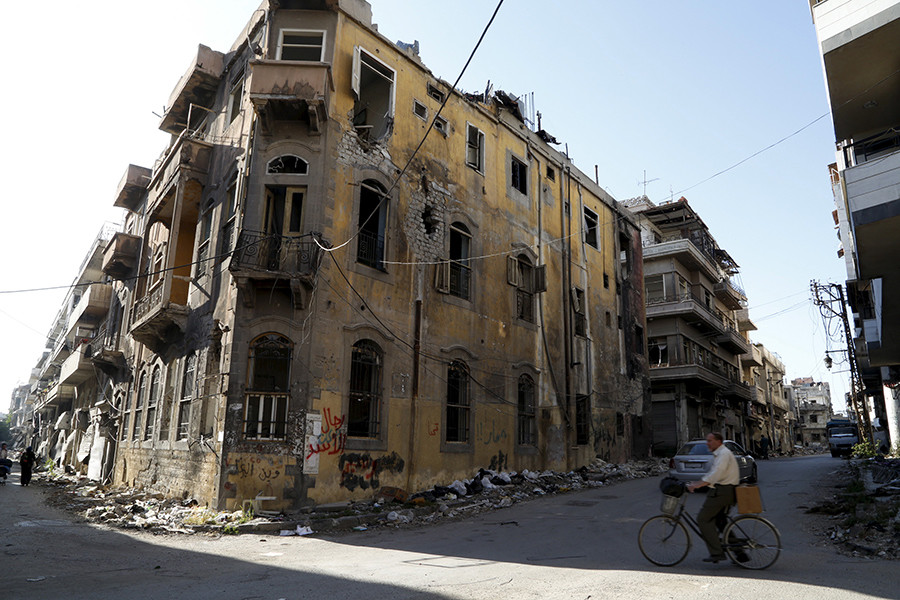
Were these narratives all manufactured? Were the images we saw all staged? Or was it only necessary to fabricate some things – because the “perception” of the vast middle population, once shaped, would create its own natural momentum toward regime change?
And what do we, in the region, do with this startling new information about how wars are conducted against us – using our own populations as foot soldiers for foreign agendas?
Create our own “game”
Two can play at this narratives game.
The first lesson learned is that ideas and objectives can be crafted, framed finessed and employed to great efficacy.
The second take-away is that we need to establish more independent media and information distribution channels to disseminate our own value propositions far and wide.
Western governments can rely on a ridiculously sycophantic army of Western and regional journalists to blast us with their propaganda day and night. We don’t need to match them in numbers or outlets – we can also employ strategies to deter their disinformation campaigns. Western journalists who repeatedly publish false, inaccurate and harmful information that endanger lives must be barred from the region.
These are not journalists – I prefer to call them media combatants – and they do not deserve the liberties accorded to actual media professionals. If these Western journalists had, in the first year of the Syrian conflict, questioned the premises of any of the four narratives listed above, would 250,000-plus Syrians be dead today? Would Syria be destroyed and 12 million Syrians made homeless? Would ISIS even exist?
Free speech? No thank you – not if we have to die for someone else’s national security objectives.
Syria changed the world. It brought the Russians and Chinese (BRICS) into the fray and changed the global order from a unipolar one to a multilateral one – overnight. And it created common cause between a group of key states in the region that now form the backbone of a rising ‘Security Arc’ from the Levant to the Persian Gulf. We now have immense opportunities to re-craft the world and the Middle East in our own vision. New borders? We will draw them from inside the region. Terrorists? We will defeat them ourselves. NGOs? We will create our own, with our own nationals and our own agendas. Pipelines? We will decide where they are laid.
But let’s start building those new narratives before the ‘Other’ comes in to fill the void.
A word of caution. The worst thing we can do is to waste our time rejecting foreign narratives. That just makes us the ‘rejectionists’ in their game. And it gives their game life. What we need to do is create our own game – a rich vocabulary of homegrown narratives – one that defines ourselves, our history and aspirations, based on our own political, economic and social realities. Let the ‘Other’ reject our version, let them become the ‘rejectionists’ in our game… and give it life.
Sharmine Narwani is a commentator and analyst of Middle East geopolitics. She is a former senior associate at St. Antony’s College, Oxford University and has a master’s degree in International Relations from Columbia University. You can follow her on Twitter at @snarwani
May 9, 2016
Posted by aletho |
Deception, Mainstream Media, Warmongering, Timeless or most popular, War Crimes | France, Qatar, Saudi Arabia, Syria, UK, Unconventional Warfare, United States |
Leave a comment

A recent conversation on security and peace between former security personnel of Saudi Arabia and Israel respectively, two weeks before Al Nakba commemoration shows that the attitude of the past on Palestine remains after 68 years.
Al Nakba is a series of events that led to the ethnic cleansing of Palestine and the Palestinians on May 15th, 1948. This is a day to remember the displacement and dispossession of 750,000 Palestinian people into refugee camps in neighboring countries; generations of whom continue to reside in these camps, others are scattered across the world in diaspora and many more internally displaced.
As the Palestinians across the world are on the verge of commemorating these events that happen to continue today in a process that is a form of incremental genocide, the Washington Institute for Near East Policy (WINEP) has recently engaged two former security personnel of Saudi Arabia and Israel respectively in a conversation related to security and peace in the Middle East. Setting aside that the said institute is a think tank that was founded by pro-Israel political figures, it is no surprise for Palestinians that an institution of this kind hosts such a choice for a duo to discuss the two topics of peace and security when both entities are serious human rights violators as well as exporters of terrorism and war; especially in the direct or indirect connection to Palestine and the Palestinians.
First and foremost, the timing of the said conversation between the two representatives of the security apparatuses of both entities reminds us that understanding the historical context is truly important for understanding the contemporary circumstances. As the events and planning took place leading up to the execution of the Nakba of 1948, there was an annulled agreement that took place prior known as the Faisal-Weizmann Agreement of 1919. This was an agreement that was signed at the Paris Peace Conference between Emir Faisal of Hejaz and Chaim Weizmann who was leader of the World Zionist Organization eventually leading to him becoming the first President of Israel. This agreement is significant in the fact that it reminds the Palestinians about the enabling and co-conspiring of the Arabs in the region and the role they played against the interests of the Palestinians; an example of which is the following:
Dr. Weizmann argued that Palestine was designed to solve “a world-wide problem” and therefore “the rights which the Jewish people has been adjudged in Palestine do not depend on the consent, and cannot be subjected to the will of the majority of its present inhabitants.” He maintained that “the Balfour Declaration and the Mandate have definitely lifted Palestine out of the context of the Middle East and linked it up with the world-wide Jewish community and the world-wide Jewish problem.” Thus the Zionists refused to let the British grant the Palestine Arabs any role in setting immigration quotas or in influencing other aspects of the development of the Jewish national home. Weizmann’s contempt for the first Arab delegation to London was apparent in his one discussion with them at the Colonial Office, in which he adopted the attitude “of a conqueror handing to beaten foes the terms of peace.”
Today’s Saudi Arabia’s role in relation to the nature of its engagement with the State of Israel, represents the same co-conspiring agenda and essence of the Faisal-Weizmann agreement under the guise of peace and security- in pursuit of self interest and Zionist led terror against the Palestinians. For example, during the latest military campaign against the Gaza Strip by the State of Israel known as Operation Protective Edge- Prime Minister Netanyahu emphasised the fact that “renewed relations” were built as a result of Saudi Arabia along with other Gulf countries engaging in security cooperation to quell the Palestinian resistance during those events.
Furthermore, the rise of the Islamic State and their reign of terror in the region has unsettling connections with these two entities. The Islamic State’s rise and political patterns in the region are leaning towards the affirmation of the Faisal-Weizmann Agreement given that this group’s reign of terror has not targeted any of these entities and have the same enemies that are “branches of the same tree”. Moreover, the group wants to abolish the Sykes-Picot Agreement which in many ways has been historically perceived as having been in the way and the obstacle of the Faisal-Weizmann Agreement. Most importantly, aside from the damage and destruction the Islamic State has done to the Palestinians both in Iraq and Syria, the Islamic State is attempting to exploit the Palestinian cause which also serves the Saudi-Israeli security interests.
And yet, with all this historical context at hand, including the horrendous human rights records of both Saudi Arabia and Israel along with an already outrageous military expenditure towards the State of Israel by the United States- the United States is granting Israel the largest military aid package in history, while simultaneously, Saudi Arabia is receiving a 15 billion dollar military arms package deal from Canada.
In Jeff Halper’s new book “War against the People” he sharply states: “In an endless war on terror, we are all doomed to become Palestinians.” The Washington Institute for Near East Policy is a political entity that enables this doom. It is an institute with residues of the pro-Israel lobby that played a pivotal role in dragging the United States into founding the global war on terror that has produced more global insecurity, the rise of the Islamic State and a push for war against Iran with no end in sight- all whilst simultaneously continuing the memoricide and erasure campaign against Palestine and the Palestinians through a nostalgic revivalism of what was embedded within the Faisal-Weizmann Agreement- demonstrated through this latest discussion between the Saudi-Israeli security personnel. This is what Palestine is trying to show the world. This is part in parcel of the Nakba in continuum.
May 8, 2016
Posted by aletho |
Ethnic Cleansing, Racism, Zionism, Timeless or most popular | Faisal-Weizmann Agreement, Human rights, Israel, Palestine, Saudi Arabia, WINEP |
Leave a comment
Founding political myths provide reassuring points of reference but they do not provide the full, or even, real reason on why major historical moments occurred. As is popularly known the American Revolution was triggered specifically by the Boston Tea Party in defiance of the British Parliament’s Tea Act of 1773. Yet in a recent article in the New York Review of Books, historian Professor Steve Pincus argues it was a series of economic policies, enforced by the British parliament from the 1760’s onward that made no small contribution to the colonialist’s rebellion against King George’s tyranny.
Recently in the United Kingdom a commemoration was held to mark hundred years since the Gallipoli expedition during World War One. The British Empire had intended to defeat the Ottoman Empire’s forces by sailing through the straits of Dardanelles and then move on to occupy Istanbul for the latter then to be parceled out to its ally, Imperial Russia.
The ‘Asia Minor Agreement’ between the Entente Powers of the British Empire, France and Imperial Russia divided the Ottoman Empire among themselves but after the Russian revolution (and the subsequent withdrawal of Russia from the war) this agreement became popularly known as Sykes-Picot. The British Empire’s failure to breach the Ottoman Empire’s positions at Dardanelles compelled it to fish around amongst the latter’s suzerainty in search of disgruntled groups who would be tricked into executing Great Britain’s dirty work of defeating the Ottomans and breaking up their Empire. Hence we today have the legend of the “Arab Revolt” as championed and jointly led by the British agent T.E.Lawrence aka “Lawrence of Arabia”.
Similarly when one attempts to ascertain the origins of the United States and the Saudi Arabian decades old alliance, the meeting held between President Franklin D. Roosevelt and the Kingdom’s founder, Abd al-Aziz Ibn Saud on board the USS Quincy on 14th February 1945 at Bitter Lake in the Suez Canal is widely regarded as the symbolic starting point. Hitherto, Ibn Saud had been the British Empire’s most reliable and favoured ally or desert stooge.
Since capturing Riyadh, what is now Saudi Arabia’s capital, with British weapons in 1902 Ibn Saud had dutifully and faithfully done the Empire’s bidding. Whether it was attacking the Ottoman’s Empire’s representatives in the Arabian desert or dispatching the recalcitrant Hussain Ibn Ali from the Hijaz, (the western part of today’s Saudi Arabia) in the mid-1920’s after he had refused to accept the Britain’s Zionist colonial project in Palestine; the Empire knew it had a loyal servant in Ibn Saud.
But with the Empire’s resources stretched during World War II, some British diplomats as early as 1941 were attempting to encourage American involvement in Saudi Arabia. The Empire believed it could no longer afford to subsidise Ibn Saud as well as soundly account for its own domestic and other imperial undertakings. According to two British biographers of the Saudi clan, David Holden and Richard Johns, British diplomats “had attempted in the dark days of 1941 to interest the United States Government in taking on some of their financial burden in Saudi Arabia” to no avail.[1]
Two academic studies by Dr. Barry Rubin also confirm it was the British who made the initial approaches to the United States. In the summer of 1941 the Minister-Counsellor in the British embassy in the United States, Neville Butler was attempting to encourage the State Department’s head of Near East Affairs, Wallace Murray to purchase more oil from Saudi Arabia. In a meeting in late July 1941, Butler suggested to Murray that it was “most important” that Ibn Saud knew he had friends in the United States to which he can rely on for assistance.[2]
Several weeks later on August 21st the Americans rebuffed British approaches to subsidise Ibn Saud. Yet this did not stop the British from trying to work out a way of enticing the Americans to take some responsibility in the Middle East. The British remained adamant that the Americans should and must be involved in the Arab World, as the “Foreign Office was trying to work out some division of economic opportunity and political responsibility to avoid being overwhelmed by the United States.”[3]
In other words, for the British, the issue was how to financially cut the Americans into the Middle East. As such, if the Americans were to be appropriately cut in, they would, it was thought, inevitably burden more imperial responsibility for policing the Middle East without threatening other British interests.
But why choose Ibn Saud? Why didn’t the British stealthily offer Iran, Iraq or any other oil wells which the British had carved countries out from i.e. Kuwait, Bahrain, Qatar, etc?
It appears that Saudi Arabia was the nation chosen by British imperialists to ingratiate the Americans with largely because the British clearly felt that they had enough oil in Iran and Iraq to satisfy their needs and therefore could afford to portion out Saudi Arabia to the Americans. More so, with the Empire’s oil needs met in Iran and Iraq there was no need to develop Saudi Arabian oil fields. This was noted by American officials who reported that the British “blessed with ample oil supplies from Iran and Iraq” had no interest in developing Saudi reserves.[4]
Furthermore, In Rubin’s book on American-British rivalry in the early 1940’s in the Middle East he observed that:
“The British, far from seeking to exclude American interests from the region, were attempting to work out a method for providing America with some responsibilities in the Middle East in order to make it a reliable partner in helping to shore up existing British interests.”[5] This responsibility ultimately culminated in transmuting Ibn Saud from a British puppet into an American puppet.
In other words if existing British interests were to be given a second American guard in the region then the Americans too needed something real or “ample” to defend. As Butler argued “Americans are not likely to accept responsibilities in the Middle East unless they first have increasing material interests there.”[6] The historian John Keay states that the “the British were to be seen simply as inviting US collaboration in the face of a new global peril.”[7] The peril was later identified as communism.
After the Americans acquiesced in accepting British invitations to embrace and subsidise Ibn Saud with a lend-lease package other narratives began to be concocted to explain the new geo-political alliance between the USA and Saudi Arabia. One narrative recently advocated by the BBC’s legendry Adam Curtis in his documentary on the meeting at Bitter Lake, is that a quid pro quo was agreed between Roosevelt and Ibn Saud, whereby the former would provide military security in exchange for ‘controlling’ the latter’s oil. But the U.S. oil needs have always largely been met by trade with western hemisphere nations.
Another narrative peddled mainly by British historians bestowed Ibn Saud with the vision, foresight and indeed the ability of reading the desert runes in that he “sensed a coming change in the regional balance of power”[8] or Ibn Saud possessed the “familiar bedouin eye to the main chance which dictated a prompt accommodation to the new facts of life”[9] and this therefore was why he struck a deal with the United States rather than the British Empire. Obviously, Ibn Saud’s sublime intuitions dovetailed neatly with British strategies.
When Roosevelt finally met Ibn Saud in 1945 at Great Bitter Lake it was on the back of almost four years of diplomatic shenanigans between British and American diplomats. When a British diplomat did complain in 1945 of the United States usurping the UK’s long established alliance with Ibn Saud he was rebuffed by central government because “London ‘was glad to see the Americans with a substantial stake in the Middle East.’”[10]
The meeting at Bitter Lake has now come to symbolise the founding of the American and Saudi Arabian geo-political relationship when it most likely represented the ceremonial handover and makeover of a pliable British stooge into an ever more pliable American stooge. In many respects the meeting can also be seen as a belated, decades-old, addendum to the Sykes-Picot carve up: American power was allowed to wiggle into the Middle East alongside the British with its own piece of Saudi booty.
[1] David Holden and Richard Johns, “The House of Saud” (London : Pan Books, 1982), pg.127
[2] Barry Rubin, “Anglo American Relations in Saudi Arabia, 1941-1945”, Journal of Contemporary History, Vol. 14 (1979), pg.254
[3] ibid., pg.255-6
[4] ibid., pg.262
[5] Barry Rubin, “The Great Powers in the Middle East 1941-1947” (London: Frank Cass, 1980), pg. 38-39.
[6] ibid., pg. 39
[7] John Keay, “Sowing the Wind: The mismanagement of the Middle East 1900-1960” (London: John Murray, 2003) pg. 334
[8] Lawrence James, “Churchill and Empire: Portrait of an Imperialist” (London: Pheonix, 2013) pg.326
[9] Holden & Johns, op., cit. Pg. 135
[10] Rubin, “The Great Powers in the Middle East 1941-1947”, op., cit., pg. 64
May 7, 2016
Posted by aletho |
Ethnic Cleansing, Racism, Zionism, Militarism, Timeless or most popular | BBC, Saudi Arabia, UK, United States |
Leave a comment


 Aletho News