Real hypocrisy versus real change: Trudeau backs arms deal with Lords of Terrorism
By Mark Taliano | American Herald Tribune | April 17, 2016
“Reverse Projection”, as described by Canadian professor John McMurtry, is a staple of propagandists as the imperial West imposes its toxic agenda of war and poverty domestically, and throughout the world.
Public Relations liars are the new myth makers who create the new stories to sell to an increasingly anesthetized public.
All of the lies serve to entrench the transnational oligarch class and to deny wealth, freedom, democracy, and Life itself to the rest of us.
Canada’s governing party, the Liberals, led by the ever charismatic Justin Trudeau, is a perfect front for a criminal agenda where black is sold as white, and white is sold as black. The Liberal party will have a long tenure.
Justin Trudeau’s defense of the sale of military equipment to Wahhabi Saudi Arabia as a matter of “principle” will no doubt solidify his glowing reputation.
Not only is Wahhabi Saudi Arabia a chief financier for NATO’s criminal terrorist proxies who are chopping their way through the Middle East and Africa, but its degenerate ideology, a deformed misinterpretation of Koranic teachings, will also continue to flourish, thanks to countries like Canada, that grow and sustain the spiritual cancer, to the detriment of humanity, and the benefit of the few.
Justin Trudeau’s self-professed “feminism” is a perfect veneer to cover the depravities of Canada’s misogynist foreign policy.
Felicity Arbuthnot describes in “United Nations Farce: Saudi Arabia to Head UN Human Rights Council,” some of the highlights of Saudi Arabia’s domestic human rights record:
“By 15th June this year executions reached one hundred ‘far exceeding last year’s tally and putting (the country) on course for a new record’ according to The Independent (15th June.) The paper adds that the Kingdom is set to beat it’s own grisly, primitive record of one hundred and ninety two executions in 1995.
The paper notes that: ‘… the rise in executions can be directly linked to the new King Salman and his recently-appointed inner circle …’
In August 2014, Human Rights Watch reported nineteen executions in seventeen days – including one for ‘sorcery.’ Adultery and apostasy can also be punished by death.”
It gets better. Arbuthnot explains:
“At home women are forbidden: ‘from obtaining a passport, marrying, traveling, accessing higher education without the approval of a male guardian.’ (HRW Report, 2014.) Saudi is also of course, the only country in the world where women are forbidden to drive.”
The Axis of Evil, to which Canada so willingly belongs, includes Apartheid Israel , the Persian Gulf monarchies, and the US-led NATO terror organization. Each of these polities has declining rights and freedoms at home which serve as a foundation for the destruction that the Western Axis spreads globally, largely beneath the radar of domestic public perception.
The “matter of principle”, as described by Trudeau, is like a “code of honour” between arms-trafficking mafia clans. The “principle” being honored will be instrumental in the deaths of more innocent people in Yemen , Syria, and beyond. It will also be an instrument for Wahhabism, and against democracy and the rule of law globally.
If, god forbid, the West’s terror proxies win in Syria, then the democratic government of Syria will be replaced by a barbaric puppet regime beholden to the West.
Fortunately, the Syrian people have witnessed the depravities of the West’s destruction of Iraq, its demolition of Libya, and its nazification of Ukraine, so they will be less likely to compromise with the forces of evil that they are defeating at this very moment. Nor should they compromise.
In an article entitled “Syrian 2016 Elections Defy US and NATO ‘Regime Change’ Agenda,” Canadian peace activist Ken Stone describes his observations of the current Syrian elections in these words:
“On the walls of the buildings along the narrow streets were plastered hundreds upon hundreds of election posters. Over the streets were strung banners showing small and large groupings of well-dressed candidates representing each slate. Clearly, the 250 parliamentary seats were being hotly contested.”
Later, he explains:
“Having worked on many Canadian elections, I can attest to the fact that Syrian elections are different from Canadian elections. But that doesn’t mean they don’t represent the national will, as claimed by US State Department.
After all, with the Canadian first-past-the-post system, the representation of political parties in the House of Commons in Ottawa bears little resemblance to their share of the popular vote. And, in Canada, we have, in effect, a two party system. Only the big business-friendly Liberals and Conservatives have ever held power in our country in 150 years.”
“Real change,” as demonstrated by Canada’s covert foreign policy, means more totalitarianism, more misogyny, more terrorism, more displaced peoples, more refugees, more death, and more destruction.
This isn’t exactly the “real change” that the public relations mandarins sold to Canadians.
Read more:
Canadian politicians controlled by the transnational oligarchy?
Canada rejects the rule of international law and embraces international barbarity
Saudi gave grant money to Malaysia PM: FM Jubeir
Press TV – April 15, 2016
The Saudi foreign minister admits that the kingdom gave nearly USD 700 million to Malaysian Prime Minister Najib Razak, who has faced corruption charges since the huge grant came to light last year.
Adel al-Jubeir said Friday that the $681 million (£479 million) Riyadh offered to the premier was a “genuine donation with nothing expected in return.”
Last July, the Wall Street Journal revealed for the first time that some $700 million had been transferred to Najib’s private accounts before the 2013 general election. The report suggested that the money came from a state development fund.
At the time, Najib was already engulfed in a scandal surrounding state fund 1Malaysia Development Berhad (1MDB) and deposits into his private accounts worth around $680 million.
However, Malaysia’s attorney general cleared Najib of any criminal wrongdoing earlier this year, saying the $681 million transferred into his account back in 2013 was from the Saudi royal family and was personal donations.
According to the attorney general, Najib had returned USD 620 million of the money to the Saudi royal family in August 2013, about five months after the transfer.
The Malaysian opposition has challenged the attorney general’s ruling, arguing that the transfer of personal donations did not rule out corrupt motives or transactions.
On Friday, Saudi foreign minister said, “We are also fully aware that the attorney general of Malaysia has thoroughly investigated the matter and found no wrongdoing.”
The remarks by Jubeir came after leaders from across Malaysia’s political spectrum called for the ouster of Najib after he returned from a four-day visit to Saudi Arabia back in March.
The Malaysian premier came into office in 2009 promising a government free of corruption and a more relaxed rule.
Red-handed: UK military trained Saudis as they rained fire on Yemen, says Reprieve
RT | April 15, 2016
UK military personnel have delivered a series of three-week courses on “international targeting” to the Saudi forces currently engaged in pummeling Yemen, a Freedom of Information (FoI) request shows.
The revelations were made following a request by the human rights NGO Reprieve. The organization is now urging the UK government to stop providing military support.
While the MoD has long claimed its role is purely advisory, the revelations lay bare the closeness with which the two countries operate.
It now appears courses were being run by RAF officers as recently as 2015 on “international targeting” over three separate three-week blocks.
This included training on the Storm Shadow missile, which is launched from aircraft to destroy enemy bunkers.
Gunnery instruction on targeting and locating enemy gun batteries was also carried out by a seven-strong detachment of personnel from the Royal Artillery.
The artillery team delivered 52 hours of training to Saudi gunners and included a senior major, a captain, a sergeant major and a sergeant.
The MoD said the course had been delivered to “a mixed group of soldiers and officers” from the Royal Saudi Land Forces RSLF) field artillery.
Saudi personnel have also visited the UK for training.
The military said their personnel were not involved in “carrying out strikes, directing or conducting operations in Yemen or selecting targets, and are not involved in the Saudi targeting decision-making process.”
They stressed, as they have on numerous occasions, that the UK military “provide guidance on best practice techniques, including advice to help continued compliance with international humanitarian law.”
Reprieve case worker Omran Belhadi said: “Claims by ministers that Britain is helping the Saudi government abide by the law are disingenuous.”
He pointed out that legal training on rules of engagement and the laws of war did not seem to have sunk in if, indeed, it was delivered.
“Extensive British ‘targeting training’ has done nothing to prevent the bombing of schools, hospitals and weddings, and the deaths of thousands of Yemeni civilians,” Belhadi told the Guardian.
Activists were preventing war crimes by blockading world’s biggest arms fair – judge
RT | April 15, 2016
 Eight activists standing trial for disrupting the world’s biggest arms fair, held in London last September, have been found not guilty. The court ruled they were acting to prevent a greater crime, according to an anti-arms trade group.
In his ruling, the judge said there was clear, credible and largely unchallenged evidence of wrongdoing at Defence & Security Equipment International (DSEI), according to Campaign Against the Arms Trade (CAAT).
He said there is “compelling evidence” that arms sold at DSEI are used for repression and human rights abuses.
Ham & High reporter Rachel Roberts said the judge dismissed the argument, put forward by the Crown Prosecution Service (CPS), that a not guilty verdict will “open floodgates” to anarchy in the UK.
Instead he accepted that all eight defendants acted reasonably and proportionally to try and prevent the sale of illegal arms and war crimes, Roberts tweeted.
The ruling is a victory for anti-arms trade activists, who sought to highlight the UK’s complicity in war crimes committed by repressive regimes around the world.
The eight activists issued a statement through CAAT in which they called on the public to join the campaign to shut down DSEI.
“Over the week, we have put DSEI and the arms trade on trial and we have proven them to be illegitimate. Our only regret is that we didn’t succeed in shutting down DSEI,” they said.
“Our thoughts are with the people who suffer as a result of the arms trade and the survivors of repressive regimes, torture, war and conflict. We call on more people to join us in our efforts to shut down DSEI 2017 and take collective action to end the arms trade.”
The campaigners were arrested after blocking the road leading to the arms fair last September, preventing tanks and weaponry from entering.
The activists used the defense of necessity, insisting their actions were justified because they intended to prevent greater crimes taking place around the world.
CAAT said the trial highlighted UK complicity in war crimes in Yemen, where the British military is offering support to the Saud-led coalition waging war against Houthi rebels.
It also raised awareness about British complicity in human rights abuses in Bahrain and the slaughter of Kurdish civilians by Turkey, according to the group.
2015’s DSEI event featured stalls from more than 1,500 exhibitors, including arms giants Lockheed Martin, BAE Systems, Finmeccanica and others.
Customers included representatives from Saudi Arabia, Israel, Bahrain and Egypt.
‘Arrest arms dealers, not peace campaigners!’ 8 on trial over weapons fair protest
RT | April 11, 2016
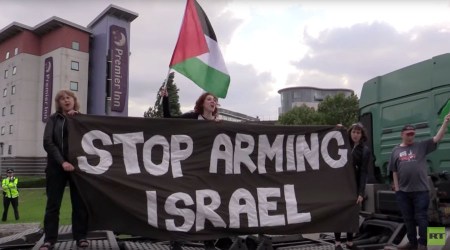
Eight activists are standing trial at Stratford Magistrates Court for disrupting the world’s biggest arms fair, held in London, where deadly merchandise was marketed to repressive regimes such as Saudi Arabia, Bahrain and Azerbaijan.
The campaigners blocked the road leading to the Defence & Security Equipment International (DSEI) in Stratford, London, last September, preventing tanks and weaponry from entering.
The defendants are using a defense of necessity, insisting their actions were justified because they intended to prevent greater crimes taking place around the world.
These include: “The sale of weapons to internally repressive regimes, including Bahrain and Saudi Arabia; the sale of weapons to countries imminently at war and overtly complicit in ongoing war crimes in Yemen, Kurdistan and Palestine; the sale of weapons to regimes that have been widely accused of arming ISIS [Islamic State or IS]; the promotion for sale of weapons that are designed specifically for torture or banned under international law for their capabilities concerning the mass indiscriminate killing of civilians.”
The DSEI arms fair is held every two years in London, and is regularly attended by representatives from repressive regimes. It has also previously provided a platform for weapons dealers to illegally promote arms that are used for torture.
Last September’s event featured stalls from more than 1,500 exhibitors, including arms giants Lockheed Martin, BAE systems, Finmeccanica and others.
Protestors sought to disrupt the fair by locking their bodies together to block access roads outside the Excel Centre, where the fair was held. Several were arrested.
Some protestors, such as Vyara Gylsen – who was arrested after writing a slogan on a military vehicle with a washable marker pen – have since seen criminal charges against them dropped.
The defendants in court this week include Isa Al Aali, a Bahraini activist who was tortured during the Arab Spring uprising in Bahrain.
Green Party activists Angela Ditchfield and Tom Franklin are also among the eight appearing in court.
“The government is supporting and facilitating the sale of weapons that are being used to kill ordinary people, from the West Bank to Yemen and Sudan,” Franklin, 57, of York, said.
“This week we will put the arms trade in the dock and highlight the crimes that the government and the companies at DSEI are complicit in. Arrest arms dealers, not peace campaigners.”
The defendants will be supported by expert witnesses, including former South African MP Andrew Feinstein, who resigned from parliament in 2001 in protest at the government’s refusal to investigate a £5 billion (US$7.12 billion) arms deal.
Amnesty International UK’s Oliver Sprague, who heads up the charity’s arms Control and Policing division, will also give oral evidence, as will Bahrain Institute for Rights and Democracy director Sayed Ahmed, who seeks to improve accountability in the repressive Gulf state.
Al-Qaeda gaining power & money from Saudi-led intervention in Yemen – report
RT | April 8, 2016
Al-Qaeda has made major financial gains as a result of the war in Yemen, running its own mini-state and pocketing $100 million in looted bank deposits and revenue from running the country’s largest port, a Reuters investigation has revealed.
The group’s deep pockets and increased power are down to the Saudi-led intervention in Yemen, which has reportedly helped it become stronger than at any time since its emergence almost 20 years ago.
Al-Qaeda in the Arabian Peninsula (AQAP) has a major presence in Mukalla, a city of 500,000 people, where it runs the third largest port in Yemen. As part of its port “management,” the group operates speedboats manned by armed fighters who impose fees on ship traffic.
Yemeni government officials and local traders estimate that the group earns up to US$2 million every day in taxes on goods and fuel coming into the port. In addition, it is believed the group has managed to extort $1.4 million from the national oil company.
The group also looted Mukalla’s central bank branch, gaining an estimated $100 million, according to two senior Yemeni security officials.
The economic empire of Mukalla was described to Reuters in detail by more than a dozen diplomats, Yemeni security officials, tribal leaders, and residents.
AQAP has abolished taxes for local residents in Mukalla, and group members have integrated themselves with southern Yemenis who have felt marginalized by their northern counterparts for years. The group has also made propaganda videos in which they have boasted about paving local roads and stocking hospitals.
In doing so, the group has managed to win over many locals.
“I prefer that Al-Qaeda stay here, not for Al Mukalla to be liberated,” said one 47-year-old resident. “The situation is stable, more than any ‘free’ part of Yemen. The alternative to Al-Qaeda is much worse.”
AQAP has managed to expand its territory by using many of the tactics used by Islamic State (IS, formerly ISIS/ISIL). It boasts 1,000 fighters in Mukalla alone, and controls 600km (373 miles) of coastline. The group also claimed responsibility for the 2015 Charlie Hebdo attack, which left 12 people dead at the satirical magazine’s Paris office.
‘Easier to expand’
According to a senior Yemeni government official, AQAP’s expansion is due to the Saudi-led coalition in Yemen, which is supported by the US.
The coalition, which has been bombing Houthi rebels since March 2015, sides with the exiled President Abd Rabbuh Mansur Hadi, while the Houthis are aligned with former President Ali Abdullah Saleh, who resigned in 2012 following a popular uprising against his rule.
The official told Reuters that the war has “provided a suitable environment for the… expansion of Al-Qaeda.”
He said the withdrawal of government army units from their bases in the south allowed AQAP to acquire “very large quantities of sophisticated and advanced weapons, including shoulder-fired missiles and armed vehicles.”
In addition, the coalition’s pre-occupation with fighting the Houthis “made it easier for Al-Qaeda elements to expand in more than one area,” the official said. “And this is why Al-Qaeda has today become stronger and more dangerous.”
But despite claims that the intervention has made it easier for AQAP to expand, a recent statement from the Saudi embassy in Washington stated that the campaign had “denied terrorists a safe haven in Yemen.”
Still, AQAP continues to grow and prosper amid a civil war which has so far led to the deaths of 6,000 people. Among the death toll are 3,218 civilians, according to the UN Human Rights Office. An additional 5,778 civilians have been injured in the violence.
Terror Bombing in Brussels and Paris: Europe’s Islamist Legionnaires Come Home to Fight
By James Petras :: 04.08.2016
Introduction: The terror bombings in Paris and Brussels have raised a cacophony of voices, ranging from state officials, Prime Ministers and Presidents, to academics, journalists and media consultants. Tons of ink and print have focused on the psychology, networks and operations of the alleged perpetrators – radicalized young Muslim citizens of the EU.
Few have examined the long-term, large-scale policies of the EU, US and NATO, which have been associated with the development and growth of the worldwide terror networks. This essay will discuss the historical links between Islamist terrorists and the US-Saudi Arabian-Pakistani intervention in Afghanistan, as well as the consequences of the US invasion and occupation of Iraq. In Iraq, the US implemented a deliberate policy of destroying all secular state structures and promoting the Balkanization of the country via ethnic-religious and tribal wars – a policy it has followed in subsequent areas of intervention.
The last section will focus on the US-EU-Gulf Petrol-Monarchy proxy invasions and ‘regime change’ bombings of the secular republics of Libya and Syria with the further cultivation and growth of international Islamist terrorism.
Historical Origins of International Islamist Terrorism: Afghanistan
In 1979, President James Carter and his National Security Chief, Zbigniew Brzezinski, launched Operation Cyclone, a major Islamist uprising against the Soviet- aligned secular Afghan regime. The US coordinated its campaign with the rabidly anti-Soviet monarchy in Saudi Arabia, which provided the funding and mercenaries for ‘international jihad’ against secular governance. This brutal campaign ‘officially’ lasted 10 years until the Soviet withdrawal in 1989. It produced millions of casualties and decades of ‘blow-back’ when the CIA-Pakistani-Saudi trained Arab mercenaries (the ‘Afghan-Arabs’) returned to their home countries and elsewhere. The US intelligence agencies, Special Forces Commands and military directorates (especially Pakistan’s ISI intelligence service) trained and armed terrorists with US-Saudi funding. The American covert financial contribution mushroomed over the years rising to over $670 million dollars a year by 1987. Tens of thousands of Islamist mercenaries and adventurers were recruited from the Middle East, North Africa, the Gulf States, the Soviet Union (Chechens), Yugoslavia (Bosnians and Kosovars), China (Uigurs) and Western Europe.
With the defeat of the secular regime of President Najibullah in 1992, the Islamists and tribal factions then fought among themselves, converting Afghanistan into the world’s best-equipped training ground for International Islamist terrorists. Eventually, the Pashtun-based Taliban faction (with Pakistani arms and support) prevailed and established an extreme Islamist regime. The Taliban, despite its rhetoric, settled down to consolidating their brand of ‘Islamism in one country’, (1995-2001), a largely nationalist project. In its quest for respectability, it successfully destroyed the opium poppy fields, earning the praise of US President GW Bush in spring 2001. It also hosted a variety of Saudi princes and warlords, eventually including the jihadi-internationalist Osama bin Laden, who had been driven from North Africa.
Following the terrorist attack on the US in September 2001, the US and NATO invaded Afghanistan on October 2001 and overthrew the nation-centered Islamist Taliban regime. The subsequent chaos and guerrilla war opened up a huge new inflow and outflow of thousands of international extremists who came to Afghanistan, trained, fought and then departed, fully prepared to practice their terrorist skills in their countries of origin in Europe, North Africa and the Middle East.
The US interventions and invasion of Afghanistan provide some of the context for the subsequent bombings in Europe and the US. The Islamist ‘returnees’ to Europe and elsewhere had received funds from Saudi Arabia and training from the CIA and Pakistani intelligence. They began their work among a very ‘available’ constituency of potential recruits in the marginalized Muslim youth of the ghettos and prisons of Europe.
The Middle Period: the US-Zionist Invasion and Destruction of Iraq
The turning point in the growth and internationalization of Islamist terrorism was the US invasion, occupation and systematic reign of terror in Iraq. Largely under the guidance of key US Zionist policymakers (and Israeli advisers) in the Pentagon, State Department and the White House, the US dismantled the entire secular Iraqi army and police forces. They also purged the administrative, civil, educational, medical and scientific institutions of nationalistic secular professionals, opening the field to warring Islamist tribal factions. Hundreds of thousands of Iraqi civilians were killed and millions fled in a regime of ethnic cleansing – which Washington touted as a model for the rest of the Middle East. However, thousands of experienced, but jobless Iraqi military officers, who had survived the US-orchestrated purges, regrouped and eventually joined with tens of thousands of nationalist and internationalist Islamist extremists to form ISIS. Their motives were arguable less ethno-religious and more related to revenge for their displacement and the destruction of their own society.
The deliberate US (Zionist)-EU-Saudi strategy to divide and conquer Iraq initially involved working closely with Sunni feudal tribal leaders and other extremists to counter the rising power of pro-Iranian Shia. They promoted a policy of fragmenting the country with the Kurds dominating in the North, the Sunnis in the center and the Shia in the south (the so-called Joseph Biden-Leslie Gelb Plan of national dismemberment and ethnic cleansing). The rationale was to create a weak central authority completely under US-EU tutelage and a loose group of fragmented subsistence fiefdoms in what had been the most advanced secular Arab republic.
Despite pouring billions of dollars in arms from the US to create a puppet-colonial Iraqi ‘national army’, the Saudis and Israelis pursued their own policy of financing sectors of the Kurds and violent Sunni opposition – with the latter forming the original mass base of ISIS.
As the US-client Shia regime in Baghdad focused on stealing billions while killing or exiling hundreds of thousands of educated Sunnis, Christians and other secular Iraqis from the capital, the morale of its US-puppet troops plummeted. With the entire experienced and nationalist Iraqi officer core purged (slaughtered or driven into hiding), the new puppet officers were cowardly, corrupt and incompetent – as openly acknowledged by their US ‘advisers’. ISIS, meanwhile had acquired hundreds of thousands of US weapons and was financed by the Shia-hating Saudi Royal Family and other Gulf Monarchs. Armed Sunnis soon launched major, lightning-quick offensives under the leadership of ex-Baathist army officers, supported by thousands of terrorists, suicide bombers and foreign mercenaries. US and European ‘military experts’ expressed ’shock’ at their effectiveness.
ISIS routed the Baghdad-controlled army, their US advisers and Kurdish allies from northern Iraq, capturing major cities, including Mosul, thousands of productive oil wells and drove their forces to within a few dozen kilometers of Baghdad. Territorial conquest and military successes attracted thousands more Islamist volunteers from the Middle East, Europe, Afghanistan and even North America. ISIS provided the military training; Saudi Arabia paid their salaries; Turkey purchased their captured oil and antiquities and opened its borders to the transfer of jihadi troops and weapons. Israel, for its part, purchased captured ISIS petrol at a discount from corrupt Turkish traders. Each regional player had its snout in the bloody trough that had once been Iraq!
ISIS successes in Iraq, led it to expand its operations and ambitions across the border into Syria. This occurred just as the US and EU were bombing and destroying the secular government of Colonel Gadhafi in Libya, in another ‘wildly successful’ planned campaign of ‘regime change’ (According to US Secretary of State Clinton as she gleefully watched the captive wounded Gadhafi ’snuff film’ by unspeakable torture – ‘WE came and HE died’.).
The chaos that ensued in Libya led to an exponential growth of extremist Islamist groups with tons of weapons of ‘liberated’ Libyan weapons! Islamist terrorists in Libya gained territory, took over oil wells and attracted ‘volunteers’ from the marginalized youth of neighboring Tunisia, Egypt, Mali and as far away as Somalia, Afghanistan, Iraq and Syria. Flush with more guns, money and training. Many graduates went on to Syria and Iraq.
The Contemporary Period: EU-US-Turkey-Saudi-Israeli Sponsored War in Syria
In 2011, as ISIS rolled across the Iraqi border into Syria and terrorist Islamist bands seized cities in Libya, the US-EU-Turkish-Saudi and Israeli regimes financed and armed Islamist (and the mythical ‘moderate’) forces in Syria to overthrow the nationalist-secular Syrian regime of Bashar al Assad.
Thousands of Islamist extremist volunteers heeded the call (and the fat paychecks) of the Saudi regime and its Salafist propagandists. These constituted the Saudi Royal Family’s own ‘Foreign Legion’. They were trained and armed and shipped into Syria by Turkish intelligence. The US armed and trained hundreds of its own so-called ‘moderate rebels’ whose fighters quickly defected to ISIS and other terrorist groups turning over tons of US arms, while the ‘moderate rebel leaders’ gave press conferences from London and Washington. ISIS seized swaths of Syrian territory, sweeping westward toward the Russian naval and air bases on the coast and upward from the south, encircling Damascus. Millions were uprooted and minority populations were enslaved or slaughtered.
The news of ISIS territorial gains with their plundered oil wealth from sales to Turkey and the flow of arms from Saudi Arabia, the EU and the US attracted over 30,000 ‘volunteer’ mercenaries from North America, Europe, North Africa, the Middle East and South Asia.
These new terrorists received military training, including bomb making and logistical planning in Syria. Many were citizens of the EU, Islamist extremists, numbering over five thousand. These young fighters trained and fought in Syria and then returned to France, Belgium, Germany and the rest of the EU. They had gone to Syria with the tacit support and/or tolerance of their own European governments who had used them, rather than NATO troops, in the US-EU campaign of ‘regime change’ against Damascus.
The European governments were sure they had ‘their’ Muslim recruits under control as they joined the US in a reckless policy of overthrowing independent secular governments in the Middle East and North Africa. They happily encouraged their marginalized young Muslim citizens to flock to Syria and fight. They hoped they would remain in Syria (fighting on the ground or buried under the ground). Officially, EU leaders claimed to support ‘moderate rebels’ (the bland term Western media used to sanitize Islamist terrorists) fighting the Assad ‘dictatorship’. European regimes were not prepared to detain the battle hardened ‘returnees’, who had been trained in Iraq and Syria. These young European Muslims (children of immigrants or converts to Islam) had been heavily indoctrinated and incorporated into international terrorist networks. They easily melted back into their marginalized European urban ghettos – beyond the control of Europe’s bloated intelligence services.
In practice, the EU regimes saw the thousands of Europe’s Muslim youth flocking to Syria as an ‘EU Foreign Legion’, a glorified wastebasket for unemployed young thugs and ex-prisoners, who would advance NATO’s imperial goals while solving the domestic social problem of the marginalized children of North African migrants. Europe’s Muslim youth were viewed as convenient cannon fodder by NATO planners and the governments of France, Belgium and the UK. For public relations, it was better for these young men and women to die overthrowing the secular government in Syria than to send in European soldiers (white Christians) whose deaths would have domestic political repercussions.
The EU underestimated the depth of antagonism these ‘volunteers’ felt about US-EU intervention in the Middle East and North Africa, as well as their anger at Europe’s continued support for Israeli land grabs in Palestine. In its racist arrogance, EU leaders underestimated the capacity of ISIS to indoctrinate, train and organize these marginalized kids from Europe’s slums into effective international cells able to carry the war back to Europe.
 The EU smugly overlooked the active roles of Turkey and Saudi Arabia who had their own independent, regional ambitions. Ankara and Riyadh trained and financed the ‘volunteers’, and facilitated their flow into Syria from camps in Turkey and Jordan. The wounded were treated in Turkey and sometimes even in Israel. Thousands, many EU citizens, would flow back into Europe or to their countries of origin in the Middle East and North Africa, as well as Russia.
The EU had slavishly and blindly followed Washington’s lead in all its Middle East wars. Now it is now paying a big price: Thousands of trained terrorists have returned; bombings and attacks on European civilians and civil structures have occurred, while the European government leaders trip over each other in a mad rush to dismantle civil and constitutional citizen rights and impose wide ranging police state measures (States of Emergency).
These new Saudi-funded terrorist recruits (Riyadh’s Legionnaires) are active in all the countries where the US and EU have launched proxy wars: Iraq, Syria, Libya, Yemen, Afghanistan . . . Turkey funds ISIS terrorists in Syria, Iraq and Kurdish territories to advance its own expansionist ambitions – oblivious to the clucking disapproval of EU leaders. Now Turkey receives over 6 billion Euro’s from the EU in what amounts to blackmail: In return, Turkey will ‘contain’ the flood of regional refugees in barely disguised concentration camps out of European sight.
Conclusion
Ever since the US-EU policymakers decided to implement a war against Arab and West Asian secular nationalism in the Middle-East, Afghanistan, Iran and North Africa through serial ‘regime change’ campaigns they have relied on Islamist Salafist mercenaries and volunteers to do most of the killing on the ground, while the West operates from the air. Washington and its NATO allies operated on the assumption that they could use and then discard their recruits, mostly from marginalized urban youth and criminal gangs, once they had served imperial military purposes. A few with requisite talent and ruthlessness could be turned into puppet ‘leaders’ to unleash on the Russians and other ‘obstacles’ in future engagements.
The EU-US totally misunderstood the volunteers’ high level of independence, their organizational autonomy and their own understanding of the tactical nature of their alliance with Western imperialism. Islamist extremist leaders, like their Western counterparts, believe there are no permanent alliances – only permanent interests.
The EU and US have pursued a policy of overthrowing independent Muslim and secular Arab nations and returning them to the status of pre-independence semi-colonies. The rollback policy against secular nationalism (with its deep roots in the Dulles era) has extended from North Africa, through the Middle East to Southwest Asia. For its part, ISIS and its allies envision a return to a pre-colonial Islamic caliphate over the same lands and people to counter Western imperialism. Millions are caught in the middle.
ISIS views the Westernized secular elites in the Muslim countries as a fifth column for the spread of empire, while it has re-socialized and trained young Islamists from the EU to serve as networks of terrorists ‘behind enemy lines’ sowing mayhem in the West.
The political repercussions of this internationalized war are profound. Millions of civilians in the war zones have been and will be killed, uprooted and converted into desperate refugees flooding the EU. Police-state emergency rule, arbitrary searches, arrests and interrogations have become the norm in the highly militarized European airports, train and metro stations, as well as markets and cultural centers. The EU has increasingly undergone an ‘Israelization’ of its society, with its population polarized and resembling Israel- Palestinian . . . its Muslim community marginalized and confined into little Gaza’s.
In this charged atmosphere, Israeli high tech security companies and advisers flourish, mergers and acquisitions of police state technology multiply. Israeli Prime Minister Benny Netanyahu embraces the French Prime Minister Hollande in the club of electoral authoritarians.
Meanwhile the refugees and their children flow to and fro, the bombs come and go. We line up to place flowers on our latest dead and then pay our taxes for more wars in the Middle East. More young ‘volunteers’ will become cheap fodder to fight in our wars; some will return and plant more bombs, so we can mourn some more at patriotic vigils -protected by armed battalions…
Lebanon is being forced to collapse
By Andre Vltchek | RT | April 8, 2016
Lebanon cannot stand on its feet anymore. It is overwhelmed, frightened and broke.
It stands at the frontline, facing Islamic State (IS, formerly known as ISIS/ISIL) in the east and north, hostile Israel in the south and the deep blue sea in the west. One and a half million (mostly Syrian) refugees are dispersed all over its tiny territory. Its economy is collapsing and the infrastructure crumbling. ISIS is right on the border with Syria, literally next door, or even with one foot inside Lebanon, periodically invading, and setting up countless “dormant cells” in all the Lebanese cities and all over the countryside. Hezbollah is fighting ISIS, but the West and Saudi Arabia apparently consider Hezbollah, not ISIS, to be the major menace to their geopolitical interests. The Lebanese army is relatively well trained but badly armed, and as the entire country, it is notoriously cash-strapped.
These days, on the streets of Beirut, one can often hear: “Just a little bit more; one more push, and the entire country will collapse, go up in smoke.”
Is this what the West and its regional allies really want?
One top foreign dignitary after another is now visiting Lebanon: the UN chief Ban Ki-moon, World Bank Group President Jim Yong Kim and the EU foreign policy chief Federica Mogherini. All the foreign visitors are predictably and abstractly expressing “deep concern” about the proximity of ISIS, and about the fate of the 1.5 million Syrian refugees now living in Lebanon. “The war in neighboring Syria is having a deep impact on tiny Lebanon”, they all admit.
Who triggered this war is never addressed.
And not much gets resolved. Only very few concrete promises are being made. And what is promised is not being delivered.
One of my sources who attended a closed-door meeting of Ban Ki-moon, Jim Yong Kim and the heads of the UN agencies in Beirut, commented: “almost nothing new, concrete or inspiring was discussed there.”
The so-called international community is showing very little desire to rescue Lebanon from its deep and ongoing crises. In fact, several countries and organizations are constantly at Lebanon’s throat, accusing it of “human rights violations” and of having weak and ineffective government. What seems to irritate them the most, though, is that Hezbollah (an organization that is placed by many Western countries and their allies in the Arab world on the “terrorist list”) is at least to some extent allowed to participate in running the country.
But Hezbollah appears to be the only military force capable of effectively fighting against ISIS – in the northeast of the country, on the border with Syria, and elsewhere. It is also the only organization providing a reliable social net to those hundreds of thousands of poor Lebanese citizens. In this nation deeply divided along sectarian lines, it extends its hand to the ‘others’, forging coalitions with both Muslim and Christian parties and movements.
Why so much fuss over Hezbollah?
It is because it is predominantly Shia, and Shia Muslims are being antagonized and targeted by almost all the West’s allies in the Arab world. Targeted and sometimes even directly liquidated.
Hezbollah is seen as the right hand of Iran, and Iran is Shia and it stands against Western imperialism determinately, alongside Russia, China and much of Latin America – countries that are demonized and provoked by the ‘Empire’ and its client states.
Hezbollah is closely allied with both Iran and Bashar al-Assad’s government in Syria. It combats Israel whenever Israel invades Lebanon, and it wins most of the battles that it is forced to fight. It is openly hostile towards the expansionist policies of the West, Israel and Saudi Arabia; its leaders are extremely outspoken.
“So what?” many people in the region would say, including those living in Lebanon.
Angie Tibbs is the owner and senior editor of Dissident Voice who has been closely watching events in the Middle East in recent years. She believes a brief comparison between events of 2005 and today is essential for understanding complexity of the situation:
“In a country where, since the end of civil wars in 1990, outward civility masks a still seething underbelly wherein old wounds, old wrongs, real and imagined, have not been forgotten or forgiven, the military and political success of Hezbollah has been the most stabilizing influence. Back in 2005, following the bomb explosion that killed former Premier Rafiq al Hariri and 20 others, the US and Israel proclaimed loudly that “Syria did it” without producing a shred of evidence. The Syrian army, in Lebanon at the request of the Lebanese government, was ordered out by the US, and UN Resolution 1559 stated in part that all Lebanese militias must be disarmed. The plan was clear. With Syrian forces gone, and an unarmed Hezbollah, we had two moves which would leave Lebanon’s southern border completely vulnerable, and then – well, what would prevent Israel from barging in and taking over?”
Ms Tibbs is also convinced the so-called international community is leaving Lebanon defenseless on purpose:
“A similar devious scenario is unfolding today. Hezbollah is busy fighting ISIS in Syria; the Lebanese army, though well trained, is poorly armed. Arms deals are being cancelled, the UN and IMF, and, in fact, the world community of nations are not providing any assistance, and little Lebanon is gasping under the weight of a million plus Syrian refugees. It’s a perfect opportunity for ISIS, the proxy army of Israel and the West, to move in and Lebanon’s sovereignty be damned.”
Indignant, several Lebanese leaders snapped back. The Foreign Minister Gebran Bassil refused to meet with Ban Ki-moon during his two-day visit of Beirut and the Bekaa Valley.
One of Lebanon’s major newspapers, the Daily Star, reported on March 26, 2016:
“Foreign Minister Gebran Bassil Saturday accused the international community of approaching the Syrian refugee crisis with a double standard; hours after UN chief Ban Ki-moon departed Beirut following a two-day visit. ‘They create war, and then call on others to host refugees in line with human rights treaties,’ he said in a televised news conference from his residence in Batroun.”
Lebanon is collapsing. Even its once lavish capital Beirut is experiencing constant blackouts, water shortages and garbage-collection dramas. Economically the country is in a sharp decline.
Dr. Salim Chahine, Professor of Finance, at the American University of Beirut, is usually at least moderately upbeat about the country. Recent developments have worn down his optimism.
“Although the Coincident Indicator issued by the Lebanese Central Bank, BDL, has recently suggested a slight enhancement in economic activity, several officials are sending clear warnings about further deterioration in the situation. The regional geopolitical tensions, the civil conflict in Syria, as well as their implications internally have impacted tourism, trade, and the real estate sectors. According to HSBC, deposits from Lebanon’s largest expatriate population – that usually provide the necessary liquidity for government borrowing – may grow at a slower rate in the near future given the worsening conditions in the Gulf. As the country enters into its sixth year of economic slump, HSBC remains skeptical about a short-term recovery. The public deficit is currently rising by around 20 percent per year, and the GDP growth rate is close to zero.”
Yayoi Segi, an educationalist and the Senior Program Specialist for UNESCO’s Arab Regional Office based in Beirut, works intensively in both Syria and Lebanon. The education sector is, according to her, struggling:
“The public education sector is very small in terms of its coverage in the country, reaching only about 35 percent of the school age population. The state allocation to education is less than 10 percent while the world average or benchmark is 18-20 percent. The situation is further compounded by the current ongoing crisis in the region whereby Lebanon has had to accommodate a large influx of refugees. The public provision of education has expanded and continues to expand. However, it is impacting on quality and contributes to an increasing number of vulnerable Lebanese students dropping out of school, while it can only reach 50 percent of Syrian refugee children.”
Nadine Georges Gholam (not her real name), working for one of the UN agencies, says that lately she feels phlegmatic, even hopeless:
“What has been happening to Lebanon particularly these past five years is really depressing. I used to actively take part in protests to voice my anger and frustration. But now I don’t know if they make any difference or change anything at all. There is no functioning government in sight. Three hundred thousand tons of unprocessed trash accumulated in just eight months. There is sectarian infighting. Regional conflicts… What else? Lebanon can’t withstand such pressure, anymore. All is going down the drain, collapsing…”
“But worse is yet to come. Recently, Saudi Arabia cancelled a $4 billion aid package for Lebanon. It was supposed to finance a massive purchase of modern weapons from France, something urgently needed and totally overdue. That is, if both the West and the KSA are serious about fighting ISIS.”
“The KSA “punished” Lebanon for having representatives of Hezbollah in the government, for refusing to support the West’s allies in the Arab League (who define Hezbollah as a terrorist group), and for still holding a Saudi prince in custody, after he attempted to smuggle two tons of narcotics from Rafic Hariri International Airport outside Beirut.”
These are of course the most dangerous times for this tiny but proud nation. Syrian forces, with great help of Russia, are liberating one Syrian city after another from ISIS and other terrorist groups supported by Turkey, KSA, Qatar and other of the West’s allies.
ISIS may try to move into Iraq, to join its cohorts there, but the Iraqi government is trying to get its act together, and is now ready to fight. It is also talking to Moscow, while studying the great success Russia is having in Syria.
For ISIS or al-Nusra, to move to weaken and almost bankrupt Lebanon would be the most logical step. And the West, Saudi Arabia and others are clearly aware of it.
In fact, ISIS is already there; it has infiltrated virtually all the cities and towns of Lebanon, as well the countryside. Whenever it feels like it, it carries out attacks against the Shia, military and other targets. Both ISIS and al-Nusra do. And the dream of ISIS is blatant: a caliphate with access to the sea, one that would cover at least the northern part of Lebanon.
If the West and its allies do nothing to prevent these plans, it is because they simply don’t want to.
Tiny Lebanon is finding itself in the middle of a whirlwind of a political and military storm that is consuming virtually the entire Middle East and the Gulf.
In recent decades, Lebanon has suffered immensely. This time, if the West and its allies do not change their minds, it may soon cease to exist altogether. It is becoming obvious that in order to survive, it would have to forge much closer ties with the Syrian government, as well as with Iran, Russia and China.
Would it dare to do it? There is no united front inside Lebanon’s leadership. Pro-Western and pro-Saudi fractions would oppose an alliance with those countries that are defying Western interests.
But time is running out. Just recently, the Syrian city of Palmyra was liberated from ISIS. Paradoxically, the great Lebanese historic cities of Baalbek and Byblos may fall soon.
Saudi Air Force struck Yemeni marketplace with US bombs – Report

RT | April 7, 2016
Two bombs dropped by the Saudi Arabian Air Force on a crowded marketplace in Yemen on March 15 were American-made, claims Human Rights Watch (HRW). The UN estimates the death toll to be at least 97 dead, among them 25 children.
HRW examined the bomb blast fragmentations found at the site and determined they came from a US-made “GBU-31 satellite-guided bomb, which consists of a US-supplied MK-84 2,000lb bomb mated with a JDAM satellite guidance kit, also US-supplied,” HRW’s report says.
Since the beginning of the airstrikes of the Saudi-led anti-Houthi coalition in March 2015, there have been 12 airstrikes inflicted on marketplaces throughout Yemen.
 HRW calls on to the US to stop selling weapons to Saudi Arabia until Riyadh ends unlawful airstrikes.
“One of the deadliest strikes against civilians in Yemen’s year-long war involved US-supplied weapons, illustrating tragically why countries should stop selling arms to Saudi Arabia,” said Priyanka Motaparthy, emergency researcher at HRW.
Mastaba, a village in Yemen’s northern Hajja governorate, some 45km from the Saudi border, was attacked at noon. Two bombs were dropped successively with a short period. The first blasted right in front of a complex of shops and a restaurant, the second exploded a short while later near the entrance to the market, within the crowd fleeing the airstrike, HRW reports.
The airstrike in Mastaba reportedly also killed 10 Houthi rebel fighters, making the attack absolutely unprecedented in military-to-civilian death ratio, causing “disproportionate loss of civilian life, in violation of the laws of war.”
The UN children’s agency UNICEF put the death toll of Mastaba airstrikes even higher, proclaiming 119 people among dead, 22 children included.
Out of two local hospitals, a clinic supported by Doctors Without Borders (MSF) received 45 wounded civilians from the market.
Since March 2015, the conflict in Yemen has claimed lives of about 6,300 people, over a half of them civilians, according to the UN estimates. Most of the people killed in Yemen died in Saudi-led coalition air strikes.
The next day after the deadly airstrike, the Saudi military spokesman for the coalition, General Ahmad al-Assiri, said the coalition attacked “a militia gathering,” saying though, that the airstrike site had been known as a place to buy qat, a mild stimulant plant widely chewed in Yemen, which means the coalition knew the airstrike hit a commercial area.
On March 18, al-Assiri told Reuters that targeting Mastaba site the coalition used reconnaissance information from Yemeni forces loyal to ousted President Abdu Rabbu Mansour Hadi and that the Houthis “deceived people by saying it was a market.”
Featured Video

The Truth About the Trump Shootings with Ken Silva
or go to
Aletho News Archives – Video-Images
From the Archives
Trans ‘milk’ as good as the real thing – NHS
RT | February 18, 2024
The drug-induced nipple secretions of trans women are as good as mothers’ breast milk for babies, the University of Sussex Hospitals NHS Trust claimed in a letter to campaigners made public in a report by British think tank the Policy Exchange on Sunday.
The healthcare trust’s medical director, Rachel James, argued that the off-label prescription drug cocktail men transitioning to female take in order to produce milk was “similar to the natural hormones which encourage lactation to develop when the baby is newly born.”
“The evidence which is available demonstrates that the milk is comparable to that produced following the birth of a baby,” James wrote in the letter, sent to Children of Transitioners last August.
Biological men who wish to lactate must first take hormones to grow milk glands and then take high doses of either domperidone or metoclopramide to stimulate milk production. Neither drug is approved for this use, though they are occasionally prescribed off-label to biological women who have trouble lactating.
However, domperidone’s own manufacturer, Janssen, warns patients the drug “may cause unwanted side effects affecting the heart in a breastfed baby” and “should be used during breastfeeding only if your physician considers this clearly necessary.” … continue
Blog Roll
 Aletho News
- Seyed M. Marandi: U.S. Strike Imminent – Toward Total War in the Middle East
- Russia Voted Under Fire. Washington Is Loading the Tankers.
- 12 Things Your Oncologist Was Trained Not to Tell You
- Anthrax Attacks Paved Way for COVID-Era ‘Junk Drugs and Vaccines’
- How Real Is the Impact of Western Sanctions on Israel?
- France, You Are Guilty: How Paris Turned Western Sahara into the Maghreb’s Powder Keg
- 2025 Nature Paper Claiming Worsening Global Drought Gets RETRACTED …Heavily Flawed
- Your Milk Is Not the Problem
- The Truth About the Trump Shootings with Ken Silva
- ARE PATIENTS BEING PROPERLY INFORMED ABOUT OZEMPIC?
- If Americans Knew
- Salah Sarsour’s Legal Team Says DHS Has Not Met Its Burden to Prove He Is Deportable
- An analysis of tax forms by The Intercept show Kraft’s charity and LLC have donated to Friends of the IDF and AIPAC’s super PAC.
- Israeli attacks kill four Palestinians in Gaza – Daily Update
- Inside Gaza’s death trap of collapsing, bombed-out buildings
- The everyday items Israel bans from Gaza every day
- Inside the siege, the ruined buildings of Gaza – Daily Update
- Debunking The Claim That Macklemore Has A “History Of Antisemitism”
- CPJ demands release of arrested Palestinian-US journalist near Bethlehem
- Robert Kraft: The Billionaire Friend of Netanyahu Pulling The Strings Behind the Macklemore/Ed Sheeran Blow Up
- Columbia Administered Fund Gives Big Money to Pro-Israel Groups
- No Tricks Zone
- 2025 Nature Paper Claiming Worsening Global Drought Gets RETRACTED …Heavily Flawed
- New Study: ‘Global Drought Shows No Detectable Recent Acceleration Under Climate Warming’
- Economic Masterminds: German Socialists Suggest Taxing Productivity Gains Stemming From Using AI
- The South China Sea Has Not Been Cooperating With The Climate Change Narrative
- Energy Crisis: Germany Enters Heating Season With Historically Low Gas Reserve Fill Levels
- New Study: The Antarctic Ice Sheet Gained Mass From 2020-2024 Due To Staggering Snow And Ice Accumulation
- Study: Ocean Heating Rates From Thousands Of Years Ago ‘Dwarf’ Modern Ocean Heating Rates
- Climate Extremists Target, Attack Large-Scale Power Grid Infrastructure In Germany!
- New Study: Antarctic Ice Melt Has Contributed Less Than 1 Centimeter To Sea Level Rise In The Last 30 Years
- Fear Of Debate: Alarmist German Climate Scientist Calls On Mainstream Media To Discredit Skeptic Voices
 Aletho News