Egyptian satellite provider Nilesat stops services to Lebanese Al-Manar
Press TV – April 6, 2016
 Egyptian satellite provider Nilesat has stopped airing Lebanese news channel Al-Manar following similar moves targeting Lebanon by Saudi Arabia and its allies.
Taking the measure on Tuesday, Nilesat alleged that Al-Manar had “violated the contract by broadcasting shows that provoke sectarian strife and sedition.”
The company is also to stop its operations in Lebanon as of Wednesday when its contract expires.
Saudi-based satellite provider Arabsat had stopped broadcasting Al-Manar in December 2015, a month after it took Al Mayadeen TV, another Lebanon-based channel, off air.
Late last week, Saudi-owned Al Arabiya TV shut its offices in the Lebanese capital, Beirut, and dismissed the local staff over “security reasons.”
Saudi Arabia has been adopting a raft of measures against Lebanon in reaction to the latter country’s refusal to side with Riyadh against Iran.
It has been targeting Lebanese resistance movement Hezbollah, which has been fighting Saudi-backed extremism inside both Lebanon and Syria.
Earlier in the year, Lebanese Foreign Minister Gibran Bassil refused to back a motion crafted by Saudi Arabia against the Islamic Republic, prompting Riyadh to retract a $4-billion aid pledge to Lebanon and demand an apology, which Lebanon refused to give.
The motion had sought to condemn Tehran over January attacks on vacant Saudi diplomatic premises. The attacks occurred during otherwise peaceful protests against Saudi Arabia’s execution earlier of prominent Shia cleric Sheikh Nimr al-Nimr.
Saudi Arabia has also ordered its citizens not to travel to Lebanon and imposed sanctions on four Lebanese firms and three individuals it accuses of having links to Hezbollah.
There are also reports that Saudi Arabia may expel the Lebanese nationals working on its territory.
Some local media reports in Lebanon have, meanwhile, said the Saudis may be applying pressure to secure the release of a member of the royal family held in Lebanon since last October on drug charges.
Abdul-Mohsen al-Waleed Al Saud was detained in Beirut after authorities seized two tons of amphetamine Captagon pills before they were loaded onto his private plane.
Iran airlines have no need for Saudi airspace: Official
Press TV – April 6, 2016
An official in Iran’s government has downplayed a Saudi ban to keep Iranian airliners off Saudi Arabia’s skies, saying the country’s air carriers have no need for the KSA airspace.
Ebrahim Moradi, head of air traffic control of Iran Airports and Air Navigation Company (IAANC), told the official IRNA news agency on Tuesday that following the recent cut in bilateral diplomatic ties, no Iranian airline company has scheduled flights to Saudi cities.
Saudi Arabia severed diplomatic relations with Iran on January 3 following demonstrations held in front of the Saudi embassy in Tehran and its consulate in the northeastern city of Mashhad by angry protesters censuring the Al Saud regime for the execution of prominent Shia cleric Sheikh Nimr al-Nimr in Riyadh a day earlier.
Moradi pointed to the recent Saudi ban on Iran’s Mahan Air company, saying Riyadh’s decision will not impact the Iranian airline as the company currently operates no flights to African nations via the Persian Gulf Kingdom of Saudi Arabia (KSA).
Saudi Arabia’s General Authority of Civil Aviation (GACA) said Monday that Mahan Air was banned due to violations of local safety rules.
The GACA said in a statement that several violations related to airline safety had been committed by Mahan Air, “prompting the suspension of licenses granted to the company.”
“This decision comes in the context of the GACA (regarding) the safety of passengers and to preserve their lives,” Reuters reported.
Trade between Iran and Saudi Arabia has mostly been small and each year only Iranian pilgrims travel to the kingdom for the hajj pilgrimage.
Several countries, including Pakistan, Russia and China, have so far voiced readiness to mediate between Iran and Saudi Arabia to ease up their tensions.
Pakistan and Saudi Arabia: the Balance of Relations
By Natalya Zamarayeva – New Eastern Outlook – 01.04.2016
For the second time in 2016, Pakistani Prime Minister, Mian Muhammad Nawaz Sharif, paid an official visit to Riyadh in March. He took part in the closing ceremony of the Northern Thunder military exercise in the Saudi desert. The intensity of the visits is dictated by the importance of the Kingdom of Saudi Arabia (KSA) in the foreign policy of Pakistan, as well as the need to maintain a balanced approach to the countries of the region as a whole, given the recent intensification of relations with Iran. It is noteworthy that it is also the second time that the Prime Minister was accompanied by Chief of Army Staff, General Raheel Sharif on a foreign trip to the KSA. Much remains yet to be clarified.
Military contacts between Islamabad and Riyadh have been maintained for several decades. The first bilateral agreements were signed back in the 60’s; in the 80’s, two teams of Pakistani ground troops were stationed in Saudi Arabia. In recent years, the commands of the two capitals hold annual joint military exercises, for example, Al Shihab-1 in 2015.
Despite the significant financial support from the KSA of social, economic, military and other projects in Pakistan, the relationship between the royal dynasty and the military and civil administration of Islamabad were not always smooth. The most recent failure occurred in March 2016. The royal family appealed to the Prime Minister, N. Sharif (and he publicly promised) to post part of the Pakistani army in the zone of military conflict in Yemen against Huthis Shiite in support of the KSA. But after ten days under the pretext of protecting only the holy places, the National Assembly of Pakistan (the lower house of parliament) refused. The Pakistani media wrote about a certain pressure the generals applied to parliamentarians.
The latest of Riyadh’s military appeals to Islamabad, announced in December 2015 as part of an alliance of 34 countries to combat the terrorist threat in the region, once again caused a lot of questions from the military leadership of Pakistan, as well as Malaysia and Lebanon about the goals and objectives of the new military campaign, the place and role of each participating country. For a long time, issues remained unclear related to the operational strategy, antiterrorist working methods, management, control and composition of the proposed cooperation. For two months, Islamabad did not comment. Sharif’s visit to Riyadh in March lifted the veil. According to the Pakistani media, Rawalpindi (the location of the Army headquarters) plans for its participation to include the exchange of intelligence information, the supply of military equipment and the development of counter-extremist propaganda.
Pakistan once again refused to participate in the armed conflict, putting forward several arguments: first, the reluctance to get involved in a so-called “foreign” war; secondly, the desire to avoid the explosion of separatist and sectarian movements within Pakistan; and thirdly, that new and promising markets (Iran) and possibilities are opening up, given the recent geopolitical developments in the region.
In the February issue of this year’s Pakistani military magazine Hilal, the author of the article entitled ‘Balanced Approach Towards the Middle East’ underlines the importance as never before, of the diplomatic efforts to solve the “raging” conflicts. It’s hard not to agree with Mr. Masood Khan and his statement: “it is not clear, in which direction the Middle East will move in 2016 … fine balancing is required … in order to prevent a major war in the region, protect our interests and save Pakistan from sectarian faults.” Thus, in contradiction to the centrifugal tendencies conducted by KSA in the vast region, Pakistan, on the contrary, promotes and supports centripetal forces. Its policy of non-participation in armed conflict puts obstacles in the way of splits, the formation of secessionist movements and / or fragmentation of its territory. Islamabad experienced the disease of separatism in 1971, allowing the separation of the Eastern Province and the proclamation of the independent Republic of Bangladesh on the territory in 1973.
At the same time, Pakistan is aware of the need to preserve traditional solidarity with the Saudi royal family, yet maintain that the time of its leadership in the region is in the past.
Islamabad is opening itself to radically new transnational projects of the 21st century in the region. Islamabad regards rapprochement with Tehran as a positive direction, despite the fact that, in general, Teheran’s step towards the Western world has made the region “feverish” (in the words of Mr. Masood Khan). In February 2016, Pakistan also lifted sanctions against Iran, supporting the decision of the “Six” (the permanent UN Security Council members and Germany). In addition to the prospective energy and hydrocarbon supplies to the country, Pakistan is set to earn a huge profit by using its strategic geographical position. The area will act as a transport bridge from the Chinese border and further to Central Asia, Iran, and then to the West under the revived China’s Silk Road project (one belt – one road). In February 2016, Beijing and Tehran signed a series of agreements.
Despite the fact that in January 2016 the Minister of Defense of the KSA rejected the mediation efforts of Pakistan in resolving the crisis with Iran (after the rift in diplomatic relations in early January 2016), Islamabad, for various reasons, remains one of Riyadh’s few opportunities to maintain civilized dialogue with Tehran and to stabilize the situation in the region.
The position of neutrality, which Pakistan upholds, and above all, the Army generals (given that the Pakistani army is one of the strongest in the region), is a guarantee their own security.
At the same time, the Northern Thunder military exercise (participated in by 21 states), led by the KSA, is a kind of demonstration of military force of the Sunni wing of Islam to the Shiites, in particular the leadership of Iran and the Yemeni Huthis.
The non-interference policy of a number of states in the region, in particular, Islamabad, is a deterrent to the further military ambitions of the new leaders of the Saudi dynasty and thus counteracts the emerging destabilization mechanisms. The Middle East will not sustain another armed conflict.
Natalia Zamaraeva, Ph.D (History), Senior Research Fellow, Pakistan section, Institute of Oriental Studies of the Russian Academy of Sciences.
As Saudi and Allies Bombard Yemen US Clocks up $33 Billion Arms Sales in Eleven Months
By Felicity Arbuthnot | Dissident Voice | April 1, 2016
Sometimes even to the most towering cynic, American hypocrisy is more than breathtaking.
As they lambast their latest “despot”, Syria’s President al-Assad — a man so popular in his country and the region that the US Embassy in Damascu had, by the end of 2006, devised a plan to oust him — arms sales to countries where human rights are not even a glimmer on the horizon have for the US (and UK) become an eye watering bonanza.
The latest jaw dropper, as Saudi Arabia continues to bombard Yemen with US and UK armaments dropped by US and UK-made aircraft, is sales worth $33 Billion in just eleven months to the Gulf Cooperation Council (GCC) according to Defense News.
The GCC, a political and economic alliance of six Middle East countries, comprises of Saudi Arabia, Kuwait, the United Arab Emirates, Qatar, Bahrain and Oman. It was established in the Saudi Capital, Riyadh, in May 1981.
Weapons sold to the alliance since May 2015 have included: “… ballistic missile defense capabilities, attack helicopters, advanced frigates and anti-armor missiles, according to David McKeeby, a spokesman for the State Department’s Bureau of Political-Military Affairs.”
“In addition, the U.S. government and industry also delivered 4,500 precision-guided munitions to the GCC countries in 2015, including 1,500 taken directly from U.S. military stocks – a significant action given our military’s own needs,” he added, stressing: “that the US government would like to continue to strengthen partnerships with Kuwait and Qatar through defense sales and other security cooperation activities.”
A metaphor for our times that “partnerships” are “strengthened” with lethal weapons, not in trade of goods, foods, medical, educational or intellectual exchanges.
A fly or two in the oil of the wheels of the US arms trade is the two year delay in approval of sales 40 F/A-18 Super Hornets to Kuwait and Qatar and also 72 F-15 Silent Eagles to Qatar.
Suspicion has been voiced that this has something to do with a pending US-Israel military financing deal, a suggestion emphatically denied by Washington.
In the meantime as Yemen continues to be blitzed, with the UN stating that eighty percent of the population are in need of humanitarian assistance, 2-4 million are displaced and approaching four thousand dead.
It seems Saudi and its allies have more than enough ordinance to continue the slaughter and more than enough US and UK military advisors to help them in the decimation.
Felicity Arbuthnot is a journalist with special knowledge of Iraq. Author, with Nikki van der Gaag, of Baghdad in the Great City series for World Almanac books, she has also been Senior Researcher for two Award winning documentaries on Iraq, John Pilger’s Paying the Price: Killing the Children of Iraq and Denis Halliday Returns for RTE (Ireland.)
Are Saudis buying Israeli drones through South Africa?
RT | March 31, 2016
Saudi Arabia announced that it is building a drone plant in cooperation with South Africa, but a well-known Saudi defense analyst claimed this is a guise to hide the clandestine purchases of aircraft from Israel.
The analyst, who calls himself “Mujtahid” has been leaking exclusive information about the royal family of Saudi Arabia on Twitter since the early 2000s. He challenged the official report released by the Saudi Defense Ministry this week, which stated the kingdom would build a drone factory in collaboration with South Africa.
“The report aims to hide the fact that Saudi Arabia intends to purchase drones from Israel via South Africa,” he said.
“Saudi Arabia buys Israeli drones through South Africa. These drones later arrive from South Africa, dismantled, to Saudi Arabia, where they are assembled,” Mujtahid added, describing the mechanism developed to carry out the Israeli-Saudi deal.
He went on to accuse Prince Mohammad bin Salman, who is Saudi Defense Minister and, according to some experts, the country’s second most powerful person, of serving Israel’s interest by purchasing drones from the Jewish state.
Saudi Arabia has been trying for years to strengthen its armed forces with drone capabilities. In 2010, General Atomics, the US producer of the Predator drone family, announced it had acquired export licenses for a number of Middle Eastern countries, including Saudi Arabia. Export to Saudi Arabia has so far failed to materialize, even though a similar deal with the United Arab Emirates was approved by the US Congress in 2015.
As supplies from its primary arms supplier were hanging in limbo, Riyadh was reportedly looking for alternative sellers of the technology. In 2013, reports said Saudi Arabia would be buying reconnaissance drones from the South African arms manufacturer Denel Dynamics. Last year, some reports said both the Saudis and the Emirates had managed to buy ground attack drones from China for their stalling Yemeni campaign.
Israel is one of the world’s leading producers of drones, but selling the technology to Saudi Arabia would be politically disastrous, as public opinion in both Israel and the Arab nation would be strongly against such a deal.
The two countries were said to have some military cooperation in their mutual rivalry with regional competitor Iran. Some reports suggested Israel and Saudi Arabia had discussed the possibility of an Israeli attack through Saudi airspace against Iranian nuclear sites amid the tense negotiation for a nuclear deal between Tehran and six leading world powers.
UK Labor chief urges end to arms supplies to Saudis
Press TV – March 24, 2016
UK Labor Party Leader Jeremy Corbyn says the British government should halt its arms sales to Saudi Arabia over the kingdom’s deadly military aggression against neighboring Yemen.
Corbyn said in a statement on Wednesday that the bombing campaign has been “a human rights tragedy and a violation of international law.”
“The British government should halt arms supplies to Saudi Arabia, now being used for this assault on its neighbor, and it should end its diplomatic and military support for the Saudi intervention,” he added in the statement.
The Labor chief further stressed that London should instead focus on promoting peace in Yemen and providing assistance to the people in the country, which has been under military attack by Saudi Arabia since late March 2015.
At least 8,400 people, among them over 2,230 children, have been killed and 16,000 others injured since March 2015. The strikes have also taken a heavy toll on the impoverished country’s facilities and infrastructure, destroying many hospitals, schools, and factories.
Corbyn has previously challenged the UK government over the issue of arms supplies to the Saudi regime which has been accused of “widespread and systematic” targeting of civilians in its aerial campaign in Yemen.
However, London has stood defiant against calls to suspend its arms sales to Saudi Arabia. In January, Prime Minister David Cameron claimed that the UK has “the strictest rules for arms exports of almost any country anywhere in the world.”
According to Amnesty International, the British government has sold 2,400 missiles and 58 warplanes to Saudi Arabia last year alone, enabling the regime to continue its war against Yemen.
British media reports say that the UK government has licensed £6.7 billion ($9.4 billion) of arms to Riyadh since Cameron came to power in 2010, including £2.8 billion ($3.9 billion) since the bombing of Yemen began.
Meanwhile, a powerful cross-party committee on arms exports has launched a full-scale investigation into British arms sales to Saudi Arabia.
“We have launched this inquiry to understand what role UK-made arms are playing in the ongoing conflict in Yemen,” said the arms control committee’s chairman, Chris White.
The Campaign Against Arms Trade (CAAT) has also brought a high court case against the British government, urging London to suspend all current export licenses and refuse all new licenses to Saudi Arabia.
Andrew Smith of CAAT slammed the UK for standing “shoulder to shoulder” with the Saudis throughout its bloody campaign in Yemen.
Yemen financial and food crisis
The Britain-based international charity group Oxfam said on Thursday that Yemen, the Arab Peninsula’s poorest nation, is in the grip of a looming famine in the face of a domestic financial crisis.
Half of the nation’s residents, or nearly 14.4 million people, already struggle to buy food and need assistance in a crisis going largely unheeded in the international community, it said in a report.
The global charity said the possibilities of tightening credit and a currency devaluation threaten Yemen which imports nearly all its food and needs a functioning economic system to fund those shipments.
The warning was issued after reports said Yemen’s Central Bank might cut credit lines that guarantee payment for incoming wheat and rice cargoes.
The Yemeni riyal also runs the risk of devaluation, which could in turn contribute to a rise in food prices in a poor country that imports nearly 90 percent of its food.
Yemeni men receive food aid provided by the World Food Program (WFP) to help families affected by the ongoing conflict, in the Yemeni capital Sana’a on March 16, 2016. (AFP photo)
“An invisible food crisis … risks turning famine warnings into a reality over the coming months,” Oxfam said.
Sajjad Mohamed Sajid, Oxfam’s country director in Yemen, said Yemenis cannot endure the rising prices for food if importers are unable to trade.
Saudi Arabia began a military campaign in Yemen a year ago with the aim of restoring former president Abd Rubbuh Mansur Hadi to power.
“A catastrophe on top of catastrophe … has created one of the biggest humanitarian emergencies in the world today,” Sajid said. “Yet most people are unaware of it.”
The charity reported instances of people eating only a meal a day in Ta’izz city, which is a regular target of Saudi attacks, and empty market stalls with no vegetables on display.
Is the ISIS Behind the Brussels Attacks? Who is Behind the ISIS?

By Prof Michel Chossudovsky | Global Research | March 22, 2016
Dramatic loss of life in the terror attacks in Brussels: 34 killed and more than 180 wounded according to the latest reports.
Prior to the conduct of a police investigation, in the hours following the attacks, the Western media went into overdrive, intimating without evidence that the Islamic State (ISIS) operating out of Raqqa, Northern Syria was responsible for the attacks.
According to the Independent “Isis supporters have been celebrating the Brussels attacks online [social media] as speculation mounts that the group is behind a wave of deadly attacks in the Belgian capital.”
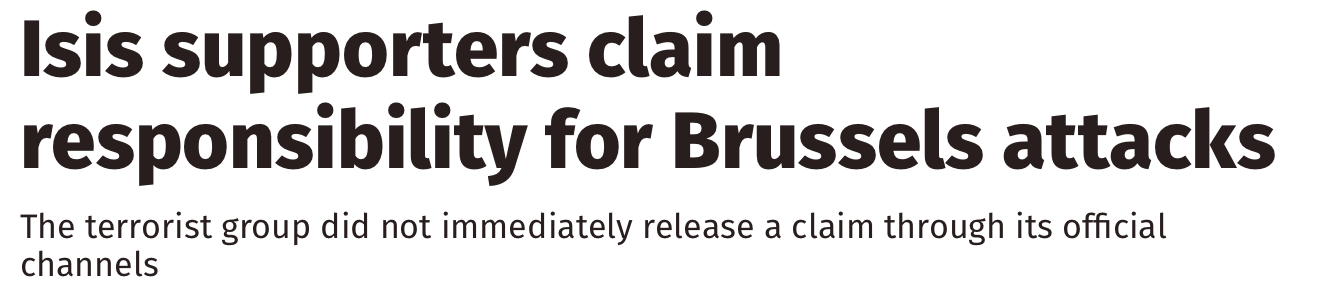
The report is based on information emanating from social media, which does not constitute a reliable source of information.
An unkown self-proclaimed news agency (Amaq Agency ) allegedly representing the ISIS provided the following report:
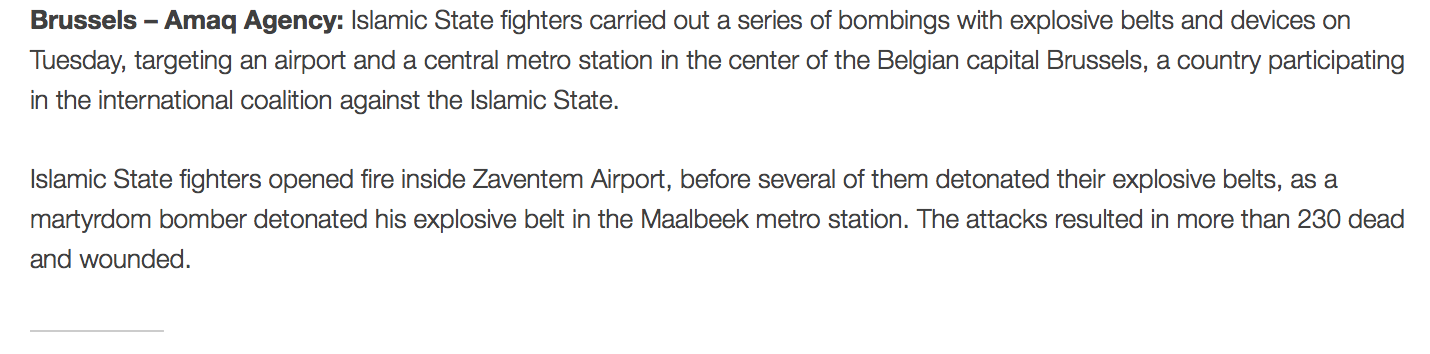
This mysterious agency was then immediately quoted by Reuters in an authoritative report.
In turn, alleged supporters of ISIS on twitter were quoted. According to the Jerusalem Post (March 21, 2016):
The “tears of joy” that were shed by ISIS supporters on Twitter are also related to the fact that the terrorists succeeded in paralyzing the activity in the airport attacked. One of ISIS’ main declared goals is to devastate the Western economy and replace the dollar with its own coin as the only international legal tender.
Who Controls the ISIS social media and twitter accounts?
Police and intelligence are often aware of the identity of ISIS social media, IP addresses, geographic location.
According to London’s Mirror (December 16, 2015):
Hackers have claimed that a number of Islamic State supporters’ social media accounts are being run from internet addresses linked to the [UK government] Department of Work and Pensions.
A group of four young computer experts who call themselves VandaSec have unearthed evidence indicating that at least three ISIS-supporting accounts can be traced back to the DWP.
Every computer and mobile phone logs onto the internet using an IP address, which is a type of identification number.
The hacking collective showed Mirror Online details of the IP addresses used by a trio of separate digital jihadis to access Twitter accounts, which have been used to spread extremist propaganda.
At first glance, the IP addresses seem to be based in Saudi Arabia, but upon further inspection using specialist tools they appeared to link back to the DWP. ..
[T]he British government sold on a large number of IP addresses to two Saudi Arabian firms.
After the sale completed in October of this year, they were used by extremists to spread their message of hate.
Jamie Turner, an expert from a firm called PCA Predict, discovered a record of the sale of IP addresses, and found a large number were transferred to Saudi Arabia in October of this year.
He told us it was likely the IP addresses could still be traced back to the DWP because records of the addresses had not yet been fully updated.

What the Daily Mirror report suggests (as well as other reports) is that the IP addresses of the ISIS are indirectly linked to the British government, i.e. 1) the identity of the ISIS social media is invariable known to police authorities, and 2) The ISIS social media are sponsored by Saudi Arabia, which is also involved in the recruitment and training of terrorists in liaison with US-NATO.
It is worth noting that the British government has acknowledged its responsibility:
The Cabinet Office has now admitted to selling the IP addresses on to Saudi Telecom and the Saudi-based Mobile Telecommunications Company earlier this year as part of a wider drive to get rid of a large number of the DWP’s IP addresses. (Mirror, op cit cit, emphasis added)
The State Sponsors of Terrorism
The events in Brussels raises the broader question: who is behind the ISIS?
Israel intelligence sources (DEBKA) in a 2011 report confirmed the role of NATO operating out of its Brussels headquarters and Turkey’s high command in the training and recruitment of terrorists:
NATO headquarters in Brussels and the Turkish high command are meanwhile drawing up plans for their first military step in Syria, which is to arm the rebels with weapons for combating the tanks and helicopters spearheading the Assad regime’s crackdown on dissent. … NATO strategists are thinking more in terms of pouring large quantities of anti-tank and anti-air rockets, mortars and heavy machine guns into the protest centers for beating back the government armored forces. (DEBKAfile, NATO to give rebels anti-tank weapons, August 14, 2011)
This initiative, which was also supported by Saudi Arabia and Qatar, involved a process of organized recruitment of thousands of jihadist “freedom fighters”, reminiscent of the enlistment of Mujahideen to wage the CIA’s jihad (holy war) in the heyday of the Soviet-Afghan war:
Also discussed in Brussels and Ankara, our sources report, is a campaign to enlist thousands of Muslim volunteers in Middle East countries and the Muslim world to fight alongside the Syrian rebels. The Turkish army would house these volunteers, train them and secure their passage into Syria. (Ibid, emphasis added)
These mercenaries were subsequently integrated into US and allied sponsored terrorist organizations including Al Nusrah and ISIS.
And then in August 2014, Obama launched his counter-terrorism campaign. Yet the evidence confirms that instead of destroying the ISIS, the US and its allies including Turkey, Saudi Arabia and Israel were in fact protecting the ISIS.
Again according to the Daily Mirror in a 2015 report, the counterterrorism campaign was conducive to ISIS doubling the territory under its control, until the launching of the Russian intervention in late September 2015.
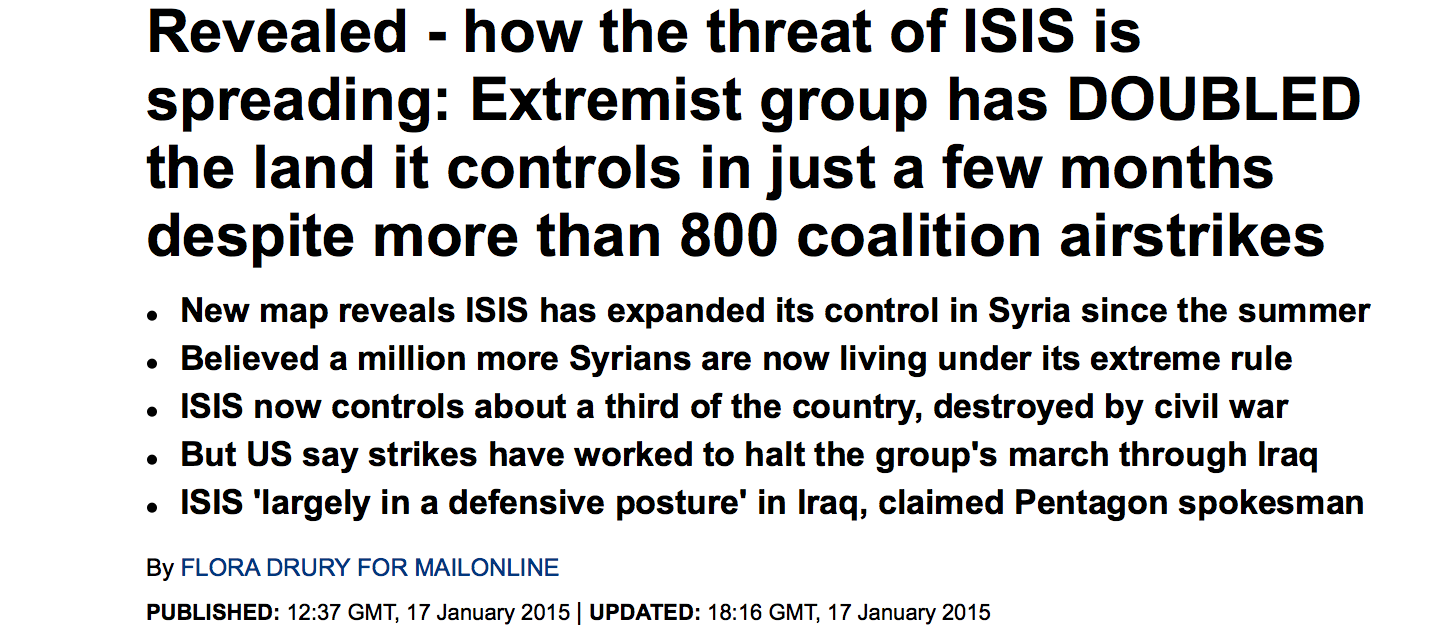
Sheer Incompetence of the US Air Force (doubtful) or Washington’s complicity in protecting the terrorists?
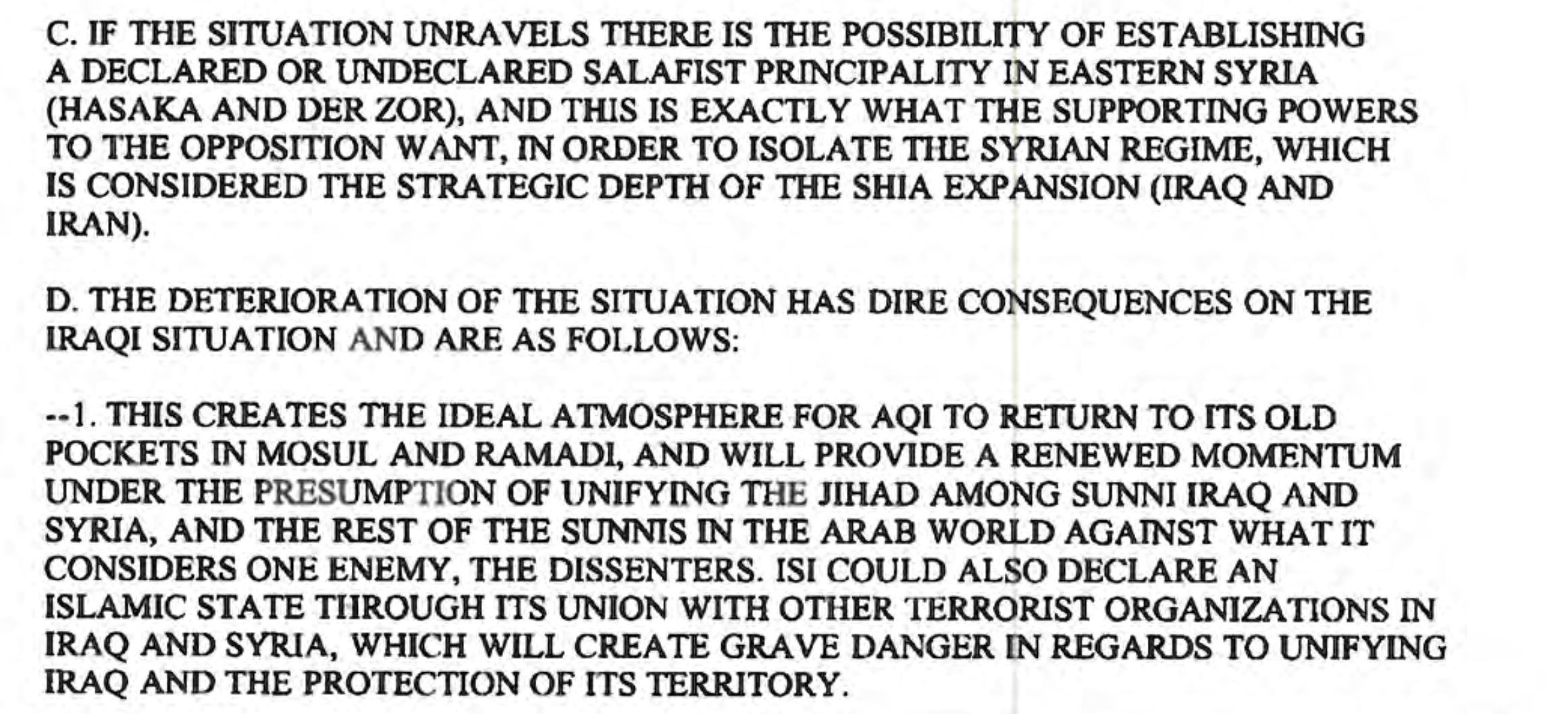
Recently the release of the Hillary Clinton email archive as well as leaked Pentagon documents confirm that the US and its allies were supportive of ISIS, which are according to press reports, the alleged architects of the Brussels attacks.
The 7-page Defense Intelligence Agency (DIA) document dated August of 2012, points to US complicity in supporting the creation of an Islamic State:
Saudi regime detains top Shia scholar in Eastern Province
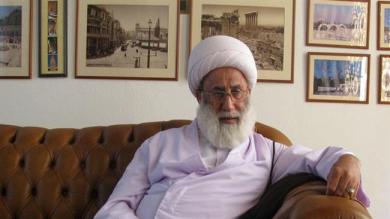
Senior Saudi cleric Ayatollah Hussein al-Radhi
Press TV – March 22, 2016
The Saudi regime’s security forces have arrested a prominent Shia cleric over his anti-regime comments as Riyadh continues its crackdown on the minority sect.
Media reports said on Tuesday that security forces arrested Ayatollah Hussein al-Radhi shortly after he led prayers in the al-Ahsa oasis region of Eastern Province.
The detention came after the senior cleric wrote an article in which he criticized the House of Saud for jailing and executing critics and dissidents, including Sheikh Nimr Baqir al-Nimr who was beheaded in January.
Al-Radi had also infuriated the monarchy by denouncing the ongoing deadly Saudi airstrikes which have claimed lives of more than 8,000 civilians in Yemen.
Riyadh has been under fire from international organizations and rights groups over the rising number of civilian casualties in Yemen. The United Nations Human Rights Council (UNHRC) has recently said that Saudi Arabia and its allies may be committing crimes against humanity due to their indiscriminate killing of civilians in Yemen.
The senior cleric had also strongly denounced a decision by the Saudi-led [Persian] Gulf Cooperation Council to brand Lebanon’s resistance movement Hezbollah as a terrorist organization.
Saudi Arabia has been denounced by rights groups for its grave human rights abuses and harsh crackdown on all forms of dissent.
The Shia-dominated Eastern Province has been the scene of peaceful demonstrations since February 2011.
Protesters have been demanding reforms, freedom of expression and the release of political prisoners. They want an end to economic and religious discrimination against the region.
Reports on protests in Qatif are scant, as Saudi authorities allow foreign news media to visit the region only if accompanied by government officials, claiming it is to ensure journalists’ safety.
Shia Muslims have long complained of entrenched discrimination in a country where the semi-official Wahhabi school condones violence against them. They face abuse from Wahhabi clerics, rarely get permits for places of worship and seldom get senior public sector jobs. Shia religious centers have also been target of a series of terror attacks across the region over the past few months.
Those basic complaints have over the years been aggravated by what residents across the Shia-majority call heavy-handed security measures against their community. They accuse the authorities of unfair detentions and punishments, shooting unarmed protesters and torturing suspects.
New US Training Program for Syrian Rebels ‘Just Another Waste of Money’
Sputnik – 20.03.2016
The US Defense Department reportedly plans to launch a new train-and-equip effort in Syria. The new effort will focus on preparing a small contingent of rebels outside Syria.
The rebels will reportedly be trained in infantry tactics and then sent back to their homeland. The spokesman for the US-led military operation against Daesh, Colonel Steve Warren, said the new effort was part of the Pentagon’s adjustments to the train-and-equip program built on prior experience.
However, many details about the new program remain unclear, including its cost, the number of fighters it aims to train as well as the exact date of its launch, according to Foreign Policy magazine.
Michael Maloof, former Pentagon official and senior security policy analyst in the office of the Secretary of Defense, was not too optimistic about the Pentagon’s ability to learn from the mistakes, saying that his hopes for the new programs were pretty low.
“The program is very vague, no details are being given as to where the training will be conducted and smaller contingents doesn’t necessarily mean a success. The problem has been as to who would be available to fight ISIS as opposed to wanting to take down the government of Syrian President Bashar Assad. That has been the problem. Also what countries would actually conduct the training, before it was Saudi Arabia, Jordan and Turkey? Those countries generally are against the government of Syria as it now stands.”
“It is going to be questionable as to how effective this so-called revised program is going to be. I don’t hold much hope for it and it’s just another waste of money frankly at this point,” Maloof said.
Talking about what the Pentagon’s exact goal was for launching this new train-and-equip program, the official said, “The concept is to fight ISIS, but in reality the people that they are recruiting are Sunnis, they are sympathetic to the Sunni ISIS fighters and even though they may not agree with them wholeheartedly, they are Sunnis and Sunnis will not be fighting Sunnis. That’s just the way it goes.”
He further spoke about the reluctance of Turkey in going after ISIS and instead are venting against the Kurds. “The consequences of these actions are questionable and the success is highly dubious and I don’t hold much faith in them.”
Maloof also discussed Saudi Arabia’s position in this situation. He said, “Saudi’s don’t like ISIS either but they are bank rolling, funding them outside the Kingdom but if they start pointing inward that’s another problem for them because ISIS is fundamentally against monarchy.”
Featured Video

The Truth About the Trump Shootings with Ken Silva
or go to
Aletho News Archives – Video-Images
From the Archives
Trans ‘milk’ as good as the real thing – NHS
RT | February 18, 2024
The drug-induced nipple secretions of trans women are as good as mothers’ breast milk for babies, the University of Sussex Hospitals NHS Trust claimed in a letter to campaigners made public in a report by British think tank the Policy Exchange on Sunday.
The healthcare trust’s medical director, Rachel James, argued that the off-label prescription drug cocktail men transitioning to female take in order to produce milk was “similar to the natural hormones which encourage lactation to develop when the baby is newly born.”
“The evidence which is available demonstrates that the milk is comparable to that produced following the birth of a baby,” James wrote in the letter, sent to Children of Transitioners last August.
Biological men who wish to lactate must first take hormones to grow milk glands and then take high doses of either domperidone or metoclopramide to stimulate milk production. Neither drug is approved for this use, though they are occasionally prescribed off-label to biological women who have trouble lactating.
However, domperidone’s own manufacturer, Janssen, warns patients the drug “may cause unwanted side effects affecting the heart in a breastfed baby” and “should be used during breastfeeding only if your physician considers this clearly necessary.” … continue
Blog Roll
 Aletho News
- Seyed M. Marandi: U.S. Strike Imminent – Toward Total War in the Middle East
- Russia Voted Under Fire. Washington Is Loading the Tankers.
- 12 Things Your Oncologist Was Trained Not to Tell You
- Anthrax Attacks Paved Way for COVID-Era ‘Junk Drugs and Vaccines’
- How Real Is the Impact of Western Sanctions on Israel?
- France, You Are Guilty: How Paris Turned Western Sahara into the Maghreb’s Powder Keg
- 2025 Nature Paper Claiming Worsening Global Drought Gets RETRACTED …Heavily Flawed
- Your Milk Is Not the Problem
- The Truth About the Trump Shootings with Ken Silva
- ARE PATIENTS BEING PROPERLY INFORMED ABOUT OZEMPIC?
- If Americans Knew
- Salah Sarsour’s Legal Team Says DHS Has Not Met Its Burden to Prove He Is Deportable
- An analysis of tax forms by The Intercept show Kraft’s charity and LLC have donated to Friends of the IDF and AIPAC’s super PAC.
- Israeli attacks kill four Palestinians in Gaza – Daily Update
- Inside Gaza’s death trap of collapsing, bombed-out buildings
- The everyday items Israel bans from Gaza every day
- Inside the siege, the ruined buildings of Gaza – Daily Update
- Debunking The Claim That Macklemore Has A “History Of Antisemitism”
- CPJ demands release of arrested Palestinian-US journalist near Bethlehem
- Robert Kraft: The Billionaire Friend of Netanyahu Pulling The Strings Behind the Macklemore/Ed Sheeran Blow Up
- Columbia Administered Fund Gives Big Money to Pro-Israel Groups
- No Tricks Zone
- 2025 Nature Paper Claiming Worsening Global Drought Gets RETRACTED …Heavily Flawed
- New Study: ‘Global Drought Shows No Detectable Recent Acceleration Under Climate Warming’
- Economic Masterminds: German Socialists Suggest Taxing Productivity Gains Stemming From Using AI
- The South China Sea Has Not Been Cooperating With The Climate Change Narrative
- Energy Crisis: Germany Enters Heating Season With Historically Low Gas Reserve Fill Levels
- New Study: The Antarctic Ice Sheet Gained Mass From 2020-2024 Due To Staggering Snow And Ice Accumulation
- Study: Ocean Heating Rates From Thousands Of Years Ago ‘Dwarf’ Modern Ocean Heating Rates
- Climate Extremists Target, Attack Large-Scale Power Grid Infrastructure In Germany!
- New Study: Antarctic Ice Melt Has Contributed Less Than 1 Centimeter To Sea Level Rise In The Last 30 Years
- Fear Of Debate: Alarmist German Climate Scientist Calls On Mainstream Media To Discredit Skeptic Voices
 Aletho News