All Is Not Quiet on the Syrian Front: US to Launch Another War
By Alex GORKA | Strategic Culture Foundation | 29.12.2017
This is a classic example of flip-flop policy. In November, the US promised Turkey to stop arming Kurdish militias in Syria after the Islamic State was routed. Brett McGurk, the US Special Presidential Envoy to the Global Coalition to Defeat Islamic State, explained that after the urban fighting in Raqqa was over “adjustments in the level of military support” would be made. “We had to give some equipment – and it’s limited, extremely limited – all of which was very transparent to our NATO ally, Turkey,” he said during a special briefing on December 21. In June, the US told Turkey it would take back weapons supplied to the Kurdish the People’s Protection Units (YPG) militia in northern Syria after the defeat of Islamic State.
But sophisticated weapons will continue to be sent to Syria in 2018, including thousands of anti-tank rocket launchers, heat seeking missiles and rocket launchers. The list of weaponry and equipment was prepared by US Department of Defense as part of the 2018 defense budget and signed by Trump of Dec. 12. It includes more than 300 non-tactical vehicles, 60 nonstandard vehicles, and 30 earth-moving vehicles to assist with the construction of outposts or operations staging areas. The US defense spending bill for 2018 (“Justification for FY 2018 Overseas Contingency Operations / Counter-Islamic State of Iraq and Syria Train and Equip Fund”) includes providing weapons worth $393 million to US partners in Syria. Overall, $500 million, roughly $70 million more than last year, are to be spent on Syria Train and Equip requirements. The partners are the Kurds-dominated Syria Democratic Forces (SDF). The YPG – the group that is a major concern of Turkey – is the backbone of this force.
The budget does not refer to Syrian Democratic Forces (SDF) but instead says “Vetted Syrian Opposition”. According to the budget list, there are 25,000 opposition forces supported as a part of the train and equip program in Syria. That number is planned to be increased to 30,000 in 2018. The arming of Kurdish militants with anti-tank rockets is a sensitive topic because of Turkey’s reliance on its armored Leopard tanks in northern Syria.
Talal Sillo, a former high-ranking commander and spokesperson of the US-backed SDF, who defected from the group last month to go to Turkey, divulged details of the US arming the Kurdish group.
The list does not detail which vetted Syrian groups will receive certain pieces of equipment. In northern Syria, there is the SDF, including the YPG, and the Syria Arab Coalition — a group of Arab fighters incorporated into the SDF. The Maghawir al-Thawra and Shohada al-Quartayn groups are operating in the southeastern part of Syria. They are being trained by US and British instructors at the al-Tanf border crossing between Syria and Iraq.
Besides the SDF and the groups trained at al-Tanf, the US is in the process of creating the New Syria Army to fight the Syrian government forces. The training is taking place at the Syrian Hasakah refugee camp located 70 kilometers from the border of Turkey and 50 kilometers from the border of Iraq.
Around 40 Syria opposition groups on Dec. 25 rejected to attend the planned Sochi conference on Syria scheduled to take place in January. They said Moscow, which organizes the conference, was seeking to bypass the UN-based Geneva peace process, despite the fact that UN Syria envoy Staffan de Mistura said that Russia’s plan to convene the congress should be assessed by its ability to contribute to and support the UN-led Geneva talks on ending the war in Syria. If fighting starts, these groups are likely to join the formations created by the US.
So, the United States not only maintains its illegal military presence in Syria and creates new forces to fight against the Syrian government, it appears to be preparing for a new war to follow the Islamic State’s defeat. The continuation of arming and training Kurdish militias will hardly improve Washington’s relations with Ankara, while saying one thing and doing another undermines the credibility of the United States as a partner.
Erdogan’s Claims That Assad is a ‘Terrorist’ Have No Legal Basis – Moscow
Sputnik | December 28, 2017
The Russian Foreign Ministry has commented on the recent statement of Turkish President Recep Tayyip Erdogan, calling his Syrian counterpart Bashar al-Assad a “terrorist”.
“Such evaluations do not have any legal basis… Such statements are groundless,” Russian Foreign Ministry spokesperson Maria Zakharova said during a briefing on Thursday, adding that the representatives of the Syrian government are members of the UN and represent the country’s government in the UN Security Council.
The statement was made after on December 27, Turkish President Recep Tayyip Erdogan called his Syrian counterpart “definitely a terrorist who has carried out state terrorism” during a meeting with Tunisian president Beji Caid Essebsi, adding that “it is impossible to continue with him”, claiming that Assad had allegedly killed about a million of Syrian citizens.
The Syrian Foreign Ministry responded to these claims by saying that Erdogan was deceiving the public opinion in Turkey by claiming that Assad should not remain in power, adding that Ankara’s policy “causes catastrophic consequences” for both countries. The Syrian president has repeatedly denied all allegations of targeting civilians.
While both Russia and Turkey are the guarantors of the Syrian ceasefire and brokers of the Astana peace talks, their positions on the role of Assad in the future of the Arab Republic have differed since the civil war’s beginning in 2011.
While Moscow has repeatedly stressed that Assad was a legitimate president, underlining that it was up to the the Syrians to decide their own future, Ankara has been insisting that the Syrian president should leave his post.
A similar stance has been recently voiced by German Foreign Minister Sigmar Gabriel, who said that the future of the Arab Republic’s president and his government could only be resolved through talks.
In his turn, Assad has previously refused to consider Ankara as its partner or a guarantor state in the peace talks, accusing the country of supporting terrorism.
READ MORE: ‘Assad Mustn’t Go’: How Qatar, France, Germany ‘Wised Up in Regard to Syria’
Flashback to 2011: Asma Assad: A Rose in the Desert

By Richard Edmondson | Fig Trees and Vineyards | December 27, 2017
The article below was initially published in Vogue Magazine in early 2011. I am re-posting it here as it provides a striking look back at Syria as it was just prior to the outbreak of the neocon-instigated regime-change war which so devastated the country.
Asma Assad, the wife of President Bashar Assad, is a woman of grace and beauty, and it’s probably not surprising that a fashion magazine would have decided to publish an article on her. But after the article appeared, Vogue, along with Joan Juliet Buck, the writer of the piece, were attacked by certain mainstream media outlets, such as The Atlantic, presumably for not sufficiently demonizing the Syrian government.
“Asma al-Assad has British roots, wears designer fashion, worked for years in banking, and is married to the dictator Bashar al-Assad, whose regime has killed over 5,000 civilians and hundreds of children this year,” wrote Max Fisher in a sarcastically-worded lead paragraph for The Atlantic.
Fisher also criticized Vogue’s “fawning treatment of the Assad family and its portrayal of the regime as tolerant and peaceful,” noting that this treatment had “generated surprise and outrage in much of the Washington foreign policy community.”
The article by Buck had appeared in Vogue’s February 2011 issue. The Syrian regime-change operation got underway in March, a month later, when protests broke out in Daraa. And the timing of the two probably was nothing more than coincidental.
But of course the neocons in the State Department would have already begun executing their scheme, and a media vilification campaign would have been deemed necessary, or at any rate helpful, in greasing the wheels–and the sudden appearance of the Vogue article (the magazine reportedly has over 11 million readers) probably was looked upon as something of a monkey wrench in the plans. You could think of it as one of the rare moments that a mainstream media organ stepped out of bounds.
Fisher, who now holds a position with the New York Times, went on to kvetch that “the glowing article praised the Assads as a ‘wildly democratic’ family-focused couple who vacation in Europe, foster Christianity, are at ease with American celebrities, made theirs the ‘safest country in the Middle East,’ and want to give Syria a ‘brand essence.’”
It is of course true that the Assads “foster Christianity,” as Fisher contemptuously puts it (indeed–you can go here to see a video I posted two years ago of the first couple attending a Christmas service at a church in Damascus in 2015), but of course it would not do to have this kind of information put out in the mainstream just before the launch of a long-planned regime change operation.
Other mainstream media attacks upon Vogue came from Gawker, where writer John Cook also accused the publication of “fawning”; the New York Times, which published a piece headlined “The Balance of Charm and Reality“; and Slate, whose writer, Noreen Malone, damned Vogue for paying “besotted compliments” to the Assads and for “unwittingly exacerbating” a “modern day Marie Antoinette problem.”
Buck should now be proud of the mainstream media attacks upon her work–but aside from this, her article, as I say, is important also in that it provides a valuable glimpse into life in the country just before the outset of the war.
Syria, she notes, was known as “the safest country in the Middle East.” Buck was roundly excoriated for making this observation, but certainly at the time, in 2011, it was true in spades: Syria was eminently safer than either US-occupied Iraq or Israeli-occupied Palestine.
Buck also notes that Syria is “a place without bombings, unrest, or kidnappings”–which would have run completely counter to the narrative of Assad being the ubiquitous “brutal dictator who kills his own people” and who serves as a “magnet to jihadis”–but perhaps most noteworthy of all are Buck’s revelations about programs set up for children in the country.
When I visited Syria in 2014, one of the things I heard about were Asma Assad’s charity efforts on behalf of children, so it was not surprising for me, upon reading the Vogue article, to learn of Massar, an organization founded by the First Lady and “built around a series of discovery centers,” or to learn that at these centers children and young adults, ages five to twenty-one, were taught “creative, informal approaches to civic responsibility.”
Buck also tells of Asma’s jaunts around the country visiting local schools and interacting with children in what seems to have been a very life-fulfilling manner.
All of this, of course, would have come to a dramatic halt, or a dramatic curtailment at any rate, when the nightmare began and the country suddenly found itself invaded by armies of US-backed terrorists.
Another fascinating aspect of the article is what it reveals regarding Asma’s contributions toward safeguarding Syria’s cultural heritage. While in Syria I attended, along with several members of the staff of Veterans Today, an anti-terrorism conference held at the Dama Rose Hotel in Damascus. Among the subjects discussed at the conference were the ongoing attacks upon cultural heritage sites. It was disclosed that at the outset of the conflict, the country’s Directorate General of Antiquities and Museums (DGAM), in anticipation of terrorist looting of cultural heritage sites, had begun securing priceless artifacts by placing them in secure storage sites around the country.
The effort was a herculean one, involving DGAM’s 2500 employees spanning out across the country, and while most of the credit has gone to Dr. Maamoun Abdulkarim, the director of DGAM, it would appear, if Buck’s article is any indication, that Asma Assad played a role in the effort as well:
There are 500,000 important ancient works of art hidden in storage; Asma al-Assad has brought in the Louvre to create a network of museums and cultural attractions across Syria, and asked Italian experts to help create a database of the 5,000 archaeological sites in the desert. “Culture,” she says, “is like a financial asset. We have an abundance of it, thousands of years of history, but we can’t afford to be complacent.”
The reference to works of art being “hidden in storage” would suggest that already at that time–February of 2011–Syrian officials had begun to anticipate the hellfire that was about to be unleashed upon their country.
One other thing I might mention is a small criticism I have of Buck’s piece. She speaks of “minders” who she claims accompanied her throughout her visit, commenting as well that “on the rare occasions I am out alone, a random series of men in leather jackets seems to be keeping close tabs on what I am doing and where I am headed.”
All I can say in response to this is that I never experienced anything of the like during my own visit to Syria. I stayed at the Dama Rose Hotel–the location where the conference was held–and while I occasionally went out for strolls through the neighborhood, I never once was followed by any “random series of men in leather jackets.” Yes–there were Syrian soldiers in the streets. But they were stationed at certain locations, busy street corners for instance, and they did not begin tailing me suspiciously after I had passed them by. They remained at their posts. Moreover, their presence, rather than threatening, was a comforting assurance I would not be attacked or kidnapped by terrorists, at least while the soldiers were around.
Lastly, I would also mention that Vogue succumbed to the withering barrage of criticism and removed Buck’s article from their website. Less than a year later, the only trace of it that remained on the Internet was at a pro-Syrian site called PresidentAssad.net–something which was made note of in a January 3, 2012 article by Fisher at The Atlantic.
The PresidentAssad.net site is still around, but for some reason the Vogue article seems to have gotten dropped over the years. However, it has re-surfaced–at Gawker. There you may find it (at least for the time being) along with a link back to the attack piece I mentioned above, written by Cook and posted in February of 2011.
***
Asma al-Assad: A Rose in the Desert
By Joan Juliet Buck
Asma al-Assad is glamorous, young, and very chic—the freshest and most magnetic of first ladies. Her style is not the couture-and-bling dazzle of Middle Eastern power but a deliberate lack of adornment. She’s a rare combination: a thin, long-limbed beauty with a trained analytic mind who dresses with cunning understatement. Paris Match calls her “the element of light in a country full of shadow zones.” She is the first lady of Syria.
Syria is known as the safest country in the Middle East, possibly because, as the State Department’s Web site says, “the Syrian government conducts intense physical and electronic surveillance of both Syrian citizens and foreign visitors.” It’s a secular country where women earn as much as men and the Muslim veil is forbidden in universities, a place without bombings, unrest, or kidnappings, but its shadow zones are deep and dark. Asma’s husband, Bashar al-Assad, was elected president in 2000, after the death of his father, Hafez al-Assad, with a startling 97 percent of the vote. In Syria, power is hereditary. The country’s alliances are murky. How close are they to Iran, Hamas, and Hezbollah? There are souvenir Hezbollah ashtrays in the souk, and you can spot the Hamas leadership racing through the bar of the Four Seasons. Its number-one enmity is clear: Israel. But that might not always be the case. The United States has just posted its first ambassador there since 2005, Robert Ford.
Iraq is next door, Iran not far away. Lebanon’s capital, Beirut, is 90 minutes by car from Damascus. Jordan is south, and next to it the region that Syrian maps label Palestine. There are nearly one million refugees from Iraq in Syria, and another half-million displaced Palestinians.
“It’s a tough neighborhood,” admits Asma al-Assad.
It’s also a neighborhood intoxicatingly close to the dawn of civilization, where agriculture began some 10,000 years ago, where the wheel, writing, and musical notation were invented. Out in the desert are the magical remains of Palmyra, Apamea, and Ebla. In the National Museum you see small 4,000-year-old panels inlaid with mother-of-pearl that is echoed in the new mother-of-pearl furniture for sale in the souk. Christian Louboutin comes to buy the damask silk brocade they’ve been making here since the Middle Ages for his shoes and bags, and has incidentally purchased a small palace in Aleppo, which, like Damascus, has been inhabited for more than 5,000 years.
The first lady works out of a small white building in a hilly, modern residential neighborhood called Muhajireen, where houses and apartments are crammed together and neighbors peer and wave from balconies. The first impression of Asma al-Assad is movement—a determined swath cut through space with a flash of red soles. Dark-brown eyes, wavy chin-length brown hair, long neck, an energetic grace. No watch, no jewelry apart from Chanel agates around her neck, not even a wedding ring, but fingernails lacquered a dark blue-green. She’s breezy, conspiratorial, and fun. Her accent is English but not plummy. Despite what must be a killer IQ, she sometimes uses urban shorthand: “I was, like. . . .”
Asma Akhras was born in London in 1975, the eldest child and only daughter of a Syrian Harley Street cardiologist and his diplomat wife, both Sunni Muslims. They spoke Arabic at home. She grew up in Ealing, went to Queen’s College, and spent holidays with family in Syria. “I’ve dealt with the sense that people don’t expect Syria to be normal. I’d show my London friends my holiday snaps and they’d be—‘Where did you say you went?’ ”
She studied computer science at university, then went into banking. “It wasn’t a typical path for women,” she says, “but I had it all mapped out.” By the spring of 2000, she was closing a big biotech deal at JP Morgan in London and about to take up an MBA at Harvard. She started dating a family friend: the second son of president Hafez al-Assad, Bashar, who’d cut short his ophthalmology studies in London in 1994 and returned to Syria after his older brother, Basil, heir apparent to power, died in a car crash. They had known each other forever, but a ten-year age difference meant that nothing registered—until it did.
“I was always very serious at work, and suddenly I started to take weekends, or disappear, and people just couldn’t figure it out,” explains the first lady. “What do you say—‘I’m dating the son of a president’? You just don’t say that. Then he became president, so I tried to keep it low-key. Suddenly I was turning up in Syria every month, saying, ‘Granny, I miss you so much!’ I quit in October because by then we knew that we were going to get married at some stage. I couldn’t say why I was leaving. My boss thought I was having a nervous breakdown because nobody quits two months before bonus after closing a really big deal. He wouldn’t accept my resignation. I was, like, ‘Please, really, I just want to get out, I’ve had enough,’ and he was ‘Don’t worry, take time off, it happens to the best of us.’ ” She left without her bonus in November and married Bashar al-Assad in December.

“What I’ve been able to take away from banking was the transferable skills—the analytical thinking, understanding the business side of running a company—to run an NGO or to try and oversee a project.” She runs her office like a business, chairs meeting after meeting, starts work many days at six, never breaks for lunch, and runs home to her children at four. “It’s my time with them, and I get them fresh, unedited—I love that. I really do.” Her staff are used to eating when they can. “I have a rechargeable battery,” she says.
The 35-year-old first lady’s central mission is to change the mind-set of six million Syrians under eighteen, encourage them to engage in what she calls “active citizenship.” “It’s about everyone taking shared responsibility in moving this country forward, about empowerment in a civil society. We all have a stake in this country; it will be what we make it.”
In 2005 she founded Massar, built around a series of discovery centers where children and young adults from five to 21 engage in creative, informal approaches to civic responsibility. Massar’s mobile Green Team has touched 200,000 kids across Syria since 2005. The organization is privately funded through donations. The Syria Trust for Development, formed in 2007, oversees Massar as well as her first NGO, the rural micro-credit association FIRDOS, and SHABAB, which exists to give young people business skills they need for the future.
And then there’s her cultural mission: “People tend to see Syria as artifacts and history,” she says. “For us it’s about the accumulation of cultures, traditions, values, customs. It’s the difference between hardware and software: the artifacts are the hardware, but the software makes all the difference—the customs and the spirit of openness. We have to make sure that we don’t lose that. . . . ” Here she gives an apologetic grin. “You have to excuse me, but I’m a banker—that brand essence.”
That brand essence includes the distant past. There are 500,000 important ancient works of art hidden in storage; Asma al-Assad has brought in the Louvre to create a network of museums and cultural attractions across Syria, and asked Italian experts to help create a database of the 5,000 archaeological sites in the desert. “Culture,” she says, “is like a financial asset. We have an abundance of it, thousands of years of history, but we can’t afford to be complacent.”
In December, Asma al-Assad was in Paris to discuss her alliance with the Louvre. She dazzled a tough French audience at the International Diplomatic Institute, speaking without notes. “I’m not trying to disguise culture as anything more than it is,” she said, “and if I sound like I’m talking politics, it’s because we live in a politicized region, a politicized time, and we are affected by that.”
The French ambassador to Syria, Eric Chevallier, was there: “She managed to get people to consider the possibilities of a country that’s modernizing itself, that stands for a tolerant secularism in a powder-keg region, with extremists and radicals pushing in from all sides—and the driving force for that rests largely on the shoulders of one couple. I hope they’ll make the right choices for their country and the region. ”
Damascus evokes a dusty version of a Mediterranean hill town in an Eastern-bloc country. The courtyard of the Umayyad Mosque at night looks exactly like St. Mark’s square in Venice. When I first arrive, I’m met on the tarmac by a minder, who gives me a bouquet of white roses and lends me a Syrian cell phone; the head minder, a high-profile American PR, joins us the next day. The first lady’s office has provided drivers, so I shop and see sights in a bubble of comfort and hospitality. On the rare occasions I am out alone, a random series of men in leather jackets seems to be keeping close tabs on what I am doing and where I am headed.
“I like things I can touch. I like to get out and meet people and do things,” the first lady says as we set off for a meeting in a museum and a visit to an orphanage. “As a banker, you have to be so focused on the job at hand that you lose the experience of the world around you. My husband gave me back something I had lost.”
She slips behind the wheel of a plain SUV, a walkie-talkie and her cell thrown between the front seats and a Syrian-silk Louboutin tote on top. She does what the locals do—swerves to avoid crazy men who run across busy freeways, misses her turn, checks your seat belt, points out sights, and then can’t find a parking space. When a traffic cop pulls her over at a roundabout, she lowers the tinted window and dips her head with a playful smile. The cop’s eyes go from slits to saucers.
Her younger brother Feras, a surgeon who moved to Syria to start a private health-care group, says, “Her intelligence is both intellectual and emotional, and she’s a master at harmonizing when, and how much, to use of each one.”
In the Saint Paul orphanage, maintained by the Melkite–Greek Catholic patriarchate and run by the Basilian sisters of Aleppo, Asma sits at a long table with the children. Two little boys in new glasses and thick sweaters are called Yussuf. She asks them what kind of music they like. “Sad music,” says one. In the room where she’s had some twelve computers installed, the first lady tells a nun, “I hope you’re letting the younger children in here go crazy on the computers.” The nun winces: “The children are afraid to learn in case they don’t have access to computers when they leave here,” she says.
In the courtyard by the wall down which Saint Paul escaped in a basket 2,000 years ago, an old tree bears gigantic yellow fruit I have never seen before. Citrons. Cédrats in French.
Back in the car, I ask what religion the orphans are. “It’s not relevant,” says Asma al-Assad. “Let me try to explain it to you. That church is a part of my heritage because it’s a Syrian church. The Umayyad Mosque is the third-most-important holy Muslim site, but within the mosque is the tomb of Saint John the Baptist. We all kneel in the mosque in front of the tomb of Saint John the Baptist. That’s how religions live together in Syria—a way that I have never seen anywhere else in the world. We live side by side, and have historically. All the religions and cultures that have passed through these lands—the Armenians, Islam, Christianity, the Umayyads, the Ottomans—make up who I am.”
“Does that include the Jews?” I ask.
“And the Jews,” she answers. “There is a very big Jewish quarter in old Damascus.”
The Jewish quarter of Damascus spans a few abandoned blocks in the old city that emptied out in 1992, when most of the Syrian Jews left. Their houses are sealed up and have not been touched, because, as people like to tell you, Syrians don’t touch the property of others. The broken glass and sagging upper floors tell a story you don’t understand—are the owners coming back to claim them one day?
The presidential family lives surrounded by neighbors in a modern apartment in Malki. On Friday, the Muslim day of rest, Asma al-Assad opens the door herself in jeans and old suede stiletto boots, hair in a ponytail, the word happiness spelled out across the back of her T-shirt. At the bottom of the stairs stands the off-duty president in jeans—tall, long-necked, blue-eyed. A precise man who takes photographs and talks lovingly about his first computer, he says he was attracted to studying eye surgery “because it’s very precise, it’s almost never an emergency, and there is very little blood.”
The old al-Assad family apartment was remade into a child-friendly triple-decker playroom loft surrounded by immense windows on three sides. With neither shades nor curtains, it’s a fishbowl. Asma al-Assad likes to say, “You’re safe because you are surrounded by people who will keep you safe.” Neighbors peer in, drop by, visit, comment on the furniture. The president doesn’t mind: “This curiosity is good: They come to see you, they learn more about you. You don’t isolate yourself.”
There’s a decorated Christmas tree. Seven-year-old Zein watches Tim Burton’s Alice in Wonderland on the president’s iMac; her brother Karim, six, builds a shark out of Legos; and nine-year-old Hafez tries out his new electric violin. All three go to a Montessori school.
Asma al-Assad empties a box of fondue mix into a saucepan for lunch. The household is run on wildly democratic principles. “We all vote on what we want, and where,” she says. The chandelier over the dining table is made of cut-up comic books. “They outvoted us three to two on that.”
A grid is drawn on a blackboard, with ticks for each member of the family. “We were having trouble with politeness, so we made a chart: ticks for when they spoke as they should, and a cross if they didn’t.” There’s a cross next to Asma’s name. “I shouted,” she confesses. “I can’t talk about empowering young people, encouraging them to be creative and take responsibility, if I’m not like that with my own children.”
“The first challenge for us was, Who’s going to define our lives, us or the position?” says the president. “We wanted to live our identity honestly.”
They announced their marriage in January 2001, after the ceremony, which they kept private. There was deliberately no photograph of Asma. “The British media picked that up as: Now she’s moved into the presidential palace, never to be seen again!” says Asma, laughing.
They had a reason: “She spent three months incognito,” says the president. “Before I had any official engagement,” says the first lady, “I went to 300 villages, every governorate, hospitals, farms, schools, factories, you name it—I saw everything to find out where I could be effective. A lot of the time I was somebody’s ‘assistant’ carrying the bag, doing this and that, taking notes. Nobody asked me if I was the first lady; they had no idea.”
“That way,” adds the president, “she started her NGO before she was ever seen in public as my wife. Then she started to teach people that an NGO is not a charity.”
Neither of them believes in charity for the sake of charity. “We have the Iraqi refugees,” says the president. “Everybody is talking about it as a political problem or as welfare, charity. I say it’s neither—it’s about cultural philosophy. We have to help them. That’s why the first thing I did is to allow the Iraqis to go into schools. If they don’t have an education, they will go back as a bomb, in every way: terrorism, extremism, drug dealers, crime. If I have a secular and balanced neighbor, I will be safe.”
When Angelina Jolie came with Brad Pitt for the United Nations in 2009, she was impressed by the first lady’s efforts to encourage empowerment among Iraqi and Palestinian refugees but alarmed by the Assads’ idea of safety.
“My husband was driving us all to lunch,” says Asma al-Assad, “and out of the corner of my eye I could see Brad Pitt was fidgeting. I turned around and asked, ‘Is anything wrong?’ ”
“Where’s your security?” asked Pitt.
“So I started teasing him—‘See that old woman on the street? That’s one of them! And that old guy crossing the road?
That’s the other one!’ ” They both laugh.
The president joins in the punch line: “Brad Pitt wanted to send his security guards here to come and get some training!”
After lunch, Asma al-Assad drives to the airport, where a Falcon 900 is waiting to take her to Massar in Latakia, on the coast. When she lands, she jumps behind the wheel of another SUV waiting on the tarmac. This is the kind of surprise visit she specializes in, but she has no idea how many kids will turn up at the community center on a rainy Friday.
As it turns out, it’s full. Since the first musical notation was discovered nearby, at Ugarit, the immaculate Massar center in Latakia is built around music. Local kids are jamming in a sound booth; a group of refugee Palestinian girls is playing instruments. Others play chess on wall-mounted computers. These kids have started online blood banks, run marathons to raise money for dialysis machines, and are working on ways to rid Latakia of plastic bags. Apart from a few girls in scarves, you can’t tell Muslims from Christians.
Asma al-Assad stands to watch a laborious debate about how—and whether—to standardize the Arabic spelling of the word Syria. Then she throws out a curve ball. “I’ve been advised that we have to close down this center so as to open another one somewhere else,” she says. Kids’ mouths drop open. Some repress tears. Others are furious. One boy chooses altruism: “That’s OK. We know how to do it now; we’ll help them.”
Then the first lady announces, “That wasn’t true. I just wanted to see how much you care about Massar.”
As the pilot expertly avoids sheet lightning above the snow-flecked desert on the way back, she explains, “There was a little bit of formality in what they were saying to me; it wasn’t real. Tricks like this help—they became alive, they became passionate. We need to get past formalities if we are going to get anything done.”
Two nights later it’s the annual Christmas concert by the children of Al-Farah Choir, run by the Syrian Catholic Father Elias Zahlawi. Just before it begins, Bashar and Asma al-Assad slip down the aisle and take the two empty seats in the front row. People clap, and some call out his nickname:
Two hundred children dressed variously as elves, reindeers, or candy canes share the stage with members of the national orchestra, who are done up as elves. The show becomes a full-on songfest, with the elves and reindeer and candy canes giving their all to “Hallelujah” and “Joy to the World.” The carols slide into a more serpentine rhythm, an Arabic rap group takes over, and then it’s back to Broadway mode. The president whispers, “All of these styles belong to our culture. This is how you fight extremism—through art.”
Brass bells are handed out. Now we’re all singing “Jingle Bell Rock,” 1,331 audience members shaking their bells, singing, crying, and laughing.
“This is the diversity you want to see in the Middle East,” says the president, ringing his bell. “This is how you can have peace!”
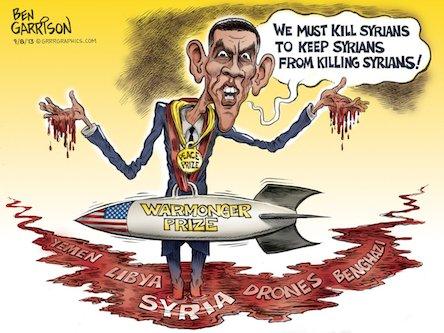
Did Obama Arm Islamic State Killers?
By Daniel Lazare | Consortium News | December 21, 2017
Did Barack Obama arm ISIS? The question strikes many people as absurd, if not offensive. How can anyone suggest something so awful about a nice guy like the former president? But a stunning report by an investigative group known as Conflict Armament Research (CAR) leaves us little choice but to conclude that he did.
CAR, based in London and funded by Switzerland and the European Union, spent three years tracing the origin of some 40,000 pieces of captured ISIS arms and ammunition. Its findings, made public last week, are that much of it originated in former Warsaw Pact nations in Eastern Europe, where it was purchased by United States and Saudi Arabia and then diverted, in violation of various rules and treaties, to Islamist rebels seeking to overthrow Syrian President Bashar al-Assad. The rebels, in turn, somehow caused or allowed the equipment to be passed on to Islamic State, which is also known by the acronyms ISIS or ISIL, or just the abbreviation IS.
This is damning stuff since it makes it clear that rather than fighting ISIS, the U.S. government was feeding it.
But CAR turns vague when it comes to the all-important question of precisely how the second leg of the transfer worked. Did the rebels turn the weapons over voluntarily, involuntarily, or did they somehow drop them when ISIS was in close proximity and forget to pick them up? All CAR will say is that “background information … indicates that IS [Islamic State] forces acquired the materiel through varied means, including battlefield capture and the amalgamation of disparate Syrian opposition groups.” It adds that it “cannot rule out direct supply to IS forces from the territories of Jordan and Turkey, especially given the presence of various opposition groups, with shifting allegiances, in cross-border supply locations.” But that’s it.
If so, this suggests an astonishing level of incompetence on the part of Washington. The Syrian rebel forces are an amazingly fractious lot as they merge, split, attack one another and then team up all over again. So how could the White House have imagined that it could keep weapons tossed into this mix from falling into the wrong hands? Considering how each new gun adds to the chaos, how could it possibly keep track? The answer is that it couldn’t, which is why ISIS wound up reaping the benefits.
But here’s the rub. The report implies a level of incompetence that is not just staggering, but too staggering. How could such a massive transfer occur without field operatives not having a clue as to what was going on? Was every last one of them deaf, dumb, and blind?
Not likely. What seems much more plausible is that once the CIA established “plausible deniability” for itself, all it cared about was that the arms made their way to the most effective fighting force, which in Syria happened to be Islamic State.
This is what had happened in Afghanistan three decades earlier when the lion’s share of anti-Soviet aid, some $600 million in all, went to a brutal warlord named Gulbuddin Hekmatyar. Hekmatyar was a raging bigot, a sectarian, and an anti-western xenophobe, qualities that presumably did not endear him to his CIA handlers. But as Steve Coll notes in Ghost Wars, his bestselling 2004 account of the CIA’s love affair with Islamic holy war, he “was the most efficient at killing Soviets” and that was the only thing that mattered. As one CIA officer put it, “analytically, the best fighters – the best-organized fighters – were the fundamentalists” that Hekmatyar led. Consequently, he ended up with the most money.
After all, if you’re funding a neo-medieval uprising, it makes sense to steer the money to the darkest reactionaries of them all. Something similar occurred in March 2015 when Syrian rebels launched an assault on government positions in the northern province of Idlib. The rebel coalition was under the control of Jabhat al-Nusra, as the local branch of Al Qaeda was known at the time, and what Al-Nusra needed most of all were high-tech TOW missiles with which to counter government tanks and trucks.
Arming Al Qaeda
So the Obama administration arranged for Nusra to get them. To be sure, it didn’t provide them directly. To ensure deniability, rather, it allowed Raytheon to sell some 15,000 TOWs to Saudi Arabia in late 2013 and then looked the other way when the Saudis transferred large numbers of them to pro-Nusra forces in Idlib. [See Consortiumnews.com’s “Climbing into bed with Al-Qaeda.”] Al-Nusra had the toughest fighters in the area, and the offensive was sure to send the Assad regime reeling. So even though its people were compatriots with those who destroyed the World Trade Center, Obama’s White House couldn’t say no.
“Nusra have always demonstrated superior planning and battle management,” Yezid Sayigh, a senior associate at the Carnegie Middle East Center in Beirut, said a few weeks later. If the rebel coalition was successful as a whole, it “was entirely due to their willingness to work with Nusra, who have been the backbone in all of this.”
Scruples, assuming they existed in the first place, fell by the wayside. A senior White House official told The Washington Post that the Obama administration was “not blind to the fact that it is to some extent inevitable” that U.S. weapons would wind up in terrorist hands, but what could you do? It was all part of the game of realpolitik. A senior Washington official crowed that “the trend lines for Assad are bad and getting worse” while The New York Times happily noted that “[t]he Syrian Army has suffered a string of defeats from re-energized insurgents.” So, for the master planners in Washington, it was worth it.
Then there is ISIS, which is even more beyond the pale as most Americans are concerned thanks to its extravagant displays of barbarism and cruelty – its killing of Yazidis and enslavement of Yazidi women and girls, its mass beheadings, its fiery execution of Jordanian fighter pilot Moaz al-Kasasbeh, and so on.
Yet U.S. government attitudes were more ambivalent than most Americans realized. Indeed, the U.S. government was strictly neutral as long as ISIS confined itself to attacking Assad. As a senior defense official told the Wall Street Journal in early 2015: “Certainly, ISIS has been able to expand in Syria, but that’s not our main objective. I wouldn’t call Syria a safe haven for ISIL, but it is a place where it’s easier for them to organize, plan, and seek shelter than it is in Iraq.”
In other words, Syria was a safe haven because, the Journal explained, the U.S. was reluctant to interfere in any way that might “tip the balance of power toward Syrian President Bashar al-Assad, who is fighting Islamic State and other rebels.” So the idea was to allow ISIS to have its fun as long as it didn’t bother anyone else. For the same reason, the U.S. refrained from bombing the group when, shortly after the Idlib offensive, its fighters closed in on the central Syrian city of Palmyra, 80 miles or so to the east. This was despite the fact that the fighters would have made perfect targets while “traversing miles of open desert roads.”
As The New York Times explained: “Any airstrikes against Islamic State militants in and around Palmyra would probably benefit the force of President Bashar al-Assad. So far, United States-led airstrikes in Syria have largely focussed on areas far outside government control, to avoid the perception of aiding a leader whose ouster President Obama has called for.” [See Consortiumnews.com’s “How US-Backed War on Syria Helped ISIS.”]
Looting Palmyra
The United States thus allowed ISIS to capture one of the most archeologically important cities in the world, killing dozens of government soldiers and decapitating 83-year-old Khalid al-Asaad, the city’s retired chief of antiquities. (After looting and destroying many of the ancient treasures, ISIS militants were later driven from Palmyra by a Russian-backed offensive by troops loyal to President Assad.)
Obama’s bottom line was: ISIS is very, very bad when it attacks the U.S.-backed regime in Iraq, but less so when it wreaks havoc just over the border in Syria. In September 2016, John Kerry clarified what the administration was up to in a tape-recorded conversation at the U.N. that was later made public. Referring to Russia’s decision to intervene in Syria against ISIS, also known by the Arabic acronym Daesh, the then-Secretary of State told a small knot of pro-rebel sympathizers:
“The reason Russia came in is because ISIL was getting stronger. Daesh was threatening the possibility of going to Damascus and so forth, and that’s why Russia came in, because they didn’t want a Daesh government and they supported Assad. And we know this was growing. We were watching. We saw that Daesh was growing in strength, and we thought Assad was threatened. We thought, however, we could probably manage, that Assad might then negotiate. Instead of negotiating, he got … Putin in to support him. So it’s truly complicated.” (Quote starts at 26:10.)
“We were watching.” Kerry said. So, by giving ISIS free rein, the administration hoped to use it as a lever with which to dislodge Assad. As in Afghanistan, the United States thought it could use jihad to advance its own imperial interests. Yet the little people – Syrian soldiers, three thousand office workers in lower Manhattan, Yazidis, the Islamic State’s beheading of Western hostages, etc. – made things “truly complicated.”
Putting this all together, a few things seem clear. One is that the Obama administration was happy to see its Saudi allies use U.S.-made weapons to arm Al Qaeda. Another is that it was not displeased to see ISIS battle Assad’s government as well. If so, how unhappy could it have been if its allies then passed along weapons to the Islamic State so it could battle Assad all the more? The administration was desperate to knock out Assad, and it needed someone to do the job before Vladimir Putin stepped in and bombed ISIS instead.
It was a modern version of Henry II’s lament, “Who will rid me of this meddlesome priest?” The imperative was to get rid of Assad; Obama and his team had no interest in the messy details.
None of which proves that Obama armed ISIS. But unless one believes that the CIA is so monumentally inept that it could screw up a two-car funeral, it’s the only explanation that makes sense. Obama is still a congenial fellow. But he’s a classic liberal who had no desire to interfere with the imperatives of empire and whose idea of realism was therefore to leave foreign policy in the hands of neocons or liberal interventionists like Secretaries of State Hillary Clinton and John Kerry.
If America were any kind of healthy democracy, Congress would not rest until it got to the bottom of what should be the scandal of the decade: Did the U.S. government wittingly or unwittingly arm the brutal killers of ISIS and Al Qaeda? However, since that storyline doesn’t fit with the prevailing mainstream narrative of Washington standing up for international human rights and opposing global terrorism, the troublesome question will likely neither be asked nor answered.
Daniel Lazare is the author of several books including The Frozen Republic: How the Constitution Is Paralyzing Democracy (Harcourt Brace).
WHITE HELMETS: The Guardian Protects UK FCO Destabilisation Project in Syria
By John Schoneboom | 21st Century Wire | December 20, 2017
Today in Too Long Don’t Read : It’s hard to tell what’s going on in the world, isn’t it? Whom do you believe when there are competing, totally irreconcilable narratives out there? Are the White Helmets heroes or villains? The mainstream narrative has them as a neutral, unarmed, grassroots (and Oscar-winning) humanitarian group with no political affiliations, nominated for a Nobel Peace Prize.
Independent journalists, notably Vanessa Beeley, Eva Karene Bartlett, Patrick Henningsen, and Khaled Iskef, among a few others, suggest a radically different picture, in which the White Helmets are nothing more than a propaganda front for terrorist groups like the Al Nusra Front.
The Guardian, in defense of the heroic narrative, just published a piece by Olivia Solon that turns the propaganda charge against the critics of the White Helmets and refers to them as “a network of anti-imperialist activists, conspiracy theorists and trolls with the support of the Russian government.”
I read this article with great interest, wondering whether it would actually back-up its claims and refute the allegations head on. That is what it would do if it were actual journalism. It would give a fair accounting of the allegations and assess the evidence behind them. If it found the evidence lacking, it would say why, it would offer context, additional evidence, show why the supposed facts were wrong, etc. That would be journalism.
Solon didn’t do that. She mentioned only one video, the so-called Mannequin Challenge piece, and dismissed it as simply the stupid mistake the White Helmets and their apologists said it was. As for the few cases of White Helmet involvement in terrorist activity that Solon did acknowledge, she dismissed these as a case of a few bad apples that left the overall courageous heroic narrative intact.
Watch White Helmets “Mannequin Challenge” spoof rescue video:
How can we tell what’s going on in the world? I feel that one way is to examine the way narratives are defended, and the way challenges are treated. What Solon has done is not journalism. Her work does nothing to examine or investigate seriously. It only tries to dismiss and defame with tired old negative buzzwords like “conspiracy theory” or new ones like “Russia” — never mind that the three main journalists she offers in support of her Russian operation CONSPIRACY THEORY are from the UK, Australia, and Canada.
There is no substantive analysis at all. Nothing. Meanwhile she uncritically and with a straight face describes the US-backed mayhem-generating team of mercenaries and fanatics as an effort to “stabilize” Syria. The piece also contains serious errors, e.g., Patrick Henningsen is NOT an editor at Infowars. Since it is not true, somebody had to have made it up. Is that an innocent mistake, or a cheap attempt to discredit? All of this tells us something about Solon and the Guardian and our media generally and these are clues to what is going on in the world. Look at what is and is not there. Listen to the dogs that are not barking here.
What else did she leave out? Was it anything important? I’ve taken the liberty of compiling a skeletal, condensed list of some of the important, credible allegations and facts that, to my mind, deserve more attention and investigation than the glib, contemptuous dismissals offered by the likes of Olivia Solon.
These are all taken from articles by Vanessa Beeley except where noted. If I’ve gotten anything wrong I hope she or someone else will correct me. Now, if you believe Solon, you’ll dismiss all of it in one fell swoop: “Well that’s Beeley! She’s appeared on RT for god’s sake!” And that is exactly the desired effect, I presume, of articles like Solon’s. To cancel out reams of evidence by impugning the messengers with what amounts to fear-mongering and slander.
But the thing is, you don’t have to take Beeley’s word for it. If you follow the links to her articles, you can see the photos and the videos and find the documentation yourself. For now, just have a look at the list. It’s simplified. You’ll have to follow the links if you want more details. But just have a look. These are things Solon couldn’t, wouldn’t, and didn’t deal with in her hack job hit piece. There may be alternative interpretations of some of the photos and videos, and they might make an interesting argument. Solon unfortunately chose not to do that, however, and while she couldn’t be expected to cover everything in one newspaper article, see if you think credible journalism would ignore all of this:
THE CONDENSED CASE AGAINST THE WHITE HELMETS
All from Vanessa Beeley’s two articles unless other sources are mentioned:
White Helmets & ‘Local Councils’ – Is the UK FCO Financing Terrorism in Syria with Taxpayer Funds?
WHITE HELMETS: State Sanctioned Terrorism and Hollywood Poster Boys for War
1: White Helmets were started and largely trained not in Syria but in Turkey and Jordan, by James le Mesurier, a former British military intelligence officer who went on to become Vice President for Special Projects at the Olive Group, “a private mercenary organization that has since merged with Blackwater-Academi into what is now known as Constellis Holdings.”
2: White Helmets receive substantial funding from the US, the UK, and the EU, at least $150 million over 3 years, from the same parties that are supporting the rebels/terrorists. No political ties?
3: White Helmets only ever operated in territory controlled by terrorist groups like Al Nusra Front, ISIS, and Nour Al Din Zinki, the latter are notorious for filming themselves torturing and beheading a 12-year-old boy. When those groups are forced to move, the White Helmets move with them, often in the same buses, as when they abandoned East Aleppo.

Mohammad Jnued, White Helmet and Nusra Front supporter. (Collage taken from his Facebook account)
4: The White Helmet leader, Raed Saleh, is tied to extremists, a fact acknowledged even by the State Department’s Mark Toner. Saleh was actually deported from the US out of Dulles Airport in April 2016, with no reason being disclosed. He is a close colleague of Mustafa Al Haj Yussef, another White Helmets leader, whose social media accounts show him openly declaring allegiance to Ahrar Al Sham, calling for unity with Al Nusra, advocating the shelling and execution of civilians and other equally charming practices. Actually a recent survey of social media activity carried out by the Syrian War Blog has conservatively identified 65 White Helmet operatives who have professed their membership of, or alliance with, extremist groups like Ahrar Al Sham and Nusra Front or even ISIS.
Also, Clarity of Signal – Massive White Helmets Photo Cache Proves Hollywood Gave Oscar to Terrorist Group
5: The White Helmet group in East Aleppo was established by the president of the UK-funded East Aleppo Council (EAC), Abdulaziz Maghrabi, often photographed with, offering support for, and maintaining active militant membership with terrorist groups Abu Amara and Nusra Front.

Abdulaziz Maghrabi (circled) with Abu Amara, one of the most brutal terrorist organisations in East Aleppo working as “security” for Nusra Front aka Al Qaeda in Syria. (Photo from Maghrabi’s Facebook account)
6: White Helmets in Idlib were photographed taking part in demonstrations and calling for the “burning and destruction” of the towns Kafarya and Foua, which resisted occupation by the terrorists and suffered a siege that deprived its citizens of food, water, and medicine in addition to attacks that killed some 1300 residents. White Helmets also participated in luring children evacuated from these towns off their buses to their death by a truck bomb in an event known as the Rashideen Massacre.

On the left White Helmets are carrying banners calling for burning of Kafarya and Foua, two Shia Muslim villages in Nusra Front controlled Idlib. On right post taken from the Facebook account of White Helmet, Abdul Halim al Shehab “Exterminate Kafarya”.
7: Muawiya Hassan Agha was present at Rashideen, and he later became infamous for his involvement in the execution of two prisoners of war in Aleppo. For this rogue bad appleness he was supposedly fired from the White Helmets, although he was later photographed still with them. He has also been photographed celebrating “victory” with Nusra Front in Idlib. There have been at least three other executions on video that show White Helmet involvement, not just being present and immediately cleaning up, but celebrating, mistreating bodies, and otherwise not acting in a manner consistent with being a neutral humanitarian group.

White Helmets in Idlib, celebrating with Nusra Front. Muawiya is on left in hi-viz jacket. (Photo: screenshot from Nusra Front video)
8: Videos show White Helmets participating in Nusra Front operations, e.g., joining in the beating and encirclement of a Syrian civilian, thoroughly mingling in with heavily armed Nusra terrorists.
9: The main White Helmets center in East Aleppo was integrated into the Nusra Front compound, and was adorned with a variety of graffiti and flags affirming the White Helmet affiliation to various terrorist groups, but predominantly Nusra Front.
Watch video by Pierre Le Corf showing the proximity of White Helmet centre in Sakhour to Nusra Front headquarters:
10: Numerous civilian witnesses from Aleppo were unfamiliar with the term White Helmets but knew the group as the Nusra Front Civil Defense and reported its participation in executions and atrocities.
11: On multiple occasions, the White Helmets have been exposed staging rescue scenes for both photo and video, recycling images in multiple propaganda pieces.
12: Swedish Doctors for Human Rights analyzed a White Helmets video report and concluded “the measures inflicted upon those children, some of them lifeless, are bizarre, non-medical, non-lifesaving, and even counterproductive in terms of life-saving purposes…[including measures that] would have resulted in the death of the child, if not already dead.” The implication is that the White Helmets may have actually killed children and/or were using already-dead children “as propaganda props.”
13: The White Helmets have been filmed describing Syrian Arab Army bodies as “trash” and one particular video shows them flashing “V” signs while standing on bodies of Syrian soldiers piled onto a truck.

14: Many photos show White Helmet operatives carrying arms or posing, armed, with rebel groups including Nusra Front. At least one of them, Mo’ad Baresh, who was killed fighting against the Syrian Army, was an active rebel/terrorist while also a member of White Helmets.
15: The White Helmets claim to have saved over 90,000 lives but there is zero documentation of these lives — no names, no records of any kind.
16: The White Helmets’ critics cannot be described or dismissed as comprising only “fringe” voices. Eminent prize-winning journalist and filmmaker John Pilger described the White Helmets as “a complete propaganda construct.”

These are all things that can be looked up and verified, much of it is in photographs and videos, other bits are first-hand accounts from Syrian people via reporters who bothered to go there instead of reprinting Pentagon press releases. Solon and the Guardian do not even hint at the existence of a body of evidence like this, let alone debunk it.
If they had only tried, and made an honest effort, then an informative debate might have ensued. I am all ears for counter arguments. Let us subject all of this to scrutiny, by all means. Maybe there are errors, mistranslations, missing context, mistakes. If truth is what we’re after, we confront criticism squarely, not weasel away from it or ignore it.
The once-respectable Guardian declines the invitation, preferring to smear and ignore, a choice that speaks sad volumes about the paucity of arrows in its quiver. The whole thing suggests, I think, that we ought to consider that what has happened before — in the Cold War, in Vietnam, in Iraq — is happening again: that people with an interest in war are offering a narrative of lies for hearts, minds, and resources. To put it another way, we might want to consider seriously the possibility that they are gaslighting the hell out of us.

Screenshot taken from UK Column report on the Guardian clumsy hit piece.
***
John Schoneboom is an author currently working on his PhD project at Northumbria University, Surrealpolitik and Cultural Gaslighting.
LEARN MORE ABOUT THE WHITE HELMETS BY READING THE FOLLOWING ARTICLES:
Geneva Press Club Event:
“They Dont Care About Us”: The White Helmet True Agenda
BBC and Guardian Whitewash of UK FCO Funding Scandal in Syria
What to Expect From BBC Panorama and Guardian’s Whitewash of UK Gov’t Funding Terrorists in Syria
White Helmets Evidence Presented at Geneva Press Club:
Vanessa Beeley Presents Exposé on White Helmets at Swiss Press Club in Geneva
‘Global Britain’ – UK Funding a Shadow State in Syria
‘Global Britain’ is Financing Terrorism and Bloodshed in Syria and Calling it ‘Aid’
White Helmets – Hollywood Poster Boys:
WHITE HELMETS: State Sanctioned Terrorism and Hollywood Poster Boys for War
21st Century Wire:
New Report Destroys Fabricated Myth of Syria’s ‘White Helmets’
Initial Investigation into White Helmets:
Who are Syria’s White Helmets?
21st Century Wire article on the White Helmets:
Syria’s White Helmets: War by Way of Deception ~ the “Moderate” Executioners
Who Funds the White Helmets?
Secret £1bn UK War Chest Used to Fund the White Helmets and Other ‘Initiatives’
Original investigative report:
The REAL Syria Civil Defence Exposes Fake White Helmets as Terrorist-Linked Imposters
Irish Peace Prize Farce
Tipperary’s White Helmets Peace Prize: A Judas Kiss to the Antiwar Movement and Syria
White Helmets Executions
WHITE HELMETS: Severed Heads of Syrian Arab Army Soldiers Paraded as Trophies
CNN Fabricate News About the White Helmets
A NOBEL LIE: CNN’s Claim That ‘White Helmets Center in Damascus’ Was Hit by a Barrel Bomb
White Helmets Links to Al Nusra
WHITE HELMETS: Hand in Hand with Al Qaeda and Extremist Child Beheaders in Aleppo
Report by Patrick Henningsen
AN INTRODUCTION: Smart Power & The Human Rights Industrial Complex
Open Letter by Vanessa Beeley
White Helmets Campaign for War NOT Peace – Retract RLA & Nobel Peace Prize Nominations
Staged Rescue Videos
(VIDEO) White Helmets: Miraculous ‘Rag Doll Rescue’
White Helmets Oscar Award Farce:
Forget Oscar: Give The White Helmets the Leni Riefenstahl Award for Best War Propaganda Film
Cory Morningstar report:
Investigation into the funding sources of the White Helmets, including Avaaz, Purpose, The Syria Campaign
Open letter to Canadian MPs from Stop the War Hamilton (Canada):
Letter from the Hamilton Coalition to Stop War to the New Democratic Party in Canada ref the White Helmet nomination for the Nobel Peace Prize:
Open letter to Canada’s NDP Leader on Nobel Prize:
Letter to NDP from Prof. John Ryan protesting White Helmet nomination for RLA and Nobel Peace Prize.
What Is The Guardian Afraid Of When Attacking Honest Syria Reporters?
By Adam GARRIE | ORIENTAL REVIEW | December 20, 2017
The recent Guardian hit-piece against journalists Vanessa Beeley, Professor Tim Anderson and Eva Bartlett is something far more sinister than most people have yet to realise. The piece which can be read here is a very crude attempt to discredit the efforts of independent journalists who have exposed the links between a group called White Helmets and terrorists committing war crimes in Syria, in contravention of well known principles of international law.
The gist of the Guardian piece is that the findings of the aforementioned journalists are not credible because they are being “used by Russia” to justify Russia’s foreign policy in regards to Syria.
First of all, the Guardian’s premise is rather absurd to begin with, as according to international law, Russia’s presence in Syria is fully legal while that of the countries that back the White Helmets (the US, UK and France, among others) is illegal.
Consequently, the presence of a so-called NGO like White Helmets (in reality they are handsomely funded by western governments) is also illegal as they are operating in Syria without the consent of the Syrian government and without any mandate from the United Nations.

Therefore, the burden of proof in any criticisms of Anderson, Beeley and Bartlett, lies on those who are openly advocating for violations of international law.
But even more fundamentally, there is a fatal flaw in the Guardian’s hatchet job.
On the 2nd of November, an exhaustive report on the alleged chemical attack in Syria’s Khan Sheikhoun was released by the combined Foreign, Defence and Industry and Trade Ministries of the Russian Federation.
The findings of this forensic study affirm that the journalistic findings of Anderson, Bartlett and Beeley regarding both the White Helmets organisation as well as the bogus US narrative on the so-called chemical attack at Khan Sheikhoun.
The following are the crucial findings of the official Russian study:
–“Victims” of the alleged attack arrived at hospitals hours before the alleged attack was said to have occurred.
–The crater at Khan Sheikhoun was consistent with that created from a ground based crude incendiary device, not an explosive dropped from a Syrian fighter jet, as the US alleged.
–The video of White Helmets ‘medics’ responding to the ‘chemical attack’ is a forgery. Based on the protective wear and lack thereof, seen on the White Helmets ‘volunteers’, the men would have died instantly if dressed in such a way around a real Sarin gas attack.
–Forensic reports show that gas was poured into the crater in question, only after the staged ‘rescue operation’ had long concluded.
–The OPCW report’s findings on the issue were politicised due to the influence of the US government.
Even prior to the report from the 2nd of November, the Russian Foreign Ministry Spokeswoman Maria Zakharova stated that the White Helmets are known to travel in terrorist circles and have been guilty of terrorist atrocities themselves.
On the 27th of April, Zakharova stated,
“The White Helmets not only feel at home on territories controlled by Jabhat al-Nusra and the Islamic State (Daesh) but also openly express positive attitude towards them, provide information and even financial assistance to them.
There is documentary evidence proving that White Helmets members participated in some operations carried out by Jabhat al-Nusra, as well as covered up the signs of civilian executions”.
Yet the Guardian’s piece about western journalists in Syria, whose independent findings were later confirmed by those of the Russian government, does not mention this fact.
In reality, the Guardian piece is more than a hit-job on Anderson, Bartlett and Beeley, it is an attack on the official statements and forensic reporting of all levels of the Russian government.
The independent findings of the western journalists and those of the Russian government have been backed up by copious amounts of evidence. By contrast, the Guardian hit-piece does not attempt to offer any exculpatory evidence in respect of the White Helmets. The report merely attempts to destroy the credibility of Anderson, Bartlett and Beeley on the basis that their work has become popular and that their findings have been discussed on the news outlet RT.
The Guardian piece neither proves nor disproves anything. It merely attempts to use crude talking points borrowed from the American “Russiagate” narrative in order to demonise anyone said to be associated with Russia, even though Anderson, Bartlett and Beeley are not associated with the Russian government.
However, unlike those alleging Russian interference in the 2016 US election, the Guardian did not have the courage to attack the credibility of the Russian study which vindicates the findings of Anderson, Bartlett and Beeley.
Perhaps this is because Russia is more than capable of responding to such a frivolous attack, not least through the social media page of the Russian Embassy in the UK. Maybe however, even Guardian readers are growing tired of the anti-Russia narrative, so instead the Guardian thought they might be able to publish something more ‘exciting’ by attacking independent journalists?
Whatever the thinking of the Guardian’s editors might be, the fact of the matter is that unless the Guardian presents evidence from a study as exhaustive and as thorough as that which Russia conducted in the wake of the OPCW report which has been forensically refuted, the findings of Anderson, Bartlett and Beeley remain not only vindicated but validated.
Guardian Newspaper Pushing Fake News: ‘Putin Plotting to Cut Off UK Internet’
21WIRE | December 18, 2017
Although not as intense as the US mainstream media, the UK mainstream outlets are producing their share of fabricated narratives intended to stoke fear into the minds of the British public.
This latest fish tale comes from The Guardian newspaper, as “defense correspondent” Ewen MacAskil attempts to revive a two year-old mainstream media conspiracy theory about a secret Russian plot to cut transatlantic undersea internet cables which connect Britain and the United States. MacAskil writes:
“Russia could pose a major threat to the UK and other NATO nations by cutting underwater cables essential for international commerce and the internet, the chief of the British defence staff, Sir Stuart Peach, has warned.
Russian ships have been regularly spotted close to the Atlantic cables that carry communications between the US and Europe and elsewhere around the world.”
It turns out that this latest attempt by The Guardian to stoke fear in the minds of the British public – is a recycled version of a 2015 piece of mainstream fake news, apparently stitched together by the New York Times. It reads like something out of Cold War B movie, with shades of the Hunt for Red October:
“Russian submarines and spy ships are aggressively operating near the vital undersea cables that carry almost all global Internet communications, raising concerns among some American military and intelligence officials that the Russians might be planning to attack those lines in times of tension or conflict.
The issue goes beyond old worries during the Cold War that the Russians would tap into the cables — a task American intelligence agencies also mastered decades ago. The alarm today is deeper: The ultimate Russian hack on the United States could involve severing the fiber-optic cables at some of their hardest-to-access locations to halt the instant communications on which the West’s governments, economies and citizens have grown dependent.”
It seems that in the absence of an actual threat, mainstream media outlets like The Guardian and the New York Times are left with nothing else but to fabricate various Russian subversion narratives – with no actual evidence ever presented – in order to construct a public perception that Russia is somehow undermining all aspects of British and American society.
The Guardian Lies About Syria
McKaskel’s Red October article also has a conspicuous statement where the author attempts to bracket Russia’s legal (unlike the US and Britain’s illegal covert and fly-over ops) intervention in Syria with ‘hybrid warfare’ and ‘destablising NATO’. The propaganda value here is breathtaking:
“As well as conventional military involvement in Syria, Russia has been accused of engaging in hybrid warfare, including cyberwarfare, aimed at destabilising NATO.”
Rather than investigate and publish real news, it seems that the once respected liberal standard bearer The Guardian is firmly in the mainstream media’s fake new camp – promoting the NATO member state and US-UK establishment conspiracy theory that Russia is plotting to do all manner of evil and subterfuge in Europe and the US.
Meanwhile, editors at the Guardian refuse to do an real investigation in the the full scope of the UK government’s covert slush fund in Syria. As 21WIRE reported earlier this month:
“The BBC will be carrying out a controlled journalistic “explosion” on their Panorama programme, airing tonight in the UK. Their report, dramatically titled, “Jihadis You Pay For” is about to expose UK Foreign and Commonwealth Office (FCO) for the funding of extremist and terrorist groups in Syria via their “Free Syrian Police” project set-up in ‘rebel-held’ areas of Syria since 2014. To referee this virtual clash of the titans, The Guardian has been drafted-in to do the honours.”
“The report, Jihadis You Pay For, will claim that Foreign Office money paid to the FSP reached people with links to the extremist group al-Nusra Front.” ~ The Guardian
 In fact, it was The Guardian newspaper who actively campaigned on behalf of the UK and US government-funded pseudo “NGO” known as the White Helmets to win the Nobel Peace Prize in 2016. This, despite the fact that this western ‘first-responder’ construct has clear links to al Qaeda terrorists affiliates in Syria.
Here is good example of how The Guardian has been spinning blatant fake news about Syria. In their Nobel Prize promotional piece for the White Helmets, they printed a number of false and misleading statements. Here is one of them:
“In Aleppo, 300,000 people are exposed to a relentless barrage of airstrikes. The Syrian government and Russia now seem intent on crushing Aleppo, the opposition’s last stronghold, before a new American president takes office.”
What the Guardian conveniently fail to mention is the fact that the terrorists brigades backed by NATO members and Gulf-states – only occupied East Aleppo with an estimated remaining population of around 160,000. In contrast, there were some 1.4 million Syrians living under government protection in the much larger West Aleppo. These residents were under siege by terrorist Hell Cannons and random mortar fire which claimed at least 11,000 innocent lives during the terrorist occupation of East Aleppo. This was a common mainstream media trick which was more or less standard practice across most mainstream corporate outlets. Unlike the fabricated and totally undocumented and very likely falsified claims by the White Helmets that they “saved 90,000 lives” between late 2013 and 2017, the 11,000+ civilians deaths in West Aleppo at the hands of NATO and Gulf-backed terrorists are all documented by the Aleppo Medical Association.
The Guardian also claim that the White Helmets are “volunteers” – when in fact they are paid a regular salary which is much higher than the national average salary in Syria – a fact conveniently left out in the Guardian’s apparent foreign office propaganda piece:
“This is the backdrop against which the White Helmets operate – a western-funded Syrian search-and-rescue organisation whose members put their lives at great risk to save civilians, receiving only a monthly stipend of $150.”
The Guardian’s “journalists” would never dare mention that the White Helmet’s ‘monthly stipend’ is far in excess of the standard salary for a Syrian Army soldier who makes far below $100 per month.
To call any this journalism would be a gross overstatement.
By this account, The Guardian are guilty of the most egregious form of propaganda throughout its shameful coverage of Syria over the last 7 years.
Read more about the White Helmets here.
SEE ALSO: The Guardian Exposed – Conning Public into Financing ‘Independent Journalism’
VIDEO: Watch this Fake rescue video filmed and released by the White Helmets
$200bn to reconstruct war-torn Syria… the US and its partners should pay
Aleppo, Syria © Karam Almasri / Global Look Press
By Finian Cunningham | RT | December 18, 2017
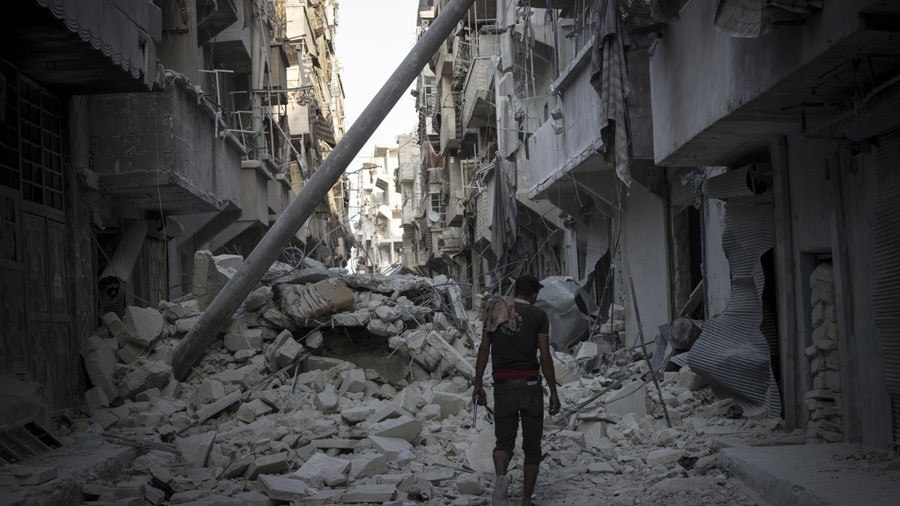
With Syria’s nearly seven-year war now virtually over, the process of rebuilding the devastated country comes to the fore, with the financial cost of that effort put at $200 billion. Who pays for it?
When you view the ruins of Aleppo alone, Syria’s second biggest city, plus the carnage across the entire country, from towns, villages, bridges, roads, public utilities, hospitals, schools, and so on, the real figure for reconstruction could be far higher than $200 billion.
Then there is the inestimable cost of human suffering and families decimated. All told, the reparations could amount to trillions of dollars.
Syria’s war was no ordinary civil war, as Western mainstream media tended to mendaciously depict it.
From the outset, the conflict was one of an externally driven covert war for regime change against the government of President Bashar Assad. The Arab Spring unrest of 2011 provided a convenient cover for the Western plot to subvert Syria.
The United States and its NATO allies, Britain, France, and Turkey, were the main driving forces behind the war in Syria, which resulted in up to 400,000 deaths and millions of citizens displaced from their homes. Other key regional players sponsoring the campaign against the Syrian government were Saudi Arabia, Qatar, and Israel.
Most of the militants who fought in Syria to overthrow the state authorities were not Syrian nationals. Self-styled jihadists from dozens of countries around the world made their way to Syria, where they were funded, armed and directed by covert forces from Western and Arab states.
The barbarian-like gravitation to Syria indicates the degree to which the effort to overthrow the Syrian government was orchestrated by foreign powers.
This was a planned, concerted project for regime change. The systematic violence imposed on Syria was very arguably due to an international criminal conspiracy perpetrated by the US and all of the above “partners.” The case can, therefore, be made for criminal responsibility.
That, in turn, means that financial reparations and damages can be sued by the Syrian state against those foreign powers which waged the war, albeit indirectly through proxy militant groups.
The bitter irony though is that the US and its Western allies are reportedly using Syria’s war-torn plight as leverage to pursue their political objective of ousting Assad. What these powers could not achieve on the battlefield with their terrorist mercenaries they now seem to be pursuing through their dominance over international financial institutions.
The Washington DC-based International Monetary Fund estimates the reconstruction of Syria’s devastated infrastructure will cost $200 billion. (As noted above, that’s probably a gross underestimate.)
As Bloomberg News reported last week: “The US and its European and Arab partners have for years insisted that Assad must go and are now using the carrot of funding for rebuilding the shattered nation in a final attempt to pressure the Syrian leader. The International Monetary Fund estimates the cost of reconstruction at $200 billion, and neither of Syria’s main allies, Russia and Iran, can afford to pick up the bill.”
It’s a moot point whether Russia and Iran cannot afford to help rebuild Syria. Who’s to say that those two powers along with China and other Eurasian nations could not club together to create a reconstruction fund for Syria, independent of Western countries and their Arab client regimes?
However, regardless of the source of funding for Syria, what Russia, China, Iran and other key international players should push for at the United Nations and other global forums such as the Non-Aligned Movement is the repudiation of Western efforts to link financial aid to future political change in Syria.
Alexander Lavrentiev, Russia’s envoy steering the peace process in Syria, has reiterated Moscow’s position that the political outcome for Syria must be determined by the Syrian people alone, free from external influence. That is also the position of several UN resolutions.
Lavrentiev says Bashar Assad should be free to run in next year’s presidential election if he chooses to and that it is unacceptable for the US and its allies to try to use financial aid as a bargaining tool.
“It’s a simplistic approach when some Western countries say that they’ll give money only when they see that the opposition comes to power or their interests are fully accommodated,” said the Russian envoy.
It’s not merely unacceptable for such Western conditioning. It’s outrageous. Far from quibbling about financial aid to Syria, the debate should be broadened out to hold governments to account for the destruction and loss of life in Syria.
To establish responsibility is not a mystery. Saudi Arabia, Qatar, and Turkey are known to have poured money and weapons into dozens of jihadist-styled groups, including Ahrar al-Sham and Jaysh al Islam under the umbrella of the Islamic Front or Army of Conquest. The precise distinction – if any – between these groups and the internationally proscribed terror organizations of Nusra Front (Hayat Tahrir al-Sham) and Daesh (Islamic State) is elusive and probably negligible.
American, British and French special forces are known to have trained militants under the faux banner of “moderate rebels” and “Free Syrian Army,” even when there is evidence these same groups were cooperating with Al-Qaeda-type extremist networks. Under President Barack Obama, the US government funneled $500 million into training “rebels” in Syria. Trump earlier this year closed down CIA training operations. This is, in effect, an admission of culpability by Washington of fueling the war.
The Americans and British forces were up to recently training the militant group Maghawir al Thawra at Al Tanf base on the Syrian-Iraqi border. The American government also funded another jihadist group Nour al-Din al Zenki, which came to notoriety in a video showing their members beheading a Palestinian boy.
Weapons caches recovered by the Syria Arab Army after the liberation of ISIS strongholds in Deir ez-Zor also show stockpiles of US-made arms and other NATO munitions, including anti-tank missiles.
The Western governments openly funded the fake emergency responders – the so-called White Helmets – who worked hand-in-hand as a propaganda front for Al-Qaeda-affiliated Nusra Front.
There have been systematic links between Western governments, their regional client regimes and the terror proxies who carried out the dirty war on their behalf in Syria over the past seven years.
It is an insult upon injury for Western governments to impose constraints on financial aid to Syria. Furthermore, the economic costs of reconstruction should not be levied on the Syrian people. Those costs should be paid in full by Washington and its partners who engaged in a criminal war on Syria.
Surely, Syria, Russia, Iran and other allied governments should form an international prosecution case for war crimes.
Not only should Washington, London, Paris and others be made to pay damages. Political and military leaders from these countries should be placed in the dock to answer personally for crimes against the Syrian people. To allow impunity is to let Washington and its rogue cohorts keep repeating the same crimes elsewhere, over and over.
Featured Video

Trita Parsi: Middle East Unraveling — Are We on the Path to World War?
or go to
Aletho News Archives – Video-Images
New Book
Trans agenda is ‘normalization of sadism’ – US author

RT | September 23, 2026
The US Democratic Party has embraced a transgender agenda that amounts to “the normalization of sadism,” author A.J. Rice has said, warning that radical trans policies would return if the party is allowed to regain power.
Speaking to RT’s America First host Scotty Nell Hughes about his new book, ‘The Curse of the Bearded Lady: How the Trans Mafia Whacked American Sanity’, Rice argued that activists have gained significant influence in schools, medicine, and corporate America while people who questioned the agenda have faced pressure to stay silent.
The author described the “trans mafia” as the sprawling network of people and institutions that have helped the movement gain influence. He singled out parts of academia, wealthy backers, and corporations, and stated that providers of transition-related treatment also have a financial incentive to keep young people in their care indefinitely.
Rice argued that the consequences of these policies ultimately fall on children who are being drawn toward gender-affirming medical treatments and on girls who are expected to share locker rooms or compete in sports with biological males.
He noted that while voters rejected the Democrats’ approach to gender in 2024, the party, which has been “captured by madness,” has since only doubled down and is seeking what is effectively “the normalization of sadism.” … Full report
Blog Roll
 Aletho News
- ‘We don’t seek permission to defend our country’: Snippets from President Pezeshkian’s UNGA address
- NATO chief wants Europeans to fight American wars [for Israel]
- German chemicals giant reveals details of downsizing
- Refaat Al-Areer Was The Canary In The Coal Mine In Israel’s War On The Truth
- Israeli election committee bars candidate from Knesset race over Gaza war opposition
- French-Lebanese man files war crimes complaint over Israeli attacks
- Mahan Air Flight Lands in China Despite US Threat against Iranian Airlines
- US eyes $10bn fund to rebuild war-battered Gulf infrastructure
- Trump meets Rodríguez near Maduro’s prison as Venezuela’s oil flows to US
- Trita Parsi: Middle East Unraveling — Are We on the Path to World War?
- If Americans Knew
- An error has occurred; the feed is probably down. Try again later.
- No Tricks Zone
- New Study: Earth And Venus Surface Warmth Largely Explained By Convection And Lapse Rate, Not CO2 Or Radiation
- 2025 Nature Paper Claiming Worsening Global Drought Gets RETRACTED …Heavily Flawed
- New Study: ‘Global Drought Shows No Detectable Recent Acceleration Under Climate Warming’
- Economic Masterminds: German Socialists Suggest Taxing Productivity Gains Stemming From Using AI
- The South China Sea Has Not Been Cooperating With The Climate Change Narrative
- Energy Crisis: Germany Enters Heating Season With Historically Low Gas Reserve Fill Levels
- New Study: The Antarctic Ice Sheet Gained Mass From 2020-2024 Due To Staggering Snow And Ice Accumulation
- Study: Ocean Heating Rates From Thousands Of Years Ago ‘Dwarf’ Modern Ocean Heating Rates
- Climate Extremists Target, Attack Large-Scale Power Grid Infrastructure In Germany!
- New Study: Antarctic Ice Melt Has Contributed Less Than 1 Centimeter To Sea Level Rise In The Last 30 Years

