Turkish journalist acquitted over exposing Ankara’s arms aid to Syria militants

Erdem Gul, Ankara bureau chief of Turkish newspaper Cumhuriyet (Photo: Hurriyet Daily News )
Press TV – July 16, 2018
A court in Turkey has acquitted a journalist of the center-left and opposition daily newspaper Cumhuriyet, who was being tried for espionage in a case about revealing state secrets by publishing footage of a video showing weapons shipment to pockets of Syria held by foreign-backed terrorists.
On Monday, Istanbul’s 14th Heavy Penal Court dropped charges against Erdem Gul, who used to serve as the paper’s Ankara representative.
In May 2016, the 14th High Criminal Court in Istanbul convicted former editor-in-chief of Cumhuriyet daily Can Dundar and Gul following the publication of the video.
The two defendants were arrested and held in prison until Turkey’s Constitutional Court ruled that their rights had been violated and ordered their release.
Earlier this year, Turkey’s Supreme Court of Appeals overturned the Istanbul court’s previous ruling on the case, and ordered Gul’s acquittal over lack of evidence.
Back in May 2015, Cumhuriyet daily posted on its website footage showing Turkish security forces in early 2014 intercepting a convoy of trucks carrying arms for the militants in Syria.
The paper said the trucks were carrying some 1,000 mortar shells, hundreds of grenade launchers and more than 80,000 rounds of ammunition for light and heavy weapons.
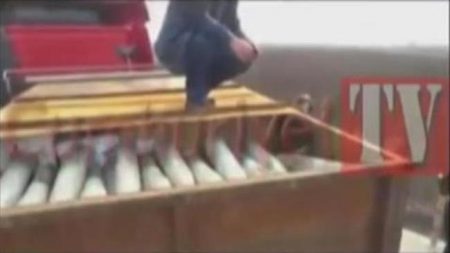
A screen grab from a video published on the website of Cumhuriyet daily on May 29, 2015 shows mortar shells in boxes intercepted on a truck destined for Syria.
Ankara denied the allegation and claimed that the trucks had been carrying humanitarian aid to Syria. However, lawmaker from the opposition Republican People’s Party Enis Berberoglu defended the video, saying it was genuine.
Turkey stands accused of supporting militant groups fighting to topple the Damascus government since March 2011.
Syria has been gripped by foreign-backed militancy since March 2011. The Syrian government says the Israeli regime and its Western and regional allies are aiding Takfiri terrorist groups wreaking havoc in the country.
Russia has been helping Syrian forces in an ongoing battle in the province of Dayr al-Zawr as Daesh struggles to keep its last positions in eastern Syria.
The Russian military assistance, which began in September 2015 at the official request of the Syrian government, has proved effective as the Syrians continue to recapture key areas from Daesh and other terrorist groups across the country with the backing of Russia’s air cover.
On May 21, the General Command of the Syrian Army and Armed Forces announced in a statement that complete security was restored to Damascus and its countryside after al-Hajar al-Aswad district and al-Yarmouk camp had been totally purged of Daesh terrorists.
The development was preceded by flushing the Takfiris out of the towns of Yalda, Babbila and Beit Sahem on the southern outskirts of Damascus.
NATO Wants to Use Turkish Territory to Encircle Iran – Turkish Analysts
Sputnik – 15.07.2018
It is the Kurdish YPG forces and their US sponsors, not the Syrian army, that pose the main threat to Turkey’s southern borders, Turkish political analysts told Sputnik when commenting on the parts of a NATO declaration directly pertaining to their country.
In a statement released on Wednesday following its summit in Brussels, NATO vows to protect Turkey’s southern border.
The statement also says that NATO “continues to monitor and assess the ballistic missile threat from Syria,” and that “tailored assurance measures for Turkey to respond to the growing security challenges from the south contribute to the security of the Alliance as a whole, and will be fully implemented.”
“We have increased the strength of the NATO Response Force, and the Very High Readiness Joint Task Force (VJTF) is ready to deploy on short notice,” the statement adds.
In an interview with Sputnik, Hasan Unal, a foreign relations expert at Atylym University in Ankara, criticized the vague notion of “threat” mentioned in the declaration, adding that the main threat to Turkey comes from Kurdish YPG forces and their “sponsors in the US.”
“There is no threat to southern Turkey coming from the Syrian army. The missiles launched at our territory from Syria came from territories controlled either by Daesh or militants of the Kurdistan Workers Party even before the start of the Turkish military operation in Afrin. This means that the biggest threat to Turkey in the south comes from the Kurdish units and their US supporters. Turkey should have rejected such a vague description of this threat contained in the NATO summit’s declaration,” he said.
He added that by approving the declaration’s provisions, Turkey finds itself in the position of a country which supports NATO’s plans of encircling and pressuring Iran.
Cahit Armagan Dilek, a political scientist and the head of the university “Turkey in the 21st Century,” pointed to the declaration’s openly anti-Turkish slant, aimed at “encircling Iran and bringing pressure to bear on it by using Turkish territories and the introduction of an additional military contingent into Turkey.”
“In future, we may see NATO forces deploying along our southern border with Syria. It looks like NATO and Turkey look differently at what a ’terrorist threat’ is all about. The declaration says that at least three missiles fired at Turkey from Syria had actually been launched by the Syrian army and Iran. In the final account, the ‘terrorist threat,’ as it is termed in the NATO declaration, may transform into an ‘Iranian threat,’” the expert noted.
Dr. Dilek said that the Rapid Response task force that NATO plans to deploy, ostensibly to ensure Turkey’s security in the south, may in fact target Iran.
He added that to consolidate its positions in the region, NATO could deploy its forces east of the Euphrates and use them as a buffer between Turkey and YPG units.
READ MORE: Turkey’s Presidential Candidate Says NATO Fails to Ensure Nation’s Security
“Some of the NATO forces may be stationed to the west of the Euphrates, inside Turkey. With the Syrian army poised to advance on Idlib in August, the local jihadists may move towards Turkey and Afrin, thus destabilizing the situation in the region. In this case, NATO is likely to offer us help. However, we should also bear in mind the fact that the NATO forces deployed inside Turkey may be used against Iran. Turkey should take its time before it agrees to let foreign forces in, because we have absolutely no idea exactly when these forces will move out,” he explained.
He mentioned NATO’s naval forces deployed in the Aegean Sea as part of an EU-Turkish agreement on refugees in order to stem the tide of Syrian refugees fleeing to Europe.
“If, in addition to this, we have NATO land forces coming in, we may eventually have problems sending them back. We have a similar situation with the Incirlik base. But this time there may be more foreign troops stationed on our territory. Before the start of Operation Euphrates Shield, the Americans kept saying they needed 30,000 soldiers to secure the border between the [Syrian cities of] Jarabulus and Azaz,” Dr. Dilek noted.
NATO Is the Model Entangling Alliance
By Jacob G. Hornberger | FFF | July 13, 2018
Suppose I had an unlimited power of attorney to sign your name as a co-signer on any loan I made with the bank. Every time I went to the bank and borrowed money, I could legally obligate you to pay my loan if I defaulted.
How would you like that? My hunch is that you wouldn’t be too excited about that arrangement.
That is precisely the authority that NATO has over the American people, only the obligation is much worse than a financial one. The obligation involves killing and dying. That is, NATO has the authority to obligate young Americans, both men and women, to kill and die for whatever overseas regime that NATO decides to admit as a member of the organization.
How does NATO work? If another nation attacks any member of NATO, the United States is automatically bound to come to its defense.
That is not the type of system on which the United States was founded when the U.S. Constitution called the federal government into existence. The founding principle was that it would be up to Congress to decide whether the country would, in fact, go to war against another nation. There would be nothing automatic about it. If Congress declared war, then it would be the president’s responsibility to wage war. But if Congress failed to declare war, the government could not legally go to war.
Unfortunately, the Constitution did not limit war to the defense of the United States. That means that if Congress decided to declare war against, say, Uruguay, simply because they didn’t like that country’s ruler, there was nothing in the Constitution that would preclude such a war.
However, as a practical matter, a founding principle was that the United States did not involve itself in wars in faraway countries. That foreign policy of “non-interventionism” was encapsulated in John Quincy Adams’s Fourth of July address in 1821, where he observed that America does not go abroad in “search of monsters to destroy.”
U.S. membership in NATO nullifies those founding principles. NATO now decides when the United States goes to war and, equally important, decides which countries the American people are obligated to defend. No congressional declaration of war is required. If, say, Russia were to invade Latvia, the American people, thanks to NATO’s decision to admit Latvia as a member, would be automatically bound to go to war against Russia.
NATO is a blank, signed check which the American people have handed to NATO bureaucrats, a check by which they have obligated the lives of American youth and America’s money in the defense of some faraway nation that NATO has decided to admit as a member.
Of course, it’s easy for people to say, “Jacob, this doesn’t really involve my children, my siblings, or me. We have a professional army.”
But let’s not forget something: Mandatory draft registration. The Pentagon requires every man to register for the draft when he reaches the age of 18. That’s not just some esoteric exercise. It is a very real, practical device that enables the Pentagon to seize millions of young men, if necessary, to wage a NATO war (or any other war that the Pentagon deems is important to get involved in).
Moreover, even though young American women are not forced to register for the draft, there is no doubt that they are as subject to being drafted to go fight, kill, and die in the defense of Latvia, Montenegro, Turkey, and every other member of NATO as young American men are.
Isn’t it amazing that Americans would object to granting someone a power of attorney to obligate them on loans but have no reservations about giving the president, the Pentagon, and NATO bureaucrats the unfettered power to seize their children, spouses, brothers and sisters, and even themselves and the authority to force them to kill and die in the defense of faraway nations, some of which, by the way, are quite autocratic and dictatorial?
Of course, it hasn’t always been that way. George Washington, the father of our country and the first U.S. president, declared “It is our true policy to steer clear of permanent alliance with any portion of the foreign world.” Thomas Jefferson, the author of the Declaration of Independence and America’s third president, echoed Washington’s sentiments: “Peace, commerce, and honest friendship with all nations — entangling alliances with none.”
NATO’s Dead?
If so, who killed it: Obama, Putin, Or Trump?
By Andrew Korbyko – InfoRoss – 06.07.2018
NATO, as the world knew it, is dead, and the organization’s demise is attributable to the combination of President Putin’s deft diplomacy in advancing the Russian-Turkish rapprochement and his American counterpart’s revolutionary reconceptualization of the very essence of the alliance, both of which wouldn’t have been possible had it not been for Obama.
NATO, as it was previously conceived of for decades, is dead, and while it might be reborn in a different format sometime in the future, its previous model has exhausted its purpose and is entering into the dustbin of history. The organization still officially exists, but everything about it is changing to the point where it might soon become unrecognizable. The consistently anti-Russian driving force behind the bloc has been decisively neutralized by President Putin’s deft diplomacy in winning over its second-largest military member, Turkey, as Russia’s newest strategic partner, while Trump’s revolutionary reconceptualization of the alliance as an equal collection of states combating the asymmetrical security challenges of terrorism and illegal migration will fundamentally transform what it means to be a NATO member.
The Shadow Of Obama
Before going through the post-mortem in detail, it’s worthwhile to describe how Obama’s shadow hangs heavy in the sense that he orchestrated the three greatest mistakes that inadvertently led to NATO’s demise. The 2011 NATO War on Libya has the chance of being seen in hindsight as the final flash of a fast- fading star, with its “shock-and-awe” destruction of the former Jamahiriya going down in history as perhaps the last real instance of the bloc’s members working in coordination with one another to conventionally wage war against a targeted state. The self-congratulatory pomp that followed this brief military campaign has since been proven to have been premature because of the country’s ongoing civil war and role as a transit state for facilitating the flood of hundreds of thousands of migrants into Europe, which sparked its own crisis that has since led to the rise of EuroRealist populists in the continent.
In addition, the Libyan model of Hybrid War destabilization was also applied to Syria, albeit minus the final conventional warfare form, and this exacerbated the Migrant Crisis to the point of no return in guaranteeing the inevitable rise of right-wing politicians in Europe. Taken together, the Wars on Libya and Syria, waged in different manners but nevertheless following the same neo-imperialist regime change form, generated unprecedented humanitarian blowback to the point of triggering far-reaching political changes in NATO’s EU members, making many of them reconsider the official anti-Russian purpose of the bloc when it could be better put to use in defending the organization’s southern shores from swarms of migrants. For as “constructive” of an idea as this may have been, it led to deep divisions within the EU itself between the pro-migrant Western countries, the anti-migrant Central & Eastern European ones, and the anti-Russian Baltic States, Poland, and Romania.
While these intra-NATO disagreements were percolating, Obama made another massive mistake in giving the greenlight for the failed pro-American coup attempt against Turkish President Erdogan in the summer of 2016, and the blowback from this sloppy operation was almost instantaneous in making the bloc’s second-largest military deeply suspicious of US intentions from then on out. Although Turkey had hitherto been mostly focused on facilitating American strategic objectives in the Mideast (which for the most part were disadvantageous to Russia’s long-term regional vision), its unchanging geopolitical position as an irreplaceable part of NATO’s anti-Russian “containment” policy was thought to have retained a consistent function that had been taken completely for granted up until that point. That was a huge error, as will be seen, because President Putin’s deft diplomacy succeeded in its judo-like maneuver to flip Turkey from an enemy into a partner.
Putin’s Judo
Taking advantage of President Erdogan’s understandable distrust of what he had presumed was his country’s closest ally, President Putin reached out to extend his support for the embattled Turkish leader in demonstrating which of the two Great Powers really had Ankara’s best interests in mind. It shouldn’t be forgotten that unconfirmed reports also alleged that Russian intelligence might have tipped President Erdogan off right before a fighter jet flown by one of the coup conspirators was set to bomb his residence, therefore saving his life and sealing a new bond of friendship between both countries. It might never be known whether that actually happened or not, but in any case, the Russian-Turkish rapprochement that followed soon thereafter was swift and even saw Moscow passively accepting Ankara’s limited “Euphrates Shield” incursion into northern Syria later that summer, something that would have been utterly unthinkable just a few months prior.
The revival of the Turkish Stream pipeline project and a related agreement on nuclear energy cooperation served as physical testimonies to the strength of the Russian-Turkish Strategic Partnership, which went one dramatic step much further in officially including a military dimension per Ankara’s desire to buy Moscow’s state-of-the-art S-400 air & missile defense system despite Washington’s threats to sanction it if the deal goes through. In the course of less than two years, President Putin’s deft diplomacy flipped the tables on the previous US-Turkish Strategic Partnership by replacing America with Russia and totally changing the overall dynamics of Mideast geopolitics. The de-facto removal of NATO’s second-largest military force from the organization, which is essentially the true state of affairs at the moment given Ankara’s planned S-400 military cooperation with Moscow and Washington’s CAATSA sanction threats, dealt a heavy blow to the bloc from which it has yet to recover.
Decades’ worth of strategic planning that went into using Turkey as a bulwark against the spread of Russian influence towards the Mediterranean are now worthless after Ankara has for all intents and purposes turned its back on the bloc out of protest of the US’ role in the failed summer 2016 coup attempt. The organization can no longer count on the cornerstone of its Mideast, Black Sea, and Eastern Mediterranean policies, and this has inevitably led to the alliance having to reinvent itself. As it happened, this took place concurrent with the rapid politicization of the Migrant Crisis and its resultant intra-NATO/-EU disputes about how best to respond to this civilizational challenge, further exacerbating divisions within the West and making Turkey’s “defection” (brought about through President Putin’s masterful diplomacy) all the more impactful of a destabilizing move for the already confused alliance.
Trump’s Turnaround
The last and most powerful factor that contributed to the death of NATO was Trump himself, who decided to turn everything around and reorient the bloc from its official anti-Russian purpose by transforming it into something entirely different. It’s true that some of the anti-Russian functions will still remain because of the Baltic States, Poland, and Romania’s membership as “frontline states”, but Trump’s vision is to use NATO as a platform for responding more to asymmetrical security threats such as terrorism and illegal immigration instead of conventional ones like Russia was portrayed as being since the organization’s inception. Words are one thing, but transforming them through action is another, and it’s here where Trump is “walking the walk” much more than “talking the talk” like his predecessors did in visibly pressuring his “allies” to contribute their required 2% of GDP towards defense like they were always supposed to do to begin with.
Trump, being the successful businessman that he is, can’t fathom why the US should subsidize the EU’s “socialist welfare states” especially given that the “foreboding challenge” of a “Soviet invasion” no longer makes that necessary like it may have once. Seeing world affairs from an economic perspective and therefore perceiving the EU to be America’s rival in this respect, Trump knows that the best way to “level the playing field” and “get a better deal” is to put pressure on America’s military underlings by compelling them to pay more for defense in order to advance their interests in a reconceptualized NATO, with this being coordinated alongside the US’ campaign to get the EU to lift its anti-American tariffs. The knock-on effect of this “double whammy” could hit the Europeans’ economic growth and possibly compel them into “cutting a deal’ of some sort for relief, one which can only be speculated upon at this time but which would undoubtedly strengthen American influence.
Far from representing the “united” West that NATO did during the Old Cold War and the brief period of unipolarity that followed, the New Cold War has seen the bloc weakened from within because of the blowback caused by Obama’s disastrous Wars on Libya & Syria as well as the failed pro-American coup attempt against President Erdogan in summer 2016.
President Putin skillfully exploited the latter in rapidly turning Turkey into a close partner and convincing it that its future interests are best served by keeping the bloc at arm’s length, while Trump dealt the deathblow against the alliance for his own reasons mainly having to do with a different view on contemporary security challenges and his economically driven vision of foreign affairs. While the shell of NATO still exists, its functional capacities are now divided into different regional blocs mostly constituting the new anti-migrant European Intervention Force in Western Europe and the remaining anti-Russian forces in the East, though Turkey’s de-facto “defection” means that the organization will never be the same as before.
Israel set to indict Turkish woman
MEMO | July 8, 2018
 Israeli prosecutors are set to charge a Turkish national on Sunday with aiding Palestinian group Hamas, according to Israeli daily Haaretz.
Ebru Ozkan, 27, was arrested by Israeli forces at Ben Gurion Airport on June 11 when she was returning to Turkey for alleged links with terrorist groups. Haaretz said Israeli prosecutors will file an indictment against the Turkish national on Sunday.
Ebru’s detention had been extended four times, Elif Ozkan, a sister of Ebru, noted.
Her lawyer Omar Khamaysa says she was charged with asking to transfer money and a cellphone charger to Hamas members, but she wasn’t aware of their identity.
Israel labels Palestinian group Hamas, which rules the Gaza Strip, as a terrorist organisation.
Ozkan is not the first Turkish citizen to have been recently detained by Israeli authorities.
In January, Osman Hazir, a 46-year-old Turkish national, was arrested for snapping a selfie at East Jerusalem’s Al-Aqsa Mosque while holding a Turkish flag.
And last December, Israel arrested two other Turks – Abdullah Kizilirmak and Mehmet Gargili – after the pair had quarreled with Israeli police who had tried to bar them from entering the flashpoint holy site.
In the same month, Adem Koc, another Turkish national, was arrested inside the Al-Aqsa Mosque compound for allegedly “disturbing the peace and taking part in an illegal demonstration”.
Kizilirmak, Gargili and Koc were all subsequently released on bail.
Syria Is Now Like the Balkans in 1914
By Jeremy Salt | American Herald Tribune | June 30, 2018
The war in Syria has returned to where it was started in 2011, in Dara’a, close to the Jordanian border and therefore easily accessible to takfiris and weapons shipped in to be used behind the façade of ‘peaceful protests.’ The template had been used in Latin America and the Middle East on many occasions and here it was being used again, with the enthusiastic support of the corporate media.
Having failed in its attempt to overthrow the Syrian government the US is now abandoning those groups described in the corporate media as its ‘allies.’ One such group is the takfiri collective fighting under the banner of the Free Syrian Army, which has been told to expect no help from the US in its collapsing attempt to hold ground in southwestern Syria. Another is the Kurdish SDF-YPG collective in the north, which the US betrayed when signing an agreement with Turkey over Manbij. The Kurds, as an administrative and military force, have been forced out. The town is now being patrolled by Turkish and US military units.
The Kurds can’t say they were not told to distrust the US. They have played their cards hopelessly just about everywhere. When Turkey invaded north-western Syria early this year the Kurds rejected an offer of military assistance from the Syrian government, apparently thinking they could hold their ground against the Turkish army, only to be routed by it and to be driven out of Afrin city.
The US had warned Turkey that Manbij was a red line. However, when the Turks insisted, the US gave in. The YPG is now reconciling with the Syrian government, just as some at least of the betrayed takfiris in the southwest, along the border with Jordan and the armistice line with the occupied Syrian Golan Heights, have been accepting an amnesty offer. Israel is still doing its best to throw the Syrian military off balance, by bombing near Damascus airport and striking at Syria’s Iraqi allies along the eastern border, but to no avail. The army is making a clean sweep and all the southwest will soon be back in the hands of the Syrian government.
Syria’s next target is likely to be the base the US has set up at Al Tanf on the Syrian-Iraqi border. At Al Tanf the US has been retraining and rebranding takfiris into its Maghawhir al Thawra (Commandos of the Revolution) proxy force. Backed by US air power, this force has been attacking Syrian forces outside the ‘deconfliction zone’ the US has unilaterally set up within a 50 km radius of Al Tanf.
The US is still arguing that its forces are needed in Syria to fight the Islamic State. In fact, if the Islamic State continues to exist, it is because of tacit support from the US. The heavy work in destroying the Islamic State was done by the Syrian military and the Syrian and Russian air forces, not the US and not the Kurds, as the corporate media would have its gullible consumers believe. The latest example of a helping hand is the helicoptering of two IS leaders from Twaimin on the Syrian-Iraqi border to the US base at Al Shaddadi, south of al Hasaka.
From Tanf the US continues to attack the Syrian and Iraqi militaries, with air support from Israel. The aim seems to be to control the border and prevent the war in Syria from ending. Donald Trump has blown hot and cold over Syria and even Americans should be asking what their forces are doing there. The US has reached none of its set goals. The Syrian government is still in power and the proxy forces armed and paid by outside governments are being routed. The Kurdish card was played, with the apparent intention of linking up the occupied northeast, predominantly Kurdish, with the Kurdish governorate in northern Iraq, in 2011 only a few steps short of statehood. That is now not going to happen, following the collapse of the independence movement in northern Iraq and the loss of all territory taken by the peshmerga since 2014. The US betrayal of the Kurds in favour of an agreement with Turkey puts the final nail in the coffin.
The US is now staying in Syria to prevent the war from ending. Its withdrawal would signify the complete and humiliating failure of the policy of intervention. The US would be signalling that Syria, Russia, Iran and Hezbollah have won and the tripartite axis of the US, Saudi Arabia and Israel have failed. The US is now isolated and vulnerable in Syria. It is opposed on both sides of the Iraq-Syrian border by military and tribal forces, whose resistance to foreign occupation is being coordinated/monitored by a joint command centre set up in Baghdad by Iraq, Syria and Russia.
If Trump does one of his familiar back flips and announces the withdrawal of US forces from Syria it will be Turkey’s turn to be left isolated and vulnerable not just in north-western Syria or Manbij where the government has repeatedly refused to withdraw its troops, but from Bashiqa, near Mosul, despite the repeated demands of the Iraqi government. Turkish occupation of north-western Syria extends to the town Al Bab, northeast of Aleppo, where an industrial zone is being created. Throughout the occupied region the Turkish flag is being flown, a police force trained and proxy town councils set up. Turkish forces are now present in Manbij, further to the west, and Idlib, where under the ‘deconfliction’ arrangements set up under the Astana negotiations Turkey has set up at least 12 ‘observation’ posts.
Bashar al Assad has said Syria intends to liberate the entire country, as is his constitutional duty, and that all occupying forces that do not voluntarily withdraw will be driven out by force. The Turkish government has said it will not return occupied territory to the Syrian government: to whom it would return this territory is not clear. Following his recent election victory Tayyip Erdogan said he would continue to take measures to ‘liberate’ Syria. As these completely polarized positions indicate, open armed conflict between Syria and Turkey would seem inevitable sooner or later. The main Turkish opposition party, the Republican People’s Party (CHP), strongly opposed to intervention in Syria, had said it intended to repair the relationship with the government in Damascus, a process that would inevitably have entailed the withdrawal of Turkish forces but that exit route has now been closed off.
Syria is now a cross between the Balkans in 1914 and Europe 1930-39. The combination of irresponsible outside powers and the violent groups they are backing inside Syria but cannot necessarily control have created a tinderbox. One more spark and the entire region could be blown sky high.
Jeremy Salt has taught at the University of Melbourne, Bosporus University (Istanbul) and Bilkent University (Ankara), specialising in the modern history of the Middle East. His most recent book is “The Unmaking of the Middle East. A History of Western Disorder in Arab Lands” (Berkeley: University of California Press, 2008.)
Is Putin Really Ready to “Ditch” Iran?
The Saker • Unz Review • June 7, 2018
The topic of Russian actions in Syria still continues to fascinate and provoke numerous polemics. This makes sense – the issue is exceedingly important on many levels, including pragmatic and moral ones, and today I want to stick strictly to the pragmatic level and set aside, just for a while, moral/ethical/spiritual considerations. Furthermore, I will also pretend, for argument’s sake, that the Kremlin is acting in unison, that there are no Atlantic Integrationists in the Russian government, no 5th column in the Kremlin and that there is no Zionist lobby exerting a great deal of influence in Russia. I will deal with these issues in the future as there is no doubt in my mind that time and events will prove how unfounded and politically-motivated these denials are in reality. But for the purpose of this analysis, we can pretend that all is well in the Kremlin and assume that Russia is fully sovereign and freely protecting her national interests.
So what do we know about what is going on in Syria?
I submit that it is obvious that Russia and Israel have made some kind of deal. That there is an understanding of some kind is admitted by both sides, but there is also clearly more happening here which is not spelled out in full. The Israelis, as always, are bragging about their total victory and posting articles like this one: “In Syria, Putin and Netanyahu Were on the Same Side All Along” with the subheading reading “Putin is ready to ditch Iran to keep Israel happy and save Assad’s victory.” Really?
The chaotic world of contradictory declarations and statements
Let’s look at that thesis from a purely logical point of view. First, what were the Israeli goals initially? As I have explained elsewhere, initially the Israelis had the following goals:
- Bring down a strong secular Arab state along with its political structure, armed forces, and security services.
- Create total chaos and horror in Syria justifying the creation of a “security zone” by Israel not only in the Golan but further north.
- Trigger a civil war in Lebanon by unleashing the Takfiri crazies against Hezbollah.
- Let the Takfiris and Hezbollah bleed each other to death, then create a “security zone”, but this time in Lebanon.
- Prevent the creation of a Shia axis Iran-Iraq-Syria-Lebanon.
- Break up Syria along ethnic and religious lines.
- Create a Kurdistan which could then be used against Turkey, Syria, Iraq, and Iran.
- Make it possible for Israel to become the uncontested power broker in the Middle-East and force the KSA, Qatar, Oman, Kuwait and all others to have to go to Israel for any gas or oil pipeline project.
- Gradually isolate, threaten, subvert and eventually attack Iran with a wide regional coalition of forces.
- Eliminate all centers of Shia power in the Middle-East.
Now let’s stop right here and ask a very simple question: if Putin and Netanyahu were on the same side all along, what should Putin have done to aid the Israelis? I submit that the obvious and indisputable answer is: absolutely nothing. By the time the Russians initiated their (very limited but also very effective) intervention in Syria those plans were well under way towards full realization!
The undeniable truth is that Putin foiled the initial Israel plan for Syria.
In fact, Hezbollah and Iran had already intervened in Syria and were desperately “plugging holes” in a collapsing Syrian front. So, if anything, Putin has to be the one to be credited for forcing the Israelis to give up on their “plan A” and go to plan “B” which I described here and which can be summarized as follows:
Step one, use your propaganda machine and infiltrated agents to re-start the myth about an Iranian military nuclear program. (…) If Trump says that the JCPOA is a terrible deal, then this is so. Hey, we are living in the “post-Skripal” and “post-Douma” era – if some Anglo (or Jewish) leaders say “highly likely” then it behooves everybody to show instant “solidarity” lest they are accused of “anti-Semitism” or “fringe conspiracy theories” (you know the drill). So step one is the re-ignition ex nihilo of the Iranian military nuclear program canard. Step two is to declare that Israel is “existentially threatened” and (…) and let the dumb Americans fight the Iranians.
As I have explained it in great detail here, Russia does not have any moral obligation to protect anybody anywhere, not in the Middle-East and most definitely not Syria and/or Iran. I have also explained in great detail here why Putin also has a lot of pragmatic internal reasons for not getting Russia involved in a major war in the Middle-East.
Finally, as I have explained here, the Israelis are clearly baiting Iran by striking Iranian (or, more accurately, Iranian-linked or Iranian-supported) targets in Syria. They hope that Iran’s patience will come to an end and that the Iranians will retaliate with enough firepower to justify not only an attack on (relatively low value) Iranian-linked targets in Syria but on Iran proper, thus leading to a guaranteed Iranian retaliation on Israel and The Big Prize: a massive US attack on Iran.
Now let’s look at Russian actions once again. If Putin was “on the same side with Netanyahu all along”, he would be helping the Israelis do what they are doing, that is baiting the Iranians, right? But what did Putin really do?
It all began with a statement by Foreign Minister Lavrov who declared that all foreign forces must leave Syria. It is my understanding that no direct quote exists from Lavrov’s initial statement, only interpreted paraphrases. Lavrov also made some clarifying comments later, like this one. But let’s not get bogged down in trying to decide which was an off-the-cuff comment and which one was “official”, let us begin by noticing this: even before Lavrov’s comment on “all foreign forces” the same Lavrov also said that “all US forces must leave Syria after the defeat of the terrorist forces.“ May I also remind everybody here that Israel has been illegally occupying the Syrian Golan for years and that the IDF exactly fits into the definition of “foreign force in Syria”? It gets better, according to the Syrians and, frankly according to common sense and international law, the Syrians say that all foreign forces must leave Syria except those legally requested to stay by the Syrian government. So when the Russians say that all foreign forces including Iranians (assuming Lavrov really said that) must leave Syria they have absolutely no legal or other authority to impose that, short of a UNSC Resolution endorsing that demand. Considering that the Israelis and the USA don’t give a damn about international law or the UNSC, we might even see a day when such a resolution is passed, enforced on the Iranians only, and ignored by the Israelis. The trick here is that in reality there are rather few Iranian “forces” in Syria. There are many more “advisors” (which would not be considered a “force”) and many more pro-Iranian forces which are not really “Iranian” at all. There is also Hezbollah, but Hezbollah is not going nowhere, and they are Lebanese, not Iranian anyway. No doubt the Israelis would claim that Hezbollah is an “Iranian force” but that is basically nonsense. And just to add to the confusion, the Russians are now being cute and saying: “of course, the withdrawal of all non-Syrian forces must be carried out on a mutual basis, this should be a two-way street.“ I suggest that we can stop listing all the possible paraphrases and interpretations and agree that the Russians have created a holy (or unholy) mess with their statements. In fact, I would even submit that, what appears to be a holy (or unholy) mess, is a very deliberate and crafty ambiguity.
According to numerous Russian sources, all this rhetoric is about the southern part of Syria and the line of contact (it ain’t a border legally speaking) between Syria and Israel. The deals seem to be this: the pro-Iranian forces and Hezbollah get out of the south, and in exchange, the Israelis let the Syrians, backed by Russian airpower and “advisors” regain control of southern Syria but without any attempts to push the Israelis out of the Golan which they illegally occupy. Needless to say, the Syrians are also insisting that as part of the deal, US forces in southern Syria must pack and leave. But, frankly, unless the US plans to have tiny (and useless) US enclaves inside Syrian controlled territory I don’t see the point of them staying. Not only that, but the Jordanians seem to be part of this deal too. And here is the best part: there is some pretty good evidence that Hezbollah and Iran also are part of the deal. And, guess what? So are the Turks.
This sure looks like some kind of major regional deal has been hammered out by the Russians. And if that is really the case, then that would also explain the tense denials in Israel and Iran, followed by more confirmations (also here) And, just to make things even more confused, we now have Stoltenberg (of all people!) saying that NATO would not assist Israel in case of an Iranian attack which, considering that the NATO Secretary General has no power, that NATO is about 80%+ made up of the USA and that the US now has a permanent “tripwire” force inside Israel and could claim to be under attack, is utter nonsense, but still amusing to note as “adding to the chaos”.
And then there is the apparent Syrian plan to kick out the US from northern Syria which, predictably, Uncle Sam doesn’t like too much. So the two sides are talking again.
If all this looks to you like evidence for the thesis that “Putin and Netanyahu were on the same side all along”, then I wonder what it would take to convince you otherwise because to me this looks like one of three things:
- some kind of major regional deal has been made or
- some kind of major regional deal is in the process of being hammered out or
- some kind of major regional deal has been made but nobody trusts anybody else and everybody wants to make that deal better for itself
and, of course, everybody wants to save face by either denying it all or declaring victory, especially the AngloZionists.
So let’s ask the key question: is there any evidence at all that Putin and/or Assad is/are “ditching Iran”?
Away from the realm of declarations and statements and back to the world
Let’s begin with a simple question: What does Iran want above all else?
I submit that the overwhelming number one priority of Iran is to avoid a massive US attack on Iran.
Conversely, triggering such an attack on Iran is the number one objective of the Israelis. They are rather open about that too. The latest idea is to create a “military coalition against Iran” while trying to please NATO by joining anti-Russian exercises in Europe.
Not because of a non-existing Iranian nuclear program threatening Israel, but because Iran offers a most successful, and therefore dangerously competing, alternative civilizational model to both the AngloZionist Empire and the Saudi-Wahabi version of Islam. Furthermore, unlike (alas!) Russia, Iran dares to openly commit the “crime of crimes”, that is, to publicly denounce Israel as a genocidal, racist state whose policies are an affront to all of civilized mankind. Finally, Iran (again unlike Russia, alas!) is a truly sovereign state which has successfully dealt with its 5th columnists and which is not in the iron claws of IMF/WB/WTO/etc types (I wrote about that last week so I won’t repeat it here).
I also submit that Iran also has as a top priority to support all the oppressed people of the Middle-East. Resisting oppression and injustice is a Quranic imperative and I believe that in its Iranian interpretation this also extends to non-Shia Sunnis and even Christians and Jews, but since I know that this will trigger all sorts of angry accusations of being naive (or even a Shia propagandist) I will concede that helping the oppressed Shia in the region is probably more important to the Iranian leaders than helping all the other oppressed. In secular terms, this means that Iran will try to protect and assist the Shia in Iraq, Syria, and Lebanon and I see absolutely nothing wrong with that at all. In fact, considering the amazing mercy shown by Hezbollah to the SLA in southern Lebanon in 2000, and the fact that currently, the Syrian security forces are acting with utmost restraint in the parts of Syria which have accepted the Russian deal (this even has some Russian analysts outright worried) I think that Iranian-backed forces liberating Syria from Daesh are the best thing which anybody could hope for.
Furthermore, the truth is that for all its other faults, the Ba’athist regime in Syria was tolerant of minorities and that Hezbollah has always been protective of absolutely all the Lebanese people regardless of confession or ethnicity (others might disagree with me, but having studied Hezbollah and Iran for several decades now I come to the conclusion that they, unlike most other political actors, are actually truthful when they state their intentions).
So who is the biggest threat to the Shia and, I would argue, to all the people of the Middle-East? The Takfiris of Daesh of course.
And what do all the variants of the possible “big regional deal” have in common? The elimination of Daesh & Co. from Syria.
So how is that against the Iranian interests?!
It isn’t, of course.
The truth is that I see absolutely no evidence at all for “Putin and Netanyahu working together all along”. What I do see is that some kind of deal is being worked out between numerous parties in which everybody is probably trying hard to cheat everybody else, Realpolitik at its worst and most cynical – yes. But hardly a betrayal of Iran by Russia.
What everybody seems to be doing is what blacksmith Vakula did in Gogol’s Christmas Story “The Night Before Christmas“: to trick the devil. In Russia, the devil is known as “лукавый” which does not just mean “evil” but also sly/wily/deceitful/wickedly clever. To try to trick the devil is a very, very dangerous and difficult task and I also find it morally very questionable. But in keeping up with our modern value-neutral “realistic” Zeitgeist, we can also debunk the “Putin betrays Iran” on purely cynical and “pragmatic” reasons with no need to appeal to any higher values at all.
For those who have not seen it yet, I highly recommend this (English subtitled) video of Ruslan Ostashko discussing what Israel can, or cannot, offer Russia and Putin:
Ostashko is absolutely right. The truth is that Israel, unlike Iran, has very little to offer Putin or Russia. This does not mean that Israel does not have influence over the Kremlin, it most definitely does, but that influence is all “stick”, no “carrot” (which is one of the conceptual flaws in the position of those who deny the existence of a Zionist 5th column in Russia – they are denying the existence of the “stick” while producing no “carrot” thus making Russian policies appear both contradictory and inexplicable: hence a need for all sorts of mental contortions to try to explain them).
But Israel’s “stick”, while undeniably big, is dwarfed by Iran’s “carrot”: not only immense resources and billions of Dollars/Rubles/Rials/Euros to be made in energy and weapons and also many sectors of the economy. There is also the fact that Iran is truly the number one regional power in the entire Middle-East: maybe not big enough to impose its will on all others, but definitely big enough to bring down any major plan or policy it does not approve of. Furthermore, now that the international sanctions against Iran have been officially lifted (the USA’s reneging on its signature notwithstanding), Iran can join and become an influential member of the Shanghai Cooperation Organization (along with, possibly, other Middle-Eastern countries). All this makes the Iranian “carrot” very attractive to Russia. There is also a conceptual Iranian “stick”: if Israel gets its way and Iran is massively and viciously attacked by the AngloZionist Empire, and either chaos or a severe crisis result, what would be the impact on Russia and her allies? And, while I don’t think for a second that this is possible, let’s say the Empire overthrows the Islamic Republic and puts a pro-AngloZionist regime in power in Tehran – what would that do to Russian national security? It would be an absolute nightmare, wouldn’t it?
Look at the relationship between Russia and Turkey before the coup attempt against Erdogan. Surely that relationship was much worse than the relationship currently enjoyed between the Islamic Republic and Russia, right? And yet, when the US attempted to topple Erdogan, what did Russia do? Russia gave Erdogan her fullest support and even, according to some rumors, physical protection during a few key hours. If Russia sided with Erdogan against the Empire, why would Russia not side with the Islamic Republic, even if we consider only arguments of Russian self-interest?
For an excellent Iranian analysis of the Russia-Iran alliance, check out this article by Aram Mirzaei.
Conclusion
The simple truth is that regardless of declarations and political statements, China, Russia, Iran, Syria and Hezbollah are all dependent on each other and cannot afford to truly betray anybody lest the Empire take them out one by one. To use Franklin’s expression – they all must hang (i.e. stand) together or most assuredly they will all “hang separately”? That does not mean that they all love each other, or always share the same goals? They might also play against each other to some degree, and even try to get some sweet deal “on the side” with the AngloZionists (remember, Assad used to torture for the CIA!), but the facts on the ground and the correlation of forces in the Middle-East will limit the scope of such “mini-betrayals”, at least for the foreseeable future.
True, there is the Saudi factor to take into account. Unlike the Israelis, the Saudis are offering a lot of “carrot”. But the Saudis are way too arrogant, they are already messing with Russian interests not only in Syria, but also in Qatar, and their brand of Islam is truly a mortal danger for Russia. Right now the Atlantic Integrationists and Eurasian Sovereignists have achieved somewhat of an equilibrium in the Kremlin. One is trying to split the EU from the USA and make lots of money, while the other is left in charge of national security issues, especially towards the South, but this equilibrium is inherently unstable and would be immediately threatened by any meaningful AngloZionist attack. So yes, there is a Zionist Lobby in Russia and yes, it does act as a 5th column, but not, most emphatically no, it is not strong enough to completely disregard the financial interests of the Russian business elites or, even less so, fundamental Russian national security interests. That is the biggest difference between the USA and Russia: Russia, while only partially sovereign, is far from being an Israeli protectorate or colony. And as long as Russia retains her even partial sovereignty she will not “ditch” Iran, regardless of Israeli whining and threats.
My personal evaluation is that Putin is playing a very complex and potentially dangerous game. He is trying to trick not one, but many “devils,” all at the same time. Furthermore, if the US Americans have been недоговороспособны (“not agreement capable”) already since Obama, Trump and his Neocon masters have made that even worse. As for the Israelis, they would make Satan himself look honest and are ideologically incapable of honesty (or even decency). Frankly, I don’t trust Erdogan one bit and I don’t think that the Russians will ever trust him either. Call me naive, but I think that Assad has been changed by this war and even if he did, indeed, collaborate with the CIA in the past, I think that he will be a pretty good ally for Russia in the future. As for Ayatollah Ali Khamenei and Hassan Nasrallah, I see them both as men of honor who will uphold any alliance they formally enter into (informal understandings and temporary mutual interests are a different deal). I also see them as brilliant and wise geostrategists: they fully realize that Iran and Hezbollah need Russia to survive. So Putin’s policy, while dangerous, is not doomed to failure at all: he is trying to save Syria from the AngloZionsts while avoiding a regional war. Time is on his side as Trump’s erratic (and that is putting it mildly) policies (or, really, lack thereof) are inflicting tremendous damage on the Empire on a daily basis (see Dmitri Orlov’s excellent analysis here).
I honestly don’t know if Putin’s dangerous strategy will work or not. I don’t think anybody else does either (except ignorant cheerleaders, of course). But I do know that even if the sight of Bibi Netanyahu in Moscow with a Saint George ribbon was nauseating to my conscience, this absolutely does not indicate that Netanyahu and Putin are working together or that Russia is “ditching Iran”. As always, the Israelis feel almighty and brazenly display their arrogance. Let them. Just remember the inevitable outcome from that kind of Zionist hubris in the past and wait for the inevitable “oy vey!“.
Finally, there is the single most important fact: the AngloZionist Empire and Russia remain at war, and have been so for at least four years or more. That war is still about 80% informational, 15% economic and 5% kinetic, but it is a very real war nonetheless, and it is escalating. As long as Russia will retain even partial sovereignty and as long as she will offer an alternative civilizational model, even an imperfect one, she will remain an existential threat to the Empire and the Empire will remain an existential threat for the entire Russian civilizational realm. While hugely important to Israel, the entire Iranian issue is just a sideshow to the transnational leaders of the Empire who see Russia and China as the real main competitors, especially when joined in a symbiotic relationship as they are today. Hence the crises in the Ukraine and on the Korean Peninsula, hence the constant warnings of a possible full-scale nuclear war (see Eric Zuesse latest article here or Paul Craig Roberts numerous article on his website; also check out Dan Glazebrook’s excellent analysis of Trump’s attempt to repeat the “Rambouillet ruse” in Korea here). Even if Putin succeeds in moving the EU closer to Russia and away from a (clearly insane) USA, and even if he succeeds in preventing the AngloZionists from directly attacking Iran, this will only further convince the AngloZionist leaders of the Empire that he, Putin, and Russia, are the ultimate evil which must be eliminated. Those who hope for some kind of modus vivendi between the Empire and Russia are kidding themselves, because the very nature of the Empire makes this impossible. Besides, as Orlov correctly pointed out – the Empire’s hegemony is collapsing, fast. The Empire’s propaganda machine denies and obfuscates this, and those who believe it don’t see it – but the leaders of the Empire all understand this, hence the escalation on all fronts which we have seen since the Neocons re-took power in the White House. If the Neocons continue on their current course, and I don’t see any indication whatsoever that they are reconsidering it, then the question is only when/where this will lead to a full-scale war first. Your guess is as good as mine.
Syrian Kurds rally to demand Turkey withdrawal
Press TV – May 26, 2018
Hundreds have demonstrated in Syria’s northeastern city of Qamishli, in response to a call by Kurdish authorities for global protests against Turkey’s military presence in the flashpoint Afrin region.
Turkish forces and allied Syrian militants seized the northwest region of Afrin from Kurdish forces in March, after a two-month military offensive that prompted tens of thousands of people to flee.
Since then, thousands of people displaced from other parts of Syria — notably the Eastern Ghouta suburb of Damascus — have been resettled in the emptied city.
Syria’s Kurds, who have built up their own autonomous administrations in the chaos of the country’s seven-year war, say that amounts to demographic change.
On Saturday, men and women marched through the Kurdish-controlled city of Qamishli to protest Turkey’s military presence.
They waved the yellow, green, and red flag that represents Kurdish part of Syria, as well as signs that read: “No to Turkish occupation.”
Ghassan Juli, a 38-year-old resident of Qamishli, described the Afrin developments as a “disaster.”
“Our people were forced out, and fighters from other areas were brought to live there,” he said.
Her head wrapped in a shawl that matched the Kurdish flag, Bahia Hassan said Afrin’s original residents were afraid to return because of fears of abduction or worse.
“Enough killing, enough kidnapping our boys! Enough killing women and children. We won’t accept this,” said the 45-year-old.
Syria’s Kurds control swathes of the country’s north, and many of those who fled to Afrin escaped into nearby Kurdish-held territory.
Around 135,000 stayed in Afrin, more than a third of them in the urban center that shares the same name, according to the United Nations.
Since war broke out in 2011, half of Syria’s population has been displaced, including more than five million outside the country and another six million internally.
Israeli Parliament Reportedly Considers Promoting Kurdish State
Sputnik – May 22, 2018
 Israeli MPs have reportedly discussed a bill that outlines the means by which Israel may help Kurds build their state in Syria, Iraq and Turkey, which would support Tel Aviv. According to one of Israel’s radio stations, the bill had been submitted to the Knesset by two Israeli right-wing parties, namely Likud and Yisrael Beiteinu. The radio quoted Yoav Kish as saying that given the Kurdish minority living in the aforementioned countries, which are generally hostile to Israel, the proposed move would play into the hands of the Israeli state.
“There is a reason that Israel was the first to publicly congratulate moves toward Kurdish independence in northern Iraq,” Kish added.
Back in 2017, Israel became the only country to support the Kurdish plebiscite which endorsed the Kurds’ secession from Iraq – a development that was vigorously criticized around the world.
Back then, Israeli Prime Minister Benjamin Netanyahu claimed that Tel Aviv backed what he called “legitimate efforts of the Kurdish people to attain a state of its own.” Alongside political backing, Israel was reportedly a major buyer of Kurdistan’s oil and the top investor in the region in 2017.
The Iraqi Kurdistan independence referendum that took place on September 25 triggered changes in the region. More than 90 percent of the voters who took part in the plebiscite backed the independence from Baghdad. Iraqi authorities declared the referendum illegal, while Turkey and Iran vehemently criticized the plebiscite and threatened to impose tough sanctions on Iraqi Kurdistan’s capital Erbil.
Read more:
Tensions Rising Between Syrian Army, Kurds Amid Creation of US Bases – Reports
Iran Signs Free Trade Agreement With Eurasian Economic Union
By Adam Garrie | EurasiaFuture | May 17, 2018
Iran has just signed an agreement to enter a three year provisional free trade agreement with the Eurasian Economic Union (EAEU). According to EAEU official Tigran Sargsyan,
“The temporary agreement stipulates an effective dispute settlement mechanism, including arbitration… It also creates a joint committee of high-ranking officials and establishes a business dialogue”.
The EAEU’s current members are Russia, Belarus, Armenia, Kazakhstan and Kyrgyzstan, while the bloc has existing free trade agreements with Vietnam, Uzbekistan and Moldova. Aside from Vietnam other ASEAN states including Indonesia and Thailand have been in early level discussions about the possibility of a free trade arrangement with the EAEU, while Serbia and Turkey have also considered joining. Russian Energy Minister Aleksandr Novak has said that Iran could become the sixth full member in the future. Today’s Iran-EAEU free trade agreement will function as a test to determine the viability of long term Iranian membership of the trading bloc. Novak stated,
“The move to enter into a temporary agreement making for a free trade zone to be set up between Iran and the Eurasian Economic Union, which is currently at an advanced stage, will obviously trigger further development of our bilateral trade and expansion of investment cooperation”.
While many will see EAEU membership as a further means for Iran to create new economic partnerships away from regions whose financial and commercial structures are subservient to a hostile United States, in the long term, it means far more to Iran than a means of skirting increasingly ridiculous sanctions from Washington in the light of the US withdrawal from the JCPOA.
For Iran, EAEU membership represents a new opportunity to expand its economic horizons beyond its current Middle Eastern partners. In this sense, just as Iran has a long history of ‘thinking east’ in terms of economic connectivity and cultural exchange, today’s EAEU presents Tehran with a modern cooperative model to expand its peaceful economic interactions to greater Eurasia. Beyond this, with proposals to integrate Pakistan into the North-South Economic Corridor, Pakistan and Iran could cooperate in order to form two unique and mutually complimentary road corridors.
The North-South Transport Corridor is a joint initiative of nations who have built and continue to expand shipping and road links between South Asia, Northern Eurasia and Europe. The map below shows the basic route which begins with a shipping lane between India and Iran’s Chabahar Port on the Gulf of Oman, before travelling north through Iran to the Caucasus and into Russia, while also linking up with existing rail routes from Iran into Central Asia and west into Europe via Turkey.
While countries as diverse as Russia, Iran and Azerbaijan have embraced the North-South Corridor as a means of creating greater opportunities for economic enrichment through joint cooperative efforts, in India, the project has been sold as a rival to China’a One Belt–One Road. This has been the case even though the North-South Corridor is vastly more limited in its geographical expanse vis-a-vis the global Chinese project and perhaps even more crucially, the other partners in the North-South Transport Corridor do not share India’s zero-sum vision of the project.
In particular, India is keen to present the North-South Transport Corridor as a rival to the China-Pakistan Economic Corridor linking China to the Indian ocean via a large road and rail network whose western terminus is Pakistan’s Gwadar port.
Pakistan’s Ambassador to Azerbaijan recently announced that his country is interested in linking up with existing routes along the North-South Transport Corridor. This gives Pakistan the opportunity to link the China-Pakistan Economic Corridor (CPEC) with the North-South Transport Corridor, which would serve the long term strategic interests of the wider region, in terms of linking Pakistan’s Gwadar Port on the Arabian Sea with Iran’s Chabahar Port on the Gulf of Oman.
Under such a scenario, goods from China would enter Pakistan via newly built road and rail routes and could then travel in one of two directions. First of all, goods could travel south through Pakistan to Gwadar where from there they could go in multiple directions including into Africa, Europe via the Suez Canal, or the wider Middle East via the Gulf of Oman/Chabahar and the Persian Gulf. Alternatively, goods could travel north into Central Asia and ultimately into Russia via Pakistan. This second option was proposed by geopolitical expert Andrew Korybko in early 2017 when he wrote,
“The enhanced trade relations that were mentioned above [see full piece] can only occur if Russia and Pakistan are connected to one another through CPEC, no matter how indirectly due to the geographic distance between them and Moscow’s reluctance to officially endorse this trade route in order to preserve its strategic “balancing act” with India. The second part of this conditional implies that the private sector needs to drive these two countries’ CPEC connectivity since the Russian state isn’t going to do so because of delicate political reasons, which thus allows one to envision three possible solutions, all of which are inclusive of one another and could in theory exist concurrently.
The most probable of the three is that Russia could connect to CPEC via the Central Asian state of Kazakhstan, which is already a member of the Moscow-led Eurasian Economic Union and through which a lot of bilateral trade already traverses. Furthermore, the Eurasian Land Bridge between East Asia and Western Europe is expected to pass through this international corridor as well, so it’ll probably be easiest for Russia and Pakistan to trade across this route by linking up at CPEC’s Urumqi hub in China’s Autonomous Region of Xinjiang.
Considering that Xinjiang’s capital city is located closer to Russia’s southern Siberian border than to CPEC’s terminal Arabian Sea port of Gwadar, there’s also the chance that a more direct north-south trade route could be established between Russia and Pakistan via this avenue. After all, Russia’s “Pivot to Asia” (which is officially referred to as “rebalancing” in Moscow’s political parlance) isn’t just international but also internal, and it aspires to develop resource-rich Siberia just as much as it aims to chart new international partnerships. With this in mind, there’s no reason why southern Siberia couldn’t one day be connected to CPEC via the nearby Urumqi juncture.
Lastly, Russia’s already building a North-South Transport Corridor (NSTC) through Azerbaijan and Iran in order to facilitate trade with India, so the opportunity exists for it to simply use this route’s overland transport infrastructure to reach Pakistan in the event that the Iranian terminal port of Chabahar is ultimately linked with nearby Gwadar. Even if that doesn’t happen, then there’s still nothing preventing private Russian businessman from using Chabahar or even the more developed port of Bandar Abbas as their base of operations for conducting maritime trade with Gwadar or Karachi. This would in effect make India’s “brainchild” the ironic basis for Russian-Pakistani economic relations”.
Both Pakistan’s willingness to embrace the North-South Corridor, thereby integrating it into CPEC which itself forms a crucial artery of One Belt–One Road and Iran’s eagerness to become a member of the EAEU, could help to speed up the process of wider inter-connectivity between China’s Pacific Coast, the Middle East and Russia’s wider economic sphere in northern Eurasia.
If all of these existing links became inter-connected, one would see Gwadar taking on the adding function of becoming Central Asia and Russia’s gateway to the wider shipping routes of the Indian Ocean, while Chabahar would act as a parallel route for goods from both CPEC and the wider Indian Ocean, into the Caucasus, Russia or the Middle East.
Iran’s membership in the EAEU would help to expedite this process as the routes from Iran into Armenia and finally, into Russia would all constitute a single market. Were Turkey to join the EAEU, this would make transcaucasian trade into Turkey and the wider Mediterranean region all the more simple, as it would also allow Iran to act as a conduit between the Caucasus and Turkey, thus avoiding the politically prickly issue of direct trade from Armenia into Turkey. Turkey and Armenia’s mutually healthy relations with Iran, means that Tehran could be a physical arbiter of trade between two nations with historically (and currently) poor relations.
Over all, a strong and southward looking EAEU will help to strengthen both Iran-Pakistan relations through enhanced South Asian-Northern Eurasian trading networks, while also helping to facilitate the smooth transport of goods along One Belt–One Road from the Pacific into the Middle East, western Eurasia and further south into Africa along Indian Ocean maritime belts.
Featured Video
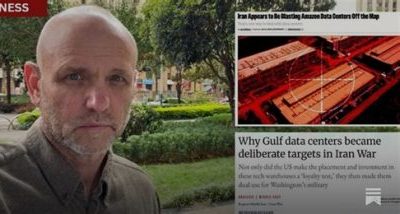
Iran spent $1 million to wipe out $30 billion in data center plans, and take down Amazon in the ME
or go to
Aletho News Archives – Video-Images
From the Archives
Clash of Civilization, Iran Part II
By Jamal Kanj – Intifada-Palestine.com – January 14, 2011
Israel’s survival kit is: perpetuate conflict, insecurity to rationalize collective hate and finally playing victim.
Devoid of conflict, Israel implodes internally; without hate, Zionism loses its justification; and playing eternal victim to continue blackmailing the West. Absence of this holy trinity, Israel ceases to exist. … continue
Blog Roll
 Aletho News
- ‘We are not like everyone else’ laws that bind other nations do not apply to Israel, says Likud lawmaker
- Report: Saudi Arabia seeks allies’ assistance as missiles deplete amid war on Yemen
- Fuel Crisis Deepens: Pakistan Warns Tanker Attack in Red Sea Would Be an ‘Act of War’
- ‘Bucha massacre’ a false flag orchestrated by UK – Moscow
- China Rejects Outside Pressure on Trade Ties After New US Russia Sanctions Bill
- Houthis Keep Advancing as the Red Sea Crisis Deepens
- Iran spent $1 million to wipe out $30 billion in data center plans, and take down Amazon in the ME
- Zionist billionaire pressure to silence Macklemore sparks exodus from Ed Sheeran tour
- House Votes to End Iran War for Third Time
- North Korea Slams US Plan for ‘AUKUS 2.0’ with South Korea and Japan
- If Americans Knew
- Biden’s Genocide Accomplices Targeted by New Accountability Campaign
- AIPAC’s Network Has Already Spent $67.2 Million to Shape the Midterm Elections
- Jewish Supremacist Manufacturing a Civilizational Threat to License Bigotry
- US bans Palestinian president from speaking at the UN
- Israeli Forces Detain Journalist Alaa al-Rimawi amid Widespread West Bank Raids
- Even a pro-Israel Congress member has put a hold on 40,000 one-ton bombs to Israel
- As Gaza crumbles, Israel preps new ground invasion – Daily Update
- ‘We are not like everyone else’ laws that bind other nations do not apply to Israel, says Likud lawmaker
- Trump’s govt makes ‘treasonous’ claim of weapons shortages
- Palestinian-American Journalist Naqaa Hamed Imprisoned by Israeli Forces After Settlers Targeted Her
- No Tricks Zone
- New Study: ‘Global Drought Shows No Detectable Recent Acceleration Under Climate Warming’
- Economic Masterminds: German Socialists Suggest Taxing Productivity Gains Stemming From Using AI
- The South China Sea Has Not Been Cooperating With The Climate Change Narrative
- Energy Crisis: Germany Enters Heating Season With Historically Low Gas Reserve Fill Levels
- New Study: The Antarctic Ice Sheet Gained Mass From 2020-2024 Due To Staggering Snow And Ice Accumulation
- Study: Ocean Heating Rates From Thousands Of Years Ago ‘Dwarf’ Modern Ocean Heating Rates
- Climate Extremists Target, Attack Large-Scale Power Grid Infrastructure In Germany!
- New Study: Antarctic Ice Melt Has Contributed Less Than 1 Centimeter To Sea Level Rise In The Last 30 Years
- Fear Of Debate: Alarmist German Climate Scientist Calls On Mainstream Media To Discredit Skeptic Voices
- End-Of-August Arctic Sea Ice Extent Hasn’t Fallen In 20 Years, Official Data Show!
 Aletho News