Turkey: France’s buildup in Syria will amount to ‘invasion’
Press TV – April 8, 2018
Turkey which has deployed troops to northern Syria says if France steps up its military presence in the Arab country, it will amount to an “invasion.”
“If France takes any steps regarding its military presence in northern Syria, this would be an illegitimate step that would go against international law and in fact, it would be an invasion,” Turkish Defense Minister Nurettin Canikli said Saturday.
Turkey sent troops to the northern Syrian region of Afrin on January 20 to force out Kurdish militants, known as the People’s Protection Units (YPG), which it suspects of having ties with anti-Ankara separatists.
France, which has criticized Ankara over the offensive, operates in Syria as part of the so-called US coalition.
French President Emmanuel Macron hosted a delegation of the so-called Syrian Democratic Forces (SDF), which has the YPG as its backbone, at the Elysee Palace on March 29.
On Saturday, Turkish President Recep Tayyip Erdogan railed against Paris. “France, you are abetting terrorism, supporting it by then hosting them at the Elysee Palace,” he said.
“Especially, if they intend to support terror group elements or give direct or indirect protection with armed forces, this would be a really calamitous step,” Canikli said during a visit to the northeastern province of Giresun.
After the Paris meeting, Kurdish officials said France was planning to send new troops to the city of Manbij, also in northern Syria.
Paris has also threatened to attack Syria if it was established that Damascus had deployed chemical weapons in its military operation, an accusation strongly rejected by the Syrian government.
Turkey, which has pushed the YPG out of Afrin, has also threatened to extend its operation to Manbij, which hosts American forces.
Ankara has further locked horns with Washington on several occasions over the latter’s providing arms, training, and logistical support to the Kurds.
France Joins Syria Fight: Goals and Consequences
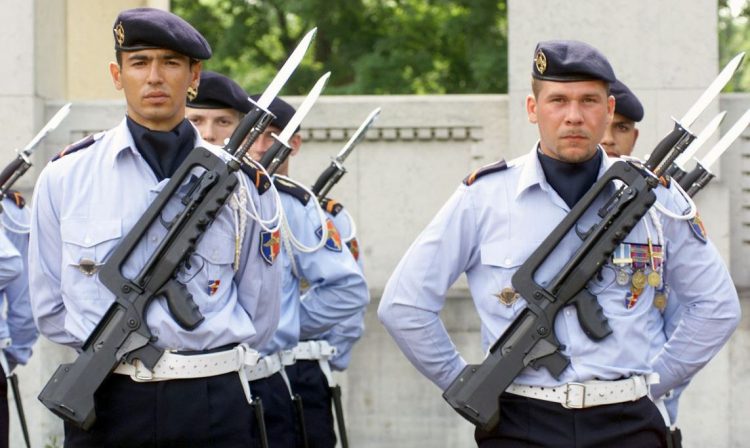
French Armed Forces, armed with FAMAS F1 assault rifles, participate in the Memorial Day ceremony at the LaFayette Escadrille Monument in Paris, France.
By Peter KORZUN | Strategic Culture Foundation | 05.04.2018
French President Emmanuel Macron kept his word. On April 1-2, French troops moved into northern Syria. This is the first time France deployed substantial forces there to turn Paris into a new actor actively involved in the war. The troops advanced toward Manbij and Remelin to join American allies and did it hastily.
The move was made at the time Ankara warned about the plans to control this territory with Russia, Turkey and Iran working together to define Syria’s future. It significantly changes the situation and makes one ask questions about the goals pursued by the US and France and the prospects for war and peace in the conflict-torn country. Summing up the recent events leads to the conclusion that the US and France have a hidden agenda to expand the conflict, wreak havoc and stymie the Russia-led peace efforts.
The news about French deployment came just before the April 4 Russia-Turkey-Iran summit in Ankara stated the goal to “speed up their efforts to ensure calm on the ground” in Syria. On April 3, US President Donald Trump said he would “decide very quickly” to remove forces from that country. The statement was made right after about 300 US Marines accompanied by armored vehicles and engineering equipment were moving toward Manbij as reinforcements to repel possible Turkish inroads. The construction of two bases in Syria’s northern Manbij region is underway.
The Marines have already launched daily patrols along the Sajur River, a tributary that feeds the Euphrates River from sources in Turkey, with observation posts built to monitor the area. This is unheard of – two leading states of the North Atlantic Alliance blocked the other NATO member’s land access to Manbij! On April 3, CNN reported that plans to send reinforcements have been discussed for several days before Trump’s remarks on leaving Syria soon.
The US also wasted no time to press Iraq into sending its 5th Army Division to Sinjar province and line the forces on the Iraqi-Syrian border to obstruct the possible advance of Turkish army from Syria into Iraq.
Obviously, the US is trying to partition Syria while creating a quasi-state on the eastern bank of the Euphrates and up to the Iraqi border. In Deir-ez-Zor, the US-led coalition resists the restoration of Syrian government institutions. It makes one think that the words about “leaving soon” may be nothing more than wishful thinking or an attempt to baffle those who are trying to predict further steps America will take.
The list of goals includes controlling the oil fields and chunks of the territory. Donald Trump wants Saudi Arabia to pay for US operations in Syria and it probably will. If the decision to leave were taken, he wouldn’t raise the question. According to the president, Saudi Arabia is interested in America staying in Syria.
That’s what the US “rocking from side to side” foreign policy is like. Rex Tillerson is fired to make the world know about it from tweets. The US wants to leave Syria but will stay if Saudi Arabia pays. Donald Trump invited the Russian leader to visit him in Washington against the background of Russia diplomats expelled and the consulate office in Seattle closed. Is it being short-sighted or far-sighted? Is this swinging back and forth a well-thought over policy or no policy at all? Is it done on purpose to keep everyone guessing with no predictions possible? You never know. Donald Trump once denounced Saudi Arabia as extremist and then sold a huge package of weapons while calling the kingdom a great friend and close ally against Iran.
The Syrian forces are preparing an offensive in the Daraa – Quneira – Suweida area in the south while denuding other fronts. The territory is huge and the terrain is hard to cross. There are at least 25 heights to fire at advancing forces from. The Free Syrian Army and other rebel groups are much more numerous than the ones being defeated in Eastern Ghuta. Their defenses are strong. Unlike in other places, the rebel forces can easily get logistical support from Jordan. That’s where the US and Saudi Arabia can contribute greatly. Israel has been involved in such activities since 2015. It took roughly six months to liberate Eastern Ghuta, with an active phase to dislodge rebel fighters launched in mid-March. It’s easy to surmise that it will take at least a year, may be much more, to liberate the area in question.
A conflict is easy to provoke. The operations of Syria’s government forces aimed at cutting off supplies coming from Jordan could be presented as an act of aggression against the Hashemite Kingdom. Chemical substances could be transported from Jordan to stage another provocation used as a pretext to attack Syria.
The operation could become a war of attrition to make Syria concentrate more and more of its forces in one place at the expense of other battlefields. They will be stuck there for a considerable period of time. That’s when the US-coalition will be in good position to attack anywhere it wants using the base of Al-Tanf as a springboard. Manbij as well as the Al-Tabka air base located to the south of Raqqa are perfect places for launching an offensive to drive Syria out from Aleppo. Then the country will plunge again into an “all-against-all” fight.
The efforts applied so far by Russia, Turkey and Syria will go down the drain. This time the US will not be alone to have substantial presence on the ground. It’s hard to imagine that the French forces arrived in Syria could be anything but the start of broader NATO presence with other members of the bloc to follow the French example. Russian military personnel and NATO soldiers will be looking at each other through the sights of guns. This scenario will be fraught with a great risk of international military conflict and a real tragedy for Syrian people but those who are provoking it don’t care.
Trump challenges the Russian-Turkish-Iranian alliance
By M.K. Bhadrakumar | Asia Times | April 5, 2018
Three is company. But if the trilateral dialogue format in international diplomacy seldom produces concrete results, that is because it cannot be sequestered from external influences. Besides, the three participants are bound to have specific interests and priorities. The long-awaited Turkey-Russia-Iran trilateral summit in Ankara on April 4 has been no exception.
The summit didn’t end as a damp squib but its outcome has been measly. Three reasons can be attributed to this. First and foremost, the US President Donald Trump might have been responsible.
The Ankara summit’s main agenda was Syria, but Trump’s “very-soon” remark in Ohio last Thursday introduced a strategic ambiguity into the Syrian situation. And he deepened the ambiguity further on the eve of the summit by stating on Tuesday at a meeting at the White House that he wanted to immediately withdraw US forces from the war-torn country, arguing that the US had already won the battle against the Islamic State.
Trump said, “I want to get out — I want to bring our troops back home. It’s time. We were very successful against ISIS.” Trump literally barged into the Istanbul tent and hijacked the mind of the three presidents.
What is the Syria that Erdogan, Putin and Rouhani would discuss – a Syria with open-ended US military presence or a Syria denuded of the Americans? That is now the big question.
Pentagon and White House split on what to do?
Even then, it is very unclear whether Trump himself is free to make up his mind. A former British ambassador to Syria Peter Ford framed the paradigm this way: “I have a feeling that there are divided counsels within the Pentagon, definitely in the White House (regarding US troop removal from Syria). Trump sincerely wants to get out since it’s what he campaigned on, but whether he’ll be allowed to by elements of the ‘deep state’ is the question.”
The good thing is that there could be elements within the Pentagon who too aren’t necessarily happy about an open-ended military presence in Syria without a clear-cut objective. The military mind cannot focus well when there are gnawing doubts.
Second, the disclosure (by the Kremlin first) that Trump has invited Putin to the White House has opened a vista of new possibilities. What if a joint Russian-American peace initiative in Syria gets revived? Trump now becomes a “stakeholder” in a Syrian settlement.
On the contrary, if the trilateral Russian-Turkish-Iranian dialogue on Syria (known as the Astana process) has gravitas today, it is mainly due to the Trump administration’s retrenchment from the Syrian peace process. The dalliance that the Obama administration (secretary of state John Kelly) kept going with the Kremlin (foreign minister Sergey Lavrov) has petered out and what remains today is the military-to-military “deconfliction” mechanism between the US and Russia to ensure that they don’t shoot at each other in Syria.
But, if Trump and Putin breathe new life into a Russian-American joint enterprise to choreograph a Syrian settlement, the Astana process gets relegated to the backburner. Participants at the Ankara summit agreed to hold the next meeting in Astana in mid-May, but much water might flow under the bridge by then.
Decision on Iran deal due by May 12
Third and finally, the fate of the Joint Comprehensive Plan of Action (JCPOA) remains the “known unknown.” Trump is due to make a decision on the Iran nuclear deal by May 12. And the geopolitics of the Middle East could change dramatically, depending on what he decides to do – especially if Trump were to pull the US out of the JCPOA.
The conventional wisdom is that changes at the US State Department and the National Security Council presage a more hawkish US foreign policy toward Iran. But there are weighty arguments too as to why Trump may not sound the death knell of the JCPOA and opt instead to simply give the nuclear deal a fresh lease of life, as he has done twice already.
To be sure, depending on the state of play in US-Iranian relations, the geopolitics of the Middle East could change and Syria is the theatre where this could see visible impacts in the near-term. So it was notable that Iranian President Hassan Rouhani didn’t go for Trump’s jugular at the Ankara summit. Iran also refrained from pushing any fresh initiatives and seemed more or less happy with a passive role – biding its time and brooding, as it were.
Given the above, what did the summit actually achieve? For a start, trilateral dialogue is always primarily a statement. What emerges from yesterday’s summit on the Bosporus is that the western influence in Syria (and the Levant) is inexorably on the wane. The summit underscored that the three countries intend to reinforce their influence in Syria.
Having said that, while the summit flagged the intention of the three countries to deepen cooperation, they also have divergent goals. For instance, the Turkish priority was that Russia and Iran continued to acquiesce with its military operation. Erdogan stated at the joint press conference, “Turkey will not stop until all regions under PYD/PKK (Kurdish militia) control, including Manbij, are secured… Turkey values Russia and Iran’s solidarity with its Afrin operation, we will establish grounds for peace in Afrin.” Rouhani and Russian President Vladimir Putin neither nodded agreement nor dissented.
The single most important outcome of the summit where all three countries have shared interest is in their forceful affirmation of the unity and territorial integrity of Syria and their rejection of “all attempts to create new realities on the ground under the pretext of combatting terrorism.”
The bottom line is that Russia, Turkey and Iran have a strong convergence of interests in the termination of the US military presence in Syria. Paradoxically, here again the Trump factor comes in. Their brittle alliance faces an existential threat if Trump somehow realizes his dream of bringing the US troops in Syria back home “where they belong.”
Raqqa’s Militia Attacks US Coalition Base in Northern Syria
Sputnik | April 2, 2018
DAMASCUS – The militia of the Syrian city of Raqqa fired mortars on the US-led coalition base in the town of Ayn Issa, the press service of the movement said on Monday.
“Following the intelligence activities, the militia of Raqqa waged a special operation targeting the US Staff located at the former base of the 93rd Brigade in the district of Ayn Issa, 43 miles north of Raqqa. Several mortar shells were fired on individual targets without any casualties on our side,” the statement said.
The militia noted that they do not tolerate “the occupational forces” of the United States, Turkey, and their allies in northern Syria.
The statement read: “Do not relax night and day, wherever you are.”
On March 25, the indigenous Arab population launched an uprising against armed groups supported by the United States in the town of Al-Mansura in the suburbs of Syria’s Raqqa, opposing a forced mobilization conducted by the Syrian Democratic Forces and local self-governing bodies appointed by the United States. The uprising came as result of a 4-year-long military campaign, carried out by the United States and its allies against Daesh in Syria, without the approval of either the Syrian official government, nor the United Nations.
Last October, the coalition drove Daesh out of Raqqa that had been previously served as the de facto capital of the terrorist group’s self-declared caliphate. According to the United Nations, the humanitarian situation in the city is disastrous and the infrastructure is completely destroyed.
READ MORE:
Violent Clashes Between US-Backed Kurds and Locals Reported in Raqqa
‘NATO Member is at War With Another One’ – Analyst on Turkey-France Relations
Sputnik – March 31, 2018
According to the French media, French president Emmanuel Macron is planning to deploy troops to Syria’s Manbij to help local Kurds in resisting Turkish forces. The move has reportedly been coordinated with Washington. Sputnik discussed relations between France and Turkey with Gearóid Ó Colmáin, Paris-based geopolitical analyst and journalist.
Sputnik: What can you say about the conversation between the Turkish and the French presidents? It seems that there is quite a bit of disagreement. Do you think that there are issues other than cooperation with the SDF that they are in disagreement about when it comes to Syria?
Gearóid Ó Colmáin: If you look at the history of French-Turkish relations even going back to the sixteenth century, France generally used the Ottoman Empire as a stick with which to beat the central European powers, the Habsburgs in the sixteenth century and later — Austria. I think French policy towards Turkey in the current context is similar with important differences in sense that France sees Turkey as an emerging imperial power and as a rival. It is probably one of the reasons for France’s hostility towards Turkey’s entry into European Union, because the Turkish military is extremely powerful, it’s reputed to be even more powerful than the French military and the French want military dominance in the European Union context.
That’s one tension between France and Turkey, and with respect to the Kurdish problem, the US is supporting the YPG forces, which are linked to the PKK [Kurdistan Workers’ Party] in Turkey, so, from the Turkish perspective, it is a national security threat to have a buffer state, develop in northern Syria, which will have access to the eastern Mediterranean. But the western side of the NATO coalition clearly wants that to happen. That has been the case throughout the war. The have supported the Kurds and that has been to the chagrin of the Turks. We now have a situation whereby Turkey is at war with France, effectively over the Kurdish issue. It is a proxy war. The French recently, in the mold of Francois Hollande, the former French president, accused Russia of allowing Turkey to enter Northern Syria in order to weaken and divide NATO. The French and the Americans are clearly concerned about Turkey’s rapprochement with Russia, its recent agreement to cooperate with Russia.
So Turkey is kind of in a difficult position right now — on the one hand it’s cooperating with Russia, on the other hand it’s NATO member who is effectively at war with another NATO member, i.e. France and possibly the US. We don’t know what the United States really means, what Trump really means, when he says the US is going to pull out of Syria. They reportedly have 20 military bases in the country right now. […] It looks like the French are taking over, or at least offering to take over, where the Americans are leaving off.
Sputnik: So that was the gist perhaps of Trump’s statement saying that “We’re going to be leaving Syria very very soon and let the other people take care of it.” Do you think France was intended as “the other people”?
Gearóid Ó Colmáin: It looks to me to be the case. The French are clearly pursuing US policy in Syria and have been from the very start of the war. They don’t have an independent policy in the Middle East and haven’t had an independent policy since Chirac. France is clearly working on behalf of the United States and I think that will be my reading of it right now.
Sputnik: Does France have any of its own interests in the Syrian conflict? Other than what is dictated by American policy.
Gearóid Ó Colmáin: France was traditionally the protector of Christians in the Middle East. That was the case in Lebanon, but it hasn’t been the case for a long time. France hasn’t protected anyone in this war. They have been supporting terrorism from the very start. Now not only have they been supporting terrorism against the Syrian state. […] But now they are being accused by their cohorts in terrorism, i.e. Turkey of supporting terrorism against them. France has really been in a mess since this war began. […]
Sputnik: The proposal was already declined by Ankara. They said that those who cooperate with terror groups against Turkey will become a target for Turkey. How is that going to impact Turkey’s relations with France and the EU in general?
Gearóid Ó Colmáin: Turkey has already threatened the EU on several occasions — last year, year before Turkey threatened to unleash an avalanche of migrants on Europe, to intensify the migrant crisis in Europe, if the EU would not concede to their demands, regarding funding and accession conditions [to the EU]. Turkey has already basically threatened Europe with coercive engineered migration, as a form of warfare, if the European Union doesn’t fully cooperate with Turkey’s demands. That is something that you could see escalating.
READ MORE:
France Deploys Military Forces to Assist Kurdish Militants in Manbij — Reports
Erdogan ‘Saddened’ by Macron’s ‘Wrong Stance’ as France Deploys Forces to Manbij
Scramble for Syria opens up disturbing scenarios
By M K Bhadrakumar | Indian Punchline | March 20, 2018
The US State Department issued a strong statement on March 19 following the fall of Afrin, the Kurdish city in northwestern Syria to the Turkish forces. The statement is highly critical of Turkey’s military operation in Afrin. It expresses concern over the humanitarian situation and of looting in Afrin by the occupation forces. Importantly, it alleges once again that the Turkish operation “has distracted from the ‘Defeat ISIS’ campaign and provided opportunity for ISIS to begin reconstituting in some areas. This is a serious and growing concern.”
The statement can be seen as an expression of sympathy toward the Kurds who suffered a crushing defeat in Afrin. This is the least that Washington could do to salvage its reputation among the Kurds. The US claims that it “does not operate in the area of northwest Syria, where Afrin is located. We remain committed to our NATO ally Turkey, to include their legitimate security concerns.” But Turkish President Recep Erdogan has contradicted the US stance of non-involvement in Afrin. He now alleges that the US tried to “deceive” Turkey. Erdogan said today in Ankara at a meeting of the ruling party,
- “If we are strategic partners, you (US) will have to respect us and move along with us. You tried to deceive us. You sent 5,000 trucks of weapons there. You sent more than 2,000 trucks of ammunition there. We wanted weapons from you to buy with our money, but you did not give any to us. What kind of a strategic partnership or solidarity is this?”
- “The U.S. spokesperson makes a comment and says, ‘We are concerned about the situation in Afrin.’ Where were you when we transmitted our concerns to you? Where were you when we said ‘let’s clean the terrorist organization from there?”
It is apparent that Washington is indulging in doublespeak. At any rate, Washington’s priority at the moment will be to pile pressure on Turkey over the chaotic situation in Afrin (which was captured by Turkish forces on March 18) and, in reality, to somehow dissuade Erdogan from extending the military operation to the northeastern region (east of Afrin), which are under the control of the Kurdish militia and the US forces.
Erdogan is keeping the Americans on tenterhooks as regards his next move. He asserted on Monday that Turkish troops would indeed press eastward, targeting territory where US forces are stationed, all the way into Iraq’s Sinjar Mountains. There is no reason to disbelieve him. The point is, there is massive popular support in Turkey for Erdogan’s muscular policy towards the Kurds – and for standing up to the US. In political terms, Erdogan can hope to exploit the wave of nationalism sweeping Turkey. The parliamentary and presidential elections are due next year in Turkey.
Unsurprisingly, Moscow and Tehran have kept quiet and left the field to Turkey and the US to throw brickbats at each other. They have reason to be pleased that the US is unable to protect the Kurdish militia, its key ally in Syria, from the Turkish assault. Besides, they are able to press ahead with their own operations against the extremist forces (that used to be previously aligned with the US and Turkey) in Ghouta in eastern Damascus and Idlib province in the extreme northwest.
Evidently, from the Russian and Iranian perspective, Erdogan is doing a magnificent job by undermining the US strategy in Syria to maintain an open-ended military presence. The Kurdish militia who are having an existential fight on their hands with the Turkish military are not going to be in a position to be the US’ proxies for very long.
On the other hand, Russia and Iran also remain wary of Turkey’s intentions, especially a Turkish attempt to create a ‘buffer zone’ in northern Syria. As it is, the US has carved out a huge swathe of land in northern Syria east of Euphrates, which comprises some of Syria’s best agricultural lands and water resources and over half of Syria’s entire oil and gas fields. (A trilateral Turkish-Russian-Iranian presidential summit is due to take place in Istanbul on April 4.)
Another complicating factor is that Russia has its own interests to pursue vis-à-vis Turkey and the Kurds. Then, there is also the overarching US-Russia competition to placate Turkey. All in all, the Syrian war is not ending as many observers had earlier envisaged, but is actually mutating into new forms. Read an insightful interview, here, with a leading expert on Syria, Professor Joshua Landis, Director of the Centre for Middle East Studies at the University of Oklahoma.
Same Old: Notorious White Helmets Report a Chemical Attack, Blame Damascus Again
Sputnik – February 26, 2108
An infamous NGO that was repeatedly accused of falsifying information about its operations and essentially working as a propaganda outlet for anti-government militants in Syria, now claims that Damascus deployed chemical weapons in Eastern Ghouta.
The notorious White Helmets group claims that the Syrian government deployed chlorine gas against the town of Al-Shifoniya town in Eastern Ghouta, killing one child and causing “widespread suffocation” among the local civilians, Anadolu Agency reports.
The White Helmets, a group that styles itself as an NGO seeking to ease the plight of civilians in Syria suffering from the ongoing conflict in the country, has previously been accused of falsifying information about its work in Syria and staging “rescue” attempts in its propaganda videos.
Earlier the Russian Defense Ministry warned that militant groups in Eastern Ghouta were preparing a false flag attack in an attempt to blame Damascus for using chemical weapons against civilians.
“Evidence has shown that the leaders of illegal armed formations in Eastern Ghouta are preparing a provocation using poisonous agents in order to accuse the government forces of using chemical weapons against its civilians,” a statement issued by the ministry said.
The Arabic-language news channel al-Manar, citing al-Ikhbariya, has also reported that White Helmets were distributing protective masks in Eastern Ghouta in preparation for a new plot to blame another chemical attack on the Syrian government, while the Russian center for Syrian Reconciliation’s representative said they were tipped by a resident of Idlib province about Nusra Front militants delivering “more than 20 bottles of chlorine and personal protective equipment in three cars” for an upcoming provocation.
As Syria’s Information Minister Imad Sarah told Sputnik, while Syrian armed forces and their allies battle terrorist groups in the field, it is equally important to counter the efforts of groups seeking to distort facts and to mislead the international community about the real state of affairs in the country — “to refute endless fake reports that mangle the actual state of affairs in the country and play with terms,” as he put it.
The minister also remarked that members of the White Helmets have been awarded for their exceptional action, which says a lot about the scale of the conspiracy against Syria and its people.
Syria has repeatedly denied allegations of chemical weapons use, underscoring that it had no weapons of mass destruction, which was confirmed by the Organization for the Prohibition of Chemical Weapons (OPCW).
On April 4, 2017, the National Coalition for Syrian Revolutionary and Opposition Forces, supported by the United States, accused Damascus of the Khan Sheikhoun incident in Idlib province, which that left 80 people dead and 200 injured. Western governments blamed Bashar al-Assad for being responsible for the use of Sarin gas, an allegation he has firmly denied.
Moscow, in turn, also demanded a thorough investigation of the incident.
READ MORE:
French President Macron Threatens to Strike Syria if Chemical Attacks Proven
UN Can’t Verify Claims of Chemical Attacks in Syria ‘Independently’ – De Mistura
Featured Video
Houthis Keep Advancing as the Red Sea Crisis Deepens
or go to
Aletho News Archives – Video-Images
From the Archives
Clash of Civilization, Iran Part II
By Jamal Kanj – Intifada-Palestine.com – January 14, 2011
Israel’s survival kit is: perpetuate conflict, insecurity to rationalize collective hate and finally playing victim.
Devoid of conflict, Israel implodes internally; without hate, Zionism loses its justification; and playing eternal victim to continue blackmailing the West. Absence of this holy trinity, Israel ceases to exist. … continue
Blog Roll
 Aletho News
- ‘We are not like everyone else’ laws that bind other nations do not apply to Israel, says Likud lawmaker
- Report: Saudi Arabia seeks allies’ assistance as missiles deplete amid war on Yemen
- Fuel Crisis Deepens: Pakistan Warns Tanker Attack in Red Sea Would Be an ‘Act of War’
- ‘Bucha massacre’ a false flag orchestrated by UK – Moscow
- China Rejects Outside Pressure on Trade Ties After New US Russia Sanctions Bill
- Houthis Keep Advancing as the Red Sea Crisis Deepens
- Iran spent $1 million to wipe out $30 billion in data center plans, and take down Amazon in the ME
- Zionist billionaire pressure to silence Macklemore sparks exodus from Ed Sheeran tour
- House Votes to End Iran War for Third Time
- North Korea Slams US Plan for ‘AUKUS 2.0’ with South Korea and Japan
- If Americans Knew
- Biden’s Genocide Accomplices Targeted by New Accountability Campaign
- AIPAC’s Network Has Already Spent $67.2 Million to Shape the Midterm Elections
- Jewish Supremacist Manufacturing a Civilizational Threat to License Bigotry
- US bans Palestinian president from speaking at the UN
- Israeli Forces Detain Journalist Alaa al-Rimawi amid Widespread West Bank Raids
- Even a pro-Israel Congress member has put a hold on 40,000 one-ton bombs to Israel
- As Gaza crumbles, Israel preps new ground invasion – Daily Update
- ‘We are not like everyone else’ laws that bind other nations do not apply to Israel, says Likud lawmaker
- Trump’s govt makes ‘treasonous’ claim of weapons shortages
- Palestinian-American Journalist Naqaa Hamed Imprisoned by Israeli Forces After Settlers Targeted Her
- No Tricks Zone
- New Study: ‘Global Drought Shows No Detectable Recent Acceleration Under Climate Warming’
- Economic Masterminds: German Socialists Suggest Taxing Productivity Gains Stemming From Using AI
- The South China Sea Has Not Been Cooperating With The Climate Change Narrative
- Energy Crisis: Germany Enters Heating Season With Historically Low Gas Reserve Fill Levels
- New Study: The Antarctic Ice Sheet Gained Mass From 2020-2024 Due To Staggering Snow And Ice Accumulation
- Study: Ocean Heating Rates From Thousands Of Years Ago ‘Dwarf’ Modern Ocean Heating Rates
- Climate Extremists Target, Attack Large-Scale Power Grid Infrastructure In Germany!
- New Study: Antarctic Ice Melt Has Contributed Less Than 1 Centimeter To Sea Level Rise In The Last 30 Years
- Fear Of Debate: Alarmist German Climate Scientist Calls On Mainstream Media To Discredit Skeptic Voices
- End-Of-August Arctic Sea Ice Extent Hasn’t Fallen In 20 Years, Official Data Show!
 Aletho News