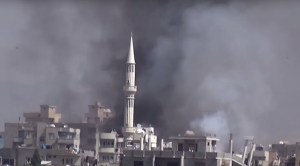
 A total of 6,320 houses have been destroyed in five Turkish southeastern districts during an operation against the Kurdistan Workers’ Party (PKK), Turkish Deputy Prime Minister Numan Kurtulmus said Monday.
Kurtulmus said at a briefing that the number of destroyed houses in the areas of Sur, Silopi, Cizre, Idil and Yuksekova amounts to 6,320.
“It is about 11,000 flats. The projected cost of restoration of these buildings is about 855 million Turkish liras [$294 million],” He said.
Tensions between Ankara and the Kurds escalated in July 2015 as fighting between the PKK, considered to be terrorist by Ankara, and the Turkish army resumed. Ankara has imposed several round-the-clock curfews in Kurdish-populated towns, preventing civilians from fleeing the regions where the military operations are taking place.
Turkish President Recep Tayyip Erdogan alleges over 5,000 Kurdish insurgents have been killed in the campaign since mid-December, a figure that pro-Kurdish officials contend includes hundreds of civilians.
May 30, 2016
Posted by aletho |
Militarism, Subjugation - Torture | Turkey |
Leave a comment
Head of the Russian General Staff told journalists that trucks carrying weapons for the al-Nusra Front cross from Turkey into Syria daily. This allows the terrorist group to continue attacking local targets.
Lt. Gen. Sergey Rudskoy said in his press briefing on Friday that weapons and ammunition are continuously being delivered to the al-Nusra Front terrorists in Syria, allowing them to engage Syrian government forces and hindering the fight against Daesh in the country.
“The never-ending flow of large trucks from Turkey carrying weapons and ammunition crosses the Turkish-Syrian border. This constant feed of live forces and weapons allows terrorists from the Nusra Front to continue their provocative shelling and make advances on Syrian government forces, which diminishes [government military] activity against Islamic State terrorists in other areas,” Rudskoy said during a briefing.
Rudskoy also added that the US has acknowledged that the heaviest fighting is centered around areas where the al-Qaeda affiliated al-Nusra Front is most active.
“Everyone knows, and our US partners admit that the biggest hot spots of active military operations are those parts of the Syrian Republic where the al-Qaeda-affiliated terrorists from the al-Nusra Front run rampant.”
So far, according to Rudskoy, the US has refused to conduct joint operations against terrorist groups in Syria, which has led to an escalation of the conflict.
The al-Nusra Front terrorist group hampers the ceasefire efforts in northern areas of Syria, the Russian General Staff said Friday.
“It is very clear that the terrorist group Jabhat al-Nusra, active in the regions of Aleppo and Idlib, is the main obstacle to expanding the ceasefire regime to northern areas of Syria,” Sergey Rudskoy, chief of the Main Operational Directorate of the Russian General Staff, said.
Moreover, the Al-Nusra Front has used the ‘period of silence’ to partly restore its combat capability. Rudskoy told reporters.
Earlier, Russian Defense Minister Sergey Shoigu offered to conduct joint air strikes against terrorist groups in Syria, but the Pentagon declined the offer. However, The Russian Foreign Affairs Ministry says Moscow hasn’t ruled out a possible joint operation in the future.
May 27, 2016
Posted by aletho |
Deception, Militarism, War Crimes | al-Nusra Front, Syria, Turkey, United States |
Leave a comment
There is a simple explanation why Washington refuses to proscribe the militant groups Jaysh al-Islam and Ahrar al-Sham as terrorist. Because Washington relies on them for regime change in Syria.
Therefore, Washington and its Western and Middle East allies cannot possibly designate Jaysh al-Islam and Ahrar al-Sham as terrorist; otherwise it would be a self-indicting admission that the war in Syria is a foreign state-sponsored terrorist assault on a sovereign country.
This criminal conspiracy is understood by many observers as an accurate description of the five-year Syrian conflict and how it originated. Syria fits into the mold of US-led regime change wars in the Middle East and elsewhere. However, Washington and its allies, assisted by the Western corporate news media, have maintained a fictitious alternative narrative on Syria, claiming the war is an insurgency by a pro-democracy rebel movement.
That narrative has strained credulity over the years as the putative “secular rebels” have either vanished or turned out to be indistinguishable from extremist groups like al-Qaeda-linked Jabhat al-Nusra and so-called Islamic State (also known as Daesh).
Washington asserts that it only supports “moderate, secular rebels” of the Free Syrian Army. British Prime Minister David Cameron has claimed that there are 70,000 such “moderate rebels” fighting in Syria against the government of President Bashar al-Assad. But no-one can locate these supposed pro-democracy warriors.
All that can be seen is that the fight against the Syrian government is being waged by self-professed extremist jihadists who have no intention of establishing “democracy”. Instead, they explicitly want to carve out an Islamic state dominated by draconian Sharia law.
In addition to Jabhat al-Nusra and Daesh, the two other major militant groups, Jaish al-Islam and Ahrar al-Sham, are vehemently committed to forming a Caliphate based on Salafi or Wahhabi ideology. That ideology views all other religious faiths, including moderate Sunni Muslims, as well as Shia and Alawites, as “infidels” fit to be persecuted until death.
Leaders of both Jaysh and Ahrar have publicly declared their repudiation of democracy.
Yet these two groups are nominated as the Syrian “opposition” in the Geneva talks, as part of the High Negotiations Committee (HNC). The HNC was cobbled together at a summit held in the Saudi capital Riyadh in December ahead of the anticipated negotiations to find a Syrian political settlement.
The HNC is endorsed by Washington as official representatives of the Syrian opposition. It is supported by Saudi Arabia, or indeed more accurately, orchestrated by the Saudi rulers since the main components of the HNC are Jaysh al-Islam and Ahrar al-Sham. Other major sponsors of the militant groups are Qatar and Turkey.
Staffan de Mistura, the UN envoy to Syria, also plays an important part in the charade of furnishing an opposition composed of extremists who demand the Syrian government must stand down as a precondition for talks. This maximalist position is one of the main reasons why the negotiations have come unstuck, according to Russian Foreign Minister Sergey Lavrov.
Another basic reason is that the HNC members have been involved in breaching the cessation of violence the US and Russia brokered on February 27, as a confidence-building measure to assist the talks process in Geneva.
That Jaysh al-Islam and Ahrar al-Sham have not observed the shaky ceasefire is a corollary of the fact that both groups are integrated with al-Qaeda-affiliated terror organizations, al Nusra and Daesh, which are internationally designated terrorist organizations.
The UN excluded al-Qaeda franchises from the ceasefire when it passed Security Council Resolution 2254 in December to mandate the purported Syrian peace talks. In that way, Syria and its foreign allies, Russia, Iran and Lebanon’s Hezbollah, have been legally entitled to continue offensive operations against the extremists in parallel to the Geneva process.
The offensive on the terror groups should include HNC members Jaysh and Ahrar. Both groups have publicly admitted to fighting alongside both Nusra and Daesh in their campaign against the Syrian army. All of these organizations have been involved at various times in bloody feuds and turf wars. Nevertheless, they are at other times self-declared collaborators.
Jaysh al-Islam and Ahrar al-Sham are also well-documented to having engaged in massacres and barbarities as vile as the other higher profile terror outfits.
Only last week, Ahrar al-Sham was responsible for the massacre of women and children in the village of Al-Zahraa, near Aleppo, according to survivors. The group has carried out countless no-warning car bombings in civilians neighborhoods. It claimed responsibility for a bombing outside the Russian base at Idlib earlier this year, which killed dozens.
Jaysh al-Islam has publicly admitted using chemical weapons against Kurdish civilians in recent weeks, also near Aleppo, Syria’s second city after the capital Damascus, and currently the key battleground in the whole conflict.
The same jihadist militia is allegedly linked to the chemical weapon atrocity in August 2013 in the Damascus suburb of East Ghouta, when hundreds of civilians, including children, were apparently killed from exposure to Sarin gas. That attack was initially blamed on Syrian government forces and it nearly prompted the Obama administration to order direct military intervention on the pretext that a “red line” was crossed. Until that is, Moscow steered a ground-breaking deal to decommission chemical weapons held by the Syrian state. It later transpired that the more likely culprit for the East Ghouta atrocity was the Jaysh al-Islam militants.
A former commander of the group, Zahran Alloush, once declared that he would “cleanse” all Shia, Alawites and other infidels from the Levant. Many Syrian civilians later rejoiced when the “terrorist boss” – their words – was killed in a Syrian air force strike on December 25. Notably, Saudi Arabia and Turkey vehemently protested over Alloush’s death.
It is irrefutable from both their actions and self-declarations that Jaysh al-Islam and Ahrar al-Sham are by any definition terrorist groups. Certainly, Russia and Iran have officially listed both as such.
But not so Washington and its allies. Earlier this month, a Russian proposal at the UN Security Council to proscribe Jaysh and Ahrar was blocked by the US, Britain and France. An American spokesperson told the AFP news agency that it rejected the Russian motion because it feared the tentative Syrian ceasefire would collapse entirely. This is an unwitting US admission about who the main fighting forces in the Syrian “rebellion” are.
This week US Secretary of State John Kerry made an extraordinary claim which, as usual, went unnoticed in the Western media. Kerry said the US “still has leverage in Syria” because if the Syrian government does not accept Washington’s demands for political transition then the country would face years of more war.
Kerry’s confidence in threatening a war of attrition on Syria is based on the fact that the main terror groups are directly or indirectly controlled by Washington and its regional allies in Saudi Arabia and Turkey.
Jaysh al-Islam and Ahrar al-Sham are essential to the terror front that gives Washington its leverage in Syria. But the charade must be kept covered with the preposterous denial that these groups are not terrorists.
May 21, 2016
Posted by aletho |
Illegal Occupation, War Crimes | Ahrar al Sham, Da’esh, France, HNC, Jaysh al-Islam, Qatar, Saudi Arabia, Syria, Turkey, UK, United States |
Leave a comment
The Turkish parliament has approved a bill allowing its lawmakers to be prosecuted. The third and final vote on the matter was a secret ballot on Friday, with 376 MPs out of 550 voting in favor of the lifting of immunity from prosecution.
The bill garnered enough support to go directly to implementation, avoiding a referendum.
The government of President Recep Tayyip Erdogan, in the midst of a crackdown on free speech and the press, is apparently turning on its own lawmakers for their alleged “support of terrorism,” which implies members of the People’s Democratic Party (HDP) in particular, and their views on Kurdish groups.
One of the MPs who could soon find themselves in hot water is Eren Erdem of the Republican People’s Party (CHP). Currently under investigation for treason, his crime was to allege that the government allowed Islamic State (IS, formerly ISIS/ISIL) terrorists to deliver deadly sarin gas through its territory and on to Syria.
“Chemical weapon materials were brought to Turkey and put together in ISIS camps in Syria, which was known as the Iraqi Al-Qaeda at that time,” Erdem told RT in an exclusive in December.
All 316 lawmakers from Turkey’s ruling Justice and Development Party (AKP) reportedly signed the proposal.
Prime Minister Ahmet Davutoglu did not hold back, claiming the measure is aimed at “so-called lawmakers who lend support to terror and terrorists,” in an apparent reference to HDP members.
The Kurdish population in the southeast of Turkey is facing a crackdown by the country’s military, as Erdogan’s government considers the territory a haven for the militants of the Kurdistan Workers Party (PKK).
Despite the fact that Kurdish groups are engaged in a fight against Islamic State in northern Syria, Ankara likes them no better than the terrorists. Its current military campaign against the ethnic group striving for independence began in mid-2015, ending a two-year ceasefire in a conflict that claimed over 40,000 lives since it began in 1984.
Press TV – May 20, 2016
Turkey’s parliament has approved a government-backed bill which would strip lawmakers of their immunity from prosecution in a move which critics say targets Kurds and dissidents.
In a secret ballot, 373 MPs in the 550-seat parliament voted for the bill on Friday with a quorum which is sufficient to avoid a referendum on the issue.
The lawmakers were also set to hold two further votes on elements of the bill later in the day, which will determine the final outcome.
Under the Turkish law, members of parliament are immune from prosecution while in office. The police can file “dossiers” against politicians, which can lead to a legal process once they cease to be members of parliament.
The new law will authorize prosecutors to pursue the MPs who currently face investigation; 138 deputies, of whom 101 are from the HDP and main opposition Republican People’s Party (CHP).
The bill had already led to unprecedented scenes at the Parliamentary Constitutional Committee, with angry legislators exchanging fist and feet blows.
The pro-Kurdish People’s Democratic Party (HDP) says the legislation is essentially a move to drive its MPs out of the parliament.
The HDP said the bill could lead to the prosecution of 50 HDP legislators out of its total contingent of 59.
Erdogan has called for the prosecution of HDP members, accusing them of being affiliated to the Kurdistan Workers’ Party (PKK) militant group.
Should a number of HDP lawmakers leave the parliament, it would ease the way for Erdogan to push for his bid to change the constitution and create a presidential system in Turkey.
Tensions have been on the rise between the Turkish government and PKK militants over the military’s campaign in several regions with a majority Kurdish population in the past few months, following a number of deadly bombing attacks in the country last year.
May 20, 2016
Posted by aletho |
Civil Liberties, Full Spectrum Dominance | Human rights, Turkey |
Leave a comment
Turkish prosecutors have demanded two aggravated life sentences for a Greek airman who allegedly shot down a Turkish jet over the Aegean Sea in 1996. They also requested cooperation from Greece in launching legal action against the pilot.
Greek pilot Thanos Grivas was charged by Turkish prosecutors with “voluntary manslaughter,” “actions for weakening the independence of the state” and “vandalizing the jet,” the Hurriyet Daily reports, citing the indictment.
The charges were based on an incident that occurred in October 1996 and was referred to as a dogfight and aircraft accident in the legal documents. At that time, a Turkish F-16 fighter jet crashed to the south of the Greek island of Chios after an encounter with a Greek Mirage 2000 aircraft. The Turkish jet’s pilot, Captain Nail Erdogan, died in the incident while co-pilot Osman Cicekli was rescued.
The Turkish authorities now claim that Grivas deliberately shot down the F-16. Turkey opened a probe into the incident after the family and lawyer of the Turkish pilot who died in the crash addressed the Greek authorities, asking them to initiate legal proceedings against the Greek airman.
Ankara Public Prosecutor’s Office made an inquiry into the case by analyzing the radar data and conversation records from the two jets obtained from the Turkish General Staff. The Turkish jet’s co-pilot, Cicekli, also gave testimony and filed his own complaint against the Greek pilot.
“It was determined that the jet caught fire and crashed by burning when conversation records of the pilots and radar were examined. In the testimony, Lt. Col. Çiçekli said they were shot down by a missile fired from one of the jets without motive in international airspace,” Hurriyet reports, citing Turkish authorities.
Meanwhile, the lawyer for Erdogan family, Mehmet Emin Keles, said that the trial would be held in Turkey if Greece does not take action, citing a judicial assistance agreement between Greece and Turkey.
The Greek Council of Appeals Court rejected Turkey’s request concerning the pilot, Greece’s Kathimerini Daily reports. Athens also denies the downing of the jet, and says that Turkish pilot reported a control failure. It also claims that the jet violated Greece’s airspace because one of the Turkish pilots was rescued in the Greek flight information region, RIA Novosti reports.
Turkey initiated legal proceedings against the Greek pilot during a period of increasingly tense relations between the two countries, which follows a series of Greek airspace violations by Turkish fighter jets.
In April, Athens News Agency reported at least three incidents of Turkish jets entering Greek airspace without “submitting a flight plan.” Similar incidents were recorded in February with up to 14 Turkish fighter jets entering Greek airspace at once.
When a Turkish jet downed a Russian Su-24 bomber over the Syrian border on November 24, 2015, Turkey did not raise the question of the responsibility of its pilot for actions that led to the destruction of the Russian aircraft and the death of its pilot.
Turkey has repeatedly claimed that it has nothing to apologize for, and has tried to shift the blame for the incident onto Russia by claiming that the bomber violated Turkish airspace – although it has never able to prove these allegations.
Moscow denies any violation of Turkish airspace and has demanded that Ankara arrest Turkish ultranationalist Alparslan Celik, who bragged about killing the pilot of the Su-24 downed by the Turkish Air Force.
This demand was also ignored by Turkey while Celik continued to give interviews and travel freely in Turkey and across the border into Syria. He was eventually arrested by Turkish authorities on unrelated charges on March 31. However, on May 10, the charges against him were dropped due to insufficient evidence.
The incident with the downing of the Russian bomber soured relations between the two countries, with Russia subsequently imposing sanctions against Turkey and suspending the visa-free regime, as well as introducing an embargo on a number of Turkish goods.
Read more:
Tsipras blasts ‘mercurial’ Turkish pilots & air defense budgets amid ground refugee crisis
Russia demands arrest of Su-24 pilot’s murderer who gave interview to Turkish media
Turkish prosecutor drops charges against alleged killer of Russian pilot
May 18, 2016
Posted by aletho |
Militarism | Turkey |
Leave a comment
KIEV – Ukraine and Turkey have signed on Monday a military cooperation plan, Ukrainian General Staff said.
“Taking into account the geopolitical situation in the Black Sea region, we are continuing to develop military cooperation with Turkey as a Ukrainian strategic partner. In recent time the cooperation between Ankara and Kiev gained additional weight. Today Ukrainian and Turkish Armed Forces signed an implementation plan of military cooperation,” the General Staff said in a statement.
The General Staff says the document would determine areas of military cooperation between the states until 2020. It is also said to contain a number of steps aimed at improving operational capabilities of the Ukrainian army.
“Implementation of practical measures in the military sphere will allow, on the one hand, to strengthen the ties with our southern neighbor, and, on the other hand, to focus efforts on the final goal – Ukrainian readiness to join the NATO in 2020,” the General Staff added.
In December 2014, the Ukrainian parliament amended two laws rejecting its neutral status. Ukraine set the goal to be ready for joining NATO in 2020. In mid-December 2015, Ukraine and NATO signed a roadmap on defense-technical cooperation.
May 17, 2016
Posted by aletho |
Militarism | NATO, Turkey, Ukraine |
Leave a comment
An MP in the Turkish ruling AKP party has tweeted about ‘downing another Russian plane.’ It was his reaction to a Turkish basketball team losing to a Russian outfit in a major game. The politician later said the tweet was a joke.
Islanbul’s Fenerbahce basketball team lost to Moscow’s CSKA 101-96 in overtime in the Euroleague final on Sunday.
“Another Russian jet should be dropped,” Samil Tayyar, MP from Turkey’s ruling AKP party, tweeted following the match.
The phrase was retweeted more than 8,000 times and garnered more than 9,000 ‘likes’. However, not all the retweets were an endorsement, as quite a number of negative and even insulting comments ensued.
On Monday, Tayyar took to Twitter again, explaining that his words were a joke made to “take the heat off.”
In the MP’s opinion refereeing at the CSKA-Fenerbahce match was warped, which influenced the outcome of the game.
Russian-Turkish relation have been frosty since November 24, 2015, when a Turkish F-16 fighter ambushed and downed a Russian Su-24 bomber taking part in anti-terrorist operations in Syrian airspace. One of the pilots was shot dead from the ground after he ejected, allegedly by Turkmen militants fighting Syrian troops.
The operation to rescue the other pilot was successful, but a marine from the rescue party was killed by the militants, who also damaged and later destroyed a Russian Mi-8 transport helicopter on the ground.
Turkey has never apologized for the incident, insisting that the Su-24 violated its airspace. Ankara has recently released the alleged killer of the Russian pilot from custody.
After the attack, Russia introduced a set of economic measures against Turkey, restricted Turkish business activities in Russia, banned employment of Turkish citizens, and canceled all charter flights to Turkey. This move has decreased the flow of Russian tourists to Turkey 10 times. A ban on practically all Turkish food imports was also put in place.
Russia’s agriculture watchdog Rosselkhoznadzor announced plans to halt imports of fruit and vegetables from Turkey this week.
The “basketball incident” is the second of its kind lately. A Russia-Turkey women’s volleyball match in Istanbul in March saw a display of hatred from Turkish fans, who showered the guest team with rubbish. The host team’s coach went as far as flipping the bird to the Russian girls and staff.
May 16, 2016
Posted by aletho |
Militarism, War Crimes | AKP, Russia, Turkey |
Leave a comment
The Republic of Azerbaijan has declared joint military drills with Turkey and Georgia, a move which is likely to increase tensions with neighboring Armenia prior to talks with Yerevan over the disputed region of Nagorno-Karabakh.
“To increase the combat capabilities and combat readiness of the Azerbaijan, Turkey and Georgia, we deemed it worthwhile to carry out joint military exercises,” Azerbaijan’s Defense Minister Zakir Hasanov said on Sunday, without specifying when the exercises would be carried out.
At least 46 people have been killed since April 1, when fighting broke out between Armenia and Azerbaijan over Karabakh.
On Friday, Azerbaijan’s Defense Ministry said an Azeri soldier had been killed by Armenian fire on Thursday.
On the Armenian side, a serviceman died of wounds on Saturday after reportedly being targeted by an Azeri sniper near southwestern Armenian border.
On April 3, Baku announced a “unilateral” ceasefire as a gesture of goodwill, warning, however, that it would strike back if its forces came under attack. Bouts of fighting were reported soon afterward.
The landlocked Karabakh region, which is located in the Azerbaijan Republic but is populated by Armenians, has been under the control of local ethnic Armenian militia and Armenian troops since a three-year war, which claimed over 30,000 lives, ended between the two republics in 1994 through mediation by Russia.
The presidents of the Republic of Azerbaijan and Armenia, as well as diplomats from Russia, the US and France, are to meet in the Austrian capital of Vienna on Monday to discuss the situation in the volatile Nagorno-Karabakh.
May 15, 2016
Posted by aletho |
Militarism | Azerbaijan, Georgia, Nagorno Karabakh, Turkey |
Leave a comment

Pinar Cetinkaya was not allowed to return to her dorm because she was accused of being a suicide bomber. | Photo: DHA
A Kurdish student lost her scholarship and housing for speaking Kurdish to her parents and was released after being questioned for terrorist propaganda.
Her roommates called police after hearing her speak Kurdish on the phone, the only language that her parents understand.
“We’ve had several fights over the same issue in the past few months,” Pinar Cetinkaya told Dogan news agency, adding that she did not expect them to take it so far. “I’m facing a very big injustice. They played with my life, with my future.”
Cetinkaya, a 20-year-old college student, lived on the street for two days after being kicked out. When she returned to gather her belongings, she was not allowed to enter and treated as a suicide bomber, reported DHA on Friday.
She said she has never engaged in terrorist activity and was victim of ethnic discrimination.
Since the Turkish government broke a ceasefire with the Kurdish militant PKK in July, it has cracked down on university students for alleged terrorist propaganda. “Some universities have become separatist terrorist organization camps,” said President Recep Tayyip Erdogan in a university speech on Friday. “Do not tolerate these organizations using force.”
May 15, 2016
Posted by aletho |
Civil Liberties | Adnan Menderes University, Human rights, Turkey |
Leave a comment
NATO is not deploying enough assets to the Black Sea and cannot counter the Russian military presence there, Turkish President Recep Tayyip Erdogan has argued. He said he would ask the alliance to address the issue during an upcoming summit in Warsaw.
“I told him [NATO Secretary General Jens Stoltenberg]: ‘You are absent from the Black Sea. The Black Sea has almost become a Russian lake,’” Erdogan said at a meeting of heads of general staff of Balkan nations in Istanbul on Wednesday. “If we don’t take action, history will not forgive us.”
He added that Bosnia and Herzegovina and Macedonia should join the alliance soon to make it stronger.
A NATO summit will be held in the Polish capital in July. The meeting is expected to strengthen the alliance’s stance on countering what its new top military commander, US General Curtis Scaparrotti, called a resurgent Russia in his inauguration ceremony last week. Moscow sees NATO’s military buildup near its border as offensive and threatening.
“We should enhance our coordination and cooperation in the Black Sea. We hope for concrete results from the NATO summit in Warsaw on July 8 and 9… The Black Sea should be turned into the sea of stability,” Erdogan said, as quoted by Sputnik.
Military access to the Black Sea is limited for nations not bordering it, as Russia does. The US regularly sends its warships into the Black Sea for rotations.
The tension between Russia and the US over the strategic body of water was highlighted last year when Russian warplanes passed by the USS Ross, an American guided-missile destroyer. The Pentagon accused the Russian military of acting aggressively, while Moscow said the warship was approaching Russian territorial waters, which prompted the response.
Turkey, previously a strong trade partner of Russia, has become a bitter foe after downing a Russian bomber near the Syrian border back in November. The Turkish president said the downing of the plane – which resulted in the death of one of its pilots, who was killed by a Turkey-supported rebel group – was a proper response to a seconds-long violation of Turkish airspace. Moscow denied that such a violation happened and accused Ankara of stabbing Russia in the back.
Turkey’s immediate move after the incident was to call an emergency NATO meeting.
May 11, 2016
Posted by aletho |
Militarism | Erdogan, NATO, Russia, Turkey |
Leave a comment
According to a leaked memo obtained by the Guardian in late March, 2016 King Abdullah of Jordan apparently briefed US officials on the fact that Jordanian Special Forces would be deployed to Libya to work alongside the British SAS. In that same briefing, Abdullah also allegedly stated that British SAS had been active in Libya since early 2016.
As Randeep Ramesh wrote for the Guardian at the time,
According to the notes of the meeting in the week of 11 January, seen by the Guardian, King Abdullah confirmed his country’s own special forces “will be imbedded [sic] with British SAS” in Libya.
According to the memo, the monarch met with US congressional leaders – including John McCain, the chairman of the Senate armed services committee, and Bob Corker, the chairman of the Senate foreign relations committee. Also present was the House of Representatives speaker, Paul Ryan.
King Abdullah said UK special forces needed his soldiers’ assistance when operating on the ground in north Africa, explaining “Jordanian slang is similar to Libyan slang”.
Abdullah also allegedly pointed out that the British had been instrumental in setting up a “mechanized battalion” in Southern Syria made up of “local tribal fighters” (aka terrorists) and lead by a “local commander” for the purposes of fighting against the Syrian government forces.
The Jordanian king also stated that his troops were ready to fight side by side with the British and Kenyans for the purposes of invading Somalia.
According to the Guardian,
The full passage of the briefing notes says: “On Libya His Majesty said he expects a spike in a couple of weeks and Jordanians will be imbedded [sic] with British SAS, as Jordanian slang is similar to Libyan slang.”
The monarch’s apparent openness with the US lawmakers is an indication of just how important an ally Jordan is to the US in the region. Since the 1950s Washington has provided it with more than $15bn (£10.5bn) in economic and military aid.
However, the Jordanians had become frustrated over perceived US inaction over the Middle East in recent months. Five years of fighting in Syria have dramatically impacted on Jordan, which has absorbed more than 630,000 Syrian refugees, and the king has repeatedly called for decisive action to end the conflict.
Interestingly enough, the King also allegedly admitted that Turkey and specifically Recep Erdogan is hoping for the victory of “radical Islamists” in Syria and that Israel is tacitly supporting al-Qaeda/al-Nusra in Syria.
Ramesh summarizes the King’s alleged statements by writing:
- The Turkish president, Recep Tayyip Erdoğan, “believes in a radical Islamic solution to the problems in the region” and the “fact that terrorists are going to Europe is part of Turkish policy, and Turkey keeps getting a slap on the hand, but they get off the hook”.
- Intelligence agencies want to keep terrorist websites “open so they can use them to track extremists” and Google had told the Jordanian monarch “they have 500 people working on this”.
- Israel “looks the other way” at the al-Qaida affiliate Jabhat al-Nusra on its border with Syria because “they regard them as an opposition to Hezbollah”.
In March, Stratfor analysts reported that UK Special Forces were already in Libya and that they were “escorting MI6 teams to meet with Libyan officials about supplying weapons and training to the Syrian army and to militias against the Islamic State. The British air force bases Sentinel aircraft in Cyprus for surveillance missions around [the Isis Libyan stronghold] Sirte as well.”
The presence of Western/NATO Special Forces in Syria is by no means a revelation at this point. These forces have been present in the embattled Middle Eastern country for some time.
In October, 2015, it was announced by the White House that 50 Special Forces troops would be sent to Syria. This announcement came days after it was reported that U.S. Special Forces commandoes were working with Kurdish forces to “free prisoners of the Islamic State” in Syria. Later, the presence of U.S. Special Forces in Syria was tacitly acknowledged in 2015 when the U.S. took credit for the killing of Abu Sayyaf.
Reports circulated in October, 2014 that U.S. soldiers and Special Forces troops were fighting alongside Kurdish battalions in Kobane. An article by Christof Lehmann published in March 20, 2015 stated,
Evidence about the presence of U.S. special forces in the Syrian town Ayn al-Arab a.k.a. Kobani emerged. Troops are guiding U.S. airstrikes as part of U.S support for the Kurdish separatist group PYD and the long-established plan to establish a Kurdish corridor.
A photo taken in Ayn al-Arab shows three U.S. soldiers. One of them “Peter” is carrying a Bushnell laser rangefinder, an instrument designed to mark targets for U.S. jets, reports Ceyhun Bozkurt for Aydinlik Daily.
The photo substantiated previous BBC interviews with U.S. soldiers who are fighting alongside the Kurdish separatist group PYD in Syria.
The photo of the three U.S. troopers also substantiates a statement by PYD spokesman Polat Can from October 14, 2014, reports Aydinlik Daily. Can admitted that a special unit in Kobani provides Kurdish fighters with the coordinates of targets which then would be relayed to “coalition forces”.
The first public U.S. Special Forces raid in Syria took place in July, 2014 when Delta Force personnel allegedly attempted to rescue several Americans being held by ISIS near Raqqa. Allegedly, the soldiers stormed the facility but the terrorists had already moved the hostages. While the raid would provide evidence that U.S. Special Forces were operating in Syria in 2014, many researchers believe the story is simply fabricated by the White House to provide legitimacy to the stories of murdered hostages and thus the subsequent pro-war propaganda that ensued as well as to promote the gradual acceptance of U.S. troops on the ground in Syria.
In 2012, an article published in the Daily Star by Deborah Sherwood revealed that SAS Special Forces and MI6 agents were operating inside Syria shortly after the destabilization campaign began in earnest. Sherwood writes,
Special Forces will help protect the refugees in Syria along the borders.
Last week as the president ignored an international ceasefire, plans were being finalised to rescue thousands of Syrians.
SAS troops and MI6 agents are in the country ready to help rebels if civil war breaks out as expected this weekend.
They also have hi-tech satellite computers and radios that can instantly send back photos and details of refugees and Assad’s forces as the situation develops.
Whitehall sources say it is vital they can see what is happening on the ground for themselves so Assad cannot deny atrocities or battles.
And if civil war breaks out the crack troops are on hand to help with fighting, said the insider.
. . . . .
“Safe havens would be an invasion of Syria but a chance to save lives,” said a senior Whitehall source.
“The SAS will throw an armed screen round these areas that can be set up within hours.
“There are guys in the communications unit who are signallers that can go right up front and get involved in close-quarter fighting.”
In addition, in March 2012, it was reported by Lebanon’s Daily Star that 13 French intelligence agents had been captured by the Syrian government, proving not only that Western Special Ops presence in Syria did, in fact, exist but also that it existed essentially from the start.
Brandon Turbeville – article archive here – is the author of seven books, Codex Alimentarius — The End of Health Freedom, 7 Real Conspiracies, Five Sense Solutions and Dispatches From a Dissident, volume 1 andvolume 2, The Road to Damascus: The Anglo-American Assault on Syria, and The Difference it Makes: 36 Reasons Why Hillary Clinton Should Never Be President.
May 11, 2016
Posted by aletho |
Deception, Ethnic Cleansing, Racism, Zionism, Illegal Occupation, Mainstream Media, Warmongering, Militarism | Al-Nusra, al-Qaeda, Erdogan, Hezbollah, Israel, Jordan, Libya, Middle East, Syria, Turkey, UK, United States, Zionism |
Leave a comment
The US anti-missile base due to be built in the Polish town of Redzikowo does not threaten Russia’s security, as the base is aimed at preventing missile threats from the Middle East, US Ambassador to Poland Paul Jones said Wednesday.
The start of construction of the military base in Poland, which is part of an US-designed ballistic missile defense system in Europe, is scheduled for May 13. The construction of the base is expected to be completed by 2018.
Speaking with the Polish Radio broadcaster, Jones assured that this defensive facility was designed to prevent the threats from the Middle East and not to threaten Russia’s security and that Moscow was aware of that. However, the United States is fully ready for different scenarios, the ambassador noted.
Russia has repeatedly expressed concern over the creation of the ballistic missile defense system in Europe, approved in 2010 during a NATO summit in Lisbon. A group of European countries, including Poland, Romania, Spain and Turkey, agreed to deploy elements of the system on their territories.
The United States and NATO continue to claim that the ballistic missile defense system is aimed primarily at countering threats from Iran and North Korea.
May 11, 2016
Posted by aletho |
Militarism, Progressive Hypocrite | NATO, Obama, Poland, Romania, Russia, Turkey, United States |
Leave a comment


 Aletho News