Ankara condemns arrest of Turkiye journalists by Germany, calls for immediate release
MEMO | May 17, 2023
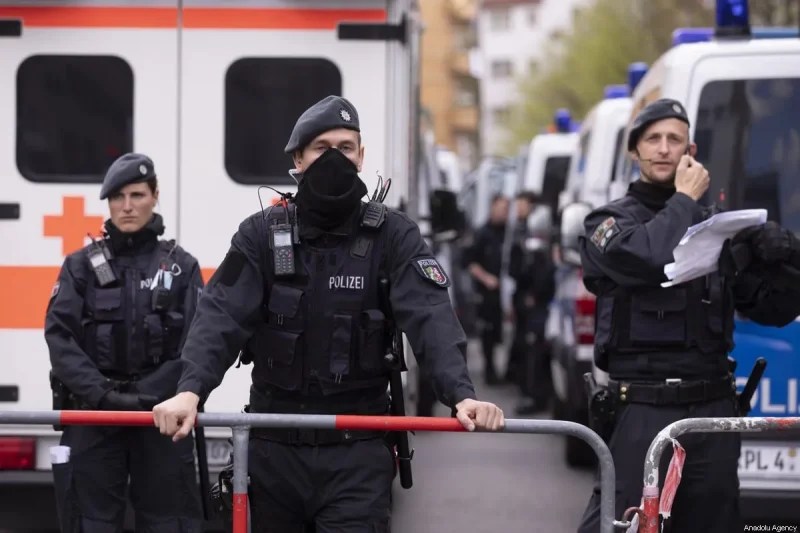
Ankara, on Wednesday, called on Germany to release Turkish journalists arrested in Frankfurt after reporting on the Fetullah Terrorist Organisation (FETO), the group behind the 2016 defeated coup in Turkiye, Anadolu News Agency reports.
“The detention of Frankfurt Bureau representatives of Sabah newspaper by the German police today, without justification, is an act of harassment and intimidation against the Turkish press. We strongly condemn this heinous act,” the Turkish Foreign Ministry said in a statement.
“We expect the immediate release of journalists who were targeted by a false denunciation of a FETO member for their reporting on the terrorist organisation FETO’s activities in Germany,” it added.
Necessary initiatives have been taken in Germany regarding the issue, and our strong reaction is conveyed to the German ambassador to Ankara, Jurgen Schulz, who was summoned today, the Ministry said.
‘Voter anger over Erdogan’s interference in Syria, war fallout, cost him dearly: Analyst
Press TV – May 17, 2023
A Lebanese political expert says incumbent Turkish President Recep Tayyip Erdogan failed to get the support of people in urban areas in the recent election mainly due to his interference in Syria and the fallout of his intervention in the war.
In an interview with the Press TV website, Nasser Qandil, editor-in-chief of Lebanon’s al-Binaa newspaper, noted that most of the youths in cities did not vote for Erdogan – who has been at the pinnacle of Turkish politics for more than two decades – with the slogan “20 years is enough.”
“The issue of Syrian refugees and Erdogan’s role in the Syrian war was among the reasons behind the decrease in his votes in cities,” he said.
“This is while his rival has promised to transfer refugees to their country within two years and deport them if necessary.”
Erdogan gained 49.5 percent of the vote in Sunday’s presidential race compared to 44.9 percent for his challenger, Kemal Kilicdaroglu.
As neither candidate reached the 50 percent threshold needed to win outright, a runoff vote will take place on May 28.
Erdogan took home fewer votes in 2023 than he did in the 2018 presidential contest.
Qandil said that in the second round of the election, Erdogan will face challenges such as heavy economic and social costs of Syrian refugees residing in Turkey, the growing unemployment rate, the rent surge, and the rising competition between Turkish and Syrian workers.
“With the support of Russia, Iran and Persian Gulf states, Erdogan can draw a two-year framework for the Turkish withdrawal from Syria, the return of refugees, and the dispersal of terrorists from Syria’s northeast and northwest,” he said.
“The second round may give better opportunities to Erdogan’s rival, unless he bravely plays his trump card and voices readiness to formulate a timetable for the return of Syrian refugees.”
For more than a decade, Turkey has backed militants fighting against the government of Syrian President Bashar al-Assad, and sent its own troops into the Arab country’s northern areas.
In recent months, however, the strategically-located US-led NATO member has taken steps to normalize relations with Syria.
Also in his interview, the Lebanese political analyst compared Erdogan with Kilicdaroglu, saying the incumbent president represents a political religion close to the West, while the latter acts for the Western-oriented and anti-religious secular movement.
Regarding international developments, he argued that Erdogan tends to pay attention to political and economic partnerships, but his rival wants Turkey to play a regional role without being drawn into war and expansionism.
Qandil further emphasized that Erdogan has managed to build a national economy while Kilicdaroglu, with a tendency towards the US, seeks to realize liberalism, eliminate the government’s role in the economy, and legalize homosexuality.
Unlike large cities, suburbs favored Erdogan as they supported an Islamic national identity aligned with the region and were unhappy with Europe’s racist approach towards Turkey’s EU accession bid, he said.
Iran claims successes in its air defense
By Alexandr Svaranc – New Eastern Outlook – 16.05.2023
Despite decades of sanctions imposed by foreign powers, the Islamic Republic of Iran has garnered tremendous experience surviving and thriving in isolation. Given Tehran’s political system, which is not so much a theocratic form of government as an independent course, is under attack by Iran’s adversaries, the Iranian authorities have prioritized the strengthening of their army and navy. In order to do this, a lot of attention is put on the development of key technologies, mainly in the defense industry, as well as the advancement of education and research.
For many foreign experts it was a revelation that it turns out that Iran has achieved a major breakthrough in the development and production of unmanned aerial vehicles. At the same time, the spoils of the Iranian UAVs on some “hot conflict” fields have allowed experts to also discover advanced Western technology. The Iranian capabilities, meantime, created a stir in a number of international newspapers, raising the question of how the Persians acquired these outlawed and sanctioned technologies from the West or Israel.
Some believe that the Iranians simply ordered products through the AliExpress channel to fictitious addresses, disassembled them, and had local engineers create new inventions (such as joining a water line to a gas line in the hopes of creating carbonated water). Others argue that Iranian replicas of Western technologies are the result of successful scientific, technological, and industrial espionage by Iranian foreign intelligence agencies, specifically the Ministry of Information, IRGC intelligence units, and the Ministry of Defense.
How can one, however, recognize such enemy intelligence triumphs when it also indicates counterintelligence support failures for sanctioned technology and products from NATO nations and their partner Israel? At the same time, their opponents cannot admit (whether out of envy or for other reasons) that Iran simply had to spend a lot of money over the years to build its own education and research, rather than encouraging corruption, as is the situation in other post-Soviet countries. However, the real condition of the arms of the Iranian army should be accepted as a fact.
The commander of the Iranian Army’s Air Defense Force, Brigadier General Alireza Sabahi-Fard recently stated in an interview with Al-Alam News Network, an Arabic news channel, that Iran now has absolute power in the region due to significant technological progress in the production of military equipment, particularly air defense weapons. Moreover, Iran relies 100 percent on its own high-tech production. Tehran now has more opportunities to export domestically produced weapons therefore.
Any army and every war place a high priority on an effective air defense. By assuming control of aerial combat, the army is able to conduct effective defensive and offensive operations during combat operations.
Iranian air defense forces are structurally a combination of the army and IRGC air defense units. Khatam-al Anbiya Central Headquarter of General Staff of Armed Forces is in charge of coordinating joint military operations within the Iranian forces. It should be mentioned that the Iranians build their own air defense systems and have previously tested several of them in live combat.
Iran’s air defense system includes: Radar systems (Nazir, Fath-14, the Matla ul-Fajr and Kashef, Meraj-4, etc.); medium-range SAMS (100-240 km) Bavar-373, Khordad-15, Talash, 3rd Khordad, Mersad-16 and short-range SAMS (up to 100 km) Ya Zahra-3 and Herz-9. In fact, the Bavar-373 is an enhanced version of the Russian S-300PMU-2 Favorit. Iran makes a variety of combat and reconnaissance unmanned aerial vehicles (UAVs), including the Karrar, Ababil, and Mojaher as well as upgraded ballistic Shahab, Sajil, and the Meskat medium-range cruise missiles.
In addition to using outdated but still functional U.S. systems left over from the Shah regime, trophy French equipment from the experience of the war with Iraq, Iran still has to combine its own production of air defense equipment with imports of relevant military equipment from Russia, China, and India. Some of Iran’s most recent innovations in this field involve modifying the equipment bought from China and Russia.
Air defense facilities cover the sky, administrative and political centers, troop concentrations, and critical facilities such as defense-industry enterprises, Natanz nuclear facility and the Bushehr Nuclear Power Plant.
Iran, despite its reliance on domestic production, cannot yet match the world leaders in the development and production of air defense systems, particularly Russia and the United States. Nonetheless, the Iranian military-industrial complex’s success is becoming noticeable in the Middle East. According to Russian experts such as Ruslan Pukhov, developing air defense systems is an expensive and time-consuming endeavor. The process of testing one type of equipment at army ranges to placing it on combat duty in the troops can often take up to ten years.
However, since the 1979 Islamic Revolution, Iran has had to deal with improving its own defense industry for more than four decades. We only possess a portion of the information available in public, since no one discloses all of their accomplishments and technological characteristics.
Furthermore, the current political and military environment and tensions with Israel, the NATO bloc, and the United States encourage Iran to accelerate its military development. For Iranian topography, the east, south, and west have always had a high level of military escalation. On Iran’s northern borders with Azerbaijan and Armenia, a new hotbed of military conflict developed in the post-Soviet era. Of course, this is about the unresolved Karabakh issue, the two conflicts that took place there from 1991 to 1994, 2016, and 2020, as well as the ongoing provocations across the line of contact.
Given the accomplishments of the domestic military-industrial complex, Iranian air defenses undoubtedly have a certain advantage over some nations in the region, including Armenia, Azerbaijan, Georgia, Iraq, Syria, Qatar, the KSA, and even Turkey, which is a NATO member. Nonetheless Iranian missile and air defense systems are unlikely to be more advanced than those of Israel, let alone the United States, in terms of technology.
Turkey started paying more attention to import substitution and modernizing the country’s military-industrial complex throughout the years of President Recep Erdoğan’s rule. Ankara was able to supply the army and navy’s weaponry with 80% of its own manufacturing thanks to this strategy for boosting the country’s independence. The development and manufacture of Turkey’s Baykar Bayraktar Kızılelma reconnaissance and combat unmanned aerial vehicles (UAVs), Hisar surface-to-air missile and SIPER air defense missile, TCG Anadolu with unmanned combat aerial vehicles on board, Altay tank, BMC Kirpi, etc. are all being observed around the world.
The Turkish government holds regular events practically every day to showcase the aforementioned and additional products of the military-industrial complex, especially during current election campaigning days. Some of the military equipment on display in Turkey might still be purely for show, and it will take some time before testing and real breakthrough is made. Even so, Turkey is making an effort to keep up with Iran and its neighbors in terms of the military-industrial complex.
There is always hope for the army because of the generals’ faith in their own air defense systems and airspace control forces. However, public statements frequently don’t match reality (or don’t match it completely), which can further the goals of misleading the direct and potential enemy or fostering diplomacy during the negotiation process.
Anyway, Iran is expanding its military-technical cooperation with Russia, China, and India to produce air defense systems in all circumstances, keeping up with new advancements, and testing them not only on army ranges but also in combat theaters, where it takes part in varying degrees.
Turkish Foreign Minister Says Ankara Won’t Wait for US F-35 Jets, Wants $1.4Bln Back
Sputnik – 13.05.2023
ANKARA – Turkiye has no plans to wait until it is brought back to the US F-35 multirole fighter program, from which it was officially removed two years ago, and seeks a refund of $1.4 billion paid for the jets, Turkish Foreign Minister Mevlut Cavusoglu said on Saturday.
“We want out money now. We want the money we paid there to be returned. Our friends from the ministry came together and reviewed the steps we will take from now on. We are now taking care of ourselves,” Cavusoglu told media, adding that Ankara does not want the situation to “turn into a snake story like with the Patriot defense system.”
Turkish President Recep Tayyip Erdogan previously said that the country had paid $1.4 billion for the jets.
In April 2021, the US excluded Turkiye from the F-35 program after Ankara purchased Russia’s S-400 air defense systems. Washington annulled the joint memorandum on the F-35 fighters with the country, while signing the document with seven other project partners — the United Kingdom, Italy, the Netherlands, Australia, Denmark, Canada and Norway. Erdogan said later that year that Turkiye had received a US offer to buy F-16 jets instead, one generation behind the F-35s. The US Congress has been debating whether to include restrictions on the sale of jets in its annual defense spending bill for fiscal 2023, while the US State Department has been trying to convince lawmakers that the deal was aligned with Washington’s interests.
Erdogan scolds rival over ‘Russian interference’ claim
RT | May 12, 2023
Turkish President Recep Tayyip Erdogan has condemned rival Kemal Kilicdaroglu for claiming without evidence that Moscow is interfering in Türkiye’s upcoming elections. Erdogan claimed that the West, and not Russia, is “manipulating the elections in Türkiye.”
“[Kilicdaroglu said that] Russia is manipulating the elections in Türkiye. Shame on you!” Erdogan told a crowd of supporters in Istanbul on Friday.
In a Twitter post a day earlier, Kilicdaroglu accused the country’s “Russian friends” of being “behind the montages, conspiracies, deep fakes and tapes that were exposed in this country yesterday.”
“Get your hands off the Turkish state,” Kilicdaroglu warned the supposed Russian meddlers.
Kilicdaroglu was likely referring to the publication of a video showing another presidential candidate, Muharrem Ince, allegedly engaging in an extramarital affair. Ince dropped out of the race on Thursday, blaming followers of exiled cleric Fethullah Gulen, whose political movement Ankara claims orchestrated a failed coup in 2016.
There is zero evidence linking Russia with the publication or production of the tape, and the Kremlin said that it “firmly rejects” Kilicdaroglu’s claims.
“If I say ‘America is manipulating the elections in Türkiye, Germany is manipulating it, France is manipulating it, England is manipulating it’, what would you say?” Erdogan continued, addressing his remarks to Kilicdaroglu.
While Erdogan did not attempt to tie the leak of Ince’s sex tape with any of the Western countries he mentioned, his interior minister, Suleyman Soylu, did. “It is clear who produced it,” he told CNN Turk earlier on Friday. “The perpetrator is the Gulen movement and the US.”
Soylu claimed that “America has been interfering in this election from the very beginning,” and produced the tape to force Ince out of the race and move his voters to Kilicdaroglu.
Erdogan did, however, accuse Western media outlets of trying to shift public opinion in Türkiye against him.
“What do all the magazines say on their covers? ‘Erdogan must go.’ [Those published] in Germany, France and England say so,” he said at Friday’s rally. “How do you put these words on the covers of these magazines? It’s not you, the West! It’s my nation that will decide!”
This week’s edition of The Economist features the slogans “Erdogan must go” and “save democracy” on its cover, while France’s Le Point and L’Express magazines also featured anti-Erdogan covers.
Türkiye’s presidential and parliamentary elections will take place on Sunday. Recent polling shows Erdogan – a social conservative who steered his country away from integration with the EU – and Kilicdaroglu – a centrist who favors realignment with the West – within single digits of each other.
Syria’s Return to Arab League Shows US Gulf Allies Tired of ‘Regime Change’
By James Tweedie – Sputnik – 09.05.2023
Syria’s secular government is still standing after more than a decade of sectarian terrorist insurgency backed by the US and its regional allies. Independent investigative journalist Christopher Helali said its readmittance to the Arab League was a sign of waning US power in the Middle East.
Return of Damascus to the bosom of the Arab League after 11 years of pariah status shows the failure of the US doctrine of regime change, a journalist says.
The regional group of nations voted on Sunday to reverse its 2012 decision to expel the Syrian Arab Republic over President Bashar al-Assad’s resistance to religious-sectarian ‘rebels’ backed by the Western powers and several of the Gulf monarchies.
The tide of the conflict turned in 2015 with Russia’s military assistance, helping to break the sieges of Aleppo and other cities alongside volunteers from Iraq and Lebanon’s Hezbollah and the Iranian Revolutionary Guard Corps.
Christopher Helali told Sputnik that the major change of stance by the Arab nations was “part of the ongoing geopolitical shifts that we’re seeing in the wider region.”
“Syria being allowed back into the Arab League is certainly a coup, not only for the Arab countries, but I think for countries like China behind the scenes who have been pushing diplomacy and pushing rapprochement between different sides in the Syrian civil war,” Helali said.
The welcome back for Damascus and President Bashar al-Assad showed there was “no more appetite for regime change” or for backing the “alphabet soup of jihadist groups” funded and armed by Washington — the al-Nusra Front, Islamic State, various al-Qaida affiliates and the Free Syrian Army (FSA).
Those sectarian terrorist forces were supported by Saudi Arabia, the United Arab Emirates (UAE) and possibly Qatar and Jordan, the journalist said.
The journalist noted there was “growing discontent” among the Arab states over how the conflict has progressed and its unwanted effects. “People are saying, okay, let’s just let’s finish it and let’s send a lot of these refugees back.”
The other question is who Assad must negotiate with to finally end the 12-year conflict, given the Gulf monarchies previous insistence on a political “transition” that brings the “rebels” into the mainstream.
Those groups have been “allowing different Western journalists there to show that ‘we are moderate rebels… we are Islamists, but we’re not fanatical like ISIS, even though they are underground’,” Helali said.
“Ultimately, Assad would have to speak to the great power brokers in this conflict — the people who supported those groups. So you’d have to think about Turkiye, Saudi Arabia and other Gulf states, the United States, Russia, Iran, everybody would have to be at the table,” he continued. “But of course, nobody’s coming to that table except for the people already on Assad’s side. Plus Turkiye, because it’s being pushed to find a settlement, especially for the northern part of Syria, especially by Russia and as well as Iran.”
The elephant in the room remains the illegal US occupation of north-eastern Syria, with its concentration of lucrative oil fields, along with its outpost at al-Tanf in the southern desert near the border with Jordan.
“There can be no peace plan, there can be no situation in which everything is resolved so long as foreign troops, including US troops, still occupy sovereign Syrian territory and so long as arms and equipment and funding keeps funnelling in to Syria, to other armed groups,” Helali stressed.
“Once that stops and once there can be sovereignty over in territorial integrity, Syria reclaiming all of its borders, then there can be some plan. But that plan will have to be Syrian-led” and not imposed form outside, he said.
The ultimate significance the republic’s return to the League is the tacit admission that the US-led plan to overthrow Syria’s government failed — with disastrous consequences for her neighbours.
“What the Arab League is saying is that we’ve tried, it’s failed. Assad is here to stay and we have to find some normalization because we’re also dealing with millions of refugees in the region,” Helali said. “There has to be some political resolution to this conflict so that people can return home. Turkiye has 5 million Syrian refugees. Everybody wants a resolution to this.”
Türkiye won’t toe Western line on Russia sanctions – FM
RT | May 8, 2023
Ankara has no plans to support the Western economic restrictions against Russia, foreign minister Mevlut Cavusoglu insisted in an interview on Monday.
Türkiye’s top diplomat made the comments to the Lider Haber TV channel in the run-up to the country’s presidential and parliamentary elections, due to take place on Sunday.
“We are not going to join the unilateral sanctions imposed against Russia by the US and the EU. Our own benefit and prosperity come first,” Cavusoglu explained, as quoted by the TASS news agency.
The minister also criticized the opposition presidential candidate Kemal Kilicdaroglu, who has said he would give priority to developing ties with the West. According to Cavusoglu, the rival to incumbent president Recep Tayyip Erdogan has shown himself to be inconsistent in his statements; at one rally, Kilicdaroglu reportedly said that nothing would endanger the relationship between Türkiye and Russia.
Reports emerged in March of Türkiye blocking some transit shipments destined for Russia, in response to recent pledges by Brussels and Washington to enforce anti-Russian sanctions and to stop the supply of sanctioned products via third parties. Türkiye’s Ministry of Trade provided no official confirmation of the move. It was later reported that Ankara had resumed the transit to Russia of some sanctioned goods of European origin.
The EU has repeatedly voiced concern about the country’s refusal to participate in Western sanctions against Russia, and accused the Middle Eastern state of becoming a ‘transit hub’ for Russia, thus enabling the economic blockade to be circumvented.
Ankara is one of Moscow’s main trading partners, with both sides having pledged to deepen economic cooperation and expand bilateral trade.
Last year, Türkiye and Russia signed a roadmap for economic cooperation that envisages bringing bilateral trade turnover to $100 billion a year. The two have also agreed to introduce the Russian ruble as a settlement currency for bilateral trade, including for Russian natural-gas supply.
Data shows that, around this time last year, Türkiye became one of the top five exporters to Russia. In 2021, it ranked 11th, ahead of the US, France, Japan, Poland and Italy.
Arab states call for withdrawal of foreign forces from Syria
RT | May 1, 2023
The government in Damascus should re-establish the rule of law on all of Syria’s territory, ending the presence of foreign armed groups and terrorists, the foreign ministers of Syria, Saudi Arabia, Jordan, Egypt, and Iraq said on Monday after meeting in Amman.
Jordan hosted the meeting, the first of its kind since Syria’s membership in the Arab League was suspended in 2011. Prior to the multilateral meeting, Syrian Foreign Minister Faisal Mekdad met with his Jordanian counterpart Ayman Safadi to discuss refugees, border security and “water issues,” according to Amman.
In a joint statement distributed by state news agencies, the five ministers called for “ending the presence of terrorist organizations” as well as “armed groups” on the territory of Syria, and “neutralizing their ability to threaten regional and international security.” They also pledged to “support Syria and its institutions to establish control over all of its territory and impose the rule of law.”
Saudi Arabia, Egypt, Jordan and Iraq pledged to establish ties with the Syrian military and security institutions in order to “address security challenges.” The five ministers also called for stopping “foreign interference in Syrian domestic affairs.” Their joint declaration also called for setting up technical teams of experts that would follow up on the summit and implement practical measures to resolve the conflict in Syria.
The Amman meeting comes just weeks after Mekdad visited Saudi Arabia and received the kingdom’s endorsement for Syria’s territorial integrity. Currently, Turkish-backed militants control parts of northern Syria, while the northeast is under the control of US-backed Kurdish militias. Several hundred US soldiers are also in Syria, controlling most of the country’s oil wells.
MIlitants backed by Saudi Arabia and the US launched an uprising against Syrian President Bashar Assad in 2011. With the help of Russia and Iran, the government in Damascus eventually prevailed over the collection of rebels, including terrorists affiliated with Al-Qaeda and Islamic State (IS, formerly ISIS). While Syria’s neighbors and regional powers have moved to improve relations with Damascus in recent months, the US has not changed its “regime change” policy.
Russia cannot lose its UNSC seat despite Western and Ukrainian attempts
By Ahmed Adel | April 27, 2023
The US has a strong ambition to add its allies to the United Nations Security Council to weaken Russia’s influence across the world, or if this fails, to render the organisation useless, akin to the old League of Nations. However, even more dangerous than the US seeking more allies in the UNSC are the initiatives to abolish Russia’s right of veto and take away its status as a permanent member. Kiev raises this suggestion at almost every session of the UN General Assembly.
In this sense, new challenges are being created, especially as UN Secretary General António Guterres stated that the majority of UN member states see the need for reforming the UNSC. Such suggestions must be treated with suspicion though as the US wants to take advantage and weaken not only Russian influence, but also Chinese.
Guterres and the US are clearly trying to push their closest allies, such as Germany, Australia, and Japan, where unsurprisingly American military bases are located, into the UNSC. There are also other countries, such as Turkey, which regularly raise the issue of UNSC reform and complain that the fate of humanity should not depend on five countries – China, France, Russia, the UK, and the US.
However, Turkey’s suggestion is problematic as the UNSC would be inundated with permanent membership requests from dozens of middle powers who have equal or greater power than Turkey, such as Egypt, Iran, and Saudi Arabia. Realistically, at this current junction, an expanded permanent UNSC could only include Brazil and India, the former because it is the most important country in Latin America and the latter because it is on a rapid path towards Great Power status.
None-the-less, Moscow, just like Washington, is in favour of reforming the UNSC, but with significantly different views. While the US and its allies are pushing reforms as a possible way to limit Russian influence, Moscow believes that the Security Council should to be expanded, but to achieve a more equitable world and to not empower Western aggression.
Russian Foreign Minister Sergey Lavrov explained that the composition of the UNSC should be strengthened by Asian, African, and Latin American countries, which are not represented in the UNSC, with the exception of China in regards to Asia. Therefore, in Moscow’s view, the UNSC should not be expanded only so that the West and its closest allies, such as Japan, can get additional seats. Moscow wants to balance the UNSC because the West has three of five permanent seats despite comprising only a minority of humanity.
It is clear that Lavrov has strategically put the West in a difficult position because if they veto the expansion initiative, it will lead to a backlash from countries like India which believe they have earned a right to a permanent seat in the UNSC. At the same time, Lavrov and his Chinese counterpart must be cautious on expansion so that the UNSC does not transform into a political branch of NATO.
The UN Charter does not provide for a reform procedure, and this especially applies to the UNSC, which is the most important body of the organisation. By recklessly expanding the body, the contradictions and conflicts of interest, which already hinder the UNSC in its current format, would elevate.
Therefore, in the current geopolitical situation, it will be very difficult to reform the UNSC in such a way as to objectively consider the interests of all participants in the process. A permanent UNSC membership is a privilege and not something to lightly contemplate expanding upon.
There is also no legal basis to exclude Russia from the UNSC, limit its status and deprive it of veto rights. The entire architecture of the UN was originally built on the fact that the five great powers, the winners of the Second World War, assumed the role of guarding the global world order. The founding states cannot exclude each other because if one or two pillars are thrown out, the UN would collapse.
If Russia was somehow excluded, it would mark the destruction of the entire system based on international law, on the UN Charter, and would call into question the existence of the UN itself. Russia, however, is a permanent member of the Security Council and has veto power. This practically means that Russia, if the Charter is applied, can only be expelled if it does not exercise its veto power. Therefore, it is impossible to deprive Russia of that right, despite constant Ukrainian attempts.
Hypothetically, there are two scenarios in which Russia could lose its seat in the UNSC – first, if it excludes itself and second, if the UN ceases to exist as an organisation. It is recalled that the Soviet Union was foolishly excluded from the League of Nations, the forerunner of the UN, but that organisation ceased to exist. The same fate would befall the UN if Russia was expelled.
Ahmed Adel is a Cairo-based geopolitics and political economy researcher.
The war, the separation of the world, or the end of an Empire?
By Thierry Meyssan | Voltaire Network | April 11, 2023
Many are those who predict a World War. Indeed, some groups are preparing for it. But the States are reasonable and, in fact, consider rather an amicable separation, a division of the world into two different worlds, one unipolar and the other multipolar. Perhaps we are actually witnessing a third scenario: the “American Empire” is not struggling in the trap of Thucydides; it is collapsing like its former Soviet rival died.
The American “Straussians,” the Ukrainian “integral nationalists,” the Israeli “revisionist Zionists” and the Japanese “militarists” are calling for a generalized war. They are alone and they are not mass movements. No state has yet committed itself to this course.
Germany with 100 billion euros and Poland with much less money are rearming massively. But neither of them seems eager to take on Russia.
Australia and Japan are also investing in armaments, but neither of them has an autonomous army.
The United States is no longer able to replenish its military and is no longer able to create new weapons. They are content to reproduce the weapons of the 1980s in an assembly line fashion. However, they maintain their nuclear weapons.
Russia has already modernized its armies and is organizing itself to renew the ammunition it uses in Ukraine and to mass produce its new weapons, which no one can compete with. China, for its part, is rearming to control the Far East and, in the long term, to protect its trade routes. India thinks of itself as a maritime power.
It is therefore difficult to see who would and could start a World War.
Contrary to their speeches, French leaders are not at all preparing for a high-intensity war [1]. The military programming law, established for ten years, plans to build a nuclear aircraft carrier, but reduces the size of the army. It is a question of giving ourselves the means of projection, but not of defending our territory. Paris continues to reason as a colonial power while the world is becoming multipolar. It is a classic: the generals prepare for the previous war and ignore the reality of tomorrow.
The European Union is implementing its “Strategic Compass”. The Commission coordinates the military investments of its member states. In practice, they all play the game, but pursue different goals. The Commission, on the other hand, is trying to take control of decisions on the financing of armies, which until now have depended on their national parliaments. This would make it possible to build an empire, but not to declare a generalized war.
Clearly everyone is playing a game, but apart from Russia and China, none is preparing for a high-intensity war. Rather, we are witnessing a redistribution of the cards. This month, Washington is sending Liz Rosenberg and Brian Nelson, two specialists in unilateral coercive measures [2], to Europe with the mission of forcing the Allies to comply. In the words of former President George Bush Jr. during the war “against terrorism”: “Whoever is not with us is against us”.
Liz Rosenberg is efficient and unscrupulous. She is the one who brought the Syrian economy to its knees, condemning millions of people to poverty because they dared to resist and defeat the Empire’s surrogates.
The Hollywood western discourse a la George Bush Jr. of good guys and bad guys has failed with Türkiye, which has already experienced the 2016 coup attempt and the 2023 earthquake. Ankara knows that it has nothing good to expect from Washington and is already looking to the Shanghai Cooperation Organization. Yet the same discourse should succeed with the Europeans, who remain fascinated by the power of the United States. Of course this power is in decline, but so are the Europeans. No one has learned any lessons from the sabotage of the Russian-German-French-Dutch gas pipelines, North Stream. Not only did the victims take the blame without saying anything, but they are about to receive further punishment for crimes they did not commit.
The world should therefore be divided into two blocs, on the one hand the US hyperpower and its vassals, on the other the multipolar world. In terms of the number of states, this should be half and half, but in terms of population, only 13% for the Western bloc against 87% for the multipolar world.
The international institutions can no longer function. They should either fall into lethargy or be dissolved. The first examples that come to mind are the effective exit of Russia from the Council of Europe and the empty seats of Western Europeans in the Arctic Council during the year of the Russian presidency. Other institutions are no longer relevant, such as the Organization for Security and Cooperation in Europe (OSCE), which was supposed to organize East-West dialogue. Only the attachment of Russia and China to the United Nations should preserve them in the short term, as the United States is already thinking of transforming the Organization into a structure reserved exclusively for the Allied Nations.
The Western bloc should also reorganize itself. Until now, the European continent was dominated economically by Germany. In order to be certain that Germany would never get closer to Russia, the United States wanted Berlin to be content with the western part of the continent and leave the center in the hands of Warsaw. So Germany and Poland armed themselves to impose themselves in their respective zones of influence, but when the American star faded, they would fight against each other.
When the Soviet Empire fell, it abandoned its allies and vassals. Having seen its inability to solve the problems, the USSR first stopped supporting Cuba economically, then dropped its vassals of the Warsaw Pact, and finally collapsed on itself. The same process is beginning today.
The first U.S. Gulf War, the 9/11 attacks and their host of wars in the broader Middle East, the expansion of Nato and the Ukrainian conflict will have offered only three decades of survival to the American Empire. It was backed by its former Soviet rival. It has lost its raison d’être with its dissolution. It is time for it to disappear too.
Translation: Roger Lagassé
NATO’s Enlargement Targets Not Only Moscow, But Ankara as Well, Turkish Media Says
By Ilya Tsukanov – Sputnik – 05.04.2023
Turkiye’s parliament approved Finland’s bid to join the Western alliance last week, citing Helsinki’s “authentic and concrete steps” to allay Ankara’s security concerns. However, one Turkish outlet fears the nod to membership may prove a strategic mistake, and that the bloc is directed as much against Turkiye as it is against Russia.
Finland officially joined NATO on Tuesday, becoming the 31st nation to join the alliance, with its accession constituting the Western military bloc’s ninth wave of expansion since its creation in 1949. Russia, which shares a 1,300+ km frontier with its Nordic neighbor, warned that Moscow would take the necessary “countermeasures” to ensure its tactical and strategic security.
Turkiye’s Defense Ministry used the occasion, which coincides with the 74th anniversary of the founding of NATO, to post a congratulatory tweet. “We have been a distinguished member of NATO since 1952. Happy 74th anniversary. Together we are stronger,” the ministry wrote, adding the hashtag “#WeAreNATO.”
But the celebration may be premature, writes Turkish newspaper Aydinlik.
“Although NATO’s enlargement has been seen as a policy of containing Russia, it is now obvious that Turkiye is being similarly besieged. In the past, the Atlantic [powers] attempted to establish global hegemony by hemming the Eurasian continent in on land, in accordance with Spykman’s Rimland theory, therefore including countries such as Turkiye, Iran, Afghanistan and China in its geopolitical axis,” the newspaper, affiliated with Turkiye’s Vatan Partisi, a left Kemalist party, wrote in an analysis published Tuesday.
From the 1970s on, the geopolitical situation began to shift, Aydinlik noted. “Among the trusted countries, Iran escaped America’s control in 1979, China after 1990, Turkiye on July 15, 2016 [the day of the attempted coup against Erdogan, ed.] and Afghanistan in 2021, becoming target countries. Therefore, the geopolitical axis was broken, and shifted to Greece, southern Cyprus and Israel. Thus, Turkiye was cut off from the Atlantic [axis], and pushed toward the Heartland, and is now besieged from Alexandropoulos to Crete, and from there to the eastern Mediterranean and northern Syria.”
Turkiye vs NATO
Aydinlik’s analysis is in line with growing anti-NATO and anti-Western sentiment in Turkiye. A 2019 poll found that only 21 percent of Turks had a positive view of the alliance. A 2021 survey discovered that a whopping 90.3 percent didn’t believe that the bloc would come to the country’s assistance in a crisis, while 51.7 percent said the bloc “exploits” Turkiye for its own interests. Another poll in early 2022 found that 39.4 percent of Turks would prefer it if their country would “give priority to Russia and China” in foreign policy, compared to 37.5 percent for the EU and the US.
Turkish grievances with the West are numerous, starting with Turkiye’s shabby treatment by Brussels – which has dangled the prospect of EU membership before the country for more than 30 years, but consistently refused to allow it to enter, ostensibly for failing to “meet membership criteria.” (Meanwhile, much less developed countries in Eastern Europe have been allowed in, and even Ukraine, which is engulfed in a NATO-Russia proxy conflict and mired in corruption and poverty, is now being considered for membership.)
NATO’s role in the 2016 coup attempt is another issue on many Turks’ minds. Some have accused NATO of direct involvement in the coup plot, and the Turkish government’s purge of NATO staff after the attempted putsch indicates that Ankara also suspects them.
America’s sheltering of Fethullah Gulen, the Muslim cleric President Erdogan suspects of masterminding the coup attempt, has served to further fray ties. As has the scandal over the F-35 fighter program. After pumping more than a billion dollars in R&D funds into the fighter and organizing the manufacture of dozens of key components, Turkiye was unceremoniously booted out of the program in 2019 and slapped with sanctions in 2020 over its purchase of advanced Russian missile defense systems.
Turkiye and NATO’s de facto leader, the United States, have also found themselves on opposite sides in Syria, where US forces have allied themselves to and shielded Kurdish militia forces which Ankara classifies as terrorists. At the same time, the ongoing standoff between Turkiye and Greece in a maritime dispute in the Mediterranean (which France, another NATO member, has joined on Athens’ side) has served to further heighten Ankara’s security concerns.
Even as Turkiye prepares for presidential and parliamentary elections scheduled for May, Ankara has accused the US of meddling in the country’s internal affairs after US Ambassador Jeff Flake met with Kemal Kilicdaroglu, Erdogan’s main rival.
“Joe Biden’s ambassador visits Kemal. Shame on you, think with your head. You are an ambassador. Your interlocutor here is the president. How will you stand up after that and ask for a rendezvous with the president? Our doors are closed to him, he can no longer come in. Why? He needs to know his place,” Erdogan said.
Turkish President Recep Tayyip Erdogan speaks to the media during a joint press conference with Finland’s President Sauli Niinisto, at the presidential palace in Ankara,
With NATO’s latest expansion, the real question worth asking, Aydinlik seems to intimate, is about Turkiye’s place in the Western alliance.
Turkey’s 2023 election a choice between Eurasianism and Atlanticism
By Ahmed Adel | April 5, 2023
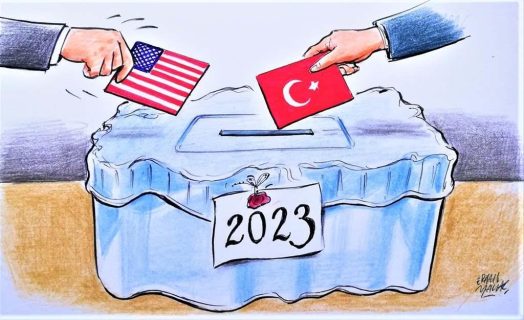
The Turkish President refuses to speak any further with the American ambassador to Ankara. The reason: a recent meeting between the diplomat and the leader of the Turkish opposition only a month and a half before the presidential election. Importantly though, this election will determine whether Turkey will continue its course towards Eurasianism, or revert back completely to the NATO bloc.
With the approach of the presidential election, Recep Tayyip Erdoğan reacted strongly following the meeting that American ambassador Jeffry Flake had with the leader of the opposition pro-American Republican People’s Party (CHP), Kemal Kılıçdaroğlu.
“Joe Biden spoke, and now you see what his ambassador here does. He visited (Kılıçdaroğlu). It is a shame. You are an ambassador, and you have to know how to act. You should be engaged with the President (not Kılıçdaroğlu),” Erdoğan said in Istanbul on April 2.
“I wonder if he will be ashamed to ask for an appointment from my office. But I tell him now. Our doors are closed to him from now on because he does not know his place. You should know how an ambassador should act,” he added.
Erdoğan’s outburst was instigated because it is evident that Flake, as head of the American diplomatic mission in Turkey, is endorsing Kemal Kılıçdaroğlu and the Alliance of the Nation coalition, which is made up of seven political parties.
“Ambassador Flake met with CHP Chairperson Kemal Kılıçdaroğlu today as part of continuing conversations with Turkish political parties on issues of mutual interest between our two countries. He expressed American solidarity and condolences for Türkiye’s earthquake losses,” the American Embassy wrote in a tweet on April 2.
The current president, Kılıçdaroğlu, and two other candidates, Sinan Oğan and Muharrem İnce, will face each other on May 14. At the surface level, the vote will determine who will be the President of Turkey for a five-year term, whilst at the same time the legislative elections will take place.
However, at a deeper level, Erdoğan represents Turkey’s slow pivot towards Eurasianism, where he believes a pan-Turkic world has its place, whilst Kılıçdaroğlu represents Ankara’s traditionally close ties with Washington and NATO. Effectively, Turkish citizens have a very deep ideological decision to make.
Respected Turkish public opinion research centre MetroPOLL conducted a survey with the participation of 2,046 people in 28 Turkish provinces between January 13 and March 14. The survey showed that 44.6% of respondents would vote for Kılıçdaroğlu, while Erdoğan would receive 42% of the votes. This makes the upcoming election one of the biggest challenges to the Turkish president’s long rule.
As this election will be close, the US is hoping that it can do its part to ensure that Kılıçdaroğlu wins. Although the US and Turkey are NATO allies, they have many outstanding issues, particularly relating to Washington’s refusal to sell F-35 fighter jets, US support for the Syrian offshoot of the Kurdistan Workers Party, and Turkey’s purchase of the Russian-made S-400 missile defence system.
Tensions significantly escalated even before President Joe Biden entered the White House in 2020. “What I think we should be doing is taking a very different approach to him [Erdoğan] now, making it clear that we support the opposition leadership,” Biden said in a New York Times interview, adding that Erdoğan had to pay the price.
The Kılıçdaroğlu-led opposition bloc has become the darling child of Western media recently, with more anti-Erdoğan coverage appearing on publications like The Economist. The Wall Street Journal, for their part, recently published an article by former US National Security Adviser and notorious warhawk John Bolton, who called on the US to support the opposition or force Turkey out of NATO if Erdoğan won the elections.
It is recalled that Flake had already angered Turkish officials after he shut down the US embassy last year over supposed “security concerns” that Turkey denied. Although the US did not shut down its consulate in Istanbul, it is noted that the mayor of Turkey’s largest city is the immensely popular Ekrem İmamoğlu of the CHP. This again is another signal that the US is backing the CHP in the elections.
But as Interior Minister Süleyman Soylu pointed out regarding Flake back in February: “Türkiye has the misfortune of having US ambassadors seeking to plot coups in our country. Every US ambassador has been engaged in efforts to harm Türkiye. They also try to dispel same advice to ambassadors of other countries.”
In this way, Turkish citizens have a generational choice to make – to continue with Erdoğan’s pursuit of sovereignty and balancing relations with the Great Powers, or a complete submission to Washington and a reversal of the many years of effort made by the Turkish president to achieve sovereignty.
Ahmed Adel is a Cairo-based geopolitics and political economy researcher.
Featured Video
The Search for Truth: Charlie Kirk’s Assassination One Year Later
or go to
Aletho News Archives – Video-Images
From the Archives
US murdering 1 million Iraqis is democracy, Iran giving yogurt to Iraq is “domination”
By Ali Salaam | American Herald Tribune | July 31, 2017
The New York Times, owned by the Zionist Jewish supremacist Ochs-Sulzberger family, has no problem with Iraqi suffering as long as Iran is not the one behind it.
The Iraq War was a genocide of the Iraqi people by Zionist supremacists in the Bush administration. Over 1 million innocent people were killed based on a lie. American soldiers died in an Israeli war and now an average of 22 soldiers commit suicide every day because their consciences cannot cope with the fact they committed crimes in an illegal war that served no purpose other than to benefit Israel, not America.
Benjamin Netanyahu, Prime Minister of the Zionist regime, once said “We are benefiting from one thing, and that is the attack on the Twin Towers and Pentagon, and the American struggle in Iraq.”
Paul Wolfowitz had his sights on Iraq since his time in the first Bush administration. Former Israeli official and Bush administration official Richard Perle had his eyes on Iraq since at least his authorship of the Clean Break white paper. The Zionist regime had their eyes on Iraq since the 1980s when strategist Oded Yinon wrote his white paper in support of dividing the Arab-Muslim world along ethnic and sectarian lines. The global Zionist lobby has had their eyes on Iraq since Theodor Herzl stated that Eretz Israel’s true borders go from the Nile River in Egypt to the Euphrates River in Iraq. … continue
Blog Roll
 Aletho News
- The Search for Truth: Charlie Kirk’s Assassination One Year Later
- ‘Harsh reality’: Iran says France seeks monopoly on power and intimidation, not peace for all
- When Will This White House Madness End?
- Huckabee aide goes to ‘unusual lengths’ to portray ‘Israel’ positively
- Trump Announces Diesel Supply Deal With Putin Following Phone Call
- MEP blasts ‘Euro-Gestapo’ for lecturing Russia on democracy
- Syria May Send Troops to Saudi Arabia Amid War with Ansar Allah
- UK whines about losing billions to ‘Putin tax’
- Baghaei to Rubio: Distorted narratives cannot erase US record of broken commitments
- Houthis Don’t Have to Conquer Saudi Arabia to Make It Pay
- If Americans Knew
- Gaza ceasefire exists in name only, say more than 100 organizations
- Nearly 2 Million in Gaza Need Urgent Shelter Assistance as Winter Looms: IOM Chief Warns
- Suppressing Palestinian resistance: US charity under fire for AI monitoring of Gaza classrooms
- Thousands Are Held in Israeli Torture Camps. This Is What Happens Inside
- Israel puts Gaza’s sick, injured, newborn in peril – Daily Update
- Report claimed Mark Levin used by Israeli government to influence Trump
- Over 2,000 Gazans have died awaiting medical evacuation amid Israel’s continued siege
- How a U.S. Diplomat Suppressed and Altered Reports Critical of Israel
- 5 Palestinians Die from Israeli Strikes in Gaza as Relentless Attacks Continue
- Report: Ceasefire Slows Killing but Leaves Devastation Intact
- No Tricks Zone
- New Study: 50 Years Of The Most Aggressive ‘Net Zero’ Policies Can Only Affect The Global Climate By 0.03°C
- US September “Heat” Was No Record…Many Records Set Decades Ago
- Latest European Green Energy Debacle; Portugal’s Largest Flagship Solar Park Insolvent!
- Green Energy Debacle: German Expert Professor Fritz Vahrenholt Warns Of Severe Economic And Social Consequences
- Two More Paleo Reconstructions Affirm Meters-Higher Sea Levels Across Ireland, Brazil 7000-6000 Years Ago
- New Study: Earth And Venus Surface Warmth Largely Explained By Convection And Lapse Rate, Not CO2 Or Radiation
- 2025 Nature Paper Claiming Worsening Global Drought Gets RETRACTED …Heavily Flawed
- New Study: ‘Global Drought Shows No Detectable Recent Acceleration Under Climate Warming’
- Economic Masterminds: German Socialists Suggest Taxing Productivity Gains Stemming From Using AI
- The South China Sea Has Not Been Cooperating With The Climate Change Narrative

