The influential Saudi daily Asharq Al-Awsat, which belongs to Prince Faisal bin Salman (son of King Salman), Governor of Madinah, tore into Turkish President Recep Erdogan with a series of vicious attacks that brings to the fore the cracks in the politics of the Muslim Middle East following the failed coup in Turkey last Friday. On successive days, three Op-Eds have appeared, authored by two of the most authoritative establishment talkers in the Saudi media – Abdulrahman Al-Rashed (currently general manager of Al-Arabiya television and formerly editor-in-chief of the daily) and Eyad Abu Shakra (incumbent managing editor of the daily).
The first Op-Ed entitled Will Turkey Boycott the West? by Al-Rashed appeared on Tuesday in the immediate aftermath of the coup attempt in Turkey. Its message to Erdogan was two-fold: a) Do not annoy the West (read US); and, b) There will be dire consequences if Erdogan pressed for the extradition of the Islamist cleric Fetullah Gulen from the US.
Evidently, Erdogan ignored Al-Rashed’s advice and doomsday predictions and went ahead to allege a likely US role in the coup attempt and warn that Washington will be making a “big mistake” if Gulen is not extradited. On Thursday, Shakra and Al-Rashed in separate articles followed up with a scathing attack on Erdogan personally and his politics.
Shakra in his article titled About Erdogan and Turkey’s Coup Attempt condemned Erdogan for the crackdown on ‘Gulenists’ and all but cited Gulen as a torch bearer of political Islam as much as Erdogan claims himself to be. The article hinted that Gulen casts an appeal within the ruling party AKP. Shakra pointedly brought in former president and AKP’s co-founder Abdullah Gul and former prime minister Ahmet Davutoglu). He virtually advised a patch-up between Erdogan and Gulen.
Al-Rashed in a second article alleged that Erdogan is grandstanding on the ‘Arab Street’ and his fate cannot be any different from that of Abdel Gamal Nasser and Sadam Hussein. Worse still, he drew comparison with Imam Khomeini. His article They All Walked This Path also seems to suggest Saudi displeasure that Erdogan draws support from parts of the Arab world. Qatar — whose Emir is close to Erdogan?
What is it that is frightening the Saudi royal family? Prima facie, the disclosures by the famous Saudi whistleblower Mutjahid (who many suspect to be a dissenter within the House of Saud) to the effect that Gulen has strong links with Saudi Arabia and that the powerful deputy crown prince and defence minister Mohammed bin Salman was in the know of the Turkish coup seems to have some basis. There is indeed a tone of panic in the Saudi media attack on Erdogan.
According to Mutjahid, Mohammed bin Salman apparently suspects that the Turkish intelligence knows about the Saudi-UAE role in the attempted coup against Erdogan. (Curiously, according to reports, Turkish military attaché in Kuwait tried to flee to an unnamed western country from the Saudi airport of Dammam before being detained for involvement in the coup attempt.) The Saudi talkers have probably gone on the offensive as the best form of defence, fearing a retaliation by Erdogan.
More importantly, Saudis must be feeling frightened about the manner in which the coup attempt in Turkey was countered by Erdogan, who invoked ‘people’s power’. Shades of ‘Arab Spring’! This is the spectre that always haunted the Saudis – masses pouring out into the streets in their tens of thousands as the final arbiters of political power in a Muslim country. Worse still, this political tactic also leaps out of the manifesto of the Muslim Brotherhood, which poses an existential threat to the Saudi regime.
The point is, from the Saudi viewpoint, the most dangerous thing about Erdogan is not his ‘neo-Ottomanism’ but his close links with the Brothers for whose sake he even sacrificed Turkey’s state-to-state relations with the Egyptian regime of President Abdel Fattah- el-Sisi (who came to power through a Saudi-backed military coup).
Finally, the Saudis are big losers – next only to Israel – in the rapprochement between Turkey and Iran that is getting under way in regional politics. Erdogan told Iranian President Hassan Rouhani during a phone conversation on Tuesday that he is ready to work with Iran and Russia to restore regional peace. The Iranian official news agency quoted Erdogan as saying,
Today, we are determined more than ever before to contribute to the solution of regional problems hand in hand with Iran and Russia and in cooperation with them.
Of course, such a realignment in the Muslim Middle East would profoundly impact the balance of forces in regional politics, virtually isolating Saudi Arabia.
What emerges on the sixth day of the failed coup attempt in Turkey is that three inflection points could be in play in the Turkish-American relations in the coming days and weeks. They are:
The functioning of the Incirlik Air Base on the Syrian border;
Extradition of Islamist cleric Fetullah Gulen from the US; and,
The massive purge of ‘Gulenists’ that is under way in Turkey.
Each of them is going to be trickier to negotiate than the other two and, yet, all three are also inter-related.
The power supply for Incirlik has been suspended since Friday and a back-up generator is barely enabling the US facilities there to support flight operations and around 2700 stationed in that NATO base. It’s an untenable situation. The US Defence Secretary Ashton Carter telephoned his Turkish counterpart Fikri Isik on Tuesday evening to stress the importance of operations at the Incirlik to the counter-ISIS campaign.
But on his part, Isik regretted his inability to attend the counter-ISIS defence ministerial that Carter was hosting in Washington on Wednesday. Turkey was represented only at ambassadorial level at Wednesday’s conference which was attended by the defence ministers of some 30 countries, NATO, and top Pentagon officials to discuss “the next plays in the campaign that will culminate in the collapse of ISIL’s control over Mosul and Raqqa”. (Pentagon)
The detention of the commander at Incirlik Gen. Bekir Ercan Van and his subordinates underscores the sensitivities involved here. Gen. Van resisted arrest and had apparently sought political asylum in the US before being led away by the Turkish security.
Interestingly, in an interview with Al Jazeera on Wednesday, President Recep Erdogan said some of those who have been detained have started confessing and that there might have been foreign involvement. Erdogan warned that it would be a “big mistake” if the US decided not to extradite Gulen.
The official Turkish position will be that there is no linkage between continued access of US forces to Incirlik and Gulen’s extradition, but, clearly, that is not the state of play here. The Turks know that Incirlik provides the most efficient base for conducting the US operations in Syria.
However, Washington is not likely to extradite Gulen to Turkey, while Erdogan has staked his prestige on that issue. It seems as of now no wriggle room really exists here – unless some face-saving formula can be found such as the US revoking Gulen’s ‘green card’ and/or persuading him to leave for a third country.
The point is, Gulen has been a ‘strategic asset’ of the US intelligence for two or three decades and if Turkish security agencies interrogate him, that may cause even more damage to the Turkish-American relationship and even, perhaps, complicate the US’ relations with third countries where Gulen’s extensive network might have functioned or are still functioning as the CIA’s front organizations. (Sputnik )
Meanwhile, what role, if any, that Israel might have played in the coup attempt also remains a mystery. Israel is keeping pin-drop silence, but would certainly know that Gen. Akin Ozturk, former chief of air force, who has confessed his leadership role in the attempted coup, used to be the Turkish military attaché in Tel Aviv at one time. (Algemeiner )
By the way, these are the exact words Erdogan used in the interview on Wednesday with Al Jazeera:
Other states could be behind this coup attempt. Gulenists have a ‘supreme intelligence,’ which could have plotted all this. The time will come for all these links to be revealed.
Erdogan explicitly hinted at the involvement of more than one country in the coup attempt.
Israel is mighty upset with Erdogan over his close ties with Hamas. Equally, Israel favors the creation of a Kurdistan state that could provide a base for its intelligence in a highly strategic region neighboring Iran. There is congruence on this issue between Israel and the US. The Turks have long suspected the US intentions in Iraq and Syria. (Read a fascinating interview with a retired Turkish admiral titled Goal Reached? Military Coup Attempt Disempowers Turkish Armed Forces.)
The plot really thickens if the opinion piece in the Saudi establishment daily Asharq Al-Awsat yesterday is read keeping in view the recent establishment of a Saudi consulate in Erbil in the Kurdish region of northern Iraq. (The daily, incidentally, is owned by Prince Faisal, son of King Salman.) The article all but warns Erdogan that he may be overthrown if he pushes for Gulen’s extradition from the US, and that he risks the West’s wrath if he proceeds with the crackdown on ‘Gulenists’. (Asharq al-Sharq )
Make no mistake, the US and its European allies are certain to pile pressure on Erdogan to fall in line. The standoff can become a showdown as time passes — and even take an ugly turn. The stakes are very very high for the western alliance system and the US’ regional strategies. This is where Erdogan’s crackdown on ‘Gulenists’ will be grabbed by the West as an alibi to isolate him.
Simply put, the US cannot let go of Turkey. Sans Turkey, NATO gets badly weakened in the entire southern tier – Balkans, Black Sea, Caucasus, Caspian, Southern Russia and Central Asia, Middle East and Eastern Mediterranean – and the US’ containment strategy against Russia will be doomed.
Beyond that, from the limited perspective of the Syrian conflict also, whatever chance the US and its allies (Israel, Saudi Arabia, etc) still would have to put in motion a viable ‘Plan B’ to counter the Russian-Iranian axis would critically depend on Turkey remaining a partner and willing to pursue an interventionist role.
Events in Turkey just become stranger with each passing day.
We now have Middle Eastern and Persian sources, cited by Russian and German papers, that Russia’s security agencies overheard helicopter radio transmissions by the coup participants, and President Putin warned Erdogan about what was happening, likely saving his skin.
If true, this would help explain the apparent ineptness of the coup forces. My first hypothesis explaining this ineptness plus other peculiarities of the coup was that the plotters were unwittingly working in a dark operation run by Turkish security forces, intended to make them fail while flushing them out and giving Erdogan a free hand.
This possibility of Russian advance warning put together with Erdogan’s own belief that the coup originated in America should yield some serious geopolitical shifts in the region.
We could have an even stronger rapprochement between Turkey and Russia than was already underway, a rapprochement, by the way, which could well have helped tip the United States into giving a wink and a nod (and of course, as always, some cash) to Turkish rebel forces.
But that would not be the only reason for America’s supporting a coup. The truth is, from the American point of view, Erdogan’s erratic behavior – shooting down a Russian war plane, firing artillery into Syria at American Kurdish allies, blackmailing Europe over large numbers of refugees resident in Turkish camps, and still other matters – over the last few years has added uncertainty and potential instability to a strategically important region.
Even if the United States were not involved in the coup, although right now Turkey’s government appears to believe firmly that it was, Putin’s warning would add a powerful positive element to Russian-Turkish relations.
Just as America’s failure to warn Erdogan adds a new negative element to Turkish-American relations. After all, no one is better equipped for international communication interception than the NSA. If the United States were not involved, why didn’t it warn Erdogan? Either way, the outcome is negative for Turkish-American relations.
One of the strongest suggestions for American involvement is the fact that Turkish jets, for bombing and fuel supplies, took off from the İncirlik Airbase during the coup. This airbase is Turkish, but has many Americans resident, including some high-level ones since there is not only a sizable air force stationed there but an estimated fifty thermonuclear bombs. The Turkish commander, Gen. Bekir Ercan Van, was in daily contact with the Americans and sought asylum in the United States before he was arrested by Turkey.
If it is true that Putin warned Erdogan, this would also be the second time Putin has blunted the success of a major American-inspired coup, as he very much did in Ukraine.
Seems as though poor old America, for all its grossly swollen and over-paid security services, just cannot run a good coup anymore.
Putin is disliked by Washington’s establishment precisely because he successfully blunted a huge and costly operation in Ukraine, so disliked that NATO has been pushed dangerously into something resembling the terrifying preparations for Hitler’s Operation Barbarossa in Eastern Europe, 1941.
And, of course, Putin also has thwarted the American effort to overthrow President Assad with paid and supplied proxy forces of mercenaries and religious maniacs. Interestingly, Erdogan has been a key player there. French intelligence has just estimated that even now about a hundred thugs cross the border from Turkey into Syria each week.
If Putin has now also stopped a Turkish adventure, the hissing in Washington will likely become much louder.
A new relationship between Turkey and Russia offers a lot of possibilities, none of them favorable from America’s point of view, the restart of the Turkish Stream natural gas project being just one.
And if Europe speaks up or acts too strongly against Erdogan’s counter-coup measures, there’s always the possibility of a new release of refugees from Turkish camps, something which could genuinely destabilize the EU after so many other recent woes. And smooth control of the EU has been one of America’s chief policy objectives for years.
Of course, we should remember that Churchill’s famous quote originally applied to Russia in the days of Stalin. It does not apply to contemporary Russia, and Putin’s deft moves have made some of America’s clumsy efforts at re-ordering the world rather make it resemble Stalin in international affairs.
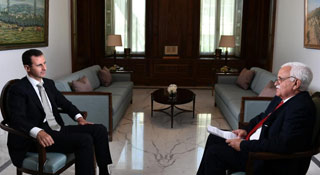
Prensa Latina transmits below the full text of the exclusive interview with Syrian President Bashar Al Assad:
PRENSA LATINA: Mr. President, thanks for giving Prensa Latina this historic opportunity of conveying your point of views to the rest of the world about the reality in Syria, because as you know, there is a lot of misinformation out there about your country, about the foreign aggression that is taking place against this beautiful country.
Mr. President, how would you evaluate the current military situation of the external aggression against Syria, and what are the main challenges of Syrian forces on the ground to fight anti-government groups? If it is possible, we would like to know your opinion about the battles or combats in Aleppo, in Homs.
President Assad: Of course, there was a lot of support to the terrorists from around the world. We have more than one hundred nationalities participating in the aggression against Syria with the support of certain countries like Saudi Arabia and Qatar with their money and Turkey with the logistical support, and of course with the endorsement and supervision of the Western countries, mainly the United States, France, and the UK, and some other allies.
But since the Russians decided to intervene in supporting legally the Syrian Army in fighting the terrorists in Syria, mainly al-Nusra and ISIS and some other affiliated groups, the scales have been tipped against those terrorists, and the Syrian Army has made many advancements in different areas in Syria.
And we are still moving forward, and the Syrian Army is determined to destroy and to defeat those terrorists. You mentioned Homs and Aleppo.
Of course, the situation in Homs, since the terrorists left Homs more than a year ago, the situation has been much, much better, more stable.
You have some suburbs of the city which were infiltrated by terrorists. Now there is a process of reconciliation in those areas in which either the terrorists give up their armaments and go back to their normal life with amnesty from the government, or they can leave Homs to any other place within Syria, like what happened more than a year ago in the center of the city.
For Aleppo it is a different situation, because the Turks and their allies like the Saudis and Qataris lost most of their cards on the battlefields in Syria, so the last card for them, especially for Erdogan, is Aleppo.
That is why he worked hard with the Saudis to send as much as they can of the terrorists – the estimation is more than five thousand terrorists – to Aleppo.
PRENSA LATINA: Through the Turkish borders?
President Assad: Yes, from Turkey to Aleppo, during the last two months, in order to recapture the city of Aleppo, and that didn’t work.
Actually, our army has been making advancement in Aleppo and the suburbs of Aleppo in order to encircle the terrorists, then, let’s say, either to negotiate their going back to their normal life as part of reconciliation, or for the terrorists to leave the city of Aleppo, or to be defeated. There’s no other solution.
PRENSA LATINA: Mr. President, which are the priorities of the Syrian Army in the confrontation with the terrorist groups? What is the role that the popular defence groups are playing in the theatre of operations?
President Assad: The priority of the Syrian Army, first of all, is to fight ISIS, al-Nusra and Ahrar al-Cham and Jaish al-Islam. These four organizations are directly linked to Al Qaeda through the ideology; they have the same ideology, they are Islamic extremist groups who want to kill anyone who doesn’t look or doesn’t feel or behave like them.
But regarding what you called the popular militia groups, actually, at the beginning of the war, the terrorists started an unconventional war against our army, and our army is a traditional army, like any other in the world, so the support of those popular defence groups was very important in order to defeat the terrorists in an unconventional way.
That was very helpful to the Syrian Army, because those fighters, those national fighters, they fight in their regions, in their cities, in their villages, so they know the area very well, they know the region very well, I mean the pathways, the terrain, let’s say, very well.
So, they can be very huge assets for the Syrian Army. That is their role.
PRENSA LATINA: Mr. President, how does the resistance of the Syrian people take place in the economic front to foreign aggression, I mean the economy, and please, what is your opinion on which sectors of the Syrian economy have remained functioning despite the war, economic blockade, looting, and so forth?
President Assad: Actually, the war on Syria is a full-blown war; it is not only supporting terrorists. They support the terrorists, and at the same time they launched a political war against Syria on the international level, and the third front was the economic front, in which they dictate to their terrorists, to their surrogate mercenaries, to start destroying the infrastructure in Syria that helped the economy and the daily needs of the Syrian citizens.
At the same time, they started an embargo directly on the borders of Syria through the terrorists and abroad through the banking systems around the world. In spite of that, the Syrian people were determined to live as much normal life as they can.
That prompted many Syrian businessmen or the owners of, let’s say, the industry, which is mainly medium and small industry, to move from the conflict areas and unstable areas toward more stable areas, on a smaller scale of business, in order to survive and to keep the economy running and to keep the needs of the Syrian people available.
So, in that regard, most of the sectors are still working. For example, the pharmaceutical sector is still working in more than 60 percent of its capacity, which is very important, helpful, and very supportive to our economy in such circumstances.
And I think now we are doing our best in order to re-expand the base of the economy in spite of the situation, especially after the Syrian Army made many advancements in different areas.
PRENSA LATINA: Mr. President, let’s talk a little bit about the international environment, please, give me your opinion about the role of the United Nations in the Syrian conflict, the attempts of Washington and its allies to impose their will on the Security Council and in the Geneva peace talks.
President Assad: Talking about the role of the United Nations or Security Council could be illusive, because actually the United Nations is now an American arm, where they can use it the way they want, they can impose their double standards on it instead of the Charter.
They can use it like any other institution within the American administration. Without some Russian and Chinese stances in certain issues, it would be a full American institution.
So, the Russian and Chinese role has made some balance within these institutions, mainly regarding the Syrian issue during the last five years. But if you want to talk about their role through their mediators or their envoys, like recently de Mistura, and before that Kofi Annan, and in between Brahimi, and so on. Let’s say that those mediators are not independent; they reflect either the pressure from the Western countries, or sometimes the dialogue between the main powers, mainly Russia and the United States.
So, they’re not independent, so you cannot talk about the role of the United Nations; it is a reflection of that balance. That is why so far, there is no United Nations role in the Syrian conflict; there is only Russian and American dialogue, and we know that the Russians are working hard and seriously and genuinely in order to defeat the terrorists, while the Americans always play games in order to use the terrorists, not to defeat them.
PRENSA LATINA: Mr. President, how do you see at the present time the coexistence among Syrian ethnic and religious groups against this foreign intervention? How do they contribute or not in this regard?
President Assad: The most important thing about this harmony between the different spectrums of the Syrian fabric, is that it is genuine, because that has been built up through the history, through centuries, so for such a conflict, it cannot destroy that social fabric.
That is why if you go around and visit different areas under the control of the government, you will see all the colors of the Syrian society living with each other.
And I would say, I would add to this, that during the conflict, this harmony has become much better and stronger, and this is not rhetoric; actually, this is reality, for different reasons, because this conflict is a lesson.
This diversity that you have, it is either to be a richness to your country, or a problem. There’s no something in the middle. So, the people learned that we need to work more on this harmony, because the first rhetoric used by the terrorists and by their allies in the region and in the West regarding the Syrian conflict at the very beginning was sectarian rhetoric.
They wanted people to divide in order to have conflict with each other, to stoke the fire within Syria, and it didn’t work. And the Syrians learned that lesson, that we had harmony; we had had harmony before the conflict, in the normal times, but we have to work more in order to make it much stronger.
So, I can say without any exaggeration that the situation regarding this part is good. In spite of that, I would say the areas under the control of the terrorists – and as you know those terrorists are mainly extremist groups affiliated to Al Qaeda – in which they worked very hard in order to indoctrinate the young generation with their dark ideology, and they succeeded in some areas, this dark ideology with the killing and beheading and all these horrible practices.
With the time, it is going to be more difficult to deal with this new generation of young people who have been indoctrinated with Al Qaeda and Wahabi doctrine and ideology. So this is the only danger that we are going to face regarding our society, harmony, and coexistence that you just mentioned.
PRENSA LATINA: Mr. President, I would like to go again to the international arena. What is in your opinion the role of the U.S.-led international coalition in relation to the groups that operate in northern Syria, in particular regarding the Kurds group. I mean the bombing of the American airplanes and the coalition in the northern part of the country. What to do you think about that?
President Assad: You know, traditionally, the American administrations, when they had relations with any group or community in any country, it is not for the sake of the country, it is not for the interest of the people; it is for the agenda of the United States.
So, that is what we have to ask ourselves: why would the Americans support any group in Syria? Not for Syria. They must their agenda, and the American agenda has always been divisive in any country. They don’t work to unite the people; they work to make division between the different kinds of people.
Sometimes they choose a sectarian group, sometimes they choose an ethnical group in order to support them against other ethnicities or to push them in a way that takes them far from the rest of the society.
This is their agenda. So, it is very clear that this American support is not related to ISIS, it is not related to al-Nusra, it is not related to fighting terrorism, because since the beginning of the American intervention, ISIS was expanding, not shrinking. It has only started to shrink when the Russian support to the Syrian Army took place last September.
PRENSA LATINA: Mr. President, what is your opinion about the recent coup d’état in Turkey, and its impact on the current situation in that country, and on the international level, and on the Syrian conflict also?
President Assad: Such a coup d’état, we have to look at it as a reflection of instability and disturbances within Turkey, mainly on the social level. It could be political, it could be whatever, but at the end, the society is the main issue when you have instability.
Regardless of who is going to govern Turkey, who is going to be the president, who is going to be the leader of Turkey; this is an internal issue. We don’t interfere, we don’t make the mistake to say that Erdogan should go or should stay. This is a Turkish issue, and the Turkish people have to decide.
But what is more important than the coup d’état itself, we have to look at the procedures and the steps that are being taken by Erdogan and his coterie recently during the last few days, when they started attacking the judges; they removed more than 2,700 judges from their positions, more than 1,500 professors in the universities, more than 15,000 employees in the education sector. What do the universities and the judges and that civil society have to do with the coup d’état?
So, that reflects the bad intentions of Erdogan and his misconduct and his real intentions toward what happened, because the investigation hasn’t been finalized yet. How did they take the decision to remove all those?
So, he used the coup d’état in order to implement his own extremist agenda, Muslim Brotherhood agenda, within Turkey, and that is dangerous for Turkey and for the neighboring countries, including Syria.
PRENSA LATINA: Mr. President, how do you evaluate the Syrian government’s relations with the opposition inside Syria? What is the difference between these opposition organizations and those based outside Syria?
President Assad: We have good relations with the opposition within Syria based on the national principles. Of course, they have their own political agenda and they have their own beliefs, and we have our own agenda and our beliefs, and the way we can make the dialogue either directly or through the ballot boxes; it could be a different way of dialogue, which is the situation in every country.
But we cannot compare them with the other oppositions outside Syria, because the word “opposition” means to resort to peaceful means, not to support terrorists, and not to be formed outside your country, and to have grassroots, to have real grassroots made of Syrian people.
You cannot have your grassroots be the foreign ministry in the UK, Franceor the intelligence in Qatar and Saudi Arabia and the United States. This is not opposition, this is called, in that case, you are called a traitor.
So, they call them oppositions, we call them traitors. The real opposition is the one that works for the Syrian people and is based in Syria and its agenda derived its vision from the Syrian people and the Syrian interests.
PRENSA LATINA: Mr. President, how do you evaluate the insistence of the U.S. and its allies that you leave power in addition to the campaign to distort the image of your government?
President Assad: Regarding their wish for me to leave power, they have been talking about this for the last five years, and we never responded even with a statement.
We never cared about them. Actually, this is a Syrian issue; only the Syrian people can say who should come and go, who should stay in his position, who should leave, and the West knows our position very well regarding this.
So, we don’t care and don’t have to waste our time with their rhetoric. I am here because of the support of the Syrian people. Without that, I wouldn’t be here. That is very simple.
About how they defame, or try to demonize certain presidents, this is the American way, at least since the second World War, since they substituted British colonization in this region, and maybe in the world, the American administrations and the American politicians haven’t said a single honest word regarding anything.
They always lie. And as time goes by, they are becoming more inveterate liars, so this is part of their politics. So, to demonize me is like how they tried to demonize President Vladimir Putin during the last two years and they did the same with the Cuban leader Fidel Castro during the last five decades.
This is their way. So, we have to know that this is the American way. We don’t have to worry about it. The most important thing is to have good reputation among your own people. That is what we have to worry about.
PRENSA LATINA: Mr. President, what is your opinion on Syria’s relation with Latin America, particularly the historical links with Cuba?
President Assad: In spite of the long distance between Syria and Latin America, we are always surprised how much the people in Latin America, not only the politicians, know about this region. I think this has many reasons, but one of them is the historical similarities and commonalities between our region, between Syria and Latin America.
Latin America was under direct occupation for long time ago but after that it was under the occupation of the American companies, and the American coup d’états and the American intervention.
So, they know what is the meaning of being independent or not to be independent. They understand that the war in Syria is about independence.
But the most important thing is the role of Cuba. Cuba was the spearhead of the independence movement within Latin America and Fidel Castro was the iconic figure in that regard.
So, on the political level and the knowledge level, there is a strong harmony between Syria and Latin America, especially Cuba. But I do not think we work enough to improve the other part of the relation; to be on the same level mainly on the educational and the economic level.
That was my ambition before the crisis and that is why I visited Latin America, Cuba, Venezuela, Argentine and Brazil, in order toinvigorate this relation. Then, we had this conflict started and it was a big obstacle to do anything in that regard, but I think that we have not to restrain the relation on the historical and the political levels. That is not enough. You have so many other sectors, people should know more about each other. The long distance could be an obstacle, but it shouldn’t because we have strong relations with the rest of the world, east and west.
So, it is not an obstacle in these days. So, I think if we overcome this crisis and this war, we should work harder in order to invigorate the different sectors of this relation with Latin America and especially with Cuba.
PRENSA LATINA: Mr. President, would you tell me your opinion about the electoral process in the United States mainly for the president? Now, there are two candidates; the Republican one is Mr. Donald Trump and the Democrat one is Mrs. Hillary Clinton, what is your opinion about this process, about the result of this process and how it could impact the conflict here, in the war in Syria?
President Assad: We resumed our relation with the United States in 1974. Now, it has been 42 years since then and we witnessed many American presidents in different situations and the lesson that we have learned is that no one should bet on any American president, that is the most important thing. So, it is not about the name.
They have institutions, they have their own agenda and every president should come to implement that agenda in his own way, but at the end he has to implement that agenda.
All of them have militaristic agendas, and the only difference is the way. One of them sends his army like Bush and the other one sends mercenaries and proxies like Obama, but all of them have to implement this agenda.
So, I do not believe that the president is allowed completely to fulfill his own political convictions in the United States, he has to obey the institutions and the lobbies, and the lobbies have not changed and the institutions’ agenda has not change.
So, no president in the near future will come to make a serious and dramatic change regarding the politics of the United States.
PRENSA LATINA: Mr. President, one final question: what message would you send using this interview with Prensa Latina to the governments and people of Latin America, the Caribbean, and also why not the American people, about the importance of supporting Syria against terrorism?
President Assad: Latin America is a very good and important example to the world about how the people and their governments regain their independence.
They are the backyard of the United States as the United States sees, but this backyard was used by the United States to play its own games, to implement its own agenda and the people in Latin America sacrificed a lot in order to regain their independence and everybody knows that.
After regaining their independence, those countries moved from being developing countries, or sometimes under-developed countries, to be developed countries. So, independence is a very important thing and it is very dear for every Latin American citizen.
We think they have to keep this independence because the United States will not stop trying to topple every independent government, every government that reflects the vast majority of the people in every country in Latin America.
And again, Cuba knows this, knows what I am talking about more than any other one in the world; you suffered more than anyone from the American attempts and you succeeded in withstanding all these attempts during the last sixty years or more just because the government reflected the Cuban people.
So, holding strongly to this independence, I think, is the crucial thing, the most important thing for the future of Latin America. Regarding Syria, we can say that Syria is paying the price of its independence because we never worked against the United States; we never worked against France or the UK. We always try to have good relations with the West.
But their problem is that they do not accept any independent country and I think this is same for Cuba. You never tried to do any harm to the American people but they do not accept you as an independent country.
The same is true for other countries in Latin America and that’s why you always have coup d’états mainly between the sixties and the seventies.
So, I think preserving the independence of a certain country is not only an isolated case; if I want to be independent, I have to support the independence in the rest of the world. So, the independence anywhere in the world, including Latin America, will support my independence. If I am alone, I will be weak.
Supporting Syria will be mainly in the international arena. There are many international organizations, mainly the United Nation, in spite of its impotence, but at the end, their support could play a vital role in supporting Syria and, of course, the Security Council; it depends on who is going to be the temporary member in the Security Council, and any other organization supporting Syria will be very important.
PRENSA LATINA: Mr. President, we know you are a very busy person, that is why I appreciate very much your time that you have dedicated to Prensa Latina interview in this moment. I hope this would not be the last interview that we have with you.
A 5-hour meeting between a visiting foreign minister and Russian President Vladimir Putin is not only rare but difficult to recall. Putin makes rare exceptions to receive foreign ministers. And he always receives them after their talks with Foreign Minister Sergey Lavrov. By all these yardsticks, US Secretary of State John Kerry’s meeting with Putin last Thursday in the Kremlin was extraordinary.
He drove into the Kremlin straight after touching down in Moscow Thursday evening and had talks with Putin lasting till 1 am in the wee hours of Friday morning. Putin’s rare appearance for a joint press briefing with a foreign minister (Kerry), Puitn’s ‘body language’ and, of course, the subsequent joint press conference by Kerry and Lavrov — they distinctly sought to convey the impression that the US and Russia were on to a big joint venture apropos the Syrian conflict. (here and here)
None of the three statesmen – neither Putin and Lavrov nor Kerry – was even remotely affected by the negative energy radiated by the high-profile summit meeting of the NATO, which had taken place in Warsaw hardly four days ago whose leitmotif was the strong determination of the western alliance to defend and deter Russia’s perceived aggressive tendencies in Eurasia.
Kerry is going to meet a select group of European allies later today in London to brief them on “the concrete steps that the U.S. and Russia are planning to take”. He disclosed that he had a phone conversation with Lavrov on Tuesday, and,
We both [with Lavrov] believe that we have understanding of the direction we are going in and what needs to be achieved. Our teams will meet shortly in order to continue to do that, in order to bolster the cessation of hostilities, in order to increase our capacity to fight against Al Qaeda, an Nusra, as well as fight back against ISIL.
It all sounds too good to be true. But then, Kerry is a seasoned diplomat with 30 years as a senator behind him during which he also headed the senate foreign relations committee and now as America’s top diplomat for over 3 years. Why is the US all of a sudden giving such hype to a peace project with Russia, an aggressive regional power, to kickstart a political process Syria?
The US has always sought a “selective engagement” of Russia on issues of concern to Washington while pursuing the containment strategy on another track. Lavrov may have gently rubbed this in when Kerry phoned him on Thursday to discuss the “concrete steps” on Syria as follow-up to his talks in the Kremlin last week. Curiously, the Russian Foreign Ministry readout makes a wry reference to Lavrov also, inter alia, availing of the opportunity to gently remind Kerry how the Obama administration is also simultaneously moving heaven and earth to humiliate Russia on another front by keeping it out of the Rio Olympics. These seasoned diplomats must be having the hide of rhinoceros — the readout says, “Mr. Kerry agreed that sports should not be politicized”. (here)
Won’t Moscow be aware that Kerry might even be dissimulating a concord with Russia over Syria? Won’t Moscow know that the Obama administration is on its last leg and time has run out? The point is, there is a powerful lobby in Washington, including the Pentagon and apparently within the State Department itself, which opposes any form of US-Russia cooperation in Syria that does not lead to the ouster of President Bashar al-Assad in a near term. (Read a briefing by the Brookings Institution, on the hawkish opinion in Washington.)
Indeed, the US is engaging Russia assiduously against the backdrop of the dramatic events in Turkey. The ground has shifted in the geopolitics of the region. Interestingly, Kerry made the hurried unscheduled trip to Moscow last week within 4 days of the NATO summit even as the failed coup attempt was getting under way in Turkey. Actually, Kerry was about to meet with Putin in the Kremlin — or had been conversing with him already –even as the coup began in Turkey. Something doesn’t quite gel here, isn’t it? Suffice it to say, much depends on how far back Kerry (Obama administration) actually had known about the coup that was in the making in Turkey. (Read a breath-taking, blow-by-blow account of the ‘Turkish coup’ by senior editor Murat Yetkin in today’sHurriyet.)
Of course, the failed coup in Turkey becomes a defining moment for the Syrian conflict. The Turkish military and state intelligence – and the political leadership – are all passing through such turbulence that Ankara simply lacks the presence of mind or the sheer capacity to continue to pursue an interventionist policy in Syria in a foreseeable future. Meanwhile, great uncertainties have crept into Turkey’s relations with the US and Europe. Moscow cannot but be aware that Turkey desperately needs to hold the Russian hand — and that indeed adds to Russia’s politico-military options in Syria. The thinking is reflected in a commentary by a top Kremlin pundit Fyodor Lukyanov inMoscow Times.
Clearly, the US policies on Syria are floundering. The Syrian forces have laid siege to Aleppo and the US-backed rebels are trapped inside the city, while Turkey may have begun disengaging from reaching aid to them. Washington has no option but to engage Moscow to work out some sort of face-saving compromise formula.
But what does Russia get in return? Participation in Rio Olympics? It shouldn’t be surprising if the International Olympics Committee has a last-minute change of heart and says ‘Da‘ to the Russian team, finally. If that happens, it will be in the best traditions of Russian-American trade-offs, and Kerry worked hard on it.
The recent violent events in Turkey, Armenia and Kazakhstan could have been provoked by special services “from across the ocean,” a Russian MP working on the committee in charge of Eurasian integration has commented.
“In my opinion these are all links in one chain. The events in Turkey, Armenia and in Aktobe, Kazakhstan, are all connected and were all provoked from abroad. I think that special services from across the ocean are dealing with these issues, destabilizing the situation in these countries,” the deputy chair of the State Duma Committee for Eurasian Integration and Commonwealth of Independent States, Kazbek Taisayev, told Life news portal.
The MP said that Western nations were not interested in a calm situation near Russian borders and took steps to prevent such developments.
“As soon as we start a normal dialogue with our neighbors, something immediately happens in these countries,” he said.
“We need to unite our efforts, I think that we have enough political will to render mutual help to poor nations,” Taisayev stated.
The comment came shortly after a group of radical nationalists stormed and captured a police station in Armenia’s capital, Yerevan, killing one policeman and taking several more hostage. The attackers demanded the release of Armenian opposition figure Jirayr Sefilyan, who was detained last month after authorities reportedly uncovered a plot to seize several buildings and telecommunication facilities in Yerevan.
The standoff continues and on Wednesday night Armenian police used tear gas to dissolve a rally of Sefiyan’s supporters in central Yerevan.
In early June, a group of radicals raided two gun shops, hijacked a bus and attacked a military base in the city of Aktobe, Kazakhstan, killing at least five people and wounding 10 more. Police fought off the terrorists, killing four of them and arresting seven more.
This week two people allegedly connected with radical Islamist groups opened fire at a police station in Kazakhstan’s largest city, Almaty, killing seven people and injuring nine more. President Nursultan Nazarbaev has called the attack an act of terrorism.
On July 15, an attempted military coup took place in Turkey. A large group of military officers attempted to seize power, displacing President Recep Tayyip Erdogan. However, their plans were thwarted by police and thousands of ordinary people who took to the streets of Ankara and Istanbul. According to Turkish authorities 246 government supporters and at least 24 coup plotters were killed during the conflict. Thousands of Turkish military and law enforcement personnel were arrested and fired in the large-scale purge that followed these events.
On Wednesday, Erdogan announced the introduction of a state of emergency in Turkey for three months.
Erdogan and the government have said that the attempted coup was masterminded by Muslim cleric Fethullah Gulen who is currently living in the United States. Ankara also demanded Gulen’s extradition.
The successful mission by a Hezbollah drone entering Israeli air space in the Golan Heights and taking photographs is a significant development at various levels. At its most obvious, Hezbollah has mocked Israel’s vaunted air superiority. Three Israeli missiles, including one fired by an F-16, couldn’t bring down the drone which returned safely to Syria. For Israel, it amounts to a humiliating show of contempt by the Hezbollah. (Sputnik )
Second, Russian radar would have certainly picked up the drone, but did nothing about it. It is straight out of Sherlock Holmes – the dog didn’t bark. The bottom line is, neither will Russia rush to protect the Hezbollah nor move a little finger to deter it.
Third, of course, the drone is a technology demonstrator, underscoring Hezbollah’s growing capability to hit back at Israel if attacked. This particular drone probably didn’t carry weapons, but the next one always could.
To be sure, Israel can only wonder how Hezbollah has gained access to such sophisticated technology. From Russia? Or, Iran? Or, is it Hezbollah technology?
Then, there is the ‘big picture’. Israel has been reminded that Golan Heights is still a frontline. Israel’s best hope is that Syria will remain weak and fragmented with no central authority in Damascus to challenge its future annexation of the occupied territories in Golan Heights. Hezbollah may have signalled that that remains a pipedream. In fact, the Syrian government forces are incrementally gaining the upper hand on the ground. The blockade of Aleppo turns the tide of war. In a telling sign of the tide turning, there are reports that Turkey has sent ‘feelers’ to the Syrian government. (Guardian )
Now, the developments in Turkey can only mean that Ankara may roll back its intervention in Syria. Turkey’s focus is on preempting a Kurdistan taking shape on its borders with tacit US support (which Israel too welcomes) and on this platform Syria, Iran and Iraq are Ankara’s ‘natural allies’.
On the other hand, without Turkey, neither Saudi Arabia nor Qatar or the other Sheikhdoms in the Gulf would have the spunk to advance the ‘regime change’ agenda in Syria. Simply put, Israel is being reduced to a mute witness to dramatic changes and realignments in its very neighbourhood with no role or capacity to influence them politically or militarily. Arguably, Israel and Saudi Arabia are the biggest ‘losers’ in the failed coup in Turkey. Both will be desperately hoping that the US will come up with some bright idea to retrieve the Syrian situation at the 2-day anti-ISIS coalition conference taking place in Washington on July 20-21. But then, the Turkish-US standoff over the extradition of Fetullah Gulen has introduced new uncertainty regarding the US’ capacity to influence the course of events in Syria.
All in all, the drone provocation by Hezbollah calls attention to the big shift in the balance of forces in the Middle East as a result of the Syrian conflict. For the first time, Israel has to contend with superior military power in its neighborhood. Indeed, but for the Russian presence, Israeli jets would have been raining destruction on Syria by now in retaliation. Fortunately, Israel faces no ‘blowback’ as such from the ISIS or the al-Qaeda affiliate Nusra Front — unlike Turkey or Saudi Arabia — for its intervention in the Syrian conflict. (Read an Iranian commentary Turkey Coup: Who Else Is Going the Way Of Iraq and Syria?)
Russian President Vladimir Putin did on Sunday what no major western leader from the NATO member countries cared to do when he telephoned his Turkish counterpart Recep Erdogan to convey his sympathy, goodwill and best wishes for the latter’s success in restoring constitutional order and stability as soon as possible after the attempted coup Friday night.
The US Secretary of State John Kerry instead made an overnight air dash to Brussels to have a breakfast meeting on Monday with the EU foreign ministers to discuss a unified stance on the crisis in Turkey. The French Foreign Minister Jean-Marc Ayrault was in an angry mood ahead of the breakfast, saying “questions” have arisen as to whether Turkey is any longer a “viable” ally. He voiced “suspicions” over Turkey’s intentions and insisted that European backing for Erdogan against the coup was not a “blank cheque” for him to suppress his opponents.
The US has expressed displeasure regarding the Turkish allegations of an American hand in the failed coup. Indeed, the Turkish allegation has no precedent in NATO’s 67-year old history – of one member plotting regime change in another member country through violent means. Clearly, US and Turkey are on a collision course over the extradition of the Islamist preacher Fethullah Gulen living in exile in Pennsylvania whom the Turkish government has named as the key plotter behind the coup. Turkish Prime Minister Binali Yildirim has warned that Ankara will regard the US as an “enemy” if it harbored Gulen. The dramatic developments expose the cracks appearing in the western alliance system. (See the commentary in the Russian news agency Sputnik entitled NATO R.I.P (1949-2016): Will Turkey-US Rift Over Gulen Destroy Alliance?)
Interestingly, the senior Turkish army officials detained so far include the following:
Commander of the Incirlik air base (and 10 of his subordinates) where NATO forces are located and 90 percent of the US’ tactical nuclear weapons in Europe are stored;
Army Commander in charge of the border with Syria and Iraq;
Corps Commander who commands the NATO contingency force based in Istanbul; and,
Former military attaches in Israel and Kuwait.
Most certainly, the needle of suspicion points toward the Americans having had some knowledge of the coup beforehand. Two F-16 aircraft and two ‘tankers’ to provide mid-air refuelling for them and used in the coup attempt actually took off from Incirlik.
Of course, Ankara has been wary of the US and France establishing military bases in northern Syria with the support of local Kurdish tribes, which it suspected would be a stepping stone leading to the creation of a ‘Kurdistan’. (The advisor on foreign affairs to Iran’s supreme leader, Ali Akbar Velayati, who is an influential figure in Tehran alleged on Sunday that the US is attempting to create a Kurdistan state carved out of neighboring countries with Kurdish population, which will be a “second Israel” in the Middle East to serve Washington’s regional interests.)
Today, the famous Saudi whistleblower known as ‘Mujtahid’ has come out with a sensational disclosure that the UAE played a role in the coup and had kept Saudi Arabia in the loop. Also, the deposed ruler of Qatar Hamad bin Khalifa Al-Thani (who is a close friend of Erdogan) has alleged that the US, another Western country (presumably France) had staged the coup and that Saudi Arabia was involved in it. (here and here) Meanwhile, word has leaked to the media that in a closed-door briefing to the Iranian parliament on Sunday, Foreign Minister Mohammad Zarif hinted at Saudi and Qatari involvement in the coup.
Putin’s phone call to Erdogan suggests the possibility that Russian and Turkish intelligence are keeping in touch. The two leaders have agreed to meet shortly.
The timing of the coup attempt – following the failure of the US push to establish a NATO presence in the Black Sea and in the wake of the Russian-Turkish rapprochement – becomes significant. Equally, the signs of shift in Turkey’s interventionist policies in Syria would have unnerved the US and its regional allies.
Israel, Saudi Arabia and Qatar have a great deal to lose if Turkey establishes ties with Syria, which is on the cards. Thus, stopping Erdogan on his tracks has become an urgent imperative for these countries. The spectre of the Syrian government regaining control over the country’s territory haunts Israel, which has been hoping that a weakened and fragmented Syria would work to its advantage to permanently annex the occupied territories in the Golan Heights. Again, Turkey’s abandonment of the ‘regime change’ agenda in Syria means a geopolitical victory for Iran. On the contrary, a triumphant and battle-hardened Hezbollah next door means that its vast superiority in conventional military strength will be rendered even more irrelevant in countering the resistance movement. Significantly, Israel is keeping stony silence.
Will the US and its regional allies simply throw in the towel or will they bide their time to make a renewed bid to depose Erdogan? That is the big question. Erdogan’s popularity is soaring sky-high today within Turkey. He can be trusted to complete the ‘vetting’ process to purge the Gulenists ensconced in the state apparatus and the armed forces. The meeting of the High Military Council due in August to decide on the retirement, promotions and transfers of the military top brass gives Erdogan the free hand to remove the Gulenists.
M. K. Bhadrakumar is the former career diplomat in the Indian Foreign Service.
The lie about Erdoğan being refused asylum in Germany appears to have originated (see from 13:50 in the video here) with a tweet from an MSNBC producer called Kyle Griffin, based on information from a ‘senior US military source’. I believe that conclusively refutes any American claims to non-involvement.
A main suspect in the failed coup against the Turkish government formerly served as a military attaché to Israel, reports say.
General Akin Öztürk, also the former commander of Turkey’s air force, was arrested on Saturday along with at least five other generals in connection to the failed coup.
From 1998 to 2000, Öztürk served in Turkey’s Tel Aviv embassy and later went on to serve as the air force commander until he stepped down last year. He then retained his seat on Turkey’s Supreme Military Council.
Turkey has announced that Öztürk and his alleged partners will be tried over treason charges.
According to Turkish Prime Minister Binali Yildirim, those behind the coup will not face the death penalty as it is against the country’s constitution, but constitutional changes are being considered to block future coups.
Prior to the coup, Öztürk was a celebrated military figure, honored by medals from his own country and NATO.
The coup attempt started on Friday evening when tanks took up positions on two bridges over the Bosphorus Strait in Istanbul, blocking traffic.
On Saturday, Turkey announced that the failed attempt to seize control of the country by a faction of the armed forces is now over, with 2,839 soldiers, including high-ranking officers being arrested.
Yildirim also said that 161 people had been killed and 1,440 wounded in clashes in the night he called a “black stain on Turkish democracy.”
It is surprising that the reaction of the NATO member states to a coup attempt in Turkey was rather modest, Afshin Rattansi, an RT contributor and the host of RT’s Going Underground said, adding that some years ago they would have rushed to aid their ally.
RT:This coup has given Erdogan a perfect chance to tighten his grip on alleged enemies within the army. What could this lead to?
Afshin Rattansi: Yes, very worrying to hear. But possible reintroduction of the death penalty and thousands are being arrested. We have got to remember that the CIA backed the coup in 1980, 36 years ago – half a million people were arrested. We can’t be sure whether it is going to be that number this time round. It’s interesting that the Prime Minister so quickly blamed the Gulen movement. Now, who is this movement? The cleric lives in the US. Well, that is the movement that reportedly funds the Hillary Clinton campaign. Certainly there will be people in Ankara not wishing for a Clinton presidency anytime soon given that so many supporters right now are being arrested. There are ties here that show how complex the events of the past 12 hours are.
RT:How would it impact relations with the EU? Would the union now discuss the membership of a country that is weighing bringing back the death penalty?
AR: As we hear in London during the referendum debate, it was repeatedly told to the British people that there is no chance whatsoever Turkish accession to the EU – that was before the referendum. So Britain does not really have a say in that today. But I think obviously critical to the whole situation in the past few hours is the Incirlik Air Base. Turkey is a NATO country. Astonishing that just a couple of years ago we would have expected NATO nations to have come to the aid of the Erdogan government, which was elected in November. This time? Nothing.
Also astonishing is John Kerry in Moscow looking to evaluate the situation, not [offering] immediate support for this linchpin of NATO supremacy, as they see it in terms of world security – this critical country in terms of their domination of the Middle East. Well, the reason why they are not going to be joining the EU any time soon is the flip-flopping of Erdogan.
He went from being a hero of the Arab world, when he championed the cause of Palestinians, [then] suddenly he switched to being – along with Britain and the US – pro-the overthrow of the secular government of Syria and supporting de facto ISIS/ISIL/DAESH and al-Qaeda linked groups.
RT: As you said, Turkey is an ally of the US in the region. But today it is saying it doesn’t want to be friends with the country that allegedly protects its enemy, Fethullah Gulen, who has actually denied being a part of this plot. The man is in self-imposed exile in America. Can Ankara afford such aggressive rhetoric against Washington?
AR: We know very well in this country [the UK] that one intelligence side doesn’t know what the other is doing – when I’m thinking of MI5 and MI6. So it has to be noted that while Erdogan has been supporting Anglo-American policy in destabilizing Syria, just in the past few days, and I think that is what a lot of analysts and observers have noted, sudden rapprochement with Russia – Turkey shot down a Russian aircraft, there have been very frosty relation between the two countries – just in the past few days sudden rapprochement; rapprochements with China and then revelations of back channels with President Assad himself – the man that Britain and the US have been trying to overthrow now for five or six years. Coincidence that suddenly there is a coup; maybe there are forces within the US that were expecting this.
It is no surprise that there would be great instability in Turkey. It is not just Erdogan’s foreign policies, it is the brutal economic policies he has. But let’s not forget: Ever since this CIA-backed coup of 1980, the economic policies of Turkey have been determined by big multinationals, by big powerful forces to the detriment of millions of working-class Turks.
RT: Is Erdogan capable of getting complete control over all of the military in the country? There is huge discontent in the military, isn’t there?
AR: In NATO nations, militaries just as in Britain, as in Turkey, are not controlled by sovereign governments after all – it is up to NATO command, which is answerable to Washington as to what the military does, which is why in the initial reports of the military coup attempt one wondered immediately by the American connections to these military forces in the US, which is presumably what President Erdogan is alluding to as regards the future relations between Ankara and Washington.
Colonel Muharrem Kose, a former officer in the Turkish Armed Forces was named by state-run Anadolu News Agency as the leader of the coup attempt against President Recep Tayyip Erdogan’s government.
The bloody coup attempt that struck Ankara on Friday now has a face — a former Turkish military officer who was dishonorably discharged in March 2016 for his alleged association with anti-government and US-based Imam Fethullah Gulen.
Colonel Muharrem Kose announced the formation of the “Peace Council,” an interim government to restore democracy and human rights in Turkey that Erdogan’s opponents claim have been stripped from the country as it had begun to drift ever closer to a theocracy after long being adored as the secular gem of the Middle East.
Military forces loyal to Colonel Kose seized the state-run TRT News station, the bridges, and Ataturk International Airport on Friday evening before being pushed back by Turkish forces loyal to Erdogan as bloody struggles have ensued throughout the country.
It appeared that the coup effort had succeeded until President Erdogan took to CNN Turk, calling in via FaceTime, pleading with his countrymen to resist the effort to overthrow the government by taking to the streets. The move, initially mocked by Western media and leaders, appears to have been successful with millions of Turks taking to the streets to resist Colonel Kose’s Peace Council.
Turkish President Recep Tayyip Erdogan earlier in the day blamed supporters of the Pennsylvania-based Imam Fethullah Gulen, prior to identifying Colonel Kose as the lead agitator in the coup attempt. Despite Muharrem Kose’s apparent links to Gulen, the Imam’s non-profit, the Alliance for Shared Values, denies any involvement and has condemned “any military intervention in the domestic politics of Turkey.”
Gulenists are not hardliners as the Imam preaches a blend of piety and Sufi mysticism while calling for free markets, democracy and religious tolerance in keeping with the original vision of Turkey laid down by the country’s founder Kemal Ataturk.
Gulen’s movement known as Hizmet, once boasted as many as 2,000 officers within the Turkish military prior to crackdowns by President Erdogan. Supporters of Gulen have long attempted to use the judiciary to advance corruption investigations against Erdogan sparking a bitter divide between the two groups. Turkish authorities accuse Gulen of attempting to form an opposing “state within a state” known by many in Turkey as the “Parallel Structure.”
Prior to being ousted for his alleged ties to the Gulenist movement, Muharrem Kose proudly served as the chief legal counsel to the Turkish military’s chief of staff Hulusi Akar. Akar was taken hostage in the first hours of the coup attempt that began on Friday evening.
By Kevin Barrett | Crescent | Dhu al-Qa’dah 24, 1445
In corporate America, hostile takeovers are commonplace. They occur when an aggressor—a larger corporation or rich individuals—seizes control of a smaller corporation without asking permission.
What few recognize is that the United States itself has been subjected to a hostile takeover. Since the aggressor, the illegitimate settler colony known as “Israel,” is much smaller than the US, the takeover has necessarily been surreptitious.
As of June, 2024, Israel’s gradual takeover of the US has become obvious and undeniable—a proverbial “elephant in the living room.” … continue
This site is provided as a research and reference tool. Although we make every reasonable effort to ensure that the information and data provided at this site are useful, accurate, and current, we cannot guarantee that the information and data provided here will be error-free. By using this site, you assume all responsibility for and risk arising from your use of and reliance upon the contents of this site.
This site and the information available through it do not, and are not intended to constitute legal advice. Should you require legal advice, you should consult your own attorney.
Nothing within this site or linked to by this site constitutes investment advice or medical advice.
Materials accessible from or added to this site by third parties, such as comments posted, are strictly the responsibility of the third party who added such materials or made them accessible and we neither endorse nor undertake to control, monitor, edit or assume responsibility for any such third-party material.
The posting of stories, commentaries, reports, documents and links (embedded or otherwise) on this site does not in any way, shape or form, implied or otherwise, necessarily express or suggest endorsement or support of any of such posted material or parts therein.
The word “alleged” is deemed to occur before the word “fraud.” Since the rule of law still applies. To peasants, at least.
Fair Use
This site contains copyrighted material the use of which has not always been specifically authorized by the copyright owner. We are making such material available in our efforts to advance understanding of environmental, political, human rights, economic, democracy, scientific, and social justice issues, etc. We believe this constitutes a ‘fair use’ of any such copyrighted material as provided for in section 107 of the US Copyright Law. In accordance with Title 17 U.S.C. Section 107, the material on this site is distributed without profit to those who have expressed a prior interest in receiving the included information for research and educational purposes. For more info go to: http://www.law.cornell.edu/uscode/17/107.shtml. If you wish to use copyrighted material from this site for purposes of your own that go beyond ‘fair use’, you must obtain permission from the copyright owner.
DMCA Contact
This is information for anyone that wishes to challenge our “fair use” of copyrighted material.
If you are a legal copyright holder or a designated agent for such and you believe that content residing on or accessible through our website infringes a copyright and falls outside the boundaries of “Fair Use”, please send a notice of infringement by contacting atheonews@gmail.com.
We will respond and take necessary action immediately.
If notice is given of an alleged copyright violation we will act expeditiously to remove or disable access to the material(s) in question.
All 3rd party material posted on this website is copyright the respective owners / authors. Aletho News makes no claim of copyright on such material.