Turkey rejects Iraq’s warning against Ankara troop deployment
Press TV – December 31, 2015
Turkish Prime Minister Ahmet Davutoglu has dismissed Baghdad’s warning of military action to defend Iraqi sovereignty if Ankara does not pull its troops out of northern Iraq.
“If Baghdad wants to use force, they should use it against Daesh, get rid of Daesh from Mousul. If they do so… why we would risk our army, we would withdraw to our country,” Davutoglu said in an interview with Turkish broadcaster NTV.
He made the remarks in response to Iraqi Foreign Minister Ibrahim al-Jaafari, who called on Turkey Wednesday to withdraw its troops or risk the use of military action.
Baghdad and Ankara are locked in a war of words over the presence of Turkish troops in northern Iraq.
On December 4, Turkey deployed some 150 soldiers, equipped with heavy weapons and backed by 20 to 25 tanks, to the outskirts of Mosul, the capital of Iraq’s Nineveh Province.
Ankara claimed the deployment was part of a mission to train and equip Iraq’s Kurdish Peshmerga forces in the fight against Daesh.
Baghdad has strongly condemned the presence of the Turkish battalion on the Iraqi territory, branding the uncoordinated act as a violation of Iraq’s national sovereignty.
Elsewhere in his remarks, Davutoglu claimed that Turkish troops were in northern Iraq in a bid to prevent terrorist infiltration into Turkey.
“I wish Iraq can control this area (northern parts) so that we don’t need to launch air operations there to prevent the leak of terrorists into Turkey.”
On Wednesday, Iraqi Prime Minister Haider al-Abadi held a phone conversation with Davutoglu, calling on Ankara to respect the territorial integrity of Iraq and withdraw its troops from the Arab country.
Syria Accuses Turkey of ‘Taking Part in Military Operations’ Backing Daesh
Sputnik – 30.12.2015
Turkish forces directly assisted terrorist groups fighting in Syria, Bashar Jaafari, Syria’s envoy to the UN, wrote in a letter to the UN Secretary General and the Security Council.
Jaafari noted that armed groups have been waging an “unprecedented terrorist war” against Syria since 2011, adding that rebels receive backing from regional powers, including “the Erdogan regime,” and other countries.
Turkey’s engagement in Syria’s domestic affairs, according to Jaafari, has been multifaceted, “including the direct participation of the Erdogan regime’s armed forces in offensive military operations in support of terrorists.”
Ankara, according to the letter, has essentially helped terrorists enter Syria. Turkish troops provided “fire cover” to rebels crossing to the war-torn Arab country.
Bashar Jaafari also noted that the Turkish president wants to “revive the Ottoman colonial legacy” as evidenced by Erdogan’s explicit desire to protect ethnic Turks, even if they live in other countries.
The Syrian envoy accused Ankara of committing crimes against Syrian refugees, who fled Daesh, al-Nusra Front and other terrorist organizations fighting in the Arab country. Human trafficking, according to Jaafari, is conducted “with knowledge and direct participation” of organizations controlled by the Erdogan regime.
Jaafari has called on the international community to put an end to “violations and crimes” committed by the Turkish leadership with regard to Syria and Syrian refugees.
The Syrian envoy to the UN also mentioned the Russian bomber, which was shot out of Syrian skies by a Turkish fighter jet while on a counterterrorism mission. “No additional explanations are needed since this crime speaks for itself,” he noted.
Turkey Backs Anti-Russian Tatar Sabotage and Subversion
By Stephen Lendman | December 29, 2015
Turkish President Erdogan is up to his ears in high crimes, internally and abroad, his rap sheet matching some of the world’s worst.
Self-determination is a universal right. Crimea is legally part of Russia, its population overwhelmingly voting by national referendum in March 2014 (by a 96.77% majority with an 83.1% turnout) to correct a historic mistake.
There’s no going back or legitimate reason for any nation to reject reality. Washington and likeminded regimes remain hardline, including Turkey – Erdogan directly aiding the formation of a Crimean Tatar battalion, tasked with committing sabotage and other forms of subversion. More on this below.
Last August, Erdogan met with anti-Russian Tatar resistance leaders Mustafa Dzhemilev and Refat Chubarov in Ankara – promising no Turkish recognition of Crimea as a Russian province, pledging aid to its subversive resistance.
Recently, he met with Dzhemilev and Chubarov in Konya Turkey, both men organizers of the failed Crimean food and electricity blockade. Discussions about a strategic alliance with Ukraine and possible naval blockade of the peninsula were held – with Turkey’s involvement.
Lenur Islyamov represents the illegitimate, unregistered “Majlis (or council) of Crimean Tatars” organization. He explained Ankara is actively involved in forming a Tatar battalion on the pretext of “protecting the Crimean frontier” – code language for plotting sabotage and subversion, operating as an enemy of Russia with direct Erdogan aid.
According to Islyamov, “(w)hile the Ukrainian defense ministry only scratches its head, (its) Turkish” counterpart is offering direct support – likely including weapons, munitions, funding and training to commit lawless acts against the Russian Federation.
Islyamov told Ukrainian television viewers, “(w)e now have more than a hundred people who have already entered the battalion as volunteers, but we hope that after all the ministry of defense and the armed forces of Ukraine, will create and allow the Crimean Tatars to have their own national battalion within the armed forces.”
He aims to enlist hundreds of fighters, able to wage guerrilla war on the pretext of defending Crimea’s borders, risking direct confrontation with Moscow, apparently part of Erdogan’s dirty scheme complicit with Washington, following his downing a Russian Su-24 bomber, a willful act of war.
Islyamov promised further efforts to isolate Crimea and ways to “liberate Tatars” within a year – returning the peninsula to Ukraine – a strategy of madness, making no more sense than attempting to liberate my home state of Illinois from America.
His notion of instituting a naval blockade with Turkish help, including “small boats (able) to attack ships carry(ing) goods to Crimea” has no chance to succeed.
In late November, Tatar insurgents destroyed parts of the southern Ukraine Kherson region electricity grid, supplying energy to Crimea – preventing repair crews from restoring power, leaving 1.8 million people in the dark for days.
Russia intervened responsibly, supplying energy amounts needed – the first stage of a so-called energy bridge weeks ahead of schedule.
Most Crimeans are ethnic Russians, Tatars at most about 12% of the population, their people not in conflict with other ethnic groups, a small rogue band entirely responsible.
Erdogan risks greater confrontation with Russia than already – by partnering in sabotage and subversion, more proof of his rogue credentials.
Legitimate Majlis Tatar officials reject Dzhemilev, Chubarov, Islyamov and other hardliners, saying “cooperation with extremist groups condemned by the whole progressive world has deprived them of their right to represent Crimean Tatars.”
“From now on, all their statements at any forums should be qualified as personal opinions” – not representing the views of the vast majority of Crimean Tatars.
They denounced rogue elements using Tatar national symbols, saying they’re “not a bargaining chip for political crooks. No one gave them the right to unilaterally use our relics at their discretion.”
Erdogan continues overstepping recklessly, already deeply involved in supporting ISIS, challenging Russia’s patience, perhaps sowing seeds of internal rebellion.
Stephen Lendman can be reached at lendmanstephen@sbcglobal.net.
His new book as editor and contributor is titled “Flashpoint in Ukraine: US Drive for Hegemony Risks WW III.”
Turkey blocks Carlos Latuff website: ‘This means I’m doing the right things’
RT | December 29, 2015
For over a decade Brazilian political cartoonist Carlos Latuff has championed what he calls “artistic activism” by animating world leaders and pressing global topics. No issue is considered too controversial by the artist, who has put his own spin on topics including the Gaza war, the rise of ISIS, Ebola, and the Scottish referendum. He’s also known for his bold cartoons depicting Turkey’s alleged links with ISIS.
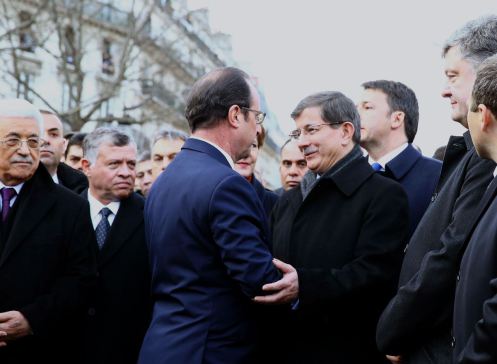
Turkish Foreign Minister Ahmet Davutoglu (center R) talks to French President Francois Hollande (center L) during the Unity March ‘Marche Republicaine’ in Paris, France on January 11, 2014.
(Photo by Hakan Goktepe/Anadolu Agency/Getty Images)
What’s Behind Turkey’s Repeated Calls for No-Fly Zone in Syria?
Sputnik – 29.12.2015
Turkish President Tayyip Erdogan’s calls for a safe zone in Syria are aimed at destabilizing the situation in the region, including the collapse of Syria, analysts said.
On December 27, Turkish President Recep Tayyip Erdogan announced plans to create a safe zone in Syria. In an interview with Al Arabiya he said that the safe zone could shelter refugees who live in Turkey and want to return to Syria.
The zone is initially planned to stretch 98 km along the border and span 45 km in the territory of Syria, with the possibility of further expansion, Erdogan explained. According to the president, the area will be “terrorism-free”.
He also suggested that the Turkish government could begin raising funds for the project, including building houses for refuges.
Thus, Erdogan continues to hold unofficial discussions with Washington. In early December, White House Press Secretary Josh Earnest said that projects such as a safe zone in Syria would require significant resources.
Ground forces would be necessary to protect a safe zone. But this contradicts the strategy proposed by President Barack Obama, Earnest underscored.
Meanwhile, in August, the Turkish Foreign Ministry announced that Washington had given the green light to establish a safe zone in Syria which would be protected jointly by US and Turkish troops.
In turn, Washington denounced the statement saying that the sides had agreed only on using the Turkish Incirlik airbase by US forces. It seems that the US and Turkey discussed a safe zone but in the end Washington evaded any final agreements.
Now, Erdogan has again brought up the initiative. And this time it is very likely that Turkey will act. The situation is changing in Syria where government forces have significantly advanced against terrorists. The country may be divided into “occupation zones”, so it is very important for Ankara to play one of the key roles in the process.
“Now, Erdogan needs major achievements in his foreign policy,” Alexei Fenenko, a security expert at the Russian Academy of Sciences, told Svobodnaya Pressa. “The last two months were difficult for the Turkish president. The row between Ankara and Moscow caused a crisis in tourism and in the Turkish garment industry. His attempt to invade Iraq failed. Finally, Turkey now has tensions with Greece.”
All of the above has prompted Erdogan to take decisive steps to establish a safe zone in Syria, the analyst noted.
“I’m afraid this may be the scenario. There is no one more fearless than a politician who has nothing to lose. After a series of failures a politician like Erdogan can hit badly,” Fenenko said.
Turkey is very likely to attempt to occupy part of Syria to establish a safe zone, he pointed out. At the same, the US’ actions would depend on what Ankara achieves.
At the same time, Russia will oppose such a scenario since it is committed to protecting Syria’s territorial integrity, Fesenko said.
“I believe we should once again reaffirm our readiness to protect its territorial integrity. Russia may rely on its S-400 air defense systems deployed to the Hmeymim airbase. This means there is still the possibility of a military confrontation between Russia and Turkey,” he concluded.
Erdogan has made numerous statements about his readiness to establish a safe zone in Syria, analyst Stanislav Tarasov said.
Ankara’s policy in the region is still based on the scenario which presumes the collapse of Syria and Iraq, he pointed out. But the balance has changed, and other players will not let Turkey establish a safe zone in Syria.
“Turkey will not invade Syria. There are Syrian forces backed by Russian jets. What is more, if Turkey invaded the Kurds may support Damascus,” Tarasov said. “The problem is that Ankara still relies on Syria’s collapse and is not ready for any other outcome. This is why Ankara’s calls for a safe zone in Syria are wrong.”
German Leftists to Protest Sending AWACs to Turkey Without Parliamentary Approval
By Alexander Mosesov | Sputnik | 28.12.2015
Germany’s Left Party (Die Linke) will officially protest the government’s decision to send Boeing E-3 Sentry Airborne Warning & Control System (AWACS) aircraft to Turkey without a parliamentary approval, member of the German parliament’s defense committee told Sputnik on Monday.
On Sunday, media reported that NATO would place the Boeing E-3 Sentry aircraft as part of its air defense package to Turkey amid the Syrian crisis. The deployment will be carried out by the country’s armed forces. The German government says the deployment only has to do with surveillance operations and the parliament will not be consulted on the issue.
“The Left party will officially protest against this decision of sending troops without consulting the parliament,” Alexander Neu said.
Neu also added that the country’s political elite “is eager to make Germany a big player [in the Middle East] by military means.”
Earlier in the day, German lawmakers criticized the government for the decision, saying that Bundestag should be immediately informed of the details.
On December 18, NATO agreed to provide Ankara with an air defense package that will include AWACS surveillance planes, enhanced air policing, and increased naval presence amid the ongoing conflict in Syria.
Syria has been mired in civil war since 2011, with opposition factions and Islamist terrorist groups fighting the Syrian Army.
Syria: Has Anyone Stepped Back from the Brink?
By Michael Jabara CARLEY | Strategic Culture Foundation | 26.12.2015
John Kerry, the US Secretary of State, recently visited Moscow to discuss the Syrian crisis with his colleague Sergei Lavrov and President Vladimir Putin. Journalists observed handshakes, smiles, even hearty laughter, between Kerry and his Russian counterparts. Syrian President Bashar al Assad does not have to resign immediately, Kerry declared, and the United States is not trying to isolate Russia. What good news, and what a surprise for the Russians. The Moscow show seemed a great success. Kerry strolled along Stariy Arbat Street, met smiling Russian pedestrians and bought souvenirs to take home. A few days later the UN Security Council passed a resolution, calling for a ceasefire and negotiations. Russian and western journalists alike now say there is some hope to avoid the worst in Syria. And as you may already know, if the United States wants a ceasefire, it’s because their «moderate» Jihadist allies are getting beaten up now by the Syrian Arab Army backed by Russian air support.
Is cautious optimism warranted about a Syrian peace? It is hard to see how. Kerry may say whatever he wants in Moscow, but when he gets back to Washington, he sings a different song, or his colleagues do. His boss, President Obama, said «Assad has to go» only a few days after Kerry returned home. And then there is the new phantasmagorical story published by Seymour B Hersh, the muckraking US journalist, who has revealed that not everyone inside the US government is brain dead. It’s a remarkable discovery when you think about US foreign policy. Some military officials, and no less than the former Chief of Staff, General Martin Dempsey, were actually indirectly, and very secretly, passing military intelligence to the Syrian government to help it fight Daesh, Al-Qaeda and allied Jihadist forces operating in Syria. At the same time, the CIA, with Obama’s support, was sending arms hither and thither in Syria to help the Jihadists overthrow the Assad government.
General Dempsey left office in September 2015 and was replaced by General Joseph Dunford, a true blue Russophobe, who says Russia is an «existential threat» to the United States. It is a classic Washington response: the US aggressor accuses its intended victim of aggression. Just the other day (22 December), the United States slapped on gratuitous new sanctions against Russia. It’s the same old pretext: Russian «aggression» in the Ukraine.
Yet another US provocation, you might think, as Russia searches for a peaceful settlement of the Syrian war. The Russian government is taking a sensible position, but in the present circumstances, is a negotiated peace a real possibility? If the war in Syria were simply a civil war, as is often repeated in the media, you could encourage the belligerents to put on suits and ties and sit down at a table to negotiate a settlement. Unfortunately, the war in Syria is not a civil war: it is rather a proxy war of aggression led by the United States, Britain, and France (until the Paris massacre in November), and pursued vigorously in the region by Turkey, Saudi Arabia, Qatar, Jordan, and Apartheid Israel.
Turkey is playing a dirty, evil role. It provides arms and supplies across its borders for Daesh in Syria. Oil taken from Syrian wells by Daesh travels in the opposite direction, sold at cut rate prices, to provide revenue to the Jihadists for their war against Assad. It is estimated that Daesh was obtaining $40 millions a month from exported oil (before Russian intervention), but this is a bagatelle in terms of the money necessary for the Jihadists to wage war against Syria. Hundreds of millions are required. Saudi Arabia and Qatar are important suppliers and financiers of the Salafi Jihadist movement. Jordan permits training of Jihadists on its territory and allows passage across its frontiers into Syria. Israel also provides support from the occupied Golan territory, even providing medical care to wounded Jihadists. A coalition of states, four of which are NATO members, is waging a war of aggression against Syria. Against this array of deadly enemies, the Syrian government and the Syrian Arab Army, in a remarkable feat of arms, has been able to hold out for more than four years. President Assad has proven his courage and tenacity as a leader by refusing US summons to resign and by staying in Damascus to share the personal danger which all Syrians must endure simply to live in their country. No wonder Obama wants to get rid of Assad before talk about Syrian elections for he would almost certainly win them.
Sputnik in Moscow has estimated that there are as many as 70,000 foreign Jihadists fighting in Syria.

These forces appear for the most part are well motivated, supplied largely with US weapons and deeply entrenched in various parts of Syria. Since the Russian intervention on the side of the Syrian government, progress has been made in rooting out Jihadist forces, but as long as supply routes remain open across Turkey, Iraq, Jordan, Israel, even Lebanon, the war in Syria is not going to end.
Turkey’s role is particularly dangerous. It is a NATO member and it uses this privileged position to commit acts of aggression against Iraq and Syria. It shot down a Russian warplane in a well-planned ambush, likely with US connivance, and then ran to hide in NATO’s skirts. Apparently, the Turkish government hoped to sabotage budding European cooperation with Russia against Daesh, or to provoke a NATO-Russian war, as insane as that might seem. Other NATO members, the United States, France, and Britain, have also been deeply involved in the proxy war against Syria. Indeed, after the destruction of Libya, it has been reported that NATO planes were secretly used to transport Jihadists and Libyan arms to other Middle Eastern fronts. NATO members are effectively allied with Daesh and its Al-Qaeda derivatives against the Syrian government.
To be sure, the United States and its European vassals have attempted to cover up their links to the Jihadist war in Syria by launching make-believe air attacks on Daesh targets, occasionally bombing a caterpillar tractor here or there and blowing up a lot of sand in people’s eyes. Russian intervention exposed the double game of the United States and changed the balance of military forces in Syria.
Even now however, the US air force sends warning messages to Jihadist truck drivers to get away from their vehicles before it attacks them. Or it refuses altogether to attack trucks carrying Daesh oil, claiming it’s private civilian property. How preposterous! Since World War II, when has the United States hesitated to attack civilian targets? It is understandable that Obama and the CIA, having been caught red-handed in Syria, are furious with Putin for exposing them. Nevertheless, the Russian government has offered the United States, a porte de sortie, pushing for an anti-Jihadist alliance and peace talks to settle the war.
Peace is a marvelous idea and the US escape route, a practical gesture, but how is Foreign Minister Lavrov going to get Saudi Arabia, Turkey, Qatar, Jordan, and Israel, not to mention the United States and Britain, to stop supporting the Jihadist movement in Syria and Iraq? Talk about an impossible alliance: it’s like taking a writhing nest of asps to your breast and hoping they won’t bite you. Are such hopes realistic? «Maybe not but that’s diplomacy,» Lavrov might respond: «we have to try nevertheless». These days it takes infinite patience and great theatrical skills to be a Russian diplomat. Russia is trying to finesse the United States into dropping its support of «moderate» Jihadists. In fact, such moderates do not exist.

Neither does the so-called Free Syrian Army (FSA). The Jihadists decapitate a few hapless victims, and FSA volunteers run away in horror leaving their arms for Daesh. Or, they laugh at the infidels’ stupidity and go over, arms in hand, to the Jihadist side.
Even if Russia could get real commitments from the United States, which is as yet quite uncertain, what is to be done about Turkey, Saudi Arabia and the Gulf states? And what is to be done with all the foreign Jihadists in Syria? Are these terrorists and war criminals going to be encouraged to return to the 40+ different countries whence they came to stir up violence there? And what is to be done about the Syrian Jihadists, though there is no open source information about their numbers? Will they be allowed to remain at large, or worse, will they be recognised as a legitimate Syrian opposition?
Even an anti-Jihadist coalition of willing members will have hard work rooting out Daesh and its allies. But the coalition of asps which Russia is trying to organise is composed of Daesh supporters. How is that going to work? One fears not at all well since the would-be alliance members, with the possible exception of France, have not abandoned their backing of Daesh, whatever one hears to the contrary notwithstanding. The United States remains the chief culprit continuing to pursue its two-faced, dangerous policies.

«The four core elements of Obama’s Syria policy remain intact today», Seymour Hersh says: «an insistence that Assad must go; that no anti-IS (Islamic State) coalition with Russia is possible; that Turkey is a steadfast ally in the war against terrorism; and that there really are significant moderate opposition forces for the US to support».
Policy based on false premises invariably leads to failure. Obama’s policy is no exception. Assad is a courageous leader of Syrian resistance against the Jihadist invasion. The only possible successful coalition against Daesh, Al-Qaeda and their affiliates is with Assad and with Russia. Turkey is a dangerous provocateur, playing with matches amongst open kegs of gunpowder, trying to drag NATO into a deeper de facto alliance with Daesh or even war with Russia. Finally, there are no «moderate» Jihadist forces in Syria. The Free Syrian Army barely exists at all, and the so-called moderates are no less murderous than their Daesh allies.
One cannot fault the Russians for trying to organise an anti-Jihadist alliance in Syria, but their potential allies, apart perhaps from the apparently repentant French, are all snakes in the grass. And Obama, the Nobel Peace Prize winner, is the biggest snake of all. «Do you realise what you have done?» Putin asked at the UN in September. Not yet apparently, reports to the contrary notwithstanding. But then, as we know, there are none so blind as those who will not see.
Turkey sheltering Daesh militants: Iraqi cmdr.
Press TV – December 25, 2015
A high-ranking Iraqi military commander has accused Turkey of providing members of the Takfiri Daesh terrorist group, who are wreaking havoc in neighboring Iraq, with shelter.
Spokesman for Badr Organization Karim al-Nouri said on Thursday, “Turks are clearly helping Daesh,” adding that the process is “obvious” and “does not require additional evidence.”
“The problem of Daesh has not appeared out of nothing. It did not arise from the ground or fell from the sky. Someone lets them (Daesh militants) travel through different countries. They use the airports, hospitals. Where are the leaders of Daesh treated? They are treated in the hospitals of Turkey,” Nouri said.
He added that Deash extremists from Uzbekistan, Chechnya and other regions sneak into Iraq and Syria via Turkey.
“Turkey recruits and sends them to Iraq and Syria. It is clear as daylight and needs no proof. It is always hard to explain the obvious things.
“We have a lot of documents that prove that the greatest logistical support and supply routes are provided by Turks. The militants even return to their countries through Turkey,” Nouri said.
The senior Iraqi military figure said Daesh militants, who murdered between 560 and 770 captured Iraqi soldiers at Camp Speicher near the oil-rich northern city of Tikrit back in June, went to Turkey after the massacre.
“I have documents proving the connection of one person to the events in the Speicher. He was arrested because he participated in events in the Speicher. After the Speicher carnage, he went to Turkey and then came back again. This problem is obvious. It is known to everyone and does not require additional evidence,” Nouri said.
This is not the first time Ankara is being implicated in support for Daesh, whose militants have been committing vicious crimes against all ethnic and religious communities, including Shias, Sunnis, Kurds, Christians and others, in Iraq and Syria.
Apart from Turkey, Saudi Arabia, and Qatar also stand accused of contributing to the violence that has gripped the neighboring Arab states for the past two years.
Confessions of a Daesh Fighter: Target Practice in Turkey
Sputnik – 24.12.2015
A former Daesh militant now held captive by Kurdish forces has told of his experiences fighting for the terrorist organization, including the training he underwent in Turkey before returning to Syria.
A former member of Daesh has told Sputnik Turkey about his experiences as part of the terror group, including the time he spent with the organization in Turkey.
“In August 2014 I trained in Adana under a Daesh commander,” said 20-year-old Abdurrahman Adulhadi. He was captured by the Kurdish People’s Protection Units (YPG) earlier this month in the al-Hol region of eastern al-Hasakah Governorate, northeastern Syria.
“There were 60 of us, and we trained in a village not far from the airport. We got up in the morning and played sport. Once a week we had target practice, they taught us how to use Kalashnikovs, machine guns and other kinds of weaponry.”
“We were trained by Ahmet from Urfa (a city in the South Eastern Anatolia region of Turkey, close to the Syrian border), and a group member called Ibrahim was our interpreter.”
“The training took place in Turkey because the Daesh command thought that it was safer there than in Syria. It wasn’t possible to carry out training in Syria because of airstrikes.”
Adulhadi said that Daesh presented its training facility in Adana to local media as a camp of the Free Syrian Army (FSA), one of many opposition groups the Turkish government allows to have a base in Turkey; the FSA’s base is in the city of Hatay on the Turkish-Syrian border.
“In the media they wrote that we were training in an FSA military camp, but in fact, all 60 of us were members of Daesh. We were Syrian nationals, many of whom in the beginning moved to Turkey to earn some money, and then joined Daesh.”
Having undergone training, Adulhadi said his main responsibility was to persuade more Syrians to join the organization’s preparations in Turkey.
“I made contacts with Syrians on the internet, helped them to get to Turkey and begin training. After I undertook the training, for five months I lived together with a relative who was a Daesh commander in Adana. My task was to meet the new recruits arriving from Syria. After training we sent them to Urfa, and from there – to Raqqa. From Raqqa they distributed themselves across different regions of Syria.”
Daesh in Turkey was provided with arms from Iraq, which were transported across the border in ordinary cars under the pretense of carrying food and other humanitarian supplies.
“Heavy weapons were delivered from Ash-Shaddadi (a town in southern Al-Hasakah Governorate),” said Adulhadi. He explained that he had been sent by a Daesh commander to work for the group’s intelligence service in the town when he was captured by the YPG.
“I spent one night there, and the next night December 11 2015 YPG forces attacked our positions, and took both of us captive. In al-Hol the commander was a Frenchman called Abu Yahya.”
Adulhadi, whose brother is still fighting for the terrorist organization, added that he was left disillusioned by his time with the terrorist organization.
“What I read about Daesh, and what I was faced with in reality were absolutely different things,” he said.
Some 100,000 People Flee Homes Amid Clashes Between Ankara, PKK
Sputnik — 24.12.2015
ANKARA – Some 100,000 people have been displaced due to armed clashes between Turkish security forces and militants from the Kurdistan Workers Party (PKK) in the country’s majority-Kurdish southeastern regions, Turkey’s Interior Ministry said on Thursday.
Severe clashes between Ankara forces and PKK militants have been arising sporadically since a July terror attack in the city of Suruc, which killed over 30 people, most of them Kurds. As Kurds killed two Turkish policemen soon after the attack, Ankara launched a military campaign against PKK. The clashes intensified earlier this week in the southeastern city of Diyarbakir.
The Turkish forces’ operations are being carried out in the southeastern districts of Diyarbakir, Silopi, Silvan, Sur and Cizre, where the PKK has a strong presence.
The authorities also declared a police curfew in area most affected by the armed clashes, with a population of 1.3 million civilians.
Over 100,000 of them have been forced to flee their homes due to the ongoing violence and domestic hardships, according to an Interior Ministry report that was cited by the Hurriyet newspaper.
According to the ministry, the security forces have taken control of eight of the 13 high-risk areas where the PKK militants were trying to establish autonomous areas, not controlled by the central government.
The Kurds, Turkey’s largest ethnic minority, are striving to create their own independent state and gain independence from Turkey. The PKK was founded in the late 1970s to promote the self-determination for the Kurdish community. The PKK is designated as a terrorist group by Turkey.
The Kurdish struggle for independence gave rise to a conflict between Ankara and various Kurdish militant groups that has been ongoing since 1984.
Featured Video

Seyed M. Marandi: US-Iran War Inevitable: Kuwait and Bahrain May Fall
or go to
Aletho News Archives – Video-Images
From the Archives
USS Liberty Massacre: A Pivotal Moment in the Hostile Takeover of America
By Kevin Barrett | Crescent | Dhu al-Qa’dah 24, 1445
In corporate America, hostile takeovers are commonplace. They occur when an aggressor—a larger corporation or rich individuals—seizes control of a smaller corporation without asking permission.
What few recognize is that the United States itself has been subjected to a hostile takeover. Since the aggressor, the illegitimate settler colony known as “Israel,” is much smaller than the US, the takeover has necessarily been surreptitious.
As of June, 2024, Israel’s gradual takeover of the US has become obvious and undeniable—a proverbial “elephant in the living room.” … continue
Blog Roll
 Aletho News
- Leaders Condemn Ansarallah Attack on Saudi Arabia While Ignoring Illegal War Against Yemen
- Leaked: Britain’s Covert Iraqi Psyops Network
- Yemeni Armed Forces Warn Airlines Against Using Saudi Airports, Exempt Mecca and Medina
- Iran security chief says powers greater than US tried to conquer Iran but ended in ‘dustbin of history’
- Europe’s mounting social chaos… chickens coming home to roost for proxy war against Russia
- US-Russia Diesel Deal Becomes Massive Defeat for Ukraine
- Hormuz and the Looming Economic Catastrophe
- Dhubab offensive, media blitz and the rapid unraveling of Saudi-backed coalition’s new gambit
- Putin Conveys to Trump Iran’s Vision on Possible Conflict Resolution – Kremlin
- The Search for Truth: Charlie Kirk’s Assassination One Year Later
- If Americans Knew
- Gaza: Ceasefire Anniversary Marks Year of Failed Promises
- The American Conservative: Mike Huckabee Should Resign
- A C-Section in Shackles: A Palestinian Woman’s Harrowing Birth in Israeli Detention
- ‘He’s Desperate’: AIPAC Begins Spending Against Abdul El-Sayed to Boost Mike Rogers:
- Trump, Hormuz, and the Looming Economic Catastrophe
- For three years, Israel has killed a child in Gaza every 71 minutes – Daily Update
- Israeli forces kill another child in Gaza – Daily Update
- Gaza ceasefire exists in name only, say more than 100 organizations
- Nearly 2 Million in Gaza Need Urgent Shelter Assistance as Winter Looms: IOM Chief Warns
- Suppressing Palestinian resistance: US charity under fire for AI monitoring of Gaza classrooms
- No Tricks Zone
- Germany’s Green Energy Debacle: High Energy Costs Force Kahla Porzellan to Close After 182 Years!
- New Study: 50 Years Of The Most Aggressive ‘Net Zero’ Policies Can Only Affect The Global Climate By 0.03°C
- US September “Heat” Was No Record…Many Records Set Decades Ago
- Latest European Green Energy Debacle; Portugal’s Largest Flagship Solar Park Insolvent!
- Green Energy Debacle: German Expert Professor Fritz Vahrenholt Warns Of Severe Economic And Social Consequences
- Two More Paleo Reconstructions Affirm Meters-Higher Sea Levels Across Ireland, Brazil 7000-6000 Years Ago
- New Study: Earth And Venus Surface Warmth Largely Explained By Convection And Lapse Rate, Not CO2 Or Radiation
- 2025 Nature Paper Claiming Worsening Global Drought Gets RETRACTED …Heavily Flawed
- New Study: ‘Global Drought Shows No Detectable Recent Acceleration Under Climate Warming’
- Economic Masterminds: German Socialists Suggest Taxing Productivity Gains Stemming From Using AI

