From the Peak of Fitness to Wanting to Die — How the COVID Vaccine Ruined One Man’s Life

By Michael Nevradakis, Ph.D. | The Defender | February 14, 2023
Adam Rowland had a promising career, working with professional athletes on the PGA Tour and Premiership Rugby, splitting his time between the U.S. and the U.K.
He also was the fittest he’d ever been, Rowland told The Defender — until early 2021, when he received the two-dose primary series of the AstraZeneca COVID-19 vaccine.
Today, Rowland, 48, cannot work, cannot lie down, and experiences several conditions affecting everything from his heart health to his vision, including pericarditis, pulmonary embolisms, severe thrombotic vasculitis and vascular neuropathy.
He is now separated from his wife, misses most family events and was repeatedly told by doctors that his severe injuries were “all in his head” — bringing him to the brink of suicide.
He said his discovery of online support groups for the vaccine-injured afforded him a new lease on life.
Rowland, who provided extensive documentation supporting his claims, shared his story with The Defender in an exclusive interview.
‘I was the fittest I’d ever been in my life’
Rowland had worked as a medical sports physiotherapist and stroke consultant for professional golfers for the previous 16-17 years.
“I was absolutely at the top of my career in professional sport,” he said, having worked on the PGA Tour with Jason Day and other high-profile golfers.
“I was working in America when COVID kicked off,” said Rowland, “and living quite a luxury lifestyle. And then, I decided to come back to the U.K. because obviously, I didn’t know when I’d be able to get back to the U.K. if I didn’t go then.”
The U.S. government gave Rowland special permission to return to the country and resume his employment. However, “Once the vaccination program kicked in, you had to be double vaccinated.”
It was during this time — before he got the vaccine — that Rowland said he was “even fitter than when I was 18,” because “any workout program I gave an athlete, I would try it myself” to determine firsthand how physically strenuous it was.
He said:
“So, because of that, I exercised six or seven days a week … I was just so fit, I could row on the rowing machine 18 minutes, something around five kilometers. I could ride a bike 20K in under 30 minutes. At one stage I was running 5K in 21 minutes.”
Multiple injuries and conditions brushed off as ‘anxiety’
Rowland received two doses of the AstraZeneca COVID-19 vaccine in February and May 2021. That’s when everything changed.
“Very quickly after being vaccinated, I started to get quite ill,” said Rowland. “I never got back to the U.S.” He continued working for six months after his first dose, but had to take a lot of time off from work because he was in the hospital.
“I’ve never worked since,” he said. “I’ve lost my job and I’m disabled as we speak.”
Rowland’s symptoms began with a “fever like I’d never had before in my life,” he said. “I was in bed for four days.” The fever eventually subsided, he said, “but I felt very virally ill for a number of weeks. I started to notice horrendous pains down my left arm and my left leg. And my wife noticed I started to have fits in bed … they were basically non-epileptic fits.”
The symptoms appeared within a week of his first dose.
Rowland couldn’t get a face-to-face appointment with his doctor because of the pandemic, so he had to settle for a phone appointment. The doctor diagnosed him with “anxiety” and “said it was a panic attack” — not unlike what happened to other vaccine-injury victims, whose conditions also were chalked up to “anxiety.”
Rowland’s condition continued to worsen. “I couldn’t sleep for five days because [the fits] were happening 15 or 20 times a night,” he said. “It got horrendous. I just couldn’t lie down.”
Rowland took six weeks off from work. However, when he spoke to his doctor again, “He said it’s anxiety and depression and put me on antidepressant medication. So, I tried this medication, and it made me even worse.”
Rowland’s doctor then prescribed “three or four” additional antidepressants, but none of them helped. Ultimately, his doctor said, “I don’t know what to do for you, I’m going to send you to a psychiatrist because I believe this is like a mental health [issue].”
“He didn’t think it was anything physical,” said Rowland, “and neither of us … I didn’t think it was a vaccine, because I had vaccines all my life. I didn’t figure it was the vaccine … no one put it down to the vaccine.”
Rowland eventually returned to work.
‘I just got sicker and sicker’
Whatever sense of normalcy Rowland reattained was short-lived. After receiving the second dose of the AstraZeneca vaccine, “That’s when all hell broke loose in my life.”
Rowland told The Defender :
“Immediately after having the second vaccine … I passed out once at work. I passed out at home … I developed chest pain immediately after the vaccine. I developed such chest pain and dizziness, and I was sweating. The pain was horrendous. I couldn’t breathe. I thought I was having a heart attack.”
Rowland was taken to the hospital, where he was told, “We can’t find anything wrong with you. We think it’s just a panic attack,” and he was sent home.
Not satisfied with the diagnosis, Rowland spoke to a cardiologist at his workplace and asked for an electrocardiogram (EKG or ECG). “So, he did a 24-hour ECG … and it basically showed my heart was going into ventricular tachycardia (VT), when I was getting all dizzy. It’s very dangerous and could cause sudden death.”
The cardiologist instructed Rowland to show the results of this exam to the hospital in the event he was to go back.
“Another week went by,” said Rowland, “I was getting tremendous pain and dizziness and I had another episode where I nearly collapsed again.” He showed paramedics the results of his ECG and was taken to the hospital.
But Rowland’s difficulties with doctors didn’t end there.
“I had a high D-dimer, so they started to look for blood clots on my lungs and kept me in hospital, wouldn’t let me move out of the bed.”
He added:
“They still didn’t think it was the vaccine when they couldn’t find blood clots … they sent my ECG to a specialist heart hospital … and got them to look at the ECG. Nobody thought it was the vaccine.”
As a result, Rowland was discharged and told he would be administered an MRI “in a couple of weeks,” with the expectation of finding cardiomyopathy. But the MRI didn’t find anything.
“Doctors were very, very confused about what was causing this VT,” he said. “They thought it was an adrenal problem and then referred me to an endocrinologist, and that’s when my horrible gaslighting and traumatic story really started. Because, again, they couldn’t find the cause of it, so they kept blaming things on anxiety.”
Rowland described what happened next:
“And then … I just got sicker and sicker. I developed blurred vision, face rashes, jaundice and tinnitus in my head. I started to develop neuropathy in my hands … some of my fingers don’t straighten anymore.
“I developed horrendous pain below both my knees … I can’t feel temperature in my lower legs. My toenails have died … I have no pulse in my feet.”
He was discharged from the hospital but returned monthly. Each time, doctors told him, “We can’t find what’s wrong with you.”
In June 2022, Rowland “collapsed with three pulmonary embolisms” in his lungs — but when he went to the hospital, they again told him it was just anxiety.
“So I said, ‘look at my eyes. I’ve lost two stone [one stone = 6.35 kilograms] in weight … I’m not leaving this hospital until you do some more scans and tests. This is definitely not anxiety.’”
So they scanned his lungs, and that’s when they found the three pulmonary embolisms and “a hundred tiny embolisms on my lungs.”
Rowland ended up in the hospital for a month, where he was diagnosed with pericarditis and told he would have died if they hadn’t found the embolisms.
Since then, Rowland said, “I’ve spent four more months in hospital on separate occasions. And I’ve been diagnosed now with severe thrombolytic vasculitis of my blood vessels.”
But that’s not all that’s wrong with his health. Rowland told The Defender :
“My diaphragm doesn’t work properly. Some of my eye muscles and my facial muscles aren’t working properly, and my leg muscles aren’t working properly … They did something called a CPET [cardiopulmonary exercise] test and … found that my cells in my muscles aren’t getting enough oxygen and nutrients.
“I’m waiting to see a vascular surgeon for the blood — it’s not getting to my legs and my muscles. I’m also waiting to see an immunologist and another hematologist because I’m on three blood-thinning medications and they don’t think it’s stopping my blood clotting properly.
“They think my blood is still clotting. They want me to have a special test where they take my blood out, spin it and take the platelets out and then look how my blood is responding to the three blood thinners I’m on, because for some reason it’s not doing its job.”
Rowland hasn’t been able to get that test because under the U.K. healthcare system, “the government won’t pay for it.”
He’s been trying to get the test through private healthcare. Meanwhile, his doctors tell him they can see that he’s really ill, “but we don’t know how to make it better” because they don’t know what’s in the vaccines. They suggested he travel to Germany to receive specialist treatment.
‘You’re the 239th person we have seen with similar symptoms from the vaccines’
Rowland described how he finally got a diagnosis that definitively linked the vaccine to his injuries:
“After I collapsed with the blood clots and they tried to send me home and I said ‘no, I’m not going anywhere, you scammed me, there’s something wrong,’ they finally admitted it was probably the vaccine.
“I was needing a wheelchair and they just discharged me and said, ‘Take this morphine, we’ll see you in four or five months’ time.’ And I was like, ‘I can’t even walk, you know?’ And they were like, ‘well, we can’t help you.’”
Rowland did his own research, locating a specialist hospital and private lung consultant, whom he visited in London, bringing with him the scans from the exams administered at his local hospital.
He said:
“I just said to him, ‘I feel like I’m dying, can you look at my scans and tell me, am I going to die, you know, imminently? I want you to be honest with me so I can tell my children.’ He looked at my scans and he said, ‘I don’t think you’re going to die imminently from your lungs’ … but he said to me, ‘it is 100% vaccine injury.’
“He said ‘you’re the 239th person we have seen with similar symptoms from the vaccines.’ And that was at one hospital in London … He said, ‘I’m more worried that you’re going to die with your heart and I need you to see one of my colleagues urgently.”
So Rowland saw a cardiologist who told him, it’s “completely vaccine injury. You don’t get VT like you developed for no reason. It’s definitely the vaccine with everything that’s happened to you since.’”
The doctor urged him to go to London immediately for treatment. “So they took me down to London for a month and then they diagnosed me … they realized it was in all my organs. So it’s in my heart, my lungs … so they diagnosed me with multisystem inflammatory syndrome.”
“So, at this moment in time, I’m on steroids for the pericarditis in my heart,” he said. “I’m on two different heart medications, another one for pericarditis [and] one for microvascular angina … and I’m on three blood thinners from my clotting, and various painkillers and things like that.”
‘It’s like living in hell’
As for what his life is like today, Rowland said:
“I don’t say these words slightly, but it’s like living in hell. It’s like torture, and I wouldn’t wish it on my worst enemy.”
He said he’s pretty much housebound and struggles to walk because of his breathing issues and chest pain.
Rowland added:
“Because I have fits trying to lie down, I can’t sleep in a regular bed … my bed’s adapted, so it’s at 45 degrees, so it’s like sitting up in a chair because the fits get triggered when I lie down.
“I don’t sleep. I just get these fits. So, every single day, I dread going to bed because the fits are so scary. And my heart sometimes misses a few beats and stops for a split second. And when I get that, it feels like I’m going to die.”
Rowland’s waking hours are not much better. He told The Defender :
“Because of my pain and my vulnerability, I can’t stand up for very long on some days. I struggle to make food. I can make breakfast and maybe lunch if I’m lucky, but I can’t cook myself an evening meal. When I go to the hospital, I never know whether I’m going to be able to walk from the car park to the hospital …
“Some days I can walk very short distances, 50 meters, maybe 100 meters. I’m really, really breathless … the chest pain is so bad that I can’t walk any further. And it does crazy things in my heart, it gives me the heart arrhythmia.”
Rowland also experiences blurred vision and struggles to type and write because of the neuropathy in his hands and because he can’t straighten some of his fingers.
Most days, he has to “live within the four walls of the house,” he said. “And then occasionally, when I’m on a good day, a friend might come and pick me up and take me for a drive to a nearby coffee shop and have a coffee. That’s about the most pleasure I’m getting in my life. I can’t walk my dog anymore. I can’t take my grandson to the park to push him on the swing.”
Rowland said he lost his wife and family because of the strain. “They couldn’t look after me,” he said. “I’ve not had a Christmas dinner with the family in two years because I’ve been too ill.”
As for his prognosis, Rowland said his doctors “don’t know how much I’ll heal or whether I’m just going to slowly die, because since I got injured, I’ve just gotten worse gradually on a linear projection.”
“I haven’t gotten any better,” he said, “so we don’t know what the future’s going to hold.”
‘I got to a point where I was suicidal’
The gaslighting Rowland experienced from multiple doctors, the lack of definitive answers, and the questioning of his mental health, drove him to the brink of suicide.
“Because they didn’t believe me … I felt like I was going crazy,” he said. “And I got to a point where I was suicidal.”
Rowland said many of the doctors he saw wanted him to be “on lots of pain medications: morphine, oxycontin, pregabalin.” He said his local hospital is “quite happy to give me morphine and all these other medications and leave me like that for the rest of my life.”
He doesn’t want to go back to taking lots of medications, he said, noting that morphine “doesn’t work … it takes a bit of the edge off the pain, but it doesn’t get rid of it.”
Rowland told The Defender he “wasn’t someone who watched TV or used social media.” But taking to social media ultimately helped provide Rowland with a new lease on life.
He said:
“I went on Twitter one evening. I don’t know what drew me to do that. This was when I was suicidal. I found a guy called Alex Mitchell in the U.K. who lost a leg [due to vaccine injury]. I started chatting to him and he was like, ‘it sounds like you might have a vaccine injury.’
“He pointed me to a support group, UK COVID Vaccine Family. I couldn’t believe it, that there was — I think at the time in the U.K. there were 600-odd people in this group — and I was like, ‘there’s all these people [with] all the same symptoms as me’ … It just completely opened my eyes.”
“From that moment,” said Rowland, while “it was nice to get the support, I still realized that the doctors didn’t have a clue what they were doing. I think what it did was, it took me from a place of being suicidal [to] where I wanted to fight for my life now.”
Rowland said he started to seek out specialists who were seeing patients with vaccine injuries and “knew it wasn’t all in their heads and knew what sort of tests to do.”
He also “went on Twitter and decided that I needed to speak out, because I thought, ‘well, if I’m going to die’ — and I didn’t realize how bad my story was — I thought, ‘well, I didn’t want anyone else to go through what I’m going through.’”
“I just wanted to warn people that if they do inject you and it goes wrong,” he said, “they tell you it’s safe and effective but there’s nobody there for you to help you.”
He said he’s met some wonderful people “who’ve reached out to me and offered me support.”
“I just take pleasure from speaking to those people and the people who are trying to help me,” said Rowland.
At the same time, Rowland told The Defender he is also “going down a legal route.”
“I want to know … what’s keeping my blood clotting and giving me vasculitis. [Doctors] don’t seem prepared to do that. So that’s the battle I’m on … I want to prove it’s negligence because then the [U.K.] government will have to pay for private treatment for me, even if it’s abroad. So, it’s about keeping me alive,” he said.
He had some words of advice for other vaccine-injured individuals:
“I think the first thing they need to do is, don’t suffer in silence alone … trust your own body and your intuition. So, if people are saying that to you, don’t just accept that if your intuition says otherwise.
“Try a two-pronged approach. Find a support group and question people in that support group. Even reach out and contact me online. That’s what I’m there for. And then also, if your doctor is gaslighting you … print off a lot of evidence. If your doctor is not helping you, you need to find another doctor, which I know is not as easy as that, but do not accept a doctor that’s telling you it’s in your head.”
Rowland encouraged vaccine injury victims to “come out publicly if you’ve got the strength to do that because there’s hundreds of thousands and probably millions of us around the world.”
“We were part of the worst experiment that I believe has probably ever taken place,” said Rowland. “And I think it’s going to be like a dam that’s going to burst by the back end of 2023 … I don’t think they can keep it covered up much longer.”
Michael Nevradakis, Ph.D., based in Athens, Greece, is a senior reporter for The Defender and part of the rotation of hosts for CHD.TV’s “Good Morning CHD.”
This article was originally published by The Defender — Children’s Health Defense’s News & Views Website under Creative Commons license CC BY-NC-ND 4.0. Please consider subscribing to The Defender or donating to Children’s Health Defense.
America’s Dirtiest Secrets

BY LARRY ROMANOFF • UNZ REVIEW • FEBRUARY 12, 2023
This essay is the Introductory Chapter to a new series of E-books which will very soon be published on bluemoonofshanghai.com.
When I began doing my historical research in earnest perhaps 20 years ago in Shanghai, my interest was driven by primarily two things: one was the incessant American propaganda flooding the world, and particularly China, with an entirely unjustified air of moral superiority that masked all of the American crimes and atrocities committed over centuries. The second was the irritating flood of negative propaganda about China, filling the print and airwaves about China’s mostly imaginary inferiority to the exceptional Americans. From this, I intended to write a series of articles, and perhaps a book or two, that illuminated the opposite side of these two pictures. This is an oversimplification, but my research and writing interests were limited to an attempt to rectify the standard narrative of “China bad; US good”.
But near the beginning of this enterprise, I encountered a statement that said, “The history of the world is the history of the Jews.” That remark registered on me and remained in my memory because it startled me and because it made no sense to me at the time. However, as I progressed with my research into things Chinese and American, I would occasionally encounter references to Jews but, at the time, I had absolutely no interest whatever in the Jews, and I initially would delete those references. In my mind, I had a clean story line which I was pursuing and those increasingly occasional references to the Jews were contaminating my story line and confusing my approach. But eventually I had to realise that the references to the Jews were not contamination but were in fact the real story line.
As one example, I was researching the opium travesty inflicted upon China by – as we were all taught – “the English”. But as I delved deeper into the historical record, I was surprised to discover that “the English” had nothing to do with the opium (except as military enforcer) and that the entire opium landscape was 100% Jewish, primarily Rothschild and Sassoon, with Kadoorie and a few other families. Those families may have held British passports, but they were all Jews and not “Englishmen“. This is also true of the HSBC bank which was created solely to launder the Jews’ drug money – a talent in which it still specialises today. The same pattern appeared to evolve in almost any historical topic I chose to investigate. I was, as we all were, taught, indoctrinated, propagandised and browbeaten to believe that the Russian Revolution was really Russian, and I was very surprised to learn that it was 99.9% Jewish, and that “Russians” had nothing to do with it except as victims. Similarly, I was taught the two World Wars were caused by Germany and that gallant little England prevailed over an evil enemy, but was again surprised to learn that it was the European Jews who contrived mightily to bring about both World Wars, that in fact Germany resisted war until the very end, and was the victim of a massive hate campaign by the Jews who wanted it destroyed.
In an earlier essay, I ended with these words:
The Boer Wars were a British story, but the manuscript was written entirely in Jewish handwriting. In like fashion, the two World Wars, the British East India Company, the unconscionable looting, famines, and slaughters of India, and China’s opium century with its vast atrocities of slaughter, misery, and slave-trafficking, were “British stories”, but the manuscripts for these were also written entirely in Jewish handwriting. Similarly, the stories of Yugoslavia, Greece, Iraq, Libya, and Syria today are “American stories”, but these also were written entirely in Jewish handwriting.
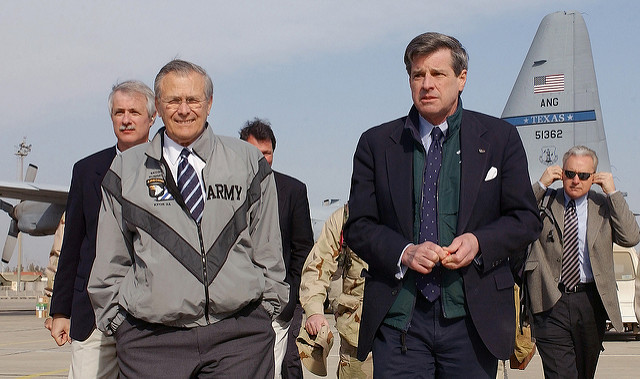
The blithe optimism demonstrated by the planners of the invasion of Iraq is still capable of taking one’s breath away. (Photo: Lisa M. Zunzanyika / Flickr Commons). Source
This is where we are today. These several volumes were originally to be titled, “America’s Dirtiest Secrets”, but that title no longer strictly applies because there is no sensible way to separate the actions of the Americans from their Jewish masters who gave the orders. For example, we know the media stories of the US hijacking of Iraq and believed this was done to remove a dictator. But our perception is severely altered when we learn the invasion was done entirely on Jewish orders, that the so-called “Provisional President” of Iraq – Paul Bremer – was a Jew and was taking all his orders from the Jews in the City of London, and that further those Jewish bankers have confiscated all of Iraq’s assets and are taking – free – more than 2/3 of Iraq’s oil. Likewise, we were taught it was the British military (with a bit of French help) that looted the 10 million priceless artifacts from China’s Summer Palace (the Yuanmingyuan) and then utterly destroyed it. But again, our perception changes when we learn the British did so under the orders of the Jews Rothschild and Sassoon, and that a great many of those priceless artifacts ended up in Jewish hands and remain there to this day.

Professor Lindemann (left) on an inspection with Churchill, 1941
In similar fashion, we were all taught about the famous British aviator “Bomber Harris” who won eternal fame for the incendiary carpet-bombing of countless dozens of German cities like Dresden, creating firestorms that incinerated millions of German civilians in one of the world’s greatest wartime atrocities. But again, our perception is severely altered when we learn that it was a Jew named Frederick Lindemann, sent by the Rothschilds as an “advisor” to Churchill, who brought with him the notion of carpet-bombing civilians with incendiary bombs, and that Churchill simply obeyed his Jewish masters in executing this program to help effect “the total destruction of Germany” that the Jews wanted. In like fashion, we were taught that the US dropped the atomic bombs on Japan to hasten the end of the war and “to save lives”. But again, our conceptions are thrown in disarray when we learn that it was a Jew, Bernard Baruch, ostensibly “the most powerful man in America” at the time, who not only chose Japan as the target for these bombs, but also personally selected the cities to be incinerated. Our conceptions are even more challenged when we learn that Baruch’s motivation may well have been retaliation to both Japan and Nagasaki for their expulsion of all the Jews prior to the war. (See End Notes)
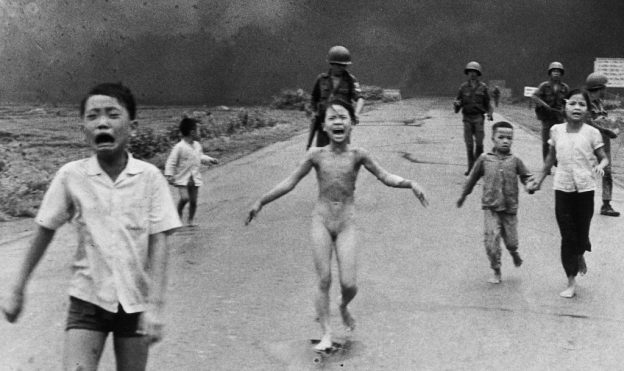
Phan Thi Kim Phuc, burned with napalm at age of 9. Source
And with both Europe and especially with Vietnam, in the application of napalm for incinerating civilians, it was indeed the Americans who extensively applied napalm during World War II, in “vast but historically-deleted genocidal incendiary attacks both in Europe and on Japanese cities, as well as during the wars in Korea and Vietnam”. But it was a Jewish chemist named Louis Fieser who developed napalm in a secret laboratory at Harvard University in 1942, and America’s Jewish masters who engineered its use on civilians. Even worse, in Vietnam, the locals discovered they could evade incineration by diving into any body or container of water to extinguish the flames. But it was another Jew, again at Harvard, who engineered the infusion of napalm with white phosphorus, which cannot be extinguished once lit, and will burn a man right through to the bones even under water. In all cases, the Americans did the dirty deeds, but they were “just following orders” from their Jewish overlords.
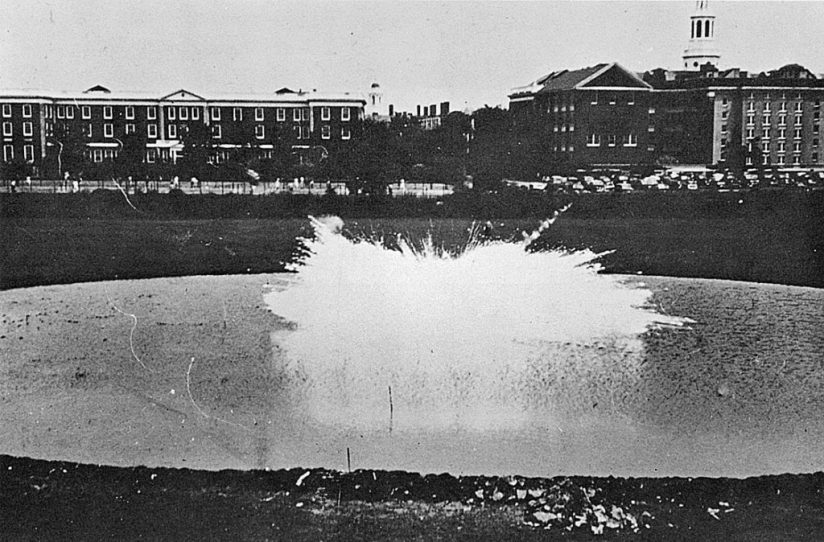
Independence Day, 1942: first field test of napalm, behind Harvard Business School. Photograph courtesy of Harvard University Archives/ Louis Fiester, The Scientific Method
And we realise, as with all such events in the past, that the American military is, just as the British military was doing in the past, functioning as “The Bankers Private Army”. And thus, in real terms, there is no sensible way to separate the actions – the “Dirtiest Secrets” of the Americans – from the “Dirtiest Secrets” of the Jews who issued the Americans and British their marching orders. We cannot disassociate the Mafia boss from his own orders executed by his own underlings.
And thus, while in these books we will be apparently (and superficially) examining America’s Dirtiest Secrets, there will in almost every instance be a distinct under-layer of Jewish influence and control. It is true we will see a few occasions or events where the Americans appeared to act independently – as in the hijacking of Hawaii – with no apparent evidence of Jewish involvement, but these are very few. And so, what we are really discussing and exposing in these pages are the Jews’ Dirtiest Secrets, and we will see that in virtually every instance the Jews operate admirably and very efficiently with what they call “A Gentile Front”, with some non-Jew apparently in charge but with a full complement of Jews in the background instigating, inciting, and ordering Gentiles to execute their plans.

The censorship board. George Creel is seated at far right. Harris & Ewing/Library of Congress. Source
One striking such example you will read about is US President Wilson’s Creel Commission, which perpetrated an astonishingly intense propaganda campaign designed to create a “white-hot hate” for Germans and lead Americans into a World War no one wanted. Creel was selected by Wilson’s Jewish handlers, quite likely by the so-called “Colonel” House, who was a Jew and whose real name was Huis, but it was the Jews Lippman and Bernays who were actually in control of the entire effort. This Jewish manipulation was so effectively done that Creel became the lightning rod for all the historical disapprobation while Bernays is celebrated today as “The father of public relations” in America. In fact, Bernays, the nephew of Sigmund Freud, was the Father of War Marketing, a template invented and executed by the Jews in the most despicable manner imaginable.
In many cases, these situations include historical events that have been so deeply buried by the Jewish media and Jewish book-publishing industries that perhaps not one person in a million has any knowledge of their existence. One such situation consists of the unremitting and unconscionable atrocities inflicted on Germany and the German people during – but especially after – both World Wars, atrocities committed primarily by the Americans but done under the orders of their Jewish masters. This was so widespread – and so true – that today it is illegal in Germany for anyone to even attempt to research atrocities committed against Germans. The reason is that anyone attempting such research would quickly discover that it was the Jews who were responsible for all those atrocities, by both hate propaganda and direct influence, and the Jews naturally don’t want those truths escaping confinement. Thus, the German government was forced to pass a law rendering illegal any investigation into such matters, and most German people today have no knowledge of the incredible betrayals and atrocities inflicted upon them by the Jews. They are instead taught by Jewish-authored books and by Jewish university professors, aided immensely by the Jewish-controlled mass media, that it was Germans who inflicted atrocities on the Jews.

‘We Hated What We Were Doing’_ Veterans Recall Firebombing Japan – The New York Times
Another such example is the incendiary carpet-bombing of nearly 100 Japanese cities – long after Japan had agreed to surrender – carried out by the American Curtis LeMay and resulting in the deaths of about 50% of the population of all those cities, done in the same manner as the Jews arranged for Germany and with the same blood-thirsty determination to utterly destroy Japan and the Japanese as they had for Germany and the German people. This immense and unconscionable atrocity, which resulted in the deaths of at least 10 million civilians – almost all women and children – was so heavily excised from history, including the re-writing of all Japanese history books, that almost no one in Japan has any knowledge of it, and no one outside Japan either. The excision in this case was so total that even Japan’s national population statistics were completely forged, fabricated, and re-calculated after the war, to entirely bury the fact of one of the greatest war-time atrocities in history.
The Japanese also do not research atrocities committed against Japan because they have been taught by their Jewish masters, as in Germany, the same things and for the same reasons. Nobody today in Japan has any knowledge of the involvement of the Jews in their destruction. This is not to dismiss atrocities that were indeed committed by the Japanese against others, but to illuminate the fact that the Jews committed much worse atrocities against the Japanese, and yet have such near-total control over the media, over book-publishing, and over the government itself, that these events have been totally excised from the historical record and the knowledge is deleted from the world’s consciousness. Again, this condition is much abetted by “the Gentile Front” where the Jews used the Americans to perpetrate these horrendous crimes while remaining hidden in the background. And again, let’s not forget that it was a Jew – Bernard Baruch – who chose Japan as the victim for the new atomic bombs and who personally selected the cities to be incinerated, almost certainly done as punishment for Japan’s prior eviction of all the Jews.
It would be of use to you to read two of my previous E-books on Propaganda and the Media[1] and Bernays and Propaganda[2], to help gain an appreciation of some of the methods used by the Jews to ensure silence (and ignorance) about past events. One of the tenets of propaganda is that we have a powerful tendency to believe the first thing we read or hear about a topic, especially if those statements are repeated a number of times. Later, even when faced with incontrovertible proof, facts that cannot be disputed, proving that our now-accepted beliefs are in fact false, we are surprisingly reluctant to change our minds, and we will “hesitate and waver and continue to believe there must be some other explanation”. Our minds are apparently unable to accept that we have believed lies.
This is important because the Jews use this to great advantage to pre-empt the discovery of their atrocities and prevent rational thought. Typically, if knowledge of their past crimes is showing signs of escaping historical confinement, the Jews will use this propaganda tactic to “get there first”, with some Jewish author quickly writing a book or treatise on the subject that is replete with lies and falsified history that attempts to exclude the Jews from involvement and, if at all possible, to blame the victim.


When the truths of China’s opium travesty were beginning to creep out of the sarcophagus and into the daylight of public knowledge, a Jewess named Julia Lovell was there with a book titled Opium War in which Jews are not even mentioned and which she categorised as a “tragic-comedy”, the hundred or so million Chinese being killed by the Jews apparently being funny to her. But a great many Americans and others, unfamiliar with the true circumstances and never having read anything else, will tend to believe this woman’s despicably false version of events and the Jews will perhaps be spared exposure.
Another such situation occurred when the truth of the mysterious depopulation of Easter Island was beginning to escape confinement. That truth seems to be that it was Jewish slave traders who kidnapped virtually the entire population of Easter Island as slaves to work their guano mines in Peru. Immediately upon this leakage, a Jew named Jared Diamond from the University of California was there with a book explaining that the Easter Islanders simply had some violent disagreement among themselves and killed each other off. Diamond was ridiculed by other academics for his foolish theory that “had not a shred of evidence to support it”, but his book wasn’t written for academics. It was written for the great unwashed of the US who had no knowledge of these events and would likely accept Diamond’s false version. And once again, the Jews might be spared exposure.

The same thing happened again when details began to emerge and leak about the Holland Tulip Bubble having been entirely staged by Jewish ‘bankers’, what with their futures market and all the rest, and not at all a “public mania” as we have been told, but a deliberate attempt to take advantage of public greed and gullibility and empty half the bank accounts in Holland. Once again, immediately on the risk of these leaks becoming public there was a female Jewish author on hand to write a “definitive” work on the topic which oddly made no mention of Jews, but furthermore claimed that no financial losses had occurred to anyone. In fact, this Jewess solemnly claimed that she had access to all the records in Holland and that through the most diligent search she found records of only a few people in Holland who had gone bankrupt during that time, and all those were bankrupt due to “property speculation“ and nothing to do with tulips. In real life, that so-called “bubble“ bankrupted probably half the people in Holland, but once again the Jews are there to pre-empt the truth and to propagate an entirely falsified version of history to protect themselves from exposure.

I have written elsewhere that at least 90%, and maybe even 95%, of everything that you know, or think that you know, or that you believe to be true about history, is wrong. To re-state another way, if we were to take the history of the entire world for the past 500 years and condense it into a history book of 100 pages, at least 50 of those pages would be blank. This is the amount of history – almost entirely involving the Jews – that has been so thoroughly excised from the historical record that it has literally evaporated from human consciousness with almost no living persons having any knowledge of it. And of the remaining 50 pages in this book, probably 45 are so extensively Photoshopped, sanitised, twisted, with crucial details omitted, that they are largely a work of fiction. And of course, anyone attempting to open this historical sarcophagus and expose the contents, is denounced as a deranged revisionist spreading misinformation. And, if the Jews are at all mentioned in this “revisionism”, we have the added attraction of being labeled an “anti-Semitic, holocaust-denying, Nazi Jew-hater”. Most of those souls attempting this historical illumination have very often paid with their careers, their reputations, their bank accounts, sometimes with their freedom and, in some cases, with their lives. These Mafia overlords in the City of London, the Khazar “so-called” Jews, are today just as brutal, savage, and filled with contempt for humanity as they were 1,000 years ago.
David Edwards was quoted in the “Third World Traveler“ as having written:
”Even open-minded people will often find themselves unable to take seriously the likes of Noam Chomsky, Edward Herman, Howard Zinn and Susan George on first encountering their work; it just does not seem possible that we could be so mistaken in what we believe. The individual may assume that these writers must be somehow joking, wildly over-stating the case, paranoid, or have some sort of axe to grind. We may actually become angry with them for telling us these terrible things about our society and insist that this simply ‘can’t be true‘. It takes real effort to keep reading, to resist the reassuring messages of the mass media and be prepared to consider the evidence again.”
This is the condition we face today in dealing with these recovered historical truths. In the case of the Jews, they know the truth but are frantic and nearly desperate to keep it buried and under confinement, which is why they so vengefully and viciously attack en masse whenever these facts emerge into daylight. With the Americans, their ignorance of their own nation’s criminality is founded on a blind faith and conviction based on a century of clever Jewish propaganda that is almost always flatly contradicted by the facts. But even citizens of the victim nations – like Germany – suffer enormous shock and disbelief when confronted with the historical truths of their own country, because the Jews and the Jewish media have for nearly 100 years browbeaten them with a totally false historical narrative. Friends sent to German acquaintances my articles on the Jews’ 1933 worldwide boycott of Germany and some related items, with those Germans replying that they found even those brief articles too painful to read at one sitting because, while the evidence was incontrovertible, it contradicted everything they’d been taught all their lives about themselves and their country, and the shock of learning that the things they “knew” were all lies, was emotionally too painful to bear.
At the same time, the world has been subjected to a century or more of outrageously false positive propaganda about the Jews, an almost incomprehensible volume of rose-tinted misinformation about the Jews as the world’s impoverished, misunderstood, persecuted “chosen ones“. In truth, there is little about the Jews and Israel today that is not based on fabricated historical mythologies, buried history, biased presentations, facts twisted so badly as to be often unrecognisable. Probably 95% of what the world knows about the Jews, their history, their massive crimes spanning centuries, their astonishing contempt for both humanity and truth, their conduct in international affairs, is not only wrong, but violently wrong. And to the same extent, the world has also been subjected to enormously and brutally false negative propaganda and misinformation about other nations – about the Jews’ victims, an equally incomprehensible volume of black-tinted information whereby the Jews typically seek to blame their victims for the atrocities perpetrated against them.
These buried historical truths are the content of my books and articles, the history of the world (or parts of it) as it really was, and is, harsh provable truths and documented realities without the vast carpet of propaganda, jingoism, and misinformation that Jewish media power has used to blanket and blind the world for well over a century.
END NOTES
The incendiary bombing of German working-class neighborhoods was planned in detail by the Jews. Since at least the early 1900s, Rothschild had owned most of the armament and munitions factories in Germany. It was through those that he supplied Japan (and Russia too) with the weapons for their war in 1905. During the Second World War the Jews didn’t want all their factories bombed to rubble when the Allies began flying over Germany. Their solution was to kill all the factory workers instead but leave the factories untouched. And it was the Jew Frederick Lindemann, sent by Rothschild to Churchill as an advisor, who brought the scheme to him. We have records of Lindemann’s submission of his plan to the war cabinet urging this method and suggesting that “greater flesh-incineration-per-bomb could be achieved” that way. This is further documented by a memo dated March 30, 1942, from Lindemann to Churchill that resulted in those intense terror-bombing campaigns of German civilians. The working-class neighborhoods were high-density, with these incendiary munitions creating natural intense firestorms that incinerated virtually every living thing in many of them. The British and the Americans, obeying the plans of their Jewish leaders, executed one of the most barbaric and inhuman atrocities of the war.
As I discuss in my essay on Japan, where the same was done there, the country’s population statistics were heavily forged, fabricated, and recalculated after the war to bury the evidence of these atrocities. I am almost certain the same was done with Germany. I haven’t the resources or time to delve into this with Germany, and researching atrocities against Germans is now illegal in Germany, but it is almost a certainty that Germany’s population statistics were massaged in the same was as those of Japan, to hide the truth. There had to have been many many millions of civilians killed in these raids, which were nothing more than an inhumanly deliberate attempt to depopulate Germany. And this doesn’t include the normal war casualties nor the 12 million to 15 million German civilians killed after the war from execution, starvation and migration, nor does it include Eisenhower’s Death Camps nor the perhaps additional million civilian deaths from Operation Paperclip.
*
Mr. Romanoff’s writing has been translated into 32 languages and his articles posted on more than 150 foreign-language news and politics websites in more than 30 countries, as well as more than 100 English language platforms. Larry Romanoff is a retired management consultant and businessman. He has held senior executive positions in international consulting firms, and owned an international import-export business. He has been a visiting professor at Shanghai’s Fudan University, presenting case studies in international affairs to senior EMBA classes. Mr. Romanoff lives in Shanghai and is currently writing a series of ten books generally related to China and the West. He is one of the contributing authors to Cynthia McKinney’s new anthology ‘When China Sneezes’. (Chapt. 2 — Dealing with Demons).
His full archive can be seen at
https://www.bluemoonofshanghai.com/ and https://www.moonofshanghai.com/
He can be contacted at:
NOTES
[1] Bernays and Propaganda
https://www.bluemoonofshanghai.com/wp-content/uploads/2022/10/BERNAYS-AND-PROPAGANDA-.pdf
[2] Propaganda and the Media
https://www.bluemoonofshanghai.com/wp-content/uploads/2022/11/ENGLISH-PROPAGANDA-and-THE-MEDIA.pdf
Zionists angry after Australian govt. refuses to blacklist Iran’s IRGC
Press TV – February 10, 2023
A recent report has exposed that the Australian Senate committee is facing a serious legal setback in its attempt to blacklist Iran’s Islamic Revolution Guards Corps (IRGC), as the force cannot be designated as a foreign terrorist organization under the country’s criminal code.
According to the Australian Jewish News website, the Attorney General’s Department (AGD), which responded to the recommendation by the Foreign Affairs, Defense and Trade Committee, told the panel that current legislation does not provide for a pathway to proscribing the IRGC.
“As an organ of a nation-state, the Islamic Revolution Guard Corps is not the kind of entity that is covered by the terrorist organization provisions in the Criminal Code,” the AGD said on Tuesday.
The Zionist Federation of Australia (ZFA) urged the Australian government to amend the criminal code to allow for the blacklisting of the IRGC.
“We … urge the Australian government to amend legislation to allow the IRGC to be proscribed here, as it is in other countries,” ZFA public affairs director Bren Carlill said.
However, other countries have also backed down on their initial proclamations to ban the official Iranian force.
The UK government has already stopped plans to blacklist Islamic Revolution Guards Corps as reports say Foreign Office fears that the move would block communications channels with Iran.
The UK Foreign Office’s about-face on proscribing the IRGC as a so-called “terrorist” entity comes despite its approval by the Home Office, The Times reported on February 2.
Citing sources in the government, the report said there are also concerns about how to blacklist the IRGC because, unlike other proscribed bodies, the Iranian force is an official government agency.
“Foreign Office officials have real concerns about proscription because they want to maintain access. The Home Office, and the government more broadly, supports the move. The IRGC should have been proscribed by now but the whole process is on ice,” a Whitehall source said.
European Union foreign policy chief Josep Borrell said on January 23 that the block could not list the IRGC as a “terrorist” entity without an EU court decision.
Speaking before a meeting of EU foreign ministers in Brussels, Borrell said a court ruling with a “concrete legal condemnation” had to first be handed down before the bloc itself could apply any such designation.
“It is something that cannot be decided without a court, a court decision first. You cannot say I consider you a terrorist because I don’t like you,” Borrell told reporters, stressing that the court of an EU member state had to issue a concrete legal condemnation before the bloc could act.
A week earlier, the European Parliament adopted an amendment, calling on the EU and its member states to include the IRGC on their terror list. It also passed another resolution later, calling for more sanctions against Iranian individuals and entities and putting the IRGC on the EU terrorist list over alleged human rights violations during the recent riots.
The European Union, however, imposed sanctions against a number of Iranian individuals and entities for what it claimed to be a crackdown on the recent foreign-backed riots, which were triggered after the death of a young Iranian woman of Kurdish descent in Tehran in September.
UK Starts Building Third Dreadnought Class Ballistic Missile Submarine
Sputnik – 09.02.2023
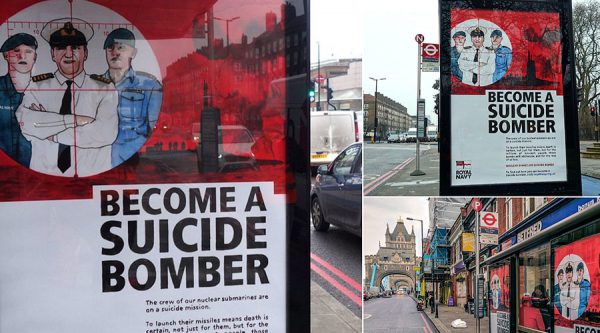 Work has begun on building the United Kingdom’s third Dreadnought class ballistic missile submarine Warspite in the north of England, BAE Systems announced in a press release on Thursday.
“BAE Systems has today marked the start of construction of the third Dreadnought class submarine Warspite at its shipyard in Barrow-in-Furness, Cumbria,” the release said.
Warspite is the third of four Dreadnought class ballistic missile submarines being designed and built by BAE Systems, the company stated.
“Due to enter service from the early 2030s, the boats will carry the UK’s nuclear deterrent and be the biggest, most powerful and technically advanced submarines ever delivered to the Royal Navy,” BAE said in the press release.
Construction of the first two submarines, Dreadnought and Valiant, is already well underway, the company added.
UK Defense Procurement Minister Alex Chalk described the Dreadnought class submarines as crucial to maintaining the nation’s national security, according to the release.
Loss of Western brands is Russia’s gain – Putin
RT | February 9, 2023
Many foreign brands and businesses are leaving Russia not of their own volition but because they are feeling pressured to do so, and suffer financially as a result, Russian President Vladimir Putin said on Thursday at a meeting of the supervisory board of the Agency for Strategic Initiatives.
Moscow, however, will not force anyone to stay, according to the president.
“Many of them, as you know, under pressure from their governments, are leaving our market. Well, all the best to them. However, because of the loss of our market they incur huge losses. It’s their choice, it’s their decision,” Putin said, noting that many of those companies “do it without any pleasure.”
“Who wants to lose a well-established business in which they invested effort, money? It’s not even about the money sometimes – many have invested their hearts – but under pressure from their governments are forced to leave.”
According to Putin, Russia will not allow the varied assets and infrastructure these companies leave behind to go to waste, and domestic industries may even benefit from the situation.
“They leave behind a good legacy, so to speak, they leave behind production infrastructure, well-trained personnel. Perhaps someone thinks that all of this will immediately crumble and fall apart – nothing of the sort is happening. Our companies, our entrepreneurs are picking up these enterprises and businesses and continuing this work. And quite successfully,” the Russian president assured.
After Moscow’s military operation in Ukraine began, many major Western brands announced their withdrawal from the Russian market and the suspension of investment. According to economists from Switzerland’s University of St. Gallen, more than 1,400 companies decided to quit Russia over the past year, including electronics manufacturers, automakers, hotels, banks and restaurant chains.
However, Russia managed to secure supplies of goods through alternate routes – via the so-called ‘parallel imports’ – where products continue to be delivered to Russia through third countries without a brand license from the rights holder.
In addition to this, the Russian government has launched a number of programs and initiatives to support domestic manufacturers, which fall within the framework of ‘import substitution’. According to Putin, the country produces a lot of quality products, which until recently had a hard time making their way to the domestic market due to competition from global players.
However, the departure of Western brands means “our domestic manufacturers received unique opportunities for development and we must take advantage of them,” Putin stated.
Save the planet – stop this Net Zero lunacy

By William Loneskie | TCW Defending Freedom | February 8, 2023
In seven years, diesel vans under 3.5 tons will be banned from sale. How will the switch from diesel to battery-powered vans affect business and commerce? Cost and range are factors of concern. A battery-powered Ford Transit costs over £10,000 more than a similar specification diesel van. The diesel, depending on fuel tank size selected, can carry its payload more than 500 miles, and takes only minutes to refuel. A laden battery Transit will manage 90 miles in summer, less in winter, and will take hours to recharge.
Then there is the question of service life. Looking at the Ford Transit Forum, the record for mileage is over 750,000 miles. While this is exceptional, figures of 200,000 are not uncommon. The trouble with battery vans is that the batteries degrade from the word go, and cost a huge sum to replace. I doubt if many will go further than 150,000 miles on the original battery, then they will probably be scrapped because the new battery will cost more than the value of the vehicle. Surely a cost-benefit analysis should be carried out about battery vans; after all, if the cost of transporting goods soars, so will the cost of living.
The reason for scrapping new dependable diesels and petrol vehicles is a supposed climate crisis, and the cause of this crisis, we are told, is anthropogenic global warming caused by CO2. Hence the ‘need’ to ban fossil fuels and move to a grid dependent on the vagaries of wind power. The irony is that building a wind farm without fossil fuels is impossible. The towers are made of steel which requires coking coal, the (non-recyclable) rotors consist of a composite plastic made from oil, and of course the gearboxes are filled with gallons of oil. The components are transported to site on land or at sea by diesel power. Even the hard hats, eye shields and hi-vis jackets used by the technicians are made from oil.
We need coal to make coke to make steel, and it makes sense to mine it in Britain rather than import it. Hence the go-ahead for the new colliery near Whitehaven. Production here will be sufficient to allow exports too; not only that but it will bring highly skilled, well-paid jobs to an area in sore need of them. Opposition to this project from ill-informed politicians and eco-zealots has held up this project for seven years. They say coal will ‘damage the planet’. But Germany, Europe’s powerhouse, is getting one-third of its electricity from coal-fired power stations – 37,000MW of reliable, cheap, weather-independent power. Japan produces over 50,000 MW from coal – and the UK a measly 4,000 MW, and zero by 2025. Not only should the Whitehaven mine go ahead in a rational world but we should be looking at opening new state-of-the-art collieries and power stations to tap the 3billion tons of UK coal reserves.
The science about AGW is not settled. Recent research using satellite temperature data has shown that warming has stalled, and indeed cooling is likely caused by the North Atlantic Multidecadal Oscillation. The Greenland ice sheet has grown. Arctic ice shrinking has stopped. The media has failed to keep up. Repeated apocalyptic predictions of climate-caused disaster have proved false. In July 2019 the then Prince Charles said: ‘I am firmly of the view that the next 18 months will decide our ability to keep climate change to survivable levels and to restore nature to the equilibrium we need for our survival’. Oh dear.
A particularly virulent form of the Net Zero virus has been caught in Scotland by the SNP regime, governing in tandem with the separatist Greens. From 2025, Patrick Harvie, the Minister for Zero Carbon Buildings, Active Travel and Tenants’ Rights, intends oil, solid fuel and LPG central heating should be ‘phased out’ from off-gas-grid homes. That will also apply to on-gas-grid homes from 2030. I have been unable to discover exactly what ‘phasing out’ means. Does it mean that from 2025 we will no longer be able to have a new LPG boiler fitted? Will we who just a love a blazing coal fire on a winter’s night, reflected in an amber glass of finest malt, no longer be able to enjoy that simple pleasure? Very likely. Perhaps Mr Harvie can explain in detail what it does mean and how much it will cost to have a heat pump fitted, which many experts say is a bad idea.
It is clear, however, that Mr Harvie and the SNP intend to force gas, oil, and coal use to be ended whether householders want it or not – just as they are keen to make farmers and foresters and gamekeepers give up their dependable diesel Land Rovers and pick-ups in favour of battery-powered vehicles. This is in line with the SNP/Green top-down Net Zero strategy which – even more than that of the Westminster government – is totalitarian in nature, where those in power dictate to hard-working men and women how they must live their lives.
They say this is to ‘save the planet’ from CO2 , but the fact is that if Britain were not to exist from tomorrow it would not make one iota of difference to climate change.
West uses chemical weapons watchdog to justify its aggression – Moscow
RT | February 7, 2023
The latest report by the Organisation for the Prohibition of Chemical Weapons (OPCW), which blames Damascus for carrying out a chemical attack in Douma in 2018, looks like a political hit piece meant to justify the West’s continued military aggression against the Syrian government, says Alexander Shulgin, Russia’s permanent representative to the organization.
Speaking to RT, Shulgin vehemently dismissed the report, which was released in late January by the so-called Investigation and Identification Team (IIT). Calling the IIT “completely illegitimate,” he claimed the group’s creation was pushed through by the US and its allies in order to undermine the core principles of the OPCW and international law and replace them with their own “made-up rules.”
The IIT’s report, according to Shulgin, is riddled with inconsistencies and factual gaps, and barely holds together. Furthermore, none of Russia’s or any other country’s “uncomfortable” questions regarding the details of the IIT’s findings were even remotely addressed during an OPCW briefing on the report, the ambassador claimed.
Shulgin also noted that the report highlighted the double standards currently present within the OPCW. When Russia presented evidence of a chemical attack in Aleppo back in 2016, every minute detail of Moscow’s findings was heavily scrutinized by the organization, he said. However, when it comes to the attack in Douma, OPCW officials seem to turn a blind eye to basic questions such as how and when the evidence was gathered and presented during the investigation.
“For instance, they referred to the fact that some new sample has appeared, provided by a third party. What is this third party? Nothing is said about it. They just say ‘trust us’,” said Shulgin, noting that the sample in question had never been reported on in previous investigations.
“So before, there was no sample, but now, suddenly, it has somehow appeared. Without any explanations,” the ambassador stressed, suggesting its sudden appearance can only be explained by the need for the US, France, and UK to escape international accountability for their aggression against Syria.
The three NATO states launched a series of airstrikes against civilian and military targets in Syria in April 2018 after the so-called ‘White Helmets’ – an NGO operating in rebel-controlled areas of Syria – published a series of videos supposedly showing the aftermath of a chlorine attack on the residents of Douma.
Syria has vehemently denied any responsibility for the incident, and both Damascus and Moscow have repeatedly pointed to evidence, including testimonies from alleged victims, that suggests the incident was staged in order to justify a Western attack.
World Health Organization zero draft pandemic treaty pushes for increased surveillance powers

By Tom Parker | Reclaim The Net | February 6, 2023
The World Health Organization (WHO) has released the latest zero draft of its international pandemic treaty which will give the unelected global health agency new sweeping surveillance powers if passed.
The treaty requires the WHO’s 194 member states (which represent 98% of all the countries in the world) to strengthen the WHO’s “One Health surveillance systems.”
One Health is a WHO system that aims to “optimize the health of people, animals and ecosystems” and “uses the close, interdependent links among these fields to create new surveillance and disease control methods.”
The WHO’s One Health fact sheet points to Covid-19 as one of the main reasons for expanding its One Health approach and states that it “put a spotlight on the need for a global framework for improved surveillance.”
The draft treaty also orders WHO member states to strengthen surveillance functions for “outbreak investigation and control through interoperable early warning and alert systems.”
Additionally, it requires member states to recognize the WHO as the “directing and coordinating authority on international health work, in pandemic prevention, preparedness, response and recovery of health systems, and in convening and generating scientific evidence, and, more generally, fostering multilateral cooperation in global health governance.”
We obtained a copy of the zero draft of the WHO’s pandemic treaty for you here.
Although the draft treaty doesn’t mention surveillance tools that were used during Covid, such as contact tracing, testing, and vaccine passports, the WHO has previously confirmed that it’s a big supporter of vaccine passports. In the early stages of the pandemic, the WHO also lauded China’s Covid response, which utilized intense digital surveillance, before changing its position and criticizing China’s zero-Covid policy.
This draft treaty has been in the works since December 2021. A final report on the treaty is expected to be presented to the WHO’s decision-making body, the World Health Assembly (WHA), in May 2024.
If passed, this treaty will be adopted under Article 19 of the WHO Constitution — an article that allows the WHO to impose legally binding conventions on the WHO’s 194 member states if two-thirds of the member states’ representatives vote in favor of the conventions.
Unlike the lawmaking process in most democratic nations, where elected officials implement national law, this WHO process allows a small number of global representatives, often unelected diplomats, to impose international laws on all of the WHO’s member states.
While some politicians have pushed back against this international pandemic treaty, it has the support of many powerful nations including the United States (US), United Kingdom (UK), Canada, Australia, New Zealand, and the European Council (EC) (which represents 27 European Union (EU) member states).
This treaty is just one of the global surveillance proposals with ties to the WHO that is being pushed by influential global figures. At Business (B20) 2022, a summit of business leaders from Group of 20 (G20) countries, numerous countries agreed on a digital health passport that uses WHO standards. This digital health certificate will track whether people have been vaccinated or tested.
Project Cumulus & the Tragedy in Devon linked to Weather Manipulation
Don’t worry, things like this only happened in the past
The Naked Emperor’s Newsletter | February 7, 2023
Whenever I go online, I see people posting pictures of plane trails in the sky and asking why we see so many of them. Some argue they are con (densation) trails whilst others say they are chem (ical) trails. Whilst there are very convincing arguments on both sides it is impossible to ascertain the truth. However, we can look at what has happened in the past to give a theory more credibility.
In a previous post, I looked at previous, documented and declassified examples of governments, via the military, spraying their own citizens. All in our best interest of course, until it isn’t.
Today I will look at a tragic story that happened in a North Devon village called Lynmouth in the 1950s.

Lynmouth is a beautiful village on the edge of Exmoor in England.
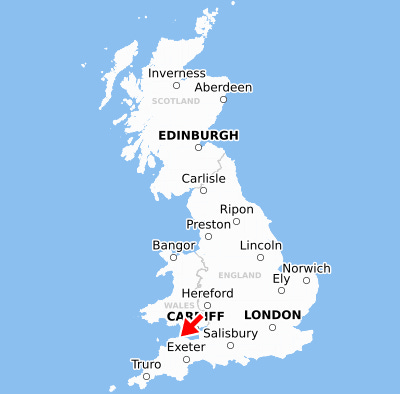
The river West Lyn and East Lyn flow down from the village of Lynton above and discharge into the sea. If you ever visit the villages and don’t fancy the steep walk up the hill between the two, you can ride in comfort on a water-operated funicular that has been in operation since 1890.

In the early 1950s, the UK government, together with an international team of scientists, decided to start meddling in weather manipulation. Project Cumulus was initiated and was operational between 1949 and 1952. Its purpose was to experiment with various cloud seeding techniques and therefore control when and where it rains.
Between 4 August and 15 August 1952 flights were flown conducting further weather manipulation experiments. However, Project Cumulus abruptly stopped on 15 August 1952. Coincidentally, on the same day a tragedy in Lynmouth unfolded.
Within a number of hours, the biggest flooding event for 300 years hit Lynmouth, destroying hundreds of buildings, bridges, cars and sadly killing 35 people. A further 420 villagers were made homeless. Bodies washed out to sea were never found. One girl who was interviewed at the time lost six family members and spoke about her mother identifying her grandmother’s body. “Mum identified her by this huge wart on her back because she hadn’t got no head, or arms, or legs when they found her.”
90 million tons of water, together with thousands of tons of rock hit the village, destroying everything in its path. Overall that month, North Devon, where the village is situated experience 250 times more rainfall than was normal for August.
Soon afterwards, the remaining villagers called for an investigation and discussed rumours of planes circling before the deluge.
However, the government and the Ministry of Defence denied any “cloud-seeding” experiments had taken place and the tragedy was labelled as a ‘hand of God’ event. Any talk of weather manipulation was considered a conspiracy theory and even to this day it is labelled as such on Wikipedia.
That was until 2001 when the BBC conducted an investigation into the floods and confirmed that secret experiments were causing heavy rainfall. Many of the classified documents had gone missing but the Document team tracked down RAF logbooks and personal testimony.
One pilot described how, as part of Operation Cumulus, he sprayed salt into the air causing a heavy downpour 50 miles away. Other flights using silver iodide are also likely to have taken place.
“The rain was the heaviest for several years – and all out of a sky which looked summery … there was no disguising the fact that the seedsman had said he’d make it rain, and he did.
“Toasts were drunk to meteorology and it was not until the BBC news bulletin [about the Lynmouth tragedy] was read later on, that a stony silence fell on the company,”
The Guardian also reported on the findings, although they now categorise the story in their “silly season” section. They quote a RAF navigator who said “we flew straight through the top of the cloud, poured dry ice down into the cloud. We flew down to see if any rain came out of the cloud. And it did about 30 minutes later, and we all cheered.”
The British Geological Survey examined soil sediments in the district of Lynmouth to see if any silver or iodide residues remain. The testing was limited due to restrictions in place because of foot and mouth disease, and it is inconclusive. However, silver residue has been discovered in the catchment waters of the river Lyn.
The BBC investigation was turned into a Radio 4 programme called “The Day They Made it Rain” in which they suggest that the Air Ministry and Treasury were aware that the experiments were causing damage to civilians.
According to declassified minutes, the war office was interested in increasing rain and snow by artificial means for a number of reasons including:
- bogging down enemy movement;
- incrementing the water flow in rivers and streams to hinder or stop enemy crossings;
- clearing fog from airfields; and
- to explode an atomic weapon in a cloud to produce a far wider area of radioactive contamination than in a normal atomic explosion.
But remember, these types of experiments only happened in the past. Your government loves you now and would never do anything like that nowadays.
Vitamin D Cuts COVID-19 Risk of Death in Half, New Study Finds. So Why Isn’t it Recommended?

BY WILL JONES | THE DAILY SCEPTIC | FEBRUARY 3, 2023
Vitamin D cuts the risk of death from COVID-19 by 51% and the risk of ICU admission by 72%, a meta-analysis of randomised controlled trials has found. The new study, published in Pharmaceuticals, is titled “Protective Effect of Vitamin D Supplementation on COVID-19-Related Intensive Care Hospitalisation and Mortality: Definitive Evidence from Meta-Analysis and Trial Sequential Analysis”. Here’s the abstract, summarising the study’s method and results.
Background: The COVID-19 pandemic represents one of the world’s most important challenges for global public healthcare. Various studies have found an association between severe vitamin D deficiency and COVID-19-related outcomes. Vitamin D plays a crucial role in immune function and inflammation. Recent data have suggested a protective role of vitamin D in COVID-19-related health outcomes. The purpose of this meta-analysis and trial sequential analysis (TSA) was to better explain the strength of the association between the protective role of vitamin D supplementation and the risk of mortality and admission to intensive care units (ICUs) in patients with COVID-19.
Methods: We searched four databases on September 20th 2022. Two reviewers screened the randomised clinical trials (RCTs) and assessed the risk of bias, independently and in duplicate. The pre-specified outcomes of interest were mortality and ICU admission.
Results: We identified 78 bibliographic citations. After the reviewers’ screening, only five RCTs were found to be suitable for our analysis. We performed meta-analyses and then TSAs. Vitamin D administration results in a decreased risk of death and ICU admission (standardised mean difference (95% CI): 0.49 (0.34–0.72) and 0.28 (0.20–0.39), respectively). The TSA of the protective role of vitamin D and ICU admission showed that, since the pooling of the studies reached a definite sample size, the positive association is conclusive. The TSA of the protective role of vitamin D in mortality risk showed that the z-curve was inside the alpha boundaries, indicating that the positive results need further studies.
Discussion: The results of the meta-analyses and respective TSAs suggest a definitive association between the protective role of vitamin D and ICU hospitalisation.
Despite these highly positive results, the latest official guidelines from NICE still state that vitamin D is not recommended for the prevention of COVID-19. (NICE also doesn’t recommend the use of ivermectin or budesonide.) Yet remdesivir is recommended despite the WHO finding little or no effect. Will NICE now update its guidelines? I wouldn’t count on it.
Dr. John Campbell discusses the new study in a recent video, arguing the evidence on vitamin D is now conclusive and wondering why adequate vitamin D supplementation is not being officially promoted in the U.K. The fact that the MHRA is 86% industry-funded may have something to do with it, he suggests.
Featured Video

The Truth About the Trump Shootings with Ken Silva
or go to
Aletho News Archives – Video-Images
From the Archives
Trans ‘milk’ as good as the real thing – NHS
RT | February 18, 2024
The drug-induced nipple secretions of trans women are as good as mothers’ breast milk for babies, the University of Sussex Hospitals NHS Trust claimed in a letter to campaigners made public in a report by British think tank the Policy Exchange on Sunday.
The healthcare trust’s medical director, Rachel James, argued that the off-label prescription drug cocktail men transitioning to female take in order to produce milk was “similar to the natural hormones which encourage lactation to develop when the baby is newly born.”
“The evidence which is available demonstrates that the milk is comparable to that produced following the birth of a baby,” James wrote in the letter, sent to Children of Transitioners last August.
Biological men who wish to lactate must first take hormones to grow milk glands and then take high doses of either domperidone or metoclopramide to stimulate milk production. Neither drug is approved for this use, though they are occasionally prescribed off-label to biological women who have trouble lactating.
However, domperidone’s own manufacturer, Janssen, warns patients the drug “may cause unwanted side effects affecting the heart in a breastfed baby” and “should be used during breastfeeding only if your physician considers this clearly necessary.” … continue
Blog Roll
 Aletho News
- Russia Voted Under Fire. Washington Is Loading the Tankers.
- 12 Things Your Oncologist Was Trained Not to Tell You
- Anthrax Attacks Paved Way for COVID-Era ‘Junk Drugs and Vaccines’
- How Real Is the Impact of Western Sanctions on Israel?
- France, You Are Guilty: How Paris Turned Western Sahara into the Maghreb’s Powder Keg
- 2025 Nature Paper Claiming Worsening Global Drought Gets RETRACTED …Heavily Flawed
- Your Milk Is Not the Problem
- The Truth About the Trump Shootings with Ken Silva
- ARE PATIENTS BEING PROPERLY INFORMED ABOUT OZEMPIC?
- US lawmaker blocks $2.8 billion weapons sale to Israel: Report
- If Americans Knew
- Salah Sarsour’s Legal Team Says DHS Has Not Met Its Burden to Prove He Is Deportable
- An analysis of tax forms by The Intercept show Kraft’s charity and LLC have donated to Friends of the IDF and AIPAC’s super PAC.
- Israeli attacks kill four Palestinians in Gaza – Daily Update
- Inside Gaza’s death trap of collapsing, bombed-out buildings
- The everyday items Israel bans from Gaza every day
- Inside the siege, the ruined buildings of Gaza – Daily Update
- Debunking The Claim That Macklemore Has A “History Of Antisemitism”
- CPJ demands release of arrested Palestinian-US journalist near Bethlehem
- Robert Kraft: The Billionaire Friend of Netanyahu Pulling The Strings Behind the Macklemore/Ed Sheeran Blow Up
- Columbia Administered Fund Gives Big Money to Pro-Israel Groups
- No Tricks Zone
- 2025 Nature Paper Claiming Worsening Global Drought Gets RETRACTED …Heavily Flawed
- New Study: ‘Global Drought Shows No Detectable Recent Acceleration Under Climate Warming’
- Economic Masterminds: German Socialists Suggest Taxing Productivity Gains Stemming From Using AI
- The South China Sea Has Not Been Cooperating With The Climate Change Narrative
- Energy Crisis: Germany Enters Heating Season With Historically Low Gas Reserve Fill Levels
- New Study: The Antarctic Ice Sheet Gained Mass From 2020-2024 Due To Staggering Snow And Ice Accumulation
- Study: Ocean Heating Rates From Thousands Of Years Ago ‘Dwarf’ Modern Ocean Heating Rates
- Climate Extremists Target, Attack Large-Scale Power Grid Infrastructure In Germany!
- New Study: Antarctic Ice Melt Has Contributed Less Than 1 Centimeter To Sea Level Rise In The Last 30 Years
- Fear Of Debate: Alarmist German Climate Scientist Calls On Mainstream Media To Discredit Skeptic Voices
 Aletho News