The announcement on Friday by Russian President Vladimir Putin that he will seek reelection for a fifth term in office came as no surprise. That he chose the occasion of a Kremlin ceremony conferring the Hero of Russia medals to servicemen who had taken part in Russia’s military operation against Ukraine to make the announcement is striking.
Putin was found responding to an exhortation by the Hero of the Donetsk People’s Republic Artyom Zhoga, commander of the famous Sparta Battalion (who succeeded his son Vladimir, who died at the age of 28 in 2022 and was posthumously awarded the title “Hero of Russia”) that the entire Donbass would like him to participate in the election. There is no question that Col. Zhoga voiced a collective wish of the Russian people.
The Ukraine war has turned out to be a defining event in Putin’s political life. There was some misjudgement initially when the special military operation commenced in late February 2022 that it would be a short-lived affair and President Vladimir Zelensky would take up the Russian offer to negotiate. But where Moscow went horribly wrong was that the US wouldn’t get into a proxy war with them with such gusto and manipulate Zelensky from seeking peace.(See an excellent account, in English, of the US’ sabotage of the Istanbul Agreement, titled Peace for Ukraine authored by a distinguished German troika of a diplomat, an historian and a general.)
Indeed, Putin eventually steered the tentative special military operation out of the woods by making a tactical withdrawal of troops in the northern sectors, allowing a large mobilisation of troops to pursue a war of attrition and ordering an effective multilevel fortification of the frontline. In retrospect, his military decisions turned the tide of war and Russian weaponry and military technology outclassed what the US and NATO supplied to Kiev.
As of now, Russian forces are pressing ahead all across the 900-km frontline and the momentum might carry them far, even across the Dnieper. Crimea and the Black Sea are not in any serious danger; the four new territories are resource-rich and Russia controls all the ports in the strategic Sea of Azov, which is an important access route for Central Asia from the Caspian Sea via the Volga-Don Canal.
However, although the US failed to achieve a military victory in Ukraine, the Biden Administration will try to prolong the conflict for as long as possible through 2024 hoping to bleed Russia in a gruelling struggle as in Afghanistan in the eighties. But it is a vain hope.
Sergey Naryshkin, chief of Russia’s foreign intelligence service wrote last week in the agency’s journal Razvedchik (The Intelligence Operative) that “there is a high probability that further support for the Kiev junta, especially given the increasing ‘toxicity’ of the Ukrainian theme for transatlantic unity and Western society as a whole, will accelerate the decline of the international authority of the West.
“Ukraine itself will turn into a ‘black hole’ absorbing material and human resources the further it goes,” he continued. “In the end, the US risks creating ‘another Vietnam,’ which every new US administration will have to deal with until some sensible person who has the courage and determination to break this vicious circle takes over in Washington.”
Ukraine will remain a priority issue for Russia and that is one main reason why the Russian elite and the nation at large want Putin to remain in power until 2030. The heart of the matter is that Putin also brilliantly tweaked the economic and social policies to sequester the lives of ordinary Russians from the usual deprivations characteristic of a ‘war economy’. Life moves on, and the ‘new normalcy’ is working well.
Putin has scattered the US’ goal to entrap Russia in an apparent quagmire — sending the Russian economy into a tailspin and stoking social discontent and creating conditions for an insurrection against the regime — to weaken Russia and remove it from the global stage as an increasingly effective counterpoint to the western hegemony by fuelling fissiparous tendencies to threaten the unity and integrity of the Russian Federation.
In reality, Putin’s achievements are a work in progress and his continuance in power remains a pre-requisite for Russia’s re-emergence as a ‘superpower’ surpassing even the Soviet Union in some ways in circumstances that are as much challenging as offering opportunities that must be creatively seized in a volatile world environment in historic transition.
Putin tested the waters and has put Russia on the right side of history, so to speak, which presents a study in contrast with the disarray and lack of conviction and mediocre leadership in the US and the transatlantic system as a whole.
If the above-mentioned essay by Naryshkin (entitled 2024 Is the Year Of the Geopolitical Awakening ) is taken as benchmark, the world in transition can be expected to have a trajectory on the following lines:
A fundamental conflict between the ‘old’ and the ‘new’ world, which has been maturing below the surface through the three decades since the end of the cold war, has “moved into an open phase” with the commencement of Russia’s special military operation and has “acquired a geographically all-encompassing character” in the last year.
An increasing number of countries that “share the ideas of multipolarity and adhere to a traditional worldview” are pushing back the West’s globalist and anti-humanistic agenda.
Consequently, the risks of instability are multiplying, which lead to “an increase in the chaotic nature of the processes taking place in the foreign policy arena.” The emergent situation demands “remarkable restraint and foresight” from world leaders.
In sum, the current situation is “increasingly reminiscent of a class revolutionary situation, when the ‘upper classes’ in the face of the weakening United States can no longer provide their own leadership, and the ‘lower classes’, as the Anglo-Saxon elite refer to all other countries, no longer want to obey Western dictates.”
In order to preserve their global hegemony, the Euro-Atlantic elite will follow the well-trodden path of creating controlled chaos — de-stabilising the situation in key regions by pitting some ‘recalcitrant’ states against others and “forming a sub-system around them as operational and tactical coalitions controlled by the West.”
However, “responsible world players, especially Russia, China and India and some others demonstrate their readiness to resolutely resist external threats and independently implement crisis management.” Even the closest allies of the US are striving to diversify external relations faced with lack of confidence in America as provider of security. The eruption of Israel-Palestine conflict is “a sobering example” for many Western politicians.
In such a backdrop, “the world stage will be marked by a further intensification of the confrontation between the two geopolitical principles — namely, the Anglo-Saxon, or island, ‘divide-and-rule’ and the continental ‘unite-and-lead’ directly antagonistic to it. Manifestations of this fierce confrontation in the coming year will be observed in even the most remote regions of the world.”
Interestingly, in Naryshkin’s prognosis, it is not the Indo-Pacific but the Arab world that will remain “the key arena of the struggle for a new world order” in 2024. By the way, the essay appeared on the eve of Putin’s daylong trip to the UAE and Saudi Arabia on Wednesday where he recieved a hero’s welcome. In an extraordinary courtesy by the host countries, Putin’s presidential jet was flanked by four armed Su-35 multi-role 4th + + generation multi-role fighter jets noted for great combat power, high speed and matchless flight range.
Achieving Net Zero means building 80 million kilometres of new and refurbished power lines within 17 years, equivalent to wrapping the Earth 2,000 times with new electricity grid capacity. All the high voltage lines built in the last century will need to be built again by 2040 to benefit from all the intermittent power produced by the vast number of wind turbines. The ecological costs of all this can only be guessed at. Electricity cables are made of aluminium and copper and strung on giant pylons made of steel and supported by large concrete bases. For their part, wind turbines are a menace to both avian and oceanic wildlife, consume vast quantities of raw materials, have a limited lifespan and are an increasing blight on both inland and offshore landscapes.
If the International Energy Agency (IEA) gets its way, you ain’t seen nothing yet. The roll-out of high voltage lines will be on an unprecedented scale. In a report on global electricity grids issued to coincide with COP28, the IEA states that “an unprecedented level of attention from policymakers and business leaders is needed to ensure grids support clean energy transitions and maintain electricity security”. Major changes in how grids operate and are regulated are said to be essential. Annual investment in grids, which has remained broadly stagnant, needs to double to more than $600 billion a year by 2030.
The Australian science journalist Jo Nova is in no mood to be understanding: “Remember, it’s not their fault that renewables need far more land, more space, more backup and more infrastructure – it’s our fault we didn’t build a world ready for their holy energy.”
The IEA paints a world where electricity grids are becoming a “bottleneck” for transitions to Net Zero emissions. While investment in renewables has been increasing rapidly, global investment in grids “has barely changed”. In Europe, policymakers can speed up progress on grids by “enhancing planning, ensuring regulatory risk assessments allow for anticipatory investment, and streamlining administrative processes”. In plain English this means ripping up local planning laws in over-populated Britain and blanketing the country with millions of giant electricity pylons. These will be required to bring energy to urban areas from power intermittently generated far away in the North Sea and off the Scottish coast.
It is perhaps no coincidence that the British Government recently set out “major plans” to speed up connections and rapidly increase capacity on the electricity grid. The press release cunningly linked it with a £960 million government investment in “green industries”. The new package is “expected” to bring forward £90 billion of investment over the next 10 years. The Government promised that it will “reward” those living closest to new infrastructure with up to £1,000 a year off their electricity bills. In another part of the release, this is downgraded to communities “could” benefit, and the bung is limited to 10 years.
Whatever the money is spent on, it is likely to be chickenfeed compared with the growing £12 billion annual subsidy paid by electricity consumers to the producers of renewable energy. But the next British government will face an empty exchequer and soaring state debt. Lack of finance along with the end of low interest rates and free money printing is likely to kill many of the green fantasises currently being peddled by collectivist Net Zero fanatics. It is becoming clearer by the day, to an increasing number of people, that renewable energy is unreliable and uneconomic, and has an insatiable requirement for financial subsidy.
Emeritus Cambridge Professor Michael Kelly has long been a critic of the blind, un-costed rush to Net Zero. The U.K. electricity grid will require upgrading from top to bottom, he wrote in a recent GWPF essay. Leaving aside the massive roll out of long-distance transmission lines required, he noted the inadequacies of all the local cabling and sub-stations built before the need to charge electric cars and run heat pumps. “The whole distribution system will need to be upgraded… the work will be extraordinarily expensive, but without it there will either be regular brownouts, or drivers will be told where and when they can charge their batteries,” he explained.
Professor Kelly believes it is a failure of the British political machinery, notably the work of the unelected Climate Change Committee. “We have set out to decarbonise the economy without anyone having thought through all the engineering issues, let alone put a cost on the exercise,” he concluded.
But as Jo Nova observes, it is all our fault. “Apparently, we should have paid attention and built the right grid and now due to our laziness we will have to rush in another 80 million kilometres of interconnectors, just like that,” she writes. Tell the children they’ve been lied to, she concludes. “The Green future is an industrial wasteland of concrete and steel built to line the pockets of billionaires and bankers.”
Chris Morrison is the Daily Sceptic’s Environment Editor.
The United States has vetoed a United Nations Security Council demand for an immediate humanitarian ceasefire in Israel’s genocidal war on the besieged Gaza Strip despite mounting calls to stop the regime’s atrocities.
On Friday, 13 Security Council members voted in favor of a draft resolution, put forward by the United Arab Emirates, while Britain abstained and the US vetoed it, isolating itself while sheilding Israel’s aggression.
“Tonight, the UK refused to back a UN resolution for a ceasefire,” said former UK Labour Party leader Jeremy Corbyn.
“We mourn those who will die because their lives were deemed unworthy of protection. And we vow to keep demonstrating in solidarity with the Palestinian people to end the bombings, blockades and occupation,” Corbyn added.
The vote came after UN Secretary-General Antonio Guterres formally warned the 15-member council on Wednesday of a global threat from the two-month-long Israeli war against the defenseless people of Gaza.
“What is the message we are sending Palestinians if we cannot unite behind a call to halt the relentless bombardment of Gaza?” Deputy UAE UN Ambassador Mohamed Abushahab asked the council.
Deputy US Ambassador to the UN Robert Wood called the draft resolution an imbalanced text “that was divorced from reality.”
“Although the United States strongly supports a durable peace in which both Israelis and Palestinians can live in peace and security, we do not support this resolution’s call for an unsustainable ceasefire that will only plant the seeds for the next war,” Wood claimed.
Washinton’s ally London abstained. Britain’s UN Ambassador Barbara Woodward said her country abstained because there was no condemnation of Hamas.
“Israel needs to be able to address the threat posed by Hamas and it needs to do so in a manner that abides by international humanitarian law so that such attack can never be carried out again,” she told the council.
Guterres convened the meeting on the “humanitarian catastrophe” in the besieged Palestinian territory, two months after Israel launched its air and ground strikes on the besieged territory.
The brutal war has so far killed more than 17,487 people and left the territory in ruins.
Wood told the meeting that Washington does not support a ceasefire.
The General Assembly, where the US has no veto power, overwhelmingly supported a humanitarian ceasefire. On Oct. 26, the assembly approved the cease-fire with 120 votes in favor and only 14 against the non-binding resolution.
UN inaction makes it complicit in Gaza slaughter: MSF
The medical charity Doctors Without Borders (MSF) said Friday that the council is “complicit in the ongoing slaughter” in the Gaza Strip through inaction and vetoes.
The charity said that “the inaction of the United Nations Security Council and vetoes from member states, particularly the United States, make them complicit in the ongoing slaughter; this inaction has given license to the mass killing of men, women and children.”
The meeting was convened after Guterres activated Article 99 — a step no one in his post has taken for decades.
The article allows the secretary general to bring to the council’s attention “any matter which in his opinion may threaten the maintenance of international peace and security.”
Israel’s ambassador to the UN, Gilad Erdan, also rejected calls for a ceasefire as he addressed the Security Council.
Erdan once again threatened that the Palestinian resistance movement Hamas has to be “eliminated.”
Israel waged its war on Gaza on October 7, after Hamas carried out the surprise Operation Al-Aqsa Storm into the occupied territories in response to Tel Aviv’s intensified crimes against the Palestinian people.
In the event, the regime’s leaders ordered Israeli military forces to attack the besieged Gaza Strip with a force “like never before.”
End ‘decimation’ of Palestinian lives in Gaza
The head of the United Nations Agency for Palestinian Refugees (UNRWA) called on Friday for an end to the “decimation” of Palestinian lives in the territory.
Philippe Lazzarini urged all UN member states to “take immediate actions to implement an immediate humanitarian ceasefire.”
Diplomats from Arab countries call for immediate ceasefire
In a related development, chief diplomats from a grouping of Arab and Islamic nations, on a visit to Washington, called for an end to Israel’s war on Gaza.
Saudi Foreign Minister Prince Faisal bin Farhan on behalf of the group, called on the UN Security Council to adopt a resolution calling for a ceasefire.
“Our message is we believe it is absolutely necessary to end the fighting immediately.”
He was in Washington as part of a visit of the Arab-Islamic Ministerial Committee.
Earlier this week, Saudi Crown Prince Mohammed bin Salman (MBS) condemned Israel’s war crimes against Palestinians and called for a ceasefire, in remarks at the summit of the Persian Gulf Cooperation Council in Qatar.
He said Israeli Prime Minister Benjamin Netanyahu “is pushing the entire region into danger for the sake of his political future.”
Hundreds of demonstrators and workers closed off four weapons manufacturing facilities in the UK that produce parts for the F-35 stealth fighter jet, which Tel Aviv utilizes in its ethnic cleansing campaign of the Gaza Strip.
Videos shared on social media show dozens on 7 December barricading the entry points to the four arms factories from early morning, hindering employees from accessing the sites.
Earlier this week, human rights organizations took the Dutch government to court for permitting the delivery of F-35 components to Israel.
US arms and aerospace company Lockheed Martin produced the fighter jet parts. Before their shipment to Israel, these components were stored in a warehouse located in the Netherlands.
In another similar case, hundreds of pro-Palestinian protesters rallied at the Port of Tacoma in Washington State in an attempt to block a supply vessel suspected of transporting weapons and military equipment to Israel.
Over the weekend, border-policy negotiations between Senate Democrats and Republicans fell apart. The talks were meant to firm up Republican support for the president’s massive $105 billion military support proposal ahead of Wednesday’s vote by including additional funds for border security in the spending package. Now, with no imminent approval of further aid to Ukraine, hawks in government and the media are trying to stoke panic about what will happen if Kyiv is cut off from US support.
In a letter to Congress Monday, White House budget director Shalanda Young told Congress the funds will dry up by the end of the year:
I want to be clear: without congressional action, by the end of the year we will run out of resources to procure more weapons and equipment for Ukraine and to provide equipment from U.S. military stocks. There is no magical pot of funding available to meet this moment. We are out of money—and nearly out of time.
Young goes on to forecast disaster for Ukraine if more money isn’t allocated. But is that really accurate? Are the Ukrainian people doomed if Washington stops funding the war?
If we’re going to understand what might happen in the absence of US involvement in Ukraine, we must first understand Washington’s actual effect on the war, the true nature of which has been laid out brilliantly in a series of recent columns by Ted Snider.
Russia’s invasion of Ukraine began with a bombardment of cruise missiles on February 24, 2022. Later that day, infantry and armored divisions rolled in from Russia, Belarus, and Crimea while paratroopers dropped in around the capital city of Kyiv.
Days later, as the shock and confusion of the initial offensive began to dissipate, Ukrainian president Volodymyr Zelensky attempted to set up indirect talks with Russian president Vladimir Putin. Zelensky called then–Israeli prime minister Naftali Bennett and asked him to contact Putin and to serve as a mediator. Bennett agreed.
Over the next week, Bennett had a series of phone calls with Putin before traveling to Moscow and Berlin to help organize diplomatic communication channels. His effort culminated in a March 10 meeting between the Russian and Ukrainian foreign ministers in Turkey.
In the series of talks that followed, Bennett described both sides as making “huge concessions” in pursuit of a ceasefire.
But Kyiv’s Western backers were resistant to the truce. At a special summit on March 24, NATO decided not to support or approve the peace negotiations. Still, Zelensky and Putin kept at it. And on March 29, the two sides reached an agreement.
According to a draft unsealed this past June, Russia had agreed to pull its forces back to prewar boundaries. In exchange, Ukraine had agreed it would not seek NATO membership.
So why didn’t it happen? Well, it may have started to. In early April, Russia withdrew its forces from northern Ukraine, around Kyiv—an action Putin later said was related to the Istanbul agreement.
But then, according to Bennett, former German chancellor Gerhard Schröder, Turkish foreign minister Mevlüt Çavuşoğlu, and the leader of the Ukrainian delegation to the talks, David Arakhamia, the West pressured Zelensky to abandon negotiations and fight.
Assuming the best intentions, it’s possible officials in Washington and Brussels believed the Ukrainians could win enough battles to improve their leverage in future negotiations. But that is not what happened.
Instead, Washington bankrolled a horrifying twenty-one-month war of attrition that has cost the people of Ukraine greatly in land, lives, and limbs. After talks broke down, Russia laid permanent claim to tens of thousands of square miles of Ukrainian territory that it had earlier agreed to relinquish.
Last summer, Ukrainian forces began attempting to retake this land by force in the so-called counteroffensive. But they have since lost more territory than they have gained. Ukraine keeps its casualty count classified, but by the end of August US estimates had put it north of two hundred thousand. And it has likely climbed substantially with the ongoing struggle to break through heavy Russian minefields.
As their supply of military-aged men has dwindled, the average age of a Ukrainian soldier has climbed to forty-three. And now there is a push within the Ukrainian government to lower the draft age to begin conscripting those who have so far been too young to be eligible.
The Ukrainian people are being put through hell. And now even senior Ukrainian military officials admit there is no military path out.
If the purpose of stifling the Istanbul agreement was to help the Ukrainians gain more leverage, the West must admit failure before Ukraine loses even more.
And if Washington’s intentions were more nefarious—as comments from officials like Mitch McConnell, who have framed the war as an easy way to burden Russia without spilling American blood, suggest—that’s all the more reason to call off this horrific project.
That brings us back to the original question. What would happen if the United States stopped supporting Ukraine? We already know. Ukraine and Russia would work toward a deal. It won’t go as well for Ukraine as it did almost two years ago when they were stronger. But it’s not a path to fear. Because the alternative is that the White House gets its way and this brutal, unnecessary war carries on. And that’s so much worse.
‘Twitter Files’ co-author Michael Shellenberger says Democrat Congressman Dan Goldman has “no evidence” to back up his “wild conspiracy theory” about the Hunter Biden laptop scandal.
Mr Goldman tried to regurgitate claims to Mr Shellenberger that the laptop’s contents could have been manipulated by Rudy Guiliani or the Russians.
Mr Shellenberger testified to the House Select Subcommittee on the Weaponisation of the Federal Government last week about the existence of a “Censorship Industrial Complex” which, he says, includes the Department of Homeland Security, big tech companies and government contractors.
“The Democrats the whole time were saying that’s just a conspiracy theory, and here we were presenting them with files – and it’s Twitter files, Facebook files … like actual documents,” Mr Shellenberger told Sky News Australia host Rita Panahi.
“Then he goes and presents this wild conspiracy theory for which there has never been any evidence and there has only been evidence going the other way.
“When the New York Post published that article … they provided not only the computer store signature of Hunter Biden on the receipt left at the computer store repair shop he left the laptop at and the New York Post published the FBI subpoena for the laptop from him.
“Twitter’s own internal staff evaluated the New York Post article and they said there’s no evidence that this was the result of a Russian hack and leak operation.
“To have a sitting member of Congress, over three years later, continue to perpetuate a conspiracy theory without any evidence … that is literally the definition of conspiracy theorising.”
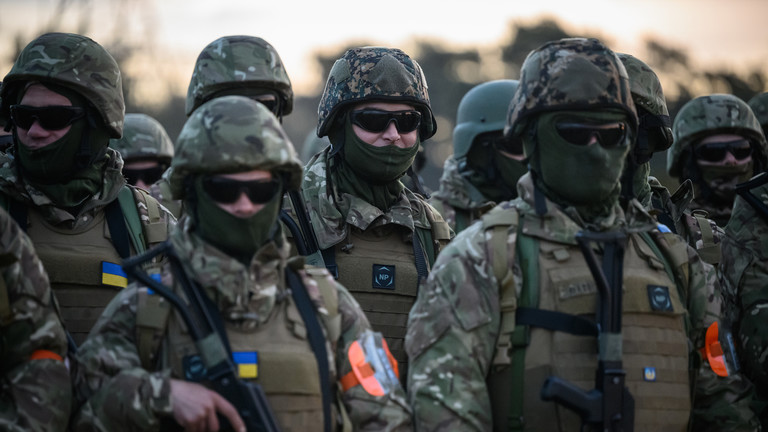
British special forces operators were embedded with Ukrainian troops in the early days of the conflict, Declassified UKreported on Wednesday, citing the newly published book by Polish journalist Zbigniew Parafianowicz.
Parafianowicz is the Ukraine correspondent for the Polish daily Dziennik Gazeta Prawna. His latest work, ‘Polska na Wojnie’ (Poland at War), examines Warsaw’s role in the neighboring conflict.
According to Declassified, at one point, a Polish government minister – who is not named – told Parafianowicz about a time in March 2022 when he was traveling from Kiev to Zhitomir.
“It was a time when the Russians were still standing in Bucha, and the route was a gray zone. It was possible to run into Russians. We passed the last checkpoint. The Ukrainians told us that we continue at our own risk,” the unnamed minister reportedly said. “Well, and who did we meet next? Ukrainian soldiers and … British special forces. Uniformed. With weapons.”
According to Parafianowicz’s source, the British and the Ukrainians worked together, driving around the countryside with artillery tracking radars, “learning about this war.”
The same official also said that Polish special forces based in Lublin had been in Brovary, a suburb of Kiev, “on the first day” of the hostilities. Poles – along with Brits and Americans – had been training the Ukrainian special forces since 2014, the minister said. According to Parafianowicz, Britain’s Special Air Service (SAS) had trained President Vladimir Zelensky’s security detail as well.
Another source, identified only as a high-ranking Polish officer, said that these commandos did not return to Poland, but “went in the opposite direction” – to Kharkov and parts of Donbass controlled by Ukrainians.
“They cooperated with the British,” the officer said. “Later, we worked out a formula for our presence in Ukraine … we were simply sent on paid leave. Politicians pretended not to see this.”
According to Declassified, some of these Polish commandos may have trained members of the neo-Nazi ‘Azov’ movement – specifically the ‘Kraken’ unit based in Kharkov – in the use of British-supplied NLAW rocket launchers. Social media posts identified them only as “instructors from NATO countries.”
Parafianowicz’s book appears to confirm previous media reports about NATO commandos fighting alongside Ukrainian troops. In April 2022, the French daily Le Figaroclaimed that SAS and Delta Force operators had waged a “secret war” on behalf of Ukraine since the beginning of Russia’s military operation. Shortly after those revelations, The Times said a number of SAS operators had returned to Ukraine to teach Kiev’s soldiers how to operate British-made anti-tank rockets. Last December, a British military publication admitted that up to 300 Royal Marines had been deployed to Ukraine for “discrete operations.”
Classified Pentagon documents that were leaked in April this year also showed at least 50 British special forces operators were still active in Ukraine as of March.
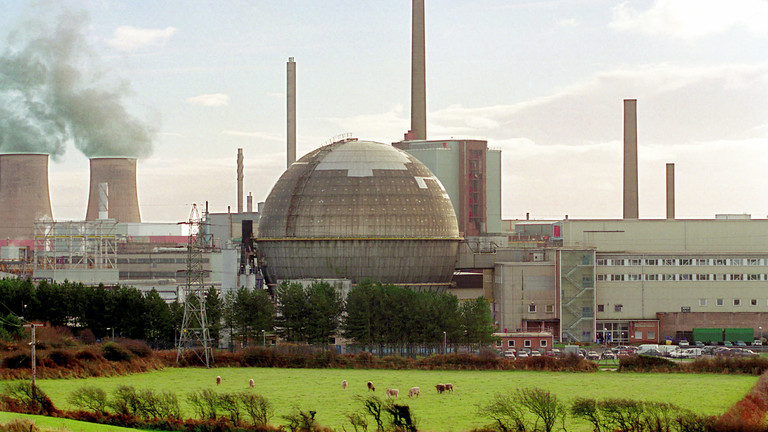
Sellafield, regarded as the most hazardous nuclear site in Europe, has developed a leak in a massive radioactive waste silo that has prompted concerns about the facility’s safety measures, as well as potential dangers to the public and the environment, The Guardian has reported.
The two-square-mile (6km sq) plant, located in Cumbria in England’s northwest, is responsible for the storage and decommissioning of nuclear waste from nuclear weapons programs and power generation. It was previously used to generate nuclear power from 1956 to 2003.
However, the decades-old facility, Europe’s largest nuclear site, has a catalog of safety issues, the newspaper said, including asbestos and fire hazards. Perhaps more concerningly, though, are cracks in storage silos which have prompted diplomatic squabbles with affected countries, including the US, Norway and Ireland.
Damage to one silo of toxic radioactive waste has caused a leak of “potentially significant consequences,” The Guardian said on Tuesday, citing official documents seen by the outlet. It adds that the leak, which it says is likely to continue until 2050, could contaminate groundwater should the situation worsen further.
Scientists are attempting to assess the full risks of the leak using “ongoing radiological dose assessments” and statistical modeling, the newspaper added. In June, the UK’s Office for Nuclear Regulation (ORR) said in a report that the risk presented by the leak is “as low as reasonably practicable.” However, the nuclear regulator remained concerned by the full impact of the leak and at what rate, if any, it may affect groundwater.
An unnamed expert who sits on a committee that monitors Sellafield and other nuclear sites told The Guardian : “It’s hard to know if transparency is put aside because no one’s brave enough to say ‘we simply don’t know how dangerous this is – other than certainly dangerous.’”
An EU report in 2001 warned that an accident at Sellafield could be more hazardous than that of the Chernobyl disaster in 1986, which exposed about five million people in Europe to radiation. Sellafield contains substantially more radioactive material than the Chernobyl facility did at the time.
Reports of Sellafield’s crumbling facade have sparked US concerns about the safety standards at the site, according to diplomatic cables seen by the publication. It has also led to complaints from the governments of both Ireland and Norway – with Oslo worried about the potential of radioactive particles being carried towards its territory by winds across the North Sea.
Health problems brought on by exposure to nuclear radiation depend on the dose but can range from nausea and vomiting to cardiovascular disease and cancer. Extremely high exposure is, in most cases, fatal.
There is a rumor in British diplomatic circles about forcing Ukraine to negotiate a way out of the conflict with Russia, per the UK podcast Politics at Jack and Sam’s. Could the reported chatter be real, and if so, what’s behind it?
The Western press is citing Ukrainian politicians expressing criticism with regard to President Volodymyr Zelensky’s failed counteroffensive, with British observers suggesting that the Kiev regime could soon be forced to sit down with Russia and hold talks. As it recently turned out, it was then-UK Prime Minister Boris Johnson who encouraged Zelensky to tear up the preliminary peace agreement with Moscow in 2022. Is London’s position on Ukraine changing?
“Well, their opinion is going to have to change, because the events on the ground are going to dictate it, with Ukraine losing militarily and neither the US nor the UK being in a position to supply any kind of significant weaponry,” retired CIA intelligence officer and State Department official Larry Johnson told Sputnik. “And even if they did, who’s going to use it? That’s Ukraine’s fundamental problem right now – it’s a lack of manpower. And over the last couple of weeks, we’ve seen more and more stories, more independent evidence that Ukraine has just suffered massive losses, both killed and wounded, that are incapable of returning to the fight. So, I think this flood of information will keep pouring out. And each day it’s going to add to the problems that Zelensky faces in trying to hang on to power.”
This is not the first time the rumor of potential Russo-Ukrainian negotiations has made its way to the press. In late November, the German newspaper Bild alleged a plot between Washington and Berlin to twist Zelensky’s arm into holding talks with Russia by substantially diminishing military aid to Kiev. According to the German publication, there is also a plan B envisaging a frozen conflict that would solidify a new “quasi-border” between Ukraine and Russia along the contact line.
Per Johnson, even if the West is ready for negotiations over Ukraine, they should bear in mind that nobody in Russia would allow them to fool Moscow after the derailed Istanbul talks of March 2022 and the Bucha hoax widely circulated by the Western press. However, it’s still unclear what the US and its NATO allies really want: a sustainable peace, or merely a frozen conflict.
“Well, again, this is the problem,” the former CIA analyst pointed out. “There has been no negotiation of any substance between the United States and Russia for now more than two years. The last time Putin entered into negotiations to negotiate a peace – that was a year ago, in April. And the West, Biden, Boris Johnson, they sabotaged it. They destroyed it. They made sure that the Ukrainians knew that they were not to agree to any deal. And that’s how they treat it. My own perception is that the Russians are still smarting over that betrayal, because they legitimately thought they had an agreement in place. And then within days, as they’re pulling back their forces from north of Kiev, the tank forces, the United States and the United Kingdom launched this propaganda campaign, accusing Russia of war crimes in Bucha. It was a blatant lie, it wasn’t true. But again, the truth didn’t matter anymore.”
Meanwhile, The Economist, a British magazine, has drawn attention to the fact that Zelensky’s approval rating is in free fall after the botched counteroffensive attempt, while Ukrainian Armed Forces Commander-in-Chief Valery Zaluzhny commands 70% support. Per the media, the two are at odds, as Zelensky apparently fears that Zaluzhny may be picked as his successor.
“Well, the Americans are trying to figure out how to get rid of Zelensky,” Johnson said. “And I think this is just a natural outgrowth of the various plotting and scheming. I think part of it is wishful thinking on the part of Americans. They launched this war as a proxy war against Russia, fully expecting Ukraine to defeat Russia. It was going to cause the collapse of Vladimir Putin and could ultimately lead to the breakup of Russia. And instead, it’s not turned out that way at all. It has completely backfired.”
“So what you’re getting now are these, let’s call them crazy ideas. People keep thinking that, ‘Okay, we can engineer this in such a way that maybe we will replace Zelensky with Zaluzhny.’ [… ] But these are the kinds of rumors that are circulating. What’s clear is that Zelensky does not have a secure hold on the presidency in Ukraine. And right now, there is a meeting underway in Washington with, I guess, the next in line for the presidency, probably because Zelensky himself didn’t feel secure leaving Ukraine right now to go beg for more money. And so he’s sticking close to home in order to just, I think, try to preserve his position.”
The sole recruitment company for the UK branch of Israel’s largest weapons company, Elbit Systems, has ended its association with the company, Palestine Action has said.
The direct-action group said iO Associates announced its decision to sever ties with Elbit on 29 November. The recruitment company had been a target of months of disruptions by anti-apartheid activists who sought to “impede their ability to recruit roles for Israel’s war machine,” Palestine Action said today.
iO Associates recruited the engineers, software developers and finance staff for Elbit Systems around the UK. Elbit is the largest weapons supplier to the Israeli occupation military, providing the vast majority of its drones, munitions, surveillance gear and parts for its tanks, jets and precision missiles. From Britain specifically, it manufactures parts for Israel’s drones, tank parts and more.
As part of efforts to drive iO Associates to cut ties with Elbit, activists stormed and occupied its Manchester office on 1 September and again on the 7th October. Activists painted iO offices red on 9 October in London, Reading and Manchester. They were forced to vacate their Manchester offices from 11 October, after the premises were also stormed by the Youth Front For Palestine, and then finally targeted in Edinburgh twice, on the 11 and 17 October.
Staff members also resigned as a result of the company’s arms trade partnership, staff told Palestine Action.
iO Associates did not reply to MEMO’s request for comment.
The collective West seems increasingly interested in worsening the crisis in the Middle East. Now, the United Kingdom is sending a new combat ship to the Persian Gulf region with the aim of deterring Iranian and pro-Palestinian forces. Amid growing tensions in the maritime zone of the Middle East, the British measure tends to escalate the crisis significantly.
According to Defense Secretary Grant Shapps, the destroyer HMS Diamond is heading to the Persian Gulf to “strengthen the United Kingdom’s presence” in the Middle East. The ship will join the frigate HMS Lancaster, which has been stationed in the region since last year. For Shapps, improving the UK’s defense capacity in that area is essential to guarantee British interests amid the current conflict situation.
“HMS Diamond is en route to join Operation Kipion, the UK’s maritime presence in the Gulf and the Indian Ocean (…) Recent events have proven how critical the Middle East remains to global security and stability,” he added in a statement (…) From joint efforts to deter escalation, following the onset of the renewed conflict in Israel and Gaza, to now the unlawful and brazen seizure of MV Galaxy Leader by the Houthis in the Red Sea – it is critical that the UK bolsters our presence in the region, to keep Britain and our interests safe from a more volatile and contested world,” he said.
More than that, Shapps also added that the destroyer will help deter regional actors, mainly “Iran and its proxies.” With these words, Shapps clearly refers to Hezbollah and mainly to the Yemeni Houthis, who recently launched a series of naval assaults, making the Israeli maritime presence in the Red Sea unworkable. Furthermore, it has also been stated that sending the ship will contribute to ensuring “freedom of navigation”, which is a common rhetoric of British and American strategists.
“Freedom of navigation” operations are naval military mobilizations carried out in disputed or conflict regions with the excuse of guaranteeing freedom of passage for civilian and merchant ships. Among Western navies, these operations have become commonplace to provoke enemy countries in a “disguised” way. The US constantly promotes such incursions into maritime zones claimed by China in Asia, for example. Now, the UK wants to do something similar in the Middle Eastern region, where military tensions are growing rapidly.
Around fifty large merchant ships pass through the Bab-el-Mandeb Strait daily, while one hundred pass through the Strait of Hormuz. These are extremely busy maritime areas that facilitate the commercial flows of local countries. The problem is that the sea is one of the first areas affected in a war scenario. Pro-Palestinian forces are intercepting Israeli ships reaching the Red Sea through the straits. Soon, it is possible that ships from Western countries will also begin to be attacked, as these states are giving full and unrestricted support to Israel’s military campaign in Gaza.
The UK uses this scenario as a justification for sending warships to the region, but this does not seem to be the correct way to deal with the situation. Instead of “deterring” the Palestinian and Iranian allies, the UK will be provoking them further and contributing to the deterioration of the crisis. The more Western interventionism is being conducted in the Middle Eastern situation, the more tensions will escalate, which is why London is making a serious mistake.
However, it is noteworthy that the British maneuver is inserted in a context of increased naval interventionism by London in several “tense” regions.
For example, in addition to the ship heading to the Gulf, the deployment of an international task force led by the British was also announced. The aim is allegedly to launch patrols from the English Channel to the Baltic Sea. In addition to the UK, countries such as Denmark, Finland, Iceland, the Baltic states, Norway and Sweden are participating in the project. The group is being called the Joint Expeditionary Force (JEF) and, according to Shapps, will “defend our shared critical infrastructure against potential threats”.
As we can see, once again the irresponsible maneuvers of Western countries can lead to serious consequences. In order to supposedly “protect their interests”, these countries implement dangerous escalatory measures that tend to create real problems. Maritime tensions in the Middle East will grow as there is more Western participation in favor of Israel – in the same sense that maritime tensions in Europe will begin to emerge from the moment that the maneuvers of Western countries began to generate security problems for Russia.
Instead of creating false enemies and launching bellicose measures, the best thing for the West to do is to calm tensions and reestablish dialogue for a peaceful solution. But unfortunately this strategic sense no longer seems to exist among Western decision makers.
Lucas Leiroz, journalist, researcher at the Center for Geostrategic Studies, geopolitical consultant.
Peter Gøtzsche reviewed every randomised mammography screening trial ever conducted for the Cochrane Collaboration. Cochrane’s headline is that, assuming a 15% mortality reduction, one woman in 2000 avoids dying of breast cancer over ten years. Ten are overdiagnosed and treated. Two hundred experience false alarms.
But that headline assumes the reduction. When Gøtzsche looked only at the trials with adequate randomisation — the higher-quality ones — the reduction disappeared. No effect on breast cancer mortality. No effect on all-cause mortality.
This is the Cochrane finding, published in the establishment’s own database of systematic reviews.
No woman being asked to consent to a mammogram this week knows it.
That is why the new Unbekoming paperback exists. … continue
This site is provided as a research and reference tool. Although we make every reasonable effort to ensure that the information and data provided at this site are useful, accurate, and current, we cannot guarantee that the information and data provided here will be error-free. By using this site, you assume all responsibility for and risk arising from your use of and reliance upon the contents of this site.
This site and the information available through it do not, and are not intended to constitute legal advice. Should you require legal advice, you should consult your own attorney.
Nothing within this site or linked to by this site constitutes investment advice or medical advice.
Materials accessible from or added to this site by third parties, such as comments posted, are strictly the responsibility of the third party who added such materials or made them accessible and we neither endorse nor undertake to control, monitor, edit or assume responsibility for any such third-party material.
The posting of stories, commentaries, reports, documents and links (embedded or otherwise) on this site does not in any way, shape or form, implied or otherwise, necessarily express or suggest endorsement or support of any of such posted material or parts therein.
The word “alleged” is deemed to occur before the word “fraud.” Since the rule of law still applies. To peasants, at least.
Fair Use
This site contains copyrighted material the use of which has not always been specifically authorized by the copyright owner. We are making such material available in our efforts to advance understanding of environmental, political, human rights, economic, democracy, scientific, and social justice issues, etc. We believe this constitutes a ‘fair use’ of any such copyrighted material as provided for in section 107 of the US Copyright Law. In accordance with Title 17 U.S.C. Section 107, the material on this site is distributed without profit to those who have expressed a prior interest in receiving the included information for research and educational purposes. For more info go to: http://www.law.cornell.edu/uscode/17/107.shtml. If you wish to use copyrighted material from this site for purposes of your own that go beyond ‘fair use’, you must obtain permission from the copyright owner.
DMCA Contact
This is information for anyone that wishes to challenge our “fair use” of copyrighted material.
If you are a legal copyright holder or a designated agent for such and you believe that content residing on or accessible through our website infringes a copyright and falls outside the boundaries of “Fair Use”, please send a notice of infringement by contacting atheonews@gmail.com.
We will respond and take necessary action immediately.
If notice is given of an alleged copyright violation we will act expeditiously to remove or disable access to the material(s) in question.
All 3rd party material posted on this website is copyright the respective owners / authors. Aletho News makes no claim of copyright on such material.



 Aletho News