First, Do Harm: A Sorry Tale in the Daily Mail
Dissenting Doctors Dishonourably Disparaged
Health Advisory & Recovery Team | November 29, 2023
The sordid state of the medical system here in the UK is laid bare in excruciating detail in a recent Daily Mail article which chooses to perpetuate myths and disinformation rather than engage in genuine reporting.
The story so far
Dr Sarah Myhill – a doctor now working as a naturopath – is being hounded by the General Medical Council (GMC) who have referred her to various hearings at the Medical Practitioners Tribunal Service (MPTS). Myhill’s alleged transgressions are outlined in great detail on the MPTS website, but the gist of the complaint seems to be that Myhill has had the temerity to highlight the benefits of low-cost treatments (such as Vitamin D) over expensive – and possibly harmful – pharmaceuticals.
This matter should hardly be controversial, even to the mainstream – after all, many will have heard or watched the various TV series such as ‘Dopesick’, ‘Painkiller’ or even the BBC recent Panorama expose ‘The Antidepressant Story’. In contrast to these expensive chemical compounds that have multiple adverse effects – both on individuals and society as a whole – stand inexpensive treatments and lifestyles that are as cheap as (and substantially healthier than) chips.
Consider the benefits of Vitamin D – the ‘sunshine vitamin’ – extolled in no lesser organ of public opinion than the Daily Mail itself, Mark Solomons reporting only a few weeks ago that “a third of Britons have Vitamin D deficiency due to spending too much time indoors, poor diet and failing to take supplements”.
What an opportunity to follow this excellent educational reporting with an additional piece that promotes healthy living and the perils of the over-promotion of ‘pill popping’.
Alas… ‘achievement not unlocked’. The headline alone is a classic of the disinformation genre, a masterclass in deceptive propagandisation comprising just 23 words (and a number):
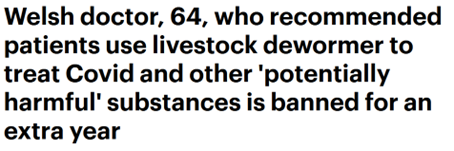
Precisely why all Welsh doctors approaching retirement are deemed worthy of this drive-by assassination by headline is not fully clear – perhaps that is just the Daily Mail’s house style. That aside, the following twin headline double-barrelled untruths deserve greater scrutiny:
- Vitamins C & D are branded “other ‘potentially harmful’ substances”, which is of course entirely correct… but only in the sense that too much of almost anything is not only possibly harmful, but potentially lethal. Water – that elixir of life, the molecule that makes up almost 60% of your bodyweight – can cause death not only by drowning, but also by overhydration: “After downing some six liters of water in three hours in the “Hold Your Wee for a Wii” contest, Jennifer Strange vomited, went home with a splitting headache, and died from so-called water intoxication”. If Vitamins C & D are now ‘potentially harmful’ and result in witch-hunt reporting, can we expect the Daily Mail to refer itself for censure for calling for its readers to “drink plenty of fluids” without suitable caveats? In comparison to this – potentially lethal – advice from the Daily Mail, Dr Myhill has advocated taking a high dosage of Vitamin D but at a level no greater than a level that recent research has determined to be safe.
- The ‘livestock dewormer’ in question is in fact Ivermectin, a very cheap and Nobel prize-winning antiviral drug. After a history of veterinary use, it was approved by the FDA for human use in 1996, has been on the World Health Organisation’s list of essential medicines since at least 2015 and was described in the Journal of Antibiotics in 2020 as an antiviral “wonder drug” that “is continuing to surprise and excite scientists, offering more and more promise to help improve global public health by treating a diverse range of diseases, with its unexpected potential as an antibacterial, antiviral and anti-cancer agent being particularly extraordinary… perhaps more than any other drug, ivermectin is a drug for the world’s poor. For most of this century, some 250 million people have been taking it annually to combat two of the world’s most devastating, disfiguring, debilitating and stigma-inducing diseases, Onchocerciasis [river blindness] and Lymphatic filariasis. Most of the recipients live in remote, rural, desperately under-resourced communities in developing countries and have virtually no access to even the most rudimentary of medical interventions. Moreover, all the treatments have been made available free of charge thanks to the unprecedented drug donation program”.
What a heart-warming story! If only the Daily Mail had chosen to share this feel-good blockbuster with its readers. Many doctors chose to prescribe Ivermectin off-label, which is entirely normal behaviour (after all, repurposing a drug that already has a defined safety record is far less risky than rushing a new medicine – which by definition will not have a long track record – to market):
“There are clinical situations when the use of unlicensed medicines or use of medicines outside the terms of the licence (i.e. ‘off-label’) may be judged by the prescriber to be in the best interest of the patient on the basis of available evidence. Such practice is particularly common in certain areas of medicine: for instance, in paediatrics where difficulties in the development of age-appropriate formulations means that many medicines used in children are used off-label or are unlicensed“.
Who better to make these kinds of decisions than a patient’s doctor?
Many people will be aware of what happened next. Various shenanigans ensued resulting in Ivermectin being discredited. One of the most Kafkaesque situations was an FDA-orchestrated smear campaign that branded Ivermectin as ‘horse-paste’ and informed people that “you are not a horse”. Quite an eyebrow-raising stunt when you consider that Ivermectin is safe enough to feature on the CDC website with an oral dosage level that is declared safe for use in children over the weight of 15kg. The FDA was – quite rightly – subsequently eviscerated in a recent Fifth District court ruling:
“The Food and Drug Administration is not a physician, so it had no business cautioning people not to take Ivermectin”.
The ruling is worth reading in full.
Returning to the Daily Mail headline, we can summarise the situation as follows: authorities have censured a doctor who promoted (within their known safe usage parameters!) certain vitamins and antiviral treatments. Whether or not these treatments are effective or not is essentially irrelevant – they are safe, which is more can be said for any newly introduced pharmaceutical product with no long-term safety data attached.
Contrast the prescription of these safe treatments with said authorities’ recent (well, since late 2020) enthusiastic one-size-fits-all promotion of various injectable products that were claimed to be both ‘safe’ and ‘effective’.
There is, of course, a rational (if somewhat chilling) explanation as to why we find ourselves in this bizarre and counter-intuitive situation.
It is worth pausing for a moment to consider what twisted circumstances can have arisen for the medical establishment to weaponise its disciplinary procedures, especially in the case of a doctor that has already attempted to take herself off the register. The GMC and the MPTS are only too aware that:
“suspension has a deterrent effect and can be used to send out a signal to the doctor, the profession and public about what is regarded as behaviour unbefitting a registered doctor.”
The action against Myhill seems overly vindictive and a waste of time, money and resources. The absurdity of proceedings has been inadvertently – and succinctly – summarised by the GMC’s KC, Tom Kark:
“The problem with the Myhill cases is that all the patients are improved and all refuse to give witness statements.”
But perhaps the intention is to come after other doctors that dare to speak out, and also to deter others from joining them in speaking truth to power.
The promotion of one-size-fits-all pharmaceutical interventions is clearly a profitable endeavour for various pharmaceutical companies and associated vested interests, but it is clearly not in the best interests of patients. Doctors promise to “first, do no harm”, and they – and all associated establishment regulators and other authorities – pay appropriate lip-service regarding patient autonomy, choice and informed consent as encapsulated in any (and one would hope all?) documented formulations of the Doctor-Patient relationship.
But the truth is starkly different. There are good doctors who are willing to put patients first, resist groupthink and stand up to bullying regulators. The hounding and demonisation of these doctors is an appalling and sinister crime. It happened before covid, it happened during covid, and it is happening now. It is sad to see spineless reporting by those in the mainstream media who (1) should know better and (2) have the resources to stand up to the drug pushers.
Perhaps the only answer is bottom-up resistance. If enough people resolve to ensure that justice is done, then complaining to the GMC might make a difference.
Father of British student killed by Israel urges Tel Aviv to change ‘inhuman’ military tactics

Tom Hurndall was volunteering at a refugee camp in Gaza when he was shot by an Israeli sniper in the Gaza Strip in 2003.
Press TV – November 29, 2023
Father of a British student killed by Israeli soldiers has urged the occupying regime to change its “unethical and inhuman” military tactics, warning Tel Aviv that it will lose support from the West by continuing such policies.
Anthony Hurndall, whose 22-year-old son was killed by Israeli snipers in 2004, denounced Israel’s “fundamentally unethical and inhuman attitudes,” in an interview with The Times published on Wednesday.
Tom Hurndall, who was a photography student, a volunteer for the International Solidarity Movement (ISM), and an activist against the Israeli occupation of the Palestinian territories, was shot in the head by an Israeli sniper in the Gaza Strip in April 2003 and lost his life in January 2004 after spending some nine months in a coma.
He was shot when he was assisting Palestinian children caught in the crossfire in the impoverished Palestinian enclave.
Soroka Hospital’s medical staff initially claimed that the critical injuries to his head were caused by a baseball bat but an investigation later revealed that the staff had removed bullet fragments from Tom’s brain before making up the baseball bat story.
When the fabricated account was refuted, Tel Aviv claimed that the young photographer was allegedly carrying a weapon and was a gunman.
“The investigation further revealed that, as standard practice,” the Israeli military “routinely falsely misrepresent civilians and children as militants, or as armed, and fabricate accounts of events as a pretext for their killing,” Hurndall, who is director of the Center for Justice, told The Times.
“These claims appear similar to the claims that” the Israeli military is “currently making to justify their bombing, missile and other attacks on civilian targets and hospitals in Gaza. It was the view of those in diplomatic circles, expressed to us at the time, that” the Israeli military “appeared to consider themselves immune from accountability and free to misrepresent innocent civilians as legitimate military targets and to target them, as a form of intimidation or collective punishment,” he added.
Hurndall denounced the narrative portrayed by the media and the governments in the West as “one-sided” that ignores the facts.
“If Israel does not change fundamentally unethical and inhuman attitudes and policies and stop committing war crimes, it will build up even greater resistance from the Palestinian people and lose the sympathy and support of the West,” he stressed.
Israel launched the war on Gaza on October 7 after the Palestinian resistance movement Hamas waged the surprise Operation Al-Aqsa Storm against the occupying entity in response to the Israeli regime’s decades-long campaign of bloodletting and devastation against Palestinians.
According to the Gaza-based health ministry, over 15,000 Palestinians, including more than 6,000 children, were killed in Israeli strikes, during the 49 days of war. Many more dead are feared to be under the rubble.
West ‘screwed over’ Ukraine – ex-Zelensky aide
RT | November 27, 2023
The West has essentially thrown Ukraine under the bus in its conflict with Russia by failing to provide Kiev with the necessary amount of military aid, Aleksey Arestovich, a former aide to President Vladimir Zelensky, has claimed.
Writing on Telegram on Sunday, Arestovich weighed in on the differing views of Ukrainian officials as to why Kiev’s conflict with Moscow is still in full swing despite several major attempts at peace.
According to the former presidential aide, the West bears most of the blame for the situation.
“The real responsibility lies with those who promised Ukraine real support for waging a real, big war and did not provide it. In other words, they screwed us over.”
Arestovich claimed that Ukraine “had won its war” by managing to survive in the first few months of the conflict. “This war of ours could have well ended with the Istanbul Agreements,” he suggested, referring to the talks in the Turkish city in the spring of 2022, which initially made some progress but stalled after then-British Prime Minister Boris Johnson’s visit to Kiev. The negotiations collapsed but Russia maintains it is open to diplomatic engagement with Kiev.
After the Istanbul talks, the conflict entered another phase in which Ukraine had no chance of winning without securing massive Western arms supplies, including warplanes and long-range missiles, the former official continued. “But nothing came. We paid a huge price for that.”
Arestovich suggested that the West would now try to force Ukraine to accept the loss of several regions, which overwhelmingly voted to join Russia in a series of public referenda last autumn.
He also suggested that, while Kiev found itself in a tough spot mostly due to the West’s inaction, the Ukrainian leadership’s “stupidity and corruption has given them many formal and informal reasons to screw us over.”
Arestovich’s remarks came amid Ukraine’s faltering counteroffensive, which has been underway since early summer but has failed to gain any significant ground. Last month, Moscow said Kiev had lost more than 90,000 troops since the start of the push, with Defense Minister Sergey Shoigu claiming that Ukrainian casualties had reached more than 13,000 soldiers in November alone.
Earlier this month, Valery Zaluzhny, Ukraine’s top general, admitted that hostilities had reached a stalemate, an assessment rejected by Zelensky. Meanwhile, on Sunday, Mariana Bezuglaya, a senior Ukrainian MP, blasted Zaluzhny over the lack of a strategic plan for 2024 and called on the military leadership to step down.
Explainer: Why are Celtic fans staunch supporters of Palestinian cause?

By Ivan Kesic | Press TV | November 26, 2023
Amid the Israeli regime’s devastating blitzkrieg on the blockaded Gaza Strip, a football club based in Glasgow has grabbed headlines in recent weeks for its support of Palestine.
Despite the Union of European Football Associations (UEFA) slapping fine on the Celtic Football Club, the club fans have vowed to continue their support for Palestine against the Israeli occupation.
On Wednesday, Europe’s top football body announced a new fine of $19,000 against the club over a “number of incidents” during its Champions League match against Atletico Madrid in late October, which ended in a 2-2 draw.
Celtic was ordered to shell out €17,500 for its supporters’ displaying “a provocative message of an offensive nature,” €8,000 for “blocking of public passageways” and €3,500 for “lighting of fireworks.”
The club fans, led by the Green Brigade group, were heard singing ‘You’ll Never Walk Alone’ while unfurling two large banners that read ‘Free Palestine’ and ‘Victory to the Resistance’.
The Green Brigade was banned by the Scottish club in October from attending its away matches but has remained insistent on showing support for Palestine by displaying its flags at Celtic matches.
Two pro-Palestinian displays
The incident took place at the match between Celtic and Atletico on October 25 at the club’s home ground Celtic Park in Glasgow, attended by 60,000 Celtic fans, including the Green Brigade group.
As the start of the Champions League group stage match approached, the stadium turned into a sea of Palestinian flags, every stand awash with the colors of Palestine in a show of solidarity with those bombed and killed by the Israeli occupying regime in the Gaza Strip.
A few days earlier, after a home match against Kilmarnock, Celtic fans strongly criticized the broadcasters for not wanting to show the North Curve corner section with Palestinian flags displayed.
This time the media was not able to cover up anything because the Palestinian symbolism was not limited to one corner of the stand, but the whole stadium was painted with colors of the Palestinian flag.
Spectacular photos and videos of pro-Palestinian Celtic fans, singing collectively “You’ll Never Walk Alone,” quickly spread around the world and were shared by millions of netizens on social media.
During the earlier Scottish premiership match against Kilmarnock in Glasgow on October 7, the Green Brigade displayed two large banners saying “Free Palestine” and “Victory to the Resistance.”
Defiance of club appeals
Two days after the 3-1 victory against Kilmarnock, the club’s board distanced itself from the fan group’s show of solidarity, issuing a statement saying “Celtic is a football club and not a political organization.”
“We ask that banners, flags and symbols relating to the conflict and those countries involved in it are not displayed at Celtic Park at this time,” the club said in a statement before the game against Atletico.
However, the Green Brigade ignored the club’s directives and, on the contrary, called on all Celtic fans to raise the Palestine flag during the club’s UEFA Champions League match.
“We must apply learning from apartheid South Africa to dismantle apartheid Israel; if we are neutral in situations of injustice, we have chosen the side of the oppressor,” the Green Brigade said in a counter-statement.
“We send our sincere solidarity and prayers to our friends across all of Palestine at this traumatic time when yet again much of the international community turns its back in cowardice while war crimes are inflicted on a largely defenseless, imprisoned population.”
Keeping the fan tradition
In another statement, issued as a response to the club’s appeals, the Green Brigade also highlighted their tradition of supporting the oppressed and criticized hypocrisy by the political and media class.
“Football remains one of the few areas of public life where working-class people have genuine political agency, and we will not be dictated to by an elitist board that has repeatedly demonstrated contempt for the history and traditions of Celtic FC,” the fan club said.
“Celtic was born out of famine and oppression, a product of colonial rule, death and the mass displacement of people. It is because of this history that Celtic fans are renowned for their empathy and solidarity; consistently siding with the oppressed and destitute,” they added.
It slammed the “hypocrisy” of the club staff, which it said is in line with “much of the political and media class, epitomized through the example of Ukraine.”
“Political messaging was welcome at Celtic Park then, yet it is being condemned now,” the statement noted. “The question on any reasonable mind should be – why? Why are Ukrainian lives more sacred than Palestinian lives.”
The fans referred to the fact that some months ago, pro-Ukrainian support on the pitches and sports stadiums was not prohibited but encouraged, ibyUEFA’s official policy.
While the Green Brigade is renowned for its Irish Republicanism and steadfast support for Palestine, fans of Celtic’s local rival Rangers have in turn supported the Israeli regime when facing Celtic.
In recent weeks, Rangers fans have waved Israeli regime flags and held a minute’s silence for the Israeli victims, but the club has not been punished for such actions.
Humanity of the club
The support of Celtic fans is much more than waving flags and is not a result of the ongoing Israeli aggression on Gaza, they have been organizing pro-Palestinian support since the 2000s.
In 2012, they organized a display of solidarity with Palestinian prisoners on hunger strike, featuring a banner reading “Dignity is More Precious than Food” alongside Palestinian flags.
Their most noble pro-Palestinian action came in 2016 after UEFA fined them £8,600 for flying Palestinian flags in a match against Israeli club Hapoel Beer-Sheva.
Defiant as always, the Green Brigade launched a crowdfunding campaign and ultimately a remarkable £176,076 was raised and split between two beneficiaries that provide medical aid to Palestinians.
One of the results of those donations was the establishment of the refugee football club Aida Celtic, based in the Palestinian city of Bethlehem.
The Green Brigade has continued with humanitarian actions in recent weeks, collecting donations for health organizations that help the Palestinian people.
Interestingly, the club was formed in 1888 by Brother Walfrid, an Irish Catholic cleric, to raise money for poor Irish immigrants in the West of Scotland, according to reports.
So, as it appears, the foundation of the Scottish club itself was based on a human cause.
Curious Admission Surfaces Concerning MHRA Blackmailing Mainstream Media Outlet Over Adverse Event Reporting
And no one really picked up on it…
BY JJ STARKY | NOVEMBER 25, 2023
Mass consumers of news – me included – are often exposed to so much information that some of that information can be lost in all the noise.
There’s little explanation why such a bombshell revelation featured in a recent Telegraph article gained next to no attention.
On 8th November, journalist Sarah Knapton published an article, entitled, ‘In the end, the AstraZeneca vaccine just wasn’t as good as its rivals’. Knapton broke down how AstraZeneca’s (AZ) purported efficacy could not stand up to the purported efficacy of the other vaccines. The consequences of which led to its eventual abandonment.
Curiously, however, buried in the 14th paragraph, was a confession that back in March 2021 – when the Telegraph first reported on AZ’s blood clot risks – Medicines and Healthcare products Regulatory Agency (MHRA) officials effectively blackmailed them.
Knapton writes:
“On the day we published the story we received a threatening phone call from a senior official at the MHRA warning that The Telegraph would be banned from future briefings and press notices if we did not soften the news.
Another well-known Cambridge academic got in touch to complain about our “disgraceful fear-mongering headline” on the story, claiming that it would discourage vaccine uptake and cost lives.”
This was the headline of that 17th March 2021 article:
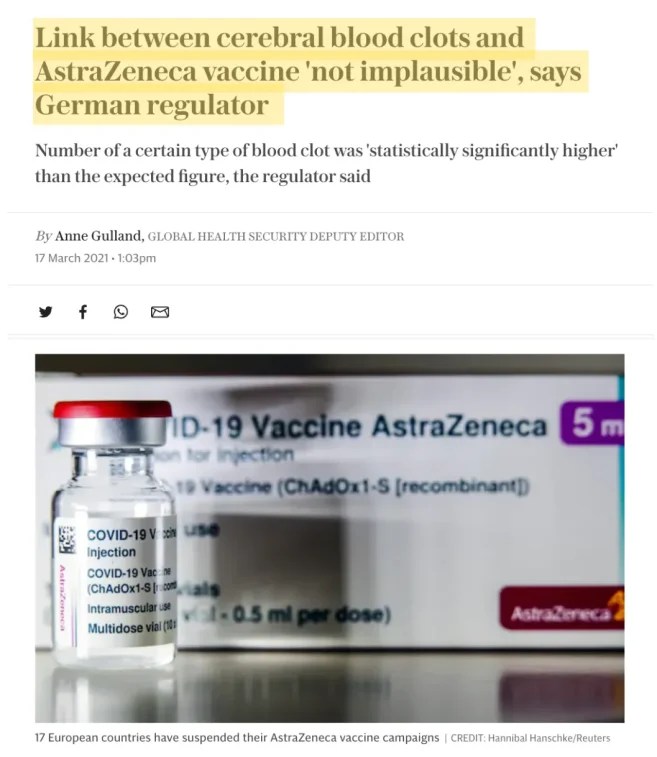
Considering the title includes a subjective opinion from a foreign medical regulator that softens the news, I’m not sure how it constitutes “disgraceful fear-mongering”.
Perhaps this remark is more reflective of the contagious petulance we witness with medical regulators. For them, negative news is not just negative news. It’s analogous to physical assault.
What seems far more “disgraceful” is how a supposedly impartial medical regulator – tasked with safeguarding citizens from potentially lethal treatments – allegedly threatened to strip away a news organisation’s access. Leaving them out in the cold as competitors would stand to benefit from their potential exclusion.
And the curious thing is, no one has seemed to pick up on the news bar The Conservative Woman and the Health Advisory & Recovery Team (HART).
A report from HART earlier in August further revealed that MHRA officials have been blocking journalists, scientists, and vaccine injured victims on social media. HART asked them why and they responded:
“Thank you for flagging your issue about Twitter. We’ve reviewed recent action taken on that platform and have identified accounts which have been blocked in error, these have now been unblocked and you should be free to interact with our content again. Please let us know if you have any further issues so we can investigate and rectify, if necessary”.
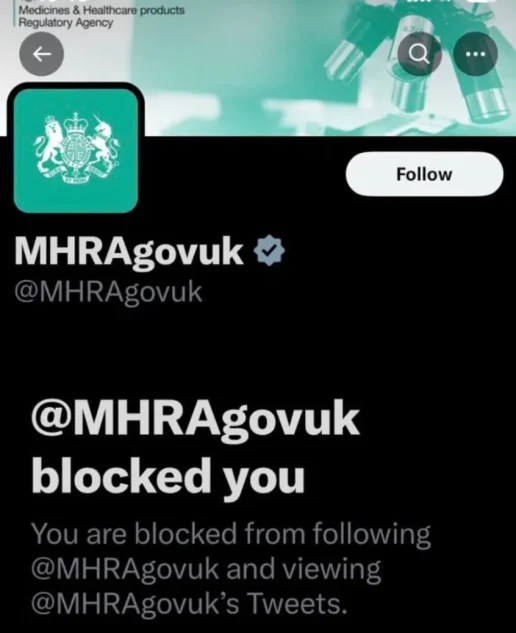
“Sorry folks, it was error. And a complete ‘coincidence’ that we primarily blocked commentators who were critical of us…”
These are the same officials who refused to answer a routine Freedom of Information Request concerning data AstraZeneca submitted in their application to licence their Covid-19 vaccine. The reason they refused? It was “vexatious”.
They wrote in their response:
“this request falls to be considered “vexatious” due to the scope of the request and the disproportionate burden that compliance would create. S14(1) of the FOIA states that “Section 1(1) does not oblige a public authority to comply with a request for information if the request is vexatious.
Downloading the dossier of the vaccine is a relatively straightforward task, although it does require time. Due to the voluminous size of the file packages, when downloading the full package of data, the database software may be more prone to freeze. However, the time required to read through the dossiers, to identify exempt information and to consider and make redactions we expect would take many weeks, if not months to complete, as the dossier encompasses gigabytes of data. To meet the request our staff: Would need to read the dossier in full, in order to identify where redactions need to be made.
We appreciate that there remains a strong public interest in COVID-19 vaccines, however, we do not feel that the public interest outweighs the resource burden required to meet your request.”
Sometimes the actions of government officials are laced with so much arrogance, incompetence, and just frank laziness that it makes one question if they’re genuinely true.
If I sat across the table from an uninitiated countryman and told him of the above, it would come as no surprise to see him raise his eyebrows in astonishment. But not because of what I was telling him, but at me, as if I was about to descend into prophetic trance about how judgement day is coming and there’s going to be some epic battle between us and the lizard people outside Matt Hancock’s house.
Put differently, the extent to which the medical regulators’ actions are so unbelievable actually benefits them. It is easier for people to dismiss it as false. Of course, if the media actually did their job, this wouldn’t be a problem.
Naturally, when MHRA threatened the Telegraph, the outlet hesitated to revisit the subject for months. The blackmail paid off.
New Report: Young People Dying of Cancer at ‘Explosive’ Rates, UK Government Data Show
By Mike Capuzzo | The Defender | November 21, 2023
Teenagers and young people in their 20s, 30s and 40s in the U.K. are dying from rapidly metastasizing and terminal cancers at an unprecedented rate since mass COVID-19 vaccination began, according to a new analysis by Edward Dowd.
The 45-page report by Dowd, a former Wall Street hedge fund manager and author of “‘Cause Unknown’: The Epidemic of Sudden Deaths in 2021 and 2022,” alarmed some oncologists who characterized it as a sharp reversal of decades of mortality data.
Dowd based his analysis on readily available government statistics from the U.K.’s Office for National Statistics.
In an interview with The Defender, Dowd said he and his research partners, who include a handful of high-level scientists, data analysts and financial experts, examined all International Classification of Diseases, 10th Revision, (ICD-10) codes for cause of death in the U.K. in the study period of 2010-2022 to investigate trends in malignant neoplasms (C00 to C99 codes).
ICD-10 codes are the international physicians’ classification of diagnosis, symptom and procedure for claim processing set by the World Health Organization (WHO). A malignant neoplasm is a cancerous tumor.
Dowd said his research team noticed a striking pattern: While almost all deaths among older people in 2021 and 2022 in Wales and England had been coded, 8% of deaths among 15- to 44-year-olds in 2021, and 30% of deaths in that age group in 2022, hadn’t yet been coded.
“When you die in a hospital, you leave a trail of life and death with indications of what led to the death,” he said. “When a young person dies at the wheel of a car, walking down the street or in their sleep, there’s an investigation” that consumes time to assign the cause of death.
Dowd said the missing codes are “indicative of the problem” of excess deaths among young people.
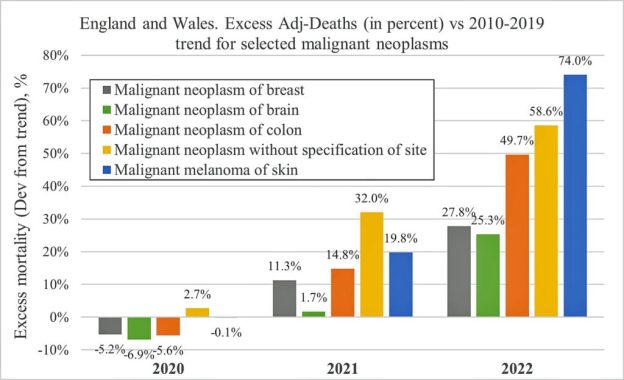
But even with the caveat of missing codes, he said, the remaining 92% of coded deaths in 2021 and 70% of coded deaths in 2022 revealed “a strong signal of cancer deaths in the young. We show a large increase in mortality due to malignant neoplasms that started in 2021 and accelerated substantially in 2022.
“The increase in excess deaths in 2022 is highly statistically significant (extreme event),” Dowd wrote in his report. “The results indicate that from late 2021 a novel phenomenon leading to increased malignant neoplasm deaths appears to be present in individuals aged 15 to 44 in the UK.”
The study’s results in the rate of cancer deaths above the historic norm in 2022 for ages 15-44 in the U.K. included:
- A 28% rise in fatal breast cancer rates in women.
- An 80% increase in pancreatic cancer deaths among women and a 60% increase among men.
- A 55% increase among men in colon cancer deaths and a 41% increase in women.
- A 120% increase in fatal melanomas among men and a 35% increase in women.
- A 35% increase in brain cancer deaths among men and a 12% rise in women.
- A 60% increase in cancer death rates among men in cancers “without site specification” and a 55% increase among women.
‘Mounting clinical evidence’ led to study
Dowd produced his report, assembled by Carlos Alegria, one of Dowd’s partners, in his Humanity Projects study of excess deaths in the U.K. and the U.S. using government and insurance industry data.
He said he started his pro bono data-driven project to help guide public policy when he saw how COVID-19 pandemic policies were destroying society’s faith in institutional experts.
Surveying the capture of national and state government regulatory agencies and corporate media by Big Pharma and other global interests, he realized, “We need independent agents to act as gatekeepers of the public interest.”
“We intend to be such agents, and to provide high-quality research to other individuals and institutions who seek similar outcomes,” he wrote.
The new report is his third in the UK Cause of Death Project, which previously examined “UK – Death and Disability Trends for Cardiovascular Diseases, Ages 15-44,” and “UK – Death Trends for the Cardiovascular System, Ages 15-44, Analysis of Individual Causes.”
The mounting clinical evidence linking burgeoning cancers in young people to the COVID-19 vaccines led Dowd to his latest study, he said.
“We focus our research on younger individuals, aged 15-44, as presently it is a topic of particular interest due to the rise in anecdotal evidence of many unexplained aggressive and unusual cancers (such as turbo cancers … ) occurring in the population, particularly in younger individuals,” he wrote in the study.
“The focus of this study is not to examine individual claims and anecdotes, but instead to provide a statistical analysis at a population level and clarify if the anecdotal evidence is abnormal or not.”
Dowd said he hopes “the relationships that we uncover in our analysis” are “a basis for a reality check for health professionals to understand underlying trends in individuals’ health.”
Dowd’s method was to analyze the number of deaths attributed to cancer in England and Wales between 2010 and 2022 in the U.K. Office for National Statistics data.
He compared excess death rates, the difference between observed deaths and the baseline for expected deaths, before and after the COVID-19 pandemic.
He established a baseline of normal cancer death rates from 2010-2020 that was remarkably consistent with few deviations, he said — until the cancer death rates rose significantly in late 2021 in the U.K. following the vaccine rollout.
Key findings from the report include:
- Breast cancer dominates in women. The most common cause of fatal cancer in women, ages 15-44, is breast cancer, representing about 25% of the total excess death rate caused by malignant tumors in women in 2022. The next most dangerous cancers for women, based on excess death rates, were colon cancer and cancer of the cervix uteri.
- While fatal cancer deaths rose dramatically among both young men and young women in 2022, young men saw a disproportionately higher rise in cancer deaths, but with no dominant cancer comparable to breast cancer in women. Brain cancer, colon cancer and stomach cancer accounted for 30.9% of the rise in fatal cancers in men in 2022.
- Cancers “without specification of site,” indicating rapid metastasis to other organs and commonly called “turbo cancers,” “exploded” in 2022, Dowd said. “These cancers saw very large rise in both women (in 2021 and 2022) and men (in 2022) and were likely metastasized already once they were identified. As the individuals refer to younger individuals who do not require early screening, these cancers were likely of rapid growth.”
- Men experienced a huge rise in skin cancer death rates of 118% in 2022. “Even though these cancers do not account for a large proportion of all cancers,” Dowd said.
- Cancers of the digestive tract “saw explosive changes in 2021 and 2022 relative to the 2010-2019 trend,” Dowd wrote. “Of particular notice are cancers of the colon (internationally coded as C18), stomach (C16) and esophagus (C15). “These cancers related to the digestive tract appear to have risen substantially in importance, and we also notice that they seem to be affecting men in a disproportionate manner.”
- Pancreatic cancer “saw a very large rise in both women (in 2022) and men (in both 2021 and 2022). Why these cancers rose so dramatically and why they rose first in men then women is one of the questions that we believe warrants investigation.”
Dowd emphasized that his research was “a first attempt to bring out some patterns that are observed in trends” in cancer post-2020.
“We hope that medical doctors and specialized researchers perform further investigations based upon these (and other) insights that our data analysis provides,” he wrote.
Link between COVID shots and rise in cancers ‘worth looking at’
Dr. Chris Flowers, an academic physician, radiologist and breast cancer specialist in England who came out of retirement to be the volunteer scientific lead of the War Room/DailyClout Pfizer Documents Analysis Project, told The Defender the U.K. data were “very, very, concerning.”
Flowers said Dowd’s research confirmed similar data on sharp cancer death increases reported by researchers, clinicians and cancer specialists in the U.S., U.K. and across the Western industrialized world since the global rollout of the experimental Pfizer and Moderna mRNA vaccine. An estimated more than 5.55 billion people, or about 72.3% of the global population, received the shots.
Flowers said he and his colleagues, including pathologists, radiologists, oncologists, internists, critical care doctors and researchers in the U.S. and U.K., have never seen anything like the severity of fatal breast cancers and other cancers in the young that exploded in 2022.
Dowd’s report confirms what Flowers and his colleagues have noticed for more than a year: “We’re seeing 2 or 3 times the normal rate of cancer.”
“We’re seeing younger people, we’re talking 20- and 30-year-old women, usually after they started menstruating and some form of growth promoter is going on normally, presenting with advanced tumors which are difficult to treat, but also they may have more than one tumor,” Flowers said. “Something that was rare is now relatively common.”
Perhaps most distressing, Flowers said, is the rise in the young of what some oncologists now call “turbo cancers,” a new term.
“Turbo cancer is a popular name that’s been coined to describe several things,” Flowers said. “It is cancers in young people just turning up, one day you’re absolutely fine, the next day you’re told you have terminal cancer and you’re dead in a week. There are many reports of that even in the mainstream media.”
“Tumors are not only faster growing but you’re getting more types of cancer occurring in the same person. It used to be very very rare. Just occasionally I’d see a very, very aggressive inflammatory cancer in young people. But now everyone has stories.”
Dr. Pierre Kory, a pulmonologist and critical care doctor who is president and medical director of the Frontline COVID-19 Critical Care Alliance (FLCCC) and treats hundreds of vaccine-injured patients in his practice, said he is “being deluged with reports and consults for help” about cancer increases from colleagues and patients.
David Wiseman, Ph.D., a pharmacist with a doctorate in experimental pathology and a pioneer, originally for Johnson & Johnson, of products to prevent post-surgery internal injuries, said he was alternatively astonished and outraged that governments and mainstream media won’t follow up on research he and Kevin McKernan, a former director of research and development at the MIT Human Genome Project, conducted showing the mRNA shots were contaminated with DNA fragments.
These fragments, Wiseman said, add to the potential damage the vaccines could cause to the human genome and open new doors to an infinite variety of problems, including cancer.
Wiseman told The Defender that the Centers for Disease Control and Prevention’s (CDC) own data show cancer concerns connected to the COVID-19 vaccines.
“We’re seeing an increase in cancers in VAERS,” the official U.S. Food and Drug Administration and CDC site for reporting vaccine injuries, Wiseman said. “The CDC did a PRR analysis, a signal analysis, that found a signal for cancer in the vaccines, which isn’t proof but it means it’s worth looking at.”
Mike Capuzzo is the managing editor of The Defender. He is a former prize-winning reporter for The Philadelphia Inquirer and The Miami Herald, a science writer, and a regional magazine founding editor and publisher who has won more than 200 journalism awards as a writer, editor and publisher.
This article was originally published by The Defender — Children’s Health Defense’s News & Views Website under Creative Commons license CC BY-NC-ND 4.0. Please consider subscribing to The Defender or donating to Children’s Health Defense.
ANALYSIS: HOW THE UK AND US MEDIA DEHUMANISE PALESTINIANS
BY CLAIRE LAUTERBACH AND NAMIR SHABIBI | DECLASSIFIED UK | NOVEMBER 22, 2023
Nazis. Beneath animals.
This is a small sample of what Palestinians have been called by commentators speaking to Western media outlets in the last month of the Palestinian-Israeli conflict – examples of the bestiary of zoological terms natural to a coloniser’s view of the colonised.
Political philosopher Frantz Fanon wrote during France’s colonial war in Algeria of “hordes of vital statistics”, “hysterical masses”, “faces bereft of all humanity”, and “children who seem to belong to nobody”.
These are all terms that could describe how western media covers the suffering of Palestinians — “a tide of humanity… a teeming mass of Gazans”, as the BBC put it (15 October). This is all sharply in focus since Hamas’ October offensive, and Israel’s genocidal razing of the Gaza strip.
We analysed the front page coverage of Israel’s war in Gaza by five major US and UK news media — the Washington Post, the New York Times, the Guardian, the Times, and the BBC (the news landing page at 7am daily) between 7-26 October.
Over these three weeks following Hamas’ offensive, the mechanics of the Western press’ dehumanisation of Palestinians in death and life are revealed as clinical and routine.
Israelis are murdered, Palestinians die
The dehumanisation process begins (or ends) with questioning who counts in death, and how the killer and the victim are portrayed.
In the UK-US mainstream media, Israelis die actively. They are either killed or murdered by Hamas, or “after a surprise Palestinian attack”. “The Palestinians” stands in for “Hamas” for sloppy or ideological editors, for example in the Guardian on 8 October.
Palestinian civilians, by contrast, die passively – and yet it is they who have done most of the dying since 7 October; over ten times the number of Israelis killed.
Gazans aren’t killed by Israeli forces or Israeli government policies. They “dehydrate to death as clean water runs out” (Guardian, 18 October) while Israeli airstrikes “continue to pound the Palestinian territory”.
On 9 October, the BBC ran with “700 people have been killed on the Israeli side with more than 400 also dead in Gaza”, presumably succumbing to shock or an act of God.
On 8 November, the Times of London noted: “Israelis marked a month since Hamas killed 1,400 people and kidnapped 240, starting a war in which 10,300 Palestinians are said to have died”, which is of course qualified.
Palestinian deaths are natural, undifferentiated. This is only possible because the media treat Israel’s blockade of Gaza as wholly logical, proportionate and even restrained.
Violations of international law
Collective punishment, which is essentially what Israel is doing by striking civilian “targets” and totally blockading the “open prison” (in former prime minister David Cameron’s words), is also illegal. This is the view of EU foreign policy chief Josep Borrell, UN human rights chief Volker Türk and Human Rights Watch, among others.
When UN chief António Guterres noted Israel’s decades-long occupation of Palestine and called for an end to the siege, Israel’s UN representative demanded he resign. At least one of Guterres’ colleagues, the head of the New York office of the UN high commissioner for human rights, Craig Mokhiber, resigned of his own accord, protesting Israel’s “genocide unfolding before our eyes” in Palestine.
However, in none of the three weeks’ of front-page headlines and lead paragraphs for the five UK-US media analysed for this article are Israel’s serial violations of international law mentioned.
The exclusion of this important context on Israel’s crimes is important. As journalists we’re trained to account for the fact that most people don’t read beyond the headlines or first paragraphs.
Off the front page, some media published separate analysis pieces, such as the New York Times’ “Israel, Gaza and the laws of war” (12 October). This unsurprisingly goes nowhere near calling Israel’s crimes what they are: crimes.
Despite discussing at length how civilians cannot be targeted or disproportionately harmed for military purposes, the closest the New York Times gets to criticising the action of the Israel Defence Forces (IDF) is quoting the opinion of an expert on siege law.
This was that Israel’s siege is “an unusually clear-cut example of starvation of civilians as a method of warfare, which is considered a violation of international humanitarian law, a crime against humanity and a war crime” (emphasis added).
A swift qualifier follows: “Jurisdiction over some war crimes would depend on whether the conflict is considered inter-state.” So some crimes are not a crime as long as Palestine or Palestinians don’t exist, as Israeli prime minister Golda Meir asserted over 50 years ago, repeated by current Israeli politicians.
By contrast, Hamas’ actions are, to the same cited expert, “not close calls”.
Preventable deaths
Moving on from, or ignoring completely, both the illegality of Israel’s total siege of Gaza, the UK-US media portray the starvation and preventable deaths resulting directly from it in almost entirely passive, naturalistic language.
For example, the Washington Post’s print version front page: “Civilian harm in Gaza looms over Biden’s visit; Rising human toll from attacks could threaten Israel’s global backing” (harm arising of course from Israel’s battering).
On 13 October, from the New York Times : “300,000 homeless in battered Gaza as food runs low” (because Israel is blocking food from entering Gaza). It continues: “Hospitals overwhelmed and fuel scarce” (because Israel is blocking medical supplies and fuel from reaching Gaza) “as Israel strikes back at Hamas.”
That’s fine then – the reader should feel at ease since Israel’s crushing of hospitals is merely an act of “self-defence”.
The Israeli military is not much a fan of Gazan hospitals – it regularly bombs them. It ordered 23 hospitals in northern Gaza to evacuate on 13 October, and seems to have been picking them off, with patients inside, ever since.
When Israel might have gone too far, as it did in almost certainly bombing Al-Ahli Arab Hospital on 17 October, most outlets covered the strike by repeating both Israel’s and Hamas’ “he said-she said” accusations against the other.
Nevertheless, the New York Times gave the IDF’s denial more weight with “Hamas fails to make case that Israel struck hospital” (23 October, emphasis added), which is a catchier headline than “We don’t know, and don’t want to work it out ourselves”.
Meanwhile, the Times ran with “Strike kills up to 500 in Gaza”, swiftly adding that “Israel denies responsibility and blames jihadis”, with no comment from a Palestinian voice.
Mirroring the discrepancy between how Palestinians have died (passively, often with no mention of Israeli actions) and Israelis have died (actively, directly attributed to Hamas or “Palestinian” actions) is how the media describes child victims of both sides.
Discussing a prisoner exchange, a Washington Post columnist described Israel’s “children hostages” while referring to Palestinian children as “young people”. Under Military Order 1591, the Israeli government can hold minors as young as 12 without trial and potentially indefinitely in “administrative detention”, UNICEF reports.
When Gazan civilian deaths from siege and strikes against civilian infrastructure are shown as authorless natural disasters rather than as war crimes, any access Gazans get to essential goods becomes “aid” or “relief”, and every tiny amount allowed to reach them is an act of Israeli mercy.
For example, the New York Times (19 October): “Deal lays groundwork for aid to reach desperate Gazans”. Or the Washington Post (12 October): “Closed borders, falling bombs choke Gaza; thousands injured as supplies wane”, adding “humanitarian crisis in Gaza worsens” (due to Israeli siege, let’s not forget).
Also in the Washington Post is the incredible headline (16 October) “As Palestinian death toll rises, aid stuck in Egypt”, as if it couldn’t physically fit through the door, which ignores the fact that Israel prevented aid from entering Israel via Rafah, demanding proof it would not be diverted to Hamas.
The numbers
Having reduced Palestinians to numbers, the work then becomes to cast doubt on these numbers.
When Israel’s flattening of Gaza began raising international alarm, Biden said he didn’t trust that “Palestinians” (or the Hamas government, since to him the distinction is irrelevant) “are telling the truth about how many people are killed.”
His statement was the latest in a time-honoured tradition of US administrations disputing the number of deaths wreaked by their allies abroad, from Suharto’s Indonesia, to Salvadoran death squads in the 1980s and Saudi Arabia today, as historian Bradely Simpson notes.
No one seriously disputes the Gazan Ministry of Health’s numbers as too high. If anything, they are likely a serious undercount given how many bodies are trapped under rubble.
Nevertheless, the attribution of figures to the “Gaza Ministry of Health” is now almost always prefaced by “Hamas-government” or followed by “controlled by Hamas”. This would seem an odd waste of words, considering that everyone from the UN to the US State Department cites Gazan health ministry casualty data, and Gaza’s government is run by Hamas.
Dead Palestinians are simply irrelevant for some media. The first mention of Palestinian deaths in Times headlines occurred 11 days after Hamas’ assault: “Strike kills up to 500 in Gaza”. It had by then run several front page pieces about specific, named Israeli victims, including an in-depth profile (with portrait) of a kibbutz family horrifically killed by the Hamas-led offensive [or not].
Unsurprisingly, on 12 October, the Telegraph published the number of Israelis killed in factors of “9/11s” in a striking infographic which didn’t even bother to include an estimate of Palestinian deaths.
Double standards
Once a people are truly dehumanised, it becomes logical – necessary, even – to apply a wholly different standard of (in)decency to them.
UK-US media report Palestinian deaths passively, as if through apparent acts of God, often couching the deaths in language suggesting that they were mostly Hamas or Hamas-adjacent, or at least that they inconveniently stood in missiles’ way.
For still-breathing Palestinians, it is not enough to have somehow escaped being killed by the almost 6,000 bombs Israel launched in its first six days punishing the densely populated territory. This is more than the US, not usually known for its restraint, deployed in any single year of its war in Afghanistan.
A living Palestinian must justify his or her continued aliveness by disavowing Hamas. A viral example of this can be seen in BBC Newsnight’s interview of the head of the Palestinian mission to the UK, Husam Zomlot.
Presenter Kirsty Wark barely flinched upon hearing Zomlot describe in detail how members of his family had been killed by Israeli strikes in the previous days before repeatedly demanding Zomlot condemn Hamas’ actions.
To reverse this, in other words, to ask every Israeli who had lost a family member in this conflict to first begin by condemning Israel’s murders and collective punishment of civilian Gazans would be rightly seen as outrageous. Unsurprisingly, we have not seen any examples of such in the Western press.
The UK-US press also tells us that to support Palestinians is to support Hamas, in case anyone doubted the conflation.
The BBC declared London’s peaceful pro-Palestine protesters as providing “backing for Hamas.” It later retracted its “poorly phrased” comments.
Sky News did no better in using images of peaceful protesters bearing Palestinian flags to accompany its discussion of efforts by the London Metropolitan Police to “tackle extremism”.
These “slips” pale in comparison with the virulently offensive terms guests on BBC programmes have called Palestinians, completely unchallenged by their hosts.
For example, BBC Arabic hosted former Israeli intelligence veteran-turned academic, Mordechai Kedar who refused to recognise popular Israeli racism towards Palestinians, claiming that bestial comparisons of Palestinians are “denigrating to animals.”
Tellingly, the BBC Arabic host neither ejected Kedar from the interview, nor did she admonish him and demand an apology. Instead, the host pivoted away from Kedar’s genocidal language with the comment “that’s your opinion”.
Platforming Israeli justifications
UK-US media have also taken to running pieces platforming Israeli justifications for the IDF’s actions when the staggering number of dead Gazan civilians was becoming harder to write around.
“How Israelis justify scale of airstrikes” ran the New York version front page of the New York Times on 26 October. It was later rewritten as “Israel’s strikes on Gaza are some of the most intense this century”.
It is unthinkable that a Western newspaper would carry a piece platforming in the same benign-to-neutral terms Palestinian rage, or worse, justifications for Hamas’ crimes.
Another trend is to normalise Israel’s actions by focusing not on its costs in Gazan lives, but its intentions which, of course, are shown as benign. (Note: intentions don’t matter in the laws of war.)
Three days into Israel’s illegal total blockade of Gaza, the BBC asked: “Could an Israeli ground invasion of Gaza meet its aims?” (14 October). Charitably characterising Netanyahu as “risk-averse” (for Israelis, not Palestinians), the New York Times ran with “All-out war is untried ground”, comforting readers that “limited strikes in past were safe politically”.
Dissenting voices: harder to hear
Journalists at the BBC and Agence France Presse (AFP) who have been critical of their agencies’ bias against Palestinian lives and minimisation of Israeli war crimes told Declassified that there is no space to discuss editorial concerns.
Palestinian commentators have seen their segments edited out of mainstream news programmes. Palestinian Americans report their events are being cancelled while they’re called Hamas supporters.
Meanwhile, a senior editor at US publication Newsweek called for Gaza to be flattened to resemble a parking lot, apparently without censure.
Elsewhere in the media ecosystem, an official of the UK’s communications regulator OFCOM, Fadzai Madzingira, was suspended for a social media post criticising UK support for “ethnic cleansing and genocide of Palestinians” and “this vile colonial alliance”.
None of these points – that Israel may be committing genocide, that it continues to ethnically cleanse Palestinian land or that Israel was founded as a colonial project which still uses settler outposts to consolidate territorial control – is outside of reasonable analysis of historical facts.
It’s looking an awful lot like the beginning (or end, depending on your starting point) of a genocide.
The IDF has instructed all Palestinians to flee south of the Wadi Gaza area “for their safety” from Israeli strikes. Some were struck as they were evacuating, and Palestinians are still being shelled by the IDF in southern refuge areas.
Soldiers plant Israeli flags on Gazan beaches, while Israel’s intelligence agency floats the idea of permanently expelling Gazans to Egyptian Sinai as a preferred solution. Netanyahu invokes a Bible passage where God orders the Israelites “to put to death men and women, children and infants” of a rival kingdom.
Still, the New York Times uncritically presents Netanyahu as “seeking [a] permanent end to threat but not a reoccupation” (13 October).
That last bastion of dissent, gallows humour, is also at grave risk. Michael Eisen, editor of science journal eLife, was sacked for posting on Twitter an article from humour site the Onion, with the headline “Dying Gazans criticized for not using last words to condemn Hamas”.
The Guardian’s cartoonist Steve Bell’s contract was not renewed after his sketch of Netanyahu preparing to operate on his own stomach with an outline of Gaza was deemed too reminiscent of the “pound of flesh” anti-semitic trope.
Meanwhile, the Washington Post published a cartoon of a Hamas official with Gazan children and women strapped to him saying “How dare Israel attack civilians”. It’s since been deleted following racism complaints.
Yet the cartoonist is still drawing for mainstream media. Last week he published another cartoon in the Las Vegas Review showing a (fat, black) woman with a Black Lives Matter t-shirt holding up a sign saying “Terrorist Lives Matter: Blame Israel, Support Hamas”.
How dare Israel attack civilians indeed.
Claire Lauterbach is an independent investigative journalist and producer. She is the former Head of Investigations at Privacy International where she investigated the use and abuse of surveillance and military technologies, and a former Senior Investigator at Global Witness. Claire previously investigated war crimes in Goma, DR Congo for Human Rights Watch.
Namir Shabibi is an independent investigative journalist, visiting lecturer in Geopolitics at the University of Westminster, and PhD candidate researching covert paramilitary action in the ‘War on Terror’. He is a former International Committee of the Red Cross delegate investigating breaches of the Geneva Conventions in Darfur and Guantanamo Bay.
A hard truth about the Russia-Ukraine conflict is finally dawning on the West
By Tarik Cyril Amar | RT | November 24, 2023
On November 16, the Wall Street Journal, one of the most prestigious and influential American media outlets, published an essay under the title “It’s Time to End Magical Thinking About Russia’s Defeat.”
The authors, Eugene Rumer and Andrew S. Weiss, are influential representatives of America’s national security and international relations establishment. After a career in government service, Rumer now directs the Russia and Eurasia program at the Carnegie Endowment for International Peace; Weiss is Carnegie’s vice president for studies. This is an important text, and both its message and the timing of its publication matter.
The message is simple: “Putin” (by which they mean Russia) has “withstood the West’s best efforts” to roll back the military operation against Ukraine; Moscow’s political system has proven resilient and even become stronger; and “America and its allies” must now switch to a strategy of “containment.”
The timing is more complex. Clearly, the current Israeli war on Gaza – referred to as “tumult in the Middle East” – is one of three key factors. The other two are the approaching presidential elections in the US, and, of course, the failure of Ukraine’s summer counteroffensive, by now acknowledged even in gung-ho outlets such as the British Daily Telegraph.
In addition, America’s hold over the non-Western majority of humanity is continuing to decline. China, in particular, is successfully resisting Washington’s pressure. Domestically, President Joe Biden’s government faces tough headwinds from both the official Republican opposition and a growing movement in the American street, where widespread and deep dissatisfaction with politics and the economy is now combining with an unprecedented groundswell of protest against US complicity in Israel’s genocidal war on the Palestinians.
American polls are unambiguous. In September, even before the Middle East crisis, the Pew Research Center found that “Americans’ views of politics and elected officials” are now unusually and “unrelentingly negative, with little hope of improvement on the horizon.” By now, a majority of Americans also contradict the Biden administration – and the rest of almost the whole bipartisan political establishment – by wanting a cease fire in Gaza, while the number of those supporting Israel is decreasing quickly and significantly.
Against this background, this Wall Street Journal article clearly serves as an authoritative call for retrenchment. The object of this signal to retreat is the proxy war in Ukraine, that is, the single most aggressive, most risky, and most defeated US foreign policy strategy in the past two years (if we count from the moment Washington recklessly decided to stonewall Moscow’s clear warning as well as its urgent offer to find a grand bargain-style off-ramp in late 2021).
So far, so telling. But not surprising. For two reasons: the turn away from Ukraine is already fairly old non-news. Even mainstream media spotted the onset of a severe, probably terminal, bout of Ukraine fatigue well before the eruption of the fresh war in the Middle East. Secondly, the skeptical insights now given prominence in the Wall Street Journal as reasons to wrap up its proxy war investment in Ukraine are very old hat indeed. As a matter of fact, the most interesting question the essay – inadvertently – raises is what took you so long?
It would be tedious to address every point raised now in the Wall Street Journal. But since they all have in common that they have been predicted or were utterly predictable, a few highlights will do.
We learn, for instance, that the West’s attempts to isolate Russia have failed. Yet how hard was it to foresee that the Global South has no reason to follow the West except fear, and that fear is abating? And was it impossible to know in advance that China would answer “No, thank you very much,” when the US and the EU did two things at the same time: urge it to abandon Russia, which would have meant giving up Beijing’s single most important partnership, and signal that China would be next to be cut down to size? China, in essence, initially gestured a little in the direction of distancing itself from Russia, but the strategic fundamentals of the situation determined its real behavior and have become explicit by now. This outcome was predicted, not by every expert but by enough of them to matter.
We are also reminded that this is a war of attrition, i.e. one favoring Russia by its very nature. Even on CNN, we heard that much as early as April 2022, and the militantly Atlanticist Economist magazine admitted it in a backhanded way (using the euphemism “war of endurance”) in September.
Every war is a matter of competitive military performance. But in a war of attrition, three fundamental things matter the most: the size, productive and technological capacity, and resilience of the economy; the stability of the political system, including its real-life popularity and the elites’ legitimacy; and, of course, demography. The Wall Street Journal observes that Russia’s economy has “been buffeted but is not in tatters” (really understating its success, but let’s not quibble) and that its political system draws on “solid” popular support and elites that have neither rebelled nor deserted.
In the West at least, this was harder to predict. Not because of Russia being so difficult to decipher, but due to Western bias and groupthink, or, bluntly put, wishful thinking. Even before the post-February 2022 Ukraine war, Western politics, media, think tanks, and even academia have rewarded unrealistically pessimistic assessments of both Russia’s economy and political stability. Consider, as a pars pro toto, Western reactions to the Wagner rebellion in June. Quite a few of them predicted the imminent collapse of Russia into anarchy and civil war or, at least, a great and lasting domestic and international weakening of Russia. Yet none of this has come to pass.
The importance of this comprehensive, almost total failure of analysis and prediction lies in how typical it was, reflecting a dominant culture of politicized sloppiness vitiating Western thinking about Russia. A sloppiness that is all the more astonishing as precisely Moscow’s opponents cannot afford it without serious self-harm.
For self-harm is the main result. It is true that Russia has to bear some of the cost of Western shortsightedness. Obviously, Moscow as well would be better off if it could work with reasonable, if competitive, partners instead of irrationally hostile opponents who constantly underestimate Russia and overestimate themselves. Yet the West is suffering even more from its pattern of repetitive mistakes.
The costs of the proxy war in Ukraine demonstrate this fact, and not only in terms of arms and money, but of political prestige as well. Regarding the quantifiable costs, the US Congress, for instance, has approved $113 billion worth of aid for Ukraine since February 2022. Currently, a request for even more is turning into a major domestic headache for the Biden administration, and most likely, a defeat. The EU has shelled out almost €85 billion.
Of course, not all of these funds have really been appropriated, and much of them have really been fueling corruption in Ukraine or served the donors and especially their arms industries, as US politicians have repeatedly pointed out with proud cynicism. Yet the overall picture remains one of severe fiscal overstretch spent on a losing gamble. Add the self-inflicted losses that the EU’s economies in particular have incurred from their misconceived sanctions policy and the picture is grim. Add, moreover, how much the West will have to spend if it really wishes to finance the rebuilding of Ukraine, and the prospect turns catastrophic. Good luck, EU, with those membership plans.
In addition, intangibles matter as well. Clearly, “losing” Ukraine (which the West should not have tried to “own” in the first place) will reveal the bloc’s weakness more sharply than the failures in, for instance, Iraq, Libya, Syria, or Afghanistan. For two reasons. First, unlike these countries, Russia is a great power; that means it is in a position to exploit the Western setback. Moscow, put differently, is big enough to geopolitically counterattack.
Whether or when exactly it will do so, and what shape such a new “snapping back” of Russian President Vladimir Putin’s metaphorical “rubber band” will take this time, remains to be seen. What is clear is that such payback is a realistic possibility. Secondly, the West is committed as never before, substantially and rhetorically, when trying to use Ukraine to reduce Russia. Hence, failing to do so exposes Western limits as never before. Rumer and Weiss are not naïve. They cannot say it – and maybe they can’t even quite think it – but in their heart of hearts they know that packaging this defeat as a mere change of strategy to “containment” will not fool anyone who does not want to be fooled.
It is good to finally see some hard facts appear prominently in mainstream Western debates. But it is not enough. For one thing, the West has to ask itself painful questions why it has stayed so obsessively one-sided for so long. Otherwise, the same pattern will be repeated in starting and waging the next war, for instance, against China or Iran. Secondly, a shift to “containment” will not repair the damage but merely stretch it out. What the West really needs is a complete rethinking of not merely its methods but its aims.
Tarik Cyril Amar is a historian from Germany working at Koç University, Istanbul, on Russia, Ukraine, and Eastern Europe, the history of World War II, the cultural Cold War, and the politics of memory.
BBC journalists accuse organization of pro-Israel bias
The Cradle | November 23, 2023
BBC journalists wrote a letter to Al-Jazeera to express their dissatisfaction with the British broadcaster over its coverage of Gaza, the Qatari news organization revealed on 23 November.
“The BBC has failed to accurately tell this story – through omission and lack of critical engagement with Israel’s claims – and it has therefore failed to help the public engage with and understand the human rights abuses unfolding in Gaza,” the letter reads.
“Thousands of Palestinians have been killed since October 7. When will the number be high enough for our editorial stance to change?”
The journalists accused the BBC of repeatedly humanizing Israeli victims over Palestinians, abandoning vital historical context in their coverage.
BBC journalists continued to slam the UK public broadcaster by saying that terms such as “massacre” and “atrocities” have been exclusively used “only for [the actions of] Hamas, framing the group as the only instigator and perpetrator of violence in the region. This is inaccurate but aligns with the BBC’s overall coverage.”
“In comparison, humanizing coverage of Palestinian civilians has been lacking. It is a poor excuse to say that the BBC could not better cover stories in Gaza because of difficulties gaining access to the [Gaza] Strip … This is achieved, for example, by telling and following individual stories across weeks. Little attempt has also been made to fully utilize the abundance of social media content from brave journalists in Gaza and the West Bank,” the journalists wrote.
On 10 October, Husam Zomlot, the head of the Palestinian Mission to the UK, spoke to presenter Kirsty Wark about his familial losses due to Israeli bombings of Gaza; Wark responded, “I am sorry for your own personal loss. I mean, can I just be clear, though? You cannot condone the killing of civilians in Israel, can you?”
Al-Jazeera spoke to one of the letter’s co-authors, who said, “For me, and definitely for other people of color, we can see blatantly that certain civilian lives are considered more worthy than others – that there is some sort of hierarchy at play. That is deeply, deeply hurtful because actually, none of us struggle to empathize with Palestinian civilians.”
Other BBC journalists have been critical of the broadcaster’s coverage since start of the war. Rami Ruhayem, Beirut correspondent for the BBC, wrote to the news organization’s director-general, saying there are “indications that the BBC is – implicitly at least – treating Israeli lives as more worthy than Palestinian lives and reinforcing Israeli war propaganda.”
The BBC has shown bias in other cases; during the early days of the war, the London-based organization suspended and investigated several of their West Asia journalists for social media activity that they claimed to be “pro-Palestinian.”
Mysterious military flights between Israel, Lebanon continue
The Cradle | November 21, 2023
Mysterious foreign military cargo flights, potentially carrying equipment for use against Hezbollah, continue to land at the Beirut and Hamat airports, Al-Akhbar reported on 21 November.
Between the 14 and 20 November, nine planes from various NATO countries were recorded landing at Beirut and Hamat airports, including several flying from Tel Aviv, according to Intelsky, a website monitoring aircraft movement in the region.
Sources speaking with Al-Akhbar said the cargo included devices used for jamming, which raises questions about the reason for their transport to Lebanon and whether they will be used to disrupt the communications network of Hezbollah in the event of an escalation of the fighting with Israel in Lebanon’s south.
Since the 7 October Hamas attack on settlements surrounding Gaza, in which 1,200 Israelis were killed and 240 more taken captive, Israel and Hezbollah have engaged in deadly tit-for-tat clashes on the Lebanese-Israel border area.
Hezbollah’s communication network played a key role during the July 2006 war against Israel, which later led to US pressure on the government of then-Lebanese Prime Minister Fouad Siniora to call for dismantling the resistance group’s communications network in 2008.
The same sources speaking with Al-Akhbar confirmed that the security authorities at Beirut and Hamat airports do not seriously inspect the cargo of the planes that land, with Hamat Air Base lacking even a scanning device. The final destination of the cargo in Lebanon is also unknown.
Intelsky reported that the movement of foreign military aircraft is proceeding at a level that Lebanon had not witnessed in years. Between 8 October and 10 November, 32 planes landed, nine of which belonged to the US, Dutch, and British Air Forces and landed at the Hamat base, and 23 planes belonging to the US, French, Dutch, Spanish, Canadian, Italian, and Saudi armies landed at the base designated for military and diplomatic aircraft on the west side of Beirut Airport.
Although Lebanese law prohibits direct flights between Lebanon and Israel, Intelsky monitored three planes landing at Beirut Airport originating in Tel Aviv.
A British Royal Air Force Airbus A400M Atlas landed in Beirut on 14 November, coming from Tel Aviv. The plane carried out a “touch and go” operation (touching the runway and taking off directly without stopping) at a British military base in Cyprus to technically comply with Lebanese law banning direct flights from Israel.
After taking off from Beirut, the plane returned to Tel Aviv after carrying out another touch-and-go operation at the British base in Akrotiri, Cyprus.
On 16 November, a US Air Force Boeing C-17A Globemaster III also flew from Tel Aviv to Beirut. The Intelsky website recorded that the plane allegedly landed in Cyprus as well but disappeared from radars before landing and reappeared after the supposed take-off. The plane was absent from radars over Larnaca for 4 minutes at an altitude of 1,264 meters, suggesting it did not land in Cyprus.
On 21 November, a British Royal Air Force (Airbus A400M Atlas landed in Beirut after making only a camouflaged landing in Akrotiri, at an altitude of only 375 meters above the base, which means that the flight violated Lebanese law and was in effect a direct flight from Tel Aviv to Beirut.
It should be noted that daily flights between the Akrotiri base and Tel Aviv have been recorded since the outbreak of the “Al-Aqsa Flood” operation on 7 October.
Al-Akhbar notes these flights raise suspicions about whether these trips are part of a broader strategy related to the conflict with Israel and may be intended to enhance the military capabilities of some parties in the region working on behalf of Israel and NATO, or to provide them with logistical support that includes transporting necessary equipment and supplies.
The Israeli army has not commented on the flight, except for a statement issued on 10 November confirming that “part of the air traffic at the airport is a routine movement to transfer military aid to the Lebanese army.”
UK GOVERNMENT BLOCKS MP QUESTIONS ABOUT GAZA-RELATED ACTIVITY AT ITS CYPRUS BASE
BY MATT KENNARD AND MARK CURTIS | DECLASSIFIED UK | NOVEMBER 20, 2023
The British government has blocked MPs asking any questions about activity at RAF Akrotiri, its vast air base on Cyprus, Declassified can reveal.
Blocking all parliamentary questions from MPs is a highly unusual move.
Government departments routinely refuse to answer specific questions about military operations for reasons of “national security”, but blocking all questions by elected parliamentarians goes far beyond the usual level of Whitehall secrecy.
It comes after Declassified revealed the RAF has made over 30 military transport flights to Tel Aviv since Israel began bombing Gaza. The Ministry of Defence refused to provide us any detail of the cargo or personnel on the flights.
Just this morning an A400M Atlas military transport aircraft operated by the RAF landed in Tel Aviv from Akrotiri. The aircraft can carry 116 soldiers, a Chinook helicopter or a payload of 37 tonnes.
RAF Akrotiri sits 180 miles from Tel Aviv with a flight time of 40 minutes.
Declassified has also reported that the US is moving arms to Israel using RAF Akrotiri, which has become an international military hub supporting Israel’s bombing campaign in Gaza. Half of US planes flying from British Cyprus are said to be carrying weapons for Israel.
Kenny MacAskill, Alba MP for East Lothian, told Declassified he put down a number of parliamentary questions concerning what military support the UK is providing to Israel and the role of RAF Akrotiri in the supply of military equipment.
“Your question has been queried because it is subject to a block by Government,” he was told in an email. “The Department [Ministry of Defence] has stated that it will not comment on operational matters at this base.”
MacAskill, a former Scottish justice secretary, told Declassified: “This is totally unacceptable in a democracy. Genocide is being perpetrated in Gaza and we have a right to know what our Government is doing about it.”
MacAskill said he had never experienced such a ‘block’ on asking parliamentary questions before.
He added: “The failure to call for an immediate ceasefire is bad enough but any complicity raises issues of participating in war crimes. We need openness and transparency by our government. This is not in our name.”
Secrecy
The UK military-run Defence and Security Media Advisory (DSMA) Committee – better known as the ‘D-Notice’ committee – has also sent out an ‘advisory’ to all British media to suppress reporting on UK special forces’ activity related to Gaza. The SAS was previously reported to have deployed a force to Cyprus.
No British mainstream media outlets have reported on Declassified’s recent findings about RAF Akrotiri and Gaza despite the President of Cyprus Nikos Christodoulides having to defend his government from accusations of complicity in Israel’s bombing of Gaza.
In answer to questions about the use of RAF Akrotiri by Cypriot journalists over the weekend, Christodoulides said: “There is no such information, our country cannot be used as a base for war operations”.
However, RAF Akrotiri has long been the staging post for British bombing campaigns across the Middle East. Declassified also recently revealed that 129 US airmen are also permanently deployed at the base.
The censorship of information requests from MPs makes it all but certain that RAF Akrotiri is being used for covert military purposes that the government does not want the public to know about.
It is likely the UK is sending material military aid to Israel during its bombing of Gaza, which has now killed over 12,000 Palestinians, although it previously told Declassified it was not providing “lethal aid”.
Featured Video

ARE PATIENTS BEING PROPERLY INFORMED ABOUT OZEMPIC?
or go to
Aletho News Archives – Video-Images
New Book
Breast Cancer: Before You Consent
A new Unbekoming paperback
Lies are Unbekoming | September 18, 2026
Peter Gøtzsche reviewed every randomised mammography screening trial ever conducted for the Cochrane Collaboration. Cochrane’s headline is that, assuming a 15% mortality reduction, one woman in 2000 avoids dying of breast cancer over ten years. Ten are overdiagnosed and treated. Two hundred experience false alarms.
But that headline assumes the reduction. When Gøtzsche looked only at the trials with adequate randomisation — the higher-quality ones — the reduction disappeared. No effect on breast cancer mortality. No effect on all-cause mortality.
This is the Cochrane finding, published in the establishment’s own database of systematic reviews.
No woman being asked to consent to a mammogram this week knows it.
That is why the new Unbekoming paperback exists. … continue
Blog Roll
 Aletho News
- The Truth About the Trump Shootings with Ken Silva
- ARE PATIENTS BEING PROPERLY INFORMED ABOUT OZEMPIC?
- US lawmaker blocks $2.8 billion weapons sale to Israel: Report
- Yemeni army claims responsibility for strikes on sensitive sites in Saudi capital, Aramco facilities in Yanbu
- Iran Judiciary issues indictments against 159 US, Israeli officials for assassination of Leader, commanders
- Turkiye revokes Iranian bank license under US sanctions campaign
- US-Denmark Agreement on Greenland Is ‘PR Stunt’ Ahead of Midterms
- Araghchi: Military intervention cannot create security; coercion cannot bring peace
- Fraud Squared
- Breast Cancer: Before You Consent
- If Americans Knew
- Inside Gaza’s death trap of collapsing, bombed-out buildings
- The everyday items Israel bans from Gaza every day
- Inside the siege, the ruined buildings of Gaza – Daily Update
- Debunking The Claim That Macklemore Has A “History Of Antisemitism”
- CPJ demands release of arrested Palestinian-US journalist near Bethlehem
- Robert Kraft: The Billionaire Friend of Netanyahu Pulling The Strings Behind the Macklemore/Ed Sheeran Blow Up
- Columbia Administered Fund Gives Big Money to Pro-Israel Groups
- Deportation Case of Palestinian Activist Salah Sarsour Tests First Amendment
- ‘We Will Not Forget’: Palestinians Mark 44 Years since Sabra and Shatila
- Why do we let Zionists decide what we can and can’t say?
- No Tricks Zone
- New Study: ‘Global Drought Shows No Detectable Recent Acceleration Under Climate Warming’
- Economic Masterminds: German Socialists Suggest Taxing Productivity Gains Stemming From Using AI
- The South China Sea Has Not Been Cooperating With The Climate Change Narrative
- Energy Crisis: Germany Enters Heating Season With Historically Low Gas Reserve Fill Levels
- New Study: The Antarctic Ice Sheet Gained Mass From 2020-2024 Due To Staggering Snow And Ice Accumulation
- Study: Ocean Heating Rates From Thousands Of Years Ago ‘Dwarf’ Modern Ocean Heating Rates
- Climate Extremists Target, Attack Large-Scale Power Grid Infrastructure In Germany!
- New Study: Antarctic Ice Melt Has Contributed Less Than 1 Centimeter To Sea Level Rise In The Last 30 Years
- Fear Of Debate: Alarmist German Climate Scientist Calls On Mainstream Media To Discredit Skeptic Voices
- End-Of-August Arctic Sea Ice Extent Hasn’t Fallen In 20 Years, Official Data Show!
 Aletho News
