DeSantis Says Further Involvement in Ukraine Conflict Not in US National Interest
Sputnik – 14.03.2023
WASHINGTON – Florida governor Ron DeSantis said that further involvement in the Ukrainian crisis goes against US national interests and Washington should focus on defending the homeland instead.
On Monday, conservative political commentator Tucker Carlson published on Twitter the responses given by potential presidential candidates to a six-point questionnaire on Ukraine.
“While the U.S. has many vital national interests – securing our borders, addressing the crisis of readiness within our military, achieving energy security and independence, and checking the economic, cultural, and military power of the Chinese Communist Party – becoming further entangled in a … dispute between Ukraine and Russia is not one of them,” DeSantis said in response to the questionnaire.
DeSantis, a potential 2024 presidential candidate, stated that the Biden administration’s “blank check” policy on Ukraine distracts the country from what he considers to be the most pressing challenges.
The US should seek a peaceful settlement of the Ukraine conflict, DeSantis said, noting that he opposes deliveries of F-16s or other weapons that would allow Kiev to engage in offensive operations beyond its borders.
“These moves would risk explicitly drawing the United States into the conflict and drawing us closer to a hot war between the world’s two largest nuclear powers. That risk is unacceptable,” he said.
DeSantis also noted that US policies have only driven Moscow closer to Beijing.
Russia’s hypersonic response to latest NATO and Kiev regime escalation
By Drago Bosnic – March 14, 2023
In the last several days, multiple sources have published information regarding the Kiev regime’s usage of a number of NATO weapons and munitions, including the JDAM (Joint Direct Attack Munition) bombs. JDAMs are standard unguided freefall/gravity bombs (so-called “dumb bombs”) equipped with a guidance kit that converts them into all-weather PGMs (precision-guided munitions). Guided by an integrated inertial guidance system combined with a GPS receiver, JDAMs have a declared range of up to 30 km, although this has been extended with newer versions, such as the JDAM-ER (up to 70 km). Precisely this type was given to the Neo-Nazi junta in recent weeks, according to the US Air Force Europe (USAFE) command.
According to The War Zone, USAF General James Hecker, head of USAFE, as well as NATO’s Allied Air Command and US Air Forces Africa (AFAFRICA), confirmed this during last week’s media roundtable.
“Recently, we’ve just gotten some precision munitions [to Ukraine] that had some extended range and go a little bit further than the gravity drop bomb and has precision [guidance],” Hecker said, adding: “That’s a recent capability that we were able to give them probably in the last three weeks.”
The exact type of the JDAM-ER provided to the Kiev regime is not entirely clear, although General Hecker himself used the designation GBU-62. The original weapon is used exclusively in naval warfare, but this one seems to have been modified for use against ground targets. And while it’s not entirely clear what platform the Neo-Nazi junta forces are using to deploy these weapons, General Hecker hinted that they were most likely integrated on existing Soviet-era jets in the same way as the US-made AGM-88 HARM (High-speed Anti-Radiation Missiles). Since last year, HARMs have been used by the Kiev regime forces’ MiG-29 and Su-27 fighter jets to target Russian air defenses. It’s very likely that this is the case, although it’s not impossible that the Su-24 and even Su-25 jets could be used for this purpose.
Local sources have reported the use of JDAMs on March 10, specifically in the vicinity of Bakhmut (Artyomovsk). It should be noted that such weapons require extensive ISR (intelligence, surveillance, reconnaissance) assets, which the Kiev regime simply doesn’t have. This only leaves NATO as the side directly providing targeting data. And while this is nothing new, as the United States and its NATO vassals have been doing this for over a year now, it does represent a new level of escalation, prompting Russia’s express response. According to the latest battlefield reports, Moscow responded with its own PGMs, specifically smart bombs used by the now legendary Su-57, as well as mass usage of air-launched hypersonic weapons.
The Kiev regime troops tasked with air defense recently reported that the Russian Aerospace Forces (VKS) used at least six 9-A-7660 “Kinzhal” air-launched hypersonic missiles at once, complaining that they have no means of intercepting such weapons. Deployed since at least 2017 and used by modified MiG-31K/I superfast interceptors and Tu-22M3 long-range bombers/missile carriers, “Kinzhals” are some of the most advanced weapons in the history of warfare, being capable of not just using standard and thermonuclear warheads, but also their sheer speed and the resulting kinetic energy to neutralize targets of both tactical and strategic importance. Not even NATO itself has any means of intercepting such weapons, while it is yet to deploy anything remotely similar.
The Russian military previously announced that the scale of production of the hypersonic missile is being streamlined and expanded significantly, most likely by using the same production lines for the ground-launched “Iskander” hypersonic missile with which it has a high commonality in terms of design. The weapon has been used at least since March 18, 2022, when it obliterated Neo-Nazi junta facilities near the Polish border. And while it can certainly be considered an “overkill” against the Kiev regime forces, launching up to six “Kinzhals” at once is most likely a clear message to the increasingly aggressive US-led political West. This possibility is further reinforced by reports from certain DPR sources which are claiming that a command center packed with NATO personnel was one of the targets for the hypersonic weapon.
In addition, the Su-57 was also confirmed to be using new types of PGMs specifically designed for the stealth jet. The weapon in question is a derivative of the Kh-38M air-to-ground missile. On March 12, various local Ukrainian sources shared footage showing the remains of what appears to be the “Grom” (“Thunder” in Russian) PGM. The Tactical Missiles Corporation (KTRV) developed two versions of the weapon. The first (“Grom-1”) is a tactical cruise missile with a range of 120 km. The second version, dubbed “Grom-2”, had its engine removed and additional explosive payload added instead, turning it into a high-precision glide bomb. Its range is up to 50 kilometers. In addition to key battlefield advantages, both weapons can also be considered a clear message to NATO, whose massive mainstream propaganda machine has been insisting for over a year that Russia is both running out of weapons and unable to produce advanced PGMs.
Drago Bosnic is an independent geopolitical and military analyst.
EU Empties the Arsenals to Fill the Arsenals
By Manlio Dinucci | Global Research | March 12, 2023
Defense ministers of the 27 EU countries, meeting in Stockholm, approved the plan – presented by Josep Borrell, EU High Representative for Foreign Affairs and Security Policy – for “joint procurement of large caliber munitions.”
The meeting was attended by the Ukrainian Defense Minister (despite the fact that Ukraine is not part of the EU), who “explained what Ukraine’s military needs are.” Borrell stated “We are in times of war and we have to have a war mentality.” He then outlined the Plan, which includes three steps:
1) Draw from the stockpiles of EU member states artillery shells, particularly 155 mm, and supply them immediately to Ukraine. The money comes from the European Peace Fund (EPF), which has already earmarked 3.6 billion euros (paid for by EU citizens) for this purpose.
2) Realize an Agreement among the 27 EU member states for the joint purchase of 155 mm projectiles from the side, signing the first seven-year contracts as early as next month. This is a “massive order” both to restore and increase national stockpiles and to secure supplies to Ukraine
3) Ensuring the long-term increase of ammunition production in Europe by supporting Defense industries to secure supplies to Ukraine in the long run. (The EU plans to supply it with about one million artillery shells).
Borrell also reported that “by the end of March, our Military Assistance Mission will have trained more than 11,000 Ukrainian soldiers. By the end of the year, we expect to have trained 30,000 soldiers.”
For support to Ukraine, the EU has allocated 18 billion euros (again paid for by European citizens).
Josep Borrell summed up the purpose of the Plan in these words,
“To win the peace, Ukraine must win the war. And that is why we must continue to support Ukraine to win the peace.”
The European Union thus openly descends into war with Russia as part of the increasingly dangerous U.S.-NATO strategy.
The assassination of Konstantin Malofeev, CEO of the Tsargrad Group, was foiled in Moscow.
This is the same type of bomb attack with a bomb placed under the car as the one by which journalist Daria Dugina was killed in August 2022. It is part of a series of terrorist attacks against Russian journalists and media managers carried out by Ukrainian intelligence services under U.S.-NATO direction.
Pentagon seeks $300 billion to replenish depleted munitions sent to Ukraine
Press TV – March 11, 2023
The US Department of Defense has planned to seek a huge budget to replenish the arms and munitions the Pentagon sent to Ukraine, where Moscow says it’s fighting a proxy war against Russia.
The Pentagon seeks more than $300 billion from the US government for weapons procurement and R & D (research and development) in the upcoming 2024 fiscal year, Bloomberg reported on Saturday citing confidential documents.
The requested budget will reportedly be allocated to replacing arms and munitions sent to the Kiev forces to fight Russia, as well as to enhance the ability of the American force to fight China.
According to an internal budget document reviewed by Bloomberg, to purchase new arms the Pentagon is requesting $76.8 billion for the Navy and Marines, $61 billion for the Air and Space Force, $15.7 billion for the Army, and $16.5 billion for other US military forces, in total $170 billion.
The Pentagon also requested $400 million to acquire a new version of the Stinger air defense system, $199 million to purchase 541 Javelin anti-armor missiles, and $179 million to procure 28 additional High Mobility Artillery Rocket Systems, Bloomberg reported.
In addition, the Pentagon also reportedly requested $145 billion for research and development projects. This includes $46 billion that would be earmarked for the Air Force, $27 billion for the Navy and $15.7 billion for the Army. The documents are scheduled to be released on Monday, according to Bloomberg.
On Thursday, US President Joe Biden unveiled the 2024 fiscal year starting in October, allocating one-fourth to the Pentagon.
The proposed budget shows an increase in military spending to a record $842 billion.
In the meantime, Russia has repeatedly warned Ukraine’s weapons suppliers that arming Kiev would only delay the restoration of peace in the region while turning those providing weapons providers to Kiev complicit in the Ukraine war.
Ukrainian Opposition Leader: Zelensky Regime Won’t Be Able to Destroy Orthodox Faith
By Viktor Medvedchuk – Sputnik – 11.03.2023
The Zelensky regime has once again demonstrated that it holds nothing sacred, this time in the literal sense. Today, the authorities have begun a gangster-style takeover of the main shrine of Orthodoxy – the Kiev-Pechersk Lavra.
On March 10, the leadership of the Orthodox Church of Ukraine received an ultimatum, being informed that the National Preserve is breaking its lease agreement for the Lower Lavra of the Holy Assumption Monastery of the Ukrainian Orthodox Church and requiring monks to vacate the territory before March 29, 2023.
We remember from history that even during the Nazi occupation, the parishes of the canonical Orthodox Church were not closed by the Nazis. But today, their ideological heirs are taking away from the people of Ukraine that which gives them their spiritual core, strengthens them in trying times, consoles them in their grief and unites them in the joy of Easter.
The Ukrainian people have been robbed of their tongue, both Russian and Ukrainian. Russian, native to millions of Ukrainians, was declared the language of invaders and traitors. Ukrainian has been perverted to such an extent that it has lost its roots, musicality and meaning.
The Ukrainian people had their rights and freedoms taken from them, with deceitful, thieving and criminal authorities placed above all laws, with the people given over into the hands of demented Nazi bandits, spawning informers and extremists. Today, a Ukrainian not only has no right to have an opinion that differs from that of the authorities, but is obliged to support this government at any opportunity, since even silence is considered a crime.
The Ukrainian people have been robbed of peace and prosperity, since the Zelensky government does not want to admit its mistakes and its lies to voters. They preferred to lead their people to the slaughter, receiving unlimited finances and NATO weaponry. The current government does not hide that it is going to fight a long and bloody conflict. It is not interested in the lives of ordinary Ukrainians.
Today, the people are being robbed of the last thing they’ve got – their faith. Orthodoxy is the basis of the culture and spiritual life of the Ukrainian people. The Ukrainian Orthodox Church has called the people to peace, unity and conscientiousness. But peaceful, God-fearing and conscientious people have been declared enemies by the Zelensky government.
Ukrainians are being robbed of their souls, their language, their hearts, their minds and their conscience. The Ukrainian state has turned into a man-made Frankenstein, a monster that hates everything living and natural, that wants to destroy peace in the world. But the authorities in Kiev will not succeed in turning Ukraine into a corpse, a dangerous zombie. Ukrainians are a living, spiritual, righteous people.
Ukrainians aren’t zombies. There is Another Ukraine – the genuine, true, Slavic, Orthodox one, which will not allow Satanism and lawlessness to be imposed upon it. And today the traitors of the Ukrainian people, Ukrainian culture and Ukrainian faith hear our voice, and understand that their sinister, black core is becoming more and more obvious each day. Everyone will receive their just deserts. The attempt to destroy the true Orthodox faith only strengthens the people. The Orthodox faith, like the people, cannot be destroyed!
Viktor Medvedchuk is a former Ukrainian opposition leader.
CNN admits America trying to use Ukraine conflict to ‘isolate’ China
By Drago Bosnic | March 10, 2023
It’s certainly no secret that the United States has been trying to foment yet another conflict in the immediate vicinity of its geopolitical adversaries. This is particularly true in regards to Russia and China, the only near-peer rivals capable of not only resisting, but also challenging Washington DC’s disastrous hegemony. It is precisely this that makes both superpowers prime targets for encirclement and destabilization, with the end goal being either their complete dismantlement or, at the very least, weakening to a point where they would be forced to accept US dominance without much (or any) opposition. To accomplish this, the belligerent thalassocracy has been using everything at its disposal, from false narratives disseminated by the massive mainstream propaganda machine to more “hard power” schemes such as weapons deliveries and (in)direct military involvement.
Most observers have always seen the connection between Russia and China or, more specifically, between their interests in Ukraine and Taiwan, respectively. These legitimate interests (primarily relating to, but not limited to security) have been targeted by the US and its numerous vassals. Both Moscow and Beijing are perfectly aware of this and are working towards building closer ties, especially on a strategic level, to counter escalating US aggression while maintaining their respective foreign policy frameworks, which aren’t always 100% convergent in every aspect. However, this does not impede their growing cooperation in any way, as can only be expected from truly sovereign nations. This is causing a tremendous amount of frustration in Washington DC, prompting it to mobilize its propaganda machine to try and tarnish the (Eur)Asian giants’ reputation.
A recent piece published by the infamous CNN perfectly illustrates the thinking behind US attempts to use the aforementioned crises against both Russia and China. Authored by Brad Lendon and titled “Ukraine war has made it easier for US to isolate China in the Pacific”, the analysis is an admission of sorts that Washington DC is pushing both conflicts.
Expectedly, the author claims that China is supposedly “backing” Russia just by virtue of Beijing’s continued refusal to join the political West’s siege of Moscow. Lendon claims that this perceived support has pushed Japan to double military spending and acquire long-range weapons from the US, while entirely ignoring the enormous pressure Tokyo has been exposed to in the last 12 months to “up the ante” and commit more of its increasingly depleted resources to the “defense of shared values”.
And while the author praised the new Japanese $320 billion remilitarization program, he harshly criticized China’s own regular military activities as “destabilizing”. This is just further proof that the incessant hypocrisy and double standards are the mainstays of US foreign policy. Lendon claims that “China’s actions are pushing the Asia-Pacific allies closer than ever before”, openly admitting that the Ukraine conflict is “very useful” for Washington DC in this regard. He then quoted the Chinese Premier Li Keqiang as saying: “The [Chinese] armed forces should intensify military training and preparedness across the board, develop new military strategic guidance, devote greater energy to training under combat conditions and make well-coordinated efforts to strengthen military work in all directions and domains.”
The CNN insists that the outgoing Chinese premier stated this as part of a government work report. Either way, the US is surprisingly open about its plans, with the recently revealed National Security Strategy (NSS) envisioning a greater strategic role for America’s numerous satellite states. While Donald Trump’s approach was more isolationist and focused on economic warfare, the Biden administration is showing much more belligerence, as well as a tendency to relegate portions of its power projection to allies and vassals such as the UK, Australia, Japan, etc. Somewhat surprisingly, Lendon claims that South Korea is now also joining the fray.
“Peace and stability in the Taiwan Strait is essential for peace and stability on the Korean Peninsula and it’s indispensable for security and prosperity of the region as a whole,” South Korean Foreign Minister Park Jin told CNN recently.
This is somewhat uncommon for Seoul, which has previously been careful not to antagonize Beijing, with which it has extensive economic cooperation. If CNN’s claims are true, this would signal a dramatic strategic shift in the Asia-Pacific, further splitting the region along geopolitical fault lines and eroding decades of essentially unlimited economic cooperation. Perhaps this might be exactly what the US wants, as per CNN itself, but it might also backfire into yet another spectacular US foreign policy failure. Lendon insists that South Korea is worried about Pyongyang and that this is the main reason it is further integrating with the US-brokered anti-Chinese coalition.
However, it could be argued that it is precisely this action by Seoul that could escalate tensions between the North and the South, particularly if the latter further antagonizes and alienates Beijing, which has been playing quite a constructive role in defusing tensions in the Korean peninsula. The destabilization could also be exacerbated by South Korea repeatedly floating the idea of potentially acquiring its own nuclear weapons, a course of action the US has not shown any opposition to while still insisting the North should disarm. Needless to say, Pyongyang is not only refusing to comply with such a suicidal request, but is even expanding its strategic capabilities, much to the chagrin of Washington.
In conclusion, Lendon laments that the Ukrainian crisis “has not been helpful in one key American partnership in the Indo-Pacific, the informal Quad alliance linking the US, Japan, Australia and India”, as New Delhi, “unlike the other three members”, has not condemned Russia’s counteroffensive against NATO aggression in Europe. “When the US, Australia, and Japan tried to condemn Russia through a joint statement, India refused…
India claimed that the Quad only tackles Indo-Pacific challenges, and since Russia isn’t in the region, this topic cannot be broached,” the piece quoted Derek Grossman, a senior defense analyst at the infamous RAND Corporation. However, he added that “the split in the Quad doesn’t really distract from its focus, as the Quad is all about how to deal with China”, essentially admitting that America is still trying to compartmentalize its geopolitical approach in the region.
Drago Bosnic is an independent geopolitical and military analyst.
Kiev’s Security Chief Is Freaking Out That A Growing Number Of Ukrainians Want Peace
By Andrew Korybko | March 10, 2023
Head of the National Security and Defense Council Aleksey Danilov claimed that the growing number of his compatriots that want peace with Russia supposedly constitutes a dangerous trend. In his own words uttered during his latest appearance on the TV show “Greater Lvov Speaks”, “One should] bear in mind that those [people advocating talks with Russia] are growing in numbers. It is a very dangerous tendency when even people in western Ukraine are starting to talk about such things”
It’s been very difficult for observers to get accurate information out of Ukraine ever since Zelensky exploited Russia’s special operation over the past year to impose a full-blown dictatorship by banning independent media and opposition parties. Prior to Danilov freaking out about this trend and thus inadvertently confirming that it veritably exists, all such claims were dismissed by the West as so-called “Russian propaganda”, but now there’s no denying it any longer after what he just revealed.
His fascist regime’s secret police obviously have their finger on the population’s pulse, hence why he became aware that a growing number of people want peace with Russia, including those that reside in Ukraine’s traditionally hyper-nationalist western regions like Lvov. The SBU, which also runs the troll network known as “NAFO” that wages information warfare aimed at manipulating Western perceptions about this proxy war in Kiev’s favor, brutally suppresses even the mildest expressions of dissent.
It should therefore be taken for granted that the secret police’s assessment about the growing number of people that want peace with Russia is derived from the information fed to them by their informants as well as what they themselves surmised upon spying on their own people’s digital communications. The SBU can’t slaughter everyone, nor do they want to since it’s in their regime’s interests to force dissidents into fighting on the front line against Russia as cannon fodder.
The fact that this trend towards peace still remains in effect despite the secret police’s efforts to brutally suppress it proves that it’s a powerful force reverberating throughout Ukrainian society, one which was clearly shaped by recent developments. In particular, Russia’s gradual on-the-ground gains around Artyomovsk/“Bakhmut” and Zelensky’s candid admission last month that he’ll abandon that geostrategic city in the worst-case scenario likely played a major role in this.
He later walked back the aforementioned remark in an exclusive interview with CNN where he claimed that Russia might roll through the rest of Donbass if it successfully captures that city, but the damage was already done. Moreover, in spite of the regime’s denials, their side’s losses are likely astronomical by this point and many Ukrainians probably already know someone who died in this conflict. That also must have certainly played a major role in shaping popular perceptions in the direction of peace.
Russia made it clear on many occasions that the resumption of peace talks is predicated on Kiev recognizing the new ground realities related to Ukraine’s former regions reunifying with their historic homeland, which the population in that rump former Soviet Republic presumably isn’t against. After all, if they were truly opposed to this sort of compromise, then they wouldn’t still be in favor of peace and their country’s security chief therefore wouldn’t have just freaked out about this trend on TV.
Skeptics can’t claim that the population is ignorant of Russia’s requirement since it’s repeated this multiple times over the past few months, which in turn prompted Ukrainian officials to publicly reject its offer to recognize the new ground realities in return for resuming peace talks. Kiev’s refusal to do so thus goes against the rising trend in their society, which impressively remains strong in the face of the SBU’s brutal suppression of anyone who expresses even the mildest form of dissent.
So-called “Russian propaganda” has been rooted out of Ukrainian society as a result of their fascist regime’s fierce censorship so skeptics also can’t dismiss the aforesaid trend as supposedly stemming from a “foreign influence operation”. It’s truly the will of the Ukrainian people, and those Westerners who insisted over the past year that “everyone needs to listen to Ukrainians” should therefore remember what they themselves demanded and finally start warming up to the scenario of peace talks.
Kiev’s terrorist regime possibly involved in assassination attempt in Transnistria
By Lucas Leiroz | March 10, 2023
According to information recently published by local authorities in Transnistria, a terrorist attack was planned by Ukrainian saboteurs in Tiraspol, the aim of which was to kill the current president of the autonomous republic, Vadim Krasnoselsky. The case reveals that in fact Kiev maintains regular terrorist activities abroad, using sabotage tactics to eliminate civilians considered “enemies” of the Ukrainian neo-Nazi regime.
The plan was discovered by the intelligence services of the secessionist republic. According to Tiraspol’s officials, the Ukrainian scheme was discovered in time to avoid the tragedy. It is believed that not only President Krasnoselsky would be targeted by the saboteurs, but also some other top Transnistrian officials would be assassinated. The agents behind the maneuver were linked to the Ukrainian Secret Service.
In a statement published on March 9, the Ministry of State Security says that “criminal cases have been opened and are being investigated with regard to the crimes”, despite the threats having already been neutralized. With this, it is possible to say that there is evidence of other plots within the republic aiming at damaging the local political system. Certainly, more information about these criminal cases will be revealed in the course of the next few days.
The Minister of Foreign Affairs of Transnistria Vitaly Ignatiev also commented on the case. He stated that the situation is under control and that the president is working normally in his office, with assured security. Ignatiev also said that the republic will formally ask Ukraine to cooperate in the investigation of the sabotage attempt, providing all the necessary information to identify and capture those responsible for the failed attempt at terrorist attack.
Tiraspol’s authorities believe that Ukraine’s possible willingness to cooperate in punishing the saboteurs is the only way to prevent tensions from escalating. If Kiev refuses to cooperate, it will be making clear that in fact there was a deliberate operation by the regime to destabilize Transnistria, and not a unilateral action by some Ukrainian spies. More than that: by denying cooperation Kiev will also be saying that it does not regret having planned the attack and suggesting that it will continue to plot against Transnistria, thus becoming an existential threat to the Republic.
In this sense, Foreign Minister Ignatiev also stated that if nothing is done by Kiev to help with the investigations, the Transnistrian government will request that the issue be discussed at the UN Security Council – a measure that would certainly be supported by the Russian Federation, which has taken the greatest responsibility for peace in the republic, keeping troops in the region to prevent illegal advances by the Moldovan government or foreign invasions.
Ukraine is unlikely to cooperate as Kiev has long practiced a policy of open terrorism against its opponents, carrying out illegal operations abroad. The assassination of Daria Dugina, the Bryansk attack, repeated drone incursions into undisputed Russian territory, and the recent assassination attempt on businessman Konstantin Malofeev make Ukrainian terrorism evident. However, to better understand the motives for sabotaging Transnistria, it is necessary to go beyond Ukraine and investigate the interests of the sponsors of the neo-Nazi regime: the Western governments.
It is necessary to take into account that the West has recently implemented a strategy of multiplying fronts. Faced with NATO’s imminent defeat in its war against Russia using Ukraine as a proxy, the objective now is to generate as many combat fronts as possible to distract Russian forces, forcing Moscow to keep soldiers in several conflict zones simultaneously.
This explains the Western pressure for Georgia to invade Abkhazia and South Ossetia – as well as the ongoing color revolution against the pro-peace government. It is also possible to understand the Azerbaijani sabotage against Artsakh and Armenia. And even the recent tensions between Kosovar terrorists and Serbian authorities can be analyzed from this perspective. All these are conflicts in which Russia would intervene supporting one of the sides, so it is in the West’s interest to intensify tensions so that Moscow maintains several combat fronts and increases its losses.
As it is possible to see, NATO tries to open these new combat fronts only in countries that are not part of the alliance, thus guaranteeing that new confrontations are fought without the need to involve the regular troops of the western countries – which are preserved for an eventual situation of direct war against Russia or China.
Indeed, Moscow has been actively working with local Transnistrian authorities to ensure that law and order is respected in the autonomous republic. The Western attempt to open new combat fronts has already been understood by Russian strategists, who work precisely trying to prevent tensions from escalating to open confrontation. It is possible that new eruptions of military frictions will arise in the coming months, but first the Russian government will do everything possible for these cases to be resolved through intelligence and diplomacy.
Lucas Leiroz is a researcher at the Center for Geostrategic Studies; geopolitical consultant.
Colonel McGregor: ‘Russia is crushing the Kiev regime’
By Drago Bosnic | March 9, 2023
Colonel Douglas McGregor doesn’t need a lot of introduction to people aware of the current geopolitical situation, as his actions, integrity and wisdom speak for themselves. Unfortunately, such cadres are now almost entirely absent from Washington DC, particularly the Pentagon. They have been replaced by a plethora of post-Cold War neoconservatives and neoliberals intended on not just maintaining the so-called Pax Americana, but also extending it to essentially every corner of the planet. In his latest interview with “Real America’s” Dan Ball, Colonel McGregor gave an assessment of the current state of the Kiev regime forces, as well as their prospects in the coming weeks and months.
After the anchor gave a brief breakdown of the disastrous state of the United States under the troubled Biden administration, he touched on the subject of ever-escalating military “aid” the Washington DC has been sending to the embattled Neo-Nazi junta in hopes of stopping Russia from finally inflicting a crushing defeat on them. He pointed out that the US Congress just approved its latest “aid” package worth $400 million, pushing the publicly revealed amount to $32 billion of US taxpayer dollars for Washington DC’s favorite puppet regime, out of the $113 billion approved thus far, “with no end in sight”, as he correctly noted.
Dan Ball then assessed the meeting between Joe Biden and German Chancellor Olaf Scholz, signaling the symbolic end of the very last remnants of Berlin’s sovereignty as Germany pledged to send more weapons and funds for the Neo-Nazi junta, despite the tremendous problems this is causing on the home front. Ball also pointed out the glaring hypocrisy of the political West, as NATO is publicly bragging about its involvement with the Kiev regime, including the massive weapons shipments and ISR (intelligence, surveillance, reconnaissance) assets, while openly threatening China in case it sends armaments to Russia.
Aside from the fact that Beijing never made such statements, nor is there any indicator that Moscow is desperate to get help from China, it’s quite obvious the US has completely lost touch with what actual diplomacy is. The anchor also questioned the impact of the “aid” the Neo-Nazi junta is getting, but warned that it’s certainly “drawing down our existing weapons stock, which puts America in a bad spot, kind of like Biden draining our emergency oil reserves”. The last line refers to Joe Biden’s unrelenting squandering of America’s SPR (Strategic Petroleum Reserve), which has been actively (ab)used for nearly a year now, despite the fact it was founded for emergencies such as nationwide natural disasters or major wars.
After touching on the topic of sending F-16 fighter jets, the question even the Pentagon is “stingy and unsure” about, Dan Ball introduced Colonel Douglas McGregor, who immediately pointed out the staggering losses of the Kiev regime forces, “now approaching 200,000”. According to McGregor, this was largely due to the Neo-Nazi junta’s disastrous decision to defend Bakhmut (Artyomovsk), with the Russian military using the opportunity to “apply all of their rockets, missiles, artillery fire against concentrations of Ukrainian infantry, inflicting enormous casualties”. He also stated the city is going to fall anyway, making the deaths of thousands of forcibly conscripted Ukrainians all the more pointless.
McGregor also touched upon the increasingly strained relationship between the Kiev regime frontman Volodymyr Zelensky and his General Staff which is rightfully furious at him for not listening to their assessment it would’ve been better to leave the city and set up a new defense line further to the west. The colonel warned that the junta has expended most of its reserves, both in terms of equipment and manpower, while its “best soldiers are dead, so it’s now shoving boys, old men, women into the breach”. He further added that Zelensky is essentially admitting defeat and taunting the political West, specifically the US, to “come here and win the war for us,” otherwise, “it’s over”.
Once again, the anchor Dan Ball mentioned the fighter jets and how the US has essentially lied it wouldn’t provide specific weapons systems, such as advanced missiles or tanks, all of which have been delivered in the meantime (or are about to). Ball warned that the same is true for F-16s, adding that “there’s now a bipartisan push in the Congress to send the jets”, but also stated that it would take at least a year to train pilots, “prolonging the killing in Ukraine”.
Colonel McGregor responded that the US doesn’t have a military strategy, but only a media one to convince everyone that the Neo-Nazi junta is supposedly winning. As the number of those who believe this narrative has dwindled to almost nothing and as the losses are piling up, the Kiev regime is forced to use contractors, the vast majority of whom are NATO personnel, meaning that if F-16s were to be sent, they would require American/NATO pilots to fly them. McGregor warned that “this is now a slow slide into [global] war that many people have really worried about for a long time” and that the US is faced with either admitting failure or pushing for a direct confrontation with Russia.
Ball and McGregor then discussed the issue of an escalating disinformation campaign in the US media, with the colonel pointing out that Washington DC has been doing this for decades, particularly in cases when any given administration was trying to not only justify, but also praise the US aggression against the world, specifically mentioning Bosnia, Iraq and the NATO-occupied Serbian province of Kosovo and Metohia. However, McGregor stated that the media are now forced to admit that “the weight of Russian manpower, as well as their military power in general, is crushing Ukrainians”.
He added that the message to the viewers is that “no amount of Ukrainian valor is going to stand up to [Russian] firepower” and people need to read between the lines and that “the message is – Ukraine can’t win”. The colonel further pointed out the Biden administration is certainly aware of this, with the recent Blinken-Lavrov meeting on the sidelines of the G20 summit in India perfectly illustrating it. McGregor thinks that “our threats don’t ring with much credibility” and that this behavior “puts everything at risk, including the United States“. However, the Biden administration is worried about its political future, so it’s refusing to admit the reality and finally come to an agreement that would take Russia’s security concerns into account.
Drago Bosnic is an independent geopolitical and military analyst.
The coming spring offensives in Ukraine
BY STEPHEN BRYEN | ASIA TIMES | MARCH 8, 2023
As it looks now, there are two potential spring offensives in Ukraine. Either of these offensives would be laden with significant risks for both sides. Predicting the outcome is difficult because outside players may intervene, especially US and NATO forces.
The first offensive is fairly well known. It is the spring offensive being organized by the Russian army. Considerable preparations have been made over many months. The Russians have honed their tactics, brought in new offensive weapons and replaced equipment so far lost in the war, especially tanks and infantry fighting vehicles.
One report suggests that Russian production of tanks, including T-90s and T-14 Armtas, is running at a high level. Manufacturing of other weapons, especially ammunition of all types, also appears to have been accelerated.
What isn’t known is how the Russians will use the large force they have assembled, numbering between 200,000 to 300,000. One theory is they will move out from the south and east in a wide encirclement trying to trap Ukrainian forces.
Another is that they will use the encirclement to tie down the Ukrainians while making a dash for Kyiv from three sides (south, east and north). This may be their best bet, but it is questionable whether they have the manpower to do the job, or enough mobility to escape Ukrainian counterattacks.
The other spring offensive is the one that Ukraine is preparing for in earnest. This offensive probably has been planned in the Pentagon rather than in Kyiv.
NATO is rapidly bolstering its forces. This past Saturday the US-flagged vehicle carrier Liberty Pride sailed into the port of Alexandroupolis, Greece, carrying military equipment destined for NATO forces.
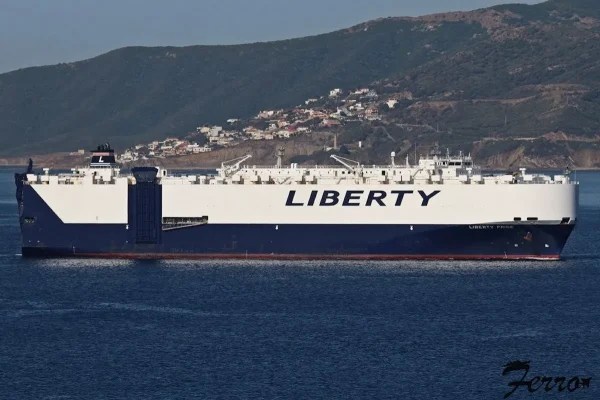
The US-flagged vehicle carrier Liberty Pride. Photo: Ships Nostalgia
How many other US ships are in the ocean at the moment or arriving at other ports, isn’t yet known. But what is known is that NATO is girding itself for a spillover, once the Ukrainian offensive gets underway.
The main focus of the Ukrainian spring offensive likely is an assault on Crimea and on Russian forces in the south. The objective is to cut them off (Kherson area across to Zaphorizia) and systematically destroy them, followed by a big push into Crimea.
The US is supplying a huge amount of war materiel for this assault. It includes bridging equipment that can support German-origin Leopard II tanks, which weigh more than 62 tons (roughly the same as the phantom M1 Abrams tanks that won’t arrive until next year, if ever).
Ukraine will have its hands full in such an operation and is dependent on US intelligence and, very likely, US airpower. There is not enough time to train Ukrainian pilots on F-16s, and there are not any spare up-to-date F-16s to throw into the battle – unless, of course, US fighter squadrons are in the mix.
One can expect that US aircraft will be painted over with Ukrainian insignia and flown by US or NATO pilots. These planes will operate as standoff assets, firing long-range air-to-air and air-to-ground weapons.
By staying wide of Russian air defense systems, but protected by what remains of Ukrainian air defenses, the F-16s could target Russian armor, command centers, troop formations, caravans, jammers and air defense radars.
The Ukrainian offensive also is likely to appear to the Russians as a casus belli involving NATO direct participation. How Russia might respond to a direct challenge is hard to say. The most likely Russian response could be to attack stockpiles and massing areas in Poland and Romania – and, almost certainly, airfields supporting the war.
Russian strategists have the opinion that Polish forces might also move into Ukraine, perhaps taking Lviv (Lvov) or other prizes, hedging that the Ukrainian offensive might fail or that the Russians are successful in toppling Kyiv’s government.
If these prognostications on the two spring offensives are anywhere near correct – and there is plenty of evidence suggesting both offensives are being prepared – then Europe is on the brink of a great catastrophe.
Stephen Bryen is a senior fellow at the Center for Security Policy and the Yorktown Institute.
It’s Zugzwang for Biden in Ukraine
BY M. K. BHADRAKUMAR | INDIAN PUNCHLINE | MARCH 8, 2023
There is a cardinal difference between the Washington Post report of June 18, 1972 by Alfred Lewis breaking the news of the Watergate burglary and the sensational claim by the New York Times on Tuesday — per a CNN report — that “intelligence suggests that a pro-Ukrainian group” sabotaged the Nord Stream gas pipelines.
The WaPo reported on Watergate several months after Richard Nixon’s thumping victory for a second term as president, while the Times’ claim has been advanced even before Joe Biden has announced his candidacy for the November 2024 election.
A common thread, though, could be that while the Lewis story was followed up a day later by two young Post reporters Bob Woodward and Carl Bernstein, the Times report also hopes to be a developing story but with a contrarian purpose.
If Watergate wiretapping forced Nixon to resign eventually, the big question is whether the Nord Stream sabotage will also be the undoing of the Biden presidency?
These are early days. But the reverberations of the Times’ claim are already being felt in Europe — Ukraine and Germany — although the report was carefully worded to keep Ukrainian leaders outside its purview.
But the bottom line is the caveat that the Times report was not made with high confidence and is apparently not the predominant view of the US intelligence community, and that the Biden Administration has not yet identified a culprit for the attack — succinctly put, this isn’t necessarily the last word on the subject!
That’s smart thinking — with an eye on Seymour Hersh, perhaps? Meanwhile, Ukraine has flatly denied involvement and German media reports stressed that there’s no proof that Ukrainian authorities ordered the attack or were involved in it. Evidently, Kiev and Berlin (and Washington) prioritise that the business of war must continue as before. And neither is in a position to hit back in defence.
But Moscow is plainly derisive. Kremlin spokesman Dmitry Peskov told RIA Novosti, “Clearly, the authors of the terrorist attack want to distract attention. Obviously, this is a coordinated stuffing in the media.”
Indeed, when asked about the Times report, the highly opinionated US National Security Council coordinator for strategic communications, John Kirby referred questions to investigating European authorities and excused himself saying he was “not going to get ahead of that investigative work.” Kirby played it safe.
So, as Lenin would have asked: ‘Who stands to gain?’ To be sure, what we have here is a high level leak planted in the Times by the US intelligence, which is non-attributable but probably serves as kite flying to see how far it will travel, especially in Europe, or, equally, it could just be, as Peskov put it, the stuff of an “obvious misinformation campaign coordinated by the media.”
Either way, someone high up in the Biden Administration is playing for high stakes. This is taking place at a time when Biden himself has been implicated by Seymour Hersh for ordering the destruction of Nord Stream — an act of international terrorism — and of course Biden is yet to announce his candidacy for the 2024 election.
As things stand, candidate Biden will not want the Nord Stream scandal to be another Albatross around his neck. The point is, if he stands for election, which he likely intends to, Biden can be sure that the scandalous Ukraine stories concerning him and his son Hunter Biden, dating back to his time as vice-president, will roar back to centrestage.
The questioning that the US ambassador to Estonia Senator George Kent was subjected to by Senator Tom Cruz at the hearings on his appointment in Tallinn in December suggested that the Republicans have a lot of dope on Hunter Biden’s activities in Ukraine and are waiting for the right moment to strike.
Kent, a career diplomat and former deputy assistant secretary of state for European and Eurasian Affairs with three stints in Kiev — the second time as DCM from 2015 to 2018 and the third as Charge d’Affaires a.i, in 2021 during Biden presidency— is in Senator Cruz’s crosshairs.
Last week, again, Sen. Cruz returned to the topic. This time around, he tore into attorney general Merrick Garland accusing the Justice Department of leaking uncontrollably in a calibrated bid to save Biden’s reputation.
Conceivably, the implication by the Times report that a “pro-Ukrainian group” may have been behind the Nord Stream attack can be seen as a veiled threat to the powers that be in Kiev to understand which side of their bread is buttered if push comes to the shove.
So far, Zelensky has played ball. Biden is bending over backward to appease Zelensky, if the manner in which the move to sack the Ukrainian Defence Minister Oleksiy Reznikov, a close ally of the president, was summarily shelved is any indication.
The western media was copiously reporting on a purge under way in Kiev but when the trail came to Reznikov and Zelensky dug in, the US inspectors deputed from Washington to investigate the corruption scandal in the defence ministry simply disappeared.
Indeed, Biden must willy-nilly remain in power beyond 2024 or else he becomes extremely vulnerable. Therefore, Biden desperately needs a second term. He cannot be too sure even if some other Democratic candidate wins in 2024. God forbid, if the Republicans seize the presidency, Biden and his family members will be fighting with their backs against the wall.
But there is also the flip side. Biden’s candidacy will bring Nord Stream, Hunter Biden, Ukraine war, et al, to the centre stage of the election campaign. Is it worth the risk?
Frankly, it is a ‘zugzwang’ for Biden. It is his turn to move, but all of his moves are so bad that having to move can lose the game — and in chess, there is nothing like “pass,” either.
The sabotage of the Nord Stream forms part of the Ukraine issue. Whoever destroyed that pipeline did it with the intention to eliminate any residual prospect left of a revival of the post-cold war Russian-German alliance in Europe built around the two countries’ energy cooperation and interdependency.
The Biden team in sheer naïveté thought that sabotage of the Nord Stream would be a geopolitical masterstroke to humiliate Germany and make it a vassal state, destroy all bridges leading from Russia to Europe, and consolidate the US’ transatlantic leadership. They overlooked, out of sheer hubris, that it still remained a cowardly criminal act.
To compound matters, the war in Ukraine flowed out of Biden’s decision to destroy the Nord Stream (which, according to Hersh, dated back to September 2021.) Today, Biden cannot easily end his war as he is also beholden to Zelensky (who knows far too much about Hunter Biden’s escapades in Kiev.)
Will Biden Administration succeed in hushing up the Nord Stream scandal? Hersh is sure to revisit the topic. Biden cannot walk away from the crime now. But it doesn’t cease to be a crime.
Biden’s remaining option may be to announce he’s going to contest the 2024 election because Build Back Better Framework is still a work in progress.
Ukraine responds to Nord Stream claims
RT | March 8, 2023
Kiev had nothing to do with the sabotage of the Nord Stream pipelines, the Ukrainian defense minister has said in response to media reports blaming last September’s explosions in the Baltic Sea on a “pro-Ukraine” group.
“For me, it’s a little bit strange story,” Aleksey Reznikov replied when asked about the issue after his arrival at an informal meeting of EU defense ministers in Stockholm on Wednesday.
“This story has nothing [to do] with us,” he said, expressing confidence that “the investigation [by] the official authorities will describe every detail” of what had happened.
The claims of Ukrainian involvement in the sabotage are “like a complement for our special forces, but this is not our activity,” the minister added.
Journalists asked Reznikov if he was concerned that the latest media reports could lead to a reduction in EU support for Kiev amid the conflict with Moscow. “No, I’m not concerned. Everything would be OK,” he said.
On Tuesday, the New York Times reported, citing US officials and unspecified new intelligence, that a “pro-Ukrainian group” may have been behind the September attack that disabled the Nord Stream 1 and 2 pipelines, which were built to deliver Russian gas to Europe via Germany. The US paper’s anonymous sources stressed that “no American or British nationals were involved” in the sabotage.
A few hours later, several German outlets claimed the country’s investigators looking into the Nord Stream blasts had found that a yacht reportedly used in the attack belonged to a Polish-based firm, owned by two Ukrainians.
Kremlin press-secretary Dmitry Peskov described the reports in the US and German media as “a coordinated media hoax campaign,” aimed at diverting attention from the actual “masterminds” of the sabotage.
Last month, veteran American investigative journalist Seymour Hersh released a bombshell report blaming Washington for destroying the Nord Stream pipelines. According to an informed source who talked to Hersh, explosives were planted on the pipelines in the Baltic Sea back in June 2022 by US Navy divers under the guise of a NATO exercise, and detonated remotely two months later. The White House has denied the report by the Pulitzer Prize-winning reporter, calling it “utterly false and complete fiction.”
Featured Video

Death Spikes & Rising Cancer In Our Youth Explained
or go to
Aletho News Archives – Video-Images
From the Archives
Politicians lie
By Mazin Qumsiyeh | Popular Resistance | August 18, 2013
There is no way to say this truth nicely: Politicians lie. That includes Japanese, American, Egyptian, Israeli, and Palestinian politicians! Is there something more common sense than that? Yet, so many citizens around the world believe their own politicians or wistfully acknowledge lies but think it is part of the job needed to run things. They believe even when politicians contradict themselves blatantly. This phenomenon is rather remarkable. It is a dissonance and disconnect from reality that many seem oblivious to. It is very dangerous because it can lead to accepting rationales for going to war. These can be deadly wars that lead to millions of lives lost as happened in what was called World War 1 and WW2. Even when incredible and declassified evidence abound, politicians continue to lie and old mythologies refuse to die. Here are just a few of the countless lies told to us over the past few decades… continue
Blog Roll
 Aletho News
- From Unipolar Universalism to Multipolar Civilizational Distinctiveness
- RSF military group defects, joins Sudanese army: State media
- Ireland goalkeeper refuses to play ‘Israel’ as squad weighs boycott
- China pushes back against US on Cuba, Iran
- Ukrainian Soldiers, Potential Mercenaries: Have Gun, Will Travel!
- Burnham’s UN debut… A masterclass in British disinformation
- Iran flights continue despite US aviation sanctions
- Global Tipping Points Lead the World Into a State of Entropy
- The day-after at the White House: USA and Xi Jinping
- The Geopolitical Balance in the Red Sea: The UAE Being Displaced by New Players
- If Americans Knew
- Deconstructing Netanyahu’s pants-on-fire UN rant – Daily Update
- Trump betrayed voters with his campaign lies and prioritized a foreign country once he took office
- Netanyahu calls Israel’s war in Gaza ‘opposite of genocide’ in UN speech to near-empty hall
- Settler Kidnappings: Torture, Sexual Abuse and Terrorisation of Palestinian Abductees as Israel Deepens Annexation of West Bank
- Gaza winter nears as 162,000 tents become unusable, raising fears of humanitarian crisis
- Netanyahu says, “It’s the opposite of genocide”; UN says Gaza economy is world’s ‘most severe crisis on record’ – Daily Update
- Israel’s US-Backed Assault on Gaza Has Created the ‘World’s Most Severe Economic Crisis on Record’: UN
- ‘Protecting U.S. Citizens’… From Israel
- ‘This is where I live now, the back of a truck’: a day in the life of a grandmother in Gaza
- In UN Speech, Iran’s President Displays Pictures of Children Killed by US, Brings Attention to Israel’s Nuclear Arsenal
- No Tricks Zone
- New Study: Earth And Venus Surface Warmth Largely Explained By Convection And Lapse Rate, Not CO2 Or Radiation
- 2025 Nature Paper Claiming Worsening Global Drought Gets RETRACTED …Heavily Flawed
- New Study: ‘Global Drought Shows No Detectable Recent Acceleration Under Climate Warming’
- Economic Masterminds: German Socialists Suggest Taxing Productivity Gains Stemming From Using AI
- The South China Sea Has Not Been Cooperating With The Climate Change Narrative
- Energy Crisis: Germany Enters Heating Season With Historically Low Gas Reserve Fill Levels
- New Study: The Antarctic Ice Sheet Gained Mass From 2020-2024 Due To Staggering Snow And Ice Accumulation
- Study: Ocean Heating Rates From Thousands Of Years Ago ‘Dwarf’ Modern Ocean Heating Rates
- Climate Extremists Target, Attack Large-Scale Power Grid Infrastructure In Germany!
- New Study: Antarctic Ice Melt Has Contributed Less Than 1 Centimeter To Sea Level Rise In The Last 30 Years

