MEP CLARE DALY: THE EU´S GOAL IS AN ENDLESS WAR IN UKRAINE
June 26, 2022
Samizdat | July 2, 2022
Scottish and Welsh ministers have said the British government took their budget funds for military aid to Ukraine, voicing concerns that it could set a precedent. The Treasury has told Scotland and Wales to contribute to a £1 billion ($1.2 billion) weapons package or have their budgets reduced.
Scottish Finance Secretary Kate Forbes said on Wednesday that Scotland agreed to provide the £65 million ($78.7 million) funding but only “on this occasion”. She cautioned that “this must not be seen as any kind of precedent,” while Welsh Finance Minister Rebecca Evans said she had been forced to set aside £30 million ($36.3 million) intended for “devolved areas like health and education”.
Devolved areas of the UK are controlled by ministers in the national parliaments of Scotland, Wales and Northern Ireland. Evans said it was “not right” to use their funds for military aid and defense, a non-devolved spending area. At the same time, she added that Wales will continue to provide humanitarian support for Ukrainians arriving in the country every day seeking refuge from the conflict.
The Scottish government said the money would be used to help fund “sophisticated air defense systems and thousands of pieces of vital kit for Ukrainian soldiers” in order to assist Kiev in fighting off Russia’s military offensive. Scotland has previously independently provided £4 million ($4.8 million) in basic humanitarian aid – health, water and sanitation and shelter – for Ukrainian refugees.
According to Welsh Education Minister Jeremy Miles, there was “no consultation” on the question of military aid, although a UK government spokesperson told the BBC it was incorrect “to say the Welsh government was not consulted… they were consulted and agreed to make a contribution.”
Simon Clarke, Chief Secretary to the Treasury, asked the devolved administrations to contribute to a £1 billion fund to supply Ukraine with state-of-the-art equipment by either directly handing over the money from their budgets or by accepting a reduction from block grants they receive from Westminster.
The UK Treasury “strongly disagreed” with the Scottish minister’s characterization of the aid request, saying that various government departments had been urged to contribute through their underspend. It also refuted claims that the move constitutes a precedent for raiding devolved budgets for reserved spending areas. “This is a response to an extraordinary crisis”, the spokesperson was quoted as saying by The Daily Telegraph.
The British media has described the request as highly unusual, as such spending usually comes from Westminster.
The UK has been one of the strongest backers of Ukraine since the start of the Russian offensive four months ago. This week it promised to provide an additional £1 billion ($1.2 billion) to support the Ukrainian Armed Forces, taking the overall military aid given to Kiev to £2.3 billion ($2.8 billion).The package includes various types of weaponry, including M270 Multiple Launch rocket systems, light anti-tank weapons and armored vehicles.
Moscow has repeatedly warned against supplies of weapons to Ukraine from the US, UK and other allied nations, saying it will only prolong the fighting, while increasing the risk of a direct military confrontation between Russia and the West.
The concerns over devolved budget funds being used by the UK government came as Scottish First Minister Nicola Sturgeon announced on Tuesday a target date of October 19, 2023 for a second referendum on independence from the UK.
Meanwhile Ukraine holds vessels in its ports
By Eva Bartlett | Samizdat | July 1, 2022
Without much notice in the West, on June 21, the first foreign ship departed from the Port of Mariupol since Ukrainian and foreign mercenary forces were fully forced out of the Donbass city a month prior. Escorted by Russian naval boats, the vessel’s departure set the precedent for a resumption of normal port activity to and from Mariupol.
Russia’s Defense Ministry on May 20 announced the liberation of the Azovstal plant from Ukraine’s Nazi Azov Battalion, and some days later stated that sappers had demined an area of one and a half million square meters around the city’s port.
In early June, the ministry declared the facility ready for use anew. “The de-mining of Mariupol’s port has been completed. It is functioning normally, and has received its first cargo ships,” Defense Minister Sergey Shoigu said at the time.
Russia promised to give ships safe passage, and on June 21, the Turkish ship Azov Concord left with a Russian escort. At Mariupol port that day, prior to setting off, the captain of the ship, Ivan Babenkov, spoke to the media, telling us that the vessel, without cargo, was heading to Novorossiysk for loading, and then on to its destination.
Rear Admiral Viktor Kochemazov, commander of the Russian naval base in Novorossiysk on the Black Sea’s northeastern coast, down the Kerch Strait from Mariupol, explained that while the corridor has been operational since May 25, the nearly one-month delay in departing was because “ships were significantly damaged during the conduct of hostilities.” Notably, he also said that some ships were deliberately damaged by Ukrainian forces in order to prevent them from leaving.
From aboard a Russian anti-sabotage forces boat, media watched the Azov Concord leave port. Further on, the ship would be met by warships of the Novorossiysk base and escorted to the Kerch Strait where FSB border control ships would continue to escort the ship.
A Bulgarian ship, the Tsarevna, was readying to depart the port next, “also following the same humanitarian corridor to its destination in accordance with plans for the use of the court by the owner,” Rear Admiral Kochemazov said.
Western press ignoring developments
Predictably, just as the Western media continues to ignore Ukraine’s war crimes against the Donbass republics, including not only the bombing of houses, hospitals, and busy markets – plus the killing and maiming of civilians – so too do they omit coverage of anything positive emanating from areas where Ukrainian forces have been ousted and stability restored.
Instead, Western media continues to spin the story that it’s Russia that’s blocking ports and preventing grain exports, and blame Moscow for “aggravating the global food crisis” – when in reality, it is Ukraine that has mined ports and burned grain storages.
In fact, according to Russia’s Ministry of Defense, “70 foreign vessels from 16 countries remain blocked in six Ukrainian ports (Kherson, Nikolaev, Chernomorsk, Ochakov, Odessa and Yuzhniy). The threat of shelling and high mine danger posed by official Kiev prevent vessels from entering the high seas unhindered.”
While Russia maintains it has opened two maritime humanitarian corridors in the Black and Azov Seas, Kiev is apparently not engaging with representatives of states and ship-owning companies about the departure of docked foreign ships.
Meanwhile, in the same vein, media outlets like the New York Times (writing as always from afar) claim that Mariupol is “suffering deeply” under Russian rule (citing the runaway former mayor, nowhere near the city for months, who is the source of previous war propaganda) even describing the Azov Neo-Nazis as “the city’s last military resistance.”
Yet, what I’ve seen in multiple trips to Mariupol in the past couple of weeks is rubble being removed so that the rebuilding process can begin, newly established street markets, public transportation running, and calm in the streets.
The people of Mariupol have indeed suffered, but now that the Azov Nazis and Ukrainian nationalists no longer reign, they can live without fear of persecution, execution, rape, torture, and all of the other ‘democratic values’ of the forces backed by the West.
The rebuilding will take time, but with the port functioning anew, and the possibility now of also bringing reconstruction materials by sea, it can begin, ship by ship.
Eva Bartlett is a Canadian independent journalist. She has spent years on the ground covering conflict zones in the Middle East, especially in Syria and Palestine (where she lived for nearly four years).
Samizdat | July 1, 2022
Washington should pull out of NATO instead of sending billions of taxpayer dollars to Ukraine and risking a nuclear war, according to a Republican congresswoman who has been highly critical of Washington’s response to the Ukraine crisis.
Georgia Representative Marjorie Taylor Greene, a strong supporter of former President Donald Trump, made the case in a series of tweets on Thursday.
Ukraine is the “new Iraq wrapped up with a pretty little NATO bow, with a nuclear present inside,” she wrote.
“The American people do not want war with Russia, but NATO & our own foolish leaders are dragging us into one. We should pull out of NATO.”
She described the provision of military aid to Ukraine, which she voted against in Congress, as a “proxy war” against Russia that Americans have no appetite for.
“Grinding up Ukraine to fight with Russia is disgusting, they could have been an ally,” she tweeted.
Marjorie Taylor Greene also listed a host of problems that she sees as more pressing for the American people, from soaring inflation to fentanyl overdoses and rampant crime. The only people vying for a conflict with Russia are “those who make money off of it,” she claimed.
“NGOs, defense contracts of all kinds, grants, business deals, even humanitarian aid, political consultants, & more,” she wrote. “War is an industry. A deadly profitable industry.”
Warmongers in Washington seeking war with Russia “should suit up and go fight it” themselves, she suggested. “Send your kids and leave ours alone. Pay for it yourself.”
Samizdat | June 30, 2022
The US will bear high gasoline prices for as long as needed, President Joe Biden said on Thursday during a news conference at the NATO summit in Madrid.
When asked how long American motorists should expect to deal with high fuel prices, Biden told reporters “As long as it takes, so Russia cannot in fact defeat Ukraine and move beyond Ukraine.” He stressed that “this is a critical, critical position for the world.”
US gasoline prices, a key driver of the highest inflation seen in the country in 40 years, hit a record $5-a-gallon this month. The prices have been on the rise since the start of the year, reflecting significant consumer demand outstripping the supply of oil, as well as the ongoing turmoil in energy markets. Biden had earlier reassured the public that the US government was doing everything it can “to reduce this pain at the pump.”
The White House has repeatedly blamed Russian President Vladimir Putin for causing inflation in the US, with Biden describing it as “Putin’s price hike.”
However, the US Federal Reserve has recently rejected the assertion that soaring inflation in the country was mostly being driven by the crisis in Ukraine, pointing out that prices had been rising well before that.
A no-nonsense analysis of the ongoing Ukraine war and its global impact
Military Situation
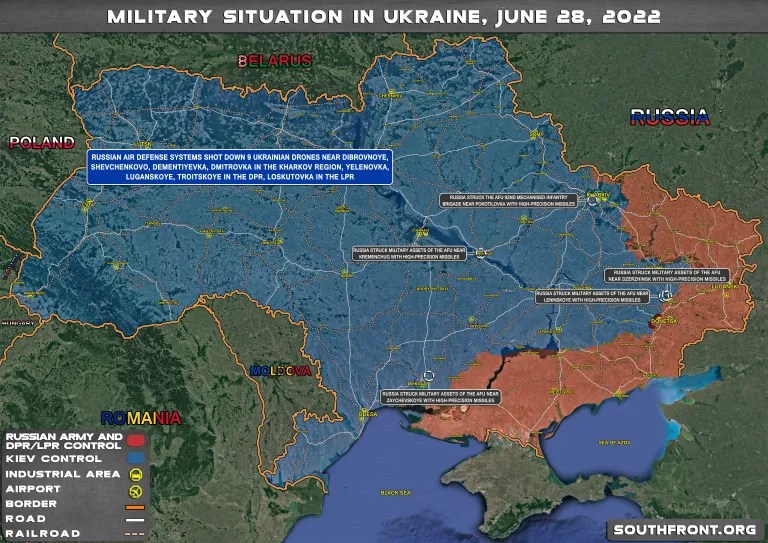
The initial Russian offensive (“phase 1”) consisted in a direct advance from Belarus to the northern gates of Kiev and the simultaneous opening of multiple fronts in the north-east, east, and south of Ukraine. There have been various theories as to what the initial Russian strategy was (e.g. conquering Kiev or ‘binding Ukrainian forces’), but most likely, Russia tried to force a collapse or capitulation of the Ukrainian government, in which case Russia would have won the war without really fighting it.
Indeed, just one day after the beginning of the invasion, Russian President Putin proposed a kind of “military coup” in Ukraine to make it easier to “reach an agreement”. There were also several rounds of negotiations between Moscow and Kiev in Belarus and Turkey.
Yet this initial, political-military plan failed and was halted in late March, about one month after the beginning of the invasion.
Nevertheless, already by early March Russia had conquered extensive territories in southern Ukraine connecting the Donbas and Crimea and had been able to restore water supply to the Crimean Peninsula (which had been cut off by Ukraine since 2014; see map above).
By late April, Russia had essentially conquered the important southern Ukrainian port city of Mariupol (500k pre-war inhabitants), and by late May, the remaining Ukrainian forces in the Azovstal steel plant of Mariupol had surrendered. In addition, Russia conquered the southern Ukrainian cities of Melitopol (150k inhabitants) and Kherson (300k) without meeting much resistance.
After the failure of the initial political-military strategy, Russia in early April withdrew all of its troops from the north of Kiev and redeployed them to the east in an attempt to encircle and defeat the main positions of the Ukrainian military and conquer the entire Donbas region.
However, the Russian advance in eastern Ukraine was much slower than expected by many observers, and Russian forces advanced only about 25 kilometers in about two months.
Many Western analysts got the impression that the Russian military was weaker than previously assumed, while many Russian and pro-Russian analysts have argued that the Russian military was advancing slow “on purpose”, allegedly to “minimize losses”.
Yet neither of these explanations were convincing. Instead, there are several substantial reasons that explain the steady, but rather slow advance of the Russian forces in eastern Ukraine.
First, in terms of the number of soldiers and tanks, the Ukrainian military is the largest military in Europe, second only to the Russian military (not counting the Turkish military).
Second, while Ukraine has already mobilized large parts of its men of fighting age, Russia has not yet mobilized at all, i.e. Russia is using only active soldiers, no reservists or conscripts. In fact, Russia has essentially deployed its peace-time army, which has resulted in a notable lack of manpower and infantry. A likely explanation for this decision is that the Russian government wants to keep up the impression, at least domestically, that it is just conducting a “special military operation”, not a full-scale war, and that it wants to avoid the political repercussions of having to conscript additional men (i.e. civilians). This is consistent with the fact that Russia has offered high-paid short-term military contracts to volunteers, again avoiding conscription.
Third, Eastern Ukraine is probably the most strongly fortified region in Europe today, having been prepared against a potential Russian invasion for several years. Although some Ukrainian units have surrendered due to a lack of supply or guidance, the overall Ukrainian resistance against Russian forces remains at a very high level.
Fourth, the Ukrainian military has received large amounts of weapons from the US and NATO countries, including powerful artillery and modern anti-tank weapons. Without these supplies, the Ukrainian front would likely have collapsed rather quickly.
Fifth, the Ukrainian military has greatly enhanced the effectiveness of its artillery by using reconnaissance data from its own drones as well as from US satellites. Indeed, the use of commercial and simple military drones appears to have fundamentally transformed modern warfare at the tactical level.
Sixth, and contrary to claims by Western media, the Russian military is still trying to minimize civilian casualties and damage to civilian infrastructure, likely because it views Eastern Ukraine as Russian territory anyway. For instance, it has been noted that the Russian military delivered fewer airstrikes and fewer missiles during the entire first month than the United States did during the Iraq war in just one day. However, as the Ukrainian military has been fiercely defending most cities and villages, the end result is still large-scale destruction of urban infrastructure.
Although Russia has had the upper hand in Eastern Ukraine, it remains uncertain if the current Russian military strategy will be viable in the longer run, especially if Russia intends to conquer some of the larger Ukrainian cities, such as Kharkiv, Odessa or Dnipro (1M-1.5M) or even Kiev (3M). If the Ukrainian government or military do not surrender or agree to a negotiated solution, the Russian military may have to call up reservists and conscripts and/or switch to an (even) more destructive mode of warfare against the cities it intends to “liberate”.
Currently, the main Russian military advantage consists in relative (but not absolute) air superiority, more powerful artillery, and cruise missiles that can destroy strategic targets anywhere in Ukraine. Nevertheless, the Ukraine war is currently not an “asymmetric war”.
In terms of military strength, it is estimated that Russia deployed about 160,000 soldiers, the pro-Russian Donbas republics about 40,000 soldiers, and Ukraine about 300,000 military and paramilitary forces, of which about 50,000 in Eastern Ukraine. In terms of military losses, it is estimated that by late June, Ukraine may have lost close to 20,000 soldiers, Russia close to 5,000 soldiers, and the Donbas republics about 10,000 soldiers.
Future Developments
Russia will certainly try to fully conquer (or liberate) the Donbas republics, including the cities of Sloviansk and Kramatorsk (100k-150k pre-war inhabitants). Russia may also try to conquer Mykolaiv (500k) and Odessa (1M) in the south of Ukraine in order to establish a corridor to Moldova/Transnistria, which would cut off Ukraine from the Black Sea and turn the country into a landlocked rump state. After conquering the Donbas republics, Russia may further try to conquer or encircle Kharkov (1.5M) and advance to the Dnipr river.
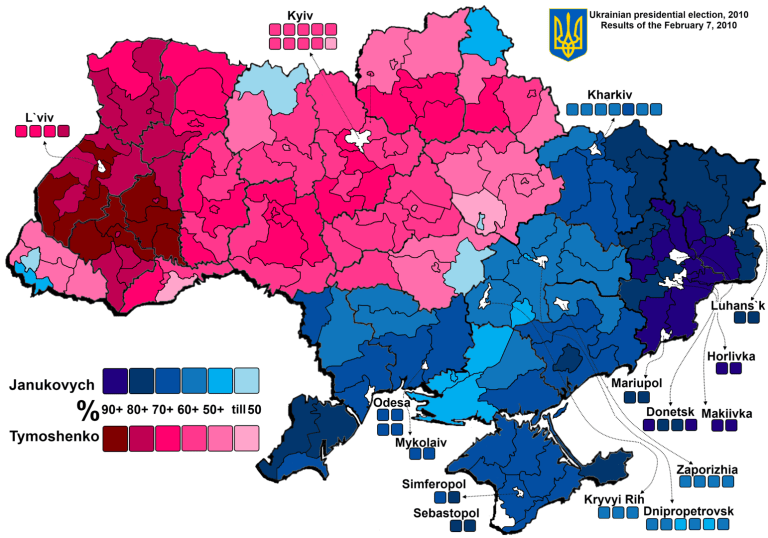
Cities or districts conquered by Russia will likely hold referendums on becoming part of Russia. These referendums will likely turn out in favor of Russia, as a majority of the people in the east and south-east of Ukraine do indeed identify as Russians (or are leaning towards Russia), and Russia may then annex or absorb these territories. However, such a strategy will not work in Kiev, nor in northern and western Ukraine (see map below).
In terms of potential escalations, a Russian advance towards Moldova may trigger a preemptive Romanian invasion (“by invitation”) of Moldova. A further destabilization of Ukraine may trigger a Polish invasion (“peace mission”) of western Ukraine, which in turn could trigger a war between Poland and Belarus in western Ukraine.
Moreover, NATO countries could decide to deliver more powerful weapons to Ukraine or to establish a “safe zone” in western Ukraine (similar to the situation in eastern Syria). In general, the US will likely try to prolong the Ukraine war as much as possible in order to weaken Russia financially and politically (similar to the Afghanistan war in the 1980s.)
Outside of Ukraine, the situation in the Baltics (Lithuania/Kaliningrad), the Balkans (Bosnia-Serbia-Kosovo) and in the Caucasus (Georgia, Armenia-Azerbaijan) could further deteriorate. The situation in Syria, where the US, Israel, Turkey, Iran and Russia are already involved, could also further escalate. In Asia, China could decide to invade and annex Taiwan.
The global economic situation will also likely continue to deteriorate, especially in the fields of energy and food supply, price inflation and financial market stability. This deterioration is driven not just by the war itself, but also by Western sanctions against Russia as well as by two years of misguided pandemic lockdown policies, which have caused serious global supply chain disruptions.
The possibility of a nuclear escalation will be discussed further below.
War Crimes
In terms of war crimes, the current situation is in stark contrast to claims by Western media and Western governments, as most war crimes have been committed not by the Russian side, but by the Ukrainian side. This includes many major war crimes blamed on the Russian side, such as the infamous Bucha massacre, the Mariupol theater bombing, or the Kramatorsk railway station bombing. Other supposed Russian war crimes were simply made up by Ukrainian officials, such as allegations of systematic rape and mass looting.
Yet other events were taken out of context, such as the alleged Russian bombing of Ukrainian schools and hospitals or shopping centers, which in almost all cases had been turned into Ukrainian military bases or ammunition depots. In other cases, civilian buildings supposedly destroyed by Russian missiles were in fact destroyed by Ukrainian air-defense missiles (e.g. in Kiev) or Ukrainian artillery missiles (e.g. in Borodyanka).
In yet other cases, Ukrainian forces, poorly disguised as Russian forces, executed Ukrainian civilians that welcomed the false “Russian liberators”; Western media then presented the execution as a Russian war crime. In even other cases, the Ukrainian bombing of Donbas cities was presented as the Russian bombing of Ukrainian cities.
In the case of Bucha, the bodies seen in the streets were victims of Ukrainian shelling of residential areas during the Russian occupation and retreat, and of subsequent Ukrainian executions of “collaborators” (hence the white armbands, a sign of friendly status during Russian occupation). The bodies were then presented as victims of a supposed “Russian massacre”.
Ironically, the Ukrainian commander who oversaw the Bucha massacre previously was a Russian intelligence asset who had built up “neonazi groups” in Russia and Belarus. The international “marketing” of the Bucha massacre as a supposed Russian war crime may have been coordinated by British intelligence, similar to numerous chemical false-flag attacks in Syria.
In the case of the Mariupol maternity clinic, Western media claimed it was a Russian airstrike, but they could not provide any evidence for this hypothesis, and witnesses at the clinic said there was no airstrike. Yet the incident remains unresolved, and both a Russian attack (possibly targeting a nearby Ukrainian base) or a Ukrainian operation remain possible.
In the case of the recent Kremenchuk shopping center incident, the Ukrainian government claimed a Russian missile hit the shopping center with 1,000 people inside; in reality, the Russian missiles hit an adjacent military plant and the shopping center was either closed (non-operational) or almost empty. However, one of the Russian missiles did hit very close to the shopping center, which then caught fire and burnt down.
Documented, confirmed or potential Russian war crimes currently consist mainly in the shooting and killing of civilians that approached Russian checkpoints or military columns, on foot or by car, although the context of these events is sometimes unclear (e.g. if there were any warning shots). There are also allegations of several other crimes against individual Russian soldiers that are currently difficult to verify independently.
On the Ukrainian side, documented war crimes encompass mass torture and mass executions, both against prisoners of war and their own people (if deemed pro-Russian collaborators or sympathizers), including several cases of decapitation; the military use of civilian infrastructure (including schools) and “human shields”; and large-scale shelling of residential areas behind front lines, especially against the city of Donetsk (in one case even hitting a maternity clinic).
Moreover, several Western journalists, whose death was blamed on the Russian side, were in fact killed by the Ukrainian side (in friendly fire incidents).
False claims of major Russian war crimes (i.e. atrocity propaganda) have been used by Western governments to justify weapons supplies to Ukraine and sanctions against Russia. The heavy use of such atrocity propaganda is not a new phenomenon, of course. Important recent examples include the US/NATO wars against Yugoslavia and against Syria.
The topic of war crimes will be covered in a separate, detailed event-by-event analysis.
Propaganda and Censorship
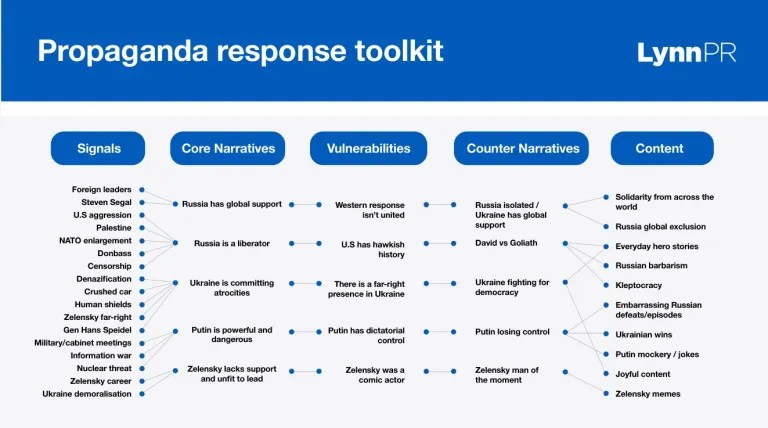
On the Russian side, propaganda efforts depict the Ukraine war as a kind of continuation of the Second World War or Great Patriotic War against National Socialist Germany, focusing on the supposed “denazification” of Ukraine. At the same time, Russian President Putin has criticized Soviet leaders for having made Ukraine a quasi-independent political entity in the first place. Thus, Russian propaganda combines elements of both the former Soviet Union and the earlier Russian Tsarist empire.
Overall, the “Nazi narrative” appears to be quite effective, both in Russia and in the West, in part because many key aspects of the Second World War and NS Germany still cannot be questioned, neither in Russia nor in the sphere of Anglo-American countries, which during the Second World War were allied with Stalin’s Soviet Union against Hitler’s Germany.
On the NATO side, propaganda efforts mainly focus on Russian aggression, supposed Russian war crimes and supposed Ukrainian successes. NATO propaganda is produced by multiple PR agencies, coordinated by intelligence services, and distributed to Western media outlets by the three global news agencies AP (American), AFP (French) and Reuters (British-Canadian). The total number of NATO propaganda messages in Western media is likely approaching about one thousand.
In addition, both sides have introduced significant media censorship. In NATO countries, this includes the removal of Russian and pro-Russian media outlets from major Internet search engines Google, Microsoft Bing and even DuckDuckGo. Furthermore, British security state operatives were caught trying to suppress independent media coverage of the Ukraine war.
Nevertheless, independent media outlets and uncensored Telegram channels have continued to provide important real-time footage and analysis of the situation in Ukraine.
NATO Expansion or Russian Expansion?
Is the Ukraine war about NATO expansion or rather about Russian expansion? In truth, it is likely about both NATO and Russian expansion, although one may argue that the Russian expansion is a response to NATO expansion. It is clear that the current Russian government sees large parts of Ukraine as “historically Russian territory”, or indeed Ukraine as part of Russia. Only by seeking a neutral status and by accepting the loss of Crimea and the autonomy of the Donbas republics might Ukraine have avoided a Russian invasion.
It has been argued that NATO expansion into Ukraine wouldn’t be a threat to nuclear Russia, but this is hardly true. NATO expansion into Ukraine would pose a geostrategic threat (control over pipelines, ports etc.), a direct military threat (planned recapture of Crimea and the Donbas republics), and a strategic military threat (NATO military infrastructure and missile bases). For similar reasons, the US did not and would not accept Russian bases in Cuba, Mexico or Venezuela.
It has been noted that Russia is unlikely to invade Finland or Sweden, despite their intention to join NATO (in response to the Russian invasion of Ukraine). In fact, Russia already has a (small) land border with NATO founding member Norway and with Baltic states. Yet Finland and Sweden do not currently threaten Russian territory or Russian interests. Otherwise, a Russian military response may in fact be conceivable (see below).
Is the Russian military operation in Ukraine legal or illegal? From a Western perspective, the Russian operation is clearly illegal, not unlike previous US invasions (e.g. of Grenada, Panama and Iraq) and most US/NATO wars (e.g. against Serbia, Afghanistan, Libya and Syria). From a Russian perspective, the military operation is a legitimate intervention into an ongoing, illegal eight-year war against the Donbas republics. Russia will likely annex large parts of Ukraine, but it will try to “legitimize” these annexations by prior referendums.
Energy War: By Whom?
It has also been argued that Russia is waging an energy war by restricting oil and gas exports in order to destabilize NATO countries and especially Europe. Yet upon closer inspection, it is clear that the energy war is in fact waged via sanctions by NATO countries in order to financially destabilize Russia, although so far this seems to have failed and indeed backfired, with energy security in Europe becoming rather uncertain.
For instance, a reduction in gas flow through the Nord Stream pipeline from Russia to Germany was (and is) due to a broken turbine sent by Germany to Canada for repair, but then retained by Canada due to sanctions against Russia. Similarly, the Russian decision to accept energy payments only after conversion into rubles was simply in response to the prior freezing of billions of Russian Euro and dollar reserves by Western countries.
Indeed, neither during nor after the Cold War has Russia (or the USSR) ever used the “energy weapon” against (Western) Europe, as Russia is very much interested in both being seen as a reliable supplier and in foreign currency export revenue.
However, one can argue that Russia is relying on a kind of “indirect energy weapon”: by being a reliable energy supplier, Russia may hope that Europe and NATO will not turn hostile, regardless of Russian military actions. Moreover, if relations should further deteriorate, Russia could of course use the “energy weapon” and stop energy exports to Europe altogether.
The Russian government likes to emphasize that the impact of Western sanctions is rather minor and that the Russian ruble has remained strong. But Russia had to impose capital controls (i.e. the ruble is no longer free floating), and the economic impact is substantial, with tens of thousands of IT specialists having already left the country, for instance.
Nuclear War?
How likely is a nuclear war as a potential escalation of the Ukraine war?
A direct nuclear war targeting the mainland of nuclear states remains very unlikely, as this would lead to the destruction of all states involved. However, from a purely military and geostrategic perspective, there are two rational offensive uses of nuclear weapons, in addition to their defensive use as a deterrent: against hostile non-nuclear states and against overseas military infrastructure of nuclear states.
In this regard, there is a major geostrategic asymmetry between Russia and China on the one hand and the US on the other hand: whereas the US has several hundred overseas military bases and several dozen non-nuclear allies or client states (both in Europe and in Asia), Russia and China have almost no overseas military bases and very few non-nuclear allies.
Thus, Russia and China could consider coordinated nuclear strikes against all US overseas military bases in Eurasia (i.e. in Europe, the Middle East, Central Asia and East Asia). In addition, Russia and China could consider nuclear strikes against hostile non-nuclear countries, both in Europe and in Asia, targeting military/industrial centers or even population centers.
Theoretically, such a coordinated nuclear operation might remove the US military from the Eurasian continent (and by extension from Africa), limiting US military influence to North and South America. Thereafter, a new geo-economic Cold War between Eurasia/Africa, led by China and Russia, and the Americas would likely ensue.
Nuclear allies of the US in Eurasia, most notably Britain, France and Israel, would have to ensure robust sea- and air-based second strike capability even against modern hypersonic missiles with multiple nuclear warheads, in order to avoid being targeted themselves.
A nuclear attack against non-nuclear NATO states would be seen as an attack against NATO, and a nuclear attack against US overseas military bases would be seen as an attack against the United States, but because of the above-mentioned asymmetry, the US could not respond in a meaningful way without forcing its own destruction.
While such a scenario seems militarily conceivable and even rational (given the breakdown of the post-WWII security architecture), both China and Russia currently seem to follow a different economic, diplomatic and military strategy, using novel alliances such as BRICS, RCEP, the Eurasian Economic Union, and the Shanghai Cooperation Organization (SCO).
In contrast, the US may attempt to contain Russia and China via economic and political sanctions and to ultimately overturn regimes in both countries, thus paving the way for global US predominance, which was almost achieved after the end of the Cold War.
Figures
1) Results of 2010 Ukrainian presidential election.
Janukovych was the pro-Russian candidate, Tymoshenko was the pro-Western candidate.
2) Mariupol: Before and after Russian conquest
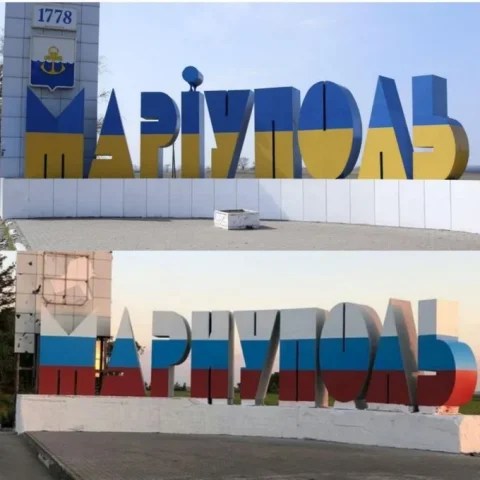
3) Western propaganda vs. Russian propaganda

Samizdat | June 29, 2022
Ukrainian President Volodymyr Zelensky has urged the US-led NATO bloc to ramp up support of his country amid the ongoing conflict with Russia, claiming that Kiev’s defeat would result in a “delayed” war between Moscow and the whole West. Zelensky made the remarks as he addressed the NATO summit in Madrid via a video link on Wednesday.
“It’s either urgent aid to Ukraine sufficient for victory, or a delayed war between Russia and you,” Zelensky told NATO leaders.
The country needs both direct military and financial aid, Zelensky stated, adding that some $5 billion a month was needed to cover its budget deficit. Top Ukrainian officials have repeatedly called upon the West to provide financial support.
“Financial aid for Ukraine has no less significance than arms deliveries,” Zelensky said. “We need some $5 billon every month, you know that. And this is a fundamental thing, needed for defense and protection.”
To help Ukraine now end this war with a victory on the battlefield, that is, to give a really strong response to Russia’s actions – this is what we, and the entire alliance, the whole Euro-Atlantic community need.
Once the conflict is over, Ukraine must be provided with a decent place in the Western security architecture, Zelensky insisted, rejecting the prospect of Ukraine remaining in a “gray zone” between Russia and the NATO bloc. “We need security guarantees, and you must find a place for Ukraine in the common security space,” he stressed.
Russia sent troops into Ukraine on February 24, citing Kiev’s failure to implement the Minsk agreements, designed to give the regions of Donetsk and Lugansk special status within the Ukrainian state. The protocols, brokered by Germany and France, were first signed in 2014. Former Ukrainian President Petro Poroshenko has since admitted that Kiev’s main goal was to use the ceasefire to buy time and “create powerful armed forces.”
In February 2022, the Kremlin recognized the Donbass republics as independent states and demanded that Ukraine officially declare itself a neutral country that will never join any Western military bloc. Kiev insists the Russian offensive was completely unprovoked.
Samizdat | June 28, 2022
Ukrainian journalist Sonya Lukashova ended up on the notorious Mirotvorets (‘Peacemaker’) website after penning an article claiming that a vast majority of Russian military rape allegations produced by the country’s now former human rights chief, Lyudmila Denisova, were false. The Mirotvorets, widely believed to be run by Ukraine’s Security Service (SBU), lists individuals deemed to be “enemies of Ukraine.”
The bombshell expose was published by the Ukrainskaya Pravda (Ukrainian Truth) newspaper on Monday. According to the piece, citing various official sources, a vast majority of allegations of “sexual atrocities,” purportedly committed by Russian troops amid the ongoing conflict, were false. The allegations have been spread by human rights chief Denisova, who got ousted in late May after a no-confidence vote over her failure to organize humanitarian corridors and prisoner exchanges as well as “inexplicably focusing” on spreading unverified and unsubstantiated claims.
According to the report, Ukrainian law enforcement officials tried to investigate Denisova’s claims but found no evidence to back them up. After interrogating Denisova several times, officials discovered she had been getting all her explosive revelations from her daughter, Alexandra Kvitko, “over tea.” The latter ran a ‘psychological hotline’ for victims of wartime violence, established in collaboration between Denisova’s office and UNICEF.
The hotline lacked transparency, and while Kvitko reportedly told investigators it received over 1,000 calls in only a month and a half, with some 450 of them detailing the rape of minors, the hotline’s logs suggested it got only 92 calls. The exact nature of the calls remained unclear as well, since Kvitko failed to provide investigators with any details on the alleged victims, according to the report.
Multiple Ukrainian public figures condemned the expose, insisting that reporting on the activities of the disgraced human rights chief and her daughter helps Russia. Political commentator and prominent supporter of ex-president Petro Poroshenko, Taras Berezovets, for instance, bluntly accused the reporter of producing prime material for “Russian propaganda.”
“The author of the Denisova investigation, Sonya Lukashova, who accused the former human rights chief of creating numerous fakes about the rape of Ukrainian children, ended up on the Mirotvorets database. Lukashova’s material has been very heavily cited by Russian propaganda,” Berezovets said in a social media post.
The Mirotvorets listing for Lukashova states that the reporter’s activities are somehow “incompatible with journalist ethics.” The journalist stands accused of actively participating “in special information operations of the Russian aggression against Ukraine,” as well as of “manipulating publicly significant information.” The report published by the newspaper amounts to “concealing evidence of crimes” allegedly perpetrated by the Russian military, according to Mirotvorets.
The Mirotvorets website was created in 2014 as a public database of “pro-Russian terrorists, separatists, mercenaries, war criminals, and murderers.” The website provides links to social media accounts and personal information, such as home addresses, phones, and emails. Over the years, numerous high-profile public figures and politicians have ended up on the Mirotvorets list over actions deemed to be “anti-Ukrainian.” Hungary’s PM Viktor Orban and former US Secretary of State Henry Kissinger are among the latest additions to the database.
Samizdat – June 28, 2022
The Russian military on Monday targeted the Kredmash vehicle plant in the Ukrainian city of Kremenchug, the chairman of the factory’s supervisory board, Nikolay Danileyko, has confirmed. The plant is located right next to the shopping mall that was destroyed in a blaze after the missile strike, with 18 people reported killed and over 50 injured.
The factory was a civilian facility and had not produced military vehicles or parts for them since 1989, Danileyko told local media. The plant’s workers were not injured in the attack, he added.
Footage from the scene aired by local media shows a large crater in the middle of one of the factory’s hangars. The strike inflicted heavy damage on the building, blowing away parts of its roofing and walls and rupturing underground piping.
While Kiev was quick to accuse Moscow of deliberately attacking the shopping mall itself, the Russian military maintained it had targeted a stockpile of Western-supplied weaponry on the premises of the Kredmash plant. Secondary detonations of the destroyed weapons sparked a fire that spread to the shopping mall, the Russian military said.
Ukrainian President Volodymyr Zelensky claimed the shopping mall was tightly packed, with “more than a thousand civilians” visiting it at the time of the strike. Footage from the scene taken moments after the strike, however, showed that the parking lot by the mall was almost empty, with several armed individuals in military uniform roaming the premises.
The mayor of Kremenchug pinned the blame for the civilian casualties on the venue’s operators, accusing them of ignoring a warning of an imminent air attack.
“Ukraine is at war, so ignoring an air raid alert is a crime, which the tragedy in Amstor [mall] demonstrated once again,” the mayor, Vitaly Maletsky, wrote on social media.
Press TV – June 28, 2022
The Kremlin says Russia will halt its months-long military offensive in neighboring Ukraine as soon as Ukrainian forces surrender.
Kremlin spokesman Dmitry Peskov told reporters on Tuesday that hostilities in Ukraine could end “before the end of today” if Kiev orders the nationalists to lay down their weapons and Moscow’s demands are met.
“The Ukrainian side can end all this before the end of today; an order is necessary for the nationalist units to lay down their weapons, an order is necessary for the Ukrainian military to lay down their weapons; and they must fulfill all Russia’s demands. Then everything will be over before the day ends,” Peskov said.
“Everything else are just speculations of the Ukrainian head of state,” he added. “We are guided by the statements of our President Vladimir Putin that the special military operation is going according to plan and achieving its goals.”
Asked whether the Russian side had any approximate timeframe for the end of the offensive in Ukraine, the Kremlin spokesman responded in the negative.
Peskov made the comment while reacting to Ukrainian President Vladimir Zelensky’s remark that he would like to end the hostilities before the end of the year.
Zelensky urged world powers on Monday to do their utmost to help end Russia’s offensive before the cold season, also saying that the time was not ripe for holding talks with Russia as Kiev was seeking to consolidate its positions.
In a statement on Monday, the Group of Seven (G7) countries expressed full support for Ukraine in the conflict with Russia, pledging to further tighten sanctions on Moscow.
Addressing G7 leaders at their summit in the Bavarian Alps via video link, the Ukrainian president called for arms supplies and air defenses to gain the upper hand in the conflict.
Since the start of Russia’s military strikes on February 24, the US and its Western allies have been imposing sanctions against Moscow. More than four months after the Kremlin launched its offensive against Ukraine, Russian troops have taken control of nearly the entire Donbass region, focusing their military attention on northeastern Ukraine.
In a separate development on Tuesday, G7 leaders in a statement denounced Russia’s offensive as “illegal and unjustifiable.”
“We, the leaders of the Group of Seven … were joined by the leaders of Argentina, India, Indonesia, Senegal and South Africa, as well as Ukraine,” they said in their draft final statement. “We re-emphasize our condemnation of Russia’s illegal and unjustifiable war of aggression against Ukraine.”
The G7 leaders also agreed to explore imposing a ban on transporting Russian oil that had been sold above a certain price, ramping up pressure on Moscow over the soaring global inflation and energy shortages fueled by the country’s offensive in Ukraine.
German Chancellor Olaf Scholz said an oil price cap would ratchet up the existing Western pressure on Russia, stressing that the sanctions would stay until Moscow accepted failure in Ukraine.
“There is only one way out: for Putin to accept that his plans in Ukraine will not succeed,” Scholz told a closing news conference at the three-day G7 summit, adding that the aim of the ban was to tie financial services, insurance, and the shipping of oil cargoes to a price ceiling. “We invite all like-minded countries to consider joining us in our actions.”
The International Energy Agency announced in its June monthly report that the revenues from Russian oil export had soared in May even as volumes had fallen.
The Kremlin said on Tuesday that Russian gas giant Gazprom could seek to change the terms of its delivery contracts if Western governments implemented a price cap on Russian gas.
or go to
Aletho News Archives – Video-Images
By Professor Roger Watson and Dr. Niall McCrae | The Daily Sceptic | November 15, 2021
As scholars at leading British universities over recent decades, we witnessed the replacement of critical thinking and debate by narrative: facts are discrimination and scientific method is imperialism; truth, instead, is derived from ‘progressive’ values. This educational trend may be a major contributory factor to the ease in which society has been inculcated to the Covid ‘new normal’ of masking, testing, and repeated doses of vaccines for a disease of similar risk to severe influenza.
One doesn’t need much critical reasoning to observe the flawed logic of some vaccination enthusiasts, such as people who respond to experiencing any side effects, however debilitating, by saying “at least I know it’s working”, or, after contracting the disease despite their promised inoculation (over 90% effective, according to initial drug company claims), “I’d have been worse off without the jab.” … continue
 Aletho News If Americans Knew No Tricks Zone
