Dublin and Monaghan – Britain forgets its recent history of “unleashing war in Europe”
By Gavin O’Reilly | OffGuardian | February 26, 2022
In the early hours of Thursday morning – in what will perhaps finally result in the COVID-19 mainstream media narrative being permanently banished from the headlines – almost nine years of Western provocations via its Eastern European proxy state Ukraine would culminate in Russia launching a military intervention into its Western neighbour.
With attempts to peacefully resolve the situation peacefully by Moscow over the past several months ultimately proving fruitless due to Kiev failing to implement its side of the Minsk Agreements – which would see a federalisation solution in which the breakaway pro-Russian Republics of Donetsk and Luhansk, located in the predominantly ethnic Russian Donbass region of eastern Ukraine, being given a degree of autonomy whilst still remaining under the rule of Kiev.
Instead, both Republics were given formal recognition by Moscow on Monday, in response to the breakdown in negotiations.
With Russian President Vladimir Putin outlining in his speech commencing the military operation that a decisive factor in launching the intervention was a failure by NATO to honour a previous agreement that it would not expand eastwards following the end of the Cold War, and that the intention of the operation is to destroy Ukrainian military infrastructure that would ultimately be used by the alliance against Russia should Kiev become a member.
One can only hope that the current situation doesn’t escalate further into a long-term conflict in which ordinary Ukrainian citizens will suffer, or indeed a catastrophic global conflict involving the use of nuclear weapons should NATO decide to intervene directly – with Ukraine having come under the influence of the US-NATO hegemony following the 2014 Euromaidan, a CIA and MI6 orchestrated regime-change operation launched in response to then-Ukrainian President Viktor Yanukovych’s November 2013 decision to suspend a trade deal with Brussels in order to pursue closer political and economic ties with Russia.
The immediate Western reaction following Thursday’s intervention however, was to predictably shift all blame onto Moscow and pay little to no attention to the almost nine years of provocations which had preceded it – such as Western support for the notoriously anti-Russian neo-Nazi Azov Battalion of the Ukrainian National Guard, established post-Maidan. Both of which played a key role in Kiev’s war on Donetsk and Luhansk following their secession in April 2014, a month after the historically Russian peninsula of Crimea voted to reunify with Moscow.
British Prime Minister Boris Johnson also accused Moscow of ‘unleashing war in Europe’, seemingly forgetting his own warmongering in Iraq, Syria and Yemen, and also Britain’s not too distant history of unleashing war on its nearest European neighbour – Ireland.
In 1974, the occupied north of Ireland had been in a five-year-long grip of escalating violence – the civil rights movement, established in 1967 to seek equal rights for the north’s Irish Nationalist community, had been met with violence every time they took to the streets, being beaten and teargassed by a predominantly British Unionist police force.
This violence would eventually culminate in Bloody Sunday, the massacre of 14 civil rights demonstrators by the British Army in Derry in January 1972 – London having deployed its forces to the north in 1969, using the pretence of being a neutral peacekeeper between two warring sides as a means to counter the influence of the IRA, re-organised the same year in response to the ongoing violence, and whose membership would grow exponentially following the massacre.
Indeed, such was the violence inflicted on the Nationalist community of the north of Ireland by Britain and its proxies, that the southern 26-county Irish state would soon begin to dissent from its traditionally pro-British stance.
In 1969, during the initial outbreak of violence, then-Taoiseach Jack Lynch threatened to send troops to the north in order to protect Irish Nationalists, in 1970 government ministers Charles Haughey and Neil Blaney would be dismissed from their posts following a collapsed trial where they were alleged to have planned to import arms for use by the IRA, and in the aftermath of Bloody Sunday, Irish police stood by as protesters burned down the British Embassy in Dublin.
Britain, fearing that Dublin would go on to become an official state sponsor of the IRA, decided that a message had to be sent.
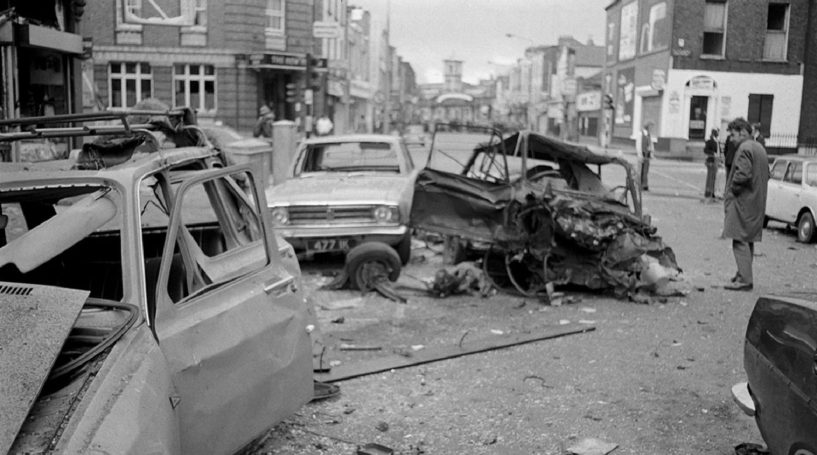
On the 17th of May 1974, a Friday afternoon, three no-warning car bombs detonated during rush hour traffic in Dublin, killing twenty-seven people, ninety minutes later, another no-warning bomb would explode in the border county of Monaghan, killing seven.
300 people would suffer injuries as a result of the bombings also, with the Irish Free State returning to its traditionally pro-British stance regarding British occupation of the north in the aftermath.
These coordinated attacks, resulting in the largest loss of life in a single day during the most recent phase of conflict related to the occupation of Ireland, were carried out by the Ulster Volunteer Force (UVF), a Loyalist terrorist organisation operating under the command of the clandestine Special Reconnaissance Unit (SRU) of the British army.
This use of proxy terrorist groups by Downing Street was later used as a tactic against both Libya and Syria in 2011 and into the present day, having been perfected by Britain’s unleashing of war in Europe in 1974.
Gavin O’Reilly is an Irish Republican activist from Dublin, Ireland, with a strong interest in the effects of British and US Imperialism; he was a writer for the American Herald Tribune from January 2018 up until their seizure by the FBI in 2021, with his work also appearing on The Duran, Al-Masdar, MintPress News, Global Research and SouthFront.
Washington’s Crocodile Tears Over Ukraine’s Destruction
By Daniel McAdams | Ron Paul Institute | February 25, 2022
As of this writing, Ukrainian president Volodymyr Zelensky is hunkered down in his bunker somewhere in Kiev, as the sound of the encroaching war gets closer and closer. A grim scene, to be sure.
All the US and EU kisses and roses leading up to this end have turned to dust and barbed wire, as a no-doubt deeply bitter Zelensky has nothing left but to cry out in anger: “Who is ready to fight with us? I do not see anyone. Who is ready to give Ukraine a guarantee of NATO membership? Everyone is afraid.”
The chips are down, as much of the US-equipped and backed Ukrainian military appears to have turned and ran as Russian forces approached. That is not to say that there has not been death and destruction on both sides. The battle for Kherson was brutal, with plenty of Russian losses. But nevertheless, as of this writing, it has fallen to Russian control.
Kiev in the main may well fall within the next 12-24 hours. Russian troops are already in the city. And Zelensky is in his bunker with fewer and fewer to take his calls. The cavalry he believed was promised him will not be coming to rescue him. Ukraine will be de-militarized and Ukraine will be neutral. Once held up as a great ally of Washington and Brussels, Zelensky is alone.
It brings to mind that great quote I often recycle from RPI academic advisor John Laughland, written as the early US-backed color revolutions rampaged through the former Soviet world in the early 2000s:
It is better to be an enemy of the Americans than their friend. If you are their enemy, they might try to buy you; but if you are their friend they will definitely sell you.
Zelensky has now learned the bitter truth, which previously favored foreign leaders also learned. Most of their lessons have been even harder than Zelensky’s (at least to this point).
The bitter truth is that Washington’s foreign policy establishment never actually considered Zelensky – or his predecessor Poroshenko – to be allies or partners of the United States. Overflowing with a toxic mix of ignorance, arrogance, and extreme cynicism, Washington’s elites have always viewed Ukraine as a tool to “regime-change” a Russia that, after its post-Yeltsin recovery, would no longer take its direction from them.
The false gods of American exceptionalism are jealous ones indeed.
The American foreign policy establishment wanted a perpetual “Yanks to the Rescue” Russia, whereby US “consultants” and spooks would ensure that the most obsequious candidate would continue to win and rule. A string of Russian presidents who would, à la Shevardnadze and a whole string of other post-Soviet leaders, run the country like a family business: lots of biznis deals for family members…and maybe 10 percent for the “big guy.”
Americans are victims (willing or not) of a mass media system as propagandistic as any that existed during Soviet Communism. The “party line” is established and it is unwaveringly followed whether the favored flavor is Fox or MSNBC. When it became obvious that Yeltsin’s one-time understudy, Vladimir Putin, wasn’t going to play that way, the party line came down that he must be demonized.
Not carefully studied and where appropriate opposed (on the basis of actual US interests), but rather Putin had to be demonized and, ultimately, “regime-changed.”
Discourse in the US is so infantile that just writing this objective truth will no doubt land this author in the “Putin’s puppet” purgatory. Not for the first time.
Most Americans will not have heard – and those who have likely do not care – that twice when the Ukrainian people elected a president who was in favor of maintaining good relations with its Russian neighbor the US intervened and overthrew the government. First time in the 2004-5 “Orange Revolution” and then the fateful 2014 “Maidan” revolt, which was explicitly and overtly supported by senior US government officials on the ground in Kiev including Victoria “F**k the EU” Nuland and the late neocon warmonger Sen. John McCain.
In the meantime tens of millions of dollars flow from the US taxpayer to favored think tanks, civic organizations, and media outlets via the National Endowment for Democracy (sic) and numerous US-funded related organizations. The goal is the same: manipulate Ukraine so that it remains on Washington’s preferred path (toward conflict with Russia).
It is fashionable – particularly over the past two days – for even antiwar and “restraint”-promoting scribblers and jaw-boners to fall into tune with the warmongers’ songbook of “Russian aggression” as the sole cause of recent bloodshed and destruction.
While anyone with an ounce of decency deeply regrets and opposes the use of such massive military force as we have seen recently in Ukraine, if there is one lesson to be learned from this entire miserable chapter (and by “chapter” I mean the entirety of post-Cold War US foreign policy) it is this: There are consequences that come with the belief that the key to peace and prosperity is to remake the world in your own image through the use of overt and covert, violent and non-violent means. That lesson should have been learned with the fall of Soviet communism itself, but the “victors” were too full of hubris to pause for a moment of humility.
Wishing reality was one thing and accepting that it is another are two very different things. The distinction must be made or the mass mental illness of “American exceptionalism” can never be cured. Otherwise the consequences next time the tectonic plates shift may be far closer to home.
Whether America and the EU like it or not, the era of ”We’re an empire now, and when we act, we create our own reality” is well and truly over. Its end is not to be mourned but to be celebrated. The only pro-America foreign policy is non-intervention in the affairs of others.
Ukrainian President Zelensky is unlikely to survive his turn being America’s cat’s paw to wrong-foot Russia. While he sits in his bunker contemplating his fate, he may well be visited by the ghosts of Saddam and Gaddafi and all those who preceded him in this position. God help him.
Copyright © 2022 by RonPaul Institute
Ukraine’s hybrid war is mutating
BY M. K. BHADRAKUMAR | INDIAN PUNCHLINE | FEBRUARY 25, 2022
The first signs of the dual track in Russia’s hybrid war in Ukraine have surfaced. By Thursday evening, the Kremlin held out an olive branch to the Ukraine president Volodymyr Zelensky.
Succinctly put, President Vladimir Putin expressed his preparedness to engage in discussions with his Ukrainian counterpart with a focus on obtaining a guarantee of neutral status for Ukraine and the promise of no offensive weapons on its territory.
The Kremlin spokesman Dmitry Peskov said without elaborating, “The president formulated his vision of what we would expect from Ukraine in order for the so-called ‘red-line’ problems to be resolved. This is neutral status, and this is a refusal to deploy weapons.”
Putin had made it clear in a nation-wide address Thursday morning announcing the launch of the military operation that the Russian objective narrowed down to “demilitarisation” and “denazification” of Ukraine. The latter refers to the ascendant neo-Nazi groups in Ukraine who have been acting as a state within the state and perpetrated atrocities against the ethnic Russian population.
The Kremlin offer didn’t come out of the blue. A group of Ukrainian MPs also came out yesterday with an appeal calling on Zelensky, in an open letter, to start negotiations with Moscow. Interestingly, the group is led by Vadim Novinsky – a Ukrainian billionaire and one of the co-leaders of the Opposition Bloc, an association of over dozen political parties. The group also proposed direct consultations between the parliaments of the two countries.
But what lends enchantment to the view is that Zelensky on his own also requested French President Emmanuel Macron to convey a message to Putin directly. Macron has since disclosed that he has had “a quick, direct and frank conversation on a request from President Zelensky.”
Macron said the aim of the conversation was a request from Kiev “to end hostilities as soon as possible.” The Kremlin confirms that Putin held a “frank” conversation with Macron.
Macron’s role is important, since it was he who first floated with Putin the idea, in the course of a conversation recently, that one way out of the impasse could be that Kiev unilaterally gave up any intention to join the NATO. Subsequently, in an interaction with the Russian media at the Kremlin on Tuesday, Putin also mentioned this idea.
Zelensky himself said (after Macron’s conversation with Putin) in an emotional video address to the nation after midnight Thursday, “We have been left alone to defend our state. Who is ready to fight alongside us? I don’t see anyone. Who is ready to give Ukraine a guarantee of NATO membership? Everyone is afraid.” He went on to disclose that he had heard from Moscow that ”they want to talk about Ukraine’s neutral status.”
Quite obviously, Zelensky realises by now that the cavalry is not coming from Washington or Brussels to salvage his government. In fact, Zelensky’s request to Macron followed the repeated categorical affirmations by US President Biden that there is no question of American intervention in Ukraine or of US troops engaging Russian military.
Meanwhile, Russian Defence Ministry highlighted on Thursday that Moscow’s strategy will be to hit military targets and avoid civilian casualty. Ukraine’s air defence system has been rendered non-functional. Moscow is encouraging Ukrainian soldiers to surrender or simply return to their families, the intention being to minimise any fighting.
All this suggests that a political track is on standby. The Russian game plan is to force Zelensky to see the writing on the wall. Ukraine’s capitulation is a matter of days only. This hybrid war would have the following elements:
- Russia will no doubt systematically vanquish the neo-Nazi elements in Ukraine (especially within the military such as the Azov Brigade) who have Russian blood on their hands. These elements so far acted with impunity because of covert western support for their anti-Russian disposition.
- Russia estimates, rightly so, that any crackdown on the neo-Nazi elements will only strengthen Zelensky’s hands. Lacking a power base of his own, he has been a hostage of extreme nationalists.
- On the other hand, Western powers have retrenched in panic from Kiev, and an embittered Zelensky is left to fend for himself. But, paradoxically, this also makes Zelensky a reasonable interlocutor, liberated from the US’ vice-like grip.
- Zelensky has been acting under immense external pressure and fear of extreme nationalists who enjoy “street power.”(The coup in February 2014, scuttling an orderly constitutional transition from President Viktor Yanukovich, was organised by the ultra-nationalists with overt US support.)
- Zelensky’s massive mandate (over 73% of votes) in the 2019 election was largely due to whole-hearted support from Russian voters who were attracted to his platform of dialogue with Russia and the promise of a negotiated settlement in Donbass with Moscow’s help. But in the event, he became a captive of extreme nationalists and a victim of western manipulation.
- Nevertheless, Zelensky has been sporadically signalling to Moscow his desire for an exit route, sensing he was on a road to nowhere. Lately, he voiced dissatisfaction over the war hysteria in Washington. At least during one telephone conversation with Biden recently, they had a heated exchange, according to the CNN.
Russia’s tentative offer appears to be that Ukraine could opt for a status of neutrality on the lines of Austria and Finland with a self-imposed ban on its NATO membership. Conceivably, Zelensky would be open to such an idea. Now, what is there in it for him?
First, Russia will forthwith call off or at least suspend the military operation. That will strengthen Zelensky’s standing. Second, Russia’s direct involvement holds the key to easing of tensions in the Donbass. Moscow had been dodging such a role.
Third, Zelensky could resume his links with the pro-Russian constituency in Ukraine, which was his mainstay of support in the 2019 election. This would have implications for his bid for a second term in the 2023 election.
Fourth, Russia enjoys extensive networking within Ukraine, which has a chaotic political environment driven by corruption and venality, oligarchs and mafia and so on. Russia still wields influence with the power brokers who have at one time or another enjoyed Moscow’s patronage. Thus, Zelensky would see that Russian help can also heal Ukraine’s fragmented political economy.
As for Russia, out of the conditions for security guarantee that it had projected to the US in mid-December, where Moscow drew a blank, Putin may succeed in reaching his objectives at least partially if Ukraine were to turn its back on NATO membership and terminate western military deployments on its soil.
Given the profound civilisational links between Russia and Ukraine, enduring people-to-people relations and family kinships, there is a reservoir of opinion in Ukraine favouring improvement of relations with Russia. Ukraine’s economy is also closely aligned with Russia — even today, Russia is Ukraine’s number one export market. Russia has been a generous donor too. The transit fee for transportation of pipeline gas to Europe alone exceeded 1 billion dollars annually!
Russia’s main gain will be that in geopolitical terms, Ukraine regains its sovereignty and ceases to be a de facto American colony. Russia calculates that a neutral Ukraine will de facto take the Ukraine matrix to its priori history before the 2014 coup.
What is of crucial importance will be that Zelensky is somehow enabled to navigate his path toward dialogue with Putin. The good part is that Russian military operations will throw radical nationalists into disarray, and, secondly, it is improbable that Biden is raring to resume the shenanigans in Ukraine. American politics is increasingly riveted on the mid-term in November and public disfavours Washington taking sides between Ukraine and Russia.
Will the US acquiesce with the nascent processes? There is hope that Macron can mediate. Conceivably, he is in touch with Biden.
How Many Chicken Hawks Are in Ukraine?
By Jacob G. Hornberger | FFF | February 24, 2022
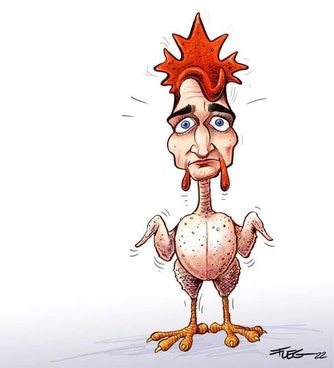
How many American chicken hawks are in Ukraine? I could be wrong but my hunch is zero. That’s right: Not one single American chicken hawk is over there helping the Ukrainians to defend their country against Russia’s attack. They are all sitting here at home, safely ensconced in their living rooms or offices.
How many American chicken hawks are there? That’s, of course, impossible to say. But you can find lots of them in Congress and in the executive branch. You can also find them on the commentary pages of America’s mainstream newspapers.
Oh, yes, they are exclaiming against the horrors of the invasion. They are expressing their deepest sympathies with the people of Ukraine. They are calling on President Biden to impose maximum sanctions on Russia. But they are all still here at home rather than over there helping the Ukrainian people in their hour of need.
It would not have been difficult during the past month to catch a flight to Europe and make one’s way to Ukraine. Chicken hawks could have gone over as a gigantic group and offered their services to the Ukrainian military or just to the government. But no, the chicken hawks have chosen to remain here at home.
The New York Times reports, “Ukraine’s defense minister, Oleksiy Reznikov, called on all Ukrainian civilians to join the fight and enlist with territorial defense units.”
Such being the case, I will guarantee you that Reznikov and the Ukranian people would welcome the personal assistance and support of American chicken hawks. Alas, they choose to remain here at home.
Why won’t America’s chicken hawks travel to Ukraine and offer a helping hand to the Ukranian people?
Three possible reasons come to mind.
One is that they’re simply scared. Going into battle against the Russian army is no doubt a frightening prospect for many American chicken hawks.
Another possible reason is that the chicken hawks simply place a higher value on their comfortable lives here at home than they place on risking their lives in a very uncomfortable situation in Ukraine.
A third possibility — the one I think is the most likely — is that deep down they know that it’s the Pentagon that has manipulated and designed this crisis by placing Russia in a position of having to make a difficult choice: (1) Let NATO absorb Ukraine, which would enable the Pentagon to establish military bases, missiles, troops, tanks, and weaponry on Russia’s border or (2) Invade Ukraine and take over the reins of power, which would thereby prevent the Pentagon from establishing its bases, missiles, troops, tanks, and weaponry on Russia’s border. (See my article “The Evil and Malevolence of the Pentagon’s Brilliant Strategy in Ukraine.”)
Given that it was the Pentagon that designed and precipitated this crisis, it would stand to reason that American chickenhawks might be reluctant to risk their lives by traveling to Ukraine and helping people resist the Russian invasion.
Interestingly, the New York Times reports that at least one Ukrainian understands fully the role that the Pentagon and NATO have played in designing and precipitating this crisis. A woman named Lyubov Vasilyevna, 75, stated, “It’s our scoundrels in Ukraine who listen to NATO and the Pentagon, which are pushing them into war.”
My hunch is that there are lots of other Ukrainians who understand this truth. My hunch also is that even though they would never say it publicly, as Lyubov Vasilyevna has, lots of American chicken hawks know this truth as well.
It is important that we keep in mind that none of this had to be. When the Soviet Union unilaterally dismantled itself and ended the Cold War, it was clear that Russia wanted nothing more than establishing peaceful and friendly relations with the West.
But the U.S. national-security establishment would have nothing to do with that plan. Rather than dismantling NATO, the Pentagon decided to keep that Cold War dinosaur in existence. Even worse, the Pentagon had NATO begin moving eastward toward Russia by absorbing former members of the Warsaw Pact.
Anyone could see where this scheme was headed. Once NATO signaled that it intended to absorb Ukraine, Russia drew the line. It was not about to permit an aggressive regime like the U.S. government (e.g., the Pentagon’s brutal invasions of Iraq and Afghanistan) to establish military bases, offensive missiles, tanks, troops, and weaponry on Russia’s border, any more than the Pentagon would permit Russia (or China or North Korea) to do the same thing in Cuba.
And so now the Pentagon has succeeded in converting Russia into a new (and old) official enemy. With its evil machinations and scheming, it has also now cost the lives of countless Ukrainians.
No wonder not one single American chicken hawk is in Ukraine helping the Ukrainian people.
Russia ready to negotiate with Ukraine – Kremlin
RT | February 24, 2022
Moscow is willing to negotiate terms of surrender with Kiev regarding the ongoing Russian military offensive currently taking place in Ukraine, Kremlin Press Secretary Dmitry Peskov said on Thursday.
According to Peskov, Russian President Vladimir Putin has expressed his preparedness to engage in discussions with his Ukrainian counterpart, with a focus on obtaining a guarantee of neutral status and the promise of no weapons on its territory.
These are terms that, according to Peskov, would enable the achievement of the demilitarization and denazification of Ukraine, and eliminate what Russia currently views as a threat to the security of its state and people.
“The president formulated his vision of what we would expect from Ukraine in order for the so-called ‘red-line’ problems to be resolved. This is neutral status, and this is a refusal to deploy weapons,” Peskov clarified.
The press secretary added that Putin would determine the timing of the negotiations, but gave assurances that Russia would only engage “if the leadership of Ukraine is ready to talk about it.”
“The operation has its goals – they must be achieved. The president said that all decisions have been made, and the goals will be achieved,” Peskov continued, suggesting that, if Kiev were to agree to meet the demands, the current military attack on Ukraine could be called off.
In the early hours of Thursday morning, Putin instigated a “special operation” in Ukraine, with the supposed aim of “securing the peace” in the breakaway Donetsk and Lugansk People’s Republics in the Donbass region.
The leaders of the republics have made claims in recent days of attacks on their territory by the Ukrainian army.
Throughout the course of Thursday, the operation has become a full-scale assault, with Ukrainian airports, military bases, and cities, including the capital Kiev, all being damaged in air strikes in an attempt by Russia to cripple any Ukrainian military response.
China points finger over Ukraine offensive
RT | February 24, 2022
China has blamed the US for creating the tensions which led to Thursday’s Russian attack on Ukraine. Beijing further called on the international community to avoid “stoking panic” over the situation.
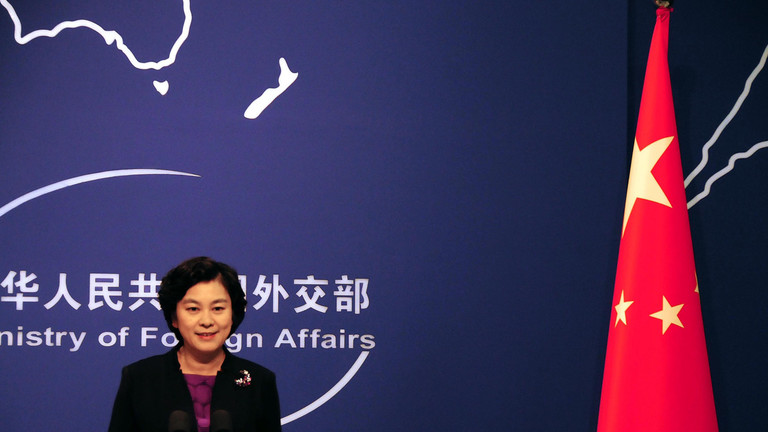
During a press briefing, China’s Foreign Ministry spokeswoman Hua Chunying said the key question was the role played by the Americans, whom she branded “the [main] culprit of current tensions.”
“If someone keeps pouring oil on the flames while accusing others of not doing their best to put out the fire, such kind of behavior is clearly irresponsible and immoral,” Hua said. China objects to “any action that hypes up war,” she added.
Chunying accused the US of hypocrisy, asking whether Washington had respected the sovereignty and territorial integrity of Iraq and Afghanistan, where she said it had “wantonly killed innocent people.” She called on the US to “take these questions seriously and abandon double standards.”
Describing the unfolding events as “complex,” the spokeswoman confirmed that Beijing was not providing military support to Russia, and said China was not “jumping to any conclusions” over the situation.
She called on all sides to “work for peace instead of increasing tensions” or “stoking panic.”
Russian President Vladimir Putin launched a military attack on Ukraine on Thursday, which he said was aimed at demilitarizing and “denazifying” the country. He accused the West of flooding Ukraine with advanced weaponry and ramping up the NATO presence in the country, arguing that the Russian “special operation” was necessary to protect the Donetsk and Lugansk People’s Republics, which Moscow has recognized as sovereign states.
Russia’s military action has prompted an international outcry and threats of new, large-scale sanctions. Ukrainian President Volodymyr Zelensky announced on Thursday that Kiev had cut diplomatic ties with Moscow.
Russian Air Strikes Destroy 74 Ukrainian Military Infrastructure Targets, Ministry of Defence Says
Sputnik – 24.02.2022
Russian President Vladimir Putin ordered the start of a special operation by the Russian armed forces in Donbass with the goal of protecting the Donetsk and Lugansk People’s Republics (DPR and LPR). He explained that the operation was needed to stop atrocities committed by Ukrainian forces in Donbass.
Air strikes by the Russian military destroyed 74 military infrastructure targets of the Ukrainian armed forces, the Russian Defence Ministry has stated. Among them are 11 airfields, three command centres, a Ukrainian Navy post, 18 S-300 radars (NATO reporting name SA-10 Grumble), and Buk (NATO reporting name Gadfly) air defence systems of the Ukrainian military, the Russian Defence Ministry elaborated.
In addition, Russian forces shot down a Ukrainian attack helicopter and four Turkish-made Bayraktar strike drones in the Donbass region, the Defence Ministry reported.
Putin responds to imperialism accusations
By Ailis Halligan | RT | February 23, 2022
Russian President Vladimir Putin has dismissed the accusation that he is plotting to restore his country to the borders of the Russian Empire, insisting that Moscow recognizes the independence of post-Soviet states.
In an exchange held with his Azerbaijani counterpart Ilham Aliyev on Tuesday, Putin assured that, while he had anticipated Western backlash over his decision to formally recognize the breakaway republics of Donetsk and Lugansk, the return of the Russian Empire was not on the cards.
“I want to say right away: we see and foresaw speculation on this topic that Russia is going to restore the empire within the same imperial borders. This is absolutely not true,” the Russian president explained to Aliyev.
Putin stressed that, rather than seeking to recolonize countries previously under Moscow’s control, his government has, in fact, “recognized all the new geopolitical realities” in a quest for cooperation with independent states which have emerged since the fall of the USSR.
“Even in very acute situations … we have always acted very carefully,” he said, referring to Russia’s treatment of issues of state sovereignty, “… proceeding from the interests of all the states involved … and have always tried to achieve mutually acceptable solutions.”
The West has accused Russia of being imperialistically motivated after Putin opted to formally recognize the sovereignty of the Donetsk and Lugansk People’s Republics on Monday, putting an end to their limbo status inside Ukraine. According to the US ambassador to the UN, Linda Thomas-Greenfield, Putin wants to “travel back in time … to a time when empires ruled the world,” something she stressed would have “dire” consequences both for Ukraine and across the globe.
Putin comments on borders of Donbass republics
RT | February 22, 2022
Moscow has recognized the Donbass republics of Donetsk and Lugansk with the borders they’ve had as regions of Ukraine, Russian President Vladimir Putin told reporters at a press conference at the Kremlin on Tuesday.
“We have recognized them, which means that we recognize their basic documents, including their constitutions. Those constitutions set the boundaries as those of the Donetsk and Lugansk regions from the time they were a part of Ukraine,” Putin told reporters.
Earlier, Deputy Foreign Minister Andrey Rudenko had said that Moscow would respect the borders of the two republics according to where local leaders exercised authority and jurisdiction. About half of the territory that had been part of both regions before the split effectively remains under the control of Ukrainian government troops.
The Russian president spoke after a meeting with his counterpart from Azerbaijan Ilham Aliyev. Meanwhile, the upper house of the Russian parliament has authorized the deployment of Russian troops abroad “in accordance with the principles and norms of international law.”
The resolution did not impose any specific limits on the use of the military, with the number of troops, as well as “the areas of their activity, their goals, and length of stay outside Russia” to be decided by the president “in accordance with the Constitution.”
Putin recognized the two breakaway republics on Monday, and asked the Russian Ministry of Defense to deploy peacekeepers into both Donetsk and Lugansk in order to provide for their security. No troops have been sent so far, however. Putin told reporters not to assume the military will move in today.
Featured Video

New positive ivermectin evidence
or go to
Aletho News Archives – Video-Images
From the Archives
Secret document reveals plans for civil war in Lebanon, Israeli false flags, and invasion
By Randi Nord | Geopolitics Alert | April 5, 2019
Beirut – During his visit with US Secretary of State, Mike Pompeo, Lebanese President Michael Aoun reportedly received a US-Israeli document detailing plans for creating a civil war in Lebanon with covert false flag operations and possible Israeli invasion.
Although the source of the document is Israeli and created in partnership with Washington, no one knows who presented it to Aoun. The Lebanese TV station, Al-Jadeed, initially reported the document on Lebanese TV and a video on its website. Geopolitics Alert translated the report for this article. … continue
Blog Roll
 Aletho News
- EU Council Advances Chat Control 2.0 Scanning Proposal
- Ex-Greek MEP files complaint against Israeli spyware firm over alleged Pegasus surveillance
- Troubling ideas throughout the Torah, Talmud, Mishneh Torah and Tanya
- ‘Grave, alarming’: Iran mission on Trump’s UNGA ‘annihilation’ threats
- Najaf airport to reopen to Iranian flights within 24 hours: Ambassador
- From ‘How Will This End For Iran’ to ‘When America Walks Away’: A tale of two Economist covers
- Tehran blasts ‘baseless’ speculation linking Iran to alleged bomb plot at UK air base
- The Rise And… Rise Of ‘Color Revolutions’
- The Coming GOP Bloodbath?
- Arctic Scare Stories Melt Away
- If Americans Knew
- Netanyahu Asked UAE Leader to Deny Report on Oct. 7 Warning in Secret Visit, Sources Say
- CNN Chief Int’l Correspondent Clarissa Ward on Journalists in Gaza
- Democratic Party Consultants Surround Troy Jackson with Pro-Israel Donors
- Christian Leader Responds To Netanyahu’s Claims Regarding Palestinian Christians
- In Gaza, ‘Whoever Survives the Bombing Won’t Survive the Rubble’
- Israel kills more Palestinians, amid push to resettle Gaza – Daily Update
- Israel forces Gazans to live in constant peril – Daily Update
- Deconstructing Netanyahu’s pants-on-fire UN rant – Daily Update
- Trump betrayed voters with his campaign lies and prioritized a foreign country once he took office
- Netanyahu calls Israel’s war in Gaza ‘opposite of genocide’ in UN speech to near-empty hall
- No Tricks Zone
- New Study: Earth And Venus Surface Warmth Largely Explained By Convection And Lapse Rate, Not CO2 Or Radiation
- 2025 Nature Paper Claiming Worsening Global Drought Gets RETRACTED …Heavily Flawed
- New Study: ‘Global Drought Shows No Detectable Recent Acceleration Under Climate Warming’
- Economic Masterminds: German Socialists Suggest Taxing Productivity Gains Stemming From Using AI
- The South China Sea Has Not Been Cooperating With The Climate Change Narrative
- Energy Crisis: Germany Enters Heating Season With Historically Low Gas Reserve Fill Levels
- New Study: The Antarctic Ice Sheet Gained Mass From 2020-2024 Due To Staggering Snow And Ice Accumulation
- Study: Ocean Heating Rates From Thousands Of Years Ago ‘Dwarf’ Modern Ocean Heating Rates
- Climate Extremists Target, Attack Large-Scale Power Grid Infrastructure In Germany!
- New Study: Antarctic Ice Melt Has Contributed Less Than 1 Centimeter To Sea Level Rise In The Last 30 Years

