Biden’s ‘Performative’ Lecture on Democracy at UN Belies True US Role in World
By John Miles – Sputnik – 25.09.2024
Biden has made his claimed struggle for democracy a primary argument for the Democratic Party’s campaign against former President Donald Trump, but a closer look reveals the malign role of the United States in preserving countries’ sovereignty and self-rule.
US President Joe Biden spoke before the United Nations General Assembly Tuesday, taking the opportunity to deliver what is likely one of the final major speeches of his political career.
The yearly gathering of world leaders and diplomats, which takes place each September in New York City, has served as the backdrop for several significant moments throughout its almost 80-year history. Cuban revolutionary Ché Guevara addressed the assembly in 1964, touting Havana’s literacy campaign and assailing US intervention in Latin America. Former Libyan leader Muammar Gaddafi delivered a highly memorable speech in 2009, as did ex-Venezuelan President Hugo Chávez, who blasted George Bush, neoliberalism, and the US War on Terror in a 2006 broadside.
The week-long event provides an important forum for developing nations, who are briefly granted equal footing with great world powers. But the General Assembly is often criticized as a “talk shop” by those who claim the recognition granted to countries is more symbolic than tangible. Author and analyst Caleb Maupin joined Sputnik’s The Final Countdown program Tuesday to discuss the 78th session of the annual event and break down Biden’s address before the international audience.
“He talked about democracy and how he’s committed to democracy,” said Maupin, noting that Biden touched on themes he has frequently spoken about during the 2024 presidential election season. “He talked against Russia. He talked against Venezuela. He talked against the Palestinians. He talked up support for Israel. Joe Biden made a series of remarks going over standard US foreign policy.”
“Joe Biden really likes to do these kinds of performative, ideological shows, and that’s what his summit for democracy that he bragged about in his UN speech was,” the analyst claimed. “He loves to do these little performances where he talks about how he’s sticking up for democracy and democratic ideals.”
Biden has made his claimed struggle for democracy a primary argument for the Democratic Party’s campaign against former President Donald Trump, but a closer look reveals the malign role of the United States in preserving countries’ sovereignty and self-rule. A 2015 study found the US provides military support to 73% of nations labeled “dictatorships,” with Saudi Arabia and Juan Orlando Hernández’s oppressive former regime in Honduras providing perhaps the most prominent examples.
Former US Secretary of State Henry Kissinger, still lauded as one of America’s most admired and consequential statesmen, made his contempt for democracy clear in 1970, when he vowed to intervene in Chile if the country elected an anti-imperialist leader. “I don’t see why we need to stand by and watch a country go communist due to the irresponsibility of its own people,” said the controversial figure, who spearheaded a campaign of social and economic subversion of the Latin American country after the election of Salvador Allende.
Three years later Chile’s democratically-elected president would be removed in a bloody US-backed military putsch, ushering in almost two decades of bloody dictatorship resulting in the death and torture of tens of thousands. The model was duplicated in Bolivia, Brazil, Peru, Uruguay, Paraguay, and Argentina in a campaign of state terror and repression known as Plan Cóndor.
The US has worked to support coups and subvert democracy in dozens of countries around the globe, but its role in Palestine has generated perhaps the most attention in recent years. The United States has frequently undermined the influence of the UN and the force of international law in the name of defending Israel from criticism, recently downplaying the importance of a vote by the UN Security Council that called on the country to end its campaign in Gaza. The US has also led a group of Western countries in defunding the UN Relief and Works Agency for Palestine Refugees in the Near East (UNRWA), a crucial lifeline for refugees facing hunger and displacement that Israel has long viewed as an impediment.
“There is a lot of criticism that can be leveled at the United Nations Relief and Works Agency,” noted Maupin. “[With] Israel though, in particular, there is a political issue there, which is the UN frequently criticizes Israel and calls out Israel for its treatment of the Palestinians.”
“Israel considers any connection with the legitimate elected government of Gaza, which is Hamas… support for terrorism,” he continued. “If the UN set up a health care clinic and an elected official who’s part of the government in Gaza – that would be a member of Hamas – showed up and got health care, that would be considered aid to terrorism.”
Former US Secretary of State Hillary Clinton revealed the country’s actual views on democracy in leaked audio of comments from 2006, in which she demonstrated that the United States’ support for democratic elections is highly contingent upon voters choosing candidates in line with views and policies supported by Washington.
“I do not think we should have pushed for an election in the Palestinian territories. I think that was a big mistake,” Clinton said of the ballot that brought Hamas’s armed resistance movement to power in Gaza.
“If we were going to push for an election then we should have made sure that we did something to determine who was going to win,” she claimed, appearing to suggest the United States should have intervened to rig the outcome.
G20 Embraces Digital ID Dream While Critics Warn of Surveillance Nightmare
By Didi Rankovic | Reclaim The Net | September 19, 2024
The G20 organization, currently chaired by Brazil and recently holding a ministerial meeting there, is wasting no time falling in line with all the key policies advanced by many governments, and globalist elites.
After promising to do its bit in the “war on disinformation” (to the delight of the host, Brazil, whose present government is accused of censorship), G20 member countries “pledged allegiance” to the digital ID and the overall scheme that incorporates it – namely, the digital public infrastructure (DPI).
DPI already counts the UN, the EU, the World Economic Forum (WEF), and the Gates Foundation as policy backers and vocal promoters. Now G20 ministers with digital economy portfolios have issued a joint declaration to express their “commitment” to both DPI and “combating disinformation”, and there is also inevitably the talk of “AI.”
On the digital ID/DPI front, the ministers speak of “inclusive” DPI, and the same attribute is attached to AI. The declaration “acknowledges” the importance of things like innovation and competition in a digital economy, among other things, at the same time “reaffirming” the importance of digital transformation based on DPI.
Boilerplate remarks are made about transparency and protection of privacy and personal data – but these are the major concerns cited by opponents of this type of scheme, along with the overall fear that they facilitate new, more dangerous forms of mass surveillance through centralization of personal information and tracking of people’s activities.
Referring to digital ID as “a basic DPI,” the declaration further speaks of the Sustainable Development Goals (a UN agenda) and one of its targets to be achieved by 2030 by using digital ID (as a tool of “inclusion”) to provide “legal identity for all.”
Interestingly enough, free speech repression is not the only controversial policy where Brazil seems keen to lead the way; so is DPI, and the digital ID.
During the G20 meeting, Brazil promoted its DPI-related activities, including digital IDs based on biometrics. This policy is explained with buzzwords such as economic growth, sustainable development, and also, “easier access to financial services and government resources, particularly for underbanked populations.”
UN overwhelmingly demands Israel end occupation of Palestinian territories
Press TV – September 18, 2024
The United Nations General Assembly has adopted a resolution that demands Israel end its unlawful presence in the Occupied Palestinian Territory within a year.
A total of 124 countries voted in favor, while 14, including the US, opposed the resolution. Britain, Switzerland, Ukraine, India and Germany were among the 43 countries to abstain.
The resolution welcomes a July advisory opinion by the International Court of Justice that said Israel’s occupation of Palestinian territories and settlements is illegal and should be withdrawn.
The advisory opinion – by the highest United Nations court said this should be done “as rapidly as possible.”
The measure calls for Israel to pay reparations to Palestinians “for the damage caused to all the natural and legal persons concerned in the occupied Palestinian territory”.
The resolution also demands sanctions and an arms embargo against Israel.
The 193-member Assembly also calls on states to “take steps towards ceasing the importation of any products originating in the Israeli settlements, as well as the provision or transfer of arms, munitions and related equipment to Israel … where there are reasonable grounds to suspect that they may be used in the Occupied Palestinian Territory.”
Riyad Mansour, Palestine’s UN ambassador, who opened the assembly meeting on Tuesday, said that no occupying power can have a veto right over the inalienable rights of the people under its occupation.
“Those who think the Palestinian people will accept a life of servitude, a life of apartheid, are the ones who are not being realistic,” Mansour said.
“Those who imagine the Palestinian people will disappear or surrender are the ones who are not being realistic. Those who claim that peace is possible in our region without a just resolution for the question of Palestine are the ones who are not being realistic.
“Each country has a vote, and the world is watching us,” Mansour said. “Please stand on the right side of history. With international law. With freedom. With peace.”
US Ambassador to the UN Linda Thomas-Greenfield urged countries to vote no on Wednesday. Washington, an arms supplier to and ally of Israel, has long opposed any resolution at the world body in favor of Palestine.
Unlike in the Security Council, no country in the General Assembly has veto power.
The action isolates Israel days before world leaders travel to New York for their annual UN gathering.
In May, the UN General Assembly voted overwhelmingly in favor of reconsidering Palestine’s full membership. It is now recognized by 145 of 193 UN member states.
Several countries, including Spain, Norway, and Ireland, recognized Palestine as a state in late May amid mounting criticism of Israel’s genocidal campaign in the besieged Gaza Strip.
While the 15-member council is largely paralyzed on the ongoing Israeli genocidal campaign in Gaza, with the United States repeatedly vetoing censures of its ally Israel, the General Assembly has adopted several texts in support of Palestinian civilians.
UN ‘Pact for the Future’: Digital IDs, Vaccine Passports, Massive Censorship
By Michael Nevradakis, Ph.D. | The Defender | September 12, 2024
World leaders will convene later this month in New York to discuss proposals that critics believe will enshrine global digital ID and online censorship and give the United Nations (U.N.) secretary-general unprecedented emergency powers.
Proposals to be discussed at the 79th U.N. General Assembly include the Pact for the Future, described by the U.N. as an “opportunity to create international mechanisms that better reflect the realities of the 21st century and can respond to today’s and tomorrow’s challenges and opportunities.”
The proposed Pact for the Future encompasses 11 policy proposals. These include proposals for the establishment of a U.N. “Emergency Platform” and a “Global Digital Compact,” and policy proposals on “Information Integrity” and “Transforming Education.”
Also among the U.N.’s proposals is the “Declaration on Future Generations.”
Under these proposals, the secretary-general would have “standing authority” to declare “an Emergency Platform in the event of a future complex global shock of sufficient scale, severity and reach.”
Discussions for the Pact for the Future will take place under the auspices of the Summit of the Future, described as “a high-level event, bringing world leaders together to forge a new international consensus on how we deliver a better present and safeguard the future.”
The proposals are part of “Our Common Agenda,” an initiative described as “the Secretary-General’s vision for the future of global cooperation.”
‘Lack of checks and balances is very worrying’
Critics of the proposals warned The Defender that they threaten personal and health freedom, will grant the U.N. unprecedented powers and may lead to an internationally binding treaty.
Dutch attorney Meike Terhorst said the U.N. is attempting to attain “more executive power.”
Francis Boyle, J.D., Ph.D., professor of international law at the University of Illinois, told The Defender, “What the secretary-general is trying to do is an end run around the United Nations charter and delegate to himself all the powers he can possibly assume.”
“The lack of checks and balances is very worrying. The member states will have very little or no power,” Terhorst said, noting that these proposals are drawing increasing opposition as they threaten national sovereignty.
The emergency powers and other proposals contained in the pact may have ominous consequences for humanity, Boyle warned.
“The most pernicious [outcomes] would certainly be extremely dangerous vaccines that probably would violate the Nuremberg Code on medical experimentation, such as these mRNA vaccines, and then also censorship, outright censorship for anyone who dissents,” Boyle said.
Other experts warned the U.N. is not being fully transparent.
According to independent journalist James Roguski, “The U.N. is not being fully transparent about the process leading up to the Summit of the Future. At this time, a consensus agreement has not been reached and the status of the three documents has not been honestly presented to the general public.”
Roguski noted that a fourth revision of the Global Digital Compact was drafted Aug. 27 but “has not been made publicly available on the U.N. website.”
And according to Dr. Meryl Nass, founder of Door to Freedom, the pact “puts the U.N. ‘at the center’ of international affairs, giving the U.N. unspecified powers.” It contains no definitions for the terms used, “allowing it to be interpreted later in ways citizens may not like.”
A means of ‘turbocharging’ the ‘Great Reset’?
Critics also connected the U.N.’s proposals to the agendas of other international organizations, such as the World Economic Forum (WEF), which promoted the “Great Reset” and “Fourth Industrial Revolution.”
“In spirit, the Summit and Pact for the Future is a relaunch of the Great Reset,” said Tim Hinchliffe, publisher of The Sociable. “Both talk about reshaping our world, which includes a desire to transform the financial system and to implement global governance surrounding issues such as climate change, healthcare and all things related to the SDGs” (Sustainable Development Goals).
“While the WEF has no direct, authoritative or legislative power to carry out its agendas, the Pact for the Future would be signed by member states whose governments wield actual executive and legislative powers,” Hinchliffe said.
“What they are trying to do is to take the WEF agenda … and turn it into solid international law and from there into solid domestic law,” Boyle said.
According to Michael Rectenwald, Ph.D., author of “The Great Reset and the Struggle for Liberty: Unraveling the Global Agenda,” the U.N.’s proposals “have been written in support of the 2030 Agenda for Sustainable Development and the ‘global governance’ regime that it aims to establish.”
Rectenwald said the proposals involve “accelerating the achievement of the SDGs” and represent the U.N.’s continued “attempt to establish a global socialist world system that is ‘inclusive’ and ‘equitable.’”
“‘Inclusion’ is achieved through such technological means as closing the ‘digital divide,’ which depends on the universal adoption of a digital identity system. Digital identity is the means by which one is ‘included’ and without which one essentially does not exist. Thus, there is to be nothing outside the system — i.e., totalitarian governance,” Rectenwald said.
Global Digital Compact calls for digital IDs, vaccine passports
Accompanying the Pact for the Future is a proposal for “A Global Digital Compact — an Open, Free and Secure Digital Future for All.”
Published May 2023, the proposed compact sets out “principles, objectives and actions for advancing an open, free, secure and human-centred digital future, one that is anchored in universal human rights and that enables the attainment of the Sustainable Development Goals.”
However, the compact contains proposals for the introduction of digital ID, “digital public goods” and “digital product passports,” and calls for “addressing disinformation” and preventing the “misuse” of online tools.
“With digital ID, it is easier for governments to censor and threaten voices with a different opinion,” Terhorst said. “In the U.N. proposals, suppressing ‘disinformation’ or ‘hateful speech’ is mentioned. Who is to decide what information is right and what is wrong?”
“Information Integrity on Digital Platforms” policy brief goes further, specifically addressing “threats to information integrity,” such as so-called “misinformation” and “disinformation.” It also calls for “empirically-backed consensus around facts, science and knowledge,” but does not clarify how this “consensus” would be determined.
Similarly, a policy brief on “Transforming Education,” proposes “incorporating practices that strengthen the ability of learners and teachers to navigate the increasing flow of false and fake information.”
The compact also proposes “Novel platform-based vaccine technologies and smart vaccine manufacturing techniques … to produce greater numbers of higher-quality vaccines.”
Terhorst said the goal of digital ID is to introduce global vaccine passports that would “overrule the right of everyone to say no to a vaccination.”
Hinchliffe noted that the U.N. has “established principles for a ‘Code of Conduct‘ that calls on not just member states, but private groups such as stakeholders, digital platforms, advertisers, and news media to crush narratives that go against the U.N. and the SDGs.”
Secretary-general ‘trying to set himself up as the UN dictator’
According to Boyle, the U.N. secretary-general is “supposed to function as a secretary in charge of the secretariat,” but these proposals are trying to “set himself up as the U.N. dictator.” He noted that the U.N. is composed of six independent organs, but said these proposals may usurp their independence.
“He would have authority over them and arguably could exert authority over U.N. specialized agencies like the World Health Organization. That ties in with the International Health Regulations and the Pandemic Treaty,” Boyle said.
Boyle argued that by specifically referring to the Pact for the Future as a “pact,” the U.N. is intentionally “trying to turn this into an international treaty that is binding” under the Vienna Convention on the Law of Treaties.
“If you call it a pact … that would clearly fall within the terms of the Vienna Convention,” Boyle said.
“We’re in the fight of our lives here. The world has to be alerted to the dangers of this pact.”
This article was originally published by The Defender — Children’s Health Defense’s News & Views Website under Creative Commons license CC BY-NC-ND 4.0. Please consider subscribing to The Defender or donating to Children’s Health Defense.
Where Was Amnesty International During the Genocide in Gaza?
By Paul de Rooij • Unz Review • September 11, 2024
Israel is genociding the Palestinians one neighborhood at the time, one hospital at the time, one school at the time, one refugee camp at the time, one ‘safe zone’ at the time
— Francesca Albanese, UN Special Rapporteur oPt, 10 August 2024
One would expect that human rights organisations would spring into action during an impending or unfolding genocide — the ultimate violation of human rights. Maybe human rights NGOs actions should be proportional to the level of the crimes they are concerned with. Thus, the more killing, torture, arbitrary imprisonment, bombing…, etc., that is plainly evident, the more action one would expect. So, what is the output of some of the leading human rights organisations in the face of the genocide in Gaza? Below is an analysis of Amnesty International’s press releases and announced actions.[1]
Will they come clean?
First things first. To assess the credibility of any organisation, one should know their relationship with Israel and the United States — both participants in the unfolding genocide. On this account, Amnesty International has never come clean about its relationship with the Israeli government. Uri Blau, a Haaretz investigative journalist, recently revealed that Amnesty_Intl.-Israel was taken over and run by Israeli operatives paid for by the Foreign Ministry.[2]
They ran interference in reporting on the situation in the occupied territories, participated in conferences, and even set up a “human rights” institute at Tel Aviv university. This was a nice way to co-opt the human rights industry. The principal who ran AI-Israel even gave an interview boasting of his exploits.
And did AI-Israel have a hand editing any Amnesty reports about the situation in the occupied territories or its many wars in the region? Some Palestinian lawyers reported having problematic encounters with AI-Israel officials, to the extent that they refused to have any dealings with it thereafter. One could well imagine AI-Israel officials reporting on Palestinians who reached out to them. So how ethical is it for Amnesty International to expose Palestinians contacting AI-Israel to imminent danger? When will Amnesty International acknowledge this dirty relationship and ensure that it maintains the requisite distance from the Israeli government in the future?
The genocide will be televised
Next, one must establish if what we witness amounts to a genocide. Craig Mokhiber, the former UN official in the High Commission for Human Rights, resigned because his agency was not reacting given the unfolding situation in Gaza, and stated in his resignation letter; “this is a textbook case of genocide”. NB: the letter was submitted on 28 October 2023. Mokhiber stated that it is usually difficult to establish whether a genocide is taking place because one doesn’t know the motivation of the leading military and political leadership.[3]
In the current context, there is no doubt about the motivation; one only has to listen to Netanyahu, Gallant, Ganz, Smotrich, Ben Gvir… And also most of the parliamentarians — they made genocidal statements in the Knesset; they were competing with each other to see who would be most truculent.
The International Court of Justice (ICJ) statement on the case brought in front of the court by South Africa also suggests that we are witnessing a genocide — at least most of the justices urged Israeli action to forestall a genocide.
Gaza is one of the most densely populated areas in the world, and in particular, the refugee camps exhibit a high population density. The Israeli military is bombing these locations using huge bombs recently delivered by 500+ of American military cargo planes.[4]
There is no doubt about this, one can even witness the bombing realtime on Al Jazeera. Civilians are directed to evacuate areas only to be bombed in locations that had been putatively named “safe areas,” hospitals, schools, UN compounds, etc. Fleeing civilians were targeted; all bakeries were destroyed; hundreds of wells destroyed; scores of chicken farms ravaged; entire families wiped out… Thus it is not only the level of killing, but also the destruction of life-sustaining infrastructure that is happening now. The weaponry is very accurate, thus the targeting was done intentionally; so it is not an issue of “collateral damage,” but it is intentional and indiscriminate targeting. A principle of International humanitarian law is that actions should be proportionate, but Israeli military and politicians revel at the disproportionate nature of the destruction; it is the Dahiya doctrine applied to Gaza.[5] This doctrine refers to the disproportionate violence perpetrated against the Lebanese population in the Dahiya neighbourhood in Beirut in 2006; the neighbourhood was entirely flattened with huge bombs. Alastair Crooke, the former British diplomat, summarises the situation succinctly: “Gaza is already a monument to callous inhumanity and suffering. It will get worse…”[6]
One thing is certain: if it quacks like a duck, waddles like a duck, then it is genocide.[7] Under these circumstances, one would expect all human rights organisations to spring into action and demand court actions, UN Security Council resolutions, calls for key officials to be held accountable for crimes against humanity, and for the US, UK, Germany… and others to stop enabling Israel’s genocidal actions.
Nature of coverage
A few things are evident when reviewing AI’s press releases: one is struck by the paucity of coverage, the trite and generic form of statements, the unwillingness to call out the nature of some crimes, and unwillingness to debunk some of the crass Israeli propaganda meant to further de-humanise the Palestinians, and to justify Israel’s crimes.
Since 7 October 2023, there have only been 60 press releases — none of any substance. One is struck also that there are a number of press releases about Israel/OPT that don’t mention the ongoing genocide at all![8]
Or the commentary is part of a discussion of human rights in general.
Ahistorical
Gaza has been subject to numerous massacres — several not even registering in the media accounts in the so-called West. There were several of the post-2006 attacks (aka “mowing the lawn” operations) usually referred to by their Israeli sugar-coated operation names. After each such operation AI dutifully produced its trite reports, but was rather circumspect in calling out Israeli crimes; and whenever it did issue a statement about a particular crime, it was immediately offset by references to Palestinian crimes.
A good historical starting point to assess the current violations of international humanitarian law would be the Goldstone report (2008) — which documented and established serious Israeli crimes during “Operation Cast Lead”.[9] Alas, one is struck by the ahistorical nature of AI’s press releases and reports. It is as if history started yesterday, but then this is the nature of the “rights-based reporting,” where there is virtually no reference to history. When it suits Amnesty it will ignore history.[10] Would one’s assessment of a criminal be altered by the fact that he was a serial criminal? If so, then it behooves AI to emphasise Israel’s long history of mass crimes against the Palestinian population. But acknowledging the long history of dispossession and brutality against the native population would suggest that “we” should be in solidarity with the Palestinians. Alas, that is not a position Amnesty is willing to take. It prefers to utter its clucking sounds, and admonish “both sides” as if there were a moral equivalence between the violence perpetrated by oppressor and oppressed.
False balance
Amnesty wants to appear impartial, and clamours for both Palestinian and Israeli rights. Thus AI will issue a report outlining some of the Israeli crimes, but will then issue a report on the “Palestinian war crimes”. In general, according to AI, most of the actions perpetrated by the Palestinians are ipso facto war crimes; there is no need for further investigation or discussion. A disgraceful example is an article discussing Palestinian war crimes published on 12 July 2024. Thus after more than nine months of bombings, maybe 186,000+ dead[11], calculated starvation, summary executions and evidence of rampant mistreatment of Palestinian prisoners… Amnesty chose to demand the release of the Israeli hostages! According to Erika Guevara Rosas, AI’s “Senior Director for Research, Advocacy, Policy and Campaigns,” holding Israeli civilian hostages is a war crime.[12] Lost in this narrative is an explanation as to why the hostages are held — they are the only means to obtain the release of some of the thousands of Palestinian prisoners. And true to form, a few days later AI released a longish press release critical of the Israeli brutal treatment of prisoners. Producing reports critical of “both sides” are attempts to claim impartiality.
Amnesty ignores the 1960 UNGA resolution acknowledging the right for an oppressed/colonised population to defend themselves — this includes armed struggle; and that Israel has an obligation to protect the oppressed population. The nature of the violence suggests that it is not possible to assume a “neutral” position. Thus, Amnesty’s proclivity to admonish “both sides” is ethically suspect.
Not countering Israeli propaganda
One useful function AI could play would be to debunk Israeli propaganda meant to dehumanise Palestinians to serve as a pretext for its genocidal campaign. The day after the Palestinian incursion, the Israeli propaganda machine was ready to push stories about rapes, babies cooked in microwave ovens, brutal murders, and so on. However, Amnesty has not countered these fabricated stories; in fact it has helped propagate the Israeli narrative. For example, it repeatedly referred to the 7 October attack as “horrific” — a term almost exclusively used to describe Palestinian actions. It doesn’t account for the fact that it was the Israeli military who killed more than half the Israeli civilians on that day.[13]
There were no babies cooked to death or impaled on bayonets. Alas, even with a pompous sounding “Evidence Investigation Unit,” Amnesty doesn’t seem to care to separate facts from hateful slander. If the latter is meant to dehumanise the Palestinians, then exposing this propaganda would go some way to humanise the victim. It seems that that is not in Amnesty’s purview.
In the press release demanding the release of Israeli hostages, Erika Guevara Rosas stated: “Israel’s brutal assault on Gaza that has resulted in the death of over 38,000 Palestinians”. This is factually correct, but contextually challenged. Guevara is using the Palestinian Health ministry’s figures that are based on the actual recovery of bodies; it misses all the victims under the rubble. The Lancet study estimates that about 8% of the Gazan population has been killed — that is in the order of 186,000 dead. Furthermore, the deaths attributable to epidemics, starvation, etc., are also missed in the Health Ministry’s statistics. The London School of Hygiene and Johns Hopkins University have attempted to estimate this mortality rate.[14]
Their estimates and methodology are complex, and it is best to read it directly from their reports. Suffice it to say that the mortality rate has increased dramatically.
Maybe a clearer explanation of the available statistics would be in order.
Lets investigate!
There are plenty of daily criminal attacks, but it is only the particularly outrageous ones when AI feels compelled to utter some comment. The discovery of mass burial sites near hospitals that had recently been invaded by the Israeli military elicited some commentary[15]. Instead of pointing a finger at Israel, and suggesting serious crimes had been perpetrated, it instead calls for an “independent investigation”. If only AI’s sanctimonious investigators could enter the scene, then one could establish what really happened. The other implication of AI’s call for investigation is that it doesn’t value the voice of the victims of Israeli crimes. Thus it is not up to Palestinians to call out their oppressor, but some “independent” body has to take its jolly good time determining whether a crime was committed; a report will follow a few years later. In the meantime, all Israeli crimes are merely “alleged” crimes.
There is a more problematic aspect to AI’s call for investigations, namely, that it is giving credence to Israeli exculpatory claims and justifications for its attacks. Thus bombing the Al Shifa hospital was justified on the spurious grounds that there was an Al Qassam bunker in the vicinity. Or, bombing a location with many refugees in tents by stating that some of the resistance commanders were in the area. Given the history of Israeli lies about all the massacres that it has perpetrated, one would think that Amnesty would be more sceptical of Israeli claims, and to challenge them outright. Instead it calls for investigations. Furthermore, when is it justified to kill 100+ civilians in order to kill two fighters? It is curious that a human rights organisation doesn’t reject this outright — there is no need for an investigation. Maybe an analogy could clarify the objection. Imagine that a rapist justified his crime by stating that the victim wore provocative clothing. Amnesty’s actions are akin to investigating if the victim’s clothing was actually sexy.
On 26 August 2024, AI issued a press release on two of the bombings of camps of displaced people killing hundreds.[16] A priori, one would say that it is a welcome report, but one is struck by the fact that these incidents “need to be investigated as war crimes”. Amnesty even reviewed the statements made by the Israeli military to justify the bombing. And to add a comic element, Amnesty sent a note to “Ministry of Justice officials,” i.e., Hamas, to determine if its fighters were sheltering in the bombed locations. In other words, it is asking the Palestinians whether the Israeli bombings were justified! And to top things off, Amnesty regurgitated its accusation that the Palestinian actions, e.g., taking hostages amounted to clear war crimes. On the one hand, AI asks that Israeli actions be investigated, yet for the Palestinians the accusation is clear: these are war crimes.
Amnesty usefully states that using civilians as human shields is “prohibited under international law.” Suggesting that if any fighter mingles with the civilian population, this amounts to a crime. The Palestinian fighters have little choice about where they can operate given that the population is constantly forced to move — the fighters included. But there is a difference between fighters being in close proximity to civilians, and the Israeli practice of placing Palestinian civilians on top of military vehicles or forcing them to enter houses ahead of Israeli soldiers. The difference is the coercion involved, and the fact that the fighters are in the midst of their own people. Thus in the press release, Amnesty wags its finger about fighters finding themselves together with civilians. However, Amnesty has yet to issue one of it missives about the civilians Israeli military forces to act as human shields. We await another press release.
Losing the forest for the trees
The crimes perpetrated against the Palestinians, i.e., genocide, crimes against humanity, and so on, must be described as mass crimes — referent to the population at large. However, Amnesty’s favourite technique to avoid mentioning the mass crimes is to dwell on individual stories to the exclusion of the totality of the crimes. On 19 August 2024, Amnesty issued a press release about the flouting of the Arms Trade Treaty. Thus: “Amnesty International has long been calling for a comprehensive arms embargo on both Israel and Palestinian armed groups because of longstanding patterns of serious violations of international human rights and humanitarian law, including war crimes…” True to form Amnesty bleats about an embargo on “both sides,” as if there were hundreds of military cargo airplanes delivering weapons to the Palestinians. But instead of mentioning the total tonnage of bombs dropped on Gaza, it provides two examples[17]:
Amnesty has documented the use of US-manufactured weapons in a number of unlawful airstrikes, including US-made Joint Direct Attack Munitions (JDAM) in two deadly, unlawful air strikes on homes in the occupied Gaza Strip, which killed 43 civilians – 19 children, 14 women and 10 men – on 10 and 22 October 2023.
A GBU-39 Small Diameter Bomb, made in the US by Boeing, was used in an Israeli strike in January 2024 which hit a family home in the Tal al-Sultan area of Rafah, killing 18 civilians, including 10 children, four men, and four women.
According to Euromed Human Rights: “Israel dropped 70,000 tons of bombs on Gaza Strip since last October, exceeding World War II bombings in Dresden, Hamburg, London combined.”[18]
Maybe providing such statistics would be more effective.
Similarly, on 18 July 2024, AI released a rather lengthy report on prison conditions.[19] To its credit, the press release was better than most AI output, but again, after a cursory mention of the total number of cases, it emphasises a few examples of prisoner’s conditions. It is dwelling on a few items to the exclusion of the mass injustice condition.
Long list of neglect
Ever since 7 October 2023, there have been many incidents that didn’t elicit a single comment by Amnesty International. Here are a few items:
- Israel bombed Palestinians waiting to obtain food from a humanitarian aid delivery truck; there were about 210 killed.
- Triple-tap bombings. Israelis bomb an area killing civilians, and then those who come to rescue them, and those who seek to rescue the rescuers.
- Al Jazeera showed a video of airplanes dropping supplies in Gaza. A few minutes later Israelis bombed the locations where the parachutes landed.
- Several hundred medical and emergency rescue staff have been killed; 170+ journalists, and in some cases the journalists’ families were also killed.
- Destruction of universities, schools and hospitals. Israeli soldiers themselves posted videos of rejoicing soldiers when hospitals and universities were blown up.
- There is a serious shortage of potable water for most Gazans. The quality and quantity of water available in Gaza was already a serious issue prior to October 2023. Groundwater had saline seepage, and thus the sodium level was above safe limits. With the destruction of wells, and the inoperability of desalination plants, the access to safe water became a serious challenge. Furthermore, the Israeli military are flooding tunnels with sea water, further contaminating groundwater.
- Israeli military declared a large garbage dump site to be a “safe zone”.
- The Israeli military forced relocations of population from North to South, and later on South to North. And of course more houses were destroyed in the meantime. There are no places where civilians can escape to safety.
- The condition of prisoners held in Israeli jails is appalling: brutality, neglect, meagre access to food and water. Al Jazeera featured the case of Moazez Abayat[20]A man who suffered torture, brutal treatment, meagre access to food and water. It was clear that Abayat had lost his mind in prison, and this is certainly not an isolated case. In August, soldiers sodomised prisoners… and +972 magazine published an article about the conditions at a military prison with a jarring statement: “The situation there [Sde Teiman detention center] is more horrific than anything we’ve heard about Abu Ghraib and Guantanamo.”
- The Hannibal killings, i.e., Israeli military killed Israelis to avoid having them taken as hostages. Haaretz reported that more than half the Israeli civilians killed on 7 October were killed by the military.
- Israeli propagandists were ready to make allegations of widespread rape and murder of children. Most of those claims were false.
- The grand larceny and theft of Palestinian land in the West Bank continues, and in the process hundreds have been killed.
- Israeli drones broadcast recordings of children in distress to entice people to investigate, and consequently kill them.
- The day after rulings by international courts (ICJ or ICC), the Israelis engaged in massive bombardments and other destructive actions. It is their means to send a “FU” message. On the eve of Netanyahu’s trip to the US, the Israeli military bombed a refugee camp killing dozens. On the day Netanyahu addressed the US Congress, 100+ Palestinians were killed.The point of this: Israel can do whatever it wants, and it has the US’s backing.
- On the eve of negotiations, Israel perpetrates particularly serious mass crimes. Early in August the US announced “negotiations,” but with meagre Israeli interest. On 10 August, Israel bombed a school killing 100+. Furthermore, Israelis murdered two of the Palestinian negotiators. Who will want to negotiate with Israel now?
- The lack of medicines is causing the certain deaths of those with chronic diseases. The protracted war is a death sentence to diabetics, renal patients, cancer victims…
Impotence and futility
Amnesty issues a few press releases and maybe a report thereafter, but there is no meaningful action. Thus far Amnesty has organised a petition calling for a ceasefire! One can fill the petition form with gibberish, and press the button however many times, and it will register in this preposterous exercise.[21] Liberal souls will be assuaged.
There have been three instances where AI urged its members to write very polite letters to Israeli officials. Thus mass crimes are happening at present, and these “urgent actions” merely plead for the fate of three individuals. All sample letters start with “Dear General…”; that is the way Amnesty likes its members to address the genocidal creeps. These letter writing campaigns are a means to get young idealistic activists to engage in “actions” that are of virtually no consequence.
Every year Amnesty claims to have more members — in the millions. Appealing to this membership base to do something meaningful could possibly be more effective. Palestinian civil society groups have long clamoured for BDS (boycott, divestment, and sanctions). Why can’t AI urge its members to boycott Israeli products? The answer is evident: the mega donors (e.g., Harvey Weinstein, Hollywood’s notorious sex predator and Israel cheerleader; the Sackler Foundation) funding Amnesty’s activities would revolt.[22]
Manifest double standards
Amnesty has produced several press releases advocating intervention in Syria, even using holocaust memes (“never again”) to emphasise its point. It even produced a melodramatic multimedia production on the “horrors” at a notorious prison.[23] When it comes to Israel, Amnesty doesn’t call for intervention; it certainly doesn’t refer to holocaust memes as “never again” seems not to apply to the Palestinians. Amnesty also doesn’t produce melodramatic videos on the most notorious Israeli prisons where inmates are tortured, brutalised and killed.
Regarding the situation in Venezuela, Amnesty demands “urgent actions from ICC prosecutor”.[24]
When it comes to Israel, it doesn’t call upon the international courts to prosecute Israel for war crimes or worse. According to Donatella Rovera, a senior AI investigator, Amnesty doesn’t issue such calls.[25] Another standard applies.
On 21 May 2024, Amnesty issued a press release urging the ICC to issue arrest warrants against Netanyahu, Gallant and three Palestinian resistance leaders. What Agnes Callamard, AI’s Secretary General, doesn’t explain is the fact that whereas an arrest warrant was issued for Putin, when it comes to Netanyahu, the prosecutor merely petitioned the court to consider issuing a warrant. Given the uproar and threats issued by US politicians, the ICC quietly dropped the matter — thus there are no warrants issued against Netanyahu and Gallant at present. There is scant evidence of a moral backbone at the ICC. But the ICC statements allows Amnesty to posture by wagging its finger at “both sides”.
On 2 September 2024, Amnesty issued a demand for Mongolia to arrest President Putin, and did so in a rather hectoring tone.[26] And although the ICC no longer seeks to prosecute Netanyahu, this doesn’t stop other organisations to call on governments hosting Netanyahu for his arrest. Alas, Amnesty didn’t send a similar demand to the US. Maybe such a call would have tarnished Netanyahu’s reputation during his recent address to the US Congress.
On the eve of the Gulf War against Iraq, Amnesty produced a report on the purported case of Iraqi soldiers “throwing babies out of incubators”. President Bush appeared on TV showing this report and using it as a justification for war. After the hoax was exposed Amnesty didn’t issue any apology or explanation. But now we face a real situation in Gaza where the Israeli military ordered the evacuation of Gaza’s largest hospital and consequently dozens of newborns had to be taken off incubators or other equipment. The doctor attending the children noted that most of them would die. One would say that this would provide emotive material to campaign to obtain a ceasefire; the plight of babies might resonate with Western liberal souls. Alas, Amnesty was silent in this instance.
And there are blind spots
One must marvel at the long list of press releases and reports Amnesty produces on a regular basis. No corner of the planet is exempt of an Amnesty commentary or reprimand. From commenting on transexual rights in Mongolia, sex workers rights, climate change, migrant rights and discrimination, etc. And many of its missives wag a finger at the offending state with titles including “… must do this”. Amnesty frequently waves its human rights magic wand. Somehow they think they have the standing of a UN-like organisation to pontificate on any topic anywhere in the world.
But one encounters blind spots in AI’s coverage. There are very few admonishing press releases regarding US, UK, or Israeli atrocious behaviour. When offending actions are mentioned at all, one finds them couched with terms such as “alleged”; and certainly not calling for a tribunal to hold criminals to account. The war in Ukraine has elicited minor critical commentary except chastising Russia; the US role in causing and fuelling the war are not mentioned. In general, AI’s position on issues aligns with US, UK and Israeli state policy. There is no criticism or even mention of the US’s penchant for forever wars; for waging violent actions in many places in the world. These seem to be just fine by Amnesty’s standards.
The United Nations Security Council has become a joke — where one finds the US and its acolytes brazenly lying, and exhibiting monumental hypocrisy and cynicism. Any relevant resolution delivering a modicum of justice is routinely vetoed. This is plainly evident regarding calls for a ceasefire in Gaza with such resolutions vetoed. On 21 December 2023, the US put forth a “compromise” resolution regarding a ceasefire and humanitarian aid. The curious thing is that on the same day the diplomats acknowledged that Israel would not be bound by the resolution — it was merely an exercise of hypocrisy on steroids. Yet the next day, Agnes Callamard, AI’s Secretary General, stated that: “This is a much-needed resolution…”![27]
. To her credit, she also stated: “It is disgraceful that the US was able to stall and use the threat of its veto power to force the UN Security Council to weaken a much-needed call for an immediate end to attacks by all parties.”
There is no pushback
An important role any organisation could play would be to confront local supporters of regimes involved in mass crimes. There are notorious cases:
- Nikki Haley, the failed presidential candidate, went to Israel to express her support to the extent that she wrote “kill them all” on an Israel artillery shell.
- At the August 2024 Democratic National Convention attendees were active cheerleaders for the Israeli actions.
- The US Congress welcomed Netanyahu and gave him 57 standing ovations.
Maybe these outrageous statements and actions would elicit critical commentary. It is not only a generic trite statement about what is happening “over there,” but what is also necessary is to challenge the local enablers of mass crimes. Alas, Amnesty would rather consort with US politicians rather than to confront them.
The bane of HR NGOs
In Europe, various governments and NGOs provide scholarships for students to specialise in Human Rights. The courses are offered in several countries, and hundreds of students attend Human Rights centres each year. Italians get to study in Finland for a year… And we find the grotesque situation of Dutch students studying human rights in Israel; it is a bit like going for education on animal rights to a slaughterhouse. This is all courtesy of EU largesse. The graduates then work for hundreds of NGOs or government agencies. Each of them will then wave their human rights wand over a topic that may be fashionable, invariably gay/trans rights, women’s reproductive rights, sex worker’s rights, etc. Further fuelling the human rights industry is the lavish funding obtained from various lottery funds — much of the profits from such institutions are disbursed to NGOs. The human rights industry experiences subsidised growth. Thus each NGO with its own warped agenda receives funds directly or indirectly. The directors of some NGOs command six figure salaries — a favourite for out-of-office politicians seeking a sinecure.[28]
In the Netherlands where this process has been in place for decades, the human rights lobby has mushroomed in size and now manifests a dysfunctional dynamic, i.e., the NGOs bring incessant lawsuits against the government tying it down in court.
Do NGOs advocating Palestinian human rights get to play in this merry go round? Fat chance!
Human rights are for the birds
When confronted with mass crimes what is needed is justice, and not one of its bastardised, neutered, malleable and ineffective substitutes. If one wants justice then it behooves one to speak in terms of justice, and to avoid the human rights mumbo jumbo. This is specially the case when human rights have been cynically exploited and weaponised by the US and UK.[29] A framework that can be used to justify wars, the so-called humanitarian interventions, cannot be a framework that advances justice or motivates people to act against mass crimes. The criminals react accordingly, i.e., they aren’t bothered if they are called transgressors of human rights, but may fear being accused of mass crimes.
The mask comes off
The current wars in Gaza, Ukraine, etc., and the reactions surrounding them has torn off the mask of the American empire revealing its hypocrisy, cynicism and sadism. Many of the “values” so dear to the neoliberals have been shown to be a sham. “Democracy,” “International law,” “freedom of speech,”…, and of course “human rights” have fallen off their pedestals. The collateral damage of the collapse also tears into the United Nations, the ICC, ICJ, and also the human rights industry because they also have been shown to be so ineffective and compromised. Amnesty International is demonstrably a conflicted organisation steeped in hypocrisy. It is a tool used by the UK and US governments to weaponise “human rights” to suit its own ends: the justification of wars, and the demonisation of “regimes,” i.e., the governments that the empire doesn’t like. It has been a conduit for pro-war propaganda in the past, and even calling for so-called humanitarian military interventions.
What is needed are critical voices that highlight the daily massacres, that call for the criminals and their enablers to be held to account, and to sue for a modicum of justice. Calling for a ceasefire is the bare minimum. Alas, most human rights NGOs don’t even fulfil this task. When Amnesty International postures about all sorts of trendy human rights everywhere in the world, but then doesn’t cover genocide and spring into effective action, then let it shut up entirely.
One thing is certain: Amnesty International is not part of the solution, it is part of the problem.
Notes
[1] This is an analysis of Amnesty’s press releases and reports. These can be found here:
https://www.amnesty.org/en/latest/ Amnesty’s position are also available on Twitter, but these are not covered here. The press releases and reports by other HR organisations are very similar and exhibit the same bias.
[2] Uri Blau, Documents reveal how Israel made Amnesty’s local branch a front for the Foreign Ministry in the 70s;
The Israeli government funded the establishment and activity of the Amnesty International branch in Israel in the 1960s and 70s. Official documents reveal that the chairman of the organization was in constant contact with the Foreign Ministry and received instructions from it; Haaretz, 18 March 2017.
https://www.aljazeera.com/opinions/2017/3/22/israels-human-rights-spies-manipulating-the-discourse
Neve Gordon and Nicola Perugini, “Israel’s human rights spies”: Manipulating the discourse
Revelations about Israel’s infiltration of NGOs in the 1970s shocked many, but human rights ‘spies’ are still out there, 22 Mar 2017.
[3] Craig Mokhiber (Director of the New York Office of the UN High Commissioner for Human Rights), The resignation letter. https://www.craigmurray.org.uk/archives/2023/11/a-textbook-case-of-genocide/
[4] Avi Scharf, Weapons shipments to Israel: A Dizzying Pace, Then a Drop: How U.S. Arms Shipments to Israel Slowed Down
subtitle: Publicly available flight tracking data shows how many U.S. arms shipments have arrived in Israel each month since the Gaza war started, revealing a sharp rise and then gradual tapering off in the pace of deliveries, Haaretz, 27 June 2024.
[5] Israel wants to be feared to maintain its morally bankrupt deterrence policy. Thus any resistance must be smashed with disproportionate power. The Dahiya neighbourhood in Beirut was brutally bombed, and the politicians ordering the bombing were very pleased with the level of destruction. Thus the Dahiya doctrine.
[6] Alastair Crooke, Trickery, Humiliation, Death – and the Timeless Hunger for ‘Honour and Glory’, Strategic Culture, 30 December 2023.
[7] Ilan Pappe, the great Israeli historian, once replied to a question of whether Israel was an apartheid state by stating: “if it quacks like a duck, and waddles like a duck, then it is apartheid”.
[8] Some examples of AI Press releases about OPT that don’t mention Gaza at all.
AI, Dutch Investor pushes for human rights safeguards to stop use of surveillance technology against Palestinians, 4 July 2024. Refers to the intrusive video spying.
AI, Israel’s attempt to sway WhatsApp case casts doubt on its ability to deal with NSO spyware cases, 25 July 2024.
[9] Operation “Cast Lead” is a curious name for a military operation. It actually refers to a passage in Deuteronomy where the Hebrews exterminate their opponents to the extent that they pour molten lead down their throats.
[10] Contrast AI’s ahistorical reporting on the situation in Gaza with that of Syria. When it comes to Syria, the history of the “regime” is suddenly an issue.
[11] Rasha Khatib, Martin McKee and Salim Yusuf, “Counting the dead in Gaza: difficult but essential”, The Lancet, Volume 404, Issue 10449, pp237-238, 20 July 2024. https://www.thelancet.com/journals/lancet/article/PIIS0140-6736(24)01169-3/fulltext
[12] AI, Israel/ OPT: Hamas and other armed groups must immediately release civilians held hostage in Gaza,12 July 2024
[13] By Yaniv Kubovich • Haaretz 7 July 2024
IDF Ordered Hannibal Directive on October 7 to Prevent Hamas Taking
Soldiers Captive
Subtitle: “there was crazy hysteria, and decisions started being made without verified
information: Documents and testimonies obtained by Haaretz reveal the Hannibal operational order, which directs the use of force to prevent soldiers being taken into captivity, was employed at three army facilities infiltrated by Hamas, potentially endangering civilians as well”
[14] Crisis in Gaza: Scenario-based Health Impact Projections https://gaza-projections.org/gaza_projections_report.pdf
[15] AI, Gaza: Discovery of mass graves highlights urgent need to grant access to independent human rights investigators, 24 April 2024.
[16] AI, Israel/OPT: Israeli attacks targeting Hamas and other armed group fighters that killed scores of displaced civilians in Rafah should be investigated as war crimes, 26 August 2024.
[17] AI, Global: Governments’ brazen flouting of Arms Trade Treaty rules leading to devastating loss of life, 19 August 2024.
[18] https://www.sgr.org.uk/resources/gaza-one-most-intense-bombardments-history
[19] AI, “Israel must end mass incommunicado detention and torture of Palestinians from Gaza”, 18 July 2024.
[20] https://www.aljazeera.com/program/newsfeed/2024/7/10/freed-former-palestinian-bodybuilder-alleges-abuse-by-israeli-jailers and https://www.middleeasteye.net/news/palestine-west-bank-muazzaz-abayat-prison-interview
[21] https://www.amnesty.org/en/petition/demand-a-ceasefire-by-all-parties-to-end-civilian-suffering/
[22] Thomas Frank, Hypocrite at the good cause parties, Le Monde Diplomatique, February 2018. Frank reports that Harvey Weinstein made “AI-USA possible”.
[23] Paul de Rooij, Amnesty International trumpets for another “Humanitarian” war… this time in Syria, MintPress, 23 March 2018.
[24] Amnesty, Venezuela: Scale and gravity of ongoing crimes demand urgent actions from ICC prosecutor, 9 August 2024
https://www.amnesty.org/en/latest/news/2024/08/venezuela-crimes-demand-urgent-action-icc-prosecutor/
[25] Personal communication with Donatella Rovera, January 2003.
[26] AI, “Mongolia: Putin must be arrested and surrendered to the International Criminal Court”, 2 September 2024.
[27] https://www.amnesty.org/en/latest/news/2023/12/israel-opt-adoption-of-un-resolution-to-expedite-humanitarian-aid-to-gaza-an-important-but-insufficient-step/
Israel/OPT: Adoption of UN resolution to expedite humanitarian aid to Gaza an important but insufficient step, 22 Decemeber 2024.
[28] Irene Khan, the former Amnesty general secretary, received a £533,000 “golden handshake” when she departed.
[29] For some of the background history of Amnesty International, see: Kirsten Sellars, The Rise and Rise of Human Rights, Sutton Publications, 2002. Also, Alfred de Zayas, The Human Rights Industry, Clarity Press, 2023.
Hamas: Washington adopts Israel’s ceasefire-disrupting position
Palestinian Information Center – August 29, 2024
ISTANBUL – The Hamas senior official Sami Abu Zuhri said the US administration adopts the Israeli position, which is disrupting ceasefire negotiations, noting that Washington is not serious about obliging Israel to stop its war on the Gaza Strip.
This came in his interview with Aljazeera Net in Istanbul on the sidelines of his participation in a conference held by the “Al-Quds International Foundation”.
Abu Zuhri told Aljazeera Net that the US administration does not show serious intention to obligate Israel to conclude an agreement.
He explained that the Hamas Movement “accepted the proposal of the brokers – Egypt, Qatar and the United States – on July 2, but Israel kept imposing new conditions, although the offer is outlined by the US President Joe Biden’s speech and the UN Security Council resolution.”
On the prospects for the negotiations in the future, Abu Zuhri said, “In all cases, there is an ongoing Israeli war of extermination in Gaza, and all international parties have to assume their responsibilities to stop the Israeli aggression and crimes.”
Abu Zuhri added, “the ball is now in the Israeli and the US court. If the Us administration is serious to reach an agreement, it must intervene to compel the Israeli occupation authority to stop this aggression against the Palestinian people and respect the previously reached agreements.”
With regard to the ongoing developments in the occupied West Bank, and the expansion of the Israeli occupation army’s military operations, Abu Zuhri said that the Israeli occupation army exploits the US cover to expand its aggression in the West Bank, stressing that the Israeli aggression is not limited to Gaza but extends to all the occupied Palestinian territories, especially the West Bank and Jerusalem.
Israeli UN envoy says UN HQ should be ‘wiped off face of the earth’
Al Mayadeen | August 21, 2024
The outgoing ambassador Gilad Erdan claims that the United Nations building in New York City is “unnecessary”.
The United Nations building must be abolished, declared “Israel’s” departing ambassador to the UN, taking aim at the global body.
During an interview with Israeli media on Tuesday, Erdan said, “The UN building should be closed and wiped off from the face of the earth,” adding, “This building, which may look nice from the outside, is actually twisted and distorted.”
When asked about his future plans, given that he is departing his position at the UN, Erdan expressed seeing himself leading the right-wing Likud Party after PM Benjamin Netanyahu resigns.
“I’m coming out with a feeling of satisfaction …” he said.
Back in June, “Israel” was looking for ways to respond to the UN after it blacklisted it as an entity that violates children’s rights in “conflict zones”, according to Israeli public broadcaster KAN, including cutting ties with UN Secretary-General Antonio Guterres.
After being blacklisted, Israeli Prime Minister Benjamin Netanyahu took to his X account to say that the UN “put itself today on history’s blacklist” instead, while Israeli Foreign Minister Israel Katz stated that the decision would affect relations with the United Nations.
KAN also reported that “Israel’s” UN envoy, Gilad Erdan, recommended the Israeli cabinet to classify the UN Agency for Palestinian Refugees (UNRWA) as “a terrorist organization.”
Israeli regime’s actions against civilians ‘blatant example of terrorism’: Iran envoy

Iran’s permanent representative to the UN Office in Geneva, Ali Bahraini.
Press TV | August 14, 2024
Iran’s permanent representative to the United Nations Office in Geneva has called for Israeli institutions to be recognized as “terrorists,” stressing that the regime’s inhumane actions against Palestinian civilians constitute “a clear example of terrorism.”
Ali Bahraini made the appeal in three separate letters to UN High Commissioner for Human Rights Volker Turk, the UN special rapporteur on extra-judicial summary or arbitrary executions, Morris Tidball-Binz as well as UN Special Rapporteur on human rights in the occupied Palestinian territories Francesca Albanese on Wednesday.
According to Article 2.1 of the international convention to prevent the financing of terrorism, the institutions of “the Zionist regime” must be identified as terrorists, he said, adding that “the actions carried out by the Israeli regime against civilians and Palestinian areas are a clear example of terrorism.”
Bahraini also noted that from Iran’s point of view, Hamas is “a liberation organization” that fights for the freedom and independence of Palestine.
Therefore, he said, the assassination of Hamas leaders is aimed at undermining the morale of the Palestinian people in their struggle to end the occupation and achieve the right to self-determination.
The Iranian diplomat also emphasized that by eliminating the Palestinian leaders, Israel seeks to destroy the Palestinian political identity and the inalienable right of the Palestinian people to have an independent state.
He further referred to the advisory opinion of the International Court of Justice (ICC), which recognizes the right of Palestinians to self-determination, and described any action that violates this right as illegal.
Elsewhere in his remarks, Bahraini strongly denounced as “a gross violation of international law” the assassination of Hamas leader Ismail Haniyeh in the capital Tehran.
He also urged UN officials to condemn the assassination decisively and to document it in their future reports.
The top Iranian diplomat also stressed the need for more efforts to achieve justice for the Palestinian people and to hold the Israeli regime accountable for its crimes.
Haniyeh, who was in Tehran to attend the swearing-in ceremony of Iran’s newly-elected President Masoud Pezeshkian, alongside other Axis of Resistance leaders, was martyred in an attack early on July 31.
Leader of the Islamic Revolution Ayatollah Seyyed Ali Khamenei has warned the Israeli regime of a “harsh response” for Haniyeh’s assassination, calling it the Islamic Republic’s duty to avenge the Palestinian resistance leader’s blood.
Indonesia, Malaysia urge UN to forge consensus against Israel after latest massacre in Gaza
Press TV – August 11, 2024
Indonesia and Malaysia have urged the United Nations to reach a general agreement against Israel after its latest massacre in the Gaza Strip.
More than 100 Palestinians were killed on Saturday in an Israeli airstrike on a school sheltering displaced people in the east of the Gaza Strip. The Israeli regime has attacked schools at least 21 times in the past 40 days.
Southeast Asian nations have been critical of the Israeli regime, vocally supporting the defenseless Palestinian people trapped and massacred by the Zionist war machine in the besieged Gaza Strip.
On Sunday, both Indonesia and Malaysia called on the UN to unite against Tel Aviv to stop the mass killing of civilians in Gaza.
“The international community should no longer tolerate and accept the belligerence of Israel,” the Malaysian Ministry of Foreign Affairs said in its statement.
“Malaysia continues to call for Israel’s allies to compel Israel to immediately stop the killings of innocent Palestinians, and to stop providing Israel with the tools to continue this genocide. An immediate, urgent and decisive action by the UN Security Council is needed to enforce a permanent ceasefire.”
Malaysia said that Israel has shown “that it has no desire for peace” and urged other Muslim countries under the 57-member Organization of Islamic Cooperation to come together and work with UN member states to demand Tel Aviv comply with the UN Security Council resolution passed in June, which called for a ceasefire in Gaza.
The Israeli regime’s airstrike on Saturday sparked a new wave of international condemnation, with the UN Human Rights Office saying that it was at least the 21st attack on schools-turned-shelters that it has recorded since July 4.
Indonesia has also joined growing calls for the UN Security Council to “immediately conduct a comprehensive investigation” into the Al-Tabin school massacre.
“Indonesia also calls upon the international community to unite in stopping the crimes against humanity and genocide committed by Israel,” the Indonesian Ministry of Foreign Affairs said. “Israel must be held accountable for all these crimes, and all forms of impunity must be brought to an end.”
Backed by the US-led Western allies, the Israeli regime has since October launched a genocidal war on Gaza, enforcing a deadly siege of the Palestinian land by stopping the flow of potable water, medicine, and electricity into the coastal territory.
Israeli forces’ genocidal war on Gaza since early October has killed nearly 40,000 people, most of them women and children, with some 91,000 more injured.
Bill Gates, U.S. Military Among Investors in GMO Insect Protein for Humans
By Michael Nevradakis, Ph.D. | The Defender | August 2, 2024
While regulators in non-U.S. countries, including Singapore, have issued approvals for specific insect-based foods, in the U.S., the regulatory landscape is murkier — there is no legal approval process or clear-cut prohibition of insects for human consumption.
As a result, insect-containing foods have reached U.S. consumers, even though one of the few existing U.S. laws that address insects in the food supply refers to them as “filth” and a form of “adulteration.”
Crickets and grasshoppers reach U.S. consumers in a variety of forms, from protein bars to protein shakes. They’re also found on restaurant menus and are promoted as pet food and animal feed ingredients.
With few U.S. regulatory barriers to contend with, investors like Bill Gates and Big Food giants such as Tyson Foods have also begun investing in “alternative protein” startups — despite mainstream media “fact-checks” claiming Gates doesn’t support the consumption of insects.
Internist Dr. Meryl Nass, founder of Door to Freedom, told The Defender lax U.S. Food and Drug Administration (FDA) regulations — under which many insect-containing foods can be classified as “Generally Regarded as Safe” (GRAS) — “means they don’t require testing” and enable the FDA to “look the other way.”
“How long will it take before we learn whether these foods are safe? It could take generations,” Nass said.
Gates, U.S. military among backers of ‘alternative protein’ startups
The Bill & Melinda Gates Foundation’s Grand Challenges Explorations program in 2012 funded All Things Bugs, a project to “develop a novel food product made from insects to treat malnutrition in children from famine stricken areas of the world,” according to Eurasia Review.
All Things Bugs has since expanded into the development of genetically modified insects. With funding from the Defense Advanced Research Projects Agency (DARPA), “we are using CRISPR/Cas9 gene editing and other methodologies to develop base technologies for creating insects as a new bioresource,” the company states.
DARPA is a research and development agency that operates under the U.S. Department of Defense.
All Things Bugs said that while insects are “a very sustainable source of protein,” it “is innovating to make them a feasible commodity for the food industry.”
Claire Robinson, managing editor of GMWatch, told The Defender, “With all GMOs [genetically modified organisms], including insects, it’s vital that they are subjected to a pre-marketing risk assessment for health and the environment.”
Robinson said, “This includes testing them for the presence of pathogens, possible allergens and substances that may be toxic to humans. Then they must be clearly labeled for the consumer.”
Gates’ investments in insect-based foods appear to be part of a broader strategy to invest in alternatives to animal-based foods for consumers.
In a February blog post, Gates said he invested in Savor, a startup producing butter made from air (carbon dioxide) and water (hydrogen). And in 2022, the Gates Foundation awarded a $4.76 million grant to Nature’s Fynd, a startup producing foods containing fungi-based protein. In 2020, Breakthrough Energy Ventures, founded by Gates, invested in Nature’s Fynd.
The U.S. government’s National Science Foundation (NSF) also is involved in the insects-as-food space, through its funding of the Center for Environmental Sustainability through Insect Farming (CEIF). Established in 2021, CEIF seeks “to develop novel methods for using insects as feed for livestock, poultry, and aquaculture.”
Institutions participating in CEIF include Texas A&M University, Indiana University-Purdue University in Indianapolis and Mississippi State University — along with Tyson Foods, Protix and Innovafeed, backed by food processing giant ADM, formerly the Archer-Daniels-Midland Company.
Insect protein start-ups raised ‘over $1 billion in venture capital since 2020’
The production of insects for human food is expanding in the U.S. and globally, with support from the United Nations and the World Economic Forum (WEF).
In 2013, the Food and Agriculture Organization of the United Nations released a seminal report, “Edible insects: future prospects for food and feed security,” which promotes the environmental and nutritional benefits of insect consumption.”
A 2022 WEF paper, “5 reasons why eating insects can reduce climate change,” suggests people are “conditioned to think of animals and plants as our primary sources of proteins … but there’s an unsung category of sustainable and nutritious protein that has yet to widely catch on: insects.”
According to a November 2023 Washington Post report, “Insect start-ups have raised over $1 billion in venture capital since 2020.”
A 2021 report by Netherlands-based Rabobank claimed the demand for insect protein, “mainly as an animal feed and pet food ingredient, could reach half a million metric tons by 2030, up from today’s market of approximately 10,000 metric tons.”
A report by Grand View Research forecasted the global insect protein market will expand by an annual compound growth rate of 16.9% by 2030, while European projections estimate “the number of Europeans consuming insect-based food will [reach] a total of 390 million by 2030,” according to EuroNews.
Ynsect, for instance, has built factories in France and the Netherlands, and is erecting factories in the U.S. and Mexico, according to Feed Navigator. The company claims its insect-producing farms are “climate positive,” “benefit biodiversity” and are aligned with the Paris Agreement and the European Union’s “Fit for 55” goal.
In March 2022, Ynsect acquired Nebraska-based Jord Producers — a mealworm farm. And in December 2022, Ynsect signed an agreement with U.S. flour milling company Ardent Mills to build a factory in the Midwestern U.S. Ardent Mills is a joint venture between ConAgra Foods, Cargill and CHS, a global agribusiness cooperative.
Investors in Ynsect include actor Robert Downey Jr.’s FootPrint Coalition and France’s Crédit Agricole bank — along with support from the FAO and the European Commission. The company has raised over $600 million.
Celebrity chefs also are embracing insect food. In November 2023, the Financial Times featured Joseph Yoon, founder of Brooklyn Bugs, whose “goal is to popularise edible insects and build up this food source to help support global food security.”
Your dog can eat insects, too
In addition to a lack of FDA regulations governing the use of insects in foods for humans, the FDA also does not regulate the use of insects for pet food ingredients.
According to Animal Frontiers, “pet food is under the nongovernment Association of American Feed Control Officials (AAFCO)” in the U.S. In January, French firm Ynsect became the first company to receive AAFCO authorization for commercial production of mealworm protein for dog food in the U.S.
In October 2023, Big Food giant Tyson Foods announced the acquisition of an ownership stake in the Dutch insect ingredient producer Protix. Tyson said the new joint venture would construct “the first at-scale facility of its kind to upcycle food manufacturing byproducts into high-quality insect proteins and lipids which will primarily be used in the pet food, aquaculture, and livestock industries.”
Although the announcement did not definitively exclude the production of insect-containing foods for humans, a Reuters “fact check” published in May stated, “Tyson Foods does not put insects into products for human consumption.”
Tyson has invested in Upside Foods, which in June 2023 won approval from the U.S. Department of Agriculture (USDA) to produce lab-grown chicken. Upside garnered more than $600 million in research and development investments, including from Gates, Richard Branson, Elon Musk’s brother Kimbal Musk and Cargill.
Vanguard and BlackRock, the world’s two largest institutional investment firms, are also the two top institutional holders of Tyson Foods shares. BlackRock, and its CEO, Larry Fink, have promoted “sustainable” corporate practices.
This article was originally published by The Defender — Children’s Health Defense’s News & Views Website under Creative Commons license CC BY-NC-ND 4.0. Please consider subscribing to The Defender or donating to Children’s Health Defense.
The UN Smothers the Peoples with Compassion
By Thi Thuy Van Dinh and David Bell | Brownstone Institute | June 27, 2024
“We The Peoples of the United Nations determined (…) to promote social progress and better standards of life in larger freedom,”
United Nations Charter Preamble (1945)
The United Nations (UN) Secretariat will hold the next Summit of the Future in New York on 22-23 September 2024. It is a vast political program covering the noblest of causes including poverty reduction, human rights, environment, climate change, development, and the welfare and rights of children, youth, and women. World leaders are expected to endorse a declaratory Pact for the Future, and commit to act toward its realization.
It all looks wonderful. As in days of old, the rich, powerful, and entitled are coming to rescue us from ourselves and make us live better lives. Freedom, after all, is intrinsically unsafe.
This is the first in a series that will look at the plans of the UN system designing and implementing this new agenda, covering implications for global health, economic development, and human rights.
Amidst all the hype and posturing regarding the negotiations on pandemic texts at the recent 77th World Health Assembly (WHA) in Geneva (Switzerland), perhaps the most consequential resolution before the WHA slipped through, approved, but virtually unnoticed. The Resolution WHA77.14 on Climate Change and Health was approved without debate, opening the door for the World Health Organization (WHO) ─ a UN specialized agency ─ to claim a broad swath of normal human activity as a potential threat to health, and therefore coming under the purview of the WHO’s detached business-class bureaucrats.
It was highlighted by a Strategic Roundtable on “Climate change and health: a global vision for joint action,” where speakers, moderated by the Lancet’s Editor-in-Chief Richard Horton, included WHO Director-General (DG) Tedros Ghebreyesus, former US Vice President Al Gore (by video message), and CEO of the 28th Climate Conference of States Parties Adnan Amin.
The Resolution was proposed by a coalition of 16 countries (Barbados, Brazil, Chile, Ecuador, Fiji, Georgia, Kenya, Moldova, Monaco, Netherlands, Panama, Peru, Philippines, Slovenia, United Arab Emirates, and the UK) and passed without changes, mandating the DG to: i) develop a “results-based, needs-oriented and capabilities-driven global WHO plan of action on climate change and health,” ii) serve as a global leader in the field of climate change and health by establishing a WHO Roadmap to Net Zero by 2030, and iii) report back to future WHA sessions.
United Nations System’s “Newspeak” on Climate Change
There is little surprise in this. It is another predictable move on the global climate chessboard. In the last decade, activities and documents from the UN system have increasingly included climate change as a “newspeak” to signal full compliance with the official narrative.
The head of the UN system, Secretary-General Antonio Guterres, is known for pushing the narrative further. In 2019, he posed in water for a picture for Time Magazine’s coverage on “Our sinking planet.” Last summer, he announced that “the era of global warming has ended…the era of global boiling has arrived.”
On 2024 World Environment Day (5th June), he doubled down on his rhetoric: “In the case of climate, we are not the dinosaurs. We are the meteor. We are not only in danger. We are the danger.” We are, it appears, a poison on our planet.
Satellite entities have wildly added their creativity and imagination: UNEP hammering on the “triple planetary crisis of climate change, nature and biodiversity loss,” UNICEF reporting on the “climate changed-child,” UNWOMEN discovering the “interconnection between climate change and gender inequality,” OHCHR claiming that “climate change threatens the effective enjoyment of a range of human rights including those to life, water and sanitation, food, health, housing, self-determination, culture and development,” and UNESCO fully committed “to addressing the impact of climate change on culture, and to enhancing the potential of culture for global climate action.”
Nomination of First Ever WHO Special Envoy for Climate Change and Health
As for WHO, DG Tedros Ghebreyesus has also demonstrated his mastery of dogmatic claims. Climate change, he insists, constitutes “one of the biggest health threats” and “the climate crisis is a health crisis.” His mandate has therefore been broadened from specific environmental issues including air pollution from particulates and chemicals to the whole climate change spectrum. In 2023, the WHO estimated that “between 2030 and 2050, climate change is expected to cause approximately 250,000 additional deaths per year, from undernutrition, malaria, diarrhoea and heat stress alone.”
Strangely, however, deaths attributable to cold weather, estimated at 4.6 million globally per year, were not weighed in balance. Nor are inevitable deaths from undernutrition related to a lack of accessible energy for agriculture and transport. Accounting for a reduction in such deaths would significantly reduce projected mortality and perhaps demonstrate an overall advantage. For instance, rising CO2 has increased plant growth and contributed to the world’s ability to feed 8 billion people, an achievement once considered impossible and is obviously highly critical to maintaining health.
The WHO’s leaders have become bolder. In June 2023, in a minor lapse of equity, inclusion, and transparency criteria, the DG appointed Dr Vanessa Kerry as “the first ever” Special Envoy for Climate Change and Health for being “a renowned global health expert and medical doctor and CEO of Seed Global Health.” The press release overlooked any connection with her father, former US Secretary of State John Kerry ─ a key US Democratic politician, well-known personality at UN climate forums, and first-ever US Presidential Envoy for Climate (January 2021-March 2024). Her nomination, apparently, was purely meritocratic.
It is estimated that $27.6 million is required to create the reports implementing the 2024 Resolution. Now, $20 million will come from WHO’s biennial 2024-25 budget, and the gap of $7.6 million will be raised through WHO’s continued “discussions with Member States, development agencies and philanthropic organizations.” People who will, perhaps, benefit from the WHO pushing the products they have invested in, such as heavily processed substitutes to (climate-harming) natural foods.
Misleading Resolution WHA77.14 on the “Link between Health, Environment and Climate Change”
All of this appears to follow conventional political and diplomatic playbooks. It comes unstuck if one applies a critical look at how Resolution WHA77.14 was built.
It referred to Resolution WHA61.19 (adopted in 2008) on climate change and health, Resolution WHA68.8 (adopted in 2005) addressing the health impact of air pollution, and Resolution WHA76.17 (adopted in 2023) on the impact of chemicals, waste, and pollution on human health as follows.
Recalling resolution WHA61.19 (2008) on climate change and health and welcoming the work carried out so far by WHO in pursuit of it;
Recalling also resolution WHA68.8 (2015) on addressing the health impact of air pollution and resolution WHA76.17 (2023) on the impact of chemicals, waste and pollution on human health, which recognize the link between health, environment and climate change;
Resolution WHA61.19 was adopted based on a WHO report “Climate change and health.” This report stated that “There is now a strong, global scientific consensus that warming of the climate system is unequivocal, and is caused by human activity, primarily the burning of fossil fuels which releases greenhouse gases into the atmosphere” (para. 1) and that “WHO has, for several years, stressed that the health risks posed by climate change are significant, distributed throughout the globe, and difficult to reverse” (para. 2). These affirmations were made without assessment of levels of evidence (strong, moderate, weak), of the extent to which (modifiable) human activity is involved, or of the actual positive versus negative impacts of higher temperatures (and atmospheric CO2).
Contrary to the statements by Resolution WHA77.14, neither Resolution WHA68.8 nor Resolution WHA76.17 mentioned climate change in the context of pollutants. Excluding rare natural phenomena, particulate and chemical air pollution do result from human activities, including indoor air pollution (e.g. cookstoves) and transport and industrial waste. Hence, these past Resolutions recognized a link between these pollutants and human health, which is common sense. They did not recognize a link between health, environment, and climate change.
Nevertheless, we can probably relax and wait. The WHO’s upcoming reports can be expected to claim a link. They have $27 million to spend on that.
The Climate Agenda Versus “We the Peoples”
It is easy for wealthy self-proclaimed philanthropists and international and governmental bureaucrats to call for phasing out fossil fuels. Living on tax-paid salaries in secure jobs, in economies made rich through the availability of cheap energy, they are able to renew their commitment annually at the Conference of States Parties (COP) to the UN Framework Convention on Climate Change, ignoring the reality that their very ability to be there is due to fossil fuels. The most recent venues ─ Dubai, Sharm-El-Sheik, and Glasgow ─ all built their prosperity on this same energy base.
Being obsessed with the man-made climate narrative, the UN system pushes poor countries to adopt green energies for lighting and cooking, rather than developing the large-scale energy infrastructure that still forms the backbone of wealthier societies.
There seems to be no shame vis-a-vis 2.3 billion people on earth that, according to the WHO, must still rely on dirty and dangerous cooking fuels such as cow dung, charcoal, and wood ─ negatively impacting women and children’s health through particulate air pollution. Increasing the cost of fossil fuels directly increases further deforestation and resultant desertification (and regional climate change) in areas such as East Africa. It feels good, apparently, for the activists of climate COPs and Extinction Rebellion to force African women to walk further each day for firewood, denuding landscapes and their meager savings.
There seems to be no shame either when Western bilateral and multilateral largesse to low-income countries comes on the condition that they pass a “climate check,” or must be spent on developing “green” but unreliable solar and wind generation which barely supplement the base energy supplies of most donor countries. We happily burn Nigerian oil, but our virtue requires Nigerians to do better. After looting wealth through colonialism, this is rubbing noses in the dirt of the poverty left behind.
One can confidently predict that the rhetoric will continue, and more “soft laws” ─ UN declarations, strategies, plans-of-action, and agendas ─ will complement the existing “hard laws” of the UN Framework Convention on Climate Change and its Protocols. At the WHO, more funding will come to extend the growing industry of climate change and health, diverting financial and human resources from far greater, but less boutique, health burdens.
A plan of action will be put before a future WHA to agree to a binding document seeking to harden the 2024 Resolution into requirements. Highly questionable assumptions that pandemics and malaria, and even tuberculosis, are worsened because of climate change will be drawn to support the global plan, complementing the coming Pandemic Agreement and the massive surveillance system set up by the freshly adopted IHR Amendments to ensure pandemic lockdowns.
Malaria, tuberculosis, and diseases of undernutrition and poor hygiene are primarily diseases of poverty. People in wealthy countries live longer primarily because of improvements in sanitation, living conditions, and nutrition. These improvements were achieved by using energy for transport, to build infrastructure, and to massively improve the efficiency of agricultural production. Locking future generations in low-income countries into poverty will not improve their health and well-being.
This increasingly charade-like global health circus will, in the end, destabilize the world and harm us all. To address complex issues, the world needs rational and honest debates, rather than games played by a self-entitled few. The WHO is demonstrating that it is no longer the organization to lead us to better health. It is on us to regain control of our own future.
Can the WHO and the United Nations impose sanctions on your sovereign country for non-compliance?
The UN is a far bigger threat than the WHO, which, although deserving of attention, cannot consume our entire focus.
BY SHABNAM PALESA MOHAMED | JUNE 18, 2024
This updated analysis was written in 2023 (read in full here at CHD Africa)
Sanctions are a powerful instrument of political control and economic profit. One of the rare but critical topics relevant to the international campaign to #ExitTheWHO is whether the World Health Organisation and the United Nations can impose, influence or recommend specific sanctions. The sanctions could be implemented against countries that choose to not comply or cannot comply with International Health Regulations, the proposed new pandemic treaty, or other legislative attempts that curtail rights, freedom and sovereignty.
The accelerating and profitable globalist march towards unprecedented levels of ‘1984’ style totalitarianism – using censorship, vaccine passports, 15 minute cities, and CBDC’s continues. It is plausible that the WHO and the UN will move to impose, influence or recommend sanctions against countries that do not want to or cannot comply with its centralised health agenda and undemocratic legislative attempts.
What is the basis for me raising the red flag on sanctions in 2023?
Health is no longer just health, as it is defined in the WHO’s constitution. Through Covid-19, and other controversially declared pandemics, health is now a multi-billion dollar health security industry. With it, creeps in the tyranny of secrecy, surveillance, vaccine certificates, forced quarantines, and the undemocratic censorship of free speech. Given the absence of public participation, the WHO is a strategic spear for oligarchs and corporations, and given international resistance to its power grab, it becomes desperate and argues or pushes for sanctions.
Reported in 2021: “In 2021, German Health Minister Jens Spahn called for sanctions against countries that hide information about future outbreaks. Citing the World Trade Organization’s power to sanction countries for non-compliance, Spahn said “there must be something that follows” if countries fail to live up to commitments under a new pandemic treaty that the World Health Assembly will take up in November.”
Further, it is entirely under reported that controversial “World Health Organization Director-General Tedros Adhanom Ghebreyesus also urged countries to consider the idea as they take up the treaty, a legally binding tool. The treaty should “have all the incentives, or the carrots” to encourage transparency, Tedros said, appearing at a press conference with Spahn in Berlin. “But maybe exploring the sanctions may be important,” he added.”
Also reported in 2021: “Speaking at the WHA in June, Mike Ryan, WHO Health Emergencies Programme Executive Director, also spoke out in favour of the treaty, despite the fact that WHO technical staff have historically avoided taking positions on controversial policy choices before member states. “My personal view is that we need a political treaty that makes the highest-level commitment to the principles of global health security — and then we can get on with building the blocks on this foundation.”
I engaged renowned international law expert Professor Francis Boyle about the possibility of sanctions via the WHO. He had no doubt “They will pursue sanctions against countries that do not comply with their orders, coming from Geneva. Both economic and political sanctions. However, they will only have the power to pursue sanctions if we accept their authority. We cannot. We must exit the WHO.”
UN Power Grab. Disaster Capitalism 101.
With far less public scrutiny currently than the controversial WHO, the United Nations is simultaneously seeking exponential new powers and stronger global governance mechanisms, including multilateralism, to deal with what they define as international emergencies.
UN Secretary-General Antonio Guterres’ Common Agenda report arises from a UN declaration on the commemoration of its seventy-fifth anniversary. This report states “All proposed actions are designed to accelerate the achievement of the Sustainable Development Goals. Our Common Agenda is intended to advance the 12 themes of the declaration.”
In March 2023, UN secretary-general Antonio Guterres released a related policy brief: To Think and Act for Future Generations – OUR COMMON AGENDA – Policy Brief 2 – Strengthening the International Response to Complex Global Shocks – An Emergency Platform.
One of this policy brief’s 12 key themes is ‘Being Prepared’, which includes:
1. Emergency Platform to be convened in response to complex global crises
2. Strategic Foresight and Global Risk Report by the United Nations every five years
3. On global public health:
a) Global vaccination plan
b) Empowered WHO
c) Stronger global health security and preparedness
d) Accelerate product development and access to health technologies in low- and middle-income countries
e) Universal health coverage and addressing determinants of health
Under the topic of addressing major risks, Guterres states:
98. An effort is warranted to better define and identify the extreme, catastrophic and existential risks that we face. We cannot, however, wait for an agreement on definitions before we act.
99. Learning lessons from the COVID-19 pandemic, we can seize this opportunity to better anticipate and prepare to respond to large-scale global crises. This requires stronger legal frameworks, better tools for managing risks, better data, the identification and anticipation of future risks, and proper financing of prevention and preparedness. Importantly, however, any new preparedness and response measures should be agnostic as to the type of crisis for which they may be needed. We do not know which extreme risk event will come next. It might be another pandemic, a new war, a high-consequence biological attack, a cyberattack on critical infrastructure, a nuclear event, a rapidly moving environmental disaster, or something completely different such as technological or scientific developments gone awry and unconstrained by effective ethical and regulatory frameworks.
101. Secondly, I propose to work with Member States to establish an Emergency Platform to respond to complex global crises. The platform would not be a new permanent or standing body or institution. It would be triggered automatically in crises of sufficient scale and magnitude, regardless of the type or nature of the crisis involved. Once activated, it would bring together leaders from Member States, the United Nations system, key country groupings, international financial institutions, regional bodies, civil society, the private sector, subject-specific industries or research bodies and other experts. The terms of reference would set out the modalities and criteria for the activation of the platform, including the scale and scope of the crisis; funding and financing; the identification of relevant actors who would form part of it; the support that it would be expected to provide; and the criteria for its deactivation. The platform would allow the convening role of the Secretary-General to be maximized in the face of crises with global reach.
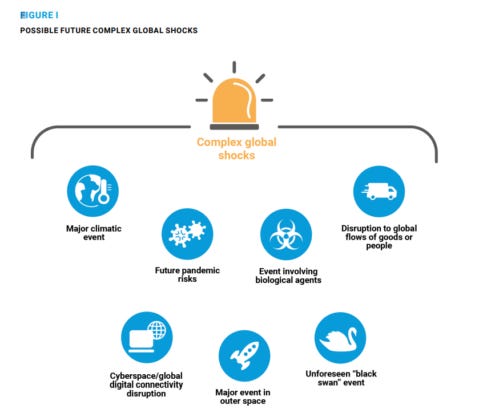
DIAGRAM: Policy Brief 2 – Strengthening the International Response to Complex Global Shocks – An Emergency Platform
UN’s Emergency Platform = One World Government backdoor
The emergency platform would be activated during any event that is deemed to have a global impact, and would provide the UN the authority to actively promote and drive an international response. Antonio Guterres, UN secretary-general, declared: “I propose that the General Assembly provide the Secretary-General and the United Nations system with a standing authority to convene and operationalize automatically an Emergency Platform in the event of a future complex global shock of sufficient scale, severity and reach.”
The policy further argues that such authority would “Ensure that all participating actors make commitments that can contribute meaningfully to the response, and that they are held to account for delivery on those commitments.” While the policy states that the emergency authority would have limited duration, it also states that the UN would be able to extend its own powers if it decides to do so. These powers would effectively render public consensus unnecessary, democracies obsolete, and the role of politicians largely irrelevant.
These all encompassing areas of expanded emergency powers relate to:
- pandemics
- wars and nuclear events
- climate or environmental events, degradation or disaster;
- accidental or deliberate release of biological agents;
- disruptions in the flow of goods, people, or finance;
- disruptions in cyberspace or “global digital connectivity;”
- a cyberattack on critical infrastructure
- a major event in “outer space;”
- “unforeseen risks (‘black swan’ events)
- technological or scientific developments gone awry – and unconstrained by effective ethical and regulatory frameworks.
At least 7 out of 10 of the above areas have already happened or are happening.
What does the UN have planned?
On September 20th 2023, the UN intends to adopt a high level political declaration on pandemics. In my analysis, the UN pathway to the one health and one world government agenda is a back up plan to the WHO’s trajectory which is increasingly exposed and resisted.
The UN is planning to host its related ‘Summit of the Future’ in September 2024. Guterres stated “The Summit of the Future is an opportunity to agree on multilateral solutions for a better tomorrow, strengthening global governance for both present and future generations.” The UN website states “The General Assembly welcomed the submission of Our Common Agenda and passed a resolution to hold the Summit on 22-23 September 2024, preceded by a ministerial meeting in 2023. An action-oriented Pact for the Future is expected to be agreed by Member States through intergovernmental negotiations on issues they decide to take forward.”
Understanding Sanctions or Unilateral Coercive Measures
Sanctions are action that is taken or an order that is given to force a country to obey international laws. There are several types of sanctions imposed through the United Nations:
- Economic sanctions – typically a ban on trade, possibly limited to certain sectors such as armaments, or with certain exceptions (such as food and medicine)
- Diplomatic sanctions – the reduction or removal of diplomatic ties, such as embassies.
- Military sanctions – military intervention
- Sport sanctions – preventing one country’s people and teams from competing in international events.
- Sanctions on the environment – since the declaration of the United Nations Conference on the Human Environment, international environmental protection efforts have been increased gradually.
- Economic sanctions are distinguished from trade sanctions, which are applied for purely economic reasons, and typically take the form of tariffs or similar measures.
It is plausible that the UN’s controllers realise that the world is pushing back against the WHO’s overreach, or find it irrelevant to real health. Given that sovereign nations will choose to exit the WHO, the UN decided to launch plan B and ascribe to itself even greater powers. Technically, there is no legislation to exit the United Nations within the UN Charter. Again, this is a critical issue of national sovereignty.
Can the WHO and the UN collaborate on sanctions?
The WHO is an agency of the United Nations.
- In 2015, on punishing member states who violate the International Health Regulations (IHR), as reported: “United Nations health officials said they want to impose sanctions on countries that do not comply with public health regulations meant to avoid the spread of dangerous epidemics, such as the Ebola outbreak that killed more than 9,000 people and ravaged domestic health care systems in West Africa last year.
- World Health Organization Director Margaret Chan said she is investigating ways to reprimand countries that disobey the IHR — a set of rules adopted in 2005 and mandate that countries set up epidemiological surveillance systems, fund local health care infrastructure and restrict international trade and travel to affected regions deemed unsafe to the public, among other provisions. Chan is on a panel set up by U.N. Secretary General Ban Ki-moon, who instructed the group to think of ways to hold countries accountable for how they manage public health crises and punish those who violate the IHR.”
- In 2022, according to commentators in a policy article: “In order to enforce compliance, some commentators have recommended concluding the treaty at the United Nations level. However, we fear that it has been already decided with the INB (mandated by WHASS) that a treaty will be developed under the roof of WHO. They added: “To move on with the treaty, WHO therefore needs to be empowered — financially, and politically. If international pandemic response is enhanced, compliance is enhanced. In case of a declared health emergency, resources need to flow to countries in which the emergency is occurring, triggering response elements such as financing and technical support.
- These are especially relevant for LMICs, and could be used to encourage and enhance the timely sharing of information by states, reassuring them that they will not be subject to arbitrary trade and travel sanctions for reporting, but instead be provided with the necessary financial and technical resources they require to effectively respond to the outbreak. High-income settings may not be motivated by financial resources in the same way as their low-income counterparts. An adaptable incentive regime is therefore needed, with sanctions such as public reprimands, economic sanctions, or denial of benefits.”
Conclusion
Given the rapidly growing distrust in the WHO, its historical failures and harms, Covid-19 failures and harms, and the fact that it cannot maintain independence because it is a largely privately funded entity; it is plausible that the WHO and/or the UN will move to impose or influence sanctions via the World Trade Organisation, ahead of Agenda 2030. This act of aggression weaponises the WHO and/or the UN against countries that influential funders and unethical stakeholders have an interest in destabilising for power and resource control.
This sinister strategy has disturbing implications for democracy, peace, and prosperity around the world. Freedom faces an existential risk through unelected bureaucratic entities. Nations can and must protect their sovereignty by defunding and exiting WHO, and, by critically assessing the true history, nature, value, and risks of continued membership in the 78 year old United Nations. Not to do so, means to ignore the risks of UN peacekeepers, known to commit crimes with impunity, being deployed in your country to enforce UN and WHO governance.
Featured Video

Iran’s Next Strike May Not Explode. It Could Shut You Down
or go to
Aletho News Archives – Video-Images
From the Archive
Zionism’s Violent Legacy
By Donald Neff | Washington Report On Middle East Affairs | January 1996
On January 4, 1948, Jewish terrorists drove a truck loaded with explosives into the center of the all Arab city of Jaffa and detonated it, killing 26 and wounding around 100 Palestinian men, women and children.[1] The attack was the work of the Irgun Zvai Leumi – the “National Military Organization,” also known by the Hebrew letters Etzel – the largest Jewish terrorist group in Palestine. The Irgun was headed by Revisionist Zionist Menachem Begin and had been killing and maiming Arabs, Britons and even Jews for the previous ten years in its efforts to establish a Jewish state.
This terror campaign meant that at the core of Revisionist Zionism there existed a philosophical embrace of violence. … continue
Blog Roll
 Aletho News
- Trump’s Iran war is on an Israeli leash
- Saudi oil boss issues global supply warning
- Riyadh Says Its Oil System Is Intact. The Numbers Say Otherwise.
- Trump and Netanyahu Want to “Finish the Job” on Iran
- US ‘one-sided dictation’ not Iran’s beliefs makes rational talks impossible: Baghaei
- Iran’s Next Strike May Not Explode. It Could Shut You Down /Col Doug Macgregor
- Iran: US political targets legitimate if assassinations return
- Iraq shuts key border crossing with Iran under US pressure: Report
- Undersea Internet cables could be targeted in retaliation for attacks on Iran: IRGC deputy chief
- EU sending ‘biased’ observers to interfere in Serbian election – president
- If Americans Knew
- The Israel Lobby’s Changing Fortunes
- AIPAC has become such a political liability that it’s shifting to a more “nimble” approach to buying politicians
- At least 160 Israeli settler attacks in 2 weeks
- Will Gaza’s Ancient Christian Community Disappear Forever?
- Israel’s vision of regional security rests on keeping Arab states weak
- Heidi Levine recounts how Palestinian youths helped save her in settler attack
- DAILY UPDATE: Latest essential news on Palestine, Israel, & region
- Trump’s Intensifying Sabotage of the ICC, for Israel’s Sake
- Israeli military detain US and UK volunteers in West Bank including Democratic NY politician Brad Lander
- Americans at National Conservatism Conference held in Israel this year criticize Israel
- No Tricks Zone
- E-Cars Reduce CO2 Emissions By Only 41% Compared To Internal Combustion Engine Vehicles
- Predictions Made By Renowned Climate Professor Over Past Decades Have Been Proven To Be Poor
- New Study Suggests Large Regions Of The Pacific Ocean Have Been Cooling For The Last 80 Years
- Germany’s Green Energy Debacle: High Energy Costs Force Kahla Porzellan to Close After 182 Years!
- New Study: 50 Years Of The Most Aggressive ‘Net Zero’ Policies Can Only Affect The Global Climate By 0.03°C
- US September “Heat” Was No Record…Many Records Set Decades Ago
- Latest European Green Energy Debacle; Portugal’s Largest Flagship Solar Park Insolvent!
- Green Energy Debacle: German Expert Professor Fritz Vahrenholt Warns Of Severe Economic And Social Consequences
- Two More Paleo Reconstructions Affirm Meters-Higher Sea Levels Across Ireland, Brazil 7000-6000 Years Ago
- New Study: Earth And Venus Surface Warmth Largely Explained By Convection And Lapse Rate, Not CO2 Or Radiation

