SITREP: Venezuelan Bay of Pig’s while the planet is under lockdown
By Ana | The Saker Blog | May 5, 2020
In the early morning of the 3rd of May 2020, an illegal foreign invasion was intended and aborted in the Caribbean small town named Chuao, in the Aragua State in Venezuela. According to the available information, the invasion was successfully contended by the Venezuelan Militias together with the armed forces in a joint operative.
At the moment, there is not a lot of information available, but it is clear that two US citizens and the son of a high ranked ex-officer of the Venezuelan Army were captured together with six more mercenaries, as informed by TeleSur.
This failed new attempt to topple the government of Nicolas Maduro is apparently linked to the operation which failed on Sunday May 3rd, executed on the coast near Caracas, Macuto which ended with a green beret imprisoned by government agents.
Guaido’s fingerprints are all over the place and were sanctioned by the confession of Silvercorp Jordan Goudreau testifying the existence of a contract between himself and Guaido. As if this confession was not enough, we also have his plea for respect for human rights of Silvercorps mercenaries involved.
Meanwhile in Imperial mainland, many more were made aware of the operations leaving as well all sorts of fingerprints, not difficult to elucidate even for starved and untrained imperial vassals. We have a trace of tweets that preceded the apparently very secret operations of the Silvercorp commands.
1. – Silvercorp itself tweets to The Donald about readiness and high efficiency of the, at that time, still future operation.

2.- Marianella Salazar, former Venezuelan journalist exiled in Miami tweets as well the night before the events.
As well a video showing Goudreau and Nieto, was aired some hours before the attempted invasion:
https://www. facebook.com/MisionVerdadEnVzla/videos/1888201781313396/
Also involved and captured is Josnars Adolfo Baduel, son of General Baduel who was a former close collaborator of Hugo Chavez who later turned on him and joined the coup attempt of April 2002.
While all events keep unfolding and more information is breaking through, we have a modern time Pontius Pilates washing his hands.
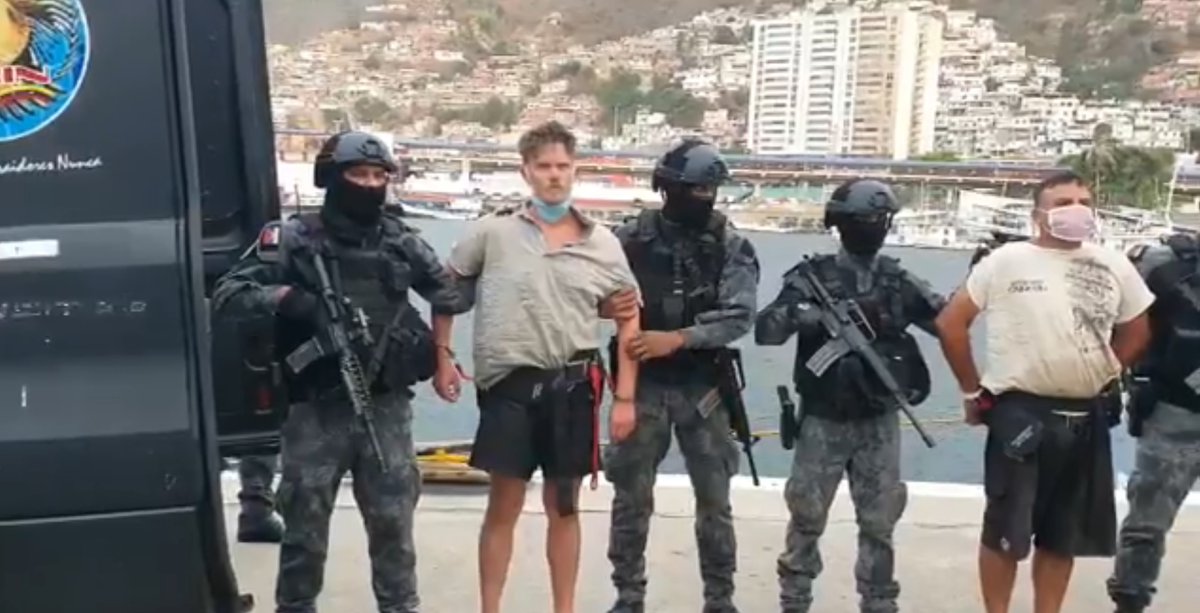
Here are some photos of the folks who wanted to invade Venezuela:
Seems like this guy was close to Trump, at least on one photo, maybe a bodyguard or security?

This is a mercenary from the Silvercorp PMC.

Here the caption says “expectations” and “reality”:

Here is another one of those “invincible” Hollywood special operators:

and here is what they look like in reality:

they sure don’t look as cocky now:
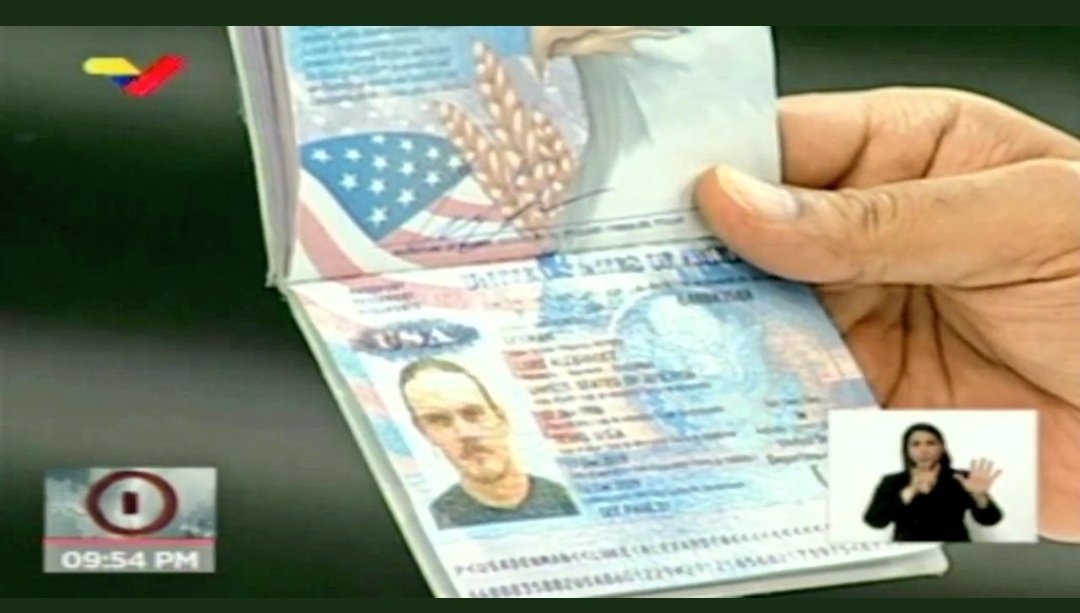
proof of nationality? Sure, these “experts” took their passports with them (!!)


Beware the Pentagon’s Pandemic Profiteers
Hasn’t the Military-Industrial Complex Taken Enough of Our Money?
By Mandy Smithberger | TomDispatch | May 3, 2020
At this moment of unprecedented crisis, you might think that those not overcome by the economic and mortal consequences of the coronavirus would be asking, “What can we do to help?” A few companies have indeed pivoted to making masks and ventilators for an overwhelmed medical establishment. Unfortunately, when it comes to the top officials of the Pentagon and the CEOs running a large part of the arms industry, examples abound of them asking what they can do to help themselves.
It’s important to grasp just how staggeringly well the defense industry has done in these last nearly 19 years since 9/11. Its companies (filled with ex-military and defense officials) have received trillions of dollars in government contracts, which they’ve largely used to feather their own nests. Data compiled by the New York Times showed that the chief executive officers of the top five military-industrial contractors received nearly $90 million in compensation in 2017. An investigation that same year by the Providence Journal discovered that, from 2005 to the first half of 2017, the top five defense contractors spent more than $114 billion repurchasing their own company stocks and so boosting their value at the expense of new investment.
To put this in perspective in the midst of a pandemic, the co-directors of the Costs of War Project at Brown University recently pointed out that allocations for the Food and Drug Administration, the Centers for Disease Control and Prevention, and the National Institutes of Health for 2020 amounted to less than 1% of what the U.S. government has spent on the wars in Iraq and Afghanistan alone since 9/11. While just about every imaginable government agency and industry has been impacted by the still-spreading coronavirus, the role of the defense industry and the military in responding to it has, in truth, been limited indeed. The highly publicized use of military hospital ships in New York City and Los Angeles, for example, not only had relatively little impact on the crises in those cities but came to serve as a symbol of just how dysfunctional the military response has truly been.
Bailing Out the Military-Industrial Complex in the Covid-19 Moment
Demands to use the Defense Production Act to direct firms to produce equipment needed to combat Covid-19 have sputtered, provoking strong resistance from industries worried first and foremost about their own profits. Even conservative Washington Post columnist Max Boot, a longtime supporter of increased Pentagon spending, has recently recanted, noting how just such budget priorities have weakened the ability of the United States to keep Americans safe from the virus. “It never made any sense, as Trump’s 2021 budget had initially proposed, to increase spending on nuclear weapons by $7 billion while cutting Centers for Disease Control and Prevention funding by $1.2 billion,” he wrote. “Or to create an unnecessary Space Force out of the U.S. Air Force while eliminating the vitally important directorate of global health by folding it into another office within the National Security Council.”
In fact, continuing to prioritize the U.S. military will only further weaken the country’s public health system. As a start, simply to call up doctors and nurses in the military reserves, as even Secretary of Defense Mark Esper has pointed out, would hurt the broader civilian response to the pandemic. After all, in their civilian lives many of them now work at domestic hospitals and medical centers deluged by Covid-19 patients.
The present situation, however, hasn’t stopped military-industrial complex requests for bailouts. The National Defense Industrial Association, a trade group for the arms industry, typically asked the Pentagon to speed up contracts and awards for $160 billion in unobligated Department of Defense funds to its companies, which will involve pushing money out the door without even the most modest level of due diligence.
Already under fire in the pre-pandemic moment for grotesque safety problems with its commercial jets, Boeing, the Pentagon’s second biggest contractor, received $26.3 billion last year. Now, that company has asked for $60 billion in government support. And you undoubtedly won’t be surprised to learn that Congress has already provided Boeing with some of that desired money in its recent bailout legislation. According to the Washington Post, $17 billion was carved out in that deal for companies “critical to maintaining national security” (with Boeing in particular in mind). When, however, it became clear that those funds wouldn’t arrive as a complete blank check, the company started to have second thoughts. Now, some members of Congress are practically begging it to take the money.
And Boeing was far from alone. Even as the spreading coronavirus was spurring congressional conversations about what would become a $2 trillion relief package, 130 members of the House were already pleading for funds to purchase an additional 98 Lockheed Martin F-35 jet fighters, the most expensive weapons system in history, at the cost of another half-billion dollars, or the price of more than 90,000 ventilators.
Similarly, it should have been absurdly obvious that this wasn’t the moment to boost already astronomical spending on nuclear weapons. Yet this year’s defense budget request for such weaponry was 20% higher than last year’s and 50% above funding levels when President Trump took office. The agency that builds nuclear weapons already had $8 billion left unspent from past years and the head of the National Nuclear Security Agency, responsible for the development of nuclear warheads, admitted to Representative Susan Davis (D-CA) that the agency was unlikely even to be able to spend all of the new increase.
Boosters of such weapons, however, remain undeterred by the Covid-19 pandemic. If anything, the crisis only seems to have provided a further excuse to accelerate the awarding of an estimated $85 billion to Northrop Grumman to build a new generation of intercontinental ballistic missiles (ICBMs), considered the “broken leg” of America’s nuclear triad. As William Hartung, the director of the Arms and Security Project at the Center for International Policy, has pointed out, such ICBMs “are redundant because invulnerable submarine-launched ballistic missiles are sufficient for deterring other countries from attacking the United States. They are dangerous because they operate on hair-trigger alert, with launch decisions needing to be made in some cases within minutes. This increases the risk of an accidental nuclear war.”
And as children’s book author Dr. Seuss might have added, “But that is not all! Oh, no, that is not all.” In fact, defense giant Raytheon is also getting its piece of the pie in the Covid-19 moment for a $20-$30 billion Long Range Standoff Weapon, a similarly redundant nuclear-armed missile. It tells you everything you need to know about funding priorities now that the company is, in fact, getting that money two years ahead of schedule.
In the midst of the spreading pandemic, the U.S. military’s Indo-Pacific Command similarly saw an opportunity to use fear-mongering about China, a country officially in its area of responsibility, to gain additional funding. And so it is seeking $20 billion that previously hadn’t gained approval even from the secretary of defense in the administration’s fiscal year 2021 budget proposal. That money would go to dubious missile defense systems and a similarly dubious “Pacific Deterrence Initiative.”
How Not to Deal With Covid-19
Along with those military-industrial bailouts came the fleecing of American taxpayers. While many Americans were anxiously awaiting their $1,200 payments from that congressional aid and relief package, the Department of Defense was expediting contract payments to the arms industry. Shay Assad, a former senior Pentagon official, accurately called it a “taxpayer rip-off” that industries with so many resources, not to speak of the ability to borrow money at incredibly low interest rates, were being so richly and quickly rewarded in tough times. Giving defense giants such funding at this moment was like giving a housing contractor 90% of upfront costs for renovations when it was unclear whether you could even afford your next mortgage payment.
Right now, the defense industry is having similar success in persuading the Pentagon that basic accountability should be tossed out the window. Even in normal times, it’s a reasonably rare event for the federal government to withhold money from a giant weapons maker unless its performance is truly egregious. Boeing, however, continues to fit that bill perfectly with its endless program to build the KC-46 Pegasus tanker, basically a “flying gas station” meant to refuel other planes in mid-air.
As national security analyst Mark Thompson, my colleague at the Project on Government Oversight (POGO), has pointed out, even after years of development, that tanker has little hope of performing its mission in the near future. The seven cameras that its pilot relies on to guide the KC-46’s fuel to other planes have so much glare and so many shadows that the possibility of disastrously scraping the stealth coating off F-22s and F-35s (both manufactured by Lockheed Martin) while refueling remains a constant danger. The Air Force has also become increasingly concerned that the tanker itself leaks fuel. In the pre-pandemic moment, such problems and associated ones led that service to decide to withhold $882 million from Boeing. Now, however, in response to the Covid-19 crisis, those funds are, believe it or not, being released.
Keep all of this behavior (and more) in mind when you hear people suggest that, in this public health emergency, the military should be put in charge. After all, you’re talking about the very institution that has regularly mismanaged massive weapons programs like the $1.4 trillion F-35 jet fighter program, already the most expensive weapons system ever (with ongoing problems galore). Even when it comes to health care, the military has proved remarkably inept. For instance, attempts of the Department of Veterans Affairs and the Department of Defense to integrate their health records were, infamously enough, abandoned after four years and $1 billion spent.
Having someone in uniform at the podium is, unfortunately, no guarantee of success. Indeed, a number of veterans have been quick to rebuke the idea of forefronting the military at this time. “Don’t put the military in charge of anything that doesn’t involve blowing stuff up, preventing stuff from being blown up, or showing up at a place as a message to others that we’ll be there to blow stuff up with you if need be,” one wrote.
“Here’s a video from Camp Pendleton of unmasked Marines queued up for haircuts during the pandemic,” tweeted another. “So how about ‘no’?” That video of troops without masks or practicing social distancing even shocked Secretary of Defense Esper, who called for a military haircut halt, only to be contradicted by the chairman of the Joint Chiefs of Staff, desperate to maintain regulation cuts in the pandemic moment. That inspired a mocking rebuke of “haircut heroes” on Twitter.
Unfortunately, as Covid-19 spread on the aircraft carrier the USS Theodore Roosevelt, that ship became emblematic of how ill-prepared the current Pentagon leadership proved to be in combatting the virus. Despite at least 100 cases being reported on board — 955 crewmembers would, in the end, test positive for the disease and Chief Petty Officer Charles Robert Thacker Jr. would die of it — senior Navy leaders were slow to respond. Instead, they kept those sailors at close quarters and in an untenable situation of increasing risk. When an emailed letter expressing the concerns of the ship’s commander, Captain Brett Crozier, was leaked to the press he was quickly removed from command. But while his bosses may not have appreciated his efforts for his crew, his sailors did. He left the ship to a hero’s farewell.
All of this is not to say that some parts of the U.S. military haven’t tried to step up as Covid-19 spreads. The Pentagon has, for instance, awarded contracts to build “alternate care” facilities to help relieve pressure on hospitals. The Uniformed Services University of the Health Sciences is allowing its doctors and nurses to join the military early. Several months into this crisis, the Pentagon has finally used the Defense Production Act to launch a process to produce $133 million worth of crucial N95 respirator masks and $415 million worth of N95 critical-care decontamination units. But these are modest acts in the midst of a pandemic and at a moment when bailouts, fraud, and delays suggest that the military-industrial complex hasn’t proved capable of delivering effectively, even for its own troops.
Meanwhile, the Beltway bandits that make up that complex have spotted a remarkable opportunity to secure many of their hopes and dreams. Their success in putting their desires and their profits ahead of the true national security of Americans was already clear enough in the staggering pre-pandemic $1.2 trillion national security budget. (Meanwhile, of course, key federal medical structures were underfunded or disbanded in the Trump administration years, undermining the actual security of the country.) That kind of disproportionate spending helps explain why the richest nation on the planet has proven so incapable of providing even the necessary personal protective equipment for frontline healthcare workers, no less the testing needed to make this country safer.
The defense industry has asked for, and received, a lot in this time of soaring cases of disease and death. While there is undoubtedly a role for the giant weapons makers and for the Pentagon to play in this crisis, they have shown themselves to be anything but effective lead institutions in the response to this moment. It’s time for the military-industrial complex to truly pay back an American public that has been beyond generous to it.
Isn’t it finally time as well to reduce the “defense” budget and put more of our resources into the real national security crisis at hand?
Mandy Smithberger, a TomDispatch regular, is the director of the Center for Defense Information at the Project On Government Oversight (POGO).
Copyright 2020 Mandy Smithberger
Iraq mounts counter-terrorism operations amid warnings of US-Daesh plot to split region
Press TV – May 5, 2020
Iraqi army troops and allied fighters from Popular Mobilization Forces — known as Hashd al-Sha’abi — have conducted fresh operations against Daesh militants amid warnings of collaboration between the United States and remnants of the Takfiri terror outfit in the country.
On Monday, Iraq’s Security Media Cell announced the launch of a new military campaign, dubbed ‘Desert Lions,’ against Daesh sleeper cells in the country’s desert areas.
The operation covers “Wadi Houran, Husayniyyat, Al-Kara, H2, and Wadi al-Hallcom, all the way to international borders” in Iraq’s western Anbar Province with an aim to “enhance security and stability in these areas, to pursue terrorist elements and to arrest those wanted,” it said in a statement.
The new campaign followed a string of deadly attacks by Daesh terrorists targeting Iraqi forces, among them Saturday’s assault in Salahuddin Province that killed at least 10 Hashd al-Sha’abi fighters.
On Monday, the Iraqi Army’s intelligence detained a Daesh ringleader, called Abu Hajar, in Nineveh Province.
It came one day after the arrest of another Daesh element, Abu Abdulmalik, in Nineveh’s provincial capital of Mosul, which once served as the terror group’s main bastion in the Arab country.
Also on Monday, Rudaw media network reported that an explosive-laden vehicle had gone off in Madham area in western Anbar, killing the occupants — all terrorists.
Among those slain were Daesh military commander Abu Ghasurah, the report said.
Concerns rise about Daesh-US collaboration
Meanwhile, Mahmoud al-Rubaye, spokesman of Iraq’s Asaib Ahl al-Haq group, which is part of the Hashd al-Sha’abi, said that the US has long been supporting terrorists in Iraq and Syria and that Daesh is part of Washington’s scheme to disintegrate the region.
The US, he added, plans to settle Palestinians in western Anbar under President Donald Trump’s self-proclaimed “deal of the century.”
Rubaye also emphasized that the Americans should honor the Iraqi parliament’s resolution on the withdrawal of foreign forces from the country. The resolution was passed in January following the US assassination of top Iranian anti-terror commander Lieutenant General Qassem Soleimani and senior Hashd commander Abu Mahdi al-Muhandis, in addition to several other comrades.
The US is evacuating its bases in Iraq and amassing its troops at Ain al-Assad and Harir bases, situated in Anbar and Kurdistan’s regional capital of Erbil, respectively, in the face of the outrage of the Iraqi people and popular forces, he pointed out.
Asaib spokesman further warned of armed resistance if the US refuses to leave Iraq and settles in the country’s remote areas.
Additionally, Iraq’s Harakat Hezbollah al-Nujaba, which is also part of Hashd al-Sha’abi, said the US has been planning to transfer senior Daesh commanders from eastern Syria to neighboring Iraq.
“Washington is insisting on the implementation of a plot to return the terrorists to Iraq by transferring a large number of ISIS (Daesh) commanders and militants from the eastern Euphrates and other parts of Syria,” it said in an online statement.
The group also described the Americans as “occupiers,” noting, “We stress that the Islamic Resistance of Iraq is monitoring all your destructive plots to prevent the dangers which threaten the Iraqi provinces.”
Daesh began a terror campaign in Iraq in 2014, overrunning vast swathes in lightning attacks.
Hashd al-Sha’abi fighters played a major role in reinforcing the Iraqi army, which had suffered heavy setbacks against the Takfiri elements.
Iraq declared victory over Daesh in December 2017 after a three-year counter-terrorism military campaign, which also had the support of neighboring Iran.
Israel’s War Crimes Have Killed Americans
If the president loves to honor the military, start with the U.S.S. Liberty

By Philip Giraldi • Unz Review • May 5, 2020
Imagine if you will a ship from a nation not at war with anyone sailing in international waters on a quiet June day being suddenly attacked by unidentified warplanes and torpedo boats, their markings covered up to conceal their country of origin. The vessel under attack had little with which to defend itself, but its crew heroically made sure that a large national flag was hoisted to demonstrate that it was not a belligerent in anyone’s conflict. The attackers noted the nationality of the vessel, but persisted in their aggression in a clear attempt to sink the ship and kill all its crew. The officers on the ship radioed that they were under attack and asked for help, but even though friendly fighter aircraft were within striking distance and were automatically dispatched, they were then mysteriously recalled. The attacks lasted for two hours, longer than the Pearl Harbor attack that brought about American entry into World War 2, killing and wounding more than two hundred of the crew. Life rafts lowered into the water as the vessel seemed to be sinking were machine gunned by the attacking aircraft and torpedo boats to make escape or evacuation of the wounded impossible but the captain and survivors worked heroically, and successfully, to keep the ship afloat. When the vessel finally made it back to port, the officers and crew were sworn to silence by their own government and a cover-up was initiated that has persisted to this day. Many of the ship’s survivors have died since that day 53 years ago, and the attempts of the remainder to see justice before they are also gone have been ignored.
I am, of course, referring to the Israeli attack on the U.S.S. Liberty, which took place on June 8, 1967, nearly 53 years ago. The anniversary of the attack is coming up in a month and the remaining officers and crew will hold a ceremony at the Navy memorial in Washington D.C. to honor the memory of their thirty-four shipmates killed and the 172 who were wounded. Seventy per cent of the crew were casualties, the highest percentage of casualties on any ship that remained afloat in the history of the U.S. Navy. The lightly armed intelligence gathering vessel Liberty and its heroic crew emerged from the near destruction as the most decorated ship for valor in a single action in the United States Navy.
Israeli willingness to attack and kill Americans unnecessarily, apparently to send a message, has been noted before. There is the case of Rachel Corrie run over by an Israeli bulldozer and of Furkan Dogan, a Turkish-American who was, like the crew of the Liberty, killed in international waters when he sailed on the Gaza relief vessel Mavi Marmara. But in spite of that, the deliberate attempt to destroy the Liberty, which, according to former U.S. Secretary of State Dean Rusk, was clearly approved at the highest level of the Jewish state’s government, still has shock value.
Israel’s apologists, a virtual fixture at all levels in the U.S. government as well as in academia and the media, have long been making the argument that the attack on the Liberty was some kind of “friendly fire” accident. But the relatively recent discovery that a Navy spy plane intercepted and recorded Israeli both helicopter and fighter pilots mentioning the American flag displayed by the ship during the attack suggests otherwise. Other recordings made of the Israeli communications revealed that some of the pilots did not want to attack. One pilot said, “This is an American ship. I can see the flag. Do you still want us to attack?” Israeli ground control responded, “Yes, follow orders. Hit it!” before admonishing the pilots to “finish the job.”
But while one expects the Israelis to behave abominably, based on any assessment of the years of war crimes committed in places like Lebanon and what remains of Palestine, the greatest crime against the Liberty crew was committed by the United States government itself. President Lyndon B. Johnson (LBJ) and Secretary of Defense Robert McNamara reportedly were informed of the attack shortly after it began and it was Johnson who twice personally ordered the recall of the U.S. fighter planes going to rescue the Liberty. Admiral Lawrence Geis, commander of the carrier group in the Mediterranean that the planes had launched from, objected and McNamara responded testily that “President Johnson is not going to go to war or embarrass an American ally over a few sailors.” It was McNamara, again acting on LBJ’s orders, who had the crew sequestered after the ship made it to Malta, issuing a “gag-order” over the incident with the understanding that anyone who spoke up would be secretly court martialed and imprisoned.
To maintain the cover-up, Captain William McGonagle, who was awarded the Congressional Medal of Honor for his role in saving the ship, had his medal awarded without any publicity in a private ceremony at the Washington Naval Yard rather than at the White House as was otherwise normal. The President of the United States did not make the award, yet another dismissal of the valor of the Liberty crew.
Normally an attack on a U.S. Navy vessel would have mandated an official Court of Inquiry, but in the case of the Liberty an improvised team consisting of Admiral Isaac Kidd and Chief Counsel Ward Boston was pulled together in the Mediterranean under orders from Admiral John S. McCain, father of Senator John McCain, who was based in London. The Navy’s official ‘Court of Inquiry’ therefore consisted in reality of just Kidd and Boston making a quick visit to the Liberty at sea and then rushing back to Washington via London, where McCain endorsed the 700 page draft document without reading it. The hastily prepared report bypassed all ordinary fact-finding and legal review procedures and no one knows what channels the ‘Findings of the Court of Inquiry’ followed in Washington.
Acting under orders from the White House, the inquiry had been given only a week to prepare its report, a procedure that normally requires six months. The result was also predetermined by McNamara acting for LBJ, who ordered that the conclusion would be that the attack on the Liberty had been a “case of mistaken identity.”
No crewmen from the Liberty were even allowed to provide formal testimony during the inquiry proceedings. Nevertheless, the inquiry’s chief counsel Ward Boston subsequently confirmed in a sworn affidavit that he and Kidd had strongly disagreed with the coerced findings, believing instead that Israel had staged an unprovoked attack intending to sink the ship and kill all the crew. Admiral Kidd referred to the Israelis as “murderous bastards.” Boston also observed that the transcript of the court of inquiry that was subsequently released had been altered, presumably by someone acting on behalf of the White House, to delete and change testimony damaging to Israel.
As is often the case, there is a back story to what happened to the Liberty. In the years prior to the attack on the Liberty, President John F. Kennedy was concerned over powerful and wealthy American Jews attempting to hijack U.S. foreign policy to favor Israel. He also took steps to prevent Israeli development of nuclear weapons. After he was assassinated, his successor as president Lyndon B. Johnson, who has been described as having a political career “interwoven with Jews,” saw things quite differently. He turned a blind eye over the Israeli nuclear program and surrounded himself with Jewish friends and advisors who were actively engaged in promoting the Zionist agenda, some of them plausibly as actual agents of Mossad.
Most prominent among that group were the Krims, Arthur and Mathilde, he a leading media lawyer and studio head who was a Democratic Party fundraiser and she a geneticist, a Swiss born convert to Judaism who had lived in British Mandate Palestine with her first husband, an Irgun terrorist. Jewish terror was a cause which she actively supported. The Krims were regular companions of LBJ throughout his presidency, with a reserved room in the White House and a house near his ranch in Stonewall Texas when he was on vacation there. Johnson also stayed at their mansion in New York.
At the time of the Six Day War when the Liberty was attacked, the Krims were constantly at the side of LBJ and it is generally accepted that they were both working on behalf of the Israeli government to cultivate a decisive presidential tilt towards Israel. Johnson, in fact, was informed of the Israeli intention to go to war against its neighbors in advance and gave the green light, even agreeing to come to the aid of the Jewish state if things went wrong. To seal the deal, Mathilde was even having an affair with LBJ, a situation well known to White House staff and to the Secret Service.
Since 1967, there have been a number of documentaries, books and unofficial inquiries regarding the attack on the Liberty, but resistance from the usual suspects has meant that the story has not become better known. Meanwhile Congress, the Pentagon and the White House have refused to authorize fair and impartial formal hearings that would recognize the deficiencies in the 1967 inquiry and which would include testimony from the remaining Liberty survivors. Senator John McCain was notorious for his offhand treatment of entreaties from the survivors as was then congressman and now governor Ron DeSantis of Florida, a former Navy Seal. DeSantis now calls himself the most pro-Israel governor in the United States.
The most serious unofficial inquiries have involved former military officers. In 2003, Admiral Thomas Moorer, former Chairman of the Joint Chiefs of Staff, formed an independent commission of inquiry to look into the attack. It produced Loss of Liberty, a documentary that included actual interviews with survivors. The commission, which included Rear Admiral Merlin Staring, Marine General Ray Davis, and Ambassador James Akins, reviewed all documentary evidence in the case and interviewed both survivors and other naval officers who were involved indirectly. They learned that the Liberty had been surveilled by the Israelis for at least eight hours prior to the attack and that the ship was both clearly marked as American and was unmistakable as a uniquely configured and immediately recognizable intelligence collection vessel, not even close to the profile of an Egyptian horse transporter as Israel subsequently claimed. During the carefully planned attack, Israeli used radio jamming in an attempt to prevent the Liberty from radioing its predicament.
Moorer’s commission concluded that Israel had deliberately attacked the Liberty and sought to sink it and kill its entire crew. The crewmen who were killed were “murdered” by Israel while the U.S. should have regarded the attack as an act of war and responded appropriately. The cover-up of what had taken place was ordered by the White House and the fact that the truth about the incident continues to be hidden is a “national disgrace.” In an op-ed Moorer wrote in 2004, he concluded by asking “Did our government put Israel’s interest ahead of our own? If so, why?”
In October 2003 the Moorer commission presented its report on Capitol Hill, though its audience was often limited to congressional staffers rather than the understandably fearful members. One year later Representative John Conyers of Michigan overcame considerable resistance to have the report and some accompanying information entered into the Congressional Record. Moorer and Admiral Staring, a former Judge Advocate General of the Navy, who had been the legal officer in the McCain office in London who had not been allowed to carefully review the Court of Inquiry report, continued to advocate for an honest investigation of the attack on the Liberty until they died in 2004 and 2013 respectively.
Which leads us to the present and the question of justice for the U.S.S. Liberty survivors who will be gathering next month. The tale of the Liberty demonstrates that even fifty-three years ago the United States government was betraying its own people out of deference to Jewish power and to the state of Israel. If anything, as horrific as the killing of 34 personnel on board of the Liberty was, the situation has gotten even worse as Washington sends billions of dollars to the Jewish state annually while also giving its kleptocratic government a green light to commit war crimes and other aggressions that will ultimately draw in the United States, and could plausibly bring about our ruination. It is unpleasant to say the least to watch an unrestrained and unprincipled client state do terrible damage to a much larger patron enabled by the machinations of a dual-loyalty fifth column, but that is what we are seeing.
And the actual rot really began with the attack on the U.S.S. Liberty, when patriotic Americans died at the whim of a feckless president who loved a foreign country more than his own. One hopes he is rotting in hell. Today few Americans even know about the Liberty even though they are now facing an election in which two presidential candidates will seek to outdo each other in expressing their love for Israel. Trump and Biden should instead take pause and first demand as a sine qua non justice for the survivors of the U.S.S. Liberty.
Philip M. Giraldi, Ph.D., is Executive Director of the Council for the National Interest, a 501(c)3 tax deductible educational foundation (Federal ID Number #52-1739023) that seeks a more interests-based U.S. foreign policy in the Middle East. Website is councilforthenationalinterest.org, address is P.O. Box 2157, Purcellville VA 20134 and its email is inform@cnionline.org.
Coronavirus Gives a Dangerous Boost to DARPA’s Darkest Agenda
By Whitney Webb | The Last American Vagabond | May 4, 2020
In January, well before the coronavirus (Covid-19) crisis would result in lockdowns, quarantines and economic devastation in the United States and beyond, the U.S. intelligence community and the Pentagon were working with the National Security Council to create still-classified plans to respond to an imminent pandemic. It has since been alleged that the intelligence and military intelligence communities knew about a likely pandemic in the United States as early as last November, and potentially even before then.
Given this foreknowledge and the numerous simulations conducted in the United States last year regarding global viral pandemic outbreaks, at least six of varying scope and size, it has often been asked – Why did the government not act or prepare if an imminent global pandemic and the shortcomings of any response to such an event were known? Though the answer to this question has frequently been written off as mere “incompetence” in mainstream media circles, it is worth entertaining the possibility that a crisis was allowed to unfold.
Why would the intelligence community or another faction of the U.S. government knowingly allow a crisis such as this to occur? The answer is clear if one looks at history, as times of crisis have often been used by the U.S. government to implement policies that would normally be rejected by the American public, ranging from censorship of the press to mass surveillance networks. Though the government response to the September 11 attacks, like the Patriot Act, may be the most accessible example to many Americans, U.S. government efforts to limit the flow of “dangerous” journalism and surveil the population go back to as early as the First World War. Many of these policies, whether the Patriot Act after 9/11 or WWI-era civilian “spy” networks, did little if anything to protect the homeland, but instead led to increased surveillance and control that persisted long after the crisis that spurred them had ended.
Using this history as a lens, it is possible to look at the current coronavirus crisis to see how the long-standing agendas of ever-expanding mass surveillance and media censorship are again getting a dramatic boost thanks to the chaos unleashed by the coronavirus pandemic. Yet, this crisis is unique because it also has given a boost to a newer yet complimentary agenda that — if fulfilled – would render most, if not all, other government efforts at controlling and subduing their populations obsolete.
DARPA Dystopia
For years, the Pentagon’s Defense Advanced Research Projects Agency (DARPA) has remained largely out of sight and out of mind for most Americans, as their research projects are rarely covered by the mainstream media and, when they are, their projects are often praised as “bringing science fiction movies to life.” However, there have been recent events that have marred DARPA’s often positive portrayal by media outlets, which paint the agency as a beacon of scientific “progress” that has “changed the world” for the better.
For instance, in 2018, a group of European scientists accused the DARPA’s “Insect Allies” program of actually being a dystopian bioweapons program that would see insects introduce genetically modified viruses into plants to attack and devastate a targeted nation’s food supply. DARPA, of course, maintained that its intent to use these insects to genetically modify plants was instead about “protecting” the food supply. Regardless of DARPA’s assertions that it is merely a “defensive” program, it should be clear to readers that such a technology could easily be used either way, depending on the wielder.
Though DARPA’s futuristic weapons of war often get the most attention from media, the agency has long standing interests in tinkering with, not just the biology of plants, but of humans. DARPA, which is funded to the tune of approximately $3 billion a year, has various avenues through which it pursues these ambitions, with many of those now under the purview of the agency’s “Biological Technologies Office” (BTO), created in 2014. As of late, some of DARPA’s human biology and biotech projects at its BTO have been getting a massive PR boost thanks to the current coronavirus crisis, with recent reports even claiming that the agency “might have created the best hopes for stopping Covid-19.”
Most of these technologies garnering positive media coverage thanks to Covid-19 were developed several years ago. They include the DARPA-funded platforms used to produce DNA and RNA vaccines, classes of vaccine that have never been approved for human use in the U.S. and involve injecting foreign genetic material into the human body. Notably, it is this very class of vaccine, now being produced by DARPA-partnered companies, that billionaire and global health “philanthropist” Bill Gates recently asserted has him “most excited” relative to other Covid-19 vaccine candidates. Yet, key aspects regarding these vaccines and other DARPA “healthcare” initiatives have been left out of these recent positive reports, likely because they provide a window into what is arguably the agency’s darkest agenda.
“In Vivo Nanoplatforms”

In 2006, DARPA announced its Predicting Health and Disease (PHD) program, which sought to determine “whether an individual will develop an infectious disease prior to the onset of symptoms.” The PHD program planned to accomplish this by “identifying changes in the baseline state of human health through frequent surveillance” with a specific focus on “viral, upper respiratory pathogens.”
Three years later, in 2010, DARPA-funded researchers at Duke University created the foundation for this tool, which would use the genetic analysis of blood samples to determine if someone is infected with a virus before they show symptoms. Reports at the time claimed that these “preemptive diagnoses” would be transmitted to “a national, web-based influenza map” available via smartphone.
Following the creation of DARPA’s BTO in 2014, this particular program gave rise to the “In Vivo Nanoplatforms (IVN)” program. The diagnostics branch of that program, abbreviated as IVN:Dx, “investigates technologies that incorporate implantable nanoplatforms composed of bio-compatible, nontoxic materials; in vivo sensing of small and large molecules of biological interest; multiplexed detection of analytes at clinically relevant concentrations; and external interrogation of the nanoplatforms without using implanted electronics for communication.” Past reports on the program describe it as developing “classes of nanoparticles to sense and treat illness, disease, and infection on the inside. The tech involves implantable nanoparticles which sense specific molecules of biological interest.”
DARPA’s IVN program has since helped to finance and produce “soft, flexible hydrogels that are injected just beneath the skin to perform [health] monitoring and that sync to a smartphone app to give the use immediate health insights,” a product currently marketed and created by the DARPA-funded and National Institutes of Health (NIH)-funded company Profusa. Profusa, which has received millions upon millions from DARPA in recent years, asserts that the information generated by their injectable biosensor would be “securely shared” and accessible to “individuals, physicians and public health practitioners.” However, the current push for a national “contact tracing” system based on citizens’ private health data is likely to expand that data sharing, conveniently fitting with DARPA’s years-old goal of creating a national, web-based database of preemptive diagnoses.
Profusa is also backed by Google, which is intimately involved in these new mass surveillance “contact tracing” initiatives, and counts former Senate majority leader William Frist among its board members. They are also partnered with the National Institutes of Health (NIH). The company also has considerable overlap with the diagnostic company Cepheid, which recently won FDA approval for its rapid coronavirus test and was previously awarded lucrative government contracts to detect anthrax in the U.S. postal system. As of this past March, Profusa again won DARPA funding to determine if their injectable biosensors can predict future pandemics, including the now widely predicted “second wave” of Covid-19, and detect those infected up to three weeks before they would otherwise show symptoms. The company expects to have its biosensors FDA licensed for this purpose by early next year, about the same time a coronavirus vaccine is expected to be available to the general public.
“Living Foundries”
Another long-standing DARPA program, now overseen by BTO, is known as “Living Foundries.” According to DARPA’s website, Living Foundries “aims to enable adaptable, scalable, and on-demand production of [synthetic] molecules by programming the fundamental metabolic processes of biological systems to generate a vast number of complex molecules that are not otherwise accessible. Through Living Foundries, DARPA is transforming synthetic biomanufacturing into a predictable engineering practice supportive of a broad range of national security objectives.”
The types of research this “Living Foundries” program supports involves the creation of “artificial life” including the creation of artificial genetic material, including artificial chromosomes, the creation of “entirely new organisms,” and using artificial genetic material to “add new capacities” to human beings (i.e. genetically modifying humans through the insertion of synthetically-created genetic material).
The latter is of particular concern (though all are honestly concerning), as DARPA also has a project called “Advanced Tools for Mammalian Genome Engineering,” which – despite having “mammalian” in the name – is focused specifically on improving “the utility of Human Artificial Chromosomes (HACs),” which DARPA describes as a “fundamental tool in the development of advanced therapeutics, vaccines, and cellular diagnostics.” Though research papers often focus on HACs as a revolutionary medical advancement, they are also frequently promoted as a means of “enhancing” humans by imbuing them with non-natural characteristics, including halting aging or improving cognition.
DARPA is known to be involved in research where these methods are used to create “super soldiers” that no longer require sleep or regular meals, among other augmented “features,” and has another program about creating “metabolically dominant” fighters. Reports on these programs also discuss the other, very disconcerting use of these same technologies, “genetic weapons” that would “subvert DNA” and “undermine people’s minds and bodies.”
Another potential application being actively investigated by DARPA is its BioDesign program, which is examining the creation of synthetic organisms that are created to be immortal and programmed with a “kill switch” allowing a synthetic, yet organic organism to be “turned off” at any time. This has led some to speculate such research could open the doors to the creation of “human replicants” used for fighting wars and other tasks, such as those that appear in the science fiction film Bladerunner.
However, these genetic “kill switches” could also be inserted into actual humans through artificial chromosomes, which – just as they have the potential to extend life – also have the potential to cut it short. Notably, it was revealed in 2017 that DARPA had invested $100 million in “gene drive” research, which is involves the use of genetic modification to wipe out entire populations, explaining why it it often referred to as a “genetic extinction” technology.
In addition, other DARPA experiments involve the use of genetically modified viruses that insert genetic material into human cells, specifically neurons in the brain, in order to “tweak” human brain chemistry. In one example, DARPA-funded research has altered human brain cells to produce two new proteins, the first allowing neural activity to be easily detected by external devices and the second allowing “magnetic nanoparticles” to “induce an image or sound in the patient’s mind.”
“Next-Generation Nonsurgical Neurotechnology”

Changing human brain chemistry and functionality at the cellular level is only one of numerous DARPA initiatives aimed at changing how human beings think and perceive reality. Since 2002, DARPA has acknowledged its efforts to create a “Brain-Machine Interface (BMI).” Though first aimed at creating “a wireless brain modem for a freely moving rat,” which would allow the animal’s movements to be remotely controlled, DARPA wasn’t shy about the eventual goal of applying such brain “enhancement” to humans in order to enable soldiers to “communicate by thought alone” or remotely control human beings (on the enemy side only, so they say) for the purposes of war.
The project, which has advanced greatly in recent years, has long raised major concerns among prominent defense scientists, some of whom warned in a 2008 report that “remote guidance or control of a human being” could quickly backfire were an adversary to gain access to the implanted technology (opening up the possibility of “hacking” a person’s brain), and they also raised concerns about the general ethical perils of such technologies. Work began in 2011 on developing “brain implants” for use in human soldiers, officially with the goal of treating neurological damage in veterans, and such implants have been tested on human volunteers in DARPA-funded experiments since at least 2015.
Concerns, like those raised by those defense scientists in 2008, have been regularly dismissed by DARPA, which has consistently claimed that its controversial research projects are tempered by their in-house “ethical experts.” However, it worth noting how DARPA’s leadership views these ethical conundrums, since they ultimately have the last word. For example, in 2015, Michael Goldblatt, then-director of DARPA’s Defense Sciences Office (DSO), which oversees most aspects of the agency’s “super soldier” program, told journalist Annie Jacobsen that he saw no difference between “having a chip in your brain that could help control your thoughts” and “a cochlear implant that helps the deaf hear.” When pressed about the unintended consequences of such technology, Goldblatt stated that “there are unintended consequences for everything.”
Thus, it is worth pointing out that, while DARPA-developed technologies – from human genetic engineering to the brain-machine interfaces – are often first promoted as something that will revolutionize and improve human health, DARPA sees the use of these technologies for such ends as being on the same footing as other dystopian and frankly nightmarish applications, like thought control. BMIs are no exception, having first been promoted as a way to “boost bodily functions of veterans with neural damage or post-traumatic stress disorder” and to allow amputees to control advanced prosthetics. While these do indeed represent major medical advances, DARPA’s leadership has made it clear that they see no distinction between the medical use of BMIs and using them to exert near total control over a human being by “guiding” their thoughts and even their movements.
Such stark admission from DARPA’s leadership makes it worth exploring the state of these current “brain-machine” interface programs as well as their explicit goals. For instance, one of the goals of DARPA’s Next-Generation Nonsurgical Neurotechnology (N3) program involves using “noninvasive or minimally invasive brain-computer interfaces” to “read and write” directly onto the brain.
According to one recent report on DARPA’s N3 program, one example of “minimally invasive” technologies would involve:
“an injection of a virus carrying light-sensitive sensors, or other chemical, biotech, or self-assembled nanobots that can reach individual neurons and control their activity independently without damaging sensitive tissue. The proposed use for these technologies isn’t yet well-specified, but as animal experiments have shown, controlling the activity of single neurons at multiple points is sufficient to program artificial memories of fear, desire, and experiences directly into the brain.”
Though the purported goal of N3 is related to creating “thought-controlled” weapons that react and fire based on a soldier’s thoughts, the fact that the technology is also bidirectional, opens up the disturbing possibility that efforts will be made to control and program a soldier’s thoughts and perceptions as opposed to the other way around. This may be more of the plan than DARPA has publicly let on, since official military documents have openly stated that the Pentagon’s ultimate goal is to essentially replace human fighters with “self-aware” interconnected robots “who” will both design and conduct operations against targets chosen by artificial-intelligence systems. This weapons system of the not-so-distant future seems to have little room for human beings, even those capable of “controlling” weapons with their minds, suggesting that futurist military planners see soldiers with BMIs as a “weapon” that would also become connected to this same AI-driven system. It is also worth pointing out that DARPA has been attempting to create an “artificial human brain” since 2013.
In addition, reports on DARPA’s BMI efforts have suggested that this bidirectional technology will be used to “cloud the perception of soldiers” by “distancing them from the emotional guilt of warfare,” a move that would set a dangerous precedent and one that would surely result in a marked jump in war crimes.
Of course, these are just the admitted, potential “military” applications of such technology. Once this technology moves from the military to the civilian sphere, as several DARPA inventions have in the past, their use for “remote guidance”, “thought control” and/or the programming of thoughts and experiences is more than likely to be misused by governments, corporations and other power-brokers in the U.S. and beyond for the purposes of control.
The entrance of BMIs into the civilian sphere isn’t very far away, as DARPA executives and researchers who have worked on the N3 and other DARPA-backed BMI programs have since been “scooped up” by Verily (a Google-GlaxoSmithKline partnership), Elon Musk’s Neuralink and Facebook’s Building 8 – all of which have been working to bring “neuro-modulation” devices and BMIs to market.
“Human Bio-reactors”, “Nanotherapeutics” and DARPA-funded gene vaccines
As detailed above, DARPA often frames the controversial technologies it develops as being developed to mainly advance medicine and healthcare. Aside from the technologies already discussed, it is important to note that DARPA has been very interested in healthcare, specifically vaccines, for sometime.
For instance, in 2010, DARPA began developing a class of vaccine that could “inoculate against unknown pathogens,” a component of its Accelerated Manufacture of Pharmaceuticals program. The vaccine would inject thousands of synthetic antibodies, such as those developed through DARPA’s “Living Foundries” program, into the human body. These synthetic antibodies or “synbodies” would then “create an immunity toolkit that can be combined in myriad ways to tackle virtually any pathogen.”
That same year, DARPA began funding efforts to create “multiagent synthetic DNA vaccines” that would be delivered into the human body via “noninvasive electroporation” and was quickly promoted in media reports as a way to quickly produce vaccines compared to traditional vaccine production methods. This category of vaccine would involve the same type of synthetic DNA that DARPA was also simultaneously researching for the purposes of both “enhancing” and “subverting” human beings at the genetic level. It was also this year, 2010, that the Bill and Melinda Gates Foundation also began heavily funding DNA and RNA vaccines.
DNA vaccines, which were first created in 2005, have never been approved for human use in the United States and past studies have warned that they “possess significant unpredictability and a number of inherent harmful potential hazards” and that “there is inadequate knowledge to define either the probability of unintended events or the consequences of genetic modifications.” Another long-standing issue with such vaccines is mitigating “unwanted immune reactions” that result from natural immune response to the foreign genetic material they contain.
In 2011, DARPA announced its “Rapidly Adaptable Nanotherapeutics” program, which seeks to create a “platform capable of rapidly synthesizing therapeutic nanoparticles” aimed at combatting “evolving and even genetically engineered bioweapons.” DARPA’s plan for these nanoparticles, which media reports described merely as “tiny, autonomous drug delivery systems,” was to combine them with “small interfering RNA (siRNA),” which are snippets of RNA that can target and shut down specific genes. As Wired wrote at the time: “siRNA could be reprogrammed ‘on-the-fly’ and applied to different pathogens,” allowing nanoparticles to “be loaded up with the right siRNA molecules and sent directly to cells responsible for the infection.”
The creation of this program was shortly followed by DARPA’s decision in 2013 to fund Moderna Therapeutics to the tune of $25 million to develop their synthetic RNA vaccine production platform. DARPA funded the project to “develop platform technologies that can be deployed safely and rapidly to provide the U.S. population with near-immediate protection against emerging infectious diseases and engineered biological weapons.”
Then, in 2015, DARPA’s research into vaccines involving synthetic antibodies and synthetic genetic material expanded, with them giving $45 million to the DNA vaccine company, Inovio Pharmaceuticals. This same year, DARPA-funded RNA and DNA vaccines began to be framed differently by both DARPA researchers and the media – who described the technology as transforming the human body into a “bio-reactor.”
In the years since, DARPA-backed DNA and RNA vaccine companies, including Moderna, Inovio as well as Germany’s CureVac, have been unable to get their products licensed for human use, largely due to the fact that their vaccines have failed to provide sufficient immunity in human trials. Examples of these ineffective vaccines include CureVac’s attempt at a rabies vaccine and Moderna’s efforts to create a vaccine for the Zika virus (which was funded by the U.S. government).
Several workarounds for this issue have been proposed, including vaccines where the genetic material (RNA or DNA) “self-amplifies.” However, the workaround of choice to this lack of immune response and other obstacles for DNA/RNA vaccines is the incorporation of nanotechnology into these vaccines. As a result, the use of nanoparticles as the carriers for the genetic material in these vaccines has been widely promoted and studied, as well as touted as the best way to improve their stability, increase their targeted delivery ability and enhance the immune response they provoke.
The combination of DNA or RNA vaccines with nanotechnology has already become reality thanks to the companies leading that field. For instance, the DARPA-backed DNA vaccine company Inovio Pharmaceuticals utilizes what reports refer to as “DNA nanotechnology” in their line of synthetic vaccines branded as “SynCon” by the company, which uses an undisclosed computer algorithm to design its vaccines. It is an interesting coincidence, then, that the Inovio “SynCon” vaccine for Covid-19 now appears to be ahead of the rest of the pack, with backing from Bill Gates, DARPA, the National Institute of Allergy and Infectious Diseases (NIAID) and other government agencies.
DARPA – Saving us from Covid-19?

In January, the Coalition for Epidemic Preparedness Innovations (CEPI) announced it would begin funding vaccine candidates for the coronavirus outbreak, long before it became a major global issue. CEPI describes itself as “a partnership of public, private, philanthropic and civil organizations that will finance and co-ordinate the development of vaccines against high priority public health threats” and was founded in 2017 by the governments of Norway and India along with the World Economic Forum (WEF) and the Bill and Melinda Gates Foundation. That month, CEPI only chose two pharmaceutical companies to receive funding for their efforts to develop a vaccine for Covid-19 – Moderna and Inovio Pharmaceuticals.
As previously mentioned, these two companies are DARPA-backed firms that frequently tout their “strategic alliance” with DARPA in press releases and on their websites. DARPA has also provided these companies with significant amounts of funding. For instance, the top funders behind Inovio Pharmaceuticals include both DARPA and the Pentagon’s Defense Threat Reduction Agency (DTRA) and the company has received millions in dollars in grants from DARPA, including a $45 million grant to develop a vaccine for Ebola. They were also recently awarded over $8 million from the U.S. military to develop a small, portable intradermal device for delivering DNA vaccines, which was jointly developed by Inovio and the U.S. Army Medical Research Institute of Infectious Diseases (USAMRIID), which also manages the “biodefense” lab at Fort Detrick.
In addition, the German company CureVac, which is also developing a CEPI-backed RNA vaccine for Covid-19, is another long-time recipient of DARPA funding. They were one of DARPA’s earliest investments in the technology, winning a $33.1 million DARPA contract to develop their “RNActive” vaccine platform in 2011.
In Moderna’s case, DARPA financed the production and development of their RNA vaccine production platform and their RNA therapy candidate for Chikungunya virus (their first for an infectious disease) was developed in direct collaboration with the agency. Since 2016, Moderna’s RNA vaccine program has received $100 million in funding from the Bill and Melinda Gates Foundation. The Gates Foundation has since poured millions directly into both Moderna’s and Inovio’s Covid-19 vaccine efforts.
Gates’ backing of DNA and RNA vaccines is significant, given that Gates – a billionaire with unparalleled influence and control over global healthcare policy – recently asserted that the best options for a Covid-19 vaccine are these same vaccines, despite the fact that they have never before been approved for use in humans. Yet, thanks to the emergency authorizations activated due to the current crisis, both Moderna’s and Inovio’s testing for these vaccines has skipped animal trials and gone straight to human testing. They are also set to be fast-tracked for widespread use in a matter of months. Moderna’s clinical trial in humans began in mid-March, followed by Inovio’s in the beginning of April. Thus, they are not only Gates’ favorites to be the new vaccine, but are also slated to be the first to complete clinical trials and garner emergency U.S. government approval, especially Moderna’s vaccine which is being jointly developed with the government’s NIH.
The rapid rise to prominence of Moderna’s and Inovio’s Covid-19 vaccines has resulted in several media articles praising DARPA as having provided our “best hope” for thwarting the coronavirus crisis. In addition to its backing of Moderna’s and Inovio’s own efforts, DARPA itself, specifically DARPA’s BTO, is set to have a “temporary” vaccine for Covid-19 available in a matter of weeks that will involve the production of synthetic antibodies that would ostensibly provide immunity for a few months until a longer-lasting vaccine (such as those produced by Moderna and Inovio) is available.
DARPA’s antibody treatment for Covid-19 is pursuing two routes, including the “human body as bio-reactor” approach that would involve synthetic DNA or RNA being injected in order to prompt the body to produce the necessary antibodies. Defense One notes that DARPA’s Covid-19 treatment would utilize techniques that had resulted from the agency’s investments in microfluidics (the manipulation of liquids at the sub-millimeter range), nanotechnology fabrication and “new approaches to gene sequencing.”
Persistent Concerns
While most media reports have painted these DARPA-led efforts as entirely positive, it is worth noting that concerns have been raised, though these concerns have hardly gotten the coverage they warrant. For instance, Nature recently noted some key points regarding safety issues related to the race for a Covid-19 vaccine, including the fact that all “previous coronavirus vaccines have not all proven appropriate or even safe,” with some past attempts at coronavirus vaccines having resulted in antibody dependent enhancement (ADE). ADE results in cells more rapidly taking up the virus and speeding up the virus’ replication, increasing its infectiousness and virulence.
Nature also noted that the two coronavirus vaccines for SARS that managed to pass phase 1 trials ended up, in subsequent studies, causing immune hypersensitivity in mice “resulting in severe immunopathology,” i.e. permanent defects or malfunctions in the immune system. In addition, Nature also pointed out that it is unknown how strong an immune response is needed to confer immunity for Covid-19 and coronaviruses in general, making it incredibly difficult to gauge if a vaccine is even effective.
Another issue worth noting involves concerns raised about Inovio Pharmaceuticals by investment research firm Citron Research, which compared Inovio to Theranos, the disgraced medical technology company that had initially promised to offer diagnoses for numerous diseases via a simple blood test, but was later revealed to be a sham. Citron asserted that “It’s been over 40 years since Inovio was founded, yet the company has NEVER [sic] brought a product to market, and all the while insiders have enriched themselves with hefty salaries and large stock sales.”
Citron Research went on to say that the company’s claim to have designed their Covid-19 vaccine in only 3 hours based on a computer algorithm was hard to believe, stating that “Inovio has a ‘computer algorithm’ that no one else in the world has and is arguably one of the greatest breakthroughs in vaccine discovery in the past 100 years, and yet this ‘computer algorithm’ is not mentioned once in any of its 10-K’s or 10-Q’s? Sounds like Theranos to us.” It also noted that Inovio’s partnerships with pharmaceutical companies Roche and AstraZeneca ended up failing with those two companies canceling the partnership despite claims from Inovio’s CEO that whey would “continue to thrive.”
A Not-So-Hidden Agenda
Of course, these are just concerns focused on corporate behavior and obstacles towards making a Covid-19 vaccine in general. As this report has already shown in detail, DARPA’s other experiments with the same technologies (particularly genetic engineering, synthetic chromosomes, and nanotechnology) that are being used to produce RNA and DNA vaccines for Covid-19 are arguably more concerning. This is especially true given that DARPA-backed companies that describe themselves as “strategic partners” of the agency are those manufacturing these vaccines. In addition, thanks to backing from the U.S. government and Bill Gate, among others, they are are also slated to be among the first vaccines (if not the first) approved for widespread use.
It is certainly troubling that media coverage of DARPA’s efforts and the efforts of Moderna and Inovio have thus far not included critical reporting regarding the different branches of DARPA’s research that has produced the technology involved in creating these vaccines, leaving little room for public scrutiny of their safety, efficacy and their potential for unintended effects on human genetics.
This is particularly alarming given that, over the past several weeks, efforts have been taking shape in many countries to enforce mandatory vaccinations once a Covid-19 vaccine becomes available. In some countries, it appears likely that the Covid-19 vaccine will not be made mandatory per say, but will be required for those who wish to return to any semblance of “normalcy” in terms of public gatherings, working certain jobs, leaving one’s home for longer periods of time and so on.
Would those involved in creating such a mandatory vaccine, e.g. DARPA, pass up the opportunity to utilize the same technologies involved in producing the vaccine for some of their other admitted goals? This question, of course, has no obvious answer, but the fact that the arc of DARPA’s research is aimed at the weaponization of human biology and genetics in a way that is ripe for misuse, suggests very worrying possibilities that warrant scrutiny. Indeed, if one merely looks at how the crisis has been a boon for the Orwellian plans of the National Security Commission on Artificial Intelligence (NSCAI) and the federal government’s current efforts to dramatically increase its powers amid the current crisis, it becomes increasingly difficult to give government agencies like DARPA and their corporate partners like Moderna and Inovio the benefit of the doubt.
This is especially true given that – without a major crisis such as that currently dominating world events – people would likely be unreceptive to the widespread introduction of many of the technologies DARPA has been developing, whether their push to create cyborg “super soldiers” or injectable BMIs with the capability to control one’s thoughts. Yet, amid the current crisis, many of these same technologies are being sold to the public as “healthcare,” a tactic DARPA often uses. As the panic and fear regarding the virus continues to build and as people become increasingly desperate to return to any semblance of normalcy, millions will willingly take a vaccine, regardless of any government-mandated vaccination program. Those who are fearful and desperate will not care that the vaccine may include nanotechnology or have the potential to genetically modify and re-program their very being, as they will only want the current crisis that has upended the world to stop.
In this context, the current coronavirus crisis appears to be the perfect storm that will allow DARPA’s dystopian vision to take hold and burst forth from the darkest recesses of the Pentagon into full public view. However, DARPA’s transhumanist vision for the military and for humanity presents an unprecedented threat, not just to human freedom, but an existential threat to human existence and the building blocks of biology itself.
Question Everything, Come To Your Own Conclusions.
Five questions Washington needs to answer on coronavirus pandemic

Photo taken on March 10, 2020 shows a plane approaching to land at Ronald Reagan Washington National Airport in Arlington, Virginia, the United States. (Xinhua/Liu Jie)
Xinhua | 2020-05-04
Five questions Washington needs to answer:
– Where did the virus in U.S. originate?
– Did U.S. fail to notice virus transmission at an early stage?
– Was the U.S. slow in early response to the pandemic?
– Did U.S. response lead to wider spread worldwide?
– What is the intention behind buck-passing?
The United States has confirmed over 1 million COVID-19 cases in just some 100 days after it reported the first case on Jan. 21, making itself the new epicenter of the coronavirus pandemic worldwide.
Facing criticism at home, some U.S. politicians have been irresponsibly attacking a certain country and the World Health Organization (WHO), hampering global efforts against the pandemic.
Their actions have drawn questions from around the world, and Washington should provide clear answers.
WHERE DID THE VIRUS IN U.S. ORIGINATE?
The U.S. Centers for Disease Control and Prevention (CDC) has restored the U.S. Army Medical Research Institute of Infectious Diseases, a military center for biological research in Maryland State, to full operation, local media reported in late March.
The institution was ordered by the CDC to halt research involving biological select agents or toxins last summer. An online petition was later submitted on the White House petition site demanding the U.S. government clarify the shutdown of the institution.
The public is waiting for Washington to provide a clear explanation to the sudden halt and resumption of the research.
According to a report by the CDC in late February, there have been at least 32 million flu illnesses in the country in the 2019-2020 flu season.
On March 11, CDC Director Robert Redfield told a hearing on Capitol Hill that some COVID-19 deaths have been diagnosed as flu-related in the United States.
Washington needs to clarify the number of COVID-19 cases previously diagnosed as the flu, and make public the samples and genetic sequence of the influenza virus in the country.
DID U.S. FAIL TO NOTICE VIRUS TRANSMISSION AT AN EARLY STAGE?
In late April, health authorities of Santa Clara County in California State confirmed that two patients had died of COVID-19 at least three weeks before the first known U.S. death from the virus on Feb. 29.
Jeffrey V. Smith, Santa Clara county executive, told Xinhua that the patients “apparently contracted the illness from community spread. This suggests that the virus was circulating in the Bay Area in January at least, probably earlier.”
Neeraj Sood, a professor at the Price School of Public Policy at the University of Southern California, was quoted by the Los Angeles Times as saying that the virus has been in the community for a long time.
“When you start seeing the first death, actually, the number of cases in the population is probably pretty high already,” Sood said.
Washington needs to answer if it failed to notice community spread of the virus.
WAS THE U.S. SLOW IN EARLY RESPONSE TO THE PANDEMIC?
According to a report by The Washington Post on April 4, the CDC “learned of a cluster of cases in China on Dec. 31,” and the U.S. side received a call from the Chinese side on Jan. 3 warning against the disease.
On Jan. 8, heads of Chinese and U.S. CDCs talked over phone to discuss technological exchanges and cooperation, a detailed timeline of China’s response to COVID-19 showed.
On Feb. 16, the China-WHO joint expert team started a nine-day field visit in China. The team consists of 25 experts, including Cliff Lane, a researcher with the U.S. National Institute of Allergy and Infectious Diseases.
The U.S. government, however, repeatedly downplayed the severity of the epidemic to the public at that time. U.S. media reported that the U.S. administration had squandered more than two months’ time since it received initial notification on the virus.
Washington needs to explain why it took so long to take action to combat the virus.
DID U.S. RESPONSE LEAD TO WIDER SPREAD WORLDWIDE?
The Washington Post said that the U.S. National Security Council had pushed for a travel ban restricting travelers from Italy and other countries in the European Union, but was met with resistance from some officials from the administration.
When the ban was finally issued over a month later, “hundreds of thousands of people crossed the Atlantic during that interval,” it said.
A report published on April 11 in The New York Times also revealed that the U.S. government’s plan to establish a surveillance system in some cities to measure the spread of the virus was delayed for weeks, leaving officials “with almost no insight into how rapidly the virus was spreading.”
In March, Australian Prime Minister Scott Morrison said the United States has been the country of origin for most of COVID-19 cases in his country.
Washington must respond to the concern that the belated and chaotic U.S. response has actually accelerated the spread of the virus to more places around the world.
WHAT IS THE INTENTION BEHIND BUCK-PASSING?
The U.S. government has criticized a so-called lack of transparency from China regarding the information on COVID-19. However, the facts speak otherwise.
The CDC said on its website that Chinese health officials reported cases of acute respiratory illness in persons associated with a seafood and animal market in the city of Wuhan on Dec. 31.
Since Jan. 3, China began to inform the United States of the outbreak and response measures on a regular basis, the timeline of China’s response to COVID-19 showed.
On Jan. 24, U.S. President Donald Trump tweeted that China “has been working very hard to contain the coronavirus,” and that “the United States greatly appreciates their efforts and transparency.”
Anthony Fauci, director of the U.S. National Institute of Allergy and Infectious Diseases, also told a coronavirus briefing in late January that China has been “quite transparent” with the world on the virus.
However, some U.S. politicians have stigmatized China with racist remarks, fabricated lies on China’s role in the global fight against the virus, and disrupted global solidarity and cooperation in combatting the disease.
The world needs a clear explanation from Washington on why it chose to pass the buck.
Techno-Tyranny: How The US National Security State Is Using Coronavirus To Fulfill An Orwellian Vision
By Whitney Webb | The Last American Vagabond | May 4, 2020
Last year, a U.S. government body dedicated to examining how artificial intelligence can “address the national security and defense needs of the United States” discussed in detail the “structural” changes that the American economy and society must undergo in order to ensure a technological advantage over China, according to a recent document acquired through a FOIA request. This document suggests that the U.S. follow China’s lead and even surpass them in many aspects related to AI-driven technologies, particularly their use of mass surveillance. This perspective clearly clashes with the public rhetoric of prominent U.S. government officials and politicians on China, who have labeled the Chinese government’s technology investments and export of its surveillance systems and other technologies as a major “threat” to Americans’ “way of life.”
In addition, many of the steps for the implementation of such a program in the U.S., as laid out in this newly available document, are currently being promoted and implemented as part of the government’s response to the current coronavirus (Covid-19) crisis. This likely due to the fact that many members of this same body have considerable overlap with the taskforces and advisors currently guiding the government’s plans to “re-open the economy” and efforts to use technology to respond to the current crisis.
The FOIA document, obtained by the Electronic Privacy Information Center (EPIC), was produced by a little-known U.S. government organization called the National Security Commission on Artificial Intelligence (NSCAI). It was created by the 2018 National Defense Authorization Act (NDAA) and its official purpose is “to consider the methods and means necessary to advance the development of artificial intelligence (AI), machine learning, and associated technologies to comprehensively address the national security and defense needs of the United States.”
The NSCAI is a key part of the government’s response to what is often referred to as the coming “fourth industrial revolution,” which has been described as “a revolution characterized by discontinuous technological development in areas like artificial intelligence (AI), big data, fifth-generation telecommunications networking (5G), nanotechnology and biotechnology, robotics, the Internet of Things (IoT), and quantum computing.”
However, their main focus is ensuring that “the United States … maintain a technological advantage in artificial intelligence, machine learning, and other associated technologies related to national security and defense.” The vice-chair of NSCAI, Robert Work – former Deputy Secretary of Defense and senior fellow at the hawkish Center for a New American Security (CNAS), described the commission’s purpose as determining “how the U.S. national security apparatus should approach artificial intelligence, including a focus on how the government can work with industry to compete with China’s ‘civil-military fusion’ concept.”
The recently released NSCAI document is a May 2019 presentation entitled “Chinese Tech Landscape Overview.” Throughout the presentation, the NSCAI promotes the overhaul of the U.S. economy and way of life as necessary for allowing the U.S. to ensure it holds a considerable technological advantage over China, as losing this advantage is currently deemed a major “national security” issue by the U.S. national security apparatus. This concern about maintaining a technological advantage can be seen in several other U.S. military documents and think tank reports, several of which have warned that the U.S.’ technological advantage is quickly eroding.
The U.S. government and establishment media outlets often blame alleged Chinese espionage or the Chinese government’s more explicit partnerships with private technology companies in support of their claim that the U.S. is losing this advantage over China. For instance, Chris Darby, the current CEO of the CIA’s In-Q-Tel, who is also on the NSCAI, told CBS News last year that China is the U.S.’ main competitor in terms of technology and that U.S. privacy laws were hampering the U.S.’ capacity to counter China in this regard, stating that:
“[D]ata is the new oil. And China is just awash with data. And they don’t have the same restraints that we do around collecting it and using it, because of the privacy difference between our countries. This notion that they have the largest labeled data set in the world is going to be a huge strength for them.”
In another example, Michael Dempsey, former acting Director of National Intelligence and currently a government-funded fellow at the Council on Foreign Relations, argued in The Hill that:
“It’s quite clear, though, that China is determined to erase our technological advantage, and is committing hundreds of billions of dollars to this effort. In particular, China is determined to be a world leader in such areas as artificial intelligence, high performance computing, and synthetic biology. These are the industries that will shape life on the planet and the military balance of power for the next several decades.”
In fact, the national security apparatus of the United States is so concerned about losing a technological edge over China that the Pentagon recently decided to join forces directly with the U.S. intelligence community in order “to get in front of Chinese advances in artificial intelligence.” This union resulted in the creation of the Joint Artificial Intelligence Center (JAIC), which ties together “the military’s efforts with those of the Intelligence Community, allowing them to combine efforts in a breakneck push to move government’s AI initiatives forward.” It also coordinates with other government agencies, industry, academics, and U.S. allies. Robert Work, who subsequently became the NSCAI vice-chair, said at the time that JAIC’s creation was a “welcome first step in response to Chinese, and to a lesser extent, Russian, plans to dominate these technologies.”
Similar concerns about “losing” technological advantage to China have also been voiced by the NSCAI chairman, Eric Schmidt, the former head of Alphabet – Google’s parent company, who argued in February in the New York Times that Silicon Valley could soon lose “the technology wars” to China if the U.S. government doesn’t take action. Thus, the three main groups represented within the NSCAI – the intelligence community, the Pentagon and Silicon Valley – all view China’s advancements in AI as a major national security threat (and in Silicon Valley’s case, threat to their bottom lines and market shares) that must be tackled quickly.
Targeting China’s “adoption advantage”
In the May 2019 “Chinese Tech Landscape Overview” presentation, the NSCAI discusses that, while the U.S. still leads in the “creation” stage of AI and related technologies, it lags behind China in the “adoption” stage due to “structural factors.” It says that “creation”, followed by “adoption” and “iteration” are the three phases of the “life cycle of new tech” and asserts that failing to dominate in the “adoption” stage will allow China to “leapfrog” the U.S. and dominate AI for the foreseeable future.
The presentation also argues that, in order to “leapfrog” competitors in emerging markets, what is needed is not “individual brilliance” but instead specific “structural conditions that exist within certain markets.” It cites several case studies where China is considered to be “leapfrogging” the U.S. due to major differences in these “structural factors.” Thus, the insinuation of the document (though not directly stated) is that the U.S. must alter the “structural factors” that are currently responsible for its lagging behind China in the “adoption” phase of AI-driven technologies.
Chief among the troublesome “structural factors” highlighted in this presentation are so-called “legacy systems” that are common in the U.S. but much less so in China. The NSCAI document states that examples of “legacy systems” include a financial system that still utilizes cash and card payments, individual car ownership and even receiving medical attention from a human doctor. It states that, while these “legacy systems” in the US are “good enough,” too many “good enough” systems “hinder the adoption of new things,” specifically AI-driven systems.
Another structural factor deemed by the NSCAI to be an obstacle to the U.S.’ ability to maintain a technological advantage over China is the “scale of the consumer market,” arguing that “extreme urban density = on-demand service adoption.” In other words, extreme urbanization results in more people using online or mobile-based “on-demand” services, ranging from ride-sharing to online shopping. It also cites the use of mass surveillance on China’s “huge population base” is an example of how China’s “scale of consumer market” advantage allowing “China to leap ahead” in the fields of related technologies, like facial recognition.

In addition to the alleged shortcomings of the U.S.’ “legacy systems” and lack of “extreme urban density,” the NSCAI also calls for more “explicit government support and involvement” as a means to speed up the adoption of these systems in the U.S. This includes the government lending its stores of data on civilians to train AI, specifically citing facial recognition databases, and mandating that cities be “re-architected around AVs [autonomous vehicles],” among others. Other examples given include the government investing large amounts of money in AI start-ups and adding tech behemoths to a national, public-private AI taskforce focused on smart city-implementation (among other things).
With regards to the latter, the document says “this level of public-private cooperation” in China is “outwardly embraced” by the parties involved, with this “serving as a stark contrast to the controversy around Silicon Valley selling to the U.S. government.” Examples of such controversy, from the NSCAI’s perspective, likely include Google employees petitioning to end the Google-Pentagon “Project Maven,” which uses Google’s AI software to analyze footage captured by drones. Google eventually chose not to renew its Maven contract as a result of the controversy, even though top Google executives viewed the project as a “golden opportunity” to collaborate more closely with the military and intelligence communities.
The document also defines another aspect of government support as the “clearing of regulatory barriers.” This term is used in the document specifically with respect to U.S. privacy laws, despite the fact that the U.S. national security state has long violated these laws with near complete impunity. However, the document seems to suggest that privacy laws in the U.S. should be altered so that what the U.S. government has done “in secret” with private citizen data can be done more openly and more extensively. The NSCAI document also discusses the removal of “regulatory barriers” in order to speed up the adoption of self-driving cars, even though autonomous driving technology has resulted in several deadly and horrific car accidents and presents other safety concerns.

Also discussed is how China’s “adoption advantage” will “allow it to leapfrog the U.S.” in several new fields, including “AI medical diagnosis” and “smart cities.” It then asserts that “the future will be decided at the intersection of private enterprise and policy leaders between China and the U.S.” If this coordination over the global AI market does not occur, the document warns that “we [the U.S.] risk being left out of the discussions where norms around AI are set for the rest of our lifetimes.”
The presentation also dwells considerably on how “the main battleground [in technology] are not the domestic Chinese and US markets,” but what it refers to as the NBU (next billion users) markets, where it states that “Chinese players will aggressively challenge Silicon Valley.” In order to challenge them more successfully, the presentation argues that, “just like we [view] the market of teenagers as a harbinger for new trends, we should look at China.”
The document also expresses concerns about China exporting AI more extensively and intensively than the U.S., saying that China is “already crossing borders” by helping to build facial databases in Zimbabwe and selling image recognition and smart city systems to Malaysia. If allowed to become “the unambiguous leader in AI,” it says that “China could end up writing much of the rulebook of international norms around the deployment of AI” and that it would “broaden China’s sphere of influence amongst an international community that increasingly looks to the pragmatic authoritarianism of China and Singapore as an alternative to Western liberal democracy.”
What will replace the US’ “legacy systems”?
Given that the document makes it quite clear that “legacy systems” in the U.S. are impeding its ability to prevent China from “leapfrogging” ahead in AI and then dominating it for the foreseeable future, it is also important to examine what the document suggests should replace these “legacy systems” in the U.S.
As previously mentioned, one “legacy system” cited early on in the presentation is the main means of payment for most Americans, cash and credit/debit cards. The presentation asserts, in contrast to these “legacy systems” that the best and most advanced system is moving entirely to smartphone-based digital wallets.
It notes specifically the main mobile wallet provider in India, PayTM, is majority owned by Chinese companies. It quotes an article, which states that “a big break came [in 2016] when India canceled 86% of currency in circulation in an effort to cut corruption and bring more people into the tax net by forcing them to use less cash.” At the time, claims that India’s 2016 “currency reform” would be used as a stepping stone towards a cashless society were dismissed by some as “conspiracy theory.” However, last year, a committee convened by India’s central bank (and led by an Indian tech oligarch who also created India’s massive civilian biometric database) resulted in the Indian government’s “Cashless India” program.
Regarding India’s 2016 “currency reform,” the NSCAI document then asserts that “this would be unfathomable in the West. And unsurprisingly, when 86% of the cash got cancelled and nobody had a credit card, mobile wallets in India exploded, laying the groundwork for a far more advanced payments ecosystem in India than the US.” However, it has become increasingly less unfathomable in light of the current coronavirus crisis, which has seen efforts to reduce the amount of cash used because paper bills may carry the virus as well as efforts to introduce a Federal Reserve-backed “digital dollar.”
In addition, the NSCAI document from last May calls for the end of in-person shopping and promotes moving towards all shopping being performed online. It argues that “American companies have a lot to gain by adopting ideas from Chinese companies” by shifting towards exclusive e-commerce purchasing options. It states that only shopping online provides a “great experience” and also adds that “when buying online is literally the only way to get what you want, consumers go online.”

Another “legacy system” that the NSCAI seeks to overhaul is car ownership, as it promotes autonomous, or self-driving vehicles and further asserts that “fleet ownership > individual ownership.” It specifically points to a need for “a centralized ride-sharing network,” which it says “is needed to coordinate cars to achieve near 100% utilization rates.” However, it warns against ride-sharing networks that “need a human operator paired with each vehicle” and also asserts that “fleet ownership makes more sense” than individual car ownership. It also specifically calls for these fleets to not only be composed of self-driving cars, but electric cars and cites reports that China “has the world’s most aggressive electric vehicle goals…. and seek[s] the lead in an emerging industry.”
The document states that China leads in ride-sharing today even though ride-sharing was pioneered first in the U.S. It asserts once again that the U.S. “legacy system” of individual car ownership and lack of “extreme urban density” are responsible for China’s dominance in this area. It also predicts that China will “achieve mass autonomous [vehicle] adoption before the U.S.,” largely because “the lack of mass car ownership [in China] leads to far more consumer receptiveness to AVs [autonomous vehicles].” It then notes that “earlier mass adoption leads to a virtuous cycle that allows Chinese core self-driving tech to accelerate beyond [its] Western counterparts.”
In addition to their vision for a future financial system and future self-driving transport system, the NSCAI has a similarly dystopian vision for surveillance. The document calls mass surveillance “one of the ‘first-and-best customers’ for AI” and “a killer application for deep learning.” It also states that “having streets carpeted with cameras is good infrastructure.”

It then discusses how “an entire generation of AI unicorn” companies are “collecting the bulk of their early revenue from government security contracts” and praises the use of AI in facilitating policing activities. For instance, it lauds reports that “police are making convictions based on phone calls monitored with iFlyTek’s voice-recognition technology” and that “police departments are using [AI] facial recognition tech to assist in everything from catching traffic law violators to resolving murder cases.”
On the point of facial recognition technology specifically, the NSCAI document asserts that China has “leapt ahead” of the US on facial recognition, even though “breakthroughs in using machine learning for image recognition initially occurred in the US.” It claims that China’s advantage in this instance is because they have government-implemented mass surveillance (“clearing of regulatory barriers”), enormous government-provided stores of data (“explicit government support”) combined with private sector databases on a huge population base (“scale of consumer market”). As a consequence of this, the NSCAI argues, China is also set to leap ahead of the U.S. in both image/facial recognition and biometrics.
The document also points to another glaring difference between the U.S. and its rival, stating that: “In the press and politics of America and Europe, Al is painted as something to be feared that is eroding privacy and stealing jobs. Conversely, China views it as both a tool for solving major macroeconomic challenges in order to sustain their economic miracle, and an opportunity to take technological leadership on the global stage.”
The NSCAI document also touches on the area of healthcare, calling for the implementation of a system that seems to be becoming reality thanks to the current coronavirus crisis. In discussing the use of AI in healthcare (almost a year before the current crisis began), it states that “China could lead the world in this sector” and “this could lead to them exporting their tech and setting international norms.” One reason for this is also that China has “far too few doctors for the population” and calls having enough doctors for in-person visits a “legacy system.” It also cited U.S. regulatory measures such as “HIPPA compliance and FDA approval” as obstacles that don’t constrain Chinese authorities.
More troubling, it argues that “the potential impact of government supplied data is even more significant in biology and healthcare,” and says it is likely that “the Chinese government [will] require every single citizen to have their DNA sequenced and stored in government databases, something nearly impossible to imagine in places as privacy conscious as the U.S. and Europe.” It continues by saying that “the Chinese apparatus is well-equipped to take advantage” and calls these civilian DNA databases a “logical next step.”
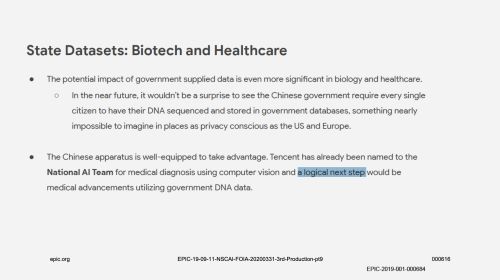
Who are the NSCAI?
Given the sweeping changes to the U.S. that the NSCAI promoted in this presentation last May, it becomes important to examine who makes up the commission and to consider their influence over U.S. policy on these matters, particularly during the current crisis. As previously mentioned, the chairman of the NSCAI is Eric Schmidt, the former head of Alphabet (Google’s parent company) who has also invested heavily in Israeli intelligence-linked tech companies including the controversial start-up “incubator” Team8. In addition, the committee’s vice-chair is Robert Work, is not only a former top Pentagon official, but is currently working with the think tank CNAS, which is run by John McCain’s long-time foreign policy adviser and Joe Biden’s former national security adviser.
Other members of the NSCAI are as follows:
- Safra Catz, CEO of Oracle, with close ties to Trump’s top donor Sheldon Adelson
- Steve Chien, supervisor of the Artificial Intelligence Group at Caltech’s Jet Propulsion Lab
- Mignon Clyburn, Open Society Foundation fellow and former FCC commissioner
- Chris Darby, CEO of In-Q-Tel (CIA’s venture capital arm)
- Ken Ford, CEO of the Florida Institute for Human and Machine Cognition
- Jose-Marie Griffiths, president of Dakota State University and former National Science Board member
- Eric Horvitz, director of Microsoft Research Labs
- Andy Jassy, CEO of Amazon Web Services (CIA contractor)
- Gilman Louie, partner at Alsop Louie Partners and former CEO of In-Q-Tel
- William Mark, director of SRI International and former Lockheed Martin director
- Jason Matheny, director of the Center for Security and Emerging Technology, former Assistant director of National Intelligence and former director of IARPA (Intelligence Advanced Research Project Agency)
- Katharina McFarland, consultant at Cypress International and former Assistant Secretary of Defense for Acquisition
- Andrew Moore, head of Google Cloud AI
As can be seen in the list above, there is a considerable amount of overlap between the NSCAI and the companies currently advising the White House on “re-opening” the economy (Microsoft, Amazon, Google, Lockheed Martin, Oracle) and one NSCAI member, Oracle’s Safra Katz, is on the White House’s “economic revival” taskforce. Also, there is also overlap between the NSCAI and the companies that are intimately involved in the implementation of the “contact tracing” “coronavirus surveillance system,” a mass surveillance system promoted by the Jared Kushner-led, private-sector coronavirus task force. That surveillance system is set to be constructed by companies with deep ties to Google and the U.S. national security state, and both Google and Apple, who create the operating systems for the vast majority of smartphones used in the U.S., have said they will now build that surveillance system directly into their smartphone operating systems.
Also notable is the fact that In-Q-Tel and the U.S. intelligence community has considerable representation on the NSCAI and that they also boast close ties with Google, Palantir and other Silicon Valley giants, having been early investors in those companies. Both Google and Palantir, as well as Amazon (also on the NSCAI) are also major contractors for U.S. intelligence agencies. In-Q-Tel’s involvement on the NSCAI is also significant because they have been heavily promoting mass surveillance of consumer electronic devices for use in pandemics for the past several years. Much of that push has come from In-Q-Tel’s current Executive Vice President Tara O’Toole, who was previously the director of the Johns Hopkins Center for Health Security and also co-authored several controversial biowarfare/pandemic simulations, such as Dark Winter.
In addition, since at least January, the U.S. intelligence community and the Pentagon have been at the forefront of developing the U.S. government’s still-classified “9/11-style” response plans for the coronavirus crisis, alongside the National Security Council. Few news organizations have noted that these classified response plans, which are set to be triggered if and when the U.S. reaches a certain number of coronavirus cases, has been created largely by elements of the national security state (i.e. the NSC, Pentagon, and intelligence), as opposed to civilian agencies or those focused on public health issues.
Furthermore, it has been reported that the U.S. intelligence community as well as U.S. military intelligence knew by at least January (though recent reports have said as early as last November) that the coronavirus crisis would reach “pandemic proportions” by March. The American public were not warned, but elite members of the business and political classes were apparently informed, given the record numbers of CEO resignations in January and several high-profile insider trading allegations that preceded the current crisis by a matter of weeks.
Perhaps even more disconcerting is the added fact that the U.S. government not only participated in the eerily prescient pandemic simulation last October known as Event 201, it also led a series of pandemic response simulations last year. Crimson Contagion was a series of four simulations that involved 19 U.S. federal agencies, including intelligence and the military, as well as 12 different states and a host of private sector companies that simulated a devastating pandemic influenza outbreak that had originated in China. It was led by the current HHS Assistant Secretary for Preparedness and Response, Robert Kadlec, who is a former lobbyist for military and intelligence contractors and a Bush-era homeland security “bioterrorism” advisor.

In addition, both Kadlec and the Johns Hopkins Center for Health Security, which was intimately involved in Event 201, have direct ties to the controversial June 2001 biowarfare exercise “Dark Winter,” which predicted the 2001 anthrax attacks that transpired just months later in disturbing ways. Though efforts by media and government were made to blame the anthrax attacks on a foreign source, the anthrax was later found to have originated at a U.S. bioweapons lab and the FBI investigation into the case has been widely regarded as a cover-up, including by the FBI’s once-lead investigator on that case.
Given the above, it is worth asking if those who share the NSCAI’s vision saw the coronavirus pandemic early on as an opportunity to make the “structural changes” it had deemed essential to countering China’s lead in the mass adoption of AI-driven technologies, especially considering that many of the changes in the May 2019 document are now quickly taking place under the guise of combatting the coronavirus crisis.
The NSCAI’s vision takes shape
Though the May 2019 NSCAI document was authored nearly a year ago, the coronavirus crisis has resulted in the implementation of many of the changes and the removal of many of the “structural” obstacles that the commission argued needed to be drastically altered in order to ensure a technological advantage over China in the field of AI. The aforementioned move away from cash, which is taking place not just in the U.S. but internationally, is just one example of many.
For instance, earlier this week CNN reported that grocery stores are now considering banning in-person shopping and that the U.S. Department of Labor has recommended that retailers nationwide start “‘using a drive-through window or offering curbside pick-up’ to protect workers for exposure to coronavirus.” In addition, last week, the state of Florida approved an online-purchase plan for low income families using the Supplemental Nutrition Assistance Program (SNAP). Other reports have argued that social distancing inside grocery stores is ineffective and endangering people’s lives. As previously mentioned, the May 2019 NSCAI document argues that moving away from in-person shopping is necessary to mitigate China’s “adoption advantage” and also argued that “when buying online is literally the only way to get what you want, consumers go online.”
Reports have also argued that these changes in shopping will last far beyond coronavirus, such as an article by Business Insider entitled “The coronavirus pandemic is pushing more people online and will forever change how Americans shop for groceries, experts say.” Those cited in the piece argue that this shift away from in-person shopping will be “permanent” and also states that “More people are trying these services than otherwise would have without this catalyst and gives online players a greater chance to acquire and keep a new customer base.” A similar article in Yahoo! News argues that, thanks to the current crisis, “our dependence on online shopping will only rise because no one wants to catch a virus at a shop.”
In addition, the push towards the mass use of self-driving cars has also gotten a boost thanks to coronavirus, with driverless cars now making on-demand deliveries in California. Two companies, one Chinese-owned and the other backed by Japan’s SoftBank, have since been approved to have their self-driving cars used on California roads and that approval was expedited due to the coronavirus crisis. The CPO of Nuro Inc., the SoftBank-backed company, was quoted in Bloomberg as saying that “The Covid-19 pandemic has expedited the public need for contactless delivery services. Our R2 fleet is custom-designed to change the very nature of driving and the movement of goods by allowing people to remain safely at home while their groceries, medicines, and packages are brought to them.” Notably, the May 2019 NSCAI document references the inter-connected web of SoftBank-backed companies, particularly those backed by its largely Saudi-funded “Vision Fund,” as forming “the connective tissue for a global federation of tech companies” set to dominate AI.
California isn’t the only state to start using self-driving cars, as the Mayo Clinic of Florida is now also using them. “Using artificial intelligence enables us to protect staff from exposure to this contagious virus by using cutting-edge autonomous vehicle technology and frees up staff time that can be dedicated to direct treatment and care for patients,” Kent Thielen, M.D., CEO of Mayo Clinic in Florida stated in a recent press release cited by Mic.
Like the changes to in-person shopping in the age of coronavirus, other reports assert that self-driving vehicles are here to stay. One report published by Mashable is entitled “It took a coronavirus outbreak for self-driving cars to become more appealing,” and opens by stating “Suddenly, a future full of self-driving cars isn’t just a sci-fi pipe dream. What used to be considered a scary, uncertain technology for many Americans looks more like an effective tool to protect ourselves from a fast-spreading, infectious disease.” It further argues that this is hardly a “fleeting shift” in driving habits and one tech CEO cited in the piece, Anuja Sonalker of Steer Tech, claims that “There has been a distinct warming up to human-less, contactless technology. Humans are biohazards, machines are not.”
Another focus of the NSCAI presentation, AI medicine, has also seen its star rise in recent weeks. For instance, several reports have touted how AI-driven drug discovery platforms have been able to identify potential treatments for coronavirus. Microsoft, whose research lab director is on the NSCAI, recently put $20 million into its “AI for health” program to speed up the use of AI in analyzing coronavirus data. In addition, “telemedicine”– a form of remote medical care – has also become widely adopted due to the coronavirus crisis.
Several other AI-driven technologies have similarly become more widely adopted thanks to coronavirus, including the use of mass surveillance for “contact tracing” as well as facial recognition technology and biometrics. A recent Wall Street Journal report stated that the government is seriously considering both contact tracing via phone geolocation data and facial recognition technology in order to track those who might have coronavirus. In addition, private businesses – like grocery stores and restaurants – are using sensors and facial recognition to see how many people and which people are entering their stores.
As far as biometrics go, university researchers are now working to determine if “smartphones and biometric wearables already contain the data we need to know if we have become infected with the novel coronavirus.” Those efforts seek to detect coronavirus infections early by analyzing “sleep schedules, oxygen levels, activity levels and heart rate” based on smartphone apps like FitBit and smartwatches. In countries outside the U.S., biometric IDs are being touted as a way to track those who have and lack immunity to coronavirus.
In addition, one report in The Edge argued that the current crisis is changing what types of biometrics should be used, asserting that a shift towards thermal scanning and facial recognition is necessary:
“At this critical juncture of the crisis, any integrated facial recognition and thermal scanning solution must be implemented easily, rapidly and in a cost-effective manner. Workers returning to offices or factories must not have to scramble to learn a new process or fumble with declaration forms. They must feel safe and healthy for them to work productively. They just have to look at the camera and smile. Cameras and thermal scanners, supported by a cloud-based solution and the appropriate software protocols, will do the rest.”
Also benefiting from the coronavirus crisis is the concept of “smart cities,” with Forbes recently writing that “Smart cities can help us combat the coronavirus pandemic.” That article states that “Governments and local authorities are using smart city technology, sensors and data to trace the contacts of people infected with the coronavirus. At the same time, smart cities are also helping in efforts to determine whether social distancing rules are being followed.”
That article in Forbes also contains the following passage:
“… [T]he use of masses of connected sensors makes it clear that the coronavirus pandemic is–intentionally or not–being used as a testbed for new surveillance technologies that may threaten privacy and civil liberties. So aside from being a global health crisis, the coronavirus has effectively become an experiment in how to monitor and control people at scale.”
Another report in The Guardian states that “If one of the government takeaways from coronavirus is that ‘smart cities’ including Songdo or Shenzhen are safer cities from a public health perspective, then we can expect greater efforts to digitally capture and record our behaviour in urban areas – and fiercer debates over the power such surveillance hands to corporations and states.” There have also been reports that assert that typical cities are “woefully unprepared” to face pandemics compared to “smart cities.”
Yet, beyond many of the NSCAI’s specific concerns regarding mass AI adoption being conveniently resolved by the current crisis, there has also been a concerted effort to change the public’s perception of AI in general. As previously mentioned, the NSCAI had pointed out last year that:
“In the press and politics of America and Europe, Al is painted as something to be feared that is eroding privacy and stealing jobs. Conversely, China views it as both a tool for solving major macroeconomic challenges in order to sustain their economic miracle, and an opportunity to take technological leadership on the global stage.”
Now, less than a year later, the coronavirus crisis has helped spawn a slew of headlines in just the last few weeks that paint AI very differently, including “How Artificial Intelligence Can Help Fight Coronavirus,” “How AI May Prevent the Next Coronavirus Outbreak,” “AI Becomes an Ally in the Fight Against COVID-19,” “Coronavirus: AI steps up in battle against COVID-19,” and “Here’s How AI Can Help Africa Fight the Coronavirus,” among numerous others.
It is indeed striking how the coronavirus crisis has seemingly fulfilled the NSCAI’s entire wishlist and removed many of the obstacles to the mass adoption of AI technologies in the United States. Like major crises of the past, the national security state appears to be using the chaos and fear to promote and implement initiatives that would be normally rejected by Americans and, if history is any indicator, these new changes will remain long after the coronavirus crisis fades from the news cycle. It is essential that these so-called “solutions” be recognized for what they are and that we consider what type of world they will end up creating – an authoritarian technocracy. We ignore the rapid advance of these NSCAI-promoted initiatives and the phasing out of so-called “legacy systems” (and with them, many long-cherished freedoms) at our own peril.
‘Bluffing’: China demands ‘enormous evidence’ Pompeo cited regarding Covid-19 origin
RT | May 4, 2020
China has responded to Pompeo’s claim that he has evidence that the novel coronavirus originated in a Chinese lab, saying that his claims were a “bluff,” as the war of words continues to escalate between Washington and Beijing.
The Global Times newspaper – an outlet owned by the Chinese Communist Party – published an editorial dismissing Pompeo’s claims as “groundless accusations.”
This comes in response to claims made by US Secretary of State Mike Pompeo in an interview with ABC that he has “enormous evidence” proving that the novel coronavirus originated in a Chinese lab.
The theory that the virus came from the Wuhan Institute of Virology (WIV) has been repeatedly promoted by the US administration. President Donald Trump also claimed earlier that he is confident the virus originated there, in an ongoing exchange of accusations between the two countries.
The editorial published by the Global Times called on Pompeo to publicly reveal his evidence – if it really exists – and that failure to do so would prove that he was “bluffing” all along.
“What was originally a scientific question, has been transformed into a vicious attack fueled by politics, intelligence, and diplomacy,” the editorial claims. It also accused the Trump administration of conducting “unprecedented propaganda warfare” against China in order to divert away attention from its own “incompetence” in handling the Covid-19 outbreak domestically.
Venezuelan Armed Forces: Paramilitary Incursion Neutralized
By Ricardo Vaz | Venezuelanalysis | May 3, 2020
Mérida – Venezuelan authorities announced they routed an armed group attempting to land on Venezuelan shores on Sunday.
The incident reportedly took place in the early morning hours, with armed men on speed boats approaching coastal La Guaira State, just north of Caracas.
“A group of terrorist mercenaries, organized and trained in Colombia, tried to disembark with war material off the coast of La Guaira,” a statement released by the Bolivarian National Armed Forces (FANB) read.
The statement detailed that intelligence work, as well as defense exercises, allowed the FANB and police units to respond immediately. In the ensuing confrontation, eight members of the paramilitary group were killed, the FANB added, and two were arrested. There are no reports of casualties on the Venezuelan side.
The operation also resulted in the apprehension of military gear and weapons, allegedly matching equipment stolen in the failed April 30, 2019 military putsch. The armed forces likewise revealed that divers are currently being deployed to recover additional weapons and that Navy ships are patrolling the coastline in search of other vessels involved in the incursion.
“The Bolivarian National Armed Forces categorically rejects these irrational acts of violence,” the statement went on to say.
Speaking to the press on Sunday, Interior Minister Nestor Reverol and Defense Minister Vladimir Padrino Lopez said that the defensive operation was ongoing and there could be further arrests in the coming days.
Padrino also announced that a new set of “Bolivarian Shield” military exercises will begin immediately on orders of President Nicolas Maduro.
For his part, National Constituent Assembly President Diosdado Cabello divulged that weapons had been seized on land, including vehicles fitted with machine guns. The location of the equipment was not disclosed. He also claimed that the boats’ GPS trackers indicated they had departed from Colombia.
Sunday’s failed incursion came on the heels of an Associated Press report revealing that former US Special Operations soldier Jordan Goudreau had played a leading role in a plan to invade Venezuela led by retired Venezuelan Major General Cliver Alcala. Goudreau was responsible for training a contingent of 300 Venezuelan army deserters who were to enter Venezuela in a heavily armed caravan and seize the capital within 96 hours.
Both the Venezuelan opposition and the Colombian government were reportedly aware of the plot.
In a video released on social media, Goudreau confirmed that the amphibious landing attempt had been launched from Colombia as part of “Operation Gedeon” and that “other units” were active in the “south, west, and east of Venezuela.” He appeared alongside retired National Guard Captain Javier Nieto Quintero, who claimed that the operation aimed to “capture” high-ranking officials and “liberate” the Venezuelan people.
Nieto spent 18 months in prison starting in 2004 for alleged connections to Colombian paramilitary groups before leaving the country. In a press conference in Florida in October 2019 he announced the creation of a “Military Command,” made up of former officials, with the stated goal of setting up an armed force to back a “transition government.”
A video of purported participants in “Operation Gedeon” was likewise released on Sunday. A man identifying himself as Antonio Jose Sequea, whom Goudreau identifies as the commander of the operation, appears on a beach flanked by heavily armed soldiers. Sequea is additionally seen with a blue armband similar to those worn by mutinous FANB soldiers who took part in last year’s failed April 30 putsch led by opposition leader Juan Guaido.
Among the other soldiers cameoed in the video is National Guard Captain Robert Colina, aka “Panther,” who reportedly died in the operation. In March, the Venezuelan government accused Colina of planning the assassination of top Caracas officials as part of Alcala’s Colombia-based paramilitary activites. Sequea was also identified at the time as a participant in the April 30 coup attempt.
For his part, opposition leader Guaido issued a statement Sunday afternoon dismissing the operation as a “false flag” allegedly perpetrated by the Maduro government. Guaido declared himself “interim president” in January 2019 with US backing but has since faded from the spotlight following repeated failed attempts to oust Maduro.
Guaido has yet to comment on Goudreau and Nieto’s video announcing the military operation.
The former National Assembly president had previously denied any connection to Alcala and Goudreau. For his part, Alcala claimed that a contract had been signed with Guaido, opposition strategist J. J. Rendon, and “US advisors.”
However, Miami-based Venezuelan journalist Patricia Poleo published a document Sunday evening, which she purported to be a copy of the contract. Poleo interviewed Goudreau, who produced a document with Guaido’s signature, which contracts Goudreau’s company Silvercorp to provide services, including “strategic planning,” “equipment procuring” and “project execution advisement,” for a fee of US $212 million.
Poleo also released several audio recordings of an alleged conference call between Guiado, Goudreau, and senior Guaido envoy Sergio Vergara, in which they agreed to sign the contract.
During the interview, Goudreau accused the Venezuelan opposition of not fulfilling their end of the contract, but that the operation (“Gedeon”) had gone ahead.
guaido_goudreau.jpg

Alleged contract signed between Juan Guaido and Jordan Goudreau’s company Silvercorp for $212 million. (@FactoresdePoder)
Pompeo and the capricious virus
By M. K. BHADRAKUMAR | Indian Punchline | May 4, 2020
Iran, by its announcement Sunday that mosques will start reopening in low-risk areas of the country from May 5, has delivered a devastating blow to the ego of the Trump administration, puncturing it beyond repair.
President Hassan Rouhani said mosques would reopen in 132 regions designated as white under a colour-coded system after being consistently free of the new coronavirus. “Friday prayers will also resume in those areas and the mosques that respect the health protocols,” Rouhani added. The US had to settle for a “virtual” Easter mass, but observant Muslims in Iran will pray during Ramadan in their mosques.
Iran has already lifted a ban on inter-city trips and malls, with large shopping centres resuming activities. Rouhani also disclosed that schools in low-risk areas will be re-opened by May 16 to allow for a month of classes before exams are held.
The Health Ministry in Tehran said Saturday the rate of infections has started a definite downward trend. This has been possible because as many as 78 million people were screened for the COVID-19 symptoms in the first phase of a nationwide program and 30 million in the second phase.
For a country with a population of 84 million, this is an astounding record. In contrast, testing in the US remains scarce, with roughly 5.5 million tests performed since the first confirmed US case on January 20th.
A recent analysis by Harvard researchers and STAT shows that as the US tries to move beyond its months-long coronavirus testing debacle — faulty tests, shortages of tests, and guidelines that excluded many people who should have been tested to mitigate the outbreak — it is at risk of fumbling the next challenge: testing enough people to determine which cities and states can safely reopen and stay open.
Iran is one of the Middle Eastern countries hardest hit by the outbreak. Its crisis was compounded by the fact that Trump administration ensured through a barbaric sanctions regime that Tehran would have to combat the pandemic with one hand tied behind its back from the time its first COVID-19 infection cases appeared in late February.
The Trump administration’s — particularly the evangelist secretary of state Mike Pompeo’s — optimistic assessment was that under the assault of Covid-19, Iran would simply collapse for want of medicines and equipment, hospital beds and ventilators.
But the mother of all ironies is that on Sunday, even as Rouhani declared a defining moment in the pandemic in Iran, President Trump revised upward the possible death toll in the US closer to 100,000. Over a million Americans have been infected by the virus so far and nearly 70,000 lives have been lost.
The corresponding figures in Iran tell a story by itself: Iran has a total of 97,424 cases of the coronavirus. 78,422 patients have recovered and been discharged from hospitals so far. The death toll from the outbreak rose by 47 over the past 24 hours to 6,203, Iran’s lowest in nearly two months.
Iran has a population which is a quarter of the population of the US and by the American experience, at least a quarter million Iranian citizens should have been infected and somewhere around 18,000 lives should have been lost by now.
What emerges out of all this is that the US is an incredibly sloppy country despite its vainglorious claims of being a superpower and is ruled by an utterly incompetent government. To hide the shame and disgrace, Pompeo has plunged into a blame game.
On Sunday, Pompeo said: “There is enormous evidence that that’s where this began,” later adding: “I can tell you that there is a significant amount of evidence that this came from that laboratory in Wuhan.” Pompeo appeared confused. Only last Thursday, he was on record as saying in a radio interview, “We don’t know if it (the virus) came from the Wuhan Institute of Virology. We don’t know if it emanated from the wet market or yet some other place. We don’t know those answers.”
This revisionist thesis of the “Wuhan virus” becomes necessary as it emerged by the weekend that the death toll in the US would go up at least by another fifty percent. Pompeo is having to contend with an unprecedented diplomatic disaster on the world arena, as the US stands exposed as a bumbling giant with feet of clay. The world community will rightly wonder how a country that cannot adequately protect its citizens can be a provider of security for other countries.
What Pompeo refuses to acknowledge is that countries in the so-called “Orient” such as Iran could so successfully handle the Covid-19 crisis — with composure, grit and an earthy wisdom — that shows up the US as a decadent power. The countries in Asia, the Middle East and Central Asia are handling the situation so much better with so few resources, while the US is grovelling on the ground, lamenting its misfortune and indulging in blame games.
In a virtual “town hall” meeting on Fox News on Sunday night, President Donald Trump admitted that the coronavirus has proved more devastating than he had expected and the death toll from the ravaging pandemic might reach as high as 100,000 in the US. He pleaded during the two-hour broadcast that although he was warned about the coronavirus in his regular intelligence briefing on Jan. 23, the information was characterised as if “it was not a big deal” and had not been presented in an alarming way that demanded immediate action.
From what Trump said, Covid-19 poses a riddle to his administration. It killed nearly 70,000 Americans so far, but in Iraq, the body count is fewer than 100; in Malaysia also around 100; in Bangladesh 182.
Or, take the body count in countries that are in close proximity to China: Taiwan – 6; Kazakhstan – 27; Kyrgyzstan -10; Laos – 0; Cambodia-0; Myanmar-6; Nepal-0; Thailand-54. The metropolis of New York has been devastated while teeming Asian cities like New Delhi, Mumbai and Kolkata have so far been largely spared.
Would Pompeo have an answer? He is peeved that Beijing has not allowed western scientists to enter Wuhan and conduct research. But that privilege wasn’t extended to Vietnam, either. Maybe, Vietnam can teach the US something here that could have profound implications for how countries respond to the virus.
Vietnam, which shares a border with China and is about 1,200 miles from where the outbreak was first reported in Wuhan, has reported 245 confirmed cases with 95 recoveries and no fatalities. Yes — zero fatalities.

Vietnam reported 245 confirmed cases of Covid-19, no fatalities.
Clearly, Pompeo got it right but for the wrong reasons — this probably has got everything to do with the Chinese Communist Party.
A Vietnamese commentary comes out with a definitive explanation: “The Communist Party of Vietnam has strengthened its anti-pandemic measures by implementing nationwide social distancing rules, such as banning outside gatherings of more than two people while keeping a distance of 6.5 feet, and temporary shutdowns of “non-essential” businesses, including restaurants, entertainment centres and tourist sites…
“Unlike the U.S. capitalist class and the Trump administration, the Vietnamese government took early measures to combat the current coronavirus epidemic. Officials began preparing strategies to combat the outbreak immediately after the first cases emerged in China.”
“On February 1, Prime Minister Nguyen Xuan Phuc signed Decision No.173.QD-TTG, categorising the virus as a Class A contagious disease “that can transmit very rapidly and spread widely with high mortality rates.” This declaration of a national emergency came after the sixth case of coronavirus in the country was reported. In contrast, the Trump administration only declared a national emergency over the global pandemic on March 13, when there were at least 1,920 confirmed cases across 46 states.”
Read a blog featured by World Bank, Containing the coronavirus (COVID-19): Lessons from Vietnam. Life is such that sometimes, even horrific tragedies can have straightforward explanations. The capricious virus knew it, but not Pompeo.
Israel lobbyist describes ways to procure massive US aid to Israel, despite US recession
If Americans Knew | May 3, 2020
Over 30 million Americans have lost their jobs due to the coronavirus. American businesses have closed and the U.S. economy is devastated. Yet, the Israel lobby works to ensure that American taxpayers will continue to give Israel over $10 million per day…
For more information, read Alison Weir’s article:
“Despite coronavirus-caused cutbacks, Israel expects to get full $3.8 billion” at: https://iakn.us/IsraelExpects
Featured Video

Weaponized Journalism: 2021 Sayer Ji Interview with NPR
or go to
Aletho News Archives – Video-Images
From the Archives
How Rothschild Banking Clan Uses Its Vast Wealth to Influence World Events and Control Governments

By Ilya Tsukanov – Sputnik – 15.09.2024
How powerful is the Rothschild banking family? How did they amass their fortune? Just how rich are they? Do they secretly control the world? Sputnik explores. … continue
Blog Roll
 Aletho News
- London tourism expo promotes Israeli agency linked to theft of Palestinian land
- Dockworkers launch global strike against Israeli and US military shipments
- Europe facing gas price shock – Gazprom chief
- Ukraine continues recruiting people with disabilities
- Weaponized Journalism: 2021 Sayer Ji Interview with NPR
- Beyond Netanyahu: what Israel’s election means for Palestinians
- Lithuania plans universal conscription
- Lies, Damn Lies, and Ukraine News
- Financial Times rejects Nordic demands to correct Putin call story – media
- The Case for Less Unity in Europe
- If Americans Knew
- The Long Arm of AIPAC
- Genocidal intent behind Hebron assault, rights group says
- This week, Israel killed 8-year-old who survived bombing that wiped out her family
- DAILY UPDATE: Latest essential news on Palestine, Israel, & region
- Israeli soldier poses at damaged Lebanon church, sparking anger
- New Report. Manufacturing the Great Replacement: Is Israel behind one of the largest racist influence campaigns ever documented?
- ‘Arab voice doesn’t count’: Jewish Israeli blocs reject Palestinian support
- Whether Bibi Stays or Goes, the ‘Special Relationship’ Must End
- AIPAC Isn’t Retreating. Here’s How It’s Already Shaping the Next Congress.
- With ‘Largest Coordinated Port Action Ever,’ Dockworkers in 22 Countries Strike Against Gaza Genocide
- No Tricks Zone
- Germany’s Green Energy Transition Becoming Increasingly Expensive…Another 6 Trillion Euros!
- Sudden Stratospheric Warming, Powerful El Niño Combination May Lead To Extreme Europe Cold, Energy Crisis!
- Two New Studies Find Thwaites Glacier Melt Cannot Be Driven By Human Activity Or A Warming Ocean
- E-Cars Reduce CO2 Emissions By Only 41% Compared To Internal Combustion Engine Vehicles
- Predictions Made By Renowned Climate Professor Over Past Decades Have Been Proven To Be Poor
- New Study Suggests Large Regions Of The Pacific Ocean Have Been Cooling For The Last 80 Years
- Germany’s Green Energy Debacle: High Energy Costs Force Kahla Porzellan to Close After 182 Years!
- New Study: 50 Years Of The Most Aggressive ‘Net Zero’ Policies Can Only Affect The Global Climate By 0.03°C
- US September “Heat” Was No Record…Many Records Set Decades Ago
- Latest European Green Energy Debacle; Portugal’s Largest Flagship Solar Park Insolvent!

