HBO hires ‘king of fake news’ Brian Stelter from CNN to produce documentary on… the dangers of fake news
By Zachary Leeman | RT | January 18, 2020
If you were making a documentary on fake news and wanted to get journalists involved behind the scenes, there are a few people you may want to avoid. One of those is CNN host Brian Stelter.
The HBO network is rightly being mocked for putting Stelter – the host of a CNN show ironically named ‘Reliable Sources’ – on the team for an upcoming documentary on fake news.
According to Stelter himself, the documentary will investigate “disinformation and the cost of fake news.” The film, for which Stelter was executive producer, will dive into “how post-truth culture has become an increasingly dangerous part of the global information environment,” according to WarnerMedia.
To say Stelter’s involvement in the documentary attracted mockery online would be an understatement.
“This is like Harvey Weinstein doing a documentary on sexual assault,” lawyer and journalist Rogan O’Handley wrote.
“HBO has hired Brian Stelter to do a documentary on Fake News. That’s like hiring Bernie Madoff to teach accounting. Like hiring Michael Moore to host a fashion show. Not to mention [Stelter] is the dullest human ever on television,” radio host Mark Simone added.
“You’re kidding, right? [Brian Stelter] is the king of disinformation and fake news,” wrote Twitter user Pattie Taz.
It would make more sense for a documentary about fake news to use Brian Stelter and his home patch CNN as subjects, rather than accomplices. The channel is hot on the heels of reaching a massive settlement with Kentucky teen Nick Sandmann over coverage of his January 2019 run-in with Native American activist Nathan Phillips at the Lincoln Memorial in Washington DC. Sandmann was portrayed by CNN as the aggressor in the situation, thanks to edited video of him and other teens smiling at Phillips as he protested. Expanded video footage later showed Phillips initiating contact with the teen.
CNN is also famous for devoting most of its time to President Donald Trump and just about every conspiracy linked to him, including that of ‘Russia collusion.’ CNN has even retracted a story about a supposed Russian investment fund that had ties to Trump officials. That 2017 report led to three journalists resigning their positions.
Stelter himself is something of a rabbit hole of odd and biased reporting.
He ran a report in 2018 about how First Lady Melania Trump had “disappeared” and become “invisible.”
That ‘nothing story’ could have been clarified by a CSNBC journalist having actually seen the first lady a few days before – something Stelter ignored – or by the fact that she was recovering from surgery; but Stelter had a doomsday clock running anyway.
He has also pushed the conspiracy theory that Fox News makes Trump’s decisions, which looks especially bad in light of the president’s recent Iran maneuvers, earning the CNN presenter more critics, like Fox News presenter Tucker Carlson.
On Jussie Smollett, the ‘Empire’ actor who falsely claimed to have been attacked by two Trump supporters who’d put him in a noose, Stelter refused to fully concede that the mounting evidence showed Smollett’s claim to be a hoax.
“We may never really know what happened on that night,” he said last year about the hoax attack on the African-American actor. He also insisted that CNN put in “really careful” reporting on the subject, despite hosts like Ana Navarro and Don Lemon being some of the first to buy into Smollett’s flaky story.
Stelter is such a lazy and biased ‘reporter’ that he once questioned why Trump was at a UFC event, without looking up the basic background, that the president was one of the earliest supporters of the sports organization and an associate of UFC President Dana White.
At best, you can say Stelter is a pundit with a very heavy bias, but this still brings into question why he would be an authority on fake news. His stories are put through such a hard-left filter that it’s difficult to view him as someone who can even recognize fake news.
And it’s not just Stelter’s left-wing bias that creates a problem. It would be just as ridiculous to produce a documentary that exposes fake news and then hire a conservative journalist who has pushed questionable stories in the name of an agenda to produce it.
A second documentary project coming from HBO includes the involvement of Ronan Farrow, an equally liberal individual but one who can at least stand on the back of solid reporting. It was Farrow who originally exposed the sexual misconduct allegations against disgraced producer Harvey Weinstein, and he hasn’t been shy about the pushback he got from some media outlets about his original story.
Farrow’s doc will investigate “threats, intimidation, and violence directed at journalists working to expose corruption and abuse by governments, corporations, and other powerful interests,” according to HBO.
That doc could end up being politically biased or weaponized, but at least it has the integrity and weight of a real journalist behind it. A Stelter doc on fake news sounds about as enticing and trustworthy as a documentary on humility from Donald Trump.
Keeping with its Crackdown on Alternative Voices, Google Deletes Press TV from YouTube
By Alan Macleod | MintPress News | January 15, 2020
Without warning, tech giant Google “permanently removed” Iranian government-owned media channel Press TV UK’s YouTube channel Monday night amid increasing American hostility to Iran.
“This attack on the freedom of speech of Press TV’s journalists seems to be part of an anti-Iran purge as the West sets its sights on regime change in Iran,” Press TV said. Its content, in its own words, focuses on “anti-imperialism, anti-racism, and covers aspects of the news which the mainstream corporate media in the United Kingdom have refused to air.”
The London-based outlet had over 28,000 subscribers on its YouTube account at the time of its deletion.
British-Sudanese journalist Ahmed Kaballo accused Google of acting like the “judge jury and executioner” for his employer’s channel, expressing his great disappointment that his journalistic output is now gone and his worry at “what this really represents” for alternative media that “show a different perspective and holds a critical lens” on war and empire.
MintPress News reached out to Kaballo for comment. “The actions of Google in the last 24 hours has made me lose hope in the idea of free press and free speech,” he said. “Journalism is about pushing the boundaries and being fearless in our reporting but in this climate where they can do this to us in this fashion, it’s clear that our perspective. which is overtly anti-imperialist, is, in the eyes of Google, simply not allowed.”
After online pushback, by Wednesday morning UK time, Google had reversed its decision. However, just as Press TV was celebrating its reinstatement, it was again taken off the air. YouTube sent a message to Press TV UK claiming that they had received a complaint about the channel and decided that it violates their terms of service. Kaballo described the political hokey pokey his organization was under as “psychological warfare.”
Press TV says the move is “part of an anti-Iran purge as the West sets its sights on regime change in Iran.” It comes in the context of the Trump administration’s assassination of Lt. General Qassem Soleimani January 3, while he was in Iraq attending peace talks. In response, Iran launched dozens of ballistic missiles at U.S.-occupied military bases in Iraq, although it was careful to warn the U.S. of the attack beforehand. As a result, there were no deaths. The Iraqi parliament also immediately voted to expel all American troops from the country. However, the U.S. refused to leave.
While the threat of a hot war with the Iran appears to have subsided, an intense, online propaganda war rages between the two countries. During his funeral, the hashtag #IraniansDetestSoleimani trended across American Twitter. But analysis showed that it was not Iranians, but organized Trump supporters who were boosting the message, supporting, as 47 percent of Americans did, their president’s decision to kill him.
Last Friday, Facebook announced that it felt compelled to delete all positive posts about the deceased general from its platform and its subsidiary Instagram. “We operate under U.S. sanctions laws, including those related to the U.S. government’s designation of the Iranian Revolutionary Guard Corps (IRGC) and its leadership,” it said, explaining that Trump’s new sanctions made supporting Iran online on any American website essentially illegal. Instagram had already closed Soleimani’s account in April last year, following Trump’s designation of the IRGC as a terrorist group. Just after Facebook’s decision, Twitter suspended Ayatollah Khamenei’s account for “unusual activity.” Instagram is extremely popular in Iran, with around one in three people owning an account, almost as popular as Soleimani, who over 80 percent view positively or very positively. Thus, the U.S. government has, through pressuring monopolistic Silicon Valley giants, effectively banned a majority opinion being shared by Iranians to Iranians, in Iran.
This is not the first occasion that the U.S. government has used the American monopoly over the means of communication online to shut down alternative voices from other countries. Facebook has previously de-platformed Venezuela-based outlets TeleSUR English and Venezuelanalysis, both of which offered differing opinions and analysis of the U.S. government’s actions in Venezuela and Latin America. Meanwhile, the Trump administration has forced RT journalists to register as “foreign agents,” under a rule originally set up to deal with Nazis during World War Two.
Press TV, too, has had a history of poor treatment at the hands of the U.S. state. In January last year, the FBI illegally detained Press TV anchor Marzieh Hashemi for ten days. She was never charged and was deprived of Halal food and a hijab during her detention. While the network is still reachable directly on its website, the fact that the U.S. government can unilaterally decide what the world sees, hears or reads, zapping British based Iranian networks from universal social media giants the entire world uses raises questions about freedom of information in the digital age.
DHS Head Claims Russia Seeks to ‘Undermine American Way of Life’, Expects US 2020 Voter Interference
Sputnik – 18.01.2020
Acting Secretary of the US Department of Homeland Security (DHS) Chad Wolf has joined the ranks of US officials who observe the DC political creed that Russia interferes in US internal affairs.
Wolf, in his 17 January speech, most of which was dedicated to what he referred to as the “top threats facing the Homeland” – Iran, China and Russia, claimed that even though Moscow does not strive to diminish the US role in the international arena, the nation is nonetheless looking to disrupt and undermine the “American way of life”.
“Lastly, let me touch on Russia. Unlike China, Russia doesn’t seek to weaken our economy and surpass us on the world-stage; rather they focus on actions that disrupt and undermine the American way of life. As we saw in 2016, we fully expect Russia to attempt to interfere in the 2020 elections to sow public discord and undermine our democratic institutions”, Wolf, serving as DHS acting secretary since November 2019, said, during an event hosted by the Homeland Security Experts Group in Washington DC.The official claimed that the 2018 midterm elections were “the most secure elections in the modern era” as the US created “classified and unclassified election war rooms” that “connected election officials in all 50 states, political parties, social media companies and agencies across the US Government, including DOD, the FBI and the Intelligence Community”.
“Let me be clear: We are prepared,” Wolf said. “More importantly, the state and local officials who run our elections are prepared. We are working with our federal partners to make sure those officials on the front lines of our elections have the information and the tools they need to combat Russian interference.”
“In 2020, we’re doing this and more to prevent our adversaries from degrading faith in our democracy and election results”, Wolf said.The acting secretary acknowledged that “100 percent security is never realistic” and asserted that US federal government and intelligence agencies were “laser-focused” on securing the upcoming elections.
Russian Trail
US intelligence agencies and lawmakers have accused Moscow of meddling in US elections since Trump’s 2016 victory, a political event that provoked allegations of Trump’s cooperation with Moscow as a means spreading anti-opponent propaganda online.
The US Department of Justice at the time launched an investigation headed by US Special Prosecutor Robert Mueller but the report concluded that no sufficient evidence existed to prove the allegations.
Both Trump and Russian officials have together repeatedly denied claims that they worked together to influence the results of the election.
In December 2019, Russian Foreign Minister Sergey Lavrov said that he had not seen any proof in support of allegations that Russia interfered in US elections, arguing that “No one has given us this proof because simply it does not exist”, while noting that Moscow is prepared to exchange assurances with Washington on non-interference in each other’s domestic affairs.Besides the US, the narrative of Russian involvement in the internal affairs of other countries has been used by a variety of European nations, however, again, no proof has been furnished.
In November 2019, El Pais published several stories alleging Russian influence in Catalonia, according to Spanish intelligence officers, again without providing evidence. The Russian embassy in Spain responded by joking about the allegations.
“With regards to the tireless work of El Pais researchers on linking the source of the Catalan crisis to Russia, we would like to draw their attention to a revealing fact. There is a suspicious coincidence: the number of the alleged Russian unit, which is mentioned in the newspaper, ends with 155, which itself creates a new reality. So – [follow] the trail,” the embassy tweeted.Spain’s constitution contains Article 155, used by Madrid to suspend Catalonia’s autonomy and violently introduce direct rule in the wake of a 2017 independence declaration.
US, Russia Agree to Begin Expert-Level Engagement on Strategic Security – State Dept.
Sputnik – 16.01.2020
WASHINGTON – US and Russian delegations during their talks in Vienna decided to begin expert-level engagement on issues of strategic security and expand the dialogue beyond a bilateral format, the State Department said in a press release on Thursday.
“The delegations decided to continue the Strategic Security Dialogue and also to begin expert-level engagement on particular topics in the near future”, the release said. “The delegations discussed their respective national strategic policies as a means to reduce misunderstandings and misperceptions on key security issues. The US and Russian delegations discussed nuclear stockpiles and strategy, crisis and arms race stability, and the role and potential future of arms control, including the importance of moving beyond a solely bilateral format”.
Earlier, Russian Permanent Representative to International Organizations in Vienna Mikhail Ulyanov said in a statement on Twitter that the two sides discussed issues of strategic stability during the talks, which were led by Russian Deputy Foreign Minister Sergei Ryabkov and US Acting Undersecretary of State Chris Ford.
New START (Strategic Arms Reduction Treaty) is the last remaining arms control treaty in force between Russia and the United States. Signed in 2010, the pact stipulates that the number of strategic nuclear missiles launchers must be cut by half and limits the number of deployed strategic nuclear warheads to 1,550.
Russia has repeatedly stated its readiness to extend the New START without any preconditions, but the US is yet undecided about the extension.
Evidence suggests US lied about Iranian strikes on US facilities in Iraq
By Robert Inlakesh | Press TV | January 16, 2020
During the early morning hours of January 8, 2020, Iranian strategic missile units launched a precision attack, branded ‘Operation Martyr Soleimani’, against US forces at the American-operated section of the ‘Ain al-Asad’ air base in Iraq.
The response, coming in response to the illegal assassination of General Qassem Soleimani, was a high-observable attack using ballistic missile forces – as opposed to a low-observable attack using terrain-reading cruise missiles and suicide drones.
With US forces already having been in a heightened state of alert, American radar and satellite reconnaissance would have spotted the attack within a minute of it being launched (and a six hour pre-warning of an imminent attack before that), giving the US and other coalition troops present at the base time to seek cover in hardened shelter areas. This, however, did not prevent the success of the attack which, according to primary source evidence, destroyed highly-expensive US aviation assets.
THE RESULT – U.S. FORCES ASSET LOSSES
According to the evidence that has been made available to us at this point, it is obvious that the US is lying about the extent of the damage inflicted upon its assets and infrastructure at the Ain al-Asad base.
No American media group or official Pentagon report initially released the satellite pictures shown in this report, and probably for good reason. To downplay the event (as Trump did in his official address, as did the Pentagon in its later report), they simply dismissed the damaged equipment, referring to the destroyed assets as simple “tents, a parking lot and a damaged helicopter” (per the Department of Defense).
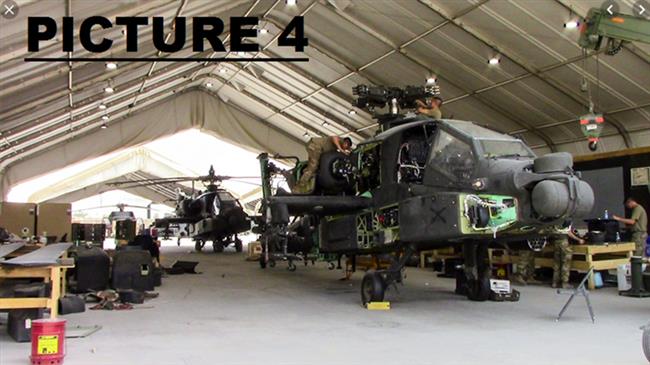
The Iranian missile attack for the most part targeted Apache (AH-64) attack helicopter shelters (refer to Picture 1). Refer to Picture 3 and Picture 4 to see what those “tent”-like Apache steel-frame shelters look like at ground level.
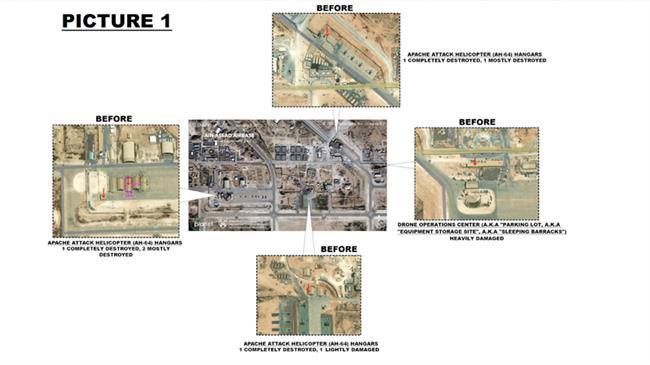
They are the standard steel-frame soft shelter design for US helicopter units based in overseas areas at second-rate airfields (such as the Ain al-Asad Base) – US helicopter units operating from old Afghan airfields are also housed in this kind of shelter design. Each one of those Apache attack helicopter shelters can house two such aircraft. With six structures of the type provably destroyed, demonstrated through the satellite images showing blackened scorch marks (suggesting assets inside them were destroyed with the shelter itself, refer to Picture 1) AND assuming each only had one Apache in them, it can be concluded that at least 6 Apache gunships were destroyed in the attack.
Recently, Danish media, citing a Danish coalition soldier who was present at the base at the time of the attack, admitted that multiple helicopters were destroyed to the point of being “split in half”.
Another Apache hangar (refer to Picture 2) was also directly struck, located to the far eastern end of the Ain al-Asad Base and destroyed. However, note that there is no scorch-blackened concrete underneath it, suggesting nothing was inside it that led to additional burning beyond the impact of the warhead itself.
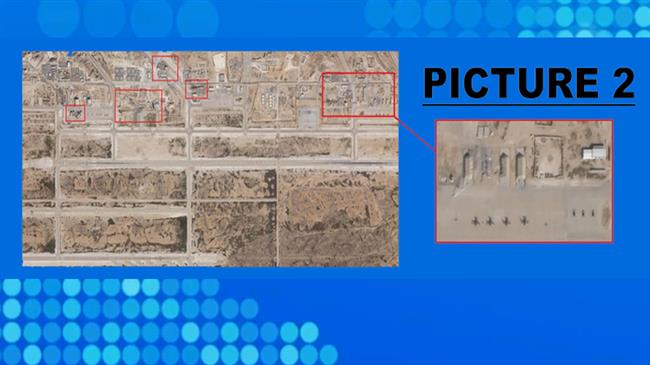
Indeed, just to the south of that destroyed hangar and the undamaged three hangars next to it, 4 Apache helicopters can be seen sitting out on the open tarmac. They were spared as they were, ironically, not being sheltered.
The official US story on the other structure targeted beyond the “tents” (i.e. Apache gunship hangars) has already changed twice – first it was called a parking lot, then an equipment storage area and now, apparently, a barracks for drone operators. Picture 1 (far right) shows the result of the attack on this structure.
It is hard to imagine that base zoning regulators within the US military would chose to place sleeping quarters right next to a strip alert (ready-to-go) aircraft parking area, itself right next to a major taxiway, given the constant noise that comes from these areas.
A more astute assessment would place this structure as an operations center, which lines up with the Iranian claim that the command site from which the Qassem Soleimani assassination operation had been coordinated, was targeted and destroyed in Iran’s retaliation strike.

Indeed, AFP recently released an exclusive report in which a US drone operator present at the Ain al-Asad Airbase, one First Sergeant Wesley Kilpatrick, admitted that airborne drones were rendered inoperable after a direct hit penetrated the base’s UAV operations center and destroyed the fiber lines which connect remote stations to satellite communication equipment(needed for drone control and visuals).
In all of this, one thing is obvious. US officials and media are stumbling over their own statements trying to cover up the extent of the damage dealt to the US-operated section of the Ain al-Asad base – in fact, going so far to cease calling the military site a US airbase (as it had been called for the last 16 years) to (all of a sudden) just an “Iraqi facility”.
THE WEAPONS USED BY IRAN
Short-range ballistic missiles (SRBM) of the upgraded Fateh-313 (range 500 km) and Qiam (range 800 km) types were launched from Western Iran towards the US-operated Ain al-Asad Base in Iraq.
Fateh-313s represent the majority of the missile type used for the attack. Their accuracy still seems to have been to within a matter of meters of their intended targets, except for two stray shots that hit the open tarmac area.
Whilst the Fateh-313 missiles use a combination of INS and electro-optical guidance, the Qiam missiles reportedly use a mix of INS, GPS and radar-mapping target acquisition. The latter method being the archaic predecessor version of DSMAC (imaging automatic target acquisition) terminal-phase guidance used in high-end ground-attack cruise missiles, such as the Tomahawk.
THE OPERATION –OTHER DETAILS
Satellite pictures show that some targeted sites were double-tapped (hit twice-over for good measure).
Initial reports from the Ain al-Asad Base claimed nearly 40 detonations in total despite the fact the number of actual warhead impacts was about fifteen, indicating that there were around two dozen cases of secondary explosions (fuel and ammo going off after being ignited).
In conclusion, according to the evidence we have available to us currently, there is no doubt that the United States has completely distorted the gravitude of Iran’s strikes. The mainstream media in the West have also seemingly refrained from acknowledging much of the damage, apart from on occasion.
Robert Inlakesh is a journalist, writer and political analyst, who has lived in and reported from the occupied Palestinian West Bank. He has written for publications such as Mint Press, Mondoweiss, MEMO, and various other outlets. He specializes in analysis of the Middle East, in particular Palestine-Israel. He also works for Press TV as a European correspondent.
Iraq denies report it has restarted joint military operations with US
Press TV – January 16, 2020
The Iraqi government has denied claims that the country’s military is resuming joint operations with the US-led coalition after Washington’s assassination of top Iranian and Iraqi commanders.
“The joint operations have not resumed and we have not given our authorization,” Major General Abdul Karim Khalaf, the spokesman for the commander-in-chief of the Iraqi armed forces, said on Thursday.
He added that the coalition did not have a permission from Baghdad to carry out any joint missions.
The remarks came after the New York Times, citing two American military officials, reported Thursday that the US had resumed the operations.
Khalaf said the Iraqi government had ordered the coalition to halt its joint operations following the US assassination of top Iranian anti-terror commander, Lieutenant General Qassem Soleimani, and Abu Mahdi al-Muhandis, the second-in-command of Popular Mobilization Units (PMU).
Last month, another US airstrike killed 25 members of PMU in the Arab country’s west.
On January 3, a US drone strike outside Baghdad airport killed General Soleimani and al-Muhandis.
Washington began the pause on January 5, two days after the strike, but furious Iraqi lawmakers voted to expel more than 5,000 US troops based in their country.
The Pentagon said it had no information with regard the the alleged resumption of joint operations with Iraqi troops.
The US-led coalition’s spokesman in Baghdad also declined to comment.
Iraq may defy Washington to buy the Russian S-400 missile defense system
By Paul Antonopoulos | January 16, 2020
With tensions mounting between Iran and the United States after the latter assassinated Iranian General Qassem Soleimani in Iraq, Baghdad has now been pushing to free itself from American domination by calling for foreign troops to leave the country and announcing its intensions in buying the Russian S-400 missile defense system. The complete destruction of the U.S. military base in Anbar province earlier this month demonstrated to Iraqi leaders that it certainly needs to strengthen its air defences since not even American air defense systems could protect their base from the barrage of Iranian missiles. The Iraqi government’s intention to buy the S-400 air defense systems from Russia has been talked about since May last year, when the country’s ambassador to Moscow said Baghdad had decided to buy the systems. However, no roadmap to purchase the systems has been made yet.
Karim Elaiwi, an Iraqi member of parliament who sits on the security and defense committee, said last week that “We are talking to Russia about the S-400 missiles but no contracts have been signed yet. We need to get these missiles, especially after Americans have disappointed us many times by not helping us in getting proper weapons.”
It appears the Iraqis will no longer tolerate U.S. occupation and demands in its country, with parliamentarian and security and defense committee member Abdul Khaleq Al Azzawi, defiantly saying “We authorized the prime minister to get air defense weapons from any country he wants and we authorized him to spend the money for it, from any country. From Russia or anyone.”
This comes as hostilities between Iraq and the U.S. increase, with U.S. President Donald Trump threatening to cut Baghdad’s access to its key account at the Federal Reserve Bank in New York if they follow through with the Iraqi Parliament’s decision to expel the U.S. military from their country. Not only has there been a threat to cut Iraq from its own money based in the U.S., but there are now threats of $250 million in military aid to Iraq being cut.
Although these are tactics to force Baghdad into maintaining ‘permission’ for the U.S. military to remain in Iraq, the clearest sign that this is an American occupation of the West Asian country was with White House National Security Adviser Robert O’Brien’s comments last week that the U.S. will leave Iraq on its “own terms.” The U.S. are not even trying to hide the fact that they are occupying Iraq and rebelling against the government.
Despite the clear occupation, Iraq continues to defy the U.S., and the willingness to purchase the S-400 system is a clear indication of this. It is for this reason that Joey Hood, the U.S. State Department’s principal deputy assistant secretary for Near Eastern Affairs, said on Tuesday in an appearance at the Middle East Institute, an extremely influential Washington think tank, that “A purchase [of the S-400] would probably trigger sanctions, so we advise our partners not to make such purchases.”
This was an expected response considering the continued threats of sanctions the U.S. has put against Turkey for its own acquisition of the S-400. Iraq wants to strengthen its air defense and the S-400 systems are considered the best in the world. It must also be remembered that Iraq is already buying modern weapons from Russia, such as the Mi-28 fighter helicopters and T-90 tanks. However, it is likely that Washington considers the purchase of the S-400 from Russia as an indication that the U.S. is losing political and military support in the country – but this was already consolidated by the assassination of Soleimani, an extremely popular figure in Iraq.
Baghdad is already in negotiations for the S-300, the older generation of the S-400. However, it is the S-400, the newest model available for foreign markets, that will provoke resistance in Washington, especially as the U.S.-made Patriot missile defense system has proven to be a failure by not being able to defend U.S. bases in Iraq or Saudi oil facilities, if we remember the Houthi-led Ansarullah Movement’s attack on the ARAMCO site in September last year.
The question then becomes how will Iraq will pay for Russian weapons if their accounts in the U.S. are frozen. Delivery is not so much of an issue despite the U.S. occupation, it is more a matter of how payments will be made. Although Iraqi parliamentarians are boldly declaring their intentions for the S-400 to be purchased, there are significant problems that Baghdad must first be able to overcome, including the extremely strong pressure being applied by the U.S. against Iraq not to buy them. If Baghdad did successfully defy Washington and purchase the systems, it will certainly weaken the U.S.’ image in the region, something the North American country will unlikely want to risk.
Will Iraq boldly defy the U.S.? This remains to be seen now.
Paul Antonopoulos is a Research Fellow at the Center for Syncretic Studies.
What’s the Point of NATO If You Are Not Prepared to Use It Against Iran?
By Philip Giraldi | Strategic Culture Foundation | January 16, 2020
Article 5 of the North Atlantic Treaty Organization (NATO) alliance commits all members to participate in the defense of any single member that is attacked. An attack on one is an attack on all. Forged in the early stages of the cold war, the alliance originally included most of the leading non-communist states in Western Europe, as well as Turkey. It was intended to deter any attacks orchestrated by the Soviet Union and was defensive in nature.
Currently NATO is an anachronism as the Soviet Union collapsed in 1991, but the desire to continue to play soldier on an international stage has granted it a measure of life support. Indeed, the alliance is regularly auditioning for new members. Its latest addition is Montenegro, which has a military consisting of 2,000 men and women, roughly one brigade. If Montenegro should be attacked, the United States is obligated to come to its assistance.
It would all be something like comic opera featuring the Duke of Plaza Toro but for the fact that there are certain things that NATO does that are not really defensive in nature but are rather destabilizing. Having expanded NATO right up to the border with Russia, which the U.S. promised not to do and then reneged, military exercises staged by the alliance currently occur right next to Russian airspace and coastal waters. To support the incursions, the myth that Moscow is expansionistic (while also seeking to destroy what passes for democracy in the West) is constantly cited. According to the current version, Russian President Vladimir Putin is just waiting to resume control over Ukraine, Georgia, Poland and the Baltic States in an effort to reconstitute the old Soviet Union. This has led to demands from the usual suspects in the U.S. Congress that Georgia and Ukraine be admitted into the alliance, which would really create an existential threat for Russia that it would have to respond to. There have also been some suggestions that Israel might join NATO. A war that no one wants either in the Middle East or in Europe could be the result if the expansion plans bear fruit.
Having nothing to do beyond aggravating the Russians, the alliance has gone along with some of the transnational abominations initially created by virtue of the Global War on Terror initiated by the loosely wrapped American president George W. Bush. The NATO alliance currently has 8,000 service members participating in a training mission in Afghanistan and its key member states have also been parts of the various coalitions that Washington has bribed or coerced into being. NATO was also actively involved in the fiasco that turned Libya into a gangster state. It had previously been the most developed nation in Africa. Currently French and British soldiers are part of the Operation Inherent Resolve (don’t you love the names!) in Syria and NATO itself is part of the Global Coalition to Defeat ISIS.
NATO will now be doing its part to help defend the United States against terrorist attack. Last Wednesday the alliance Secretary General Jens Stoltenberg spoke with President Donald Trump on the phone in the wake of the assassination of Iranian Major General Qassem Soleimani at the Baghdad International Airport. The killing was apparently carried out using missiles fired by a U.S. Reaper drone and was justified by the U.S. by claiming that Soleimani was a terrorist due to his affiliation with the listed terrorist Quds Force. It was also asserted that Soleimani was planning an attack on the U.S. Embassy in Baghdad and would have killed “hundreds” of Americans. Evidence supporting the claims was so flimsy that even some Republicans balked at approving the chain of events.
Nine Iraqis also died in the attack, including the Iraqi General who headed the Kata’Ib Hezbollah Militia, which had been incorporated into the Iraqi Army to fight against the terrorist group ISIS. During the week preceding the execution of Soleimani, the U.S. had staged an air attack that killed 25 Iraqi members of Kata’Ib, the incident that then sparked the rioting at the American Embassy in Baghdad’s Green Zone.
Bearing in mind that the alleged thwarted terrorist attacks took place seven thousand miles away from the United States, it is hard to make the case that the U.S. was directly threatened requiring a response from NATO under Article 5. No doubt the Mike Pompeo State Department will claim that its Embassy is sovereign territory and therefor part of the United States. It is a bullshit argument, but it will no doubt be made. The White House has already made a similar sovereignty claim vis-à-vis the two U.S. bases in Iraq that were hit by a barrage of a dozen Iranian missiles a day after the killing of Soleimani. Unlike the case of Soleimani and his party, no one was killed by the Iranian attacks, quite possibly a deliberate mis-targeting to avoid an escalation in the conflict.
In spite of the fact that there was no actual threat and no factual basis for a call to arms, last Wednesday, NATO Secretary General Jens Stoltenberg spoke by phone with President Donald Trump “on developments in the Middle East.” A NATO press release stated that the two men discussed “the situation in the region and NATO’s role.”
According to the press release “The President asked the Secretary General for NATO to become more involved in the Middle East. They agreed that NATO could contribute more to regional stability and the fight against international terrorism.” A tweet by White House deputy press secretary Judd Deere later confirmed that Trump had “emphasized the value of NATO increasing its role in preventing conflict and preserving peace in the Middle East.” Prior to the phone call, Trump had announced that he would ask NATO “to become much more involved in the Middle East process.”
As the Trumpean concept of a peace process is total surrender on the part of the targeted parties, be they Palestinians or Iranians, it will be interesting to see just how the new arrangement works. Sending soldiers into unstable places to do unnecessary things as part of a non-existent strategy will not sit well with many Europeans. It should not sit well with Americans either.
Burisma Hack Story: Attempt to Put ‘Trump’, ‘Russia’ & ‘Impeachment’ in the Same Headline?
Sputnik – January 16, 2020
The timing of the media fuss over the alleged “Russian hack” of Burisma coincides with the resumption of the impeachment process by the Senate, say American academics, suggesting that the story could be a mere distraction aimed at evoking the spectre of “Trump-Russia” collusion amid the 2020 election cycle.
Ukraine has kicked off an investigation into a suspected cyberattack by so-called “Russian military hackers” on the energy company Burisma requesting assistance from the FBI. As The New York Times claimed Monday, Fancy Bears or Advanced Persistent Threat (APT) 28, allegedly subjected the energy company to phishing attacks, citing a recent report by Area 1 Security, a California-based American cybersecurity firm.
Burisma entered the spotlight light during the Democrats-driven impeachment process against Donald Trump due to its connections with the son of presidential candidate and former Vice President Joe Biden, Hunter, who previously served on the company’s board of directors and is believed to have financially benefitted from the apparent nepotistic scheme.
Falling short of confirming whether the hackers obtained any information, the Area 1 report says that the timing of the alleged malicious activities in relation to the 2020 US elections “raises the spectre that this is an early warning of what we have anticipated since the successful cyberattacks undertaken during the 2016 US elections”, referring to unfounded allegations of Russia’s interference in the previous US presidential race and hacking of the Democratic National Committee (DNC).
Media Fuss Over Alleged Burisma Hack is ‘Distraction’
“The level of media attention given to this story in the United States is curious”, says Matthew Wilson, an associate professor of political science at Southern Methodist University. “Assuming that this hacking did, in fact, occur – and I have no reason to doubt that it did – nothing has yet come of it. No one in Russia (or elsewhere) has released anything about the Bidens gleaned from a hack of Burisma’s servers, and discussion of the motives behind the hack is entirely speculative”.
According to the professor, “one almost suspects that it is simply an attempt by some in the American media to get the words ‘Trump’, ‘Russia’, and ‘impeachment’ into the same headline” ahead of a Senate impeachment trial that is likely to commence very shortly.
For her part, Laura Wilson, a political science professor at the University of Indianapolis, does not rule out that the hacking allegations serve as distraction from two important events: the Trump impeachment and the US 2020 presidential elections.
“As the Senate takes up the question of removal of office after the House passed the impeachment resolution, and the parties and candidates prepare for the upcoming primary elections, these major events will undoubtedly play a significant role in shaping the future of our country and require attention and focus”, she says.
According to Wilson, “distractions in any way should be considered just that, distractions, and though other issues will come up, they need to be evaluated fairly and swiftly given their potential impact relative to the importance of the impeachment and election”.
It’s ‘Less Than Definitive’ That Fancy Bears Hacked Burisma
American monthly Wired noted Tuesday that “it’s still not entirely proven” that Fancy Bears did hack Burisma citing cybersecurity analysts who see Area 1’s evidence tying the alleged phishing campaign to the aforementioned hackers as “less than definitive”.
The media outlet quotes security firm ThreatConnect that shared its brief analysis of the phishing campaign’s features on Twitter concluding that “none of these characteristics are definitively indicative of APT28 activity” and that “we don’t have any specific information on how the domains have been operationalised”.
Wired added that in response to its request, Area 1 Security said it has more evidence to back up its findings but declined to share it publicly.
Area 1 Security’s belief that the hacking was conducted by “Russian military hackers” originates from earlier assumptions made by Crowdstrike, a former DNC contractor, that hacker group Fancy Bear, which supposedly broke into the DNC email servers in 2016, had something to do with Russia’s Main Intelligence Department (GRU). However, this connection has never been proven beyond a reasonable doubt. Furthermore, according to some cyber experts, the so-called “Fancy Bear” or Advanced Persistent Threat (APT) 28 could be nothing more than a collection of hacking tools originating from the dark web that can be used by virtually anyone.
On the other hand, Veteran Intelligence Professionals for Sanity (VIPS), a group of former officers from the United States Intelligence Community, has repeatedly stated that the leak of DNC files was an inside job and not an external breach into the committee’s system.
Featured Video

Thomas Fazi: NATO’s Hybrid Warfare – Deception & Permanent War
or go to
Aletho News Archives – Video-Images
Book Review
The Zeolite Book — First Edition, 2026, Paperback
The volcanic mineral medicine will not patent — for the toxic burden medicine will not name
Lies are Unbekoming – October 30, 2026
 Zeolite is old. It is in Roman concrete that has held for two thousand years. It’s in the water filters of ancient cisterns. It’s in the stomachs of Pacific livestock whose keepers knew, somehow, that this grey crumbling rock made the animals healthier. It’s in Soviet clinical protocols from the 1960s. It’s in the standard emergency response to the Chernobyl explosion.
In 1986, after the Chernobyl reactor failure, the Soviet Union manufactured and distributed natural zeolite at industrial scale — for soil remediation, for livestock feed, for human consumption, for the cleanup itself. Karl Hecht, who had been director of the Institute for Experimental and Clinical Pathophysiology at the Charité of Humboldt University Berlin, spent the six decades after that building the clinical research base — on silicon’s role in human health, on zeolite’s clinical safety, on its applications in ageing. In 2018, Pavelić and colleagues published a comprehensive clinical safety review of natural clinoptilolite in Frontiers in Pharmacology. In 2019, Mastinu analysed its binding affinities. In the Western medical literature, these works sit largely uncited.
What has not been treated at book length, until now, is how a volcanic mineral with six decades of Soviet clinical work behind it, two major peer-reviewed Western reviews, and ongoing clinical use across the former Eastern Bloc, remains almost entirely absent from Western medical practice — and what the toxic burden it’s meant to address actually is.
The Zeolite Book gathers the Soviet clinical record, the Western peer-reviewed studies, three contemporary practitioner voices, and three serious counterviews into one honest treatment. That’s why the book runs to seven appendices. 288 pages, four parts, three practitioner voices, three counterviews, seven appendices. The honest treatment is the argument.
Blog Roll
 Aletho News
- UAE security forces tortured, killed journalist for opposing Israel normalization: Report
- They Compared the Spice to the Drug. The Spice Won — Again. (Part 2)
- Thomas Fazi: NATO’s Hybrid Warfare – Deception & Permanent War
- Wrong, AP and NPR: Europe’s 50,000 Heat Deaths Are a Computer-Model Estimate, Not a Real Body Count
- Questioning Your Doctor Is Now Considered A Psychological Problem (Seriously)
- London tourism expo promotes Israeli agency linked to theft of Palestinian land
- Dockworkers launch global strike against Israeli and US military shipments
- Europe facing gas price shock – Gazprom chief
- Ukraine continues recruiting people with disabilities
- Weaponized Journalism: 2021 Sayer Ji Interview with NPR
- If Americans Knew
- An error has occurred; the feed is probably down. Try again later.
- No Tricks Zone
- Germany’s Green Energy Transition Becoming Increasingly Expensive…Another 6 Trillion Euros!
- Sudden Stratospheric Warming, Powerful El Niño Combination May Lead To Extreme Europe Cold, Energy Crisis!
- Two New Studies Find Thwaites Glacier Melt Cannot Be Driven By Human Activity Or A Warming Ocean
- E-Cars Reduce CO2 Emissions By Only 41% Compared To Internal Combustion Engine Vehicles
- Predictions Made By Renowned Climate Professor Over Past Decades Have Been Proven To Be Poor
- New Study Suggests Large Regions Of The Pacific Ocean Have Been Cooling For The Last 80 Years
- Germany’s Green Energy Debacle: High Energy Costs Force Kahla Porzellan to Close After 182 Years!
- New Study: 50 Years Of The Most Aggressive ‘Net Zero’ Policies Can Only Affect The Global Climate By 0.03°C
- US September “Heat” Was No Record…Many Records Set Decades Ago
- Latest European Green Energy Debacle; Portugal’s Largest Flagship Solar Park Insolvent!

