Iraqis must resort to resistance if US forces refuse to pull out: Senior Nujaba official
Press TV – January 14, 2020
The deputy secretary general of Iraq’s al-Nujaba Movement says the Iraqi nation must choose the path of resistance in case the parliamentary bill demanding the withdrawal of all US-led foreign military forces from the country is not implemented.
“The Iraqi people must opt for the path of resistance unless the parliament’s decision on the pullout of foreign forces is carried out,” Nasr al-Shammari said in an exclusive interview with Lebanon-based Arabic-language al-Mayadeen television news network on Tuesday.
He added that the decision to expel foreign forces from Iraq does not need a parliamentary mandate, stating that the US-led military coalition purportedly fighting the Daesh terrorist group entered Iraq at the request of Baghdad government and can be removed by a letter from the government as well.
“The decision concerning the removal of foreign forces from Iraq is the only decision taken away from sectarian fault lines. A person of sound mind cannot accept the presence of a foreign state that imposes its own authority on a sovereign country. If getting foreign forces out of Iraq is a charge, then we consider it as an honor for ourselves, our children and our grandchildren,” Shammari pointed out.
He then noted that all Iraqi resistance factions are united to end the presence of foreign troops in the country, saying, “The United States must respect the sovereignty of states and decisions of peoples, and adhere to them.”
“Iraq will not accept being ruled by any country. Any failure to implement the parliament decision on the withdrawal of foreign forces will give the green light for the start of resistance operations,” Shammari highlighted.
The Nujaba official went on to say that Popular Mobilization Units (PMU), better known by the Arabic word Hashd al-Sha’abi, have become more coherent and solid in the wake of the recent US assassination of the second-in-command of PMU, Abu Mahdi al-Muhandis.
“The death of Muhandis does not mean the end of Hashd al-Sha’abi and its role in the region,” Shammari said.
He added that Iraqi resistance groups are indebted to Lieutenant General Qassem Soleimani, the commander of the Quds Force of Iran’s Islamic Revolution Guards Corps (IRGC).
“The resistance against US forces will soon attain its goal of removing foreign troops from the Iraqi soil. The blood of martyrs will finally bring about the demise of the Zionist entity, and the end of its occupation of Arab lands,” Shammari concluded.
Baghdad moving to internationally prosecute US for crimes in Iraq
Meanwhile, a member of the Iraqi Parliamentary Human Rights Committee said the Baghdad government was preparing to prosecute the United States at international courts of law for its crimes in Iraq, noting that the offenses amount to genocide.
“The United States has been committing the most heinous war crimes since 2003 up until now. The invasion of Iraq, the Abu Ghraib prisoner abuse, the Nisour Square massacre and the emergence of Daesh (Takfiri terrorist group) besides the attack on the leaders of Hashd al-Sha’abi are all crimes classified as genocide,” Ahmed al-Kanani said in a statement on Tuesday.
Kanani added, “All the crimes that America has perpetrated against the Iraqi nation are documented, and that there are bids to prosecute Washington for its crimes against Iraqis before international courts.”
On January 5, Iraqi lawmakers unanimously approved a bill, demanding the withdrawal of all foreign military forces led by the United States from the country.
Late on January 9, Iraq’s caretaker Prime Minister Adel Abdul-Mahdi called on the United States to dispatch a delegation to Baghdad tasked with formulating a mechanism for the withdrawal of US troops from the country.
According to a statement released by the Iraqi premier’s office, Abdul-Mahdi “requested that delegates be sent to Iraq to set the mechanisms to implement the parliament’s decision for the secure withdrawal of (foreign) forces from Iraq” in a phone call with US Secretary of State Mike Pompeo.
The prime minister said Iraq rejects violation of its sovereignty, particularly the US military’s violation of Iraqi airspace in the airstrike that assassinated Lt. Gen. Soleimani, Muhandis and their companions.
Abdul-Mahdi asked Pompeo to “send delegates to Iraq to prepare a mechanism to carry out the parliament’s resolution regarding the withdrawal of foreign troops from Iraq,” the statement said.
“The prime minister said American forces had entered Iraq and drones are flying in its airspace without permission from Iraqi authorities and this was a violation of the bilateral agreements,” the statement added.
The US State Department bluntly rejected the request the following day.
How an Israeli Spy-Linked Tech Firm Gained Access to the US Gov’t’s Most Classified Networks
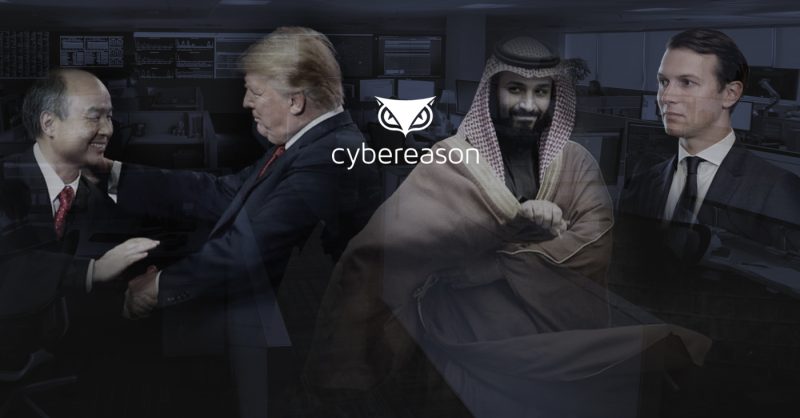
Graphic by Claudio Cabrera
By Whitney Webb | MintPress News | January 14, 2020
If the networks of the U.S. military, the U.S. intelligence community and a slew of other U.S. federal agencies were running the software of a company with deep ties, not only to foreign companies with a history of espionage against the U.S. but also foreign military intelligence, it would — at the very least — garner substantial media attention. Yet, no media reports to date have noted that such a scenario exists on a massive scale and that the company making such software recently simulated the cancellation of the 2020 election and the declaration of martial law in the United States.
Earlier this month, MintPress News reported on the simulations for the U.S. 2020 election organized by the company Cybereason, a firm led by former members of Israel’s military intelligence Unit 8200 and advised by former top and current officials in both Israeli military intelligence and the CIA. Those simulations, attended by federal officials from the FBI, DHS and the U.S. Secret Service, ended in disaster, with the elections ultimately canceled and martial law declared due to the chaos created by a group of hackers led by Cybereason employees.
The first installment of this three part series delved deeply into Cybereason’s ties to the intelligence community of Israel and also other agencies, including the CIA, as well as the fact that Cybereason stood to gain little financially from the simulations given that their software could not have prevented the attacks waged against the U.S.’ electoral infrastructure in the exercise.
Also noted was the fact that Cybereason software could be potentially used as a backdoor by unauthorized actors, a possibility strengthened by the fact that the company’s co-founders all previously worked for firms that have a history of placing backdoors into U.S. telecommunications and electronic infrastructure as well as aggressive espionage targeting U.S. federal agencies.
The latter issue is crucial in the context of this installment of this exclusive MintPress series, as Cybereason’s main investors turned partners have integrated Cybereason’s software into their product offerings. This means that the clients of these Cybereason partner companies, the U.S. intelligence community and military among them, are now part of Cybereason’s network of more than 6 million endpoints that this private company constantly monitors using a combination of staff comprised largely of former intelligence operatives and an AI algorithm first developed by Israeli military intelligence.
Cybereason, thus far, has disclosed the following groups as lead investors in the company: Charles River Ventures (CRV), Spark Capital, Lockheed Martin and SoftBank. Charles River Ventures (CRV) was among the first to invest in Cybereason and has been frequently investing in other Israeli tech start-ups that were founded by former members of the elite Israeli military intelligence Unit 8200 over the last few years. Spark Capital, based in California, appears to have followed CRV’s interest in Cybereason since the venture capitalist who co-founded Spark and led its investment in Cybereason is a former CRV partner who still has close ties to the firm.
While CRV and Spark Capital seem like just the type of investors a company like Cybereason would attract given their clear interest in similar tech start-ups coming out of Israel’s cyber sector, Cybereason’s other lead investors — Lockheed Martin and SoftBank — deserve much more attention and scrutiny.
Cybereason widely used by US Government, thanks to Lockheed
“A match made in heaven,” trumpeted Forbes at the news of the Lockheed Martin-Cybereason partnership, first forged in 2015. The partnership involved not only Lockheed Martin becoming a major investor in the cybersecurity company but also in Lockheed Martin becoming the largest conduit providing Cybereason’s software to U.S. federal and military agencies.
Indeed, as Forbes noted at the time, not only did Lockheed invest in the company, it decided to integrate Cybereason’s software completely into its product portfolio, resulting in a “model of both using Cybereason internally, and selling it to both public and private customers.”
Cybereason CEO and former offensive hacker for Israeli military intelligence — Lior Div — said the following of the partnership:
Lockheed Martin invested in Cybereason’s protection system after they compared our solution against a dozen others from the top industry players. The US firm was so impressed with the results they got from Cybereason that they began offering it to their own customers – among them most of the top Fortune 100 companies, and the US federal government. Cybereason is now the security system recommended by LM to its customers for protection from a wide (sic) malware and hack attacks.”
Rich Mahler, then-director of Commercial Cyber Services at Lockheed Martin, told Defense Daily that the company’s decision to invest in Cybereason, internally use its software, and include the technology as part of Lockheed Martin’s cyber solutions portfolio were all “independent business decisions but were all coordinated and timed with the transaction.”
How independent each of those decisions actually was is unclear, especially given the timing of Lockheed Martin’s investment in Cybereason, whose close and troubling ties to Israeli intelligence as well as the CIA were noted in the previous installment of this investigative series. Indeed, about a year prior to their investment in the Israeli military intelligence-linked Cybereason, Lockheed Martin opened an office in Beersheba, Israel, where the IDF has its “cyberhub”. The office is focused not on the sales of armaments, but instead on technology.
Marilyn Hewson, Lockheed Martin’s CEO, said the following during her speech that inaugurated the company’s Beersheba office:
The consolidation of IDF Technical Units to new bases in the Negev Desert region is an important transformation of Israel’s information technology capability… We understand the challenges of this move. Which is why we are investing in the facilities and people that will ensure we are prepared to support for these critical projects. By locating our new office in the capital of the Negev we are well positioned to work closely with our Israeli partners and stand ready to: accelerate project execution, reduce program risk and share our technical expertise by training and developing in-country talent.”
Beersheba not only houses the IDF’s technology campus, but also the Israel National Cyber Directorate, which reports directly to Israel’s Prime Minister, as well as a high-tech corporate park that mostly houses tech companies with ties to Israel’s military intelligence apparatus. The area has been cited in several media reports as a visible indicator of the public-private merger between Israeli technology companies, many of them started by Unit 8200 alumni, and the Israeli government and its intelligence services. Lockheed Martin quickly became a key fixture in the Beersheba-based cyberhub.
Not long before Lockheed began exploring the possibility of opening an office in Beersheba, the company was hacked by individuals who used tokens tied to the company, RSA Security, whose founders have ties to Israel’s defense establishment and which is now owned by Dell, a company also deeply tied to the Israeli government and tech sector. The hack, perpetrated by still unknown actors, may have sparked Lockheed’s subsequent interest in Israel’s cybersecurity sector.
Soon after opening its Beersheba office, Lockheed Martin created its Israel subsidiary, Lockheed Martin Israel. Unlike many of the company’s other subsidiaries, this one is focused exclusively on “cybersecurity, enterprise information technology, data centers, mobile, analytics and cloud” as opposed to the manufacture and design of armaments.
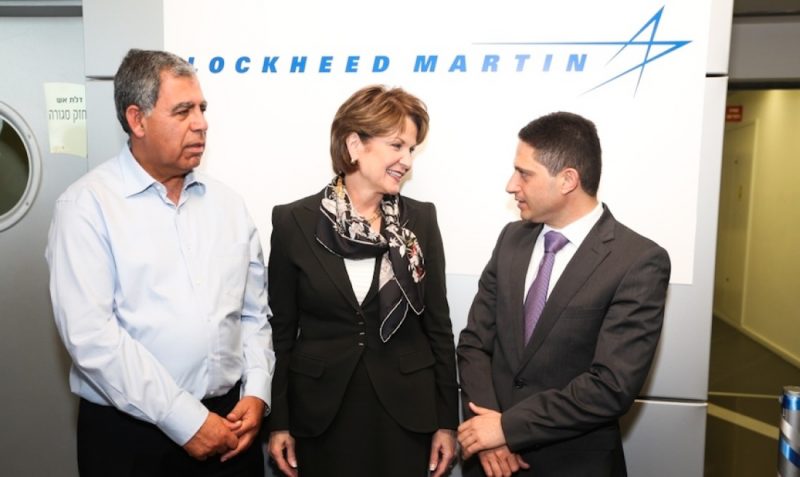
Marillyn Hewson, center, poses with Israeli gov. officials at the opening of Lockheed Martin’s facility in Beersheba. Photo | Diego Mittleberg
Haden Land, then-vice president of research and technology for Lockheed Martin, told the Wall Street Journal that the creation of the subsidiary was largely aimed at securing contracts with the IDF and that the company’s Israel subsidiary would soon be seeking partnership and investments in pursuit of that end. Land oversaw the local roll-out of the company’s Israel subsidiary while concurrently meeting with Israeli government officials. According to the Journal, Land “oversees all of Lockheed Martin’s information-systems businesses, including defense and civilian commercial units” for the United States and elsewhere.
Just a few months later, Lockheed Martin partnered and invested in Cybereason, suggesting that Lockheed’s decision to do so was aimed at securing closer ties with the IDF. This further suggests that Cybereason still maintains close ties to Israeli military intelligence, a point expounded upon in great detail in the previous installment of this series.
Thus, it appears that not only does Lockheed Martin use Cybereason’s software on its own devices and on those it manages for its private and public sector clients, but it also decided to use the company’s software in this way out of a desire to more closely collaborate with the Israeli military in matters related to technology and cybersecurity.
The cozy ties between Lockheed Martin, one of the U.S. government’s largest private contractors, and the IDF set off alarm bells, then and now, for those concerned with U.S. national security. Such concern makes it important to look at the extent of Cybereason’s use by federal and military agencies in the United States through their contracting of Lockheed Martin’s Information Technology (IT) division. This is especially important considering Israeli military intelligence’s history of using espionage, blackmail and private tech companies against the U.S. government, as detailed here.
While the exact number of U.S. federal and military agencies using Cybereason’s software is unknown, it is widespread, with Lockheed Martin’s IT division as the conduit. Indeed, Lockheed Martin was the number one IT solutions provider to the U.S. federal government up until its IT division was spun off and merged with Leidos Holdings. As a consequence, Leidos is now the largest IT provider to the U.S. government and is also directly partnered with Cybereason in the same way Lockheed Martin was. Even after its IT division was spun off, Lockheed Martin continues to use Cybereason’s software in its cybersecurity work for the Pentagon and still maintains a stake in the company.
The Leidos-Lockheed Martin IT hybrid provides a litany of services to the U.S. military and U.S. intelligence. As investigative journalist Tim Shorrock noted for The Nation, the company does “everything from analyzing signals for the NSA to tracking down suspected enemy fighters for US Special Forces in the Middle East and Africa” and, following its merger with Lockheed and consequential partnership with Cybereason, became “the largest of five corporations that together employ nearly 80 percent of the private-sector employees contracted to work for US spy and surveillance agencies.” Shorrock also notes that these private-sector contractors now dominate the mammoth U.S. surveillance apparatus, many of them working for Leidos and — by extension — using Cybereason’s software.
Leidos’ exclusive use of Cybereason software for cybersecurity is also relevant for the U.S. military since Leidos runs a number of sensitive systems for the Pentagon, including its recently inked contract to manage the entire military telecommunications infrastructure for Defense Information Systems Agency (DISA). In addition to maintaining the military telecom network, Cybereason is also directly partnered with World Wide Technologies (WWT) as of this past October. WWT manages cybersecurity for the U.S. Army, maintains DISA’s firewalls and data storage as well as the U.S. Air Force’s biometric identification system. WWT also manages contracts for NASA, itself a frequent target of Israeli government espionage, and the U.S. Navy. WWT’s partnership is similar to the Lockheed/Leidos partnership in that Cybereason’s software is now completely integrated into its portfolio, giving the company full access to the devices on all of these highly classified networks.
Many of these new partnerships with Cybereason, including its partnership with WWT, followed claims made by members of Israel’s Unit 8200 in 2017 that the popular antivirus software of Kaspersky Labs contained a backdoor for Russian intelligence, thereby compromising U.S. systems. The Wall Street Journal was the first to report on the alleged backdoor but did not mention the involvement of Unit 8200 in identifying it, a fact revealed by the New York Times a week later.
Notably, none of the evidence Unit 8200 used to blame Kaspersky has been made public and Kaspersky noted that it was actually Israeli hackers that had been discovered planting backdoors into its platform prior to the accusation levied against Kaspersky by Unit 8200. As the New York Times noted:
Investigators later discovered that the Israeli hackers had implanted multiple back doors into Kaspersky’s systems, employing sophisticated tools to steal passwords, take screenshots, and vacuum up emails and documents.”
Unit 8200’s claims ultimately led the U.S. government to abandon Kaspersky’s products entirely in 2018, allowing companies like Cybereason (with its own close ties to Unit 8200) to fill the void. Indeed, the very agencies that banned Kaspersky now use cybersecurity software that employs Cybereason’s EDR system. No flags have been raised about Cybereason’s own collaboration with the very foreign intelligence service that first pointed the finger at Kaspersky and that previously sold software with backdoors to sensitive U.S. facilities.
SoftBank, Cybereason and the Vision Fund
While its entry into the U.S. market and U.S. government networks is substantial, Cybereason’s software is also run throughout the world on a massive scale through partnerships that have seen it enter into Latin American and European markets in major ways in just the last few months. It has also seen its software become prominent in Asia following a partnership with the company Trustwave. Much of this rapid expansion followed a major injection of cash courtesy of one of the company’s biggest clients and now its largest investor, Japan’s SoftBank.
SoftBank first invested in Cybereason in 2015, the same year Lockheed Martin initially invested and partnered with the firm. It was also the year that SoftBank announced its intention to invest in Israeli tech start-ups. SoftBank first injected $50 million into Cybereason, followed by an additional $100 million in 2017 and $200 million last August. SoftBank’s investments account for most of the money raised by the company since it was founded in 2012 ($350 million out of $400 million total).

Cybereason CEO Lior Div speaks at a SoftBank event in Japan, July 21, 2017. Photo | Cybereason
Prior to investing, Softbank was a client of Cybereason, which Ken Miyauchi, president of SoftBank, noted when making the following statement after Softbank’s initial investment in Cybereason:
SoftBank works to obtain cutting edge technology and outstanding business models to lead the Information Revolution. Our deployment of the Cybereason platform internally gave us firsthand knowledge of the value it provides, and led to our decision to invest. I’m confident Cybereason and SoftBank’s new product offering will bring a new level of security to Japanese organizations.”
SoftBank — one of Japan’s largest telecommunications companies — not only began to deploy Cybereason internally but directly partnered with it after investing, much like Lockheed Martin had done around the same time. This partnership resulted in SoftBank and Cybereason creating a joint venture in Japan and Cybereason creating partnerships with other tech companies acquired by SoftBank, including the U.K.’s Arm, which specializes in making chips and management platforms for Internet of Things (IoT) devices.
SoftBank’s interest in Cybereason is significant, particularly in light of Cybereason’s interest in the 2020 U.S. election, given that SoftBank has significant ties to key allies of President Trump and even the president himself.
Indeed, SoftBank’s Masayoshi Son was among the first wave of international business leaders who sought to woo then-president-elect Trump soon after the 2016 election. Son first visited Trump Tower in December 2016 and announced, with Trump by his side in the building’s lobby, that SoftBank would invest $50 billion in the U.S. and create 50,000 jobs. Trump subsequently claimed on Twitter that Son had only decided to make this investment because Trump had won the election.
Son told reporters at the time that the investment would come from a $100 billion fund that would be created in partnership with Saudi Arabia’s sovereign wealth fund as well as other investors. “I just came to celebrate his new job. I said, ‘This is great. The US will become great again,’” Son said, according to reports.
Then, in March of 2017, Son sent top SoftBank executives to meet with senior members of Trump’s economic team and, according to the New York Times, “the SoftBank executives said that because of a lack of advanced digital investments, the competitiveness of the United States economy was at risk. And the executives made the case, quite strongly, that Mr. Son was committed to playing a major role in addressing this issue through a spate of job-creating investments.” Many of SoftBank’s investments and acquisitions in the U.S. since then have focused mainly on artificial intelligence and technology with military applications, such as “killer robot” firm Boston Dynamics, suggesting Son’s interest lies more in dominating futuristic military-industrial technologies than creating jobs for the average American.
After their initial meeting, Trump and Son met again a year later in June 2018, with Trump stating that “His [Son’s] $50 billion turned out to be $72 billion so far, he’s not finished yet.” Several media reports have claimed that Son’s moves since Trump’s election have sought to “curry favor” with the President.
Through the creation of this fund alongside the Saudis, SoftBank has since become increasingly intertwined with Saudi Crown Prince Muhammad bin Salman (MBS), a key ally of President Trump in the Middle East known for his authoritarian crackdowns on Saudi elites and dissidents alike. The ties between Saudi Arabia and SoftBank became ever tighter when MBS took the reins in the oil kingdom and after SoftBank announced the launch of the Vision Fund in 2016. SoftBank’s Vision Fund is a vehicle for investing in hi-tech companies and start-ups and its largest shareholder is the Public Investment Fund of Saudi Arabia. Notably, Son decided to launch the Vision Fund in Riyadh during President Trump’s first official visit to the Gulf Kingdom.
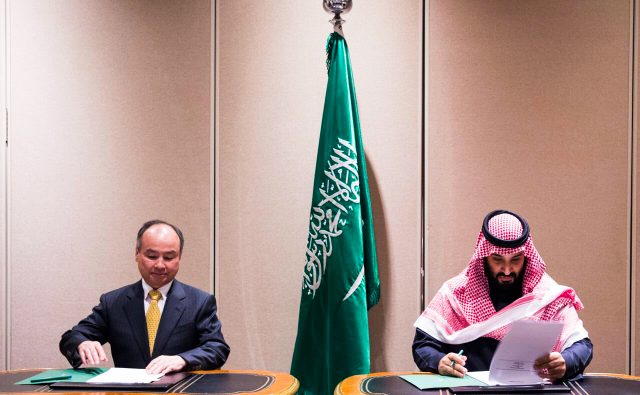
Masayoshi Son, left, signs a deal related to the Vision Fund with Bin Salman in March 2018. Photo | SPA
In addition, the Mubadala Investment Company, a government fund of the United Arab Emirates (UAE), gave $15 billion to the Vision Fund. UAE leadership also share close ties to the Trump administration and MBS in Saudi Arabia.
As a consequence, SoftBank’s Vision Fund is majority funded by two Middle Eastern authoritarian governments with close ties to the U.S. government, specifically the Trump administration. In addition, both countries have enjoyed the rapid growth and normalization of ties with the state of Israel in recent years, particularly following the rise of current Saudi Crown Prince Muhammad bin Salman and Jared Kushner’s rise to prominence in his father-in-law’s administration. Other investments in the Vision Fund have come from Apple, Qualcomm and Oracle’s Larry Ellison, all tech companies with strong ties to Israel’s government.
The Saudi and Emirati governments’ links to the Vision Fund are so obvious that even mainstream outlets like the New York Times have described them as a “front for Saudi Arabia and perhaps other countries in the Middle East.”
SoftBank also enjoys close ties to Jared Kushner, with Fortress Investment Group lending $57 million to Kushner Companies in October 2017 while it was under contract to be acquired by SoftBank. As Barron’s noted at the time:
When SoftBank Group bought Fortress Investment Group last year, the Japanese company was buying access to a corps of seasoned investors. What SoftBank also got is a financial tie to the family of President Donald Trump’s senior advisor and son-in-law, Jared Kushner.”
According to The Real Deal, Kushner Companies obtained the financing from Fortress only after its attempts to obtain funding through the EB-5 visa program for a specific real estate venture were abandoned after the U.S. Attorney and the Securities and Exchange Commission began to investigate how Kushner Companies used the EB-5 investor visa program. A key factor in the opening of that investigation was Kushner Companies’ representatives touting Jared Kushner’s position at the White House when talking to prospective investors and lenders.
SoftBank also recently came to the aid of a friend of Jared Kushner, former CEO of WeWork Adam Neumann. Neumann made shocking claims about his ties to both Kushner and Saudi Arabia’s MBS, even asserting that he had worked with both in creating Kushner’s long-awaited and controversial Middle East “peace plan” and claimed that he, Kushner and MBS would together “save the world.” Neumann previously called Kushner his “mentor.” MBS has also discussed on several occasions his close ties with Kushner and U.S. media reports have noted the frequent correspondence between the two “princelings.”
Notably, SoftBank invested in Neumann’s WeWork using money from the Saudi-dominated Vision Fund and later went on to essentially bail the company out after its IPO collapse and Neumann was pushed out. SoftBank’s founder, Masayoshi Son, had an odd yet very close relationship with Neumann, perhaps explaining why Neumann was allowed to walk with $1.7 billion after bringing WeWork to the brink of collapse. Notably, nearly half of SoftBank’s approximately $47 billion investments in the U.S. economy since Trump’s election, went to acquiring and then bailing out WeWork. It is unlikely that such a disastrous investment resulted in the level of job creation that Son had promised Trump in 2016.
Given that it is Cybereason’s top investor and shareholder by a large margin, SoftBank’s ties to the Trump administration and key allies of that administration are significant in light of Cybereason’s odd interest in 2020 U.S. election scenarios that end with the cancellation of this year’s upcoming presidential election. It goes without saying that the cancellation of the election would mean a continuation of the Trump administration until new elections would take place.
Furthermore, with Cybereason’s close and enduring ties to Israeli military intelligence now well-documented, it is worth asking if Israeli military intelligence would consider intervening in 2020 if the still-to-be-decided Democratic contender was strongly opposed to Israeli government policy, particularly Israel’s military occupation of Palestine. This is especially worth considering given revelations that sexual blackmailer and pedophile Jeffrey Epstein, who targeted prominent U.S. politicians, mostly Democrats, was in the employ of Israeli military intelligence.
Notably, Cybereason’s doomsday election scenarios involved the weaponization of deep fakes, self-driving cars and the hacking Internet of Things devices, with all of those technologies being pioneered and perfected — not by Russia, China or Iran — but by companies directly tied to Israeli intelligence, much like Cybereason itself. These companies, their technology and Cybereason’s own work creating the narrative that U.S. rival states seek to undermine the U.S. election in this way, will all be discussed in the conclusion of MintPress’ series on Cybereason and its outsized interest in the U.S. democratic process.
Whitney Webb is a MintPress News journalist based in Chile. She has contributed to several independent media outlets including Global Research, EcoWatch, the Ron Paul Institute and 21st Century Wire, among others. She has made several radio and television appearances and is the 2019 winner of the Serena Shim Award for Uncompromised Integrity in Journalism.
Trump and Congress Double Down on Demonizing Iran
Will the national security nightmare ever end?
By Philip Giraldi • Unz Review • January 14, 2020
If one seriously seeks to understand how delusional policymakers in Washington are it is only necessary to examine the responses by the president and Congress to the assassination of Iranian Major General Qassem Soleimani. The first response came in the form of a Donald Trump largely incoherent nine-minute self-applauding speech explaining what he had done and why. It was followed by a House of Representatives War Powers non-binding resolution that was all theater and did nothing to limit the president’s unilateral ability to go to war with the Islamic Republic.
It was reported that the Trump speech had been hurriedly written by aides the night before it was given and that it existed in several competing drafts. It was full of out-and-out lies and half truths and intended to reassure the American people that the president was keeping them safe. The opening line might well be regarded as some kind of joke: “As long as I am President of the United States, Iran will never be allowed to have a nuclear weapon.” Trump has in fact done more to ensure that Iran will have a nuclear weapon than any other president through his abrupt withdrawal from the Joint Comprehensive Plan Of Action (JCPOA) and his assassination of Soleimani, which together have convinced the Iranian leadership that there is no possibility of a reasonable negotiated solution when dealing with the American president, even when he claims he wants to “talk.”
Trump then went on characteristically to eulogize our brave soldiers on far flung battlefields before lying again, saying “For far too long — all the way back to 1979, to be exact — nations have tolerated Iran’s destructive and destabilizing behavior in the Middle East and beyond. Those days are over. Iran has been the leading sponsor of terrorism, and their pursuit of nuclear weapons threatens the civilized world. We will never let that happen.” Lie one is that the “destructive and destabilizing behavior” actually has Made in U.S.A. stamped all over it. Lie two is “leading sponsor of terrorism,” an honor that belongs to Israel, Saudi Arabia and the United States, in that order. And lie three is that Iran “pursued” nuclear weapons. It has never done so.
Trump them boasted that “Last week, we took decisive action to stop a ruthless terrorist from threatening American lives. At my direction, the United States military eliminated the world’s top terrorist, Qasem Soleimani. As the head of the Quds Force, Soleimani was personally responsible for some of the absolutely worst atrocities.” Trump’s preening was again wrong on every count: Soleimani is no terrorist by any reasonable definition, nor is there any evidence that he threatened American lives. And Trump and his chorus of neocons cannot name a single “atrocity” committed by the man
The president claimed that Soleimani “… viciously wounded and murdered thousands of U.S. troops, including the planting of roadside bombs that maim and dismember their victims,” a particularly absurd charge suggesting that Trump believes that any American soldier who died in Iraq or Afghanistan did so at the hands of the Iranian Major General. By the same logic, the musical chairs series of American generals that have served in Afghanistan, Iraq and Syria have murdered hundreds of thousands of people. If Trump wants to start counting fatalities he should perhaps start with David Petraeus.
Piling Ossa on Pelion, Trump declared that Soleimani “… orchestrated the violent assault on the U.S. embassy in Baghdad. In recent days, he was planning new attacks on American targets, but we stopped him.” There is no evidence whatsoever to support either assertion and Trump then goes on to ascribe all the problems of the Middle East to Iran, ignoring the roles played by others, most notably Washington, Israel and the Saudis. He also roundly condemned the JCPOA before asserting falsely that “Three months ago, after destroying 100 percent of ISIS and its territorial caliphate, we killed the savage leader of ISIS, al-Baghdadi…” In reality, ISIS was defeated by the Syrian Army and its allies Russia and Iran, the very countries that Trump has continued to vilify even as he struts his anti-terrorist credentials. Qassem Soleimani played a major role in the destruction of ISIS.
The only good things in the Trump speech were that it was short and the president did not find it necessary to say a whole lot of good things about Israel. Interestingly, no one in the mainstream media or in the political chattering class made much effort to challenged Trump on the “facts” he cited, though there was some pushback from mostly Democratic congressmen who stated that they could not see any “imminent threat” in the evidence that the Administration produced during a classified briefing. The actual war powers concurrent resolution that passed in the House last Thursday was symptomatic of the unwillingness of the political opposition to take on the illegal and immoral wars in the Middle East themselves – it had no teeth and will not change anything.
The resolution’s subject line “Directing the President pursuant to section 5(c) of the War Powers Resolution to terminate the use of United States Armed Forces to engage in hostilities in or against Iran” actually is misleading. And the first thing the text does do is slam Iran with the same dubious “facts” employed by Trump, including that “The Government of Iran is a leading state sponsor of terrorism and engages in a range of destabilizing activities across the Middle East. Iranian General Qassem Soleimani was the lead architect of much of Iran’s destabilizing activities throughout the world.”
The resolution includes “In matters of imminent armed attacks, the executive branch should indicate to Congress why military action was necessary within a certain window of opportunity, the possible harm that missing the window would cause, and why the action was likely to prevent future disastrous attacks against the United States.” It then goes on to explain that “When the United States uses military force, the American people and members of the United States Armed Forces deserve a credible explanation regarding such use of military force…” because “The War Powers Resolution (50 U.S.C. 1541 et seq.) requires the President to consult with Congress ‘in every possible instance’ before introducing United States Armed Forces into hostilities.” It concludes with “Congress has not authorized the President to use military force against Iran.”
It would seem to be a devastating critique of the Trump Art of War but then comes the wiggle room “… Congress hereby directs the President to terminate the use of United States Armed Forces to engage in hostilities in or against Iran or any part of its government or military, unless Congress has declared war or enacted specific statutory authorization for such use of the Armed Forces; or such use of the Armed Forces is necessary and appropriate to defend against an imminent armed attack upon the United States, its territories or possessions, or its Armed Forces, consistent with the requirements of the War Powers Resolution. Nothing in this section may be construed to prevent the President from using military force against al Qaeda or associated forces…” In other words, all Trump has to do is claim “imminent threat” or that he is attacking “terrorist associated forces” and he is home free no matter what he does, particularly as the resolution itself is non-binding.
The sheer ignorance and arrogance of elites in Washington combined with a colonialist mentality that dismisses Asians and Africans as unthinking “wogs” who will do one’s bidding if they are confronted with punishment is currently on display. It was inevitable that Iraq would demand the departure of U.S. troops after thirty-four Iraqi militiamen were killed by American drone and air strikes, but many in Washington just didn’t get it. Trump threatened, in characteristic fashion, to respond with sanctions, but now Iraqi Prime Minister Adel Abdul Mahdi has made it official in a phone call to Secretary of State Mike Pompeo, demanding a plan and timetable for the removal of the American soldiers. The State Department has indicated that it is not prepared to discuss the matter.
Some pundits who should know better have predicted that the withdrawal of U.S. soldiers will not take place because Iraq somehow “needs” the United States. And besides, there will be economic consequences if Iraq does go ahead to insist on an American withdrawal. But sometimes abstractions prove to be more powerful than material incentives. The United States violated Iraqi sovereignty not once but twice and murdered 30 Iraqis in the process. Pompeo can huff and puff all he wants and Trump can mouth his illiteracies, but nothing changes the fact that the United States did things it did not have to do based on a delusional view of the Middle East and will have to pay a price. Minus a presence in Iraq, Syria will be untenable and one might hope that once the U.S. loses its ability to directly confront Iran on the ground the whole house of cards just might collapse, leading to Washington’s gradual departure from the region. That would be good for the region and also for the United States even if Israel and the Saudis, who prefer to have Americans fight and die in their wars, might object.
Philip M. Giraldi, Ph.D., is Executive Director of the Council for the National Interest, a 501(c)3 tax deductible educational foundation (Federal ID Number #52-1739023) that seeks a more interests-based U.S. foreign policy in the Middle East. Website is councilforthenationalinterest.org, address is P.O. Box 2157, Purcellville VA 20134 and its email is inform@cnionline.org.
US to Iraq: ‘Vote All You Want, We’re Not Leaving!’
By Ron Paul | January 13, 2020
President Trump’s decision earlier this month to assassinate Iran’s top military general on Iraqi soil – over the objection of the Iraqi government – has damaged the US relationship with its “ally” Iraq and set the region on the brink of war. Iran’s measured response – a few missiles fired on an Iraqi base after advance warning was given – is the only reason the US is not mired in another Middle East war.
Trump said his decision to assassinate Gen. Qassim Soleimani was intended to prevent a war, not start a war. But no one in his right mind would think that killing another country’s top military leader would not leave that country annoyed, to say the least. Senators Mike Lee (R-UT) and Rand Paul (R-KY) said the Trump Administration’s briefing to Congress on its evidence to back up claims that Soleimani was about to launch attacks against the US was among the worst briefings they’d ever attended.
After initially claiming that Soleimani had to be taken out immediately because of “imminent” attacks he was launching against the US, Trump Administration officials including Secretary of State Pompeo and Defense Secretary Esper have been busy walking back those claims. Esper claimed over the weekend that he had not seen the intelligence suggesting an attack on US embassies was in the works. If the Secretary of Defense did not seen the intelligence, then who did?
No doubt the Iraqi leadership recognized these kinds of deceptions: the same kinds of lies were used to push the US into attacking their own country in 2003. So it should not have come as a big surprise that the Iraqi government met last week and voted that all foreign military personnel should leave Iraqi soil.
Then a funny thing happened when the Iraqi prime minister attempted to communicate to the US government the will of the Iraqi people through their democratically-elected officials. On Thursday Iraqi Prime Minister Mahdi phoned Pompeo to urgently request that Washington enact a US troop “withdrawal mechanism” in Iraq. American troops are in Iraq by invitation of the Iraqi government and the Iraqi government had just voted to revoke that invitation.
The State Department responded with a statement titled “The US Continued Partnership with Iraq,” in which it essentially said that the US would not abide by the request of its Iraqi partners because the US military is a “force for good” in the Middle East and that as such it is “our right” to maintain “appropriate force posture” in the region.
The US invaded Iraq based on Bush Administration lies and a million Iraqis died as a result. Later, President Obama ramped up the drone program and also backed al-Qaeda affiliated terrorists to overthrow the secular Syrian government. Obama also attacked Libya based on lies, leaving the country totally destroyed. Trump is assassinating foreign officials and threatening destruction of Iran.
And the State Department calls that a “force for good”?
The United States can be a true force for good, however. End the military occupation of the Middle East, end foreign military aid, stop using the CIA to overthrow governments. Allow Americans to travel and do business in any country they wish. Lead by example and demonstrate how free markets and peace benefit all. A “force for good” means not forcing others to bow to your will.
Copyright © 2020 by RonPaul Institute.
U.S. Media Says Russia the True Winner in Hostilities Against Iran
By Paul Antonopoulos | January 13, 2020
While the final outcome of the U.S.-Iran conflict is not yet clear, US media outlets and think tanks are already claiming that Russian President Putin is the winner. The U.S.-Iran hostilities have undermined Washington’s confidence and reputation in the region, allowing Russian influence in the Middle East to increase as a force for peace and stability. While it is unclear exactly how Moscow can benefit from escalations between Washington and Tehran, U.S. media are convinced that any outcome will be consistent with the Kremlin’s plans to increase its political influence in the region and create a rift between Washington and its allies.
This simplistic explanation does not account the fact that Moscow has a clear foreign policy to achieve its geopolitical goals in the Middle East while Washington mostly depends on their own internal contradictions and events on the domestic political scene to guide their foreign policy. The assassination of Iranian General Soleimani, made on orders from Trump, questions whether this was to demonstrate his power and determination to protect U.S. national interests in the face of domestic criticisms, to serve Evangelical Christian interests on behalf of Israel, or part of a clear guided policy that the U.S. has for the Middle East.
The Democrats are trying to show the public that everything Trump does is contributing more to Russian interests rather than American. It appears that the Democratic Party will continue with the same rhetoric to try and win this year’s election.
Moscow maintains good relations with all countries in the Middle East region and there is no country with which Russia has an openly hostile relationship. Moscow successfully balances its relations between Saudi Arabia, Iran, Syria and Israel, while the U.S. attempts to divide the region into competing camps with no interest of defusing tensions, suggesting that even if Washington has a clearly defined Middle East policy, it is one based on division and destruction rather than one of balance and peace.
As a result of the assassination of General Soleimani, calls for U.S. troops to withdraw from Iraq under pressure from local authorities have been made. Without troops in Iraq, the Americans are incapable of retaining their positions in Syria, which increases Russia’s manoeuvring space, strengthens its positions, influence, and opens space for filling the political vacuum. The U.S. has become embroiled with so many Middle Eastern countries that it is now struggling to cope to withdraw. Washington has already tried to withdraw its troops from Iraq during the Obama era.
But it is one thing to militarily withdraw on your own will and based on your decision, and another to withdraw because you have been asked too. Although the U.S. criticizes Iranian influence across the region and claims the Islamic Republic is acting in an aggressive manner, the Trump administration has not even hid away from the fact its an occupying force by flatly refusing to withdraw from Iraq despite being told to by the country’s parliament.
However it was the assassination of Soleimani that the most ridiculous claims were being made about, with Bloomberg even suggesting that Putin needs a “Plan B” because the Iranian General’s death disrupted Russian plans for Syria, Iran and Turkey. This scenario implied that Trump’s aggressive actions would elicit an even more aggressive response from the Iranian side, eventually leading to an escalation of the conflict in which Tehran lacked adequate defense capabilities. This implies that Iran will lose the status of a regional power and Russia will have no choice but to betray Syria. This option quickly disappeared from the media space as reality completely denied this possibility.
As for Putin’s victory, many cite the fact that many European leaders are increasingly turning to Russia as a reliable partner in face of Trump’s unpredictability. It is fair to say that the U.S. strategy in the Middle East is a mystery even to U.S. allies. With Washington being unrelenting in attempting to maintain the unipolar world order, it has forced Europeans to cooperate with reliable Russia.
This is not the first time that Washington has made a problem for its allies, citing the example of the U.S. invasion of Iraq in 2003 when Germany and France, along with Russia, protested U.S. President George Bush and his actions. While Iraq was an example of typical aggression, the Americans did not lose allies because of this, nor did NATO disintegrate. However, domestic politics has always been a major focus for U.S. presidents, obviously, which in turn can influence foreign policy decisions for internal political use. In the case of killing an Iranian general and in the propaganda that Russia is the victor in the U.S.-Iran conflict, nothing new has happened.
Paul Antonopoulos is a Research Fellow at the Center for Syncretic Studies.
Esper Contradicts Trump: “Didn’t See” Specific Evidence Of Iran Plot To Attack 4 Embassies
By Tyler Durden – Zero Hedge – 01/12/2020
When late last week President Trump first referenced a Soleimani-directed plot to “blow up” the US embassy in Baghdad, which during a Friday Fox interview became in the president’s words “I believe it would’ve been four embassies” — senators which had been given a classified briefing Wednesday balked, saying no such intelligence was referenced but should have been if there was evidence.
And now no less than Secretary of Defense Mark Esper appears to have publicly contradicted the White House’s rationale for taking out the “imminent” threat of Qasem Soleimani. Esper told CBS’ Face the Nation on Sunday that he “didn’t see” specific evidence for embassy attacks, while adding that he still believes such an attack was likely.
“The president didn’t cite a specific piece of evidence. What he said was he believed,” Esper said.
“What the president said was that there probably could be additional attacks against embassies. I shared that view,” Esper said. “The president didn’t cite a specific piece of evidence.”
When pressed on whether intelligence officers offered concrete evidence on that point he said: “I didn’t see one with regards to four embassies.” — Reuters
During a separate CNN interview on Sunday, the Pentagon chief continued to awkwardly dance around the question of whether specific intelligence showed such an attack was being planned. Esper described that Trump merely “believed” it to be the case, while refusing to confirm any particular intelligence.
But earlier statements of Secretary of State Mike Pompeo, who before reporters defended Trump’s assertion about the IRGC targeting the embassies, suggested there was specific intelligence.
When Pompeo was pressed on Friday by reporters over the nature of the “imminent threat” claims, he said: “We had specific information on an imminent threat and that threat stream included attacks on U.S. embassies. Period. Full stop.” And asked about what made it imminent, Pompeo simply said: “It was going to happen.”
At first it was unclear whether President Trump was claiming to have seen specific intelligence outlining such a threat, or perhaps was just speaking generally and in his usual hyperbolic style (“blow up” the embassy) of the pro-Iranian mob’s actions besieging the US embassy in Baghdad days prior to the Soleimani assassination.
The demonstrators had been filmed setting the outer walls of the compound on fire during the chaotic events nearly two weeks ago which resulted in a contingent of Marines rapidly deploying from Kuwait to bolster embassy security.
So now Esper appears to be saying it was Trump’s personal belief, while Pompeo appeared to base it on “specific information” — in other words direct intelligence. But which is it?
It can’t be both ways.
Like the Bush administration’s famously evolving rationale for the war in Iraq, are we witnessing the narrative on Iran made up on the fly?
Western media coverage of Russia as an exercise in propaganda
By Gilbert Doctorow | January 12, 2020
The notion of “fake news” has entered our vocabulary as a pejorative term for dissemination of bogus information, usually by social media, sometimes by traditional print and electronic channels which happen to hold positions contradicting the tenets of our conventional wisdom, i.e., liberal democracy. The term has been applied to Russian state owned media such as RT to justify denying such outlets normal journalistic credentials and privileges.
In this essay, I will employ the more traditional term propaganda, which I take to mean the manipulation of information which may or may not be factually true in order to achieve objectives of denigrating rivals for influence and power in the world, and in particular for denigrating Russia and the “Putin regime.”
The working tools of such propaganda are
- tendentious determination of what constitutes news, which build on the inherent predisposition of journalism to feature the negative and omit the positive from daily reporting while they carry this predisposition to preposterous lengths
- the abandonment of journalism’s traditional “intermediation,” meaning provision of necessary context to make sense of the facts set out in the body of a news report. In this regard, the propagandistic journalist does not deliver the essential element of paid-for journalism which should distinguish it from free “fake news” on social media and on the internet more broadly
- silence, meaning under-reporting or zero reporting of inconvenient news which contradicts the conventional wisdom or might prompt the reader-viewer to think for himself or herself. As a colleague and comrade in arms, professor Steve Cohen of Princeton and NYU, has said in his latest book War with Russia? : the century old motto of The New York Times “All the news that’s fit to print” has in our day turned into “All the news that fits.”
Demonstrations of the arguments I present here could easily fill a book if not a library shelf. However, I think for purposes of this essay, it suffices to adduce several examples of the three violations of professional journalism giving us a constant stream of propaganda about Russia and its political leadership by offering a few reports drawn from the very cream of our print and electronic media. In particular, I have chosen as markers the Financial Times and the BBC. The use of propaganda methods in their coverage of Russia is all the more telling and damaging, given that in a great many domains these channels otherwise represent some of the highest quality standards to be found in reporting anywhere today and consequently enjoy the respect of their subscribers and visitors, who little suspect they could be so prejudicial in their coverage of select domains like Russia.
* * * *
As 2019 drew to a close, many of our media outlets drew attention to two Russia-related anniversaries: the just celebrated thirtieth anniversary of the fall of the Berlin Wall with the retreat of Soviet armed forces from Eastern Europe that it touched off; and the soon to be celebrated twentieth year of Vladimir Putin’s hold on power in the Kremlin. Both subjects may be fairly called news worthy and so fully correspond to traditional journalistic values. What has been exceptional and unacceptable has come in the second category of violations listed above – lack of context.
Starting in October 2019, the BBC’s Moscow correspondent Steve Rosenberg did several programs dedicated to the fall of the Berlin Wall. During the Christmas to New Year’s period, the BBC aired one program which consisted of two parts. In the first half, Rosenberg considered the impact of the withdrawal of Russian forces from East Germany on the Russians themselves and interviewed the former chief of those forces, who explained at length how they “came home” to shocking living conditions in the provinces, how they were abandoned to their fate by their own government. The tone of the reporting was sympathetic to Russians’ hardships and it was good that their side of the story from the ground up was given the microphone. What implied criticism there was of the powers that be came from a patriotic source. However, the second half of the program was turned over to a certain Lydia Shevtsova, a very outspoken Putin-hater, formerly with the Carnegie Center Moscow, till she was finally booted out and moved to a more congenial and supportive think tank, Chatham House, in London, where her anti-Russian vitriol is encouraged and disseminated by her co-author, ex-British ambassador to Moscow Sir Andrew Wood. Among the gem quotations which Shevtsova delivered was the claim that Russia under Putin is a declining power which is capable only of disrupting the world order, a spoiler not capable of any creative or productive contribution. Of course, Shevtsova has a right to her opinions, however the BBC had an obligation to its audience to explain exactly who the lady is and, if they wanted to practice fair play, to offer an alternative interpretation of what Vladimir Putin’s Russia stands for on the global stage today. They did not do either. The result was pure propaganda not news and analysis.
As for violations in the categories one and two above, a very good example arose following the recent publication of a study performed by the Levada Center public opinion polling organization in Moscow during October which showed that “53 per cent of 18-to-24 year-olds wanted to leave the country.” This was written about by many of our news peddlers, including FT. The decision to feature this factoid and use it to support claims that the Putin regime’ is a failure fits well with tendentiousness of our news coverage. Meanwhile, nearly all coverage of that study, including in the Financial Times, offered no contextual information whatsoever, when the context was begging to be told.
The article in FT which carried the Levada Center findings was published on 9 January as “Generation Putin: how young Russians view the only leader they’ve ever known.” The remarks on Levada followed directly on another statement begging for context: “Youth unemployment in Russia is more than three times the rate of the total population, according to 2018 data, compared with just twice the rate in 2000.”
First, as regards those 53% would-be “leavers,” one might ask: and so, why don’t they just leave? Russia today is truly a free country: anyone other than convicted felons who wants a passport can get it, and get it rather quickly. And thanks to the efforts of their remarkably hard-working Ministry of Foreign Affairs, most of the world welcomes Russian travelers without a visa requirement. But for that matter, getting a Schengen visa for the EU is not so complicated either.
However, those 53% are, in fact, not going anywhere. They are just sounding off about their youthful disgruntlement with a world created and run by their parents.
At the same time, as the Financial Times editorial board knows full well, young, middle-aged and even old have been leaving the Baltic States, Bulgaria, Romania and other former Soviet Bloc countries in droves, for the past thirty years up to the present day. That was the subject of an article published in the FT on the next day, 10 January 2020 under a title which speaks for itself: “Shrinking Europe.” The states I mentioned here have seen 25 and 30% loss of their population to citizens voting with their feet and departing the shrinking economies and personal prospects which result directly from deindustrialization and economic colonization by Germany and other founding Member States of the EU since 1991. The issue appears in the news now because, as the FT explains, “Andrej Plenkovic, the Croatian prime minister, has decided to elevate population decline to the top of his agenda as Zagreb assumes the EU’s rotating presidency.” Good for him! Now that the skeleton has finally come out of the EU closet, all the stories about Russia’s demographic crisis can be put in context – by those few who wish to do so.
Second, as regards unemployment in Russia today, I believe that similar ratios of youth unemployment to the general population unemployment can be found most everywhere in Western Europe if not in the world at large. The fact that this ratio has worsened comparatively in Russia since 2000 may be explained by the anomalous situation in Russia prevailing throughout the 1990s in step with the economic collapse that accompanied the transition to a market economy. Precisely the older generations, those over 40, were thrown into the street and their children or grandchildren were the first to be hired by the newly emerging industrial conglomerates, not to mention by Western multinationals settling in. What has happened since 2000 is merely a reversion to more normal distribution of employment and unemployment in the population as the Russian economy stabilizes.
Dear Reader!
For those who find my examples above too subtle to support my argument for egregious propagandistic treatment of Russia in our media, allow me to introduce violation number three, silence, in a way that should sweep away all objections to my thesis.
I draw your attention to an event that occurred in the past week about which you probably know nothing, or perhaps a wee bit from the odd man out reporting in the Wall Street Journal and a few other outlets. I am talking about the visit of Vladimir Putin to Damascus on Tuesday, 7 January. To their credit, the WSJ carried a short article in their 8 January edition, but went no further than to note this was the second visit by Putin since the Russians joined the fight in support of President Bashar Assad back in September 2015, turning the tide in the civil war his way. That is true, but only represents a tiny slice of what all our journalists, including the WSJ’s could have and possibly did learn from watching Russian state television on the 7th. What our media chose not to report was passed over in silence because it shows the complexity of Russia’s policy in the Middle East that includes but goes well outside the domain of pure geopolitics. This is so not least because of the date chosen for the visit, which happens to be Orthodox Christmas.
On the evening of the 6th, that is to say on Christmas eve, by the Russian Orthodox calendar, Russian state television broadcast live coverage of the Christmas service in the Christ the Savior cathedral in Moscow officiated by Patriarch Kirill, with prime minister Medvedev present on behalf of the Government. Then it cut to the service in St Petersburg, where Vladimir Putin sat in the congregation, as is his custom. The commentator mentioned in passing that the Patriarch’s father, a parish priest, just happened to be the one who baptized Vladimir Putin as a child where they all lived, in the Northern Capital.
The next coverage of Putin on state television was from Damascus on the 7th, where he obviously arrived on a night flight from Petersburg. I did not see video coverage [video coverage has now been posted] … But still photos and reports on state television informed us that Putin had not merely held talks with President Assad on the Russian military base outside the capital, but had strolled together with him down the streets of Damascus, had visited the main church in the (still existing) Christian quarter of the city, had presented to the Patriarch of Antioch an icon of the Virgin and had also gone on to visit the city’s oldest and largest mosque.
What you have here is precisely the second line of justification for Russian presence in Syria alongside military/geopolitical reasons: resuming Russia’s 19th century role as protector of the Orthodox population in the Holy Land and the broader Middle East. A similar role was exercised back then by France on behalf of the Catholic populations, but that since has been totally negated by rampant secularism and multiculturalism in Western Europe.
It also has to be said that Putin’s visit to Damascus was back-to-back with other very high visibility political statements: his visit to Istanbul on the 8th for the official opening of the TurkSteam gas pipeline and for lengthy talks with President Erdogan that ended in a joint statement calling for a truce in the Libyan civil war for which Russia and Turkey support opposing sides; and his visit on the 9th to Russian naval exercises in the Eastern Mediterranean that included the launch of Russia’s latest hypersonic missiles, the reality of which U.S. and other Western experts have yet to acknowledge.
With this I rest my case on the unfortunate propagandistic behavior of our media which deprive the broad Western public of any chance to make sense of the most dangerous military and political stand-off of our age.
©Gilbert Doctorow, 2020
Epstein accomplice Ghislaine Maxwell reportedly hiding in Israel
If Americans Knew | January 12, 2020
Jewish Telegraphic Agency reports: “Ghislaine Maxwell, a British socialite who has been accused of helping late sex offender Jeffrey Epstein, is reportedly hiding out in Israel.”
The story quotes a New York Post article based on information from an unnamed source who told the Post : “She is sometimes in the U.K., but most often in other countries, such as Israel, where her powerful contacts have provided her with safe houses and protection.”
According to the Post source: “Ghislaine is protected. She and Jeffrey were assets of sorts for multiple foreign governments. They would trade information about the powerful people caught in his net — caught at Epstein’s house.”
Reuters recently reported that the FBI is investigating Maxwell, who allegedly recruited under age girls to have sex with Epstein. It is unknown whether the Israeli government is assisting the US in locating Maxwell. Critics have complained that Israeli law enforcement is frequently lax on those who have committed crimes in other countries. The US gives Israel over $10 million per day.
Maxwell is the the daughter of Robert Maxwell, who died under mysterious circumstances in 1991. Maxwell was an Anglo-Jewish multi-millionaire who was suspected of working with the Israeli Mossad.
Former CIA officer Philip Giraldi reports: “After his death, he was given a state funeral by Israel in which six serving and former heads of Israeli intelligence listened while Prime Minister Yitzhak Shamir eulogized: “He has done more for Israel than can today be said.”
Giraldi writes that the Epstein case “has all the hallmarks of a major espionage case, possibly tied to Israel… the whole filming procedure smacks of a sophisticated intelligence service compiling material to blackmail prominent politicians and other public figures.”
Epstein, who had been facing sex trafficking charges for allegedly abusing dozens of girls as young as 14, died in a New York City jail cell in August. While law enforcement officials said it was suicide, a forensic pathologist hired by his family said the autopsy pointed to homicide.
An attorney for one of the young victims says Maxwell “was integral in maintaining the sex trafficking ring,”
“Jeffrey Epstein couldn’t have done what he did for as long as he did it without the services of somebody like Ghislaine Maxwell. She is as culpable, in my judgment, as Jeffrey Epstein himself.”
Victims depict her as dominating, controlling, and abusive.
‘Trump cited GOP hawks’ support as reason to assassinate Soleimani: Reports
Press TV – January 12, 2020
US President Donald Trump has told his associates his decision to assassinate Iran’s top commander Lieutenant General Qassem Soleimani came amid pressure from Senate war hawks he views as crucial allies in his upcoming impeachment trial, according to two separate reports.
As Trump discussed the assassination drone strike at his private mansion in Mar-a-Lago, he told some associates that he wanted to safeguard the backing of Senate Republicans in time for the impeachment trial in the upper chamber, The New York Times said in a report this week.
The Wall Street Journal also reported that after the assassination operation, Trump told associates he was under pressure from a number of Senate Republicans, whose support he needs in the impeachment trial, to take action on the Iranian general.
“Mr. Trump, after the strike, told associates he was under pressure to deal with Gen. Soleimani from GOP senators he views as important supporters in his coming impeachment trial in the Senate, associates said,” according to the Journal.
The reports did not mention any Republican senators by name, however, many of the president’s allies in the Senate, including Lindsey Graham of South Carolina, have openly praised his decision to assassinate Gen. Soleimani.
Sen. Graham was reportedly the only senator who was briefed by the administration about the assassination operation.
“I was briefed about the potential operation when I was down in Florida. I appreciate being brought into the orbit,” the senator told FOX News.
Soleimani, the head of Iran’s Quds Force, was assassinated in a US drone strike outside Baghdad’s International Airport last Friday.
The new information comes as the Trump administration is under mounting pressure from Congress concerning the justification for assassinating the senior military official of another country.
The reports further call into questions the narrative by Trump and his top aides that General Soleimani had been planning “imminent” attacks against US personnel and interests. Even some US officials have admitted that there is no evidence to support that claim.
In the wake of the assassination, a number of Republican senators have joined Democrats in pushing back against Trump’s war powers.
Featured Video
Thomas Fazi: NATO’s Hybrid Warfare – Deception & Permanent War
or go to
Aletho News Archives – Video-Images
Book Review
The Zeolite Book — First Edition, 2026, Paperback
The volcanic mineral medicine will not patent — for the toxic burden medicine will not name
Lies are Unbekoming – October 30, 2026
 Zeolite is old. It is in Roman concrete that has held for two thousand years. It’s in the water filters of ancient cisterns. It’s in the stomachs of Pacific livestock whose keepers knew, somehow, that this grey crumbling rock made the animals healthier. It’s in Soviet clinical protocols from the 1960s. It’s in the standard emergency response to the Chernobyl explosion.
In 1986, after the Chernobyl reactor failure, the Soviet Union manufactured and distributed natural zeolite at industrial scale — for soil remediation, for livestock feed, for human consumption, for the cleanup itself. Karl Hecht, who had been director of the Institute for Experimental and Clinical Pathophysiology at the Charité of Humboldt University Berlin, spent the six decades after that building the clinical research base — on silicon’s role in human health, on zeolite’s clinical safety, on its applications in ageing. In 2018, Pavelić and colleagues published a comprehensive clinical safety review of natural clinoptilolite in Frontiers in Pharmacology. In 2019, Mastinu analysed its binding affinities. In the Western medical literature, these works sit largely uncited.
What has not been treated at book length, until now, is how a volcanic mineral with six decades of Soviet clinical work behind it, two major peer-reviewed Western reviews, and ongoing clinical use across the former Eastern Bloc, remains almost entirely absent from Western medical practice — and what the toxic burden it’s meant to address actually is.
The Zeolite Book gathers the Soviet clinical record, the Western peer-reviewed studies, three contemporary practitioner voices, and three serious counterviews into one honest treatment. That’s why the book runs to seven appendices. 288 pages, four parts, three practitioner voices, three counterviews, seven appendices. The honest treatment is the argument.
Blog Roll
 Aletho News
- UAE security forces tortured, killed journalist for opposing Israel normalization: Report
- They Compared the Spice to the Drug. The Spice Won — Again. (Part 2)
- Thomas Fazi: NATO’s Hybrid Warfare – Deception & Permanent War
- Wrong, AP and NPR: Europe’s 50,000 Heat Deaths Are a Computer-Model Estimate, Not a Real Body Count
- Questioning Your Doctor Is Now Considered A Psychological Problem (Seriously)
- London tourism expo promotes Israeli agency linked to theft of Palestinian land
- Dockworkers launch global strike against Israeli and US military shipments
- Europe facing gas price shock – Gazprom chief
- Ukraine continues recruiting people with disabilities
- Weaponized Journalism: 2021 Sayer Ji Interview with NPR
- If Americans Knew
- An error has occurred; the feed is probably down. Try again later.
- No Tricks Zone
- Germany’s Green Energy Transition Becoming Increasingly Expensive…Another 6 Trillion Euros!
- Sudden Stratospheric Warming, Powerful El Niño Combination May Lead To Extreme Europe Cold, Energy Crisis!
- Two New Studies Find Thwaites Glacier Melt Cannot Be Driven By Human Activity Or A Warming Ocean
- E-Cars Reduce CO2 Emissions By Only 41% Compared To Internal Combustion Engine Vehicles
- Predictions Made By Renowned Climate Professor Over Past Decades Have Been Proven To Be Poor
- New Study Suggests Large Regions Of The Pacific Ocean Have Been Cooling For The Last 80 Years
- Germany’s Green Energy Debacle: High Energy Costs Force Kahla Porzellan to Close After 182 Years!
- New Study: 50 Years Of The Most Aggressive ‘Net Zero’ Policies Can Only Affect The Global Climate By 0.03°C
- US September “Heat” Was No Record…Many Records Set Decades Ago
- Latest European Green Energy Debacle; Portugal’s Largest Flagship Solar Park Insolvent!

