Step to nuclear doomsday: US puts low-yield nukes on submarines to counter made-up Russian ‘strategy’
By Scott Ritter | RT | February 5, 2020
The US has deployed “low-yield” nuclear missiles on submarines, saying it’s to discourage nuclear conflict with Russia. The move is based on a “Russian strategy” made up in Washington and will only bring mass annihilation closer.
In a statement released earlier this week, US Under Secretary of Defense for Policy John Rood announced that “the US Navy has fielded the W76-2 low-yield submarine launched ballistic missile (SLBM) warhead.” This new operational capability, Rood declared, “demonstrates to potential adversaries that there is no advantage to limited nuclear employment because the United States can credibly and decisively respond to any threat scenario.”
The threat underpinning justification for this new US nuclear deterrent had its roots in testimony delivered to the House Armed Services Committee in June 2015 by US Deputy Secretary of Defense Robert Work, who declared that “Russian military doctrine includes what some have called an ‘escalate to deescalate strategy’ – a strategy that purportedly seeks to deescalate a conventional conflict through coercive threats, including limited nuclear use.”
However, any review of actual Russian nuclear doctrine would have shown this to be a false premise. Provision 27 of the 2014 edition of ‘Russian Military Doctrine’ states that Russia “shall reserve the right to use nuclear weapons in response to the use of nuclear and other types of weapons of mass destruction against it and/or its allies, as well as in the event of aggression against the Russian Federation with the use of conventional weapons when the very existence of the state is in jeopardy. The decision to use nuclear weapons shall be taken by the President of the Russian Federation.”
Russian threat, made in America
Despite this, the concept of ‘escalate to deescalate’ as official Russian military doctrine had become ingrained in official US nuclear doctrine by 2018, with the publication of the US Defense Department’s Nuclear Posture Review (NPR). Moscow, the 2018 NPR claimed, “threatens and exercises limited nuclear first use, suggesting a mistaken expectation that coercive nuclear threats or limited first use could paralyze the United States and NATO and thereby end a conflict on terms favorable to Russia. Some in the United States refer to this as Russia’s ‘escalate to deescalate’ doctrine.”
In response to this “made in America” Russian threat, the 2018 NPR identified a requirement to modify a number of submarine-launched ballistic missiles (SLBMs) with low-yield nuclear warheads to strengthen US nuclear deterrence by providing US military commanders with a weapon that addresses “the conclusion that potential adversaries, like Russia, believe that employment of low-yield nuclear weapons will give them an advantage over the United States and its allies and partners.”
As was the case with Robert Work’s 2015 congressional testimony, the 2018 NPR did not provide the source for the existence of a Russian ‘escalate to deescalate’ doctrine, except to note that it originated in the US – not Russia. Nonetheless, based upon the 2018 NPR, President Donald Trump requested that the Defense Department acquire a new low-yield nuclear warhead for the Trident SLBM, setting in motion a process which culminated in the recent announcement that this new warhead had reached operational capacity.
Voices of reason fall on deaf ears
In response to President Trump’s request, a letter, signed by a laundry list of notable American statesmen, politicians and military officers, including former Secretary of State George Schultz, former Secretary of Defense William Perry and the former Vice Chairman of the Joint Chiefs, General James Cartwright, was sent to the Senate Majority Leader, Mitch McConnell, stating that there was no need for this new “low yield” warhead. The letter furthermore noted that the premise of this warhead — the so called ‘escalate to deescalate’ Russian doctrine — was derived from a “false narrative” combining non-existent Russian intent with an equally fictitious “deterrence gap” that could only be filled by the new nuclear weapon. This letter fell on deaf ears.
At a meeting of the Valdai Club in October 2018, Russian President Vladimir Putin addressed the issue of Russian nuclear doctrine, prompted by questions raised by the publication of the 2018 NPR. “There is no provision for a pre-emptive strike in our nuclear weapons doctrine,” Putin declared. “Our concept is based on a reciprocal counter strike. There is no need to explain what this is to those who understand, as for those who do not, I would like to say it again: this means that we are prepared and will use nuclear weapons only when we know for certain that some potential aggressor is attacking Russia, our territory…[o]nly when we know for certain — and this takes a few seconds to understand — that Russia is being attacked we will deliver a counter strike. This would be a reciprocal counter strike. Why do I say ‘counter’? Because we will counter missiles flying towards us by sending a missile in the direction of an aggressor.”
There’s no such thing as ‘limited’ nuke use
In a 1982 article published in Foreign Affairs entitled ‘Nuclear Weapons and the Atlantic Alliance’, four senior American statesmen (McGeorge Bundy, George F. Kennan, Robert S. McNamara and Gerard C. Smith) who had a hand in crafting US nuclear policy declared that “No one has ever succeeded in advancing any persuasive reason to believe that any use of nuclear weapons, even on the smallest scale, could reliably be expected to remain limited.”
This fact holds as true today as it did when the article was written. Perhaps there is no better voice to emphasize this point than Russian President Vladimir Putin, again addressing the 2018 Valdai Conference.
“Of course, [the decision to launch nuclear weapons in defense of Russia] amounts to a global catastrophe, but I would like to repeat that we cannot be the initiators of such a catastrophe because we have no provision for a pre-emptive strike. Yes, it looks like we are sitting on our hands and waiting until someone uses nuclear weapons against us. Well, yes, this is what it is. But then any aggressor should know that retaliation is inevitable, and they will be annihilated.”
“And we as the victims of an aggression, we as martyrs would go to paradise while they will simply perish because they won’t even have time to repent their sins.”
The Trump administration would do well to ponder these words as they embrace the false deterrence of the new “low yield” nuclear-armed Trident SLBM. The fact of the matter is it deters nothing, and only invites global annihilation.
Scott Ritter is a former US Marine Corps intelligence officer. He served in the Soviet Union as an inspector implementing the INF Treaty, served in General Schwarzkopf’s staff during the Gulf War, and from 1991-1998 served as a Chief Weapons Inspector with the UN in Iraq. Mr. Ritter currently writes on issues pertaining to international security, military affairs, Russia and the Middle East, and arms control and nonproliferation. Follow him on Twitter @RealScottRitter
Also on rt.com:
US says it won’t rule out nuclear first strike, because allies wouldn’t trust it otherwise
DNC Loses Public Trust in Primary Process on Very First Day

By Caitlin Johnstone | February 5, 2020
After a 2016 presidential primary race riddled with scandals, all of which worked against Bernie Sanders to the advantage of anointed establishment favorite Hillary Clinton, the 2020 Democratic presidential primary elections officially began with a massive scandal working against Bernie Sanders to the advantage of an establishment favorite.
The 2020 Iowa caucuses turned out to have been designed to depend on the use of a new, untested app with extensive ties to establishment insiders and to the Pete Buttigeig campaign, and because of problems using this app as of this writing we are still waiting on the full results of the election. The Iowa Democratic Party has bizarrely released a partial result with 62 percent of 99 counties reporting, which just so happens to have favored the campaign of a Mr. Peter Buttigeig, who in the sample came out on top in delegates despite coming in second in votes. [After 71 percent of the vote counted Buttigieg was still ahead on Wednesday morning.]
According to an Iowa precinct chair, the problems using the app (developed by the aptly named Shadow, Inc) included literally switching the numbers entered into it on the final step of reporting results.
“A precinct chair in Iowa said the app got stuck on the last step when reporting results,” CNN reports. “It was uploading a picture of the precinct’s results. The chair said they were finally able to upload, so they took a screenshot. The app then showed different numbers than what they had submitted as captured in their screenshot.”
It doesn’t actually matter anymore who really won Iowa at this point; the damage is already done. Iowa is a sparsely populated state with an insignificant number of delegates; nobody campaigns there for the delegates, they campaign to make headlines and generate excitement and favorable press for themselves in the first electoral contest of the presidential primary race. This has already happened, and with Buttigeig first declaring victory before any results were in, followed by his delegate count lead announced hours later, the favorable press has predominantly gone his way.
Even if Sanders turns out to have won the delegate count as well, this will already have happened. He will have already lost the opportunity to start off the primary contest with a win and a rousing victory speech. In every way that matters, he has already been robbed, by extremely shady establishment dealings, in the very first electoral contest of the race.
The very first. Berners are already as outraged as they were at the height of the 2016 DNC scandal, which was still months out from this point in the race. They’re already getting screwed over, and it’s just getting started.
I see many people blaming this on incompetence, some in bad faith and some in good, but in either case there is no legitimate reason to do that anymore. It has been my experience that if someone seems to be totally incompetent but every “oopsie” they make just happens to end up benefiting them, it’s manipulation you’re dealing with, not incompetence. Some people are happy to look dumb if they can get what they want. If you watch their actions and ignore their words, a very revealing pattern shows up immediately.
This is all extremely blatant, and the feelings it brings up in people are completely legitimate. Yet narrative managers like Neera Tanden and Shannon Watts are telling everyone they’re just like Trump if they suspect the Democratic establishment is again doing the thing it did just four years ago.
If such extremely shady shenanigans had occurred in Russia or Venezuela, within minutes Mike Pompeo would have been holding a press conference demanding a new election under UN supervision and an international coalition of sanctions. It’s hilarious how America is constantly staging coups, implementing sanctions and arming violent militias on the basis that their government has an illegitimate democratic process, yet its own most important electoral proceedings would make any third world tin pot dictator blush.
And don’t give me that crap about how Democratic Party primaries are separate from the U.S. electoral system and therefore don’t undermine American democracy; of course they do. If your country has a rigidly enforced two-party system and one of those parties has bogus internal elections, then you do not have any degree of democracy in your country. Saying “Well if you don’t like our rigged primary process you can vote for the other corrupt warmongering pro-establishment party” is not democracy.
The difference between a true totalitarian dictatorship and America is that the totalitarian dictatorship enforces one political belief system which supports the status quo, whereas in America you get the freedom of choice between two political belief systems which support the status quo. The entire system is stacked to ensure the continued rule of the oligarchs, spooks and warmongers who really run things behind the two-handed sock puppet show of the official elected government.
The U.S. doesn’t attack and undermine nations when they lack “freedom” or “democracy”, they attack and undermine them when they refuse to bow to the demands of the power establishment which controls the U.S. government and its allies.
The sooner people wake up to this, the better. In Iowa, things couldn’t have gone worse for those responsible for keeping people asleep.
Caitlin Johnstone is a rogue journalist, poet, and utopia prepper who publishes regularly at Medium. Follow her work on Facebook, Twitter, or her website.
US uneasy as Iraq gets new prime minister
By M. K. BHADRAKUMAR | Indian Punchline | February 5, 2020
In happier times, Washington and Tehran might well have zeroed in on Mohammed Tawfik Allawi as their consensus candidate for the post of Iraq’s prime minister.
Why not? He was opposed to Saddam Hussein’s dictatorship — although, unlike most Shia politicians who fled from Saddam’s tyranny, he never lived in Iran but chose UK.
However, unlike his famous (notorious) cousin Iyad Allawi who also lived in exile in the UK and whom the US handpicked to head the first government during its occupation (2004-2005), Mohammed Allawi didn’t work for the western intelligence.
Even detractors dare not say that he ever was on Tehran’s payroll. In fact, he wasn’t — unlike another famous relative Ahmed Chalabi.
Yet, although part of Iraqi Shia aristocracy, he was sensible enough as an aspiring Iraqi politician to have good rapport with Iran.
Mohammed Allawi is said to be deeply religious and yet is secular-minded. He twice resigned from former Prime Minister Nouri al-Maliki’s cabinet protesting against the latter’s “sectarian agenda and political interference”.
There is no conceivable reason why the US cannot be happy that Iran has failed at this crucial juncture in regional politics to insert an ‘yes man’ as the head of the new government in Baghdad.
But prioritising Iraq’s stability more than anything else, Tehran welcomed Mohammed Allawai’s appointment. On the contrary, even after five days since President Barham Salih gave him the appointment letter, Washington is holding back.
American think tankers wired into the US establishment have run down Mohammed Allawi as a mere frontman of Moqtada Al Sadr’s Sairoon coalition and its rival, the Fatah alliance led by Hadi Al Amiri. They anticipate that he is doomed to fail.
The heart of the matter is that there is much angst in the American mind that Mohammed Allawi, once confirmed as prime minister by the Iraqi parliament, may not only restructure US-Iraqi relations, but eventually take the winds out of the sails of the so-called protests whom Washington and its regional allies have inserted since October into the Iraqi body polity as an extra-constitutional centre.
Today, the US’ capacity to influence the Iraqi political elite — a vast unwieldy network of politicians, Shia political parties, security forces, militias, and religious figures that make up Iraq’s muhasasa (sectarian power-sharing) political system — stands much diminished. Clawing its way back up the greasy pole is difficult.
Thus, the protest movement in Iraq, which is now entering its fourth month, has come to be the principal instrument for Washington (and its Saudi and Emirati allies) to surreptiously advance the broader geopolitical confrontation with Iran that is being played out within the country.
The Iraqi protest movement bears striking similarity with Hong Kong’s, which too had brought the local government down on its knees. In Iraq too, it is a remarkably young movement made up almost entirely of adolescents or youth below the age of 25 and a significant female participation.
The movement has an inchoate programme that keeps mutating — ranging from electoral reforms to eradication of corruption — amidst the artistic graffiti, rap videos, and citizen journalism as modes of political activism and civic engagement.
The Iraqi protest movement too has no unified leadership and yet through its abstract calls for the removal of the current political elite it has worked to insert itself as a factor in the decision-making over the prime minister’s nomination. Some hidden forces are evidently pulling the strings from behind, as in Hong Kong.
The outgoing Iraqi prime minister Adel Abdul-Mahdi bitterly complained in the Iraqi parliament on January 5 that in two telephone conversations, the US President Donald Trump had threatened him with precisely such protests to overthrow him if he didn’t comply with US demands.
POTUS allegedly threatened to position US marine snipers “atop the highest buildings,” who will target and kill protesters and security forces alike in an attempt to pressure the Prime Minister.
Therefore, it is hugely significant that the Iraqi protestors have rejected Mohammed Allawi’s appointment. Iraq is now at a political impasse. In essence, Washington will do everything in its power to prevent the new government from settling in.
In Hong Kong, the turmoil began subsiding once the US-China trade deal was signed. In Iraq, everything depends on the negotiation of the terms of engagement with the US. The amorphous nature of the protest movement means that it may meet with sudden death as well.
The Trump administration hopes to salvage relations with Baghdad and smother the Iraqi demand for American troop withdrawal. The top US commander in the Middle East Gen. Frank McKenzie visited Baghdad on Tuesday to set the ball rolling.
In a longer perspective, US hopes that the Sadrists could be exploited as a powerful driver of placing the Iran-backed Popular Mobilisation Force (PMF) structure under real controls of the government.
But there’s a caveat. As a seasoned American analyst puts it, “Moqtada also believes he has a role to play as a ‘guide’ focused on ‘social justice’… While unlikely to be a ruler in the mould of Iran’s Supreme Leader Ayatollah Ali Khamenei, Moqtada is also unlikely to be a ‘quietist’ cleric in the style of Sistani. Something in-between is more likely, raising parallels with Hezbollah’s Hassan Nasrallah. This is not a comparison that should reassure (Washington).”
In fact, on Tuesday, Sadr supporters took control of the iconic Tahir Square building in Baghdad and evicted the protestors ensconced there.
The bottom line is that although the level of emotion in the Sadrist discourse about American forces in Iraq is no more acute as it used to be a decade ago, it still remains a deeply held conviction of the movement, from Moqtada himself to the militant cadres, that the presence of foreign military forces should not become a proforma reality of Iraqi life.
Trump’s deal will go ahead, because there is no real PA opposition to it
By Lama Khater | MEMO | February 4, 2020
After Mahmoud Abbas’s speech about Donald Trump’s “deal of the century”, there was optimism that it would lead to something new on the ground from the PA. At the very least, that it would help to manage the relationship between the Palestinian factions.
Several days have now passed and nothing has happened to match the seriousness of the situation. Abbas’s speech at the Arab League summit in Cairo was weak, suggesting that we can expect more of the same tweaked slightly to suit the PA leader’s media performance. None of this has any impact on the political world, nor does it set the stage for action to face the risks arising from the deal if Israel starts to implement it unilaterally.
There is no point in threatening to cut off the security relationship with Israel while the PA prisons are still filled with young Palestinians on charges of forming cells to resist the occupation. Nor is there any point in announcing a boycott of America while the Director of the CIA was in Ramallah for a meeting with senior PA security officials Majed Faraj and Hussein Al-Sheikh.
What more does the Trump administration and Israel want from the PA for it to maintain security cooperation? Regardless of how serious any political estrangement and boycott is, will Trump or Israeli Prime Minister Benjamin Netanyahu care about the insults and condemnation voiced by the PA against their plans? They know exactly what they want from the PA and they know that the authority will not give up its security role in the West Bank, where most of the effects of the deal will be felt. The PA is not only continuing its security role to please the US and Israel, which may result in its toppling, but also because this is in total alignment with Abbas’s approach, to which he still clings despite all that has happened. He still thinks that armed resistance to the Israeli occupation is “terrorism” and a future “State of Palestine” must be demilitarised. Does any sane person dream of a demilitarised state in a troubled world, believing it to be worthy of the efforts needed for its creation, and that it will be both viable and sustainable?
The details of the deal make it clear that the two-state solution is an illusion, and that there is no place for a Palestinian state inside historic Palestine or alongside Israel; the facts imposed on the ground by the occupation made this obvious many years ago. However, in exposing it clearly, Trump has put the ball firmly in the PA-Fatah court; the Fatah leadership is now required to take a progressive stand when its anger dies down. So far, it has done nothing in terms of internal reconciliation or ending the monopoly over Palestinian decision-making; it is not ready to back down from its catastrophic mistakes against the national cause and Palestinian people. Is it that hard to admit that the path followed by Fatah has led us to this position? If we concede that it was a political endeavour that was justified at the time, why do we continue to stick to it now in our current position, and make statements about ending security cooperation with Israel, which we know to be a lie?
With such hesitation, weakness and failure to implement even a single bold measure, what does the PA believe will prevent the deal from being implemented, especially as many of its stipulations already exist in practice? There is no doubt that the PA’s fruitless efforts will not stop this from happening, because what is needed at this moment are practical decisions that surprise the Israelis and go beyond formalities, public relations and speeches.
The move of the US Embassy from Tel Aviv to Jerusalem in May 2018 was a test to see what the Palestinian response would be to the deal when announced in full. The official response was muted, with no significant changes to security cooperation or anything like that. Israel and the US are now well aware that whatever they do, no red lines will be crossed, simply because the PA is so weak in enforcing them. We can expect the deal to be implemented, unilaterally or otherwise, following which the future will be more dangerous for the people of Palestine.
UAE, Israel officials conspiring against Iran at secret White House meeting
Press TV – February 5, 2020
The US, Israel and the UAE held a secret meeting at the White House to conspire against Iran, a report reveals.
According an Axios report on Tuesday, the secret meeting was held on December 17, 2019.
The sit-down, which involved a nonaggression pact between Abu Dhabi and Tel Aviv, was referred to as an attempt to forge closer ties between the two.
The Israeli team was led by Prime Minister Benjamin Netanyahu’s national security adviser, Meir Ben-Shabbat, and the UAE was represented by Yousef al-Otaiba, the country’s envoy to the US, who maintains close ties with Emirati Crown Prince Mohammed bin Zayed.
The American officials engaged in the process were national security adviser Robert O’Brien, his deputy, Victoria Coates, and US special envoy for Iran Brian Hook.
In a tweet on December 21, UAE Foreign Minister Abdullah bin Zayed pointed to what he called “Islam’s reformation,” adding that, “an Arab-Israeli alliance is taking shape in the Middle East.”
The tweet was responded by the Israeli premier a day later, urging Abu Dhabi to remain reticent over the matter for now.
“The UAE Foreign Minister, Abdullah bin Zayed, spoke about a new alliance in the Middle East: An Israeli-Arab alliance. … I can only say that this remark is the result of the ripening of many contacts and efforts, which at the moment, and I emphasize at the moment, would be best served by silence,” Netanyahu said at the start of a weekly cabinet meeting.
The UAE-Israel alliance comes as no surprise in the wake of the Muslim country’s support for the US so-called “peace” initiative between Israel and Palestinians, dubbed “deal of the century.”
Rejected by Palestinians and the world’s Muslim population, the deal recognizes Jerusalem al-Quds as the “undivided capital” of the Zionist regime.
It also amounts to violation of the fundamental rights of the Palestinians by disregarding UN resolutions and international law.
Washington has previously voiced support for closer ties between its allies in West Asia, namely the Israeli regime, United Arab Emirates, and Saudi Arabia.
As a senior White House official put it, “while the United States would certainly welcome expanding relationships between our critical allies and partners in the Middle East, we’re not going to detail private diplomatic conversations, nor do we have anything to announce.”
Israel pushing for ties with Morocco in exchange for US recognition of its rule over Western Sahara
MEMO | February 4, 2020
Israeli Prime Minister Benjamin Netanyahu has reportedly been discussing a three-way agreement that would see the United States recognise Moroccan sovereignty over the Western Sahara in exchange for having Rabat take steps to normalise ties with Tel Aviv, Israeli broadcaster Channel 13 reported.
Netanyahu has been trying in recent months to make the US promote his plan, as it will raise the chances for him getting a high-profile public visit to Morocco as well as being a major diplomatic achievement for Morocco’s King, Mohammed VI.
In addition, the report claimed, US President Donald Trump can gloat of having advanced ties between Israel and an Arab state, should the deal go through.
However, the spread of sovereignty of Morocco on Western Sahara was a deal always strongly opposed by former national security adviser John Bolton.
Following Bolton’s departure in September, Netanyahu reportedly began raising the matter again with Secretary of State Mike Pompeo.
It’s been more than 40 years since Morocco claimed sovereignty over Western Sahara, after it occupied large swathes of the area in 1975 as Spain withdrew from the area and later annexed the territories in a move not recognised internationally.
According to the publication, contacts between the two countries intensified after a secret meeting between Netanyahu and the Minister of Foreign Affairs of Morocco Nasser Burita during the UN General Assembly in September 2018.
That meeting was the result of a back channel established between Bourita and Netanyahu’s national security adviser, Meir Ben-Shabbat, reported Arutz Sheva.
It also reported that Netanyahu wanted to reach an agreement before the April elections of 2019, but the plan was dismissed after the media got information about the secret visit of Ben-Shabbat to Morocco.
Though the countries have no formal relations, Morocco has long maintained informal but close intelligence ties with Israel and Israelis are allowed to visit there.
Last week, Morocco received three Israeli reconnaissance drones as part of $48 million arms deal, to counter extremist groups and fight rebel movements in the Western Sahara, French website Intelligence Online reported.
Democrats’ Dubious Impeachment Subtext of Treason
By Michael Tracey | Real Clear Politics | January 28, 2020
Less than 72 hours before Donald Trump was impeached last month, the House Judiciary Committee released a behemoth 658-page report outlining the rationale for the final articles produced by the Democratic majority. It would be interesting to conduct a secret ballot asking members of Congress — and indeed, members of the media — to confide whether they actually read the report before the vote took place. Based on the woefully incomplete public discussion of what this impeachment really entails, one has to conclude that few, if any, bothered.
Because if they did read it, they’d know these impeachment articles were never strictly about punishing Trump for mentioning Joe Biden on a phone call with Ukrainian President Zelensky. That’s the popular bite-sized depiction of Trump’s purported wrongdoing, but by the House Judiciary Committee’s own telling, the scope of their impeachment went far beyond just that one narrow allegation — and is fraught with highly ideological assumptions that have so far gone largely ignored.
Even if the Senate trial fails to result in a conviction (as is exceedingly likely) the long-term implications of what the House of Representatives has already ratified by way of its impeachment vote in December are highly ominous.
For instance — and the fact that this has been overlooked is especially mind-blowing — the first article alleges that Trump “betrayed the Nation.” Grave stuff. No president has ever been impeached for “betraying the Nation” before. What does this mean, exactly? The Judiciary Committee report helpfully provides a definition of the relevant terms. In a section describing what they believe constitutes “impeachable treason,” the Democratic majority writes, “At the very heart of ‘Treason’ is deliberate betrayal of the nation and its security.” There’s that phrase: “betrayal of the nation.” According to the drafters of the impeachment articles, then, Trump has been effectively impeached for treason — except the drafters presumably recognized that inserting the word “treason” in the actual text might prove a tad controversial. So instead they just heavily insinuate it, and confirm that they are charging the president with treason in supporting materials that few will ever read.
“Such betrayal would not only be unforgivable,” the report’s explication of treason reads, “but would also confirm that the President remains a threat if allowed to remain in office. A President who has knowingly betrayed national security is a President who will do so again. He endangers our lives and those of our allies.” This language is then imported into the impeachment articles almost verbatim: “Wherefore President Trump, by such conduct, has demonstrated that he will remain a threat to national security and the Constitution if allowed to remain in office.”
So let’s be clear on what was done here. The Democrats set forth a definition of treason in their lengthy impeachment report, and then inserted that same definition into the final impeachment articles — except without using the actual word “treason” in the text. This would seem like a rather significant development, but most of the media discussion has blithely glossed over it.
Having established that treason was a central element of the impeachment articles, a number of troubling implications become clearer. First, in order to have engaged in treason, one must have acted to further the interests of a nation with which the U.S. is in a state of war — thereby “endanger[ing] our lives and those of our allies,” in the words of the report’s authors. Clearly, the “ally” in this scenario is Ukraine, and the “adversary” is Russia. The designation of Russia as an “adversary” is sourced to what the impeachment report’s authors describe as the official “national security policy” of the United States. (Underpinning the logic of the entire impeachment exercise is the notion that Trump defied so-called “official” U.S. foreign policy — a characterization attributed to witness George Kent in the report — as if presiding over “official” policy is the purview of unelected members of the national security state bureaucracy, not the elected president.)
The report’s authors cite impeachment witness Tim Morrison, the former National Security Council operative under Trump, as saying: “The United States aids Ukraine and her people so that they can fight Russia over there, and we don’t have to fight Russia here.” (Adam Schiff directly cited this quote during one of his trial soliloquies.) Central to the reasoning behind these impeachment articles, then, is the presumption that the U.S. is engaged in direct hostilities with Russia, and taking any steps to interrupt these hostilities — such as temporarily withholding (but not actually rescinding) future dispersals of military aid — constitutes a treasonous betrayal of the American people. Only in the minds of the most hardened and conspiratorial Cold Warriors does that prospect have even the slightest plausibility.
And the idea, asserted almost in passing by the report’s authors, that the lives of Americans are “endangered” by the temporary withholding of military aid to Ukraine is of course another incredibly fraught proposition, seeing as it conflates U.S. national security with that of Ukraine. Assuming that sending lethal weaponry into Ukraine’s eastern provinces actually does enhance its long-term national security (another disputed premise), the concept that U.S. and Ukrainian interests are one and the same is not some objective statement of fact but a highly ideological proposition devised to justify an interventionist U.S. policy. An illuminating challenge for these pro-impeachment advocates would be to go to Ohio and ask voters whether they believe their security interests are interchangeable with those of Ukraine. After the blank quizzical stares set in, the advocates might come to realize that this belief is a fairly niche one.
Another under-analyzed element of the impeachment articles is the assertion that Trump’s actions with regard to Ukraine “were consistent with [his] previous invitations of foreign interference in United States elections.” The objective here, then, is to emphasize that the Ukraine matter must not be understood as a standalone episode, but part of a broader pattern that heightens the urgency of impeachment. What are these “previous invitations of foreign interference”? The Judiciary Committee report again provides an answer.
“These previous efforts include inviting and welcoming Russian interference in the 2016 United States Presidential election,” the report reads. So we are now back to the Mueller investigation, which was widely presumed to have been discarded. Far from it: the report’s authors state that Trump’s conduct vis-a-vis the 2016 election confirms that there are “sufficient grounds” for impeachment. Past instances of “inviting and welcoming Russian interference” include the infamous Trump wisecrack on July 27, 2016 about Hillary Clinton’s private email server (“Russia, if you’re listening, I hope you’re able to find the 30,000 emails that are missing”). They also include Trump exclaiming, “I love WikiLeaks!” on the campaign trail and the allegation that members of the Trump campaign “were maintaining significant contacts with Russian nationals.” (Yes, Russian “nationals” are supposed to be seen as sinister, even if such “nationals” have no connection to any government body.) There is even a reference to George Papadopoulos and his purported discussion with Joseph Mifsud about “dirt” related to Hillary Clinton.
These were all core tenets of the Mueller investigation and they were all exhaustively analyzed, and summarily debunked as constituting any illicit or conspiratorial relationship between Trump and Russia. But Democrats in their zeal still managed to smuggle Mueller back in. When Nancy Pelosi proclaimed that impeachment was never fundamentally about Ukraine, but about Russia — exclaiming “All roads lead to Putin” as her justification for the endeavor — she wasn’t kidding.
Again, Democrats who voted for these impeachment articles voted not simply to punish Trump for soliciting an investigation of Biden. Rather, they also voted to impeach him for committing treason at the behest of Russia. And in turn, they ratified a number of extremely fraught New Cold War assumptions that have now been embedded into the fabric of U.S. governance, regardless of what the Senate concludes.
It’s crucial to emphasize that this is the first impeachment in American history where foreign policy has played a central role. As such, we now have codified by way of these impeachment articles a host of impossibly dangerous precedents, namely: 1) The U.S. is in a state of war with Russia, a nuclear armed power; 2) the sitting president committed treason on behalf of this country with which the U.S. is in a state of war; 3) the president lacks a democratic mandate to conduct foreign policy over the objections of unelected national security state bureaucrats.
Is the reality of what was done here going to set in any time soon?
Railroaded Again: ‘Technical Glitch’ in Democratic Party Voting App Deprives Sanders of Iowa Victory
21WIRE | February 4, 2020
It’s amazing to think how the entire American media and political Establishment has been banging on ad nauseum for the last four years running, telling the public that the biggest threat to the integrity of their fragile western democracy and fleeting freedoms – was the Russians.
We’re now told that the Democratic Party’s opening act for the 2020 Presidential Elections – the Iowa Caucuses, has descended into chaos after the release of voting results from the state’s precincts was delayed due to “inconsistencies in voter data” which was meant to be reported accurately via a new digital mobile app commissioned by esteemed members of the party’s elite high committee.
Normally, Iowa results are released a few hours after the polls close, but this year that didn’t happen.
Numerous internal party arguments have now broken out, with opposing camps attacking different people, all but guaranteeing more in-fighting and controversy in what is already turning out to be the ultimate internecine war.
The biggest loser here, clearly, is front-runner Bernie Sanders, who has been deprived of the certain momentum he would have had with the announcement of a resounding victory in Iowa.
As a result of the chaos, more marginal candidates like Amy Klobuchar and Pete Buttigieg are now claiming to have ‘won’ the state, although it will be hard to tell who is speaking truth and who is trying to take advantage of the chaos in order to artificially inflated their performance.
As of this morning, voters are still waiting for Final results, and even then, those may be contested now that confidence in the system has been shaken.
The ‘glitch’ came about after Democratic Party activists manning some 1,700 precincts had downloaded the new app on their smart phones in order to submit voter data from the caucus sites, over to the party’s central headquarters. It’s still unknown exactly how the app distorted the voting results, and will no doubt be the subject of much argument and speculation in the coming days and weeks.
The firm behind the shady app is called Shadow Inc, owned by the Democratic Party nonprofit group Acronym. As it turns out, many of the people behind this new election technology are former Hillary Clinton staffers.
So all the major players at the company that made the #IowaCaucuses software, also worked for Hillary’s campaign pic.twitter.com/w2kuFcs4Yu
— fake georgia (@lemonadenormani) February 4, 2020
This may just be a coincidence, but it is certain to fuel existing distrust and skepticism among Democrat voters, especially in light of the previous exposure of how the 2016 Hillary Clinton campaign had colluded with the Democratic National Committee (DNC) operatives to prevent candidate Bernie Sanders from winning his party’s nomination.
None of this should come as any surprise to voters who have been raising the alarm about voting fraud and voting irregularities for decades. But this situation is unprecedented.
Many suspected a scandal was afoot on Sunday, after it was announced that the traditional benchmark Des Moines Register poll of likely Iowa Democratic caucus goers – would not be released as per normal on Saturday night. Apparently, the poll was shelved due to the efforts the Pete Buttigieg’s campaign who claimed the poll was ‘unfair.’ Buttigieg was seen to be in discussions with operatives at CNN at this time. Their operation to submerge polling results damaged front-runner Bernie Sanders who was expecting to capitalize on announcements of a wide lead going into the Caucuses.
For Sanders campaigners, it seemed that the fix was in. Only, they never imagined how bad things would get on Monday evening.
All polling beforehand showed #Bernie with a commanding lead in #iowacaucus. Then suddenly, the entire voting system ‘crashes’.
We said it before yesterday and we’ll say it again: the #DemocraticParty is the most corrupt political org on the planet and cheats its own voters.
— Patrick Henningsen (@21WIRE) February 4, 2020
Just days before this, Hillary Clinton, still reeling from her 2016 epic loss, took to national media to attack the Sanders campaign in a move which many believe is part of a wider DNC establishment level effort to undermine front-runner Bernie sanders – who Clinton and Biden operatives believe is too far left for the Democratic Party and has ‘no chance’ to beat Donald Trump’s re-election bid come November.
Make no mistake about it: as of this morning, public confidence in the Democratic Party has hit an all-time low.
Tom Perez needs to pull a Debbie Wasserman Schultz and resign in disgrace
— Michael Tracey (@mtracey) February 4, 2020
Trump Green Lights Greater Israel
Palestinians lose again
By Philip Giraldi • Unz Review • February 4, 2020
Many interested parties have already weighed in on President Donald Trump’s “Deal of the Century.” Even though it sounds like a phrase that a used car dealer would use, the “Deal” is dead serious in that it effectively denies to the Palestinians in perpetuum any political entity that has attributes of genuine sovereignty. Israel, which has just postponed a vote to immediately annex some of its illegal settlements on the West Bank with the blessing of the White House, will completely surround the fragmented Palestinian holdings by virtue of the annexation of the entire Jordan River Valley. It is the Zionist dream of a Greater “Eretz” Israel from the Jordan River to the Mediterranean Sea finally achieved. The empty shell swiss-cheese-like completely disarmed state of Palestine will have no authority over its borders and airspace, no means to defend itself and no right to manage its own water resources.
Within the territory granted to Palestinians by Trump there will remain Israeli settler enclaves guarded by soldiers and police. Israel will have total control over the entire West Bank. Millions of Palestinians under its control will de facto be stateless people without basic civil rights whose land will be stolen by settlers. They will be unable to travel even within their “state,” forced to pass through checkpoints, arrested and imprisoned for speech harming “public order” and jailed through indefinite “administrative detentions” without any charges or trial.
Gaza will be completely disarmed and connected to the West Bank by a tunnel controlled by Israel. Presumably, the Mediterranean will continue to be a restricted area for Gazan fishermen, patrolled by the Israeli navy with the offshore oil and gas reserves exploited by Israeli companies. In return for their complete surrender, the Palestinians will be required to express gratitude for being able to survive as helots in what will be largely an open-air outdoor prison. If they behave well, they may or may not get money doled out by Trump to Israel for distribution to the Palestinians as long as they keep quiet and smile as they writhe under the Israeli thumb.
One of the more interesting features of the Deal is that Trump insists that the Palestinians will have East Jerusalem as their capital while at the same time confirming that an undivided Jerusalem will be under total Israeli control. If one looks at the map provided by the White House when the Deal was unveiled, it appears that a piece of East Jerusalem is indeed shown as part of the Palestinian land. But obviously, even though it will have that area technically as its capital it will have no sovereignty over it. It is a detail that is clearly unsustainable and may in fact be a complete fiction designed to demonstrate how magnanimous Israel and the United States are in giving the Palestinians a “state.”
Trump’s one-sided Deal was crafted around Israeli interests, not those of the United States and without any input whatsoever from the Palestinians themselves. The team pulled together by presidential son-in-law Jared Kushner consisted of Orthodox Jews and they worked closely with U.S. Ambassador (sic) David Friedman, whose time in Israel has consisted mostly of being an apologist for Netanyahu, excusing accelerated Israeli settlement building as well as the weekly shooting party along the fence line in Gaza. Immediately after Trump and Netanyahu announced the outline of the Deal in Washington, Friedman stated that the Israeli government was at that point free to begin the annexation of any or all of the illegal settlements.
The sad part of what we see unfolding in front of our eyes is that the United States, long an enabler of Israel, is now openly a partner in Israeli war crimes. The Fourth Geneva Convention, adopted in 1949, was intended to protect civilians in time of war. It clearly states that occupying a territory obtained by war and colonizing it with your own people is a war crime. Germany’s demand for lebensraum for German colonists during the lead up to the Second World War and its defining the Slavs who would be displaced as Untermenschen was the crime that motivated the drafters of the Convention. Does that sound familiar? The words are probably somewhat similar in Yiddish.
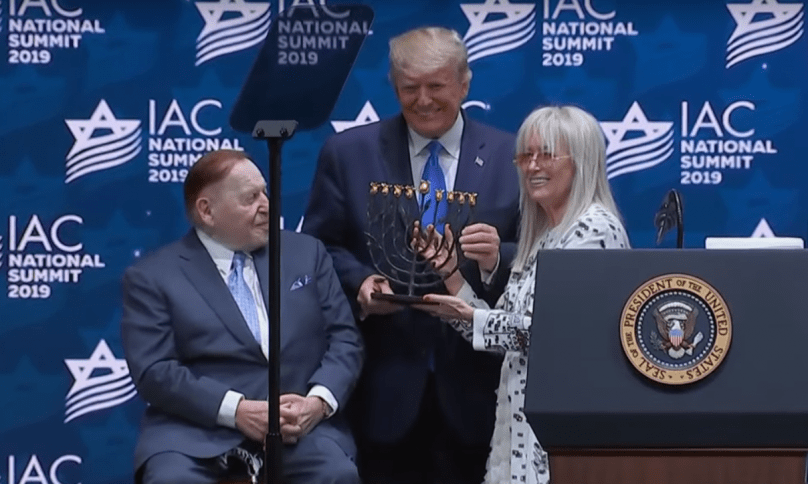
Most of the mainstream media commentary on the Deal is neutral or even mildly critical, observing inter alia that it is a gift to Israeli Prime Minister Benjamin Netanyahu, who was at the podium and beaming alongside Trump. If the boost from the White House succeeds in getting Bibi reelected, Trump will expect payback big time in 2020 through the Israel Lobby’s influence over Jewish voters and from the generosity of Jewish billionaire donors named Sheldon Adelson, Paul Singer and Bernard Marcus.
That Trump has betrayed U.S. interests repeatedly in the Middle East and has also flipped on his pledge to remove American soldiers from its “loser wars,” makes him a disgrace as president, though he will likely be re-elected as the voters have been fed a steady diet of propaganda both by the mainstream media and government on Israel. That just might be because Jews are vastly over-represented both in the media and in the choke points in government that deal with the Middle East and foreign policy in general. Even liberal Jews who are critical of Israeli oppression of the Palestinians tend to rally round-the-flag at election time and vote for the candidate perceived as being “strongest” on Israel. One notes with interest that while Senator Bernie Sanders roundly condemned the Deal, Speaker of the House Nancy Pelosi saw “some areas of common ground here” in it. She would, wouldn’t she? And I am sure Senator Chuck Schumer, the self-proclaimed protector of Israel in the Senate, is secretly delighted.
In the rather less restrained alternative media, there is much banter about how the Deal is little more than a sweeping annexation plan that is really Apartheid by another name. That in itself is a bit of a fudge as the reality in Palestine is far worse than South African Apartheid ever was. Some braver individuals have observed how the United States is controlled by Israel in terms of its engagement in the Middle East, but the language used to describe the situation really misses the point. The United States vis-à-vis Israel is not controlled by Israel per se but rather by subversion from within, Jewish billionaires having bought both major political parties and a Jewish dominated media spouting nonsense about the “only democracy in the Middle East” and “America’s best friend and ally.” Israel is neither a democracy nor a friend. And the American Jews and their allies the Christian Zionists who are full time promoters of the Israel myth are little more than traitors to the United States and everything it once upon a time stood for.
The Palestinians have already rejected the Deal, but their refusal to participate will be seen by Trump and Israel as an insult, or at least it will be spun that way. Trump has already warned that his proposal is the Palestinians’ “last chance” and his United Nations Ambassador Kelly Craft has advised Palestinian President Mahmoud Abbas not to raise the issue at all with the world body. Unwillingness to embrace it will provide a good opportunity to really lower the hammer on the Arabs. The map provided by Trump shows a cluster of Bantustans surrounded by Israel soldiers and police who historically have regarded nominally Palestinian areas as a free fire zone. When violence erupts, which it will, the largely unarmed Arabs will be slaughtered and David Friedman, Donald Trump and Bibi Netanyahu will all conveniently blame it on the Palestinians as it was the Israelis who “wanted peace” and the only obstacle remaining was and is the obduracy of the Palestinians. If only they had accepted the Deal, the outcome would have been different the contrived narrative will go.
Philip M. Giraldi, Ph.D., is Executive Director of the Council for the National Interest, a 501(c)3 tax deductible educational foundation (Federal ID Number #52-1739023) that seeks a more interests-based U.S. foreign policy in the Middle East. Website is councilforthenationalinterest.org, address is P.O. Box 2157, Purcellville VA 20134 and its email is inform@cnionline.org.
Moscow May Soon End ‘Provisional Enforcement’ of 1990 Bering Strait Accord With US
By Paul Goble, Eurasia Daily Monitor, Volume: 17 Issue: 12 – January 30, 2020
In yet another sign of deteriorating relations between Moscow and Washington, senior Russian officials and parliamentarians have agreed that Russia should end its “provisional enforcement” of the 1990 accord signed by then–Soviet Foreign Minister Eduard Shevardnadze and then–US Secretary of State James Baker on the delimitation of the sea border between the two countries in the Bering Strait. That agreement was ratified by the United States in 1992 but was not ratified by the Soviet Union before it collapsed and has not been ratified by its legal successor, the Russian Federation. Instead, Moscow has heretofore agreed to provisionally recognize and enforce its stipulations. But now, that looks likely to change.
On Monday (January 27), Konstantin Kosachev, the chairperson of the Federation Council’s (upper chamber of the Russian parliament) foreign relations committee, said he and other lawmakers had met with foreign ministry, Federal Security Service (FSB), and Russian fisheries officials to discuss whether Moscow should continue to fulfill the provisions of the agreement in the absence of its ratification. He insisted that the participants were unanimous in calling for the Russian government to announce it would no longer recognize or enforce the terms of that agreement. The following day, a spokesperson for the Russian foreign ministry indicated it was receptive to the idea (Finanz.ru, January 27, 2020).
The agreement has been unpopular in Russia since it was signed because many there believe Shevardnadze gave up too much in an effort to curry favor with the West; indeed, this is one reason the Russian parliament never ratified the deal. Still, until this week, there was no indication that Moscow would change its de facto recognition of the accord even though there was little chance of a de jure ratification. Now, Russia appears set to declare that it will no longer adhere to it, though some Russian analysts are skeptical whether Moscow has sufficient naval power to enforce any prospective new sea border between the two countries (Topcor.ru, January 29).
According to the document’s terms, Moscow and Washington agreed to delineated the sea border between them in the Bering Strait from “the point, 65° 30′ North, 168° 58′ 37″ West, along the 168° 58′ 37″ West meridian through the Bering Strait and Chukchi Sea into the Arctic Ocean as far as permitted under international law” (Un.org, June 1, 1990, accessed March 18, 2002).
The State Department noted (State.gov, September 8, 2009), as have other observers since that time, that when the US purchased Alaska from the Russian Empire, there was no need to define the border beyond the three-mile exclusion rule then in effect. But with the introduction of a 200-mile economic exclusion zone as a result of the Law of the Sea agreements, both Russia and the US recognized that there was suddenly a necessity to come up with one. The negotiating record from the 1860s was flimsy, however; and the two could not agree. The Baker-Shevardnadze exchange eventually opened the way for a compromise, but it left most of what had been disputed inside the US zone. Many Russians objected at the time, and those objections have continued.
Shevardnadze and Baker consented to split the difference, but that led to US sovereignty over areas that Russians had long considered theirs. As a result, Moscow has not ratified the 1990 accord, and Russian officials, including Vladimir Putin, periodically talk about the need to modify it. Since the document’s signing, the two countries have occasionally conducted talks on further adjusting the agreement; but to date, nothing has come of those talks. Two reasons explain this deadlock, one pertaining to Russia and the other to the United States. The Russian issue relates to the fact that Moscow wants to expand shipping across the Northern Sea Route and does not want to have to request approval from the US for transiting through what are now American waters (see EDM, March 29, 2017); additionally, Russia does not want the US to interfere with Russian fishing in the area. As for the United States, it widely believes there are significant oil and other mineral deposits in that region, which it hopes to one day exploit.
It remains to be seen how far Moscow will push this issue. Russia has brought up the sea boundaries before—at a 2003 Federation Council hearing and in Putin’s comments to Western leaders after Russia’s annexation of Crimea—and each time it led to a sharp uptick in tensions; but ultimately Russia took no action. This time, however, statements by senior Russian officials and parliamentarians appear to make it less likely that Moscow will back down from its tough line, especially given that Russian outlets are suggesting openly that “Russia is ready to begin a territorial dispute with the US over the sea border” (Gr-sily.ru, January 29, 2020).
Anatoly Kuznetsov, the editor of Russia’s Sea News, suggested that, at the very least, “the Russian parliament might pass the law about a refusal to recognize the 28-year-old Soviet legal act” (Fairplanet.org, January 29, 2020). “According to the law ‘About Russia’s international agreements,’ any deal regarding borders, be it land or maritime, is considered legally [null and void] unless ratified.” The expert added, “If Russia decides to ignore the American interests in the Bering Sea, it risks engaging with the similar ‘war of nerves.’ Russian fishermen will have to rely on the [Russian navy’s] protection in a hope that the U.S. warships are reluctant to start sea battles over such minor incidents.” A Russian parliamentary move in that direction could end the current brewing dispute, but the principle the legislature in Moscow would be enunciating—a non-enforcement of accords not yet ratified—would open the way to more problems elsewhere in the future.
Crisis and opportunity: The ‘Deal of the Century’ challenge for Palestinians
By Ramzy Baroud | MEMO | February 3, 2020
After several postponements, US President, Donald Trump, has finally revealed the details of his Middle East plan, dubbed ‘Deal of the Century’, in a press conference in Washington on January 28.
Standing triumphantly beside Trump, Israeli Prime Minister, Benjamin Netanyahu, must have surely understood that the timing of the announcement, only a few weeks before Israel’s third general elections in one year, was tailored especially to fit the embattled Israeli leader’s domestic agenda.
Consisting of 80 pages, 50 of which are entirely dedicated to the plan’s economic component, the document was a rehash of previous Israeli proposals that have been rejected by Palestinians and Arab governments for failing to meet the minimum standards of justice, equality and human rights.
Former Palestinian negotiator, Saeb Erekat, contended in an interview that the plan is not even American, but an Israeli one.
“What you heard last night from Trump is what I heard from Netanyahu and his negotiating team in 2011-2012,” Erekat said. “I can assure you that the US team did not make a single word or comma in this program. I have the protocols and I am willing to reveal to you what we have been offered. This is the plan of Netanyahu and the settler council.”
It was no surprise, then, to read the reaction of Palestinian Authority (PA) President Mahmoud Abbas, who assigned Trump’s plan to the “dustbin of history”.
As expected, Trump has granted Netanyahu everything that he and Israel ever wanted. The American vision for Middle East ‘peace’ does not demand the uprooting of a single illegal Jewish settlement and recognizes Jerusalem as Israel’s ‘undivided’ capital. It speaks of a conditioned and disfigured Palestinian state that can only be achieved based on vague expectations; it wholly rejects the Right of Return for Palestinian refugees, and fails to mention the word ‘occupation’ even once.
Obviously, only Israel benefits from the US plan; the Zionist discourse, predicated on maximum territorial gains with minimal Palestinian presence, has finally prevailed. Every Israeli request has been met, to the last one. Meanwhile, Palestinians received nothing, aside from the promise of chasing another mirage of a Palestinian state that has no territorial continuity and no true sovereignty.
Palestinian concerns continue to be ignored, as Palestinian rights have been ignored for many years, even during the heyday of the ‘peace process’, in the early and mid-1990s. At the time, all fundamental issues had been relegated to the ‘final status negotiations’, which have never taken place.
The ‘Deal of the Century’ merely validated the status quo ante as envisioned and unilaterally carried out by Israel.
That said, Trump’s plan will fail to resolve the conflict. Worse, it will exacerbate it even further, for Israel now has a blank check to speed up its colonial venture, to entrench its military occupation and to further oppress Palestinians, who will certainly continue to resist.
As for the economic component of the plan, history has proven that there can be no economic prosperity under military occupation. Netanyahu, and others before him, tried such dubious methods, of ‘economic peace’ and such, and all have miserably failed.
Time and again, the UN has made it clear that it follows a different political trajectory than that followed by Washington, and that all US decisions regarding the status of Jerusalem, the illegal settlements and the Golan Heights, are null and void. Only international law matters, as none of Trump’s actions in recent years have succeeded in significantly altering Arab and international consensus on the rights of the Palestinians.
As for the status of – and Palestinian rights in their occupied city – East Jerusalem, rebranding a few neighborhoods – Kafr Aqab, the eastern part of Shuafat and Abu Dis – as al-Quds, or East Jerusalem, is an old Israeli plan that has already failed in the past. The late Palestinian leader, Yasser Arafat, had enough political sagacity to reject it, and neither Abbas nor any other Palestinian official would dare compromise on the historic and legal Palestinian rights in the city.
The Palestinian leadership cannot be absolved from its responsibility towards the Palestinian people, and its unmitigated failure to develop a comprehensive national strategy.
Immediately after Trump announced his plan, Abbas called on all Palestinian factions, including his rivals in the Hamas movement, to unite and to develop a common strategy to counter the ‘Deal of the Century’.
Knowing that the US-Israeli plot was imminent, why did Abbas wait this long to call for a common strategy?
National unity among Palestinians should never be used as a bargaining chip as a scare tactic, or as a last resort option aimed at validating ineffectual Abbas in the eyes of his people.
The PA is now facing an existential crisis. Its very formation in 1994 was meant to marginalize the more democratically-encompassing Palestine Liberation Organization (PLO).
According to the new American diktats, the PA has already outlasted its usefulness.
As for Israel, the PA is only needed to maintain ‘security coordination’ with the Israeli army, which essentially means ensuring the safety of the illegal and armed Jewish settlers in occupied Palestine.
While unity among Palestinian parties is an overriding demand, Abbas’ PA cannot expect to maintain this ridiculous balancing act: expecting true and lasting national unity while still diligently serving the role expected of him by Israel and its allies.
While Trump’s sham ‘plan’ does not fundamentally alter US foreign policy in Israel and Palestine – as US bias towards Israel preceded Trump by decades – it has definitely ended the so-called ‘peace process’ charade, which divided the Palestinians into ‘moderate’ and ‘extremist’ camps.
Now, all Palestinians have become ‘extremists’ from Washington’s viewpoint, all equally shunned and marginalized.
Abbas would be terribly mistaken if he thinks that the old political discourse can be saved, which was, oddly enough, written in Washington.
The problem with the Palestinian leadership is that, despite its frequent protestations and angry condemnations, it is yet to take independent initiatives or operate outside the American-Israeli paradigm.
And this is the Palestinian leadership’s greatest challenge at this stage. Will it move forward with a Palestinian-centric strategy or persist in the same place, regurgitating old language and reminiscing of the good old days?
Featured Video

John Mearsheimer: New World Order Arrived & Europe Is Left Behind
or go to
Aletho News Archives – Video-Images
Book Review
Sunset on Net Zero: A Heretic’s Guide to the Futile CO2 Target
By Ronald Paul Barmby (Author) – October 3, 2025
SUNSET ON NET ZERO describes in detail why Net Zero CO2 is pointless and unachievable. It explains in understandable terms the up-to- date thoughts of the greatest minds of today in physics, meteorology, economics, engineering, and the geosciences.
Net Zero CO2 is pointless because we have now confirmed by satellites that 90% of CO2 warming has already happened. CO2 is not an existential threat but clouds, El-Niño, and human habitation are significant drivers of global warming that are often ignored.
Net Zero CO2 is unachievable because the green technology alternatives are unreliable and unaffordable. Wind and solar power triple electricity costs, building fully electric vehicles produces at least one-half of CO2 emissions they are meant to avoid, and heat pumps will leave you dangerously cold in the winter. Green hydrogen, air capture CO2, and carbon capture and storage are prescriptions for national bankruptcy. The supply of key metals and minerals required to achieve Net Zero need to be at least doubled—some much more—and are often controlled by a very few. Net Zero comes with huge environmental and agricultural costs.
We have been through similar climatic temperature changes before, more recently than you think. Our efforts to control it are futile.
Blog Roll
 Aletho News
- FDA Ordered to Pay Over $570,000 in Fight Over Pfizer COVID Vaccine Records
- USAID turned to Facebook to drive demand for Covid vaccines in Global South – files
- Britain’s shadow security network expands into south Lebanon
- The ADL Has a Foreign Policy, and You Are Not Supposed to See It
- Former Qatari PM says ‘Israel’ has security ties with all Gulf states
- The Sound of Silence in the Strait of Hormuz
- Poland’s call for a no-fly zone in Ukraine means NATO direct war with Russia
- John Mearsheimer: New World Order Arrived & Europe Is Left Behind
- Naqab demolition notices top 1,000; settlers demolish Jaloud homes
- Israel is Using the ‘Gaza Ceasefire’ to Commit Ethnic Cleansing
- If Americans Knew
- An error has occurred; the feed is probably down. Try again later.
- No Tricks Zone
- Physicists: Doubling CO2 Has A Smaller Impact On Ocean ‘Acidification’ Than Existing Internal Variability
- Alarmist Climatologists In Shock! 2026 Atlantic Hurricane Season Sees Lowest Count In 101 Years
- New Study: Modern Temps Are Among The Coldest Of The Last 10,000 Years In East Central Europe
- Germany’s Renewable Energies Lead to 1.4 Billion Euro Electric Power Trade Deficit
- Argentina’s Perito Moreno Glacier Joins Antarctica and Arctic In Defying Doomsday Melt Claims
- New Study: Barents Sea Temperatures Were Warmer And Sea Ice Less Extensive In The 1700s Than Today
- German Authorities Start Initiative To Evaluate Public Register For Climate “Disinformation” Spreaders!
- Zonal Asymmetry of Temperature Change in the Antarctic Circumpolar Current
- New Study: The Net Fossil Fuel Contribution To Rising Atmospheric CO2 Has Been Zero For 500 Years
- Germany’s Green Energy Transition Becoming Increasingly Expensive…Another 6 Trillion Euros!

