A Terrorist Attack Against Eurasian Integration
By Federico Pieraccini | Strategic Culture Foundation | January 6, 2020
The murder of Iranian general Qasem Soleimani in Baghdad, in the early hours of January 3 by US forces, only highlights the extent to which US strategy in the Middle East has failed. It is likely to provoke reactions that do not benefit US interests in the region.
To understand the significance of this event, it is necessary to quickly reconstruct the developments in Iraq. The US has occupied Iraq for 17 years, following its invasion of the country in 2003. During this time, Baghdad and Tehran have re-established ties by sustaining an important dialogue on post-war reconstruction as well as by acknowledging the importance of the Shia population in Iraq.
Within two decades, Iraq and Iran have gone from declaring war with each other to cooperating on the so-called Shia Crescent, favoring cooperation and the commercial and military development of the quartet composed of Iran, Iraq, Syria and Lebanon. Such ties, following recent victories over international terrorism, have been further consolidated, leading to current and planned overland connections between this quartet.
Local movements and organizations have been calling for US troops to leave Iraqi territory with increasing vigor and force in recent months. Washington has accused Tehran of inciting associated protests.
At the same time, groups of dubious origin, that have sought to equate the Iranian presence with the American one, have been calling for the withdrawal of the Popular Mobilization Units (PMUs) that are linked to Iran from Iraq. The protests from such groups appear to be sponsored and funded by Saudi Arabia.
With mutual accusations flying around, the US hit a pro-Iranian faction known as Kataib Hezbollah on December 29. This episode sparked a series of reactions in Iraq that ended up enveloping the US embassy in Baghdad, which was besieged for days by demonstrators angry about ongoing airstrikes by US forces.
The US secretary of state, Mike Pompeo, blamed this volatile situation on Iran, warning that Tehran would be held responsible for any escalation of the situation involving the embassy.
In the early hours of January 3, 2020, another tangle was added to the Gordian Knot that is the Middle East. Qasem Soleimani was assassinated when his convoy was attacked by a drone near Baghdad International Airport. The most effective opponents of ISIS and Wahabi jihadism in general was thus eliminated by the US in a terrorist act carried out in a foreign country in a civilian area (near Baghdad International Airport). The champagne would have no doubt been flowing immediately upon receiving this news in the US Congress, the Israeli Knesset, Riyadh royal palace and in Idlib among al Nusra and al Qaeda militants.
It remains to be seen what the reasons were behind Trump’s decision to okay the assassination of such an influential and important leader. Certainly the need to demonstrate to his base (and his Israeli and Saudi financiers) plays into his anti-Iranian crusade. But there are other reasons that better explain Trump’s actions that are more related to the influence of the US in the region; the geopolitical chess game in the Middle East transcends any single leader or any drone attack.
In Syria, for example, the situation is extremely favorable to the government in Damascus, with it only being a matter of time before the country is again under the control of the central government. General Soleimani and Iran have played a central role in ridding the country of the scourge of terrorism, a scourge directed and financed by the US and her regional allies.
In Iraq, the political situation is less favorable to the US now than it was back in 2006. Whatever progress in relations between Baghdad and Tehran has also been due to General Soleimani, who, together with the PMUs and the Iraqi army, freed the country from ISIS (which was created and nurtured by Western and Saudi intelligence, as revealed by Wikileaks).
It would seem that the US sanctions against Iran have not really had the intended effect, instead only serving to consolidate the country’s stance against imperialism. The US, as a result, is experiencing a crisis in the region, effectively being driven out of the Middle East, rather than leaving intentionally.
In this extraordinary and unprecedented situation, the Russians and Chinese are offering themselves variously as military, political and economic guarantors of the emerging Eurasian mega-project (the recent naval exercises between Beijing, Moscow and Tehran serving as a tangible example of this commitment). Naturally, it is in their interests to avoid any extended regional conflict that may only serve to throw a monkey wrench into their vast Eurasian mega-project.
Putin and Xi Jinping face tough days ahead, trying to council Iran in avoiding an excessive response that would give Washington the perfect excuse for a war against Iran.
The prospects of a region without terrorism, with a reinvigorated Shia Crescent, led by Iran at the regional level and accompanied by China and Russia at the economic (Belt and Road Initiative) and military level, offer little hope to Riyadh, Tel Aviv and Washington of being able to influence events in the region and this is likely going to be the top argument that Putin and Xi Jinping will use to try to deter any Iranian overt response.
Deciding to kill the leader of the Quds Force in Iraq proves only one thing: that the options available to Trump and his regional allies are rapidly shrinking, and that the regional trends over the next decade appear irreversible. Their only hope is for Tehran and her allies to lash out at the latest provocation, thereby justifying the regional war that would only serve to benefit Washington by slowing down regional unification under Iranian leadership.
We must remember that whenever the US finds itself in a situation where it cannot control a country or a region, its tendency is to create chaos and ultimately destroy it.
By killing General Soleimani, the US hopes to wreak havoc in the region so as to slow down or altogether scupper any prospect of integration. Fortunately, China, Russia and Iran are well aware that any conflict would not be in any of their own interests.
No drone-launched missiles will be enough to save the US from decades of foreign-policy errors and their associated horrors; nor will they be enough to extinguish the memory of a hero’s tireless struggle against imperialism and terrorism.
The Middle East Strategic “Balance” Shredded
By Alastair Crooke | Strategic Culture Foundation | January 6, 2020
President Trump was understood to not want a Mid-East war that might blight his rosy re-election prospects (so long as the US stock market stays inflated, and the economy doesn’t tank). Pat Buchanan, the three-times US Presidential candidate, warned Trump that if there is a potential landmine on Trump’s road to reelection, it may be found in the Middle and Near East: “Not infrequently, foreign policy has proven decisive in presidential years”. Plus Iran was not seeking any major confrontation; Hizbullah wasn’t; Iraq wasn’t; and the Israeli Security Establishment wasn’t.
In fact, the strategic balance – though sorely tested – had been hanging together. Just to be clear: Iran and Israel both had been keeping – just – within the parameters of unspoken ‘red lines’ – despite the inflated rhetoric. And both were practicing ‘strategic patience’. So the strategic balance seemed more or less sustainable: until its upending with the assassination of Qasem Soleimani and the head of the PMU, Al-Muhandis, ordered by Trump.
Israel has not – despite its lurid language – been landing strategic blows on Iran in Syria. It has not been killing Iranians there (apart from seven killed at T4 airport in eastern Syria last year). It did not target the head of the Iranian air force, some ten days ago, as some reports have suggested (he was not even in Iraq at the time). Most of the Israeli air attacks have been on depots in the early hours, when no personnel were present. It has been a campaign more of a regular, small slicing away at Iranian logistics. It was not strategic damage.
And Iran, after sending clear ‘messages’ to Gulf States of its willingness to inflict pain on parties to its economic siege, plainly had been calibrating this push-back carefully; Iran still had its eye to global diplomacy (to wit: the joint Iranian naval exercises with Russia and China in the Persian Gulf) – whilst countering politically, America’s ‘new’ tactic of inciting ‘colour’ protests across Lebanon and Iraq (and trying to bust Syria financially, by stealing its energy revenues).
Here is the point: The US was no longer content with mere sanctions on Iran. It has been covertly escalating across the board: orchestrating protests in Iraq, in Lebanon, and in Iran itself; mounting a major cyber offensive on Iran; and a ‘messaging’ operation aimed at turning genuine popular frustration with regional mis-governance and corruption, into a weapon aimed at weakening revolutionary Iran.
The US was having some success with turning protest messaging against Iran – until, that is – its killing and wounding of so many Iraqi security force members last week (Ketaib Hizbullah is a part of Iraq’s armed forces).
Escalation of maximum-pressure was one thing (Iran was confident of weathering that); but assassinating such a senior official on his state duties, was quite something else. We have not observed a state assassinating a most senior official of another state before.
And the manner of its doing, was unprecedented too. Soleimani was officially visiting Iraq. He arrived openly as a VIP guest from Syria, and was met on the tarmac by an equally senior Iraqi official, Al-Muhandis, who was assassinated also, (together with seven others). It was all open. General Soleimani regularly used his mobile phone as he argued that as a senior state official, if he were to be assassinated by another state, it would only be as an act of war.
This act, performed at the international airport of Baghdad, constitutes not just the sundering of red lines, but a humiliation inflicted on Iraq – its government and people. It will upend Iraq’s strategic positioning. The erstwhile Iraqi attempt at balancing between Washington and Iran will be swept away by Trump’s hubristic trampling on the country’s sovereignty. It may well mark the beginning of the end of the US presence in Iraq (and therefore Syria, too), and ultimately, of America’s footprint in the Middle East.
Trump may earn easy plaudits now for his “We’re America, Bitch!”, as one senior White House official defined the Trump foreign policy doctrine; but the doubts – and unforeseen consequences soon may come home to roost.
Why did he do it? If no one really wanted ‘war’, why did Trump escalate and smash up all the crockery? He has had an easy run (so far) towards re-election, so why play the always unpredictable ‘wild card’ of a yet another Mid-East conflict?
Was it that he wanted to show ‘no Benghazi’; no US embassy siege ‘on my watch’ – unlike Obama’s handling of that situation? Was he persuaded that these assassinations would play well to his constituency (Israeli and Evangelical)? Or was he offered this option baldly by the Netanyahu faction in Washington? Maybe.
Some in Israel are worried about a three or four front war reaching Israel. Senior Israeli officials recently have been speculating about the likelihood of regional conflict occurring within the coming months. Israel’s PM however, is fighting for his political life, and has requested immunity from prosecution on three indictments – pleading that this was his legal right, and that it was needed for him to “continue to lead Israel” for the sake of its future. Effectively, Netanyahu has nothing to lose from escalating tensions with Iran — but much to gain.
Opposition Israeli political and military leaders have warned that the PM needs ‘war’ with Iran — effectively to underscore the country’s ‘need’ for his continued leadership. And for technical reasons in the Israeli parliament, his plea is unlikely to be settled before the March general elections. Netanyahu thus may still have some time to wind up the case for his continued tenure of the premiership.
One prime factor in the Israeli caution towards Iran rests not so much on the waywardness of Netanyahu, but on the inconstancy of President Trump: Can it be guaranteed that the US will back Israel unreservedly — were it to again to become enmeshed in a Mid-East war? The Israeli and Gulf answer seemingly is ‘no’. The import of this assessment is significant. Trump now is seen by some in Israel – and by some insiders in Washington – as a threat to Israel’s future security vis à vis Iran. Was Trump aware of this? Was this act a gamble to guarantee no slippage in that vital constituency in the lead up to the US elections? We do not know.
So we arrive at three final questions: How far will Iran absorb this new escalation? Will Iran confine its retaliation to within Iraq? Or will the US cross another ‘red line’ by striking inside Iran itself, in any subsequent tit for tat?
Is it deliberate (or is it political autism) that makes Secretary Pompeo term all the Iraqi Hash’d a-Sha’abi forces – whether or not part of official Iraqi forces – as “Iran-led”? The term seems to be used as a laissez-passer to attack all the many Hash’d a-Sha’abi units on the grounds that, being “Iran-linked”, they therefore count as ‘terrorist forces’. This formulation gives rise to the false sequitur that all other Iraqis would somehow approve of the killings. This would be laughable, if it were not so serious. The Hash’d forces led the war against ISIS and are esteemed by the vast majority of Iraqis. And Soleimani was on the ground at the front line, with those Iraqi forces.
These forces are not Iranian ‘proxies’. They are Iraqi nationalists who share a common Shi’a identity with their co-religionists in Iran, and across the region. They share a common zeitgeist, they see politics similarly, but they are no puppets (we write from direct experience).
But what this formulation does do is to invite a widening conflict: Many Iraqis will be outraged by the US attacks on fellow Iraqis and will revenge them. Pompeo (falsely) will then blame Iran. Is that Pompeo’s purpose: casus belli?
But where is the off-ramp? Iran will respond… Is this affair simply set to escalate from limited military exchanges … and from thence, to escalate until what? We understand that this was not addressed in Washington before the President’s decision was made. There are no real US channels of communication (other than low level) with Iran; nor is there a plan for the next days. Nor an obvious exit. Is Trump relying on gut instinct again?
Iran holds all the cards in coming Middle East conflict with US – unless Trump is ready to drop a tactical NUKE
By Scott Ritter | RT | January 6, 2020
Iran has promised retaliation for the assassination of Qassem Suleimani. Donald Trump said this will lead to a disproportionate response from the US. One side can deliver on its threats, the other can’t, unless it goes nuclear.
Iran means business
“Our reaction,” Iranian general Hossein Dehghan said at the weekend, “will be wise, well considered and, in time, with decisive deterrent effect.”
Dehghan also noted that Iran was not seeking a wider confrontation with the US.
“It was America that has started the war. Therefore, they should accept appropriate reactions to their actions. The only thing that can end this period of war is for the Americans to receive a blow that is equal to the blow they have inflicted.”
Dehghan is no run-of-the-mill former Iranian general officer, but was one of the major decision makers within the Islamic Revolutionary Guard Corps (IRGC) during the Iran-Iraq War, and later went on to command the IRGC Air Force, before eventually being appointed Iran’s minister of defense. After stepping down from that position, Dehghan became a special advisor to the Supreme Leader of the Islamic Republic Ali Khamenei.
His words must be viewed as representing those of Khamenei himself.
Iran’s three likely targets
A closer assessment of Dehghan’s statement, when considered in the context of the vote by the Iraqi Parliament this Sunday to remove all foreign troops from Iraq, provides clarity as to what the US and the Middle East can expect from Tehran.
First and foremost, the response will not be carried out by proxy.
The attack will be military in nature. Assaults on the oil and gas infrastructure of America’s Gulf Arab allies, similar in nature to the drone attacks on Saudi oil production facilities last May, are not in the works. The same holds true for shipping transiting the strategic Strait of Hormuz, as well as US diplomatic facilities in the region.
Likewise, Iran must respect the will of the Iraqi Parliament regarding the operation of foreign troops on its soil, which means that the response will most probably not be conducted against US military forces currently stationed in Iraq.
This does not mean US troops and facilities in Iraq will be immune to attack; Khaitab Hezbollah, the Iraqi militia whose leader, Abu Mahdi al-Muhandis, was killed in the same attack that took Qassem Suleimani’s life, have pledged their own retaliatory attacks separate from those promised by Iran.
There are a host of viable US military targets in the Persian Gulf region that are of high enough stature as to qualify as “an equal blow” in the eyes of Tehran.
Three come to mind; the concentration of US forces based in Kuwait, the headquarters of the 5th Fleet in Bahrain, and the Al Udeid Air Base in Qatar.
Of these three, only one, Al Udeid Air Base, has a direct connection to the Suleimani assassination; the drones that fired the missiles that killed Suleimani were operated from there. Al Udeid is host to critical US command and control facilities, as well as the bulk of the American combat aircraft operating in the region. It is well within the range of Iranian ballistic missiles and armed drones, which could be expected to operate in concert with one another to defeat air defenses and then saturate the base with precision strikes which could destroy hundreds of millions of dollars of aircraft and equipment, and potentially kill and wound hundreds of US service members.
Trump’s all tweets, no capacity
President Trump has promised that the US will not tolerate any attack against its personnel or facilities. “If they do anything,” he told reporters, referring to Iran, “there will be major retaliation.”
Earlier, Trump had tweeted a very explicit warning, telling Iran that he had already designated some 52 sites inside Iran, “some at a very high level & important to Iran & the Iranian culture,” for destruction. “[T]hose targets,” Trump declared, “and Iran itself, WILL BE HIT VERY FAST AND VERY HARD. The USA wants no more threats!”
Trump’s threat, however, rings hollow. First, his tweet constitutes de facto evidence of a war crime (Section 5.16.2 of the US Department of Defense Law of War Manual prohibits threats to destroy cultural objects for the express purpose of deterring enemy operations), and as such would likely not be implemented by US military commanders for whom niceties such as the law of war, which forbids the execution of an unlawful order, are serious business.
Of more relevance, however, is the fact that Trump has been down this road before, when he threatened massive military retaliation against Iran for shooting down an unarmed drone over the Strait of Hormuz last May. At that time, he was informed by his military commanders that the US lacked the military wherewithal to counter what was expected to be a full-spectrum response by Iran if the US were to attack targets inside Iran.
In short, Iran was able to inflict massive harm on US and allied targets in the Middle East region, and there was nothing the US could do to prevent this outcome.
Little has changed since May that would alter the military balance of power between the US and Iran. If Iran were to strike a US facility such as the Al Udeid Air Base, and Trump were to order a response, then Iran would most likely unleash the totality of its military capability, and those of its regional proxies, to devastate the military and economic capabilities of those targeted. These strikes would most likely include oil production facilities in Kuwait, Saudi Arabia, and the UAE, in addition to US military facilities and diplomatic missions.
Seen in this light, Trump’s threats of retaliation appear to be little more than words that cannot be backed up by reality.
Pushing the red button for Fordow
However, there was a second significant development in the region on Sunday, in addition to the vote by the Iraqi Parliament to cut ties with the US military.
The Iranian government announced that it was ending all restrictions on the enrichment of uranium, in effect nullifying the Iran nuclear agreement (the Joint Comprehensive Program of Action, or JCPOA), which the US withdrew from in May 2018. While Iran has stated that these measures were reversible if the US returned to the agreement, the newly unconstrained enrichment capability puts Iran well inside the one year “breakout” window (i.e. the time needed by Iran to produce enough fissile material for a single nuclear device) of one year that underpinned the prime purpose of the JCPOA.
In doing so, Iran has inadvertently opened itself up to a preemptive nuclear attack by the US.
The centrifuges that could be used by Iran to produce enriched uranium capable of being used in a fissile device are housed in a hardened underground facility located near the town of Fordow. No conventional munition currently in the US arsenal can destroy Fordow.
Only a modified B-61 nuclear bomb can do the job.
Trump has hinted that any future war with Iran would not be a drawn-out affair. And while the law of war might curtail his commanders from executing any retaliation that includes cultural sites, it does not prohibit the US from using a nuclear weapon against a known nuclear facility deemed to pose a threat to national security.
This is the worst-case scenario of any tit-for-tat retaliation between Iran and the US, and it is not as far-fetched as one might believe.
Scott Ritter is a former US Marine Corps intelligence officer. He served in the Soviet Union as an inspector implementing the INF Treaty, in General Schwarzkopf’s staff during the Gulf War, and from 1991-1998 as a UN weapons inspector.
Why I Don’t Trust Trump on Iran
By Ron Paul | January 6, 2020
President Trump and his Secretary of State Mike Pompeo told us the US had to assassinate Maj. Gen. Qassim Soleimani last week because he was planning “Imminent attacks” on US citizens. I don’t believe them.
Why not? Because Trump and the neocons – like Pompeo – have been lying about Iran for the past three years in an effort to whip up enough support for a US attack. From the phony justification to get out of the Iran nuclear deal, to blaming Yemen on Iran, to blaming Iran for an attack on Saudi oil facilities, the US Administration has fed us a steady stream of lies for three years because they are obsessed with Iran.
And before Trump’s obsession with attacking Iran, the past four US Administrations lied ceaselessly to bring about wars on Iraq, Afghanistan, Syria, Libya, Serbia, Somalia, and the list goes on.
At some point, when we’ve been lied to constantly and consistently for decades about a “threat” that we must “take out” with a military attack, there comes a time where we must assume they are lying until they provide rock solid, irrefutable proof. Thus far they have provided nothing. So I don’t believe them.
President Trump has warned that his administration has already targeted 52 sites important to Iran and Iranian culture and the US will attack them if Iran retaliates for the assassination of Gen. Soleimani. Because Iran has no capacity to attack the United States, Iran’s retaliation if it comes will likely come against US troops or US government officials stationed or visiting the Middle East. I have a very easy solution for President Trump that will save the lives of American servicemembers and other US officials: just come home. There is absolutely no reason for US troops to be stationed throughout the Middle East to face increased risk of death for nothing.
In our Ron Paul Liberty Report program last week we observed that the US attack on a senior Iranian military officer on Iraqi soil – over the objection of the Iraq government – would serve to finally unite the Iraqi factions against the United States. And so it has: on Sunday the Iraqi parliament voted to expel US troops from Iraqi soil. It may have been a non-binding resolution, but there is no mistaking the sentiment. US troops are not wanted and they are increasingly in danger. So why not listen to the Iraqi parliament?
Bring our troops home, close the US Embassy in Baghdad – a symbol of our aggression – and let the people of the Middle East solve their own problems. Maintain a strong defense to protect the United States, but end this neocon pipe-dream of ruling the world from the barrel of a gun. It does not work. It makes us poorer and more vulnerable to attack. It makes the elites of Washington rich while leaving working and middle class America with the bill. It engenders hatred and a desire for revenge among those who have fallen victim to US interventionist foreign policy. And it results in millions of innocents being killed overseas.
There is no benefit to the United States to trying to run the world. Such a foreign policy brings only bankruptcy – moral and financial. Tell Congress and the Administration that for America’s sake we demand the return of US troops from the Middle East!
Copyright © 2019 by Ron Paul Institute
Soleimani was to deliver Tehran’s reply to Saudi de-escalation letter when killed: Iraqi PM
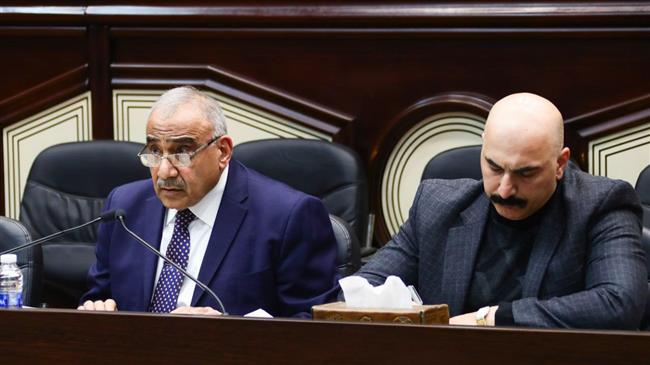
Picture released by Iraqi Prime Minister’s Media Office shows Iraq’s caretaker prime minister Adel Abdul Mahdi (L) attending a parliamentary session on January 5, 2020. (Photo via AFP)
Press TV – January 5, 2020
Iraq’s Caretaker Prime Minister Adel Abdul-Mahdi has said that Lieutenant General Qassem Soleimani was set to deliver Tehran’s reply to an earlier Saudi message regarding de-escalation talks mediated by Baghdad when he was assassinated.
Abdul-Mahdi made the remarks during an extraordinary parliamentary session in the capital which led to the adoption of a law demanding the withdrawal of US forces from the country on Sunday, the National Iraqi News Agency reported.
The premier said that he was due to meet Soleimani at 8:30 am local time on Friday before the US assassinated the general a few hours earlier.
The revelations come as Baghdad has been mediating talks between Tehran and Riyadh following a recent uptick of tensions the region.
Sunday’s parliamentary vote was held in response to Washington’s Friday airstrikes targeting Soleimani and his comrades.
Abu Mahdi al-Muhandis, the second-in-command of Iraq’s Popular Mobilization Units (PMU) was also killed in the attack.
Iran’s judiciary has said that the attack took place despite Soleimani being a “formal” and “high profile” guest of the Iraqi government.
The Sunday vote comes as many Iraqi figures and parliamentary factions have been long demanding the withdrawal of US troops from the country, specifically following a series of unclaimed airstrikes on PMU forces.
Abdul-Mahdi also revealed in his Sunday remarks that Washington had confirmed to Baghdad that Tel Aviv was behind a number of the attacks.
“America informed us that Israel bombed the warehouses of the PMU last summer,” he said, calling on the parliament to take all measures to end the presence of foreign forces in Iraq.
Rockets rock Baghdad’s Green Zone
Also on Sunday, the Iraqi military reported that three Katyusha rockets fell in Baghdad, two of which landed inside the capital’s heavily fortified Green Zone housing government buildings and foreign missions.
Witnesses told AFP that the rockets had landed close to the US embassy without further elaborating on probable casualties.
No group has yet claimed responsibility for the attack.
Some War Truth In A Single Photograph
By Bill Willers | Dissident Voice | January 5, 2020
Once I realized to my dismay that I couldn’t believe a word of what our media and political leaders said about major events in the here and now, their credibility on controversial happenings so long ago and far away entirely disappeared.” — Ron Unz, 2018
The 100th anniversary of Armistice Day, November 11, 1918, generated renewed interest in the First World War, its beginnings, its aftermath, and the lead up to World War II. For anyone brought up with the carefully-crafted narratives that constitute “popular” history, a dive into details of the World Wars can shake one’s faith in the validity of all generally accepted history. A good introduction to long buried aspects of the era of the World Wars is Patrick J. Buchanan’s 2008 book “Churchill, Hitler and the Unnecessary War“, in which all roads lead back to Britain’s 1914 declaration of war on Germany, which soon involved much of the world. Germany’s rising power had threatened British imperial dominance within a Rube Goldberg complexity of formal alliances and secret agreements. A Serbian shot an Austrian archduke, Serbia allied with Russia, but Austria-Hungary allied with Germany, and Russia with Britain and France, etc. Ultimately, the “Great Men” leading the masses appeared powerless to stop the WW I slaughter: 8 million dead, 20 million wounded. Thereafter, the Treaty of Versailles imposed on Germany grossly unjust reparations, this leading ultimately to a humiliated Germany embracing Hitler’s rise, thence to a war with a price tag of more than 50 million human lives.
Massive works on Churchill and Hitler by the towering historian David Irving are based on every conceivable information source down to personal diaries and interviews. Irving’s departure from widely accepted “mainstream” story lines has irked some fellow historians, and because he has not been perfectly in synch with Holocaust dogma, he, like so many, has suffered unwarranted accusations of anti-semitism. He writes that many details in the generally-accepted history of WW II, apparently like much of history itself, are simply wrong. His depiction of Winston Churchill is as a central causative agent of both world wars. What’s that? you say! Churchill, during his lifetime considered the greatest living Englishman, a war monger? Likewise, Adolph Hitler struggled to avoid war? Are these too shocking to accept? Research for yourself, and you may find yourself in agreement with Caitlin Johnstone: “Our species fought two world wars (or arguably one world war with a long intermission to grow more troops) for no justifiable reason at all.”
Insight into how governmentally-sanctioned histories might be managed for mass consumption is offered by Ron Unz who cites an amazing number of A-list commentators (scroll down to subtitle “Purging our Leading Historians and Journalists”) who, on diverging from authorized accounts, were simply blacklisted, thereafter unable to get published. It seems that a thread of decency runs through the human family such that elaborate lies must be maintained by governments in order to justify and generate and perpetuate wars. If the Spanish-American War, the two World Wars, Vietnam and both invasions of Iraq have anything in common, it is that all six involved official lies used to bring We The People on board: Remember the Maine, the Lusitania, Pearl Harbor, the Gulf of Tonkin, Kuwaiti babies, Weapons of Mass Destruction. Lies.
During Christmas, 1914, certain British and German soldiers of WW I got the urge for a truce. Shouts of “Merry Christmas!” across “no man’s land” of the front led to troops emerging from trenches, exchanging food and trinkets, playing a bit of soccer. Photos are easy to find on the Internet, but one in particular crystalizes a truth about humanity, regardless of what contorted propaganda might be coming down from the damned stuffed shirts who send humans to slaughter. Historians necessarily focus on political power players and the decision makers of war, but it is decent folk within the powerless masses who are the ones driven to do the killing and the dying. The two youths in the photo — not many years beyond childhood — could be any soldiers from any period of time, of any ethnicity, in any war. Like healthy people everywhere, they would have greatly preferred to be friends, and it shows.
Dwight Eisenhower, a General turned President, is quoted as having said “I think that people want peace so much that one of these days governments had better get out of the way and let them have it.” Such a day is not yet visible on the horizon.

Bill Willers is an emeritus professor of biology, University of Wisconsin at Oshkosh. He can be contacted at willers@uwosh.edu.
The USA is now at war, de-facto and de-jure, with BOTH Iraq and Iran
The Saker | January 5, 2020
First, let’s begin by a quick summary of what has taken place (note: this info is still coming in, so there might be corrections once the official sources make their official statements).
- Iraqi Prime Minister Adil Abdl Mahdi has now officially revealed that the US had asked him to mediate between the US and Iran and that General Qassem Soleimani was to come and talk to him and give him the answer to his mediation efforts. Thus, Soleimani was on an OFFICIAL DIPLOMATIC MISSION as part of a diplomatic initiative INITIATED BY THE USA.
- The Iraqi Parliament has now voted on a resolution requiring the government to press Washington and its allies to withdraw their troops from Iraq.
- Iraq’s caretaker PM Adil Abdul Mahdi said the American side notified the Iraqi military about the planned airstrike minutes before it was carried out. He stressed that his government denied Washington permission to continue with the operation.
- The Iraqi Parliament has also demanded that the Iraqi government must “work to end the presence of any foreign troops on Iraqi soil and prohibit them from using its land, airspace or water for any reason“
- The Iraqi Foreign Ministry said that Baghdad has turned to the UN Security Council with complaints about US violations of its sovereignty.
- Iraqi cleric Moqtada al-Sadr said the parliamentary resolution to end foreign troop presence in the country did not go far enough, calling on local and foreign militia groups to unite. I also have confirmation that the Mehdi Army is being re-mobilized.
- The Pentagon brass is now laying the responsibility for this monumental disaster on Trump (see here). They are now slowly waking up to this immense clusterbleep and don’t want to be held responsible for what is coming next.
- For the first time in the history of Iran, a Red Flag was hoisted over the Holy Dome Of Jamkaran Mosque, Iran. This indicates that the blood of martyrs has been spilled and that a major battle will now happen. The text in the flag says “Oh Hussein we ask for your help” (unofficial translation)
- The US has announced the deployment of 3,000 soldiers from the 82nd Airborne to Kuwait.
- Finally, the Idiot-in-Chief tweeted the following message, probably to try to reassure his freaked out supporters: “The United States just spent Two Trillion Dollars on Military Equipment. We are the biggest and by far the BEST in the World! If Iran attacks an American Base, or any American, we will be sending some of that brand new beautiful equipment their way… and without hesitation!“. Apparently, he still thinks that criminally overspending for 2nd rate military hardware is going to yield victory…
Analysis
Well, my first though when reading these bullet points is that General Qasem Soleimani has already struck out at Uncle Shmuel from beyond his grave. What we see here is an immense political disaster unfolding like a slow motion train wreck. Make no mistake, this is not just a tactical “oopsie”, but a major STRATEGIC disaster. Why?
For one thing, the US will now become an official and totally illegal military presence in Iraq. This means that whatever SOFA (Status Of Forces Agreement) the US and Iraq had until now is void.
Second, the US now has two options:
- Fight and sink deep into a catastrophic quagmire or
- Withdraw from Iraq and lose any possibility to keep forces in Syria
Both of these are very bad because whatever option Uncle Shmuel chooses, he will have lost whatever tiny level of credibility he has left, even amongst his putative “allies” (like the KSA which will now be left nose to nose with a much more powerful Iran than ever before).
The main problem with the current (and very provisional) outcome is that both the Israel Lobby and the Oil Lobby will now be absolutely outraged and will demand that the US try to use military power to regime change both Iraq and Iran.
Needless to say, that ain’t happening (only ignorant and incurable flag-wavers believe the silly claptrap about the US armed forces being “THE BEST”).
Furthermore, it is clear that by it’s latest terrorist action the USA has now declared war on BOTH Iraq and Iran.
This is so important that I need to repeat it again:
The USA is now at war, de-facto and de-jure, with BOTH Iraq and Iran.
I hasten to add that the US is also at war with most of the Muslim world (and most definitely all Shias, including Hezbollah and the Yemeni Houthis).
Next, I want to mention the increase in US troop numbers in the Middle-East. An additional 3,000 soldiers from the 82nd AB is what would be needed to support evacuations and to provide a reserve force for the Marines already sent in. This is NOWHERE NEAR the kind of troop numbers the US would need to fight a war with either Iraq or Iran.
Finally, there are some who think that the US will try to invade Iran. Well, with a commander in chief as narcissistically delusional as Trump, I would never say “never” but, frankly, I don’t think that anybody at the Pentagon would be willing to obey such an order. So no, a ground invasion is not in the cards and, if it ever becomes an realistic option we would first see a massive increase in the US troop levels, we are talking several tens of thousands, if not more (depending on the actual plan).
No, what the US will do if/when they attack Iran is what Israel did to Lebanon in 2006, but at a much larger scale. They will begin by a huge number of airstrikes (missiles and aircraft) to hit:
- Iranian air defenses
- Iranian command posts and Iranian civilian and military leaders
- Symbolic targets (like nuclear installations and high visibility units like the IRGC)
- Iranian navy and coastal defenses
- Crucial civilian infrastructure (power plants, bridges, hospitals, radio/TV stations, food storage, pharmaceutical installations, schools, historical monuments and, let’s not forget that one, foreign embassies of countries who support Iran). The way this will be justified will be the same as what was done to Serbia: a “destruction of critical regime infrastructure” (what else is new?!)
Then, within about 24-48 hours the US President will go on air an announce to the world that it is “mission accomplished” and that “THE BEST” military forces in the galaxy have taught a lesson to the “Mollahs”. There will be dances in the streets of Tel Aviv and Jerusalem (right until the moment the Iranian missiles will start dropping from the sky. At which point the dances will be replaced by screams about a “2nd Hitler” and the “Holocaust”).
Then all hell will break loose (I have discussed that so often in the past that I won’t go into details here).
In conclusion, I want to mention something more personal about the people of the US.
Roughly speaking, there are two main groups which I observed during my many years of life in the USA.
Group one: is the TV-watching imbeciles who think that the talking heads on the idiot box actually share real knowledge and expertise. As a result, their thinking goes along the following lines: “yeah, yeah, say what you want, but if the mollahs make a wrong move, we will simply nuke them; a few neutron bombs will take care of these sand niggers“. And if asked about the ethics of this stance, the usual answer is a “f**k them! they messed with the wrong guys, now they will get their asses kicked“.
Group two: is a much quieter group. It includes both people who see themselves as liberals and conservatives. They are totally horrified and they feel a silent rage against the US political elites. Friends, there are A LOT of US Americans out there who are truly horrified by what is done in their name and who feel absolutely powerless to do anything about it. I don’t know about the young soldiers who are now being sent to the Middle-East, but I know a lot of former servicemen who know the truth about war and about THE BEST military in the history of the galaxy and they are also absolutely horrified.
I can’t say which group is bigger, but my gut feeling is that Group Two is much bigger than Group One. I might be wrong.
Enrichment based on technical needs: Iran rolls back on 2015 nuclear deal
RT | January 5, 2020
Tehran has removed the last constraints it agreed to impose on its nuclear program under the 2015 deal but said it is ready to return to fulfilling its obligations under the agreement if the US lifts sanctions.
Iran’s nuclear program “no longer faces any operating restrictions,” a government statement cited by Iranian media said, adding that parameters of enrichment capacity, enrichment level and the amount of enriched material would from now on be determined only by the program’s “technical needs.”
Tehran still vowed to continue its cooperation with the International Atomic Energy Agency (IAEA) and said that it could potentially return to fulfilling its obligations under the nuclear deal if sanctions imposed by Washington are lifted and Tehran’s interests are respected.
Supreme Leader Khamenei’s Adviser Says Iran Will Target US ‘Military Sites’ – Report
Sputnik – January 5, 2020
The world waits in anticipation after Iran pledged to respond with a “vengeance” to the killing of top ranking General Qasem Soleimani in a US airstrike on Friday. The killing came after the US claimed that the Iranian commander was going to put US lives at risk in a series of planned attacks.
Iran will respond to the killing of General Qasem Soleimani in a US drone strike by targeting “military sites”, an advisor to Iranian Supreme Leader Ayatollah Khamenei’s said on Sunday.
While speaking to CNN former Iranian defence minister Hossein Dehghan said: “The response for sure will be military and against military sites”.
Dehghan reiterated the position that Iran “will not be seeking war”.
“It was America that has started the war. Therefore, they should accept appropriate reactions to their actions. The only thing that can end this period of war is for the Americans to receive a blow that is equal to the blow they have inflicted,” he told the network. “Afterward they should not seek a new cycle.”
Dehghan also used the opportunity to respond to a threat by US President Donald Trump on Saturday night that any Iranian retaliation would be met by the targeting of 52 unspecified Iranian sites, describing them as “ridiculous and absurd.”
Many of the areas which the US plans to target may be culturally important or UNESCO protected sights.
“Trump doesn’t know international law. He doesn’t recognize U.N. resolutions either. Basically, he is a veritable gangster and a gambler. He is no politician he has no mental stability,” Dehghan told CNN, citing United Nations Resolution 2347, which makes illegal the unlawful destruction of cultural heritage under international, which the US itself is a signatory to since 2017.
Dehghan warned that if Trump were to carry out his threat: “for sure no American military staff, no American political center, no American military base, no American vessel will be safe. And they are accessible to us.”
While speaking to ABC on Sunday, Secretary of State Mike Pompeo softened the presidents remarks claiming that the US would “act lawfully”.
The attack which killed Soleimani in Baghdad was approved by Trump in Mar-a-Lago last Thursday.
The operation took place in Baghdad in the early hours of Friday as Soleimani and as well as Iraqi officials of Iranian-backed militias were leaving Baghdad airport.
Several missiles were launched from a drone killing at least seven people including Soleimani and his comrades.
Iran has pledged to respond to the attack, vowing “harsh vengeance” against the US for the liquidation of one of their top commanders and beloved officials.
“Harsh vengeance awaits the criminals that got his and other martyrs’ blood on their evil hands in last night’s incident”, said Iran’s supreme leader in a statement following the event on Friday.
US officials claim that it was a preemptive strike in response to planned attacks by Soleimani on American targets but have yet to provide any details.
The strike followed a storming of the UN embassy in Iraqi after US airstrikes were launched against Iranian-backed militia groups in Iran which killed 25 people.
Iraqi parliament passes resolution asking government to cancel request for assistance from US-led coalition
RT | January 5, 2020
Iraqi parliament has voted to have foreign troops removed from the country, heeding a call from its caretaker prime minister. The move comes after US assassination of a top Iranian general and a commander of Iraqi militia.
The resolution, which was passed anonymously, instructs the government to cancel a request for military assistance to the US-led coalition, which was issued in response to the rise of Islamic State (IS, formerly ISIS). With IS supposedly defeated, Iraq will not need foreign troops to fight the jihadists and can close its airspace to coalition aircraft.
“The Iraqi government must work to end the presence of any foreign troops on Iraqi soil and prohibit them from using its land, airspace or water for any reason.”
According to Press TV, some Western military presence may remain for training purposes. The resolution says Iraqi military leadership has to report the number of foreign instructors that are necessary for Iraqi national security.
At the same time, the Iraqi Foreign Ministry said that Baghdad had turned to the UN Security Council with complaints about US violations of its sovereignty.
Speaking at an emergency parliament session on Sunday, Iraq’s caretaker PM said the American side notified the Iraqi military about the planned airstrike minutes before it was carried out. He stressed that his government denied Washington permission to continue with the operation.
“Despite the internal and external difficulties that we might face, it remains best for Iraq on principle and practically.”
Qassem Soleimani, the commander of Iran’s Quds Force, and Abu Mahdi al-Muhandis, the deputy commander of Iraq’s Popular Mobilization Force, were killed by a drone strike as their convoy was leaving Baghdad International Airport on Friday morning.
The interim prime minister said after the incident that it was clear it was in the interest of both the US and Iraq to end the presence of foreign forces on Iraqi soil.
Mahdi said Soleimani was on his way to meet him when the US airstrike killed the Iranian general.
Influential Iraqi cleric Muqtada al-Sadr stated in a letter that Iraq should go further and shut down the US embassy.
Washington claims the assassination of Soleimani was an act of self-defense justified by his planning of attacks on American citizens. Tehran called it international terrorism and vowed to avenge the popular military officer.
In the wake of the attack the US advised all American civilians to leave Iraq. The US-led coalition troops in Iraq have also suspended all training operations and hunkered down at fortified bases, bracing for retaliatory strikes.
170 Iraqi lawmakers sign draft bill to expel US military forces from country
Press TV – January 5, 2020
A total of 170 Iraqi lawmakers have signed a draft bill, demanding the withdrawal of US military forces from the country following the assassination of Iran’s top military commander, Lt. Gen. Qassem Soleimani, and the second-in-command of Iraq’s Popular Mobilization Units (PMU), Abu Mahdi al-Muhandis.
On Sunday, the legislators used an extraordinary parliamentary session to push for a vote on a resolution requiring the government to press Washington to withdraw US troops from Iraq.
The lawmakers, citing Articles 59 and 109 of the Constitution and in line with their national and regulatory responsibilities as representatives to safeguard the security and sovereignty of Iraq, singed a four-point draft bill as follows:
Firstly, the central government in Baghdad is obliged to cancel its request to the US-led military coalition, which was purportedly fighting the Daesh Takfiri terrorist on the grounds, now that military operations have ended in the country, and victory over Daesh has been achieved. The Iraqi government should therefore put an end to the presence of any foreign troops and prevent the use of the Iraqi airspace.
Secondly, the government and the commander-in-chief of the armed forces must announce the number of foreign trainers they need, along with their locations, responsibilities, and duration of their contracts.
Thirdly, the Iraqi foreign minister, on behalf of the government, must turn to the United Nations and the Security Council to file a complaint against the United States for violations of the Iraqi sovereignty and security.
Finally, the plan comes into force once it obtains the parliamentary approval.
On Saturday, the leader of a powerful political coalition in Iraq’s parliament said US forces will be driven out of the Iraqi territory following the vicious, cowardly US operation.
“We offer our condolences to the adherents of Hashd al-Sha’abi and all Iraqis over the martyrdom of Abu Mahdi al-Muhandis, General Soleimani and a number of young valiant men. This is the path of martyrdom, and we hereby declare that we will continue to tread it. We have no reservations whatsoever in this regard,” Hadi al-Ameri, who is the head of the Fatah (Conquest) Alliance, told reporters as he participated in the funeral ceremony for the fallen heroes in the Iraqi capital, Baghdad, on Saturday.
“We will defeat Americans and drive them out, as we did earlier in the face of Daesh. We will expel Americans right before Iraqis’ eyes as they will be frustrated and humiliated.”
“We will press ahead with this struggle. We don’t have any option but to fully restore Iraq’s sovereignty,” added Ameri, who is also the secretary general of the Badr Organization.
Back on August 27 last year, the Fatah Alliance called for the withdrawal of US troops from Iraq, following a series of airstrikes targeting Hashd al-Sha’abi forces in the country that have been blamed on Israel.
The parliamentary bloc said it held the United States fully responsible for the Israeli act of aggression, “which we consider to be a declaration of war on Iraq and its people.”
The US, backed by the United Kingdom, invaded Iraq in 2003 claiming that the former regime of Saddam Hussein possessed weapons of mass destruction.
No such weapons, however, were ever found.
The invaders withdrew from Iraq, after nearly nine years of a military campaign that cost tens of thousands of Iraqi lives.
Leading a new coalition of its allies, the United States returned to Iraq in 2014, when Daesh unleashed a campaign of destruction in the Arab country. Widespread reports, however, said the Washington-led operations largely spared the terrorists and led, instead, to civilian deaths and inflicted damage on the Iraqi infrastructure.
Iraq’s army troops, backed by volunteer Hashd al-Sha’abi forces, managed to liberate all Daesh-held areas thanks to military advisory assistance from neighboring Iran.
Baghdad declared the end of the anti-Daesh campaign in late 2017.
Why a Shadowy Tech Firm With Ties to Israeli Intelligence Is Running Doomsday Election Simulations
Graphic by Claudio Cabrera for MintPress News
By Whitney Webb | MintPress News | January 4, 2020
Election Day 2020: 32 Americans dead, over 200 injured, martial law declared and the election itself is canceled. While this horrific scenario seems more like the plot of a Hollywood film, such was the end result of a recent simulation examining the preparedness of U.S. officials from the Federal Bureau of Investigation (FBI), the Department of Homeland Security (DHS) and the U.S. Secret Service against “bad actors” seeking to undermine the upcoming presidential election.
Yet, this simulation was not a government-organized exercise but was instead orchestrated by a private company with deep ties to foreign and domestic intelligence services, a company that is also funded by investors with clear connections to individuals who would stand to benefit if such a catastrophic election outcome were to become reality.
Much of the rhetoric since the last presidential election in 2016 has focused on the issue of foreign meddling by U.S. rival states like Russia, while China has emerged as the new “meddler” of choice in American corporate media as the 2020 election approaches. Though time has revealed that many of the post-2016 election meddling claims were not as significant as initially claimed, the constant media discussion of foreign threats to U.S. democracy and electoral processes – whether real or imagined – has undeniably created a climate of fear.
Those fears have since been preyed upon by neoconservative groups and the U.S. military-industrial complex, both of which are hardly known for their love of democratic processes, to offer a series of ready-made solutions to these threats that actually undermine key pillars of American democracy, including independent reporting and voting machine software.
However, many of the very same media outlets and groups that frequently fretted about Russia, China or another rival state meddling in U.S. democracy have largely ignored the role of other nation states, such as Israel, in efforts to sway the last U.S. election in 2016 and meddle in numerous elections in Africa, Latin America and Asia in the years since.
As a consequence of this climate of fear, it should be hardly surprising that the corporate media lauded the recent 2020 election simulation that ended in an abysmal failure for U.S. officials, the cancellation of the U.S. election and the imposition of martial law. Yet, none of those reports on the exercise noted that the company that hosted the simulation, called Cybereason, is led by ex-members of Israel’s military intelligence unit 8200, advised by former top and current officials in both Israeli military intelligence and the CIA. In addition, it is funded by and partnered with top U.S. weapons manufacturer and government contractor Lockheed Martin and financial institutions with clear and direct ties to Saudi Crown Prince Mohammed bin Salman and White House adviser and the president’s son-in-law Jared Kushner. Also left unmentioned in media reports on Cybereason’s election simulations is the fact that Cybereason’s CEO, Lior Div, has openly admitted that he views his work at Cybereason as a “continuation” of his service to Israel’s intelligence apparatus.
With Cybereason planning to host more simulations in cooperation with federal agencies as the U.S. election inches closer, a deeper exploration of this company, its ties to intelligence and military contractors in the U.S. and Israel and its financial ties to key Trump allies both domestically and abroad warrants further investigation.
In this two part series, MintPress will not only explore these aspects but also how many of the technologies wielded by the “bad actors” in the Cybereason election simulation have been pioneered and perfected, not by U.S. rival states, but by Israeli companies and start-ups with clear ties to that country’s intelligence apparatus.
Also notable is the fact that Cybereason itself has covertly become a major software provider to the U.S. government and military through its direct partnership with Lockheed Martin, which followed the defense company’s decision to open an office at the Israeli military’s new cyber operations hub in the Negev desert. In examining all of these interlocking pieces, a picture emerges of a potentially sinister motive for Cybereason’s simulations aimed at gauging how U.S. federal officials respond to crisis situations on Election Day.
Understanding “Operation Blackout”
In early November, a team of “hackers” working for the private U.S.-based, Israeli-founded company Cybereason conducted a 2020 election simulation with members of various U.S. agencies, namely the DHS, FBI and the U.S. Secret Service. The simulation was organized by Cybereason and the law firm Venable and the U.S. agencies in attendance were invited and appear to not have been charged to participate.
The simulation, titled “Operation Blackout,” was set in a fictional swing state called “Adversaria” and pitted “ethical hackers” from Cybereason against a team of federal and local law enforcement officials. The opposing teams were supervised by a “white team” composed of members of Cybereason’s staff and Ari Schwartz — a former member of the White House’s National Security Council and the National Institute of Standards and Technology (NIST) — who set the rules of the simulation and would ultimately decide its outcome. Schwartz also used to work for the Center for Democracy and Technology (CDT), a major backer of Microsoft’s ElectionGuard software.
Operation Blackout did not involve hackers targeting election software or voting machines, instead, it focused on civilian infrastructure and psychological operations against the American citizens in the fictitious “Adversaria” on election day. The hacker team was led by Cybereason co-founder Yonathan Striem-Amit, a former contractor for Israeli government agencies and a former operative for the elite Israeli military intelligence Unit 8200, best known for its cyber offensives against other governments.
“In a country as fragmented as the US, the number of people needed to influence an election is surprisingly small,” Striem-Amit told Quartz of the exercise. “We attempted to create havoc and show law enforcement that protecting the electoral process is much more than the machine.”
Streim-Amit’s team completely devastated the U.S. law enforcement team in Operation Blackout by not only causing chaos but murdering numerous civilians. Hackers took control of city buses, ramming them into civilians waiting in line at polling stations, killing 32 and injuring over 200. They also took control of city traffic lights in order to cause traffic accidents, used so-called “deepfakes” to conduct psychological operations on the populace and created fake bomb threats posing as the terror group ISIS, which incidentally has its own ties to Israeli intelligence. Telecom networks and news outlets within the fictitious states were also hacked and flooded with deepfakes aimed at spreading disinformation and panic among U.S. citizens.

A map of targets in Adverseria is shown during Operation Blackout in Boston’s John Hancock Tower. Mark Albert | Twitter
The supervising team, composed of Cybereason employees and former NSC member Ari Schwartz, decided that the outcome of the face-off between the hacker and law enforcement teams was the outright cancellation of the 2020 election, the declaration of martial law by authorities, the growth of public fear regarding terrorism and allegations of U.S. government collusion with a foreign actor. Cybereason has stated that they will soon conduct another 2020 election simulation with federal authorities as the election draws closer.
Given how the simulation played out, it is quite clear that it is a far cry from the actual scope of alleged foreign meddling during the 2016 election, meddling which was allegedly the motivation behind Operation Blackout. Indeed, the extent of Russian interference in the 2016 election amounted to $100,000 worth of Facebook ads over three years, 25 percent of which were never seen by the public, and claims that Russian state actors were responsible for leaking emails from the then-Democratic presidential nominee Hillary Clinton and the Democratic National Committee (DNC). In contrast, Operation Blackout went well beyond any observed or even imagined “foreign meddling” related to the 2016 election and appears more like a terror attack targeting elections than a covert means of manipulating their outcomes.
Several mainstream publications have covered Operation Blackout but have failed to note that the company behind them has deep ties to foreign intelligence outfits and governments with a documented history of manipulating elections around the world, including the 2016 U.S. election.
Quartz framed the exercise as important for “preparing for any and all possibilities in 2020,” which “has become an urgent task for US regulators and law enforcement.” Similarly, CyberScoop treated the simulation as a “sophisticated exercise to help secure the vote.” Other articles took the same stance.
A series of simulations
In the weeks after the Washington area election simulation, Cybereason repeated the same exercise in London, this time with members of the U.K. Intelligence agency GCHQ, the U.K. Foreign Office and the Metropolitan Police. The law enforcement team in the exercise, which included the U.K. officials, was headed by a Cybereason employee — Alessandro Telami, who formerly worked for the NATO Communications and Information Agency (NCI). Like the prior simulation conducted in the U.S., Cybereason did not appear to charge U.K. government agencies for their participation in the exercise.
Cybereason has — with little fanfare — been promoting extreme election day scenarios since before the 2016 election. Cybereason’s first mention of these tactics appears in a September 2016 blog post written by the company’s CEO and former Israeli government contractor Lior Div — a former leader of offensive cyberattacks for the IDF’s elite Unit 8200 and a former development group leader at the controversial Israeli-American corporation Amdocs.
Div wrote that hackers may target U.S. elections by “breaking into the computers that operate traffic lighting systems and interfering with the ones around polling stations to create massive traffic jams, “hacking polling companies,” and “targeting live election coverage on cable or network television stations.” A follow-up post by Div from October 2016 added further meddling tactics such as “cut power to polling stations” and “mess with a voter’s mind.”
Two years later, Cybereason held its first election meddling simulation, touting many of these same tactics, in Boston. The simulation focused on local and state responses to such attacks and saw Boston-based Cybereason invite Massachusetts state and local officials as well as Boston police officers and a former police commissioner to participate. “Twitter accounts spreading fake news,” “turning off a city’s closed-circuit cameras,” “hacking self-driving cars and navigation apps,” and “targeting a city’s 911 call center with a DDoS attack” were all used in the simulation, which saw Cybereason’s “ethical hackers” attempt to disrupt election day. Media coverage of the simulation at the time framed it as a necessary preparation for countering “Russian” threats to U.S. democracy. Like the more recent simulations, the mock election was canceled and voter confidence in the electoral process was devastated.
This past July, Cybereason conducted a similar simulation with officials from the FBI, DHS and the Secret Service for the first time. That simulation, which also took place in Boston, was remarkably similar to that which occurred in November. One intelligence officer from DHS who participated in the July exercise called the simulation “very realistic.” Another claimed that the simulation was a way of applying “lessons learned from 9/11” by preventing the government’s “failure of imagination” that officials have long alleged was the reason for the government’s inability to thwart the September 11 attacks. Notably, The U.S. military simulated a scenario in which terrorists flew airplanes into the Pentagon less than a year before the September 11 attacks.
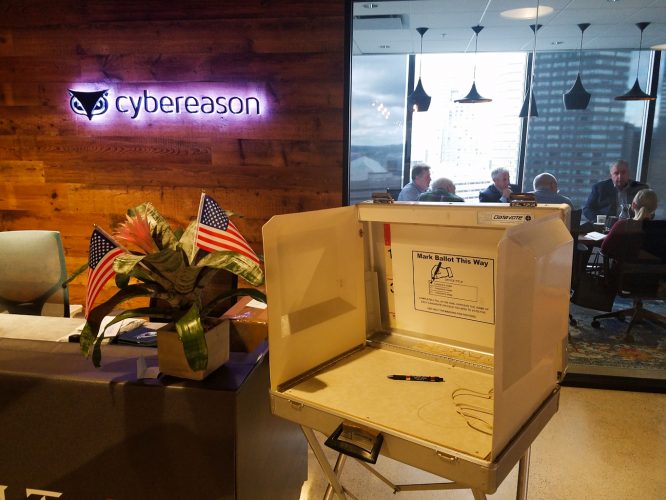
In this undated photo from Cybereason’s website, a faux ballot box is shown in the company’s Boston office.
Participating government officials, Cybereason staff and the media have consistently touted the importance of these simulations in securing elections against extreme threats, threats which — to date — have never materialized due to the efforts of foreign or domestic actors on election day. After all, these exercises are only simulations of possibilities and, even if those possibilities seem implausible or unlikely, it is important to be prepared for any eventuality.
But what if the very figures behind these simulations and the investors that fund them had a history of election meddling themselves? Cybereason’s deep ties to Israeli intelligence, which has a documented history of aggressive espionage and election meddling in the United States and in several nations worldwide, warrant a deeper look into the firms’ possible motives and the myriad conflicts of interest that arise in giving it such unprecedented access to the heart of America’s democracy.
What Does Cybereason Do?
Cybereason’s interest in terror events during elections seems out of place given that the company itself is focused on selling technological cybersecurity solutions like antivirus and ransomware protection software, software products that would be minimally effective against the type of threat encountered in the company’s election day simulations.
Cybereason is often described as offering a comprehensive technological defense platform to companies and governments that combines a next-generation antivirus with endpoint detection and response (EDR), which enables the company to respond to typical viruses and malware as well as sophisticated, complex attacks. The platform makes heavy use of artificial intelligence (AI) and cloud computing and specifically uses Amazon Web Services (AWS), which is used by a litany of private companies as well as U.S. intelligence agencies.
While many cybersecurity platforms combine antivirus and antimalware with EDR and AI, Cybereason claims that their military background is what sets them apart. They have marketed themselves as offering “a combination of military-acquired skills and cloud-powered machine learning to endpoint detection and response” and actively cite the fact that most of their employees are former members of Unit 8200 as proof that they are “applying the military’s perspective on cybersecurity to enterprise security.”
In 2018, Cybereason’s former senior director for intelligence, Ross Rustici, described the platform to CBR as follows:
Our founders are ex-Israeli intelligence who worked on the offensive side. They basically wanted to build a tool that would catch themselves. We follow the kill chain model started by Lockheed Martin [now a major investor in Cybereason] and try to interrupt every stage once an intruder’s inside a target network.”
Lior Div, Cybereason’s CEO described the difference between his company’s platform and that of past market leaders in this way to Forbes :
The old guard of antivirus companies like Symantec and McAfee would install something to block endpoints and you needed to do a lot [of monitoring] to make sure you weren’t under attack. We came with a different approach to see the whole enterprise and leverage AI to be able to fully autonomously identify where attackers are and what they’re doing.”
Thus, in looking at Cybereason’s product and its marketing objectively, it seems that the only innovative component of the company’s system is the large number of ex-military intelligence officers it employs and its tweaking of a previously developed and automated model for threat engagement, elimination and prevention.
Instead, Cybereason’s success seems to owe to its prominent connections to the private and public sectors, especially in Israel, and its investors who have funneled millions into the company’s operations, allowing them to expand rapidly and quickly claim a dominant position in emerging technology markets, such as the Internet of Things (IoT) and advanced healthcare systems.

A screenshot from a live stream of a 2019 Cybereason cyber-attack simulation
Their considerable funding from the likes of Lockheed Martin and Softbank, among others, has also helped them to expand their international presence from the U.S., Europe and Israel into Asia and Latin America, among other places. Notably, while Cybereason is open about their investors and how much funding they receive from each, they are extremely secretive about their financial performance as a company and decline to disclose their annual revenue, among other indicators. The significance of Cybereason’s main investors in the context of the company’s election simulations and its ties to Israeli and U.S. intelligence (the focus of this article) will be discussed in Part 2.
Cybereason also includes a security research arm called Nocturnus, currently headed by a former Unit 8200 officer. Nocturnus will be explored further in Part 2 of this series, as it essentially functions as a private intelligence company in the tech sector and has been behind several recent claims that have attributed alleged hacks to state actors, namely China and North Korea. For now, it is important to keep in mind that Nocturnus utilizes Cybereason’s “global network of millions of endpoints” for its intelligence gathering and research, meaning the endpoints of every device to which Cybereason’s software has access.
Given what Cybereason provides as a company, their interest in offering election simulations to government officials free of charge seems odd. Indeed, in the simulations hosted by Cybereason for U.S. officials, there is little opportunity for the company to market their software products given that the simulation did not involve electronic voting infrastructure at all and, instead, the malevolent actors used deep fakes, disinformation and terror attacks to accomplish their goals. Why then would this company be so interested in gauging the response of U.S. law enforcement to such crises on election day if there is no sales pitch to be made? While some may argue that these simulations are an altruistic effort by the company, an investigation into the company’s founders and the company’s ties to intelligence agencies suggests that this is unlikely to be the case.
The People Behind Cybereason
Cybereason was created in 2012 by three Israelis, all of whom served together as officers in the Israel Defense Force’s elite technological and signals intelligence unit, which is most often referred to as Unit 8200. Unit 8200 has been the subject of several MintPress investigative reports over the past year focusing on its ties to the tech industry.
Unit 8200 is an elite unit of the Israeli Intelligence corps that is part of the IDF’s Directorate of Military Intelligence and is involved mainly in signal intelligence, surveillance, cyberwarfare and code decryption. It is also well-known for its surveillance of Palestinian civilians and for using intercepted communications as blackmail in order to procure informants among Palestinians living under occupation in the West Bank.
The unit is frequently described as the Israeli equivalent of the NSA and Peter Roberts, a senior research fellow at Britain’s Royal United Services Institute, characterized the unit in an interview with the Financial Times as “probably the foremost technical intelligence agency in the world and stand[ing] on a par with the NSA in everything except scale.” Notably, the NSA and Unit 8200 have collaborated on numerous projects, most infamously on the Stuxnet virus as well as the Duqu malware.
Given the secrecy of the work conducted by Unit 8200, it is hard to know exactly what Cybereason’s co-founders did while serving in the controversial unit, however, a brief biography of the company’s current CEO and co-founder Lior Div states that “Div served as a commander [in Unit 8200] and carried out some of the world’s largest cyber offensive campaigns against nations and cybercrime groups. For his achievements, he received the Medal of Honor, the highest honor bestowed upon Unit 8200 members (emphasis added).”

Lior Div speaks during the Cyber Week conference in Tel Aviv, Israel, June 25, 2019. Corinna Kern | Reuters
After having served in leadership positions within Unit 8200, all three Cybereason co-founders went on to work for private Israel-based tech or telecom companies with a history of aggressive espionage against the U.S. government.
Cybereason co-founders Yonathan Striem Amit (Cybereason’s Chief Technology Officer) and Yossi Naar (Cybereason Chief Visionary Officer) both worked for Gita Technologies shortly before founding Cybereason with fellow Unit 8200 alumnus Lior Div. Gita, according to public records, is a subsidiary of Verint Systems, formerly known as Comverse Infosys.
Verint/Comverse was initially funded by the Israeli government and was founded by Jacob “Kobi” Alexander, a former Israeli intelligence officer who was wanted by the FBI on nearly three dozen charges of fraud, theft, lying, bribery, money laundering and other crimes for over a decade until he was finally extradited to the United States and pled guilty to some of those charges in 2016.
Despite its history of corruption and foreign intelligence connections, Verint/Comverse was hired by the National Security Agency (NSA) to create backdoors into all the major U.S. telecommunications systems and major tech companies, including Facebook, Microsoft and Google. An article on Verint’s access to U.S. tech infrastructure in Wired noted the following about Verint:
In a rare and candid admission to Forbes, Retired Brig. Gen. Hanan Gefen, a former commander of the highly secret Unit 8200, Israel’s NSA, noted his former organization’s influence on Comverse, which owns Verint, as well as other Israeli companies that dominate the U.S. eavesdropping and surveillance market. ‘Take NICE, Comverse and Check Point for example, three of the largest high-tech companies, which were all directly influenced by 8200 technology,’ said Gefen.”
Federal agents have reported systemic breaches at the Department of Justice, FBI, DEA, the State Department, and the White House going all the way back to the 1990s, breaches they claimed could all be traced back to two companies: Comverse/Verint and Amdocs. Cybereason’s other co-founder and current CEO, Lior Div, used to work for Amdocs as the company’s development group leader.
After leaving Amdocs, Div founded a company called Alfatech. Alfatech publicly claims to specialize in “professional Head Hunting and Quality Recruiting services,” yet it has no functional website. Despite its publicly stated mission statement, Israeli media reports that mention Alfatech describe it as “a cybersecurity services company for Israeli government agencies.” No reason for the obvious disconnect between the company’s own claims and those made by the media has been given.
Div left Alfatech in 2012 to found Cybereason alongside Striem-Amit and Naar. According to an interview that Div gave to TechCrunch earlier this year, he stated that his work at Cybereason is “the continuation of the six years of training and service he spent working with the Israeli army’s 8200 Unit (emphasis added).” Div was a high-level commander in Unit 8200 and “carried out some of the world’s largest cyber offensive campaigns against nations and cybercrime groups” during his time there. TechCrunch noted that “After his time in the military, Div worked for the Israeli government as a private contractor reverse-engineering hacking operations,” an apparent reference to his work at Alfatech.
Even deeper ties to intelligence
Not only do Cybereason’s own co-founders have considerable links to the Israeli government, Israeli intelligence and intelligence-connected private companies, but it also appears that the work of Cybereason itself is directly involved with Israeli intelligence.
The company periodically publishes reports by a secretive faction of the company called the Cybereason Intelligence Group or CIG. The only description of CIG’s composition available on Cybereason’s website is as follows:
The Cybereason Intelligence Group was formed with the unique mission of providing context to the most sophisticated threat actors. The group’s members include experts in cyber security and international security from various government agencies, including the Israel Defense Forces’ Unit 8200, which is dedicated to conducting offensive cyber operations. Their primary purpose is to examine and explain the Who and the Why behind cyber attacks, so that companies and individuals can better protect themselves (emphasis added).”
It is unclear how many members comprise CIG and if its members are employees of only Israeli government agencies, or if it includes officials from the U.S. government/Intelligence or other governments. However, what is clear is that it is composed entirely of government officials, which include active members of Unit 8200, and that the purpose of the group is to issue reports that place blame for cyberattacks on state and non-state actors. Perhaps unsurprisingly, the vast majority of CIG’s reports published by Cybereason focus exclusively on Russia and China. When discussing nation-state cyber threats in general, Cybereason’s website only mentions China, North Korea, Iran and Russia by name, all of which are incidentally rival states of the U.S. government. Notably, Israel’s government — listed as a “leading espionage threat” to U.S. financial institutions and federal agencies by the U.S.’ NSA — is absent from Cybereason’s discussions of state actors.
In addition to CIG, Cybereason’s cybersecurity research arm, Nocturnus, includes several Unit 8200 alumni and former Israeli military intelligence and government contractors and has assigned blame to state actors for several recent hacks. It also has claimed to have discovered more such hacks but has declined to publicly disclose them due to the “sensitive” nature of the hacks and companies affected.
Other hints at Cybereason’s connections to state intelligence can be seen in its advisory board. Robert Bigman, the former Chief Information Security Officer (CISO) for the Central Intelligence Agency (CIA) who oversaw the spy agency’s “commercial partner engagement” program (i.e. alliances with the private tech sector), is a key figure on the company’s advisory board. According to his biography, Bigman “ contributed to almost every Intelligence Community information security policy/technical standard and has provided numerous briefings to the National Security Council, Congress and presidential commissions. In recognition of his expertise and contributions, Bigman has received numerous CIA and Director of National Intelligence Awards.”
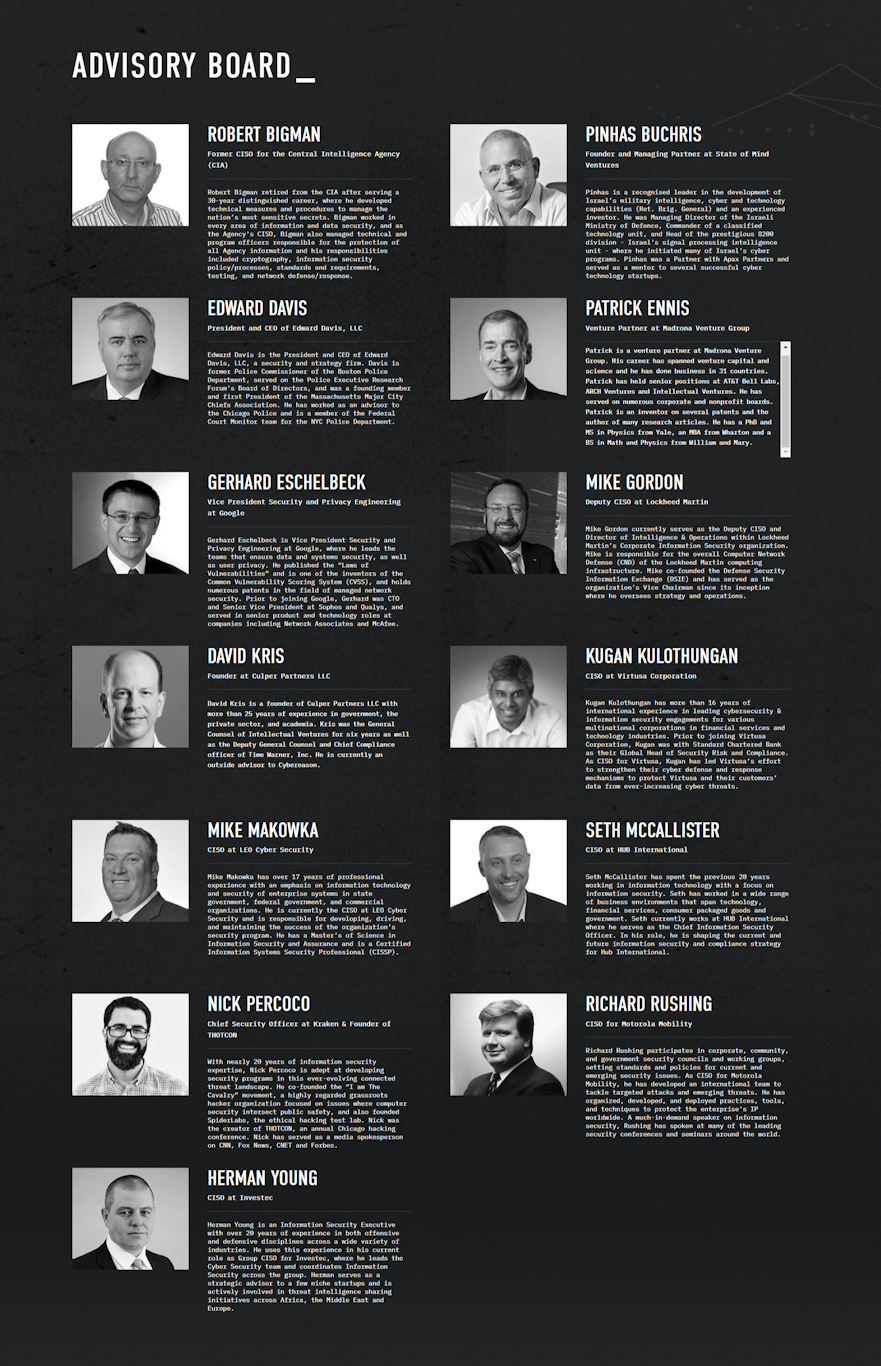
Cybereason’s leadership team features a who’s who of Israeli and US intel officials
Unmentioned in his biography published on his own website, or on Cybereason’s website, is that Bigman is also an advisor to another Israeli tech company, Sepio Systems. The chairman of Sepio, Tamir Pardo, is a self-described “leader” in the cybersecurity industry and former director of Israel’s Mossad. Sepio is funded by a venture capital firm founded by the creators of the controversial Israeli spy tech company NSO Group, which has received a slew of negative press coverage after its software was sold to several governments who used it to spy on dissidents and human rights activists.
In addition to Bigman, Cybereason’s advisory board includes Pinchas Buchris, the former head of Unit 8200 and former managing director of the IDF. Not unlike Bigman, Buchris’ bio fails to mention that he sits on the board of directors of Carbyne911, alongside former Israeli Prime Minister Ehud Barak and Nicole Junkerman, both well-known associates of intelligence-linked sex trafficker Jeffery Epstein. Epstein himself poured at least $1 million into Carbyne, an Israeli company that seeks to run all 911 call centers in the U.S. at the national level and has close ties to the Trump administration. More information on Carbyne and its ties to Israeli and U.S. intelligence as well as its connection to coming pre-crime policies to be enacted in 2020 by the U.S. Department of Justice can be found in this MintPress report from earlier this year. Given that Cybereason’s election day simulations involve the simulated collapse of 911 call center functionality, Buchris’ ties to both Cybereason and Carbyne911 are notable.
Another notable Cybereason advisor is the former commissioner of the Boston Police Department, Edward Davis. Davis heavily promoted Cybereason’s disturbing election day simulations and even participated directly in one of them. He was also police commissioner of the Boston PD at the time of the Boston Marathon bombing and oversaw the near-martial law conditions imposed on the city during the manhunt for the alleged perpetrators of that bombing (who themselves had a rather odd relationship with the FBI). This is notable given that Cybereason’s election day simulations ended with martial law being imposed on the fictional city used in the exercise
Cybereason also has several advisors who hold top positions at powerful U.S. companies that are also — incidentally — U.S. government contractors. These include the Vice President Security and Privacy Engineering at Google, Deputy Chief Information Security Officer (CISO) of Lockheed Martin and CISO at Motorola. Both Motorola and Lockheed Martin use Cybereason’s software and the latter is also a major investor in the company. Furthermore, as will be explained in Part 2 of this article, Lockheed Martin has used its privileged position as the top private contractor to the U.S. government to promote the widespread use of Cybereason’s software among U.S. government agencies, including the Pentagon.
Much more than a cybersecurity company
Given Cybereason’s deep and enduring ties to Israeli intelligence and its growing connections to the U.S. military and U.S. intelligence through its hiring of top CIA officials and partnership with Lockheed Martin, it’s worth asking if these disturbing election simulations could serve an ulterior purpose and, if so, who would benefit. While some aspects regarding clear conflicts of interest in relation to the 2020 election and Cybereason will be discussed in Part 2, this article will conclude by examining the possibility that Cybereason is acting as a front company for Israeli intelligence based on that country’s history of targeting the U.S. through private tech companies and on Cybereason’s own questionable characteristics.
First, Cybereason as a company presents several oddities. Its co-founder and CEO openly states that he views Cybereason’s work as a continuation of his service for Israeli military intelligence. In addition, he and the company’s other founders — after they left Unit 8200 — went to work for Israeli tech companies that have been known to spy on U.S. federal agencies for the Israeli government.
In addition, as previously mentioned, Cybereason has sought out former intelligence officers from the CIA and Unit 8200 for its management team and board of advisors. The company itself also functions as a private intelligence firm through CIG and Nocturnus, both of which employ former and current intelligence officials, and have made significant claims regarding the attribution of specific cybercrimes to state actors. It appears highly likely that these claims are influenced by those same intelligence agencies that boast close ties to Cybereason. Furthermore, Nocturnus’ access to Cybereason’s “global” network of endpoints makes it a private intelligence gathering company as it gathers and analyzes data from all devices that run Cybereason’s software.
Yet, even more telling is the fact that Israel’s government has an open policy of outsourcing intelligence-related activity to the private sector, specifically the country’s tech sector. As MintPress previously reported, this trend was first publicly acknowledged by Israel in 2012, the same year that Cybereason was founded by former Israeli military intelligence officers then-working for private contractors for Israel’s government (Alfatech) or private companies known to have ties to Israeli intelligence, including Verint/Comverse.
As noted in an article on the phenomenon from the Israeli media outlet The Calcalist:
Israel is siphoning cyber-related activities from its national defense apparatus to privately held companies. Since 2012, cyber-related and intelligence projects that were previously carried out in-house in the Israeli military and Israel’s main intelligence arms are transferred to companies that in some cases were built for this exact purpose.”
Mention of Israel’s policy of blurring the lines between the public and private sector when it comes to cybersecurity and intelligence gathering has even garnered the occasional mention in mainstream media, such as in a 2018 Foreign Policy article:
Israel, for one, has chosen to combat the problem on a statewide level by linking the public and private spheres, sometimes literally. The country’s cyberhub in the southern city of Beersheba is home not just to the Israeli military’s new technology campus but also to a high-tech corporate park, Ben-Gurion University of the Negev’s cyber-research center, and the Israel National Cyber Directorate, which reports directly to the prime minister’s office. “There’s a bridge between them—physically,” [Gabriel] Avner, the security consultant, said by way of emphasis.”
Notably, a year before Lockheed Martin invested in and partnered with Cybereason, the U.S.-based weapons company opened an office at the IDF’s public-private cyber hub in Beersheba. At the inauguration ceremony for Lockheed’s Beersheba office, company CEO Marilyn Hewson stated:
The consolidation of IDF Technical Units to new bases in the Negev Desert region is an important transformation of Israel’s information technology capability… By locating our new office in the capital of the Negev we are well positioned to work closely with our Israeli partners and stand ready to: accelerate project execution, reduce program risk and share our technical expertise by training and developing in-country talent.”

Lockheed Martin CEO Marillyn Hewson, inaugurates the Lockheed Martin Israel Demonstration Center in Tel Aviv.
Further evidence of this public-private merger can be seen in how two of Israel’s intelligence agencies, Shin Bet and Mossad, have both recently launched a private start-up accelerator and a hi-tech venture capital fund, respectively. The Shin Bet’s accelerator, called Xcelerator, usually makes its investments in private companies public, while Mossad’s Libertad Ventures refuses to disclose the tech companies and start-ups in which it invests. Former directors of both Mossad and Shin Bet have described these intelligence agencies themselves of being like start-ups, clearly showing how much the line between intelligence apparatus and private company has been blurred within the context of Israel’s tech industry and specifically its cybersecurity industry.
The advantages of outsourcing cyber intelligence operations to private companies have been noted by several analysts, including Sasha Romanosky, a former Cyber Policy Advisor at the Department of Defense and current analyst at RAND Corporation. Romanosky noted in 2017 that private intelligence and cybersecurity firms “do not necessarily face the same constraints or potential repercussions” as their public counterparts when it comes to designating blame for a cyberattack, for example. In addition, outsourcing intelligence objectives or missions to private companies provides a government with plausible deniability if that private company’s espionage-related activities or ties are made public.
Furthermore, Israeli intelligence has a long history of using private tech companies for the purposes of espionage, including against the United States. While Amdocs and Verint/Comverse were already mentioned as having been used by the state of Israel in this way, other private companies have also been used to market software backdoored by Israeli intelligence to countries around the world, both within the U.S. and elsewhere. The most well-known example of this is arguably the mass sale and distribution of the bugged PROMIS software, which was discussed at length in several recent MintPress News reports.
Given Cybereason’s ties to intelligence and Israeli intelligence’s history of placing backdoors in its software, it is worth pointing out that Cybereason’s main product, its antivirus and network defense platform, offers a major espionage opportunity. Blake Darché, a former N.S.A. operator, told the New York Times in 2017 that antivirus programs, which Cybereason’s defense platform includes, is “the ultimate backdoor,” adding that it “provides consistent, reliable and remote access that can be used for any purpose, from launching a destructive attack to conducting espionage on thousands or even millions of users.” Whether a company like Cybereason would use its software for such ends is unknown, though the company does acknowledge that its cybersecurity arm does gather intelligence from all systems that use the company’s software and currently employs and works with active duty Unit 8200 officials through CIG. This is notable because Unit 8200’s main task for Israeli military intelligence is signals intelligence, i.e. surveillance.
More of a mystery, however, is why a company like Cybereason is so interested in U.S. election security, particularly when Israeli intelligence and Israeli intelligence-connected private companies have been caught in recent years meddling in elections around the world, including the United States.
Whitney Webb is a MintPress News journalist based in Chile. She has contributed to several independent media outlets including Global Research, EcoWatch, the Ron Paul Institute and 21st Century Wire, among others. She has made several radio and television appearances and is the 2019 winner of the Serena Shim Award for Uncompromised Integrity in Journalism.
Featured Video
Thomas Fazi: NATO’s Hybrid Warfare – Deception & Permanent War
or go to
Aletho News Archives – Video-Images
Book Review
The Zeolite Book — First Edition, 2026, Paperback
The volcanic mineral medicine will not patent — for the toxic burden medicine will not name
Lies are Unbekoming – October 30, 2026
 Zeolite is old. It is in Roman concrete that has held for two thousand years. It’s in the water filters of ancient cisterns. It’s in the stomachs of Pacific livestock whose keepers knew, somehow, that this grey crumbling rock made the animals healthier. It’s in Soviet clinical protocols from the 1960s. It’s in the standard emergency response to the Chernobyl explosion.
In 1986, after the Chernobyl reactor failure, the Soviet Union manufactured and distributed natural zeolite at industrial scale — for soil remediation, for livestock feed, for human consumption, for the cleanup itself. Karl Hecht, who had been director of the Institute for Experimental and Clinical Pathophysiology at the Charité of Humboldt University Berlin, spent the six decades after that building the clinical research base — on silicon’s role in human health, on zeolite’s clinical safety, on its applications in ageing. In 2018, Pavelić and colleagues published a comprehensive clinical safety review of natural clinoptilolite in Frontiers in Pharmacology. In 2019, Mastinu analysed its binding affinities. In the Western medical literature, these works sit largely uncited.
What has not been treated at book length, until now, is how a volcanic mineral with six decades of Soviet clinical work behind it, two major peer-reviewed Western reviews, and ongoing clinical use across the former Eastern Bloc, remains almost entirely absent from Western medical practice — and what the toxic burden it’s meant to address actually is.
The Zeolite Book gathers the Soviet clinical record, the Western peer-reviewed studies, three contemporary practitioner voices, and three serious counterviews into one honest treatment. That’s why the book runs to seven appendices. 288 pages, four parts, three practitioner voices, three counterviews, seven appendices. The honest treatment is the argument.
Blog Roll
 Aletho News
- UAE security forces tortured, killed journalist for opposing Israel normalization: Report
- They Compared the Spice to the Drug. The Spice Won — Again. (Part 2)
- Thomas Fazi: NATO’s Hybrid Warfare – Deception & Permanent War
- Wrong, AP and NPR: Europe’s 50,000 Heat Deaths Are a Computer-Model Estimate, Not a Real Body Count
- Questioning Your Doctor Is Now Considered A Psychological Problem (Seriously)
- London tourism expo promotes Israeli agency linked to theft of Palestinian land
- Dockworkers launch global strike against Israeli and US military shipments
- Europe facing gas price shock – Gazprom chief
- Ukraine continues recruiting people with disabilities
- Weaponized Journalism: 2021 Sayer Ji Interview with NPR
- If Americans Knew
- An error has occurred; the feed is probably down. Try again later.
- No Tricks Zone
- Germany’s Green Energy Transition Becoming Increasingly Expensive…Another 6 Trillion Euros!
- Sudden Stratospheric Warming, Powerful El Niño Combination May Lead To Extreme Europe Cold, Energy Crisis!
- Two New Studies Find Thwaites Glacier Melt Cannot Be Driven By Human Activity Or A Warming Ocean
- E-Cars Reduce CO2 Emissions By Only 41% Compared To Internal Combustion Engine Vehicles
- Predictions Made By Renowned Climate Professor Over Past Decades Have Been Proven To Be Poor
- New Study Suggests Large Regions Of The Pacific Ocean Have Been Cooling For The Last 80 Years
- Germany’s Green Energy Debacle: High Energy Costs Force Kahla Porzellan to Close After 182 Years!
- New Study: 50 Years Of The Most Aggressive ‘Net Zero’ Policies Can Only Affect The Global Climate By 0.03°C
- US September “Heat” Was No Record…Many Records Set Decades Ago
- Latest European Green Energy Debacle; Portugal’s Largest Flagship Solar Park Insolvent!

