New US Ambassadors to Central Asia – the Testament of Growing US Interest
By Vladimir Platov – New Eastern Outlook – 03.12.2019
Carrying on the discussion about the role Central Asia plays in Washington’s grand designs and the tactics it employs to ensure its expansion in this region of the world, one cannot omit the criteria it employs to hand-pick ambassadors sent to regional capitals to advance Washington’s agenda.
In this regard, it’s only logical to cite Professor of International Affairs of the Pennsylvania State University, Dennis Jett who stated that:
In every other developed democratic country, the role of ambassador, with only very rare exceptions, is given to career diplomats who have spent decades learning the art of international relations. In the U.S., however, many ambassadors are untrained in diplomacy.
This matter became even more relevant after a series of scandals prompting interest both in the media and the US Congress regarding the role of non-career ambassadors damaging Washington’s ties with various states of the world. It came to a point when US Representative Ami Bera introduced legislation that would require at least 70% of a president’s ambassadorial appointments to come from the ranks of career Foreign Service officers and civil servants.
Returning to the matters of Wahington’s designs in Central Asia, it’s noteworthy that the White House has been appointing people with an extensive military background and first-hand experience in supervising government coups as US ambassadors to Central Asian countries for quite some time now.
Thus, Washington’s special interests in Uzbekistan, previously discussed by the American intelligence company Stratfor, are going to be advanced by its new ambassador to this country, Daniel Rosenblum, who arrived in Tashkent last July. It is noteworthy that Rosenblum holds an MA degree from the Johns Hopkins School of Advanced International Studies, with the same foundation hosting the Central Asia-Caucasus Institute – the key American think tank tasked with developing a strategy for shaping regional affairs. From 1997-2008, the now US ambassador to Tashkent held a variety of positions, including Deputy Coordinator, Director of the Eurasia Division, and Special Advisor for Economic Programs. That’s when he was tasked with overlooking preparations for a number of color revolutions in Georgia (2003), Ukraine (2004) and Kyrgyzstan (2005). Therefore, there is no doubt that Washington has sent the “right man for the job” to Uzbekistan, and judging by his appointment it’s not hard to figure out the precise nature of his job.
The overall increased interest in Central Asia shown by the US and its ongoing preparations for “offensive actions” in this region are clearly indicated by the roster of new US ambassadors that have been sent to the region this year. It is an indicator that we can safely expect a number of “color revolutions” to shake up the region.
Thus, both the new US ambassador to Ashgabat retired colonel Matthew S. Klimow and his wife, Major Edie Gunnels, who arrived to Turkmenistan last June, have extensive military experience. It is unlikely that anyone in this regard may have doubts about the true goals of their role in overlooking a great many of purely military questions that the United States wants resolved in this Central Asian country and the region as a whole.
In March, William H. Moser was sent to Kazakhstan to serve as the new US ambassador. In 2011-2015, he was the US ambassador to Moldova, that is, during the years of an extensive political crisis in this country, which would soon be shaped by the age-old Washington narrative, pushing Nur-Sultan away from Moscow, with emphasis on laying the foundation of American influence through the preparation of “national cadres” loyal to the United States. Without a doubt, the main occupation of the US Embassy under his leadership will be the further expansion of the omnipresent influence of such American NGOs as the Soros Foundation and the National Endowment for Democracy (NED), which are already hard at work implementing the program of “language and cultural Westernization” of Kazakhstan, aimed at closing Russian schools, ousting the Russian language with the subsequent Latinization of the country, and inciting anti-Russian sentiments.
Although, out of all of the Central Asian republics, Tajikistan appears to represent the least amount of interest for Washington, the White House is taking into account the fact that that by controlling the political narrative in Dushanbe and using Tajikistan as a bridgehead, the United States can inflict damage upon both Russia and the PRC, which are described as Washington’s strategic adversaries. Against this background, the arrival of the leading State Department Russian specialist, John Mark Pommersheim, to Dushanbe in the capacity of a US ambassador is very telling. In the 1980s, he worked at the US Information Agency (USIA), and was transferred to Tajikistan after working at the US Embassy in Kazakhstan. It goes without saying that he knows Central Asia well. To date, the United States hasn’t had an opportunity to undermine Russia’s or China’s influence in Tajikistan, put it doesn’t mean that it will not continue trying. Washington could have resorted to hard power, by sending the same militants it controls in Afghanistan to Tajikistan, but so far it has been resorting to soft power. Relatively speaking, Pomersheim is no stranger to the “diplomacy” of reinforcing anti-Chinese and anti-Russian narratives through a network of NGOs.
At the same time, one should not forget that, in addition to actively opposing Russia and its influence in the Central Asian states, Washington’s opposition to China will be the primary goal that all new US ambassadors appointed this year to Central Asia will be tasked to uphold. Indeed, by controlling (or destabilizing) Central Asia, Washington could destroy the whole concept of the One Belt, One Road global initiative, which implies China’s reorientation from relying on sea routes to in-land routes. Moreover, there’s the matter of exports of Central Asian hydrocarbons to China, and the way regional players can influence the Muslim population of the Xinjiang Uygur Autonomous Region of China. It’s no secret that the successful destabilization and radicalization of Central Asia through the “assets” that Washington has managed to accumulate in Afghanistan may present a serious challenge to both China and Russia. That is why Washington needed precisely such “right men” to serve as US ambassadors in this region.
DHS proposes MANDATORY facial recognition checks for US citizens at airports
RT | December 3, 2019
The US Department of Homeland Security (DHS) is pushing to impose mandatory facial recognition scans on all Americans entering or leaving the United States, moving to close a loophole that allows citizens to opt out.
Proposed in a recent filing, the DHS requested a change to the current rules in order to “provide that all travelers, including US citizens, may be required to be photographed upon entry and/or departure” from the US, citing the need to identify criminals or “suspected terrorists.” While not yet implemented, the rule change is in the “final stages of clearance,” a DHS official told CNN Business.
Under the existing guidelines, US citizens and other lawful permanent residents have the ability to avoid airport biometric scans and identify themselves by another means. While some travelers have found it difficult to opt out given opaque or inconsistent guidelines from airport to airport, the DHS would apparently like to cut down on the confusion by doing away with the exemption altogether.
The new rule was rejected by civil liberties groups and privacy advocates, who said it would only further erode Americans’ privacy and subject them to yet another layer of intrusive government surveillance.
“Time and again, the government told the public and members of Congress that US citizens would not be required to submit to this intrusive surveillance technology as a condition of traveling,” said Jay Stanley, a senior policy at the American Civil Liberties Union, adding that the rule raises “profound privacy concerns.”
“Travelers, including US citizens, should not have to submit to invasive biometric scans simply as a condition of exercising their constitutional right to travel.”
The DHS is currently set to outfit 20 of America’s largest airports with biometric scanners by 2021, despite a flurry of privacy issues and ongoing technical problems. Last year, an internal watchdog report found that the department’s facial recognition tech was not performing up to snuff and “may be unable to meet expectations” by its deadline. The DHS also piqued security concerns last year when it announced it would partner with Amazon for its all-seeing HART system, which will pass highly detailed information on some 250 million people to the tech giant for storage.
Recalling a data breach in June which saw 100,000 license plate and traveler images stolen from a private contractor hired to store information for the DHS, Stanley said the government simply “cannot be trusted” with the invasive technology.
The International Zionist Conspiracy
It poisons everything it touches
By Philip Giraldi • Unz Review • December 3, 2019
A recent article by Philip Weiss on the Mondoweiss website lays out an argument that most liberal Jews, like Weiss, are hesitant to support, namely that Jewish power, and more to the point its money, as exercised through the so-called Israel Lobby in the United States and elsewhere, has been the principal enabling force behind the international pariah that the state of Israel has become.
Weiss notes how “most observers accept the antisemitism redlines echoed lately by Bernie Sanders: you are not to speak of an outsize Jewish role in politics. So few write about the Israel lobby, though they know it to be a significant force…” In other words, Sanders, liberal to the core and ostensibly supportive of Palestinian rights, draws a line that forbids any real discussion of Jewish power in the United States even though everyone who has not been asleep is more than aware of just how powerful American Jews, and by extension Israel, are.
Weiss details how the vast sums of money raised by both Democratic and Republican Jews has distorted American politics since the time of President Harry S. Truman. He describes how president after president has backed down versus Israel when confronted by Jewish power and observes that “This is not just a domestic political question, it’s a foreign policy problem. The Israel lobby is the root cause of the Israel Palestine conflict. Consider the two… main causes of the conflict. 1, Israeli settlement/colonialism (or in Zionist terms, the effort to liberate European Jewry from persecution by establishing a Jewish homeland in historical Palestine). 2, Palestinian resistance to 1. Neither of these historical forces would still be a source of serious conflict 71 years after Israel’s establishment were it not for the lobby. Without the blind support of the United States, Israel would have made a deal a long time ago. The country would have followed through on the historic Palestinian concession of 1988 followed by the Arab Peace Initiative of 2001, and accepted partition of the land on highly favorable terms (Israel gets 78 percent). Without U.S. support, Israel would have been internationally isolated and would have grabbed the deal. The Israelis have been able to continue to devour the land only because the United States supports the occupation in international fora, and gives Israeli a diplomatic umbrella against any storm, due to blind bipartisan political backing here.”
Jewish power in America and elsewhere must never be discussed unless it is a discussion involving only Jews, who openly recognize and appreciate the phenomenon. Weiss notes how “Israel lobbyists themselves extol Jewish political power in the U.S. as Israel’s lifeline for money and arms and diplomatic protection” and quotes Michael Koplow of the Israel Policy Forum, who boasts how “I have no qualms about pointing out that the American Jewish community is almost certainly the most influential minority community in the history of the U.S., and possibly in the history of the world. American Jews have worked hard to make it so, and have built a network of outward-facing institutions that protect this privileged position.”
Beyond Weiss’s observations, one might note how Zionist Jews are essentially able to shut down any discussion of Palestine or of Palestinian rights. Given the extreme over-representation of Jews in both the news generation process and in various choke points in the political process, an honest discussion of Israel-Palestine and the actual U.S. interests in the region is extremely difficult to find anywhere in the mainstream media.
In both the 2012 and 2016 Democratic Party conventions, for example, there was considerable pressure from the members of the party base to include language reflective of the need to recognize Palestinian suffering and condemn the Israeli “occupation.” Long-time liberal activist James Zogby pushed for an amendment to the party platform in 2016 calling for “an end to occupation and illegal settlements” in Israel-Palestine. In both conventions, Hillary Clinton interests pushed back and rejected any changes, arguing that they would constitute “terrible mistake[s],” too “one-sided” toward the Palestinians. In both instances there was loud and sustained booing from the floor when the reflexively pro-Israel platform was announced, but the speaker rejected calls for any floor vote.
To cite another example, two weeks ago, California’s Democratic party concluded its fall convention by finalizing what would be included in the state party platform. An amendment promoted by Palestinian supporters was defeated in a floor vote. It was offered by delegate David Mandel, himself a Jew, and called on the party to support “a solution of the Israeli-Palestinian conflict negotiated by the parties that guarantees equality, security and democracy for all, no matter what the final settlement regarding states and borders” and called on party members to “oppose any unilateral annexation of territory, and support the right of all those who were forced from their homes to return to their homelands and receive compensation for their losses.” Mandel’s proposal attracted the ire of Zionist apologists including State Senator Scott Wiener and Assemblywoman Laura Friedman, who asserted that “This amendment cuts to the core of Israel’s ability to be its own state.”
One might observe that the Mandel amendment was pretty mild stuff relatively speaking, even excluding the word “occupation,” and that the Wiener-Friedman riposte is nonsense, but the result was more of the same. Reliably liberal California Democrats delivered the usual pander to Israeli-Jewish interests. They surrendered to the persistent Jews-in-politics demand never to give even one inch when it comes to permitting Israel absolute license to behave badly while at the same time extracting from the United States billions of dollars in subsidies every year.
And the Israel conspiracy might well be regarded as international. In France, which has the largest diaspora Jewish population after the United States, hate legislation which de facto protects only Jews has been employed to shut down any and all criticism. It has become common all across Europe to regard any criticism of Israel as anti-Semitism and therefore as a hate crime, with criminal penalties attached. French comedian Dieudonné, who admittedly is rather pointed in his satire, has been convicted eight times.
And then there is the sad case of Jeremy Corbyn, British Labour Party leader who will be contesting a national election on December 12th. Corbyn has been accused of being an anti-Semite based on his fairly mild defense of Palestinians, which one might have thought to be a good, sound socialist human rights position. And so it would be if Israel were not involved. With the election looming, British Jews have increased pressure on Corbyn and by default are endorsing his conservative opponent Boris Johnson, who has spoken repeatedly about his love of Israel. Britain’s Chief Rabbi Ephraim Mirvis recently produced an article for the influential Times of London declaring Corbyn “unfit for office” because “the way in which the [Labour] leadership has dealt with anti-Jewish racism is incompatible with the British values of which we are so proud — of dignity and respect for all people.”
The good rabbi is not, of course including Palestinians as worthy of “dignity and respect.” He is really only concerned about his own tribe and the “racism” he refers to is largely concentrated among those Britons who are opposed to Israeli government policies. Britain is already in some senses Zionist controlled territory, even more so than the United States. Jews are prominent at many choke points in the media and entertainment industries while 80% of Conservative Party politicians are members of “Conservative Friends of Israel.” The Labour Party is also active engaged with their own version of the same, Labour Friends of Israel, which includes 80 out of the party’s 262 members of parliament.
Finally, International Zionism is very well represented in recent announcements coming from the world of professional sports, where billionaire Jewish team owners take their orders from Israel to combat critics and the scourge of anti-Semitism.
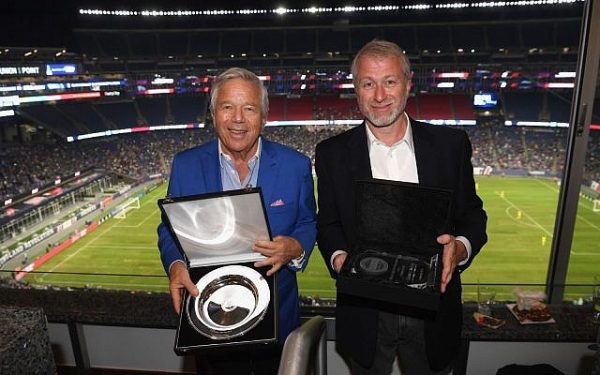
In January 2019 New England Patriots owner Robert Kraft received the Genesis prize, a million-dollar award given annually to Jews “who have attained excellence and international renown in their chosen professional fields.” Kraft’s friend Israeli Prime Minister Benjamin Netanyahu personally presented the plaque and Kraft told the audience that he would use the money to combat anti-Semitism and the BDS (the Boycott, Divestment and Sanctions) movement. He also pledged to add $20 million of his own money to set up a foundation to do more of the same. Kraft enthused “Israel is so special to me and my family… I have sponsored dozens of missions and countless other trips for people to experience Israel for the first time. Spiritually, there is no place like it on earth.”
Perhaps Kraft should move to Israel so he won’t be troubled by allegations of dual loyalty made by people like me. He has now been joined by Britain’s Chelsea football club owner Roman Abramovich, a billionaire investor who has pledged £3.9m ($5 billion) of his own money to support the foundation “to tackle anti-Semitism.” Abramovich was born in the Soviet Union but is an Israeli citizen and lives most of the year in that country. He has been linked to a number of financial scandals.
Kraft, of course, has his own baggage. On February 22nd, 2019, he was charged in Jupiter Florida for “soliciting another to commit prostitution.” Kraft was reportedly video recorded by a hidden camera while engaged in sexual activity within the confines of a seedy enterprise called the Orchids of Asia Day Spa that sold the services of Asian sex trafficked women. The case is still being resolved but Kraft denies the charges and he has plenty of high- priced lawyers to make sure that he walks.
Beyond all that, if one doubts the power of the Jewish/Israel lobby internationally, note one of the first actions undertaken by the new coup government in Bolivia. It has moved to reestablish diplomatic relations with Israel as a top priority. Brazil also sought a closer relationship with Israel after conservative Jair Bolsonaro was elected president and pledged to visit the Jewish state, a promise which he carried out in March. Everyone in the world understands that the way to gain favor with Washington is to go through Israel.
Philip M. Giraldi, Ph.D., is Executive Director of the Council for the National Interest, a 501(c)3 tax deductible educational foundation (Federal ID Number #52-1739023) that seeks a more interests-based U.S. foreign policy in the Middle East. Website is councilforthenationalinterest.org, address is P.O. Box 2157, Purcellville VA 20134 and its email is inform@cnionline.org.
Global Giants: American Empire and Transnational Capital
Maximilian C. Forte review of Giants: The Global Power Elite by Peter Phillips (Introduction by William I. Robinson). New York: Seven Stories Press, 2018. LCCN 2018017493; ISBN 9781609808716 (pbk.); ISBN 9781609808723 (ebook); 353 pps.
Giants: The Global Power Elite, by Peter M. Phillips, Professor of Political Sociology at Sonoma State University, opens with a stated intention of following in the tradition C. Wright Mills’ The Power Elite. This book is clearly meant to be a contemporary update and expansion of Mills’ work, such that the “power elite” now becomes the global power elite (GPE) in Phillips’ volume—and central to the idea of a global power elite is the transnational capitalist class that was at the core of the theorization of Leslie Sklair. One of the most important features of this book, in my view, is that it overcomes the unproductive dichotomy that continues to silently inform many academic and political debates on this question: is the contemporary world order one dominated by US imperialism or transnational capital? Phillips’ answer is productive (even if I do not entirely agree): transnational capital has acquired US power and uses the power of the US state to further its aims, protect its interests, and enforce its agenda. Where I differ, the difference is a relatively slight matter of emphasis: Phillips’ model is largely correct, but it is also important to remember that the wealthiest, most numerous, and most powerful membership of the “transnational” capitalist class is in fact American.
Aside from this, Phillips reveals how even now mere mention of the “transnational capitalist class” is obscured in mainstream corporate media coverage. As he points out: “the concept of a global transnational capitalist class is essentially completely absent from corporate news coverage in the United States and Europe” (p. 62).
The centrepiece of this work is its detailed exposition of the 389 individuals who constitute the core of “the policy planning nongovernmental networks that manage, facilitate, and protect the continued concentration of global capital” (p. 10).
I am thankful to the author for providing me with a free copy of this text, so that this review could be written. I have also assigned one of the chapters as required reading in one of my recent courses (DeGlobalization & the Nation), and thus I also have the benefit of feedback from students on some of the book’s key contents.
Chapters—Contents
The Preface to the volume effectively summarizes the key contents of the book and outlines its principal arguments. It was not prepared as a mere formality, and is worth reading on its own.
The Introduction, “Who Rules the World?” was written by William I. Robinson, one of the leading scholars today on the topic of the transnational capitalist class.
Chapter 1, “Transnational Capitalist Class Power Elite: A Seventy-Year History,” aims at explaining the “transition from the nation state power elites described by Mills to a transnational power elite centralized on the control of global capital around the world”. In this chapter Phillips traces the development of the concept of global power elites from the work of C. Wright Mills, through to Leslie Sklair, William Robinson, William Carroll and even David Rothkopf. While the author also invokes “shadow elites,” he does not mention the work of Janine Wedel in this regard. Phillips also provides a detailed outline of the nature of global wealth inequality, ranging from the control of wealth by a few, to over-accumulation, and starvation. In addition to the preface, this is the chapter that makes the central arguments of the book.
Chapter 2, “The Global Financial Giants: The Central Core of Global Capitalism,” identifies the 17 global financial giants—money management firms that control more than one trillion dollars in capital. As these firms invest in each other, and many smaller firms, the interlocked capital that they manage surpasses $41 trillion (which amounts to about 16% of the world’s total wealth). The 17 global financial giants are led by 199 directors. This chapter details how these financial giants have pushed for global privatization of virtually everything, in order to stimulate growth to absorb excess capital. The financial giants are supported by a wide array of institutions: “governments, intelligence services, policymakers, universities, police forces, militaries, and corporate media all work in support of their vital interests” (p. 60).
Chapter 3, “Managers: The Global Power Elite of the Financial Giants,” largely consists of the detailed profiles of the 199 financial managers just mentioned.
Chapter 4, “Facilitators: The Power Elite Policy Planning Center of the Transnational Capitalist Class,” examines the membership of two non-governmental Global Elite policy-planning organizations: the Group of Thirty and the Trilateral Commission. The chapter also goes into some depth in related organizations, such as the Bilderberg Group and the Council on Foreign Relations. Detailed profiles of the directors of the G30 are included in this chapter, as well as profiles of the members of the Trilateral Commission Executive Group.
Chapter 5, “Protectors: The Power Elite and the US Military NATO Empire, Intelligence Agencies, and Private Military Companies,” focuses on the power of “the US/NATO military empire”. As Phillips explains, the US/NATO functions as a “transnational military police state” that operates in nearly every country in the world, and, “threatens nations that do not fully cooperate with global capital with covert activities, regime change, and heavy negative propaganda” (p. 12). Phillips also examines how the global Giants, “invest in war making as a method of using surplus capital for a guaranteed return, with an increasing use of private military/security companies for protection of Global Power Elites and their wealth” (p. 12). Detailed profiles of the 35 members of the Atlantic Council Executive Committee form part of this chapter. This chapter also examines “Private Military Contractors,” focusing on Blackwater and G4S.
Chapter 6, “Ideologists: Corporate Media and Public Relations Propaganda Firms,” concentrates on the extensive investment by the Giants in corporate media and their expanding “use of public relations propaganda companies in the news systems of the world” (p. 13). The six major global media organizations The chapter this focuses on the six leading global media organizations, and how they offer ideological justification for corporate capitalism while censoring contrary perspectives. As Phillips explains early in his book:
“We have a media system that seeks to control all aspects of human thinking and promotes continued consumption and compliance. The dominant ideological message from corporate media today is that the continued growth of the economy will offer trickle-down benefits to all humans and save the planet”. (p.13)
One outstanding fact that is presented at the start of this chapter is that, “corporate media receive anywhere from two thirds to 80 percent of their broadcast and print news content from public relations and propaganda (PRP) firms” (p. 263). Since only a handful of media companies monopolize the world market of information distribution, this fact reveals a monumental bullhorn in the hands of the transnational capitalist class (p. 265). This chapter also informs us that, in the US, the number of media companies has declined from 50 in the early 1980s to just six today, and that 98% of all US cities are served by only one daily newspaper (p. 264).
This chapter also provides detailed profiles of the major media and public relations firms in the US, along with discussion of some of their noteworthy international interventions. In addition, the chapter discusses propaganda and the “engineering of consent”.
Chapter 7, “Facing the Juggernaut: Democracy Movements and Resistance,” offers “a summary and what-needs-to-be-done statement” (p. 13), that emphasizes what needs to be done to reform the system, in very broad terms, with a return to the principles outlined in the UN’s Universal Declaration of Human Rights.
The books ends with a postscript which amounts to a letter to the Global Power Elites “asking them to consider future generations when making decisions regarding global capital, and urging them to take corrective action before more serious and inevitable unrest and environmental devastation take effect” (p. 13).
“Global Power Elites”: the Transnational Capitalist Class
Phillips describes the Global Power Elite as follows:
“The Global Power Elite function as a nongovernmental network of similarly educated wealthy people with common interests of managing, facilitating, and protecting concentrated global wealth and insuring the continued growth of capital. Global Power Elites influence and use international institutions controlled by governmental authorities—namely, the World Bank, International Monetary Fund (IMF), NATO, World Trade Organization (WTO), G7, G20, and many others”. (p. 9)
Therefore what Phillips indirectly points to here is the growing recognition of the fact that, far from the promised obsolescence of the state, globalization has not only been enacted by states, the power of certain states has in fact increased. On the other hand, he apparently endorses Robinson’s claim that nation-states have become, “little more than population containment zones,” while “the real power lies with the decision makers who control global capital” (p. 26). Both propositions are unconvincing: first, populations are clearly not being contained; second, if states matter so little, and the real decision-makers are global capitalists, then why do the latter need states?
Indeed, Phillips appears to be of two minds on this question. He does note, for example: “The World Bank, IMF, G7, G20, WTO, Financial Stability Board, and Bank for International Settlements are institutions controlled by nation-state representatives and central bankers with proportional power/control exercised by dominant financial supporters, primarily the United States and European Union countries” (p. 161). Critical institutions of the global capitalist system are themselves state institutions. Clearly then, states are a lot more than just population containers. The shaky narrative of this book is a product of an underlying theoretical lack of clarity.
Global Power Elites, as Phillips explains, “are the activist core of the Transnational Capitalist Class—1 percent of the world’s wealthy people—who serve the uniting function of providing ideological justifications for their shared interests and establishing the parameters of needed actions for implementation by transnational governmental organizations” (p. 10). They should therefore not be confused with all elites, nor apparently with elite technocrats who serve in government but who are not among the world’s wealthiest people. The GPEs also apparently exclude the lobbyists, academics, media and think tank members who constitute a large part of what Janine R. Wedel describes as flexible “influence elites,” in her own updating of Mills’ work on elites (see “From Power Elites to Influence Elites: Resetting Elite Studies for the 21st Century” in the special issue of Theory, Culture & Society on Elites and Power after Financialization).
What unites the members of the GPEs are common interests and backgrounds. They tend to interact with each other regularly, and a wide range of mutually reinforcing organizations. It can come down to sharing the same university affiliations and membership in social clubs—“It is certainly safe to conclude they all know each other personally or know of each other in the shared context of their positions of power” (p. 11). Elsewhere in the book, these transnational elites are described as effectively forming a club: “interacting families of high social standing with similar lifestyles, corporate affiliations, and memberships in elite social clubs and private schools” (p. 22). “The power elite policy groups inside the Transnational Capitalist Class,” Phillips observes, “are made up of persons with shared educational experiences, similar lifestyles, and common ideologies” (p. 214). The degree of commonality among the elites studied in this book is striking:
“One hundred thirty-six of the 199 power elite managers (70 percent) are male. Eighty-four percent are whites of European descent. The 199 power elite managers hold 147 graduate degrees, including 59 MBAs, 22 JDs, 23 PhDs, and 35 MA/MS degrees. Almost all have attended elite private colleges, with 28 attending Harvard or Stanford”. (p. 62)
Of those same 199 individuals, 59% are from the US; many of the 199 are dual citizens; and, “they live in or interact regularly in a number of the world’s great cities: New York City, Chicago, London, Paris, Munich, Tokyo, and Singapore” (p. 63). Of the same 199 global financial directors, 69 have attended the World Economic Forum (p. 147).
Less convincing was William Robinson’s assertion, in the Introduction to the book, that suggests that national capitalists have effectively vanished. Presumably they metamorphosed into a transnational capitalist class, and for that reason Mills’ work needs to be updated (p. 17). What was missing here then was a golden opportunity to reflect on the fractious breakup of the dominant elites into a diminished and angered national capitalist faction in opposition to the transnationalist faction. That alone could have done more to explain the rise of Trump, as a champion of national capital, than resorting to facile ideological truisms about “populism”. Unfortunately, Robinson is destined to continue missing this, as elsewhere he quickly rushed to assert that Trump himself was a leading representative of the transnational capitalist class—and it was as unconvincing as it was misleading. Even worse, Robinson risks reducing “transnational capitalist class” to something like “fascist”: a term of abuse, with limited explanatory power. Unlike Robinson’s comments in this book, Phillips seems much more attuned to the reality of factions that exist even among the global power elites (p. 23).
Phillips describes the world’s top billionaires as “similar to colonial plantation owners” (p. 21), which can be a useful way for conceptualizing Western power structures as they have developed over the past five centuries. Phillips thus points to the UK’s Barclays Bank as an example of the colonial heritage at work today: “Barclays Bank [is] the number-one most connected firm. Barclays is a 300-year-old banking company founded in 1690 in London. Barclays grew with the expansion of the British Empire and now offers services in more than 50 countries and territories, serving some 49 million clients” (p. 79)
Transnational capitalists work through an array of institutions such as, “the World Bank, World Trade Organization, International Monetary Fund, the G20, G7, World Economic Forum, Trilateral Commission, Bilderberg Group, Bank for International Settlements,” among others (p. 25). This book also cites the The Handbook of Transnational Governance (2011) which “lists 52 trans-governmental networks, arbitration bodies, multi-stakeholder initiatives (with internet cooperation), and voluntary regulation groups (fair labor/trade associations)” as key bodies of the transnational capitalist class. It’s not clear why, if their interests and agendas are shared in common, they would need so many multilateral international organizations—at the very least it would seem to be an inefficient diffusion of effort.
The other question is, if the global power elites discussed in this book control/manage a total of about $41 trillion, and the world’s total wealth is estimated at $255 trillion, then that would mean the global power elites in fact control a minority share of global wealth (roughly 16%). Then who owns or controls the other 84%? Elsewhere in the book it is revealed that “147 companies controlled some 40 percent of the world’s wealth” (p. 36). Then the question becomes: who controls the remaining 60%? Also, is control the same thing as ownership? Later the book informs us that, “in excess of $74 trillion of inter-invested centralized capital” is controlled by 69 cross-invested firms (p. 49). This would mean that they control just over 29% of the world’s wealth. One wishes that some overall profile of global wealth ownership and distribution had been provided in this book, so as to better contextualize what the “giants” really own.
American Power Elites (APEs)?
One of the ironies in this text is what Phillips reveals in Chapter 1:
“The top six billionaires in 2017, with their country of citizenship and estimated net worth, were Bill Gates (US, $88.8 billion), Amancio Ortega (Spain, $84.6 billion), Jeff Bezos (US, $82.2 billion), Warren Buffett (US, $76.2 billion), Mark Zuckerberg (US, $56 billion), and Carlos Slim Helú (Mexico, $54.5 billion). Forbes’s billionaire list contained 2,047 names in 2017”. (p. 21)
Thus of the top six billionaires, four are American. As for the Forbes list, in 2019, seven of the top 10 billionaires listed are American. In fact, the list has become increasingly American since circa 2012, according to this compilation of annual rankings, returning to the situation that was observed from before 2005. In total, 14 of the world’s richest 20 persons are American. Overall, 607 of the world’s 2,153 billionaires in 2019 are American—or just over 28%, which still reflects a disproportionately large American presence. As mentioned above, the American proportion has been steadily increasing:
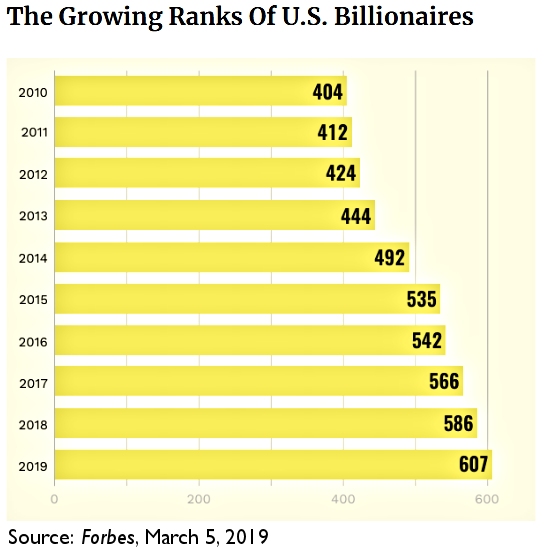
So what does one conclude from this picture? Is it in fact transnational capital of a global power elite that has dominated globalization, that we are seeing here? Or would it be more accurately reflective of reality to speak of an American Power Elite that dominates the world’s circuits of wealth creation and concentration? The answer has enormous import for how we think about globalization vs. American imperialism as the best mode of describing contemporary reality.
As we saw in the last section, the inability to explain why transnational capitalists need states is one of the most serious flaws in explanations that claim states have been diminished while transnational capitalists have real power. If they had real power, they would not need states. Thus one of the problems of this book is that it under-theorizes critical areas that really needed attention, if we were really to update Mills’ work.
US Imperialism and Transnational Capitalism
One of the key strengths of this book is that it goes against fashionable theorizing on the political left, prevalent among academics and activists, that minimizes or even refuses to name US imperialism. As Phillips shows in this book, the US is the foundation of transnational policing that works to enforce the interests of global capital. In particular, the global financial giants invest heavily in war-making as a means of profitably deploying excess capital.
Thus Phillips notes that, “the policy elites in the United States have been mostly united in support of an American empire of military power that maintains a repressive war against resisting groups…around the world” (p. 23). He also points out: “uncooperative regimes are undermined and overthrown in support of the free flow of global capital for investments anywhere that returns are possible” (p. 64).
“Humanitarian intervention” is also critically addressed by Phillips. He argues that the transnational capitalist class promotes “military interventions [that] are ideologically justified as peacekeeping or humanitarian missions,” primarily in cases where governments are “viewed as unfavorable to the TCC’s capital interests”—in such cases then, “resistance forces will be supported and encouraged toward regime change, as in…Libya, Syria, Iraq, Yemen, Somalia, Ukraine, Venezuela, and Yugoslavia” (p. 30). It is refreshing to read a North American academic who recognizes this reality. As indicated in the list of contents, Phillips dedicated an entire chapter to the subject of US empire (chapter 5).
The protection of transnational capital, Phillips argues, is what lies behind the production of “failed states, manufactured civil wars, regime changes, and direct invasions/occupations”. Each of these is a manifestation of “the new world order requirements for protecting transnational capital” (p. 215).
NATO is a key part of Phillips’ discussion, and he notes that NATO members collectively account for 85% of the world’s military spending (p. 223). Phillips’ argument is that NATO is the leading military defender of the interests of global capital: “NATO is quickly becoming a US military empire supplemental police force for the Global Power Elite and the Transnational Capitalist Class” (p. 224). In conjunction with this, he discusses the role of the Atlantic Council as the chief purveyor of NATO propaganda.
Yet, despite Phillips’ own arguments about manufactured civil wars, “resistance” groups funded if not created by Western powers, and regime change war—he still manages to produce an unquestioning endorsement of “Arab Spring protests” in North Africa as examples of resistance against neoliberal austerity politics (p. 304).
Global Inequality
Global inequality has become extreme under the dominance of the Global Power Elites. As William Robinson writes in the Introduction,
“the richest 1 percent of humanity in 2017 controlled more than half of the world’s wealth; the top 30 percent of the population controlled more than 95 percent of global wealth, while the remaining 70 percent of the population had to make do with less than 5 percent of the world’s resources”. (p. 15)
Phillips recounts a recent finding that only eight individuals now own half the world’s wealth (p. 21).
While not always clear about whether “the richest 1 percent” are the top 1% in the US or the top 1% of the world as a whole, the book informs us that the top fraction “increased their total wealth by 42.5 percent in 2008, and 50.1 percent in 2017,” and in the latter year, “2.3 million new millionaires were created, bringing the total number of millionaires around the globe to more than 36 million”; these millionaires represent “0.7 percent of the world’s population controlling more than 47 percent of global wealth’; the world’s bottom 70% only control 2.7% of total wealth (pp. 301–302).
This book also relays the following overview of global wealth inequality:
“The world’s total wealth is estimated to be close to $255 trillion, with the United States and Europe holding approximately two thirds of that total; meanwhile, 80 percent of the world’s people live on less than $10 per day, the poorest half of the global population lives on less than $2.50 per day, and more than 1.3 billion people live on only $1.25 per day”. (p. 30)
Robinson offers a partial/partisan view of the political results of increasing inequality, asserting that it has fueled “populist insurgencies” (thus unfortunately reinforcing elitist terminology), and that these are dominated by racist, xenophobic, and nativist concerns. What Robinson does not do is offer an explanation as to why those on the losing end of globalization in North America and Europe have turned to the right, and not the left.
What Robinson predicts is that the global concentration of wealth is, in effect, suicidal: it will lead to a global contraction of demand, and thus the global market will be unable to absorb the output of the global economy, and at that point the system will seize up. Is this something to be celebrated or criticized?
Phillips makes a similar point about the over-accumulation of capital: “there are only three mechanisms of investing excess capital: risky financial speculation, wars and war preparation, and the privatization of public institutions” (p. 30). What needs to be explained to readers is why, if capital over-accumulation is really a problem, would the holders of such capital invest in areas that generate even more capital.
Land and hunger also stand out as one of the strong points of this book’s explanations. First, some important statistics are provided, such as: the UN’s World Food Program estimates that 1 in 9 people go to bed hungry each night, which amounts to 795 million people suffering from chronic hunger; nine million die each year from starvation; one-third of the planet suffers from malnutrition; two billion more people will be lacking food by 2050, according to UN forecasts; and yet, “chronic hunger is mostly a problem of distribution, as one third of all food produced in the world is wasted and lost” (p. 31). Phillips clearly pins the blame of this mal-distribution on global speculation invested in agricultural lands, and global speculation in food, which have both raised the costs of land and food, and displaced populations (pp. 31, 63). As Phillips explains:
“In the last ten years, more than $90 billion has been invested in 78 countries for buying up more than 74 million acres of farmland. The result is mass corporate farming, usually for export, and the removal of these lands as a local food source”. (p. 32)
While the book tends to endorse much of the emergency talk around “climate change,” it’s important to note that Phillips is aware of some of the glaring opportunism that motivates some of the crisis-making:
“Amazingly, TCC/Global Power Elite money managers study the transforming environment for new investment opportunities. Climate change investing can be profitable, according to Forbes, and getting in on low-carbon investments, and sectors that will benefit should climate stress increase—such as defense, health care, and property insurances—can prove lucrative. Increasing interest in new mining opportunities available due to global warming is an important issue in Greenland. Private investment in the control of water sources is seen as an increasingly attractive opportunity for power elite speculation”. (p. 32)
Criticisms of the Book
Unfortunately, much of the book is written for an audience that is already prepared to believe and accept its main arguments and their assumptions. The question then is why such an audience would need this book. The echo-chambering of public discourse is itself echoed louder than ever in academic production. This book is not written for, say, skeptical students who are unconvinced and like to raise questions. On the other hand, it can be useful precisely for generating questions.
What in my view is one of the least attractive features of the book is the tendency to reduce discussion to moral principles. In that respect it is a very American book, which follows the very American tradition of displacing politics into morality. The result is a moralistic appeal for reform. Thus the book is directed at precisely those elites who are least likely to read or care about this book. However, matters become even murkier when the book’s idea of reform means that activists should volunteer to work with billionaires: “An honest, open look at real human options is vitally needed, and social movement activists seeking to end the crisis of humanity may find allies at the top willing to make radical readjustments needed to prevent wars, mass poverty, and environmental degradation” (p. 159). In an open letter to the Global Power Elite at the end of the book, we read this: “We absolutely believe that continued capital concentration and neoliberal austerity policies only bring greater human misery to the vast majority of people on earth” (p. 320, emphasis added). Why reduce what the book shows to be factually true, a matter of objective knowledge, to a matter of belief? Why should anyone care what the author and his colleagues “believe”? Sometimes the book has an unfortunate tendency of diminishing itself.
Theory remains relatively under-developed in this book, which tends to leave major questions unspoken (some of which were discussed in the sections above). The result is that books like C. Wright Mills’ The Power Elite remain as outstanding contributions, and the updating of his work is something that still needs to be done. Neither this book, nor other attempts at updating Mills, are yet ready to be read as “Mills Part 2”.
Related to the latter point, we seem to be generating an ever expanding vocabulary for describing essentially the same phenomenon. Thus, added to the base that is the transnational capitalist class (which is sufficient), we have shadow elites, influence elites, flexible networks, and now global power elites. Pretty soon, rather than having work that takes our understanding further, we will instead have works that lose time and energy in just clearing up the mystifying mass of new labels.
Though I intensely dislike facile comments like, “some of the book’s strengths are also its weakness,” I find myself here needing to make the same comment about the immense catalogue of empirical detail that appears in the profiles of the 389 individuals and the dozens of organizations named in this book. In that respect, the book begins to resemble more of a database, that makes for tedious reading. Seen from another angle, the book serves as a reference resource. However, what really stands out is the limited theorization of the material, that really does not expand on or elaborate on either the works of Mills, Sklair, or William Robinson.
Restrictions on access to the power elites means that the profiles that are provided in the book are based almost exclusively on open source documentation. The profiles thus result as flat, and almost lifeless—useful perhaps for statistical analysis, but almost devoid of oral history and cultural content.
Sometimes this book mirrors a website more than a printed volume, meaning that there can be excessive interleaving with contents that are already widely available. Thus the book unnecessarily reproduces, in full, the UN’s Universal Declaration of Human Rights. The tendency to copy and insert so much that is open source tends to produce excessive length.
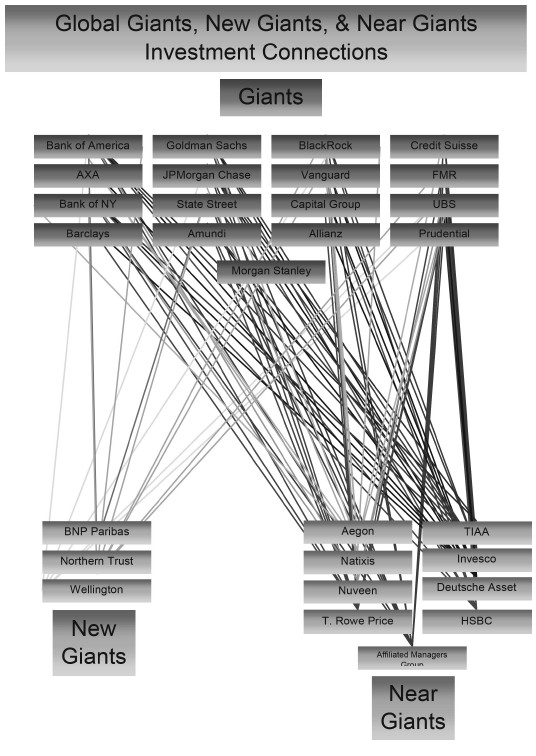
Diagrams in the book are often useless spaghetti illustrations of many dozens of crisscrossing lines linking inter-locked firms. The point is to show that each one is connected to every other—and it is far more economical to express that fact with words.
The Introduction by William Robinson was, surprisingly, one of the disappointing elements of this book. Robinson exploited the opportunity to sound off on a range of issues that personally anger and frustrate him—everything from Trump to climate change. I gather that this a popular Californian academic narrative. The chapter on the whole has a certain apocalyptic, doomsday quality to it, which is arguably more of a reflection of how culturally unprepared Americans are when it comes to absorbing the reality of their imperial decline: “If we do not annihilate ourselves in a nuclear holocaust or descend into the barbarism of a global police state, we will have to confront the threat of a human-induced sixth mass extinction that scientists say has already begun” (pp. 15–16).
At times, the book appears to pander to the fixations of the liberal-left, especially where climate emergency alarmism and identity politics are concerned. We are thus told at various points that this or that board of directors is exclusively male, or exclusively white, or white and male—as if the aesthetic veneer of dominance is what should occupy our attention.
Sometimes the book paints an excessively bleak and hopeless picture of inevitable collapse and war. The power of elites is sometimes overstated. Assumptions that poverty leads to rebellion (p. 303) are part of the book’s baggage of truisms, even if there is painfully little evidence to validate such assumptions. The point is that if it is all so bleak, then that defeats the chances of reform, the same reform that the book advocates. Phillips argues that unless something is done soon, movements like Occupy Wall Street will continue to emerge (p. 305)—to which the answer has to be a big “so what?”
Lastly, the index contains some notable errors and omissions, and is actually not very useful for using this book.
Conclusion
Reminding me of the some of the great books written by Susan George in the 1980s on debt crises and hunger, this is one of the more original and important contributions to early 21st-century debates about the decline of the 20th-century phenomenon known as “globalization”. It will serve as a valuable reference to many students of globalization, both within and outside of academia. Thus, despite my criticisms above, I would still recommend this book as required reading for any students in the fields of Political Science and International Relations, Global Sociology, and International Political Economy, as well as perhaps students in Economic Anthropology. What is especially valuable about this book is more than just its detail, but its reconciling of transnational capitalism with US empire. Even where the book falls short, it does so in a manner that provokes many productive and constructive questions.
For me personally, what emerged from studying this text is recognition of the degree to which states still matter immensely in the so-called globalized world (produced by states themselves), and the extent to which the US stands on top of globalization. It is no surprise then that we see the decline of US empire at the same time as the rise of de-globalization. Not discussed in this volume—and hardly mentioned on this site either—is the rise of an embryonic new order dominated by China, as evidenced by its extremely ambitious and widely spread Belt and Road Initiative.
Source: https://zeroanthropology.net/2019/11/27/global-giants-american-empire-and-transnational-capital/
Bilateral trade relations between Iran and EU suffer under harsh US sanctions
By Sarah Abed – December 2, 2019
Trade between the European Union (EU) and the Islamic Republic of Iran has dropped roughly 74.92% percent this year from January to September compared to last year during the same timeframe, due to US-imposed sanctions, according to the European statistical office. The top three trading partners in the European bloc were Germany, Italy, and the Netherlands. Analysts at the European Council on Foreign Relations have described the US’s secondary sanctions as abuse of its global financial dominance.
Iran’s commodities exports have fallen 94% and imports have declined 51.15%. Before the sanctions, the EU was Iran’s main trading partner, but now China and the United Arab Emirates have risen to the first and second slots respectively.
While most discussions regarding Iran and EU trade relations center on oil, a crucial indicator of Europe-Iran trade relations lies in European technology and the billions of dollars’ worth of European parts, machinery, and transport equipment exports, which play an important role in Iran’s industrial sector and economy.
In May 2018, the United States unilaterally withdrew from the 2015 Joint Comprehensive Plan of Action (JCPOA) complaining that the deal didn’t curb Iran’s nuclear capabilities but Europeans and the International Atomic Energy Agency (IAEA) have repeatedly confirmed that the nuclear deal was working and that Iran was in compliance. Since then the remaining five world powers who signed the nuclear deal with Iran, namely the UK, France, Russia, China, and Germany have tried to keep the nuclear deal alive by urging the United States to return to the deal and lift the harsh sanctions.
Immediately after leaving the nuclear deal, the United States reinstated crippling sanctions under its “maximum pressure campaign” with the goal of bringing about “regime change” while reducing Iran’s oil exports to zero.
Iran patiently waited for over a year for the United States to either return to the deal or for European nations to ease their suffering. France advocated for a $15 billion dollar line of credit and an EU Instrument for Supporting Trade Exchanges commonly referred to as INSTEX, became “operational” in June of this year, but hasn’t offered Iran any relief yet.
INSTEX was created to circumvent Washington’s sanctions as a payment channel with the UK, France, and Germany to help Iran continue to trade. The exchange of goods is allowed without requiring direct transfers of money, serving as a diplomatic shield. Good intentions aside, it’s been useless.
Sweden, Norway, the Netherlands, Finland, Denmark and Belgium announced on November 29th that they are in the process of becoming shareholders in INSTEX, in order to support the JCPOA and the economic parts of it and facilitate legitimate trade between Europe and Iran. A joint statement of support for the preservation and full implementation of the JCPOA was made. They reiterated that the nuclear agreement was unanimously endorsed by the UN Security Council and is an instrumental tool for global non-proliferation and stability in the region.
Unfortunately, neither the line of credit nor INSTEX have been properly implemented yet. With no relief in sight and economic conditions worsening, Iran started to scale back on its commitments under the JCPOA, thus far it has taken four such steps and has vowed to continue to scale back its obligations every sixty days, until there’s a solution.
For almost three decades the United States was Iran’s main military and economic partner and played an important role in its infrastructure and industry modernization, from 1950 until 1978. All of that ended when the US-backed Shah of Iran Mohammed Reza Pahlevi was forced to step down during the Iranian Revolution in 1979. And that’s when the United States cut economic and diplomatic ties, froze billions of dollars of assets, and banned Iranian imports.
Iran is the world’s third largest consumerer of natural gas after the United States and Russia, and a major oil exporter since 1913.
Iran’s economy is dominated by oil and gas production, ownership of 10% of the world’s proven oil reserves and 15% of its gas reserves have earned Iran recognition as an energy superpower. This of course puts a huge target on its back for US imperialism and intervention.
Since mid-2018 US sanctions have been placed on Iran’s oil sales, banking transactions, metals trading, petrochemicals, shipping etc. and as a result, Tehran was forced to raise oil prices on November 15th by fifty percent and impose a strict rationing system. Soon after, protests erupted and at least eight people linked to the U.S. Central Intelligence Agency (CIA) were arrested by Iranian security agents.
Although trade has significantly decreased Washington’s attempts to destroy Iran’s economy, bilateral attempts to improve and normalize Iran-EU trade relations have fallen short. If successful, Washington would benefit from increasing its own oil and commodities trade, while hurting economic ties between Iran and EU.
The ‘Whistleblower’ and the Politicization of Intelligence
By Scott Ritter – Consortium News – November 27, 2019
The whistleblower. A figure of great controversy, whose actions, manifested in an 11-page report submitted to the Intelligence Community Inspector General (ICIG) on August 12 alleging wrongdoing on the part of the president of the United States, jump-started an ongoing impeachment process targeting Donald Trump that has divided the American body politic as no other issue in contemporary time.
His identity has been cloaked in a shroud of anonymity which has proven farcical, given that his name is common knowledge throughout the Washington-based national security establishment in whose ranks he continues to serve. While Trump publicly calls for the identity of the whistleblower to be revealed, the mainstream media has played along with the charade of confidentiality, and Congress continues to pretend his persona is a legitimate national security secret, even as several on-line publications have printed it, along with an extensive document trail sufficient to corroborate that the named man is, in fact, the elusive whistleblower.
There is no legitimate reason for the whistleblower’s identity to remain a secret. The Democratic chairman of the House Intelligence Committee, Representative Adam Schiff, (D-CA) has cited statutory protections that simply do not exist while using his authority as chairman to prohibit any probe by his Republican colleagues designed to elicit information about the whistleblower’s identity. “The whistleblower has a right, a statutory right, to anonymity,” Schiff recently opined during recent impeachment-related testimony. And yet The Washington Post, no friend of Trump, was compelled to assign Schiff’s statement three “Pinocchios”, out of a scale of four, in rejecting the claim as baseless.
The myth of statutory protection for the whistleblower’s identity has been aggressively pursued by his legal counsel, Andrew Bakaj, the managing partner of the Compass Rose Legal Group, which has taken on the whistleblower’s case pro bono. In a letter to the president’s legal counsel, Pat Cippolone, Bakaj demanded that Trump “cease and desist in calling for my client’s identity”, claiming that the president’s actions, undertaken via Twitter and in press briefings, constituted violations of federal statutes prohibiting, among other things, tampering with a witness, obstruction of proceedings, and retaliating against as witness.
All of Bakaj’s claims are contingent upon the viability of the whistleblower’s status as a legitimate witness whose testimony can, therefore, be tampered, obstructed or retaliated against. The legal foundation of the whistleblower’s claims are based upon the so-called Intelligence Community whistleblower statute, 50 USC § 3033(k)(5), which stipulates the processes required to report and sustain an allegation of so-called “urgent concern” to the U.S. intelligence community. An “urgent concern” is defined, in relevant part, as: “A serious or flagrant problem, abuse, violation of the law or Executive order, or deficiency relating to the funding, administration, or operation of an intelligence activity within the responsibility and authority of the Director of National Intelligence involving classified information, but does not include differences of opinions concerning public policy matters.”
The Call
At issue was a telephone call made between President Trump and the newly elected President of Ukraine, Volodymyr Zelensky, on July 25 of this year. According to the whistleblower’s report to the ICIG, “Multiple White House officials with direct knowledge of the call informed me that, after an initial exchange of pleasantries, the President used the remainder of the call to advance his personal interests.” President Trump, the whistleblower alleged, “sought to pressure the Ukrainian leader to take actions to help the President’s 2020 reelection bid,” an act which the whistleblower claimed presidential abuse of his office “for personal gain.”
Upon review of the whistleblower’s report, which consisted of a nine-page unclassified letter and a separate two-page classified annex, Michael K. Atkinson, the Inspector General of the Intelligence Community, initiated an investigation of the complaint as required by the whistleblower statute. This investigation must be completed within a 14-day period mandated by the statute, during which time the ICIG “shall determine whether the complaint or information appears credible.”
While the statute is silent on the methodology to be used by the ICIG in making this determination, Atkinson had testified during his Senate confirmation hearing that, when it came to any investigation of a whistleblower complaint, “I will work to ensure that ICIG personnel conduct investigations, inspections, audits, and reviews in accordance with Quality Standards promulgated by CIGIE (Council of the Inspectors General on Integrity and Efficiency) to keep those activities free from personal, external, and organizational impairments.” The CIGIE standard in question requires that, “Evidence must be gathered and reported in an unbiased and independent manner in an effort to determine the validity of an allegation or to resolve an issue.”
In a letter transmitting the whistleblower complaint to the Director of National Intelligence (DNI), Atkinson stated that he had “determined that the Complainant (i.e., whistleblower) had official and authorized access to the information and sources referenced in the Complainant’s Letter and Classified Appendix, including direct knowledge of certain alleged conduct, and that the Complainant has subject matter expertise related to much of the material information provided in the Complainant’s Letter and Classified Appendix.”
However, when it came to assessing whether or not the whistleblower, in reporting the second-hand information provided to him by White House persons familiar with the July 25 Trump-Zelensky phone call, had done so accurately, Atkinson did not review the actual records of the telephone call, noting that he “decided that access to records of the telephone call was not necessary to make my determination that the complaint relating to the urgent concern ‘appears credible.’”
Atkinson declared that “it would be highly unlikely for the ICIG to obtain those records within the limited remaining time allowed by statute,” and opted to perform an investigation in violation of the very CIGIE standard he had promise to adhere to in his Senate testimony. In short, no evidence was gathered by the ICIG to determine the validity of the whistleblower’s allegation, and yet Atkinson decided to forward the complaint to the DNI, certifying it as “credible.”
The whistleblower statute allows the DNI seven days to review the complaint before forwarding it to the House Committee on Intelligence, with comments if deemed appropriate. However, in reviewing the actual complaint, Joseph McGuire, the acting DNI who took over from Dan Coats, who was fired by President Trump in early August, had questions about whether or not the matters it alleged fell within the remit of the whistleblower statute, and rather than forwarding it to the House Intelligence Committee, instead sent it to the Justice Department Office of Legal Counsel for legal review.
The Office of Legal Council, on September 3, issued a legal opinion rejecting the ICIG’s certification of the whistleblower complaint as constituting an “urgent concern” under the law. “The complaint,” the opinion read,
“does not arise in connection with the operation of any U.S. government intelligence activity, and the alleged misconduct does not involve any member of the intelligence community. Rather, the complaint arises out of a confidential diplomatic communication between the President and a foreign leader that the intelligence-community complainant received secondhand. The question is whether such a complaint falls within the statutory definition of ‘urgent concern’ that the law requires the DNI to forward to the intelligence committees. We conclude that it does not. The alleged misconduct is not an ‘urgent concern’ within the meaning of the statute.”
DOJ Rejected Complaint as Urgent
As related in the Office of Legal Counsel’s opinion, the Justice Department did, however, refer the matter to the Criminal Division of the Department of Justice for appropriate review. After considering the whistleblower’s complaint and classified annex, the Criminal Division opted not to pursue charges, in effect determining that no crime had been committed.
Under normal circumstances, this would have concluded the matter of Trump’s phone call with Zelensky, and the second-hand concerns unnamed White House officials had reported to the whistleblower. But this was not a normal circumstance. Far from diffusing an improperly predicated complaint, the failure of the acting DNI to forward the whistleblower complaint to the House Intelligence Committee, and the concurrent legal opinion of the Justice Department’s Office of Legal Counsel rejecting the “urgent concern” certification of the ICIG, opened the door for the whistleblower, through legal counsel, to reach out to the House Intelligence Committee directly.
The whistleblower followed procedures set forth in the whistleblower statute detailing procedures for a complaint, which had not been certified as an “urgent concern,” to be forwarded to Congress. The issue is that the matter was being treated by the ICIG, Congress and the whistleblower’s attorney’s as an “urgent concern”, a status that it did not legally qualify for.
On September 24, Bakaj sent a “Notice of Intent to Contact Congressional Intelligence Committees” to acting DNI McGuire providing “formal notice of our intent to contact the congressional intelligence committees directly” on behalf of the whistleblower, identified only as “a member of the Intelligence Community.” Almost immediately, Schiff announced via Twitter that “We have been informed by the whistleblower’s counsel that their client would like to speak to our committee and has requested guidance from the Acting DNI as to how to do so. We‘re in touch with counsel and look forward to the whistleblower’s testimony as soon as this week.”
Thus was set in motion events which would culminate in impeachment proceedings against President Trump. On the surface, the events described represent a prima facia case for the efficacy of statutory procedures concerning the processing of a whistleblower complaint. But there were warning signs that all was not right regarding both the whistleblower himself, and the processes involved leading to the whistleblower’s complaint being presented to Congress.
Political Bias?
Far from an exemplar in bureaucratic efficiency, the whistleblower complaint has opened a window into the politicization of the intelligence community, and the corresponding weaponization of the national security establishment, against a sitting president.
As I shall show, such actions are treasonous on their face, and the extent to which this conduct has permeated the intelligence community and its peripheral functions of government, including the National Security Council and Congress itself, will only be known if and when an investigation is conducted into what, in retrospect, is nothing less than a grand conspiracy by those ostensibly tasked with securing the nation to instead reverse the will of the American people regarding who serves as the nation’s chief executive.
The key to this narrative is the whistleblower himself. Understanding who he is, and what role he has played in the events surrounding the fateful July 25 telephone conversation, are essential to unravelling the various threads of this conspiracy.
Much has been made about the political affiliation of the whistleblower, namely the fact that he is a registered Democrat who supports Joe Biden as the Democratic candidate for the 2020 presidential election. On the surface this information is not dispositive—the intelligence community is populated by thousands of professionals of diverse political leanings and affiliations, all of whom have been trained to check their personal politics at the door when it comes to implementing the policies promulgated by the duly elected national leadership.
Indeed, Inspector General Atkinson, while acknowledging in his assessment of the whistleblower’s complaint an indication of possible political bias on the part of the whistleblower in favor of a rival political candidate, noted that “such evidence did not change my determination that the complaint relating to the urgent concern ‘appears credible’”. But when one reverse engineers the whistleblower’s career, it becomes clear that there in fact existed a nexus between the whistleblower’s political advocacy and professional actions that both influenced and motivated his decision to file the complaint against the president.
A Rising Star
Like most CIA analysts, the whistleblower possessed a keen intellect born of stringent academic preparation, which in the whistleblower’s case included graduating from Yale University in 2008 with a degree in Russian and East European studies, post-graduate study at Harvard, and work experience with the World Bank.
Andrea Kendall-Taylor, a contemporary colleague of the whistleblower, has provided an apt account for what is expected of a CIA analyst. “The CIA is an intensely apolitical organization,” Kendall-Taylor wrote. “As intelligence analysts, we are trained to check our politics at the door. Our job is to produce objective analysis that the country’s leaders can use to make difficult decisions. We undergo rigorous training on how to analyze our own assumptions and overcome biases that might cloud our judgement.”
The training program Kendall-Taylor referred to is known as the Career Analyst Program (CAP), a four-month basic training program run out of the CIA’s in-house University, the Sherman Kent School, which “introduces all new employees to the basic thinking, writing, and briefing skills needed for a successful career. Segments include analytic tools, counterintelligence issues, denial and deception analysis, and warning skills.”
The standards to which aspiring analysts such as the whistleblower were trained to meet were exacting, and included a requirement to be “independent of political considerations,” meaning the product produced should consist of objective assessments “informed by available information that are not distorted or altered with the intent of supporting or advocating a particular policy, political viewpoint, or audience.” As an analyst, the whistleblower would have chosen a specific specialization, which in his case was as a “Political Analyst”, charged with examining “political, social, cultural, and historical information to provide assessments about foreign political systems and developments.”
By the time the whistleblower completed his application process with the CIA, which requires a detailed background check, several rounds of interviews, and final security and psychological evaluation before an actual offer of employment can be made, and by the time he finished his basic analytical training, the U.S. had undergone a political and social revolution of sorts with the election of Barack Obama as the 44th president of the United States.
The whistleblower was assigned to the Office of Russian and Eurasian Analysis (OREA), within the CIA’s Directorate of Intelligence, at a time when U.S.-Russian policy was undergoing a radical transformation.
Under the guidance of Michael McFaul, President Obama’s special advisor on Russia and the senior director of Russian and Eurasian Affairs at the National Security Council, the Obama administration was seeking to take advantage of the opportunity afforded by the election of Dmitri Medvedev as Russia’s president in 2008. Medvedev had succeeded Vladimir Putin, who went on to serve as prime minister. Medvedev was a more liberal alternative to Putin’s autocratic conservatism, and McFaul envisioned a policy “reset” designed to move relations between the U.S. and Russia in a more positive trajectory.
Andrea Kendall-Taylor (Center for a New American Security)
As a junior analyst, the whistleblower worked alongside colleagues such as Andrea Kendall-Taylor, who joined OREA about the same time after graduating from UCLA in 2008 with a PhD is Slavic and Eurasian studies. A prolific writer, Kendall-Taylor wrote extensively on autocratic leaders and Putin in particular. Her work was in high demand at both the CIA and NSC, which under the Obama administration had undergone a massive expansion intended to better facilitate policy coordination among the various departments that comprised the NSC.
The whistleblower had a front-row seat on the rollercoaster ride that was U.S.-Russian policy during this time, witnessing the collapse of McFaul’s Russian “reset,” Putin’s return to power in 2012, and the U.S.-backed coup in Ukraine that led to the annexation of Crimea and Russian support for rebels in the Donbas region.
During his tenure at OREA, the whistleblower obviously impressed his superiors, receiving several promotions and, in July 2015, he detailed to the NSC staff at the Obama White House as the Director for Ukrainian Affairs. According to a former CIA officer, any high-performing analyst who aspires to be promoted into the ranks of the Senior Intelligence Service must, prior to that time, do a rotation as part of the overall policy community, which includes the NSC or another department, such as Defense or State, as well as a tour within another directorate of the CIA.
NSC positions were originally intended for senior CIA analysts, at the GS-15 level, but waivers could be made for qualified GS-14 or “very strong” GS-13’s (the whistleblower was a GS-13 at the time of his assignment at the NSC, a reflection of both his qualification and the regard to which he was held by the CIA.) NSC assignments do not coincide with the political calendar—detailees (as career civil servants who are detailed to the NSC are referred) are expected to serve in their position regardless of what political party controls the White House. When an opening becomes available (usually when another detailee’s assignment has finished), prospective candidates apply, and are interviewed by their senior management, who forward qualified candidates to another board for a final decision.
Assignments to the NSC are considered highly sought after, and while the process for application must be followed, the selection process is highly political, with decisions being signed off by the director of the CIA. In the case of the whistleblower, his candidacy would have been approved by both Peter Clement, the director of OREA, and John Brennan, the CIA director.
Into the Lion’s Den
By the time the whistleblower arrived at the NSC, the NSC staff had grown into a well-oiled policy machine managing the entire spectrum of Obama administration national security policy-making and implementation. The NSC staff operated in accordance with Presidential Policy Memorandum (PPM) 1, “Organization of the National Security Council System”, which outlined the procedures governing the management of the development and implementation of national security policies by multiple agencies of the United States Government.
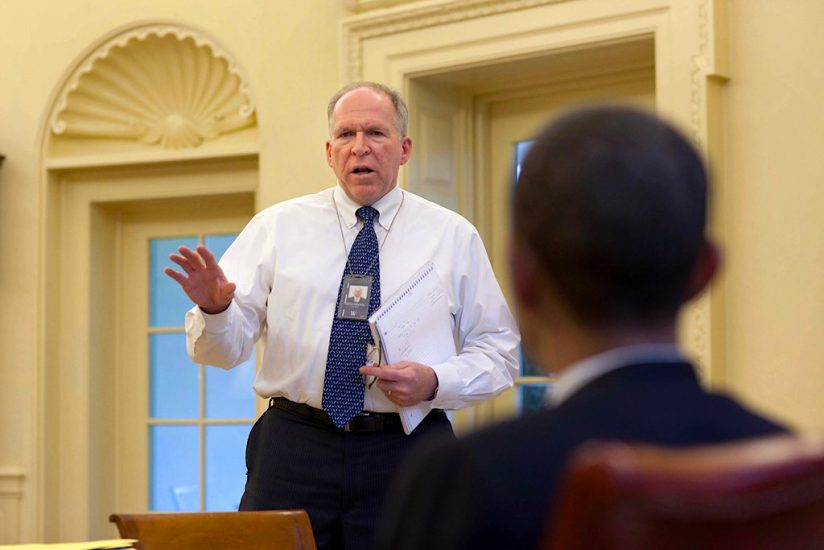
Brennan briefing Obama May 3, 2010. He approved whistleblower. (Official White House Photo by Pete Souza)
The vehicle for accomplishing this mission was the NSC Interagency Policy Committee (NSC/IPC). The NSC/IPCs were the main day-to-day fora for interagency coordination of national security policy. They provided policy analysis for consideration by the more senior committees of the NSC system and ensured timely responses to decisions made by the president. NSC/IPCs were established at the direction of the NSC Deputies Committee and were chaired by the relevant division chief within the NSC staff.
The whistleblowers job was to develop, coordinate and execute plans and policies to manage the full range of diplomatic, informational, military and economic national security issues for the countries in his portfolio, which included Ukraine. The whistleblower coordinated with his interagency partners to produce internal memoranda, talking points and other materials for the National Security Advisor and senior staff.
The whistleblower reported directly to Charles Kupchan, the Senior Director for European Affairs on the NSC. Kupchan, a State Department veteran who had previously served on the NSC staff of President Bill Clinton before turning to academia, in turn reported directly to Susan Rice, President Obama’s national security adviser.
When the whistleblower first arrived at the NSC, he volunteered for the Ukraine portfolio. Kupchan was impressed by the whistleblower’s work ethic and performance, and soon expanded his portfolio to include the fight against the Islamic State. The whistleblower was aided by another organizational connection—his colleague and mentor at OREA, Andrea Kendall-Taylor, had been selected to serve in the Office of the Director of National Intelligence as the deputy national intelligence officer for Russia and Eurasia. Among Kendall-Taylor’s responsibilities was to closely coordinate with the NSC staff on critical issues pertaining to Russia and Ukraine.
The whistleblower’s arrival at the NSC staff also coincided with the start of Trump’s improbable candidacy for the presidency of the United States. As 2015 transitioned into 2016, and it became apparent that Trump was the presumptive nominee for the Republican Party, allegations about the Trump campaign colluding with Russia began to circulate within the interagency. Trump’s electoral victory in November 2016, shocked the whistleblower, like everyone else on the NSC staff.
Alarmed By Trump on Russia
The line between policy and politics began to blur, and then disappeared altogether. National Security Advisor Rice was becoming increasingly alarmed by the activities of the Trump transition team, especially when it came to issues pertaining to Russia. According to The Washington Post, “Rice apparently was closely monitoring the high-profile investigation into Russian interference.”
The President-elect had, during the campaign, openly advocated for better relations between the U.S. and Russia and had even suggested that the Russian annexation of Crimea could eventually be accepted by the U.S. This stance was anathema to the policies that had been massaged into place by the NSC in general, and the whistleblower in particular. According to multiple sources familiar with the whistleblower during this time, his animus against Trump was palpable.
In December 2016, Rice was involved in the unmasking of the identities of several members of the Trump transition team. Various sensitive intelligence reports were circulating within the NSC regarding the interaction of unnamed U.S. citizens with foreign targets of intelligence interest. In order to better understand the significance of such a report, Rice has acknowledged that, on several occasions, she requested that the identity of the U.S. persons involved be “unmasked.”
The U.S. intelligence community is prohibited by law from collecting information about U.S. citizens. As such, when a conversation undertaken by a foreign national of intelligence interest was captured, and it turned out the person or persons whom the target was speaking to was a U.S. citizen, the analysts preparing the report for wider dissemination would “mask”, or hide, the identities of the U.S. citizens involved. Under relevant laws governing the collection of intelligence, up to 20 officials within the Obama administration had the authority to unmask the identities of U.S. citizens. One of those was Rice.
In late December 2016, the crown prince of the United Arab Emirates, Sheikh Mohammed bin Zayed al-Nahyan, arrived in New York for a meeting with several top Trump transition officials, including Michael Flynn, Trump’s son-in-law, Jared Kushner, and the President-elect’s top strategist Steve Bannon. Intelligence reports had been circulating about the UAE coordinating a backchannel for the Trump transition team and Russia.
Zayed’s arrival, which was unannounced and had not been coordinated with the U.S. government, caused great concern among the NSC staff especially given the context of allegations of collusion between Trump and Russia to influence the outcome of the 2016 election.
The principle NSC staffers who would logically have been advising Rice on this matter were Kupchan, the whistleblower, and Sean Misko, a State Department detailee who served as the director for the Gulf Arab States (According the NSC staffers who worked in the White House at the time, Misko and the whistleblower were said to be close friends, frequently socializing with one another after hours, and possessing a common dislike for Trump.) Rice requested that the intelligence reports pertaining to Zayed’s visit be subjected to unmasking procedures.
While the subsequent reporting about the three-hour meeting between Zayed and the Trump transition team failed to uncover any evidence of a secret communications channel with Russia, Rice (who would logically have been assisted by Kupchan and the whistleblower) facilitated the near continuous unmasking of intelligence reports involving Flynn, who was in contact with Russian officials, including Sergei Kislyak, the Russian ambassador to the U.S.
The Greatest Sin
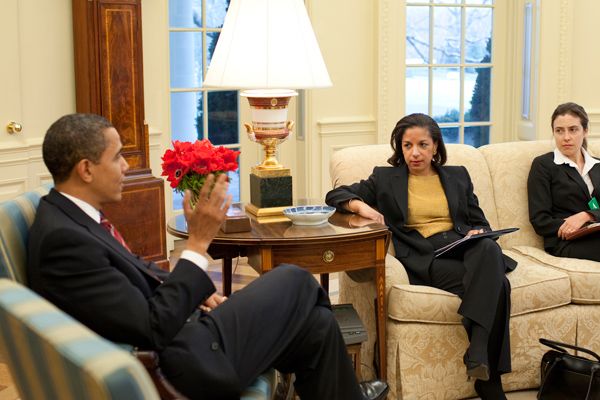
Susan Rice, center, with Obama, March 10, 2009. (White House photo)
As a professional intelligence analyst detailed to the NSC, the whistleblower was committed to a two-year assignment, extendable to three years upon the agreement of all parties. President Obama’s departure from the White House did not change this commitment. According to NSC staffers who served in the White House at the time, the whistleblower, like many of his fellow detailees, had grown attached to the policies of the Obama administration which they had fought hard to formulate, coordinate and implement. They viewed these policies to be sacrosanct, regardless of who followed in the White House.
In doing so, they had committed the greatest sin that an intelligence professional could commit short of espionage—they had become political.
In December 2016, the whistleblower was, based upon his role as a leading Russian analysts advising Rice directly, more than likely helping unmask Flynn’s communications with Russians; a month later, he was working for Flynn, someone he had likely actively helped conspire against, using the unfettered power of the intelligence community.
The Trump administration had inherited a national security decision-making apparatus that was bloated, and which fostered White House micromanagement via the NSC. While the Obama NSC had proven able to generate a proliferate amount of “policy”, it did so by relying on a staff that had expanded to the largest in the history of the NSC, and at the expense of the various departments of government that were supposed to be the originators of policy.
As the new national security adviser, Flynn let it be known from day one that there would be changes. One of his first actions was to hire four new deputies who centralized much of the responsibilities normally tasked to regional directors such as the whistleblower. Flynn was putting in place a new level of bureaucracy that shielded professional detailees from top level decision makers.
Moreover, it recognized that the NSC, while staffed with professionals who are supposed to be apolitical, was viewed by the White House as a partisan policy body whose work not only furthered the interests of the United States, but also the political interests of the president. When Trump included his top political advisor, Bannon, on the list of people who would comprise the National Security Council (normally limited to cabinet-level officials), it sent shockwaves through the national security establishment, which accused Trump of politicizing what they claimed was an apolitical process.
But the reality was that the NSC had always functioned as a partisan decision-making body. Its previous occupants may have tried to temper the level to which domestic politics intruded on national security decision-making, but its presence was an unspoken reality. All Trump did by seeking to insert Bannon into the mix was to be open about it.
Like the other professional detailees who comprised 90 percent of the NSC staff and were expected to remain at their posts as part of a Trump administration, the whistleblower was dismayed by the changes. Some accounts of the early days of the Trump NSC indicate that the whistleblower was defensive of the Ukraine policies he had helped craft during his tenure at the NSC.
When his immediate superior, Kupchan (a political appointee) departed the NSC, the whistleblower was temporarily elevated to the position of senior director for Russia and Eurasia until a new replacement could be found. (Flynn had reached out to Fiona Hill, a former national intelligence officer for Russia under the administration of George W. Bush, to take this job; Hill had accepted, but would not be available until April.)
The whistleblower was a known quantity within the NSC, as were his decidedly pro-Obama political leanings. As such, he was not trusted by the incoming Trump officials, and his access to the decision-making process was limited.
According to persons familiar with his work at the NSC during the Trump administration, the whistleblower’s frustration and anger soon led to acts of resistance designed to expose, and undermine public confidence in President Trump.
Cut Out of Call to Putin
In late January 2017 Trump made several introductory telephone calls to world leaders, including President Putin. Normally the NSC director responsible for Russia would help prepare the president for such a call by drafting talking points and supporting memoranda, and then monitor the call directly, either from within the Oval Office or from the White House situation room.
According to sources familiar with the incident, Flynn did not coordinate Trump’s call with NSC staff, and as such the whistleblower, who was acting as the director for Russia and European Affairs at the time, would have been cut out of the process altogether. When the whistleblower tried to access the read out of the phone call afterwards, he found that no verbatim record existed, only a short summary released by the White House, presumably prepared by Flynn.
More frustrating was the fact that the official readout of the call released by the Kremlin contained much more information, putting Russia in the driver’s seat in terms of defining U.S.-Russian policy priorities—the very policy blunder the NSC was supposed to prevent from happening. While searching for the non-existent records of the Putin-Trump conversation, however, the whistleblower came across detailed verbatim transcripts of two other calls made by Trump that day—one with Mexico, and one with Australia.
Within days the details of these calls were leaked to the media, resulting in a series of unflattering articles being published by the mainstream media. While no direct evidence has emerged about who was responsible for leaking these calls, NSC staffers who worked in the White House at the time suspected the whistleblower. (One of the byproducts of this incident was the decision by NSC lawyers to move the records of Presidential phone calls to a more secure server, significantly limiting access by NSC staff.)
On February 13, 2017, Flynn resigned from his position as President Trump’s national security adviser. The reason given was Flynn’s having misrepresented his conversations with Russian Ambassador Kislyak when questioned by Vice President Mike Pence. For the whistleblower, whose previous work in the Obama NSC appeared to help Rice’s efforts to unmask the very conversations Flynn was being held accountable for, this had to have been a satisfying moment. He had to have been even more pleased by Trump’s choice to replace Flynn —Lieutenant General H. R. McMaster, a decorated combat veteran known for his intelligence and willingness to challenge the establishment.
In the little more than a month that transpired between McMaster coming on board and the arrival of Hill as the new director for Russia and Europe, the whistleblower would have had the opportunity to meet his new boss and work with him on repairing what they both viewed as the flawed changes undertaken by Flynn at the NSC.
McMaster rewrote the presidential guidance regarding the functioning of the NSC, replacing the original Presidential Policy Memorandum 1 with a new version, PPM 4, which removed Bannon from the NSC and restored much of the policy coordinating functions that characterized the NSC under Obama.
Moreover, McMaster stuck up for the professional detailees, such as the whistleblower. When Hill arrived in April 2017 to assume her responsibilities as the NSC director for Russia and Europe, the whistleblower found himself without a job.
But instead of being returned to the CIA, McMaster, who had come to know the whistleblower during his first month as national security adviser, appointed him to serve as his personal assistant. The whistleblower moved from his desk next door in the Executive Office Building, where most NSC staffers work, to the West Wing of the White House, a move which gave him direct access to every issue that crossed McMaster’s desk.
Oval Office Leak
The new job, however, did nothing to diminish the disdain the whistleblower had for Trump. Indeed, the proximity to the seat of power may have served to increase the concern the whistleblower had about Trump’s stewardship. On May 10, President Trump played host to Russian Foreign Minister Sergey Lavrov and Russian Ambassador Kislyak. During the now-infamous meeting, Trump spoke about the firing of former FBI Director Jim Comey; a sensitive Israeli intelligence source related to the ongoing fight against ISIS in Syria; and alleged Russian interference in the 2016 presidential election.
As McMasters’ assistant, the whistleblower was privy to the readout of the meeting, and was so alarmed by what he had seen that he sent an email to John Kelly, who at that time was serving as director of the Department of Homeland Security, detailing the president’s actions and words. All materials relating to this meeting were collected and secured in the NSC’s top secret codeword server; the only unsecured data was that contained in the whistleblower’s email. When the media subsequently reported on the details of Trump’s meeting with the Russians, the White House condemned the “leaking of private and highly classified information” which undermined “our national security.”

Trump meets with Lavrov on May 10, 2017. (TASS/Wikipedia)
According to a NSC staffer who worked in the White House at the time, an internal investigation pointed to the whistleblower’s email as the likely source of the leak, and while the whistleblower was not directly implicated in actually transmitting classified information to the press, he was criticized for what amounted to unauthorized communication with an outside agency, in this case the Department of Homeland Security. When his initial two-year assignment terminated in July 2017, the White House refused to authorize a one-year extension (a courtesy offered to the vast majority of detailees).
The whistleblower had become a liability, publicly smeared by right-wing bloggers and subjected to death threats. He was released from the NSC and returned to the CIA, where he resumed his role as a Eurasian analyst. Shortly after the whistleblower left the NSC, the full transcripts of President Trump’s January 28, 2017 conversations with the leaders of Mexico and Australia were leaked to the press. While several colleagues in the NSC believed that the whistleblower was behind the leaks, McMaster refused to authorize a formal investigation which, if evidence had been found that implicated the whistleblower, would have effectively terminated his career at the CIA.
It is at this juncture the saga of the whistleblower should have ended, avoiding the turn of events which ended up labeling him with the now famous (or infamous) appellation. However, in June 2018 the whistleblower’s colleague, Kendall-Taylor, ended her assignment as the deputy national intelligence officer for Russia and Eurasia. An announcement was made to fill the vacancy, and the whistleblower applied.
Despite having left the NSC under a cloud of suspicion regarding the unauthorized disclosure of sensitive information, and even though his anti-Trump sentiment was common knowledge among his colleagues and superiors, the whistleblower was picked for a position that would put him at the center of policy formulation regarding Russia and Ukraine, and the sensitive intelligence that influenced such. His appointment would have been approved by Director of National Intelligence Dan Coates.
Enter Vindman
The whistleblower was well versed in the collaborative functions of the deputy national intelligence officer position, having worked with Kendall-Taylor during his time at the NSC. He began to develop professional relationships with a number of individuals, including the new director of Ukraine at the NSC, Army Lieutenant Colonel Alexander Vindman. Vindman had extensive experience regarding Ukraine and had been detailed to the NSC from the Joint Chiefs of Staff. The two soon appeared to share a mutual concern over President Trump’s worldview of both Russia and Ukraine, which deviated from the formal policy formulations promulgated by the interagency processes that both Vindman and the whistleblower were involved in.
Kiev-born Vindman. (Wikipedia)
The whistleblower’s concerns about President Trump and Ukraine predated the July 25, 2019 telephone call, and mirrored those expressed by Lieutenant Colonel Vindman, both in chronology and content, provided during his testimony before the House Intelligence Committee. While Vindman was critical of President Trump’s deviation and/or failure to conform with policy that had been vetted through proper channels (i.e., in conformity with PDD 4), he noted that, as president, “It’s his prerogative to handle the call whichever way he wants.”
Vindman took umbrage at the non-national security topics brought up by the president, such as investigating former Vice President Joe Biden and his son, Hunter, regarding their relationship with a Ukrainian energy company, Burisma Holdings, and other references to the 2016 U.S. presidential election.
According to Vindman, it was this aspect of the telephone call Vindman believed to be alarming, and which he subsequently related to an authorized contact within the intelligence community. While Vindman remained circumspect about the identity of the intelligence community official he communicated with about his concerns over Trump’s Ukraine policy, the fact that the chairman of the House Intelligence Committee refused to allow any discussion of this person’s identity strongly suggests that it was the whistleblower who, as the deputy national intelligence officer for Russia and Ukraine, would be a logical, and fully legitimate, interlocuter.
According to an account published in The Washington Post, sometime after being informed by Vindman of the July 25 Trump-Zelensky telephone call, the whistleblower began preparing notes and assembling information related to what he believed was untoward activity vis-à-vis Ukraine on the part of President Trump and associates who were not part of the formal Ukraine policy making process. He made numerous telephone calls to U.S. government officials whom he knew from his official work as the deputy national intelligence officer for Russia and Eurasia. Because much of the information he was using was derived from classified sources, or was itself classified in nature, the whistleblower worked from his office, using a computer system approved for handling classified data.
Off Limits
From the perspective of security, the whistleblower’s work was flawless. There was one problem, however; investigating the actions of the president of the United States and officials outside the intelligence community who were carrying out the instructions of the president was not part of the whistleblower’s official responsibilities.
Indeed, anything that whiffed of interference in domestic American politics was, in and of itself, off limits to members of the intelligence community.
Robert Gates, a long-time CIA analyst and former CIA director, had warned about this possibility in a speech he delivered to the CIA in March 1992 on the issue of the politicization of intelligence. “National intelligence officers”, Gates noted, “are engaged in analysis and—given their frequent contact with high-level policymakers—their work is also vulnerable to distortion.”
There was no greater example of politicized distortion than the rabbit hole the whistleblower had allowed himself to fall into. From Gates’ perspective, the whistleblower had committed the ultimate sin of any intelligence analyst—he had allowed his expertise to become tarnished by political considerations.
Worse, the whistleblower had crossed the threshold from advocating a politicized point of view to becoming political—that is, to intervene in the domestic political affairs of the United States in a manner which influenced the political future of a sitting president of the United States.
Once he had assembled his notes, he sought out staffers on the House Intelligence Committee for guidance on how to proceed. Schiff, the chairman of the House Intelligence Committee, had hired two former members of the Trump NSC staff who had served at the same time as the whistleblower.
One, Abigail Grace, had worked at the NSC from 2016-2018, covering U.S.-Chinese relations. Grace was hired by Schiff in February 2019 for the express purpose of investigating the Trump White House. A second NSC veteran was hired in August 2019, around the same time that the whistleblower was preparing his complaint. That staffer was none other than Sean Misko, the whistleblowers friend and fellow anti-Trump collaborator.
Both Misko and the whistleblower departed the NSC in 2017 under a cloud. Misko went on to work for the Center for New American Security, a self-described bipartisan think tank set up by two former Obama administration officials, Michèle Flournoy and Kurt M. Campbell, before being recruited by Schiff. It is not known if Misko was one of the House Intelligence staffers the whistleblower approached, or if there had been any collaboration between the whistleblower and Misko about the nature of the complaint prior to Misko being recruited by Schiff.
After conferencing with the House Intelligence Committee staffers, the whistleblower sought legal counsel. He reached out to a lawyer affiliated with Whistleblower Aid, a group of national security lawyers who came together in September 2017—eight months after the inauguration of President Trump—to encourage whistleblowers within the U.S. government to come out against Trump, and provide legal and financial assistance to anyone that chose to do so. One of Whistleblower Aid’s founding members was a lawyer named Mark Zaid.
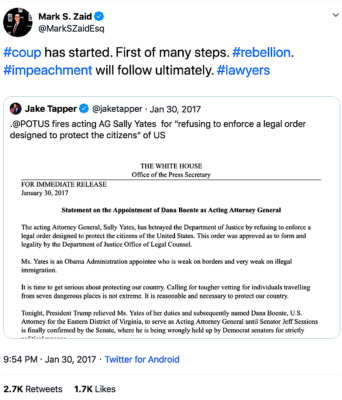 In the days following Trump’s swearing in as president, Zaid turned to Twitter to send out messages supportive of a “coup” against Trump that would lead to the president’s eventual impeachment. The identity of the lawyer who met with the whistleblower is not known. However, this lawyer referred the whistleblower to Bakaj, a fellow member of Whistleblower Aid, who took on the case and provided procedural guidance regarding the preparation of the complaint. Bakaj later brought on Zaid and another lawyer, Charles McCullough, with close ties to Senator Chuck Schumer and Hillary Clinton, to assist in the case.
On August 12, the whistleblower completed his complaint, and forwarded it to the intelligence community inspector general, thereby setting in motion events that produced weeks of hearings before the House Intelligence Committee that will very likely result in Trump’s impeachment.
Shielded from Questions
While the whistleblower, through counsel, had expressed a desire to testify before the House Intelligence Committee about the issues set forth in his complaint, he was never called to do so, even in closed-door session. The ostensible reason behind this failure to testify was the need to protect his anonymity, a protection that is not contained within the relevant statutes governing whistleblower activities within the intelligence community.
Later, as witnesses were identified from the content of the whistleblower’s complaint and subpoenaed to testify before the House Intelligence Committee, both Schiff and Bakaj indicated that the whistleblower’s testimony was no longer needed, since the specific issues and events covered in his complaint had been more than adequately covered by the testimony of others.
But the apparent reason Schiff and Bakaj refused to allow the whistleblower to testify, or to be identified, was to avoid legitimate questions likely to be asked by Republican committee members.
Namely, what was a deputy national intelligence officer of the U.S. intelligence community doing investigating activities of a sitting president? Who, if anyone, authorized this intervention in U.S. domestic political affairs by a CIA official? How did the whistleblower, who had a history of documented animosity with the Trump administration that included credible allegations of leaking sensitive material to the press for the express purpose of undermining the credibility of the president, get selected to serve as a deputy national intelligence officer? Who signed off on this assignment? What was the precise role played by the whistleblower in unmasking the identities of U.S. citizens in 2016, during the Trump transition?
Did the whistleblower maintain his friendship with Misko after leaving the NSC in July 2017? Did the whistleblower collaborate with Misko to get the House Intelligence Committee to investigate the issues of concern to the whistleblower before his complaint was transmitted to the ICIG? Who did the whistleblower meet on the House Intelligence staff? What did they discuss? Who was the lawyer the whistleblower first met regarding his intent to file a complaint? Did the whistleblower have any contact with Whistleblower Aid prior to this meeting?
Answers to these questions, and more, would have been useful in understanding not only the motives of the whistleblower in filing his complaint—was he simply a concerned citizen and patriot, or was he part of a larger conspiracy to undermine the political viability of a sitting president? There is no doubt that Congress has a constitutional right and obligation to conduct proper oversight of the operations of the executive branch, and to hold the president of the United States accountable if his conduct and actions are deemed unworthy of his office. Whether or not the facts surrounding the July 25, 2019 telephone call between Trump and Zelensky constitute grounds for impeachment is a political question for Congress to decide.
Intervening in Domestic Affairs
There is, however, the major issue looming in the background of this impeachment frenzy: the intervention by elements of the intelligence community in the domestic political affairs of the United States. There is no question that the whistleblower’s complaint served as the genesis of the ongoing impeachment proceedings.
The American people should be deeply concerned that an inquiry which could result in the removal of a duly elected president from office was initiated in secrecy by a member of the intelligence community acting outside the four corners of his legal responsibilities. The legitimacy of the underlying issues being investigated by the House Intelligence Committee is not at issue here; the legitimacy of the process by which these proceedings were initiated is.
To find out what happened, the whistleblower should not only be identified, called before the House Intelligence Committee, and other relevant Congressional committees, and be compelled to answer for his actions.
Impeachment is a constitutional remedy afforded to the U.S. Congress to deal with the political issues surrounding the conduct of a sitting president. If this constitutional remedy can be triggered by the intelligence community in a manner which obviates laws prohibiting the intrusion of intelligence agencies into the domestic political affairs of the United States, and done so in a manner where the identities of the persons and organizations involved, along with their possible motives, are shielded from both American people and those whom they elect to represent them in Congress, then a precedent will have been set for future interventions of this nature which undermine the very foundation of American democracy.
The political weaponization of intelligence represents a significant threat to the viability of the American constitutional republic that cannot be ignored.
Scott Ritter is a former Marine Corps intelligence officer who served in the former Soviet Union implementing arms control treaties, in the Persian Gulf during Operation Desert Storm, and in Iraq overseeing the disarmament of WMD.
‘Poisoner in Chief’: Scientist Behind CIA’s Disturbing Mind-Altering Techniques
By Lilia Dergacheva – Sputnik – 01.12.2019
Author Stephen Kinzer boasts stunning knowledge when it comes to writing about terror attacks and coup plots. His most recent work, however, seems to be the most hair-raising, focusing on the puppet master behind the CIA’s poisoning and torture schemes.
“I’m still in shock”, writer Stephen Kinzer says of what he learned about the horrid experiments conducted by a US government scientist that few know by name – Sidney Gottlieb.
“I can’t believe that this happened”, he recounted as his book with the suggestive title “Poisoner in Chief: Sidney Gottlieb and the CIA Search for Mind Control” saw the light of day.
This is a story about Gottlieb’s 22-year career, as the chemist continuously ran mind-control projects that aimed to assist the US in its fight against international communism from the 1950s to the 1970s.
“The investigation of drug effects on ego control and volitional activities, i.e., can willfully suppressed information be elicited through drugs affecting higher nervous systems? If so, which agents are better for this purpose?” the author cited a CIA memo on the project subsequently called Artichoke.
Kinzer writes that in the 50s and 60s, Gottlieb “directed the application of unknowable quantities and varieties of drugs into” hordes of people as he sought the most suitable conscience-altering recipe to effectively mold subjects’ thoughts and behaviours.
Stealthy Doses
Gottlieb has been widely reported to have performed LSD tests on prisoners, government employees, and hospital patients, with many of them kept in the dark about being fed narcotics.
One of the cited examples is the lethal case of a CIA officer who died in a highly suspicious manner after Gottlieb reportedly laced his drink with LSD. He later designed custom-made poisons when his seniors raised the question of “dealing with” a foreign leader, with the sinister doctor finally portrayed by actor Tim Blake Nelson in Errol Morris’ Wormwood in 2017.
However, Kinzer has outlined quite a few new details in his book, the first proper biography of the scientist. For instance, “Poisoner in Chief” depicts the way Gottlieb tried his hand in torture sessions at US military sites and allowed his colleague, a doctor, to give LSD to children.
Kinzer notes that when “Artichoke scientists came up with a new drug or other technique they wished to test… they asked the CIA station in South Korea to supply a batch [of] ‘expendable’ subjects'”.
One CIA memo suggested the subjects were needed for the testing of an unnamed but “important new technique”, adding: “technique does not, not require disposal problems after application”.
On Duty
Gottlieb’s project notably involved foreign heads of state that belonged to the communist camp. According to colleagues cited by Kinzer, he prepared “a pre-poisoned tube of toothpaste” meant for Congolese Prime Minister Patrice Lumumba, although it was never used.
He also ran a scientific team working on a bizarre plot to disgrace Fidel Castro: believing that his strength was accumulated in his beard, Gottlieb reportedly sought to have thallium salts sprinkled in his boots to make his beard hair fall out, “leaving him open to ridicule and overthrow”.
Kinzer believes his 22 years with the agency left a significant imprint on the CIA as it is today: he says there is “a direct line between Sidney Gottlieb’s work and techniques that US agents taught to Latin American security services in the 1960s and 70s”.
“These techniques were also used in Vietnam—and then later on to the techniques of torture and so-called extreme interrogation that were used at Abu Ghraib and Guantanamo”, Kinzer added.
Given an “effectively unlimited supply” of LSD supplied by the pharmaceutical company Eli Lilly to the CIA, Gottlieb became perhaps “the most powerful unknown American of the 20th century”, Kinzer states.
After the CIA, the father of four tried to reinvent himself, working with children who have speech problems. “Nobody had any idea of what he had done in the past, but he was tormented by it”, Kinzer assumes noting that when he passed away in 1999 no cause of death was officially announced.
Michael Bloomberg’s Israel connection runs deep
The Democratic Party’s Michael Bloomberg, has strong ties to Israel and apparently no time for justice for Palestinians; his media empire has also pushed a pro-Israel agenda.
Then-Mayor Bloomberg kissing the Western Wall in Jerusalem on a visit to Israel in 2003 (GETTY IMAGES)
By Kathryn Shihadah – If Americans Knew – November 29, 2019
The pool of democratic candidates for president just expanded again with the addition of billionaire and three-term mayor of New York City, Michael Bloomberg. If Americans Knew has published multiple reports on the candidates’ positions regarding Israel/Palestine (including an in-depth analysis of Joe Biden and a comparison of Elizabeth Warren and Bernie Sanders); it’s only fair to have a look at Bloomberg as well.
The newest candidate has close ties to the Jewish state and asserts a commitment to what he calls “Jewish values.” The New York Times quoted Bloomberg:
The values I learned from my parents are probably the same values that, I hope, Christians and Muslims and Hindus and Buddhists learned from their parents. They’re all centered around God put us on Earth and said we should take care of each other. We have an obligation not to just talk about it but to actually do it. [Those values are] freedom, justice, service, ambition, innovation.
Michael Bloomberg’s record indicates that, when it comes to Palestinians, his close affiliation with Israel has hampered his ability to act on his values of freedom and justice.
Israel ties
Bloomberg has made many trips to Israel and donated millions to charitable causes in Jerusalem, including in 2003 a Mother and Child Center at the Hadassah University Medical Center dedicated to his mother, and in 2007 a blood bank and massive ambulance station named after his father.
During his time as NYC mayor, Bloomberg initiated a $2 billion high-tech research campus in Manhattan, a joint venture between Cornell University and the Technion-Israel Institute of Technology (Haifa, Israel). He personally donated $100 million to the effort.
In 2014, he talked about his closeness to the Jewish state:
My parents saw in our lives just why Israel had to exist, and why it must always exist, and those lessons were passed on to us. We are as one with this city [Jerusalem], and this country and this people as you can be.
[Jewish history] gives us a special obligation to build a brighter future for everyone, and to always believe that tomorrow can be better than today. For them and for so many Jews who witnessed the horrors of World War II, the creation of Israel embodied that obligation and validated that belief. It was a dream fulfilled.After all, if the dream of Israel can be realized, what dream can’t be?
Bloomberg’s words betray a total disregard for the Palestinian experience: the birth of the state of Israel came at the cost of the indigenous Palestinians’ loss of a homeland. 750,000 became refugees, thousands were massacred, and hundreds of villages were bulldozed – so that Jewish immigrants (and a small number of indigenous Jews) could have a nearly Arab-free state.
Michael Bloomberg was the inaugural recipient of the Genesis Prize, which was created to “inspire Jewish pride” and “strengthen the bond between Israel and the Diaspora.” He turned the $1 million prize into a global competition for ten $100,000 prizes – to be awarded to young entrepreneurs who demonstrated “Jewish values” and innovative ideas.
One of those prizes was awarded to Building with Israelis & Palestinians (BIP), which according to its website, “gives an opportunity for people around the world to partner with; and support Israelis & Palestinians willing to build together.” In 2016, BIP worked in the Palestinian town of Al-Auja to provide a solar facility that would enable farmers to pump more water less expensively.
What is not publicized about this project is the fact that in 1967, after Israel’s occupation of the West Bank, about 30% of Al-Auja’s land was confiscated from its Palestinian owners, some of which became four illegal Israeli settlements. More land was then confiscated in order to build a military base to protect the residents of the settlements. Most of the remaining village land is under total Israeli control.
Israeli skies
In 2009, when Israel was embroiled in an invasion of Gaza and the Federal Aviation Administration (FAA) downgraded Ben Gurion Airport’s security rating, then-mayor Bloomberg took his private jet to Israel as a show of solidarity. He visited Sderot, an Israeli city close to Gaza and within range of its rockets (rockets that had, as of that time, caused the deaths of 18 Israelis in 8 years).
Significantly, Sderot was built on the site of the demolished Palestinian village of Najd – a village whose history went back at least four centuries.
Bloomberg did not address the reason for the rockets – Israel’s then-two year long illegal siege of Gaza (a siege that still continues, and is designed to keep the Strip on the verge of collapse and its residents on the edge of starvation). Instead, he Bloomberg accused Gaza’s leaders of “trying to destroy [Israel].”
It would appear that the opposite is true: the Israeli invasion killed over 1,400 Gazans (over 900 of them civilians) and 13 Israelis (3 of them civilians).
In July 2014, during another Israeli onslaught, when Ben Gurion Airport was within reach of Gazan rockets, the FAA announced the suspension of all US flights to Israel; in defiance of this decision and solidarity with Israel, Bloomberg again flew to Israel.
Ignoring the facts of the ongoing blockade of Gaza and the humanitarian crisis that it had created, he wrote in an op-ed:
Every country has a right to defend its borders from enemies, and Israel was entirely justified in crossing into Gaza to destroy the tunnels and rockets that threaten its sovereignty. I know what I would want my government to do if the U.S. was attacked by a rocket from above or via a tunnel from below; I think most Americans do, too. Israel has no stronger ally than the U.S.
Michael Brown noted in the Electronic Intifada that Bloomberg’s op-ed failed to contextualize Israel’s onslaught: no reference was made to the occupation of Palestine or the siege of Gaza, and “[h]e says not a word about Palestinian freedom, but speaks only in general terms about ‘bringing peace to the region.’”
In a CBS interview a short time later, Bloomberg declared that Israel was not under obligation to limit itself to “proportional” response to Gaza’s rockets, and “nobody’s attacking schools or hospitals, we’re attacking Hamas.”
And indeed, Israel was unrestrained. Its 2014 assault killed 2,250 Gazans (about 1,600 civilians) and 73 Israelis (6 of whom were civilians).
Israel’s failure to act with proportionality – and Michael Bloomberg’s endorsement of this failure – clashes with international law, which prohibits attacks that would cause “excessive” civilian damage or loss of life in relation to the anticipated military advantage of the attack.
Israel’s military objective in both 2008-9 and 2014 was to end Gaza’s practice of shooting rockets – rockets that were rarely lethal – but Israel’s attacks caused heavy civilian casualties and immense destruction in a region that was already suffering the effects of an illegal blockade. Because of the disproportionate nature of the attacks and other factors, the United Nations determined that Israel committed war crimes and crimes against humanity in both the 2008-9 invasion (read more about it here) and that of 2014 (read more here). The Hamas leadership in Gaza also faced accusations of war crimes.
Through pro-Israel eyes
Other “small” incidents can be added to the above large, conspicuous examples of Michael Bloomberg’s affinity for all things Israeli.
For example, in 2014, he referred to the nonviolent movement known as Boycott, Divest, and Sanction (BDS) – modeled after the movement that brought the downfall of apartheid in South Africa – as “an outrage” that is “totally misplaced.” The ACLU has argued in favor of BDS as free speech, but Israel partisans routinely label it anti-Semitic.
As early as 2002, Bloomberg’s mainstream media empire, Bloomberg News, was demanding that its writers sanitize news reporting about Israel/Palestine. Mondoweiss quotes leaked memos:
Avoid referring to Palestine, as in “Israel’s incursion into Palestine,” because there is no such country. Instead, describe the occupied areas by their names, as in the West Bank or Gaza Strip. Palestinian people or Palestine Authority is OK.
A 2010 memo gave a selective history lesson:
Palestine signifies different territory in different contexts. The land historically belonged to the kingdoms of Israel and Judah. Palestine represented the area west of the Jordan River that was a British mandate from the 1920s until the creation of modern Israel in 1948.
Significantly, Bloomberg News, usually a stickler for objectivity in reporting, relaxes its standards when it comes to Israel. The above memo – and others circulated in the organization – were understood by Scott Roth, “dissenting Jew” and publisher of Mondoweiss as “an attempt to avoid using the term Palestine in any way that would signify that it ought to be or can be a country on its own.” He also noted that Bloomberg’s directives look:
like something out of an AIPAC primer. The land historically belonged to ancient Israel and Judah? It also belonged to a lot of other people. Plus no reference to partition, ’48, ’67 occupation or millions of human beings living under Israel’s boot that have no vote.
No surprise
The question is whether Michael Bloomberg would be very good for the United States.
US gatecrashes into Libyan endgame. But Russia stands in the way
By M. K. BHADRAKUMAR | Indian Punchline | November 29, 2019
The United States has alleged that Russia’s presence in Libya is having an “incredibly destabilising” impact. Washington is stepping out of the shade and making way to the centre stage of the Libyan conflict.
David Schenker, the State Department’s assistant secretary for near eastern affairs said Tuesday in Washington, “The United States is committed to a secure and prosperous future for the people of Libya. For this to become a reality, we need real commitments from external actors… In particular, Russia’s military interference threatens Libya’s peace, security, and stability.”
Schenker explained, “Russian regulars and the Wagner forces are being deployed in significant numbers on the ground and support of the LNA [Libyan National Army]. We think this is incredibly destabilising. And the way this organisation, the Russians in particular, have operated before raises the spectre of large-scale casualties in civilian populations.”
Schenker spoke only days after a delegation of US civilian and military officials led by the high-flying US Deputy National Security Advisor Victoria Coates met with Khalifa Haftar, the supremo of the LNA. A state department readout said Coates expressed serious concern to Haftar over Russia’s “exploitation of the conflict” at the expense of the Libyan people.
US Delegation meeting with General Khalifa Haftar, Nov 24, 2019
Libya becomes the third theatre after Ukraine and Syria where Washington has locked horns with Moscow in a Cold War-style proxy war. Up until last weekend, two EU members were supposedly conducting a proxy war in Libya over control of Africa’s largest oil and gas resources — France and Italy.
Actually, the alignments in Libya do not warrant a US-Russia standoff, as disparate external powers largely pursue self-interests. Italy, Turkey and Qatar have backed the Government of National Accord (GNA) in Tripoli (also supported by Germany and the UN), while France, Egypt, UAE, Saudi Arabia and Russia backed LNA.
The fight against terrorist groups is a stated common objective of all protagonists, but there are sub-plots too — Libya’s oil and gas (France, Italy, Turkey and Russia); political Islam (Turkey, Qatar, Egypt, UAE); France’s military operations in the five Sahel countries (Mauritania, Mali, Niger, Burkina Faso and Chad), which can end only with the stabilisation of Libya; the migration issue; and geopolitical interests (France, Italy, Russia and Turkey).
Although Haftar was a CIA “asset” for over three decades, Washington largely kept contacts with him under the radar and seemingly watched the struggle between GNA and LNA from the sidelines even after Haftar launched a determined push in April to capture Tripoli. The US policies were incoherent. President Trump apparently viewed Haftar as a factor of stability, while Washington officially pitched for a UN-mediated political settlement in Libya, although that is easier said than done, given the fragmentation in the country.
Washington was marking time, unsure whether Haftar’s military campaign would succeed. Moscow too took a back seat, but in recent months the Kremlin began weighing Haftar’s prospects positively. Moscow (like Cairo) counts on Haftar’s impeccable credentials in the fight against terrorist groups.
Russian military support has decisively helped Haftar’s campaign, which took big leaps lately. Haftar controls something like 80 percent of Libya, whereas, GNA is reduced to a mere rump confined to Tripoli.
Enter Washington. Washington feels alarmed that in the Libyan endgame, with Haftar inexorably gaining the upper hand, thanks to Moscow’s help, the vista opens for cascading Russian influence over the new regime.
Nonetheless, it isn’t easy to find fault with Russia’s military role to stabilise Libya, since NATO intervention in 2011 that wrought havoc and such colossal destruction had enjoyed the backing of Obama Administration. Washington is on weak moral grounds. Geopolitics is dictating its policy trajectory.
Washington’s policy is driven by the project to make Libya the headquarters of the United States Africa Command, one of the eleven unified combatant commands of the United States Armed Forces (which is presently based in Stuttgart, Germany.) Clearly, the rollback of Russian presence and influence in Libya becomes a prerequisite of the US project.
The backdrop, of course, is the big-power struggle erupting over Africa and its vast untapped resources. China has been rapidly expanding its presence in Africa and Russia too is stepping up. Importantly, as the recent Russia-Africa summit in Sochi (October 23-24) signalled, military cooperation is Moscow’s priority.
Russia and China’s growing presence creates space for African leaderships to negotiate with the Western powers. It is a sign of the times that the South African Navy’s first-ever multinational maritime exercise (November 25-30) is exclusively with Russia and China.
Fan Guanqing, the captain of the PLA Navy frigate Wei Fang, said in Cape Town last weekend, “We hope that the exercises will allow China, Russia and South Africa to work together and make an improvement through co-operation and exchanges. This exercise is historical and the first of its kind for these three countries.” Captain Fan said the maritime exercise should help maintain world peace and stability and would also be the starting point of a relationship between the three countries.”
Libya is the perfect gateway for NATO to penetrate the African continent. But a willing government in Tripoli could give the Russian Navy access to the eastern Libyan ports of Sirte and Benghazi on the Mediterranean. If Russia gets ensconced in Libya (in addition to Syria), NATO presence in the Mediterranean is affected. Russia and Libya also have a history of close political, military and economic ties dating back to the Soviet era.
Russia had a traditional presence in Libya’s armaments market and Soviet troops were deployed in Libya. Today, Libya’s reconstruction is the real prize for Moscow in terms of infrastructure (roads, railways, cities). Russia lost heavily due to the NATO-led regime change in Libya in 2011. Moscow had billions of dollars in investments in Libya during Moammar Gadhafi’s rule.
It remains to be seen how far the US pressure tactic on Haftar to sever his links with Russia will work. Russia, France and Egypt are on the same page in helping Haftar militarily. All three countries also bond together. While Moscow’s politico-military relations with Cairo are deepening, France is decoupling from the US’ Russia policies. Washington will be hard-pressed to isolate Russia in Libya. The big question is where indeed Haftar himself stands.
From killed Armenian priest in Syria to the roots of hatred and genocide
By Steven Sahiounie | December 1, 2019
Father Hovsep Bedoyan, the head of the Armenian Catholic community in Qamishli, and the priest’s father, Abraham Bedoyan, were killed November 11, on the road leading from Qamishli to Deir Ez Zor, where they were headed to check on the rebuilding of the Forty Martyr’s Armenian Apostolic Church in Deir Ezzor, which was destroyed in 2014 by terrorists who targeted Christians and churches. Deacon Fati Sano of the Al-Hasakeh church was injured in the attack when the car was ambushed at a checkpoint by masked gunmen on motorcycles, which shot at point-blank range. The car they drove was inscribed with the Armenian Church’s logo. The same day, a series of bomb blasts in Qamishli occurred, targeting the Armenian Catholic church, an Assyrian Christian-owned business, and a Catholic school, killing at least 6 people and wounded 22 others. More than 100,000 ethnic Armenians lived in Syria, mainly in the province of Aleppo prior to 2011; however, after the constant targeting of Christians by the Free Syrian Army (FSA) beginning in 2011, thousands have fled and many hundreds went to Armenia, who offered the Syrians a visa, when most of the world had shut its doors to them.
Tens of thousands of Christians from the Assyrian minority fled attacks in 2015, and have not returned. Christians in Homs were targeted very early in 2011 by the FSA, with churches attacked, burned and priests killed. Christians in Damascus were dodging missiles fired into Bab Touma by terrorists, in East Ghouta, until the Syrian Arab Army defeated them and they could walk again safely on the street called straight, from Bible passages about Saint Paul.
In September 2012, the large Christian neighborhood in Aleppo, Azizia, fought the FSA, with Christian civilians holding arms to defend their homes and churches. George, an Armenian Christian of Aleppo said, “The Armenians are fighting because they believe the FSA are sent by their Turkish oppressors to attack them, the Christians want to defend their neighborhoods.”
“FSA snipers were on the rooftops and they were attacking the Maronite church and Armenian residents there,” said a former clergyman calling himself John. A Syrian Armenian mother said, “They are shouting ‘the Alawites to the graves and the Christians to Beirut.”
While many Syrian Christians have resisted leaving Syria, for the life of a refugee abroad. Many have gone even though they were living in safe areas, such as the coast. They saw their Christian countrymen leaving in large numbers, and they feared that the FSA terrorists that the Obama administration was supporting would win, and in that case, they could never live safely in Syria.
Father Hovsep Bedoyan had been visiting Deir Ez Zor every 2 weeks while overseeing the rebuilding of the church there. The France-based association, L’Oeuvre d’Orient, is a Catholic charity aimed at reconstructing infrastructure for the return of the Christian community. Monseigneur Pascal Gollnisch, the group’s head, pointed at Turkey’s recent invasion of Northern Syria: “It is the responsibility of all occupying forces to protect the safety of the local Christian minority,” he insisted.
The United Nations (UN) estimates that almost 200,000 people have been displaced by the Turkish invasion, dubbed “Operation Peace Spring”, during which there have been eyewitness accounts of summary executions, beatings, and torture, unlawful detention, and kidnappings by the Turkish military and the FSA, who are Radical Islamic terrorists, employed as mercenaries.
The FSA is the Turkish backed terrorists/mercenaries
“It was sadly learned that a cleric from the Syrian Armenian community was killed in a vicious attack in the area under the control of the terrorist organization PYD/YPG/PKK,” the Turkish Foreign Ministry said in a written statement, which deflected responsibility, and blamed the Syrian Kurds who had been allied to the US, and denying their own FSA mercenaries were the actual killers. ISIS has claimed responsibility for the killings, but the FSA and ISIS are allies, and sources close to the events on the ground have said it was the FSA who killed them, and ISIS only issued the claim of responsibility to shield the blame from the FSA.
FSA history in Syria and sectarianism
The FSA and its political wing, the SNC, have never been secular or moderate. The founding members of the SNC and FSA were members of the Muslim Brotherhood. Their goal for Syria has always been to establish an Islamic government, thus abolishing the secular Ba’ath Party as well as the Syrian Social Nationalist Party (SSNP).
“The Free Syrian Army practically doesn’t exist,” Kamal Sido, a Mideast expert at the human rights group Society for Threatened Peoples (GfbV) told Germany’s Deutschlandfunk broadcaster. “The Free Syrian Army is a smokescreen hiding various names, and if you look at the names, at these groups’ videos, you’ll find they are radical Islamist, Jihadist groups.”
The FSA was not only fighting the Syrian government but they were also killing, raping, maiming and kidnapping unarmed Syrian civilians, most of whom were Sunni Muslims, like themselves. On July 20, 2017, President Trump cut the CIA’s covert program to equip and train the FSA.
The CIA program began in 2013 by Obama to overthrow President Assad; however, CIA officials observed that many FSA had joined ISIS and other radical groups, and feared the weapons they gave the group might end up with ISIS.
The Marmarita massacre
On August 17, 2013, in Marmarita, Amin Nakour, Maya Barshini, Atalla Aboud, and Ibrahim Saadi were attending a Christian celebration to honor the annual commemoration of “Mother Mary’s Day”. The small village of Marmarita sits in the historic “Valley of the Christians” which is near Homs. It was a hot August night, and Christian party-goers were suddenly attacked the FSA and their allies. The four were killed when they attempted to flee the party in a car. The FSA and their allies, have vowed to make Syria a Sunni Muslim State, and have targeted Christians and minorities for 8 years.
The invasion, occupation, and destruction of Kessab
On March 21, 2014, Kessab was attacked when shelling from the Turkish side of the border rained down on the undefended Armenian village, sending its 2,000 residents into panic. Over 20,000 fanatics from the FSA and its allies came pouring over the border. They desecrated all 3 churches, and looted the village’s graves, before scattering the bones of the deceased around the town. The FSA held 26 elderly Armenians against their will for forty days in Turkey, where the FSA kidnappers brought the US Ambassador to Turkey, Francis J. Riccardone, Jr., to visit the elderly captives, but offered no help or release.
Samuel Poladian, who stayed in Kessab for the 3-month occupation, claims he heard Turkish military helicopters overhead on the morning of the invasion, and that Turkey assisted in the invasion.
Monseigneur Ayvazian said, ”They burned all my books and documents, many of them very old, and left my library with nothing but 60cm of ash on the floor.” He has a photo of the church altar, which was desecrated by the FSA before the Syrian Arab Army liberated Kessab on June 15, 2014. The Armenians claim the Kessab attack, which was directed solely against Armenian Christians, was Turkey’s brutal way of showing the Armenians and the Syrian government that they can attack at any time.
Armenian Church in Deir Ez Zor destroyed
On November 10, 2014, terrorists blew up the Armenian Church in Deir el-Zour, which is dedicated to the 1.5 million Armenians slaughtered by the Turks during the 1915 genocide, when many hundreds of thousands of victims died in death camps around Deir el-Zour. Because the FSA has received arms from Turkey, the destruction of the church is regarded by Armenians as crimes carried out by Turks, harkening back to the genocide. “During the Armenian genocide, the Turks entered the church and killed its priest, Father Petrus Terzibashian, in front of the congregation,” Monseigneur Ayvazian said, adding “Then they threw his body into the Euphrates. This time when the Islamists came, our priest there fled for his life.”
The Turkish hatred of Armenians
The 19th century Armenian Surp Asdvadzadzin Church in Gurun district of Sivas (Sebastia), Turkey, will reopen as a museum. At different times the church has been used as a prison, movie theater, storeroom, and wedding hall. The local mayor hopes it will boost the development of tourism in the region. That is the stark reality in Turkey, where Muslims account for 98% of the population, compared to the large Christian minority in Syria. In Turkey, they have tried to erase their Christian history, and have used the old Armenian churches as museums, or locked up or ruined them.
The Armenian Genocide, Turkish denial, the US House recognition
The Armenian Genocide was the systematic mass extermination and expulsion of 1.5 million ethnic Armenians within the Ottoman Empire, from approximately 1914 to 1923. Other ethnic groups were similarly targeted for extermination; such as Assyrians and the Greeks, also strictly Christians. Mass executions were followed by the deportation of women, children, the elderly, and the infirm on death marches leading to Deir Ez Zor, which were driven forward by military escorts, as the deportees were deprived of food and water and subjected to periodic robbery, rape, and massacre.
On Oct. 29, 2019, the US House voted overwhelmingly to formally recognize the Armenian genocide and denounce it. Lawmakers had previously failed to support such a resolution to preserve the United States’ relationship with Turkey, a NATO ally that has steadfastly denied that the atrocities amounted to genocide. Livid at Turkey’s recent bloody military invasion in Syria, lawmakers saw a possible tie to the Armenian genocide, as many feared the withdrawal of American forces would lead to ethnic cleansing in northeast Syria.
Report: US rejected UAE request to purchase F-35 fighter jets
MEMO | November 26, 2019
The United States has rejected a request by the United Arab Emirates to purchase the F-35 Stealth Fighters, Israeli Channel 13 reported.
According to the news station Pentagon officials said they would not allow the sale of F-35 Stealth Fighters to the UAE in order to preserve Israel’s qualitative military edge (QME).
According to the channel, the UAE has been seeking to purchase the stealth fighters for more than six years without success.
The US, Channel 13 continued, has a long held policy of upholding Israel’s qualitative military edge, whereby Israel maintains a technological advantage in the region when it comes to defence capabilities.
Israel has recently received two additional F-35 fighter jets amid escalating tensions with Iran in the region.
Featured Video
Thomas Fazi: NATO’s Hybrid Warfare – Deception & Permanent War
or go to
Aletho News Archives – Video-Images
Book Review
UAE tortured, killed journalist for opposing Israel normalization
The Cradle | October 31, 2026
UAE security officers detained, tortured, and killed Emirati poet and news editor Habib al-Sayegh in August 2019, shortly after he published a column opposing UAE normalization with Israel, according to a newly published book.
“Princes and Thieves,” a book by investigative journalist Matthew Cole published on 25 October, alleges that UAE security officers raided Sayegh’s Abu Dhabi home shortly after the publication of the column, hooded him in front of his wife and took him to a detention facility where he was tortured to death.
His interrogators reportedly pulled out several of his teeth with pliers and beat him repeatedly with a sharp metal object.
On 11 August 2019, Sayegh criticized the UAE’s plan to normalize relations with Israel as part of the Abraham Accords in his weekly column for Khaleej newspaper. The column was titled “Israel Is Our Real Enemy and A Dangerous Project.”
Sayegh described Israel as “a real and natural enemy” while questioning “who authorized the normalizers to speak on behalf of everyone?”
Nine days after the column was published, Emirati state media announced his death, without stating a cause. … continue
Blog Roll
 Aletho News
- ‘The Arab Vote’: How Israeli Racism Has Ruined Their Elections
- Israel forces Palestinians in Gaza to choose between assassination alone or death with their families: Report
- US Approves Sale of 500 Patriot Missiles to Ukraine, Deliveries May Take Years
- German Imperialism: An Urgent Explainer
- Backed by AAP, West Virginia Proposal Would Allow Dental Hygienists to Give HPV Vaccine to 9-Year-Olds
- Poland Is the Symptom and Europe Is the Patient
- UAE security forces tortured, killed journalist for opposing Israel normalization: Report
- They Compared the Spice to the Drug. The Spice Won — Again. (Part 2)
- Thomas Fazi: NATO’s Hybrid Warfare – Deception & Permanent War
- Wrong, AP and NPR: Europe’s 50,000 Heat Deaths Are a Computer-Model Estimate, Not a Real Body Count
- If Americans Knew
- An error has occurred; the feed is probably down. Try again later.
- No Tricks Zone
- Germany’s Green Energy Transition Becoming Increasingly Expensive…Another 6 Trillion Euros!
- Sudden Stratospheric Warming, Powerful El Niño Combination May Lead To Extreme Europe Cold, Energy Crisis!
- Two New Studies Find Thwaites Glacier Melt Cannot Be Driven By Human Activity Or A Warming Ocean
- E-Cars Reduce CO2 Emissions By Only 41% Compared To Internal Combustion Engine Vehicles
- Predictions Made By Renowned Climate Professor Over Past Decades Have Been Proven To Be Poor
- New Study Suggests Large Regions Of The Pacific Ocean Have Been Cooling For The Last 80 Years
- Germany’s Green Energy Debacle: High Energy Costs Force Kahla Porzellan to Close After 182 Years!
- New Study: 50 Years Of The Most Aggressive ‘Net Zero’ Policies Can Only Affect The Global Climate By 0.03°C
- US September “Heat” Was No Record…Many Records Set Decades Ago
- Latest European Green Energy Debacle; Portugal’s Largest Flagship Solar Park Insolvent!

