US not sending 14,000 troops to Mideast: Pentagon
Press TV – December 5, 2019
The Pentagon has denied a report concerning the expansion of US military presence in the Middle East.
The denial came in reaction to an article published in the Wall Street Journal on Wednesday.
The paper claimed that Washington was weighing the deployment of fourteen-thousand additional troops and a dozen of naval vessels in the region, to counter alleged threats from Iran.
A Pentagon spokesman, however, said that they were not considering sending additional troops to the Middle East.
“To be clear, the reporting is wrong. The U.S. is not considering sending 14,000 additional troops to the Middle East,” Alyssa Farah tweeted.
The Grand Poo Bah Still Searching for Impeachment
By Renée Parsons | OffGuardian | December 5, 2019
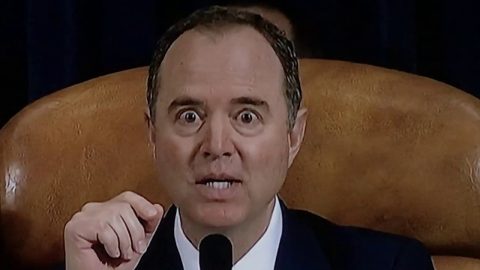
There were two especially notable testimonys made during the recent House impeachment inquiry that should have been ‘nothing to see here folks, let’s move on’ except that The Grand Poo-bah of the Intel Committee Chair Adam Schiff, haughty in his own insecurity and full of his usual self-regard, bugging his eyes in anticipation, continues to act as if he is living in a reality where facts and evidence are non existent.
In a series of mental meanderings, House Speaker Nancy Pelosi’s statement that two career diplomats had provided “corroborated evidence of bribery” was little more than off-hand ramblings with no evidence of exactly what was corroborated.
Upon questioning, Pelosi defined ‘bribery’ as the President’s alleged withholding of military aid to Ukraine in exchange for an investigation into the Biden’s financial bonanza.
In contrast to Pelosi’s allegation, neither of the career diplomats aforementioned presented any “corroborated evidence of bribery” nor has any testimony confirmed that bribery occurred.
As Lord High Justice of the Misguided Society of Wild Goose Chases, the myopic Schiff Show moves on this week to the House Judiciary Committee with more disgruntled witnesses on Wednesday who have, as of the 2016 election, lost any objectivity or claim to legal scholarship.
In a recent WSJ op ed, GW University law professor Jonathon Turley referred to the impeachment inquiry as the “shortest investigation producing the thinnest record of wrongdoing for the narrowest impeachment in history.”
On the first day of the Intel Committee hearings, Rep. Jim Jordan questioned ‘star’ witness former Ambassador Bill Taylor who was expected to drop a “bombshell.”
Instead, channeling his best Clarence Darrow, Jordan caught Taylor in the admission that after Ukraine aid was held up until September 11, Taylor had three meetings with Ukraine President Volodymyr Zelensky (July 26, August 27 and September 5); during which, Taylor agreed, that the subject of US financial assistance as a Quid Pro Quo for a Ukraine investigation into the Bidens or Burisma was never discussed.
Up against the wall with no place to go, Taylor identified former US Ambassador to the EU Gordon Sondland as the source of his ‘clear’ understanding which turned out to be third or fourth hand hearsay and would be inadmissible in court.
Two days later, Jordan took his turn with another ‘star’ witness when Sondland testified that, contrary to his earlier statement that the White House required a QPQ with a public statement from Zelinsky for an investigation to occur, Sondland confessed there was no such agreement or public announcement by Zelensky.
As the only witness who had direct personal contact with President Trump on the subject of Ukrainegate, Jordan related Sondland’s earlier statement to Republican staff counsel that:
The President never told you that the announcement had to happen to get anything”
… and then Sondland’s personal verbatim conversation with Trump:
Sondland: What do you want from Ukraine, Mr. President.
Trump: I want nothing, I want no QPQ. I want Zelensky to do the right thing. I want him to do what he ran on.
When Jordan asked why his conversation with the President of the United States had not been included in Sondland’s prepared 23 page statement, Sondland replied
“it wasn’t purposeful, trust me.” By then, Sondland looked ready for a cold brewski.
As the entire witness script played out during the last two weeks before the Intel Committee, one common theme of almost all the witnesses was that they are (or were) long-standing (albeit unelected) veteran State Department bureaucrats.
Given their decades of experience and seniority, it became clear during their testimony that they are convinced of their own infallibility as better informed with a divine right to make foreign policy decisions more than a duly elected President of the US; especially Donald Trump.
How exactly do unelected, uninspiring State Department bureaucrats (or any Federal bureaucrats) become so deeply entrenched and so powerful to assume that their view on foreign policy is beyond reproach and matters more than a hill of beans? Therein lies a Separation of Powers conundrum of historic proportions for our teetering constitutional democracy to address.
James Madison had a considerable amount of concern about the potential for abuse of the Separation clause as articulated in five essays he contributed to The Federalist Papers (#47, #48, #49, #50, #51).
As the Intel Committee’s Democratic majority has not yet publicly released its report on the impeachment inquiry, the Republican minority staff report was released on Monday.
As the Inquiry moves to the Judiciary Committee, it will be essential to identify the specific Constitutional grounds for impeachment as set forth by the Grand Poo Bah.
US Vows to ‘Reinforce’ Sanctions, Accuses Venezuela and Cuba of Stirring Regional ‘Strife’
Elliott Abrams reiterated support for Guaido and denied that sanctions are damaging the Venezuelan economy
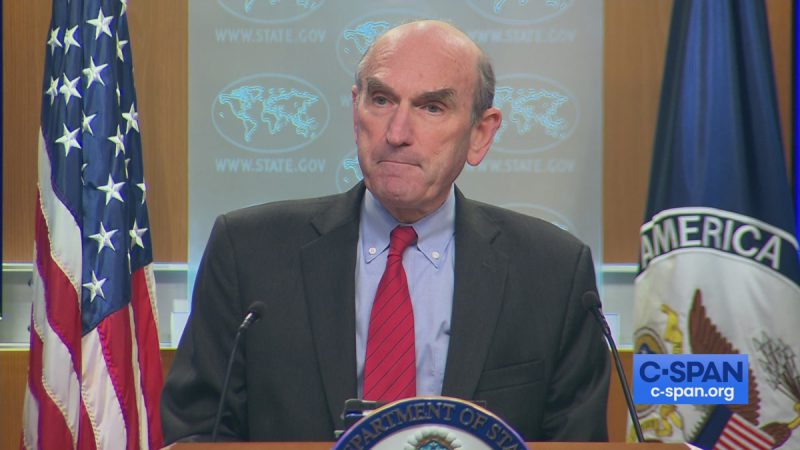
White House envoy for Venezuela Elliott Abrams defended Washington’s Venezuela sanctions on Wednesday. (C-Span)
By Lucas Koerner | Venezuelanalysis | November 28, 2019
Caracas – The Trump administration has pledged to continue economic sanctions against Venezuela in its ongoing bid to oust the Maduro government.
Speaking at a press conference at the State Department Wednesday, Special Envoy for Venezuela Elliott Abrams defended US regime change policy, which he said would “continue.”
“There’s no change… What is next is, I would say, a continuation of the current policy,” he said in response to questions about the status of US efforts more than ten months after recognizing opposition politician Juan Guaido as “interim president” of Venezuela.
Guaido proclaimed himself head of state in January and has gone on to lead several unsuccessful efforts to topple Maduro, including a failed military putsch in April.
Trump immediately backed Guaido’s “interim presidency,” handing the Venezuela file to Abrams, a veteran cold warrior infamous for his role in the Iran/Contra scandal, the Reagan administration’s Central America policy, and the Iraq War.
Asked about the efficacy of US sanctions, Abrams assured reporters that the measures are cutting off vital funds for the Venezuelan government. However, he acknowledged that he “would like to see, obviously, the sanctions work better,” adding that “there are plans to reinforce the effort.” He did not offer further details.
“The gravy train days that they had 10 years ago are over,” he announced, referring to the period when Venezuela had the highest minimum wage in Latin America and among the lowest levels of inequality.
Abrams went on to deny that US sanctions are negatively impacting Venezuela’s economy, citing a paper authored by former Guaido Inter-American Development Bank envoy Ricardo Hausmann claiming, “the bulk of the deterioration of living standards occurred long before sanctions were enacted in 2017.” Hausmann was a key architect of neoliberal policies in Venezuela in the 1980s and 1990s and has been a longtime government opponent.
The conclusions of Hausmann’s study have been disputed by the DC-based Center for Economic and Policy Research, which published its own report in April finding sanctions responsible for at least 40,000 deaths since 2017. The study likewise claims that sanctions amount to “collective punishment,” blocking any possibility of economic recovery in the Caribbean nation.
Washington has dramatically ramped up its sanctions regime since January, imposing an oil embargo which has since been escalated to a sweeping ban on dealings with Caracas under threat of secondary sanctions.
Abrams likewise rebuffed reporters’ concerns about Guaido’s “lack of momentum,” suggesting that “hundreds of thousands… went to the streets on November 16.” The claim was scrutinized by journalists who pointed out that viral video footage purported to be from the protests was in fact taken in January.
Questioned repeatedly about allegations of the Maduro government “intervening” in regional protests, the White House envoy accused Caracas and Havana of acting to “promote more strife everywhere.”
“There is evidence beginning to build of an effort by the regimes in Cuba and Venezuela to exacerbate problems in South America,” he added.
In recent weeks, the region has been rocked by massive anti-neoliberal protests that have shaken right-wing governments in Ecuador, Haiti, Chile, and Colombia. Government spokespeople have frequently attributed the uprisings to “meddling” by Caracas, while the Organization of American States has branded them a “destabilization strategy” by the “Bolivarian and Cuban dictatorships.”
US Fails to Issue Visas to Several Russian Officials – Russian Embassy
Sputnik – December 4, 2019
WASHINGTON – A delegation of the Russian Federal Treasury that was supposed to arrive in Washington on Tuesday, 3 December, did not receive American visas, the Embassy of Russia in the US has announced, expressing concern over repeated US visa denials to Russian officials.
“A statement shifting the blame for initiating a ‘visa war’ on Russia is still posted on the website of the US embassy in Moscow. There were and are no grounds for such false attacks on us. … We stress that US authorities have been consistently restricting the entry of our official representatives and disrupting crucial negotiating formats,” the Russian embassy said in a Facebook statement.
A delegation of the Russian Treasury that was supposed to arrive in Washington on Tuesday, did not receive visas, the Russian embassy said.
“Thus, very recently, a delegation of our Federal Treasury that was supposed to arrive in Washington on December 3 to participate in the conference of the International Institute on Audit Regulation did not get visas,” the embassy said in its statement.
According to the release, Director of the Russian Foreign Ministry’s Department for Relations with Compatriots Abroad (DRCA) Oleg Malginov was prevented from taking part in a youth forum in the United States last week.
“The [US] State Department also prevented Director of the Russian Foreign Ministry’s Department for Relations with Compatriots Abroad O. S. Malginov from attending the Youth forum in New York on November 28-29 2019,” the embassy said.
The embassy also pointed out that the United States had still not explained why some members of the Russian delegation to the UN General Assembly in September were denied visas.
“In violation of its own obligations, the United States created obstacles to the participation of the Russian side in the meetings of the First and Third Committees of the UN General Assembly. To a large extent, their substantive work was disrupted. It is noteworthy that not only the Russian delegation suffered: representatives of other countries did not receive visas either. Essentially, Washington has started to determine who can (should) represent a particular country,” the Russian embassy said.
The embassy warned that such actions on the part of the United States lead to a degradation of US-Russian relations that are already complicated and contradict Washington’s calls for the normalization of ties with Moscow.
Putin: Russia is against militarization of space but US sees it as theater of war
RT | December 4, 2019
Russia has consistently opposed the idea of space militarization, but the actions of the US and its allies force Moscow to counterbalance this growing threat, President Vladimir Putin has said.
“Russia has always opposed and continues to oppose the militarization of space,” the president told a government meeting on military policies. Putin expressed concern over world powers increasing the capabilities of their space systems which have both military and dual-use applications.
“The US political and military leadership openly consider space a war theater,“ he said.“Developments demand that we pay increased attention to strengthening our orbital group as well as our rocket and space industries.”
Russia’s so-called orbital group is a constellation of more than 150 satellites, two thirds of which have military applications. Most of them are parts of military satellite communication systems, but Russia also has satellites monitoring launches of intercontinental ballistic missiles as well as short-range tactical missiles. This warning system was “significantly enhanced” over the recent years and tested successfully during the large-scale military drills in October, the president said.
His words, meanwhile, came as NATO finally made space its official war domain. During a summit in London on the 70th anniversary of the alliance on Wednesday, its members declared space “the fifth operational domain and committed to ensuring the security of telecommunications infrastructure, including 5G.”
However, nothing has been publicly said regarding concrete steps in this direction or decisions made in this field.
Is Criticism of Israel Already an Official Hate Crime in America?
By Philip Giraldi – American Free Press – December 2, 2019
One subject that congressmen and the mainstream media tend to avoid is the erosion of fundamental liberties in the United States as a consequence of the war on terror and American involvement in the Middle East. Some of America’s legislators apparently do not even understand that freedom of speech actually means that one can say things that others might find distasteful. The assault on freedom of speech has been accelerated through the invention of so-called “hate speech,” which has in turn morphed into “hate crimes” where punishments are increased if there is any suggestion that hatred of groups or individuals is involved. Some have rightly questioned the whole concept, pointing out that if you murder someone the result is the same whether you hate your victim or not.
Freedom of speech is particularly threatened in any situations having to do with Israel, a reflection of the power of that country’s lobby in the United States. At a recent town hall gathering, Rep. Dan Crenshaw (R-Texas) demonstrated how he and his colleagues run and hide whenever the issue of Israel is raised when he would not respond directly to a question over whether any criticism of Israel should or should not be protected under the First Amendment. Crenshaw is a Republican and generally reliably conservative, though he recently spoke out against the “For the People Act of 2019,” which he claimed “would limit free speech dramatically.”
A constituent specifically asked Crenshaw’s opinion about federal laws that require citizens in some states to sign a pledge that they will not boycott Israel if they wish to get government contracts or obtain a government job. The audience member also mentioned a law passed in Florida that bans anti-Semitism in public schools and universities, defining “anti-Semitism” as criticism of Israel. The constituent observed, “These laws are obviously flagrant and troubling violations of the First Amendment to free speech.”
“Will you honor your oath and denounce these laws here, now and forever?” Crenshaw was then asked. Crenshaw quickly fired back that the critic was “cloaking yourself in the First Amendment” to enable engaging in “vehement anti-Semitism.” Crenshaw then asserted that the questioner was “advocating the BDS movement,” a recent target of much of the legislation that the critic was addressing.
BDS refers to the Boycott, Divestment, and Sanctions movement, which calls on people to protest Israel by pulling investments from and boycotting the country.
Israel is engaged in what might be described as a war with the objective of driving any and all criticism of the Jewish state out of polite discourse, making it illegal wherever and whenever possible. The Knesset has passed legislation criminalizing anyone who supports BDS and has set up a semi-clandestine group called Kella Shlomo to counteract its message. The country’s education minister has called BDS supporters “enemy soldiers” and has compared them to Nazis. Netanyahu has also backed up the new law with a restriction on foreigners who support the BDS movement entering the country, including American Jewish dissidents, several of whom have been turned around at the airport and sent home.
Israel has been particularly successful at promoting its own preferred narrative, together with sanctions for those who do not concur, in the English language speaking world and also in France, which has the largest Jewish population in Europe. The U.S. government under Donald Trump is completely under the thumb of the Israeli prime minister’s office, with Secretary of State Mike Pompeo recently saying “our major focus is stamping out anti-Semitism.”
Sanctions already in place in Europe consist of fines and even jail time. The legal penalties come into play for those criticizing Israel or questioning the accuracy of the accepted holocaust narrative, i.e., disputing that “6 million died.” Even attacking specific Israeli government policies, like its slaughter of Palestinians in Gaza every Friday, can be found guilty of anti-Semitism, which is now considered a hate crime in Britain, France, Germany, and, most recently, the Czech Republic. In Britain, where the Jewish lobby is extremely strong, a law passed in December 2016 made the UK one of the first countries to use the definition of anti-Semitism agreed upon earlier in the year at a conference of the Berlin-based International Holocaust Remembrance Alliance (IHRA).
A statement from the British prime minister’s office at that time explained that the intention of the new definition was to “ensure that culprits will not be able to get away with being anti-Semitic because the term is ill-defined, or because different organizations or bodies have different interpretations of it.”
The British government’s own definition relies on guidance provided by the IHRA, which asserts that it is considered anti-Semitic to accuse Jews of being “more loyal to Israel or their religion than to their own nations, or to say the existence of Israel is intrinsically racist.” In other words, even if many Jews are more loyal to Israel than to the countries they live in and even though Israel is in fact intrinsically racist, it is now illegal to say so in Great Britain.
One should not be surprised, as the British government’s subservience to Jewish and Israeli interests is nearly as enthusiastic as is government in the United States, though it is driven by the same sorts of things—Jewish money and Jewish power, particularly in the media. A majority of Conservative Party members of parliament have joined Conservative Friends of Israel, and the Labour counterpart is also a major force to be reckoned with on the political left.
Here in the United States, the friends of Israel appear to believe that anyone who is unwilling to do business with Israel or even with the territories that it has illegally occupied should not be allowed to obtain any benefit from federal, state or even local governments. Constitutional guarantees of freedom of speech and association for every American are apparently not valid if one particular highly favored foreign country is involved, as the discussion with Crenshaw reveals.
Twenty-seven states now have laws sanctioning those who criticize or boycott Israel. And one particular pending piece of federal legislation that is regularly re-introduced into the Senate would far exceed what is happening at the state level and would set a new standard for deference to Israeli interests on the part of the national government. It would criminalize any U.S. citizen “engaged in interstate or foreign commerce” who supports a boycott of Israel or who even goes about “requesting the furnishing of information” regarding it, with penalties enforced through amendments of two existing laws, the Export Administration Act of 1979 and the Export-Import Act of 1945, that include potential fines of between $250,000 and $1 million and up to 20 years in prison.
Israel, and its friends like Crenshaw, are particularly fearful of the BDS movement because its non-violence is attractive to college students, including many young Jews, who would not otherwise get involved on the issue. The Israeli government clearly understands, correctly, that BDS can do more damage than any number of terrorist attacks, as it represents a serious critique of the behavior of the Jewish state while also challenging the actual legitimacy of the Israeli government and its colonizing activity in Palestine. Much of the current hate crime legislation in places like Germany and the Czech Republic directly targets BDS, stating specifically that it is “inherently” anti-Semitic. In late July, the House of Representatives overwhelmingly passed its own resolution condemning BDS explicitly in a 398-to-17 vote.
Going hand-in-hand with the condemnation of BDS is a drive to maintain the exclusivity of Jewish suffering. In June, when Rep. Alexandria Ocasio- Cortez (D-N.Y.) called border detention centers holding asylum seekers “concentration camps,” she was inundated with protests from Jewish groups that claimed she was denigrating the holocaust and “insulting victims of genocide.” The United States Holocaust Memorial Museum even published a statement objecting to comparisons between “the holocaust and other events.”
It is important for Americans to realize that Israel not only spies on the U.S., digs its paws deep into our Treasury, and perverts Washington’s Middle East policy, it is also attempting to dictate what we the people can and cannot say. And Congress and much of the media are fully on board, which is the real tragedy.
The Latin Alphabet in Central Asia — America’s Geopolitical Tool
By Vladimir Odintsov – New Eastern Outlook – 04.12.2019
Central Asia has long been one of the key fronts in America’s ideological battle and information war against Russia.
A year ago, the American geopolitical intelligence platform Stratfor published its forecast for US policy in Central Asia, which focuses much attention on Russia. Analysts from this agency, which is dubbed the “Shadow CIA”, indicated in this forecast that the United States is looking to strengthen ties with countries along the periphery of the former Soviet Union — from Eastern Europe to the Caucasus and Central Asia — in an effort to put more pressure on Russia. A geopolitical war is going to be waged against Russia, or a multi-domain battle to use the American military terminology, affecting the political, economic, energy and military spheres.
Washington has long identified the Central Asian republics and Afghanistan a “zone of US national interests”, which is why this region is targeted with the full spectrum of American information campaigns. In order for these campaigns to be effective, not only have so-called “independent” media outlets and pro-Western NGOs, been making a massive contribution in Central Asia over the past number of years, which the US has been busily implanting in the region, but military specialists in information warfare have also been recruited — servicemen from the United States Army’s 4th Psychological Operations Group. The 8th Psychological Operations Group is responsible for work in Central Asia, which runs the Caravanserai information portal, a website specifically created to counter Russia, sponsored by the United States Central Command and targeted at residents of Uzbekistan, Kazakhstan, Kyrgyzstan and Tajikistan.
The main aim shared by most of the information campaigns Washington supports is to separate the regional population from Russia, mentally and psychologically, and to undermine Russia’s position in Central Asia. The campaigns mainly target young people in the hope that the leaders of the future in these countries will have been brought up on Western “democratic” ideals and will therefore be less inclined to partner with Russia.
Special programs are being launched and implemented by NGOs and “independent” media outlets in order to counteract Russia’s influence in the CIS countries. For instance, a new five-year program called MediaCAMP was presented at the end of last year in Kazakhstan and Tajikistan, which is run in Kazakhstan, Tajikistan and Uzbekistan by an American NGO called Internews Network (California, USA), and receives heavy funding from the United States Agency for International Development (USAID). The program has a budget of $15 million. Its official goal is “to develop a more balanced information environment”, but in reality, it is used for intensive anti-Russian propaganda. Internews Network had its activity suspended in Russia back in 2007, but it has continued to operate efficiently in most Central Asian countries up to this day. The USAID Agency, funded by the United States federal government, also ran programs in Russia up until 2012 when it was banned.
One clear example of the United States’ involvement in this anti-Russian information war in Central Asia would be the material that was published at the end of January by the Pentagon’s Caravanserai information portal mentioned earlier, pushing Central Asian countries to switch to the Latin alphabet. At the same time, Washington does not try to hide the fact that specialists in information warfare are pushing people to use the Latin alphabet instead of the Cyrillic alphabet, and it is part of their plan because it primarily acts as a tool to drive a cultural wedge between Russia and the Central Asian republics, and would erase the Russian language’s historical presence in Eurasia, constricting and shrinking the Russian-speaking cultural sphere and sphere of information.
It is important to remember that the extensive process of transcribing almost all the languages spoken in the Soviet Union into Cyrillic, which began in 1935, was one of the measures the Soviet government took to unite people in the former USSR. This included transliterating languages with a rich written tradition, interrupted by the reforms of the late 1920s, and languages that had only recently adopted a written form. By 1940, the “Cyrillization of the entire country” was largely complete. Dozens of languages acquired a writing system which united them with the Russian cultural sphere, and it was essentially the first time speakers of these languages received access to a single Eurasian space to share information. After the Second World War ended with Soviet victory in 1945, the Cyrillic alphabet was further consolidated as the main alphabet in the Soviet Union and the Eastern Bloc which was beginning to take shape (for example, the Cyrillic alphabet was introduced in Mongolia).
That is why Caravanserai’s sponsors not only see replacing the Cyrillic alphabet with the Latin alphabet as a kind of symbolic act; it is also meant to drive a mental and psychological wedge between Central Asian countries and Russia. This is the precise aim of the language conflict and Russophobia Washington has been encouraging in the Baltic States, Ukraine, and in some countries in the Caucasus.
It was Washington that began stirring things up, stressing the need for Latinization in Central Asian countries through various channels under its control in Kazakhstan, where Russian is not only a native language for the ethnic Russians who live there, but also for many of the Kazakhs, Ukrainians, Germans and Koreans living in Kazakhstan. Now the Russian language has even been erased from Kazakhstan’s national tenge banknotes. Around 300 thousand people have emigrated from Kazakhstan over the past 10 years, most of them Slavs, and to some extent, it is due to this policy. As it was put in an article published in the Polish newspaper Rzeczpospolita in November 2017, “by abandoning the Cyrillic alphabet, Nazarbayev is cutting the umbilical cord with Russia.”
Latinization has also been foisted in Kyrgyzstan and Uzbekistan.
However, as we have seen in recent years, switching to the Latin alphabet has clearly been an unhappy experience in Uzbekistan and Kazakhstan. Thus, it is worth recalling that Uzbekistan looked to the Turkish model in its first years of independence, and switching to the Latin alphabet was viewed a sort of “basis for unity”. Transitioning to the Latin alphabet also came to symbolize national identity and independence for the new Uzbek authorities. At the time however, no one stopped to consider the financial side of this transition, the costs associated with transliterating a huge archive of literature from Cyrillic into Latin script. Another thing no one saw coming was the conflict between generations reading in different alphabets. Relations between Uzbekistan and Turkey cooled within a very short space of time, the alphabet stayed the same, but the country’s education suffered a significant loss, which even affected basic literacy.
Attempts to switch to Latin have unleashed significant problems in Kazakhstan. In the 80 years since Kazakhstan made the transition from Arabic to Cyrillic, a huge network of libraries was created in this country, even in remote villages. The country had already achieved a literacy rate of 100%, which meant that the whole “matrix” of thinking for the entire population would need to be changed in switching to a new alphabet, and that would not only entail significant financial costs, but would also create generational conflict.
People in the region have responded to the attempts the West has been making to replace the Cyrillic alphabet with the Latin alphabet in Central Asian countries as fast as possible. They have increasingly begun to realize that there is no point in making this transition. Russian is a second language in Central Asian countries anyway, these states are geographically, economically, politically and linguistically distant from the West, and they are members of the Eurasian Economic Union, where the working language is Russian. Given these circumstances, there is a growing understanding that this issue requires a logical approach and some common sense, and linguistic problems should not be politicized.
Various foreign NGOs, such as Freedom House and other similar organizations, have been interfering in the domestic affairs of Central Asian states, destroying the linguistic and cultural heritage of the people who live there, and clearly pose a threat to their constitutional order, a threat coming from outside the region, so it is therefore unsurprising that this issue has been discussed more and more heatedly over recent years, with an increasingly resounding negative tone.
Linguist Refutes MSNBC Host Maddow’s Defense in ‘Russian Propaganda’ Defamation Suit
Sputnik – December 4, 2019
A Santa Barbara linguist may have just dealt the coup de grace to MSNBC anchor Rachel Maddow’s legal defense in a suit brought against her by One America News (OAN) alleging defamation when she claimed the network “really literally is paid Russian propaganda.”
“Maddow did not use any typical opinion-markers when she stated that OAN ‘really literally is paid Russian propaganda,’” Amnon Siegel, a lawyer for OAN owner Herring Networks, wrote in response to a motion to throw out the suit made by Maddow’s lawyers in late October.
Siegel retained UC Santa Barbara linguistics professor Stefan Thomas Gries, one of the most widely cited cognitive linguists in the world, as an expert witness for the legal filing, reported the Times of San Diego, which broke the story Monday.Noting that Maddow consistently uses markers such as “I mean” and “I guess,” as well as changes in intonation to distinguish her opinions from facts, Gries said in the filing that “there are virtually no lexical, grammatical, or intonational characteristics” that would lead viewers to conclude her statement was an opinion.
“In a highly-structured and transparent way, Maddow separates informational/factual reporting and opinion in a way that marks it as factual,” he noted. “It is very unlikely that an average or reasonable/ordinary viewer would consider the sentence in question to be a statement of opinion.”
“She is a graduate of Stanford and Oxford Universities and a Rhodes Scholar,” Siegel said of Maddow. Noting that misusing the word “literally” isn’t in the reporter’s repertoire, Siegel pointed out that ”on the show, Maddow regularly uses ‘literally’ in its primary meaning,” providing several supporting examples.According to the Times, Siegel supplied Merriam-Webster Online Dictionary definitions of “really” and “literally” as supporting evidence in his filing, alongside nearly three dozen references to state and federal courts citations and statutes.
In the segment in question, which aired on July 22, 2019, the MSNBC host blasted OAN for employing Kristian Brunovich Rouz, a former contributor to Sputnik News and a perennial favorite target for Maddow’s Russiagate crusade. Herring lawyers brought the $10 million suit in September.
Maddow lawyer Theodore J. “Ted” Boutrous Jr. has tried to parry the accusations by claiming his client’s use of the word “literally” was “a quintessential statement ‘of rhetorical hyperbole, incapable of being proved true or false.’”
Herring President Charles Herring also said in a declaration attached to Siegel’s response that the network was unaware of Rouz’s prior employment at Sputnik and that “neither Maddow nor anyone from Comcast Corporation, NBCUniversal Media, LLC, or MNSBC Cable LLC [sic]” had sought out answers from his company or OAN before airing the segment in question.
“Neither OAN nor Herring Networks has ever received money from Russia or the Russian government, and none of OAN’s content is influenced by Russians or the Russian government,” Herring said. “In fact, Herring Networks is exclusively financed by the Herring Family and has never received outside investment.”
Only 19.7% of Americans agree with US State Dept on Israeli settlements
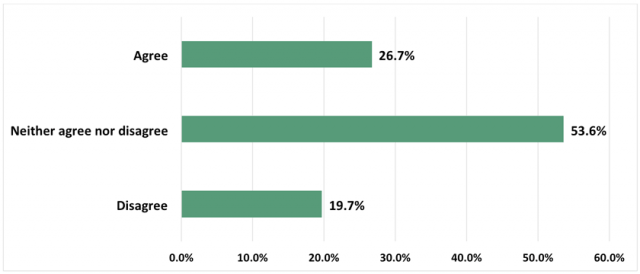
IRmep Poll: “International law SHOULD APPLY to Israel’s military occupation & colonization of the West Bank, Golan Heights, E. Jerusalem and displacement of their indigenous populations. Do you Disagree or Agree?”
More than 80 percent of Americans seem unwilling to let Israel reinterpret international law to suit its colonialist agenda.
By Grant F. Smith | IRmep Polls
IRmep representative public opinion poll of 2,034 American adults through Google Surveys on November 20-22. Answer order randomly reversed.
Most American adults of voting age don’t appear willing to reject the applicability of international law to Israel’s ongoing colonization of occupied territories in East Jerusalem, the West Bank and Golan Heights.
On Monday, November 18, U.S. Secretary of State Mike Pompeo reversed a 1978 State Department legal opinion stating that Israeli settlements were “inconsistent with international law.” Citing President Ronald Reagan’s 1981 assessment that the settlements were not “inherently illegal,” Pompeo stated that, “After carefully studying all sides of the legal debate… the establishment of Israeli civilian settlements in the West Bank is not, per se, inconsistent with international law.”
The Trump administration relocated the U.S. Embassy from Tel Aviv to Jerusalem in 2018 and recognized the city as the capital of Israel. This most recent announcement is yet another blow to rule of law and international consensus. However, when polled, 53.6 percent of Americans don’t yet appear ready to register any concrete view on the matter. This may be due to the longstanding absence of serious U.S. mass media coverage of historical and legal issues. In other countries, informed and ongoing international legal analysis is the norm. Given that reality, it is surprising that 26.7 percent of Americans believe international law still applies, while only 19.7 percent believe it does not.
In a Nov. 21 letter sent to Pompeo, 107 House Democrats condemned the State Department’s recent decision on settlements.
Grant F. Smith is the director of the Institute for Research: Middle Eastern Policy in Washington, DC. For more IRmep polls, visit https://IRmep.org/Polls.
What Did #ExxonKnew and When Did They Knew It?
Corbett • 12/03/2019
As #ExxonKnew gains traction with the public, one Corbett Report listener writes in for more info on the subject. Today we explore the Rockefeller-funded beginnings of this push for prosecution, how it has disintegrated in the courts, and how it has succeeded in penetrating the public consciousness in the service of the technocratic agenda.
Watch this video on BitChute / Minds.com / YouTube or Download the mp4
SHOW NOTES:
ExxonKnew.org
Who Wants To Be A Carbon Trillionaire?
New York Attorney General Started RICO Planning Before Any InsideClimate Stories Were Released
SEC Investigators Decide Not To Punish Exxon For Alleged Climate Heresy
Bloomberg Government Ponders Collapse of #ExxonKnew
What They’re Saying About New York’s ExxonMobil Trial
Podcast – Examining Climate Change Litigation (Guest: Christopher Horner)
What Did Shell Know and When Did They Know It?
#ExxonKnew Epic Fail: Oil Companies DID NOT build “their rigs to account for sea-level rise”
1988: James Hansen And Tim Wirth Sabotaged The Air Conditioning In Congress
‘Trump’s demeaning me!’ Lisa Page’s new victim narrative is just a media-backed PR move ahead of FBI misconduct report
By Michael Rectenwald | RT | December 3, 2019
Former FBI lawyer Lisa Page’s interview isn’t about clawing back the dignity Donald Trump’s insults have denied her – it’s damage control before a likely damning DOJ report about the agency’s Russian collusion investigation.
In an interview published late Sunday in the Daily Beast, Page claimed that Trump’s “demeaning fake orgasm” enacted during an October rally in Minneapolis – and not Inspector General Michael Horowitz’s FBI misconduct investigation, to be made public in a week – prompted her to break a two-year silence.
Page tweeted the link to her Daily Beast interview Sunday night with a warning: “I’m done being quiet.” The interview cast Page as another victim of Trump’s “bullying,” which she described as “very intimidating” – the exact same phrase uttered by former Ambassador to Ukraine Marie Yovanovitch in her testimony during the congressional impeachment hearings.
“It’s like being punched in the gut,” Page said. “My heart drops to my stomach when I realize he has tweeted about me again. The president of the United States is calling me names to the entire world. He’s demeaning me and my career. It’s sickening.”
Page’s remarks also echoed Christine Blasey Ford’s testimony during the Brett Kavanaugh Supreme Court nomination hearings: “I had stayed quiet for years hoping it would fade away, but instead it got worse,” Page lamented.
The word-for-word refrains are the trademarks of a concerted PR campaign choreographed by the anti-Trump establishment. The tired script features Trump as an unrestrained monster, who in every scene tries to intimidate his opponents, especially women. Trump is a misogynist, who therefore must also be a criminal and a traitor.
Page complained of the toll that Trump’s endless ridicule has taken on her:
“Like, when somebody makes eye contact with me on the Metro, I kind of wince, wondering if it’s because they recognize me, or are they just scanning the train like people do? It’s immediately a question of friend or foe? Or if I’m walking down the street or shopping and there’s somebody wearing Trump gear or a MAGA hat, I’ll walk the other way or try to put some distance between us because I’m not looking for conflict. Really, what I wanted most in this world is my life back.”
As if anyone would dare to wear a MAGA hat anywhere in urban America – other than among thousands of Trump fans attending a rally. As if Page is likely to meet a real “foe” of the permanent bureaucracy in the heart of Washington, DC.
Meanwhile, if Page sought to hide from attention, she sure picked a strange way to do it. News of her interview, in which she complained about getting way too much exposure, was carried by all the major media. It remained at the top of the Google News listings all day on Monday.
The purpose of Page’s timely interview was – as Page herself admitted in the interview – to “control the narrative.”
Page has been at the heart of controversy surrounding the Trump presidency ever since scandalous text messages between her and former FBI head of counterintelligence Peter Strzok exposed the couple’s extramarital affair and their mutual disdain for Trump and support for Hillary Clinton. The emails were reportedly sent to an FBI official by Strzok’s two-timed wife.
In one exchange concerning the presidential race, an apparently alarmed Page texted Strzok and asked if Trump had any chance of becoming president. Strzok answered: “No. No he won’t. We’ll stop it.” In another, Strzok alludes to an “insurance policy” against the unlikelihood of a Trump victory. Devin Nunes (R-CA) has claimed the insurance policy was the potential for the FBI to hack into the Trump campaign’s emails.
Page and Strzok worked on the FBI’s initial investigation into ‘Russian meddling’ in the 2016 election. At the same time, Strzok led a botched investigation, on which Page also worked, into Secretary of State Hillary Clinton’s hacked private email server. Page and Strzok later worked together on the Special Counsel Robert Mueller team investigating unsubstantiated Trump ‘collusion’ with Russia. Page resigned and Strzok was fired when their partisan rancor and intimate relationship were revealed.
Will the public swallow this couple of smug plotters in their new role as stoic patriots? The Democratic establishment already has. Expect the furious media spinning to continue when the report is released next week.
Michael Rectenwald is the author of nine books, including the most recent, Google Archipelago. He was Professor of Liberal Arts at NYU from 2008 through 2019.
Say No To The US-Israel Mutual Defense Pact
By Eric Striker | National Justice | December 3, 2019
Last September, Donald Trump and Benjamin Netanyahu hinted that they were working on a mutual defense pact. Such a treaty, if signed, would officially and permanently mandate an American military intervention if Israel were to ever start a conflict with its neighbors.
The Trump administration is desperate to get this done, but Netanyahu is having trouble selling the idea to his rival Benny Gantz. The Likud party has so far been unable to form a government and Netanyahu is battling corruption charges. As a side note, two major GOP donors, Sheldon Adelson and Larry Ellison, are defense witnesses in Bibi’s case.
The major reason why some sectors of the Israeli state want Netanyahu gone is that they believe his government’s belligerence is responsible for Iran’s stunning rise. Netanyahu has chosen Israel-above-all unilateralism using Zion’s cats-paws in Washington to try and bully Tehran, but have walked all over Chinese and Russian interests in the process.
Two years into the Trump/Israel “maximum pressure” campaign, Iran is not only more powerful than before, it is participating in joint war games with China and Russia. This has angered competing Jewish factions inside Israel, who preferred the Obama method of passively subverting Iran through its countries pro-US/pro-Europe “moderate” liberal reformists. Hassan Rouhani, who they saw as the Persian “Gorbachev,” has now been fully discredited in the eyes of his people thanks to Trump and Netanyahu.
While all segments of Israeli society are having a public debate on the pros and cons of a military pact for their country, here in the US nobody has consulted with the 1.3 million active-duty American servicemen who will die in a world war to expand Israel’s borders.
JINSA’s Plan
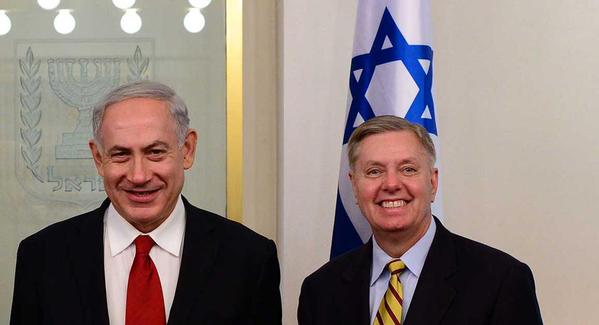
Lindsay Graham has told Jews at private events that he is working on this bill and is confident it will be ratified in the Senate. So far, the only people within US borders participating in this conversation are the Republican Jewish Coalition and JINSA (Jewish Institute for National Security of America). The latter fifth column is writing the terms of the treaty.
Last July, JINSA released details of the pact they want Graham to push through, titled “For a Narrow US-Israel Defense Pact,” which can be obtained online (I will not link to downloads on JINSA’s website for security reasons).
The policy paper demands that Israel be granted special access to intelligence collected by the “Five Eyes Alliance” (Australia, UK, New Zealand, Canada and the US), officially turning the entire Anglo-Saxon world into a global Jewish spy network (which is already unofficially true).
Furthermore, it calls on the war clause be triggered if any country “threatens” to use chemical or nuclear weapons against the Jewish state or physically undermines Israel’s economic activities. This is very open-ended.
The most ludicrous part of the Graham/JINSA treaty is section 3.4, where Israel is under no obligation to notify or seek approval from the United States when it decides to engage in a military attack against another party.
In other words, if Israel decides to start a war with Iran (or China, or Russia, or all of them), it doesn’t have to discuss this with its “ally” first. Israel reserves its right to act unilaterally and America must go along for the ride whether we want to or not.
America gets absolutely nothing from joining such an agreement, except the possibility of a catastrophic world war that can be started by unstable psychopaths like Benjamin Netanyahu without warning, whenever they please.
The US has not signed a mutual defense treaty since 1962.
It’s time the 98% start demanding Donald Trump and Lindsey Graham include us in this debate, and prepare to protest as soon as this bill hits the Senate floor.
Featured Video

Thomas Fazi: NATO’s Hybrid Warfare – Deception & Permanent War
or go to
Aletho News Archives – Video-Images
Book Review
UAE tortured, killed journalist for opposing Israel normalization
The Cradle | October 31, 2026
UAE security officers detained, tortured, and killed Emirati poet and news editor Habib al-Sayegh in August 2019, shortly after he published a column opposing UAE normalization with Israel, according to a newly published book.
“Princes and Thieves,” a book by investigative journalist Matthew Cole published on 25 October, alleges that UAE security officers raided Sayegh’s Abu Dhabi home shortly after the publication of the column, hooded him in front of his wife and took him to a detention facility where he was tortured to death.
His interrogators reportedly pulled out several of his teeth with pliers and beat him repeatedly with a sharp metal object.
On 11 August 2019, Sayegh criticized the UAE’s plan to normalize relations with Israel as part of the Abraham Accords in his weekly column for Khaleej newspaper. The column was titled “Israel Is Our Real Enemy and A Dangerous Project.”
Sayegh described Israel as “a real and natural enemy” while questioning “who authorized the normalizers to speak on behalf of everyone?”
Nine days after the column was published, Emirati state media announced his death, without stating a cause. … continue
Blog Roll
 Aletho News
- ‘The Arab Vote’: How Israeli Racism Has Ruined Their Elections
- Israel forces Palestinians in Gaza to choose between assassination alone or death with their families: Report
- US Approves Sale of 500 Patriot Missiles to Ukraine, Deliveries May Take Years
- German Imperialism: An Urgent Explainer
- Backed by AAP, West Virginia Proposal Would Allow Dental Hygienists to Give HPV Vaccine to 9-Year-Olds
- Poland Is the Symptom and Europe Is the Patient
- UAE security forces tortured, killed journalist for opposing Israel normalization: Report
- They Compared the Spice to the Drug. The Spice Won — Again. (Part 2)
- Thomas Fazi: NATO’s Hybrid Warfare – Deception & Permanent War
- Wrong, AP and NPR: Europe’s 50,000 Heat Deaths Are a Computer-Model Estimate, Not a Real Body Count
- If Americans Knew
- An error has occurred; the feed is probably down. Try again later.
- No Tricks Zone
- Germany’s Green Energy Transition Becoming Increasingly Expensive…Another 6 Trillion Euros!
- Sudden Stratospheric Warming, Powerful El Niño Combination May Lead To Extreme Europe Cold, Energy Crisis!
- Two New Studies Find Thwaites Glacier Melt Cannot Be Driven By Human Activity Or A Warming Ocean
- E-Cars Reduce CO2 Emissions By Only 41% Compared To Internal Combustion Engine Vehicles
- Predictions Made By Renowned Climate Professor Over Past Decades Have Been Proven To Be Poor
- New Study Suggests Large Regions Of The Pacific Ocean Have Been Cooling For The Last 80 Years
- Germany’s Green Energy Debacle: High Energy Costs Force Kahla Porzellan to Close After 182 Years!
- New Study: 50 Years Of The Most Aggressive ‘Net Zero’ Policies Can Only Affect The Global Climate By 0.03°C
- US September “Heat” Was No Record…Many Records Set Decades Ago
- Latest European Green Energy Debacle; Portugal’s Largest Flagship Solar Park Insolvent!

