The Roger Stone – Wikileaks – Russia Hoax
By Craig Murray | November 18, 2019
As ever, the Guardian wins the prize for the most tendentious reporting of Roger Stone’s conviction. This is not quite on the scale of its massive front page lie that Paul Manafort visited Julian Assange in the Ecuadorean Embassy. But it is a lie with precisely the same intent, to deceive the public into believing there were links between Wikileaks and the Trump campaign. There were no such links.
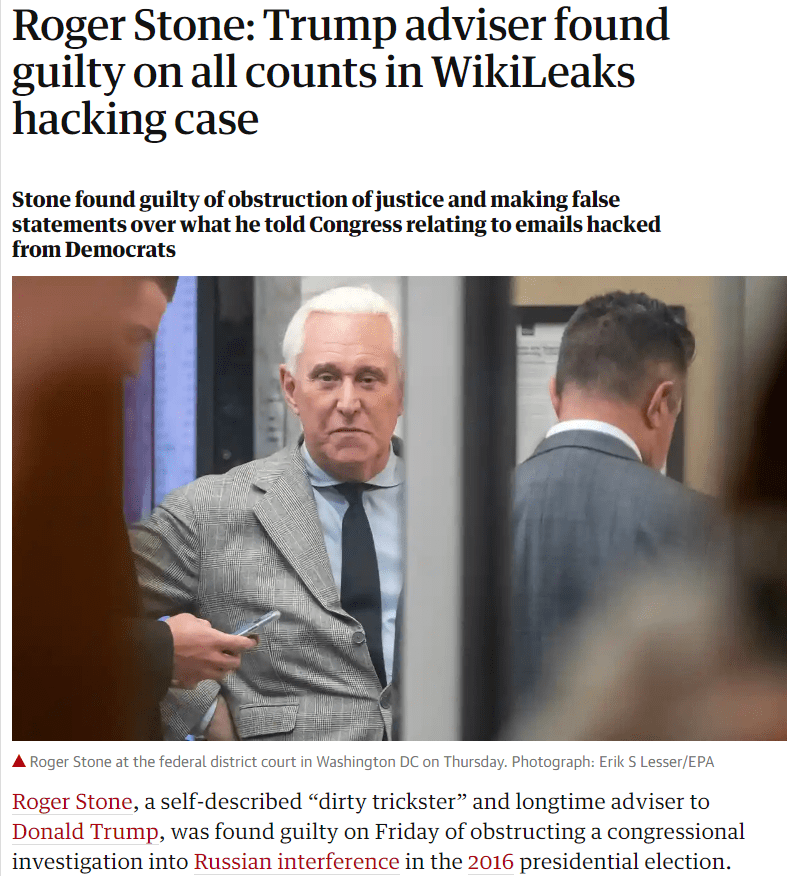
The headline “Roger Stone: Trump Adviser Found Guilty On All Charges in Trump Hacking Case” is deliberately designed to make you believe a court has found Stone was involved in “Wikileaks hacking”. In fact this is the precise opposite of the truth. Stone was found guilty of lying to the Senate Intelligence Committee by claiming to have links to Wikileaks when in fact he had none. And of threatening Randy Credico to make Credico say there were such links, when there were not.
It is also worth noting the trial was nothing to do with “hacking” and no hacking was alleged or proven. Wikileaks does not do hacking, it does “leaks”. The clue is in the name. The DNC emails were not hacked. The Guardian is fitting this utterly extraneous element into its headline to continue the ludicrous myth that the Clinton campaign was “Hacked” by “the Russians”.
It is worth noting that not one of those convicted of charges arising from or in connection with the Mueller investigation – Manafort, Papadopolous, Stone – has been convicted of anything to do with Wikileaks, with anything to do with Russia or with the original thesis of the enquiry.
Astonishingly, in the case of Stone, he has been convicted of saying that the Mueller nonsense is true, and he was a Trump/Wikileaks go-between, when he was not. Yet despite the disastrous collapse of the Mueller Report, and despite the absolutely devastating judicial ruling that there was no evidence worthy even of consideration in court that Russiagate had ever happened, the Guardian and the neo-con media in the USA (inc. CNN, Washington Post, New York Times ) continue to serve up an endless diet of lies to the public.
Randy Credico was the chief witness for the prosecution against Roger Stone. That’s for the prosecution, not the defence. This is the state’s key evidence against Stone. And Credico is absolutely plain that Stone had no link to Wikileaks. The transcript of my exclusive interview with Randy has now been prepared (thanks to Sam and Jon) and follows here.
I spoke to Randy yesterday to clarify one point. The first conversation Randy ever had with Julian Assange was on 25 August 2016 and it was on-air on Randy’s radio show. There was no private talk off-air around the show. That was Randy’s only contact of any kind with Julian Assange before the 2016 election. His next contact with him, also an on-air interview, was not until Spring 2017, well after the election. He could not have been in any sense a channel to Wikileaks.
Here is the unedited interview from 10 November:
RC: Hello.
CM: Hello there, Randy. Hello, can you hear me OK?
RC: Yes, perfectly.
CM: Yeah. I’m good, I’m very good indeed. OK, let’s do it like this, shall we, it seems …
RC: Now listen, before you start, you can ask me anything you want, and this is the only interview I’m going to do. I’ll be in town with—like, all day long—with people asking me to talk about this and I just want to get it out of the way and move on. All right?
CM: No, I quite understand. And that’s very sensible. Now, let’s start then … let’s start … before we get into the substance, let’s start then with some of the atmospherics. How did it feel to you, you know, to be you … to be Randy walking into that courtroom?
RC: Well, you know, when I, when I … first of all, for the last eight months I knew this was eventually going to happen. So I’ve been on needles and pins, a lot of anxiety that … Wait a second … Hold on, hold on … can you start and do that again?
[aside] Bye, everybody. … I’m doing an interview with somebody here.
Hi, Craig. Hi, Craig.
CM: Yep. Yep. I’m here.
RC: Hello. All right. Start going. Start … start again.
[1:30]
CM: OK. Before we get into the substance, Randy, let’s talk about the atmospherics. How did it feel to be you? How did it feel to be Randy Credico walking into that courtroom?
RC: Well, you know, all of my life … I got into show business when I was 18 years old and I really was pursuing fame and notoriety and, you know, I finally got it, and this is “be careful what you wish for”—because this is certainly not something that I was relishing. For the past eight months, when Mr Stone was indicted, I have been suffering from heavy anxiety, having to appear as a witness under subpoena. And then when it finally happened, eight months went by quickly, and I got to tell you something, going into that courtroom, and anticipating it the previous night in which I couldn’t sleep was not a very comforting feeling. I walked in and, you know, it wasn’t the traditional way where you walk in from the back. You had to walk through the very front of the courthouse, past the defendant, past his family, past his friends, past his supporters, and then get on that witness stand right next to the jury, and begin answering questions. So after a while I was OK with it, but I knew it was going to be a long session; I knew I was going to have to come back the next day and continue and then I was going to have to go through the cross-examination. So it was just nothing but anxiety going in, and there was some relief when it was over but it was a different kind of a feeling because I felt bad for the defendant at the end of the testimony.
CM: Yeah, no, I’m sure you did. Did you catch his eye at any slight stage while you were … while you were talking?
RC: Yeah. You know, I tried not to. I didn’t think that was fair, so I did look at him. He was very morose looking, very sullen looking … and, you know, but for the grace of God, there goes I. I could’ve been in that seat, in that situation at some point in my lifetime, and the weight of the federal government with the vast resources in a case like that, and the defendant, he had … he had a lot of attorneys, but I didn’t think they were … they were really sufficient. These were not great barristers, you know what I mean? They were not good. And I found out they weren’t really that good because I had known earlier the way they were cross-examining previous witness that they just weren’t up to the job.
So, you know, you go in there and you’re under a lot of stress, and you’ve got to tell the truth and at the same time the truth is going to hurt the guy who’s sitting there … you know, just 25 or 30 feet away from you, and it could put him in prison. I mean—who wants to be in that position? All of my life, I have worked to get people out of prison. I’m a prison reformer. I’ve extricated people out of prison through clemency and changes of laws in the State of New York. And other activism that I have done like in Texas, I got 46 people out of prison. So this was a very bizarre, ironic situation that I was in at that particular point.
So yes, I caught his eye; I did catch his eye. You know, it’s such loose strings—it’s someone that you’ve known. I’ve known the guy for 17 years. And people say “How were you ever friends with this guy? You know, you’re an extreme left-winger, the guy is an extreme right-winger”. Well, I have no regrets meeting him, because I met him in 2002, after I had been working 5 years, visiting prisons, organizing families of prisoners who were subjected to New York’s racist and draconian Rockefeller drug laws. They were called the Mothers of the New York Disappeared. I was working with him, organizing, visiting their loved ones in prison, and we were moving forward to getting some substantial change in 2002, but we were at loggerheads with the government. So because Roger Stone was running the campaign of a third party candidate—a billionaire, a real maverick individual, who had some great ads that I saw—I went to Mr Stone because the Democrats and the Republicans in the race were not addressing the issue. Mr Stone actually not only agreed with my position there, but he spent … had his candidate spend … millions of dollars doing ads to repeal New York’s racist Rockefeller drug laws. And that was a very key moment in the historical run of this movement. Within a year and a half, the laws had changed, and each year there was major building blocks. We got the public to support us; we were getting politicians to support us. In 2002, Hillary Clinton and Chuck Schumer—our two Democratic Senators—were not on board. And so, this guy Tom Golisano was on board and he did rallies with these families, he put them on television, and he, like I said, spent millions of dollars on ads. And if it weren’t for Roger Stone, that wouldn’t have happened. And so because of that within a year and a half, these families that I had worked with, there was retroactivity when the laws were changed within a year and a half, and that was a key component. And Mr Golisano stayed with it for another year, he continued to work with us.
So, something like that. Even though Mr Stone had screwed me over, had done some very nasty things over the next 17 years, there was still that soft spot for him because, when I look at those families and I remember their faces when they get reunited with their loved ones—he played a role in that.
So that’s the dilemma I was facing when I was on that witness stand. I was an aggrieved person. This could’ve been done, by the way, in a civil court, you know, my grievance against Mr Stone because, for me—for me—my position was I was kind of smeared by being associated with the Trump campaign with these bogus allegations of being the back channel to Wikileaks—which we’ll get into. There was never any back channel to Wikileaks—that was all hocus pocus! So, answering your question, it was … it was a very bizarre, uncomfortable experience undergoing those {inaudible} in that highly publicized and media-covered circus that was going on. Not a circus, but whatever was going on there, it was something that I would not want to go through again. And, look, I’ve performed in front of a million different audiences; I’ve worked strip joints when I was in air force bases; I’ve done vigils, rallies; I’ve worked the worst toilets in the room over a 45 year period in show business, but I still wasn’t prepared for that kind of atmosphere.
CM: Yes, I can imagine. Is it a fair characterisation to say that you, Randy, you’re on the libertarian left of politics, whereas Roger’s on the libertarian right, and you both met because there were some issues such as drug decriminalization on which you agree and on which he then did good work in decriminalizing communities in New York. Is that the basic analysis?
RC: Yes, I would say I once ran on the Libertarian party line in 2010. A lot of their positions I don’t agree with … but I’m on the left, he’s a libertarian right. He’s not like one of these people—when I met him he was not the ideologue that he was portrayed to be in the media in 2002—a far right Jesse Helms type or a far right John Ashcroft type. He was a libertarian, he smoked pot; you know, we had the same views on music. He actually was advocating for the pardon of Marcus Garvey, who was framed, who was a leader of Black Nationalism in the 20s, on these bogus mail fraud charges. So, you know, he’s kind of a sphinx, you know, politically. He’s not, like I said, a hard-core right-winger. He was not for the war in Iraq back in 2003. So, you know, I don’t even know what the right and the left is sometimes. You know, I really don’t know what that means. I mean Tony Blair’s supposed to be a Labour guy, but he’s as bad as George Bush is, and always has been. So does he really support Labour, is he a leftist? No. So, you know, these labels are a little confusing to me. But like I said, Stone—you know—he’s a showman. He’s a showman; he’s an exhibitionist. That’s what got him in trouble here. The poor guy is … you know, he’s a megalomaniacal showman. Just like I am. I’m in show business, why? Because I’m like him—I like to get laughs, and I want to be recognised. That’s him.
I said he’d done a lot of bad things to me but politically we were, you know, we coincided on a few major issues, and one of them was drug law reform in the State of New York. Now, mind you, 97% of the people that were subjected to the Rockefeller drug laws in the State of New York were black and Latino. And still are—they have been modified, not completely changed. But, you know, they were subjected to harsh punishment; they were getting 15 years to life. I know one kid by the name of Terence Stevens, paralysed from the neck down—from the neck down—with muscular dystrophy, and that guy was doing all of this time for possession on a bus! They ascribed it to him for possession! And he had done 10 years in prison, in the medical ward of a real dank prison—it was called Green Haven—for possession. And that was not like the exception to the rule. There were thousands of people in similar circumstances that were there that were just mules, or addicts that were doing this time—and Stone actually was very sympathetic to it. It wasn’t like it was a—you know, what would you call it—flash in the pan type of a push. He continued afterwards, he even wrote some op-ed pieces; but, like I said, he did some bad things to me over the years, but I’m a good natured guy, and I overlooked it. I let him get away with it.
CM: The astonishing thing about all this is … is that it all comes out of the Mueller inquiry, and the so-called Russiagate scandal, and yet none of these charges relate to Russia. And let’s be quite plain, to the best of your knowledge and belief—or to the best of your knowledge anyway—Roger Stone has no link to the Russian government that we’re aware of, and he certainly has no link to Wikileaks that we’re aware of. Is that your understanding?
RC: Well, actually what he had was … Look … Roger Stone … Here’s what happened. In 2015, Trump hired him. He lasted one month. Why? Because every time he did an interview it was more about him than it was about Trump; and Trump got frustrated with him and dumped him. And he may have given Trump advice here and there because, you know, he was the one who got Trump to run 30 years earlier; it was his idea, he kept pushing Trump. So he was kind of unceremoniously kicked out of the Trump camp.
Flash forward to 2016, he’s kind of hanging around the Trump campaign, he comes up with one of these super packs. And so he’s trying to ingratiate himself back into the Trump orbit there. And what he did was he, like, looks at Wikileaks and he sees what’s going on with Wikileaks, and he’s trying to get information. He’s going to guys like Jerome Corsi. You know, Jerome Corsi is a complete lunatic, you know, beyond the pale of conspiracy freaks … and he got hoodwinked by that guy. And this is my estimation, this is my analysis. He gets hoodwinked into thinking that he’s got a back channel. Right.
So he is showing, you know … First of all, the whole idea of a back channel is ridiculous. Julian Assange does not telegraph what he’s going to put out. He never has. He doesn’t compromise his sources and he always puts out that his whole M.O. is the element of surprise. So there was no reason for him to give it to Roger Stone, of the kind of preview of what he was doing. Why would he do that? When everything that he was doing, he was doing carefully, and he was selecting the time and then he’d put it out. There was no reason for him to give anything to Stone. No, Stone was playing the role of someone that had the inside information from Assange. Now, you know Assange, he’s very careful. He’s not going to … if he wanted to he would just give it directly to Trump, you know, but he didn’t. He never did. He didn’t need to go through Stone. But Stone was pretending that he had some kind of access to Wikileaks, and he was selling that to the Trump campaign—that he was able to get something in advance, he knew what it was. And so they didn’t think they were going to win, and they were looking for Hail Marys and this was one of them, and they brought him into the orbit and Stone was thinking that whatever this guy Corsi was giving him was accurate, possibly, and then … then me. All right? So, there was nothing there.
And then, the following month, in August 25th, after Stone had said a few weeks previously that he had direct contact with Assange, and he modelled at that to get a back channel. I had never met Assange, never had any conversation with Assange. In fact, I never ever even met him until the following year. So, on August 25th, through my friend, through someone then that worked with Assange got him on my radio show … on August 25th. And so, I was … it was a big fish for me. I had just gone from one day a week with my show to three days a week, and two of those days were prime time—5 o’clock drive time—and I let Stone know that I had Assange on my show. He didn’t even respond to that. I let him know. So I was kind of one-upping him. And Assange was on the show—we even talked about it: “Do you have a back channel with Roger … ?” And he laughed at it. You know, Stone was on my show on the twenty … two days previously … and I asked him about it, and he said that he had a back channel and he really couldn’t disclose what it was. And then Assange was on. So there was no back channel there, with me.
I went to London a few weeks later. I went to London to see a fellow by the name of Barry Crimmins, who is a left wing comedian, who I had known for 30 years; and we were in London together performing there back in 1986. It was the 30 year anniversary. He was working at the Leicester Square Comedy Club in London. And somebody underwrote my trip to see him. Three days. I hung out with him for three days.
I also had a letter from the General Manager from the station to give to Julian Assange, or someone that works with Julian Assange, with a proposal that he do a radio show out of the Ecuadorian Embassy, with an IFB, and do it over the Pacifica network, and it would be his show. But at that time remember in September he was preparing obviously putting stuff together, collating it, or whatever, and putting it together, for the eventual day that he was trying to put it out, which was on October 7th. Now, the date that he put it out they say it was to coincide with the Access Hollywood tape. Now, anyone, talk to Stefania Maurizi, she will tell you that they were planning to put that out a day or two earlier on the 7th. That was the day they were going to put it out. She was the one that knew, she never told anybody, but she did afterwards. And last year she said she knew they were going to put something out on the 7th, because she worked with Assange. She was one of the few journalists that he trusted, and rightly so.
But I never got in to see him. They didn’t, they didn’t see me, because Stone found out on the 27th, he knew that I was flying to London to see my friend Barry Crimmins, so … and possibly see Assange. He wanted me to find out from Assange, because he put somebody on my radio show—Gary Johnson, the Libertarian candidate for President—he put him on my show on the 9th of September, and I owed him a favour and the favour was to find out if this email from Hillary Clinton to somebody existed regarding the situation in … in Libya, and sabotaging the peace talks with Gaddafi. Well, I never did that, I never gave it to Assange. I wouldn’t dare ask him.
I’ve been in that Embassy three times since, after that year 2017 when I spent some time with you and John Pilger in London and Edinburgh. That’s when I saw him. I never once asked him about his business. I didn’t want to know. I didn’t ask him how they did things … nothing. The stuff was so general. We talked about dogs, we talked about him running for Senate, and the Green Party, we talked about food. We talked about general things. And that was it. I never once saw … There was no way I was going to ask him to confirm if this email existed. In fact, I told Stone that if it existed, it would be on the Wikileaks website.
All right, so that happens; that happens, and nothing happens. I did say, I did predict, and I put it on Facebook after standing outside that Embassy on the 29th, I dropped the letter off. There was a guy from either MI6, MI5, or a metropolitan police department outside that building with a headphone on, or an earplug, and he was listening: you could tell, these guys are so obvious. And I dropped the letter off. I was in for less than 20 seconds. I knocked on the door on the left; a hand came out; I dropped the letter off from the station, and left; I went through Harrods and I was followed. So I extrapolated from that, that something must be coming up. I put it on Facebook: “Here’s a picture of me, look at this guy behind me. I got a feeling the guy inside’s gonna drop something this week.”
Two days later I said the same thing to Stone. So now, he’s going to use me as—well, I mean, well, he has to—as the back channel. Supposedly he had a back channel for months. But the whole thing was ridiculous: I mean, there was no back channel; there never was a back channel. This was Stone just blowing himself up as, you know, as an important person to impress. As you said yesterday in your tweet, that he was looking to make money, and he did, he did ask the family for some money when he said that this was coming out, and that in fact did justify his luck that it came out on the 7th, and they thought that Stone had the inside information; he had no inside information. All right, so that’s where we were back … that’s where we are back then, up until October first or second or third. So I had no back channel. I had no information; Stone had no information—but he continued to sell himself as a person that did.
And then the, then the … I think that Correa shut down this internet for a while after he got pressure from John Kerry at that meeting in Bogota of the OAS [Organization of American States]. And so I said to Stone at a dinner, the only time I saw him in 2016 was at a dinner on October 12th or 13th, and I told him that, that was information that I got from about 20 people that there was pressure—it was even in the paper. So that was it. So now we go a year later, Stone testifies. Are you with me there, Craig?
CM: Yes, I am with you.
RC: OK. Do you want to ask a question, or should I continue?
CM: No, you carry on. Go with the flow.
RC: I shall. You go forward. The following year, Stone testifies, he testifies to confirm, not to Mueller, but the House Intel Committee—they had opened up an investigation right after this whole Russia stuff—and I was totally against it. I thought the whole thing was a ridiculous thing, chasing down you know Russians being behind it. Hillary Clinton ran a terrible campaign. Julian Assange did not send a map to the Clinton campaign of every school in Michigan and Wisconsin … all right. So she lost. She was a horrible campaign…
I was a big Bernie person. I was supporting … I did a four day howler marathon for Bernie to get out to vote just prior on the day before the New York primaries. So I was still pissed off at Hillary because she had taken it away from Bernie. Her and her cohorts at the DNC had taken it away from Bernie. And if Bernie had won that primary, had won that nomination, he would have beaten Trump … I believe. But Hillary …
CM. Yeah, I know. There’s a lot of polling evidence that says that, I think.
RC: Yes, I think, I think … I really do think that Bernie would have won that election. So I was really furious! I was furious that he was out of it. I’m still furious. I ended up voting for Jill Stein that day. And I went to Jill Stein’s party on November 8th 2016. I think I had you on the show with Jill Stein just prior to that. And I had her on the show that day and I went to her party and Trump won, and I was very depressed about that … not that I supported Hillary, I mean she didn’t have any chance at all so it’s fine …
Now going forth, let me get back to 2017. He voluntarily—voluntarily—goes before the House Intel Committee. They didn’t subpoena him, they didn’t ask him to show up but he voluntarily goes up and it’s behind closed doors. Simultaneously he releases a 47-page screed that he’s about to read on YouTube, he reads it on YouTube, and then his opening statement. Forty-seven pages he reads to them chiding the whole process and slamming Schiff and everybody, putting this whole Russiagate thing out there. And then at the end they ask him if he had a back channel, and he says “Yes, it’s a journalist but I’m not supposed to say who it is”.
Now, the next day, I’m trying to reach him. I’m thinking he’s going to say that I was now, because I had sent him those text messages, he’s gonna say …. And then he sends me a text message saying “Look, just go along with this, don’t worry about it. You’ll get a lot of press out of this. They’re not going to believe you, Credico; they’re going to believe me.” So, look he was covering up his attempts; he had no connection. And by the way, this is not helping Julian Assange out, having Roger Stone and Trump and all these people out there saying that they’re connected to Wikileaks. This is not helping his cause—all right—because Roger Stone is radioactive. Julian Assange knows that he’s radioactive. He doesn’t hate Stone; he finds him to be some kind of showman, you know, an exhibitionist; but he had nothing … he’s smart enough to know that you don’t go there, and he didn’t go there. But, so … now, he’s got himself in a bind here: he has said he’s got a back channel, he’s gloating about it, you know, he’s showboating … and a few days later, he lets me know that he’s gonna name me as the back channel. And that’s gonna go public! He said, “Look nobody’s gonna believe you, Credico. And better that, uh … better that I name you than go to jail.” So he doesn’t mention this guy Corsi, who was the back channel that wasn’t the back channel.
CM: OK. Can you just hang on a second, Randy? He said “better he names you than go to jail”. What was he thinking: that having claimed to have a back channel to the committee, he had to try to substantiate it or he’d be in trouble for lying? Or was there was some other risk of jail?
RC: If he says … If he says that they … He didn’t even get a subpoena! In other words, they didn’t subpoena him. Adam Schiff said, “We’d like to know who that back channel is.” And you have to get a full vote on the committee to get a subpoena. Without even getting a subpoena, he went and named me. I said “Well, why are you naming me?”. He says “Why should I go to jail for you?”. Now this is a cocked hat situation for me at that particular point. You know, here I’m being named for something I didn’t do, but he can circumstantially say that I did, because I had told him that I had a connection with Assange on my show: Margaret Ratner Kunstler. You know, but she …. And that was it. When I asked her to get him on the show, she was furious that I even asked her. So, you know, I had a show for a year prior to that and I never asked her. I did not want to get involved and bring her into this. And so I gotta get my own guests. But now I had it three days a week, and so I asked her gingerly and she did get him on the show. But by telling him that, putting that name out, now he’s got her name. Right?
And now I told him on October 1st that something’s coming out which I had already announced, extrapolating on public comments by Assange saying that something is coming out; I think Sarah Harrison may have said that something was coming out; everyone knew that something was coming out. And so since I never was able to get that thing, and never tried, on the Libyan connection with Hillary Clinton—and … what’s his name? … Gaddafi—I felt obligated to get something. And by the way, this is coming from the Heathrow Airport, where I was at the duty free bar there, and I was getting free drinks, because I got a couple of bottles there, and it’s the only duty free store I’ve ever been in where they’ve got like three or four portable bars where you could drink. Instead of spending money at the bar, you know, twelve pounds per ale, I was getting all of these different booze samples that they had and then I was buying a couple. And so when I’m waiting around at the gate, you know, I’m just texting him too along with other people “Something’s coming out”. I’m gonna go back to 2017. So he’s going to name me, he says he’s gonna name me, and just to go along with it. And he’ll go to jail … I don’t know how he could go to jail by not answering the subpoena, or not giving up the name. He could always just take the Fifth Amendment. He could, like I did later on; I took the Fifth Amendment. For a variety of reasons I took the Fifth Amendment. So now he’s put me in a jam … all right, he names me, he names me as a back channel.
And there’s a ton of papers, a ton of stories out there in the newspapers and the electronic media that Randy Credico’s the back channel. Now everybody on the centre left hates me. People connected to the Clinton people think that I helped Donald Trump win, I facilitated it, and I got myself in a big jam right there. Now what do I do? Do I go up there, when I get the letter from the House Intel Committee, and contradict Roger Stone? If I do, then he’s in trouble legally and then he could go to jail for perjury. So I had to think about that. Even though he put my reputation on the line there I feel like … Look, people lie to Congress all the time, to Congressional committees; and, you know, it leads to wars; it leads to mass surveillance; it leads to … appointments to the Supreme Court federal bench. And so those are big lies that are never investigated and they get away with it. So his was a small lie except for it was about me though; that was the only problem. I don’t mind that he lied to Congress, because everybody lies to Congress.
CM: Yeah, I must say to that point I mean he hadn’t done anything. He’d boasted a bit; he’d tried to work an angle by claiming he had a contact he didn’t have; he’d then maintained that by telling the Intelligence Committee that he had a contact he didn’t have. But then, that’s a fairly harmless lie.
RC: You … you … you know what it is? It’s a fender bender. But turned out to be a 21 trailer tractor pile-up. It was a fender bender. It was no big thing to tell them that. I kind of laughed at his 47-page statement. It was kind of entertaining. You know, he was putting on a show there. But when he put me in there …. Look, if it was anybody else, it’s fine. And it’s not like it was a major transgression to say that he had a back channel that he didn’t have. Right? That’s not a major transgression. When you lie about weapons of mass destruction—that is something that cost millions of lives, and people got away with that. People got away with lying to Congress about that, lately. You got guys who lie about not being spied on—there’s no domestic spying—that was a lie, they got away with that. All right? That’s the kind of stuff that affects them. This doesn’t affect, you know, anything. But he did lie to Congress, he did it five or six times, he kept lying; and there are five or six times that he lied in there and said that I had been providing him information from, like, early June all the way through October third or fourth or fifth. So … which is totally ridiculous, you know! And nobody else provided him with that, because Assange does not tip his mitt. You know what I mean?
So he was building himself up, ingratiating himself with the Trump campaign, which he had been disaffected from … thrown off the campaign. So he was clawing himself back on, and this was his way … and he was fishing around. Wikileaks had rebuffed him, told him “Stop saying you’re connected to us! All right? That’s not true.” They put that out there. They sent them a direct mail that “we had nothing to do with Roger Stone”. And all that was doing was hurting them, by saying that, you know, he was one of the most despised person in the US, whether it’s true or not the reasons why, but he’s a despised person in the US by a lot of people. And traditional right-wingers don’t like him, and the left doesn’t like him, because he’s a dirty trickster and he’s been connected … remember, he was connected to … with Mobutu, he helped out Mobutu do PR work; he helped out Marcos do PR work; Savimbi … did PR work for Savimbi; he was a big fan of Pinochet. So he doesn’t have a clean past. All right? He made a lot of money, made millions of dollars working with some of the most odious dictators in the 80s. And he and Manafort, and a few others, they had a PR firm and that’s who they worked for. All right? So let’s not say Roger Stone is an angel here. You don’t make money … maybe if this is the ghost of Lumumba, the ghost of Aquino, of Victor Jara, coming back to haunt Mr Stone. You know, but we just push that aside, we push that aside.
Getting back to Wikileaks: they rebuffed, they publicly said they did not have anything to do … and you know that was true: they did not. He did not have a back channel. He invented himself in, he insinuated himself into the Wikileaks orbit, as if he was like, you know, some part of it. And that wasn’t good for them, you know, because they were going to release that stuff.
Now Assange has material there. He’s got the material. Either he can not put it out there and possibly help out Hillary, or he could put it out there and help out … whatever it was, that wasn’t his decision. His decision as a journalist is: he’s got material and so his ethics as a journalist: you put it out there. You can’t hold back material. That’s the way he looked at it. And he put it out there. Because he had it. He got a big scoop there. And he had to put that out there. If he had a similar scoop on Trump, he would’ve put that out there. He does not compromise his ethics. He is a journalist, and he operates as a journalist in the best tradition.
CM: To move the story on now, though: next, Stone does get nasty and he gets nasty towards you because you won’t play along with his story and you won’t say you were a back channel when you weren’t, so he starts to threaten you.
RC: Well, here’s what happened. I went there back to London—and I don’t think I saw you this time around, I think there in November, and I knew I put it out, and I was covering for Pacifica the case of … the case that Stefania Maurizi had against the Crown Prosecutor Services over the emails that were suppressed by them, between them and the Swedish Prosecutor. So I went to that proceeding and … {inaudible} … and spent three or four days in London. I got to see Julian a couple of times and, you know, that was the last time I saw him, by the way. But I was still … I didn’t know what to do at that particular time.
I got the subpoena when I got back and I really thought that they were going to ask me about my communications with Assange, the House Intel Committee. So that was one of the reasons that I said, “Well, here I can go and use my First Amendment rights”, and my lawyer said “No, you can’t; you can use your Fifth Amendment rights.” And then, you know, Stone was hanging over my head that he was going to bring in Mrs Kunstler, and drag her through this. And, you know, he and I are both come from Italian-American families and it’s chauvinistic but we don’t drag the women into it; that’s a tradition—you don’t bring the women into the mud here. But he was going to do that, he was going to bring Mrs Kunstler’s name into to it. She’s this woman with a pristine past; she’s done nothing. Her husband was the greatest civil rights attorney; he liked the fanfare, he got a lot of publicity, but he did incredible work. She did incredible work throughout her life, and she did it quietly. She does not like the trash, she does not like the beach going out there. She’s lived this humble life, and just done all of the grunt work legally, and I did not want to drag her through this, this entire quagmire. I didn’t want her name, and the fact I even broached her name to Stone, that was … I was an asshole for doing it. And for Stone to hang that over my head, that was one of the reasons why I took the Fifth Amendment when I did … and to the very end I had no idea what I was going to do. I was trying to do this—do you remember the Wallendas, you know, the tightrope specialists? I was trying to walk this line there where I could say I wasn’t the guy, wasn’t the back channel, without pissing off Stone, and to do that, say that I wasn’t the back channel, but like I said, without giving them information, without going before the Committee. But if I … the thing is once I took the Fifth Amendment, everyone assumed that I was a back channel and was helping out Stone. That’s just the way people think.
And then, the … I was working for this millionaire guy who was going to run for Governor. I was working throughout 2018; I had, like, a one year contract. He decided … he’s such a nice guy, rather than … rather than fire me, he decided to drop out of the race. OK, I worked with him for the previous year, OK, because he was a big shot with the liberal Democrats—he was like probably a billionaire—and he was a big finance guy who just couldn’t be seen at that point with me because I was now radioactive being associated with Stone, but I played it that way—I did take the Fifth Amendment but, like I said, people just assumed, and I started doing television shows, trying to explain myself; I couldn’t explain myself. And then I finally said … and he was getting upset that I was even out there, contradicting, gainsaying what he had put out there in front of the House Intel Committee. And why? Why was he upset? Because he didn’t want it to get out that he had been calling up Trump with this bogus information that he had gotten from this guy Corsi and somebody else. He had been calling up Trump, he had been calling the family, he had been calling up everybody, to get back in there, weasel his way back in there with this back channel claim that he didn’t have. And so he didn’t want to get that to be exposed. He got so furious with me that he started saying nasty ….
Now, I understand: he’s in a bad situation right now. He’s in a bad situation: he lied to Congress! Now he’s saying things about me, and he’s, like, saying nasty … now, look, going up to the … before I took the Fifth, he was sending me text messages to take the Fifth and not to talk. All right? And he’s text messaging this … in broad daylight! You know, we live in an age of mass surveillance … why would you be doing that, text messaging someone: “Don’t talk. All right? If you talk, you do this, do that!” And … but, you know that’s not the reason why. The only reason, the main reason was that I was worried that she would be dragged into this, because he could somehow circumstantially, you know, say that this is the … and I didn’t know he had these prior discussions with other people.
So now we’re going through … getting back to 2018, and what … I’m in a quandary here: what do I do? Big dilemma. Do I come out? And I finally said, “Look, I wasn’t the guy; this is all a complete lie.” And then he started sending out some of the text messages and emails—the one about … {inaudible} …, and all of that—to make it look like I was … {inaudible} …, you know, a war—a public battle between the two of us. And thing is … is that I don’t know why he did that. He’s escalating it. He’s getting stories planted about my character … he’s smearing me, and then … he’s threatening me. But the threats I never took seriously. All right? If I took them seriously, I would gone to the police department—911, and would’ve called up 911—”Somebody had threatened … “. I never took those seriously. It was a guy that was desperate now; he was acting in a desperate way. And he didn’t know what to do. Look, I’ve seen … the guy is sending these things out at two o’clock in the morning … you know, the guy, you know, he gets toasted. All right? He’s not doing it on a sober level. He’s sending out some very nasty things. And so when I … I got so sick and tired of him saying these things about me publicly, that I took the private emails, and I said when … when they got so bad … the smear job had got so bad … it was what was called a ‘brushback pitch’. I gave them to somebody in the media and said “Here, here’s what he’s saying to me in these emails.” And then that’s what … that’s what dragged in the Mueller people when they saw them. I wish I had never put them out, but he escalated it, and I put it out; and the next thing you know, they show up; they’re looking for me, and I’m kind of laying low. I did a show at the …{inaudible} …, my first public performance, and they’re there … they’re there, and they asked me to cancel it; I wouldn’t testify, and then I got a subpoena a couple of months later, and I have … Mow, when you go before them, the first thing they tell you is you can say anything you want, you just can’t lie. All right?
CM: Yep?
RC: Are you there?
CM: Yeah, I’m with you.
RC: You can’t lie to them. You just can’t lie to them. So I sat there and I told them they had all of our emails, they had subpoenas, they had the text messages, and you know, Stone was … Stone put himself into that situation. You know, when they were doing this broad investigation with the Mueller people … these are the best lawyers that exist in the US prosecutors. So like, some top level attorneys and FBI people assigned to it. And they found everything, and so now, now I have to go before the Grand Jury. And in fact I went before the Grand Jury, and I had to answer “Yes” or “No”, and I had the … I was there with my book Sikunder Burnes, by the way, which everyone was interested in … if you recall?
CM: I do. I recall the photos very well.
RC: So now I go before them. Nothing’s happened and months go by and Stone starts dripping out more text messages that were recently found. These were text messages I didn’t have: 2016 and 2017. He selectively cherry-picked some messages, dropped them out there and so they want to know. They call me back into DC, I gotta go back to DC and go over hundreds of pages of text messages with Stone. And the next thing you know, the following January 25th, Stone had lied and he had threatened … you know, I didn’t take the threats seriously. Like I said, I would have said something to the authorities, you know. But, you know, he did put it out there and he did try to get me to change my testimony. So … you know, you gotta be careful, you can’t do things like that. And so he got arrested, and now you know, he gets arrested and now the onus is on me. I know that I’m gonna be … I looked at those charges, seven … he had seven charges and five of them were related to me.
I’m in a real box right now. I felt terrible. But eventually, hopefully, the guy pleads out or he gets a pardon or whatever. He didn’t. He didn’t get a pardon. In fact, he hasn’t pardoned any of the people connected to this. And you would think that this guy would have gotten a pardon. I felt terrible, like I said, about having to testify, but if I don’t testify then I’m in contempt and can spend two years in jail on contempt charges. Plus, they already had the goods there, they had the goods, they had the text messages, and Stone was … you know, indiscreet, putting those things out there. Can you imagine Assange putting something out there like that? Would you do something like that, in the open? You know that everyone can see your Gmail. If you’re a follower of Assange, you don’t put in things in Gmail, because it’s like graffiti on a train: it’s hard to get off, you can’t wash it off, it’s there forever. And so … so he never had a back channel, though. Stone never had a back channel.
CM: Don’t you think there’s a tremendous irony here, because the Mueller inquiry set out to prove Hillary Clinton’s claims that the Russians had hacked the DNC and had then conspired with the Trump campaign and Wikileaks to take the election from her, and they couldn’t find any of that because it’s nonsense: it’s just not true, so …
RC: He wasn’t charged.
CM: So they found …
RC: He wasn’t charged. I repeat, Julian Assange was not charged here.
CM: No, precisely. And they end up … they end up doing the opposite: they end up actually trying Roger Stone because he was claiming that that original thesis was true, in fact. You know, he was claiming to be a link between the Trump campaign and Wikileaks, and fact there was no link between the Trump campaign and Wikileaks; so they end up taking someone to court for the opposite reason from what they tried to prove in the first place.
RC: Obviously, he did not have a back channel. Obviously, what he did was … he disrupted an investigation and threw everybody off. All right? So you step on toes when you do something like that. If he had just been hon… Look, all he had to do, Craig, for himself … all right, very easily … was go before that House Intel Committee, if they ever were even going to call him, and say “Look, I tried. I did not have a back channel. Nothing ever happened. You know, I was bluffing the Trump campaign … if he had just said that and just been honest …. He put himself in a bad spot all because of this narcissism or this megalomania, this need for attention. You know, the guy, like I said, is not everyone’s favourite character, and … you know …. Look, there was no back channel to Wikileaks, ever! You’re right, there was no back channel … I mean, that’s my opinion. I don’t see a back channel to Wikileaks. And I said that, that I don’t think … you know … if they have something they’re going to show at the rest of this trial. Maybe there was, but I didn’t see it. I don’t … so far, I don’t see anything. And why would Assange ever, ever, ever give up … you know, he doesn’t give up the source—A; and, B—he doesn’t tip what he … you know, tip his mitt, as it were. So that is where Stone got himself into trouble, with lying to Congress five times and then they couldn’t … and so the whole time they want me, you know, all … I got three subpoenas and Congressional committees—from the Senate, the House … two from the House judiciary, the Senate Intel—and I rebuffed … I said no to all of them. I didn’t want to get involved in that circus, that political circus between the Democrats and Republicans—I didn’t want to have anything to do with that. But from the Mueller people, they have the subpoena, and I was compelled, and … like I said there was nothing there that I did; but if people think that, you know, well maybe I was BS’ing Stone, you know, I was just trying to satisfy what … you know, the guy wanted something for the Gary Johnson … all because of this whole Gary Johnson, getting him on my show, and me trying to reciprocate it and I never did try. I’d never … He wanted me to get Assange on his show; that was the first request for getting Gary Johnson. I didn’t do that. So, look, this whole thing could have been avoided. All he had to do was, when he went in front of the Intel Committee, when he volunteered, to say that he didn’t have a back channel, that it was all BS, you know, that he was just bluffing, that he was trying to get in good with … you know … with the Trump campaign. So now, he’s facing … the biggest charge against Stone right now is guess what? Jury tampering, I mean, witness tampering. So the other things carry a couple of years; but the witness tampering carries 20 years, and I’m the witness that he tampered with! Now I told …. They did such a bad job, the defence attorneys yesterday. What he said was “Mr Stone … “. One charge was that he’d steal my dog! And I never took that seriously that he was gonna steal my dog. I volunteered, I said: “Stone likes dogs. Stone likes dogs, he’s got dogs, he loves dogs, he wasn’t gonna steal my dog”. I was never worried about him taking this dog of mine. All right? It was hyperbole of the highest order, and it was out of frustration, and probably juiced up on Martinis when he said it. I didn’t take it seriously, at all.
CM: And you were able to say that in the witness stand. That’s what you said, yeah?
RC: I said it. I literally witnessed … I said in the witness stand. You know, I can’t say that he didn’t try to get me to change my … to get me to take the Fifth Amendment. That was … He was one person that had advice. Everyone … I think I even asked you about it! I asked a hundred people what should I do—I had no idea! I’d never been in that situation before! Now what do I do? I knew what the cost was going to be: if I took the Fifth Amendment, people were going to wonder; and if I had not taken the Fifth Amendment, and testified, then Stone would have been charged, and he would have been guilty and possibly do some time in prison. So I was basically saving him then, and … Look, ironically he is now facing prison time.
CM: Yep. You did ask me. I advised you not to take the Fifth, I said you should go in there and tell, tell the full truth … was my advice.
RC: That’s right. I did ask you. I may have asked you on my show; I may have asked you by phone—but I remember you were the one of the few people that said “Don’t take the Fifth Amendment!” You were one of them. And a few others said the same thing: Ben Weiser said “Do not take the Fifth Amendment!” And Glenn Greenwald told me not to take the Fifth Amendment. So there were three people who told me … wise people told me not to take the Fifth Amendment. And lo and behold I did anyway, and all it did was create some problems. But Stone could have taken … that’s the thing, Stone could have taken the Fifth Amendment…. He could have done that and it would’ve been over with…. And now it’s dragged on, he’s put himself in harm’s way. You know, I did say that I wasn’t worried about this, but they didn’t ask me. The other threats about I’m gonna die … because there was a lot of things he said, but was I worried about that? No, I wasn’t worried that he was going to kill me! You know what I mean.
CM: The thing I take away from this is that you … plainly you forgive him for his bluster against you, which you never took that seriously in the first place, and I mean, I think it goes to your nature as the very kind and caring person you are, Randy: you’re more concerned now for Roger Stone … you know, you’re worried what’s going to happen to him, about him going down to jail, being in an awful situation. So despite everything, your main worry now is for him.
RC: I worry about that! I worry about the guy. Look, he’s 67 years old. He’s got a wife, he’s got friends, he’s got kids … you know, I don’t want to be the guy that’s responsible for him doing time in a US prison. US prisons are terrible … you know, that’s why, you know, we’re vying so hard to keep Julian from coming over here, and Lauri Love from coming over here, because of conditions of US prisons. That guy wouldn’t last a minute with a Nixon tattoo on his back, so I feel terrible that he put himself in this situation. Like I said, if his lawyer had asked me—his lawyer closed up, it was like “My God, this guy should have asked me some more questions … that I did not feel threatened by Stone personally.” You know what I mean? He made this threat, but I didn’t … I didn’t … I told him I’d never felt threatened by that. The thing is, that he had not emailed, telling me to take the Fifth, to stonewall all of this—he should have never done that! You know what I mean? I didn’t ask him for his advice on that. I asked people who were … legal people, people like yourself who know the legal system, what to do—and I got a mixed bag. At the end of the day, I ended up taking the Fifth Amendment. And, like I said, as bad as he’s been to me … I don’t want to see …. Look, jail is for people like Hannibal Lecter … people like … people like Rudolf Hess … and people like, you know … that commit the heinous crimes … people that get us into wars. Tony Blair, I’d like to see in prison. Pinochet, I’d like to see in prison … you know, before he died. Those are the kind of people that should be in prison—people that cause bodily harm, torture people—whoever tortured those loyal people in Uzbekistan … those are the people that should be in prison. But I am not … I had a father that did ten years in prison, OK? It ruined the kids … we all became hard-core alcoholics. You know, it was long before I was born. So I heard the horror stories of the prison that my father spent ten years in on the … on the … he was a male nurse on the tuberculosis ward. Ninety-nine percent of the people on that ward were black. All right? So he had an Italian … first generation, second generation Italian … that’s there, and you know they’re not good on race. My father was always good. That was the … that was what I took as a takeaway. But I always worked on prison reform because of I went through as a kid, listening to my father’s horror stories. So prison is not good for anybody. Now, Stone should do something like get probation or something. I don’t want to see the guy—at 67, 68 years of age—you know, the fact that he’s a broken man now, a broken-down man right now … he spent all this money. Look, I have a grievance against him—he has done some rotten things to me over the years; but, you know, forgiveness is a cardinal virtue, and I subscribe to having … you know, to forgive. I forgive. I forgive … and let it go. You know what I mean?
CM: Yes.
RC: The stuff that he did back in the 80s, that’s … he’ll have to deal with his maker on that … with those dictators … so he’ll have to deal with his … I don’t know how bad he is, what he did, I don’t know. But as far as me, I can forgive somebody. I don’t want to have resentment, I don’t want to carry resentment around. And I will be in a very bad spiritual way … a very bad spiritual way if in fact he goes to prison. It’s going to do a number on me to see that guy actually go into a maximum security prison, or any kind of prison. It’s not something that I want to see, personally. It’s not up to me … but believe me, it’s a lot of weight on my shoulders right now. And I don’t want to see anybody go to prison. It’s just not … it’s not the answer. Putting people in prison is not the answer. There has to be alternatives to incarceration. There are so many bad things that go on the world, and we spend a hundred thousand dollars here to put Roger Stone in prison. You know, it’s going to be a heavy burden for me to carry for the rest of my life, if he does go. And I, you know … I’m sorry that I’m in this …this … you know, I … right now, Assange is in a prison … and that kills me, every day that he’s in that prison. This bright … as you say, he’s the brightest person you’ve ever met. And I say, he’s the second brightest—you’re the brightest person I’ve ever met. But Assange is right behind you. And this brilliant individual is there, suffering. The people that put him through this should be in prison. The people that have been … the people on the CPS that conspired to put him there … and the politicians and the judges that put him there. Remember, when Garibaldi liberated San Stefano prison in 1860, you see, the first thing he said to one of the inmates was “Show me the judges!” And that how I feel: show me the judges. Who are … who’s doing this to Julian Assange? Just show me who the judges are! Show me those who are conspiring in the judiciary to destroy this young man, this brilliant young man, this great journalist. Show me who those people are. Those are the ones that should be behind bars.
CM: Yep. No, you’re absolutely right: there’s much more evil done by the State and those in a position of power in the State than there is by, unfortunately, the actual criminals (as the state sees them). Anyway, Randy, we ….
RC: You get these people, they’re so … the blacks and Latinos that go through the criminal justice system. It creates a lot of jobs for the bailiffs, for the lawyers, for the bail bondsmen, the jailers … you know, for the prison guards. Everyone’s got a piece of pie. But you need low-level so-called criminals; but the big criminals—the ones that start wars, the guys like Tony Blair and people like Jack Straw—they’re walking the streets.
CM: Yep. No, I quite agree. Well, we’d better wind it up, Randy. That’s been a long ….
RC: It was a long conversation … it was a long, a long … the end is in sight … and I’m sorry it was so garrulous there, but …
CM: No, that was excellent. And it’s very good that you got that off your chest, if you like, and, you’ve got the record set absolutely straight now for people to hear, which is superb.
RC: It’s the only interview I’m doing. I told you that I needed to get this off. Believe me … I’m getting calls all day long, to be interviewed. I did the one interview. It’s over—I’m not doing another one. So thanks very much for bearing with me … it was like going to a shrink, right now, and I got this off my chest. OK?
CM: It’s a new career for me. All right. I’ve got to go now, Randy, and get that processed. All right?
RC: Thank you very much. You know it’s the first time I’ve been interviewed by you. I’ve interviewed you 45 times over the years.
CM: Yes, it’s quite fun doing it the other way round.
RC: And give my best to Cameron and to Nadira. OK?
CM: I will do. Thank you very much. Thank you.
RC: All right. Thank you. Bye bye.
Tehran loses patience with Modi government’s hide and seek
By M. K. BHADRAKUMAR | Indian Punchline | November 18, 2019
Historically speaking, the India-Iran relationship had its ups and downs during the decades of the Shah’s rule. The Lowest point was reached when, during the 1965 and 1971 wars with India, Pakistani Air Force jets were stationed in Iran to gain ‘strategic depth’ vis-a-vis the IAF.
However, after the 1979 Islamic revolution, Iran adopted an explicitly anti-Western foreign policy and began viewing India as a natural ally. The ideology-based regime rooted in the principles of justice, freedom and resistance was greatly attracted by India’s freedom struggle, non-aligned policies, and the sheer grit to preserve its strategic autonomy. This perceived affinity withstood the changes and shifts in Delhi’s foreign policy outlook in the post-Cold war era.
Tehran was not unduly perturbed when the India-US relationship took an upward curve in the nineties during the Bill Clinton administration or when the 2008 nuclear deal was concluded — or, even when Washington and Delhi began chanting their ‘defining partnership of the 21st century’ during the Barack Obama Administration.
Tehran remained confident about India’s DNA anchored on the country’s strategic autonomy. This confidence took a beating when India voted for the first time in February 2006 in favour of a West-led resolution in the International Atomic Energy Agency (IAEA), which reported against Iran to the UN Security Council — and, again, in November 2009 when India voted in favour of a resolution spearheaded by the US at the IAEA censuring Tehran over its controversial nuclear programme and demanding that it stop uranium enrichment.
Nonetheless, life moved on. There was no apparent rancour. This much needs to be recalled to put in perspective the highly critical remarks by Iran’s foreign minister Mohammad Javad Zarif recently, while meeting a group of visiting journalists from New Delhi, regarding the Modi government’s pusillanimous attitude under American pressure to roll back cooperation with Tehran.
Zarif said Tehran had expected the Modi government to be “more resilient” in the face of Washington’s bullying. Zarif speculated that India probably “did not want to agitate” the US by being a sanctions spoiler and he added with biting sarcasm, “People want to be on the right side of President Trump” but the problem is “he hasn’t got a right side.”
Equally, Zarif regretted that the Modi government was dragging its feet on the Chabahar Port project, which has far-reaching implications for regional connectivity, stability and security.
Iranian state media widely reported Zarif’s remarks, which most certainly reflect deep misgivings at the highest level of the Iranian leadership that India’s capacity or political will to pursue independent foreign policies is increasingly in doubt.
To be sure, Zarif’s remarks must also be seen in the backdrop of the Modi government’s fawning attitude toward Saudi Arabia lately. There is no empirical evidence to suggest that Riyadh laid pre-conditions for Crown Prince Mohammed bin Salman’s embrace of PM Modi. In fact, Saudi-Iranian rivalry is far too complex to be reduced to zero-sum mindset. After all, Riyadh is robustly advancing cooperation with Russia and China despite these two countries having thriving strategic partnerships with Iran.
Indian analysts tend to link the Modi government’s dalliance with Saudi Arabia and the deepening chill in Indian-Iranian relations. Indeed, the Modi government has relegated cooperation with Iran to the back burner. It is no secret of course that Washington encourages third countries to replace Iranian crude with Saudi supplies.
The Modi government is pinning hopes on massive Saudi investments in India. During the Crown Prince’s visit to India in February, he forecast Saudi investments to the tune of $100 billion during the next two-year period. The Indian side has been daydreaming since then about big Saudi investments in the Ratnagiri petrochemical project and in Reliance Industries. While the Ratnagiri project is in limbo, Reliance is keeping its fingers crossed. Modi’s recent visit to Saudi Arabia can be viewed in this context.
How realistic are the Indian expectations? Clearly, Saudi Arabia itself needs to attract outside investment. Lackluster oil prices have caused the country’s budget deficit to widen. The budget deficit would be in the region of $36 billion in 2018 and 2019, and may widen to $50 billion in 2020. Saudi Aramco’s IPO itself is for raising money for funding the Crown Prince’s ambitious program of economic and social reforms (‘Vision 2030’).
CNBC recently featured an interview with ex-CIA chief General David Petraeus (who presently heads the KKR Global Institute, which provides consultancy to American companies active in the Middle East) regarding Saudi Arabia’s economic malaise. Some excerpts are worth noting:
“It’s a fact that Saudi Arabia is gradually running out of money, they’d be the first to acknowledge that the sovereign wealth fund has been reduced, it’s somewhere below $500 billion now.”
“The (budget) deficits each year, depending on the price of Brent crude, can be anywhere from $40 to $60 billion depending on some of their activities in countries in the region.”
“The bottom line is that they need the money, they need that outside investment that is crucial to delivering ‘Vision 2030’ which cannot be realized without outside investment, this is just one component of a number of different initiatives that they’re pursuing to try to attract that outside investment.”
The prospects aren’t bright for Reliance and Ratnagiri to pin hopes on Saudi investment. The Crown Prince’s priority is ‘Vision 2030’ — and it remains a hard sell. Period.
Put differently, neglecting India’s cooperation with Iran, especially Chabahar Port development, for the sake of a chimerical Saudi bonanza can only find the Modi government falling between two stools eventually. India cannot, should not and need not substitute Saudi Arabia as a preferred partner to Iran — or vice versa.
Why keep at arm’s length a regional power in our extended neighbourhood who is manifestly eager to foster cooperation with India? Such an attitude is illogical, myopic and cramps India’s diplomatic options in the Persian Gulf.
Washington threatens Egypt with Sanctions over Russian Su-35 fighter jet purchase
By Sarah Abed | November 18, 2019
Washington’s latest attempt to dissuade an ally from making arms deals with Russia came in the form of a letter sent on last Wednesday to Egyptian officials warning them that they could face sanctions if they continued with their $2 billion dollar Su-35 fighter jets contract.
In addition to sanctions, Secretary of State Mike Pompeo and Secretary of Defense Mark Esper warned Egyptian Defense Minister Mohamed Ahmed Zaki in Wednesday’s letter that “Major new arms deals with Russia would — at a minimum — complicate future U.S. defense transactions with and security assistance to Egypt.” The United States sends Egypt $1.3 billion annually in military assistance.
Russia has become one of Egypt’s major arms suppliers. This particular arms between Egypt and Russia for ten fighter jets was signed at the end of 2018, with delivery of the Su-35 Flanker-E air superiority fighter aircraft as well as weapons for the planes starting in 2020-2021.
In order to counter Russia’s expanding military influence in the Middle East and dissuade countries from buying Russian-made arms, the Countering America’s Adversaries Through Sanctions Act (CAATSA) was signed by President Donald Trump in August 2017. Countries that are trading with Russia’s defense or intelligence sectors could face secondary sanctions.
Russia estimates that since 2014 it has lost $760 million dollars in potential weapons sales due to the international sanctions sealing off the U.S. market.
However, the CAATSA is not limited to sanctioning Russia and those who purchase Russian-made weapons, this U.S. Federal law also imposes economic sanctions on Iran and North Korea.
The first case for secondary sanctions under CAATSA took place in September 2018 when sanctions were imposed by the Trump administration on the Chinese military for purchasing 10 Su-35 aircraft and S-400’s from Russia, also 33 people and entities were blacklisted due to links to Russian military and intelligence.
The second case would be Turkey’s purchase of Russia’s S-400 air defense system with the first delivery of its components having taken place in July of this year. As a result of going through with their purchase and delivery, Turkey was also suspended from participating in the F-35 program and the F-35 air systems it had already purchased are now under U.S. control.
Although requirements have been met for CAATSA to be enforced there is a gray area as to how, and to what extent the sanctions should be applied. A waiver is also in place that the president can use. Also, both the U.S. executive and legislative branches play a role in determining the action that would be taken against Turkey for doing business with Russian personnel targeted by sanctions.
India is paying close attention to how the US is reacting to Turkey’s purchase as they too have purchased Russia’s S-400 SAMS system which would put them in conflict with the CAATSA as well. However, relations between India and the United States are strong and the likelihood that a waiver will be used to avoid making India suffer collateral damage is likely.
For the past decade Russia has been expanding its military influence in the Middle East, much to the dissatisfaction of the United States. Russia and Egypt’s military and technical cooperation has been deepening and expanding for years. Both nations have repeatedly held joint naval and airborne counterterrorism exercises since 2015. From October 27th till November 7th of this year the Egyptian air force’s tactical training center near Cairo hosted joint Russian/Egyptian military drills dubbed Arrow of Friendship-1.
There’s even been speculation about the prospect of Russia setting up a military base in Egypt, due to the increase of Russian activity on Egyptian grounds. Just two years ago a draft agreement which would “allow each side to use the other’s airspace and air bases” was approved by Moscow and Cairo. Even though it didn’t specify setting up a military base it did set the ground for significant expansion in military cooperation between the two countries.
While the US fumbles around in the Middle East leaving death and destruction in its tracks, Russia has become the main peace broker. While maintaining good relations with all the major players in the region, Russia intervened militarily in Syria at the request of Syrian President Bashar Al Assad to fight terrorism and derail a strong regime-change plan by the Obama administration. Relations and business with Iran and Turkey have also increased.
Moscow knows that security in neighboring countries directly impacts its own and standing by allies will only help grow its influence and positive image in the Middle East and beyond.
New Legislation Will Throw People in Jail for Disrespecting Cops—Seriously
By Matt Agorist – The Free Thought Project – November 15, 2019
Albany, NY — In the land of the free, the First Amendment to the U.S. Constitution explicitly prohibits the government from abridging the freedom of speech. However, we’ve seen citizens pepper-sprayed, assaulted, and arrested for there acts of free speech, showing just how little law enforcement cares about upholding the oaths they swore to this very Constitution. Now, a new piece of legislation that is quickly passing through the legal process in New York goes one step further.
If you annoy a police officer in upstate New York, you could find yourself facing massive fines and even jail time. Seriously.
In a vote this week, lawmakers in the Monroe County Legislature passed a proposal in a 17-10 vote to fine and/or jail a person who annoys, alarms or threatens the personal safety of an officer. The jail sentence is up to one year and the fine is up to $5,000.
According to the legislation, the anti-disrespecting applies to all first responders, not just cops.
Naturally, those who have respect for the constitution and freedom of speech in general, are up in arms over the passage of such a tyrannical piece of legislation.
As PIX 11 reports, “Iman Abid with the New York Civil Liberties Union said it will have a chilling effect on complaints against police. Abid said she is also concerned over what the legislation could mean for communities of color.”
“Members of the community have every right to challenge police officers, particularly those that engage in unnecessary behavior,” she said in a statement. “At a time when more accountability of police departments is needed, this law takes us incredibly backward.”
But advocates for this tyranny claim that it “looks after those who look out for us” — because people need to be jailed if they talk back to a cop.
“This local law aims to crack down on behaviors of disrespect and incivility toward law enforcement and first responders in the hopes that these smaller incidents do not escalate,” County Legislator Kara Halstead said in a statement.
According to PIX 11:
Delores Jones-Brown, professor emerita at the John Jay College of Criminal Justice, said courts have found that the use of the words annoying or alarming in statue is overbroad and unconstitutionally vague.
The legislation, she said, could create a situation where people are scared to exercise their First Amendment rights. An officer could be annoyed by a person who asks them their badge number or who records them with a cellphone while on the job, Jones-Brown said.
“This statue definitely has the capacity to make people afraid to do that,” she said
We agree. This legislation is nothing short of tyranny and is paving the way for abuse by snowflake cops who cannot handle citizens talking back or disrespecting their authority. Instead of making respect a two-way street and earning it, this legislation sets out to mandate it through the threat of violence and kidnapping.
In the land of the free, a person can be kidnapped and thrown in a cage for arbitrary sounds made with their mouth or raising their middle finger that causes harm to no one.
Aside from this being clearly asinine, it’s well established by the Supreme Court that arresting someone for swearing and raising the middle finger is unconstitutional.
In Cohen v. California, the U.S. Supreme court upheld a citizen’s First Amendment right to wear a jacket to court that read “F**k the Draft,” the court held:
“WHILE THE PARTICULAR FOUR-LETTER WORD BEING LITIGATED HERE IS PERHAPS MORE DISTASTEFUL THAN MOST OTHERS OF ITS GENRE, IT IS NEVERTHELESS OFTEN TRUE THAT ONE MAN’S VULGARITY IS ANOTHER’S LYRIC. INDEED, WE THINK IT IS LARGELY BECAUSE GOVERNMENTAL OFFICIALS CANNOT MAKE PRINCIPLED DISTINCTIONS IN THIS AREA THAT THE CONSTITUTION LEAVES MATTERS OF TASTE AND STYLE SO LARGELY TO THE INDIVIDUAL.”
What’s more, the U.S. Supreme Court ruled, in City of Houston v. Hill, that police must tolerate even more abusive speech than an average citizen—which certainly includes looking at someone’s middle finger. The court concluded that “in the face of verbal challenges to police action, officers and municipalities must respond with restraint,” and added that, “the First Amendment protects a significant amount of verbal criticism and challenge directed at police officers.”
Here at the Free Thought Project, we feel there are no such things as ‘bad words’ but, rather, certain words some people don’t like to hear. The same goes with raising random fingers.
The arbitrary nature of government enforcing laws that dictate what vocabulary a person can use and which finger they can display to a cop is as ridiculous as it is tyrannical. Sadly, it remains a part of society and as this legislation illustrates, it is getting worse.
Have we learned nothing from history?
Telling people what words they can and can’t say or which fingers they can raise, to ‘protect’ a cop’s feelings is chilling. Freedom of speech does not come with terms and conditions.
Major US-South Korea air exercise postponed, described by US as an ‘act of goodwill’ to Pyongyang
RT | November 17, 2019
The United States and South Korea shelved aerial drills that were set to kick off later in November and were earlier described by Pyongyang as provocative, US Defense Secretary Mark Esper announced on Sunday.
At a press briefing with his South Korean counterpart Jeong Kyeong-doo in Bangkok, Esper insisted the move was not “a concession” to his partner country’s neighbor and argued the postponement was rather a diplomatic gesture in a hope to bring new life into the gridlocked denuclearization talks. “We have made this decision as an act of goodwill to contribute to an environment conducive to diplomacy and the advancement of peace,” Esper said.
No new date for the training has been set. Previously, Seoul and Washington had scaled down the exercise from the grandiose Vigilant Ace drills to a more modest Combined Flying Training Event, for the second year in a row.
US Defense Secretary urged Pyongyang to return to the negotiating table and hinted the delay with the exercise could be considered a part of a deal, term frequently used by Trump’s administration for diplomatic talks. “I see this as a good-faith effort by the United States and the Republic of Korea to enable peace, to facilitate a political agreement, a deal if you will,” he said.
Last month, North Korea walked away from the formal denuclearization talks with the United States in Sweden. Country’s foreign ministry added that it had “no intention to hold such sickening negotiations before the U.S. takes a substantial step to completely and irreversibly abandon the hostile policy” against North Korea.
A less obvious sign of softening of the US policy towards North Korea played out on Thursday in the United Nations, when the assembly adopted a resolution condemning human rights violations in North Korea. The document was sponsored by the European Union and joined by the United States and others. However, South Korea decided to withdraw from the list of sponsors, for the first time since 2008, the period of Seoul’s Sunshine Policy towards North Korea. North Korea dubbed the resolution as “a political provocation” of the US.
UN Votes to Renew UNRWA Mandate
Palestine Chronicle – November 16, 2019
The overwhelming vote at the United Nations General Assembly’s Fourth Committee in favor of renewing the mandate of the UN Relief and Works Agency for Palestine Refugees (UNRWA) dominated the front page of the three Palestinian Arabic dailies today.
This issue was given special attention in light of American and Israeli efforts to do away with UNRWA as part of a plan to undermine Palestinian refugee rights in their homeland they were expelled from 70 years ago when Israel was created on their land and in their homes.
The US and Israel were the only two states voting against the renewal of the mandate while 170 countries voted in favor.
Al-Hayat al-Jadida said President Mahmoud Abbas welcomed the vote.
“The Palace… Threatened Us a Million Different Ways”
By Craig Murray | November 16, 2019
This leaked off-air recording of ABC News anchor Amy Robach is much more revealing than anything the BBC is going to air about Andrew Saxe Coburg Gotha.
Buckingham Palace has been “threatening” journalists to bury the story for years – which is all very reminiscent of Jimmy Savile, who was of course, ahem, popular at the Palace. Robach also states they were scared of losing interview access to folically challenged William Saxe Coburg Gotha and his underweight wife. She does not explicitly state that was one of the “threats” Buckingham Palace employed, but it does follow directly as her next observation.
Amy Robach very probably realised this “unguarded” moment would get out to the public, and we should be grateful to her for lifting the lid on how the protection of the crimes of the powerful operates, on a global level. Alan Dershowitz, whom Robach mentions, was not only a Lolita Express passenger, he is the celebrity lawyer who defended the CIA‘s use of torture as legally and morally justified. One might speculate on the psychological parallels of torturing the defenceless and inflicting sex on the young.
There is overwhelming evidence that Virginia Roberts Giuffre was trafficked into the UK by Epstein for sex with Prince Andrew. There are flight logs. There is that compromising photo in Ghislaine Maxwell’s flat. Both are entirely consistent with, and strongly corroborate, Virginia’s own testimony. This instance occurred in the UK.
It ought to be a matter of deep national disgrace that neither Ghislaine Maxwell nor “Prince” Andrew has been questioned over by the Metropolitan Police over this sex trafficking. That Virginia was over 16 is not the issue. She was sex trafficked into the UK and not legally adult. Why is there not a massive media clamour for Scotland Yard to investigate?
Amy Robach has the answer to that question.
Hat Tip to projectveritas
Impeachment Witness Questions
By Peter Van Buren | We Meant Well | November 15, 2019
In addition to the whistleblower himself, when Republicans get their chance to fully question the people whose testimony is now being stage managed by the Democrats, here are the points they must make to illustrate all this.
There is no crime. Exactly what is the president being impeached over? The July 25 phone call text? Scream all the mob movie references you wish, but point to what law the smoking gun phrase Trump used, “Do us a favor,” violates. DOJ ruled the whistleblower revealed no criminal act. Unlike with Nixon and Clinton, the House is not building on an existing law enforcement investigation. Instead, the “investigation” is jerry-rigged in real-time consisting of hostile witnesses interpreting what Trump meant.
If one prefers the simplistic quid for quo, “something in return for something,” that falls empty too. Ukraine conducted no investigations. Whatever Biden did remains only in his version of events. No aid was withheld. As for extortion, at the time of the “ask,” the July 25 call, Ukraine did not know any aid was even being considered to be withheld and witnesses can’t place Ukraine’s knowledge of the delay within a month of each other. Maybe Republicans could try ex nihilo nihil fit, Latin badly translated into “nothing in return for nothing.” Anybody gonna ask the many witnesses why the aid was not actually withheld and why Ukraine did no investigations? How’d that come to be?
The idea America would want to know if a Vice President misused his office for his son’s benefit is clear. The information would have been of value to Trump, but it would have been of greater value to America. C’mon, if it was Pence and Ivanka Dems would see it differently, and characterizing any of this as help with domestic politics or tying it into efforts to bring a foreign government into our election process are deeply disingenuous. And Trump asking for information, however far-fetched Dems think it is and that’s a stretch given they considered Trump a literal KGB asset for most of his term, on possible foreign interference in the 2016 election was not wrong, and using aid to pry it loose (if that was indeed what didn’t happen) is not wrong.
But here is the killer question Republicans should ask of each witness: when did you speak to the president? To the Secretary of State? To Guliani, who you claim was in charge?
Because none of them did. Each is basing his testimony on hearsay and second hand information, just like the initial whistleblower. Ask each “If you never spoke to the president, how can you call yourself a witness with knowledge of his motives?” Is the only rebuttal to those who do claim to understand first hand his motive — Trump himself, Pompeo, Sonderland, Zelensky — a detailess claim that they are liars?
A careful look at existing witness testimony shows they are passing on what others told them (one of Taylor’s main gripes is he was cut out of the loop, and his testimony was a repetition of stories he heard from Morrison and Sondland, and an overheard phone call) or what they surmised.
Republicans should dismiss any witness without first-hand knowledge, and that would empty the room.
When Did Ukraine Become a ‘Critical Ally’?
By Pat Buchanan • Unz Review • November 15, 2019
On hearing the State Department’s George Kent and William Taylor describe President Donald Trump’s withholding of military aid to Ukraine, The New York Times summarized and solemnly endorsed their testimony:
“What clearly concerned both witnesses wasn’t simply the abuse of power by the President, but the harm it inflicted on Ukraine, a critical ally, under constant assault by Russian forces.”
“‘Even as we sit here today, the Russians are attacking Ukrainian soldiers in their own country, and have been for four years,’ Taylor said. ‘I saw this on the front line last week; the day I was there a Ukrainian soldier was killed and four more wounded.’”
Kent compared Ukrainian resistance to Russia’s intervention on the side of the Donbass secessionists to “our own Minutemen in 1776.”
“More than 13,000 Ukrainians have died on Ukrainian soil defending their territorial integrity and sovereignty from Russian aggression. … American support in Ukraine’s own de facto war of independence has been critical.”
Kent went on:
“The American colonies may not have prevailed against British imperial might without help from transatlantic friends after 1776. In an echo of Lafayette’s organized assistance to General George Washington’s army and Admiral John Paul Jones’ navy, Congress has generously appropriated over $1.5 billion over the past five years in desperately needed train and equip security assistance to Ukraine…”
“Similar to von Steuben training colonials at Valley Forge, U.S. and NATO allied trainers develop the skills of Ukrainian units at Yavoriv near the Polish border, and elsewhere. They help rewrite military education for Ukraine’s next generation, as von Steuben did for America’s first.”
“One would think, listening to this,” writes Barbara Boland, the American Conservative columnist, “that the U.S. had always provided arms to Ukraine, and that Ukraine has relied on this aid for years. But this is untrue and the Washington blob knows this.”
Indeed, Ukraine has never been a NATO ally or a “critical ally.”
Three decades ago, George H.W. Bush implored Ukraine not to set out on a course of “suicidal nationalism” by declaring independence from the Russian Federation. Despite constant pressure from Sen. John McCain and our neocons to bring Ukraine into NATO, wiser heads on both sides of the Atlantic rejected the idea.
Why? Because the “territorial integrity and sovereignty” of Ukraine is not now and has never been a vital interest of ours that would justify a U.S. war with a nuclear-armed Russia.
Instead, it was the avoidance of such a war that was the vital interest that nine U.S. presidents, from Truman to Bush I, secured, despite such provocations as the crushing of the Hungarian Revolution in 1956 and the building of the Berlin Wall.
In February 2014, the elected pro-Russian government of Viktor Yanukovych was overthrown by U.S.-backed protesters in Maidan Square, cheered on by McCain. This was direct U.S. intervention in the internal affairs of Ukraine. Victoria Nuland of the State Department conceded that we had dumped billions into Ukraine to reorient its regime to the West.
To Vladimir Putin, the Kyiv coup meant the loss of Russia’s historic Black Sea naval base at Sebastopol in Crimea. Rather than let that happen, Putin effected an uprising, Crimea’s secession from Ukraine, and the annexation by Russia. In eastern Ukraine, the pro-Russian Donbass rose up in rebellion against the pro-NATO regime in Kyiv.
Civil war broke out. We backed the new regime. Russia backed the rebels. And five years later, the war goes on. Why is this our fight?
During the Obama years, major lethal aid was denied to Ukraine.
The White House reasoned that arming Ukraine would lead to an escalation of the war in the east, greater Russian intervention, defeat for Kyiv, and calls for the U.S. to intervene militarily, risking a war with Russia.
Not until Trump became president did lethal aid begin flowing to Ukraine, including Javelin anti-tank missiles.
So where are we?
Despite dramatic depictions of Ukraine as our embattled ally, Ukraine has never been an ally. We are not now nor have we ever been obligated to fight for its sovereignty or territorial integrity. Efforts to bring Ukraine, Moldova and Georgia into NATO have been repeatedly rebuffed in the United States and by our European NATO allies.
Kent and Taylor are honorable men. But they are career diplomats of the Department of State and veteran advocates of a foreign policy that sees Russia as an enduring aggressor and Ukraine as a fighting ally entitled to U.S. military assistance.
They have, in the old phrase, gone native. They champion the policies of yesterday and the embattled countries to which they are accredited and to whose causes they have become converted.
But Trump was elected to overturn the interventionist policies America has pursued since the century began. He was elected to end Cold War II with Russia, to reach a modus vivendi as Reagan did, and to extricate us from the endless wars into which Presidents Bush and Obama plunged the nation.
Copyright 2019 Creators.com.
Featured Video
Ivermectin and iodine
or go to
Aletho News Archives – Video-Images
Book Review
UAE tortured, killed journalist for opposing Israel normalization
The Cradle | October 31, 2026
UAE security officers detained, tortured, and killed Emirati poet and news editor Habib al-Sayegh in August 2019, shortly after he published a column opposing UAE normalization with Israel, according to a newly published book.
“Princes and Thieves,” a book by investigative journalist Matthew Cole published on 25 October, alleges that UAE security officers raided Sayegh’s Abu Dhabi home shortly after the publication of the column, hooded him in front of his wife and took him to a detention facility where he was tortured to death.
His interrogators reportedly pulled out several of his teeth with pliers and beat him repeatedly with a sharp metal object.
On 11 August 2019, Sayegh criticized the UAE’s plan to normalize relations with Israel as part of the Abraham Accords in his weekly column for Khaleej newspaper. The column was titled “Israel Is Our Real Enemy and A Dangerous Project.”
Sayegh described Israel as “a real and natural enemy” while questioning “who authorized the normalizers to speak on behalf of everyone?”
Nine days after the column was published, Emirati state media announced his death, without stating a cause. … continue
Blog Roll
 Aletho News
- Ivermectin and iodine
- Congratulations climate skeptics — you are a ‘Hybrid weapon of war’ and a growing public health threat
- ‘The Arab Vote’: How Israeli Racism Has Ruined Their Elections
- Israel forces Palestinians in Gaza to choose between assassination alone or death with their families: Report
- US Approves Sale of 500 Patriot Missiles to Ukraine, Deliveries May Take Years
- German Imperialism: An Urgent Explainer
- Backed by AAP, West Virginia Proposal Would Allow Dental Hygienists to Give HPV Vaccine to 9-Year-Olds
- Poland Is the Symptom and Europe Is the Patient
- UAE security forces tortured, killed journalist for opposing Israel normalization: Report
- They Compared the Spice to the Drug. The Spice Won — Again. (Part 2)
- If Americans Knew
- An error has occurred; the feed is probably down. Try again later.
- No Tricks Zone
- Germany’s Green Energy Transition Becoming Increasingly Expensive…Another 6 Trillion Euros!
- Sudden Stratospheric Warming, Powerful El Niño Combination May Lead To Extreme Europe Cold, Energy Crisis!
- Two New Studies Find Thwaites Glacier Melt Cannot Be Driven By Human Activity Or A Warming Ocean
- E-Cars Reduce CO2 Emissions By Only 41% Compared To Internal Combustion Engine Vehicles
- Predictions Made By Renowned Climate Professor Over Past Decades Have Been Proven To Be Poor
- New Study Suggests Large Regions Of The Pacific Ocean Have Been Cooling For The Last 80 Years
- Germany’s Green Energy Debacle: High Energy Costs Force Kahla Porzellan to Close After 182 Years!
- New Study: 50 Years Of The Most Aggressive ‘Net Zero’ Policies Can Only Affect The Global Climate By 0.03°C
- US September “Heat” Was No Record…Many Records Set Decades Ago
- Latest European Green Energy Debacle; Portugal’s Largest Flagship Solar Park Insolvent!

