Despite Withdrawal Claims, US Troops Retain ‘Colonial’ Hold on Syrian Kurdish Lands
Sputnik – October 10, 2019
Turkish President Recep Tayyip Erdogan has announced Ankara’s military offensive against the Kurdish-led Syrian Democratic Forces just a day after US President Donald Trump announced he would pull troops from Syria. However, with US troops simply shifted in the region, questions remain about Trump’s actual motivation.
On Wednesday, Erdogan announced that Turkey would be carrying out “Operation Peace Spring” in order “to neutralize terror threats against Turkey and lead to the establishment of a safe zone” and combat terrorism in the region.
The move and its intended “safe zone” for refugees have been condemned by the European Union and European Commission President Jean-Claude Juncker, who said “it will not work,” in a Wednesday address in Brussels.
Nevertheless, Turkey has pushed forward, and some Washington officials are even defending Ankara’s offensive.
Ambassador Peter Ford, the former UK ambassador to Syria, joined Radio Sputnik’s Loud and Clear on Wednesday to discuss the Washington’s possible motivation behind moving US troops in the region
“It looks like all the US has done is … pull back 150 guys who [were] sprinkled in that northern safe zone,” Ford told hosts John Kiriakou and Brian Becker. “But they are still there with the rest of the 1,000 occupying that quarter of Syria, which is effectively controlled by the US.”
While the move is minor, the ambassador pointed out that now the Turks are able to make their first move in the region “without having to worry about tripping over US” troops.
Amid both domestic and international backlash for Trump’s decision, US Secretary of State Mike Pompeo spoke with PBS in a Wednesday interview and said Washington in no way provided Ankara with “a green light.” He went on to defend Turkey’s offensive by asserting they had “legitimate security concerns” and argued that Trump’s decision to move to troops was out of concern for their safety.
Ford highlighted that “the Turks are not actually being threatened by the Kurds [and] there have been virtually nil incursions from the Kurdish side of the Syrian border,” and that Turkey’s claim of respecting “the territorial integrity of all our neighbors” is false.
Instead, Turkish troops have been deployed to “prevent the emergence of a US-protected Kurdish statelet,” Ford said.
According to him, it is likely that the Kurds will “mount a token resistance,” rather than to go all in against Turkey, and “hope the hullabaloo in the US will force the Turks to either stop or withdraw.”
Ford reiterated that while Trump said he wanted to bring the US troops home, the fact remains that they are still in Syria. Prior to this move, part of the rationale given for having a US troop presence in the region was to deter a Turkish attack, but with that no longer being an objective, “the only remaining rationale is to deter the Syrians from regaining control of their own country,” he asserted.
“You have to ask: at the end of the day, what right does America have to prevent a country like Syria [from] establishing control over itself? This is purely colonial, imperialist behavior.”
Pompeo & Biden BOTH have it wrong: ‘Green light’ for Turkey’s Syria invasion wasn’t for the US to give
RT | October 9, 2019
Presidential candidate Joe Biden and US mainstream media insist the White House gave a ‘green light’ to Ankara to invade Syria. Secretary of State Mike Pompeo denies it. Neither seem to understand that it’s not up to Washington.
Trump “impulsively gave Turkey a green light to invade Syria, blindsiding our military,” Biden tweeted on Wednesday, accusing President Donald Trump of a “betrayal” of Kurdish fighters that helped the US defeat Islamic State (IS, formerly ISIS).
The “green light” phrasing also found its way to most mainstream media outlets. Later in the day, Judy Woodruff of PBS NewsHour treated it as an established fact, asking Pompeo to comment on the Turkish operation in northern Syria.
“Does the US take responsibility for whatever the outcome is, because the US has given Turkey a green light?” asked Woodruff.
“Well, that’s just false. The United States didn’t give Turkey a green light,” Pompeo replied.
He’s technically correct. As Turkey launched ‘Operation Peace Spring,’ bombing Kurdish targets in northern Syria on Wednesday, Trump issued a statement calling it “a bad idea” and warning Ankara that it was now responsible not just for the safety of civilians in the area, but the fate of IS prisoners.
However, the real issue isn’t whether Washington did or did not give Ankara the “green light” for its military adventure. The question no one in Washington or the legacy media seems to be asking is whether such permission was up to the US to give – because the obvious answer is “no.”
American politicians and pundits of all stripes love to talk about the “rules-based international order,” but one of the actual, written rules of that order is that the world consists of sovereign nation-states, one of which is Syria. Both the US and Turkey have had troops in Syria for years. Yet neither has been invited by the Syrian government – unlike, say, Russia, which has had an expeditionary force there on request from Damascus since 2015.
Only Damascus, or the UN Security Council, can legitimately give the “green light” for a military intervention in Syrian territory. Neither has done so.
The New Yorker’s Partisan Attempt to Refute Its Claim of Partisan Disinformation on Biden and Ukraine
By Joe Lauria | Consortium News | October 8, 2019
The New Yorker‘s Jane Mayer has gained a reputation as one of the best reporters in Washington, but in her latest piece on Ukraine and former Vice President Joe Biden, Mayer has succumbed to the partisan mania ripping apart this city and much of the country.
There is little subtlety in her argument, as evidenced by the title of the piece: “The Invention of the Conspiracy Theory on Biden and Ukraine.” Rather than taking an impartial, non-partisan view—needed now more than ever in journalism—Mayer neglects evidence that would have produced a more nuanced report on this increasingly volatile story.
Such an achievement required the suppression of a seasoned reporter’s natural curiosity. Maybe the other side has evidence worth examining too.
Mayer is not alone in dismissing serious questions about Biden as merely “a repeatedly discredited conspiracy theory involving Joe Biden and his son Hunter’s work in Ukraine.” In doing so, Mayer has joined an unthinking media consensus protecting Biden and the media’s own interests to save itself from the shame of having pushed the now discredited conspiracy theory of Trump’s collusion with Russia. With the Trump Justice Department digging into the origins of that fiasco it was the perfect time to preempt its findings with a trumped up impeachment scandal. The last thing the intelligence agencies and their compliant media need are revelations about how they together duped the country.
Mayer, who distinguished herself on many stories, including a defense of the wrongly accused National Security Agency senior executive Tom Drake—an actual whistleblower—reduced herself to the journalists’ herd that gave Russiagate credence, and in the process undermined scores of media reputations.
Instead of owning up to it, Mayer writes that the media was manipulated in 2016, not by Democrats or intelligence officials, but by Republican partisans. She produces a line about Ukrainegate that would more credibly describe media accomplices in Russiagate: “News organizations continue to be just as susceptible to manipulation by political partisans pushing complicated and hard-to-check foreign narratives as they were in 2016.”
Mayer’s unwillingness to see the corruption of both major parties is stunning.
She writes: “Anyone trying to track the Ukrainian conspiracy stories that were eventually embraced by President Trump is likely to get mired in the same echo chamber of right-wing news purveyors that misinformed voters in 2016” (except that in 2016 it was an echo chamber aligned with Democrats).
Mayer only blames Republicans who were largely on the defensive during Russiagate. Her exoneration of Democrats then and now for misinforming voters, extends to Secretary of State Hillary Clinton’s approval of an uranium deal with Russia, after which, Mayer reports, “more than two million dollars in contributions” came to “the Clinton Foundation from the businessmen behind the deal.” She says Clinton is in the clear because other U.S. agencies also approved the deal and the amount of uranium was “negligible.” It was all just a conservative plot, Mayer tells us.
The Biggest Omissions
Mayer attributes the origins of Biden’s appearance of conflict of interest in Ukraine solely to a disinformation campaign run by a shadowy group set up by Donald Trump’s former chief strategist, the right wing activist, Steve Bannon.
This is intended to put a nail in the story at its origins, portraying it as just a nutty conservative conspiracy, and thus no one needs to be concerned about significant evidence that followed. “For nearly two years, conservative operatives have been trying to weaponize the Ukraine-based story that has led Trump to the brink of impeachment,” Mayer wrote.
She takes at face value Bannon’s braggadocio about his so-called Government Accountability Initiative being “key” and the “predicate” to the Biden-Ukraine story, allowing her to easily dismiss an array of facts, including a public admission of corruption by Biden himself, as merely an “unethically seeming morass.”
Of all the evidence missing from Mayer’s piece, perhaps the most important is the opening act of this Washington drama: the U.S.-backed coup that overthrew an elected Ukrainian government in 2014. Without that evidence it is impossible to understand the context of the nauseating Biden/Ukraine impeachment story. She is not alone in this either. The entire elite liberal media and Fox News won’t mention it in a bipartisan cover-up of rapacious American foreign policy.
The press usually takes 25 years, after the declassification of documents, to admit the United States routinely breaks international law by overthrowing sovereign governments, and not in the name of spreading democracy, but in the interests of capital and geo-strategy. That was the case with Ukraine in 2014.
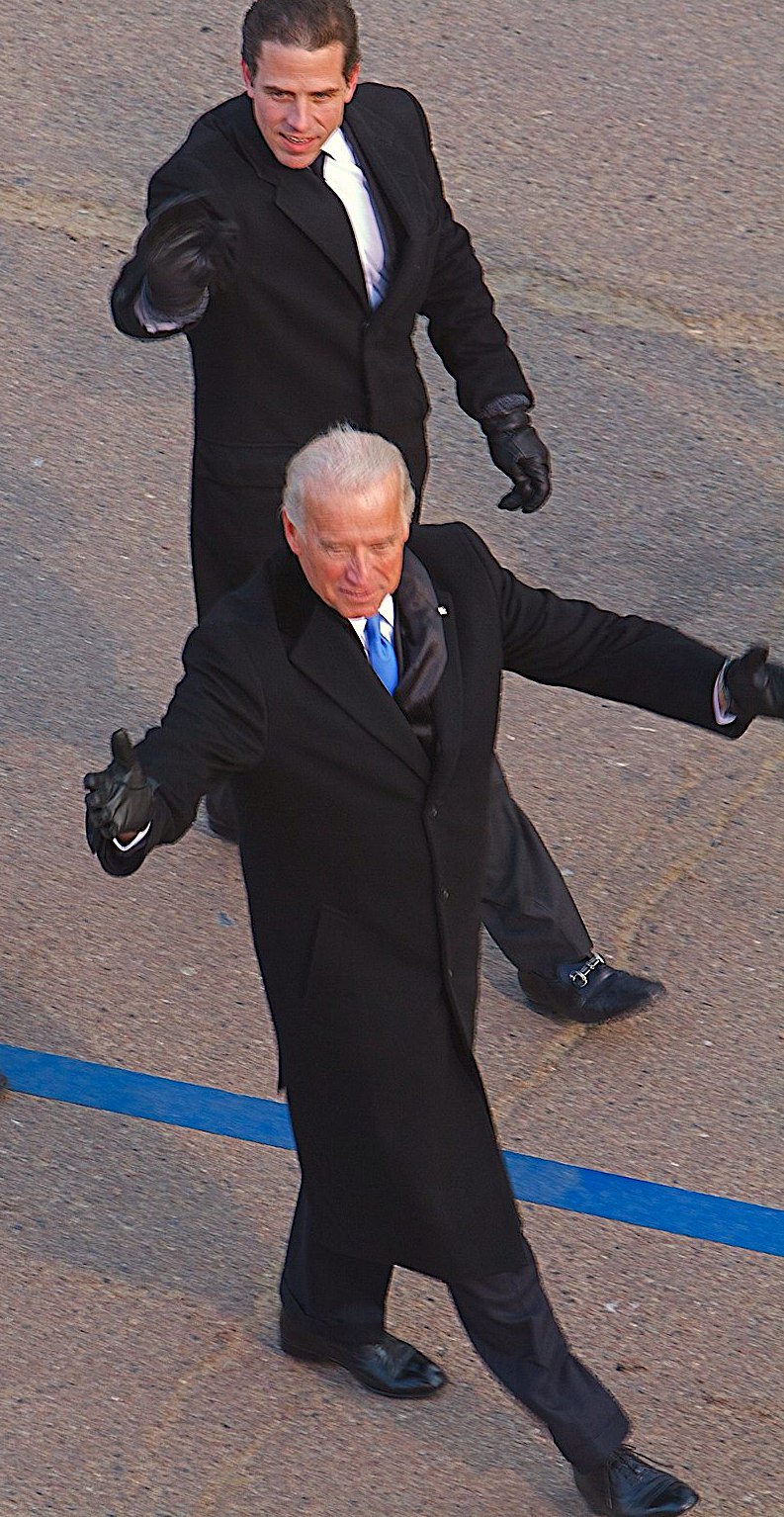
Hunter and Joe Biden at Obama’s 2009 inaugural parade
Can you imagine if the Trump administration finally succeeds in overthrowing the Venezuelan government and a couple of months later Vice President Mike Pence’s son (who wasn’t kicked out of the Navy for drug use) lands a spot on the board of a privatized Venezuelan national oil company?
That is exactly what happened with Biden and his son Hunter in Ukraine.
And then imagine that the U.S.-installed government of Juan Guaidó begins an investigation into corruption at the oil company and wants to question Pence’s son. So Pence flies to Caracas and tells Guaidó he won’t get a $1 billion U.S. credit line until the prosecutor is fired. Six hours later the prosecutor begins cleaning out his desk and Pence later brags about it in an open forum at the Council on Foreign Relations.
That is exactly what Biden did in Ukraine.
The fired Venezuelan prosecutor then gives an affidavit under oath that Pence had him fired because he was investigating his son’s company and that the U.S. had taken over the country’s prosecutor’s office.
That is exactly what the Ukrainian prosecutor testified.
But none of these facts are in Mayer’s story. In the face of the affidavit and Biden’s open admission on video, she still somehow calls these “baseless tales claiming that Biden corruptly intervened on behalf of his son’s Ukrainian business interests.”
Instead Mayer attacks the reporter who revealed most of them, John Solomon of The Hill. A partisan reporter attacking another partisan reporter is what passes for journalism these days. Being non-partisan—a requirement to practice serious journalism—means looking past the politics of a reporter or a news outlet, and even overlooking their partisan motivation, if they present documented evidence. The motive is irrelevant if the evidence is substantiated.
There was no such evidence in the Russiagate farce, but that never stopped partisans in the Democratic media. The same lack of skepticism has accepted now two CIA officials as “whistleblowers” without questioning their motives, while showing no interest in real whistleblowers who challenge the Establishment on behalf of the nation.
If the Department of Justice and its investigation into the origins of Russiagate is serious and reveals wrongdoing by intelligence officials and by extension by the media, the best move those officials and journalists can make is to go on offense as their best defense. It also gives them another crack at Trump after failing with Russiagate. And Trump gave them the opening to do it.
Trump’s Blunder
Trump’s mistake was to get personally involved in the investigations into the origins of Russiagate and the Bidens. By mentioning both in a telephone conversation with Ukrainian President Volodymyr Zelensky, he broke the wall that should exist between the White House and the Justice Department. Though there was no clear quid-pro-quo, Trump hinted that he would release military aid to Ukraine in exchange for the investigations. If Trump did that it is the routine corrupt way the U.S. carries out foreign policy, as Biden openly admitted.
Trump compounded his problems by publicly calling for China to investigate Hunter Biden’s dealings in that country. By getting personally involved, instead of leaving it up to the DOJ to investigate his possible challenger in next year’s presidential election, Trump allowed his enemies in intelligence and the media to portray his conversation as an impeachable offense.
Every move the DOJ or Trump’s personal lawyer, Rudy Giuliani, makes in investigating Russiagate or the Bidens’ corruption, including legitimately asking foreign governments for assistance, is now tainted as political because of Trump’s unwise intervention. He threw a lifeline to intelligence officers and journalists like Mayer, who will continue to make the most of it even if it means turning their backs on their professional commitments.
Pinning an ‘Antisemite’ Label on President Trump
By Adam Dick | Ron Paul Institute | October 9, 2019
In a Friday The Intercept editorial, Mehdi Hasan wrote that President Donald Trump “and his acolytes” have been “banging their anti-Semitic drum in plain sight” since United States House of Representatives Speaker Nancy Pelosi’s September 24 announcement of an impeachment inquiry in regard to Trump. But, Hasan then offers no substantial evidence to back this bold claim.
The first pittance Hasan presents as supposed backing for his claim is a September 28 Twitter post from Trump. In the tweet, Trump complains about the treatment of Trump by “Do Nothing Democrat Savages, people like Nadler, Schiff, AOC Plus 3.” The people referenced are all House members: Reps. Jerrold Nadler (D-NY) and Adam Schiff (D-CA), as well as Alexandria Ocasio-Cortez (D-NY) (“AOC”) and three other freshman House members who are seen by Trump and many other people as forming a group with Ocasio-Cortez based on common interests — Ilhan Omar (D-MN), Ayanna Pressley (D-MA), and Rashida Tlaib (D-MI).
Hasan notes that Schiff and Nadler are Jewish. Hasan also mentions that Ocasio-Cortez is a “woman of color.” Plus, observes Hasan, Trump only chose to mention these House members from among the more than 200 House members who “have signed onto an impeachment inquiry.”
From this information, Hasan presents the following rhetorical question as if he has proven something: “How is such rhetoric not racist?”
How, indeed? A negative comment does not become a racist comment just because the individuals about which the comment is made are of particular races, ethnicities, or religions.
Of course, Trump has a long and well-known record of harshly criticizing people of various races, ethnicities, and religions. The fact that his presidential primary and general election opponents were not mostly Jewish people or “women of color” did not prevent Trump from leveling at many of them verbal and written attacks similar in strength to the attack found in the tweet Hasan references.
Further, there is good reason, other than racism, that Trump would single out the House members he did for criticism. Nadler and Schiff, as Hasan notes in his editorial, are chairmen, respectively, of the House Judiciary and Intelligence committees. In those roles the two men have been devoting much time and effort to developing and promoting the case for Congress removing Trump from the presidency. While “AOC Plus 3” lack committee chairmanships, they have been very harsh in their criticism of the president. Trump’s inclusion of these four additional Congress members in the tweet also makes sense as part of his ongoing trading of barbs with them.
So, in answer to Hasan’s question, there is plenty of reason not to interpret Trump’s tweet as racist or antisemitic.
Next up, Hasan makes this claim:
On October 2, Trump escalated his brazenly anti-Semitic attack on Schiff. ‘We don’t call him “Shifty Schiff” for nothing,’ the president told reporters in the Oval Office. ‘He’s a shifty, dishonest guy.’
Hold on. Why is this a “brazenly anti-Semitic attack”? It just sounds like Trump being Trump. He frequently attacks people verbally and in writing, often doing so by calling them names. Wikipedia even provides a long list of nicknames, many of them negative, that Trump has used for people. Among the listed nicknames are multiple negative nicknames for people including Joe Biden, Hillary Clinton, James Comey, Nancy Pelosi, and Chuck Schumer (most of whom are not Jewish), along with Schiff.
But, insists Hasan: “The stereotype of Jews as ‘shifty,’ the suggestion that they are sneaky and manipulative, has a long and ignominious history.” Whatever. There is a long history of people calling non-Jewish people shifty too.
An obvious reason Trump would choose to use the insulting nickname “Shifty Schiff” is because the nickname is made up of two words that share a first syllable. That helps make the nickname catchy. Indeed, looking at the Wikipedia list, you can see Trump has applied similar types of nicknames playing on the sound of people’s names before — “Lamb the Sham” for House Member Conor Lamb (D-PA) and “Wacky Jacky” for Senate Member Jacky Rosen (D-NV), for example.
That’s it for Hasan’s argument that Trump is saying antisemitic things since Pelosi announced an impeachment inquiry regarding Trump. Talk about underwhelming.
Just as underwhelming is how Hasan then proceeds to argue in support of his assertion that Trump’s “acolytes” are doing the same thing. To support the claim, Hasan points to two October 2 Twitter posts from Trump’s son Donald Trump, Jr.
Before dealing with those tweets it should be noted that it is absurd to have trump’s son stand in for all Trump’s “acolytes.” Even if Donald Trump, Jr. wrote something antisemitic that does not mean that all supporters of President Trump, or even a substantial portion of them, agree with it.
Hasan points to Donald Trump, Jr. saying in two October 2 tweets that Schiff is a “radical liberal” who “has been hand picked and supported by George Soros” and is “a George Soros *puppet.*” Hasan apparently has a problem with these tweets because Soros is Jewish. Hasan writes:
Radical liberal. Handpicked by George Soros. A Soros puppet.
Don Jr.’s tweets provoked a rare response from Jonathan Greenblatt, head of the Anti-Defamation League, who referred to his invocation of Soros, a left-leaning Jewish billionaire, as an ‘anti-Semitic trope’ and a ‘dangerous’ insinuation.
Alleging politicians are taking actions and making public stands because of pressure from wealthy individuals, or from businesses or interest groups, is common practice in American political debate. Soros comes up in some of those allegations, but so also do many other individuals, groups, and organizations — Charles Koch, the military-industrial complex, and the National Rifle Association, for example — that are not generally seen as connected to Jewish ethnicity or religion.
The truth is that Soros directs much effort to influence political action in America and across the world. Saying that people should refrain from noting and criticizing such effort because Soros is Jewish is saying that some major players in political influence should have a free pass from recognition and criticism. That is not a call for suppressing antisemitism. Rather, that is a call for suppressing debate.
After presenting his milk-toast evidence, Hasan asks the following question:
So why isn’t there more outrage over Trump’s blatant and dangerous anti-Semitism, in the specific context of this impeachment inquiry?
All that “blatant and dangerous anti-Semitism” is in Hasan’s head, not in reality. Hopefully Hasan, and other people offering the spurious arguments in Hasan’s editorial, will find little success in their effort to recruit people to believe their fantasy assertions of Trump’s expressions of antisemitism.
Copyright © 2019 by RonPaul Institute
Here they go again: Senate reheats ‘Russian meddling’ claims, using assertions as evidence
RT | October 9, 2019
The Senate Intelligence Committee’s final report on ‘Russian interference’ in the 2016 US presidential election is short on evidence and long on reheated assertions and innuendo from ‘experts’ exposed as actual election meddlers.
There is little new in the 85-page, partially redacted document released on Tuesday, that has not been made public by the committee previously – including the accusations that “Russia” focused on stoking anger and resentment among African-Americans, for example.
There is a reason for that. By the committee’s own admission, “much of this Volume’s analysis is derived from” the work of two Technical Advisory Groups (TAG), which produced two public reports back in December 2018, to the same kind of fawning press coverage the report is receiving now.
Not Surprisingly, the report’s “findings” are being cited as conclusive proof that Democrats were right and President Donald Trump was wrong about 2016, Russia, Ukraine and the US presidential election.
The only trouble with that is that the committee provides no actual evidence for any of its claims – only assertions. For example, their description of the Internet Research Agency – the “Russian troll farm” – is basically copied over from Special Counsel Robert Mueller’s indictment of a dozen of its alleged members. Yet a federal judge presiding over the case ruled back in May that allegations cannot be treated as established evidence or conclusion, coming close to finding Mueller’s prosecutors in contempt.
Another document presented as evidence is the January 2017 “Intelligence Community Assessment,” the disingenuously named work of a small group of people, hand-picked by the Obama administration’s DNI and chiefs of the CIA, FBI and NSA – all of whom, except for the NSA, have since been implicated in what seems to be a campaign to spy on Trump, delegitimize his presidency, and have him impeached.
The Senate report also quotes testimonies from Obama aides such as Ben Rhodes – helpfully redacted of course – Gen. Philip Breedlove, the NATO commander who tried to set off a war with Russia; professional “Russian bot” hunters like Clint Watts and Thomas Rid; and NATO’s “Strategic Communications Center of Excellence.”
The best part, however, has to be the reliance on New Knowledge, presented as “a cybersecurity company dedicated to protecting the public sphere from disinformation attacks.” In reality, New Knowledge was exposed by the New York Times as the outfit that actually ran bots and disinformation operations during the 2017 Alabama special election for the US Senate, targeting Republican candidate Roy Moore on behalf of Democrats – while blaming Russia!
In an internal memo, New Knowledge executives boasted how they “orchestrated an elaborate ‘false flag’ operation that planted the idea that the Moore campaign was amplified on social media by a Russian botnet.”
The other TAG, led by British academics and researchers, found that the activity of ‘Russian trolls’ increased after the election – by 238 percent on Instagram, 59 percent on Facebook, 52 percent on Twitter, and 84 percent on YouTube. So it was influencing elections… retroactively?
Left unsaid was that the absolute quantity of “Russian” posts was minuscule, a proverbial drop in the bucket compared to the billions of social media posts generated and consumed by the US electorate during the campaign.
These are the people who “significantly informed the Committee’s understanding of Russia’s social media-predicated attack against our democracy,” as this week’s report puts it.
Ever since Hillary Clinton blamed “Russian hackers” for the revelations of corruption within the DNC in July 2016, the Washington establishment has been eager to blame Moscow for all the ills of the US political system, real or imagined. The Senate Intelligence Committee’s report seems to be nothing more than an attempt to reheat the long-cold corpse of a conspiracy that should have been buried with the Mueller Report and allowed to rest in peace.
Syria Says Ready to Welcome Kurds back into Fold
Al-Manar | October 8, 2019
Damascus voiced readiness on Tuesday to welcome Syria’s Kurds back into the fold after Washington left them to face Turkish military threats alone.
Deputy Foreign Minister Faisal Mekdad stressed that Damascus “will defend all Syrian territory, and will not accept any occupation of its land,” he told Al-Watan newspaper.
The official said Kurdish groups have been “tossed aside” by Washington, after US President Donald Trump on Monday gave Turkey a green light to press ahead with its planned military operation.
“The nation welcomes all its children and Damascus will solve all problems in Syria in a positive manner, away from violence,” Mekdad said, vowing to take back all Syrian territory.
“We advise those who have gone astray to return to the nation, because the nation is their final destiny,” he added, encouraging Syria’s Kurds to reconcile with the government.
Ankara has threatened an offensive in Syria against Kurdish militias and US forces on Monday pulled back from Turkish border areas, opening the way for an invasion President Recep Tayyip Erdogan has said could come at any moment.
Mekdad said that Kurdish militias in Syria were being “played” by Washington.
Worried for Kurds in Syria, abandoned by US? Here’s an obvious solution but it will make Washington hawks MAD
By Nebojsa Malic | RT | October 7, 2019
US President Donald Trump’s decision to pull out US troops from northern Syria has been met with bipartisan outrage, calling it a “betrayal” of the Kurds. Wait till the regime-changers hear the obvious solution to keep them safe.
As some two dozen US troops stationed in northwestern Syria began to withdraw on Monday, reports began coming in of Turkish airstrikes against Kurdish targets. Ankara is apparently calling the operation “Fountain of Peace.”
Officially, the goal is to establish a “safe zone” along the border to resettle some of the 3,6 million Syrian refugees. Oh, and also to set up a buffer zone between the Kurdish militias in Syria – YPG and YPJ – from their PKK kin in Turkey, designated terrorists by Ankara.
Trump’s detractors in Washington have denounced his decision as a “betrayal” of the Kurds, accusing the president of abandoning the force that the Pentagon has used as boots on the ground against IS in eastern Syria. Recall that it was the Kurdish-led “Syrian Democratic Forces” (SDF) that liberated Raqqa – “capital” of Islamic State (IS, formerly ISIS) – in October 2017.
Thing is, the Obama administration sought to create some kind of parallel government in those territories, in line with its policy of demanding regime change in Damascus and the overthrow of Syrian President Bashar Assad.
If Kurdish leaders thought this would somehow translate into support for statehood, or dominion over traditionally Arab-majority territories, they were dangerously deluded. Trump has made it clear from the beginning of his presidency that he had no interest in “nation-building” anywhere, and has tried to put that info effect despite constant push-back from the US establishment.
What happened in August 2016 should have also been a clue – and offers a possible way out of the present conundrum. Back then, Turkey invaded from the north in ‘Operation Euphrates Shield,’ attacking the Kurds from the rear just as the SDF was launching the major push against Raqqa. The US did nothing to stop this. Only when the Syrian Arab Army – accompanied by Russian observers – stepped in to create a buffer zone between the Turks and the SDF, did the invasion stop.
While Ankara thinks nothing of attacking the Kurds, it is hard to imagine it would dare open fire on Syrian troops – or the Russians fighting alongside them. The obvious solution for the Kurds is to make a deal with Damascus and secure the protection of the Syrian government that the US could never provide. This would keep them safe, while keeping Damascus happy and Ankara without grounds to object.
The only ones displeased by this would be regime-change advocates in Washington – but that’s their problem.
On Racism and ‘Wild Beasts’: Why Israel besieges Palestinians

A segment of the Israeli Seperation Wall near Abu Dis, in the occupied West Bank on 15th April 2016.
By Ramzy Baroud | MEMO | October 7, 2019
The Israeli Apartheid Wall, which is being built largely on occupied Palestinian land in the West Bank and East Jerusalem, once more underscores the ugliness of military occupation. As such, it truly epitomises the nature of Israeli apartheid and also delineates the siege-driven, isolationist mentality that dominates the ruling-class thinking in Israel.
Even years before the establishment of the state of Israel over the ruins of the Palestinian homeland in May 1948, Zionist communities in Palestine perfected the stratagem of besiegement, isolating themselves behind massive walls while blockading Palestinians, the native inhabitants of the land, in every way possible.
Throughout the Nakba – the catastrophic ethnic cleansing and destruction of Palestine in 1947-48 – Israel used this military theory in abundance. Neighbourhoods, villages and entire towns would be besieged for days, weeks or months, while being bombarded from all directions before their residents were finally pushed out. None of these ethnically-cleansed Palestinian communities, which numbered in the hundreds of thousands, were ever allowed to return to their homes.
In fact, besiegement and isolation remain at the core of the Israeli military strategy to date.
No other place, however endured the brutality of the seemingly never-ending siege like the Gaza Strip. Gaza, that small region of 365 square kilometres, has been under various stages of besiegement and blockade since 1948.
The most hermetic stages of this perpetual siege began some time in 2006 and intensified in the summer of the following year. Three factors make the latest siege on Gaza particularly horrific: its long duration, the lack of any serious respite for besieged Gazans and, most importantly, the fact that it has been interrupted by massive Israeli wars that killed and wounded thousands of Palestinians. With much of Gaza’s infrastructure destroyed or dilapidated, the Israeli blockade on the Strip has proved to be the most savage and deadliest of all sieges.
On 30 September, Israel’s Channel 12 reported that nearly 70 per cent of an underground barrier east of Gaza is now complete. An estimated 1,400 Israeli and foreign workers are reportedly taking part in building the barrier, which when finished, will extend to reach 60 kilometres in length.
Considering the layers of walls, fences, trenches and no-go military zones, the additional underground wall around Gaza seems frivolous. Is it possible that Israeli leaders truly believe that Gaza is not isolated enough?
In actuality, the latest wall will likely satisfy a psychological, not a practical objective, as it gives the Israeli army and southern settlements a temporary sense of safety, while once more hailing Israeli leaders as the protectors of a defenceless and exposed nation.
Oddly, while scores of young Gazans continue to be killed at the fence separating Gaza from Israel while protesting the Israeli siege on the Strip, it is the Israelis who claim to be targeted, unsafe and victimised.
The newest wall, once it is officially launched with massive fanfare, will still make no difference. It will not upgrade the status of the Gaza siege in any way, nor will it alter the collective fear that has been thoroughly instilled in ordinary Israelis.
For Gazans, wall or no wall, the siege will remain intact.
Israeli wall architects may argue that the latest wall will deter Palestinians from digging tunnels as well as preventing resistance fighters from circumventing the siege via the sea – since part of this underground barrier will also extend into the Mediterranean Sea.
However, there is no proof that walls or fences, over ground or underground barriers have prevented Palestinians from retaliating against Israeli attacks. If the Israeli logic holds any truth, Palestinian resistance would have dissipated or folded decades ago as the Israeli siege mentality was put into practice from the very start of the Israeli war on the Palestinian people.
Israel receives $3.8 billion in US funding every year, in addition to hundreds of millions in loans and other financial giveaways which are mostly used to fortify Israel’s so-called security. To no avail. Palestinians, impoverished and incarcerated in Bantustan-like structures and open-air prisons, continue with their resistance unhindered.
It is clear that the Israeli security model has failed. In fact, that model never had a chance of success in the first place. The additional Israeli wall around Gaza and the hundreds of other walls and fences that are yet to be built are only meant to feed the collective illusion among Israelis and their leaders that the answer to their problem does not lie in ending the apartheid regime, military occupation and siege, but in adding more layers of “security”.
“At the end of the day as I see it, there will be a fence like this one surrounding Israel in its entirety. We will surround the entire state of Israel with a fence, a barrier,” Israeli Prime Minister, Benjamin Netanyahu, said on 9 February 2016 during a visit of the construction site of the barrier around Gaza.
Netanyahu added: “In our neighborhood, we need to protect ourselves from wild beasts.”
While such language and behaviour reflect the deeply-rooted racist mentality at work in Israel, they also underscore the dehumanized way in which Israel sees Palestinians. Since “wild beasts” are not human, they can be killed en masse, besieged and ethnically cleansed in their millions without an iota of regret or remorse.
The problem then is not that of “security” or so-called “terrorism”. Not that of Hamas, or any other group, secular or Islamist. It is not that of Gaza’s March of Return or of children approaching the fences around Gaza. The problem is the entrenched Israeli racist mentality that perceives Palestinian natives as sub-humans and as “wild beasts” to be exterminated or forever besieged.
Iraq says all evidence points to ‘malicious hands’ in protests
Press TV – October 7, 2019
Iraqi officials say there are “malicious hands” behind the killing of both protesters and security forces during the recent spate of unrest in Baghdad and some other cities.
Interior Ministry spokesman Saad Maan confirmed for the first time on Sunday that 104 people had been killed, including eight security officers, and more than 6,000 wounded in the protests.
Maan said the ministry was working with other government institutions to find out who was behind the killings. According to medical sources, the majority of protesters killed were struck by bullets.
The protests began last Tuesday, with demonstrators calling for better living conditions. The rallies soon turned into riots as some protesters started vandalizing public properties and attempted to enter the Green Zone in the capital Baghdad — which houses government offices and foreign diplomatic missions.
On Saturday night, armed elements and violent rioters attempted to take over local TV stations in Baghdad after the government removed a days-long curfew.
Maan said protesters burned 51 public buildings and eight political party headquarters but Iraqi security forces did not confront them.
According to the spokesman, most of those killed on Friday had been shot in the head or heart, a sign that skilled snipers had carried out the killings.
Officials say there are attempts at “sedition” from “unidentified snipers” who shot police and protesters indiscriminately.
“We can’t accept the continuation of the situation like this,” Prime Minister Adil Abdul-Mahdi told his Cabinet late Saturday. “We hear of snipers, firebombs, burning a policeman, a citizen.”
Parliament speaker Mohamed al-Halbousi echoed the premier’s remarks, saying that “infiltrators” were wreaking havoc. He said the parliament had formed a committee to investigate the matter.
Iraqi security officials have made it clear that their forces would not use lethal force against protesters unless their lives were in danger.
On Sunday night, at least 13 people were killed in clashes with security forces in a district of capital, where the military admitted some forces had violated the rules of engagement.
“Excessive force outside the rules of engagement was used and we have begun to hold accountable those commanding officers who carried out these wrong acts,” the military said in a statement.
There are unconfirmed reports that some foreign diplomatic missions are trying to keep the flames of the unrest alive by sending mercenaries into the ranks of protesters to cause more violence.
Lebanese newspaper Al Akhbar reported Saturday that Saudi Arabia’s Embassy in Baghdad had been hiring paid snipers to take out people and guards alike. The report made similar allegations against the US Embassy staff.
There were no immediate official reactions to the claims.
On Sunday, the Iraqi government announced a series of reforms after an “extraordinary” session overnight in response to the sweeping unrest.
The governor of the province of Baghdad, Fallah al-Jazairi, also stepped down and members of the provincial council accepted his resignation.
Confronted by its biggest challenge since coming to power just under a year ago, Abdul-Mahdi’s cabinet issued a decree including 17 planned reforms, such as land distributions and increased welfare stipends for needy families.
Authorities have asked protesters to give them time to implement reform. Grand Ayatollah Ali al-Sistani, the top Shia cleric of Iraq, on Friday urged security forces and protesters to avoid violence.
Iraq declared victory over the Daesh terrorist group at the end of 2017 — after nearly four years of conflict.
The violence comes as millions of Shia pilgrims are preparing to travel to the Iraqi holy cities of Najaf and Karbala to attend Arba’een ceremonies, marking the fortieth day after the martyrdom anniversary of their third Imam, Hussein ibn Ali (AS).
Iraq recently reopened its al-Qa’im border crossing with Syria and accused the occupying regime of Israel of orchestrating a string of recent drone strikes on Iraqi popular mobilization forces.
Tehran-based political analyst Hussein Sheikholeslam said Saturday the unrest is a product of US efforts to weaken “the resistance axis,” which is the key pillar of rising opposition to American and Israeli plans in the Middle East.
Hashd ready protect government, punish saboteurs
Iraqi Popular Mobilization Units (PMU), or Hashd al-Sha’abi, announced Monday that it is ready to help prevent “a coup d’etat or a rebellion” in the wake of the violence.
Faleh al-Fayyad, the PMU head and Iraq’s national security Adviser, told reporters that he wanted to see “the fall of corruption, not the fall of the government.”
He was referring to demands by some protesters for Abdul-Mahdi to step down in order to perform a complete overhaul of the country’s political system.
“We tell the enemies and the conspirators that their efforts have failed,” he said in a press conference. “We will defend the constitution and the government that we have established with our blood and our lives.”
Fayyad said eradicating corruption and achieving economic prosperity is only possible if the government stays in office.
“The government and on top of it the prime minister do their best to complete the transition,” Fayyad said. “In the absence of government security is lost and it is only within this framework that a solution can be reached.”
He also pledged a crushing response to those who perpetrated violence and killed and injured people.
“We know who is behind letting some saboteurs infiltrate the demonstrations,” he said, adding “we have footage and intelligence that we will present when time is appropriate.”
Iraqi PM discusses situation with Pompeo
Abdul-Mahdi’s office issued a statement on Monday, saying the prime minister had discussed the situation with US Secretary of State Mike Pompeo.
According to the statement, Abdul-Mahdi told the US top diplomat that the government was in full control and planning to continue taking practical steps to meet people’s demands.
Later, Russian Foreign Minister Sergei Lavrov arrived in Baghdad on what Moscow said was a two-day working trip.
Who’s been Trying to Destabilize Iraq?
By Valery Kulikov – New Eastern Outlook – 07.10.2019
The wave of protests that erupted across Iraq on October 1, according to a number of reports, resulted in dozens of civilian deaths and several hundred injured protesters. As it’s been reported by Al Arabiya TV station, human rights activists claim that at least a hundred people lost their lives in the course of the protests, while some 3 thousand got injured.
The unrest that was sparked by the frustration that local residents share over the massive corruption, high unemployment rates, frequent power outages and water shortages, would soon lead to demands for the resignation of the sitting government, followed by all sorts of other political demands. In spite of the attempts that local authorities make to restore order by imposing a curfew, the intensity of the protests wouldn’t die down. There’s tires burning in the streets, demonstrators assaulting airports and government buildings.
Egypt‘s Sasapost states that Iraq has not seen a mass movement as popular since the days Iraqis tried to repel the US attack on their country. Demonstrations have swept all the large cities of the country, except for those that remain in the hands of ISIS terrorists in the northern and western parts of the country.
Even though Al Jazeera alleges there’s no leader to head the protest movement, a number of Arab observers have already expressed their doubts about the validity of such allegations. In their opinion a “rebellion of the starving” doesn’t resemble an armed assault on the police and security forces, as there’s been reports about law enforcement units suffering losses.
Most protesters are young people under the age of 20. They can hardly be described as religious conservatives and it is difficult to suspect them of being influenced by clerics. Over the past few weeks their demands have underwent a major change and it’s clear that such a transition could only occur if they were under some sort of external influence. What started out as youth’s attempt to express frustration over the existing social policies would be hijacked by an angry mob chanting extreme political demands, like the replacement of the parliamentary republic with a presidential one, stepping down of Adil Abdul-Mahdi al-Muntafiki and his substitution with the former security chief General Abdul Wahab al-Saidi. All this goes in line with protesters chanting anti-Iranian slogans and burning Iranian flags. It is also noteworthy that those protests started in southern parts of the country mostly inhabited by the Shiites, as well as in Baghdad.
It’s clear that the increasingly anti-Iranian tone of the protests serves as yet another indicator of the possible involvement of external forces in the events that unfold in Iraq these days. Against this backdrop, it’s noteworthy that the Lebanese Al Akhbar recalls that last summer an informed source in the Iraqi military department predicted what was about to happen, while stating that Washington was extremely concerned about the growing influence of Iran in his country. In his opinion, such protests would serve as a warning served to the Iraqi authorities in a bid to prevent the two countries from leaning closer together.
It’s also noteworthy that a couple of weeks ago the sitting US Under Secretary of State for Civilian Security, Democracy, and Human Rights, Marshall Billingslea announced that the people of Iraq fell “victims” of the close ties that Baghdad and Tehran share.
However, the US is not the only player that would try combating Iran’s influence in Iraq, as Israel has been trying to achieve same end. Since mid-summer, both Israeli and US combat aircraft and drones have made over two dozen sorties, bombing a number of targets across Iraq from those near the border with Syria in the Al Anbar Governorate to those on the borderline with Iran. But primarily these air attacks were directed against the bases of the Iraqi Shia “people’s militia”, which has already been dubbed as “Iranian proxies” in the West.
Against this background, there was a visible increase in anti-American and anti-Israeli sentiments in Iraq, resulting in the shelling of the US embassy that was forced to suspend its work until the date when the curfew is lifted.
The moment chosen by the “external instigators” to stir the unrest is particularly noteworthy, as it coincides with the preparation for the Arba’een Pilgrimage made by millions of Iranians. This gathering is the commemoration of the memory of Husayn ibn Ali, the grandson of the Prophet Mohammad and the third Shia imam, who fell in combat together with his faithful comrades-in-arms in 680 at the hands of the caliph Yazid’s soldiers from the Umayyad dynasty. This year the pilgrimage to Iraq is bound to start in two weeks. The annual public gathering is no less important for millions of Shiites than the regular pilgrimage to Mecca for the rest of the Muslims of the planet: according to official Iraqi media, more than 22 million believers took part in the ceremony at the end of the 40-day mourning period following Ashura last year, making this gathering a couple of times more numerous that last year’s Hajj. To coordinate and facilitate the movement of Iranian pilgrims, Tehran sent its representatives to Iraq mere days before the protests broke out. This collaboration and other bilateral contacts between Iraq and Iran that are only getting more numerous are received rather enviously both in Washington and Tel-Aviv.
However, as protests started taking an anti-Iranian turn, Tehran was forced to close two border checkpoints with Iraq (Khosravi and Khazabekh), that are commonly used by Shia traveling to Iraq to visit the shrines of Shia imams.
There’s little doubt that by sabotaging this year’s Shia pilgrimage those forces behind the protests will increase the frustration of the populations of Iraq and Iran. But this is precisely what certain anti-Iranian forces are aspiring to achieve, primarily in the United States and Israel, in order to increase the scale of their military operations in Iraq, while Baghdad is busy dealing with the unrest.
Featured Video

Ivermectin and iodine
or go to
Aletho News Archives – Video-Images
From the Archives
UN declares war on ‘dangerous’ conspiracy theories
‘World is not secretly run by elites’
Free West Media | August 5, 2022
UNESCO says it is seriously concerned about the increase in “disinformation” and “conspiracy theories”. And they plan to put an end to it through a network of informants.
“Conspiracy theories can be dangerous,” the UN agency warned. “Often they ignore scientific evidence and polarize society with dire consequences. This has to stop.”
Unesco’s director-general warned that “conspiracy theories” could cause damage to people as well as to their health. “They reinforce misconceptions about the pandemic, reinforcing stereotypes that can fuel violence and violent, extremist ideologies,” said Audrey Azoulay.
The UN agency has launched a campaign to help people identify, debunk and report “conspiracy theories” to prevent them from spreading further.
This campaign is being carried out in collaboration with the European Commission, Twitter and the World Jewish Congress. The UN has created a toolkit to “debunk” such theories and smear anyone who dares to claim that governments are not fair and transparent.
The UN also warned that George Soros, the Rothschilds and Israel should not be linked to “alleged conspiracies”.
World events “are not secretly manipulated behind the scenes by powerful players with malicious intent,” the UN agency maintained.
And if anyone therefore comes across someone who believes that the world elite is plotting to consolidate power or direct events, then that person needs to take action. According to the UN agency, when meeting a “conspiracy theorist”, under no circumstances should one enter into a discussion. … continue
Blog Roll
 Aletho News
- Ukrainian air alert app hacked with fake nuclear warnings
- Ivermectin and iodine
- Congratulations climate skeptics — you are a ‘Hybrid weapon of war’ and a growing public health threat
- ‘The Arab Vote’: How Israeli Racism Has Ruined Their Elections
- Israel forces Palestinians in Gaza to choose between assassination alone or death with their families: Report
- US Approves Sale of 500 Patriot Missiles to Ukraine, Deliveries May Take Years
- German Imperialism: An Urgent Explainer
- Backed by AAP, West Virginia Proposal Would Allow Dental Hygienists to Give HPV Vaccine to 9-Year-Olds
- Poland Is the Symptom and Europe Is the Patient
- UAE security forces tortured, killed journalist for opposing Israel normalization: Report
- If Americans Knew
- An error has occurred; the feed is probably down. Try again later.
- No Tricks Zone
- Germany’s Green Energy Transition Becoming Increasingly Expensive…Another 6 Trillion Euros!
- Sudden Stratospheric Warming, Powerful El Niño Combination May Lead To Extreme Europe Cold, Energy Crisis!
- Two New Studies Find Thwaites Glacier Melt Cannot Be Driven By Human Activity Or A Warming Ocean
- E-Cars Reduce CO2 Emissions By Only 41% Compared To Internal Combustion Engine Vehicles
- Predictions Made By Renowned Climate Professor Over Past Decades Have Been Proven To Be Poor
- New Study Suggests Large Regions Of The Pacific Ocean Have Been Cooling For The Last 80 Years
- Germany’s Green Energy Debacle: High Energy Costs Force Kahla Porzellan to Close After 182 Years!
- New Study: 50 Years Of The Most Aggressive ‘Net Zero’ Policies Can Only Affect The Global Climate By 0.03°C
- US September “Heat” Was No Record…Many Records Set Decades Ago
- Latest European Green Energy Debacle; Portugal’s Largest Flagship Solar Park Insolvent!

