State Department Accuses ‘Russian Trolls’ of Meddling in Chile Protests
Sputnik – November 1, 2019
The US State Department claims it has seen evidence of Russian attempts to “influence” the recent unrest in Chile.
The South American country has been rocked by massive anti-government protests for over three weeks now, with demonstrations and violence leading to a temporary curfew, soldiers in the streets and the cancellation of the Asia-Pacific Economic Cooperation (APEC) summit, expected to have taken place in Santiago in mid-November.
Speaking to reporters in Washington on Thursday, a senior State Department official told reporters that Russia was trying to ‘take advantage’ of the unrest in the country “and skewing it through the use and abuse of social media trolling and seeking –rather than allowing the citizens of Chile to have their own debate about how their country and the courses their country should take… to exacerbate divisions, foment conflict, and all around act as a spoiler to responsible democratic debate.”
The official pointed to alleged “Russian activity supporting this negative course of the debate,” but did not elaborate on what this entailed.
Pressed on the claims, and whether the alleged Chile meddling also included efforts by Venezuela or Cuba, the official said they were “not a digital analytical wizard,” but that they “saw organisations such as [Latin American news agency] Telesur exacerbating those debates.”
The official did not expand on his claims of Russia’s alleged meddling, noting only that “in recent years we’ve seen an increase of Russian engagement in the Americas, in South America in particular – very little of it positive.”
Commenting on the claims on Friday, Russian Deputy Foreign Minister Sergei Ryabkov dismissed the State Department’s allegations outright.
“The US administration is using the difficult internal situation in Chile to continue its efforts to blacken our country’s foreign policy. This isn’t news,” Ryabkov said in a statement.
The official added that Russia “has never meddled, does not meddle and will not meddle in any electoral or other internal political processes in any country.”
Chilean officials did not comment on the State Department’s claims.
Arguably the best-known case of confirmed meddling in Chile’s internal affairs took place on September 11, 1973, when the CIA-backed Chilean armed forces led by General Augusto Pinochet overthrew the democratically elected government of Salvador Allende in a coup.
Violent protests erupted in Chile last month over authorities’ decision to increase subway fares. The protests have spread to violent clashes between protesters, police and the military, with over 2,400 people reported injured and 21 people killed, and over 5,400 others detained. Last week, over a million people marched in the streets, demanding the resignation of President Sebastian Pinera.
Five Years On, Saudi Attacks on Yemen’s Farmers Are Pushing the Whole Country into Famine
By Ahmed AbdulKareem | MintPress News | November 1, 2019
HODEIDA, YEMEN — The country of Yemen, known in the medieval period as “Green Yemen,” is one of the most extensively terraced areas of the world. There, Yemeni farmers transformed rugged mountain slopes into terraces and built dams like the Great Marib, a structure whose history spans long enough that it was mentioned in the Quran. During the medieval period, Yemen had one of the widest ranges of agricultural crops in all of the Middle East.
Farhan Mohammed is one of the richest farmers in Qama’el, a rural village in the region of Baqim in northwestern Yemen. He owns 50 hectares of land which he uses to cultivate corn, pomegranates, and apples. Now, Farhan is struggling to keep his farm afloat after Saudi airstrikes targeted his fields, burning his crops and rendering the soil so toxic that it’s no longer able to sustain life. Saudi Arabia’s now nearly five-year-old project in Yemen has decimated the incomes of Farhan and most other Yemeni farmers. Fuel is hard to come by thanks to a Saudi-led coalition blockade and the fuel that is available has become prohibitively expensive. Airstrikes targeting farm fields and orchards have rendered large swaths of Yemen’s arable land too toxic to use.
Almost immediately after March 2015, when the war began, the Saudi-led Coalition began targeting Yemen’s rural livelihood, bombing farms, food systems, markets, water treatment facilities, transportation infrastructure, and even agricultural extension offices. In urban areas, fishing boats and food processing and storage facilities were targeted.
Before the war began, over 70 percent of Yemen’s population lived in villages dispersed in the mountains and small towns with irregular, and at times torrential, summer rainfall. These rural residents relied on agriculture and animal husbandry and grew fruits and vegetables to feed their own families and to sell to markets. Yet that way of life has all but disappeared since the Saudi attacks began, undermining rural livelihoods, disrupting local food production, and forcing rural residents to flee to the city.
Now, Yemen’s nationwide level of household food insecurity hovers at over 70 percent. 50 percent of rural households and 20 percent of urban households are now food insecure. Almost one-third of Yemenis do not have enough food to satisfy basic nutritional needs. Underweight and stunted children have become a regular sight, especially amongst the holdouts in rural areas. Families that have fled to cities are often forced to beg or to pick through the trash for food scraps.
According to a recent report by the United Nations Development Program (UNDP), poverty in Yemen has jumped from 47 percent of the population in 2014 to a projected 75 percent by the end of 2019 because of the war. The report warned, “If fighting continues through 2022, Yemen will rank the poorest country in the world, with 79 percent of the population living under the poverty line and 65 percent classified as extremely poor.”
The intentional targeting of agriculture
The targeting of the Yemeni agriculture sector and rural livelihoods is not merely accidental collateral damage incurred while targeting military sites. Data from the country’s Ministry of Agriculture shows that in the period between March 2015 and March 2019, the Saudi-led Coalition launched at least 10,000 airstrikes that struck farms, 800 that struck local food markets, and about 450 airstrikes that hit silos and other food storage facilities in the country.
According to the Ministry, crop-area cultivation declined an average of 40 percent and crop yields by 45 percent in rural areas. Many farmers in these areas reported that they could no longer produce yields at pre-war levels due to the extensive damage to infrastructure, the high cost of diesel fuel and other agricultural inputs, a collapse in markets and the destruction of roads and storage facilities.
According to a field survey carried out by the Ministry of Agriculture in the period between March 2015 and March 2018, Saudi attacks completely destroyed 270 agricultural buildings and facilities, 43 agricultural associations, 9,017 traditional irrigation canals, 54 agricultural markets, and 45 export centers.
High precision U.S. bombs dropped by Saudi-led coalition warplanes destroyed at least 1,834 irrigation pumps, 109 artesian and surface wells, 1,170 modern irrigation networks, 33 solar irrigation units, 12 diggers, 750 pieces of agricultural equipment, 940,400 farms, 7,531 agricultural reserves, 30 productive nurseries, 182 poultry farms, and 359,944 beehives.
Yemen has no major rivers like the Euphrates in Iraq and Syria or the Nile River, which supplies water to farmers in a number of African countries. This leaves farmers reliant on irrigation canals that channel rain and floodwaters into weirs and bunds built by local communities that are vulnerable to Saudi attacks. Attacks that have already completely destroyed at least 45 water installations (dams, barriers, reservoirs) and partially destroyed at least 488, including the ancient Marib Dam.
Yemen’s fishing sector has not been spared either. By the end of May 2019, every fish off-loading port in Yemen had been targeted by Saudi attacks. At least 220 fishing boats have been destroyed, 222 fishermen have been killed and 40,000 fishermen lost their only source of income. According to Yemen’s Ministry of Fishing Wealth, this has affected the lives of more than two million people living in coastal cities and villages.
Data shows that Saudi Coalition forces have stopped at least 4,586 fishing boats from leaving port in the directorates of Midi, Hajjah, Dabab, Bab al-Mandab, and in the Mukha districts in the Taiz governorate. Thirty fishing industry companies have left the country and about fifty fish factories have closed, causing catastrophic damage to Yemen’s fishing industry. Even before the war, Yemen’s fishermen were amongst the poorest segments of society.
As the war nears its fifth year, the Saudi-led coalition has continued to target the livelihoods of Yemen’s food producers. The coalition has expanded its military offensive to include large areas of agricultural lands and valleys in the K16, Durahami, Al-Jah, A-Tahita, Al-Faza, Jabaliya, Al-Mughrous, Al-Khokha and Hays countrysides.
Yemen’s breadbasket withers
With family in tow, Haddi Ibrahim Koba fled his family home in Al-Shaab in northwestern Tihama months ago after Saudi airstrikes destroyed his farm. The Koba family now struggles to eke out an existence 60 km away in the populous Hajjah province. Once proudly self-sufficient, relying on animal husbandry and farming for their livelihood, they now depend on handouts from humanitarian organizations, the meager bodies of their children already show signs of malnutrition.
According to a study by the Sana’a University-based Water & Environment Centre (WEC) in collaboration with the Flood-Based Livelihoods Network issued in November 2017 to assess the impact of the current war on food security in Yemen, the war is already drastically aggravating Yemenis’ ability to earn a livelihood, rapidly deteriorating the availability of food and elevating the complexity of an already dire humanitarian crisis in the country.
The study, The War Impact on Food Security in the Tihama, (Tihama is a region of Yemen traditionally known to be the country’s breadbasket) showed how agriculture in Tihama, which sustains most of the country’s population, has been seriously disrupted by the war. This, the study’s authors say, is undermining the productivity and investment capacity of the entire country.
Wadi Zabid is one of Tihama’s main valleys located in the Houthi stronghold of Hodeida, the second-largest governorate in Yemen. It is the second-largest valley in Tihama, with an area of 4,639 square kilometers. Before the war, Wadi Zabid was a model of sustainable agriculture and food security, but as of June 2017, when the WEC study was released, 43 percent of the valley’s residents were going hungry every night. Land cultivation has decreased by 51 percent and crop yields per hectare have declined between up to 61 percent. The production of fruits and vegetables has been wiped out as has the livestock population. Today, conditions for farmers in Tihama are likely even more dire than they were when the study was released.
Tihama’s woes are not due to climate change or local mismanagement. Instead, they are a direct result of the destruction of irrigation and water infrastructure resulting from Saudi attacks on the valley’s diversion dams and irrigation systems. Water in the irrigation canals in the downstream villages of both of Tihama’s main valley’s has decreased by about 60 percent since the war began, according to the study.
That damage has also created a massive impact on upstream areas that rely heavily on floodwater irrigation and has damaged irrigation systems and diversion dams affecting up to 75 percent of Tihama’s households.
Creating a toxic legacy
The Saudi-led coalition’s blockade on Yemen’s ports, airports and borders has only exacerbated the suffering of the country’s farmers and rural residents. The coalition has prevented the export of their products, especially to wealthy Gulf countries which imported thousands of tons of pomegranates and vegetables from Yemen before the war began. Importing pesticides, agricultural fertilizers and fuel has also become difficult due to the frequent seizure of seafaring vessels by the coalition.
For 77 days, the coalition, led by Saudi Arabia and the United Arab Emirates, has continued to hold ships loaded with oil derivatives at sea, preventing them from entering the port of Hodeida. The four ships that were allowed in carried transport fuel, not the fuel needed to power generators on which farmers rely.
Like in Tahamah, the blockade and attacks on agricultural targets across Yemen have not only destroyed machinery and infrastructure, it has had acute ecological impacts that may take decades to reverse. The accumulation of sediment in flood channels due to damaged gates and automatic barriers has caused trees to begin to reclaim now-dormant stream beds and flood plains, hampering the arrival of much-needed floodwaters to agricultural fields.
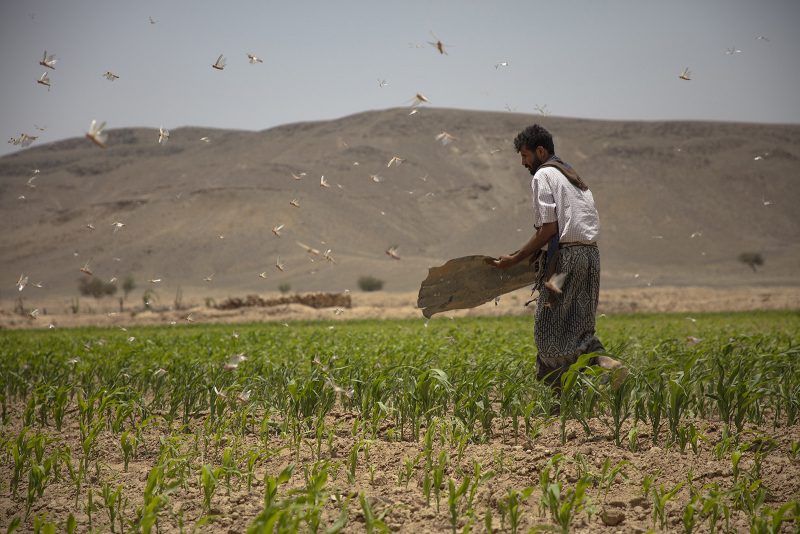
A Yemeni farmer tries to chase locusts off of his fields. Photo | UNFAO
Fertile soil, especially in the border areas in Saada and Hajjah, has become environmentally polluted due to the number of weapons dropped in more than half a million airstrikes. That pollution has not only affected the soil, experts fear it could genetically alter the pomegranates, grapes and coffee that were once staple crops in Yemen. Farmers and their families are at constant risk from unexploded ordnance, especially cluster bombs like the one that killed a young boy on his family farm in Hodeida last Thursday.
Agricultural and environmental experts that spoke to MintPress said that the effects of the Saudi coalition’s targeting of the agricultural sector will likely last for decades. The Director of Agricultural Extension in Yemen, Salah al-Mashreqi, said that more catastrophic effects will appear in the medium and long term, including genetic changes to pomegranates, for which Yemen is famous.
The deliberate targeting of food is prohibited by article 54 of the Geneva Conventions and the May 24, 2018, UN Security Council resolution 2417 on the protection of civilians in wartime, specifically reiterates this principle. Article 14 of the 1977 Protocol Additional to the Geneva Conventions clearly states that starvation as a means of combat is not allowed: ‘’It is prohibited to attack, destroy, remove, or render useless objects indispensable for the survival of the civilian population.” Yet the international community has done little to curb the Saudi-led coalitions use of starvation as a tactic of war in Yemen.
This, in large part, according to many Yemenis and legal scholars alike, is because Saudi Arabia enjoys the near-total diplomatic protection of the United States. Without that support, Saudi Arabia’s airstrikes, which rely on American contractors, targeting software, training, weapons, and technicians to target farmers that are concerned with little more than feeding themselves and their country, would not be possible.
Ahmed AbdulKareem is a Yemeni journalist. He covers the war in Yemen for MintPress News as well as local Yemeni media.
‘Thank God for Deep State’, ex-CIA boss says. Still think it’s a conspiracy theory?
By Nebojsa Malic | RT | November 1, 2019
In just a few short months, the US political establishment has gone from denying the existence of the ‘Deep State’ and calling it a conspiracy theory, to praising it as the bulwark of the Republic against President Donald Trump.
“Thank God for the ‘Deep State,’” declared former CIA director John E. McLaughlin at an event this week, describing the diplomats and intelligence officers testifying before the congressional impeachment inquiry as “people who are doing their duty or responding to a higher call.”
Lavishing praise on the ‘whistleblower’ intelligence officer whose complaint about Trump’s phone call launched the impeachment probe, McLaughlin said the intelligence community is “institutionally committed to objectivity and telling the truth.”
One would think this might be a bit rich, coming from the former deputy director of the CIA at the time of the infamous ‘Iraqi WMDs’ fiasco – and acting director for a time in 2004 – but McLaughlin’s comments were met with applause by the crowd at George Mason University’s Schar School of Policy and Government.
He wasn’t the only one to praise the Deep State either. Sitting right next to him was John Brennan, the CIA director under President Barack Obama, whose fingerprints are all over the so-called ‘Steele dossier’ and ‘Russiagate’, and who is now enjoying a rewarding career as a TV pundit accusing Trump of treason.
Brennan argued that the reason Trump “has a contentious relationship with the Deep State people… is because they tell the truth,” and praised the unelected intelligence and law enforcement officials for continuing to “do their work irrespective of what he’s going to do or say.”
Under normal circumstances, these admissions would be rather earth-shattering. It isn’t every day that former bosses of the intelligence apparatus basically admit that yes, they are meddling in the country’s politics, because they feel they have a “higher loyalty” – to borrow a phrase from ex-FBI boss James Comey, another member of this merry cabal – than to the chief executive elected by the American people.
Yet the response has been muted at best, with a silent shrug and the implicit “nothing to see here, move along” from the major outlets. That’s not particularly surprising, given the media’s role in the ‘Russiagate’ conspiracy. Why, just a couple weeks ago, the New York Times published an opinion piece praising the Deep State along the very same lines Brennan and McLaughlin would.
When Trump and his defenders talked about the Deep State during the ‘Russiagate’ hysteria, the very same outlets pooh-poohed them as insane, paranoid, and delusional. Now they say the Deep State is real, it’s always been real, and it’s acting in the best interests of the American Republic – and if you don’t believe it, you’re the one who’s insane, paranoid and delusional. Sense a pattern?
Whatever one may think of Trump, it beggars belief that the very people who cry the loudest about “our democracy” are elevating an unelected bureaucracy, spies and counter-spies as the arbiters of it. It almost makes you think the people responsible for pushing the ‘Russian meddling’ conspiracy theory may have done it as a smokescreen for their own (mis)deeds.
Oh, wait.
Questions Remain Over Alleged Death of Islamic State Leader
Strategic Culture Foundation | November 1, 2019
Russia’s Ministry of Defense this week said it had not seen any credible evidence that Abu Bakr al-Baghdadi, the leader of the Islamic State (IS) terror group, had been killed in northern Syria last weekend, allegedly in a daring US military operation.
US President Donald Trump boasted last Sunday that American Special Forces raided a base in Idlib Province, which purportedly led to al-Baghdadi’s death from a suicide explosion. The Pentagon said six other people were killed in the operation. In addition, two of al-Baghdadi’s children were killed when the IS leader blew himself up as American troops were closing in, according to Trump’s own dramatic telling of the event.
Curiously, Trump gave prominent thanks to Russia for its help in the logistics of carrying out the attack.
However, Russian MOD spokesman Major General Igor Konashenkov has subsequently stated that Russia was not involved in the raid, as Trump had claimed. He said that Russian flight data indicated that there were no US air strikes in the vicinity of the declared raid. The spokesman went further and remarked that there were doubts as to whether the assassination mission even took place in the way that Washington is publicly claiming.
Another anomaly in the official US account is that the base where al-Baghdadi was purportedly hiding out is in a location known to be a stronghold for another al-Qaeda affiliate that is a sworn enemy of their perceived rival jihadists belonging to IS. Why and how then was the IS leader able to maintain a base surrounded by enemy jihadists?
According to the New York Times, it is claimed that al-Baghdadi paid $67,000 to the rival terror group, Hurras al-Din, for protection. Somehow that sounds a dubious explanation.
A glaring omission in US media coverage of the alleged killing of al-Baghdadi is the historical background as to who he was and how his former so-called caliphate came into being straddling Iraq and Syria.
There is copious evidence that Iraqi-born al-Baghdadi was recruited by American intelligence while imprisoned during the US war on Iraq in the mid- to late-2000s. He was held in the notorious Abu Ghraib US-run torture prison, but subsequently was released by the Americans despite his known jihadist past. It was around 2012 that the Obama administration was covertly mobilizing and weaponizing jihadi assets to carry out its clandestine war for regime change against the Syrian government. It is believed that al-Baghdadi was a key CIA asset for the US dirty war in Syria, even though Washington was proclaiming its involvement in Syria was to “defeat IS” and other terror groups.
It is entirely plausible that US intelligence assets are “terminated” whenever it is politically convenient and when it is calculated that their usefulness has expired.
Trump and the mainstream US media depiction of a spectacular success in exterminating a feared terror chief is almost certainly a distortion of reality and events.
The way Trump in particular has crowed about the purported operation suggests he is seeking a boost to his re-election chances next year. The thuggish rhetoric of killing the IS leader “like a dog” smacks of Trump trying to project an image of a tough president.
More generally, the event has afforded US media to proclaim the virtue of American military power in apparently bringing a notorious renegade “to justice”.
The timing could not be more important. The nearly eight-year war in Syria has exposed the criminality of Washington and its NATO partners for fueling carnage. By contrast, the Syrian government and its Russian and Iranian allies have been vindicated in their long-held claims that a criminal US-backed aggression using terrorist proxies has been thwarted.
When Trump abandoned the Kurdish militants last month, the move was condemned for throwing Syria into further turmoil. It was Russia’s deft diplomacy which managed to contain the situation. At that point, Washington’s international credibility was scraping the barrel of duplicity and malign responsibility for conflict and chaos in Syria.
Hence, a sensational operation resembling “a movie” – as Trump put it – was a timely public relations remedy for Washington’s badly tarnished image. Ostensibly, “taking out” a terrorist leader gives the US the means to renew its propaganda narrative that it is “fighting against terrorism” rather than the reality of using terrorism for its regime-change wars and other imperialist objectives.
Was Abu Bakr al-Baghdadi killed last weekend? It is not the first time his “death” has been reported by US forces who have made similar claims in past years. There are too many questions and discrepancies to take Washington’s version of events as accurate. More plausibly, it was a carefully contrived propaganda stunt to burnish Washington’s disgraced image.
One thing for sure, however, is that the US will continue to use terror proxies and assets into the future in order to achieve its pernicious geopolitical aims. There are plenty more “al-Baghdadis” to be cultivated and orchestrated by Washington as it sows chaos and destruction in the Middle East and beyond for its selfish interests.
The “Deep State” Has Been Redefined as Career Bureaucrats Doing Their Patriotic Duty
By Edward J. Curtin | Behind the Curtain | October 31, 2019
It gets funny, this shallow analysis of the deep state that is currently big news. There’s something ghoulish about it, perfectly timed for Halloween and masked jokers. What was once ridiculed by the CIA and its attendant lackeys in the media as the paranoia of “conspiracy theorists” is now openly admitted in reverent tones of patriotic fervor. But with a twisted twist.
The corporate mass-media has recently discovered a “deep state” that they claim to be not some evil group of assassins who work for the super-rich owners of the country and murder their own president (JFK) and other unpatriotic dissidents (Malcom X, MLK, RK, among others) and undermine democracy home and abroad, but are now said to be just fine upstanding American citizens who work within the government bureaucracies and are patriotic believers in democracy intent on doing the right thing and keeping their jobs.
This redefinition has been in the works for a few years, and it shouldn’t be a surprise that this tricky treat was being prepared for our consumption a few years ago by The Council on Foreign Relations. In its September/October 2017 edition of its journal Foreign Affairs, Jon D. Michaels, in “Trump and the Deep State: The Government Strikes Back,” writes:
Furious at what they consider treachery by internal saboteurs, the president and his surrogates have responded by borrowing a bit of political science jargon, claiming to be victims of the “deep state,” a conspiracy of powerful, unelected bureaucrats secretly pursuing their own agenda. The concept of a deep state is valuable in its original context, the study of developing countries such as Egypt, Pakistan, and Turkey, where shadowy elites in the military and government ministries have been known to countermand or simply defy democratic directives. Yet it has little relevance to the United States, where governmental power structures are almost entirely transparent, egalitarian, and rule-bound.
The White House is correct to perceive widespread resistance inside the government to many of its endeavors. But the same way the administration’s media problems come not from “fake news” but simply from news, so its bureaucratic problems come not from an insidious, undemocratic “deep state” but simply from the state—the large, complex hive of people and procedures that constitute the U.S. federal government.
Notice how in these comical passages about U.S. government transparency and egalitarianism, Michaels slyly and falsely attributes to Trump the very definition – “unelected bureaucrats” – that in the next paragraph he claims to be the real deep state, which is just the state power structures. Pseudo-innocence conquers all here as there is no mention of the Democratic party, Russiagate, etc., and all the machinations led by the intelligence services and Democratic forces to oust Trump from the day he was elected. State power structures just move so quickly, as anyone knows who has studied the speed which bureaucracies operate. Ask Max Weber.
Drip by drip over the past few years, this “state bureaucracy” meme has been introduced by the mainstream media propagandists as they have gradually revealed that the government deep-staters are just doing their patriotic duty in trying openly to oust an elected president.
Many writers have commented on the recent New York Times article, Trump’s War on the ‘Deep State’ Turns Against Him asserting that the Times has finally admitted to the existence of the deep state, which is true as far as it goes, which is not too far. But in this game of deceptive revelations – going shallower to go deeper – what is missing is a focus on the linguistic mind control involved in the changed definition.
In a recent article by Robert W. Merry, whose intentions I am not questioning – New York Times Confirms: It’s Trump Versus the Deep State – originally published at The American Conservative and widely reprinted, the lead-in to the article proper reads: “Even the Gray Lady admits the president is up against a powerful bureaucracy that wants him sunk.” So the “powerful bureaucracy” redefinition, this immovable force of government bureaucrats, is slipped into public consciousness as what the deep state supposedly is. Gone are CIA conspirators and evil doers. In their place we find career civil servants doing their patriotic duty.
Then there is The New York Times’ columnist James Stewart who, appearing on the Today Show recently, where he was promoting his new book, told Savannah Guthrie that:
Well, you meet these characters in my book, and the fact is, in a sense, he’s right. There is a deep state… there is a bureaucracy in our country who has pledged to respect the Constitution, respect the rule of law. They do not work for the President. They work for the American people. And, as Comey told me in my book, ‘thank goodness for that,’ because they are protecting the Constitution and the people when individuals – we don’t have a monarch, we don’t have a dictator – they restrain them from crossing the boundaries of law. What Trump calls the deep state in the United States is protecting the American people and protecting the Constitution. It’s a positive thing in this sense.
So again we are told that the deep-state bureaucracy is defending the Constitution and protecting the American people, as James Comey told Stewart, “in my book, ‘thank goodness for that,’” as he put it so eloquently. These guys talk in books, of course, not person to person, but that is the level not just of English grammar and general stupidity, but of the brazen bullshit these guys are capable of.
This new and shallow deep state definition has buried the old meaning of the deep state as evil conspirators carrying out coup d’états, assassinations, and massive media propaganda campaigns at home and abroad, and who, by implication and direct declaration, never existed in the good old U.S.A. but only in countries such as Egypt, Turkey, and Pakistan where shadowy elites killed and deposed leaders and opponents in an endless series of coup d’états. No mention in Foreign Affairs, of course, of the American support for the ruthless leaders of these countries who have always been our dear allies when they obey our every order and serve as our servile proxies in murder and mayhem.
Even Edward Snowden, the courageous whistleblower in exile in Russia, in a recent interview with Joe Rogan, repeats this nonsense when he says the deep state is just “career government officials” who want to keep their jobs and who outlast presidents. From his own experience, he should know better. Much better.
Linguistic mind control is insidious like the slow drip of a water faucet. After a while you don’t hear it and just go about your business, even as your mind, like a rotting rubber washer, keeps disintegrating under propaganda’s endless reiterations.
To think that the deep state is government employees just doing their patriotic duty is plain idiocy and plainer propaganda.
Happy Halloween!
Assad casts doubt on ISIS leader’s death, draws parallels with Bin Laden’s killing
‘Americans will RESPAWN al-Baghdadi’

RT | October 31, 2019
Take any words from US politicians with a grain of salt, Syria’s Bashar Assad has urged, as he cast doubt on the story of the Islamic State leader being killed in US a raid, and compared it to the shady killing of Osama Bin Laden.
The widely publicized US special forces raid that allegedly killed Abu Bakr al-Baghdadi, the leader of the Islamic State (IS, formerly ISIS/ISIL) terrorist group, left more questions than answers and it should not be taken at the face value, the Syrian President cautioned, during a lengthy interview with state media on Thursday.
Damascus did not participate in the raid by any means, Assad stated, adding that he’d learned about the claim only through media reports. Adding imaginary participants into the operation is likely supposed to give it credibility, he added, while countries on such a list would likely be flattered to be a “part of a ‘great’ operation.”
“We do not need such credit. We are the ones fighting terrorism. We have no relations and have had no contact with any American institutions.”
Washington’s loud praise of its own actions, a picture of the ‘hero dog’ that took part in the raid and footage purportedly of the aerial strikes have not convinced Assad if it “actually took place or not.” Moreover, he thought the whole affair suspiciously resembled the 2011 killing of another notorious terrorist – Al Qaeda’s head Osama Bin Laden.
“Why were the remains of Baghdadi not shown? This is the same scenario that was followed with Bin Laden. If they are going to use different pretexts in order not to show the remains, let us recall how [former Iraqi] President Saddam Hussein was captured and how the whole operation was shown from A to Z; they showed pictures and video clips after they captured him.”
The killing of Saddam’s sons was also well-documented and widely publicized, Assad went on to add, suggesting that the Americans “hide everything” about both the killing of bin Laden and that of al-Baghdadi for a reason.
“This is part of the tricks played by the Americans. That is why we should not believe everything they say unless they come up with evidence. American politicians are actually guilty until proven innocent, not the other way around.”
All in all, it’s unlikely that death of the IS leader – if he really was killed – and even the ultimate destruction of the terrorist group would change anything, Assad said. The root of the problem – the Wahhabi ideology that is “more than two centuries old” would not disappear at once. The radical Islamist thought and al-Baghdadi were merely US tools all along, Assad claimed, adding that those tools could easily be re-purposed elsewhere.
“I believe the whole thing regarding this operation is a trick. Baghdadi will be recreated under a different name, a different individual, or ISIS in its entirety might be reproduced as needed under a different name but with the same thought and the same purpose. The director of the whole scenario is the same, the Americans.”
Leaked document reveals Sidewalk Labs’ Toronto plans
Private taxation, private roads, charter schools, corporate cops and judges, and punishment for people who choose privacy.
BoingBoing | October 30, 2019
Tomorrow, Toronto’s City Council will hold a key vote on Sidewalk Labs’s plan to privatize much of the city’s lakeshore in the name of creating a “smart city” owned by Google’s parent company, Alphabet.
Today, the Globe and Mail published a summary of Sidewalk Labs’s leaked “yellow book,” a 2016 document that lays out Sidewalk Labs’s vision for Toronto and future projects in Detroit, Denver, and Alameda.
The plan lays out a corporate-owned city similar to Lake Buena Vista, the privately owned municipality established by the Walt Disney Company on a massive tract of central Florida land that contains the Walt Disney World resort.
The plan calls for the creation of privately owned and regulated roads, charter schools in place of publicly administered schools, the power to levy and spend property taxes without democratic oversight, a corporate criminal justice system where the cops and judges work for Sidewalk Labs, and totalizing, top-to-bottom, continuous surveillance.
Torontonians who decline to “share” information with Sidewalk Labs will not receive the same level of services as those who do.
Sidewalk Labs says that the document does not reflect its current ambitions.
Sidewalk Labs previously grossly understated the scope of its ambitions. When we revealed that the company had secretly secured the right to build across virtually the city’s entire waterfront, they lied to us before finally admitting it.
Those choosing to remain anonymous would not be able to access all of the area’s services: Automated taxi services would not be available to anonymous users, and some merchants might be unable to accept cash, the book warns.
The document also describes reputation tools that would lead to a “new currency for community co-operation,” effectively establishing a social credit system. Sidewalk could use these tools to “hold people or businesses accountable” while rewarding good behaviour, such as by rewarding a business’s good customer service with an easier or cheaper renewal process on its licence.
This “accountability system based on personal identity” could also be used to make financial decisions.
“A borrower’s stellar record of past consumer behaviour could make a lender, for instance, more likely to back a risky transaction, perhaps with the interest rates influenced by digital reputation ratings,” it says.
Sidewalk Labs document reveals company’s early plans for data collection, tax powers, criminal justice [Tom Cardoso and Josh O’Kane/Globe and Mail]
The Failed FBI Plot to Paint Trump Doing Deals with Putin

Felix Sater
By Larry C. Johnson | Sic Semper Tyrannis | October 31, 2019
To appreciate the lies and corruption that are the foundation of the conspiracy to destroy the Presidency of Donald Trump by the FBI, the CIA and the DNI, one need only look at how Robert Mueller lied about FBI informants who were targeting the Trump team.
Let us look specifically at Felix Sater. Felix Sater has been a fully signed up Confidential Human Source for the FBI since 1998. His original plea deal was signed off on by Mueller’s deputy, Andrew Weismann. But you would not know any of this if you relied solely on the Mueller Report.
Here is how Mueller portrays Sater:
In approximately September 2015, Felix Sater, a New York based real estate advisor, contacted Michael Cohen, then-executive vice president of the Trump Organization and special counsel to Donald J. Trump. Sater had previously worked with the Trump Organization and advised it on a number of domestic and international projects. Sater had explored the possibility of a Trump Tower project in Moscow while working with the Trump Organization and therefore knew of the organization’s general interest in completing a deal there.
This is fundamentally dishonest. Sater was more than a mere “real estate advisor” who had previously worked with Trump. He was and is a fully signed up FBI Confidential Human Source. Not my opinion. It is a fact.
An excellent article by Newsweek reporter Bill Powell, Donald Trump Associate Felix Sater Is Linked to the Mob and the CIA—What’s His Role in the Russia Investigation?, provides an excellent review of Sater’s history and involvement with the FBI. One of the surprising revelations from Powell is that Felix Sater was a childhood friend of Michael Cohen, Trump’s lawyer. Let that sink in for a moment. The FBI informant, Felix Sater, was a long time friend of Cohen.
Sater was playing a role scripted by the FBI and deliberately designed to feed the meme that Trump was dealing with the Russians.
The covert op to paint Trump as a Russian stooge was not left to Sater alone. Christopher Steele, a British spy who was hired by Fusion GPS, conveniently produced a report insisting that the Russians were working overtime to get Trump in bed with them on “lucrative real estate deals.” The Steele report dated 20 June 2016 makes the following claims:
Speaking to a trusted compatriot in June 2016 sources A and B, a senior Russian Foreign Ministry figure and a former top level Russian intelligence officer still active inside the Kremlin respectively, the Russian authorities had been cultivating and supporting US Republican presidential candidate, Donald TRUMP for at least 5 years. . . .
In terms of specifics, Source A confided that the Kremlin had been feeding TRUMP and his team valuable intelligence on his opponents, including Democratic presidential candidate Hillary CLINTON, for several years (see more below). . . .
The Kremlin’s cultivation operation on TRUMP also had comprised offering him various lucrative real estate development business deals in Russia, especially in relation to the ongoing 2018 World Cup soccer tournament. How ever, so far, for reasons unknown, TRUMP had not taken up any of these.
Pay attention. Who offered Trump the deal in Moscow? FELIX SATER. Was he a Russian agent? No. He was the FBI’s Joe.
If the Steele Dossier was true, Trump should have had multiple offers for projects on in Russia, especially Moscow. Steele claims Putin’s people were feeding Trump information and opportunity. So where is the evidence of such activity? There is none. Just Felix Sater, FBI snitch.
Robert Mueller tried in vain to advance the lie that Trump was doing deals in Moscow. His report states:
In the late summer of 2015, the Trump Organization received a new inquiry about pursuing a Trump Tower project in Moscow. In approximately September 2015, Felix Sater . . . contacted Cohen (i.e., Michael Cohen) on behalf of I.C. Expert Investment Company (I.C. Expert), a Russian real-estate development corporation controlled by Andrei Vladimirovich Rozov. Sater had known Rozov since approximately 2007 and, in 2014, had served as an agent on behalf of Rozov during Rozov’s purchase of a building in New York City. Sater later contacted Rozov and proposed that I.C. Expert pursue a Trump Tower Moscow project in which I.C. Expert would license the name and brand from the Trump Organization but construct the building on its own. Sater worked on the deal with Rozov and another employee of I.C. Expert. (see page 69 of the Mueller Report).
Who was pushing the project in Moscow? FELIX SATER. Not Michael Cohen and certainly not Donald Trump. Sater was the instigator. At no time did he testify that he was directed by Trump or anyone else in the Trump organization to reachout to the Russians. And don’t forget what Christopher Steele claimed—the Russians were in a frenzy supposedly to offer Trump lucrative deals. That was and is a monumental lie.
Sater was and is an FBI informant. Sater was not just a private entrepreneur looking to make some coin. We know without a doubt that Sater was a fully signed up FBI informant. Sater’s status as an FBI snitch was first exposed in 2012 (you can read the letter confirming Sater’s status as an FBI snitch here). Another inconvenient fact excluded from the Mueller report is that one of Mueller’s Chief Prosecutors, Andrew Weissman, signed the deal with Felix Sater in December 1998 that put Sater into the FBI Informant business. Sater was used multiple times in the next decade by the FBI to make cases against Russian spies and mobsters.
How could Robert Mueller neglect to mention this critical fact? This was not the oversight of a senile old man. It was deliberate obfuscation.
The question that prosecutor Robert Durham needs to ask is who directed Sater to pitch the Trump team in September 2015 to pursue a deal in Moscow? The answer probably lies in Sater’s FD-1023s. A 1023 is a report that an FBI agent must file every time he meets with a Confidential Human Source. This was an orchestrated attempt to set up Donald Trump as a Russian stooge. But it did not start in July 2016 as the FBI falsely claims. It started in September 2015. Who authorized this?
Killing Julian Assange: Justice Denied When Exposing Official Wrongdoing
By Philip Giraldi | Strategic Culture Foundation | October 31, 2019
The hideous treatment of WikiLeaks founder Julian Assange continues and many observers are citing his case as being symptomatic of developing “police state” tendencies in both the United States and in Europe, where rule of law is being subordinated to political expediency.
Julian Assange was the founder and editor-in-chief of the controversial news and information site WikiLeaks. As the name implies, after 2006 the site became famous, or perhaps notorious, for its publication of materials that have been leaked to it by government officials and other sources who consider the information to be of value to the public but unlikely to be accepted by the mainstream media, which has become increasingly corporatized and timid.
WikiLeaks became known to a global audience back in 2010 when it obtained from US Army enlisted soldier Bradley Manning a large quantity of classified documents relating to the various wars that the United States was fighting in Asia. Some of the material included what might be regarded as war crimes.
WikiLeaks again became front page news over the 2016 presidential election, when the website released the emails of candidate Hillary Clinton and her campaign manager John Podesta. The emails revealed how Clinton and her team collaborated with the Democratic National Committee to ensure that she would be nominated rather than Bernie Sanders. It should be noted that the material released by WikiLeaks was largely documentary and factual in nature, i.e. it was not “fake news.”
Because he is a journalist ostensibly protected by the First Amendment guarantee of free speech, the handling of the “threat” posed by journalist Assange is inevitably somewhat different than a leak by a government official, referred to as a whistleblower. Assange has been vilified as an “enemy of the state,” likely even a Russian agent, and was initially pursued by Swedish authorities after claims of a rape, later withdrawn, were made against him. To avoid arrest, he was given asylum by a friendly Ecuadorean government seven years ago in London. The British police had an active warrant to arrest him immediately as he had failed to make a bail hearing after he obtained asylum, which is indeed what took place when Quito revoked his protected status in April.
As it turned out, Julian Assange was not exactly alone when he was in the Ecuadorean Embassy. All of his communications, including with his lawyers, were being intercepted by a Spanish security company hired for the purpose allegedly by the CIA. There apparently was also a CIA plan to kidnap Assange. In a normal court in a normal country, the government case would have been thrown out on constitutional and legal grounds, but that was not so in this instance. The United States has persisted in its demands to obtain the extradition of Assange from Britain and London seems to be more than willing to play along. Assange is undeniably hated by the American political Establishment and even much of the media in bipartisan fashion, with the Democrats blaming him for Hillary Clinton’s loss while Secretary of State Mike Pompeo has labeled him a “fraud, a coward and an enemy.” WikiLeaks itself is regarded by the White House as a “hostile non-government intelligence service.” Sending Julian Assange to prison for the rest of his life may be called justice, but it is really revenge against someone who has exposed government lies. Some American politicians have even asserted that jail is too good for Assange, insisting that he should instead be executed.
The actual charges laid out in the US indictment are for alleged conspiracy with Chelsea Manning to publish the “Iraq War Logs,” the “Afghan War Logs” and the US State Department cables. On May 23rd, the United States government further charged Assange with violating the Espionage Act of 1917, which criminalizes any exposure of classified US government information anywhere in the world by anyone. Its use would create a precedent: any investigative journalist who exposes US government malfeasance could be similarly charged.
Assange is currently incarcerated in solitary confinement at high-security Belmarsh prison. It is possible that the Justice Department, after it obtains Assange through extradition, will attempt to make the case that Assange actively colluded with the Russian government, a conspiracy to “defraud the United States” to put it in legalese. Assange is unlikely to receive anything approaching a fair trial no matter what the charges are.
Assange’s prison term ended on September 22nd, but an earlier procedural hearing at Westminster Magistrates’ Court had already decided that a full hearing on extradition to the US would not begin until February 25th, 2020. District Judge Vanessa Baraitser ruled that Assange would not be released even though the prison term had ended, because he was a flight risk. His status in the prison system was duly changed from a serving prisoner to a person facing extradition and his final hearing would be at the high security Belmarsh Magistrates’ Court rather than in a normal civil court. Belmarsh is where terrorists are routinely tried and the proceedings there permit only minimal public and media scrutiny.
Most recently, on October 21st, 2019, Assange was again in Westminster Magistrates’ Court for a “case management hearing” regarding his possible extradition to the US, Judge Baraitser denied a defense team request for a three-month delay so that they could gather evidence in light of the fact that Assange had been denied access to his own papers and documents in order to prepare his defense. British government prosecutor James Lewis QC and the five US “representatives” present opposed any delay in the extradition proceedings and were supported by Judge Baraitser, denying any delay in the proceedings.
Another procedural hearing will take place on December 19th followed by the full extradition hearing in February, at which time Assange will presumably be turned over to US Marshalls for transportation to the Federal prison in Virginia to await trial. That is, of course, assuming that he lives that long as his health has visibly deteriorated and there have been claims that he has been tortured by the British authorities.
Former British Ambassador Craig Murray, who knows Julian Assange well, was present when he appeared in court on the 21st. Murray was shocked by Assange’s appearance, noting that he had lost weight and looked like he had aged considerably. He was walking with a pronounced limp and when the judge asked him questions, to include his name and date of birth, he had trouble responding. Murray described him as a “shambling, incoherent wreck” and also concluded that “one of the greatest journalists and most important dissidents of our times is being tortured to death by the state, before our eyes.”
The British court was oblivious to Assange’s poor condition, with Judge Baraitser telling the clearly struggling prisoner that if he were incapable of following proceedings, then his lawyers could explain what had happened to him later. Objections to what was happening made by both Assange and his lawyers were dismissed by the Crown’s legal representatives, often after discussions with the American officials present, a process described in full by Murray, who, after describing the miscarriage of justice he had just witnessed observed that Julian Assange is being “slowly killed in public sight and arraigned on a charge of publishing the truth about government wrongdoing.” He concluded that “Unless Julian is released shortly he will be destroyed. If the state can do this, then who is next?” Indeed.
Hoax Alert: The Trump Swastika of Yale (2019)
Semitic Controversies | October 29, 2019
According to the ‘Jewish Daily Forward’ there has been another so-called ‘anti-Semitic hate crime’ at Yale University’s Law School.
To wit:
‘A white, spray-painted swastika appearing above the word “Trump” was found on the Yale Law School campus over the weekend an an act referred to as “utterly antithetical” to the school’s values.
The graffiti, which, the Yale Daily News reports, was covered by noon on Sunday with black paint and a doormat, appears to have been painted late Saturday or early Sunday morning on the steps to a side entrance. The hate symbol has since been washed away.
“We are saddened by this act of hate against our community at any time but understand that this is particularly difficult occurring between the High Holy Days,” Ellen Cosgrove, associate dean of students at Yale Law School, told the Yale Daily News.
The Jewish chaplain at Yale, Rabbi Jason Rubenstein wrote an email to the school’s Jewish community, stating that investigators were looking at video footage to find the suspect, and added that there was “no evidence that this incident is part of a larger campaign.”
Yale Law School has produced a great many Jewish jurists who go on to great things, including former Treasury Secretary Robert E. Rubin, defense attorney and Harvard professor Alan Dershowitz, actor and speech writer Ben Stein and author Elizabeth Wurtzel. The school is currently home to a number of Jewish faculty, including constitutional law scholar Jed Rubenfeld, Pulitzer-winning reporter Linda Greenhouse and former president of the Israeli Supreme Court Aharon Barak.
The Yale Daily News noted that swastikas were found twice before at the old campus in 2008 and 2014.’ (1)
Now anyone with half-a-brain can guess that what has been removed from this ‘anti-Semitic hate crime’ to make it… well… ‘anti-Semitic’ is the word ‘Trump’. The obvious fact that this is a bit of anti-Trump graffiti – hence the word ‘Trump’ with a Swastika aka ‘Trump is a Nazi’ – has apparently passed the Jewish Daily Forward by.
References
Washington’s Armenian Genocide Recognition Is Politically Motivated, But Does That Matter?
U.S. Deals Another Blow To Washington-Ankara Relations
By Paul Antonopoulos | October 31, 2019
A historical moment was achieved on October 29 for the Armenian lobby in the U.S. after the House of Representatives recognized the Armenian genocide, with 405 votes in favor and 11 against the Resolution. This timely move was certainly aimed at provoking Turkey, who has consistently denied that the foundation of the modern Republic of Turkey was built on the ethnic cleansing of the Christian minorities in the country, particularly the Armenians, Greeks and Assyrians. There is little doubt that this belated recognition by the U.S. was chosen to be announced on Republic Day, a public holiday in Turkey commemorating the proclamation of the Republic of Turkey on 29 October 1923.
Although the resolution focuses primarily on the Armenian genocide, it also recognizes the genocide against “Greeks, Assyrians, Chaldeans, Syriacs, Arameans, Maronites, and other Christians.” The resolution also makes mention of U.S. Ambassador to the Ottoman Empire from 1913 to 1916, Henry Morgenthau, who described the empire’s “campaign of race extermination,” and was instructed on July 16, 1915, by U.S. Secretary of State Robert Lansing “to stop Armenian persecution.”
The resolution also highlights other instances in history where the U.S. recognized the genocide, but of course makes no mention of why the recognition has occurred now? The Armenian lobby in the U.S. has been pushing for genocide recognition for decades, but recognition was only achieved on Tuesday. With over 400 votes in favor, President Donald Trump cannot veto the resolution even if he wanted.
Normally at odds with each, Turkey’s ruling Justice and Development Party (AKP) and opposition Republican People’s Party (CHP), along with all other sectors of Turkish society and political establishment, denounced the U.S. recognition. There is little doubt that the recognition is politically motivated, with Turkish Foreign Minister Mevlüt Çavuşoğlu claiming the U.S. are wanting “to take revenge” over their differences in Syria and CHP leader Kemal Kılıçdaroğlu stating that “You cannot use the events of history to take revenge politically.”
With Washington-Ankara becoming increasingly distant because of Turkey’s insistence on buying the Russian S-400 and conducting an operation against the Syrian branch of the Kurdistan Worker’s Party (PKK), the People’s Protection Units (YPG), that the U.S. has financially and military supported despite Ankara’s insistence that they’re a terrorist organization, Washington’s move to recognize the Armenian genocide is in conjunction to sanctions and bitter rhetoric between the two countries.
Rather, this proves that the Armenian genocide recognition should have been a moral imperative for the U.S., but Washington never did so to appease Turkey. As the U.S. and Turkey are members of the anti-Russian NATO, the issue of genocide recognition, despite significant pressures from the Armenian lobby, found no success in Washington. Turkey controls the Dardanelles and the Bosporus straits, Russia’s only access to its only warm water ports in their country. Although international law guarantees freedom of navigation through the waterways, in any hypothetical war between NATO and Russia, blocking Russia in the Black Sea would be a priority.
With Turkey continually defying the U.S. and improving its relations with Russia, Washington is now finding alternatives to Turkey. It is for this reason that the U.S. has opened three new military bases in Greece and made the Mediterranean country a Plan B option against Russia in case of Turkey’s continued insubordination. With a bolstered American presence in Greece, the U.S. feels it is in a comfortable position to potentially blockade Russia and/or Turkey if it ever had to do so, making it a well-timed moment to recognize the genocide.
Çavuşoğlu and Kılıçdaroğlu are justified in their claims that the U.S. recognition of the Armenian genocide is politically motivated, but also the very fact that the recognition was not made decades ago was also politically motivated to appease Turkey and ensure their loyalty to NATO. With Turkish President Recep Tayyip Erdoğan claiming that the resolution has “no legal force” as only “historians […] and not politicians, should decide on this issue,” he does not build a strong case for Turkey as it is nearly unanimous by genocide historians and scholars that the ethnic cleansing of the Armenians, Greeks, Assyrians and other Christians in the late Ottoman period definitely occurred with organization and structure.
More curious is the fact that several Kurdish organizations and political parties have not only recognized the Armenian genocide, but also apologized for their ancestor’s role in following orders from Turkish authorities in Constantinople to massacre and ethnically cleanse Armenians and Assyrians. Included in recognizing and apologizing for the genocide are the PKK, the Turkey-based Peoples’ Democratic Party and the Iraqi-based Kurdistan Democratic Party.
With the modern Republic of Turkey built on a Turkification process, with some of my own family members forced to change their surname into a more Turkish-sounding name in living memory, coupled with Turkish national hero Mustafa Kemal Atatürk’s slogan of “Ne mutlu Türküm diyene!” (How happy is the one who calls himself a Turk!) that had to be recited by every student in Turkey as an Oath until it was annulled by the AKP government in 2013, the Armenian genocide recognition by the U.S. is a step in restoring Armenian, Greek and Assyrian ethnic and religious identity in Turkey.
Justice Minister Abdulhamit Gul is justified to say that the U.S. should look at its own history before accusing others of genocide. This argument though does not absolve Turkey from facing its dark history, apologize and try and create more friendly relations with Greece, Armenia and the Christian minorities who remain in Turkey.
Russia has recognized the Armenian genocide since 1995 and today it has little impact on Russian-Turkish relations. Rather, this latest provocation by the U.S. against Turkey is likely to just push Ankara closer to Moscow because of the motive and timing of the Armenian recognition.
There is little doubt that the U.S. recognizing the Armenian genocide is politically motivated. However, this does not negate the fact that the decades of non-recognition was also politically motivated. Although late in recognizing the genocide compared to other European countries, it is likely that Washington’s recognition will have a far greater impact then the Russian, French or German recognition. It is likely we will begin seeing extremely pro-U.S. states like the United Kingdom, and perhaps even Israel, following this move.
Therefore, does it matter why the U.S. has decided to now recognize the genocide when it did?
Paul Antonopoulos is a Research Fellow at the Center for Syncretic Studies.
Climate change denial is the new ‘flat Earth’ & causes WILDFIRES, California ex-governor testifies
RT | October 30, 2019
Add California’s wildfires to the list of problems caused by US President Donald Trump. The state’s former governor has warned Trump and his fellow Republicans that “the blood is on your soul”… for denying climate change.
“California’s burning while the deniers make a joke out of the standards that protect us all. The blood is on your soul here and I hope you wake up,” former governor Jerry Brown snarled, during a House Oversight Committee hearing on the Trump administration’s recent decision to bar California from setting its own auto emissions standards. “This is not politics, this is life, this is morality… this is real,” he continued.
“Climate change is real, it’s happening, and you and everyone else will recognize that.”
Brown likened Trump and his fellow climate change skeptics to believers in “flat Earth,” claiming climate change is directly responsible for the wildfires currently engulfing swathes of California. While at least two of this year’s fires are actually believed to have been caused by malfunctioning PG&E power lines – like last year’s devastating Camp Fire, which wiped out an entire town – Brown has glossed over the notoriously mismanaged utility to pin the blame on hotter, drier weather. The only solution? “Limiting our carbon pollution,” he told reporters in 2015, defying climate scientists who suggested that that year’s fires were not caused by anything of the sort.
The House called Brown and other “experts” to testify against the White House’s decision to quash the waiver that had allowed California to set its own vehicle emissions standards and effectively control the whole country’s auto industry. Car companies can hardly afford to manufacture two separate versions of the same vehicle, and California has more drivers than any other state, so they can’t ignore the stricter emissions rules either.
Democrats, including current California governor Gavin Newsom, have slammed the move as “reckless and politically motivated,” a symbol of Big Oil’s iron grip on the Environmental Protection Agency and other regulators. The White House, however, has claimed that stricter emissions standards make vehicles more expensive, meaning fewer people will drive these energy-efficient cars. The rule change is due to take effect next month.
Featured Video

John Mearsheimer: New World Order Arrived & Europe Is Left Behind
or go to
Aletho News Archives – Video-Images
Book Review
Sunset on Net Zero: A Heretic’s Guide to the Futile CO2 Target
By Ronald Paul Barmby (Author) – October 3, 2025
SUNSET ON NET ZERO describes in detail why Net Zero CO2 is pointless and unachievable. It explains in understandable terms the up-to- date thoughts of the greatest minds of today in physics, meteorology, economics, engineering, and the geosciences.
Net Zero CO2 is pointless because we have now confirmed by satellites that 90% of CO2 warming has already happened. CO2 is not an existential threat but clouds, El-Niño, and human habitation are significant drivers of global warming that are often ignored.
Net Zero CO2 is unachievable because the green technology alternatives are unreliable and unaffordable. Wind and solar power triple electricity costs, building fully electric vehicles produces at least one-half of CO2 emissions they are meant to avoid, and heat pumps will leave you dangerously cold in the winter. Green hydrogen, air capture CO2, and carbon capture and storage are prescriptions for national bankruptcy. The supply of key metals and minerals required to achieve Net Zero need to be at least doubled—some much more—and are often controlled by a very few. Net Zero comes with huge environmental and agricultural costs.
We have been through similar climatic temperature changes before, more recently than you think. Our efforts to control it are futile.
Blog Roll
 Aletho News
- FDA Ordered to Pay Over $570,000 in Fight Over Pfizer COVID Vaccine Records
- USAID turned to Facebook to drive demand for Covid vaccines in Global South – files
- Britain’s shadow security network expands into south Lebanon
- The ADL Has a Foreign Policy, and You Are Not Supposed to See It
- Former Qatari PM says ‘Israel’ has security ties with all Gulf states
- The Sound of Silence in the Strait of Hormuz
- Poland’s call for a no-fly zone in Ukraine means NATO direct war with Russia
- John Mearsheimer: New World Order Arrived & Europe Is Left Behind
- Naqab demolition notices top 1,000; settlers demolish Jaloud homes
- Israel is Using the ‘Gaza Ceasefire’ to Commit Ethnic Cleansing
- If Americans Knew
- An error has occurred; the feed is probably down. Try again later.
- No Tricks Zone
- Physicists: Doubling CO2 Has A Smaller Impact On Ocean ‘Acidification’ Than Existing Internal Variability
- Alarmist Climatologists In Shock! 2026 Atlantic Hurricane Season Sees Lowest Count In 101 Years
- New Study: Modern Temps Are Among The Coldest Of The Last 10,000 Years In East Central Europe
- Germany’s Renewable Energies Lead to 1.4 Billion Euro Electric Power Trade Deficit
- Argentina’s Perito Moreno Glacier Joins Antarctica and Arctic In Defying Doomsday Melt Claims
- New Study: Barents Sea Temperatures Were Warmer And Sea Ice Less Extensive In The 1700s Than Today
- German Authorities Start Initiative To Evaluate Public Register For Climate “Disinformation” Spreaders!
- Zonal Asymmetry of Temperature Change in the Antarctic Circumpolar Current
- New Study: The Net Fossil Fuel Contribution To Rising Atmospheric CO2 Has Been Zero For 500 Years
- Germany’s Green Energy Transition Becoming Increasingly Expensive…Another 6 Trillion Euros!

