Ukraine gains from Trump’s impeachment inquiry
By M. K. BHADRAKUMAR | Indian Punchline | October 2, 2019
The controversy swirling around the phone conversation between the US President Donald Trump and Ukraine President Vladimir Zelensky regarding the business interests of former vice-president Joe Biden’s son is having a salutary effect on the conflict in Ukraine.
The US Special Representative for Ukraine Kurt Volker has resigned from his official position once it transpired that his name appeared in the whistleblower complaint about Trump’s dealings with Zelensky. (Meanwhile, Trump’s personal lawyer, Rudy Giuliani, also implicated Volker saying that the latter encouraged him to speak to Ukrainian officials regarding Biden and his son Hunter Biden.) Volker is expected to testify in the Congress’ impeachment inquiry on Thursday.
Now, Volker also enjoys an impeccable reputation as a Russia hawk with extensive diplomatic experience on that front in NATO previously. He recently said that “there is a long way to go before there would be any normalisation between the two countries (Russia and Ukraine). Russia’s invasion, occupation, and claimed annexation of Crimea will never be accepted by Ukraine.”
Volker’s exit is the surest sign that for the foreseeable future, US-Ukraine relations have become toxic. Put differently, for the first time after the “regime change” in Ukraine in 2014, no US official worth his salt will want to risk hobnobbing with the powers that be in Kiev.
This “hands-off” phase gives Zelensky a free hand to handle his country’s relations with Russia. The same holds good for Moscow which gets an opportunity to deal with Kiev without the Americans breathing over the neck of the Ukrainian president.
It is in this backdrop that we need to asses the outcome of the meeting of the Trilateral Contact Group on Ukraine – Ukraine, Russia and the Organization for Security and Cooperation in Europe — in Minsk on October 1. The meeting agreed to a peace process known as the “Steinmeier Formula,” green-lighting local elections in the Russian-controlled regions of Donbas.
The meeting agreed that the warring parties will withdraw their military and equipment in Donbas, dismantle fortifications, and conduct de-mining. The agreement envisages that the separatist regions will get a special self-governing status after they hold local elections. (The pro-Russia separatists are seeking a special status allowing for self-governance in the Donbas region, large parts of which have been under their control since April 2014.)
In preparation for the election, the Ukrainian government and separatist leaders will withdraw troops from two locations in the Donetsk and Luhansk regions next week. No doubt, this development signifies a major step by Zelensky toward resolution of the conflict in eastern Ukraine.
The “Steinmeier Formula” is a concept attributed to then German Foreign Minister (presently president of Germany), Frank-Walter Steinmeier dating back to 2015-2016, designed to implement the political clauses of the Minsk “accords” (2014 and 2015) to settle the conflict in Donbas.
However, the concept could not be implemented due to Kiev’s reservations (under American pressure.) Washington persuaded Kiev that Steinmeier’s Formula in effect served to legitimise Russia’s “proxies” in the separatist regions by means of staging local elections, which in turn aimed at allowing Russia’s de facto control of that territory, even if the territory were to be notionally reinserted into Ukraine.
The former pro-US Ukrainian President Petro Poroshenko simply refused to work with Russia, Germany and France to codify Steinmeier’s Formula. Indeed, the US strategy aimed at preventing any “thaw” between Kiev and Moscow.
Poroshenko maintained that holding democratically valid elections in Donbas under the shadow of a Russian presence there was unthinkable. Volker too repeatedly articulated this stance. In early September, Volker was quoted as saying that a secure environment would have to be established in Donbas before implementing the political and technical procedures for holding elections.
Volker underscored that as minimal preconditions to a secure environment, the Russian military must withdraw from Donbas, the Russian-backed separatist forces must be dissolved, and the Ukrainian side of the border has to be brought under non-Russian control.
The Russian interpretation of the Minsk accords has been that all solutions (special status, elections, border control, etc.) be negotiated between Kiev and the separatist leaders in Donbas. Germany and France do not challenge the Russian interpretation.
Therefore, the breakthrough on Tuesday must be equally attributed to the political transition in Kiev leading to the election of Zelensky (on a mandate of resolving the conflict in Donbas and normalising relations with Russia) as well as the elbow room he is getting lately to shake off American pressure. Volker’s exit will do a world of good for resolving the Donbas conflict.
The agreement on October 1 paves the way for a summit between Zelensky and the leaders of Russia, France and Germany within the ambit of the “Normandy Four” (France, Germany, Russia and Ukraine). Russia had previously refused such a meeting, unless Ukraine agreed to hold local election in the Donbas region.
On Tuesday, Zelensky said that nothing should stand in the way of the summit, and that a date would be announced soon. The French President Emmanuel Macron said he expected the summit in the coming weeks.
Germany, which authored the Steinmeier Formula, feels gratified. The German Foreign Minister Heiko Maas said, “I am glad that the constructive atmosphere at the session of the Contact Group in Minsk has led to long-awaited progress. This makes way for the Normandy Four summit and further steps in the implementation of the Minsk Agreements.”
The Kremlin concurs, too.
The “big picture” is that Russia’s relations with the European powers are looking up, finally. The close consultations between Macron and Russian President Vladimir Putin in the recent weeks and months are resulting in a determined effort to address the frozen conflict in Ukraine, which had led to the EU sanctions against Russia. (See my blog Eurasian politics on the cusp of change.)
On the other hand, liberated from the clutches of manipulative American diplomats, especially following Volker’s exit, Zelensky can be expected to advance his strategy to improve relations with Russia. In fact, Zelensky has lost no time to initiate the first steps to introduce legislation giving “special status” to Donbas.
“We will have a new law, that will be drafted by the parliament in close cooperation with the public after a public discussion. No red lines will be crossed in it, and that is why there will be no capitulation,” Zelensky said on Tuesday.
Former Israeli Intel Official Claims Jeffrey Epstein, Ghislaine Maxwell Worked for Israeli Intel
Graphic by Claudio Cabrera
By Whitney Webb – Mint Press News – October 2, 2019
A recent interview given by a former high-ranking official in Israeli military intelligence has claimed that Jeffrey Epstein’s sexual blackmail enterprise was an Israel intelligence operation run for the purpose of entrapping powerful individuals and politicians in the United States and abroad.
Since the apparent death by suicide of Jeffrey Epstein in a Manhattan prison, much has come to light about his depraved activities and methods used to sexually abuse underage girls and entrap the rich and powerful for the purposes of blackmail. Epstein’s ties to intelligence, described in-depth in a recent MintPress investigative series, have continued to receive minimal mainstream media coverage, which has essentially moved on from the Epstein scandal despite the fact that his many co-conspirators remain on the loose.
For those who have examined Epstein’s ties to intelligence, there are clear links to both U.S. intelligence and Israeli intelligence, leaving it somewhat open to debate as to which country’s intelligence apparatus was closest to Epstein and most involved in his blackmail/sex-trafficking activities. A recent interview given by a former high-ranking official in Israeli military intelligence has claimed that Epstein’s sexual blackmail enterprise was an Israel intelligence operation run for the purpose of entrapping powerful individuals and politicians in the United States and abroad.
In an interview with Zev Shalev, former CBS News executive producer and award-winning investigative journalist for Narativ, the former senior executive for Israel’s Directorate of Military Intelligence, Ari Ben-Menashe, claimed not only to have met Jeffrey Epstein and his alleged madam, Ghislaine Maxwell, back in the 1980s, but that both Epstein and Maxwell were already working with Israeli intelligence during that time period.
“They found a niche”
In an interview last week with the independent outlet Narativ, Ben-Menashe, who himself was involved in Iran-Contra arms deals, told his interviewer Zev Shalev that he had been introduced to Jeffrey Epstein by Robert Maxwell in the mid-1980s while Maxwell’s and Ben-Menashe’s involvement with Iran-Contra was ongoing. Ben-Menashe did not specify the year he met Epstein.
Ben-Menashe told Shalev that “he [Maxwell] wanted us to accept him [Epstein] as part of our group …. I’m not denying that we were at the time a group that it was Nick Davies [Foreign Editor of the Maxwell-Owned Daily Mirror], it was Maxwell, it was myself and our team from Israel, we were doing what we were doing.” Past reporting by Seymour Hersh and others revealed that Maxwell, Davies and Ben-Menashe were involved in the transfer and sale of military equipment and weapons from Israel to Iran on behalf of Israeli intelligence during this time period.
He then added that Maxwell had stated during the introduction that “your Israeli bosses have already approved” of Epstein. Shalev later noted that Maxwell “had an extensive network in Israel at the time, which included the then-Prime Minister Ariel Sharon, according to Ben-Menashe.”
Ben-Menashe went on to say that he had “met him [Epstein] a few times in Maxwell’s office, that was it.” He also said he was not aware of Epstein being involved in arms deals for anyone else he knew at the time, but that Maxwell wanted to involve Epstein in the arms transfer in which he, Davies and Ben-Menashe were engaged on Israel’s behalf.
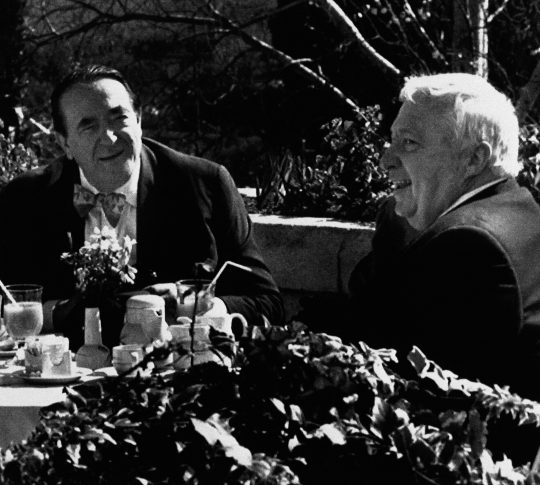
Ariel Sharon (right) meets with Robert Maxwell in Jerusalem on Feb. 20, 1990. Photo | AP
However, as MintPress reported in Part IV of the investigative series “Inside the Jeffrey Epstein Scandal: Too Big to Fail,” Epstein was involved with several arms dealers during this period of time, some of whom were directly involved in Iran-Contra arms deals between Israel and Iran. For instance, after leaving Bear Stearns in 1981, Epstein began working in the realms of shadow finance as a self-described “financial bounty hunter,” where he would both hunt down and hide money for powerful people. One of these powerful individuals was Adnan Khashoggi, a Saudi arms dealer with close ties to both Israeli and U.S. intelligence and one of the main brokers of Iran-Contra arms deals between Israel and Iran. Epstein would later forge a business relationship with a CIA front company involved in another aspect of Iran-Contra, the airline Southern Air Transport, on behalf of Leslie Wexner’s company, The Limited.
During this period, it is also known that Epstein became well acquainted with the British arms dealer Sir Douglas Leese, who collaborated with Khashoggi on at least one British-Saudi arms deal in the 1980s. Leese would later introduce Epstein to Steven Hoffenberg, calling Epstein a “genius” and describing his lack of morals during that introduction. Thus, there are indications that Epstein was involved with Middle Eastern arms deals, including some related to Iran-Contra, during this period. In addition, Epstein would later claim (and then subsequently deny) having worked for the CIA during this period.
After having been introduced to Epstein, Ben-Menashe claimed that neither he nor Davies were impressed with Epstein and considered him “not very competent.” He added that Ghislaine Maxwell had “fallen for” Epstein and that he believed that the romantic relationship between his daughter and Epstein led Robert Maxwell to work to bring the latter into the “family business” — i.e., Maxwell’s dealings with Israeli intelligence. This information is very revealing, given that the narrative, until now at least, has been that Ghislaine Maxwell and Jeffrey Epstein did not meet and begin their relationship until after Robert Maxwell’s death in 1991, after which Ghislaine moved to New York.
Ben-Menashe says that well after the introduction, though again he does not specify what year, Ghislaine Maxwell and Jeffrey Epstein began a sexual blackmail operation with the purpose of extorting U.S. political and public figures on behalf of Israeli military intelligence. He stated:
In this case what really happened, my take on it, in the later thing, is that these guys were seen as agents. They weren’t really competent to do very much. And so they found a niche for themselves — blackmailing American and other political figures.”
He then confirmed, when prompted, that they were blackmailing Americans on behalf of Israeli intelligence.
In response to his statement, Zev Shalev replied, “But, you know, for most people it’s hard for them to think of Israel as being … blackmailing their leaders in the United States, it’s a very …” at which point, Ben-Menashe interrupted and the following exchange took place:
Ari Ben-Menashe: You’re kidding? [laughs]…. It was quite their M.O. Sleeping around is not a crime, it may be embarrassing, but it’s not a crime, but sleeping with underage girls is a crime.
Shalev: It was a crime in 2000 as well, but they let him off that…
Ben-Menashe: And that it is [why] always so he [Epstein] made sure these girls were underage.
In addition, when Shalev asked Ben-Menashe about the relationship between Jeffrey Epstein and former Israeli Prime Minister Ehud Barak, Ben-Menashe stated “After a while, you know, what Mr. Epstein was doing was collecting intelligence on people in the United States. And so if you want to go to the U.S. if you’re a high-profile politician you want to know information about people.” Ben-Menashe subsequently stated that Barak was obtaining compromising information (i.e., blackmail) that Epstein had acquired on powerful people in the United States.
PROMIS, sex, and blackmail
If Robert Maxwell did recruit Epstein and bring him into the “family business” and the world of Israeli intelligence, as Ben-Menashe has claimed, it provides supporting evidence for information provided to MintPress by a former U.S. intelligence official, who chose to remain anonymous in light of the sensitivity of the claim.
This source, who has direct knowledge of the unauthorized use of PROMIS to support covert U.S. and Israeli intelligence projects, told MintPress that “some of the proceeds from the illicit sales of PROMIS were made available to Jeffrey Epstein for use in compromising targets of political blackmail.” As was noted in a Mintpress series on the Epstein scandal, much of Epstein’s funding also came from Ohio billionaire Leslie Wexner, who has documented ties to both organized crime and U.S. and Israeli intelligence.
After the PROMIS software was stolen from its rightful owner and developer, Inslaw Inc., through the collusion of both U.S. and Israeli officials, it was marketed mainly by two men: Earl Brian, a close aide to Ronald Reagan, later U.S. envoy to Iran and close friend of Israeli spymaster Rafi Eitan; and Robert Maxwell. Brian sold the bugged software through his company, Hadron Inc., while Maxwell sold it through an Israeli company he acquired called Degem. Before and following Maxwell’s acquisition of Degem, the company was a known front for Mossad operations and Mossad operatives in Latin America often posed as Degem employees.
With Maxwell — Epstein’s alleged recruiter and father of Epstein’s alleged madam — having been one of the main salespeople involved in selling PROMIS software on behalf of intelligence, he would have been in a key position to furnish Epstein’s nascent sexual blackmail operation with the proceeds from the sale of PROMIS.
This link between Epstein’s sexual blackmail operation and the PROMIS software scandal is notable given that the illicit use of PROMIS by U.S. and Israeli intelligence has been for blackmail purposes on U.S. public figures and politicians, as was described in a recent MintPress report.
Can an ex-spy be trusted?
When dealing in the world of deception and intrigue that defines intelligence operations, it is often difficult to determine whether any individual linked to an intelligence agency is telling the truth. Indeed, in the United States, there are examples of elected intelligence officials committing perjury and lying to Congress on several occasions with no consequences, and of intelligence officials feeding politically motivated and untrue information to agency assets in the media.
So, are Ari Ben-Menashe’s claims regarding Epstein and the Maxwells trustworthy? In addition to the aforementioned, corroborating information for his claims, a review of Ben-Menashe’s post-intelligence career suggests this is the case.
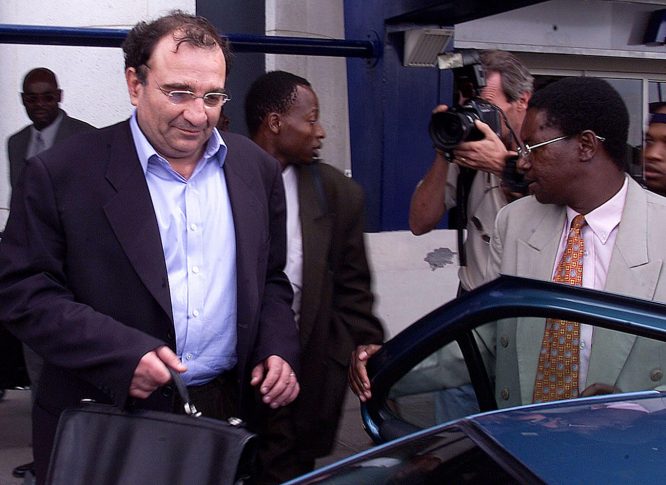
Ari Ben-Menashe arrives at Harare International Airport, in Zimbabwe, Feb. 22, 2002. Photo | AP
Prior to his arrest in November 1989, Ben-Menashe was a high-ranking officer in a special unit of Israeli military intelligence. He would later claim that his arrest for attempting to sell American-made weapons to Iran was politically motivated, as he had threatened to expose what the U.S. government had done with the stolen PROMIS software if the U.S. did not cease providing Saddam Hussein’s Iraq with chemical weapons. Ben-Menashe was later acquitted when a U.S. court determined that his involvement in the attempted sale of military equipment to Iran was done on behalf of the Israeli state.
After his arrest, Ben-Menashe was visited in prison by Robert Parry, the former Newsweek contributor and Associated Press reporter who would later found and run Consortium News until his recent passing last year. Parry remembered that, during that interview, “Ben-Menashe offered me startling new information about the Iran-Contra scandal, which I thought that I knew quite well.”
Israel’s government immediately began to attack Ben-Menashe’s credibility following his interview with Parry, and claimed that Ben-Menashe had never worked for Israeli intelligence. When Parry soon found evidence that Ben-Menashe had indeed served in Israeli military intelligence, Israel’s government was then forced to admit that he had worked for military intelligence, but only as a “low-level translator.” Yet, the documentation Parry had uncovered described Ben-Menashe as having served in “key positions” and performed “complex and sensitive assignments.”
A year later, Ben-Menashe would be interviewed by another journalist, Seymour Hersh. It would be Ben-Menashe who first revealed to Hersh secrets about Israel’s nuclear program and the fact that British media mogul Robert Maxwell was an Israeli spy, revelations that Hersh would not only independently corroborate but include in his book The Samson Option: Israel’s Nuclear Arsenal and American Foreign Policy. Hersh was then sued by Robert Maxwell and the Maxwell-owned Mirror Group for libel. The case was later settled in Hersh’s favor, as the claims Hersh had made were true and not libelous. As a result, the Mirror Group paid Hersh for damages, covered his legal costs, and issued him a formal apology.
After Ben-Menashe’s interviews by Hersh and Parry, Israel’s government was apparently concerned enough about what Ben-Menashe would tell congressional investigators that it attempted to kidnap him and bring him back to Israel to face state charges, much like Israeli intelligence had done to Israel’s nuclear-weapons whistleblower Mordechai Vanunu. The plan was foiled largely thanks to Parry.
Parry, who broke many key stories related to the Iran-Contra scandal in the 1980s and beyond, was tipped off by a U.S. intelligence source about a joint U.S.-Israel plan to have Ben-Menashe be denied entry to the United States on his planned trip to give congressional testimony. Per the plan, Ben-Menashe would be denied entry to the U.S. in Los Angeles and then be deported to Israel, where he would have stood trial for “exposing state secrets.” Parry called Ben-Menashe and convinced him to delay his flight until he secured a guarantee for safe passage from the U.S. government.
Ben-Menashe subsequently gave a sworn statement to the House Judiciary Committee that mostly focused on U.S.-Israel collusion regarding the theft and creation of a “backdoor” into the PROMIS software. Ben-Menashe offered to name names and provide corroborating evidence for several of his claims if he was offered immunity by the committee, which, for whatever reason declined that request.
Prior to the conclusion of the Hersh “libel” trial, which would later uphold Ben-Menashe’s claims regarding Robert Maxwell’s Mossad activities as true, there was a concerted effort in the U.S. press to downplay Ben-Menashe’s credibility. For instance, Newsweek — in an article on Ben-Menashe entitled “One Man, Many Tales” — claimed that “inconsistencies may undermine Ben-Menashe’s testimony in the British courtroom proceedings,” citing inconsistencies from sources in Israel’s government and Israeli intelligence as well as Ben-Menashe’s ex-wife and Israeli journalist Shmuel (or Samuel) Segev, a former IDF colonel. It goes without saying that such sources had much to gain from any effort to discredit Ben-Menashe’s claims.
According to Parry, this media campaign, which employed American journalists with close ties to Israel’s government and intelligence agencies, was very successful “in marginalizing Ben-Menashe by 1993, at least in the eyes of the Washington Establishment.” After a years-long media campaign to discredit Ben-Menashe, “the Israelis seemed to view him as a declining threat, best left alone. He was able to pick up the pieces of his life, creating a second act as an international political consultant and businessman arranging sales of grain.” The effort to marginalize Ben-Menashe has continued well into recent years, with mainstream news outlets still referring to him as a “self-described ex-Israeli spy” — despite the well-documented fact that Ben-Menashe worked for Israeli intelligence — as a means of downplaying his claims regarding his time in Israel’s intelligence service.
After the conclusion of the Hersh libel trial, Ben-Menashe became an international political consultant who “surrounded his far-flung business activities in secrecy and got involved with some controversial international figures, such as Zimbabwe’s leader Robert Mugabe,” and “conducted his international consulting business … in a wide variety of global hotspots, including conflict zones,” according to Parry. In addition to Mugabe, Ben-Menashe has also recently come under fire for his consulting work on behalf of Sudan’s military junta and Venezuelan opposition politician Henri Falcón.
Ben-Menashe has also maintained ties to several different intelligence services and eventually became a controversial whistleblower whose information led to the arrest of the former head of Canada’s Security Intelligence Review Committee, Arthur Porter.
As far as his character is concerned, Parry noted that Ben-Menashe could often be “his own worst enemy” and that, even though Parry considered his information regarding Iran-Contra and PROMIS reliable and noted that much of it was later corroborated, he “often compound[ed] his media problem by treating journalists in a high-handed manner, either due to his suspicions of them or his arrogance.”
Bill Hamilton, the original developer of the PROMIS software and head of Inslaw Inc., also found Ben-Menashe’s claims regarding the illicit use of PROMIS by U.S. and Israeli intelligence agencies to be credible, though he expressed doubts about Ben-Menashe’s character.
Hamilton told MintPress the following about Ben-Menashe:
Ari Ben Menashe was the first source to tell us reliable information about the role of Rafi Eitan and Israeli intelligence vis-a-vis PROMIS but, in the end, of course, he was a clandestine services-type guy whose official duties include the ability and willingness to lie, cheat, and steal.”
A threat revived
While Ben-Menashe may have been viewed as a “declining threat” after the early 1990s, his plans to meet with Robert Parry of Consortium News years later in 2012 to discuss Iran-Contra and other covert dealings of the 1980s appeared to change that. Right before he planned to travel from Canada to the United States to meet with Parry and “finally prove” the truthfulness of his past claims, a fire-bomb was thrown into his Montreal home, destroying it.
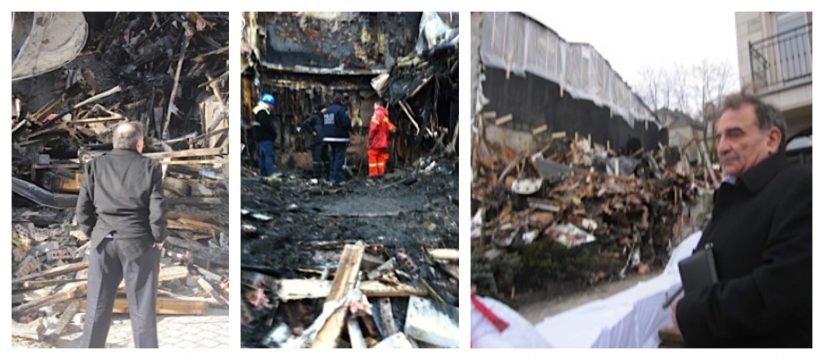
Ari Ben-Menashe surveys the damage to his home after it was mysteriously firebombed. Photos | Robert Parry
Though Canadian media referred to the incendiary device as a “molotov cocktail,” Consortium News reported that “the arson squad’s initial assessment is said to be that the flammable agent was beyond the sort of accelerant used by common criminals,” leading to speculation that the accelerant was military-grade.
Had it not been for the bomb, the origins of which Canadian police failed to determine, Ben-Menashe would have traveled to the U.S. alongside a “senior Israeli intelligence figure” to be interviewed by Parry. The other intelligence-linked individual, according to Parry, “concluded that the attack was meant as a message from Israeli authorities to stay silent about the historical events that he was expected to discuss.”
Though neither Ben-Menashe nor Parry directly blamed Israel’s government for the destruction of Ben-Menashe’s home, Parry noted that the bombing did succeed in “intimidating Ben-Menashe, shutting down possible new disclosures of Israeli misconduct from the other intelligence veteran, and destroying records that would have helped Ben-Menashe prove whatever statements he might make.”
While Ben-Menashe’s post-intelligence associations with controversial governments and individuals have given plenty of fodder to the still thriving media campaign to discredit his claims about covert U.S.-Israel operations in the 1980s, there remain troubling indications that the Israeli government sees his information on decades-old events as a threat.
Now, with the major efforts by powerful Americans and Israelis to distance themselves from Jeffrey Epstein and other figures associated with his depraved sex trafficking operation, Ben-Menashe may soon again find his reputation — and perhaps more — under fire.
Whitney Webb is a MintPress News journalist based in Chile. She has contributed to several independent media outlets including Global Research, EcoWatch, the Ron Paul Institute and 21st Century Wire, among others. She has made several radio and television appearances and is the 2019 winner of the Serena Shim Award for Uncompromised Integrity in Journalism.
NY Times Removes Race Context After Black Girl Admits Faking Hate Crime
To hide the fact they amplified another race hate hoax
By Paul Joseph Watson | Infowars | September 30, 2019
After a 12-year-old African-American girl admitted she lied about a group of white boys cutting off her dreadlocks, the New York Times decided to strip the fact that the accused were “white” from its follow up headline.
The global mainstream media, as well as lawmakers like Rashida Tlaib, amplified Amari Allen’s falsehood after she claimed that three white male classmates had pinned her down, called her “nappy” and “ugly” and cut her hair.
This prompted a wave of sympathy for Allen, a lucrative GoFundMe, and a volley of resentment towards young white men.
In the vast majority of these media reports, the fact that the boys were white was included in the headline.
It subsequently emerged that Allen had faked the entire story, with her grandparents today apologizing to those falsely accused.
However, in the media reports that carried the update to the story, the fact that the entire narrative was predicated on the incident being a racist hate crime was stripped from the story.
In its initial report on the issue, the New York Times headline read ‘Black Virginia Girl Says White Classmates Cut Her Dreadlocks on Playground’.
However, in the follow up story, the headline read ‘Virginia Girl Recants Story of Boys Cutting Off Her Dreadlocks’.
The media seems very keen to obscure the fact that they helped inflate yet another race hate hoax that turned out to be nothing but hot air.
“The most noteworthy part of this story is this girl allegedly getting a bit of her hair cut off made international news while the murder of John Weed was ignored,” comments Chris Menahan.
Will Congress Impeach Over the Ukraine?
By Peter Van Buren | We Meant Well | October 2, 2019
Like a dog hearing he’s going for a car ride, with that first leak the Dems couldn’t wait to hang their heads out the window for another ride around the block.
There are few hard facts: a leak claims a whistleblower in the intelligence community believes during a July 25 phone call Trump made unspecified “promises” to the Ukrainian president in return for his investigating Biden family corruption. The whistleblower did not have direct knowledge of what was said, and may have read a transcript or summary. Trump knew the call was monitored by multiple people and said whatever he said anyway.
Despite the lack of real information, the story blossomed like chlamydia at band camp to soon say Trump illegally withheld $391 million in military aid from the Ukraine in a direct quid pro quo for the Ukrainians finding dirt on Biden. Correlation was turned into causation and a narrative was created in mid-air. That was then crowd-refined into a tweetable “Trump is again inviting foreigners into our democratic process.” From there it took the New York Times only 48 hours to question whether the “president can get away with weaponizing the federal government to punish political opponents.” Impeachment was called for, and one nominal Trump challenger literally demanded on MSNBC execution be considered.
Democrats also decided all sorts of procedural and legal stuff the public will not pay attention to has been trod upon because the whistleblower complaint has not been handed over to them. In sum, “many elements are murky, but something clearly stinks” said the NYT, suggesting that’s good enough as a standard for demanding regime change in the middle of an election.
The big difference this time around is there’s no holy grail pee tape to quest after for three years. A transcript of the call between Trump and the Ukrainian president exists. What did Trump say? The Ukrainian government version, which is as close as we have to an actual fact at present, has been quietly online for two months now and reads “Donald Trump is convinced that the new Ukrainian government will be able to quickly improve image of Ukraine, complete investigation of corruption cases, which inhibited the interaction between Ukraine and the USA. [sic]”
For whatever Trump said to fulfill the headlines stating he pressured/extorted/bribed the Ukrainian leader, or manipulated U.S. foreign policy to (again?!?) bring a foreign government into the 2020 election, the actual words matter a lot. If this whole thing turns out to be shoehorning some broad or flippant statement by the president about investigating corruption which may involve the Biden family into a quid pro quo accusation, it will fail spectacularly with voters. If we all have to become whistleblower law experts the same way we all were obstruction experts just a few weeks ago for this to matter, it fails. The Dems might as well bring Congressman Wile E. Coyote onto the floor with his Acme Impeachment Kit.
And yet while the actual words matter, it should not be lost that none of what Trump was supposed to have really done — using military aid to get dirt on Biden — happened. We’re talking about talking about maybe burning the Reichstag, just not in so many words.
No one claims the Ukrainians investigated Biden at Trump’s demand (and Dems insist there was no wrongdoing anyway so an investigation would be for naught anyway.) It is thus a big problem in this narrative that the long-promised military aid to the Ukraine was only delayed and then paid out, as if the bribe was given for nothing in return, which hardly makes it a bribe. Trump is apparently bad at bribing; even though he made the decision to temporarily withhold the aid for some reason, the Ukrainians were never even told about it until weeks after the “extortion” phone call, meaning nobody’s arm got knowingly twisted. So no bribe was given, or to the Ukrainians’ knowledge, no money withheld.
As with all the souls Trump supposedly sold to get his Moscow hotel but then there was no Moscow hotel, the Dems claim they see a smoking gun but there is no body on the ground under the muzzle. So will this devolve into another complicated thought crime, another “conspiracy” to commit without the committal? “No explicit quid pro quo is necessary to betray your country,” helpfully tweeted Adam Schiff, chair of the House Intelligence Committee. Three years ago “almost” might have worked but we are far too cynical now following the collapse of Russiagate. The gray areas will fall to Trump in the court of public opinion.
Sigh. This will drag on for a while anyway. So the next step is for someone to see the actual whistleblower complaint, or, better, the transcript of the call itself. Because absolutely everything swirling around Washington otherwise today is just based on a leak.
Prying things loose if Trump wants to keep them from Congress will not be easy. The law sets conditions for disclosure of the whistleblower compliant itself, based on the specific legal definitions of credible and urgent; the media is mangling this part of the story by using vernacular definitions. How to apply those criteria can be argued over to Kiev and back. For example, the complaint itself seems to have nothing to do with intelligence operations except that it was allegedly filed by an intelligence staffer. That could make it not an “urgent” matter in the definition of the law and thus not available to Congress.
Trump’s withholding of the whistleblower complaint is also consistent with the stance taken by both the Clinton and Obama administrations. Bill Clinton, in a signing statement accompanying the original 1998 Intelligence Community Whistleblower Protection Act, wrote this “does not constrain my constitutional authority to review and, if appropriate, control certain classified information to Congress.”
Obama also reserved the right to withhold information from Congress “in [undefined] exceptional circumstances” when the original Act was updated as Congress created the Office of the Intelligence Community Inspector General in 2010. Trump is thus the third president to assert a whistleblower complaint does not grant the filer the right to force classified, privileged information into the public sphere. That right rests with the president — Clinton, Obama, Trump, as well as the next one. Citing long precedent, the courts would likely agree if asked.
While there is room to argue over the release of the complaint to Congress, there is nothing to compel the release of the presidential call transcript itself. What presidents say to other world leaders with the expectation of privacy is at the core of conducting foreign policy. No world leader is willing to interact frankly with the American president today wondering if the conversation will be on CNN tomorrow. That was one of the arguments used to assess the damage whistleblower Chelsea Manning did revealing State Department documents containing such conversations. So, never mind the Ukraine, no president would readily turn over a transcript without a fight, a fight he’ll likely win given the long standing unitary role of the executive in foreign policy.
Law and precedent are thus on Trump’s side if he chooses to withhold the complaint and transcript from Congress. If no one can see those documents, there is no means to move any investigation decisively forward, though theatrical hearings are always possible. A full leak of those specific, highly classified materials would be unprecedented. It would then be a true Constitutional crisis if illegally obtained, leaked docs were used at the heart of an impeachment process.
There’s more. As a whistleblower myself I know well the personal cost of telling the truth. It requires enormous courage to place yourself at odds with the full power of the government. You risk your job, your life as you knew it, and your freedom. Our democracy requires such people to come forward despite all that. So it is with some mixed feeling I record my skepticism here. At the core whistleblowers are different solely in motive; whistleblowers act because conscience tells them they must. They understand their allegiance is to The People, not a party (leakers) or self-interest (traitors.)
If the whistleblower here is someone who wrapped themselves in hard-fought legal protections to score points snitching over a difference in partisan politics, it will contribute to ending what little faith the public has in the vital process of revealing the truth at whatever cost, and will cause someone with legitimate concerns now trying to decide what to do to sit down. I hope with all of my soul, and with respect for those like Ellsberg, Manning, and Snowden, that this whistleblower proves worthy to stand next to them. And God help his soul and our country if not.
Trump-Zelensky-Ukraine: What is really going on here?
By Tony Kevin | OffGuardian | October 2, 2019
I have over several days reflected on the official White House record of the Trump-Zelensky conversation on Ukraine-US relations on 25 July 2019, a conversation held soon after Zelensky’s confirmed election victory, and declassified by Trump’s presidential order of 24 September 2019.
I have also been reflecting on the more recent Democratic Party decision to explore possibilities for impeachment of Trump, a decision fortified by the so-called ‘CIA whistleblower’ and his/her rather unimpressive revelations.
Here is my hypothesis of what may be going on here. As always, it is a complex mixture of domestic US politics, and Trump’s and Zelensky’s foreign policy goals. And a footnote follows on Downer.
Let’s start with the foreign policy goals. Both Trump and Zelensky are operating in highly constrained and threatening foreign policy environments at home. At the time of their phone call, Trump still had the warmonger Bolton to deal with inside the house: and even now he is still under the watchful scrutiny of the Russophobe imperial state figure of his Secretary of State Pompeo, closely though undeclaredly linked to the Washington imperial party on Ukraine-Russia as on other East-West issues.
Zelensky is similarly constrained and threatened in Kiev by the anti-Russian fanaticism that has been indoctrinated in large sections of the Ukrainian population by decades of nationalist, often neo-Nazi, Russophobe propaganda.
It is a tribute to the instinctive good sense of the Ukrainian electorate that Zelensky was able to defeat in the polls the discredited NATO stooge Poroshenko so comprehensively and decisively. The maturity of this vote gives me renewed hope for Ukraine. But there is a long way to go still towards political normalisation and economic recovery there.
Zelensky is smart enough to see that his country must achieve a normalisation of relations with Russia, but knows that he cannot yet say this openly. Putin wants this also, very much. But both men know it will take a very long time after the accumulated bitter grievances on both sides over recent decades, and especially since the lethal and destructive civil war on Eastern Ukraine that was begun by Poroshenko in April 2014 – no doubt on American advice.
This war has had terrible human consequences: loss of life, wounded and disabled casualties, destroyed communities, massive forced refugee outflows. Neither side can get over this easily or quickly.
The reciprocal prisoner release on 7 September was an essential symbolic action. Putin’s release of the navy crews who took part in the provocative and foolish Ukrainian raid on the Kerch Strait bridge a year ago was a key part of building Ukrainian confidence and trust in Zelensky’s leadership.
Russophobes in the West are in consternation at new green shoots of possible hope for progress towards Kiev-Moscow normalisation under the Normandy diplomacy format.
They are desperate to derail this hope, by proposing impossible conditions for normalisation: in particular that any self-determination elections for Donbass (while remaining within sovereign Ukraine) could only be held under an ‘internationally supervised’ election and with ‘international peacekeepers’ in charge.
See for example this recent piece by a European analyst, Gustav Gressel. East Ukrainians rightly see such a formula as a sure recipe for US infiltration and black regime change operations in Donbass. So it will not happen.
As I interpret the Trump-Zelensky conversation, both leaders were cautiously but in a friendly way exploring the boundaries of what might be possible for each of them as presidents to revisit the troubled history of the past few years. I see nothing dishonourable or intimidating in this conversation. Trump critics are reading into it only what they want to read.
Here I turn to the US domestic politics aspect.
Trump is still bitterly opposed by the US imperial state represented by people like Biden, Clinton, Bolton and McFaul (and increasingly, I suspect, by Obama), but also the FBI-CIA national security dissident faction represented by people like Brennan, Comey and Clapper. These people have learned nothing from the embarrassing failure of the Mueller investigation to prove the false Russiagate allegations.
They are keen still to bring Trump down by whatever possible means.
They see the threat to the credibility of their cause if Trump and Zelensky should together succeed in finding evidence of Ukrainian underpinnings of the 2016-17 Russiagate conspiracy against Trump. They are desperate to have a last bash at Trump before he might finally expose any such improprieties, through evidence from Ukraine (or, for that matter, Australia – see below).
They were powerful enough in the Democratic Party to finally overcome the experienced Nancy Pelosi’s prudent and well-founded resistance to their plans. She knows that this impeachment process could destroy any Democratic Party hopes for power next year.
But these fanatics are ready to go for broke, in their rage and despair against Trump. The ‘CIA whistleblower’, whoever he or she may be, is their last desperate throw.
The pathetic, compromised figure of Joe Biden, with his damning Ukrainian nationalist connections, is their unlikely standard-bearer. Elizabeth Warren is a possible backstop.
For these folk, either Sanders or Gabbard would be a disaster as a candidate – because neither shares the imperial agenda, and both are morally strong enough to resist it.
Nancy Pelosi and Tulsi Gabbard know the realities. I suspect Bernie Sanders does too, but is awaiting his moment to speak out on this.
The US liberal print media led by the New York Times and Washington Post, and more sympathetic networks like MSNBC and CNN, are trying to keep the impeachment fire alive. Other networks like FoxNews are standing back from it more sceptically.
I predict – analytically – that Trump will survive this latest impeachment wave and come out even stronger for the 2020 election as a result. His indignant base will be energised to vote in strategically important numbers sufficient to regain for him the US presidency for four more years.
This is good news for prospects for peace between Ukraine and Russia, however problematical it may be in other areas of the world diplomatic arena (and I am no supporter of Trump).
But I do not expect early miracles in Ukraine, rather a slow normalisation and contact-building process between these two closely related nations.
* * *
And a late footnote on Trump, Morrison and Downer: with exquisite timing, Trump has now put the acid on Morrison to give his Attorney-General Barr access to Australian intelligence files on Downer’s alleged attempt to collect intelligence from, and possibly incriminate, George Papadopoulos in their alleged wine rooms encounter in London, while Downer was still Australian High Commissioner.
It would seem, according to the allegations, that Downer was trying to collect intelligence to support the Russiagate allegations against Trump.
Morrison is now between a rock and a hard place. He cannot reject Trump’s request outright. (As Australian Labor figures are thoughtlessly urging him to do). But nor can he pursue Trump’s request enthusiastically enough to expose any alleged anti-Trump secret activities of Australian intelligence agencies, who were under pressure at the time from visiting figures in the US FBI and intelligence world – Comey, Clapper and Brennan – to help them build the Russiagate case against Trump in the first year of his presidency.
A Five-Eyes operational dilemma indeed, that will test Morrison’s loyalties.
How Israel Controls Its Narrative
Potential critics often self-censor
By Philip Giraldi • Unz Review • October 1, 2019
It is interesting to note how the Israel Lobby is able to manage and contain the commentary of groups in America that might normally be critical of Israeli policies vis-à-vis the United States. A recent article by Professor Andrew Bacevich entitled “President Trump, Please End the American Era in the Middle East” is a good example of how self-censorship by authors works. The piece appeared as one of Bacevich’s regular weekly contributions to The American Conservative website under the rubric “Realism and Restraint.”
The article particularly focused on the foreign policy pronouncements of Bret Stephens, the resident neocon who writes for The New York Times. Stephens, per Bacevich, has been urging constant war in the Middle East and worrying lest “we may be witnessing the beginning of the end of the American era in the Middle East.” Bacevich, unlike Stephens, is a genuine foreign policy expert, a realist, an Army veteran, and always quite sensible. He correctly described how “in the Middle East, the military power of the United States has played a large part in exacerbating problems rather than contributing to their solution.”
The overall message is sound, but in this case, it is interesting to note what Bacevich left out rather than what he included. It is easy to understand the “realism” part when he writes and it is sometimes also possible to perceive the “restraint.” He cited Iran seven times as well as Saudi Arabia, but, strangely enough, he never mentioned Israel at all, which a number of commenters on the piece noted. It rather suggests that there is a line that Bacevich is reluctant to cross. The omission is particularly odd as Israel is absolutely central to and might even be described as driving American policy in the Middle East and Bret Stephens, whom Bacevich excoriates, is a notable Israel-firster who once worked as the editor of the Jerusalem Post. Almost everything Stephens writes is basically a promotion of Israel and its interests coupled with a call for the United States to do what it must to attack and destroy the Jewish state’s principal perceived enemy Iran.
The reticence is perhaps understandable as Bacevich is president of a newly organized group called the Quincy Institute for Responsible Statecraft, which I have written about previously, that will have its official launch in November. It claims to promote “ideas that move U.S. foreign policy away from endless war and toward vigorous diplomacy in the pursuit of international peace” and further takes some pride in being non-partisan though bipartisan might be a better description. To be sure, Quincy’s two major donors are the highly controversial George Soros on the globalist left and the equally notorious Koch Foundation on the libertarian-lite right, which leads one to wonder who is ordering the restraint when it comes to Israel. Or is it both of them as neither organization, though very active in foreign policy, has indicated any desire to seriously criticize the many crimes of the Jewish state. I appear to have accurately predicted in my earlier article on Quincy that “… there will inevitably be major issues that Quincy will be afraid to confront, including the significant role played by Israel and its friends in driving America’s interventionist foreign policy.”
Indeed, anyone who wants to be a player in Washington DC has to avoid the Israel hot wire. That it should be so is a tribute to the power of the Jewish lobby coupled with the bulk support and Bible-belt votes of its brain-dead Christian Zionist spear carriers. Congress, once described by Pat Buchanan as “Israeli-occupied territory,” likewise knows whom not to offend lest one be unemployed in the next electoral cycle. That is why criminalizing criticism of Israel or support of a non-violent boycott of the country are regularly introduced in Congress and find themselves with more than one hundred sponsors and co-sponsors. Nearly two dozen such pro-Israel bills are currently at certain points in the legislative process, including one that will enable aggrieved Israelis to sue the Palestinian Authority (PA) in sympathetic U.S. courts for damages, a move that will potentially bankrupt the PA.
And the colleges and universities have not been immune from pressure to conform to the pro-Israel narrative. The White House acting through the Department of Education is functioning as thought police on behalf of the Jewish state. It is currently planning on withholding some federal funding of the University of North Carolina and Duke because their joint Middle Eastern studies program does not meet alleged government standards. The standards involved relate to the fact that the program has had speakers and course content that can be construed as critical of Israel and friendly to Muslims. The message clearly being sent to the schools by the Trump Administration is that if you criticize the Jewish state you will be punished.
The drive to eliminate any pushback against Israeli actions at colleges has been spearheaded by leading Zionist Kenneth L. Marcus, who was appointed the Education Department’s Assistant Secretary of Civil Rights. Marcus, who has worked as a paid pro-Israel activist, has been urging the government to define the BDS movement as anti-Semitic and has used his office to designate any Palestinian advocacy as a violation of Jewish students’ civil rights.
The federal action to enforce educational conformity on Israel is not exactly new as universities have long since been self-censoring, just like Bacevich, normally in response to complaints by Jewish groups. To cite only one example, in 2013, at nominally Catholic Fordham University in New York City, a student group sought to form a Students for Justice in Palestine (SJP) club. Their paperwork advised that their goal was to “build support in the Fordham community among people of all ethnic and religious backgrounds for the promotion of justice, human rights, liberation and self-determination for the indigenous Palestinian people.” The applicants also revealed that they would support the Boycott, Divestment and Sanctions (BDS) movement. Three years later, Fordham’s Dean of Education denied the application because of the support for BDS. The students took Fordham to court and in August of this year, three years later, a New York judge finally struck down the decision as “arbitrary and capricious.”
So it took six years and a lawsuit to enable a group of students to form a club that was admittedly political in nature but non-violent and welcoming of everyone. So much for freedom of speech and association at America’s colleges and universities when they run up against the Israel wall.
What is less observed is how Israel’s message is promoted at the state and local levels. At the state level, anti-BDS legislation is now the rule in 26 states, with some requiring government employees to sign a pledge not to boycott Israel. And the same thing is happening among Boards of Education. Fourteen states now require holocaust education, where students are compelled to read fiction like Eli Wiesel’s “Night” while also consuming the established and standard, largely fabricated, account of what the so-called holocaust was all about. In Virginia, for example, a shadowy group called the Institute for Curriculum Services (ICS), which is actually a “partisan group with backing by state and local Israel advocacy organizations,” is seeking to change the information conveyed by the history and social studies textbooks used in K-12 classrooms across the state. ICS recommended changes include: “1. Emphasizing Arab culpability for crisis initiation leading to military action and failure of peace efforts—and never Israeli culpability, even when it is undisputed historic fact. 2. Replacing the commonly used words of “settlers” with “communities,” “occupation” with “control of,” “wall” with “security fence,” and “militant” with “terrorist.” 3. Referencing Israeli claims such as “Israel annexed East Jerusalem” and the Golan Heights as accepted facts without referencing lack of official recognition by the United Nations and most member nation states.”
The ICS is only one example of the persistent Israel Lobby brainwashing of the American public on behalf of the Jewish state to completely alter the narrative about what is going on in the Middle East. Taken all together, the self-censorship of groups and individuals that wish to remain viable by ignoring the Israel problem, the criminalization of non-violent movements like BDS, and the pressure on universities and schools to conform with positive narratives about Israel means that any genuine understanding of that nation’s war crimes and crimes against humanity will, unfortunately, remain on the margins.
Philip M. Giraldi, Ph.D., is Executive Director of the Council for the National Interest, a 501(c)3 tax deductible educational foundation (Federal ID Number #52-1739023) that seeks a more interests-based U.S. foreign policy in the Middle East. Website is https://councilforthenationalinterest.org, address is P.O. Box 2157, Purcellville VA 20134 and its email is inform@cnionline.org.
Iran nuclear issue at inflection point

French President Emmanuel Macron met Iran’s President Hassan Rouhani at UN Hqs, New York, Sept 24, 2019
By M. K. BHADRAKUMAR | Indian Punchline | September 30, 2019
The unexpected move by the Pentagon to shift the Combined Air and Space Operations Center (CAOC) at al-Udeid Air Base in Qatar to the Shaw Air Force Base in South Carolina 7,000 miles away from the Middle East took place against the backdrop of the gathering storms in the regional environment. It injects a crisis atmosphere into regional politics.
To put the Pentagon move in perspective, in addition to hosting Qatari forces, the base also hosts the 379th Air Expeditionary Wing of the US Air Force. Other US military has been active in the country as well including the US Navy SEALS. The facility is also used by the British Royal Airforce. The al-Udeid Air Base is one of the few US airbases overseas where B-52 bombers, America’s largest warplane can land due to the long runways.
This is not the first time that the US temporarily relocated the CAOC. The last time it happened was 13 years ago. When tensions erupted between Qatar and Saudi Arabia, there was even talk of relocating the Central Command out of Qatar.
However, in the current scenario, the Pentagon move is undoubtedly related to the US’ mounting tensions with Iran. If push came to shove and a full blown US-Iran conflict erupts, the CAOC would be one of Iran’s priority targets. The CAOC is so critical to providing fire power for the US forces operating in the region that the Pentagon cannot take risks. The US commander of the 609th Air and Space Operations Center has been quoted as saying, “Iran has indicated multiple times through multiple sources their intent to attack US forces.”
How serious are the prospects of a US-Iran military conflict? Iran’s President Hassan Rouhani disclosed after his return to Tehran from New York that the two sides came breathtakingly close to a summit meeting on the sidelines of the UN GA in New York last week. Rouhani said,
“They (Americans) had sent messages to almost all European and no-European leaders that they wanted one-to-one negotiations between the two Presidents, but we had rejected it, saying that negotiations had to be done in the framework of P5+1, and they accepted.”
“Of course, 3 out of the 6 countries, that is the Chancellor of Germany, Prime Minister of Britain, and President of France all insisted for the meeting to be held, saying that the US would lift all sanctions. But the problem here is that under sanctions and maximum pressure, even if we want to negotiate with the Americans within the framework of P5+1, nobody can predict about the end and upshot of the negotiation.”
Significantly, last Tuesday, during the UNGA in New York, Saudi Arabia’s Crown Prince Mohammad bin Salman (MbS) also spoke with noticeable restraint in a rare interview with CBS’ ’60 Minutes’. MbS warned, “If the world does not take a strong and firm action to deter Iran, we will see further escalations that will threaten world interests. Oil supplies will be disrupted and oil prices will jump to unimaginably high numbers that we haven’t seen in our lifetimes.” And he went on to stay that a “political and peaceful solution is much better than the military one.”
Importantly, he was categorical that there should be a US-Iranian summit meeting, and added, “this is what we all ask for.” Conventional wisdom is that Saudi Arabia is petrified that the US may engage with Iran directly. But that is apparently not the case.
No doubt, the Russian President Vladimir Putin’s visit to Saudi Arabia in October will be keenly watched. Prior to the Saudi visit, Putin will be meeting Rouhani on the sidelines of the summit meeting of the Eurasian Economic Union (EAEU) in Yerevan on October 1 when the regional situation and the Iran nuclear deal will certainly be on the agenda of discussion.
This is a defining moment in Russian-Iranian relations too, as Iran is about to sign the formal agreement to join a free trade zone with the EAEU, which of course is a prestigious Kremlin project.
Moscow is cautiously optimistic that “Possibly we will achieve some positive solution (on the 2015 nuclear deal) over several months to come, or else the situation will continue to get worse,” to quote Russia’s representative at international organisations in Vienna, Mikhail Ulyanov during a press conference on Friday to highlight that the Iran nuclear issue is approaching an inflection point.
But Iran is potentially inching its way back [?] in the nuclear weapons business, with a fourth step it is expected to take in early November to reduce its commitments under the 2015 deal. A report in the Guardian last week said the European Union has “privately warned Iran that it will be forced to start withdrawing from the nuclear deal in November if Tehran goes ahead with its threat to take new steps away from the deal… The EU told Iran that it would put the issue of Iranian non-compliance into the agreement’s formal dispute mechanism if the next Iranian move away from the deal is significant… Once the deal’s dispute mechanism is triggered, both sides have 30 days to prove significant non-compliance, and if necessary a world-wide sanctions snap-back occurs.”
The Guardian report put across the European dilemma on the following lines: “The difficulty is that Iran says the steps are reversible, but if they learn about building a nuclear bomb, that is irreversible.”
Iran is no longer finding the support it hoped for in Europe and could be susceptible to broad censure. Conversely, the US is getting the opportunity to restore a modicum of credibility with its allies and the international community, which would broaden the pressure on Iran.
On the other hand, a climb-down by Trump is becoming more difficult in the rising tumult of impeachment proceedings. But while he may appear to have boxed himself in, it is still up to him to offer to Iran that resuming compliance with the 2015 agreement would be met with concrete benefits, like the $15 billion bailout package France’s president, Emmanuel Macron, has proposed.
Such a turn to events between now and November cannot be ruled out. After the UNGA, Trump hinted at willingness to negotiate. He said on Friday, “I don’t want military conflict. We’ve offered to talk, we’ve offered to discuss things… I’ve shown great restraint and hope that Iran likewise chooses peace.”
It is within these broad parameters that events may unfold in the coming months. Meanwhile, Pentagon is doing advance planning by shifting the CAOC away from the zone of conflict.
Impeachment… or CIA Coup?
By Ron Paul | September 30, 2019
You don’t need to be a supporter of President Trump to be concerned about the efforts to remove him from office. Last week House Speaker Nancy Pelosi announced impeachment proceedings against the President over a phone call made to the President of Ukraine. According to the White House record of the call, the President asked his Ukrainian counterpart to look into whether there is any evidence of Ukrainian meddling in the 2016 election and then mentioned that a lot of people were talking about how former US Vice President Joe Biden stopped the prosecution of his son who was under investigation for corruption in Ukraine.
Democrats, who spent more than two years convinced that “Russiagate” would enable them to remove Trump from office only to have their hopes dashed by the Mueller Report, now believe they have their smoking gun in this phone call.
It this about politics? Yes. But there may be more to it than that.
It may appear that the Democratic Party, furious over Hillary Clinton’s 2016 loss, is the driving force behind this ongoing attempt to remove Donald Trump from office, but at every turn we see the fingerprints of the CIA and its allies in the US deep state.
In August 2016, a former acting director of the CIA, Mike Morell, wrote an extraordinary article in the New York Times accusing Donald Trump of being an “agent of the Russian Federation.” Morell was clearly using his intelligence career as a way of bolstering his claim that Trump was a Russian spy – after all, the CIA should know such a thing! But the claim was a lie.
Former CIA director John Brennan accused President Trump of “treason” and of “being in the pocket of Putin” for meeting with the Russian president in Helsinki and accepting his word that Russia did not meddle in the US election. To this day there has yet to be any evidence presented that the Russian government did interfere. Brennan openly called on “patriotic” Republicans to act against this “traitor.”
Brennan and his deep state counterparts James Comey at the FBI and former Director of National Intelligence James Clapper launched an operation, using what we now know is the fake Steele dossier, to spy on the Trump presidential campaign and even attempt to entrap Trump campaign employees.
Notice a pattern here?
Now we hear that the latest trigger for impeachment is a CIA officer assigned to the White House who filed a “whistleblower” complaint against the president over something he heard from someone else that the president said in the Ukraine phone call.
Shockingly, according to multiple press reports the rules for CIA whistleblowing were recently changed, dropping the requirement that the whistleblower have direct, first-hand knowledge of the wrongdoing. Just before this complaint was filed, the rule-change allowed hearsay or second-hand information to be accepted. That seems strange.
As it turns out, the CIA “whistleblower” lurking around the White House got the important things wrong, as there was no quid pro quo discussed and there was no actual request to investigate Biden or his son.
The Democrats have suddenly come out in praise of whistleblowers – well not exactly. Pelosi still wants to prosecute actual whistleblower Ed Snowden. But she’s singing the praises of this fake CIA “whistleblower.”
Senate Minority Leader Chuck Schumer once warned Trump that if “you take on the intelligence community, they have six ways from Sunday at getting back at you.” It’s hard not to ask whether this is a genuine impeachment effort… or a CIA coup!
Copyright © 2019 by RonPaul Institute.
The Biden Affair in the Ukraine
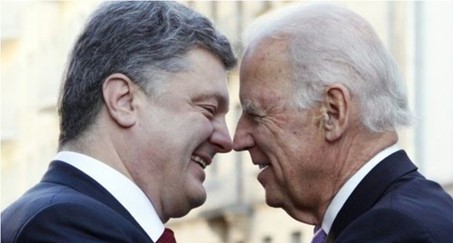
By Israel Shamir • Unz Review • September 30, 2019
The Borderlands of the Ukraine have been a decisive battlefield for centuries. Here Stockholm, Berlin and Moscow vied for dominance. Karl XII had lost here to Peter the Great; Stalin defeated Hitler; now the Clintonites are likely to suffer in the Ukraine their ultimate defeat. The Democrats had made their biggest political mistake of the century in attacking Trump for the Biden affair — that is, if the Americans retain any common sense.
Vice-President Biden extorted millions of dollars in personal bribes from the vulnerable Ukrainian client state. When this sordid affair came under investigation, he blackmailed Ukrainians, using his position and American taxpayer money to force the sovereign state to fire its Attorney General for investigating the bribes.
Instead of covering their face in shame and dismissing Biden as a potential party candidate in the 2020 race, the Dems led by the superannuated Mrs Pelosi decided to impeach the President for uncovering this rogue. In the well-remembered flick Dirty Harry the lawyers tried to save a criminal by attacking the policeman who didn’t observe the niceties of a Miranda warning. This was the model for the Dems in their impeachment attempt.
Biden’s criminal extortion wasn’t a secret. He boasted of this racket at a public occasion. He famously admitted that:
I said, I’m telling you [the Ukrainian leaders], you’re not getting the billion dollars. I said, you’re not getting the billion. I’m going to be leaving here in, I think it was about six hours. I looked at them and said: I’m leaving in six hours. If the prosecutor is not fired, you’re not getting the money. Well, son of a bitch. (Laughter.) He got fired. And they put in place someone who was solid at the time.
The Ukrainians put in place someone who was solid at the time, so solid that he terminated the investigation of Burisma oil company. This company was the vessel to transfer bribes to VP Biden, via his son Hunter Biden. John Solomon of The Hill wrote:
“U.S. banking records show Hunter Biden’s American-based firm, Rosemont Seneca Partners LLC, received regular transfers into one of its accounts — usually more than $166,000 a month — from Burisma from spring 2014 through fall 2015, during a period when Vice President Biden was the main U.S. official dealing with Ukraine and its tense relations with Russia.”
The fired prosecutor Mr Viktor Shokin said that Biden fils had been under investigation. After he was dismissed due to Biden père interference, the money continued to pour out of poor Ukrainian pockets to well-stuffed Biden coffers. My Kiev acquaintances had a memory of a good-for-nothing young man, keen on coke and broads, who by himself would never get such a salary.
You would ask, why Biden admitted to the crime? He considered himself untouchable like Mrs Clinton and other people of her circle. Mischievous President Trump decided to prosecute Biden for bribery and extortion, as if he were an ordinary mortal. This was a direct threat to the Clintonites (let us use this nickname for the power variously described as Democrats, Liberals, Internationals, financiers, Masters of Discourse or Deep State). This challenge caused them to abandon caution and to start a furious pre-emptive campaign against cocky Trump.
Their accusation is outright ridiculous: they claim Trump’s intention to bring Corrupt Joe to justice was criminal per se, as Biden was a likely contender for the Dem nomination. As it happens, the US Constitution didn’t find it fit to provide likely contenders with full immunity for past and future crime prosecutions. It’s just the Clintonites were used to be above the law. Indeed, for three years President Trump avoided to touch them. Crimes of Mrs Clinton were well known, from the simple affair of the email server to the Libya murders.
It was expected victorious Trump would unleash the law against the defeated dowager for Mrs. Clinton’s role in the Obama administration’s decision to allow the Russian nuclear agency to buy a uranium mining company. Conservatives have long pointed to donations to the Clinton family foundation by people associated with the company, Uranium One, as proof of corruption, reported the New York Times. The Clintonites saved the old lady’s skin by starting the Russiagate hoax. In 2016 election debate Trump told Clinton that, if he was in charge of the nation’s laws, “you’d be in jail”. But a year later he was in charge, and she wasn’t in jail, not even charged. The ruse of Russiagate worked wonders: the President accused of collusion with Russia did not dare to charge his adversary with this very offence.
Now the Clintonites decided to repeat their feat and began impeachment procedure hoping it will keep Trump busy and away from uncovering the Ukrainian Hell’s Kitchen.
What actually had happened in the Ukraine? In 2014, Clintonites had managed the regime change in this former Soviet republic. They removed the legitimate president by using the full spectre of illegal operations. The Ukraine became a Clintonite colony, and Joe Biden their viceroy in the Ukraine. Biden’s involvement in the coup d’état was his biggest crime, but nobody speaks of that, noticed Joe Lauria. They had turned Ukraine against Russia and instigated the civil war in the East of the poor country, despite strong efforts of president Putin to keep Russia out of Ukrainian turmoil. But they also gave a thought to personal profiteering, like they did in Russia in 1990.
Joe Biden had been treated royally in Kiev. He was asked to chair government meetings and proudly sat on the Presidential seat. The Ukrainians are not famous for their subtlety. Nice people, but rather simple ones, even by East European measure. They became involved in 2016 election campaign on the Clintonite side. There is no doubt VP Biden was the man who directed this “foreign involvement in the US elections”. The obliging Ukrainians delivered to him the dirt on Paul Manafort, and Manafort went to jail.
The Ukraine is the second home for CrowdStrike, the cyber-security company that was instrumental in accusing Russia of meddling. Its founder and head, a Russian Jew and American citizen Dmitry Alperovich is a pathological Russia hater on the model of Masha Gessen and Max Boot. People in Kiev say he had built the case against Russia on the strength of a single server allegedly used for hacking the DNC. The server is located in the Ukraine, not in Russia. President Trump asked for its whereabouts in his conversation with the Ukrainian President Mr Zelensky.
The subject of the server makes many people in the Clintonite camp extremely nervous. They already marked it with “conspiracy” marker, meaning you may not touch it. In another “conspiracy debunking” item they created a straw man, saying “the notion that there is some missing “server,” and that the server might exist somewhere—like in Ukraine—has no basis in reality. The DNC’s network consisted of many servers and computers”. However, the server Trump asked about is not the DNC server, but the server allegedly used to hack DNC server. It had left some Russian-language traces, and it was presented as a proof of Russian involvement. But Alperovich’s hackers in the Ukraine also use Russian as their working language, and this allowed the Russia-hating Jew an opportunity to create the whole chain of “proofs” of Russian hackers’ activity with fancy names. Recovery of the server would put paid to the whole myth of Russian hacking, and would make the Clintonite case untenable.
Alperovich, obsessed with his hatred, could cook the case of Russian meddling, but it had to be ordered and utilized by somebody up the feeding chain, most probably Joe Biden. And now Joe Biden, the real criminal, who took bribes and blackmailed the friendly state officials, who orchestrated foreign involvement in the US elections, went on to become the leading contender for Dem party.
The Dems claimed Trump threatened to withdraw funds from the Ukraine if they won’t cooperate with the US enquiry. This claim had been debunked after the full transcript of two Presidents’ chat had been published. But even if it were sterling truth, it would be business as usual for the US. You probably remember the threats of cutting aid that were issued by the US representative in the UN in order to force sovereign states to vote for Israel. The execrable Nicky Haley said, ‘The US will be taking names’, and Donald Trump added his own threats to cut aid.
How could they find fault in Trump allegedly threatening to cut aid to Ukraine if they think Biden was perfectly all right for doing exactly that? But these guys aren’t playing cricket.
The forthcoming Presidential race is becoming a global affair, it seems. In so many countries the US influence had been delivered by agents of Clintonite clan, and all of them are tempted to do what the Clintonites ask, that is to help them to undermine President Trump. In the Ukraine, the struggle of Clintonites and Trumpers is far from over. President Zelensky promised President Trump to help him; but the oligarchs of the Ukraine are in Clintonite camp.
All but one: Igor (Benny) Kolomoysky, a maverick Jewish oligarch and a friend of the President, is an enemy of Clintonites. He also stands against IMF, International Monetary Fund, the powerful bankers’ body that issued many loans to the Ukraine. Just this year, Kiev has to pay six billion dollars to the IMF to remain solvent, and IMF refused to refinance it. The loans were mainly stolen by the gang of the former President, Mr Poroshenko. People in Kiev say that about 1.7 billion dollars of the latest loan had been pocketed by the American supporters of Poroshenko, meaning Joe Biden and his ilk. Now Mr Kolomoysky suggests the new Ukrainian president may default on IMF loans.
Kolomoysky is also the only oligarch who is not in bed with the liberals. The balance of power in the Ukraine is not in favour of Trumpers. The Ukrainians like to back winners; once they made a mistake supporting Mrs Clinton, as they were sure she would win. Perhaps they will make this mistake again. It would depend on the actual Dem contender. Joe Biden had cooked his goose by taking too many bribes in the Ukraine, but another contender may have a better chance, the Ukrainians think. Mrs Warren, perhaps?
They even fiddle with the idea of Mrs Hillary Clinton running again and winning this time. The Ukrainian oligarchs, and first of all Mr Victor Pinchuk, a Jewish billionaire from Dnepro city, No. 1 among the rich Ukrainians, would do anything for her. He contributed many millions to her fund; he finances the Atlantic Council, the Clintonite think-tank, fighting against Russia and Euro-sceptics. He is ‘the wealthy businessman’ Trump referred to in his talk with Mr Zelensky. Judging by Trump’s interest in the Ukrainian server, the President is aware that the old lady is still able to do some mischief, and his promise to take her to jail is still unfulfilled.
It is possible in the presidential race 2020, the Dems will use drafting technique, as the long-distance runners (or bikers, or cross-country skiers) do. The first leading contender (in our case, Biden) would get the flak, get exhausted, and in the last moment he would withdraw from the race yielding the nomination to his well-rested comrade, be it Warren or Clinton or whoever. Bearing that in mind, Trumpers could keep some of the ammo they have on Biden (and there is a lot to find in the Ukraine) until (or rather if) he gets the nomination.
Israel Shamir can be reached at adam@israelshamir.net
The Untold Story of the Trump-Ukraine ‘Scandal’: The Routine Corruption of US Foreign Policy
By Joe Lauria | Consortium News | September 26, 2019
The most crucial aspects of the Trump-Ukraine “scandal,” which has led to impeachment proceedings against Donald Trump, are not being told, even by Republicans.
Trump was very likely motivated by politics if he indeed withheld military aid to Ukraine in exchange for Kiev launching an investigation into Democratic presidential frontrunner Joe Biden, though the transcript of the call released by the White House between Trump and Ukrainian President Volodymr Zelinsky does not make certain such a quid-pro-quo.
But what’s not being talked about in the mainstream is the context of this story, which shows that, politics aside, Biden should indeed be investigated in both Ukraine and in the United States.
We know from the leaked, early 2014 telephone conversation between Victoria Nuland, then assistant secretary of state for European and Eurasian affairs, and Geoffrey Pyatt, then U.S. ambassador to Ukraine, that then Vice President Biden played a role in “midwifing” the U.S.-backed overthrow of an elected Ukrainian government soon after that conversation.
That’s the biggest crime in this story that isn’t being told. The illegal overthrow of a sovereign government.
As booty from the coup, the sitting vice president’s son, Hunter Biden, soon got a seat on the board of Ukraine’s biggest gas producer, Burisma Holdings. This can only be seen as a transparently neocolonial maneuver to take over a country and install one’s own people. But Biden’s son wasn’t the only one.
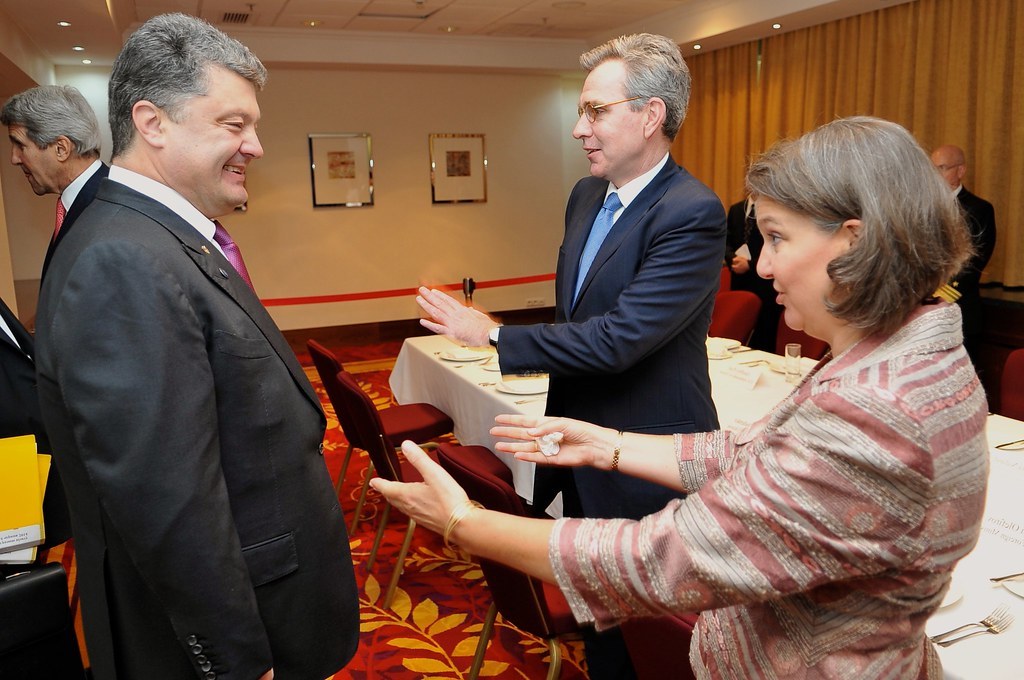
Kerry, post-coup president Petro Poroshenko, Pyatt and Nuland, June 2014. (State Dept.)
A family friend of then Secretary of State John Kerry also joined Burisma’s board. U.S. agricultural giant Monsanto got a Ukrainian contract soon after the overthrow. And the first, post-coup Ukrainian finance minister was an American citizen, a former State Department official, who was given Ukrainian citizenship the day before she took up the post.
After a Ukrainian prosecutor began looking into possible corruption at Burisma, Biden openly admitted at a conference last year that as vice president he withheld a $1 billion credit line to Ukraine until the government fired the prosecutor. As Biden says himself, it took only six hours for it to happen.
Exactly what Biden boasted of doing is what the Democrats are now accusing Trump of doing, and it isn’t clear if Trump got what he wanted as Biden did.
Threats, Bribes and Blackmail
That leads to another major part of this story not being told: the routine way the U.S. government conducts foreign policy: with bribes, threats and blackmail.
Trump may have withheld military aid to seek a probe into Biden, but it is hypocritically being framed by Democrats as an abuse of power out of the ordinary. But it is very much ordinary.
Examples abound. The threat of withholding foreign aid was wielded against nations on the UN Security Council in 1991 when the U.S. sought authorization for the First Gulf War. Yemen had the temerity to vote against. A member of the U.S. delegation told Yemen’s ambassador: “That’s the most expensive vote you ever cast.” The U.S. then cut $70 million in foreign aid to the Middle East’s poorest nation, and Saudi Arabia repatriated about a million Yemeni workers.
Katharine Gun
The same thing happened before the Second Gulf War in 2003, as revealed by whistleblower Katharine Gun. Gun leaked an NSA memo that showed the U.S. sought help from its British counterpart in signals intelligence to spy on the missions of Security Council members to get “leverage” over them to influence their vote to authorize the invasion of Iraq.
In 2001 the U.S. threatened the end of military and foreign aid if nations did not conclude bilateral agreements granting immunity to U.S. troops before the International Criminal Court.
More recently, the U.S. used its muscle against Ecuador, including dangling a $10 billion IMF loan, in exchange for the expulsion of WikiLeaks founder Julian Assange from its London embassy.
This is how the U.S. conducts “diplomacy.”
As former UN Secretary General Boutros Boutros Ghali wrote:
“Coming from a developing country, I was trained extensively in international law and diplomacy and mistakenly assumed that the great powers, especially the United States, also trained their representatives in diplomacy and accepted the value of it. But the Roman Empire had no need for diplomacy. Nor does the United States. Diplomacy is perceived by an imperial power as a waste of time and prestige and a sign of weakness.”
This fundamental corruption of U.S. foreign policy, which includes overthrowing elected governments, is matched only by the corruption of a political system that exalts partisan political power above all else. Exposing this deep-seated and longstanding corruption should take precedence over scoring partisan scalps, whether Biden’s or Trump’s.
Joe Lauria is editor-in-chief of Consortium News and a former correspondent for The Wall Street Journal, Boston Globe, Sunday Times of London and numerous other newspapers. He can be reached at joelauria@consortiumnews.com and followed on Twitter @unjoe .
Featured Video

John Mearsheimer: New World Order Arrived & Europe Is Left Behind
or go to
Aletho News Archives – Video-Images
Book Review
Sunset on Net Zero: A Heretic’s Guide to the Futile CO2 Target
By Ronald Paul Barmby (Author) – October 3, 2025
SUNSET ON NET ZERO describes in detail why Net Zero CO2 is pointless and unachievable. It explains in understandable terms the up-to- date thoughts of the greatest minds of today in physics, meteorology, economics, engineering, and the geosciences.
Net Zero CO2 is pointless because we have now confirmed by satellites that 90% of CO2 warming has already happened. CO2 is not an existential threat but clouds, El-Niño, and human habitation are significant drivers of global warming that are often ignored.
Net Zero CO2 is unachievable because the green technology alternatives are unreliable and unaffordable. Wind and solar power triple electricity costs, building fully electric vehicles produces at least one-half of CO2 emissions they are meant to avoid, and heat pumps will leave you dangerously cold in the winter. Green hydrogen, air capture CO2, and carbon capture and storage are prescriptions for national bankruptcy. The supply of key metals and minerals required to achieve Net Zero need to be at least doubled—some much more—and are often controlled by a very few. Net Zero comes with huge environmental and agricultural costs.
We have been through similar climatic temperature changes before, more recently than you think. Our efforts to control it are futile.
Blog Roll
 Aletho News
- FDA Ordered to Pay Over $570,000 in Fight Over Pfizer COVID Vaccine Records
- USAID turned to Facebook to drive demand for Covid vaccines in Global South – files
- Britain’s shadow security network expands into south Lebanon
- The ADL Has a Foreign Policy, and You Are Not Supposed to See It
- Former Qatari PM says ‘Israel’ has security ties with all Gulf states
- The Sound of Silence in the Strait of Hormuz
- Poland’s call for a no-fly zone in Ukraine means NATO direct war with Russia
- John Mearsheimer: New World Order Arrived & Europe Is Left Behind
- Naqab demolition notices top 1,000; settlers demolish Jaloud homes
- Israel is Using the ‘Gaza Ceasefire’ to Commit Ethnic Cleansing
- If Americans Knew
- An error has occurred; the feed is probably down. Try again later.
- No Tricks Zone
- Physicists: Doubling CO2 Has A Smaller Impact On Ocean ‘Acidification’ Than Existing Internal Variability
- Alarmist Climatologists In Shock! 2026 Atlantic Hurricane Season Sees Lowest Count In 101 Years
- New Study: Modern Temps Are Among The Coldest Of The Last 10,000 Years In East Central Europe
- Germany’s Renewable Energies Lead to 1.4 Billion Euro Electric Power Trade Deficit
- Argentina’s Perito Moreno Glacier Joins Antarctica and Arctic In Defying Doomsday Melt Claims
- New Study: Barents Sea Temperatures Were Warmer And Sea Ice Less Extensive In The 1700s Than Today
- German Authorities Start Initiative To Evaluate Public Register For Climate “Disinformation” Spreaders!
- Zonal Asymmetry of Temperature Change in the Antarctic Circumpolar Current
- New Study: The Net Fossil Fuel Contribution To Rising Atmospheric CO2 Has Been Zero For 500 Years
- Germany’s Green Energy Transition Becoming Increasingly Expensive…Another 6 Trillion Euros!

