How Japanese scientists confronted the U.S. and Japanese governments to reveal the effects of Bikini H-bomb tests
By Okuaki Satoru¹ – The Asia Pacific Journal – September 1, 2019 – Volume 17 | Issue 17 | Number 2
Introduction and translation by Steve Rabson
Introduction
The March, 1954 “Bravo Shot” H-bomb test in the Pacific dumped radioactive debris on the Marshall Islands, U.S. servicemen, and the crew of a Japanese fishing boat. The multi-megaton blast infected Marshall Islanders with radiation sickness and caused cancers in the years that followed. Their contaminated home on Bikini Atoll remains uninhabitable to this day. U.S. servicemen who had been purposely transported by the Navy into the blast zone have suffered from multiple cancers from radiation exposure. For years their claims denied were denied by the Veterans Administration. It took an act of Congress in 1990 to provide compensation for them and their children with birth defects. The crew of the Japanese fishing boat, Lucky Dragon No. 5, suffered from acute radiation poisoning. One crew member, Kuboyama Aikichi (age 40), died while in treatment for exposure.

“Bravo Shot” H-bomb test, Bikini, March 1, 1954

U.S. military forcibly evacuating Marshall Islanders from Bikini Atoll

U.S. servicemen transported under orders into the Bikini blast zone

Japanese scientists examine the hull of contaminated Lucky Dragon at Yaizu City port
Okuaki Satoru tells below how Japanese scientists confronted, and eventually overcame, roadblocks thrown up by both the U.S. and Japanese governments to obtain urgently needed information for the treatment of radiation poisoning and to determine the extent of environmental contamination. As Jacob Darwin Hamblin and Linda M. Richards explain in the journal Historia Scientarium, “Japanese perspectives influenced several American scientists to think differently about the implications of nuclear tests for humans and the natural environment . . . despite stiff resistance from offices of the U.S. government.”2
The U.S. government withholds information on lethal fallout
On March 16, 1954, the newspaper Yomiuri Shimbun first reported victims of a U.S. nuclear test in the Pacific among Japanese crew members of the fishing boat Lucky Dragon. The U.S. government acknowledged that tests had been carried out, but, insisting on secrecy, refused to provide information about them to Japanese scientists. Today it is known that they were hydrogen bomb tests, but even that wasn’t disclosed at the time. The only information Japanese scientists could obtain was from radioactive contamination of the Lucky Dragon’s hull.
Several scientists visited the fishing port at Yaizu City in Shizuoka Prefecture and recorded high levels of radioactive contamination from fallout on the boat’s hull. Okano Masaharu, a specialist in measuring radioactivity, was twenty-eight at the time and on the faculty of the Institute for Scientific Research (now known as RIKEN).
After World War II when Japan was under Allied Occupation (1945-1952), research on atomic energy was strictly prohibited. However, in 1950 permission was granted for research on radioactive isotopes. Okano traveled throughout the country giving lectures to inform Japanese about isotopes, and became skilled in handling radioactive materials. On April 16, 1954, he traveled with his supervisor, Dr. Yamazaki Fumio, to examine the hull of the Lucky Dragon. A full month had passed since fallout had contaminated the boat, but both men were astonished to see the needle of their radiation meter swing wildly up into the danger zone. This was the first time they had detected significant radiation outside their laboratories, and it exceeded one hundred times the level occurring in nature. With the discovery that radioactive fallout had contaminated the Lucky Dragon, scientists at universities in Tokyo, Kyoto, Shizuoka, Osaka and Kanazawa began their own studies, communicating their findings by telephone.
Ikeda Nobutaka conducted research on radioactive fallout in Professor Kimura Kenjirō’s research laboratory in the Chemistry Department of Tokyo University. He also visited the Lucky Dragon at Yaizu, and collected samples of fallout-contaminated material. Returning with them to the laboratory, he and about a dozen other researchers spent the next several days and nights frantically analyzing the material out of acute concern for the Lucky Dragon’s crew.
“We needed the results as soon as possible,” said Ikeda, now eighty-eight. “Without knowing the characteristics of the fallout, there would be no way to find a treatment for the crew. We were also aware that the reputation of Japanese scientists was at stake. If our results turned out to be wrong, it would be a disgrace for Japan’s scientific methods.”
Over the next month Ikeda and his colleagues found twenty-seven types of atomic radiation including Strontium (Sr) 89, Yttrium (Y) 90, and Cerium (Ce) 141. “We were overjoyed because knowing the radiation characteristics meant that it could be located in patients’ bodies and a way might be found to eliminate it. I can still remember how lovely the sunset looked the evening we finally finished the analyses.”
U.S. Atomic Energy Commission declares “no risk” from radioactive contamination
The U.S. carried out many nuclear weapons tests in the Pacific; however, the one named “Castle Bravo” on March 1, 1954, which showered fallout on the Lucky Dragon, was the most powerful conducted to that time, 1,000 times the fifteen megatons of the Hiroshima bomb. On March 31, Lewis Strauss, Chairman of the U.S. Atomic Energy Commission, issued a statement denying that there had been any contamination of fish or seawater.
With respect to the stories concerning widespread contamination of tuna and other fish as a result of the tests, the facts do not confirm them. The only contaminated fish discovered were in the open hold of a Japanese trawler [that had been] well within the danger zone. The Federal Drug Administration has informed us that their thorough survey found no radioactive contamination of boats or fish. The fallout dissipated rapidly in the ocean current and has posed no risk. No radioactivity has been detected in an area between five and five hundred miles of the test site.
There was a rumor last week of a danger from radioactivity falling in the United States. As with Soviet nuclear tests, there might be a small increase in natural background radiation in some local areas. However, it is only infinitesimally higher than what has been observed after previous tests in the continental United States and overseas, far too small to pose any risk to persons, animals or plants. Radioactivity dissipates rapidly after tests, and soon returns to normal levels of natural background radiation.
Did American officials deny that radioactivity had contaminated the ocean because they wanted to conceal the possibility that it had, or because they didn’t believe it would spread over a wide area beyond the test site?
Professor Higuchi Toshihiro at the Institute for the Study of Diplomacy of Georgetown University cites radioactive contamination from the Bikini tests as having initiated world-wide concern over the problem of environmental pollution; and he has studied how the governments and societies in Japan and in the United States took opposing positions over the issue of radioactive pollution.
It was known among scientists at the time that, at least in theory, radioactive contamination of the ocean from nuclear tests could be detected in seawater, plants, and animals. So when the U.S. conducted the first hydrogen bomb test in 1953, the Atomic Energy Commission began surveying seawater, tuna, and other ocean life for radioactivity. The Bikini test that contaminated the Lucky Dragon occurred the following year, but the data collected by the survey was still insufficient. Nevertheless, the Atomic Energy Commission sought first and foremost to quiet the furor over the tests at home and abroad, and issued a series of announcements for political reasons. Lacking reliable scientific data, the Commission surveyed a large area of seawater in which any trace of radiation would have been much diluted, and then claimed no contamination had been detected. Thus, it wasn’t that the Commission was trying to conceal findings of contamination, or that it was ignorant of the possibility. For strictly political reasons, it quickly declared the ocean safe.3
Contradicting its own denials of radioactive contamination, the U.S. government banned imports of Japanese tuna
The U.S. government was greatly alarmed by news that radiation had contaminated tuna in Japan. At the time of the Bikini tests the U.S. was importing large quantities of canned tuna from Japan. Cheap and plentiful, long-finned tuna was canned in vegetable oil.
The development of Japan’s canning industry had begun before World War II in the fresh waters of Shizuoka Prefecture. In the 1950’s before Japan’s heavy industry recovered from the war, the government strongly encouraged the production of goods for export of which canned tuna was a key enterprise. Sold under the brand names “Fujiyama” and “Geisha,” high-quality and inexpensive Japanese canned tuna became so popular it dominated the American market.
Now the U.S. government became deeply concerned that contaminated tuna was being imported and distributed in America. Located by Professor Higuchi in the U.S. National Archives, an official U.S. government memo entitled “fish exports” was sent to Washington from the American Embassy in Tokyo on March 21, 1954, five days after the Yomiuri Shimbun reported contamination of the fishing boat Lucky Dragon. Higuchi described the memo:
The memo explained that embassy officials and representatives of the American fishing industry had warned the Japanese government to stop exports of contaminated fish. The government agreed that no fish would be exported to the United States in which radiation was detected.4
Subsequently, a member of the Atomic Energy Commission came to Japan and went to Yokohama Port. There, he ordered thorough monitoring tests for the fins and bellies of frozen tuna scheduled for export to the United States. People in Japan were outraged because, on the one hand, the U.S. government was denying that radiation from nuclear tests had contaminated the ocean or fish, yet it was suspiciously monitoring fish being exported to America.
The Japanese government refuses to pursue U.S. responsibility for contamination and supports continuation of nuclear tests
How, then, in the wake of radiation injuries to the Lucky Dragon’s crew and nuclear contamination of tuna, did the Japanese government deal with the U.S. government that had carried out the tests?
On March 17, with the Diet in an uproar over the Bikini tests, Foreign Minister Okazaki Katsuo came under persistent questioning in a session of the Lower House Budget Committee. Representative Imazumi Isamu, a member of the Socialist Party, severely criticized the Japanese government for failing to request crucial information from the U.S. about the nuclear tests. “America has inflicted radiation injuries on our country’s innocent fishermen. The treatment varies depending on what kind of bomb was detonated. A Japanese government that fails to seek this information for treating the victims is in no way worthy of representing our citizens. It is truly unforgivable.”5
Representative Kawasaki Hideji of the Progressive Party insisted that the Japanese government confront the U.S. government.
We have learned that the test was of either a hydrogen or a cobalt bomb. Should Japan bring the case to the International Court of Justice, world opinion would be deeply sympathetic to a nation that has been victimized three times by nuclear explosions. Our foreign policy must be courageous enough to petition the court. Does the Foreign Minister agree? Please answer the question directly.6
“We know from the information they already provided us that the Americans are very sympathetic,” replied Foreign Minister Okazaki. “They have said they will send doctors specializing in atomic bomb injuries and pay compensation no matter the cost. I am confident we can resolve the issue without going to the International Court of Justice.”7
Foreign Minister Okazaki reiterated the decision not to pursue America’s legal responsibility at a party given by the America-Japan Society in Tokyo on April 9, 1954. A tape recording of his speech before guests that included the American ambassador is available at the Society’s office in Akasaka.
Although it goes without saying that the fishing industry Japan’s economy relies on has suffered major losses as a result of the ban in the area of the ocean affected by the atomic tests, we have no intention of asking the U.S. government to stop them. We recognize that they are indispensable to the security, not only of America, but of Japan and other democratic nations. Thus, we join the other democratic nations in helping to make sure the atomic tests are successful.8
Radioactive contamination from the Bikini test occurred two years after Japan regained its independence in 1952 under the San Francisco Peace Treaty. Yet, despite the damage the test inflicted on the nation, the Japanese government supported their continuation. This attitude provoked outrage among the citizenry.
Japanese scientists respond
Japanese government leaders refused to pursue U.S. responsibility for the damages inflicted by the Bikini test. However, among all government departments, the Fisheries Agency was most acutely aware of the danger. It alone planned a survey of radiation contamination in the ocean area around the Bikini atoll where the test was conducted. “The U.S. government was entirely downplaying the test’s effects,” explained Miyake Yasuo who joined the scientific advisory group organized to carry out the survey. “The Japanese government was seeking compensation for injuries to the Lucky Dragon’s crew and the major damage to our fishing industry, but conducting a survey at the site for crucial information about the radioactive contamination was absolutely essential.”
With daily reporting in the newspapers on their expedition aboard the ship Shunkotsu Maru, the scientists were given a heroes’ welcome when they returned to Tokyo on July 4, 1954 from their fifty-one day voyage. It was their survey that first determined the extent of ocean contamination and damage to the environment from atomic tests. Though conducted for the Fisheries Agency, the results advanced knowledge in several scientific fields including radiology, oceanography, meteorology and medicine.
Notes
1From Okuaki Satoru, 海の放射能に立ち向かった日本人:ビキニからフクシマへの伝言 Radioactive Contamination of the Ocean Revealed by Japanese Scientists: From Bikini to Fukushima, Junpō-sha, Tokyo, 2017.
2Jacob Darwin Hamblin and Linda M. Richards, “Beyond the Lucky Dragon: Japanese Scientists and Fallout Discourse in the 1950s,” Historia Scientiarum, Vol. 25, No. 1 (2015), pp. 36-56.
3Okuaki, pp. 44-45.
4Ibid., p. 46.
5Ibid., p. 47.
6Ibid., pp. 47-48.
7Ibid., p. 48.
8Ibid., pp. 48-49.
Okuaki Satoru is a program director at NHK. Born in Kanagawa Prefecture, he graduated with a Masters Degree from the Life Sciences Division of Tokyo University, joining NHK in 1999. He has directed television documentaries on the work of novelist Inoue Yasushi and the massacres of Koreans following the 1923 Tokyo earthquake. He was awarded the Media Ambitious Prize in 2013 for the documentary “Radioactive Contamination of the Ocean Revealed by Japanese Scientists: the Bikini Test Nuclear Fallout and the Ship Shunkotsu Maru,” which is the subject of the excerpts below from his book.
Steve Rabson is Professor Emeritus of East Asian Studies, Brown University, and a contributing editor to the Asia-Pacific Journal. He is the author of Righteous Cause or Tragic Folly: Changing View of War in Modern Japanese Poetry (Center For Japanese Studies, University of Michigan, 1998) and The Okinawan Diaspora in Japan: Crossing the Borders Within (University of Hawaii Press, 2012). His recent articles include “Okinawa was a ‘storage location’ for nuclear weapons: published accounts,” Asia-Pacific Journal, January 7, 2013, Volume 11 | Issue 1 | Number 6 and “Nuclear Hawks in Tokyo Call for Stronger US Nuclear Posture in Japan and Okinawa,” Gregory Kulacki with a comment by Steve Rabson, Asia-Pacific Journal, June 1, 2018, Volume 16 | Issue 11 | Number 1. He was stationed as a U.S. Army draftee at a nuclear weapons storage base in Henoko, Okinawa, 1967-68.
The original Japanese text can be found here.
Related articles:
Ōishi Matashichi and Richard Falk, “The Day the Sun Rose in the West. Bikini, the Lucky Dragon and I,” Asia-Pacific Journal, June 19,2011, Vol. 9, No. 3
Steve Rabson, “Okinawa was a ‘storage location’ for nuclear weapons: Published accounts,” Asia-Pacific Journal, January 7, 2013, Volume 11 | Issue 1 | Number 6
“Nuclear Hawks in Tokyo Call for Stronger US Nuclear Posture in Japan and Okinawa,” Gregory Kulacki with a comment by Steve Rabson, Asia-Pacific Journal, June 1, 2018, Volume 16 | Issue 11 | Number 1
America Loses Asia-Pacific as Full Spectrum Dominance Continues to Fail
By Matthew Ehret | Strategic Culture Foundation | September 2, 2019
Always working a little harder than most to stay a step below reality, US Secretary of Defense Mark Esper made especially candid remarks this week that America’s INF pullout was timed for a targeting of forces against China.
Speaking to Fox on August 21st, Esper said: “We want to make sure that we, as we need to, have the capability to deter Chinese bad behavior… China is the number one priority for this department. It’s outlined in the national defense strategy, why we think it’s a long term strategic competitor and one that is pursuing a maximization campaign, if you will, throughout the indo-Pacific theater, whether its politically, economically or militarily…”
Echoing a little Dr. Strangelove, Esper stated that there is “a coming shift” from “low intensity conflict that lasts 18 years to high intensity conflicts against competitors such as Russia and China.”
While American military exercises in the Pacific have played out on China’s doorstep at an accelerating rate since the Pivot to Asia was announced in 2011 with the most recent US-Australia Talisman Sabre bi-annual exercise and US-South Korea Ulchi Freedom war games this month, China has not remained idle.
In response to America’s vast array of military infrastructure built up on China’s border, China has responded by the unveiling of cutting edge anti-ballistic missile technologies, including hypersonic weaponry to counteract the American threat. A large part of China’s defensive response includes the Russian S400 anti-missile system which is also being adopted by India, Turkey, Syria and the United Arab Emirates as a unified system which renders the American THAAD and ABM systems impotent and obsolete. Although unconfirmed, American generals have freaked out that China is building a joint China-Cambodia naval base in Preah Sihanouk Province that gives China easy access to coastal waters on the Gulf of Thailand and ready access to the South China Sea.
America’s military impotence when faced with the new cutting edge technologies unveiled by Russia and China was outlined in a recent report released by the US Studies Center at the University of Sydney which stated that “America no longer enjoys military primacy in the indo Pacific and its capacity to uphold a favorable balance of power is increasingly uncertain.” Referring to China’s advanced anti-aircraft weapons, the report says “Chinese counter-intervention systems have undermined America’s ability to project power in the Indo-Pacific region” which the authors say, could be rendered impotent within the first 8 hours of conflict.
Rather than use this information to propose a new security doctrine premised on cooperation and dialogue as China has offered on countless occasions, the report’s authors join the fantasy world of Esper calling instead for a “collective defense” strategy akin to a Pacific NATO, whereby all of America’s Pacific allies could join in an anti-Chinese military alliance together, and relieving America of the burden of carrying WWIII on its own.
We know that this Pacific NATO has been discussed for some time and was at the heart of recent Pacific Vanguard naval drills conducted between the USA, Australia, Japan and South Korea in May 2019 which saw the participation of 3000 soldiers, two Japanese destroyers, a South Korean destroyer and two Australian frigates in their first joint war game. This outlook was also behind the August naval drill played out by Malaysia, USA, New Zealand and Australia in Guam. The USA has 54,000 troops in Japan and 28,000 in South Korea.
When China and Russia conducted their first long range joint air patrol in the Asia Pacific in July 2019, South Korea and Japan scrambled jets to intercept the Chinese and Russian aircraft, with South Korea firing hundreds of warning shots. Backed up by the USA, both Asian countries screamed loudly (and without evidence) that their air space had been violated.
In response to the belligerent comments by Esper and the Australian report, the Chinese Foreign Ministry said “China is firmly on a path of peaceful development and our national defense policy is defensive in nature”. China has gone further by providing a cooperative framework under the Belt and Road Initiative which is built around the brilliant political agenda of providing diplomatic solutions to geopolitical points of tension through economic development strategies that enrich all participants. This approach has provided China great payback through the defusing of tensions with other nations claiming territory within the South China Sea- especially under the pro-BRI orientation of Malaysia’s Dr. Mahathir Mohammed and the Philippines’ President Duterte.
Not feeling at ease being caught in the crossfire of a nuclear exchange, Japan and South Korea have also gone so far as to create a new trilateral cooperation agreement with China on August 21 premised on “next generation exchange projects in three countries… We hope to discuss future-oriented partnerships and regional affairs, including North Korea.” The agreement also enables international joint investment in all countries operating under the BRI framework. Together the three countries account for over a quarter of the world’s productivity and have everything to gain by working together.
Those American military officials promoting the obsolete doctrine of Full Spectrum dominance are dancing to the tune of a song that stopped playing some time ago. Both Russia and China have changed the rules of the game on a multitude of levels, and can respond with fatal force to any attack upon their soil with next generation weaponry beyond the scope of anything imagined by ivory tower game theorists in the west.
The ship of world history has changed course away from the rapids of war and economic collapse, as the Belt and Road Initiative has grown to proportions not imagined possible just a few years earlier and the coming months will be decisive as the west does some soul searching and decides which future it would like to have.
Moscow Concerned, Puzzled Over US Airstrike in Syria’s Idlib
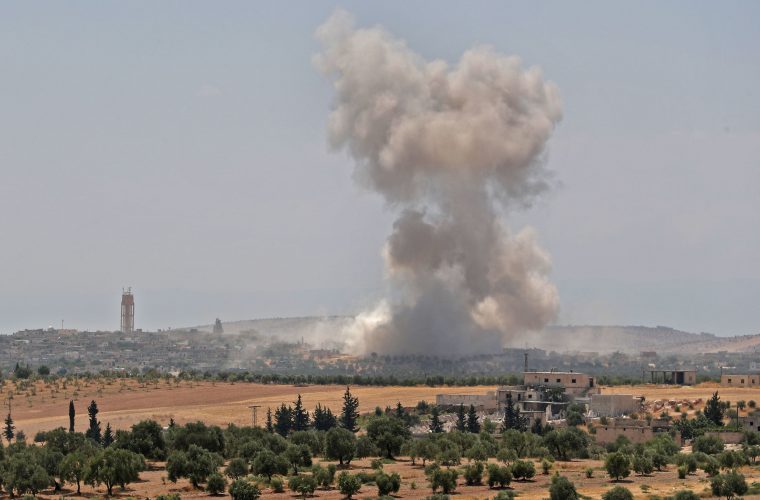
Smoke billows above buildings near the town of Hish in Syria’s Idlib province © AFP 2019 / Omar Haj Kadour
Sputnik – September 2, 2019
The Russian Foreign Ministry said in a statement on Monday that it was concerned and puzzled by Washington’s recent airstrike in Syria’s Idlib, slamming the move as “inconsistent” and “contradictory.”
“Inconsistent and contradictory steps that the United States makes in Idlib cannot but cause bewilderment and concern. On the one hand, US representatives … call for halting escalations in Idlib … On the other hand, they conduct an airstrike, which results in large-scale damage and victims”, the Russian Foreign Ministry said.
Moscow added it expected the United Nations to take the consequences of the airstrike into consideration when preparing reports on the situation in Syria, and also to brief members of the UN Security Council on “the consequences for civilians and civilian infrastructure” and to check the airstrike’s compliance with international humanitarian law.
Although the strike has put the ceasefire under threat, a moratorium on military campaigns is still in place, the ministry emphasised.
US forces struck on Saturday what they said were positions of leaders of the al-Qaeda terrorist group in the north of Idlib.
The strike came on the same day when a new ceasefire entered into force in the rebel-held province. According to the Russian Defence Ministry, Washington violated the ceasefire agreement in Syrian de-escalation zone by launching an attack on it without informing the ceasefire guarantors, namely Russia and Turkey.
The attack resulted in an unspecified number of casualties and damage to surrounding structures.
Questions Nobody Is Asking About Jeffrey Epstein
By Eric Rasmusen • Unz Review • September 2, 2019
The Jeffrey Epstein case is notable for the ups and downs in media coverage it’s gotten over the years. Everybody, it seems, in New York society knew by 2000 that Jeffrey Epstein and Ghislaine Maxwell were corrupting teenage girls, but the press wouldn’t cover it. Articles by New York in 2002 and Vanity Fair in 2003 alluded to it gently, while probing Epstein’s finances more closely. In 2005, the Palm Beach police investigated. The county prosecutor, Democrat Barry Krischer, wouldn’t prosecute for more than prostitution, so they went to the federal prosecutor, Republican Alexander Acosta, and got the FBI involved. Acosta’s office prepared an indictment, but before it was filed, he made a deal: Epstein agreed to plead guilty to a state law felony and receive a prison term of 18 months. In exchange, the federal interstate sex trafficking charges would not be prosecuted by Acosta’s office. Epstein was officially at the county jail for 13 months, where the county officials under Democratic Sheriff Ric Bradshaw gave him scandalously easy treatment, letting him spend his days outside, and letting him serve a year of probation in place of the last 5 months of his sentence. Acosta’s office complained, but it was a county jail, not a federal jail, so he was powerless.
Epstein was released, and various lawsuits were filed against him and settled out of court, presumably in exchange for silence. The media was quiet or complimentary as Epstein worked his way back into high society. Two books were written about the affair, and fell flat. The FBI became interested again around 2011 (a little known fact) and maybe things were happening behind the scenes, but the next big event was in 2018 when the Miami Herald published a series of investigative articles rehashing what had happened. In 2019 federal prosecutors indicted Epstein, he was put in jail, and he mysteriously died. Now, after much complaining in the press about how awful jails are and how many people commit suicide, things are quiet again, at least until the Justice Department and the State of Florida finish their investigation a few years from now. (For details and more links, see “Investigation: Jeffrey Epstein” at Medium.com and “Jeffrey Epstein” at Wikipedia.)
I’m an expert in the field of “game theory”, strategic thinking. What would I do if I were Epstein? I’d try to get the President, the Attorney-General, or the U.S. Attorney for the Southern District of New York to shut down the investigation before it went public. I’d have all my friends and all my money try to pressure them. If it failed and I were arrested, it would be time for the backup plan— the Deal. I’d try to minimize my prison time, and, just as important, to be put in one of the nicer federal prisons where I could associate with financial wizards and drug lords instead of serial killers, black nationalists, and people with bad breath.
That’s what Epstein would do. What about the powerful people Epstein would turn in to get his deal? They aren’t as smart as Epstein, but they would know the Deal was coming— that Epstein would be quite happy to sacrifice them in exchange for a prison with a slightly better golf course. What could they do? There’s only one good option— to kill Epstein, and do it quickly, before he could start giving information samples to the U. S. Attorney.
Trying to kill informers is absolutely routine in the mafia, or indeed, for gangs of any kind. The reason people call such talk “conspiracy theories” when it comes to Epstein is that his friends are WASPs and Jews, not Italians and Mexicans. But WASPs and Jews are human too. They want to protect themselves. Famous politicians, unlike gangsters, don’t have full-time professional hit men on their staffs, but that’s just common sense—politicians rarely need hit men, so it makes more sense to hire them on a piecework basis than as full-time employees. How would they find hit men? You or I wouldn’t know how to start, but it would be easy for them. Rich powerful people have bodyguards. Bodyguards are for defense, but the guys who do defense know guys who do offense. And Epstein’s friends are professional networkers. One reporter said of Ghislaine Maxwell, “Her Rolodex would blow away almost anyone else’s I can think of—probably even Rupert Murdoch’s.” They know people who know people. Maybe I’m six degrees of separation from a mafia hit man, but not Ghislaine Maxwell. I bet she knows at least one mafioso personally who knows more than one hit man.
In light of this, it would be very surprising if someone with a spare $50 million to spend to solve the Epstein problem didn’t give it a try. A lot of people can be bribed for $50 million. Thus, we should have expected to see bribery attempts. If none were detected, it must have been because prison workers are not reporting they’d been approached.
Some people say that government incompetence is always a better explanation than government malfeasance. That’s obviously wrong— when an undeserving business gets a contract, it’s not always because the government official in charge was just not paying attention. I can well believe that prisons often take prisoners off of suicide watch too soon, have guards who go to sleep and falsify records, remove cellmates from prisoners at risk of suicide or murder, let the TV cameras watching their most important prisoners go on the blink, and so forth. But that cuts both ways. Remember, in the case of Epstein, we’d expect a murder attempt whether the warden of the most important federal jail in the country is competent or not. If the warden is incompetent, we should expect that murder attempt to succeed. Murder becomes all the more plausible. Instead of spending $50 million to bribe 20 guards and the warden, you just pay some thug $30,000 to walk in past the snoring guards, open the cell door, and strangle the sleeping prisoner, no fancy James Bond necessary. Or, if you can hire a New York Times reporter for $30,000 (as Epstein famously did a couple of years ago), you can spend $200,000 on a competent hit man to make double sure. Government incompetence does not lend support to the suicide theory; quite the opposite.
Now to my questions.
- Why is nobody blaming the Florida and New York state prosecutors for not prosecuting Epstein and others for statutory rape?
Statutory rape is not a federal crime, so it is not something the Justice Dept. is supposed to investigate or prosecute. They are going after things like interstate sex trafficking. Interstate sex trafficking is generally much harder to prove than statutory rape, which is very easy if the victims will testify.
At any time from 2008 to the present, Florida and New York prosecutors could have gone after Epstein and easily convicted him. The federal nonprosecution agreement did not bind them. And, of course, it is not just Epstein who should have been prosecuted. Other culprits such as Prince Andrew are still at large.
Note that even if the evidence is just the girl’s word against Ghislaine Maxwell’s or Prince Andrew’s, it’s still quite possible to get a jury to convict. After all, who would you believe, in a choice between Maxwell, Andrew, and Anyone Else in the World? For an example of what can be done if the government is eager to convict, instead of eager to protect important people, see the 2019 Cardinal Pell case in Australia. He was convicted by the secret testimony of a former choirboy, the only complainant, who claimed Pell had committed indecent acts during a chance encounter after Mass before Pell had even unrobed. Naturally, the only cardinal to be convicted of anything in the Catholic Church scandals is also the one who’s done the most to fight corruption. Where there’s a will, there’s a way to prosecute. It’s even easier to convict someone if he’s actually guilty.
- Why isn’t anybody but Ann Coulter talking about Barry Krischer and Ric Bradshaw, the Florida state prosecutor and sheriff who went easy on Epstein, or the New York City police who let him violate the sex offender regulations?
Krischer refused to use the evidence the Palm Beach police gave him except to file a no-jail-time prostitution charge (they eventually went to Acosta, the federal prosecutor, instead, who got a guilty plea with an 18-month sentence). Bradshaw let him spend his days at home instead of at jail. In New York State, the county prosecutor, Cyrus Vance, fought to prevent Epstein from being classified as a Level III sex offender. Once he was, the police didn’t enforce the rule that required him to check in every 90 days.
- How easy would it have been to prove in 2016 or 2019 that Epstein and his people were guilty of federal sex trafficking?
Not easy, I should think. It wouldn’t be enough to prove that Epstein debauched teenagers. Trafficking is a federal offense, so it would have to involve commerce across state lines. It also must involve sale and profit, not just personal pleasure. The 2019 indictment is weak on this. The “interstate commerce” looks like it’s limited to Epstein making phone calls between Florida and New York. This is why I am not completely skeptical when former U.S. Attorney Acosta says that the 2008 nonprosecution deal was reasonable. He had strong evidence that Epstein violated Florida state law— but that wasn’t relevant. He had to prove violations of federal law.
- Why didn’t Epstein ask the Court, or the Justice Dept., for permission to have an unarmed guard share his cell with him?
Epstein had no chance at bail without bribing the judge, but this request would have been reasonable. That he didn’t request a guard is, I think, the strongest evidence that he wanted to die. If he didn’t commit suicide himself, he was sure making it easy for someone else to kill him.
- Could Epstein have used the safeguard of leaving a trove of photos with a friend or lawyer to be published if he died an unnatural death?
Well, think about it— Epstein’s lawyer was Alan Dershowitz. If he left photos with someone like Dershowitz, that someone could earn a lot more by using the photos for blackmail himself than by dutifully carrying out his perverted customer’s instructions. The evidence is just too valuable, and Epstein was someone whose friends weren’t the kind of people he could trust. Probably not even his brother.
- Who is in danger of dying next?
Prison workers from guard to warden should be told that if they took bribes, their lives are now in danger. Prison guards may not be bright enough to realize this. Anybody who knows anything important about Epstein should be advised to publicize their information immediately. That is the best way to stay alive. This is not like a typical case where witnesses get killed so they won’t testify. It’s not like with gangsters. Here, the publicity and investigative lead is what is most important, because these are reputable and rich offenders for whom publicity is a bigger threat than losing in court. They have very good lawyers, and probably aren’t guilty of federal crimes anyway, just state crimes, in corrupt states where they can use clout more effectively. Thus, killing potential informants before they tell the public is more important than killing informants to prevent their testimony at trial, a much more leisurely task.
- What happened to Epstein’s body?
The Justice Dept. had better not have let Epstein’s body be cremated. And they’d better give us convincing evidence that it’s his body. If I had $100 million to get out of jail with, acquiring a corpse and bribing a few people to switch fingerprints and DNA wouldn’t be hard. I find it worrying that the government has not released proof that Epstein is dead or a copy of the autopsy.
- Was Epstein’s jail really full of mice?
The New York Times says,
“Beyond its isolation, the wing is infested with rodents and cockroaches, and inmates often have to navigate standing water — as well as urine and fecal matter — that spills from faulty plumbing, accounts from former inmates and lawyers said. One lawyer said mice often eat his clients’ papers.”
“Often have to navigate standing water”? “Mice often eat his clients’ papers?” Really? I’m skeptical. What do the vermin eat— do inmates leave Snickers bars open in their cells? Has anyone checked on what the prison conditions are really like?
- Is it just a coincidence that Epstein made a new will two days before he died?
I can answer this one. Yes, it is coincidence, though it’s not a coincidence that he rewrote the will shortly after being denied bail. The will leaves everything to a trust, and it is the trust document (which is confidential), not the will (which is public), that determines who gets the money. Probably the only thing that Epstein changed in his will was the listing of assets, and he probably changed that because he’d just updated his list of assets for the bail hearing anyway, so it was a convenient time to update the will.
- Did Epstein’s veiled threat against DOJ officials in his bail filing backfire?
Epstein’s lawyers wrote in his bail request,
“If the government is correct that the NPA does not, and never did, preclude a prosecution in this district, then the government will likely have to explain why it purposefully delayed a prosecution of someone like Mr. Epstein, who registered as a sex offender 10 years ago and was certainly no stranger to law enforcement. There is no legitimate explanation for the delay.”
I see this as a veiled threat. The threat is that Epstein would subpoena people and documents from the Justice Department relevant to the question of why there was a ten-year delay before prosecution, to expose the illegitimate explanation for the delay. Somebody is to blame for that delay, and court-ordered disclosure is a bigger threat than an internal federal investigation.
- Who can we trust?
Geoffrey Berman, U.S. Attorney for the Southern District of New York, is the only government official who is clearly trustworthy, because he could have stopped the 2019 Epstein indictment and he didn’t. I don’t think Attorney-General Barr could have blocked it, and I don’t think President Trump could have except by firing Berman. I do trust Attorney-General Barr, however, from what I’ve heard of him and because he instantly and publicly said he would have not just the FBI but the Justice Dept. Inspector-General investigate Epstein’s death, and he quickly fired the federal prison head honcho. The FBI is untrustworthy, but Inspector-Generals are often honorable.
Someone else who may be a hero in this is Senator Ben Sasse. Vicki Ward writes in the Daily Beast:
“It was that heart-wrenching series that caught the attention of Congress. Ben Sasse, the Republican senator from Nebraska, joined with his Democratic colleagues and demanded to know how justice had been so miscarried.
Given the political sentiment, it’s unsurprising that the FBI should feel newly emboldened to investigate Epstein—basing some of their work on Brown’s excellent reporting.”
- Will President Trump Cover Up Epstein’s Death in Exchange for Political Leverage?
President Trump didn’t have anything personally to fear from Epstein. He is too canny to have gotten involved with him, and the press has been eagerly at work to find the slightest connection between him and Epstein and have come up dry as far as anything but acquaintanceship. But we must worry about a cover-up anyway, because rich and important people would be willing to pay Trump a lot in money or, more likely, in political support, if he does a cover-up.
- Why did Judge Sweet order Epstein documents sealed in 2017. Did he die naturally in 2019?
Judge Robert Sweet in 2017 ordered all documents in an Epstein-related case sealed. He died in May 2019 at age 96, at home in Idaho. The sealing was completely illegal, as the appeals court politely but devastatingly noted in 2019, and the documents were released a day or two before Epstein died. Someone should check into Judge Sweet’s finance and death. He was an ultra-Establishment figure— a Yale man, alas, like me, and Taft School— so he might just have been protecting what he considered good people, but his decision to seal the court records was grossly improper.
- Did Epstein have any dealings in sex, favors, or investments with any Republican except Wexner?
Dershowitz, Mitchell, Clinton, Richardson, Dubin, George Stephanopolous, Lawrence Krauss, Katie Couric, Mortimer Zuckerman, Chelsea Handler, Cyrus Vance, and Woody Allen, are all Democrats. Did Epstein ever make use of Republicans? Don’t count Trump, who has not been implicated despite the media’s best efforts and was probably not even a Republican back in the 90’s. Don’t count Ken Starr– he’s just one of Epstein’s lawyers. Don’t count scientists who just took money gifts from him. (By the way, Epstein made very little in the way of political contributions, though that little went mostly to Democrats ($139,000 vs. $18,000. I bet he extracted more from politicians than he gave to them.
- What role did Israeli politician Ehud Barak play in all this?
Remember Marc Rich? He was a billionaire who fled the country to avoid a possible 300 years prison term, and was pardoned by Bill Clinton in 2001. Ehud Barak, one of Epstein’s friends, was one of the people who asked for Rich to be pardoned. Epstein, his killers, and other rich people know that as a last resort they can flee the country and wait for someone like Clinton to come to office and pardon them.
Acosta said that Washington Bush Administration people told him to go easy on Epstein because he was an intelligence source. That is plausible. Epstein had info and blackmailing ability with people like Ehud Barak, leader of Israel’s Labor Party. But “intelligence” is also the kind of excuse people make up so they don’t have to say “political pressure.”
- Why did nobody pay attention to the two 2016 books on Epstein?
James Patterson and John Connolly published Filthy Rich: A Powerful Billionaire, the Sex Scandal that Undid Him, and All the Justice that Money Can Buy: The Shocking True Story of Jeffrey Epstein. Conchita Sarnoff published TrafficKing: The Jeffrey Epstein Case. I never heard of these before 2019. Did the media bury them?
- Which newspapers reported Epstein’s death as “suicide” and which as “apparent suicide”?
More generally, which media outlets seem to be trying to brush Epstein’s death under the rug? There seems to have been an orchestrated attempt to divert attention to the issue of suicides in prison. Subtle differences in phrasing might help reveal who’s been paid off. National Review had an article, “The Conspiracy Theories about Jeffrey Epstein’s Death Don’t Make Much Sense.” The article contains no evidence or argument to support the headline’s assertion, just bluster about “madness” and “conspiracy theories”. Who else publishes stuff like this?
- How much did Epstein corrupt the media from 2008 to 2019?
Even outlets that generally publish good articles must be suspected of corruption. Epstein made an effort to get good publicity. The New York Times wrote,
“The effort led to the publication of articles describing him as a selfless and forward-thinking philanthropist with an interest in science on websites like Forbes, National Review and HuffPost….
All three articles have been removed from their sites in recent days, after inquiries from The New York Times….
The National Review piece, from the same year, called him “a smart businessman” with a “passion for cutting-edge science.”…
Ms. Galbraith was also a publicist for Mr. Epstein, according to several news releases promoting Mr. Epstein’s foundations… In the article that appeared on the National Review site, she described him as having “given thoughtfully to countless organizations that help educate underprivileged children.”
“We took down the piece, and regret publishing it,” Rich Lowry, the editor of National Review since 1997, said in an email. He added that the publication had “had a process in place for a while now to weed out such commercially self-interested pieces from lobbyists and PR flacks.””
The New York Times was, to its credit, willing to embarrass other publications by 2019. But the Times itself had been part of the cover-up in previous years. Who else was?
Eric Rasmusen is an economist who has held an endowed chair at Indiana University’s Kelley School of Business and visiting positions at Harvard Law School, Yale Law School, the Harvard Economics Department, Chicago’s Booth School of Business, Nuffield College/Oxford, and the University of Tokyo Economics Department. He is best known for his book Games and Information. He has published extensively in law and economics, including recent articles on the burakumin outcastes in Japan, the use of game theory in jurisprudence, and quasi-concave functions. The views expressed here are his personal views and are not intended to represent the views of the Kelley School of Business or Indiana University. His vitae is at http://www.rasmusen.org/vita.htm .
Moratorium on US oil sanctions to open talks with Iran
By M. K. BHADRAKUMAR | Indian Punchline | September 2, 2019
The diplomatic manoeuvrings over the situation around Iran are entering a crucial phase with an Iranian delegation led by Deputy Foreign Minister Abbas Araqchi leaving from Tehran for Paris today to pick up the threads of the 3-way discussions involving France, Iran and the United States at Biarritz a week ago on the sidelines of the G7 summit.
Araqchi is Iran’s chief negotiator with the E3 — France, UK and Germany — on the nuclear issue. Interestingly, Araqchi openly acknowledged on Saturday that the US has “shown some flexibility on the licensing of Iranian oil sales.”
The formula that was tossed around in Biarritz that the US will not oppose income being generated for Iran through oil sales is being finessed and linked to the working of the European Union’s trade mechanism for legitimate trade with Iran known as INSTEX. In essence, the formula is based on the French proposal of “freeze for freeze” — US freezing oil sanctions against Iran while Iran will freeze its steady pullback from the JCPOA commitments.
Araqchi said Iran and its European partners in the nuclear deal faced “difficult and complex” talks towards salvaging the pact. But a note of cautious optimism is apparent in Foreign Minister Javad Zarif’s remark in Tehran following a meeting of the National Security and Foreign Policy Committee at the Iranian parliament on Sunday afternoon that Iran may review the decision to further reduce JCPOA commitments if the European countries take action on INSTEX to live up to their own obligations. Tehran expects the Europeans to take a final decision by Thursday.
In the above backdrop, Iranian President Hassan Rouhani telephoned French President Emmanuel Macron on Saturday to convey Tehran’s interest in resuming the discussions under the latter’s mediation. Macron welcomed the move. Rouhani also assured Macron that Iran is supportive of a political settlement in Yemen and is willing to guarantee the security of the shipping lanes in the Persian Gulf and the Strait of Hormuz.
Perhaps, in an indirect alert to the US President Trump, Rouhani conveyed to Macron Iran’s misgivings that Israel is pulling all stops to derail the current negotiations which are at a delicate stage. Rouhani specifically referred to the Israeli attempt to provoke a flare-up involving Iran somehow, as evident in its recent air attacks on Lebanon, Syria and Iraq successively. The Hezbollah retaliated on Sunday by attacking Israel’s military vehicles, leaving a number of Israeli forces reportedly dead or injured.
In a sure sign that a broad settlement of the situation around Iran is under discussion, Zarif has travelled to Moscow with a high-level delegation aimed at coordinating the Iranian and Russian positions. Iran’s special envoys for Afghanistan, Yemen, and Syria are accompanying him. (Interestingly, Zarif referred to “serious developments” in Afghanistan, hinting at imminent US-Taliban deal this week.) Indeed, Iran is across the board addressing the western disquiet over Iran’s role in the conflicts in Yemen, Syria and Afghanistan. Tehran’s diplomatic priority will be to underscore that it can be a factor of regional security and stability.
From all appearance, Macron is steering the negotiations along three parallel tracks: a) forestall any precipitate crisis in the implementation of the 2015 nuclear deal by enabling Tehran to generate income out of oil sales that helps alleviate the hardships in the Iranian economy; b) persuade the Trump administration to concede Iran’s prerogative to resume trade relations with Europe and generate income through oil sales; and, c) defuse and de-escalate the various ‘hotspots’ in the Middle East where Iran’s role is regarded as critical — principally, Yemen, Syria and Afghanistan.
A convergence of the three tracks can be expected to lead to a new understanding between Tehran and Washington, possibly even a near-future summit involving the US and Iranian presidents. The clock is ticking and there is urgency to generate momentum for Macron’s efforts, as Trump and Rouhani are due to attend the UN General Assembly in September. A meeting is entirely conceivable as things stand.
Indeed, a deeply troubled relationship such as the Iranian-American is bedeviled with a lot of signalling and grandstanding, especially on the part of Tehran where Rouhani has to overcome significant resistance to the very idea of engaging with the US. The Supreme Leader Ali Khamenei has not said a word so far on Zarif’s visit to Biarritz or the 3-way France-Iran-US discussions under way. Tehran keeps repeating the demand on the lifting of the US sanctions as a pre-requisite for a face-to-face meeting between Rouhani and Trump.
However, it is possible to discern that Tehran is open to negotiations without preconditions and to strive for a meaningful breakthrough by optimally resorting to creative and flexible diplomacy. This flexibility factors in the assessment that Washington too is in a chastened mood.
Trump will not brook disruption by “hardliners”. Several Israeli attempts to have a phone conversation between PM Benjamin Netanyahu and Trump at Biarritz failed to materialise. Trump understands that all attempts by the US to create an international coalition against Iran have failed.
The law of diminishing returns is at work. The maximum pressure strategy against Iran is opening the window for an unprecedented expansion of Russian and Chinese influence in Tehran which may damage American regional interests in the long-term. The planned first-ever naval exercises between Iran and Russia in the Persian Gulf has rattled the US.
All in all, we may expect a moratorium on US oil sanctions in exchange for Iran’s compliance with its JCPOA obligations, which would be followed by direct negotiations for a historic thaw in the US-Iran relations.
Undeclared US airstrike on Syria’s Idlib leaves multiple casualties, puts truce at risk – MoD
RT | September 1, 2019
Sending no warning to Russia or Turkey, the US bombed an array of targets within Idlib, Syria, killing numerous civilians and threatening the hard-earned truce across the province, the Russian Defense Ministry said.
The air raid led to “multiple casualties and destruction” around two villages in the Idlib province, where a fragile ceasefire between government forces and militants is still in place, the Russian Reconciliation Center said on Sunday. The airstrike, carried out on Saturday, “endangered the truce” and “violated all previous arrangements.”
Earlier, US Central Command (CENTCOM) said it targeted leaders of a group it calls al-Qaeda in Syria. The strike “will further degrade their ability to conduct future attacks and destabilize the region,” it claimed.
But it hit shortly after Syrian government forces began a unilateral truce in the rebel-held province, Russia’s Defense Ministry noted. The Syrian Army is still sticking to the ceasefire despite militant attacks provoked by the US bombing.
Simultaneously, all combat sorties inside Syria were brought to a halt, the ministry said, rebuking US accusations about Russian “indiscriminate airstrikes” in Idlib.
Forces loyal to the government launched a major offensive on Idlib back in April and made significant advances last month. After days of fierce battles, they managed to liberate strategic locations, including Khan Sheikhoun, a town which had remained a rebel stronghold for years.
Still, a part of the province remains in the hands of a host of jihadist groups that continue to fight against the Damascus government. Hostilities between the Syrian army and the militants were mitigated through a joint diplomatic effort by Russia, Turkey and Iran to create a lasting peace in north-eastern Syria.
In September last year, the three nations agreed to create a 30km buffer zone dividing opposing forces, as part of an extended ceasefire.
Fault Lines Radio Interview With Whitney Webb (August 30, 2019)
Fault Lines Radio | August 30, 2019
Interview begins at 2:20:21
The Bigotry of Environmental Pessimism
By Michael Shellenberger | Quilette | August 15, 2019
Democratic Presidential candidates and the New York Times rightly condemned the use of inflammatory words like “invasion” by President Donald Trump and Fox News hosts to describe the desperate people coming from Latin America to seek a better life in the U.S. Such language is irresponsible and may very well have contributed to the motivation of a man suspected to have killed 13 Americans, eight Mexicans, and one German in El Paso last week. In a manifesto he posted online before the attack, the suspect also used the word “invasion.”
While they are at it, they should condemn the inflammatory rhetoric used by environmentalists, which also may have contributed to the motivations of the El Paso shooting suspect. The suspect justified his mass shooting of people in a Walmart by arguing that “our lifestyle is destroying the environment of our country.” The suspect writes, “y’all are just too stubborn to change your lifestyle. So the next logical step is to decrease the number of people in America using resources. If we can get rid of enough people, then our way of life can become more sustainable.”
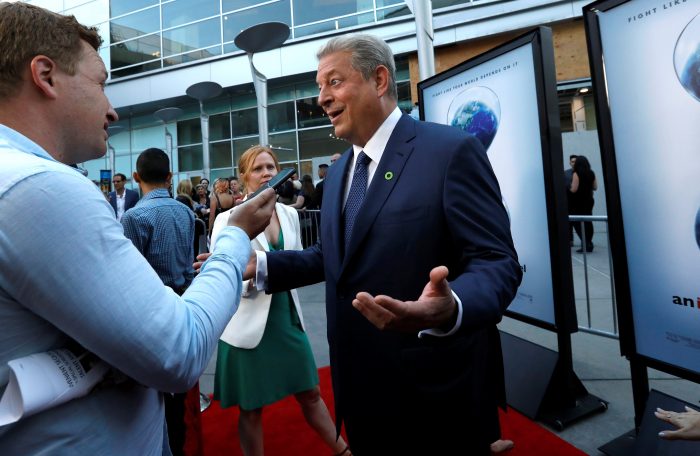
For over 50 years, environmentalists have argued that a significant down-sizing of American living standards is required to prevent environmental catastrophe. They have been attacking the American lifestyle since the 1960s, and Walmart since the 1990s. The El Paso shooting suspect named his manifesto “The Inconvenient Truth,” a title nearly identical to the 2006 documentary about Al Gore’s slideshow on global warming. In it, Gore says: “The truth about the climate crisis is an inconvenient one that means we are going to have to change the way we live our lives.”
Many Democrats and New York Times readers will object that we cannot attribute the El Paso shooting subject’s actions to Gore or to the language he uses. But if that’s true, then we can’t attribute them to Trump and Fox News, either. We can’t have it both ways.
After I made this point on Twitter, some people replied that while the suspect may have had environmental concerns, he acted on his anti-immigrant beliefs. Others said that had he acted on his environmental concerns, he would have shot up ExxonMobil. But such claims demonstrate ignorance of what the shooting suspect wrote, his worldview, and the ways in which it “echoes,” to use the Times’ word, the long history of anti-immigrant, Malthusian environmentalism.
The suspect clearly states that his decision to kill immigrants was, in significant measure, because of their impact on the natural environment. “Of course these migrants and their children have contributed to the problem, but are not the sole cause of it,” he writes. “The American lifestyle affords our citizens an incredible quality of life.”
The El Paso suspect said he was partly inspired by the suspected shooter of Muslim immigrants in New Zealand in March, who also made clear in a manifesto that environmental concerns motivated his anti-immigrant ones. “Why focus on immigration and birth rates when climate change is such a huge issue?” the New Zealand shooting suspect asks. “Because they are the same issue, the environment is being destroyed by overpopulation, we Europeans are one of the groups that are not overpopulating the world.”
It is not surprising that the two manifestos echoed environmentalist ideas. For two centuries, prominent scientists, conservationists, and journalists, have blamed immigrants, the poor, and non-whites for their degradation of the natural environment. Much of what we call “environmentalism” is simply a repackaging of the ideas of 19th-century economist Thomas Malthus. He believed overpopulation of the poor would deplete resources, and that the ethical thing to do was let the poor die of hunger and disease to prevent more hunger and disease in the future. “Instead of recommending cleanliness to the poor, we should encourage contrary habits,” he wrote, “and court the return of the plague.” The British government and media used Malthus’ ideas to justify the policies that led to mass starvation in Ireland from 1845 to 1849.
After the Second World War, leading conservationists embraced Malthus’ view that overpopulation would result in resource depletion. Their concerns were directed at poor non-whites in other countries, particularly India, even though North Americans and Europeans consumed and produced an order of magnitude more resources and pollution. Anti-humanist environmentalism came full bloom in Stanford biologist Paul Ehrlich’s 1968 Sierra Club book, The Population Bomb, which used dehumanizing language similar to that used by today’s anti-immigrant activists. In the opening pages of his book, Ehrlich depicted poor people in India as animals, “screaming… begging… defecating and urinating.”
More recently, environmentalists and scientists concerned about overpopulation tried to get the Sierra Club to oppose immigration from Mexico and other Latin American countries, expressing the concern that, by adopting an American lifestyle, immigrants will use up supposedly scarce natural resources—the same argument used by the El Paso shooting subject—and increase pollution.
Both the El Paso and New Zealand suspects echo the exaggerated rhetoric of environmentalists. “Nothing is conserved,” wrote the New Zealand shooting suspect. “The natural environment is industrialized, pulverized and commoditized.” The El Paso suspect blames “consumer culture” for plastic and electronic waste, and “urban sprawl” for environmental degradation.
The El Paso suspect says environmental destruction was “brilliantly portrayed in the decades old classic The Lorax,” which is a children’s book about a greedy entrepreneur who shortsightedly chops down all of the trees. “Corporations are heading the destruction of our environment by shamelessly overharvesting resources,” he writes. The New Zealand shooting suspect agrees. “Not a thing has been conserved other than corporate profits and the ever increasing wealth of the 1% that exploit the people for their own benefit.”
Both men’s views are highly simplistic. Happily, Malthusian environmentalists, including the two shooting subjects, are wrong about the environment, and have been since Malthus wrongly predicted that too many people would result in famines and resource scarcity. Technology has outpaced increases in population and consumption, so that today humankind faces the prospects of reducing the total amount of our usage of natural resources, including land.
It is simply not the case that “nothing is conserved,” nor that “urban sprawl” is a major problem in comparison to other uses of land. Humans use about half of the ice-free surface of the earth, with just one to three percent of it used for cities. In fact, by increasing the size of cities through industrialization, we have been able to return more of the countryside to nature. Urbanization and industrialization have mostly been good, not bad, for the natural environment. When people move to cities and grow more food on less land, forests grow back and wildlife returns. This has been happening in developed nations for over 100 years, a process that could begin in most poor and developing nations before mid-century. If we encourage the process of ecological modernization, it will happen faster. That means humanistic environmentalists should help poor countries move up the energy ladder, from wood to hydroelectricity and coal to natural gas to uranium[?].
The “Lorax” view of environmental problems as a consequence of greed has always been wrong and depressing. Environmental problems, from climate change to plastic waste to species extinctions, mostly result from people trying to improve their lives, not from a few greedy corporate fat cats. Around the world, where important natural grasslands and forests are vulnerable, they are usually threatened by people seeking to expand agriculture to produce the food that people need, not to build suburban Walmart stores.
Anti-humanist environmentalists have long exaggerated high birth rates in poor nations, even while condemning the most effective ways to lower them. The New Zealand shooting suspect opens his manifesto by repeating “it’s the birth rates” three times. He later writes, “There is no Green future with never ending population growth, the ideal green world cannot exist in a World of 100 billion 50 billion or even 10 billion people.”
But technology is a far bigger factor in determining humankind’s environmental impacts than fertility rates. Modern agriculture reduces by half the amount of land we need to produce the same amount of food. Nuclear plants require less than one percent of the land that solar and wind farms need to produce the same amount of electricity. With abundant clean[?] nuclear energy, we will never run out of food, because it can be used to desalinate water, produce fertilizers, and even power indoor farms.
Birth rates among wealthier, more industrialized populations are a product of choice, driven mostly through a reduced need of children for farming. Unsurprisingly, the New Zealand suspect cites China as a model. For decades it enforced a draconian “one child” policy when birth rates would have fallen on their own.
Why do the shooting suspects and other pessimists get the environment so wrong? Perhaps because doing so makes them feel better about themselves and their place in society. Environmentalist concern over birth rates has always been disproportionately focused on immigrants, non-whites, and people in poor countries. The sad reality is that many weak and desperate humans—the kind who gun down innocent people—feel more powerful by seeking to hurt others and keep them down.
While it’s easy to dismiss the Christchurch and El Paso shooting suspects as insane, it’s also dangerous. Their manifestos, like the one written by the “Unabomber” before, suggest that the problem isn’t just psychological but also ideological—a consequence of believing people are inherently greedy, the environment is in decline, and the future is dark. As such, both anti-human and anti-immigrant influences may be having a larger influence on recent shootings than either side in the culture war wants to admit.
Michael Shellenberger is a Time Magazine “Hero of the Environment,” and president of Environmental Progress. Follow him on Twitter @ShellenbergerMD.
Israel Uses Its Firepower, Far and Wide
By Paul R. Pillar | LobeLog | August 27, 2019
Israel recently has been expanding its military attacks across much of the Middle East, hitting multiple countries. The aggressive campaign far outpaces anything any adversaries of Israel have been doing to it, or even trying unsuccessfully to do to it.
Over the past two years Israel has used combat aircraft to conduct scores of attacks in Syria. Israel has stayed silent about most of this campaign of bombardment, but when it speaks it says the targets it hits are associated with Iran. The most recent widening of Israel’s assaults have involved Lebanon, including drone attacks on facilities in suburban Beirut associated with Hezbollah—a departure from the cease-fire established after the last Israeli-Hezbollah war.
The most dramatic geographic widening of the Israeli assault came last month with multiple attacks, reportedly conducted with F-35s, in Iraq—which, of course, does not even border Israel. Among the targets hit was one facility that is 500 miles from Israel but only about 50 miles from the Iranian border.
It is difficult to identify anything being fired in anger in the opposite direction that justifies such an expansive Israeli military campaign. In January of this year, Israel’s missile defense system intercepted a missile heading for the Israeli-occupied Golan Heights, but that is about as close as anyone in Syria, Lebanon, or Iraq has come lately to inflicting damage on Israel. Planned or failed attempts to inflict such damage all appear aimed at retaliating for Israel’s own attacks. Israel claimed that sorties it conducted this past weekend in Syria had thwarted an Iranian attempt to launch attack drones against Israel. That claim is unconfirmed, but it is quite plausible that, as suggested by Israeli sources, Iran was indeed planning such an operation to retaliate for the Israeli attacks last month in Iraq. One searches in vain for hostile operations that are unprovoked and not attempted tit-for-tat responses to Israel’s own actions.
The escalated Israeli military campaign exhibits some longstanding attributes of Israeli policies and practices. One is to assert a right to seek absolute security even if that means absolute insecurity for everyone else. The mere possibility of someone harming Israel is taken as sufficient reason to inflict certain harm on someone else. Israeli Prime Minister Benjamin Netanyahu, in commenting on the most recent Israeli operations in Syria, said that Israel “won’t tolerate attacks on its territory.” Evidently that means asserting the privilege of attacking anyone else’s territory, even if those countries have not already attacked Israel.
Domestic politics figures into such matters, in Israel as elsewhere. With an Israeli election looming, Netanyahu has a political reason to use aggressive operations to bolster his image as a tough-minded guardian of Israeli security.
The operations also are part of the larger anti-Iran theme that the Israeli government uses to keep a regional rival weak, preclude any rapprochement between that rival and the United States, blame someone other than itself for all the ills of the region, and distract international attention from subjects involving Israel that Netanyahu’s government would rather not talk about. The Israeli government wants to retain Iran permanently as a perceived threat, loathed and isolated, rather than to negotiate away any issues or problems involving Iran. Netanyahu demonstrated this when, after years of sounding an alarm about a possible Iranian nuclear weapon, he opposed the very agreement that closed all possible paths to such a weapon. His government demonstrated it again this week when it opposed President Trump’s expressed willingness to meet and negotiate with Iranian President Hassan Rouhani.
Israel’s heightened military aggressiveness has multiple bad consequences, in addition to being an affront to the sovereignty of multiple regional states. It pours gasoline on fires in places that need de-escalation, not escalation. It is certain to provoke more attempts at retaliation. Hezbollah Secretary-General Hassan Nasrallah was quite explicit in promising such retaliation in response to the recent Israeli attacks in Lebanon.
Given the close U.S. association with Israel, the Israeli attacks disadvantage the United States in its own relations with the affected states, in the form of increased resentment and lessened willingness to cooperate with Washington. This type of reaction is appearing today in Iraq, as a result of the Israeli attacks there. The episode has been the occasion for a powerful bloc in the Iraqi parliament to call for the withdrawal of all U.S. troops from Iraq and for shouts of “Death to America” to accompany “Death to Israel” at the funeral of one of those killed in the attacks.
No benefits offset these harmful consequences. It is useful to recall the previous time, before last month, that Israel attacked Iraq: the bombing of an Iraqi nuclear reactor in 1981. Far from setting back the Iraqi development of a nuclear weapon, the attack energized and accelerated what until then had been a semi-moribund program. Armed attacks on states have a way of provoking that sort of reaction.
U.S. policy has failed to recognize these realities. Following the attacks in Iraq, the Pentagon did issue a statement—in the course of denying direct U.S. involvement—that “we support Iraqi sovereignty and have repeatedly spoken out against any potential actions by external actors inciting violence in Iraq.” But such mild language will hardly deflect Israel from its present course when Secretary of State Mike Pompeo calls Netanyahu and, according to the official State Department statement, “expressed support for Israel’s right to defend itself from threats posed by the Iranian Revolutionary Guard Corps and to take action to prevent imminent attacks against Israeli assets in the region.”
It is not just current U.S. policy that fails to recognize realities, but also wider discourse in the United States about troubles in the Middle East. A question that needs to be pondered carefully is, “Who is destabilizing the Middle East?” Stoked by the Trump administration’s own unrelenting campaign of hostility toward Iran, the stock and overly simple answer has been, “Iran.” That is an insufficient answer even when excluding Israel from the picture. And Israel does get excluded, and excused, for the variety of reasons—ranging from religious doctrine and historical legacies to the inner workings of domestic U.S. politics—for the strong U.S. favoritism toward Israel.
It may be too much to ask for consistency rather than hypocrisy in such matters, but the rest of the world easily perceives the hypocrisy. It at least would be honesty to acknowledge that the U.S. approach toward the region has been shaped not by which players are or are not destabilizing the region, but instead by U.S. fondness for some players rather than others.
Paul R. Pillar is Non-resident Senior Fellow at the Center for Security Studies of Georgetown University and an Associate Fellow of the Geneva Center for Security Policy. He retired in 2005 from a 28-year career in the U.S. intelligence community. His senior positions included National Intelligence Officer for the Near East and South Asia, Deputy Chief of the DCI Counterterrorist Center, and Executive Assistant to the Director of Central Intelligence.
Adam Schiff’s New Law Expands Definition of ‘Domestic Terrorism’, Promotes FBI Entrapment
21st Century Wire | August 31, 2019
Recently, the US House Intelligence Committee Chairman Adam Schiff (D-CA) introduced a bill which intends to criminalize various new acts under the ever-expanding banner of domestic terrorism. Undoubtedly, this is an attempt by the government to broaden the definition of ‘domestic terrorism’ in order to make interpretation more arbitrary, and thus qualify more offenses for terrorism prosecutions.
Schiff’s new law will give the US Attorney General new powers which would potentially charge any threat of violence or damage to property that “creates a substantial risk of serious bodily injury” – as an act of domestic terrorism.
Potentially, this might could also include the use of heated political rhetoric during a “planning meeting” (a conversation in person, or in an internet chat room), or even breaking a window during a protest. In theory, the Federal government could them pursue sentences up to 30-years in prison.
Predictably, mainstream partisan pundits are cheering this authoritarian move by Schiff, as they believe that this legislation will give the state more power to crack down on what they perceive as their political enemies, namely ‘white supremacists’ and ‘white nationalists. It’s important to point out that this same reactionary, flawed logic was used by Neconservatives in the wake of 9/11 in order to target and ‘deal with’ the supposed ‘Muslim threat’ by rushing through Patriot Act I and II during the Bush Administration.
Writing for The Hill, Michael German offers a few real-life scenarios, explaining, “If you think this possibility is absurd, keep in mind that in 2012 the Justice Department put two political activists in jail for months for refusing to testify before a grand jury about colleagues who may have participated in a Seattle May Day protest in which a federal courthouse window was broken,” adding that, “In 2017, the Justice Department charged more than 200 protesters at an anti-Trump rally with felony charges for allegedly conspiring to riot because someone broke windows and lit a limousine on fire while they were in the general vicinity. Prosecutors used selectively edited undercover recordings of protest planning meetings in which a speaker threatened to turn the inauguration into a “giant clusterf—” as evidence of a broad conspiracy.”
“The prosecutions failed in these cases, which may partly explain why the Justice Department and FBI have been seeking to expand their domestic terrorism powers. If they were intent on using these new powers to target far-right militants, they could have simply amended current Justice Department policies that de-prioritize the investigation and prosecution of hate crimes,” said German.
Schiff federal power-grab is a bi-partisan effort – because both the Republican and Democratic wings of the Establishment will want to use such broad powers in order to marginalize their perceived political opponents, or worse – use the FBI to fabricate terror plots in order to create and maintain an ongoing crisis through which it can reinforce convenient political and state-power narratives and also justify increasing departmental expenditures.
In short, this breed of new legislation will only give the FBI increased license to continue and expand upon its highly shady practice of using handlers and informants to entrap and arrest unsuspecting dupes, and further boast to the press about the impressive number of “terror busts” it has referred to prosecution.
All the while, short-sighted partisan lawmakers remain oblivious to the long-term consequences of such a reactionary policy.
Israel partisan Peter Berkowitz named head of State Dept Policy Planning

Peter Berkowitz flanked by Paul Singer (L) and Lawrence Mone (R) at 2018 Manhattan Institute event. Singer, chair of the Manhattan institute’s board of trustees, is a hedge fund billionaire known for supporting Israel causes. Mone is president of the institute. Its board has included numerous Israel partisans, includiing Daniel Loeb, a backer of the Emergency Committee for Israel; Weekly Standard editor William Kristol; Project for the New American Century director Mark Gerson; former American Enterprise Institute chairman Bruce Kovner; and Michael Fedak, board member of AIPAC spinoff Washington Institute for Near East Policy.
By Alison Weir | If Americans Knew | August 30, 2019
The new official in charge of the State Department’s long-term strategic thinking is yet another neoconservative with close ties to Israel.
Politico reports that the State Department’s new head of policy planning will be longtime Israel partisan and neocon Peter Berkowitz. According to Politico, the position “puts him in charge of long-term strategic thinking for the department.”
Politico reports that the announcement “came in an internal email to select State Department officials on Monday morning.” Berkowitz will specifically be in charge of the State Department’s Office of Policy Planning.
Berkowitz is extremely close to Israel. He received an M.A. degree from Israel’s Hebrew University in 1985, and currently teaches for the Tikvah Fund in Israel. He is the Co-founder and Director of the Israel Program on Constitutional Government, located in Tel Aviv. He has been on the advisory committee for the Center for Jewish Political Thought, a section within Israel’s Shalom Hartman Institute. Berkowitz has been the Tad and Dianne Taube Senior Fellow at the Hoover Institute (the Taubes donate to numerous Israeli organizations) and is on the faculty of the Hertog Foundation.
Berkowitz has written numerous articles about Israel, often for the neoconservative outlet, Weekly Standard. His fellow neocon, Stanley Kurtz, credits Berkowitz with causing South African jurist Richard Goldstone to recant after leading a fact-finding investigation whose findings Israel disliked. The investigation had determined that Israel had committed numerous war crimes in Gaza. The report’s findings were corroborated by a number of other investigations that found Israel had violated international law.
In one of his pieces, Berkowitz claimed that “No military in the history of warfare has made greater efforts in the face of grave national security threats to avoid the use of force or has tried harder, when obliged to fight, to protect noncombatants than the Israel Defense Forces. With the possible exception of the U.S. armed forces, no military has investigated itself as rigorously as the IDF. With the possible exception of the U.S. judiciary, no courts have done more to hold their military accountable than Israel’s. And with the possible exception of America, no democracy has gone further in wartime to legitimize dissent than Israel.”
Berkowitz’s contention flies in the face of documentary evidence compiled by Human Rights Watch, Amnesty International, Christian Aid, B’Tselem (also see this), the International Red Cross, Physicians for Human Rights, Reporters Without Borders, Foreign Service Journal, and even the U.S. State Department. According to Berkowitz, all of these agencies are wrong.
Berkowitz also penned a piece attacking Harvard Professor Stephen Walt and University of Chicago Professor John Mearsheimer for their essay in the London Review of Books and Harvard working paper about the Israel lobby. Berkowitz accused the professors of “myriad half-truths, gross distortions, ignorant assertions, and defective reasoning.” Mearsheimer and Walt’s findings were later published in a book by Farrar, Straus and Giroux, The Israel Lobby and U.S. Foreign Policy.
Trump had initially opposed neocons and kept them out of his administration. Although neocons are nominally Republicans, many had endorsed Hillary (and many now remain, at least on the surface, Democrats). As Trump came under escalating attack, however, he moved ever closer to billionaire campaign donor Sheldon Adelson (who funds many neocon enterprises) and eventually began naming neocons to positions of power, where they often drive policy.
Neocons in the Bush Administration promoted the disastrous war with Iraq, and Israel and its partisans are central in the demonization of Iran that has resulted in the sanctions against Iran and threats of still worse.
Alison Weir is executive director of If Americans Knew, president of the Council for the National Interest, and author of the best selling book Against Our Better Judgment: The Hidden History of How the U.S. Was Used to Create Israel.
Another Syrian Victory – and West’s Telling Silence
Strategic Culture Foundation | August 30, 2019
The liberation of Khan Sheikhoun in Idlib Province by the Syrian army and its Russian ally marks another important victory towards ending the eight-year war in Syria.
Last week saw the return to relative normalcy in the northwestern town which had been held under siege by al Qaeda-affiliated militants for over five years. Situated south of Aleppo on the road to the capital Damascus, Khan Sheikhoun was officially declared under the control of Syrian state forces on August 21 after a hard-fought battle against militants.
International journalists from Italy, Bulgaria, Greece and Russia witnessed the return of residents and efforts to resume electricity services and reopening of schools. Khan Sheikhoun was ransacked by the routed jihadi terror groups, with the typical depravity that had been seen in other liberated areas. But despite the devastation, residents were relieved to begin the task of restoration of what was previously a town renowned for its culture and beauty before the war erupted in March 2011.
The remnants left behind by the defeated militants as well as the identity of dead fighters testified to their terrorist affiliation. Many of them were foreign mercenaries. Khan Sheikhoun was a stronghold for the Hayat Tahrir al-Sham group which was formerly known as Al Nusra Front. Notwithstanding the chameleonic name, they are part of the jihadi Al Qaeda terror network which is internationally proscribed and which Western governments are officially opposed to.
The capture of the town again demonstrates the vile nature of the Syrian war as being one of foreign-sponsored aggression for regime change. In particular, the United States government and its NATO allies, Britain, France, Turkey, and others, are now known to be fully complicit in covert sponsorship of these terrorists.
Khan Sheikhoun is of particular significance because on April 4, 2017, it was dramatically reported by Western news media as being the site of a Sarin chemical weapon attack, allegedly carried out by the Syrian state forces. Three days later, on April 7, the US, Britain and France launched over 100 airstrikes on Syria in what was claimed to be “revenge” against the “Syrian regime” for allegedly committing an atrocity with chemical weapons. Syrian authorities and Russia asserted the alleged Sarin attack at Khan Sheikhoun was a false-flag provocation, fabricated by the militants with the aim of eliciting a military strike on Syria by the US and its NATO allies.
Clearly, after the liberation of the town this month, it is evident that it was a den of terrorist groups which held residents under a reign of terror. Yet for years, the Western news media had proclaimed that these fighters were “rebels” who deserved support from Western intervention. Even as Syrian forces were launching their assault on Idlib Province in recent months, the Western media were animated by shrill reports of “rebels” and civilians being killed by indiscriminate “regime” air strikes.
Tellingly, the momentous victory at Khan Sheikhoun was met with an astonishing silence among Western governments and news media.
The same duplicitous pattern has been seen before when the Syrian army and its Russian ally liberated Douma, Ghouta, Daraa, Aleppo, Maaloula and many other areas besieged by the so-called “rebels” so lionized in Western media. Syrian residents have been invariably relieved and overjoyed to have their freedom and dignity restored by the Syrian army and Russian forces. Their stories of the horror they endured under captivity are shocking from the depravity and cruelty meted out by Western-backed “rebels”.
That is why the liberation of Khan Sheikhoun, as with other locations in Syria, has had to be studiously ignored by the Western news media. Because if they really performed normal journalistic duty what the Western public would learn is that their governments and media have been complicit in huge war crimes against the Syrian nation.
It is all the more despicable therefore that the US is shifting its efforts to block the reconstruction of war-torn Syria. This week, the country is to hold the annual Damascus International Trade Fair. Delegates from some 40 nations are attending and exploring ways to regenerate the Syrian economy and to meet the challenge of reconstruction. Some estimates put minimal repair of infrastructure at a cost of $388 billion. The true figure could be in trillions of dollars.
That bill should be assigned to Washington, London, Paris, Ankara, Riyadh, Doha and Tel Aviv for the criminal aggression they collectively and stealthily inflicted on Syria.
Ahead of the Damascus trade fair, the US was warning prospective foreign investors that they could face sanctions if they did business with Syria. Russia’s foreign ministry condemned the American effort to sabotage Syria’s reconstruction.
As Russian lawmaker Valery Rashkin, who was in Syria this week, put it, the US is trying to destroy Syria through economic warfare after losing its dirty-war military agenda.
The European Union also stands condemned for continuing to impose economic sanctions on Syria. The war is over and it has been exposed as Western-backed criminal aggression. All past accusations against the Syrian state are null and void as malign propaganda. Thus, sanctions on Syria are a contemptible attack on the country by nations whose criminal complicity should actually be a matter of prosecution.
We can only wish the people of Syria well. With international solidarity from Russia, China, Iran and others, Syria will recover its former strength and pride. Syria has won a tremendous victory. The losers are the Western governments and media who have been exposed for the corrupt charlatans they are.
Featured Video

Broke Princes: Saudi Arabia’s Powder Keg
or go to
Aletho News Archives – Video-Images
From the Archives
A sample of vaccine and injectable medication tragedies during my lifetime
This is what happens when you demand speedy production in an era of politicized regulation
By Meryl Nass, MD | February 12, 2022
All these tragedies have been due to failures of testing or failures in manufacturing processes. Most occurred before vaccine manufacturers were given virtually complete protection from liability in 1987.
With the duration of patent exclusivity determining how much new products earn, products are rushed to market as quickly as possible, most using a shortened path for FDA review. Recalls and market removals of approved products are much more common than they used to be. We can only expect more of these disasters in the future, especially if the products are mandated for everyone. … continue
Blog Roll
 Aletho News
- Broke Princes: Saudi Arabia’s Powder Keg
- Albania’s Crisis: Rama, Israeli Investments and the Demand for Accountability
- Hezbollah Categorically Denies Syrian Accusations: We Aim at Confronting Israeli Enemy, Not Undermining Syria’s Stability
- Trump claims funding to Israel ending in 2026 as merger of Israeli–US armies looms
- Iran Weathering The Storm, But Saudi Arabia Is Sinking
- Sunk Ships Don’t Sail Home: Why Peace Won’t Save the Oil Market and War Will Wreck It
- No Cossacks at the gates, fix Italy instead – opposition leader to Meloni
- The Pits: Zelensky’s torture chamber network in the public eye
- Moscow mocks Kiev’s language hypocrisy exposed by ‘torture chamber’ scandal
- Military ‘torture chamber’ triggers new scandal in Kiev
- If Americans Knew
- An error has occurred; the feed is probably down. Try again later.
- No Tricks Zone
- Germany’s Green Energy Transition Becoming Increasingly Expensive…Another 6 Trillion Euros!
- Sudden Stratospheric Warming, Powerful El Niño Combination May Lead To Extreme Europe Cold, Energy Crisis!
- Two New Studies Find Thwaites Glacier Melt Cannot Be Driven By Human Activity Or A Warming Ocean
- E-Cars Reduce CO2 Emissions By Only 41% Compared To Internal Combustion Engine Vehicles
- Predictions Made By Renowned Climate Professor Over Past Decades Have Been Proven To Be Poor
- New Study Suggests Large Regions Of The Pacific Ocean Have Been Cooling For The Last 80 Years
- Germany’s Green Energy Debacle: High Energy Costs Force Kahla Porzellan to Close After 182 Years!
- New Study: 50 Years Of The Most Aggressive ‘Net Zero’ Policies Can Only Affect The Global Climate By 0.03°C
- US September “Heat” Was No Record…Many Records Set Decades Ago
- Latest European Green Energy Debacle; Portugal’s Largest Flagship Solar Park Insolvent!

