Chinese company making F-35 parts?! Embarrassing ‘discovery’ further erodes ‘Huawei spying’ hysteria
RT | June 15, 2019
After a Chinese company was found manufacturing circuit boards for the F-35 jet, the UK Ministry of Defense insisted there is nothing to worry about, rendering the fuss over omnipresent Beijing spies increasingly silly.
Exception PCB, a Chinese-owned company based in Gloucestershire, England, manufactures the circuit boards that control the engines, lighting, fuel and navigation systems of the F-35 Joint Strike Fighter, the most expensive weapons system ever made. While the UK’s Ministry of Defense insists the company is an established supplier to the defense industry and presents “no risk,” months of flogging the China-spying narrative have done their job, and UK media and politicians are up in arms over this “shocking revelation.”
“We have been completely and utterly naive about the role of China and it is only now that people are beginning to wake up,” former Tory defense minister Sir Gerald Howarth told the Telegraph, expressing concern about Chinese involvement in a classified defense program.
“I think it’s breathtaking,” Tory MP and army reservist Bob Seely told SkyNews. “It’s not a question of: Is this bad? But it’s a question of: how bad is it?”
Exception PCB was bought by Shenzhen Fastprint in 2013, has never concealed its Chinese ownership and has also worked on the Eurofighter Typhoon fighter jet and the Apache attack helicopter, among other sensitive programs. A director from the company told SkyNews there are “clear firewalls in place” between the Exception and its Chinese owners, that the company only produces bare circuit boards, and that no additional electronic information is supplied. But Lockheed Martin didn’t seem so sure, informing Sky that “like all components of the F-35,” the circuit boards “are inspected repeatedly at each stage of manufacture.”
“Exception PCB has no visibility or access to any sensitive program information and there is limited to no risk associated with their minimal role in the program,” Lockheed said, adding that they had alternate sources of supply to draw from “should Exception PCB be determined an unapproved source in the future.”
This isn’t the first time the US military has concealed Chinese involvement in the F-35’s supply chain. In 2014, the Pentagon sought multiple waivers to a ban on using Chinese-built components in its efforts to keep the cost-overrun-plagued program on schedule. Suppliers Northrop Grumman and Honeywell both were permitted to use Chinese-made magnets in the plane’s radar system and landing gears as the Pentagon feared further delays to the project would cut into foreign orders needed to finance it, ultimately triggering an investigation by the Government Accountability Office over whether the “mistake” was made “knowingly and willfully.”
The nonchalance with which both US and UK defense ministries have made use of Chinese parts should raise questions about the Huawei spying panic, if nothing else. The US has banned Huawei from doing business with American telecom companies and has made a concerted effort to have Huawei and other Chinese tech firms blacklisted throughout Europe, to the point of threatening to freeze the UK out of the Five Eyes intelligence-sharing network over merely the suggestion that the Chinese company might be allowed to bid on a peripheral component of the country’s 5G network. Germany, too, has been threatened with curtailment of intelligence-sharing over worries that Huawei tech is riddled with backdoors to the Chinese government.
Another Chinese firm making their top-secret military equipment, however, is just fine. This is because the US is not actually worried about the security risks of Huawei equipment at all, according to Huawei chief security officer John Suffolk, who has offered US officials the opportunity to test its equipment in whatever way they need to confirm the absence of the dreaded backdoors. Instead, it’s competition they fear – both in technological development and in control of global communications networks. As Suffolk has pointed out more than once, it’s US technology that has been weaponized to surveil the entire world. And it doesn’t take kindly to competitors.
US video not enough to blame Iran for tanker attacks: Germany
Press TV – June 14, 2019
Video footage released by the US military to blame Iran for the recent attacks on two oil tankers in the Sea of Oman has been disputed even by Washington’s allies and Western analysts.
Less than a day after the US Central Command (CENTCOM) released the video late Thursday purportedly showing “Iranian sailors” removing a mine from the Japanese-owned Kokura Courageous’ hull earlier in the day, European governments — except for Britain — have so far refused to accept the US’ narrative that Tehran was to blame for the “suspicious” attacks.
They are reluctant to accept the White House’s claims at face value, and do not want to provide Washington with any pretext for war.
German Foreign Minister Heiko Maas said on Friday the video is not sufficient to prove the US claim that Iran was behind the attacks.
“The video is not enough. We can understand what is being shown, sure, but to make a final assessment, this is not enough for me,” Maas, who was in Iran earlier this week on an official two-day visit, told reporters in Oslo.
Nathalie Tocci, a senior adviser to European foreign policy chief Federica Mogherini also rejected the US allegations, saying, “Before we blame someone, we need credible evidence.”
Iranians are deeply rational actors, she said. And for Iran to have attacked a Japanese ship when the Japanese prime minister was in Tehran “is not an especially rational thing to do.”
In the video released, a small boat is shown coming up to the side of the Japanese-owned tanker. An individual stands up on the bow of the boat and can be seen removing an object from the tanker’s hull. The US claims that the object is likely an unexploded mine.
“At 4:10 p.m. local time an IRGC Gashti Class patrol boat approached the M/T Kokuka Courageous and was observed and recorded removing the unexploded limpet mine from the M/T Kokuka Courageous,” the CENTCOM said in a statement.
The claim, however, was soon rejected by the Japanese ship’s operator, whose president said on Friday its sailors on board the Kokuka Courageous saw “flying objects” just before the attack, suggesting the tanker wasn’t damaged by mines.
“The crew told us something came flying at the ship, and they found a hole,” President Yutaka Katada of Kokuka Sangyo told a press conference in Tokyo. “Then some crew witnessed the second shot.”
The video was also disputed by Western investigative journalists and defense analysts.
Investigative historian and journalist Gareth Porter said he had “written to the CENTCOM media desk to ask why the video the command has released does not show what happened before the moment something is removed from the side of the boat.”
The investigative journalism website Bellingcat also wrote that “there’s currently no evidence to verify what was removed from the side of the vessel was a mine, and there’s no evidence at the moment about who placed it there, so claiming it was a mine placed by the Iranians is pure conjecture at this point in time.”
Some analysts and observers even questioned the authenticity of the video, arguing that the US military has edited the video to make it misleading.
False-flag operation
The attacks on Thursday morning sent shock waves through the world which was awaiting the news of a meeting between Japanese Prime Minister Shinzo Abe and Leader of the Islamic Revolution Ayatollah Seyyed Ali Khamenei in Tehran.
François Heisbourg, a French defense analyst, told The New York Times there’s a lot of suspicion among US allies in Europe about American motives.
“The maritime milieu is especially susceptible to manipulation — remember the Gulf of Tonkin,” a dubious report of naval hostilities that President Lyndon B. Johnson used to escalate the war in Vietnam. And then, he said, are the bitter memories of the Iraq war, which was based on faulty intelligence and badly split Europe.
Heisbourg said there are several potential beneficiaries from the attacks, among them Washington hard-liners like the national security adviser, John Bolton, and “wild ones” in Saudi Arabia or in the UAE.
Back in April, Iranian Foreign Minister Mohammad Javad Zarif had warned that an “accident” could be plotted to take place so as to trigger a broader crisis.
Speaking in an interview with Reuters at the Iranian mission to the United Nations in New York on April 24, Zarif said the so-called “B-Team,” including Bolton and Israeli Prime Minister Benjamin Netanyahu, could goad Trump into a conflict with Tehran.
In a tweet after the recent incidents in the Sea of Oman, Zarif referred to his earlier warnings, and said, “The B-Team is sabotaging diplomacy (including important and constructive visit of PM Shinzo Abe) and covering up economic terrorism by the US against Iran.”
Last month, the Trump administration had accused Iran of being behind a similar attack on four oil tankers in the Persian Gulf while independent analysts blamed US and Israeli intelligence agencies for carrying out a false flag operation in order to ignite a conflict in the Middle East region.
Last week, the United Nations Security Council held a meeting on the vessel attacks near the UAE port of Fujairah, but member states refused to blame any party despite Abu Dhabi’s claim that a “state actor” was behind the incident. Russian Deputy Ambassador Vladimir Safronkov told reporters that no evidence on Iran’s alleged link to the attacks were presented during the briefing.
Days before the Security Council briefing, Bolton had vowed to present to the UN evidence on Iran’s involvement in the Fujairah attacks, but he didn’t.
Following those allegations, Iran officially warned about the use of fake intelligence, similar to those which resulted in the US invasion of Iraq in 2003, to push Washington toward a war with Tehran.
“Those who were responsible for the Iraqi invasion back in 2003 are the same people who are trying to create a conflict in our region,” Iranian ambassador to the UN Majid Takht-Ravanchi said in May, referring to Bolton’s role in the Iraqi invasion.
DOJ Bloodhounds on the Scent of John Brennan
By Ray McGovern – Consortium News – June 13, 2019
The New York Times Thursday morning has bad news for one of its favorite anonymous sources, former CIA Director John Brennan.
The Times reports that the Justice Department plans to interview senior CIA officers to focus on the allegation that Russian President Vladimir Putin ordered Russian intelligence to intervene in the 2016 election to help Donald J. Trump. DOJ investigators will be looking for evidence to support that remarkable claim that Special Counsel Robert Mueller’s final report failed to establish.
Despite the collusion conspiracy theory having been put to rest, many Americans, including members of Congress, right and left, continue to accept the evidence-impoverished, media-cum-“former-intelligence-officer” meme that the Kremlin interfered massively in the 2016 presidential election.
One cannot escape the analogy with the fraudulent evidence of weapons of mass destruction in Iraq. As in 2002 and 2003, when the mania for the invasion of Iraq mounted, Establishment media have simply regurgitated what intelligence sources like Brennan told them about Russia-gate.
No one batted an eye when Brennan told a House committee in 2018, “I don’t do evidence.”
Leak Not Hack
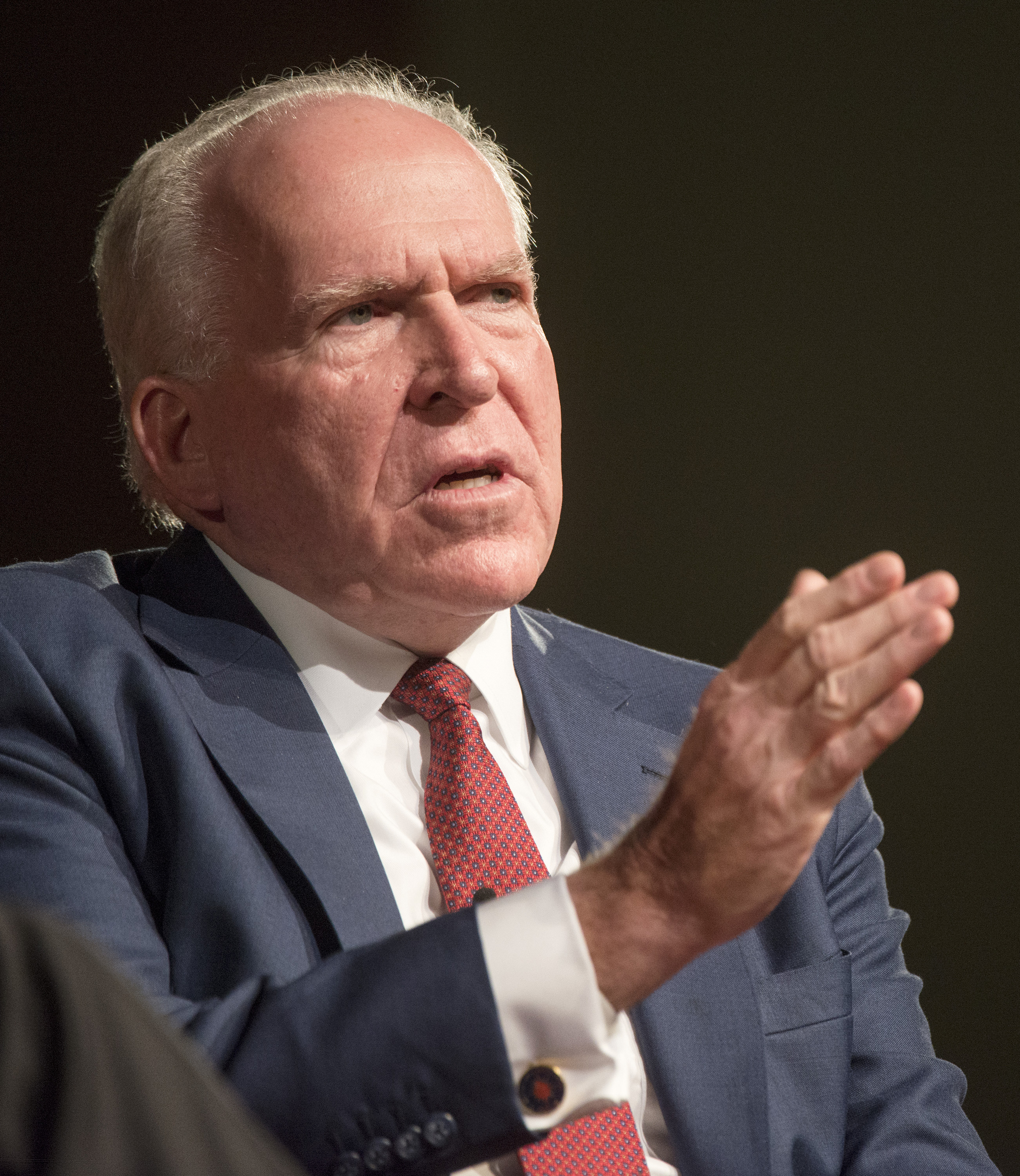
Brennan: Is the jig up? ( LBJ Library photo/ Jay Godwin)
As we Veteran Intelligence Professionals for Sanity have warned numerous times over the past two plus years, there is no reliable forensic evidence to support the story that Russia hacked into the DNC. Moreover, in a piece I wrote in May, “Orwellian Cloud Hovers Over Russia-gate,” I again noted that accumulating forensic evidence from metadata clearly points to an inside DNC job — a leak, not a hack, by Russia or anyone else.
So Brennan and his partners, FBI Director James Comey and National Intelligence Director James Clapper were making stuff up and feeding thin but explosive gruel to the hungry stenographers that pass today for Russiagate obsessed journalists.
Is the Jig Up?
With Justice Department investigators’ noses to the ground, it should be just a matter of time before they identify Brennan conclusively as fabricator-in-chief of the Russiagate story. Evidence, real evidence in this case, abounds, since the Brennan-Comey-Clapper gang of three were sure Hillary Clinton would become president. Consequently, they did not perform due diligence to hide their tracks.
Worse still, intelligence analysts tend to hang onto instructions and terms of reference handed down to them by people like Brennan and his top lieutenants. It will not be difficult for CIA analysts to come up with documents to support the excuse: “Brennan made me do it.”
The Times article today betrays some sympathy and worry over what may be in store for Brennan, one of its favorite sons and (anonymous) sources, as well as for those he suborned into making up stuff about the Russians.
The DOJ inquiry, says the Times, “has provoked anxiety in the ranks of the C.I.A., according to former officials. Senior agency officials have questioned why the C.I.A.’s analytical work should be subjected to a federal prosecutor’s scrutiny.” Attorney General William Barr is overseeing the review but has assigned the U.S. attorney in Connecticut, John Durham, to conduct it.
No Holds Barred
Barr is approaching this challenge with a resoluteness and a calm candor rarely seen in Washington — particularly when it comes to challenging those who run the intelligence agencies.
The big question, once again, is whether President Donald Trump will follow his customary practice of reining in subordinates at the last minute, lest they cross the vindictive and still powerful members of the Deep State.
Happily, at least for those interested in the truth, some of the authors of the rump, misnomered “Intelligence Community Assessment” commissioned by Obama, orchestrated by Brennan-Clapper-Comey, and published on January 6, 2017 will now be interviewed. The ICA is the document still widely cited as showing that the “entire intelligence community agreed” on the Russia-gate story, but this is far from the case. As Clapper has admitted, that “assessment” was drafted by “handpicked analysts” from just three of the 17 intelligence agencies — CIA, FBI, and NSA.
U.S. Attorney Durham would do well to also check with analysts in agencies — like the Defense Intelligence Agency and State Department Intelligence, as to why they believe they were excluded. The ICA on Russian interference is as inferior an example of intelligence analysis as I have ever seen. Since virtually all of the hoi aristoi and the media swear by it, I did an assessment of the Assessment on its second anniversary. I wrote:
“Under a media drumbeat of anti-Russian hysteria, credulous Americans were led to believe that Donald Trump owed his election victory to the president of Russia, whose “influence campaign” according to the Times quoting the intelligence report,helped “President-elect Trump’s election chances when possible by discrediting Secretary Clinton.”
Hard evidence supporting the media and political rhetoric has been as elusive as proof of weapons of mass destruction in Iraq in 2002-2003. This time, though, an alarming increase in the possibility of war with nuclear-armed Russia has ensued — whether by design, hubris, or rank stupidity. The possible consequences for the world are even more dire than 16 years of war and destruction in the Middle East. …
The Defense Intelligence Agency should have been included, particularly since it has considerable expertise on the G.R.U., the Russian military intelligence agency, which has been blamed for Russian hacking of the DNC emails. But DIA, too, has an independent streak and, in fact, is capable of reaching judgments Clapper would reject as anathema. Just one year before Clapper decided to do the rump “Intelligence Community Assessment,” DIA had formally blessed the following heterodox idea in its “December 2015 National Security Strategy”:
“The Kremlin is convinced the United States is laying the groundwork for regime change in Russia, a conviction further reinforced by the events in Ukraine. Moscow views the United States as the critical driver behind the crisis in Ukraine and believes that the overthrow of former Ukrainian President Yanukovych is the latest move in a long-established pattern of U.S.-orchestrated regime change efforts.”
Any further questions as to why the Defense Intelligence Agency was kept away from the ICA drafting table?
Ray McGovern works with Tell the Word, a publishing arm of the ecumenical Church of the Saviour in inner-city Washington. During his 27 years as a CIA analyst, he was Chief of the Soviet Foreign Policy Branch, and preparer/briefer of the President’s Daily Brief. He is co-founder of Veteran Intelligence Professionals for Sanity (VIPS).
Why Didn’t Mueller Investigate Seth Rich?
By Daniel Lazare | Consortium News | June 12, 2019
After bungling every last aspect of Russia-gate since the day the pseudo-scandal broke, the corporate press is now seizing on the Mueller report to shut down debate on one of the key questions still outstanding from the 2016 presidential election: the murder of Democratic National Committee staffer Seth Rich.
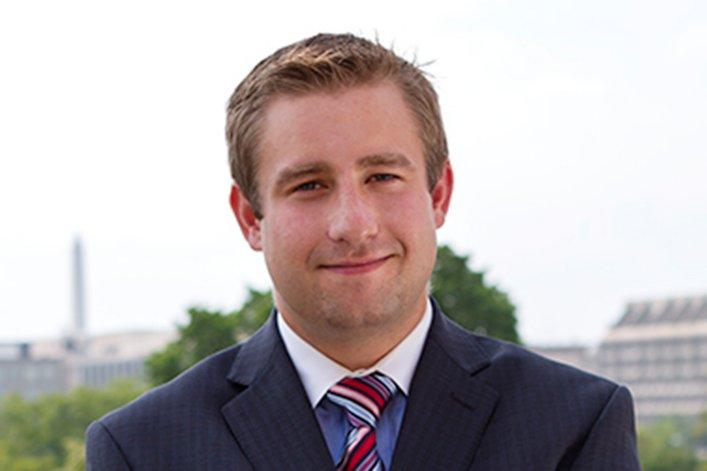
Slain Democratic National Committee staffer Seth Rich. (LinkedIn)
No one knows who killed Rich in Washington, D.C., on July 10, 2016. All we know is that he was found at 4:19 a.m. in the Bloomingdale neighborhood “with apparent gunshot wound(s) to the back” according to the police report. Conscious and still breathing, he was rushed to a nearby hospital where he was pronounced dead at 5:57.
Police have added to the confusion by releasing information only in the tiniest dribs and drabs. Rich’s mother, Mary, told local TV news that her son struggled with his assailants: “His hands were bruised, his knees are bruised, his face is bruised, and yet he had two shots to his back, and yet they never took anything…. They took his life for literally no reason. They didn’t finish robbing him, they just took his life.”
But cops said shortly after the killing that they had no immediate indication that robbery was a motive. Despite his mother’s report of two shots in the back, all the local medical examiner would say is that the cause of death was a gunshot wound to the torso. According to Rich’s brother, Aaron, Jeff “was very aware, very talkative,” when police found him lying on the pavement. Yet cops have refused to say if he described his assailant. A month later, they put out a statement that “there is no indication that Seth Rich’s death is connected to his employment at the DNC,” refusing to elaborate.
The result is a scattering of disconnected facts that can be used to support just about any theory from a random killing to a political assassination. Nonetheless, Robert Mueller is dead certain that the murder had nothing to do with the emails — just as he was dead certain in 2003 that Iraq was bristling with weapons of mass destruction “pos[ing] a clear threat to our national security.”
Mueller’s Theory About Assange ‘Dissembling’
Mueller is equally positive that, merely by expressing concern that the murder may have had something to do with the release of thousands of DNC emails less than two weeks later, WikiLeaks founder Julian Assange was trying to protect the real source, which of course is Russia.
Here’s how the Mueller report puts it:
“Beginning in the summer of 2016, Assange and WikiLeaks made a number of statements about Seth Rich, a former DNC staff member who was killed in July 2016. The statements about Rich implied falsely that he had been the source of the stolen DNC emails. On August 9, 2016, the @WikiLeaks Twitter accounted posted: ‘ANNOUNCE: WikiLeaks has decided to issue a US$20k reward for information leading to conviction for the murder of DNC staffer Seth Rich.’
Likewise, on August 25, 2016, Assange was asked in an interview, ‘Why are you so interested in Seth Rich’s killer?’ and responded, ‘We’re very interested in anything that might be a threat to alleged WikiLeaks sources.’ The interviewer responded to Assange’s statement by commenting, ‘I know you don’t want to reveal your source, but it certainly sounds like you’re suggesting a man who leaked information to WikiLeaks was then murdered.’
Assange replied, ‘If there’s someone who’s potentially connected to our publication, and that person has been murdered in suspicious, circumstances, it doesn’t necessarily mean that the two are connected. But it is a very serious matter … that type of allegation is very serious, as it’s taken very seriously by us’” (vol. 1, pp. 48-49).
This is what the Mueller report calls “dissembling.” The conclusion caused jubilation in corporate newsrooms where hostility to both Russia and WikiLeaks runs high. “The Seth Rich conspiracy theory needs to end now,” declared Vox.com. “The special counsel’s report confirmed this week that Seth Rich … was not the source,” said The New York Times. “The Mueller report might not end the debate over what President Donald Trump did,” the Poynter Institute’s Politifact added, “but it has scuttled one conspiracy theory involving a murdered Democratic party staffer and WikiLeaks.”
One Conspiracy Theory for Another
But all the Mueller report did was replace one conspiracy theory with another involving the Kremlin and its minions that is equally unconvincing.
Remarkably, there’s nothing in the Mueller report indicating that the special counselor independently reviewed the forensic evidence or questioned family members and friends. He certainly didn’t interview Assange, the person in the best position to know who supplied the data, even though Craig Murray, the ex-British diplomat who serves as an unofficial WikiLeaks spokesman, says the WikiLeaks founder would have been “very willing to give evidence to Mueller” while holed up in the Ecuadorian embassy in London, “which could have been done by video-link, by interview in the Embassy, or by written communication.”
Murray says Mueller’s team made no effort to contact him either even though he has publicly stated that he met clandestinely with an associate of the leaker near the American University campus in Washington.
Why not? Because Mueller didn’t want anything that might disturb his a priori assumption that Russia is the guilty party. If he had bucked the intelligence community finding – set forth in a formal assessment in January 2017 – that Russian President Vladimir Putin ordered an influence campaign aimed at undermining Hillary Clinton’s candidacy — it would have been front-page news since an anti-Trump press had already accepted the assessment as gospel. But Mueller is far too much of an establishmentarian to do anything so reckless.
So he selected evidence in support of the official theory that “[t]he Russian government interfered in the 2016 presidential election in sweeping and systematic fashion,” as the report states on its very first page. And since Assange had consistently maintained that the data was the result of an inside leak rather than internal hack and that “[o]ur source is not the Russian government,” he cherry picked evidence to show that Assange is a liar, not only about Russia but about Seth Rich.
Cryptic Exchange
It’s a self-serving myth that corporate media have swallowed whole because it serves their interests too. One problem in exposing it, however, is Assange’s pledge – intrinsic to the WikiLeaks mission – to safeguard the identities of whistleblowers who furnish it with information. The upshot has been a good deal of beating around the bush. A month after the murder, the WikiLeaks founder appeared on a Dutch program called “Nieuwsuur” and took part in a cryptic exchange with journalist Eelco Bosch van Rosenthal:
Assange: Whistle blowers go to significant efforts to get us material and often very significant risks. There’s a 27-year-old – works for the DNC – who was shot in the back, murdered, just a few weeks ago for unknown reasons as he was walking down the street in Washington, so….
Rosenthal: That was just a robbery, I believe, wasn’t it?
Assange: No, there’s no finding, so –
Rosenthal: What are you suggesting?
Assange: I’m suggesting that our sources take risks, and they become concerned to see things occurring like that.
Rosenthal: But was he one of your sources then? I mean –
Assange: We don’t comment about who our sources are.
Rosenthal: But why make the suggestion about a young guy being shot in the streets of Washington?
Assange: Because we have to understand how high the stakes are in the United States and that our sources, you know, face serious risks. That’s why they come to us – so we can protect their anonymity.
Rosenthal: But it’s quite something to suggest a murder. That’s basically what you’re doing.
This was as close as Assange could come to confirming that Rich was tied up with the leak without actually saying it. Hours later, WikiLeaks tweeted about the $20k reward.
Four months after that, Craig Murray told the Libertarian Institute’s Scott Horton: “Don’t get me wrong, I’m not saying that he [Rich] was the source of the leaks. What I’m saying is that it’s probably not an unfair indication to draw that WikiLeaks believe[s] that he may have been killed by someone who thought he was the source of the leaks.” (Quote begins at 11:20.)
Thanks to such foggy rhetoric, it was all but inevitable that conspiracy theories would ignite. Two months after the killing, an ultra-conservative talk-radio host named Jack Burkman – best known for organizing a protest campaign against the Dallas Cowboys’ hiring of an openly gay football player named Michael Sam – approached members of the Rich family and offered to launch an investigation in their behalf.
The family said yes, but then backed off when Burkman grandly announced that the murder was a Kremlin hit. Things turned even more bizarre a year later when Kevin Doherty, an ex-Marine whom Burkman had hired to look into the case, lured his ex-boss to a Marriott hotel in Arlington, Virginia, where he shot him twice in the buttocks and then tried to run him down with a rented SUV. Doherty received a nine-year sentence last December.
The rightwing Washington Times meanwhile reported that WikiLeaks had paid Seth and Aaron Rich an undisclosed sum, a story it was forced to retract, and Fox News named Seth as the source as well. (A sympathetic judge dismissed a lawsuit filed by the Rich family on technical grounds.) But still the speculation bubbled on, with conservative nuts blaming everyone from ex-DNC chair Debbie Wasserman Schultz to acting DNC chairwoman Donna Brazile, Clinton campaign chairman John Podesta, and Bill and Hillary themselves.
All of which plays into the hands of a corporate press happy to write off any and all suspicion as a product of alt-right paranoia.
But if speculation refuses to die, it’s for a simple reason. If the DNC email disclosure was a hack, then Rich clearly had nothing to do with it, which means his death was no more than a robbery gone awry. But if it was a leak, then – based on broad hints dropped by Assange and Murray – it looks like the story could well be more complicated. This proves nothing in and of itself. But it guarantees that questions will grow as long as the Washington police make zero progress in its investigation and the Mueller report continues to fall apart.
And that’s just what’s happening. Mueller’s account of how Russian intelligence supposedly supplied WikiLeaks with stolen data makes no sense because, according to the report’s chronology, the transfer left WikiLeaks with just four days to review some 28,000 emails and other electronic documents to make sure that they were genuine and unaltered – a clear impossibility. (See “The ‘Guccifer 2.0’ Gaps in Mueller’s Full Report,” April 18.)
The FBI assessment that Paul Manafort associate Konstantin Kilimnik “has ties to Russian intelligence” – which Mueller cites (vol. 1, p. 133) in order to justify holding Manafort in solitary confinement during the Russia-gate investigation – is similarly disintegrating amid reports that Kilimnik actually served as an important State Department intelligence source.
So the idea of a hack makes less and less sense and an inside leak seems more and more plausible, which is why questions about the Rich case will not go away. Bottom line: you don’t have to be a loony rightist to suspect that there is more to the murder than Robert Mueller would like us to believe.
Daniel Lazare is the author of “The Frozen Republic: How the Constitution Is Paralyzing Democracy” (Harcourt Brace, 1996) and other books about American politics. He has written for a wide variety of publications from The Nation to Le Monde Diplomatique and blogs about the Constitution and related matters at Daniellazare.com.
US Treasury Dept imposes new Iran-related sanctions on 2 individuals and a company in Iraq
RT | June 12, 2019
The US Treasury Department announced sanctions on Wednesday against two Iraq-based persons and one company, for their alleged links to Iran’s Revolutionary Guard.
Makki Kazim and Mohammed Hussein, along with the South Wealth Resources Company have all been hit with secondary sanctions, according to the Treasury Department website.
Secondary sanctions form a major part of US international statecraft, cutting off businesses and individuals from the US financial system and tarnishing their reputations with international businesses and banks. A number of measures can be enforced against targeted individuals, ranging from limiting their ability to do business in the US to prohibiting all US parties from conducting business with them.
Bolton’s Long Goodbye

By John Kiriakou • Consortium News • June 12, 2019
John Bolton’s days as national security advisor are apparently numbered—for reasons that have all played out in the press, says John Kiriakou.
Everybody in America knows that Donald Trump places a premium on what he considers to be “loyalty.” You’re either with him or against him. The White House staff has been a revolving door from virtually the start of his administration. It’s not unusual for aides to last mere weeks or months, only to then be thrown out on the street.
Trump then inevitably says something about “loyalty.”
The situation isn’t unique to just the White House political and domestic policy staff. It is just as pervasive at the National Security Council. Nobody is sacred. Remember, you’re either with him or against him. Now it’s John Bolton’s turn to find himself in a corner. I believe that his days as national security advisor are numbered—for reasons that have all played out in the press.
I’m one of those people—not at all unique in Washington—who has contacts and friends all over the political spectrum, including in the Trump Administration. After work and over drinks, they like to vent. What they are telling me privately is what other Washington insiders are telling the conservative press. The White House, and especially the National Security Council, are in disarray. And Bolton will soon be fired.
Bolton-Centric
The right-wing Washington Examiner reported this week that Bolton acknowledged these reports, but in a back-handed way. He said in a Wall Street Journal podcast that he believes five countries are spreading “lies about dysfunction in the Trump administration.” Those countries are North Korea, Iran, Venezuela, Russia, and China. That’s laughable.
What Bolton is saying is that there is a vast and incredibly well-coordinated international conspiracy that includes some of the most important countries in the world, the main purpose of which is to embarrass him. That sounds perfectly rational, right?
Of course, a more rational person might conclude that Bolton has done a terrible job, that the people around him have done a terrible job, that he has aired his disagreements with Trump in the media, and that the President is angry about it. That’s the more likely scenario.
Here’s what my friends are saying. Trump is concerned, like any president is near the end of his term, about his legacy. He said during the campaign that he wanted to be the president who pulled the country out of its two longest wars. He wanted to declare victory and bring the troops back from Afghanistan and Iraq. He hasn’t done that, largely at the insistence of Bolton. Here we are three years later and we’re still stuck in both of those countries.
Second, my friends say that Trump wants to end U.S. involvement in the Yemen war, but that Bolton has been insistent that the only way to guarantee the closeness of the U.S. relationships with Saudi Arabia and the United Arab Emirates is to keep providing those countries with weapons, aerial refueling planes, and intelligence support.
Obsessed With Iran
That would explain the reason why the White House did not seek to block the recent Congressional vote on Yemen support. Bolton likely talked Trump into vetoing the resolution. Or he talked the Saudis into talking Trump into it. Still, at least in internal deliberations, Trump has said that he simply doesn’t see a national security reason to keep the war going. The U.S. gets nothing out of it.
Third, the mainstream media has accused Bolton of being the reason behind the failure of Trump’s second summit with North Korean leader Kim Jong-un. Bolton towed a hard line, so much so that the North Korean media called him a “war monger” and a “human defect” once the summit ended.
This week Trump told reporters gathered on the White House south lawn that Kim had “kept his word” on nuclear and missile testing. This was a direct contradiction of Bolton, who had said just hours earlier that the North Koreans had reneged on their commitments to the U.S. Trump said simply, “My people think there could have been a violation. I view it differently.”
Most importantly, Bolton has been famous for decades for his irrationally hard line on Iran. He has made no secret of his desire to bomb Iran into the stone age, to smash and overthrow its government, and to let the chips fall where they may. The policy makes literally no sense.
Iran is a country of 80 million people. It has an active and well-trained global intelligence service. It has a robust navy with highly-specialized “swift boats” that are active in the Persian Gulf. And it controls the vital Strait of Hormuz, through which 20 percent of the world’s oil and 33 percent of its liquified natural gas flows.
Trump said just a week ago that he was willing to begin talks with the Iranians “with no preconditions.” This was a major softening of U.S. policy toward Iran and it immediately drew Bolton’s ire. Indeed, The New York Times pointed out that the policy directly “overruled a longtime goal of (Trump’s) national security advisor.”
All of this has made Trump angry. He’s constantly being one-upped by one of the Washington swamp monsters he promised to rid the city of. He finally seems to have come to realize that even establishment Republicans dislike and distrust John Bolton. And now he understands why.
Mick Mulvaney, Trump’s chief of staff, has very quietly and discreetly begun informal meetings with a list of a half-dozen possible replacements for Bolton. Let’s hope he finds one that he and Trump both like sooner, rather than later.
John Kiriakou is a former CIA counterterrorism officer and a former senior investigator with the Senate Foreign Relations Committee. John became the sixth whistleblower indicted by the Obama administration under the Espionage Act—a law designed to punish spies. He served 23 months in prison as a result of his attempts to oppose the Bush administration’s torture program.
Kushner as a Colonial Administrator
Let’s Talk About the “Israeli Model”
By Ramzy Baroud | Dissident Voice | June 11, 2019
In a TV interview on June 2, on the news docuseries “Axios” on the HBO channel, Jared Kushner opened up regarding many issues, in which his ‘Deal of the Century’ was a prime focus.
The major revelation made by Kushner, President Donald Trump’s adviser and son-in-law, was least surprising. Kushner believes that Palestinians are not capable of governing themselves.
Not surprising, because Kushner thinks he is capable of arranging the future of the Palestinian people without the inclusion of the Palestinian leadership. He has been pushing his so-called ‘Deal of the Century’ relentlessly, while including in his various meets and conferences countries such as Poland, Brazil and Croatia, but not Palestine.
Indeed, this is what transpired at the Warsaw conference on ‘peace and security’ in the Middle East. The same charade, also led by Kushner, is expected to be rebooted in Bahrain on June 25.
Much has been said about the subtle racism in Kushner’s words, reeking with the stench of old colonial discourses where the natives were seen as lesser, incapable of rational thinking beings who needed the civilized ‘whites’ of the western hemisphere to help them cope with their backwardness and inherent incompetence.
Kushner, whose credentials are merely based on his familial connections to Trump and family friendship with Israeli Prime Minister, Benjamin Netanyahu, is now poised to be the colonial administrator of old, making and enforcing the law while the hapless natives have no other option but to either accommodate or receive their due punishment.
This is not an exaggeration. In fact, according to leaked information concerning Kushner’s ‘Deal of the Century,’ and published in the Israeli daily newspaper, Israel Hayom, if Palestinian groups refuse to accept the US-Israeli diktats, “the US will cancel all financial support to the Palestinians and ensure that no country transfers funds to them.”
In the HBO interview, Kushner offered the Palestinians a lifeline. They could be considered capable of governing themselves should they manage to achieve the following: “a fair judicial system … freedom of the press, freedom of expression, tolerance for all religions.”
The fact that Palestine is an occupied country, subject in every possible way to Israel’s military law, and that Israel has never been held accountable for its 52-year occupation seems to be of no relevance whatsoever, as far as Kushner is concerned.
On the contrary, the subtext in all of what Kushner has said in the interview is that Israel is the antithesis to the unquestionable Palestinian failure. Unlike Palestine, Israel needs to do little to demonstrate its ability to be a worthy peace partner.
While the term ‘US bias towards Israel’ is as old as the state of Israel itself, what is hardly discussed are the specifics of that bias, the decidedly condescending, patronizing and, often, racist view that US political classes have of Palestinians – and all Arabs and Muslims, for that matter; and the utter infatuation with Israel, which is often cited as a model for democracy, judicial transparency and successful ‘anti-terror’ tactics.
According to Kushner a ‘fair judicial system’ is a conditio sine qua non to determine a country’s ability to govern itself. But is the Israeli judicial system “fair” and “democratic”?
Israel does not have a single judicial system, but two. This duality has, in fact, defined Israeli courts from the very inception of Israel in 1948. This de facto apartheid system openly differentiates between Jews and Arabs, a fact that is true in both civil and criminal law.
“Criminal law is applied separately and unequally in the West Bank, based on nationality alone (Israeli versus Palestinian), inventively weaving its way around the contours of international law in order to preserve and develop its ‘(illegal Jewish) settlement enterprise’,” Israeli scholar, Emily Omer-Man, explained in her essay ‘Separate and Unequal’.
In practice, Palestinians and Israelis who commit the exact same crime will be judged according to two different systems, with two different procedures: “The settler will be processed according to the Israeli Penal Code (while) the Palestinian will be processed according to military order.”
This unfairness is constituent of a massively unjust judicial apparatus that has defined the Israeli legal system from the onset. Take the measure of administrative detention as an example. Palestinians can be held without trial and without any stated legal justification. Tens of thousands of Palestinians have been subjected to this undemocratic ‘law’ and hundreds of them are currently held in Israeli jails.
It is ironic that Kushner raised the issue of freedom of the press, in particular, as Israel is being derided for its dismal record in that regard. Israel has reportedly committed 811 violations against Palestinian journalists since the start of the ‘March of Return’ in Gaza in March 2018. Two journalists – Yaser Murtaja and Ahmed Abu Hussein – were killed and 155 were wounded by Israeli snipers.
Like the imbalanced Israeli judicial system, targeting the press is also a part of a protracted pattern. According to a press release issued by the Palestinian Journalists Union last May, Israel has killed 102 Palestinian journalists since 1972.
The fact that Palestinian intellectuals, poets and activists have been imprisoned for Facebook and other social media posts should tell us volumes about the limits of Israel’s freedom of press and expression.
It is also worth mentioning that in June 2018, the Israeli Knesset voted for a bill that prohibits the filming of Israeli soldiers as a way to mask their crimes and shelter them from any future legal accountability.
As for freedom of religion, despite its many shortcomings, the Palestinian Authority hardly discriminates against religious minorities. The same cannot be said about Israel.
Although discrimination against non-Jews in Israel has been the raison d’être of the very idea of Israel, the Nation-State Law of July 2018 further cemented the superiority of the Jews and inferior status of everyone else.
According to the new Basic Law, Israel is “the national home of the Jewish people” only and “the right to exercise national self-determination is unique to the Jewish people.”
Palestinians do not need to be lectured on how to meet Israeli and American expectations, nor should they ever aspire to imitate the undemocratic Israeli model. What they urgently need, instead, is international solidarity to help them win the fight against Israeli occupation, racism and apartheid.
Dr. Ramzy Baroud is an author and a journalist. He is athor of The Second Palestinian Intifada: A Chronicle of a People’s Struggle and his latest My Father Was a Freedom Fighter: Gaza’s Untold Story. He can be reached at ramzybaroud@hotmail.com.
Carey Wedler on Tulsi Gabbard’s Hope and Change
Corbett • 06/11/2019
Yay! Another politician seems to hold a correct opinion on an important policy issue. Time to give up on those silly anarchist ideals and vote for the CFR member who’s right about one thing (and wrong about a lot of things), right guys? Well, maybe not. Joining me today to discuss the important issue of Hope And Change 2.0 is Carey Wedler of The Anti-Media.
SHOW NOTES:
Interview 1249 – Carey Wedler on How Government $ach$ Won The (s)Election
Why do Democrats & the mainstream media hate this veteran & presidential candidate?
Tulsi voted to fund the DoD war machine
Vote Tulsi for Sensible Gun Control!
Tulsi will protect Medicare and Social Security!
Wedler: Why I’m burning my last bridge with Obama
Watch this video on BitChute / DTube / YouTube or Download the mp4
Egypt, Jordan, Morocco to attend US-led Palestinian conference
MEMO | June 11, 2019
Egypt, Jordan and Morocco have informed the Trump administration they will attend a US-led conference in Bahrain this month on proposals for boosting the Palestinian economy as part of a coming US peace plan, US officials said on Tuesday, reports Reuters.
Egypt and Jordan’s participation is considered especially important since historically they have been key players in Israeli-Palestinian peace efforts and are also the only Arab states to have reached peace agreements with Israel.
However, Palestinian leaders’ decision to boycott the June 25-26 conference has raised doubts about its chances for success. They have shunned a broader diplomatic effort that US President Donald Trump has called the “deal of the century,” which they see as likely to be heavily tilted in favour of Israel and denying them a state of their own.
Despite that, White House senior adviser Jared Kushner, Trump’s son-in-law and a chief architect of the long-delayed peace plan, is pressing ahead with arrangements for the Bahrain meeting, where the economic components are expected to be unveiled as the first step in the plan’s rollout.
Acceptance of the invitation to the conference by Jordan and Egypt will bring to the table two countries that border both Israel and Palestinian areas.
Saudi Arabia, Qatar and the United Arab Emirates have previously confirmed their attendance, a White House official said.
The official declined to say what level of representation the countries would send. US officials have said they were inviting economic and finance ministers, as well as business leaders from the region and around the world.
Global financial bodies including the International Monetary Fund (IMF) and World Bank also plan to be present.
US officials have been vague about the timing for the second phase of their initiative, which would be the release of proposals for resolving the thorny political issues at the core of the Israeli-Palestinian conflict.
With Israel heading for new elections in September after Prime Minister Benjamin Netanyahu failed to meet a deadline to form a government, uncertainty is expected to further delay the full release of the plan.
Most experts are skeptical the Trump administration can succeed where decades of US-backed efforts have failed.
How NeoCon Billionaire Paul Singer Is Driving the Outsourcing of US Tech Jobs to Israel
By Whitney Webb | MintPress News | June 11, 2019
WASHINGTON — With nearly 6 million Americans unemployed and regular bouts of layoffs in the U.S. tech industry, major American tech companies like Google, Microsoft and Intel Corporation are nonetheless moving key operations, billions in investments, and thousands of jobs to Israel — a trend that has largely escaped media attention or concern from even “America first” politicians. The fact that this massive transfer of investment and jobs has been so overlooked is particularly striking given that it is largely the work of a single leading neoconservative Republican donor who has given millions of dollars to President Donald Trump.
To make matters worse, many of these top tech companies shifting investment and jobs to Israel at record rates continue to collect sizable U.S. government subsidies for their operations while they move critical aspects of their business abroad, continue to layoff thousands of American workers, and struggle to house their growing company branches in Israel. This is particularly troubling in light of the importance of the tech sector to the overall U.S. economy, as it accounts for 7.1 percent of total GDP and 11.6 percent of total private-sector payroll.
Furthermore, many of these companies are hiring members of controversial Israeli companies — known to have spied on Americans, American companies, and U.S. federal agencies — as well as numerous members of Israeli military intelligence as top managers and executives.
This massive transfer of the American tech industry has largely been the work of one leading Republican donor — billionaire hedge fund manager Paul Singer, who also funds the neoconservative think tank American Enterprise Institute (AEI), the Islamophobic and hawkish think tank Foundation for Defense of Democracies (FDD), the Republican Jewish Coalition (RJC), and also funded the now-defunct Foreign Policy Initiative (FPI).
Singer’s project to bolster Israel’s tech economy at the U.S.’ expense is known as Start-Up Nation Central, which he founded in response to the global Boycott, Divest and Sanctions (BDS) movement that seeks to use nonviolent means to pressure Israel to comply with international law in relation to its treatment of Palestinians.
This project is directly linked to Israeli Prime Minister Benjamin Netanyahu, who in recent years has publicly mentioned that it has been his “deliberate policy” to have former members of Israel’s “military and intelligence units … merge into companies with local partners and foreign partners” in order to make it all but impossible for major corporations and foreign governments to boycott Israel.
In this report, MintPress identifies dozens of former members of an elite Israeli military intelligence unit who now hold top positions at Microsoft, Google and Facebook.
Singer’s nonprofit organization has acted as the vehicle through which Netanyahu’s policy has been realized, via the group’s close connections to the Israeli PM and Singer’s long-time support for Netanyahu and the Likud Party. With deep ties to Netanyahu, the American Israel Public Affairs Committee (AIPAC), and controversial tech companies — like Amdocs — that spied on the American government, this Singer-funded organization has formed a nexus of connections between the public and private sectors of both the American and Israeli economies with the single goal of making Israel the new technology superpower, largely at the expense of the American economy and government, which currently gives $3.2 billion in aid to Israel annually.
Researched and developed in Israel
In recent years, the top U.S. tech companies have been shifting many of their most critical operations, particularly research and development, to one country: Israel. A 2016 report in Business Insider noted that Google, Facebook, Microsoft, Amazon and Apple had all opened up research and development (R&D) centers in recent years, with some of them having as many as three such centers in Israel, a country roughly the size of New Jersey. Other major tech companies that have also opened key operation and research centers in Israel include Sandisk, Nvidia, PayPal, Palantir and Dell. Forbes noted last year that the world’s top 10 tech companies were now “doing mission-critical work in Israel that’s core to their businesses back at HQ.”
Yet, some of these tech giants, particularly those based in the U.S., are heavily investing in their Israeli branches while laying off thousands of American employees, all while receiving millions of dollars in U.S. government subsidies funded by American taxpayers.
For example, Intel Corporation, which is the world’s second largest manufacturer of semiconductor computer chips and is headquartered in California, has long been a major employer in Israel, with over 10,000 employees in the Jewish state. However, earlier this year, Intel announced that it would be investing $11 billion in a new factory in Israel and would receive around $1 billion in an Israeli government grant for that investment. Just a matter of months after Intel announced its major new investment in Israel, it announced a new round of layoffs in the United States.
Yet this is just one recent example of what has become a trend for Intel. In 2018, Intel made public its plan to invest $5 billion in one of its Israeli factories and had invested an additional $15 billion in Israeli-created autonomous driving technology a year prior, creating thousands of Intel jobs in Israel. Notably, over that same time frame, Intel has cut nearly 12,000 jobs in the United States. While this great transfer of investment and jobs was undermining the U.S. economy and hurting American workers, particularly in the tech sector, Intel received over $25 million dollars in subsidies from the U.S. federal government.
A similar phenomenon has been occurring at another U.S.-based tech giant, Microsoft. Beginning in 2014 and continuing into 2018, Microsoft has laid off well over 20,000 employees, most of them Americans, in several different rounds of staff cuts. Over that same time period, Microsoft has been on a hiring spree in Israel, building new campuses and investing billions of dollars annually in its Israel-based research and development center and in other Israeli start-up companies, creating thousands of jobs abroad. In addition, Microsoft has been pumping millions of dollars into technology programs at Israeli universities and institutes, such as the Technion Institute. Over this same time frame, Microsoft has received nearly $197 million in subsidies from the state governments of Washington, Iowa and Virginia.
Though Israeli politicians and tech company executives have praised this dramatic shift as the result of Israel’s tech prowess and growing reputation as a technological innovation hub, much of this dramatic shift has been the work of the Netanyahu-tied Singer’s effort to counter a global movement aimed at boycotting Israel and to make Israel a global “cyber power.”
Start-Up Nation Central and the Neocons
In 2009, a book titled Start Up Nation: The Story of Israel’s Economic Miracle, written by American neoconservative Dan Senor and Jerusalem Post journalist Saul Singer (unrelated to Paul), quickly rose to the New York Times bestseller list for its depiction of Israel as the tech start-up capital of the world. The book — published by the Council on Foreign Relations, where Senor was then serving as Adjunct Senior Fellow — asserts that Israel’s success in producing so many start-up companies resulted from the combination of its liberal immigration laws and its “leverage of the business talents of young people with military experience.”
“The West needs innovation; Israel’s got it,” wrote Senor and Singer. In a post-publication interview with the blog Freakonomics, Senor asserted that service in the Israeli military was crucial to Israel’s tech sector success, stating that:
“Certain units have become technology boot camps, where 18- to 22-year-olds get thrown projects and missions that would make the heads spin of their counterparts in universities or the private sector anywhere else in the world. The Israelis come out of the military not just with hands-on exposure to next-gen technology, but with training in teamwork, mission orientation, leadership, and a desire to continue serving their country by contributing to its tech sector — a source of pride for just about every Israeli.”
The book, in addition to the many accolades it received from the mainstream press, left a lasting impact on top Republican donor Paul Singer, known for funding the most influential neoconservative think tanks in America, as noted above. Paul Singer was so inspired by Senor and Singer’s book that he decided to spend $20 million to fund and create an organization with a similar name. He created the Start-Up Nation Central (SUNC) just three years after the book’s release in 2012.
To achieve his vision, Singer – who is also a top donor to the Republican Party and Trump – tapped Israeli economist Eugene Kandel, who served as Netanyahu’s national economic adviser and chaired the Israeli National Economic Council from 2009 to 2015.
Senor was likely directly involved in the creation of SUNC, as he was then employed by Paul Singer and, with neoconservatives Bill Kristol and Robert Kagan, co-founded the FPI, which Singer had long funded before it closed in 2017. In addition, Dan Senor’s sister, Wendy Singer (unrelated to either Paul or Saul), long-time director of Israel’s AIPAC office, became the organization’s executive director.
SUNC’s management team, in addition to Eugene Kandel and Wendy Singer, includes Guy Hilton as the organization’s general manager. Hilton is a long-time marketing executive at Israeli telecommunications company Amdocs, where he “transformed” the company’s marketing organization. Amdocs was once highly controversial in the United States after it was revealed by a 2001 Fox News investigation that numerous federal agencies had investigated the company, which then had contracts with the 25 largest telephone companies in the country, for its alleged role in an aggressive espionage operation that targeted the U.S. government. Hilton worked at Microsoft prior to joining Amdocs.
Beyond the management team, SUNC’s board of directors includes Paul Singer, Dan Senor and Terry Kassel — who work for Singer at his hedge fund, Elliott Management — and Rapheal Ouzan. Ouzan was an officer in the elite foreign military intelligence unit of Israel, Unit 8200, who co-founded BillGuard the day after he left that unit, which is often compared to the U.S.’ National Security Agency (NSA). Within five months of its founding, BillGuard was backed by funding from PayPal founder Peter Thiel and former CEO of Google, Eric Schmidt. Ouzan is also connected to U.S. tech companies that have greatly expanded their Israeli branches since SUNC’s founding — such as Microsoft, Google, PayPal and Intel, all of which support Ouzan’s non-profit Israel Tech Challenge.
According to reports from the time published in Haaretz and Bloomberg, SUNC was explicitly founded to serve as “a foreign ministry for Israel’s tech industry” and “to strength Israel’s economy” while also aiming to counter the Boycott, Divest and Sanctions (BDS) movement that seeks to use a nonviolent boycott to end the illegal military occupation of the West Bank and Israeli apartheid, as well as the growth of illegal Jewish-only settlements in occupied Palestinian territory.
Since its founding, SUNC has sought to transfer tech jobs from foreign companies to Israel by developing connections and influence with foreign governments and companies so that they “deepen their relationship with Israel’s tech industry.” Though SUNC has since expanded to include other sectors of the Israeli “start-up” economy, its focus has long remained on Israel’s tech, specifically its cybersecurity industry. Foreign investment in this single Israeli industry has grown from $227 million in 2014 to $815 million in 2018.
In addition to its own activities, SUNC appears to be closely linked to a similar organization, sponsored by Coca Cola and Daimler Mercedes Benz, called The Bridge, which also seeks to connect Israeli start-up companies with large international corporations. Indeed, SUNC, according to its website, was actually responsible for Daimler Mercedes Benz’s decision to join The Bridge, thanks to a delegation from the company that SUNC hosted in Israel and the connections made during that visit.
Teaming up with Israel’s Unit 8200

Members of Israel’s signals intelligence Unit 8200 work under a Saudi flag. Photo | Moti Milrod
Notably, SUNC has deep ties to Israel’s military intelligence unit known as Unit 8200 and, true to Start Up Nation’s praise of IDF service as key to Israel’s success, has been instrumental in connecting Unit 8200 alumni with key roles in foreign companies, particularly American tech companies. For instance, Maty Zwaig, a former lieutenant colonel in Unit 8200, is SUNC’s current director of human capital programs, and SUNC’s current manager of strategic programs, Tamar Weiss, is also a former member of the unit.
One particularly glaring connection between SUNC and Unit 8200 can be seen in Inbal Arieli, who served as SUNC’s Vice President of Strategic Partnerships from 2014 to 2017 and continues to serve as a senior adviser to the organization. Arieli, a former lieutenant in Unit 8200, is the founder and head of the 8200 Entrepreneurship and Innovation Support Program (EISP), which was the first start-up accelerator in Israel aimed at harnessing “the vast network and entrepreneurial DNA of [Unit] 8200 alumni” and is currently one of the top company accelerators in Israel. Arieli was the top executive at 8200 EISP while working at SUNC.
Another key connection between SUNC and Unit 8200 is SUNC’s promotion of Team8, a company-creation platform whose CEO and co-founder is Nadav Zafrir, former commander of Unit 8200. In addition to prominently featuring Team8 and Zafrir on the cybersecurity section of its website, SUNC also sponsored a talk by Zafrir and an Israeli government economist at the World Economic Forum, often referred to as “Davos,” that was attended personally by Paul Singer.
Team8’s investors include Google’s Eric Schmidt, Microsoft, and Walmart — and it recently hired former head of the NSA and U.S. Cyber Command, retired Admiral Mike Rogers. Team8 described the decision to hire Rogers as being “instrumental in helping strategize” Team8’s expansion in the United States. However, Jake Williams, a veteran of NSA’s Tailored Access Operations hacking unit, told CyberScoop:
“Rogers is not being brought into this role because of his technical experience. … It’s purely because of his knowledge of classified operations and his ability to influence many in the U.S. government and private-sector contractors.”
In addition to connections to Unit 8200-linked groups like Team8 and 8200 EISP, SUNC also directly collaborates with the IDF in an initiative aimed at preparing young Israeli women to serve in Unit 8200. That initiative, called the CyberGirlz Club, is jointly funded by Israel’s Defense Ministry, SUNC and the Rashi Foundation, the philanthropic organization set up by the Leven family of Perrier-brand water, which has close ties to the Israeli government and IDF.
“Our aim is to bring the girls to this process already skilled, with the knowledge needed to pass the exams for Unit 8200 and serve in the military as programmers,” Zwaig told Israel National News.
Seeding American tech
The connections between SUNC and Unit 8200 are troubling for more than a few reasons, one of which being that Unit 8200, often likened to the U.S.’ NSA, closely coordinates with Israel’s intelligence agency, the Mossad, and is responsible for 90 percent of the intelligence material obtained by the Israeli government, according to its former commander Yair Cohen. Cohen told Forbes in 2016, that “there isn’t a major operation, from the Mossad or any intelligence security agency, that 8200 is not involved in.” For obvious reasons, the fact that an organization founded by an American billionaire is actively promoting the presence of former military intelligence officers in foreign companies, specifically American companies, while also promoting the transfer of jobs and investment to that same country, is very troubling indeed.
Particularly troubling is the fact that, since SUNC’s founding, the number of former Unit 8200 members in top positions in American tech companies has skyrocketed. Based on a non-exhaustive analysis conducted by Mintpress of over 200 LinkedIn accounts of former Israeli military intelligence and intelligence officers in three major tech companies, numerous former Unit 8200 alumni were found to currently hold top managerial or executive positions in Microsoft, Google and Facebook.
At Microsoft, managers for at least 15 of the company’s products and programs — including Microsoft’s lead managers for engineering, product strategy, threat analytics and cloud business intelligence — publicly listed their affiliation with Unit 8200 on their LinkedIn accounts. In addition, the general manager of Microsoft’s Israeli Research and Development Center is also a former member of Unit 8200. In total, of the 200 accounts analyzed, 50 of them currently worked for Microsoft.
Similarly, at Google, 28 former Unit 8200 members at the company were identified from their LinkedIn accounts. Among them are Google’s Engineering Director, its strategic partner manager, two growth marketing leads, its lead technical manager, and six product and program managers, including Google’s manager for trust and safety search.
Facebook also has several Unit 8200 members in prominent positions, though fewer than Google and Microsoft. MintPress identified at least 13 Unit 8200 alumni working for Facebook, including its director of engineering, lead manager for express wi-fi, and technical program manager. Notably, Facebook has spent the last several years collaborating with Israel’s government to censor Israel’s critics.
Of course, there is likely much more influence of Unit 8200 on these companies than this non-exhaustive analysis revealed, given that many of these companies acquired several Israeli start-ups run by and staffed by many Unit 8200 alumni who subsequently went on to found new companies and start-ups a few years or shortly after acquisition. Furthermore, due to the limitations of LinkedIn’s set-up, MintPress was not able to access the complete list of Unit 8200 alumni at these three tech companies, meaning that the eye-opening numbers found were generated by a relatively small sample.
This jump in Unit 8200 members in top positions in tech companies of global importance is actually a policy long promoted by Netanyahu, whose long-time economic adviser is the chief executive at SUNC. During an interview with Fox News last year, Netanyahu was asked by Fox News host Mark Levin if the large growth seen in recent years in Israel’s technology sector was part of Netanyahu’s plan. Netanyahu responded, “That’s very much my plan … It’s a very deliberate policy.” He later added that “Israel had technology because the military, especially military intelligence, produced a lot of capabilities. These incredibly gifted young men and women who come out of the military or the Mossad, they want to start their start-ups.”
Netanyahu further outlined this policy at the 2019 Cybertech conference in Tel Aviv, where he stated that Israel’s emergence as one of the top five “cyber powers” had “required allowing this combination of military intelligence, academia and industry to converge in one place” and that this further required allowing “our graduates of our military and intelligence units to merge into companies with local partners and foreign partners.” The direct tie-ins of SUNC to Netanyahu and the fact that Paul Singer has also been a long-time political donor and backer of Netanyahu suggest that SUNC is a key part of Netanyahu’s policy of placing former military intelligence and intelligence operatives in strategic positions in major technology companies.
Notably, just as SUNC was founded to counter the BDS movement, Netanyahu has asserted that this policy of ensuring Israel’s role as a “cyber power” is aimed at increasing its diplomatic power and specifically undermining BDS as well as the United Nations, which has repeatedly condemned Israel’s government for war crimes and violations of international law in relation to the Palestinians.
Building the bi-national surveillance state
Top U.S. tech companies have filled top positions with former members of Israeli military intelligence and moved strategic and critical operations to Israel, boosting Israel’s economy at the expense of America’s, and SUNC’s role in this marked shift merits scrutiny.
A powerful American billionaire has built an influential organization with deep connections to the U.S.-Israel lobby (AIPAC), an Israeli company that has been repeatedly investigated for spying on the U.S. government (Amdocs), and the elite Israeli military intelligence unit (Unit 8200) that has used its influential connections to the U.S. government and the U.S. private sector to dramatically shift the operations and make-up of major companies in a critical sector of the U.S. economy.
Further consider that U.S. government documents leaked by Edward Snowden have flagged Israel as “leading threat” to the infrastructure of U.S. financial and banking institutions, which use much of the software produced by these top tech companies, and have also flagged Israel as a top espionage threat. One U.S. government document cited Israel as the third most aggressive intelligence service against the U.S. behind Russia and China. Thus, Paul Singer’s pet project in Start-Up Nation Central has undermined not only the U.S. economy but arguably U.S. national security as well.
This concern is further exacerbated by the deep ties connecting top tech companies like Microsoft and Google to the U.S. military. Microsoft and Google are both key military contractors — Microsoft in particular, given that it is set to win a lucrative contract for the Pentagon’s cloud management and has partnered with the Department of Defense to produce a “secure” election system known as ElectionGuard that is set to be implemented in some U.S. states for the 2020 general election.
Whitney Webb is a MintPress News journalist based in Chile. She has contributed to several independent media outlets including Global Research, EcoWatch, the Ron Paul Institute and 21st Century Wire, among others. She has made several radio and television appearances and is the 2019 winner of the Serena Shim Award for Uncompromised Integrity in Journalism.
‘They will pay a price’: Bolton says US has expanded ‘offensive cyber operations’ against Russia
RT | June 11, 2019
The United States is ramping up cyber operations targeting Russia and other so-called adversaries, in what US National Security Advisor John Bolton says is a response to election meddling.
Speaking at the Wall Street Journal’s CFO Network conference on Tuesday, Bolton said Washington had taken steps to create “structures of deterrence” in cyberspace in order to stop interference in US elections, but what he described sounded a lot like launching a cyber war.
Under a new presidential directive, the administration has “fundamentally changed the way the United States government makes decisions about offensive cyber operations,” Bolton said, adding that the new approach has improved “capabilities across the board to engage in more offensive cyber activities.”
Though Bolton said the measures were intended to “avoid conflict,” the hawkish White House adviser couldn’t resist some public sabre rattling.
“The purpose … is to say to Russia, or anybody else that’s engaged in cyber operations against us, ‘you will pay a price,’” he said. “We will impose costs on you until you get the point.”
Bolton maintained that US efforts were largely focused on state actors – he flew down the list of usual suspects: China, Russia, Iran, North Korea – but noted some attention was being devoted to hacking in the private sector.
Perhaps the most bellicose figure in the White House on foreign policy matters, Bolton has long argued for a more hostile footing in cyberspace. In an op-ed for the Hill last year, he urged the US to launch a “retaliatory cyber campaign” against Russia, which has apparently now become policy.
The ramped up cyber offensive comes as Chinese telecom Huawei tussles with Washington over accusations of technology theft and spying, while Democrats in Congress push ahead with investigations into alleged Russian election interference, and whether the president obstructed the special counsel probe into the so-called meddling.
Featured Video

False Flags and the Dawn of Bioterrorism
or go to
Aletho News Archives – Video-Images
From the Archives
How 1960’s French Nuclear Tests Are Still Claiming Lives in Algeria
Sputnik – 15.02.2018
On February 13, 1960, France carried out its first nuclear test in Algeria’s southern Reggane region. According to official statistics, 17 nuclear tests were carried out in total over the next 6 years. The area remains affected, and local scientists say that radioactive contamination has caused genetic mutations and irreversibly changed the region.
There are no official statistics on the number of victims. The only figures can be found in the records kept by the French representative of the local church, which lists 42,000 victims of nuclear tests. Three years ago, the French Ministry of Defense issued a statement, putting the number at 27,000 people. The victims include French soldiers as well as local Algerians who lived in the surrounding areas. … continue
Blog Roll
 Aletho News
- Ukrainian general accused of protecting crime bosses
- US-‘Israel’ alliance faces growing rupture after midterms
- GOP’s Crushing Midterm Loss Could Reshape US Political Landscape – Analyst
- Midterm loss gives Congress power to rein in US war on Iran
- Midterms Were ‘Vote of No Confidence’ in GOP, But Iran Has No Illusions About Democrats – Marandi
- Israeli Soldiers Inadvertently Prove Their Own Genocidal Guilt
- Ukraine arrests woman who exposed Azov battalion’s ‘torture chamber’
- Did Israel lose the midterms?
- How Iran defeated Trump’s Israel First GOP
- De-escalating the conflict: What the OSCE, the UN, and Europe are (not) doing to prevent war
- If Americans Knew
- An error has occurred; the feed is probably down. Try again later.
- No Tricks Zone
- New Study: The Net Fossil Fuel Contribution To Rising Atmospheric CO2 Has Been Zero For 500 Years
- Germany’s Green Energy Transition Becoming Increasingly Expensive…Another 6 Trillion Euros!
- Sudden Stratospheric Warming, Powerful El Niño Combination May Lead To Extreme Europe Cold, Energy Crisis!
- Two New Studies Find Thwaites Glacier Melt Cannot Be Driven By Human Activity Or A Warming Ocean
- E-Cars Reduce CO2 Emissions By Only 41% Compared To Internal Combustion Engine Vehicles
- Predictions Made By Renowned Climate Professor Over Past Decades Have Been Proven To Be Poor
- New Study Suggests Large Regions Of The Pacific Ocean Have Been Cooling For The Last 80 Years
- Germany’s Green Energy Debacle: High Energy Costs Force Kahla Porzellan to Close After 182 Years!
- New Study: 50 Years Of The Most Aggressive ‘Net Zero’ Policies Can Only Affect The Global Climate By 0.03°C
- US September “Heat” Was No Record…Many Records Set Decades Ago

