Why the US Puppet President of Venezuela is Toast

Photograph Source: The White House – Public Domain
By Roger Harris | CounterPunch | July 5, 2019
Even the corporate media are losing enthusiasm for the US government’s ploy to replace the democratically elected President Nicolás Maduro of Venezuela with the US-anointed security asset Juan Guaidó. Reuters reports in a July 1 article, “Disappointed Venezuelans lose patience with Guaidó as Maduro hangs on,” that the US-backed “military uprising” has “unraveled.” A critical reading of the article explains why.
Reuters correctly notes that “the 35-year old (Guaidó) had risen to prominence three months before,” though a little more background information would have been helpful. For instance, Guaidó was unknown to 81% of Venezuelans a little more than a week before he got a telephone call from US Vice President Pence telling him to declare himself interim president of Venezuela, which Guaidó dutifully did the following morning at a street rally flanked with US and Israeli flags. A member of a marginal far-right Venezuelan political party, Guaidó was not even in the top leadership of his own grouplet.
For background, Reuters tells the reader that President Maduro “took office in 2013 following the death of his political mentor, Hugo Chávez,” but fails to mention that Maduro took office via a democratic national election. Guaidó has never stood in a national election. He was elected to the National Assembly but became head of that body through a mechanism where the political parties in the legislature rotate which party’s representative occupies the office.
Reuters continues that after Maduro took office, he “has overseen an economic collapse that has left swaths of the once-wealthy country without reliable access to power, water, food, and medicines.” Not mentioned by Reuters is the economic war being waged against Venezuela by the US and its allies that has employed unilateral coercive measures – sanctions – responsible for taking the lives of some 40,000 people.
This illegal collective punishment of the Venezuelan people by the US government has diverted legitimate funds of the Venezuelan government. Reuters obliquely mentions “Guaidó has gained control of some of the Venezuelan assets in the United States.” In fact, the US government seized those assets, which would have gone to preventing the “economic collapse” that Reuters supposedly laments.
Reuters reports: “The opposition’s momentum has slowed since the April 30 uprising. Attendance at Guaidó’s public rallies has dropped and the opposition has held no major protests since then.” Reuters hints why Guaidó’s fortunes are eclipsing: “the opposition says it is…seeking to build a grassroots organization.” That is, the US surrogate does not have a meaningful grassroots presence.
This is further confirmed by Reuters’ admission that Guaidó’s organization is now “focused on expanding a network of Help and Freedom Committees…to organize at the local level – something the ruling Socialist Party has done successfully.” Reuters continues, “so far the committees have gotten little traction.” That is, Guaidó lacks significant organized popular support outside of Washington and its allies.
Guaidó visited Washington shortly before his self-appointment and subsequently toured a number of Latin American countries but has “only traveled to 11 of Venezuela’s 23 states,” according to Reuters. Guaidó’s handlers have directed him to “travel to at least five more this month to motivate his supporters.”
Recent polls cited by Reuters show support for Guaidó is falling. Reuters quotes a paid political consultant for Guaidó: “We can expect Guaidó’s popularity to continue to erode the longer he is not exercising power.”
President Maduro, according to Reuters, had waged a “crackdown on the opposition.” That is, the Venezuelan government has defended itself against US-backed assets who have actively engaged in attempts to violently overthrow the democratically elected government and assassinate key government and social movement leaders.
In the alternative universe of corporate media, which ignores the economic war being waged against Venezuela, Reuters bemoans that the “crackdown” on Guaidó’s agents has failed to receive “significant retaliation from the international community.” In reality, Venezuela has massively suffered from the US-orchestrated punishments for resisting reverting to the status of a client state.
While not consulting anyone associated with the elected government of Venezuela, Reuters gives full voice to an anonymous “US administration” official as is the practice of the corporate media. The US official states: “The United States continues to execute the president’s strategy of maximum pressure to achieve a peaceful transition to democracy in Venezuela.” Not mentioned is that the “military option” is a prominent part of the “peaceful transition”; deposing a democratically elected president is part of the “transition to democracy”; and “maximum pressure” is preventing vital foods and medicines from reaching Venezuela.
The anonymous US government official further claims, “Only Maduro wishes for the US to give up now.” Reuters does not question how incredibly circumscribed is the universe occupied by that official, which renders invisible the two-decade-old Bolivarian grassroots movement in Venezuela in support of their elected government and its international allies. The Venezuelans most adversely hurt by the US sanctions are those most militantly in support of their government.
Nor does Reuters question why in the US, with the conceit of a supposedly free press, the government is allowed to hide behind a cloak of anonymity. Reuters cites the names of a Venezuelan taxi driver, doctor, former police student, and teacher to give a patina of authenticity to the article but can’t name an official US government functionary who is quoted authoritatively.
Reuters reports Guaidó’s supporters “have demanded that Guaidó shift strategy and request a US-led military intervention.” So much for democracy! “We can’t get rid of Maduro with votes. It will have to be a violent exit.” Meanwhile, the polling firm Datanalisis, according to Reuters, tells us that less than 10% of Venezuelans support such an action.
In short, a critical reading between the lines of the Reuters article confirms that Washington has failed to cobble together a united opposition in Venezuela that is popular enough to win in the polls, so the alternative is violent regime-change supposedly in the name of “democracy.” The lesson that the Venezuelans themselves are the best agents of history to address their own destiny has yet to be learned by the world’s hegemon and its media apologists.
Trump outflanks Iran to the west and east
By M. K. BHADRAKUMAR | Indian Punchline | July 5, 2019
The Turkish state news agency Anadolu has featured an analysis titled US sanctions on Iran increasing public unease, which is highly critical of the Iranian ruling elite’s approach to the current standoff with the US. The thrust of the commentary is that the Iranian ruling elites are deliberately provoking a showdown with the US by spurning President Trump’s repeated offers for unconditional negotiations because Tehran harbours the notion that it can lethally damage his bid for a second term in the 2020 election by entangling the US in an asymmetrical war and creates a Middle Eastern quagmire for him. The sub-text of the commentary is that the newfound belligerence in Tehran is attributable to the Supreme Leader and is not in the interests of the Iranian nation.
The opinion piece comes at a time when Turkey is quietly pleased with President Trump’s pragmatism in accommodating its purchase of the S-400 ABM system from Russia. It reinforces the impression from Trump’s extraordinary remarks at the press conference in Osaka on June 29 on Turkish President Erdogan that some sort of a deal has been struck by the two leaders. Trump had gone out of the way to defend Erdogan’s decision on purchase of the S-400 missiles (because “he got treated very unfairly” by the Obama administration), which is “not really Erdogan’s fault”. Trump had said he’s “working on it (S-400 deal). We’ll see what we can do.”
Erdogan claimed later that Trump told him at their meeting in Osaka that the US will not impose sanctions against Turkey on account of the S-400 deal with Russia. Meanwhile, the actual delivery of the S-400 system in Turkey is expected next week. (Erdogan had also said recently that a visit by Trump to Turkey in July “is being talked about”.)
Some sort of an understanding between Trump and Erdogan with regard to Iran cannot be ruled out. Of course, Turkey is in a position to render invaluable help to Iran to bust the US sanctions (which it actually did in the past under the infamous oil-for-gold deal between Turkish and Iranian business elites during the Obama presidency.) Trump would know that if Turkey denies “strategic depth” to Iran, it can be a game changer for the “maximum pressure” strategy against Tehran.
Significantly, Pakistan Prime Minister Imran Khan is also due to visit the US to meet Trump on July 22. Turkey and Pakistan aren’t exactly comparable but there are common elements here. Turkey is an estranged NATO ally which is open to reconciliation, whereas Pakistan is keenly seeking the resuscitation of its moribund strategic ties with the US.
The bottom line is that the US stands to gain out of “win-win” cooperation with both these Cold War allies over the vexed Iran problem.
Turkey’s cooperation is vital for the US to plug Iran’s land route to Syria’s ports in eastern Mediterranean and the US bases in eastern Turkey are key intelligence outposts eavesdropping on Iran. Similarly, the US hopes to keep a “very large” intelligence presence in the Afghan bases, which requires Pakistan’s acquiescence. Certainly, these US intelligence assets are not merely focused on the terrorism problem but also target Russia, China and Iran. In sum, the US intelligence assets in Turkey and Pakistan will play a crucial role in any military confrontation with Iran.
Fundamentally, in regard of both Turkey and Pakistan, their estrangement as allies happened due to the US’ flawed policies that failed to adequately accommodate their legitimate interests. In both cases, the degradation of the relationships and the ensuing nosedive took place under President Obama. The alienation of Turkey when the Obama administration began soft-pedalling on the regime project in Syria in 2012 and it exacerbated following the failed coup attempt in 2016 to overthrow Erdogan.
In the case of Pakistan also, that watershed moment was reached in 2011 when a series of incidents took place that rocked the US-Pakistan ties — the detention of ex-CIA employee Raymond Allen Davis in Lahore in January that year, the Abbottabad operation to kill Osama bin Laden in May and the slaughter of 28 Pakistani troops at two Pakistani border posts in Mohmand tribal agency by NATO Apache helicopters, an AC-130 gunship and fighter jets in November.)
Unsurprisingly, Trump didn’t say at the press conference in Osaka as to what Erdogan’s side of the bargain might be. But the Anadolu commentary hints that Turkey won’t erode the US’ “maximum pressure” on Iran. Turkey has closed its ports to Iranian oil, fully complying with US sanctions against its main supplier — although Erdogan had previously slammed the sanctions, saying they are destabilising for the region. Prior to May 2018, when the US pulled out of the Iran nuclear accord, Turkey imported an average of 912,000 tonnes of oil a month from Iran, or 47% of its total imports.
Again, last Tuesday, the US put the Baluchistan Liberation Army on its global terrorist watchlist and on Thursday, Islamabad made the formal announcement on Imran Khan’s visit to the US. Pakistan comes under the US Central Command theatre of operations. (So does Iran.) Currently, there are no US bases in Pakistan.
But Pakistan, like Turkey, also has a long history of hosting American military bases. In Baluchistan alone, there were several US drone bases — Shamsi Airfield, shrouded in secrecy, which exclusively used to conduct drone operations and housed US military personnel; PAF base on the Sindh-Baluchistan border, which was also used for CIA drone operations; Pasni Airport where US spy planes used to be based, and so on.
Russia: Economic part of deal of the century contradicts UNSC resolutions
MEMO | July 4, 2019
Russian Foreign Minister Sergey Lavrov said yesterday that the economic part of the US deal of the century contradicts UN Security Council resolutions, TASS reported.
Following a meeting with the Secretary-General of the Organisation of Islamic Cooperation (OIC) Yousef Al-Othaimeen, he said: “Without seeing the comprehensive US vision of the settlement, it is very difficult to draw any conclusions.”
“But on a preliminary basis, I can say that the economic part proposes investing about $50 billion, half of the amount in Palestine, and the remaining $25 billion in the infrastructure of the countries where Palestinian refugees have lived for many years now.”
“If this is targeted at the refugees staying there for good and the countries will receive these financial injections to this end, then this alone contradicts the decisions of the UN Security Council, which among other things stipulate [establishing] such a Palestinian state.”
Lavrov stressed that the future Palestinian state “will be competent and will welcome refugees from the countries where they are hosted now, primarily, Lebanon, Egypt and a number of others.”
He concluded: “Therefore, we would like our American colleagues to finally explain their plan completely, instead of revealing their ideas piece by piece.”
The DPRK’s News Report on The Recent Kim-Trump Meeting is Not Only Accurate But Highly Instructive
By Adam Garrie | Eurasia Future | 2019-07-04
After being conditioned to think of both South Korea and the United States as the “imperial savage aggressors”, it would clearly be a challenge for DPRK media directors to shift this narrative in order to prepare the people for the eventuality of peace and partnership with Seoul and Washington. Beyond this, if the DPRK leadership was apprehensive about the realistic chances of securing a comprehensive peace with the South and the United States, the news and propaganda output of the country would not have dramatically shifted in terms of how Americans and South Koreans are portrayed.
Last year, it was observed by frequent visitors to Pyongyang that old anti-American and anti-South posters and art displays had been replaced by public art emphasising a shared North-South Korean fraternity. This was a good indication that the DPRK was preparing its people for a shift in an otherwise semi-unilateral public mentality that has been carefully crafted since the days of Kim il-Sung.
Thus, in a country in which social developments tend to be stable and centrally managed, a change in official government narratives is vastly more indicative of actual policy than it would be in more open countries.
This trend was confirmed exponentially in the DPRK’s official television news report on the Kim-Trump summit on the DMZ. Contrary to what one might expect, the news broadcast is fully accurate in terms of its factual content and its failure to omit crucial details. The report speaks about the warm personal bonds between the DPRK’s Supreme Leader and the US President whilst also offering constructive realism about a would-be timeline for a final peace deal.
The DPRK report acknowledges that an extended peace process will be a gradual and time consuming phenomenon and that there are bound to be some reasonable disagreements along the way. However, the report remains optimistic that the sincere willingness of Kim and Trump to open up a new era of peace and enlightenment remains a goal that is both realistic and mutually advantageous.
In this sense, the tone of the DPRK’s report was more dignified and more accurate than what came out of western liberal media in the aftermath of the historic meeting during which time Donald Trump became the first sitting US president to enter the DPRK. Beyond this, the DPRK revealed previously unseen photos of Ivanka Trump shaking hands with Kim Jong-un. This contrasted sharply with liberal media’s mockery of Ivanka’s presence in Korea and in Japan for the G20 summit. Assuming that Donald Trump sees this footage, he will be all too aware that whilst American and European liberal media heaped scorn on his daughter, DPRK media portrayed her interaction with Kim in a stately and respectful manner.
The DPRK also showed footage of Kim shaking hands with US Treasury Secretary Steve Mnuchin. As Mnuchin is best known for announcing new sanctions on multiple countries, the fact that he was personally introduced to Kim could be an indication that the US might become more wiling to lessen sanctions during rather than after the de-nuclearisation process.
Whilst scepticism might get otherwise non-entities onto television, the genuine spirit of optimism shared by Moon Jae-in, Kim Jong-un and Donald Trump is palpable. The fact that this optimism is now being conveyed by the once stridently anti-American and anti-South DPRK media means that Pyongyang is conditioning its population for an irreversible shift in relations with the wider world.
Russia has ‘political will’ for arms reduction deal, but ball is in US’ court – Putin
RT | July 4, 2019
Russia does not seek an arms race, only protection, Vladimir Putin said shortly after suspending the INF treaty in a mirror response to the US. Moscow is open to a new arms reduction deal, but the US must reciprocate, he added.
In an extended interview with Italy’s Corriere della Sera daily on Thursday, Putin pointed to the gargantuan difference between the US and Russian defense budgets, to dismiss the notion that Moscow could want to enter an arms race.
“Compare how much Russia spends on defense – some $48 billion, and how much the US spends – over $700 billion. Where is the arms race? We will not let ourselves be dragged into such a race, but we must ensure our security,” Putin said.
Reaching a comprehensive arms reduction agreement is what Moscow is striving for, but Washington doesn’t seem as willing, he said.
“Russia has the political will to work on this. Now it’s the US’ turn,” Putin said.
He pointed out that Moscow never heard back from the Trump administration after offering to sign a joint declaration on the inadmissibility of nuclear war in October, the same month Trump announced his intention to unilaterally withdraw from the cold-war era Intermediate-Range Nuclear Forces Treaty (INF).
Washington cited Russia’s alleged violations as it dismantled the cornerstone of European security, accusations that Moscow vehemently denied. In a mirror response, Russia has suspended the treaty as well. Putin signed the corresponding bill into law on Wednesday.
The treaty banned nuclear and non-nuclear ground-launched ballistic and cruise missiles with a range of up to 5,000km.
After pulling the US out of the INF, Trump signaled that he would like to thrash out a trilateral nuclear pact that would also include China. The US president said that he discussed the possibility of striking such a “three-way-deal” in a phone call in May.
In spite of this rhetoric, Trump has been aggressively expanding the already immense US nuclear arsenal, spending billions of dollars on its build-up.
Last week, Trump bragged about the US war industry churning out “brand new nuclear weapons” that he “hopefully” will never use.
Trump is finished with the Afghan war
By M. K. BHADRAKUMAR | Indian Punchline | July 4, 2019
There could be several ways of interpreting the US State Department’s decision on Tuesday to designate the Baloch Liberation Army (BLA) as a Specially Designated Global Terrorist, which imposes economic sanctions on the group and anyone affiliated with it. What is absolutely certain is that this is by no means an altruistic decision by Washington.
The BLA is based in Afghanistan and has been waging a violent armed struggle against Pakistan for the past decade and a half upholding the right of self-determination of the Baloch people and demanding the separation of Balochistan province from Pakistan, apart from being involved in ethnic-cleansing of non-Baloch minorities in Balochistan.
Curiously, the BLA’s timeline (starting from 2004) has been co-terminus with the US’ occupation of Afghanistan. It is inconceivable that the US and NATO forces in Afghanistan were unaware of the BLA’s subversive activities or who were its mentors. Islamabad has been shouting and screaming from the rooftop all this while that its adversaries exploited the group as a proxy to destabilise Pakistan.
Put differently, the timing of the State Department decision banning the BLA is noteworthy. Why now, at this juncture?
These are extraordinary times when almost anything and everything that the US does in the Greater Middle East would have an eye on Iran with which it is locked in an epochal rivalry. Can it be that by making this gesture, Washington hopes to recruit Pakistani military and intelligence to strengthen further its ‘maximum pressure’ strategy against Iran? The possibility cannot be ruled out.
Of course, this is not to suggest that Pakistan will make hostile moves against Iran. Although Pakistan-Iran relations have been highly problematic through the past four decades since the 1979 Islamic Revolution, and their mutual animosity kept frothing from time to time, things never reached a flashpoint as both sides observed certain ground rules of how far to go and what not to do. In the present context, Pakistan will take utmost care not to get entangled in the US-Iran standoff.
Having said that, there is a vital US-Pakistani convergence over Iran that cannot be overlooked, either. That is, when it comes to the Afghan situation. Iran has made it clear that if the US attacks it, it will retaliate against American assets all across the region. There have been two statements at least by senior US officials lately that Iran is moving against American assets in Afghanistan. Iran, of course, has stoutly rejected the allegation, but the US is paranoid — and not without reason.
The point is, apart from the traditional links with the Shi’ite groups in Afghanistan, Tehran also has dealings with the Taliban. Coincidence or not, Washington moved against the BLA within days of an incident in the eastern Afghan province of Wardak on June 26 in which two US soldiers were killed by the Taliban in an ambush.
The incident took place only a day after after Pompeo stopped in the Afghan capital, Kabul, for daylong talks with Afghan President Ashraf Ghani as well as other senior leaders and opposition politicians to discuss two topics, namely, the US’ ongoing efforts to reach a peace agreement with the Taliban and the potential that Iran has to carry out actions that would jeopardise the US exit strategy out of Afghanistan. (Read a report in Geopolitics magazine entitled Two Topics Dominating Pompeo’s Visit to Afghanistan.)
In fact, the US apprehends that an extremely dangerous situation is arising in Afghanistan even as the withdrawal of American troops accelerates. President Trump disclosed in an interview this week with Tucker Carlson on FOX television that the US troop level has come down to 9,000 from 16,000 already. Trump made no bones about the fact that he is finished with the war in Afghanistan.
At one point in the interview, Trump bursts out, “I’d like to just get out.” Trump claims that he intends to keep a “very strong” intelligence presence in Afghanistan. He couldn’t care less anymore whether there will be a broad-based government in Kabul or a Taliban takeover. He’s well past that point of agonising. At one point, Trump implied to Carlson — who also happens to be an inveterate critic of America’s “endless wars” — that he no longer trusts the judgment or integrity of the military commanders. (By the way, Carlson accompanied Trump to the meeting with North Korea Kim Jong-Un in Panmunjom while NSA John Bolton was sent away to Mongolia.)
This is where Pakistani help becomes critical. Ghani’s government lacks legitimacy but the holding of a presidential election in September, as planned, depends heavily on a settlement with the Taliban. The US expects Pakistani help in three directions: one, persuading the Taliban to reach an agreement at the Qatar talks without any further delay; two, enabling the US to withdraw the troops expeditiously and in an orderly fashion; and, three, creating politico-security conditions to facilitate a peaceful transfer of power in Kabul. Of course, it is a tall order.
The Americans know that Iran can escalate in Afghanistan anytime it wishes. Afghanistan falls within the domain of the elite Quds Force of Iran’s Islamic Revolutionary Guard Corps, commanded by the legendary general Qassem Soleimani who was the bête noire of the US and Israel in Iraq and Syria. Of course, if Soleimani creates a hopeless situation like in Vietnam (which forced the US into a humiliating retreat from the rooftop of the American embassy in Saigon), that will be highly damaging for Trump politically in the midst of his campaign for the 2020 election. And that is precisely why Trump is impatient to cut loose and get out from Afghanistan without even waiting for the implementation of any peace agreement with Taliban.
All this should be a morality play for the Indian strategists and policymakers as they pick up the debris of their own Afghan policies and its $2 billion price tag, which has been predicated so heavily through the past decade and a half on the US strategy. Equally, this should be a wake-up call for the Indian lobbyists who still want to bandwagon with the US in other regional theatres such as Sri Lanka, the Maldives or Nepal. (See blog US eyes Sri Lanka as its military logistics hub.)
For sure, the Afghan war has not ended. Trump recalled poignantly that the 9/11 attacks were not staged by Afghans but the Hindu Kush provided the plotters a “lab for terrorists”. Now, the US can only take the word of the Taliban that such a thing will not repeat. Washington’s best hope will be that Pakistan will keep an eagle’s eye to ensure that the terrorists from Afghanistan will not come visiting the US.
In turn, that is going to create an interdependency between the US and Pakistan. The IMF bailout, the ban on the BLA, the near-certainty that Pakistan is off the hook at the upcoming plenary of the Financial Action Task Force, an official visit by Prime Minister Imran Khan to the White House — these are the starters from the US side. Pakistan is highly experienced in dictating the terms of engagement with the US.
Airlines no longer avoiding Iran airspace despite US ban: Official
Press TV – July 4, 2019
Iran’s top aviation official says that major international airlines have been returning to skies south of the country after a brief hiatus caused by an Iran-US military escalation in the region.
Siavosh Amir Mokri, who heads Iran Airports and Air Navigation Company, said on Thursday that the number of flights using Iranian-controlled skies above the Persian Gulf and the Sea of Oman had increased over the past several days to reach its normal level of 840 flights a day.
The official said the increased use of the airspace came despite a notam (Notice to Airmen) issued by US Federal Aviation Administration on June 21 which banned flights from using skies above the region.
The notam came after Iran shot down an intruding American drone which officials said had violated the country’s airspace above the Persian Gulf waters.
The move caused a serious escalation in military tensions between Iran and the United States and caused major airlines, including British Airways, KLM and Lufthansa, to follow the FAA instructions and stop to use the Iranian airspace.
However, Amir Mokri said carriers had reversed the decision as they have noticed that security in the Persian Gulf has been restored. He said that returning to the Iranian airspace would also be more economic for the airlines.
“That tension is gone and airline companies have understood that the country’s airspace is still safe,” he said, adding that the number of international flights using the Iranian airspace had decreased to 800 a day, down five percent, since the downing of the US drone by Iran.
The official said Iran had lodged an official complaint with the International Civil Aviation Organization over the FAA notam as it inflicted losses on the country. He said Iran’s total revenues from overflight fees in the last Iranian calendar year which ended in March topped $180 million.
Bolton hails sanctions for ‘severing ties’ between Cuba & Venezuela
RT | July 4, 2019
US President Donald Trump’s national security hawk John Bolton has vowed to “sever ties” between Havana and Caracas with sanctions on oil and other exports after an Italian oil shipping firm folded under pressure.
The US State Department has lifted sanctions from the Italy-based PB Tankers oil shipping company, commending it for taking steps to “ensure that its vessels no longer were complicit in supporting the former Maduro regime.”
The company was sanctioned in April along with three others, accused by the US of aiding Maduro government by transporting oil from Venezuela, including to Cuba. The inclusion on the list came like a bolt out of the blue to PB Tankers, which said it was “shocked and concerned” by the development, while pledging to comply with the demands.
While the Italian firm caved in to the US’ browbeating, Washington slapped sanctions on Cubametales, a Cuban state-run company. In a statement on Wednesday, the State Department called it a “prime facilitator of oil imports from Venezuela” for its attempt to breach the US economic blockade.
Bolton apparently took pride in having bullied businesses into denying services to Venezuela, tweeting that the US “will continue to take actions” to end what he called an “oil for repression” scheme.
“We will continue to sever the ties between Cuba and Venezuela that contribute to repression,” he wrote.
Cuba has denounced the new sanctions as an illegal meddling attempt.
“The US has no right to impose unilateral measures on entities of Cuba or any other country trading with Venezuela,” Cuban Minister of Foreign Affairs Bruno Eduardo Rodríguez tweeted.
The Trump administration has been hell-bent on stamping out the close cooperation between Venezuela and Cuba, which along with Russia, China, Turkey and several other Latin American nations, took Maduro’s side in the ongoing political turmoil.
Washington has accused Havana of playing a “destabilizing” role in Latin America, and in Venezuela, in particular, hitting it with rounds of sanctions for refusing to abandon its major ally.
Bolton went as far as claiming the Venezuelan military would defect from Maduro to self-declared ‘interim president’ Juan Guaido if Cubans “let them do it.”
Bolton has never been shy about the US’ true intentions in Venezuela, openly encouraging regime change while claiming that Guaido enjoys “overwhelming public support” after the failed coup attempt, an assertion that did not age well considering that the stalemate between the Maduro government and the opposition is still ongoing.
Koch and Soros Team Up For World Peace! WTF?
Corbett • 07/04/2019
In case you haven’t heard, George Soros’ Open Society Foundation and the Charles Koch Foundation have teamed up to help launch a new Washington think tank. The Quincy Institute for Responsible Statecraft will be “an action-oriented think tank that will lay the foundation for a new foreign policy centered on diplomatic engagement and military restraint.” So what gives? What’s the real agenda here? And what does this mean for those who hold a principled anti-war stance. Join James as he explores these issues on The Corbett Report today.
SHOW NOTES
In an astonishing turn, George Soros and Charles Koch team up to end US ‘forever war’ policy
Previous Corbett Report coverage on Soros
Podcast: Play in new window | Download | Embed
Beijing urges Canada not to ‘naively’ rely on U.S. to pressure China

CGTN | July 3, 2019
Chinese Foreign Ministry spokesman Geng Shuang said on Wednesday that Canada is “fully responsible” for difficulties facing bilateral relations, stressing that Canada should not “naively” rely on the United States to pressure China.
Geng made the remarks at a regular press conference in response to recent remarks by Canadian Prime Minister Justin Trudeau regarding China’s detention of two Canadian citizens.
China confirmed last December that two Canadians – former diplomat Michael Kovrig and business consultant Michael Spavor – were being investigated on suspicion of “engaging in activities that endangered China’s national security.”
Trudeau said on Tuesday that he was “confident” that U.S. President Donald Trump had made good on his promise to raise the cases during his meeting with Chinese President Xi Jinping on the sidelines of the G20 summit in Japan’s Osaka last week.
Geng said China had published a news report on the meeting between Xi and Trump, noting that he has nothing to add.
“We hope the Canadian side would not be too naïve,” he said. “Don’t think naively that asking certain ‘ally’ to pressure China would work.”
China, whose judicial authorities work independently in accordance with the law, does not allow other countries to interfere in its judicial sovereignty, the spokesman stressed.
“The Canadian side should not naively believe that its so-called allies would make real efforts for it,” he said.
“Relations between China and Canada are currently undergoing severe difficulties and the Canadian side is fully responsible for that,” Geng said, urging Canada to take actions as soon as possible to bring bilateral ties back on the right track.
Tensions rose between Beijing and Ottawa late last year over the arrest of Chinese telecom giant Huawei’s Chief Financial Officer Meng Wanzhou in Canada.
Read more:
Wang Yi: Meng Wanzhou case ‘deliberate political move’
Huawei: Confident in the innocence of its CFO Meng Wanzhou
Meng was arrested on December 1, 2018, at Vancouver International Airport at the request of the United States, which is seeking her extradition on fraud charges. Both Meng and Huawei have repeatedly denied any wrongdoing. And Beijing has repeatedly demanded Washington to withdraw its arrest warrant and the extradition request against Meng.
US eyes Sri Lanka as its military logistics hub
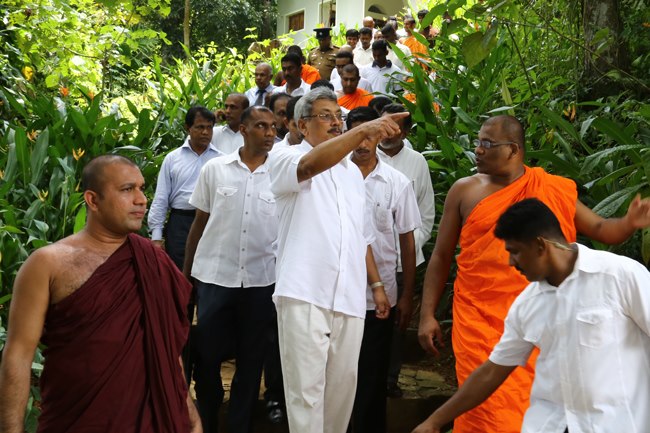
Sri Lankan presidential aspirant Gotabaya Rajapaksa with the radical Buddhist monk Gnanasara Thera of Bodu Bala Sena. File photo.
By M. K. BHADRAKUMAR | Indian Punchline | July 3, 2019
The Easter Sunday terrorist attacks in Sri Lanka on 21st April in which 259 people were killed and over 500 injured were initially attributed to the Islamic State (IS). But no hard evidence is available to substantiate such a reading and it remains an open question as to the perpetrators.
The Sri Lankan President Maithripala Sirisena may have somewhat de-mystified the topic this week. On July 1, Sirisena charged at a public function that drug traffickers are behind the Easter Sunday bomb attacks. The following day he ordered the arrest of former Defense Secretary Hemasiri Fernando and the Inspector General of Police Pujith Jayasundara for their failure to prevent the Easter Sunday attacks despite prior knowledge of the attacks.
What lends enchantment to the view is that the United States had brilliantly succeeded in deploying to Sri Lanka the personnel of the Indo-Pacific Command within a couple of days of the Easter Sunday attacks on the pretext of investigating and assisting in Colombo’s upcoming fight against the IS. Historically, Sri Lanka is chary of allowing foreign military presence on its soil, but in this case Washington pressed home the deployment, since the ruling elite in Colombo was on the back foot, incoherent and in disarray in the immediate aftermath of the terrorist attacks.
In political terms, what Sirisena may have done this week is to reverse the ‘internationalisation’ of Sri Lanka’s terrorism problem. Indeed, for tackling a local drug mafia, Sri Lanka doesn’t need the expertise of the US’ Indo-Pacific Command.
This is just as well because in the downstream of the Easter Sunday attacks in April, Washington also began pushing hard for the signing of a Status of Forces Agreement (SOFA) with Sri Lanka, which Pentagon has traditionally demanded as the pre-requisite of establishment of military bases in foreign countries. (The SOFA establishes the rights and privileges of American personnel present in a host country in support of a larger security arrangement.)
Unsurprisingly, the Sri Lankan opinion militated against the SOFA project and suspected its real intentions. A huge uproar followed in the Sri Lankan media. Without doubt, the SOFA became yet another template of the power struggle between the staunchly nationalistic Sirisena and the famously ‘pro-western’ prime minister Ranil Wickremesinghe.
The net result is that the project which the US hoped to conclude in absolute secrecy, got derailed once the draft SOFA document under negotiation got somehow leaked to a Colombo newspaper. Interestingly, the US Secretary of State Mike Pompeo, who was scheduled to travel to Colombo following his recent visit to New Delhi was compelled to cancel the visit once it became apparent that the SOFA project has become a hot potato.
Meanwhile, the Empire strikes back. A case has been filed in the US District Court in central California by an American law firm claiming damages on behalf of alleged victims of human rights abuse during the war against separatist LTTE ten years ago. The plaintiffs have targeted Gotabaya Rajapaksa, then wartime defense chief and the younger brother of former president Mahinda Rajapaksa, as well as several government agencies, including military intelligence, the Criminal Investigation Department, the Terrorism Investigation Division, and the Special Intelligence Service, including some serving officials.
Of course, this is a blatant American attempt to put into jeopardy Gotabaya Rajapaksa’s plan to run for president in the upcoming Sri Lankan election in December. Gotabaya was a US citizen at the time of the war against the LTTE. He has dual citizenship and his request renouncing American citizenship is pending with Washington. Now, the catch is, the lawsuits in California could delay his bid to renounce his US citizenship, in which case he would not qualify to run for president under Sri Lankan electoral laws. Washington has tripped Gotabaya.
The US is making sure that the Rajapaksa family will not regain the calculus of power in Colombo following the December poll. Equally, the trial in California can expose former President Mahinda Rajapaksa as well — and even entangle Sirisena who had a direct role as acting defence minister in the final stages of the war. Clearly, Washington is interfering in the December election in Sri Lanka in a calibrated manner with a view to strengthen the prospects of a pro-American candidate such as Wickremesinghe or the Finance Minister Mangala Samaraweera who can be trusted to put the signature on the SOFA.
The US is determined to push ahead with the signing of the SOFA leading to the establishment of long-term American military presence in Sri Lanka. In August 2018, USS Anchorage, a Seventh Fleet vessel, and a unit of Marines visited the port of Trincomalee. In December 2018, the aircraft carrier USS John C. Stennis visited Trincomalee as part of the Pentagon’s plans to establish a logistic hub there for the US Navy. A Mass Communication Specialist on board USS John C. Stennis in a dispatch to the US Navy official web portal wrote:
“The primary purpose of the operation is to provide mission-critical supplies and services to U.S. Navy ships transiting through and operating in the Indian Ocean. The secondary purpose is to demonstrate the U.S. Navy’s ability to establish a temporary logistic hum ashore where no enduring U.S. Navy logistic footprint exists.”
The US disclaims any intention to set up military bases in Sri Lanka. This is factually true — except that it is sophistry. The US plan to use Sri Lanka as a ‘military logistics hub’ involves supportive measures that facilitate any American military operation in the Asia-Pacific region. Actually, this is well beyond the solitary use of a particular harbour such as Trincomalee as a military base. The point is, the entire island nation is being transformed into a ‘military logistics hub’.
Never before has there been such blatant US interference in Sri Lanka’s internal affairs. Washington tasted blood in the successful regime change project in January 2015 and it never looked back. The interference is so very extensive today that it is destabilising the Sri Lankan situation which is already highly polarised.
This is happening only due to India’s passivity bordering on acquiescence. The containment strategy against China in the Indian Ocean has become a common endeavour for Washington and Delhi. Is it in India’s long term interests that Sri Lanka is being destabilised, even if in the short term the Chinese Navy might be put to some difficulties in the Indian Ocean?
India’s medium and long term interests lie in regional stability. Its influence as a regional power is linked to regional stability. India cannot overlook that China has legitimate interests in our region. The US is a faraway power and is also in decline. It doesn’t make sense for India to bandwagon with the US in South Asia. A far more realistic approach will be to work with China and expand and deepen the common interests in regional security and stability.
Mueller Report Gets the Trump Tower Meeting Wrong; Promotes Browder Hoax
By Lucy Komisar – Consortium News – July 3, 2019
A “key event” described in the Mueller Report is the Trump Tower meeting where a Russian lawyer met with the president’s son Donald Trump Jr, his son-in-law Jared Kushner and his campaign chairman Paul Manafort.
Russiagaters have been obsessed with the meeting saying it was the smoking gun to prove collusion between Russia and the Trump campaign to steal the 2016 election. Months after Mueller concluded that there was no collusion at all, the obsession has switched to “obstruction of justice,” which is like someone being apprehended for resisting arrest without committing any other crime.
The Mueller report thus focuses instead on “efforts to prevent disclosure of information about the June 9, 2016 Trump Tower meeting between Russians and senior campaign officials.”
But the report on this topic is deceptive. Ironically, as it attacks Donald Trump and top campaign officials for lying, the report itself lies about the issue the meeting addressed.
It wasn’t to provide dirt on Hillary Clinton, which the Russian lawyer did not have and never produced. That was a ploy by Robert Goldstone, a British music publicist whose job is to get what his clients want, in this case, a meeting. So, recklessly, he invented the idea of Clinton dirt as a bait-and-switch to get Trump’s people to come to it. He got the lawyer the meeting for her to lobby a potentially incoming administration against the Magnitsky Act, which is why she was in the United States in the first place.
The Magnitsky Act is a 2012 U.S. law that was promoted by William Browder, an American-born British citizen and hedge fund investor, who claimed his “lawyer” Sergei Magnitsky had been imprisoned and murdered because he uncovered a scheme by Russian officials to steal $230 million from the Russian Treasury. It sanctioned Russians he said were involved or benefitted from Magnitsky’s death. It has since been used by the U.S. to put sanctions on other Russians and nationals from other countries.
The lawyer lobbying against the act, Natalia Veselnitskaya, told Trump Jr., Kushner and Manafort that Browder’s story was fake, a smokescreen to block the Russians from going after him for multi-millions in tax evasion. She argued the Magnitsky Act was built on this fraud. Manafort’s notes, included in the Mueller Report, trace what she said.
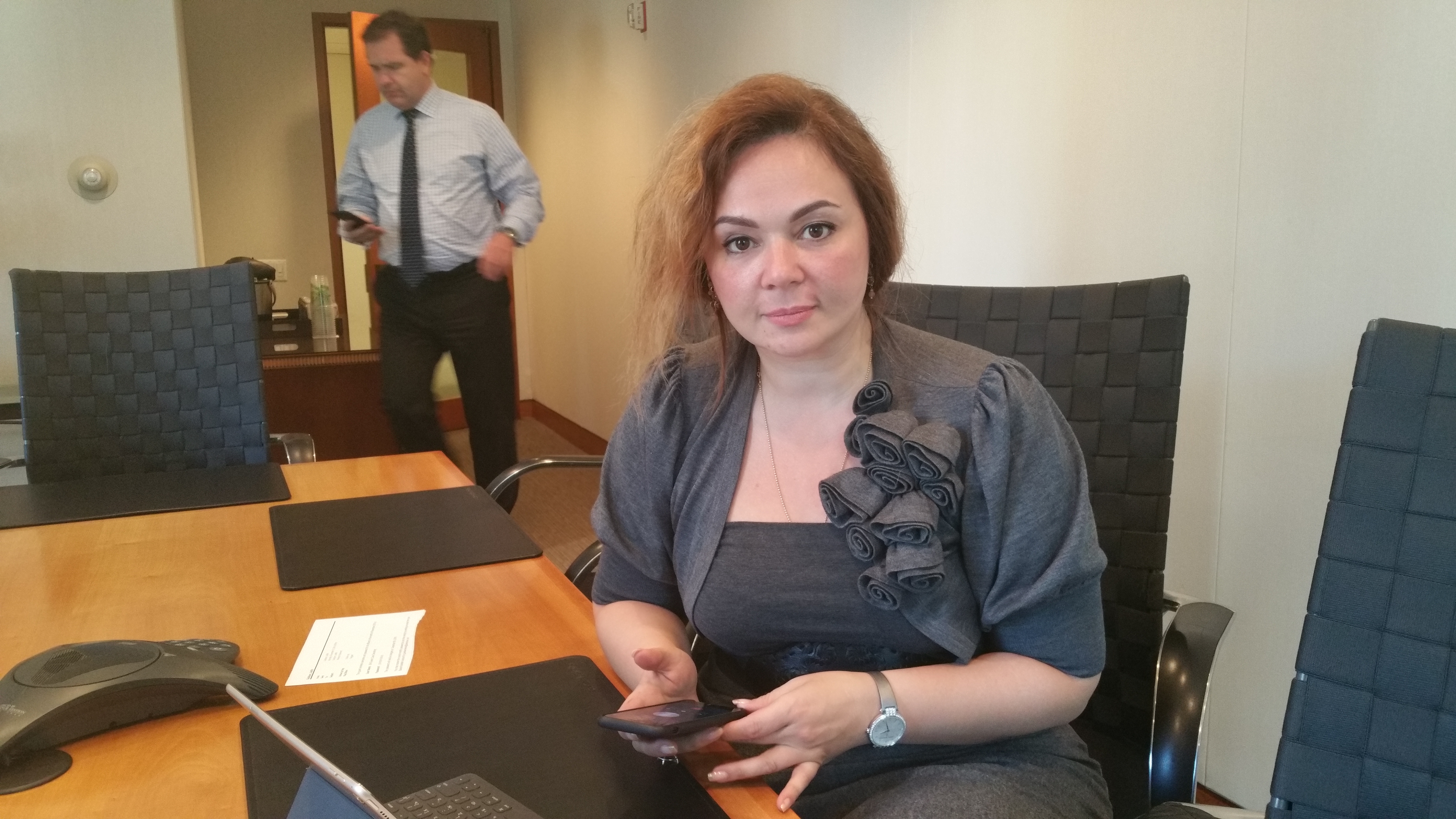
Natalia Veselnitskaya, the Russian lawyer who met with Trump team members in Trump Tower, and her interpreter, in background. (Lucy Komisar)
Nothing Illegal
The Trump people did nothing illegal to meet with her. Their problem was the exaggerating communications Goldstone sent them about Veselnitskaya having “dirt” on Clinton. (While U.S. election laws says it’s illegal for a campaign to receive “a thing of value” from a foreign source, it’s never been established by a court that opposition research fits that description, the Mueller Report admits.) Veselnitskaya testified to the U.S. Senate Judiciary Committee in November 2017 that Browder’s major American client, the Ziff brothers, had cheated on American and Russian taxes and contributed the “dirty money” to the Democrats.
The Mueller investigators appear not to have looked into her charges. The report promotes Browder’s fabrications, citing “the Magnitsky Act, which imposed financial sanctions and travel restrictions on Russian officials and which was named for a Russian tax specialist who exposed a fraud and later died in a Russian prison.”
But instead of his “lawyer” Magnitsky exposing Russian fraud, for which he was jailed and killed in prison, Magnitsky was actually Browder’s accountant who was detained under investigation for his part in Browder’s tax evasion and died of natural causes in prison, as Magnitsky’s own mother admits to filmmaker Andrei Nekrasov in the film “The Magnitsky Act: Behind the Scenes.”

Magnitsky’s mother in Nekrasov film.
Mueller’s investigators might have started with documents filed in U.S. federal court in the case of Veselnitskaya’s client, Prevezon, a Russian holding company that settled a civil-forfeiture claim by the U.S. government that linked it, without proof, to the tax fraud.
The documents include a deposition where Browder admits that the alleged “lawyer” Magnitsky did not go to law school nor have a law degree. Magnitsky’s own testimony file identifies him as an “auditor.”
Why does that matter? Because it was Browder’s red herring. Magnitsky had worked as Browder’s accountant since 1997, fiddling on Browder’s taxes on profits from sales of shares held by Russian shell companies run by his Hermitage Fund. He was not an attorney hired in 2007 to investigate and then expose a tax fraud against the Russian Treasury.
That fraud was exposed by Rimma Starova, the Russian nominee director of a British Virgin Islands shell company that held Hermitage’s reregistered companies and who gave testimony to Russian police on April 9 and July 10, 2008. It was reported by the New York Times and Vedomosti on July 24, 2008, months before Magnitsky mentioned it in an Oct. 7 interrogation.
Kremlin-connected?
The Mueller Report says Veselnitskaya promised dirt on Hillary Clinton as “part of Russia and its government support for Trump.” Two days before the meeting, Goldstone emailed Trump Jr. and said “the Russian government attorney” was flying in from Moscow. She had not been a government attorney since 2001, 15 years earlier.
I interviewed Veselnitskaya in New York in November 2016. She explained what she later told the Trump group, that Browder’s clients the Ziff Brothers had invested in Russian shares in a way that routed the money through loans so that they could evade U.S. taxes. [“Not invest – loans” in Manafort’s notes.]
The report says, “Natalia Veselnitskaya had previously worked for the Russian government and maintained a relationship with that government throughout this period of time.” Later it says that from 1998 to 2001, she had worked as a prosecutor for the “Central Administrative District” of the Russian Prosecutor’s office. “And continued to perform government-related work and maintain ties to the Russian government following her departure.” We are meant to presume, with no evidence, as the media does – that means “a Kremlin-connected lawyer.”
When Trump Jr asked for evidence, how the payments could be tied to the Clinton campaign, she said she couldn’t trace them, according to the Mueller Report.
Then she turned to the Magnitsky Act. The report repeats earlier fakery: “She lobbied and testified about the Magnitsky Act, which imposed financial sanctions and travel restrictions on Russian officials and which was named for a Russian tax specialist who exposed a fraud and later died in a Russian prison.” Magnitsky did not expose a fraud. Rimma Starova did.
A footnote in the report said: “Browder hired Magnitsky to investigate tax fraud by Russian officials, and Magnitsky was charged with helping Browder embezzle money.” Browder did not hire Magnitsky to investigate the fraud. Magnitsky had been the accountant in charge of Hermitage since 1997, 10 years before the fraud. Embezzlement refers to Browder shifting assets out of Russia without paying taxes.
But the investigation’s focus was not on Browder’s fakery — the substance of the Trump Tower meeting — but on the communications organizing the event. The section on obstruction says Trump became aware of “emails setting up the June 9, 2016 meeting between senior campaign officials and Russians who offered derogatory information on Hillary Clinton as ‘part of Russia and its government’s support for Mr. Trump.’”
That would have been inflating Goldstone’s promises.
The report says “at the meeting the Russian attorney claimed that funds derived from illegal activities in Russia were provided to Hillary Clinton and other Democrats.” Trump Jr. told a White House press officer that “they started with some Hillary thing, which as bs and some other nonsense, which we shot down fast.”
As Veselnitskaya told me, she knew the Ziffs made contributions to Democrats. She probably started with that. Manafort’s notes don’t report a “Hillary thing,” but are about Browder and the Ziffs.
On the issue of Browder, the Magnitsky story and the essence of the Trump Tower meeting, the Mueller Report is a deception intended to keep the myth of collusion in the air while dismissing that any collusion took place.
Lucy Komisar is an investigative reporter who writes about financial corruption and won a Gerald Loeb award, the most important prize in financial journalism, for breaking the story about how Ponzi schemer Allen Stanford got the Florida Banking Dept to allow him to move money offshore with no regulation. Her stories about William Browder focus on tax evasion. Find out more on The Komisar Scoop.
Featured Video

or go to
Aletho News Archives – Video-Images
Book Excerpt
Clinical Trials Relied Upon to License the MMR Vaccine
They insist we must rely on the data, well here it is…
Informed with Aaron Siri | November 24, 2026
Adding to my last post about the MMR vaccine, this one reviews the clinical trials relied upon for its licensure.
Here is an excerpt from my book, Vaccines, Amen, summarizing the clinical trials relied upon to license this vaccine… continue
Blog Roll
 Aletho News
- Kremlin Aide Slams Top German Diplomat for ‘Confrontation Against Russia’ Remark
- Canada stripped of World Cup events over Russian athletes ban
- Guatemala arrests ex-colonel over 1982 killings of Maya Ixil civilians
- Clinical Trials Relied Upon to License the MMR Vaccine
- FDA Ordered to Pay Over $570,000 in Fight Over Pfizer COVID Vaccine Records
- USAID turned to Facebook to drive demand for Covid vaccines in Global South – files
- Britain’s shadow security network expands into south Lebanon
- The ADL Has a Foreign Policy, and You Are Not Supposed to See It
- Former Qatari PM says ‘Israel’ has security ties with all Gulf states
- The Sound of Silence in the Strait of Hormuz
- If Americans Knew
- An error has occurred; the feed is probably down. Try again later.
- No Tricks Zone
- Physicists: Doubling CO2 Has A Smaller Impact On Ocean ‘Acidification’ Than Existing Internal Variability
- Alarmist Climatologists In Shock! 2026 Atlantic Hurricane Season Sees Lowest Count In 101 Years
- New Study: Modern Temps Are Among The Coldest Of The Last 10,000 Years In East Central Europe
- Germany’s Renewable Energies Lead to 1.4 Billion Euro Electric Power Trade Deficit
- Argentina’s Perito Moreno Glacier Joins Antarctica and Arctic In Defying Doomsday Melt Claims
- New Study: Barents Sea Temperatures Were Warmer And Sea Ice Less Extensive In The 1700s Than Today
- German Authorities Start Initiative To Evaluate Public Register For Climate “Disinformation” Spreaders!
- Zonal Asymmetry of Temperature Change in the Antarctic Circumpolar Current
- New Study: The Net Fossil Fuel Contribution To Rising Atmospheric CO2 Has Been Zero For 500 Years
- Germany’s Green Energy Transition Becoming Increasingly Expensive…Another 6 Trillion Euros!

