Islamic Republic No Threat to Anybody in Iraq or Elsewhere: Iran UN Mission
Al-Manar | May 16, 2019
Iran has rejected the United States’ claims that ‘Iranian activities’ endanger American sites and troops in Iraq, saying the Islamic Republic is no threat to anybody in Iraq or elsewhere.
“’Iran is no threat to anybody in Iraq or elsewhere, and Iran is not preparing for any attacks anywhere,” Alireza Miryousefi, the spokesman for Iran mission to the United Nations made the statement on Wednesday.
“Iran, as is evidenced by our history, only acts in self-defense, and has no offensive strategy against any nation,” he added, according to Mehr news agency.
The official censured the US for sticking to fake reports for spreading propaganda against the Islamic Republic, saying, “Iranians will never capitulate to this new psychological war.”
The US has recently built up its military presence in the region over what it calls an Iranian threat to American troops and interests.
Last week, US Secretary of State Mike Pompeo claimed that the US administration had received intelligence related to “Iranian activity” that put American facilities and service personnel at “substantial risk.”
Other senior officials within the US administration itself as well as other countries have however dismissed that claim.
Following Pompeo’s claims, the US on Wednesday ordered the partial evacuation of its embassy in Baghdad and a consulate in Erbil.
Why is the US always ‘stumbling’ or ‘sliding’ into war? How the media misleads with language

By Danielle Ryan | RT | May 15, 2019
The way the mainstream media tells it, the United States never, ever ends up embroiled in wars and military conflicts on purpose — only ever by mistake, or as a result of things like ‘bad planning’ or ‘strategic missteps’.
Very often when media coverage of war is analysed, there is a focus on how hawkish pundits cheerlead for conflict and journalists parrot official narratives while dissenting voices are drowned out. Mainstream networks, for example, have been heavily criticized by media watchdogs for almost exclusively inviting pro-war guests and ex-military hawks onto their news shows to convince Americans that war is the only reasonable course of action, while refusing to let anti-war commentators get a look in.
But there is another more subtle and unnoticeable way that the media deceives us. Even when they are not outright cheerleading for military action (as was the case in the lead up to the Iraq War), the language they use to describe events is designed to absolve Washington of blame.
Next time you read the news, notice how the US is always “stumbling into” war, or “drifting into” war or “sliding into” war — or even “sleepwalking into” war. To “stumble into” war seems to be a firm favorite among headline writers. The US has “stumbled” into war in Iraq and Syria and has been, at one time or another, at risk of “stumbling” into war with Russia, North Korea and most recently Iran.
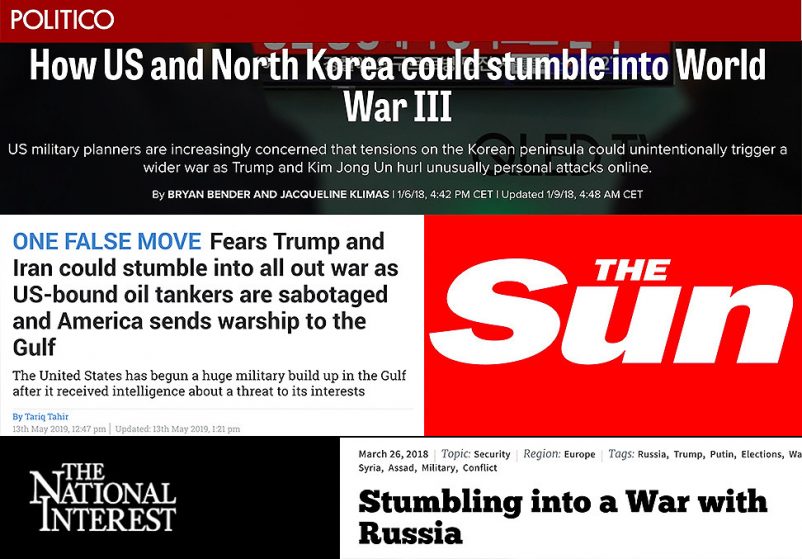
According to these headlines, the US has also been “dragged into” (CNN) and “sucked into” (NI ) war in Syria and Afghanistan, twice (NI, The Times ). In recent weeks, the Trump administration has been “sliding into” (AP ) a potential “accidental” war with Iran — and back in 2017, it was “dragged into” (FP ) the disastrous Yemen conflict.
The examples of the US stumbling, blundering and bumbling its way into wars are endless — and it does raise a question that no one ever seems to ask: If it’s so easy to trip and fall into massive never-ending wars, why isn’t it happening to everyone else? Is Washington just especially clumsy?
With this narrative of the bumbling superpower, agency is always removed from the architects of war. Instead of enthusiastically banging the drums for war, we’re told the White House is always ‘reluctant’ to deploy its military, but is ‘forced’ into it . Then, once the war is in full-swing, when things are not panning out exactly as planned, the US can become the sacrificial hero, propelled into a deadly conflict not of its own making.
A recent headline in the Miami Herald framed recent US actions on Venezuela as the US being “pushed to act.” Pushed by who? The Trump administration voluntarily helped organize and instigate the attempted coups that worsened the country’s political crisis and proudly imposed the economic sanctions which have led directly to thousands of premature deaths. There was no “pushing” involved.
In April, Foreign Policy magazine even had Venezuela’s self-declared interim president Juan Guaido “stumbling toward a coup.” How do you stumble into a military coup? Surely that’s the kind of thing that requires careful, deliberate planning and execution? The Washington Post had Trump “fumbling” an uprising in Caracas, too.
It’s not just media pundits and journalists who employ this kind of misleading language, either. British Foreign Secretary Jeremy Hunt said this week that a US war with Iran could happen “by accident.” Did Hunt take a vacation from reality and miss US Secretary of State Mike Pompeo and National Security Advisor John Bolton ramping up war rhetoric against Iran for months? Maybe Trump abandoned the 2015 Iran nuclear deal by accident and sent an aircraft carrier and bomber task force into the Persian Gulf last week to “send a message” to Iran by mistake.
Such framing obscures basic facts about Washington’s motives and predilection toward military conflict over diplomacy. Washington doesn’t get into wars by mistake. Unless a country is directly attacked, threatened or occupied, wars are quite easy to avoid getting into if you really don’t want to be in them — but the hawks in Washington, no matter how much they pretend to not want war, are always itching for more and they will stop at nothing to get what they want, even if that means fabricating evidence (as in Iraq) or pulling off false flag attacks to use as convenient pretexts for the US to ‘respond’ to.
US military actions are designed specifically to provoke the conflicts that they believe will be of benefit to their overall geopolitical strategy. Talk of freedom, democracy and human rights are just a convenient cover. Washington is never at risk, for example, of stumbling into war with Saudi Arabia, despite Riyadh’s laundry list of crimes against humanity.
Whether this propagandistic language is always employed in a totally conscious way or not, it’s difficult to tell. Either way, it’s a psychological trick which frames the most powerful, military-minded and trigger-happy country in the world as some kind of innocent victim of events beyond its control.
Also on rt.com:
US media’s love affair with war: Major outlets showed zero opposition to Syria strikes
Tishchenko’s Case Has Signs of US Intelligence Services’ Provocation – Embassy
Sputnik – 15.05.2019
The case of Russian citizen Oleg Tishchenko, who was extradited from Georgia to the United States, has signs of a provocation, staged by the US intelligence services, the Russian Embassy in the United States said in a statement.
“The Russian Embassy in the United States is closely following the situation around the arrest of Russian citizen O. M. Tishchenko, who has earlier been extradited from Georgia [to the United States]. He is accused of five charges, including smuggling, violation of the law on arms exports ban as well as conspiracy against the United States. The case has signs of the US intelligence services’ provocation,” the statement posted on the embassy’s Facebook page on late Tuesday said.
According to the embassy, Tishchenko is held now in a prison in the Weber County of the US state of Utah.
“Now we are seeking consular access to our compatriot. We will provide O. M. Tishchenko with the necessary consular assistance so that his rights will be respected,” the statement added.
Tishchenko, 42, is a video game developer, who worked on high-precision flight simulators. He is accused of online purchasing documentation about various planes, including F-16, F-22 and F-35 fighters. The criminal case was opened in 2016 and, in early 2019, Tishchenko was arrested in Georgia and later transferred to the United States.
Who Really Gains from the Gulf Ship ‘Sabotage’
By Finian Cunningham | Strategic Culture Foundation | May 15, 2019
After dramatic and patently scripted warnings of “Iranian aggression” by bellicose US officials, there then follows – conveniently enough – an alleged sabotage incident in the Persian Gulf region implicating Iran.
Meanwhile, US Secretary of State Mike Pompeo poses with a straight face that his country doesn’t want war with Iran. His comments warp credulity given that American forces have suddenly escalated firepower in the Persian Gulf for the purpose of “responding” to alleged Iranian infractions.
Typically, Western news media are “reporting” (or rather, “echoing”) the purported sabotage incident as if it were fact, basing their source of information on Saudi and Emirati officials, sources which have a vested interest in creating a war pretext against Iran.
Given the grotesque, barefaced lies that have emanated from the Saudi regime over the past year with regard to the murder of journalist Jamal Khashoggi and also its barbaric, mass executions of political dissidents, it is nauseating how Western media can affect to be so credulous in citing Saudi claims as reliable over the latest alleged shipping incident.
“Two Saudi oil tankers have been sabotaged off the coast of the United Arab Emirates posing a potentially serious threat to world oil supplies,” reports [sic] Britain’s Guardian, attributing the source of this information to the “Saudi government”. What the Guardian omitted was the key word “alleged” before “sabotage”. Notice how the impression given is one of a factual incident of malicious intent. Most other Western news media adopted the same reliance on the official Saudi and Emirati claims.
Tellingly, however, Saudi and Emirati officials gave no details about the “significant damage” allegedly caused to a total of four tankers.
What we seem to know is that the four vessels were somehow disabled off the UAE port of Fujairah early on Sunday. The location at sea is in the Gulf of Oman, which lies outside the Persian Gulf, about 140 kilometers south from the Strait of Hormuz. The latter is the narrow passage from the Gulf of Oman into the Persian Gulf, through which up to 30 per cent of all globally shipped crude oil passes each day.
Last week, Iran once again threatened it would blockade its territorial waters in the Strait of Hormuz “if” the US carried out a military attack on it. Such a move by Iran would throw the global economy into chaos from the anticipated crisis in oil markets. It would also doubtless trigger an all-out war between the US and Iran, with American regional client regimes like Saudi Arabia and Israel piling in to facilitate attacks against Tehran.
So far, there have been no official accusations explicitly made against Iran over the latest shipping incident. But the implications are pointedly skewed to frame-up the Islamic Republic.
Saudi energy minister Khalid al Falih, whom Western media have quoted uncritically, claimed that one of the vessels allegedly attacked was on its way to load up on crude oil from the Saudi port of Ras Tanura, destined for the US market. The Saudi official did not give any substantiating details on the alleged sabotage, but emphasized that it was aimed “to undermine the freedom of navigation”. He called on international action to “protect security of oil tankers”. Wording that the American self-appointed global “policeman” (more accurately, “thug”) invokes all the time to cover for its imperialist missions anywhere on the planet.
When the US warned last week that it was sending a naval carrier strike armada to the Persian Gulf along with nuclear-capable B-52 bombers, it assumed the right to hit “Iran or its proxies” for any alleged attack on “American interests”. The wording out of Washington is so vague and subjective that it lends itself to any kind of perceived provocation.
An oil tanker on its way to collect crude from Saudi Arabia for the US market? That certainly could qualify as perceived Iranian aggression against American vital interests.
Last week, Washington issued hammed-up warnings that “Iran or its proxies” was set to “target commercial sea traffic”. Days later, as if on cue, the alleged sabotage of four ships appears to fit the theatrical bill.
Iran, for its part, has said it would not start a war with the US; that it will only act to defend itself from any American offensive. The foreign ministry in Tehran called the latest sabotage claims “highly alarming” and demanded more clarity from the Saudi and Emirati authorities as to what happened exactly. We can be sure that neither will come clean on that score, given their past record of calumny.
The clarifying question is, of course, who gains from the latest twist in tensions? Certainly, it fulfills American, Saudi and Israeli desires to intensify aggression towards Iran.
Another important question is the location of the alleged sabotage. If Iran wanted to carry out such an operation, it would be much more feasible to do it near the Iranian territorial waters in the Strait of Hormuz. Seriously: how feasible is it for several Iranian commando teams to strike four oil tankers in waters some 140 kms away? Waters that are forensically surveilled by the US Fifth Fleet based in the Persian Gulf.
Suspiciously, as already noted, there is no verifiable information about the alleged sabotage. All we’ve got are claims from Saudi and Emirati officials, the same kind of people who claim journalists disappear into thin air while in consular buildings, or that children in Yemen are slaughtered in air strikes by “mistake”, or that peaceful women protesters from Saudi’s oppressed Shia minority are “terrorists” to be executed by beheading with a sword.
And, shamefully, the Western media tamely go along doe-eyed and gullibly with this risible charade.
Sequencing, timing, sources, agenda and motives plus the dutiful Western media servility. The bets are this is a false-flag operation to incriminate Iran.
If it doesn’t result in a pretext for American military attack, at the very least Washington and its Saudi and Israeli clients are trying to make sure the European lackeys are bounced into toeing the line for increasing economic warfare on Iran over the floundering nuclear accord. An international treaty, by the way, which has been torpedoed – verifiably – by American political sabotage.
What’s really going on here is another brazen case of reality-inversion. Compare with contemporaneous US mendacity towards Venezuela, Syria, Cuba, Russia, China, North Korea, and so on. American criminal aggression is, incredibly, again being laundered with a moral license by lying corporate mass media which have the gall to call their blatant war propaganda a “news service”.
Indeed, the world is being lied into a potentially catastrophic war by a congenitally criminal US regime.
Trump considering replacing John Bolton: Report
Press TV – May 15, 2019
US media reports suggest that President Donald Trump is considering replacing his hawkish National Security Adviser John Bolton over his plans to push the United States towards a military conflict with Iran, Venezuela and North Korea.
Bolton “is headed for the exits, having flown too close to the sun on his regime change efforts for Iran, Venezuela and North Korea,” The National Interest magazine reported Tuesday, citing sources familiar with the matter.
“Hearing that Trump wants him out,” a former senior Trump administration official told the magazine.
There is speculation in Washington “that there’s now daylight between Trump and Bolton,” the report added.
The fighting has also expanded to include US Secretary of State Mike Pompeo, officials say. A State Department official and a former White House official both report that Bolton and Pompeo are “fighting all the time.”
A former senior official in the State Department said Pompeo is enthusiastic about isolating Iran, but fearful of an actual war that might engulf much of the Middle East.
“John Bolton is the problem … Trump’s national security adviser is getting dangerous… particularly to the president’s ideals,” Douglas Macgregor, a Bolton rival and would-be successor, writes in Spectator USA.
Trump ran his election campaign on the promise to pull the US military out of Iraq, Afghanistan and Syria — unwinnable post-9/11 wars that have consumed American lives and military budgets.
That partial retreat remains one of Trump’s strongest points in his pitch to be the so-called outsider president.
But Bolton is working in exactly the opposite direction.
The United States has been ratcheting up economic and military pressure on Iran, with Trump recently urging Tehran to talk to him.
“What I’d like to see with Iran, I’d like to see them call me,” Trump told reporters at the White House on Thursday.
But then he said he would not rule out the possibility of military action in Iran amid escalating tensions before slamming former secretary of state John Kerry for his involvement in the issue.
His remarks came after Bolton said on Sunday that the United States was sending an aircraft carrier strike group and a bomber task force to the Middle East in a “clear and unmistakable” message to Iran.
The Pentagon announced on Friday that the US was deploying an amphibious assault ship and a Patriot missile battery to bolster an aircraft carrier and B-52 bombers already sent to the Persian Gulf.
US orders departure of non-emergency employees from Iraq
Press TV – May 15, 2019
The US State Department has ordered the departure of non-emergency government employees from Iraq, following Washington’s repeated expressions of concern about so-called threats from Iran’s allies in the Arab country.
The State Department ordered the pullout of the employees from both the US Embassy in Baghdad and its consulate in Erbil, the embassy said in a statement on Wednesday.
“Normal visa services at both posts will be temporarily suspended,” it said, recommending that those affected depart as soon as possible.
“The US government has limited ability to provide emergency services to US citizens in Iraq,” it added.
It was unclear how many staff members would leave.
US Secretary of State Mike Pompeo made an unannounced trip to Iraq on Tuesday, pressing Iraqi leaders about what he alleged were the increased dangers to Americans there from Iranian forces and their allies.
Despite this, the British general overseeing the so-called US-led coalition forces in Syria and Iraq has asserted that there has been “no increased threat from Iran” amid the US military buildup in the Persian Gulf.
British Major General Chris Ghika said at a Pentagon news briefing Tuesday that the coalition has seen “no increased threat from Iranian-backed forces” in the two countries.
The coalition has observed “no change in their posture since the recent exchange between the United States and Iran and we hope and expect that that will continue… We don’t see an increased threat from them at this stage,” Ghika told reporters.
Iraqi Prime Minister Adel Abdul-Mahdi said on Tuesday he was getting indications from talks with both the United States and Iran that “things will end well” despite the rhetoric.
The administration of US President Donald Trump has been ratcheting up economic and military pressure on Iran.
The US has deployed a carrier strike group and a bomber task force to the Middle East to confront what the Trump administration claims are “clear indications” of threats from Iran.
History’s Dire Warning: Beware False-Flag Trigger for Long-Sought War with Iran
By Whitney Webb | MintPress News | May 14, 2019
With the beat of Washington’s war drums continuing to grow, particularly following the Monday revelation of a government plan to send as many as 120,000 troops to counter Iran, the threat of an “accidental” provocation or a “false flag” is also becoming increasingly likely. As MintPress recently reported, the possibility of an “accident” leading to open conflict between the U.S. and Iran is now being openly stated by top European officials — such as U.K. Foreign Minister Jeremy Hunt — following meetings with noted Iran hawk and current Secretary of State Mike Pompeo.
In Part I of this series, MintPress explored how current events — including seemingly unrelated regional events, such as the Israeli government’s bid to occupy the West Bank and the Syrian offensive against Al Qaeda-held Idlib — were converging to create a “now or never” scenario for those most eager for regime change in Iran and a U.S.-Iran military confrontation, particularly Israeli Prime Minister Benjamin Netanyahu and U.S. National Security Advisor John Bolton.
This installment will also reveal how Trump’s top political patron Sheldon Adelson — who is also the top donor to Netanyahu and a long-time confidant of Bolton, whom he helped install in his powerful post in the Trump administration — may be the deciding factor whether Trump authorizes the use of military force against Iran.
Yet, while the endgame for Bolton, Adelson and Netanyahu, as well as Pompeo, has long been a U.S.-led war with Iran, public justification for such hostilities must be given in order to manufacture American consent for a war against a country significantly larger than Iraq, complete with a more powerful army. Historically, the U.S. government has frequently planned and used false flags in order to justify the initiation or expansion of hostilities, with the best-known examples being Operation Northwoods and the Gulf of Tonkin incident.
However, given the current situation, it is essential to revisit two other incidents that reveal that the key players pushing for war in Iran — Israel’s government and neoconservatives of the Bush era (Bolton chief among them) — have planned and attempted to execute false flag attacks to push the U.S. into a major war that the American public would not normally support.
Remembering the U.S.S. Liberty
On June 8, 1967, one of the worst attacks on a U.S. naval vessel during peacetime took place, an attack that the U.S. government has kept shrouded in secrecy over 50 years later in what many have called a cover-up.
Around two in the afternoon on a cloudless, sunny day, unmarked aircraft and torpedo boats attacked the U.S.S. Liberty — a largely defenseless naval intelligence vessel flying visible American flags — without provocation. The attack saw the aggressors commit several war crimes, including attacking with unmarked aircraft and vessels; shooting survivor-bearing lifeboats out of the water with machine-gun fire; and the jamming of the Liberty’s ability to use international distress frequencies.
Thirty-four American sailors lost their lives and 173 were wounded, and the Liberty — which cost U.S. taxpayers $40 million to build — was so badly damaged it was subsequently sold for scrap metal for pennies on the dollar.
During the attack and in its immediate aftermath, Liberty survivors were puzzled as to why the U.S. Department of Defense ordered the recall of U.S. ships that were on route to aid the Liberty from the hostile attack, which many sailors had assumed at the time was being conducted by Egyptian or Arab forces in light of the ship’s proximity to the Sinai Peninsula.
Indeed, the attack on the Liberty took place during the Israeli-Arab Six Day War, a war that Israel claimed to have started as a preemptive means of self-defense but that was later revealed to have been the culmination of years of planning for a war of aggression. This fact was openly admitted by former Israeli Prime Minister Menachem Begin in the early 1980s. Israel, an American ally, was not suspected by Liberty crewmen at the time of the attack as being their potential assailants.
However, no Arab nation had attacked the Liberty that day, though that assumption by Liberty sailors was what their true assailants had hoped they and the American public would believe. Instead, it had been Israeli aircraft and torpedo boats that had fired on the clearly-marked American vessel with torpedoes, machine gun fire and even napalm. The Israelis “officially” maintain to this day, with little challenge from the U.S. government, that the attack was an accident, a fact that has been and continues to be heavily contested by the attack’s survivors.
Yet, beyond the testimony of survivors, the most compelling evidence that the attack on the Liberty was no accident comes from the Israelis themselves. Intercepted Israeli communications from the time of attack, made public only in recent years, reveal that the ship had been identified as American prior to the attack and, despite that, the plan was to sink the U.S.S. Liberty and ensure that there were no survivors. The goal of the attack was to place the blame on Egyptian forces, which necessitated there being no American survivors who could dispute the claim. If the Liberty had been sunk, it would have provided the United States legal cover and popular support for a more central role in the conflict and its crucial diplomatic aftermath. Indeed, the Israeli attack on the U.S.S. Liberty was a false flag, one that failed to achieve its intended goal of goading the U.S. into a major war.
Instead of responding with indignation, then-President Lyndon Johnson — whether it occurred before or during the attack is disputed — ordered that the Liberty not be rescued during the course of the attack, allegedly not wanting to harm relations with or “embarrass” an ally even if it meant consigning the 294-person crew of the Liberty to death.
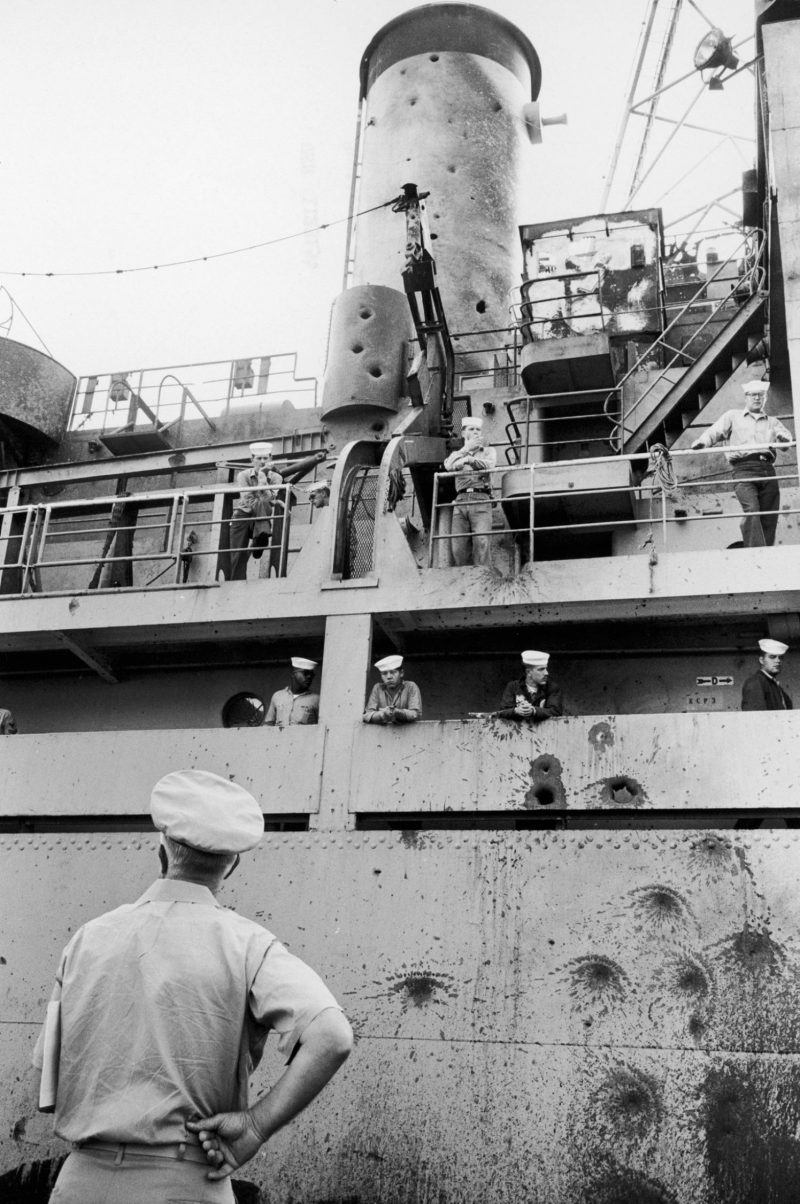
Damage to the starboard side of the USS Liberty following Israeli attacks, June, 1967. Photo | NSA Archive
Those who survived the assault of the Liberty owe their lives to the then-23-year-old Terry Halbardier, who valiantly navigated the Liberty’s napalm-glazed deck and managed to rig an antenna and send out an SOS signal to the Navy’s Sixth Fleet. Upon intercepting that distress signal, the Israelis immediately broke off the attack. Halbardier’s heroism prevented the massacre of all 294 crewmen and allowed them to live to tell their stories, despite Johnson’s having left them for dead.
Yet many Liberty survivors were unable to tell their stories for decades, as the U.S. government issued gag orders and threatened them with being court-martialed for speaking to anyone, even their spouses, about the incident. The Navy’s Board of Inquiry, which abetted the cover-up, was headed by Admiral John S. McCain Jr., the father of the late Senator John McCain of Arizona.
To this day, the U.S. government has failed to conduct a full, public inquiry into the attack. Liberty survivors who have since spoken out have been accused of “anti-Semitism” and of slandering Israel for discussing their personal and traumatic experiences of the attack, significantly compounding their suffering and post-traumatic stress.
While the survivors of Israel’s assault on the Liberty have been denied closure, the U.S. government’s response has endangered the lives of American personnel by clearly signaling to Israel that they will suffer no consequences for such “false flag” attacks, regardless of whether American servicemen are wounded or killed. As former CIA intelligence analyst Ray McGovern has previously noted for Consortium News, “the U.S. cover-up [of the attack on the U.S.S. Liberty ] taught the Israelis that they could literally get away with murder.”
In a 2015 interview on the Real News Network, McGovern warned that the attack on the Liberty still holds “current relevance” and that he felt that “the Israelis are capable of doing this kind of thing when they see their supreme national interests at stake.” McGovern further stated that Israeli officials may well have considered a provocation, such as false flag, to throw a wrench in the Iran nuclear deal, which was being negotiated at the time.
McGovern — in an open letter to President Barack Obama, co-authored with former Deputy National Intelligence Officer for the Near East in the National Intelligence Council Elizabeth Murray — noted that Admiral Mike Mullen, former member of the Joint Chiefs of Staff in the Bush administration, had flown to Israel in 2003 and told the Israeli government emphatically “to disabuse themselves of the notion that U.S. military support would be knee-jerk automatic if they somehow provoked open hostilities with Iran. According to the Israeli press, Mullen went so far as to warn the Israelis not to even think about another incident at sea like the deliberate Israeli attack on the U.S.S. Liberty.”
McGovern and Murray cited Mullen’s statements to Israeli officials as the first time that “a senior U.S. official braced Israel so blatantly about the Liberty incident.” In an email to MintPress, McGovern stated that he was unsure whether current Chairman of the Joint Chiefs of Staff Gen. Joseph Dunford “can be counted upon to play a similar restraining role” in preventing hostilities with Iran. Notably, Dunford was in attendance along with Bolton at the recent CIA meeting to discuss “highly sensitive covert actions” in relation to Iran.
An “accident” waiting to happen
Since Bolton announced the movement of the Lincoln carrier strike group towards the Persian Gulf, some have pointed out that the vessels could well be destined for use in a “false flag” provocation, such as one planned by former Vice President Dick Cheney in 2008 (to be discussed shortly) and another conducted by Israel in 1967. Indeed, as MintPress noted the day after Bolton’s announcement, the carrier strike group’s deployment was actually announced a month prior and was a routine deployment.
The political analysis blog Moon of Alabama also noticed that Bolton had framed this routine deployment as something more dire for his own purposes, writing:
The carrier deployment to the Gulf is routine. It had been announced on April 8. The U.S. has bombers on rotation in the Middle East since 2001. Moreover – a carrier in the Persian Gulf is a sure sign that the U.S. will not attack Iran. Within the restricted waters of the Persian Gulf a carrier is a too easy target. The idea though may be to provide for an ‘accident’’ as Iran’s Foreign Minister [Javad Zarif] described it in a recent CBS interview.”
In an interview late last month with CBS’ Face the Nation, Zarif explicitly told journalist Margaret Brennan his concern about an imminent “false flag” to trigger war with Iran by John Bolton in collaboration with Israeli, Saudi and Emirati leadership:
Foreign Minister Zarif | I don’t think military confrontation will happen. I think people have more prudence than allowing a military confrontation to happen. But, I think the U.S. administration is putting things in place for accidents to happen. And there has to be extreme vigilance, so that people who are planning this type of accident would not have their way.
Margaret Brennan | What do you mean? What kind of accident are you talking about?
Zarif | I’m talking about people who have — who are designing confrontation, whose interest —
Brennan | Who’s doing that?
Zarif | My ‘B’ team. I call —
Brennan | What do you mean ‘B’ team?
Zarif | I call the group ‘B’ team who have always tried to create tension, whose continued existence depends on tension. Ambassador Bolton, one ‘B,’ Bibi Netanyahu, second ‘B,’ Bin Zayed, third ‘B,’ Bin Salman, fourth ‘B.’ And I’m not just making accusations.
With an aircraft carrier little more than a sitting duck in the area amid rising tensions between the U.S. and Iran, an “accident” may well occur. As was noted in Part I of this mini-series, such a possibility was directly stated by British Foreign Minister Jeremy Hunt on Monday.
Hunt told reporters “We are very worried about the risk of a [U.S.-Iran] conflict happening by accident, with an escalation that is unintended really on either side but ends with some kind of conflict.” Hunt notably made the statement after meeting with Pompeo, who is currently in Europe meeting with European heads of state to discuss Iran. The Associated Press noted that the Trump administration had warned European officials, Hunt included, that “Iran or its proxies could be targeting maritime traffic in the Persian Gulf region.”
The possibility of such an “accident” is further compounded by Bolton’s aforementioned and “highly unusual” meeting about Iran and “highly sensitive covert actions” at CIA headquarters last week. Declassified CIA documents show that the agency had previously planned to stage terror attacks on U.S. soil and murder Americans to blame on Cuba in order to justify invading the Caribbean nation in the 1960s. That plan, known as Operation Northwoods, further called for the destruction of U.S. military vessels to be blamed on Cuba and also the staging of fires and mortar attacks on U.S. military installations in Cuba (i.e., Guantanamo Bay) or nearby (i.e., in Florida). Though Operation Northwoods was never enacted, the agency has been accused of orchestrating numerous “false flags” in the decades since.
As was recently seen with the alleged “sabotage” of Saudi oil tankers near Iran, there are many potential targets for provocation. However, the incident that would most assuredly force U.S. involvement in a military conflict would be an attack on an American military target. While some have dismissed Bolton’s announcement of the carrier’s movements as a self-serving manipulation of the facts, it may have had the added purpose of framing the lead-up to an unfortunate “accident” targeting American vessels in the area, particularly the Lincoln carrier strike group or one of the other subsequent U.S. naval deployments to the Middle East.
The neocon plan for a Liberty-like attack
If any sort of provocation blamed on Iran should occur, it is important to consider that a powerful group of U.S. politicians — the neo-conservatives — have long sought to plan provocations that would drag the U.S. into war with Iran. One of the most recent examples took place during the George W. Bush administration when then-Vice President Dick Cheney held a meeting with other administration officials in 2008 aimed at provoking war with Iran.
The details of that meeting were revealed by Pulitzer Prize-winning journalist Seymour Hersh, who described some of the ideas considered in that Cheney-led meeting as follows:
There were a dozen ideas proffered about how to trigger a war. The one that interested me the most was why don’t we build in our shipyard four or five boats that look like Iranian PT boats. Put Navy seals on them with a lot of arms. And next time one of our boats goes to the Straits of Hormuz, start a shoot-up. Might cost some lives.
And it was rejected because you can’t have Americans killing Americans. That’s the kind of, that’s the level of stuff we’re talking about. Provocation.
Silly? Maybe. But potentially very lethal. Because … if you get the right incident, the American public will support bang-bang-kiss-kiss. You know, we’re into it.”
It is unknown if any Bush officials now in the Trump administration were present at that meeting where the use of a “false flag” pitting Americans against Americans disguised as Iranian was discussed. However, what is known is that John Bolton — who was a member of the neo-conservative Project for a New American Century, along with Cheney, and who also served in the Bush administration — has zealously sought war with Iran for nearly two decades. Indeed, the New York Times recently described Bolton as “one of the administration’s most virulent Iran hawks, whose push for confrontation with Tehran was ignored more than a decade ago by President George W. Bush.” It is also known that Bolton has a history of playing fast and loose with unconfirmed intelligence and also distorting intelligence to fit his pre-determined narrative.
As MintPress reported last year, former Israeli Ambassador to the UN Danny Gillerman has stated that Bolton, when serving in the Bush administration, was prone to “direct fire on his own forces,” — i.e., the U.S. government — in order to advance the goals of the Israeli government, especially with respect to Iran. For instance, in more than one instance while in the Bush administration, Bolton traveled to Israel in violation of State Department rules and negotiated privately with Israeli officials, including the then-head of the Mossad, Meir Dagan, to lay the groundwork for a war with Iran. As journalist Gareth Porter has noted, Bolton did this in an effort to directly undermine Colin Powell, Bolton’s superior, just as Powell “was saying administration policy was not to attack Iran.”
Worse still, Bolton has pressured Israeli officials to initiate a war with Iran, even when they didn’t support such a move. One such case was Shaul Mofaz, former Israeli defense minister, who told Israeli media last March that Bolton “tried to convince me that Israel needs to attack Iran,” even though Mofaz did not see such a war as “a smart move — not on the part of the Americans today or anyone else until the threat is real.”
Pompeo’s Holy war and rapture
Furthermore, Bolton is not the only top Trump administration official who has long promoted a war with Iran, as current Secretary of State Mike Pompeo had also called for the preemptive bombing of Iran long before he joined the Trump administration. Pompeo’s desire to push the U.S. towards war with Iran is based on his fervent adherence to Christian Zionism. As a result of the admitted influence his beliefs hold over his foreign policy, Pompeo sees an “apocalyptic” war between Israel and Iran as a necessary precursor to the Second Coming of Christ and the “rapture.”
Pompeo is on record speaking about the rapture on several occasions, particularly as CIA director when he spoke about the event — which holds that “true believers” will ascend to Heaven prior to the tribulations and trials of the “end times” — so often that he made veteran intelligence officers uncomfortable. As a result, some have asserted that Pompeo is “a man who appears to view American foreign policy as a vehicle for holy war.”
The fact that the actions of the current Secretary of State are influenced by his Christian Zionist faith was on display last month, when American Christian journalist Chris Mitchell of the Christian Broadcasting Network asked Pompeo: “Could it be that President Trump right now has been sort of raised for such a time as this … to help save the Jewish people from the Iranian menace?” Pompeo responded that this was definitely “possible.”
If Adelson has his way . . .
Yet, perhaps the most dangerous force driving the U.S. towards a war with Israel is not the public face of the Trump administration’s foreign policy but its private face. Sheldon Adelson — the top donor to Trump, the entire Republican Party, and also the top political donor to Israeli Prime Minister Netanyahu — has long sought war with Iran, and several of Adelson’s desired policies have already been enacted by Trump. These include recognizing Jerusalem as Israel’s capital, replacing H.R. McMaster with Bolton as National Security Advisor, and withdrawing from the Iran nuclear deal. Several reports have asserted that pressure from Adelson was a deciding factor in Trump’s fulfillment of these policies.
Adelson’s influence over Trump again takes on great significance, given recent events with respect to Iran, as Adelson has previously advocated for a U.S. nuclear attack on Iran without provocation, just so the U.S. could “impose its demands [on Iran] from a position of strength.”
Per Adelson’s plan, the U.S. would drop a nuclear bomb in the middle of the Iranian desert and then threaten that “the next one is in the middle of Tehran” to show that “we mean business.” Tehran, Iran’s capital, is home to nearly 9 million people with 15 million more in its suburbs. Were Tehran to be attacked with nuclear weapons, an estimated 7 million would die within moments, according to a 2013 study jointly conducted by researchers at the University of Georgia and Harvard.
Yet, any sort of diplomatic engagement with Iran, according to Adelson, is “the worst negotiating tactic I could ever imagine.”
In other words, Adelson has called for dropping nuclear weapons on a country, including its heavily populated capital city, for no reason other than to show that the U.S. “means business” and considers nuclear war a negotiating tactic.
While some media reports have suggested that Trump is unwilling to go to war with Iran and is uneasy with the hawkish policies of Bolton and Pompeo, he will have a hard time ignoring Adelson. Adelson, who poured $35 million into Trump’s 2016 campaign and spent $55 million on Republican primary campaigns last year, is the party’s most influential donor and angering him could well mean the end of Trump’s political career.
Would Trump resist a push for war from not just Netanyhu, Bolton and Pompeo but Adelson as well? It seems unlikely. Craig Holman of the watchdog group Public Citizen told ProPublica in 2018 that he “would put Adelson at the very top of the list of both access and influence in the Trump administration,” a sentiment that was also echoed by Alan Dershowitz, who has done legal work for Adelson and advised Trump. Dershowitz told ProPublica that Adelson “just calls the president all the time. Donald Trump takes Sheldon Adelson’s calls.” As MintPress has noted on several occasions, those calls often translate into policy decisions.
Unfortunately, Trump — even when he tries to follow a different path, as he attempted to do in Syria — often ends up conceding to the neo-conservatives and Zionist extremists who surround (and fund) him.
History issues a warning
The combination of current tensions and the documented history of both Israel and Bush-era neo-conservatives planning and even executing false flag attacks in order to justify U.S. military action against a desired target — should set off alarm bells. Instead, most corporate media outlets are playing up unfounded or baseless claims of the “Iranian threat” and Iran’s unproven role in recent acts of “sabotage” in Saudi Arabia and in the UAE in ways that are strikingly similar to the lead-up to the 2003 invasion of Iraq.
Furthermore, the history and mindset of both Bolton and Pompeo, in addition to the unprecedented influence of Sheldon Adelson in the Trump administration, add yet another layer to this increasingly complex yet undeniably troubling situation.
As a consequence, it is imperative for people around the world, particularly in the United States, to be skeptical of any act of violence blamed on Iran before a full investigation is completed, and to resist a rapid push to begin a conflict with Iran that could well follow such an act.
The time for resistance, ideally, would be before such an attack occurs, making critical the widespread dissemination of relevant information left unmentioned by the corporate media, such as that contained in Parts I and II of this series. The crucial context here is the well-documented willingness of both the Israeli and U.S. governments to sacrifice (i.e., kill) Americans in order to plunder the natural resources of “unfriendly” nations and pursue the objectives of the political and economic elite of both countries.
Whitney Webb is a MintPress News journalist based in Chile. She has contributed to several independent media outlets including Global Research, EcoWatch, the Ron Paul Institute and 21st Century Wire, among others. She has made several radio and television appearances and is the 2019 winner of the Serena Shim Award for Uncompromised Integrity in Journalism.
Forensic Experts: No Evidence Couple Shot at Police in Houston Botched Drug Raid
By Carlos Miller | Photography is Not a Crime | May 13, 2019
Despite claims by Houston police that they engaged in a fierce gunfight with a couple they raided in January, a team of forensic investigators who spent four days in the house say there is no evidence the couple ever shot at police.
That contradicts the claim by Houston police that four cops were shot as they entered the home in what turned out to be a botched raid based on fabricated information.
The couple were killed and the cops were not wearing body cameras, so police probably did not expect evidence to surface that would contradict their claims.
According to the Houston Chronicle :
A four-day independent forensics review at 7815 Harding Street found a cache of evidence left behind by the city’s crime scene teams after a botched drug raid at the home left dead a couple suspected of selling drugs
Hired by the relatives of Rhogena Nicholas and Dennis Tuttle, the new forensics team found no signs the pair fired shots at police — and plenty of signs that previous investigators overlooked dozens of pieces of potential evidence in what one expert called a “sloppy” investigation.
“It doesn’t appear that they took the basic steps to confirm and collect the physical evidence to know whether police were telling the truth,” said attorney Mike Doyle, who is representing the Nicholas family. “That’s the whole point of forensic scene documentation. That’s the basic check on people just making stuff up.”
And it does not appear as if Houston police are conducting any type of “robust investigation” as Houston Police Chief Art Acevedo promised back in February after previous attempts of spin and deception failed.
It appears that they are doing just what we expected them to do, which is to let this drag out in the hopes people will forget about it.
Already the cop who lied on the search warrant and has a history of lying on search warrants has retired, so he’ll be collecting a pension when he probably should be sitting in prison.
The forensic experts found more inconsistencies:
Though police said they started shooting when the dog lunged as they came through the door, Maloney’s forensics team found that the dog was shot and killed at the edge of the dining room, 15 feet from the front door. Authorities never picked up the shotgun shell when they collected evidence.
And police said that Tuttle started firing at them, but Maloney’s team did not find clear evidence of that.
“The initial bullet trajectories appear to be somewhat contradictory,” said Louisiana-based attorney Chuck Bourque, who is also representing the Nicholas family. “We see no evidence that anybody inside the house was firing toward the door.”
Some of the bullet holes outside the house appeared at least a foot from the door, a fact that Doyle flagged as troubling.
“You can’t see into the house from there,” he said, “you’re firing into the house through a wall.”
The four-day investigation was led by independent forensic expert Mike Maloney, a retired supervisory special agent with the Naval Criminal Investigative Service.
The Deal of the Century
Trump Team and Netanyahu conspire to sell out the Palestinians
By Philip Giraldi • Unz Review • May 14, 2019
In the aftermaths of both the First and Second World Wars national borders were readjusted to suit the victors and entirely new countries were created from the ruins of the empires that had collapsed as a result of the conflict. The process continued with the end of the Soviet Union but the new states were constituted within an already existing ethnic and linguistic framework. More recently, the United States has engaged in imperialism-lite, with “regime change” programs seeking to lop off the governments of existing nations by coercion or through military invasion, replacing them with Quislings supportive of Washington’s continuing dominance exercised from “over the horizon.”
But regime change too is falling out of favor, even if it is currently being pursued in both Venezuela and Iran, eschewing using armed force in favor of “economic warfare” intended to make life so miserable for the inhabitants of the targeted country that they will rise up in revolt and remove their leaders. So far regime-change policies have been a disappointment, with major failures in Afghanistan, Iraq and Libya that relied on military interventions that converted stable countries into hotbeds of insurgency and unrest.
Given all of that, it is extremely audacious for the White House to consider going back to the old Sykes-Picot model of 1916 and seeking to impose a peace plan that will include reordering borders for Israel/Palestine, something that has been tried before in various forms by presidents named Carter and Clinton without any success. The new plan, which is already being touted as the “Deal of the Century,” has been the product of a group of Orthodox Jews working for senior advisor and presidential son-in-law Jared Kushner, together with representative for international negotiations Jason Greenblatt and the U.S. (sic) Ambassador to Israel David Friedman. There are no Arabs or Muslims (or Christians) on the team but there have been numerous discussions with the leaders of Jordan, Egypt, Saudi Arabia, the Emirates, and, of course, Israel. Israel has clearly been allowed to see the nearly complete report and has likely participated in drafts as it moved along, but it is not clear what access the Arabs had to it. The Palestinians, of course, played no real part in the process and the Lebanese, a frontline state confronting Israel, also were not a party to the deliberations.
All of the Kushner team supports Israel’s settlements, which are illegal under international law and contrary to long-standing American government policy, which rather suggests that an open consideration of all the complex issues involved was unlikely to have taken place. Whether there are any actual American interests involved in the plan is unknown, but, given the make-up of Trump team, it is likely that there was an assumption that what is good for Israel is also good for the United States. Donald Trump has announced that the plan, which is apparently complete but for some minor tinkering, will be unveiled in June.
Those who follow the so-called peace process are likely aware that a document in Hebrew purporting to be the Deal of the Century plan has been recently leaked by an Israeli newspaper Israel Hayom that is owned by casino magnate Sheldon Adelson and which also has been linked to Israeli Prime Minister Benjamin Netanyahu. Adelson, as the major donor to the Republican Party in the U.S., is somewhat of a bridge between Netanyahu and Trump and the document would not have appeared without foreknowledge by Adelson himself as well as the prime minister and president. The authenticity of the document has been debated, however, and the White House has claimed it was both “speculative” and “inaccurate,” but, in its defense, it is very close to what Jared Kushner revealed in comments made a month ago.
There has been considerable speculation regarding what the document and the peace plan it proposes actually mean. Though it forces both sides to make some concessions, including the creation of a Palestinian capital in part of Jerusalem, it is heavily favorable to Israel and to Netanyahu’s vision for Jerusalem and the West Bank. Even the Palestinian presence in Jerusalem would, for example, be under Israeli municipal control.
Signatories to the deal outlined in the document would be Israel, Hamas and the Palestinian Authority with the United States serving as the guarantor of the agreement. It would create a Palestinian state called “New Palestine,” which would consist of the Gaza Strip and those parts of the West Bank that do not have Israeli settlements. Arab residents of Jerusalem, even if they live in the Jewish area, would be citizens of New Palestine, not of Israel. To maintain the status quo created by the division of Jerusalem, no Arab or Jew would subsequently be able to buy a home in the region controlled by the other community. New Palestine would have an airport on land currently in Sinai leased to it by Egypt and there would be a seaport in Gaza. New Palestine and Gaza would be linked by a road running through Israel and controlled by it to guarantee “security.”
To make the deal palatable to Palestinians, there would be $30 billion in economic investment over the first five years, coming from the United States, European Union, Saudi Arabia and the Emirates. New Palestine will have police to suppress potential trouble makers but no armed forces. Israel will control the Jordan River valley but New Palestine will have two crossing points into Jordan. The U.S., as the enforcer of the deal, will cut off all aid to any party that refuses to sign the agreement. It threatens to use its control over the Swift dollar denominated international banking system to block all money transfers from any source to the Palestinians if they do not sign, similar to the squeezing that is currently being applied to Venezuela and Iran.
It is quite plausible that Netanyahu leaked the document to create controversy that would lead to Kushner having to go back to the drawing boards. The wily and unscrupulous prime minister likely sees no gain in the agreement as he is obtaining most of what he wants from Trump incrementally without conceding anything at all to the Palestinians. And he has already committed himself to virtually complete annexation of the West Bank, meaning that the creation of any kind of legitimate quasi-independent Palestinian state would be an obstacle to achieving that goal.
Even if Bibi were to go along with the plan, it would be a bad deal for the Palestinians. Without a military or control of its own borders it would be a state without any real sovereignty and, if all the Israeli settlements were to be excluded from the new nation, it would have control over only 12% of historic Palestine. The Kushner plan would mean a green light from Washington for a Greater Israel that would include 88% of the land regarded as Palestinian when Israel was created and stolen since that time. The New Palestine 12% would also be broken into smaller bantustans-like entities surrounded by Israeli roads and settlements and Israel will also be certain to obtain control of the region’s water resources.
If the Palestinians object to the way they are being treated, the United States as guarantor, as noted above, could step in and work with Israel to cut off their money, just as takes place currently, to punish them when they do not toe the line. It is, meanwhile, difficult to imagine that any circumstances might arise that would impel Washington to cut money going to Israel.
One of the more interesting details of the alleged plan is the demand that both Hamas and Islamic Jihad disarm completely, surrendering their weapons to Egypt. If they refuse, the White House would endorse and support Israel’s personal attacks directed against the groups’ leadership through the use of extrajudicial assassinations.
The leaked “peace” plan is so one-sided, harsh, and catastrophic with respect to any possible viable Palestinian state that it must be true. It is a Netanyahu dream document but for the fact that the Israeli leader would prefer to achieve what it outlines by stealth without giving anything as a sop to the Palestinians. If it fails to convince its audience, which includes a number of Arab states required to donate tens of billions to the cause, it will be back to square one with Israel continuing its creeping annexation of Palestinian land with the United States looking the other way. And speaking of the United States, what’s in it for the American people? Nada. Zilch. Nothing at all. So much for Make America Great Again.
Philip M. Giraldi, Ph.D., is Executive Director of the Council for the National Interest, a 501(c)3 tax deductible educational foundation (Federal ID Number #52-1739023) that seeks a more interests-based U.S. foreign policy in the Middle East. Website is councilforthenationalinterest.org, address is P.O. Box 2157, Purcellville VA 20134 and its email is inform@cnionline.org.
With the US-Iran War Ball Now Rolling, Could an “Accident” or “False Flag” Serve as Pretext?
By Whitney Webb | MintPress News | May 13, 2019
As tensions between the U.S. and Iran threaten to boil over, the probability of a provocation or “accident” that would provoke hostilities between the two countries is higher than ever. U.K. Foreign Minister Jeremy Hunt, after meeting with U.S. Secretary of State Mike Pompeo, openly stated as much on Monday, telling reporters in Brussels that the U.K. was worried of a conflict breaking out between the U.S. and Iran by “accident with an escalation that is unintended really on either side but ends with some kind of conflict.”
Yet, current and past events make it clear that such an “accidental” provocation is unlikely to be purely accidental in nature, as forces in the U.S. and Israel have been actively pushing for a U.S.-led war with Iran for years and have a track record that demonstrates little inhibition about using an “accident” or “false flag” to drag the country into a war with the Islamic Republic.
Notably, the state of Israel — in an event long since buried by the government and corporate media — has previously staged such a “false flag” by targeting an American naval vessel, killing 34 Americans, in order to blame the attack on Egypt and drag the U.S. into a war with several Middle Eastern nations in 1967. However, Israel is not alone in this, as the CIA as well as neo-conservatives serving in the Bush administration, led by then-Vice President Dick Cheney, have planned “false flags” that involved the murder of American servicemen and civilians in order to justify miltiary action against U.S. adversaries.
In this two-part series, MintPress explores the troubling evidence that preparations for another such “false flag” are well underway. In this first installment, current events in relation to U.S.-Iran relations and the role of Israel in the ratcheting up of tensions will be examined, while the second installment will focus on Israel’s past of conducting “false flags” to goad the U.S. into wars on Israel’s behalf as well as efforts by former Vice President Dick Cheney to conduct a “false flag” pitting American sailors against American sailors disguised as Iranian naval forces to justify a conflict with Iran.
Bolton, taking a page from Iraq 2003 playbook, sets ball rolling
Since National Security Advisor John Bolton sent out a dramatic press release announcing the deployment of a U.S. carrier strike group as a warning to Iran on May 5, tensions between the U.S. and Iran have risen dramatically, a development that Bolton — who has long advocated regime change and a pre-emptive war against Iran — likely welcomes. As MintPress recently reported, that press release was intentionally vague, allowing justification for a military response to any number of incidents, whether committed by Iran or alleged “proxies” of Iran, including groups over which Iran’s government has no control.
Furthermore, it has since been revealed that the “intelligence” Bolton used to frame the deployment and the rationale for future U.S. military action against Iran was from the Israeli government — which has long pushed the U.S. towards war with Iran. In addition, several unnamed U.S. officials stated soon after that Bolton and other Trump administration officials had greatly exaggerated the nature of this intelligence and overreacted. MintPress has noted on several occasions Bolton’s history of distorting intelligence to conform with a specific narrative or in order to promote specific policy actions and this tendency of Bolton’s was also recently noted in a New Yorker profile on the current National Security Advisor.
It was subsequently revealed that a few days prior to Bolton’s press release, Bolton had made a “highly unusual” visit to CIA headquarters to discuss Iran. NBC News reported that the “extremely rare” choice to hold this meeting at the CIA instead of the White House’s Situation Room likely meant that the purpose of the meeting was “to brief top officials on highly sensitive covert actions, either the results of existing operations or options for new ones,” based on statements from five former CIA operations officers and military officials.
That meeting, as noted by the political and financial news site ZeroHedge, “hearkens back to the Bush-Cheney White House’s direct intervention over Iraq intelligence in the lead-up to the 2003 invasion, which involved the VP and his staff making multiple personal visits to CIA headquarters and the Pentagon to pressure the intel analysts into conforming to a preferred ‘narrative.’” Yet, the emphasis on “covert actions” in relation to Iran suggests that something much more sinister may be afoot.
Indeed, in the weeks since that press release and the “highly unusual” CIA meeting, the U.S. has deployed more military assets towards the Persian Gulf and Secretary of State Pompeo has made several abrupt schedule changes in order to discuss Iran with various countries. Notably, the Trump administration has also announced the end of waivers that have allowed some foreign companies to continue buying Iranian oil without facing U.S. sanctions.
The situation has forced Iran to respond, with Iran announcing that it would begin withdrawing from the Iran nuclear deal — which the U.S. unilaterally withdrew from over a year ago — as the U.S.’ economic war against Iran shoots to another level.
Perhaps most telling of all is the fact that Western media, particularly U.S. media, have been heavily promoting the Iranian “threat” since soon after Bolton’s Mary 5 press release, in yet another striking parallel to the lead-up to the 2003 invasion of Iraq. Yet, particularly notable in this case is that much of the “intelligence” that has been used to justify these recent moves by the Trump administration has come from Israel’s government, led by the recently re-elected Israeli Prime Minister Benjamin Netanyahu, whose desire to goad the U.S. into a war with Iran is an open secret.
One potential pretext already in play in the Persian Gulf
On Sunday, reports surfaced that several oil tankers were the victims of “sabotage” while sailing towards the Persian Gulf near Fujairah, one of the seven emirates that comprise the United Arab Emirates (UAE), which is located just outside the Strait of Hormuz. Fujairah’s government initially denied that any “sabotage” took place and maintained that its port facilities were operating normally after media reports from Iranian outlet PressTV and Lebanese outlet Mayadeen reported on a series of “explosions” on unidentified ships in the area.
The UAE’s foreign ministry later confirmed an incident in the area but said no casualties or spills occurred and notably did not provide details as to the number or nationalities of the ships involved nor the groups responsible for the alleged attack.
However, Saudi Arabia subsequently claimed that its tankers had been affected by this act of “sabotage” and that the targeted tankers had been approaching the Strait of Hormuz on route to load oil destined for the United States. Saudi Arabia, like the UAE, did not blame any country for the attack. A Norwegian-registered oil tanker experienced hull damage after striking “an unknown object,” potentially suggesting the attack was caused by an explosion of a sea mine or the result of a torpedo or other projectile launched underwater. Notably, the U.S., U.K. and France held a “mine warfare drill” in the Persian Gulf just last month and past Western media reports have characterized sea mines as “Iran’s favorite military asset.”
Iran rejected any responsibility for the attack and Iran’s Foreign Ministry spokesman Abbas Mousavi warned against a “conspiracy orchestrated by ill-wishers” and “adventurism by foreigners.”
However, the timing of the sabotage came right on the heels of statements made by the U.S. and Israeli governments that have led some to blame Iran or suggest Iranian responsibility for the attacks — despite the lack of evidence made public and the decision by both the Saudis and Emiratis, long-time adversaries of Iran, from blaming any country for the incident or describing any specifics about the attack.
This past Thursday, the U.S. Maritime Administration — a division of the U.S. Department of Transportation — stated that “Iran or its proxies could respond by targeting commercial vessels, including oil tankers, or U.S. military vessels in the Red Sea, Bab-el-Mandeb Strait or the Persian Gulf.” The U.S. Department of Transportation is currently headed by Elaine Chao, who was paid $50,000 for a five-minute speech to the Iranian exile group, Mujahedeen-e-Khalq (MEK), known to actively seek regime change for Iran. Other top U.S. officials, such as Bolton, have also been paid hefty sums for appearances at MEK events, where they have openly advocated for the overthrow of the Iranian government.
In addition to warning from a U.S. department headed by an official with links to an Iranian opposition group actively seeking regime change, Israeli officials “leaked” information on Israel’s Channel 13 on Saturday that Iran was allegedly planning to target Saudi oil assets in the region. According to the unsourced report, as cited by the Times of Israel, the Iranians were “considering various aggressive acts” against American assets or those of its regional allies, such as Saudi Arabia and Israel. The report also claimed that Iran had considered targeting American bases in the Gulf, but rejected it as too drastic and instead had decided to target “Saudi oil production facilities.”
In light of recent events, as well as the corporate media’s willingness to suggest Iranian culpability despite little to no publicly available evidence, it appears that this recent attack — regardless of who was responsible — could be seized upon by officials in the U.S. or Israel eager to see tensions between the U.S. and Iran escalate.
Netanyahu: “America is easily moved”
It is an open secret that Israel’s government, particularly under Netanyahu, has been eager to see the U.S. engage in hostilities with Iran. The main driver for this is the fact that, while Israel has since forged alliances with several Arab-majority nations such as Saudi Arabia, Egypt and the United Arab Emirates, Iran and its regional allies — namely Lebanon’s Hezbollah and Syria — oppose Israeli objectives for the region and those of its allies. More crucially, Iran is arguably the country that is most supportive of Palestine and the major barrier to Netanyahu’s plans to annex Palestine’s occupied West Bank, a promise on which Netanyahu rode to reelection last month. Now more than ever, Netanyahu wants Iran’s government out of the way.
Netanyahu has openly stated that he views the U.S. government as a vehicle for fulfilling Israeli objectives and believes that Americans are easily manipulated, by Israel in particular. For instance, in a video recorded in the early 2000s — later broadcast on Israeli TV and subsequently reported on by Consortium News — Netanyahu “brags about how he deceived President Bill Clinton into believing he [Netanyahu] was helping implement the Oslo accords when he was actually destroying them. The tape displays a contemptuous attitude toward, and wonderment at, a malleable America so easily influenced by Israel.”
In the video, Netanyahu states:
America is something that can be easily moved. Moved in the right direction. They won’t get in our way; 80 percent of the Americans support us. It’s absurd.”
Israeli journalist Gideon Levy later asserted that the video reveals Netanyahu to be “a con artist who thinks that Washington is in his pocket and that he can pull the wool over its eyes” and that the current Israeli prime minister’s attitude is unlikely to “change over the years.”
Now, with the Trump administration having shown its willingness to favor Israeli interests in the Middle East, Netanyahu has apparently sensed that the hour has come to push the U.S. towards war with Iran. For instance, the Trump administration organized a summit aimed at securing “peace and security in the Middle East,” to which Iran was not invited. The New York Times described that summit as follows:
…Leaders of Israel and Arab states met publicly again, at an international conference in Warsaw staged by the Trump administration. But the goal of this meeting, drawing officials of some 60 nations, was not peacemaking. It was to rally support for economic and political war with Iran, for which the United States has found little enthusiasm among allies since withdrawing from the 2015 deal that restricts Iran’s nuclear program.”
Notably, during that meeting, Netanyahu wrote in a since deleted tweet that the summit was “an open meeting with representatives of leading Arab countries, that are sitting down together with Israel in order to advance the common interest of war with Iran.”
In the wake of the Warsaw summit, Netanyahu has since claimed that he was responsible for the Trump administration’s decision to label Iran’s Islamic Revolutionary Guard Corps (IRGC) a terror group, a move that dramatically increased the risk of a military confrontation between the U.S. and Iran, especially given that Iran subsequently responded by declaring the U.S. military’s Central Command a terrorist organization.
Now, with Netanyahu feeding Bolton “intelligence” that Bolton has greatly exaggerated in order to justify their common goal — a U.S. war with Iran — and also “predicting” dubious “sabotage” attacks near the Persian Gulf, Israel’s government has revealed itself to be a driving force behind the spiking tensions between the two countries.
Equally troubling is the fact that world leaders are now openly positing that an “accident” or “false flag” provocation will be used to provoke such hostilities.
For Netanyahu, it’s now or never for a U.S.-Iran war
With the Iran nuclear deal in tatters, one consequence of the Trump administration’s “maximum pressure” campaign against Iran has been to push Iran to renege on aspects of the deal, from which the U.S. has already long since withdrawn. The goal, by all appearances, is to use Iran’s plan to breach parts of the deal as justification for further aggressive actions against the country by claiming that such breaches, instead of a response to U.S.-led economic warfare, are a sign of an intention to develop nuclear weapons.
With waivers for the purchases of Iranian oil now ending and Iran’s president announcing that Iran will end compliance with some aspects of the deal if Europeans do not find a meaningful workaround for U.S. sanctions, the Trump administration — and the Iran hawks within — seem to have their ducks in a row.
While there has long been concern about a U.S.-Iran conflict, several situations have arisen that have made this push for a regime-change conflict with Iran of extreme importance to both U.S. and Israeli interests in the region.
For instance, Syria’s government is set to take the Idlib province, after which Syria will turn its attention towards the Israel-controlled Golan Heights and the U.S.-occupied area of northeastern Syria. Israel was revealed to be the “brains” behind the Syria conflict and has been actively preparing for hostilities with Syria and nearby Lebanon since last year, following the failure to overthrow Syria’s government. Syria holds a mutual defense pact with Iran, meaning that it will join a conflict with Iran if Iran is threatened, thus preventing Syria’s government from focusing its efforts on retaking areas occupied by the U.S. and Israel.
If the U.S. and Israel wait until Syria consolidates control over Idlib, they will be facing a much stronger adversary in Iran’s closest regional ally than one distracted by a pocket of Al Qaeda-dominated terrorist groups in its north.
Yet, the clearest indicator that the push for war is very much in earnest is the intention of Netanyahu to effectively destroy Palestine. Several analysts, including ex-CIA analyst Ray McGovern, have long maintained that Israel’s and Netanyahu’s main reason for wanting a war with Iran is to “have Iran bloodied the same way we did to Iraq” so that Iran “would no longer be able to support Hamas and Hezbollah in Gaza, Lebanon, and elsewhere.” In other words, Netanyahu wants Iran out of the picture so it can no longer provide material or financial support to groups that resist Israeli occupation.
Having won reelection in part because of his promise to annex the occupied West Bank, Netanyahu worries that Iran and its regional allies will strongly oppose that annexation and may even go to war over it, particularly if the fate of the Al-Aqsa mosque compound in Jerusalem is threatened. Now, with the Trump administration’s “Deal of the Century” also set to be made public in less than a month, that deal’s push to enable the annexation is also threatened by the regional bloc led by Iran that still supports Palestine. If Netanyahu is able to eliminate Iran as a regional power, he will have eliminated the greatest single threat to both his plans for complete annexation and the enactment of the Trump administration’s “Deal of the Century.”
With top officials in the U.S. government and much of the media failing to push back, Netanyahu finally has a window of opportunity — albeit one that is shrinking — to push the U.S. to war with Iran and it appears that he, along with his allies in the Trump administration, plans on taking it.
As Part II of this series will show, Israel’s government and Bush-era neo-conservatives have a track record of enacting and planning “false flag” attacks to embroil the U.S. in foreign wars and that playbook would include provoking the U.S. into a war with Iran.
Whitney Webb is a MintPress News journalist based in Chile. She has contributed to several independent media outlets including Global Research, EcoWatch, the Ron Paul Institute and 21st Century Wire, among others. She has made several radio and television appearances and is the 2019 winner of the Serena Shim Award for Uncompromised Integrity in Journalism.
Featured Video

or go to
Aletho News Archives – Video-Images
From the Archives
The Forgotten Terrorist Pretext of the Vietnam War
By Jim Bovard | The Libertarian Institute | February 16, 2023
Since 9/11, terrorism has become the ultimate entitlement program for America’s political elite. Whether it is illegally spying on Americans or blowing Somali dissidents to pieces, invoking terrorism provides all the cover needed for Washington policymakers. But the disastrous results of granting politicians a blank check to fight terrorism should have been undeniable almost 60 years ago.
Back in the 1960s, terrorism was what the communists did. Anti-terrorist moral fervor and ideological blinders propelled the U.S. into its biggest foreign policy blunder since World War II. … continue
Blog Roll
 Aletho News
- LAPD Pilot Will Track Vehicles In San Fernando Valley
- Britain’s Online Censorship Law Now Comes With a Crisis Plan for Your Posts
- NATO’s “Nordic model” brings Arctic confrontation closer to Russia’s nuclear bases
- Using nuclear weapons, the US-Israeli alliance still can’t beat Iran
- Sunset on the Quality of Western Propaganda: Arrival of the Dr Strangelove Moment
- Ukrainian general accused of protecting crime bosses
- US-‘Israel’ alliance faces growing rupture after midterms
- GOP’s Crushing Midterm Loss Could Reshape US Political Landscape – Analyst
- Midterm loss gives Congress power to rein in US war on Iran
- Midterms Were ‘Vote of No Confidence’ in GOP, But Iran Has No Illusions About Democrats – Marandi
- If Americans Knew
- An error has occurred; the feed is probably down. Try again later.
- No Tricks Zone
- New Study: The Net Fossil Fuel Contribution To Rising Atmospheric CO2 Has Been Zero For 500 Years
- Germany’s Green Energy Transition Becoming Increasingly Expensive…Another 6 Trillion Euros!
- Sudden Stratospheric Warming, Powerful El Niño Combination May Lead To Extreme Europe Cold, Energy Crisis!
- Two New Studies Find Thwaites Glacier Melt Cannot Be Driven By Human Activity Or A Warming Ocean
- E-Cars Reduce CO2 Emissions By Only 41% Compared To Internal Combustion Engine Vehicles
- Predictions Made By Renowned Climate Professor Over Past Decades Have Been Proven To Be Poor
- New Study Suggests Large Regions Of The Pacific Ocean Have Been Cooling For The Last 80 Years
- Germany’s Green Energy Debacle: High Energy Costs Force Kahla Porzellan to Close After 182 Years!
- New Study: 50 Years Of The Most Aggressive ‘Net Zero’ Policies Can Only Affect The Global Climate By 0.03°C
- US September “Heat” Was No Record…Many Records Set Decades Ago

