How Madeleine Albright Got the War the U.S. Wanted

By Gregory Elich | Global Research | May 13, 2019
Twenty years have passed since the U.S.-orchestrated NATO attack on Yugoslavia. As the United States readied its forces for war in 1999, it organized a peace conference that was ostensibly intended to resolve differences between the Yugoslav government and secessionist ethnic Albanians in Kosovo on the future status of the province. A different scenario was being played out behind the scenes, however. U.S. officials wanted war and deliberately set up the process to fail, which they planned to use as a pretext for war.
The talks opened on February 6, 1999, in Rambouillet, France. Officially, the negotiations were led by a Contact Group comprised of U.S. Ambassador to Macedonia Christopher Hill, European Union envoy Wolfgang Petritsch, and Russian diplomat Boris Mayorsky. All decisions were supposed to be jointly agreed upon by all three members of the Contact Group. In actual practice, the U.S. ran the show all the way and routinely bypassed Petritsch and Mayorsky on essential matters.
Ibrahim Rugova, an ethnic Albanian activist who advocated nonviolence, was expected to play a major role in the Albanian secessionist delegation. Joining him at Rambouillet was Fehmi Agani, a fellow member of Rugova’s Democratic League of Kosovo.
U.S. Secretary of State Madeleine Albright regularly sidelined Rugova, however, preferring to rely on delegation members from the hardline Kosovo Liberation Army (KLA), which had routinely murdered Serbs, Roma, and Albanians in Kosovo who worked for the government or opposed separatism. Only a few months before the conference, KLA spokesman Bardhyl Mahmuti spelled out his organization’s vision of a future Kosovo as separate and ethnically pure: “The independence of Kosovo is the only solution… We cannot live together. That is excluded.” [1]
Rugova had at one time engaged in fairly productive talks with Yugoslav officials, and his willingness to negotiate was no doubt precisely the reason Albright relegated him to a background role. Yugoslav Minister of Information Milan Komnenić accompanied the Yugoslav delegation to Rambouillet. He recalls, “With Rugova and Fehmi Agani it was possible to talk; they were flexible. In Rambouillet, [KLA leader Hashim] Thaçi appears instead of Rugova. A beast.” [2] There was no love between Thaçi and Rugova, whose party members were the targets of threats and assassination attempts at the hands of the KLA. Rugova himself would survive an assassination attempt six years later.
The composition of the Yugoslav delegation reflected its position that many ethnic groups resided in Kosovo, and any agreement arrived at should take into account the interests of all parties. All of Kosovo’s major ethnic groups were represented in the delegation. Faik Jashari, one of the Albanian members in the Yugoslav delegation, was president of the Kosovo Democratic Initiative and an official in the Provisional Executive Council, which was Yugoslavia’s government in Kosovo. Jashari observed that Albright was startled when she saw the composition of the Yugoslav delegation, apparently because it went against the U.S. propaganda narrative. [3] Throughout the talks, Albright displayed a dismissive attitude towards the delegation’s Albanian, Roma, Egyptian, Goran, Turkish, and Slavic Muslim members.
U.S. mediators habitually referred to the Yugoslav delegation as “the Serbs,” even though they constituted a minority of the members. The Americans persisted in trying to cast events in Kosovo as a simplistic binary relationship of Serb versus Albanian, disregarding the presence of other ethnic groups in the province, and ignoring the fact that while some ethnic Albanians favored separation, others wished to remain in multiethnic Yugoslavia.
After arriving at Rambouillet, the secessionist Albanian delegation informed U.S. diplomats that it did not want to meet with the Yugoslav side. Aside from a brief ceremonial meeting, there was no direct contact between the two groups. The Yugoslav and Albanian delegations were placed on two different floors to eliminate nearly all contact. U.S. mediators Richard Holbrooke and Christopher Hill ran from one delegation to the other, conveying notes and verbal messages between the two sides but mostly trying to coerce the Yugoslav delegation. [4]
Luan Koka, a Roma member of the Yugoslav delegation, noted that the U.S. was operating an electronic jamming device. “We knew exactly when Madeleine Albright was coming. Connections on our mobile phones were breaking up and going crazy.” [5] It is probable that the U.S. was also operating electronic listening equipment and that U.S. mediators knew everything the delegations were saying in private.
Albright, Jashari said, would not listen to anyone. “She had her task, and she saw only that task. You couldn’t say anything to her. She didn’t want to talk with us and didn’t want to listen to our arguments.” [6]
One day it was Koka’s birthday, and the Yugoslav delegation wanted to encourage a more relaxed atmosphere with U.S. mediators, inviting them to a cocktail party to mark the occasion. “It was a slightly more pleasant atmosphere, and I was singing,” Koka recalled. “I remember Madeleine Albright saying: ‘I really like partisan songs. But if you don’t accept this, the bombs will fall.’” [7] According to delegation member Nikola Šainović, “Madeleine Albright told us all the time: ‘If the Yugoslav delegation does not accept what we offer, you will be bombed.’” Šainović added, “We agreed in Rambouillet to any form of autonomy for Kosovo,” but sovereignty remained the red line. [8]
From the beginning of the conference, U.S. mediator Christopher Hill “decided that what we really needed was an Albanian approval of a document, and a Serb refusal. If both refused, there could be no further action by NATO or any other organization for that matter.” [9] It was not peace that the U.S. team was seeking, but war.
As the conference progressed, U.S. negotiators were faced with an alarming problem, in that the Yugoslav delegation had accepted all of the Contact Group’s fundamental political principles for an agreement, balking only at a NATO presence in Kosovo. On the other hand, the secessionist delegation rejected the Contact Group’s political principles. Something had to be done to reverse this pattern.
On the second day of the conference, U.S. officials presented the Yugoslav delegation with the framework text of a provisional agreement for peace and self-rule in Kosovo, but it was missing some of the annexes. The Yugoslavs requested a copy of the complete document. As delegation head Ratko Marković pointed out, “Any objections to the text of the agreement could be made only after an insight into the text as a whole had been obtained.” Nearly one week passed before the group received one of the missing annexes. That came on the day the conference had originally been set to end. The deadline was extended, and two days later a second missing annex was provided to the Yugoslav delegation.[10]
When the Yugoslavs next met with the Contact Group, they were assured that all elements of the text had now been given to them. Several more days passed and at 7:00 PM on February 22, the penultimate day of the conference, the Contact Group presented three new annexes, which the Yugoslavs had never seen before. According to Marković, “Russian Ambassador Boris Mayorsky informed our delegation that Annexes 2 and 7 had not been discussed or approved by the Contact Group and that they were not the texts drafted by the Contact Group but by certain Contact Group members, while Annex 5 was discussed, but no decision was made on it at the Contact Group meeting.” The Yugoslav delegation refused to accept the new annexes, as their introduction had violated the process whereby all proposals had to be agreed upon by the three Contact Group members. [11]
At 9:30 AM on February 23, the final day of the conference, U.S. officials presented the full text of the proposal, containing yet more provisions that were being communicated for the first time. The accompanying note identified the package as the definitive text while adding that Russia did not support two of the articles. The letter demanded the Yugoslav delegation’s decision by 1:00 PM that same day.[12] There was barely time enough to carefully read the text, let alone negotiate. In essence, it was an ultimatum.
Quite intentionally, U.S. mediators included provisions in the final version of the text that no sovereign nation could be expected to accept. Neoliberal economic interests are always front and center when U.S. officials are involved, and they surely were not unaware of Kosovo’s abundant reserves of mineral resources, ripe for exploitation. The first point in Article 1 of the Economic Issues section of the text states: “The economy of Kosovo shall function in accordance with free market principles.” Western investors were favored with a provision stating that authorities shall “ensure the free movement of persons, goods, services, and capital to Kosovo, including from international sources.” [13] One may wonder what these stipulations had to do with peace negotiations, but then the talks had far more to do with U.S. interests than anything to do with the needs of the people in the region.
The document called for a Western-led Joint Commission including local representatives to monitor and coordinate the implementation of the plan. However, if commission members failed to reach consensus on a matter, the Western-appointed Chair would have the power to impose his decision unilaterally. [14] Local representatives would serve as little more than window-dressing for Western dictate, as they could adopt no measure that went against the Chair’s wishes.
The Chair of the Implementation Mission was authorized to “recommend” the “removal and appointment of officials and the curtailment of operations of existing institutions in Kosovo.” If the Chair’s command was not obeyed “in the time requested, the Joint Commission may decide to take the recommended action,” and since the Chair had the authority to impose his will on the Joint Commission, there was no check on his power. He could remove elected and appointed officials at will and replace them with handpicked lackeys. The Chair was also authorized to order the “curtailment of operations of existing institutions.” [15] Any organization that failed to bend to U.S. demands could be shut down.
Chapter 7 of the plan called for the parties to “invite NATO to constitute and lead a military force” in Kosovo. [16] The choice of words was interesting. In language reminiscent of gangsters, Yugoslavia was told to “invite” NATO to take over the province of Kosovo or suffer the consequences.
Yugoslavia was required “to provide, at no cost, the use of all facilities and services required” by NATO. [17] Within six months, Yugoslavia would have to withdraw all of its military forces from Kosovo, other than a small number of border guards. [18]
The plan granted NATO “unrestricted use of the entire electromagnetic spectrum” to “communicate.” Although the document indicated NATO would make “reasonable efforts to coordinate,” there were no constraints on its power. [19] Yugoslav officials, “upon simple request,” would be required to grant NATO “all telecommunication services, including broadcast services…free of cost.” [20] NATO could take over any radio and television facilities and transmission wavelengths it chose, knocking local stations off the air.
The plan did not restrict NATO’s presence to Kosovo. It granted NATO, with its “vehicles, vessels, aircraft, and equipment, free and unrestricted passage and unimpeded access throughout the FRY [Federal Republic of Yugoslavia].” [21] NATO would be “granted the use of airports, roads, rails, and ports without payment of fees, duties, dues, tools, or charges.” [22]
The agreement guaranteed that NATO would have “complete and unimpeded freedom of movement by ground, air, and water into and throughout Kosovo.” Furthermore, NATO personnel could not be held “liable for any damages to public or private property.” [23] NATO as a whole would also be “immune from all legal process, whether civil, administrative, or criminal,” regardless of its actions anywhere on the territory of Yugoslavia. [24] Nor could NATO personnel be arrested, detained, or investigated. [25]
Acceptance of the plan would have brought NATO troops swarming throughout Yugoslavia and interfering in every institution.
There were several other objectionable elements in the plan, but one that stood out was the call for an “international” (meaning, Western-led) meeting to be held after three years “to determine a mechanism for a final settlement for Kosovo.” [26] It was no mystery to the Yugoslav delegation what conclusion Western officials would arrive at in that meeting. The intent was clearly to redraw Yugoslavia’s borders to further break apart the nation.
U.S. officials knew the Yugoslav delegation could not possibly accept such a plan. “We deliberately set the bar higher than the Serbs could accept,” Madeleine Albright confided to a group of journalists, “because they needed a little bombing.” [27]
At a meeting in Belgrade on March 5, the Yugoslav delegation issued a statement which declared: “A great deceit was looming, orchestrated by the United States. They demanded that the agreement be signed, even though much of this agreement, that is, over 56 pages, had never been discussed, either within the Contact Group or during the negotiations.” [28]
Serbian President Milan Milutinović announced at a press conference that in Rambouillet the Yugoslav delegation had “proposed solutions meeting the demands of the Contact Group for broad autonomy within Serbia, advocating full equality of all national communities.” But “agreement was not what they were after.” Instead, Western officials engaged in “open aggression,” and this was a game “about troops and troops alone.” [29]
While U.S. officials were working assiduously to avoid a peaceful resolution, they needed the Albanians to agree to the plan so that they could accuse the Yugoslav delegation of being the stumbling block to peace. U.S. mainstream media could be counted on to unquestioningly repeat the government’s line and overlook who the real architects of failure were. U.S. officials knew the media would act in their customary role as cheerleaders for war, which indeed, they did.
British Foreign Secretary Robin Cook revealed the nature of the message Western officials were conveying to the Albanian delegation when he said, “We are certainly saying to the Kosovo Albanians that if you don’t sign up to these texts, it’s extremely difficult to see how NATO could then take action against Belgrade.” [30] Western officials were practically begging the secessionists to sign the plan. According to inside sources, the Americans assured the Albanian delegation that disarmament of the KLA would be merely symbolic and that it could keep the bulk of its weaponry so long as it was concealed. [31]
Albright spent hours trying to convince Thaçi to change his mind, telling him: “If you say yes and the Serbs say no, NATO will strike and go on striking until the Serb forces are out and NATO can go in. You will have security. And you will be able to govern yourselves.” [32] That was a clear enough signal that the intent was to rip the province away from Yugoslavia and create an artificial state. Despite such assurances, Thaçi feared the wrath of fellow KLA members if he were to sign a document that did not explicitly call for separation. When U.S. negotiators asked Thaçi why he would not sign, he responded: “If I agree to this, I will go home and they will kill me.” [33] This was not hyperbole. The KLA had threatened and murdered a great many Albanians who in its eyes fell short of full-throated support for its policy of violent secession and ethnic exclusion.
Even NATO Commander Wesley Clark, who flew in from Belgium, was unable to change Thaçi’s mind. [34] U.S. officials were exasperated with the Albanian delegation, and its recalcitrance threatened to capsize plans for war. “Rambouillet was supposed to be about putting the screws to Belgrade,” a senior U.S. official said. “But it went off the rails because of the miscalculation we made about the Albanians.” [35]
On the last day at Rambouillet, it was agreed that the Albanian delegation would return to Kosovo for discussions with fellow KLA leaders on the need to sign the document. In the days that followed, Western officials paid repeated visits to Kosovo to encourage the Albanians to sign.
So-called “negotiations” reconvened in Paris on March 15. Upon its arrival, the Yugoslav delegation objected that it was “incomprehensible” that “no direct talks between the two delegations had been facilitated.” In response to the Yugoslavs’ proposal for modifications to the plan, the Contact Group informed them that no changes would be accepted. The document must be accepted as a whole. [36]
The Yugoslav position, delegation head Ratko Marković maintained, was that “first one needs to determine what is to be implemented, and only then to determine the methods of implementation.” [37] The delegation asked the Americans what there was to talk about regarding implementation “when there was no agreement because the Albanians did not accept anything.” U.S. officials responded that the Yugoslav delegation “cannot negotiate,” adding that it would only be allowed to make grammatical changes to the text. [38]
From the U.S. perspective, the presence of the Yugoslav delegation in Paris was irrelevant other than to maintain the pretense that negotiations were taking place. Not permitted to negotiate, there was little the Yugoslavs could do but await the inevitable result, which soon came. The moment U.S. officials obtained the Albanian delegation’s signatures to the plan on March 18, they aborted the Paris Conference. There was no reason to continue engaging with the Yugoslav delegation, as the U.S. had what it needed: a pretext for war.
On the day after the U.S. pulled the plug on the Paris talks, Milan Milutinović held a press conference in the Yugoslav embassy, condemning the Paris meeting as “a kind of show,” which was meant “to deceive public opinion in the whole world.” [39]
While the United States and its NATO allies prepared for war, Yugoslavia was making last-ditch efforts to stave off attack, including reaching out to intermediaries. Greek Foreign Minister Theodoros Pangalos contacted Madeleine Albright and told her that Yugoslav President Slobodan Milošević had offered to engage in further negotiations. But Albright told him that the decision to bomb had already been made. “In fact,” Pangalos reported, “she told me to ‘desist, you’re just being a nuisance.’” [40] In a final act of desperation to save the people from bombing, Milutinović contacted Christopher Hill and made an extraordinary offer: Yugoslavia would join NATO if the United States would allow Yugoslavia to remain whole, including the province of Kosovo. Hill responded that this was not a topic for discussion and he would not talk about it. [41]
Madeleine Albright got her war, which brought death, destruction, and misery to Yugoslavia. But NATO had a new role, and the United States further extended its hegemony over the Balkans.
In the years following the demise of the Warsaw Pact and the Soviet Union, NATO was intent on redefining its mission. The absence of the socialist bloc presented NATO not only with the need to construct a new rationale for existence but also with the opportunity to expand Western domination over other nations.
Bosnia offered the first opportunity for NATO to begin its transformation, as it took part in a war that presented no threat to member nations.
Bombing Yugoslavia was meant to solidify the new role for NATO as an offensive military force, acting on behalf of U.S. imperial interests. Since that time, NATO has attacked Libya, and engaged in military operations in Afghanistan, Iraq, and a variety of nations in Africa. Despite NATO’s claim that it is “committed to the peaceful resolution of disputes,” the record shows otherwise.
Fox News contributor calls for destruction of Palestine
Ma’an – May 13, 2019
BETHLEHEM – An American author and Fox News contributor called for Palestine to be “flattened” on Twitter after Israeli warplanes carried out over 300 airstrikes across the Gaza Strip, claiming the lives of 27 Palestinians, including an infant and a toddler.
Last week, Janie Johnson, posted a tweet on her personal Twitter account, in which she advocated for the complete destruction of Palestine and genocide of its people, suggesting no one “would miss it.”
Johnson’s tweet that has since been deleted, read, “Can we flatten Palestine already? Who would miss it?”
Johnson was responding to a tweet by an Israeli journalist, who was describing how “fearful” the situation was during the escalation between Israel and the Palestinian factions in Gaza.
Although Johnson removed the tweet, social media users condemned her genocidal rhetoric, with many mentioning they reported it on Twitter.
One social media user posted, “What type of person do you have to be to straight up advocate for genocide?,” while another wrote, “Fox News contributor deleted this tweet calling for literal genocide.”
Another user responded, “Ms. Johnson, with her 208K followers, calls for genocide against the defenseless Palestinians. It is deeply disappointing how well hate and racism sells in America.”
Fox News has not yet commented on the matter.
Johnson’s tweet came after Israeli warplanes carried out 340 airstrikes across the besieged Gaza Strip, killing a total of 27 Palestinians, including a four-month-old infant, 14-month-old toddler, and two pregnant mothers, and at least 154 others were injured, while the Hamas movement launched over 600 rockets into southern Israel.
National Lawyers Guild International Statement On The Venezuelan Embassy And U.S. Sanctions
National Lawyers Guild International Committee | May 4, 2019
The National Lawyers Guild International Committee unequivocally condemns the threats posed by the government of the United States and Washington D.C. Police Department to the Embassy of the Bolivarian Republic of Venezuela. We also condemn the unilateral financial sanctions imposed by the U.S. government intended to force “regime change” in Venezuela by limiting people’s access to basic goods necessary for survival.
As a legal organization committed to the promotion and defense of international law and human rights, the NLG demands that federal and local law enforcement abide by all applicable legal standards governing diplomatic protections, sovereignty and freedom of assembly. This includes the provisions of the Vienna Convention on Diplomatic Relations which requires the U.S. to recognize the inviolability of embassies and to “take all appropriate steps to protect the premises of the mission against any intrusion.” The Vienna Convention was ratified by the United States in 1972 and thus is a part of federal law.
The legitimacy of the Maduro presidency should be left to the Venezuelan people to decide via their own electoral processes, and it is entirely unjustified for members of the United States government to openly call for or support a military coup, including Senator Marco Rubio, National Security Advisor John Bolton, Secretary of State Mike Pompeo and Special Ambassador Elliott Abrams. Self-proclaimed president Juan Guaidó has no legitimate claim under the Bolivarian Constitution (Sections 233 and 234).
Since 2006, the NLG has sent multiple delegations to observe local and national Venezuelan elections. We have observed the process noted by the Carter Center as one of the best electoral processes in the world, with its paper receipts, open source software and the public audit to compare paper and digital votes at close of polls. Even the opposition has admitted the Venezuelan election system is “fraud-proof.”
Both the proposed takeover of the Venezuelan Embassy by the Guaidó agents and the criminal unilateral economic sanctions imposed on Venezuela by the U.S. to bring about regime change by crippling the Venezuelan economy and thwarting the basic needs of the Venezuelan people constitute a clear violation of international law.
The National Lawyers Guild condemns the on-going attempted coup d’etat organized by the United States and evocation of the ignominious Monroe Doctrine in clear violation of the basic sovereignty provisions of the UN and OAS Charters.
US, Russia engage on Venezuela
By M. K. BHADRAKUMAR | Indian Punchline | May 12, 2019
Kremlin spokesman Dmitry Peskov remarked last Thursday in Moscow that no contacts between Russian President Vladimir Putin and US President Donald Trump are expected at the G20 summit in Japan on June 28-29. “An encounter is not planned so far and there is no talk about a meeting,” Peskov said.
This remark was made in the run-up to US Secretary of State Mike Pompeo’s forthcoming visit to Russia on April 12-14. There has been much speculation in the US media that a summit meeting between Trump and Putin was likely among Pompeo’s talking points with the Russian leadership.
The ‘pull asides’ that Trump has been resorting to on the sidelines of international events to have a quick word with Putin have fallen into a pattern. Firstly, things remained strictly between the two statesmen at a personal level and secondly, Trump had to take care no feathers were ruffled back home while the Robert Mueller inquiry on ‘Russia collusion’ was going on. The arrangement left the Russian side unhappy, since the unstructured informal conversations eventually led to nothing. Russian-American relations continued to deteriorate.
Unsurprisingly, it has taken over one year for Pompeo to schedule his first visit to Moscow after he took over as state secretary in April 2018. (No US secretary of defence has yet visited Russia during the Trump presidency, either.) The proposal on Pompeo’s visit was hurriedly mooted by Washington just a few days ago, earlier this month. Therefore, if Pompeo’s visit is being treated on a low key, it could be that Moscow doesn’t expect anything much to come out of it.
The point is, although the Mueller inquiry could not prove any ‘collusion’ between Trump and the Kremlin, Russia still remains a toxic subject domestically in the US. For Trump’s detractors, he and Russia are often synonymous. The narrative that Trump and people around him were engaged in improper activities with Russia is not about to wither away and there are further moves likely in the Washington Beltway to find out about any other possible links between the Trump organisation and even his family and Russian entities or oligarchs.
Then, there is the vexed issue of the US sanctions against Russia, which inherently curb the scope for any meaningful expansion of ties. The post-2016 sanctions do not stem from executive orders but emanate out of laws passed by the US Congress, which takes away from Trump’s hands the powers to remove them — and, equally, they are not even tied to specific Russian behaviours. The Russians understand well enough that the sanctions won’t be lifted for a long time.
Within such constraints, what is it that Pompeo’s visit hopes to achieve? At a state department briefing on May 10, an unnamed senior US official disclosed that arms control will top Pompeo’s agenda during the Russia visit. He said Trump seeks new agreements with Russia “that reflect modern reality. These agreements must include a broader range of countries and account for a broader range of weapon systems than our current bilateral treaties with Russia.” Besides, he said, “There will be a full range of global challenges to discuss, including Ukraine, Venezuela, Iran, Syria, and North Korea.”
However, there are enough signs that the main thing to watch could be whether a US-Russia deal on Venezuela becomes possible. Three weeks back, Fiona Hill, senior director for European and Russian affairs on the National Security Council in the White House, had visited Moscow for consultations. Amongst others, she met Putin’s foreign policy advisor Yuri Ushakov. According to media reports, Hill prioritised Venezuela as the most important topic in the US-Russia relations at the moment.
Arguably, more than oil or the Monroe Doctrine, what motivates Trump could be the impact of a regime change in Venezuela on the Hispanic voters in the 2020 presidential race in Florida. This impression would only have been reinforced last week when Pompeo met Lavrov on the sidelines of the Arctic Council meeting in Helsinki when, again, Venezuela figured prominently in their discussion.
With the recent US-backed coup attempt in Venezuela on April 30 having failed spectacularly, the probability of an outright US intervention is low — almost non-existent. Trump would be reaching out for Russian help for a constitutional transition in Caracas that he could project as a ‘win’. Both Washington and Moscow are highly experienced in adopting a transactional approach to their relationship.
For Russia, on the other hand, its support for the Maduro government in Caracas is driven as much by financial and energy interests as by Moscow’s vision of a multipolar world order that is based on international law. As the Moscow-based analyst Fred Weir wrote recently, “while it may look and sound like a Cold War standoff, for Russia it is really about the simpler issue of establishing rules for competing big powers in a post-Cold War world. In Venezuela, and between the US and Russia generally, there is no sharp ideological divide over world-shaping doctrines like communism versus capitalism.”
Simply put, the Russian-American discord over Venezuela boils down to this: Washington wants Russia to stop ‘meddling’ in the Western Hemisphere, while Moscow would expect that the US also should stop fomenting anti-Moscow revolutions in Russia’s backyard. Otherwise, Russian experts acknowledge, it matters little to Moscow who rules in Caracas.
The influential strategic thinker in Moscow Fyodor Lukyanov told Weir, “The relationship that emerged between Russia and Venezuela was an accident. It was mainly the initiative of Hugo Chávez, who was seeking counterbalances to his country’s dependence on the US. Of course this was enthusiastically supported in Moscow. But it should be pointed out that at that time, the early 2000s, Chávez was rich and could pay for Russian arms and advice. Since Chávez died, and his successor has not proven so adept or popular, many in Moscow have been worried about our heavy investments in a potentially unstable regime.”
It is entirely conceivable that this complicated Russian-American tango of ‘meddling’ in the other side’s region could be in the first instance what prompted Washington to schedule Pompeo’s hurried visit to Russia to meet Lavrov and Putin in Sochi on April 14. Evidently, the Trump administration’s resuscitation of the Monroe Doctrine provides a diplomatic opening to Moscow, which of course continues to cherish the territories of the former Soviet republics as its own ‘sphere of influence’, too.
To quote Lukyanov again, “This citing of the Monroe Doctrine is something quite intriguing, and it would be warmly welcomed in Moscow if we thought the Americans took it seriously.” Indeed, some reports on Fiona Hill’s talks in Moscow last month hinted that she made a proposal to what roughly involved Russia letting up on Venezuela in exchange for some US concessions on Ukraine.
Be that as it may, significantly, Russian and Venezuelan foreign ministers met in Moscow on the eve of Lavrov’s meeting with Pompeo in Helsinki last week. What needs to be factored in is that although the coup attempt of April 30 failed, the situation in Venezuela is fluid. According to the Russian media, President Maduro has expelled dozens of army officers for their involvement in the coup, including high ranking officers.
To be sure, Moscow would know that a political solution is needed. The good part is that regime change is off the table as of now, which gives the respite to negotiate. After the meeting with Pompeo in Helsinki, Lavrov told the media that he’d rule out any foreign military intervention in Venezuela.
But the problem is that trust is lacking between Washington and Moscow. Russia cannot be sure that the American side will keep its side of the bargain — that is, assuming there is a will to negotiate at all. Again, there is the issue of US sanctions, which has crippled the Venezuelan economy over recent years. This is important because Russia’s exposure to Venezuela is huge. At the very least, Russian investments (loans) to Venezuela since 2005 amount to $17 billion.
FBI’s Steele story falls apart: False intel and media contacts were flagged before FISA
By John Solomon – The Hill – 05/09/19
The FBI’s sworn story to a federal court about its asset, Christopher Steele, is fraying faster than a $5 souvenir T-shirt bought at a tourist trap.
Newly unearthed memos show a high-ranking government official who met with Steele in October 2016 determined some of the Donald Trump dirt that Steele was simultaneously digging up for the FBI and for Hillary Clinton’s campaign was inaccurate, and likely leaked to the media.
The concerns were flagged in a typed memo and in handwritten notes taken by Deputy Assistant Secretary of State Kathleen Kavalec on Oct. 11, 2016.
Her observations were recorded exactly 10 days before the FBI used Steele and his infamous dossier to justify securing a Foreign Intelligence Surveillance Act (FISA) warrant to spy on Trump campaign adviser Carter Page and the campaign’s contacts with Russia in search of a now debunked collusion theory.
It is important to note that the FBI swore on Oct. 21, 2016, to the FISA judges that Steele’s “reporting has been corroborated and used in criminal proceedings” and the FBI has determined him to be “reliable” and was “unaware of any derogatory information pertaining” to their informant, who simultaneously worked for Fusion GPS, the firm paid by the Democratic National Committee (DNC) and the Clinton campaign to find Russian dirt on Trump.
That’s a pretty remarkable declaration in Footnote 5 on Page 15 of the FISA application, since Kavalec apparently needed just a single encounter with Steele at State to find one of his key claims about Trump-Russia collusion was blatantly false.
In her typed summary, Kavalec wrote that Steele told her the Russians had constructed a “technical/human operation run out of Moscow targeting the election” that recruited emigres in the United States to “do hacking and recruiting.”
She quoted Steele as saying, “Payments to those recruited are made out of the Russian Consulate in Miami,” according to a copy of her summary memo obtained under open records litigation by the conservative group Citizens United. Kavalec bluntly debunked that assertion in a bracketed comment: “It is important to note that there is no Russian consulate in Miami.”
Kavalec, two days later and well before the FISA warrant was issued, forwarded her typed summary to other government officials. The State Department has redacted the names and agencies of everyone she alerted. It is unlikely that her concerns failed to reach the FBI.
Rep. Mark Meadows (R-N.C.), a member of the House Oversight and Reform Committee and ranking member of its Subcommittee on Government Operations, told me late Thursday he had confirmed with U.S. officials that Kavalec’s memo was forwarded to the FBI in the Oct. 13, 2016, email.
“This once again shows officials at the FBI and (Department of Justice) DOJ were well aware the dossier was a lie — from very early on in the process all the way to when they made the conscious decision to include it in a FISA application,” he said. “The fact that Christopher Steele and his partisan research document were treated in any way seriously by our Intelligence Community leaders amounts to malpractice.”
FBI and DOJ officials did not respond to a request for comment.
But it is almost certain the FBI knew of Steele’s contact with State and his partisan motive. That’s because former Assistant Secretary of State Victoria Nuland says she instructed her staff to send the information they got from Steele to the bureau immediately and to cease contact with the informer because “this is about U.S. politics, and not the work of — not the business of the State Department, and certainly not the business of a career employee who is subject to the Hatch Act.”
Even if the FBI didn’t get Kavalec’s memo, it is just as implausible that the bureau couldn’t figure out, during the many hours that its agents spent with Steele, what Kavalec divined in a few short minutes: He was political, inaccurate, spinning wild theories and talking to the media.
All those concerns would weigh against Steele’s credibility and should have been disclosed to the judges under the honor system that governs the Foreign Intelligence Surveillance Court, experts say.
Kavalec’s handwritten notes clearly flagged in multiple places that Steele might be talking to the media.
“June — reporting started,” she wrote. “NYT and WP have,” she added, in an apparent reference to The New York Times and The Washington Post.
Later she quoted Steele as suggesting he was “managing” four priorities — “Client needs, FBI, WashPo/NYT, source protection,” her handwritten notes show.
Those same notes suggest Steele spun some wild theories to State, including one that the Russians had a “plant in DNC” and had assembled an “HRC dossier,” apparent references to the Democratic National Committee and Clinton.
She expounded in her typed memo. “The Russians have succeeded in placing an agent inside the DNC,” she quoted Steele as saying.
Steele offered Kavalec other wild information that easily could have been debunked before the FISA application — and eventually was, in many cases, after the media reported the allegations — including that:
- Trump lawyer Michael Cohen traveled to Prague to meet with Russians;
- Trump campaign chairman Paul Manafort owed the Russians $100 million and was the “go-between” from Russian President Vladimir Putin to Trump;
- Trump adviser Carter Page met with a senior Russian businessman tied to Putin;
- The Russians secretly communicated with Trump through a computer system.
Special counsel Robert Mueller’s report, released last month, dispelled all those wild theories while hardly mentioning Steele, except for a passing reference to his dossier being “unverified.” That’s significant, because the FISA request from October 2016 that rested heavily on Steele’s information was marked “verified application” before the FBI submitted it to the court.
And, as I reported earlier this week, Kavalec’s memo clearly warned that Steele had admitted his client was “keen” to get his information out before Election Day. In other words, he had a political, rather than an intelligence, deadline.
David Bossie, head of Citizens United, called on State and the FBI to release the rest of Kavalec’s information they redacted: “Christopher Steele was a political operative. The American people have a right to know why the FBI took this garbage to the FISA court.”
Kavalec’s notes aren’t the only red flag that should have caught the FBI’s attention before the bureau vouched for Steele’s credibility.
Notes and testimony from senior Justice Department official Bruce Ohr make clear Steele admitted early on that he was “desperate” to get Trump defeated in the election, was working in some capacity for the GOP candidate’s opponent, and considered his intelligence raw and untested. Ohr testified that he alerted FBI and other senior Justice officials to these concerns in August 2016.
Steele eventually was fired by the FBI for leaking to the press — in violation of his source agreement with the bureau — and lying about it. But that did not happen until Nov. 1, 2016 — after the FISA warrant was secured. And, even then, the court wasn’t notified until a few months later, well after Election Day.
Steele’s admission of media contacts on Oct. 11, 2016, and the mere existence of his meeting at the State Department likewise violated his confidentiality agreement with the bureau and clearly were discoverable well before the FISA warrant was secured Oct. 21, 2016.
If the State Department and Ohr could figure out that Steele was a partisan, paid by a political client and facing an Election Day deadline to broadcast raw intelligence that in some cases probably was false, the FBI should have done the same before it ever envisioned taking his evidence to a FISA court.
Banker Behind Biggest Malaysian Corruption Scandal Indicted For Donation To Obama Campaign
By Tyler Durden – Zero Hedge – 05/10/2019
Pras Michel, the Fugees rapper who once included a cameo appearance from a pre-Apprentice Donald Trump on his hit solo album “Ghetto Supastar”, has been indicted alongside the Malaysian banker and alleged mastermind of the $4.5 billion 1MDB fraud for funneling money stolen from the doomed sovereign wealth fund to benefit President Obama’s reelection campaign.
Yes, you read that right.
The rapper, who has largely faded into obscurity until he appeared in several stories about Malaysian financier Jho Low’s lavish Vegas parties, was identified as a close friend of Low, and allegedly helped open bank accounts in the US that were used to disguise the source of Low’s money, which was donated to PACs working to support Obama’s reelection bid.
Michel and Low were indicted Friday afternoon in the same indictment, which – for those who have been keeping track of the sprawling 1MDB probe – ties the 1MDB scandal – one of the biggest financial frauds in history – and former Malaysian Prime Minister Najib Razak to political organizations that supported Obama’s reelection campaign. And where did this money come from initially? Why, it was raised by Goldman Sachs!

So an international fugitive who is believed to be hiding somewhere in China under the official protection of the Communist Party illegally used foreign money to tamper with a US election.
Sometimes, the truth can be stranger than fiction.
Both men were charged with one count of conspiracy to defraud the United States (one of the charges that was bandied about by Russian collusion conspiracy theorists like Rachel Maddow).
Here’s more from the DoJ press release announcing the charges.
A United States entertainer and businessman and a Malaysian financier were charged in a four-count indictment unsealed today in the District of Columbia for conspiring to make and conceal foreign and conduit campaign contributions during the United States presidential election in 2012, announced Assistant Attorney General Brian Benczkowski of the Justice Department’s Criminal Division.
Prakazrel “Pras” Michel, 46, and Low Taek Jho, 37, also known as “Jho Low,” were charged with one count of conspiracy to defraud the United States government and for making foreign and conduit campaign contributions. Michel also was charged with one count of a scheme to conceal material facts and two counts of making a false entry in a record in connection with the conspiracy. Michel appeared today for his arraignment before U.S. Magistrate Judge G. Michael Harvey in the District of Columbia. Low remains at large.
The charges are an outgrowth of the sprawling federal probe into the collapse of 1MDB, which was purportedly looted by former Prime Minister Najib Razak, Low and members of their inner circle. While Michel is in custody, Low remains at large.
Remember this the next time Democrats denounce foreign interference in American elections.
US sanctions could force Pakistan to ditch ‘Peace pipeline’ project with Iran
RT | May 12, 2019
Pakistan has notified Iran that mounting US economic pressure makes it “impossible” to proceed with the massive Iran-Pakistan gas pipeline (IP) project, also known as the ‘Peace pipeline’.
“We cannot risk US sanctions by going ahead with the [IP] project as America has clearly said that anybody who will work with Iran will also be sanctioned,” Mobin Saulat, the managing director of Inter State Gas Systems, which works under the auspices of the Pakistani government, told Arab News.
Islamabad recently informed Tehran in writing about the hurdle to implementing the pipeline project, according to the official. He noted that if the restrictions against Iran are lifted, Pakistan will be eager to go ahead with it. The same position was earlier voiced by Pakistani Prime Minister Imran Khan.
The project, which has been under discussion since 1994, was initially meant to deliver natural gas from Iran’s giant South Pars field to Pakistan and India. New Delhi quit it in 2009, citing the costs and security concerns.
The US vocally opposed the $7 billion project long ago, even before the 2015 nuclear deal, from which Washington has already withdrawn. It said that the construction of the pipeline could violate sanctions imposed on Iran over alleged nuclear activities, despite Iran denying the claims and arguing that natural gas cannot be used for making atomic bombs.
Iran has already slammed Pakistan for failing to adhere to the bilateral deal and delays in laying down the pipeline. In February, the Islamic Republic threatened to take its project partner to the international court of arbitration over the lack of progress on construction. Islamabad has at least two months to respond to Iran on the matter, according to Inter State Gas Systems.
“We have time till August this year to legally respond to Iran’s legal notice and settle the issue through negotiations,” Saulat said.
The news comes just days after the Trump administration imposed new sanctions targeting anyone who fails to wind down transactions related to Iran’s metal sector. This is in addition to the tough restrictions on energy exports, which the US seeks to cut to zero.
On Sunday, Iranian President Hassan Rouhani called for unity as the country faces “unprecedented” pressure from its “enemies.” He compared the current situation with the conditions during the 1980s war with Iraq, saying that it is not clear if they are “better or worse,” but back then Iran had no problems with its banks, oil sales, or imports and exports, except for arms purchases.
Bolton Is Spinning Israeli ‘Intelligence’ to Push for War Against Iran
By Gareth Porter | TruthDig | May 11, 2019
John Bolton has gotten away with a dangerous deception. The national security adviser’s announcement Sunday that the Pentagon has deployed air and naval forces to the Middle East, which he combined with a threat to Iran, points to a new maneuver to prepare the ground for an incident that could justify a retaliatory attack against Iran.
Bolton presented his threat and the deployments as a response to alleged intelligence about a possible Iranian attack on U.S. targets in the Middle East. But what has emerged indicates that the alleged intelligence does not actually reflect any dramatic new information or analysis from the U.S. intelligence community. Instead, it has all the hallmarks of a highly political case concocted by Bolton.
Further underscoring the deceptive character of Bolton’s maneuver is evidence that senior Israeli national security officials played a key role in creating the alleged intelligence rationale for the case.
The new initiative follows an audacious ruse carried out last fall by Bolton and Secretary of State Mike Pompeo, detailed in Truthdig in February, to cast the firing of a few mortar rounds in the vicinity of the U.S. embassy and a consulate in Iraq as evidence of an effort by Tehran to harm U.S. diplomats. Bolton exploited that opportunity to press Pentagon officials to provide retaliatory military options, which they did, reluctantly.
Bolton and Pompeo thus established a policy that the Trump administration would hold Iran responsible for any incident involving forces supported by Iran that could be portrayed as an attack on either U.S. personnel or “interests.”
Bolton’s one-paragraph statement on Sunday considerably broadened that policy. It repeated the previously stated principle that the United States will respond to any alleged attack, whether by Iranian forces or by what the administration calls “proxy” forces. But it added yet another major point to Trump administration policy: “a clear and unmistakable message to the Iranian regime that any attack on United States interests or on those of our allies will be met with unrelenting force [emphasis added].”
That language represents an obvious move by Bolton to create potential options for U.S. retaliation against Iran for a real or alleged attack by “proxy forces” on Israeli or Saudi forces or “interests.” Such a commitment to go to war with Iran over incidents related to Israeli or Saudi conflicts should be the subject of a major debate in the press and in Congress. Thus far, it has somehow escaped notice.
Significantly, on a flight to Finland on Sunday, Pompeo repeated the threat he made last September to respond to any attack by “proxy forces” on U.S. “interests.” He made no reference to possible attacks against “allies.”
Bolton and his staff claimed to the news media that what he characterizes as “troubling and escalatory indications and warnings” are based on “intelligence.” Media reports about Bolton’s claim suggest, however, that his dramatic warning is not based on either U.S. intelligence reporting or analysis.
Citing “U.S. officials,” The Wall Street Journal reported Monday that the alleged intelligence “showed that Iran drew up plans to target U.S. forces in Iraq and possibly Syria, to orchestrate attacks in the Bab el-Mandeb strait near Yemen through proxies and in the Personal [sic] Gulf with its own armed drones.”
But in the very next paragraph, the report quotes an official saying it is “unclear whether the new intelligence indicated operations Tehran planned to carry out imminently or contingency preparations in the case U.S.-Iran tensions erupted into hostilities.”
A Defense Department source said the intelligence showed “a change in behavior that could be interpreted to foreshadow an attack on American forces or interests,” according to the New York Times’ story on the matter. But the source didn’t actually say that any emerging intelligence had led to such a conclusion or even that any U.S. intelligence official has come to that conclusion.
The timing of the alleged new intelligence also suggests that Bolton’s claim is false. “As recently as last week there were no obvious sign of a new threat,” the Wall Street Journal reported. The New York Times similarly reported that “several Defense officials” said “as recently as last Friday they have had [sic] not seen reason to change the American military’s posture in the region.”
Normally, it would require intelligence from either a highly credible source within the Iranian government or an intercept of a sensitive communication from Iran to justify this kind of accusation. But no news outlet has brought word that any such spectacular new intelligence has found its way to the White House or the Pentagon.
The Journal’s report revealed, moreover, that Bolton has only a “fresh intelligence assessment” rather than any new intelligence report. That “assessment” is clearly not a product of the intelligence community, which would have taken at least several days to arrive at such a fundamental reinterpretation of Iranian intentions. The mysterious new “assessment” was evidently unknown outside Bolton’s office before Bolton swung into action last weekend.
We now know, in fact, that the sources behind Bolton’s claim were Israel’s national security adviser and intelligence agency. Axios published a report Monday by leading Israeli journalist Barak Ravid, who covers national security for Israel’s Channel 13, revealing that a delegation of senior Israeli officials had given Bolton “information” about “possible Iranian plots against the U.S. or its allies in the Gulf” two weeks earlier.
The Israeli delegation, led by national security adviser Meir Ben Shabbat, met with Bolton and other unnamed officials in the White House, according to Ravid, to discuss possible Iranian plans. Bolton himself tweeted on April 15 about his meeting with Shabbat.
Israeli officials told Ravid that they understood that “intelligence, gathered by the Mossad intelligence agency, was part of the reason for Bolton’s announcement.” What Ravid’s official sources told him reveals, however, that what the Israelis provided to Bolton was not really new intelligence at all; it consisted of several scenarios for what the Iranians might be planning, according to one Israeli official.
“It is still unclear to us what the Iranians are trying to do and how they are planning to do it,” the Israeli official told Ravid, “but it is clear to us that the Iranian temperature is on the rise as a result of the growing U.S. pressure campaign against them, and that they are considering retaliating against U.S. interests in the Gulf.”
That revelation explains the lack of evidence of either genuine U.S. intelligence reporting or proper assessment to support Bolton’s statement.
Bolton is an old hand at using allegedly damning intelligence on Iran to advance a plan of aggressive U.S. war. In 2003-04, he leaked satellite photographs of specific sites in Iran’s Parchin military complex to the press, claiming those images provided evidence of covert Iranian nuclear weapons-related experiments—even though they showed nothing of the sort. He then tried to pressure International Atomic Energy Agency Director General Mohamed ElBaradei to insist on an inspection of the sites. When ElBaradei finally relented, he found nothing in that inspection to support Bolton’s claim.
Bolton’s deceptive maneuver has the effect of increasing the range of contingencies that would trigger a U.S. strike on Iran and represent a major advance toward his long-declared intention to attack it. More alarmingly, however, some media outlets have reported his claims without any serious questioning.
Given the violent struggles in Iraq, Yemen, Syria and Israel itself, Bolton and the Netanyahu government will be able to portray an incident as an attack by Shiite militias, the Houthis or Hamas on Israeli, Saudi or U.S. “interests,” just as Bolton and Pompeo did last fall. That, in turn, would offer an opportunity for urging Trump to approve a strike against one or more Iranian military targets.
Even more alarming is that both acting Defense Secretary Patrick Shanahan and new CENTCOM commander Gen. Kenneth McKenzie have signed up for the Bolton initiative. That means that the Pentagon and military leaders can no longer be counted on to oppose such a war, as they did in 2007, when Vice President Dick Cheney pushed unsuccessfully for a plan to retaliate against a future Iraqi militia attack on U.S. troops in Iraq.
The United States is in danger of falling for yet another war ruse as malignant as those that led Congress and the mainstream media to accept the invasion of Iraq or the Gulf of Tonkin resolution.
Bases in Almost Every Direction: HERE is Where US Outposts Near Iran are Located

Sputnik – May 11, 2019
Tensions between Washington and Tehran escalated sharply this week after the US announced the deployment of a carrier strike group to the region and warned that Washington would hit back at Iran with “unrelenting force” if the Islamic Republic threatened US interests.
The Pentagon doubled down on the deployment of its carrier strike group on Friday, saying it would beef up its Middle Eastern theatre command’s assets with additional Patriot missile defence batteries, an amphibious assault ship full of Marines and an amphibious dock ship to complement the recently deployed USS Abraham Lincoln and several nuclear-capable B-52 strategic bombers.
Iran has dismissed both Washington’s threats and President Trump’s simultaneous offer to negotiate with the country’s leadership, with a deputy commander of Iran’s Revolutionary Guards saying the US was mistaken if it felt it could intimidate Tehran into talks with threats and sanctions.
Senior US officials have claimed that the troop buildup was a response to Iranian behaviour. Acting Secretary of Defence Patrick Shanahan called the carrier deployment a “prudent repositioning of assets in response to indication of a credible threat” by Iranian forces. National Security Adviser John Bolton said the move was a reaction “to a number of troubling and escalatory indications and warnings,” and was aimed at sending “a clear and unmistakable message to [Tehran] that any attack on United States interests or on those of our allies will be met with unrelenting force.”
However, in light of the vast network of bases that the US has surrounding Iran from virtually all directions, it’s worth asking what the US’s real goal is in the present escalation. Because even without those fresh deployments, the US already has thousands of troops surrounding the Islamic Republic.
The US Navy’s 5th Fleet, whose area of responsibility includes the Middle East and North Africa, has at least 7,000 US troops at its permanent base in Bahrain. In Kuwait, meanwhile, the US Army’s Central Command has its forward command post, where some 13,000 troops are stationed.
Abu Dhabi’s Al Dhafra Air Base in the United Arab Emirates contains 5,000 plus US personnel, while Qatar’s massive Al Udeid Air Base has roughly US 10,000 troops.
Along with the bases, the US has special forces troops operating in Yemen, while Iraq, Afghanistan and Pakistan station thousands more troops, although some politicians in Baghdad have recently threatened to evict the estimated 5,200 troops based in their country.
Along with the bases, the US also has access to a large series of smaller ‘cooperative security locations’, also known as ‘lily pads’ with 200 troops or less, as well as access to airfields and ports in countries including Oman, Saudi Arabia, Turkey and Egypt.
On Saturday, Iranian Ambassador to the UN Majid Takht Ravanchi brushed aside US allegations about Iran posing a threat to US forces in the Middle East, accusing the Trump administration of using “fake intelligence.”
“These are all allegations which are being produced by the same people who, in the run-up to the US invasion of Iraq, did the same,” Ravanchi said, likely referring to John Bolton’s role in pushing the invasion during his work as an adviser in the administration of President George W. Bush.
Given the presence of US troops at bases in virtually every one of Tehran’s neighbours, perhaps it’s Iran’s leaders who should be the ones complaining about “credible threats” and “escalatory indications.”
Zainab Walks On Her Feet, Ivanka Uses Government Money for Secret Services
Image: Hezbollah Flag (L), Ivanka Trump (R). Credit: Public Domain/ Fortune Conferences
By Heba Mourad | American Herald Tribune | May 10, 2019
I entered the hotel apartment where a dozen ladies were sitting together. They were in Tehran for a conference on the status of women in Islam. Among the ladies sitting was a young lady in her 30s. I had seen her before in a public event in Beirut some two years ago. I went to the hotel to see a friend, and then I thought, why not see if I can socialize and get to know her up close. I had to go soon, loads of unfinished work was waiting for me at my office.
The next day, I decided to take some distance from office work and go on a short trip to accompany the ladies who were traveling to another Iranian city. And I did get lucky when I had the seat right next to her on the flight. Well, I forgot to introduce her to you; she is the daughter of the man Israel fears to death. Zainab, the daughter of Hezbollah Chief Sayed Hassan Nasrallah and I spoke all the way during that flight. We later had a long talk as well during the night after dinner.
She told me about her childhood memories, her relationship with her dad, her brother who was martyred while defending Lebanon in face of Israeli occupation, her mother who she thinks highly of, her life as a woman, a mother and a Lebanese citizen, and the list goes on.
Let all the details aside, what is so amazing about this young lady who is 33 years old and a mother of four children is that you totally forget she is the daughter of the Hezbollah chief. She is so humble and friendly. My plan was first to write about her memories with her dad in particular, especially that she does not usually talk to the media. I thought many might be curious to know more about this Nasrallah family member. I stayed with the group for one day at the hotel; we socialized and had food together. And again, I kept forgetting she is the daughter of so and so.
Rumors about this lady and her family have been circulating throughout the years. Some say she is arrogant, others say she and her family enjoy a luxurious life and spend the money of the people. Other times I hear some claiming that she lives somewhere underground and she does not go out without escorts and body guards.
She keeps a smile on her face all the time and she makes sure she is an average person in her society in terms of finances and spending.
“I go out alone, I do my own shopping and I do not have any bodyguards to escort me,” she told me. She likes keeping a simple life style and she says she is not poor, but would say she lives like any other middle-class person in her country. She joined the group of ladies all the time in the lunches and dinners, and shared a room with a couple of ladies. It felt like I had known her forever.
On that day, she was wearing her neat black gown known as the ‘Abaya’ and a pair of Sketchers. Taking pictures with the group here and there, they made jokes on how these should remain out of media’s reach to keep a low profile. She does not like being in the lime light and she likes having a normal and simple life. She told me how she enjoyed moments with her father, and how she looks up to him not only as a father but also as a leader.
She told me that the trait she likes the most about her father is how humble he is, and she tries to be always like him and teach this to her kids as well. Maybe I will not write down what I decide to keep to myself for the time being; a long and colorful discussion with the First daughter of the resistance movement.
For a second, I stopped to think: this young lady who can abuse the power of her father respects people and their feelings so much and practices what her father preaches. Her father, put on the terror list by the US is the one who taught this girl good manner. She said she always listens to his advice. “When it comes to society, I listen to his advice a lot. He knows what is best and always urges us to be respectful of the people and their feelings and that we should always set a good example.”
“I can say we are considered as middle-class. We are not poor and I thank God for providing us a decent life. However, even if we were super rich we would not have use that money to live a luxurious life. We are part of our society and we should share a similar living.”
On the other side of the planet, there exists another daughter of a famous man who has become notorious in the eyes of many, Ivanka Trump. First daughter and US presidential adviser Ivanka Trump and her husband, Jared Kushner, vacationed at a luxury resort in the Dominican Republic over a long weekend in August. The cost to US taxpayers: more than $58,000.
Also, a week-long Aspen ski vacation taken in March 2017 by Ivanka Trump, Eric Trump, and their families cost taxpayers at least $330,000 in security costs, plus thousands more in ski equipment rentals for the agents assigned to shadow the family on the slopes, according to records obtained by CBS News.
That other side of the planet is the one that keeps trying to impose “otherness”, wars, supremacy across the globe, and is inconsiderate of its own people. As Ivanka and the American ruling family enjoy luxurious hotel rooms and secret services, the Children’s Defense Fund (CDF) said in a new report that about 13 million American children are living in homes with incomes below the poverty line, depriving many of a decent education and proper nutrition, and putting them at risk of homelessness and violence.
The US Secret Service has allocated more than $90,000 for golf cart rentals in South Florida in the winter of 2018, ostensibly to protect President Donald Trump while he hits the links. Critics call the family’s frequent travel exorbitant and wasteful and insist the Trump family can afford their own security. It is okay for a president to use secret services but not to go (cheat) on golf courses, travel for the weekends or even allow his family to use that for personal and business trips.
This is while the head of the Hezbollah resistance movement lives a normal life and does not seek any luxuries, but rather dedicates all his time to protect Lebanon and the Lebanese in face of the US’s number one ally; the Israeli apartheid regime.
And the Israelis seem to fear Hezbollah more than ever. Israeli newspaper Yedioth Ahronoth quoted Yuval Steinitz, Israel’s Minister of Energy, saying that “Hezbollah missiles may target all of Israel. Zionists consider Hezbollah a very dangerous and highly experienced enemy.”
The Israeli Defense Forces, referring to the precision of the Lebanese Hezbollah missiles, writes: “Hezbollah is capable of targeting Israel’s critical facilities, and the 2006 Lebanon War seems nothing compared to a conflict with Hezbollah in future.”
Daniel “Danny” Rubinstein, an Israeli journalist, said that “Hassan Nasrallah is a great figure. Gamal Abdel Nasser fought for six days, but Hassan Nasrallah kept Israelis four weeks in their place in 2006.”
Now if you do not read history or keep up with the news, do not mistakenly think that Hezbollah is behind all the trouble in the region as Western mainstream media try to put it. Hezbollah is a Lebanese political party, as legitimate as any other in Lebanon. It was formed only when the Israeli apartheid regime decided to attack Lebanon, what people in the region used to call the ‘bride of the Middle East’.
Hezbollah has been defending the region in face of Israeli attacks and it has been standing firm in the face of terrorist groups like Daesh, al-Qaeda and al-Nusra front.
Back to where this all started; great people enjoy humility. Many say humility is weakness; however, a short but sufficient explanation would be that of Dr. Robert Hogan, founder and president of Hogan Assessments who was quoted by Forbes as explaining “Humility is the psychological opposite of narcissism.”
It is an underrated leadership quality. To be humble is not to think less of oneself, but to think of one-self-less, and this is what I think my story today should be all about.
Another Whistleblower Bites the Dust as The Intercept Adds a Third Notch to Its Burn Belt
By Whitney Webb | MintPress News | May 10, 2019
Early Thursday morning, the Department of Justice unsealed an indictment against Daniel Everette Hale — a former intelligence analyst for the U.S. Air Force and National Security Agency (NSA) and later a defense contractor working for the National Geospatial-Intelligence Agency (NGA) — for providing a reporter with classified government information. The reporter in question, although unnamed in the indictment, is Jeremy Scahill, co-founder of and journalist for the online publication The Intercept.
The indictment against Hale makes him the third Intercept source to be charged with leaking classified information to the outlet in less than two years. Notably, both of the government whistleblowers that have already been prosecuted and convicted by the Trump administration – Reality Winner and Terry Albury – were Intercept sources who were outed as whistleblowers by reporters working for the online publication.
The publication, which has long been associated with the documents shared by whistleblower Edward Snowden, has yet to fire any of the reporters responsible for these breaches that have seen two whistleblowers already imprisoned and third, Daniel Hale, likely to be imprisoned.
Despite its increasingly dismal track record, the publication – largely funded by government-linked tech billionaire Pierre Omidyar – continues to invite and “welcome” whistleblowers from the public and private sector and implores them to “consider sharing your information securely with us.”
“An utter failure of source protection. Again”
According to the Department of Justice website and the official indictment, Hale has been charged with obtaining national defense information, retention and transmission of national defense information, causing the communication of national defense information, disclosure of classified communications intelligence information, and theft of government property. Each charge carries a maximum sentence of 10 years in prison, meaning that Hale faces 50 years behind bars.
The indictment, which can be read in full here, details that Hale and “the reporter” (Scahill) communicated rather insecurely on several occasions, appearing at public events together, talking by phone and sending unencrypted text messages by phone.
Other information in the indictment shows that Scahill is clearly “the reporter” in question, given that “the reporter” in the indictment attended the Oscars in 2014 and held book events at the Washington, D.C. venue Busboys and Poets on April 29, 2013 and on June 8, 2013. During the June 8 book event, the indictment states that Hale was seated next to “the reporter” at an event where said reporter was promoting his book. A video taken at an event at Busboys and Poets held on June 8, 2013 shows Hale seated next to Scahill.
The indictment does not specify what led federal investigators to Hale several years after the events in question took place. Indeed, the indictment deals exclusively with events that took place between 2013 and 2015, and Hale’s house had been raided in August 2014, from which some of the evidence cited in the indictment was likely acquired. However, the Obama administration never pressed charges and it is unclear why the Trump administration has waited until now to do so, or if investigators acquired new information on Hale’s whistleblowing activities relatively recently. Hale, who appeared in the 2016 documentary National Bird about drone whistleblowers, had stated in that film that he anticipated being indicted at some point in time.
While the indictment suggests that the lack of secure communication with Scahill was a likely factor, there are other possibilities, such as the “friend” of Hale, noted in the indictment, with whom he discussed his relationship with Scahill.
Another possibility is that someone else at the Intercept other than Scahill was made aware of Hale’s identity, a point raised years ago by CIA whistleblower John Kiriakou and recently pointed out by independent journalist Caitlin Johnstone. After it was revealed that the Intercept had obtained information from a whistleblower on drone warfare, which turned out to be Daniel Hale, in 2015, Kiriakou tweeted: “New drone whistleblower at The Intercept. For God’s sake don’t let Matthew Cole learn his identity.”
Cole, as will be noted later on in this report, has been accused by Kiriakou for outing him as a journalistic source to the federal government and, two years after Kiriakou’s tweet, was believed to have helped lead federal investigators to Intercept source Reality Winner in 2017. Thus, it is possible that Cole or another employee of the online publication had learned of Hale’s identity from Scahill and then passed it along, either intentionally or inadvertently, to the government.
Betsy Reed, editor-in-chief of the Intercept, said in a brief statement that the publication “does not comment on matters relating to the identity of anonymous sources.”
Jesselyn Radack — Hale’s lawyer, who has represented several past whistleblowers, such as Thomas Drake and Kiriakou — stated on Twitter that “unsophisticated whistleblowers” like Hale, now 31 years old but who was only 23 when he met Scahill, should not have borne the burden of keeping his identity safe. Rather, Radack wrote, such a burden fell to the journalist – particularly those working at an outlet like the Intercept that promotes its source protection capabilities (now very much in doubt).
In a separate tweet to journalist Tim Shorrock, Radack called Hale’s case “an utter failure of source protection. Again.” In other words, Hale’s lawyer – who is privy to information not contained in the publicly available indictment – asserts that a large part of the blame for Hale’s arrest was attributable to the Intercept’s, and presumably Scahill’s, behavior and failure to protect their source. The other guilty party, of course, is the Trump administration’s continuation — if not intensification — of the Obama-era crackdown on whistleblowers and journalistic sources.
The Intercept’s three-of-a-kind
For readers who may be puzzled by Radack’s use of “again” in her tweet to Shorrock, it is worth revisiting the case of the two currently imprisoned Intercept sources – Reality Winner and Terry Albury – both of whose whistleblowing activities were made known to the government as a result of poor decisions by Intercept staff.
MintPress reported on the acts by the online publication and noted that the Intercept made two Freedom of Information Act (FOIA) requests in March 2016 for documents that the publication had already received from Albury — so the requests were an effort to “launder” or obfuscate the fact that the classified documents had been obtained from a whistleblower. Yet, both FOIA requests contained specific information identifying the names of the documents that were not publicly available, an error that led the FBI to link references contained in the requests to Albury’s activity on FBI information systems. The FBI subsequently found that documents that Albury had accessed had been later published by the Intercept.
Albury, a father of two young children, is currently serving a four-year sentence for bringing important information about the FBI’s abuse of power in relation to its counter-terrorism activities and surveillance of journalists to the public. To date, no one at the Intercept was fired in connection with Albury’s prosecution, despite the role of the FOIA requests made by the Intercept in his arrest.
Nine months prior to Albury’s arrest, Reality Winner, a federal contractor, had been arrested for giving a classified document to the Intercept. While the Intercept has long maintained that it was unaware that Winner was the source of the document, FBI documents have shown that negligence helped lead federal investigators straight to Winner. The Intercept’s scanned images of the intelligence report that Winner leaked contained tracking dots – a type of watermark – that, according to Rob Graham of the Errata Security blog, showed “exactly when and where documents, any document, is printed.” These dots make it easy to identify a printer’s serial number as well as the date and time a document was printed. As Graham noted, “Because the NSA logs all printing jobs on its printers, it can use this to match up precisely who printed the document.”
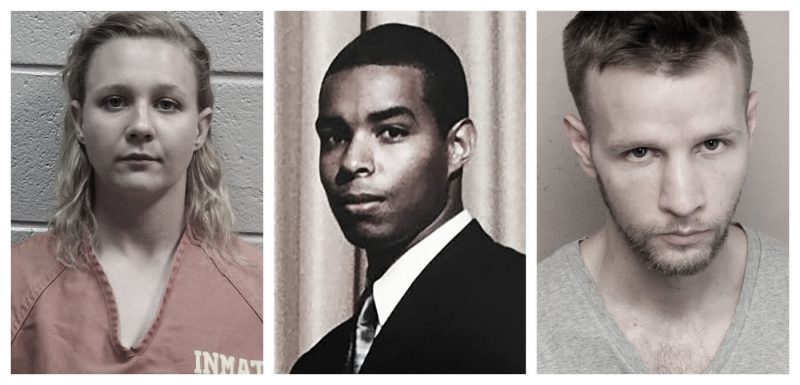
From left to right: Winner, Albury and Hale
Most concerning of all, the FBI warrant also notes that the reporter in question – who is unnamed in the document – contacted a government contractor with whom he had a prior relationship and revealed where the documents had been postmarked from – Winner’s hometown of Augusta, Georgia – along with Winner’s work location. He also sent unedited images of the documents that contained the tracking dot security markings that allowed the documents to be traced to Winner. Jesselyn Radack as well as whistleblower John Kiriakou, who served two and a half years in prison for exposing the CIA’s illegal torture program, have since asserted that Matthew Cole was the journalist mentioned in this warrant. Well prior to being hired by the Intercept, Cole’s behavior was known to have been a key factor that led to Kiriakou being outed as a confidential source, which led to his arrest. Upon learning of Hale’s arrest, Kiriakou openly speculated upon whether the outlet was incomptent or compromised.
Despite this track record, the Intercept hired Cole anyway. Cole continues to write for the Intercept and appears to have suffered no negative consequences for his alleged role in outing Winner. Intercept editor-in-chief Reed took responsibility for the acts on the part of the publication that led to Winner’s arrest and “for making sure that the internal newsroom issues that contributed to it are resolved.” Reed remains employed by the Intercept and continues to make a hefty six-figure salary. Winner is currently serving a five year and three month prison sentence for releasing a classified NSA document in relation to alleged Russian intrusion of a U.S. election software supplier.
Furthermore, journalist Barrett Brown — who served a lengthy 63-month prison sentence for linking to hacked material — has recently stated that Intercept journalist Sam Biddle played a role in his imprisonment, further worsening the optics of the publication’s track record. Brown originally faced a combined sentence of over 100 years in prison before negotiating a plea deal.
With Hale now the latest whistleblower to have been allegedly outed as a result of poor operational security by Intercept staff, the question turns to whether any of those responsible will be held accountable. Scahill, a celebrity reporter at the paper who makes over $40,000 per article, is just as unlikely as those involved in the outing of Albury and Winner to face any sort of negative consequences for failing to protect their sources, who risked (and have temporarily lost) their freedom to bring vital information to the public.
Will Omidyar’s pull keep Scahill out of hot water?
While only an indictment against Hale has been made public, Scahill may soon find himself in trouble with the Department of Justice based on information contained in that indictment.
As Moon of Alabama noted in an article detailing the charges against Hale:
The first contacts with Hale and the first leaks by Hale were in the first half of 2013, when Hale was still enlisted and worked at the NSA. In July Hale emailed a resume to Scahill which he wanted to use to find a job with a defense contractor who leases people with security clearances to other U.S. agencies. They seem to have discussed the resume by phone. Hale was later hired by such a contractor and worked at the NGIA. There he copied the secret and top secret documents and presentations that seem to be the objects of Scahill’s later reporting. That Scahill discussed Hale’s resume with him could be construed as active help to gain access to secrets that would then be leaked to The Intercept.”
Indeed, such a narrative is present within the indictment and Scahill may be pursued by the Trump Department of Justice, which has shown great zeal in prosecuting not only confidential government sources but also their publishers. Notably, the currently unsealed charges against WikiLeaks co-founder and Editor-in-Chief Julian Assange put forth a similar, though less compelling, narrative that Assange actively goaded Chelsea Manning into accessing state secrets that were subsequently given to WikiLeaks. Based on this alone, it seems likely that Scahill’s behavior as detailed in the indictment is likely to see the journalist pursued by the DOJ in some capacity, given the charges now facing Assange.
If this comes to pass, it will bode dark days for the future of American journalism that are already heralded by the indictment awaiting Julian Assange and the current imprisonment of Chelsea Manning for refusing to testify against Assange or WikiLeaks.
Yet, if Scahill evades any legal predicament on his end, it will raise many questions, most notably one of a double standard between his treatment and Assange’s treatment by the Trump DOJ, especially considering that both Scahill’s and Assange’s journalistic work has largely been unfavorable to government interests. Unlike Assange, Scahill’s publication and work are funded by eBay billionaire and the owner of PayPal, Pierre Omidyar, who is very well-connected to the public and private sector as well as to the U.S. intelligence community. Omidyar’s past public statements show hostility towards whistleblowers, whom Omidyar had likened to “thieves” prior to the Intercept’s founding.
If Scahill goes uncharged, it would likely be due to the intervention of powerful, politically-connected forces in the United States that are friendly towards Scahill, something Julian Assange lacks. Omidyar, given his ownership of the Intercept, would be the most probable person who could intervene successfully.
What did Hale’s whistleblowing reveal?
Based on the indictment, Hale is named as the source of several documents that revealed grave government wrong-doing, much of which related to the Obama administration’s expansion of the drone war and other counterterrorism programs with little or no oversight that have resulted in untold numbers of civilian deaths abroad.
One document noted in the indictment — “Document M,” which was classified as “secret” — appears in an article published in the Intercept in August 2014. That article revealed that most of the people in the government’s secret terror suspect database had no affiliation with any terror group and that the system disproportionately targeted Arab-Americans.
In addition, Documents A-F in the indictment appear to have been used in the Intercept’s “Drone Papers” series. Those documents revealed many stark truths and shocking facts about the Obama administration’s drone warfare campaign — which Trump has since significantly expanded — including the fact that U.S. drones killed innocent people 90 percent of the time, victims who were subsequently labeled “enemy combatants” regardless of their actual status.
Hale’s motive for coming forward with this information is very compelling and shows him to have risked his personal freedom in order to change a corrupt system. Cited in a 2015 article by Scahill as “the source,” Scahill wrote that Hale “decided to provide these documents to The Intercept because he believes the public has a right to understand the process by which people are placed on kill lists and ultimately assassinated on orders from the highest echelons of the U.S. government.”
Hale had said anonymously at the time:
This outrageous explosion of watchlisting — of monitoring people and racking and stacking them on lists, assigning them numbers, assigning them ‘baseball cards,’ assigning them death sentences without notice, on a worldwide battlefield — it was, from the very first instance, wrong…We’re allowing this to happen. And by ‘we,’ I mean every American citizen who has access to this information now, but continues to do nothing about it.”
To date, no one in the government has been held accountable for the killing of civilians in relation to the U.S. government’s covert drone assassination program.
The Intercept must be held accountable
Daniel Hale, just like Terry Albury and Reality Winner, is a hero. He exposed government programs that were out of control and killing innocent people around the world. Hale’s bravery helped hold the powerful to account and now Hale faces 50 years in prison, thanks to both the Trump administration’s troubling effort to double down on the persecution of whistleblowers and would-be whistleblowers as well as the actions of an employee, and potentially employees, of the Intercept.
If the Intercept will not hold itself accountable, as has thus far been the case, then it must be held accountable in the court of public opinion. Its employees must be held to account, including its celebrity journalists, for the paper’s refusal to deal with its indefensible track record of burning sources who have placed their trust in it. Concerned citizens on social media should ask Intercept journalists and the publication’s own accounts why nothing has been done and should demand that something tangible be done now that no less than three brave Americans who trusted the Intercept have found out the hard way that their trust was misplaced.
The lives of Winner, Albury and now Hale have been destroyed, in large part by the acts of a single publication that continues to market itself as “safe” for whistleblowers. While the Trump administration’s continued persecution of whistleblowers is the clear root of the problem, the fct remains that a site that advertises itself as “adversarial” to the State’s interests and as a haven for whistleblowers has aided the Trump administration in its persecution of whistleblowers, regardless of whether its operational security failures were intentional or inadvertent. If the Intercept as an organization were really so concerned with the Trump administration’s crackdown on press freedom, there would be accountability — not impunity — in such cases.
Sadly, by all appearances, the only confidential Intercept source from the public sector who was not outed by the publication and subsequently arrested was the source that prompted its formation: Edward Snowden, who “outed” himself. However, the Intercept closed its archive of the Snowden documents in late March, citing “cost” factors, despite the fact that the archive was less than 2 percent of its budget and its celebrity journalists, Glenn Greenwald and Jeremy Scahill, make over $500,000 and $349,000, respectively, leaving aside that the Intercept’s owner, Omidyar, is worth $12.7 billion.
If the Intercept continues to remain unaccountable, its track record of poor operational security and lack of concern for the risks its sources have taken could lead to the destruction of other lives. It also aggravates the chilling effect that the government’s prosecution of journalistic sources has had on those in the public sector seeking to expose government wrong-doing by narrowing their options for coming forward. Indeed, if something had been done after Winner’s case, perhaps the whistleblowing activities of neither Albury or Hale would have been made known to the government.
The Intercept claims to “hold the powerful accountable,” but such an adage will ring forever hollow until it is applied internally to its own organization and to those in its ranks who put the Trump administration on the trail of these brave whistleblowers.
Whitney Webb is a MintPress News journalist based in Chile. She has contributed to several independent media outlets including Global Research, EcoWatch, the Ron Paul Institute and 21st Century Wire, among others. She has made several radio and television appearances and is the 2019 winner of the Serena Shim Award for Uncompromised Integrity in Journalism.
Featured Video

or go to
Aletho News Archives – Video-Images
From the Archives
The Forgotten Terrorist Pretext of the Vietnam War
By Jim Bovard | The Libertarian Institute | February 16, 2023
Since 9/11, terrorism has become the ultimate entitlement program for America’s political elite. Whether it is illegally spying on Americans or blowing Somali dissidents to pieces, invoking terrorism provides all the cover needed for Washington policymakers. But the disastrous results of granting politicians a blank check to fight terrorism should have been undeniable almost 60 years ago.
Back in the 1960s, terrorism was what the communists did. Anti-terrorist moral fervor and ideological blinders propelled the U.S. into its biggest foreign policy blunder since World War II. … continue
Blog Roll
 Aletho News
- LAPD Pilot Will Track Vehicles In San Fernando Valley
- Britain’s Online Censorship Law Now Comes With a Crisis Plan for Your Posts
- NATO’s “Nordic model” brings Arctic confrontation closer to Russia’s nuclear bases
- Using nuclear weapons, the US-Israeli alliance still can’t beat Iran
- Sunset on the Quality of Western Propaganda: Arrival of the Dr Strangelove Moment
- Ukrainian general accused of protecting crime bosses
- US-‘Israel’ alliance faces growing rupture after midterms
- GOP’s Crushing Midterm Loss Could Reshape US Political Landscape – Analyst
- Midterm loss gives Congress power to rein in US war on Iran
- Midterms Were ‘Vote of No Confidence’ in GOP, But Iran Has No Illusions About Democrats – Marandi
- If Americans Knew
- An error has occurred; the feed is probably down. Try again later.
- No Tricks Zone
- New Study: The Net Fossil Fuel Contribution To Rising Atmospheric CO2 Has Been Zero For 500 Years
- Germany’s Green Energy Transition Becoming Increasingly Expensive…Another 6 Trillion Euros!
- Sudden Stratospheric Warming, Powerful El Niño Combination May Lead To Extreme Europe Cold, Energy Crisis!
- Two New Studies Find Thwaites Glacier Melt Cannot Be Driven By Human Activity Or A Warming Ocean
- E-Cars Reduce CO2 Emissions By Only 41% Compared To Internal Combustion Engine Vehicles
- Predictions Made By Renowned Climate Professor Over Past Decades Have Been Proven To Be Poor
- New Study Suggests Large Regions Of The Pacific Ocean Have Been Cooling For The Last 80 Years
- Germany’s Green Energy Debacle: High Energy Costs Force Kahla Porzellan to Close After 182 Years!
- New Study: 50 Years Of The Most Aggressive ‘Net Zero’ Policies Can Only Affect The Global Climate By 0.03°C
- US September “Heat” Was No Record…Many Records Set Decades Ago

