The “Yemen Bill” Trump Just Vetoed Never Had Anything to do With Yemen
By Adam Garrie – EurasiaFuture – 2019-04-17
Donald Trump has just vetoed a bill passed by the US Congress which would have ended American financial support for the Saudi led coalition in the Yemen conflict. When the bill was passed by both the House of Representatives and Senate, many were surprised that an otherwise pro-war and pro-interventionist group of politicians would support something that was seemingly anti-war. However, to assume that the majority of votes were motivated by an anti-war sentiment is to deny the very specific circumstances behind the bill’s passage.
In the United States, both main political parties have incredibly strong relations with Saudi Arabia. Yet among the US public, this “special relationship” is far more controversial than the fact that both US parties also have strong ties to Saudi Arabia’s de facto ally Israel. While Israel and Saudi Arabia are both known for pursuing internationally controversial foreign policies, among the US public, Israel is generally viewed in a positive light while Saudi Arabia is not. As such, whenever an opportunity comes along for American politicians to virtue signal against Saudi Arabia without actually changing US foreign policy in a meaningful way, such an opportunity will be acted upon. Trump himself virtue signaled against Saudi Arabia during his 2016 election campaign.
When it became clear that elements of the Saudi “deep state” were responsible for the murder of journalist Jamal Khashoggi and when after that it became clear that Donald Trump was not going to do anything to punish Riyadh for the Khashoggi murder, many in the opposition Democratic party sought to take advantage of a public opinion that had soured even further against Riyadh in the aftermath of the infamous murder which took place in Saudi Arabia’s Istanbul consulate.
In this sense, the vote to cut funding to the Saudi coalition in Yemen was a largely symbolic measure that most who voted for it knew would be vetoed. Making matters all the more stark, it can be assumed that some of those who voted for the bill even wanted it to be vetoed as the intention was only ever to virtue signal to an American public that had become somewhat upset in the aftermath of the Khashoggi murder. The bill was never actually meant to change Washington’s pro-Riyadh/anti-Tehran position vis-a-vis Yemen.
In this sense, while some are blaming Trump for prolonging the crisis in Yemen because of his veto, the reality is that Trump was handed a bill intended as a virtue signalling provocation rather than a genuine call to end the conflict in Yemen. As such, Trump responded in the way that virtually anyone in his position would have done.
Haspel, CIA, Sappy Sentimental Job.
By Andrei Martyanov | Reminiscence of the Future | April 16, 2019
NYT today decided to praise Gina Haspel as “professional”. I don’t know what they teach in CIA anymore, judging by “outstanding” results for the United States, but this piece I found to be hilarious. Follow the text:
London was pushing for the White House to expel dozens of suspected Russian operatives, but Mr. Trump was skeptical. He had initially written off the poisoning as part of legitimate spy games, distasteful but within the bounds of espionage. Some officials said they thought that Mr. Trump, who has frequently criticized “rats” and other turncoats, had some sympathy for the Russian government’s going after someone viewed as a traitor. A former Russian intelligence officer, Sergei Skripal, and his daughter were poisoned last year in Britain in a slipshod attack that also sickened children, killed ducks and required careful cleanup. During the discussion, Ms. Haspel, then deputy C.I.A. director, turned toward Mr. Trump. She outlined possible responses in a quiet but firm voice, then leaned forward and told the president that the “strong option” was to expel 60 diplomats. To persuade Mr. Trump, according to people briefed on the conversation, officials including Ms. Haspel also tried to show him that Mr. Skripal and his daughter were not the only victims of Russia’s attack. Ms. Haspel showed pictures the British government had supplied her of young children hospitalized after being sickened by the Novichok nerve agent that poisoned the Skripals. She then showed a photograph of ducks that British officials said were inadvertently killed by the sloppy work of the Russian operatives. Ms. Haspel was not the first to use emotional images to appeal to the president, but pairing it with her hard-nosed realism proved effective: Mr. Trump fixated on the pictures of the sickened children and the dead ducks. At the end of the briefing, he embraced the strong option.
Now you get it, I hope. Welcome to US “intelligence”, also known for Russiagate and support of terrorists. CIA also is known to have good skills in staging false flag operations such as “Chemical Attacks” by “Assad” in Syria. But I like this little insight in workings of US IC and its head Gina Haspel in handling forensic evidence, sound analysis, impressive record… nah, I am being facetious. Ah, yes–record, killed children, other atrocities. You may always keep yourself informed on how real US democracy and “realism” look like in terms of civilians’ body count, but who counts really, right? The depravity and casuistic nature of this piece of dung “journalism” is stunning, but then again–being sappy sentimental when committing war crimes and pushing world closer to Armageddon is what US intelligence “professionals” like Haspel are known for. Well that, and torture techniques. I am sure Gina cried while waterboarding some unfortunate creep. It is so, well, emotional after all–especially dead ducks.
What If Mainstream Media’s Message About Putin Was Delivered in Orwell’s Language?
By Patrick ARMSTRONG | Strategic Culture Foundation |16.04.2019
The West is under attack by Putin; he is at war with us and wars demand extreme measures. Putin’s influence is spreading: everywhere he is nibbling away at the foundations of democratic society. He is the dictator of Russia; still evil, still an empire; Russians are genetically driven to co-opt and penetrate and gain favour: it’s who they are and what they do. Russian scum! Putin interferes in referendums and elections all over the democratic world. A world that, for no good reason except his own needs, he calls his enemy. When his bots swung the US election and made his puppet POTUS, the world community began to wake up to the threat. Putin is bent on restoring the USSR and, until he can, he assembles an empire of losers, basket-cases and rogue states. When the weather is cold, we should fear him more. Putin’s whole existence depends on having an enemy and we are that enemy. We must defend against Putin’s threat to democracy; he threatens our democracy because he hates democracy and he fears democracy. We must defend against these multi-faceted, aggressive, unacceptable, bullying, continual and sinister attacks on the Rules-Based International Order which our democracies uphold. (Added to which, he’s short and can’t hide the fact and that makes him a megalomaniac.)
I humbly offer a few proposals so that we can better defend our precious heritage of democracy against his attacks.
• Putin hates democratic elections and seeks to twist them to his ends. He will interfere in Your Democracy’s elections. If your Ruling Party loses, it’s because Putin wanted it to lose and interfered with the voting: if your Ruling Party loses, Putin wins. Therefore, the “election” must be annulled and the Ruling Party must stay in power. That way Putin loses and we all win.
• Putin seeks to sow division in Your Democracy. Disagreement with the Ruling Party’s policy helps Putin divide us. Russian bots are ceaselessly trying to sow division; therefore you, as a True Democrat, must resist all attempts to disagree with your Ruling Party. Remember, disagreeing with the Ruling Party is what Putin wants you to do and that means he wins; agreeing with the Ruling Party means we all win and Putin loses.
• As a corollary, objectively speaking, if you disagree with the Ruling Party, you are agreeing with Putin and he wins. Putin hates what the Ruling Party stands for and you, as a True Democrat, shouldn’t hate what Putin hates. So love the Ruling Party: we all win and Putin loses.
• Putin and his legions of trolls engage in hybrid warfare an important part of which is the spreading of fake news. Putin and his trolls know that, while full mind control may not be possible or practical, sowing doubt is much easier. The True Democrat will never risk the chance of having his opinions infiltrated and therefore will be careful to read only news that has been first authenticated by responsible news outlets. Reading unauthenticated stories can let Putin into your brain. Keep him out and we all win.
• Putin uses social media to spread fake news and sow division in Your Democracy. It was one of the most important of his tools in winning the election for his stooge Trump. Putin is subtle – he even uses children’s cartoons and he has weaponised humour – and we must be protected if we don’t want him to win. The True Democrat will encourage efforts to regulate social media by trusted and reliable authorities such as the aptly-named Minister of Democratic Institutions in Canada. If Putin wins, we all lose!
• Putin needs useful idiots in Your Democracy to further his aims. Therefore the True Democrat will continually examine his thoughts to see whether any doubt or divisions are taking root: Putin wants us all to live in his “paranoid and polarized world“. If you find any division in your mind, Putin has put it there and you should make full confession to the authorities so that the rot may be stopped early and the damage repaired. The True Democrat will monitor his neighbours for signs of infection. Always remember that doubting the Ruling Party is what Putin wants you to do: stop doubting and we all win and Putin loses.
• Your Democracy’s security services work hard to protect our freedoms against Putin’s attacks. Putin wants us to criticise and impede the work of these brave men and women who put their lives on the line for us. Only Putin is served when these institutions are attacked. Support our brave men and women in all that they do to protect us. In that way we all win and Putin loses.
• From time to time, although they never start wars, democracies must use military force to end evil in the world. Putin is on the side of evil – he opposes the Rules-Based International Order – and he supports, when he is not actually causing, most of the evil and suffering in the world. As a dictator himself, he invariably sides with dictators who are torturing their populations. Dictators are repugnant to True Democracies and, therefore, they must occasionally take up arms in order to secure peace and order and punish the dictator’s “cruel indifference to the suffering of his people“. True Democrats understand this and support the Ruling Party in its occasional but justified uses of limited force. Objectively speaking, opposing these wars is the same as supporting Putin. True Democrats understand that wars must be fought for the sake of peace so we can all win and Putin can lose.
War against Putin is Peace
Freedom to Question is Slavery to Putin
Ignorance of Putin is Strength
Trump & the Bolton-Pompeo Axis
By Patrick Lawrence | Consortium News | April 16, 2019
Moon Jae-in’s Oval Office meeting with President Donald Trump last Thursday marked an important step forward for both leaders. The South Korean president appears to have drawn Trump away from the all-or-nothing “big deal” he proposed when he last met Kim Jong-un — an offer we now know was intended to precipitate the North Korean leader’s rejection. Trump won, too: The encounter with Moon has effectively put the Dealmaker back on his feet after the calamitous collapse of the second Trump–Kim summit in Hanoi two months ago. A top-down agreement on the North’s denuclearization is once again within reach.
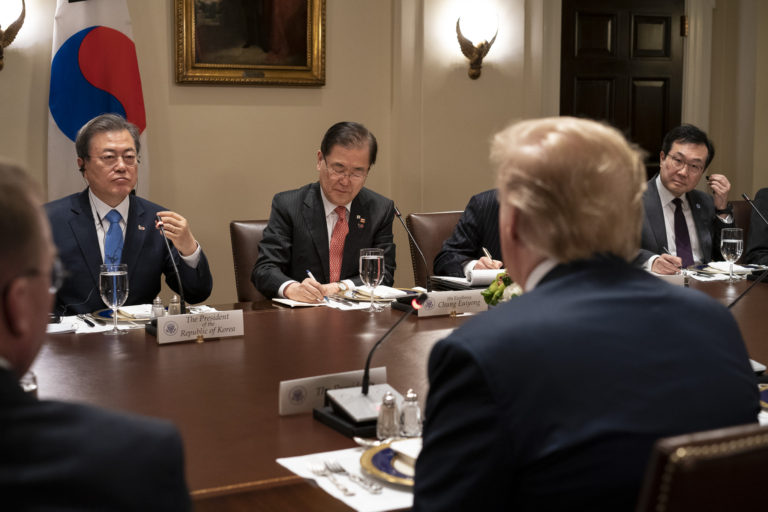
Moon facing Trump in DC, April 11, 2019. (White House/ Shealah Craighead via Flickr)
The importance of the Moon–Trump summit, while eclipsed by news of Julian Assange’s arrest in London the same day, is not be underestimated. Even before receiving Moon, Trump announced for the first time that he is willing to summit with Kim for a third time. While still stressing the North’s complete denuclearization as the U.S. objective, Trump also said he is open to the incremental diplomacy he precluded with his everything-at-once offer in Hanoi.
“There are various smaller deals that maybe could happen,” Trump said before he and Moon withdrew to the Oval Office. “Things could happen. You can work out step-by-step pieces, but at this moment we are still talking about the big deal.”
New Stance
This new stance is a big deal in itself. Moon and Kim — with Chinese and Russian support — have advocated talks based on gradualist reciprocity from the first. “Action for action,” Moon calls it. This strategy is widely accepted at the other end of the Pacific as the only plausible path to a sustainable denuclearization agreement. The U.S. has been the only nation engaged on the Korean question to argue otherwise.
In addition, Trump appeared to signal that Moon may get something he dearly wanted when he arrived in Washington: dispensation to proceed with inter–Korean economic projects — including transport links, an industrial park, and a joint-venture resort in the North — that are now blocked by a plethora of U.S. and UN–imposed sanctions. Moon views these as essential confidence-builders and the first steps toward integrating the North into a Northeast Asian economic hub that will also include South Korea, China, and the Russian Far East.
In Pyongyang, Kim responded to the events in Washington when he addressed the Supreme People’s Assembly last Friday. The speech was carefully balanced between optimism and caution, the latter reflecting Kim’s view that he was betrayed in Hanoi when Trump marshaled an offer he could not possibly embrace. “I am willing to accept if the United States proposes a third North Korea — United States summit,” Kim told North’s legislative body, “on condition that it has a right attitude and seeks a solution that we can share.”
Kim had other things to add. “We don’t like — and we are not interested in — the United States’ way of dialogue, in which it tries to unilaterally push through its demands,” he said. “We don’t welcome — and we have no intention of repeating—the kind of summit meetings like the one held in Hanoi.” The North Korean leader went on to set a year-end deadline “for the United States to make a bold decision.”
While Washington and Pyongyang had sharply conflicting versions of what transpired in Hanoi — each blaming the other for the summit’s failure — there is now little question that the U.S. side was at fault. A post–Hanoi Reuters exclusive reports that, prior to their famously canceled lunch, Trump handed Kim a sheet of paper listing, in English and Korean, extensive U.S. conditions that began with “a blunt call for the transfer of Pyongyang’s nuclear weapons and bomb fuel to the United States,” according to the piece filed by Leslie Broughton and David Brunnstrom.
The English-language version of the letter, the Reuters team reports, went on to demand “fully dismantling North Korea’s nuclear infrastructure, chemical and biological warfare program and related dual-use capabilities; and ballistic missiles, launchers, and associated facilities.”
The Libya Model
In simple terms, this was a kitchen-sink proposition — effectively a demand for unilateral disarmament — that was intended to prompt Kim to walk away. The Reuters reporters suggest that the fatal gambit was the work of John Bolton, Trump’s hyper-hawkish national security advisor. They quote North Korean officials as also implicating Secretary of State Mike Pompeo, another administration hawk, in what amounts to an act of diplomatic sabotage. The device used was Bolton’s “Libya model,” a laden reference if ever there was one. When Muammar Gaddafi gave up his chemical and nuclear weapons programs in 2003, he did so by sending Libya’s nuclear materials and equipment to the U.S. Eight years later, of course, he was assassinated in the wake of a NATO bombing campaign led by the U.S.
“The document appeared to represent Bolton’s long-held and hardline ‘Libya model’ of denuclearization that North Korea has rejected repeatedly,” Broughton and Brunnstrom report. “It probably would have been seen by Kim as insulting and provocative, analysts said.” One of those analysts was Jenny Town, a North Korea specialist at the Stimson Center in Washington. “‘This is what Bolton wanted from the beginning and it clearly wasn’t going to work,’” Reuters quotes Town as observing. “‘If the U.S. was really serious about negotiations, they would have learned already that this wasn’t an approach they could take.’”
Formidable Challenges
As this record of the Hanoi proceedings makes plain, Trump and Moon will assume formidable challenges to the extent they agree to work together toward a resolution of the Korea question on new terms. It is not clear why Trump — who went to Hanoi eager to cut his “big deal” with Kim — accepted the Bolton-inspired design and handed it on to the North Korean leader. But he has now set himself up for another in what appears to be a long line of conflicts with his foreign policy minders, Bolton and Pompeo chief among them.
The outlook in this connection is mixed at best. Trump was able to overrule new sanctions against North Korea that were announced several weeks after the Hanoi debacle. It is a matter of interpretation, but he effectively lost a battle with the Bolton–Pompeo axis when the administration designated the Iran Revolutionary Guard Corps a terrorist organization earlier this month. That move is understood widely to have pushed renewed negotiations with Tehran, for which Trump had been hoping, well beyond the point of no return.
For Moon, the challenges ahead are two. Most immediately, he must keep both Trump and Kim seated at the chess table between now and the end of the year. If no third summit is set by then, Kim has already signaled, he will consider this chapter in the long history of U.S.–North Korean negotiations closed — another story of failure. In such a case, the question facing Moon could hardly be more daunting: Can a South Korean leader determined to end nearly seven decades of enmity between the Koreas decisively wrest control of the diplomatic process from the U.S.?
That would amount to an unprecedented showdown between Seoul and Washington. Despite Moon’s admirable dedication, this is unlikely to materialize — not in the near term, in any case. Moon has formidable allies in Beijing and Moscow; Kim is plainly eager to break North Korea out of its isolation. But the U.S., perfectly satisfied to act as “spoiler” in Northeast Asia (as elsewhere), remains too powerful an obstacle despite the many signs that it is in the sunset phase of its global preeminence.
Patrick Lawrence, a correspondent abroad for many years, chiefly for the International Herald Tribune, is a columnist, essayist, author, and lecturer. His most recent book is “Time No Longer: Americans After the American Century” (Yale).
Italian banking major to pay hefty US fine for Iran sanctions-busting
RT | April 16, 2019
European subsidiaries of Italy’s biggest bank UniCredit have pleaded guilty to US charges of violating sanctions against Iran and other countries. The lender has agreed to pay $1.3 billion to settle the six-year probe.
UniCredit’s units in Germany, Austria and Italy admitted to illegally moving of hundreds millions of dollars via the US financial system on behalf of sanctioned entities, according to the US Treasury Department. The violations reportedly included sanctions programs against [alleged] weapons of mass destruction proliferation.
The resolution, which is among the largest ever related to US sanctions laws, followed last week’s $1.1 billion settlement reached by London-based banking multinational Standard Chartered with American and British authorities over similar misconduct.
The latest case revealed that UniCredit’s subsidiary in Germany processed more than 2,000 payments totaling over $500 million through US financial institutions. In addition, over two years through 2012 all the three of the bank’s units reportedly carried out transactions, withholding information on sanctioned persons or countries from the US authorities.
The US Treasury Department noted that the illegal cash proceedings were carried out to several states subject to US penalties, including Burma, Cuba, Libya, Sudan, and Syria.
Since 2004, some 15 European lenders paid about $18.5 billion to US authorities to resolve claims over violating Washington’s sanctions programs. A record $8.9 billion settlement was reached by French international banking group BNP Paribas in 2015.
Trump Dances to Israel’s Tune
More wag-the-dog means war for America
By Philip Giraldi • Unz Review • April 16, 2019
So newly reelected Israeli monster-in-chief Benjamin Netanyahu has boasted, with a grin, that America’s President Donald J. Trump followed through on his proposal to declare the Iranian Revolutionary Guard Corps (IRGC) a terrorist group. Bibi was smiling because the timing of the move, one day before the Israeli election, strongly suggests it was done to assist him against what had become a very strong opposition challenge. That Trump likely colluded with Netanyahu to blatantly interfere in the election has apparently bothered no one in Israel or in the tame American media.
The gift from Washington came on top of recognizing Israeli sovereignty over the Golan Heights, threatening members of the International Criminal Court if they try to prosecute Israel for war crimes, moving the U.S. Embassy to Jerusalem, removing the word “occupation” from the State Department’s assessments of human rights infringements on the West Bank, eliminating relief funding for Palestinian refugees, leaving the U.N. Human Rights Council because it was too critical of Israel, and looking the other way as Israel declared itself a state only for Jews. Washington also ignored the bombing of hospitals, schools and water treatment infrastructure in Gaza while Israeli army snipers were shooting unarmed demonstrators demanding their freedom.
The labeling of the Revolutionary Guard as a terrorist group is particularly disturbing as it means that the United States military by virtue of the Authorization to Use Military Force (AUMF) now has a mandate to attack the IRGC wherever it appears, including in Syria or even in the waterway the Straits of Hormuz, where the guard has regular patrols in small boats. It is a de facto declaration of war and it comes on top of a number of deliberate provocations directed against Iran starting with the withdrawal from the nuclear agreement Joint Comprehensive Plan Of Action (JCPOA) one year ago, which led to the unilateral imposition of harsh sanctions directed against the Iranian economy to bring about a popular uprising as well as regularly repeated false claims that Iran is the leading “state sponsor of terrorism.” Next month, the U.S. will begin enforcing a unilaterally declared worldwide sanction on any and all Iranian oil sales.
Netanyahu pledged to annex Israeli settlements on the largely Palestinian West Bank if elected, which is undoubtedly a move cleared in advance with the Trump team of foreign policy sociopaths as it de facto puts an end to any delusional speculation over a possible two-state negotiated solution for the Israel-Palestine conflict. It will also lead to a massive upsurge in violence as the Palestinians object, which is neither a concern for the White House or Netanyahu, as they are assuming that it can be suppressed by overwhelming force directed against an almost completely unarmed civilian population.
And Trump will no doubt expect Bibi to return the favor when he is running for reelection in 2020 by encouraging American Jews who care about Israel to support the Republicans. Trump is focused on his own electability and is absolutely shameless about his betrayal of actual American interests in the Middle East, possibly because he has no inkling of the actual damage that he is doing. His speech last week before the casino multi-billionaire Sheldon Adelson-hosted Jewish Republican Coalition Annual Leadership Meeting in Las Vegas was a disgusting pander to a group that includes many key players who have little or no concern for what happens to the United States as long as Israel flourishes. The only good news that came out of the meeting was that Adelson himself appears to be “gravely ill.”
Trump at times appeared to be speaking to what he thought was a group of Israelis, referring to “your prime minister” when mentioning Benjamin Netanyahu and several times describing Israel as “yours,” suggesting that deep down he understands that many American Jews are more loyal to Israel than to the United States. At another point, Trump declared that “The Democrats have even allowed the terrible scourge of anti-Semitism to take root in their party and their country,” apparently part of a White House plan to keep playing that card to turn American Jews and their political donations in a Republican direction before elections in 2020.
Trump also told the Republican Coalition audience how he came to a decision on recognizing Israel’s sovereignty over the Golan Heights. He described how “he’d been speaking to his son-in-law and senior adviser, Jared Kushner, as well as U.S. ambassador to Israel David Friedman and his Israel adviser, Jason Greenblatt, over the phone about an unrelated issue when he suddenly brought up the Golan Heights.” Trump shared how “I said, ‘Fellows, do me a favor. Give me a little history, quick. Want to go fast. I got a lot of things I’m working on: China, North Korea. Give me a quickie.’ After the advisers filled him in, Trump said he asked Friedman: ‘David, what do you think about me recognizing Israel and the Golan Heights?’ Friedman, apparently surprised by the suggestion, reacted like a ‘wonderful, beautiful baby,’ Trump said, and asked if he would ‘really … do that.’ ‘Yeah, I think I’m doing it right now. Let’s write something up,’ Trump said he responded, prompting applause and cheers from his audience in Las Vegas. ‘We make fast decisions and we make good decisions.’”
Putting the Trump story about the Golan Heights in some kind of context is not really that difficult. He wanted an answer to please Netanyahu and he went to three Orthodox Jews who support the illegal Israeli settlements and have also individually contributed financially to their growth so he was expecting the response that he got. That he was establishing a precedent by his moves on Jerusalem and the Golan apparently did not occur to him as his administration prides itself on having a foreign policy vision that extends no longer than the beginning of next week, which is why he hired Mike Pompeo, John Bolton and Elliott Abrams. And then there is always the doleful Stephen Miller lurking in the background as well as the three musketeers of Kushner, Greenblatt and Friedman for really serious questions relating to why acceding to the wishes of parasite state Israel should continue to be the apparent number one priority of the government of the United States.
Donald Trump neither poses nor answers the question why he feels compelled to fulfill all of the campaign pledges he made to the Jewish community, which by and large did not vote for him, while failing to carry out the promises made to those who actually did support him. The absurd Jewish Republican Coalition narrative about how Trump gave Israel the Golan Heights should have resulted in a flood of opprobrium in the U.S. media about his profound ignorance and fundamental hypocrisy, but there was largely silence.
The nonsense going on in Las Vegas in front of a lot of fat cats who regard the United States as little more than a cash cow that they control as well as in the White House itself unfortunately has real world consequences. America is being led by the nose by a well-entrenched and powerful group of Israeli loyalists and this will not end well. The U.S. doesn’t even have a Middle Eastern foreign policy anymore – it has a “to do” list handed by Netanyahu to whomever is president. The fact that the current man in charge in Washington is either so ignorant or so deluded as to allow the process to escalate until the U.S. is drawn into yet more catastrophic wars is beyond regrettable. U.S. foreign policy should not depend on the perceptions of Kushner and company. It should be based on real, tangible American interests, not those of Israel. Someone should explain that to the president.
Philip M. Giraldi, Ph.D., is Executive Director of the Council for the National Interest, a 501(c)3 tax deductible educational foundation that seeks a more interests-based U.S. foreign policy in the Middle East. Website is councilforthenationalinterest.org, address is P.O. Box 2157, Purcellville VA 20134 and its email is inform@cnionline.org.
How the U.S. Navy Sold the Vietnam War

Dr. Tom Dooley. (YouTube screen shot)
By Gareth Porter | TruthDig | March 27, 2019
Dr. Tom Dooley, whose best-selling book “Deliver Us From Evil” helped create a favorable climate of opinion for U.S. intervention in South Vietnam, has long been linked to legendary CIA officer Edward G. Lansdale and his black operations in Vietnam between 1954 and 1955. But the real story about Dooley’s influential book, which has finally emerged from more recent scholarly research, is that it was engineered by an official of the U.S. Navy’s Pacific Command, Capt. William Lederer.
Lederer is best known as the co-author, with Eugene Burdick, of the 1958 novel “The Ugly American,” which was turned into a 1963 movie starring Marlon Brando. Far more important, however, is the fact that from 1951 through 1957 Capt. Lederer was on the staff of the commander in chief of the U.S. Pacific Fleet (CINCPAC), Adm. Felix Stump.
The Pacific Command was intensely interested in Dooley, because the U.S. Navy had the greatest stake of all the military services in the outcome of the conflict between the communists and U.S.-backed anti-communist regimes in Vietnam and China during the mid-1950s. And the Pacific Command was directly involved in the military planning for war in both cases.
Adm. Arthur Radford, the former CINCPAC and then chairman of the Joint Chiefs of Staff, led the senior officials pressing President Dwight D. Eisenhower to approve a massive U.S. airstrike against the Viet Minh at Dien Bien Phu in April 1954. And between 1954 and 1955, Adm. Stump called for increasing the size of the Nationalist Chinese raids on the Chinese mainland from offshore islands. He also pushed for a U.S. attack on the mainland, including the use of nuclear weapons, if necessary, to defend those same offshore islands.
Capt. Lederer met Dooley in Haiphong, Vietnam, in 1954 after the Navy launched “Operation Passage to Freedom” to help transport more than 300,000 Vietnamese civilians, soldiers and members of the French Army from the French-controlled North to Saigon. A CIA psychological warfare team led by Lansdale had slipped into Hanoi and Haiphong to sabotage the Ho Chi Minh government takeover and to spread propaganda to provoke fear among Catholics and other residents.
The key tactic of the Lansdale team was to print a series of “black propaganda” leaflets—designed to appear as though they came from the Viet Minh—to frighten residents of the North into leaving for South Vietnam. The most dramatic such deception involved spreading the rumor that the U.S. military was going to bomb Hanoi, a story that was further promoted by leaflets showing concentric circles of destruction of the city by an atomic bomb.
Lt. Tom Dooley, a young Irish Catholic Navy doctor, was “loaned” by the U.S. Navy to Lansdale for the operation, although Dooley apparently thought the team’s function was to gather intelligence. Dooley’s job was ostensibly to manage medical supplies needed for the movement of North Vietnamese to the South, but in fact Dooley functioned as the team’s propagandist, briefing visiting news media and sending out out reports through Catholic media in the United States that supported the CIA’s anti-Viet Minh mission.
Lederer quickly recognized Dooley as a potentially valuable propaganda asset because of his connection with Vietnamese Catholics and his penchant for telling tales of Viet Minh atrocities. It was Lederer who suggested that Dooley write a book about his experiences with North Vietnamese refugees who wanted to move to the South. The Navy gave him a leave of absence to write it, and Lederer became Dooley’s handler for the project. Dooley was a charismatic public speaker but needed Lederer’s help with writing. Lederer also introduced Dooley to Reader’s Digest—by far the most popular magazine in America, with 20 million readers. Chief of Naval Operations Arleigh Burke officially embraced the book and even wrote the introduction to it.
Reader’s Digest published a highly condensed 27-page version of the book in its April 1956 edition, and Farrar, Straus and Cudahy immediately published the full-length version. It became a runaway bestseller, going through twelve printings.
The constantly reiterated theme of Dooley’s book “Deliver Us From Evil” was that the Ho Chi Minh government was determined to suppress the Catholic faith in Vietnam and used torture and other atrocities to terrorize Catholics into submission. That was a grotesque distortion of actual Viet Minh policy. The Ho Chi Minh government had worked hard from the beginning of the war to ensure that there was no interference with Catholics’ exercise of their faith, even establishing severe legal penalties on any infringement of that freedom.
But Dooley’s book was full of lurid descriptions of North Vietnamese Communist atrocities against Catholics that Dooley claimed to have known about from treating the victims. It told of the Viet Minh having partially torn off the ears of several teenagers with pliers and left them dangling—supposedly as punishment for their having listened to the Lord’s Prayer.
And he described the Viet Minh taking seven youths out of their classroom and forcing wooden chopsticks through their eardrums. The children, he wrote, had been accused of “treason” for having attended a religious class at night. As for the teacher, Dooley claimed the Viet Minh had used pliers to pull out his tongue, as punishment for having taught the religious class.
But it was widely recognized within the U.S. government that these stories were false. Six U.S. Information Agency officials who had been in North Vietnam during that period, as well as former Navy corpsmen who had worked in the Haiphong camp with Dooley, all said they had never heard of any such events. And in 1992 Lederer himself, who had made 25 fact-finding trips to Vietnam since 1951, told an interviewer, “[T]hose things never happened. … I traveled all over the country and never saw anything like them.”
Many years later, in an interview with scholar Edward Palm, Lederer disclaimed any significant influence on the content or tone of Dooley’s book, even though Dooley had credited Lederer with helping put the book in final form. Lederer also told Palm he didn’t remember any such stories appearing in the first draft of the book he read.
But Palm, who obtained the first draft of the manuscript from Dooley’s papers, confirmed to this writer that the first draft did contain those stories of atrocities. And Palm’s monograph documented the fact that the last draft chapter was dated the end of July 1955 and that communications from both men at the time indicated that Lederer had met repeatedly with Dooley during June and July to help him finish the draft.
Palm also quoted from Dooley’s first draft to show that it concluded with a call for Americans to be ready for a U.S. war against communism. If negotiations with the Soviet Union failed to bring “lasting peace,” Dooley’s draft warned, “Communism will have to be fought with arms … it must be annihilated….” Dooley concluded, “[T]here can be no concessions, no compromise and no coexistence.”
Palm pointed out that the published version of the book dropped that rabidly warlike rhetoric and instead introduced a new character named “Ensign Potts” to represent the view that America must be ready to fight a war to destroy communism. The role of the “Potts” character was to be converted to Dooley’s argument that service to the ordinary Vietnamese would be the most effective way to prevail in the Cold War—after Dooley’s tearful recounting of the story of the Viet Minh puncturing the Catholic youths’ ears with chopsticks, reduced “Potts” to tears as well.
Lederer and Burdick popularized the idea that personal kindness to the people of Southeast Asia from American could help defeat Communism in “The Ugly American” and that same idea infused Lederer’s own March 1955 Reader’s Digest article on the interactions between U.S. sailors and Vietnamese aboard a U.S. Navy ship. Lederer told Palm in a 1996 interview that he had suggested that Dooley model his book on that article.
Palm wrote that he didn’t believes Lederer’s personal preference was to promote a U.S. war in Vietnam. But Lederer had obviously approved Dooley’s portrayal of the Vietnamese Communists as an alien horde terrorizing the Catholics. Catholics were the fastest-growing religious denomination in America from 1940 to 1960, during which time their numbers doubled, and Dooley’s message was an obvious way of mobilizing American Catholics to support Adm. Stump and the Navy’s agenda for Vietnam.
Marine Lt. Col. William Corson, who was detailed to the CIA during much of his career and knew Dooley during the writing of his book, told fellow former Marine Edward Palm in a 1997 telephone interview, “Dooley was programmed toward a particular end.” He did not say specifically what that end was, but he appeared to mean building popular support for U.S. intervention in Vietnam.
While on a nationwide book tour, Dooley was one of the featured speakers at the first conference of The American Friends of Vietnam—later known as the “Vietnam Lobby”—in Washington, D.C., on June 1, 1956. The meeting was held at a crucial moment in U.S. Vietnam policy. Eisenhower was still supporting the election for a government throughout Vietnam as called for by the 1954 Geneva Agreement, with strict conditions for a free vote. Meanwhile, hardliners in the administration were pushing for opposing that election outright on the ground that Ho Chi Minh would certainly win it, regardless of conditions.
Dooley’s contribution was to describe “Communism” as an “evil, driving, malicious ogre” and recount the “hideous atrocities that we witnessed in our camps every single day.” And he retold the story of the Viet Minh punishing the schoolchildren by puncturing their eardrums.
A few weeks after the meeting, Eisenhower reversed his previous position of supporting the all-Vietnamese Vietnamese, opening the path to deeper U.S. political and military intervention in Vietnam.
Dooley had just learned that his secret life as a gay man in the Navy had been discovered by Naval intelligence, and he was forced to quietly resign. At Lansdale’s suggestion, Leo Cherne of the International Rescue Committee helped Dooley establish a primitive medical clinic near the Chinese border in northern Laos. But Dooley had to agree to cooperate with CIA in Laos by allowing it to smuggle arms into the site of the clinic to eventually be distributed to local anti-Communist militiamen.
The Dooley Clinic in Laos helped make him a hugely popular celebrity, with two more best-selling books, feature stories in popular magazines and network television appearances. By the time Dooley died of cancer in 1961, a Gallup Poll found that Americans viewed him as the third most admired person in the world, after Eisenhower and the pope. But his role in the larger tragedy of U.S. war in Indochina was to serve as the instrument of a highly successful campaign by the U.S. Navy to create the first false propaganda narrative of the conflict—one that has endured for most of Dooley’s fans for decades.
But Dooley’s popularity and saintly image increased the power of his tales of Viet Minh atrocities against Catholics that represented the first major false U.S. propaganda narrative of the Vietnam conflict—one that helped build public support for the U.S. military intervention in Vietnam that began under President John F Kennedy in 1962.
Zarif Slams EU over Not Fulfilling Nuclear Deal Commitments
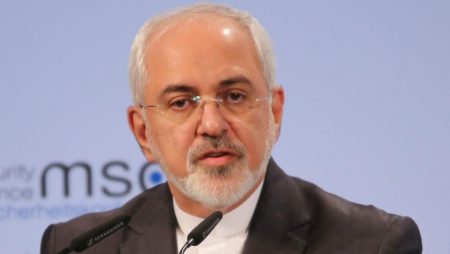
Iranian Foreign Minister Mohamamd Zarif
Al-Manar | April 14, 2019
Iran’s Foreign Minister Mohamamd Javad Zarif slammed the EU on Sunday over delays in the implementation of the new mechanism for non-dollar trade with the Islamic Republic.
In comments on Sunday, the top Iranian diplomat deplored the European signatories to the 2015 Iran nuclear deal for failing to fulfill their commitments under the agreement, saying it is long overdue.
The Europeans are far behind on fulfilling their commitments under the Joint Comprehensive Plan of Action (JCPOA), Zarif said, adding: “They (EU) should not assume that the Islamic Republic of Iran will be waiting for them.”
Describing INSTEX -a payment channel that the three EU signatories to the JCPOA have set up to maintain trade with Iran- as a preliminary measure, Zarif said the Europeans need to work hard for a long time to honor their commitments.
The Iranian minister further noted that Iran has maintained close ties with its neighbors and has launched mechanisms similar to the INSTEX with many other countries.
“While the European countries have proposed INSTEX to maintain business ties with Iran in defiance of the US sanctions, the payment channel has not been put into practice yet,” he added.
On the other hand, Zarif said Iran will ask the international community to take a position on the US designation of its Revolutionary Guards as a terrorist organization.
“Today … we will send messages to foreign ministers of all countries to tell them it is necessary for them to express their stances, and to warn them that this unprecedented and dangerous U.S. measure has had and will have consequences,” Zarif was quoted as saying by state news agency IRNA.
The Iranian diplomat said he had also sent letters to United Nations Secretary-General Antonio Guterres and the United Nations Security Council to protest against “this illegal U.S. measure”.
Russia expands ties in Lebanon’s oil and gas sector
Michal Kranz – Al Monitor – April 10, 2019
During a Middle East tour last month, US Secretary of State Mike Pompeo focused primarily on Iran’s influence in the region, but on Mar. 20 in Jerusalem he also labeled Russia an adversary of US regional allies in addition to Iran and China when speaking about energy and security in the eastern Mediterranean. “Revisionist powers like Iran and Russia and China are all trying to take major footholds in the East and in the West,” Pompeo said, alongside Israeli Prime Minister Benjamin Netanyahu and the leaders of Greece and Cyprus.
Pompeo had also reportedly planned to set “red lines” on Russian projects in Lebanon while in Beirut March 22-23. Yet, whatever plans Pompeo may have had to counter Russia in Lebanon, they seem to have had little effect. Lebanese leaders have doubled down on working with Russian companies in their country’s expanding oil and gas sector in the weeks since Pompeo’s visit.
Although the United States maintains an important degree of diplomatic clout in Lebanese energy matters, Russian economic investments in the sector have far outpaced those of the Americans, and Russian officials and business leaders have expressed their desire to take further steps to cement roles as key players like the United States continue to lag behind.
“The Russians have an advantage over the Americans not only in Lebanon, but in the region as well,” Amal Abou Zeid, adviser for Lebanese-Russian affairs at Lebanon’s Foreign Ministry, told Al-Monitor.
Lebanon and Russia signed a memorandum of understanding to cooperate on oil and gas in October 2013, and since then cooperation between them has deepened. In December 2017, the Lebanese government awarded its first contracts for offshore oil and gas exploration to a consortium of three firms that included Novatek, Russia’s second-largest gas company.
This past January, Russia’s majority state-owned oil giant Rosneft signed a deal to manage, operate and potentially rehabilitate and expand part of the oil storage terminal in Tripoli, Lebanon’s second largest city, as part of a 20-year lease. Rosneft is also competing in a bidding process along with other consortiums, including an American company, for an offshore gas terminal off the Lebanese coast.
Days after Pompeo’s visit, Lebanese President Michel Aoun traveled to Moscow, where he met with Russian President Vladimir Putin and Rosneft CEO Igor Sechin, who said the company is interested in “elevating the oil facilities in north Lebanon.” According to Abou Zeid, Sechin is interested in building up to three additional oil storage facilities in Tripoli and potentially investing in a future refinery in the north.
Cesar Abi Khalil, a parliamentarian who served as energy minister when Lebanon signed the Tripoli deal with Rosneft, told Al-Monitor that there is “high interest” in Lebanon to work with companies, including American ones, on refinery construction and rehabilitation. He added that ultimately, contracts will be awarded to companies that present the best proposals, as Rosneft did for the Tripoli terminal.
Russia’s interest in Lebanon is tied to its regional strategy. Since 2016, Rosneft has steadily expanded its operations into Iraq, Egypt and Libya, and Gazprom, Russia’s state-owned gas company, has been making inroads in Syria’s gas market during the civil war there. While Syria’s oil and gas reserves are dwarfed by those in neighboring Iraq, its location is highly strategic for Russia, which has been supporting Syrian President Bashar al-Assad in the civil conflict since 2015. Hundreds of Russian mercenaries have reportedly been killed securing oil fields in the country [actually that is a myth], and Russia has begun exploring for oil and gas off the Syrian coast.
Abou Zeid confirmed that the rehabilitation of a long-disused oil pipeline connecting Tripoli with oilfields in Iraqi Kurdistan, where Rosneft is active, was one of the topics discussed by Aoun and Sechin in Moscow. It is likely that gaining access to oil infrastructure in Lebanon in addition to offshore reserves in the country will enhance Russia’s strategic position in Syria and across the eastern Mediterranean, but it remains possible that it could also use the Tripoli facilities to try to bypass US sanctions on fuel shipments to Syria.
Meanwhile, American companies have been unable or unwilling to secure stakes in Lebanon’s new offshore prospects, which the US Department of Energy estimates will produce almost $254 billion between 2020 and 2039. Abou Zeid said that he had heard that ExxonMobil had entered into a consortium before the first bidding process for the offshore exploration contract began, but ultimately they and many other American companies failed to submit bids once they were eligible.
“I am certain that the Americans are interested, and they were not very happy with the Russian presence in this sector,” Abou Zeid said, speculating that political issues, like Hezbollah’s role in Lebanese politics, may have scared off potential American investors.
Mona Sukkarieh, a political risk consultant and co-founder of Middle East Strategic Perspectives, told Al-Monitor that other factors were more likely to be involved.
“Repeated delays resulting from frequent vacuums within the executive branch, an incomplete legal framework, changes in blocks offered and a change in market conditions all affected companies’ enthusiasm for the first licensing round,” she said.
Abi Khalil agreed that market forces were partially to blame for the lack of interest from the United States during the first round of bidding, but he also said that he had found ongoing interest by American firms in Lebanese oil and gas during his three official visits to the States, including in potential refinery projects across the country.
Despite these difficulties, the Novatek consortium followed through on its interest and secured rights to two blocks in Lebanon’s Exclusive Economic Zone (EEZ), one of which is in a disputed zone that Israel has claimed as part of its own EEZ since 2010. On April 4, Lebanese Energy Minister Nada Boustani announced the opening of a second round of bidding for contracts to five additional offshore blocks, two of which lie along the disputed border area. Lebanese leaders have long maintained that Israel is encroaching on Lebanon’s maritime boundary.
On April 1, parliament Speaker Nabih Berri said that Lebanon won’t give Israel “one cup” of its water. According Berri’s office, on March 22 the speaker and Pompeo discussed the issue of Lebanon’s southern maritime border and efforts to settle the dispute with Israel.
Abou Zeid claims that all the involved parties are interested in seeing the United States play a mediating role in the boundary issue. Regardless, US influence over matters related to energy in Lebanon are quickly diminishing given American companies’ absence in the country’s oil and gas sector and the lack of trust among Lebanese leaders, who believe Washington is biased toward Israel’s geopolitical positions.
“The US is really, one, not that interested, and two, the space that the US used to have in Lebanon in terms of influence and shaping decisions, it’s been lost,” Hanin Ghaddar, a researcher specializing in Lebanon and Iran at the Washington Institute for Near East Policy, told Al-Monitor. She added that in her view, it is unlikely that American firms will gain any offshore contracts.
So far, US efforts to counter Russian expansion in the eastern Mediterranean through diplomacy have proven inadequate. Unless American companies get serious about acquiring stakes in Lebanon’s offshore reserves, it will likely be almost impossible for the United States to overcome the head start Russia has gotten in Lebanon’s oil and gas sector, allowing Moscow to continue to strengthen its economic position across the Middle East.
Russia Profits as US Takes Venezuelan Oil off the Market in Europe
By Irina Slav – Oilprice.com – April 12, 2019
European refiners are switching to Russian sour grades as U.S. sanctions have shrunk Venezuela’s similar-grade exports, Reuters reports, adding that the Russian sour crude is getting increasingly expensive.
Citing sources from the trading industry, Reuters says the situation has been made worse by the fact that OPEC members have cut mainly their output of heavier, more sour grades under the OPEC+ agreement aimed at stimulating a price rise.
U.S. crude is not an alternative as it is overwhelmingly light and sweet, while refineries in Europe are equipped to process heavier grades as well as light ones to make refined products.
The news is the latest reminder that the world is tipping towards a shortage of heavy, sour crude, which is the staple kind of Venezuela crude and which many refineries need to produce fuels and other products.
“Urals is anchored in a positive zone versus dated Brent and there is no indication it will fall to a discount any time soon,” one of the Reuters’ sources said. That’s a complete reversal of the traditional differential between light and heavy oil, with the latter typically trading at a discount to Brent, a light blend.
Sanctions on Iran are further complicating life for European refiners as they have restricted exports of sour grades that Iran also produces in addition to its very popular superlight crude, also called condensate.
According to Reuters, U.S. sanctions have removed 800,000 bpd of heavy crude from the global market, leaving refiners scrambling for alternatives in a limited pool that, besides Russia and Middle Eastern producers, also includes Canada and Mexico as large producers of these grades of crude. The former is having its own problems with a pipeline capacity shortage and a production cut that has boosted prices, and the latter has yet to reverse a fall in oil production.
Featured Video

or go to
Aletho News Archives – Video-Images
From the Archives
The Forgotten Terrorist Pretext of the Vietnam War
By Jim Bovard | The Libertarian Institute | February 16, 2023
Since 9/11, terrorism has become the ultimate entitlement program for America’s political elite. Whether it is illegally spying on Americans or blowing Somali dissidents to pieces, invoking terrorism provides all the cover needed for Washington policymakers. But the disastrous results of granting politicians a blank check to fight terrorism should have been undeniable almost 60 years ago.
Back in the 1960s, terrorism was what the communists did. Anti-terrorist moral fervor and ideological blinders propelled the U.S. into its biggest foreign policy blunder since World War II. … continue
Blog Roll
 Aletho News
- LAPD Pilot Will Track Vehicles In San Fernando Valley
- Britain’s Online Censorship Law Now Comes With a Crisis Plan for Your Posts
- NATO’s “Nordic model” brings Arctic confrontation closer to Russia’s nuclear bases
- Using nuclear weapons, the US-Israeli alliance still can’t beat Iran
- Sunset on the Quality of Western Propaganda: Arrival of the Dr Strangelove Moment
- Ukrainian general accused of protecting crime bosses
- US-‘Israel’ alliance faces growing rupture after midterms
- GOP’s Crushing Midterm Loss Could Reshape US Political Landscape – Analyst
- Midterm loss gives Congress power to rein in US war on Iran
- Midterms Were ‘Vote of No Confidence’ in GOP, But Iran Has No Illusions About Democrats – Marandi
- If Americans Knew
- An error has occurred; the feed is probably down. Try again later.
- No Tricks Zone
- New Study: The Net Fossil Fuel Contribution To Rising Atmospheric CO2 Has Been Zero For 500 Years
- Germany’s Green Energy Transition Becoming Increasingly Expensive…Another 6 Trillion Euros!
- Sudden Stratospheric Warming, Powerful El Niño Combination May Lead To Extreme Europe Cold, Energy Crisis!
- Two New Studies Find Thwaites Glacier Melt Cannot Be Driven By Human Activity Or A Warming Ocean
- E-Cars Reduce CO2 Emissions By Only 41% Compared To Internal Combustion Engine Vehicles
- Predictions Made By Renowned Climate Professor Over Past Decades Have Been Proven To Be Poor
- New Study Suggests Large Regions Of The Pacific Ocean Have Been Cooling For The Last 80 Years
- Germany’s Green Energy Debacle: High Energy Costs Force Kahla Porzellan to Close After 182 Years!
- New Study: 50 Years Of The Most Aggressive ‘Net Zero’ Policies Can Only Affect The Global Climate By 0.03°C
- US September “Heat” Was No Record…Many Records Set Decades Ago

