Despair or distraction? Pompeo’s ‘push for peace’ in Libya does not pass smell test
By Alex Benley – RT- April 12, 2019
The US Secretary of State Mike Pompeo may have called for peace in Libya but his lack of credibility makes one suspect something else is going on.
“There is no military solution,” warns West Point graduate, former CIA chief and waterboarding defender, Mike Pompeo.
“We have made clear that we oppose the military offensive by Khalifa Haftar’s forces and urge the immediate halt to these military operations against the Libyan capital,” Pompeo’s statement read.
There is something not right about Pompeo’s call. Otherwise, it would seem to mark a major U-turn in US foreign policy. But the record of this and previous administrations does not corroborate such an assumption.
Libya is a great case study when it comes to the gap between US leaders’ public statements and their underlying intent.
In his address to the nation on March 28, 2011, Nobel peace prize laureate Barack Obama framed the mission as one “to protect the Libyan people from immediate danger and to establish a no-fly zone… Broadening our military mission to include regime change would be a mistake.” Roger that.
During a Senate hearing, Hillary Clinton’s deputy, James Steinberg said, “President Obama has been equally firm that our military operation has a narrowly defined mission that does not include regime change.”
During the months that followed, however, the US provided rebels with $25 million in assistance and reportedly allowed advanced weapons to be delivered by Egypt and Qatar.
NATO ships stationed in the Mediterranean to enforce an arms embargo under Section 9 of Resolution 1970 let go a rebel tugboat with small arms, 105mm howitzer rounds, and “lots of explosives.”
On the day Vice Adm. William Gortney, director of the Joint Staff, “guaranteed” the press that Muammar Gaddafi is “not on a targeting list,” bombs hit the presidential compound.
Clinton’s eventual “we came, we saw, he died” is the most striking giveaway that regime change was the White House’s goal right from the start.
The US action under the guise of a peace and humanitarian narrative resulted in the collapse of a once rich and stable country that has since turned it into a playground for extremist forces, with spillover effects for the entire region. It has been a de-facto failed state for eight years now.
Need more examples of Washington’s hypocrisy? Promoting peace in Yemen and Syria on paper did not preclude the US from launching airstrikes against Damascus and exporting weapons that kill civilians in the protracted Saudi-led war on Yemen’s Houthis.
The US is clearer on Venezuela but again not everything is said in public. Remember National Security Advisor John Bolton’s hand-written reminder to send 5,000 troops to Colombia captured on camera?
Going back to Libya, there is another detail that is adding flavor to the story.
It is common knowledge that Haftar’s military experience helped topple the Gaddafi regime in 2011 following his return to Libya from the US where he gained American citizenship. Other than being a skilled commanding officer, he is said to have become a CIA asset and was trained in guerilla warfare by the agency’s paramilitary arm. This was after Washington saved him from a prison in Chad following a botched Libyan campaign and abandonment by Gaddafi in 1987. In March 1996, Haftar took part in the uprising against the Libyan leader.
However, Haftar has also been building ties with Russia. He’s flown to Moscow and has met several times with Defense Minister Sergey Shoigu.
If the general has made up his mind, he could run his homeland on his own terms. The US is just trying to buy time to figure out his and its own next move.
Also on rt.com Libya’s military strongman Haftar to meet Russian FM Lavrov in Moscow
But the timing of the general’s offensive – just days ahead of a major UN conference – might indicate he may have been directed by the US to thwart European and broader international efforts. The goal would be to show who the real powerbroker is, to scare the Europeans with potentially more refugees, and punish the EU for seeking greater autonomy from the US.
So, what’s truly behind Pompeo’s statement – a distraction to prove their alibi while a special CIA op is underway or a signal to a former asset gone rogue in a geopolitical tug of war over who defines Libya’s future?
Whatever the case, make no mistake: Pompeo is no peace dove and the US will have no qualms about issuing secret orders to advance their strategic interests that run counter to their publicly stated objectives.
North Korea’s Kim says US must stop ‘way of calculation’, gives deadline
Press TV – April 13, 2019
North Korean leader Kim Jong-un says the United States has raised the risk of returning to past tensions after the collapse of his second summit with President Donald Trump, stressing that yet another meeting between the two leaders is only possible if Washington comes with the right attitude.
The North’s official KCNA news agency on Saturday quoted Kim as making the remarks, two days after Trump floated the idea of holding a potential third nuclear summit with the North’s leader.
“What is needed is for the US to stop its current way of calculation, and come to us with a new calculation,” Kim was quoted as saying in a speech to the Supreme People’s Assembly on Friday.
He also said that he would wait “until the end of this year” for Washington to decide.
Back in late February, Trump and Kim reached an impasse at their second face-to-face denuclearization talks in the Vietnamese capital Hanoi, with Washington demanding full disarmament and Pyongyang demanding economic incentives through partial lifting harsh sanctions.
The second summit in fact did collapse when the American president abruptly walked away from the talks without reaching a deal or even issuing a final statement.
Trump claimed that he quit the talks because Kim demanded to lift all economic sanctions as a prerequisite to denuclearization.
However, Pyongyang quickly responded that it had never asked for the removal of all sanctions, but only the partial removal of them.
In June last year, the two leaders met at a historic summit for the first time in Singapore, where they agreed to work toward denuclearization of the Korean Peninsula. Subsequent diplomacy between the two sides, however, made little progress, mainly because Washington refused to lift its crippling sanctions.
“The second DPRK-US summit in Hanoi in February raised strong questions about whether the steps we took under our strategic decision were right, and gave us a sense of caution about whether the US is even really trying to improve the DPRK-US relationship,” Kim added, using the initials of North Korea’s full name, the Democratic People’s Republic of Korea.
The North’s leader also said that Washington came with “completely unrealizable plans” to Hanoi and that the US was “not really ready to sit with us face-to-face and solve the problem.”
“By that sort of thinking, the US will not be able to move us one iota even if they sat with us a hundred, thousand times, and will not be able to get what it wants at all,” Kim stressed.
The North Korean leader further blamed the US for continuing “to ignore the basic way of the new DPRK-US relations, including withdrawing hostile policies.”
Kim also warned that the White House mistakenly believes that “if they pressure us to the maximum, they can subdue us”, stressing that he had no interest in a third summit if it is a repeat of Hanoi.
The North’s leader also noted that his relations with Trump remained excellent.
So far, Pyongyang has taken several steps toward the goal by suspending missile and nuclear testing, demolishing at least one nuclear test site, and agreeing to allow international inspectors into a missile engine test facility.
The US, however, has insisted that sanctions on the North must remain in place until it completely and irreversibly dismantles its nuclear program.
The collapse of the Hanoi summit also disappointed US-ally South Korea, which has been improving relations with the North since early 2018.
Moon, who acts as a go-between in diplomacy involving Washington and Pyongyang, flew to Washington earlier this week in his third official visit to the US with the objective of helping put denuclearization talks with North Korea back on track after the Hanoi failed summit.
Despite the fact that that the situation on the Korean Peninsula had significantly improved following a number of high-level talks last year between Pyongyang and Seoul, as well as Washington, the North is still subject to harsh international sanctions over its nuclear and ballistic missile programs.
US Hands Argentina 5,600 Declassified Files from ‘Dirty War’
teleSUR | April 12, 2019
The United States presented to Argentina its fourth and final installment of the Declassification Process on human rights abuses made during the military dictatorship from 1976 to 1983 on Friday.
The final 5,600 documents were added to a record-breaking, 50,000 page-government file composed through the efforts of 16 U.S. intelligence agencies and delivered over the course of the last seven years.
In 2002, both the Argentine Foreign Ministry and the U.S. fortified a declassification process to share top secret information from the United States Archives to the Argentine Commission on Historical Memory and other human rights organizations and public institutions via the Minister of Justice and Human Rights, German Garavano.
Currently the U.S. is developing a web portal to access the collection of declassified notes written during the seven-year, “Dirty War,” when a military dictatorship cracked down on left-wing opponents between 1974 and 1983.
“As the families of victims continue their quests for truth and justice, the declassification of these records helps confront the past with honesty and transparency,” the U.S. Department of State said in a statement on Friday.
Names of perpetrators and victims are inscribed within the set of hard drives, Garavano said. The Argentine Minister is hopeful the judicial system will be able to close some 400 pending investigations on the 30,000 disappeared cases which transpired during the dictatorship.
Is the U.S. Prepared to Accept a Defeat in Venezuela?
By Marco Teruggi – Pagina 12 – April 12, 2019
The attack should have been short since the Maduro administration was not strong enough to resist. This was the conviction of the United States as they carried out a strategy to overthrow him: they built a President 2.0 Juan Guaido; they gave him a fictionalized government, international recognition, a collective narrative among mass media companies, accelerated economic sanctions at different levels. Overlapping these variables, different results were expected to be achieved on their path of getting a forced negotiation or the toppling of the government.
Events did not take the planned course. First and most important, the breaking of the Bolivarian National Armed Force (FANB): a crucial element that should have happened but did not. A series of tactics were implemented for it, from internal conspiracy with the support of a lot of dollars, visas and guarantees, or the strategy of a latent threat of a possible U.S. intervention. A combination of bluff – an unloaded weapon pointed at your head – with built up dates to try to achieve a rupture, such as on February 23rd.
The second event that should have occurred, despite the difficulty in defining a target, was Guaido supposedly building mass support in the streets. He boasted that 90 per cent of the population supports him. Pictures of his mass mobilization capacity show that the initial momentum on January 23, when his self-proclamation was acknowledged by Donald Trump through a tweet, lost strength. A major reason for this was the crisis of expectations that resulted from the unfulfilled promise of an immediate outcome. Another is that it was an artificial, communicational, diplomatic construction which could not gather more than the right’s historical rank-and-file supporters, characterized by a specific social, geographic class, living conditions, idiosyncrasy and symbolism. The opposition looked too much like themselves.
Third was the attempt to take the poor to the streets; blackouts and the water shortages were the most favorable of the scenarios to provoke this. But the outcome was not what they expected either. The clearer and wide reaching reality was the majority trying to solve their problems, individually, collectively, together with the Venezuelan Government. Sustained protests, fostered almost completely by the right, were scarce and without capacity to spread in the country.
Each of these variables has feedback points. The crisis of expectations is the result, for instance, of the fact that the Armed Force has not broken, that Guaido speaks of a hastiness that does not occur, with the conclusion that if they don’t succeed in any of their three targets, the last resort is an international intervention headed by the United States. That same interventionist narrative moves away from those who see Guaido as an alternative to the current political and economic situation. Calling on the majorities to achieve an international operation comes across evident obstacles.
Overthrowing Maduro does not seem possible in the correlation of national forces. It has been proven that the attack will not be short and that Chavismo, which is more than a Government, has enough strength to resist. If it was just a national affair, Guaido would lose strength to the point that he wouldn’t even be part of the list of opposition leaders that carry the burden of defeat. The problem is that this new coup attempt was devised over a point of no return with the United States building of a parallel government facade, acknowledged by the European Union, the United Kingdom, Israel, Canada, and right-wing governments in Latin America. What to do with Guaido when the plan is not successful due to initial miscalculations?
The question is due to the US, its current Administration is a mixture of Donald Trump-neoconservative leaders, and the so-called deep state; that is to say, real, invisible structures of power that constitute and safeguard that country’s strategic development in the geopolitical struggle. A defeat in Venezuela would be charged to the Administration in a pre-election period and it would suffer a double blow with Maduro’s continuity, or the lack of ability make a key Latin American country fall in line, and its implications in the international arena.
The deep state has grown stronger recently through tweets and speeches of U.S. spokespeople like Special Representative for Venezuela Elliott Abrams, Secretary of State Mike Pompeo, National Security Advisor John Bolton, and Southern Command’s commanding general Craig Faller. Their different statements have shifted towards painting Venezuela as an operational base for Russia, Iran, Cuba and China, while the Maduro administration would be subordinated to each of these governments and their corresponding intelligence and military services —particularly to the first three.
The United States has announced its following steps based on that narrative. Pompeo is going to Chile, Paraguay, Peru and Colombia; Abrams to Spain and Portugal; and they convened a third meeting in the United Nations Security Council to talk about Venezuela’s situation. They have not announced the goals of the different moves yet. It is possible though to predict that there is a private and public dimension to the agreements. A possibility would be for the US to declare the Venezuelan government a transnational criminal organization and branding colectivos (Chavista grass-roots organizations) as terrorist groups that “undermine the Constitution and territorial integrity of Venezuela,” according to Bolton’s description. New possible actions would result from each of these elements.
That increase in pressure, tightening the blockade, and isolation has not led yet to the possibility of a military intervention, despite the repeated “all options are on the table.” Abrams himself sidestepped that hypothesis last Thursday. Therefore, how are they planning to achieve the outcome proposed with the combination of these actions? The United States needs to establish means, on-the-ground operational capacity, and domestic and diplomatic agreements. In this regard, the European Union stance was expressed by its high representative for foreign affairs, Federica Mogherini, who affirmed that “new free and credible presidential elections should be held as soon as possible.”
Would the U.S. be willing to accept a negotiated outcome in which Maduro remains in power? So far, that does not look possible. They don’t seem willing to accept a geopolitical defeat in Venezuela either. The U.N. Security Council met on Wednesday to deal with this aspect. At the same time, the right called for more mobilizations. The pieces are still in motion.
Translation by Resumen Latinoamericano, North America bureau
Edited by Venezuelanalysis.com
Yet Another Senator from Israel

Cory Booker shines at AIPAC
Philip Giraldi • Unz Review • April 9, 2019
How do you take a typical progressive and turn him or her into a fascist? One possible way is to send the poor bastard off on an all expenses paid trip to Israel where a meticulously crafted and sophisticated brainwashing program will make one believe almost anything regarding the noble and God-chosen Israelis versus the satanic Arab terrorists. Add into that the fact that being pro-Israel is a plus in many career fields and it is easy to understand why a monster like Prime Minister Benjamin Netanyahu gets favorable press and commentary in the United States even as he is reviled in most of the rest of the world.
The liberal to fascist metamorphosis is most evident among Democratic Party politicians, who have been successfully targeted by the Israel Lobby and its deep pocketed supporters for many years. It is all part of a massive public relations campaign, which some might instead refer to as disinformation, planned and executed by the Israeli foreign ministry and its diaspora supporters to advance Israeli interests in spite of the fact that the government of Netanyahu has implemented and executed fundamentally anti-democratic programs while at the same time committing war crimes and violating a whole series of United Nations resolutions.
Israel works hard to influence the United States at all levels. Its tentacles dig deep, now extending to local and state government levels where candidates for office can expect to be grilled by Jewish constituents regarding their views on the Middle East. The constituents often insist that the responses be provided in writing. The candidates being grilled understand perfectly well that their answers will determine what kind of press coverage and level of donations they will receive in return.
One of the most blatant propaganda programs is the sponsorship of free “educational” trips to Israel for all newly elected congressmen and spouses. The trips are normally led by Israel boosters in Congress like Democratic House Speaker Steny Hoyer, who recently boasted at an AIPAC gathering how he has done 15 trips to Israel and is now preparing to do another with 30 Democratic congressmen, including nearly all of those who are newly elected. The congressional trips are carefully coordinated with the Israeli government and are both organized and paid for by an affiliate of the American Israel Public Affairs Committee called the American Israel Education Foundation (AIEF). Other trips sponsored by AIEF as well as by other Jewish organizations include politicians at state and even local levels as well as journalists who write about foreign policy.
As noted above, all the trips to Israel are carefully choreographed to present a polished completely Israel-slanted point of view on contentious issues. Visits to Palestinian areas are arranged selectively to avoid any contact with actual Arabs. Everyone is expected to return and sing the praises of the wonderful little democracy in the Middle East, which is of course a completely false description as Israel is a militarized ethno-theocratic kleptocracy headed by a group of corrupt right-wing fanatics who also happen to be racists.
Even progressive politicians who are aware that the Israeli message is bogus and also resent the heavy handedness of the Israelis and their diaspora friends often decide that it is better to go along for the ride rather than resist. But some embrace it enthusiastically, like Senator Cory Booker of New Jersey, a liberal Democrat running for his party’s nomination for president, who has, by his own admission, visited Israel many times. Israel and its friends are, of course, both courting and promoting him assiduously.
Booker inevitably reminds one of ex-President Barack Obama because he is black but the similarity goes beyond that as he is also presentable, well-spoken and slick in his policy pronouncements. One suspects that like Obama he would say one thing to get elected while doing something else afterwards, but we Americans have become accustomed to that in our presidents. More to the point, Booker was and is a complete sell-out to Israel and its Jewish supporters during his not completely successful career in New Jersey as mayor of Newark as well as in his bid for the presidential nomination. Booker is a close friend of the controversial “America’s rabbi” Shmuley Boteach and has taught himself enough Hebrew to pop out sentences from Torah with Jewish audiences.
Last week the Intercept published a secret recording of Booker meeting with a group of Jews from New Jersey at the recently concluded AIPAC summit in Washington, which Booker, unlike a number of other Democratic presidential hopefuls, attended enthusiastically. Booker pandered so assiduously that it is hard to believe that he actually knows what he is saying in an effort to be more Israeli than the Israelis. He described an Israel that deserves total commitment from Washington and stated clearly that he wants to create a “unified front” against the nonviolent boycott movement (BDS). He said that there is “no greater moral vandalism than abandoning Israel.”
Phil Weiss on Mondoweiss sums up the high points of what Booker said and did not say in the meeting: “Donald Trump is endangering Israel’s security in Syria; there is no ‘greater moral vandalism’ than dividing the U.S. and Israel; Booker would cut off his right hand before abandoning Israel; he lobbied black congresspeople not to boycott Netanyahu’s 2015 speech because we need to show a ‘united front’ with Israel; AIPAC is an ‘incredible… great’ organization whose mission is urgent now because of rising anti-Semitism; he ‘text messages back and forth like teenagers’ with AIPAC’s president Mort Fridman; and he swears to uphold bipartisan support in the Congress for Israel and give it even more money. And Booker says not one word about Palestinian human rights or Israel’s persecution of Palestinians. That’s right. A progressive senator who invokes Martin Luther King Jr. over and over again has not one word to say about the Jim Crow status of Palestinians while describing Israel as a ‘country that I love so deeply, that changed my life from the day I went there as a 24 year old.’”
Booker elaborated in his own words: “Israel is not political to me. It’s not political. I was a supporter of Israel well before I was a United State Senator. I was coming to AIPAC conferences well before I knew that one day I would be a federal officer. If I forget thee, o Israel, may I cut off my right hand.”
Booker described how he is appalled by the rise of alleged anti-Semitic incidents in the U.S. and worldwide. Rather than using that possible development as leverage to get Israel to behave more humanely, he instead prefers to punish all Americans with new legislation intended to strip all everyone of their First Amendment rights. Per Booker “We must take acts on a local stage against vicious acts that target Israel. That’s why I’m cosponsor of Senate Bill 720. Israel anti-Boycott Act.”
Normally progressive Booker, who has criticized the endless war in Afghanistan on the campaign trail, has hypocritically condemned Trump for not continuing war in Syria to protect Israel, saying
“This administration’s seeming willingness to pull away from Syria makes it more dangerous to us, makes it more dangerous to Israel, and this is not sound policy…. When you’re tweeting about pulling out of Syria within days, when that would create a vacuum that would not only endanger the United States of America but it would endanger our ally Israel as well. We need a comprehensive strategy for that region because Israel’s neighborhood is getting more dangerous than less. Syria is becoming a highway for Iran to move more precision guided missiles to Hezbollah. There has got to be a strategy in this country to support Israel that is bipartisan that is wise and that frankly calls upon all the resources of this country, not just military”.
And because Israel always needs more money, Booker is ready to deliver: “Unequivocally 100 percent absolutely [yes] to the 3.3 billion [a year]. I have been on the front lines every time an MOU is up to make sure Israel gets the funding it needs. I even pushed for more funding.”
Do we need a man like Cory Booker as President of the United States? He is articulate enough to cite “moral vandalism” but not perceptive enough to take the concept one step further and appreciate that uncritical close ties to Israel’s feckless and fascist government could easily lead to a nuclear war that would constitute something far worse. He further believes that Israel’s hand deep in the U.S. Treasury is a desirable policy, that unlimited “all resources” support of Israel is a U.S. national imperative, that ending the continued American military presence in the Middle East “would endanger our ally” Israel, and that moves to nonviolently oppose Israel’s oppression of the Palestinians must be made illegal.
One does not see an actual American interest in any of that, but perhaps special spectacles made in Israel are needed, an environment where Booker has clearly spent a great deal of time both physically and metaphorically. Or maybe it’s the Benjamins. Booker will need millions of dollars to mount his campaign and he knows where to go and what he needs to say to get it.
One struggles to see just a tiny bit of humanity in Booker vis-à-vis the Arabs who have lost their homes and livelihoods to Israeli criminality, but none of that comes through in a session in which, admittedly, the Senator from New Jersey is speaking with his Jewish donor/supporters. Booker is on record favoring an Israel-Palestine “two state solution,” which is no longer viable, though he has not objected to Israeli army snipers shooting dead children, journalists, medical personnel and unarmed protesters in Gaza. Frankly, we already have an American leader who puts Israel first in Donald Trump and we don’t need another round of wag the dog in our next president. Cory Booker should work hard to maintain his perfect attendance record at AIPAC as he texts “like a teenager” with Mort Fridman, but maybe someday he will actually grow up and learn to think for himself. As he is a U.S. Senator that certainly is something we might all hope for.
Philip M. Giraldi, Ph.D., is Executive Director of the Council for the National Interest, a 501(c)3 tax deductible educational foundation that seeks a more interests-based U.S. foreign policy in the Middle East. Website is councilforthenationalinterest.org, address is P.O. Box 2157, Purcellville VA 20134 and its email is inform@cnionline.org.
US bars entry to Palestinian co-founder of BDS movement
MEMO | April 12, 2019
The US has denied entry to the co-founder of the Boycott, Divestment and Sanctions (BDS) movement, Washington-based advocacy group the Arab American Institute (AAI) said Thursday, Anadolu reports.
AAI said Omar Barghouti, a Palestinian activist, was barred from taking a flight to New York on Wednesday. He was stopped at Ben Gurion Airport in Israel, according to the institute, which had been coordinating his trip to the US
Barghouti, the co-founder of the BDS movement, had a valid US visa as well as the proper travel documents, AAI said.
“Omar Barghouti is a leading Palestinian voice on human rights. Omar’s denial of entry into the US is the latest example of the Trump administration’s disregard for those rights,” James Zogby, president of AAI, said in a statement.
Barghouti also released a statement, which was posted online, saying the denial of entry is part of Israel’s repression of the Palestinian people.
“The US entry ban against me, which is ideologically and politically motivated, is part of Israel’s escalating repression against Palestinian, Israeli and international human rights defenders in the BDS movement for freedom, justice and equality,” Barghouti said, according to the statement, which was posted on the BDS movement’s Twitter account.
“Supporters of Israeli apartheid in the US are desperately trying to deny US lawmakers, media, diverse audiences at universities, a bookstore and a synagogue their right to listen, first-hand, to a Palestinian human rights advocate calling for ending US complicity in Israel’s crimes against our people,” he added.
“But all my talks will go ahead, with me speaking online.”
The BDS movement was formed in 2005 by 170 Palestinian civil society and rights groups and calls for a boycott of Israeli companies involved in violating Palestinian human rights and for institutions to withdraw their investments in those companies as a form of non-violent pressure on Israel.
It also calls for sanctions campaigns to pressure governments to fulfil their legal obligation to hold Israel to account.
The movement works to end international support for Israel’s oppression of Palestinians and pressure Israel to comply with international law, according to its official website.
The ban on Barghouti’s entry comes as Republicans in the House of Representatives pushed forward a petition to force the Senate to vote on a bill that would allow state and city governments to penalize entities seeking to boycott, divest from or sanction the state of Israel.
Some 26 states across the US have imposed anti-BDS measures.
Where Trump’s and Bibi’s Interests Clash
By Pat Buchanan • Unz Review • April 12, 2019
On Monday, President Donald Trump designated the Islamic Revolutionary Guard Corps a terrorist organization, the first time the United States has designated part of another nation’s government as such a threat.
Iran’s Supreme National Security Council responded by declaring U.S. Central Command a terrorist group.
With 5,000 U.S. troops in Iraq and 2,000 in Syria, often in proximity to Iranian units, this inches America closer to war.
Why did we do it? What benefit did the U.S. derive?
How do we now negotiate with the IRGC on missile tests?
Israel’s Bibi Netanyahu took credit for Trump’s decision, tweeting, “Once again you are keeping the world safe from Iran aggression and terrorism. … Thank you for accepting another important request of mine.”
Previous “requests” to which Trump acceded include moving the U.S. embassy to Jerusalem, declaring Jerusalem Israel’s eternal capital, closing the Palestinian consulate and cutting off aid, and U.S. recognition of the Golan Heights, captured from Syria in 1967, as sovereign Israeli territory.
What Bibi wants, Bibi gets.
One hopes his future requests will not include a demand that we cease dithering and deliver the same “shock and awe” to Iran that George W. Bush delivered to Saddam Hussein’s Iraq.
With Bibi’s election win Tuesday, his fifth, the secret Mideast peace plan Trump’s son-in-law Jared Kushner has been laboring on these last two years is likely to be unveiled.
Yet it is hard to see how Jared’s baby is not stillborn.
Bibi is not going to accept a Palestinian right of return to Israel, or a sharing of the Holy City with a Palestinian state ruled by a successor of Yasser Arafat. And as Bibi fought Ariel Sharon’s withdrawal of the 8,000 Jewish settlers from Gaza, he is not going to order the removal of tens of thousands of Jewish settlers from homes on the West Bank.
Indeed, on the eve of his reelection Tuesday, Bibi promised Israelis he would begin the annexation of Jewish settlements on the West Bank.
As for Trump, he is the most popular man in Israel. And he is not going to force Bibi to do what Bibi does not want to do and thereby imperil his major political gains in the U.S. Jewish community.
Given the indulgence of the progressive wing of the Democratic Party for BDS, the anti-Israel Boycott, Divestment and Sanction movement, and the divisions among Democrats over Netanyahu’s expansionism, the president’s pro-Israel stance has proven a political winner for the GOP.
But while a U.S. war with Iran may be what Bibi wants, it is not what America wants or needs.
Consider what 20 years of U.S. wars in the Mideast have cost this country, as China has stayed out of the region and pushed its power and influence into Asia, Africa and Europe.
In Afghanistan, the Taliban have regained control of more territory than they have held since 2001, and they are negotiating with the Americans for a withdrawal of our remaining 14,000 troops.
Cost of the Afghan war: 2,400 U.S. dead, 32,000 wounded, $1 trillion sunk, and the U.S. on the precipice of a potential strategic defeat.
So dreadful has become the five-year Yemeni civil war between Iran-backed Houthi rebels and the Saudi-backed regime they ousted that the U.S. House and Senate have invoked the War Powers Act and directed Trump to terminate U.S. assistance for the Saudi intervention.
In Libya, where a U.S.-led NATO intervention overthrew Colonel Gadhafi in 2011, a renegade general now controls two-thirds of the country and is mounting an assault on Tripoli. U.S. soldiers and diplomats fled the capital last week.
In Syria, President Bashar Assad, with the support of Russia, Iran and Hezbollah, defeated the U.S. backed-rebels years ago.
The Syrian Kurdish militia we partnered with to crush ISIS have been designated as terrorists by the Turks, who promise to annihilate the Kurds if they try to return to homes along the Turkish border.
As for Turkey itself, President Erdogan says he will take delivery this summer of a Russian-made S-400 air and missile defense system.
Go through with that, says the U.S., and we cancel your order for 100 F-35s. The justified U.S. fear: Russia’s S-400 system will be tested against America’s most advanced fifth-generation fighter, the F-35.
If Turkey does not cancel the S-400, a NATO crisis appears imminent.
In Iraq, where 5,000 U.S. troops remain, the government has both pro-U.S. and pro-Iran elements in Baghdad, and mutual designation of the IRGC and CENT-COM as terrorist organizations can only present hellish problems for America’s soldiers and diplomats still in that country.
Bottom line: Though Bibi and John Bolton may want war with Iran, U.S. national interests, based on the awful experience of two decades, and Trump’s political interests, dictate that he not start any more wars.
Not a single Middle East war this century has gone as we planned or hoped.
Copyright 2019 Creators.com.
President Carter: Congress should reject unconstitutional anti-BDS laws
Carter Center – April 5, 2019
In the past year, 26 states in the U.S. have adopted legislation to discourage support to the “Boycott, Divestment, Sanctions” (BDS) campaign advocated by Palestinian activists. The campaign aims to pressure Israel to respect Palestinian rights. These laws apply to individuals and business entities, and prevent them from receiving U.S. government contracts. Courts in Kansas and Arizona have struck down anti-BDS laws, declaring them unconstitutional as they infringe on rights protected by the First Amendment to freedom of expression.
On February 5, 2019, the US Senate adopted a bill to safeguard the right of states to adopt such anti-BDS laws. While stressing that they do not support the BDS movement, 23 senators opposed the anti-BDS provision on grounds that it is unconstitutional. The bill is now pending in the House of Representatives.
“Under our Constitution, people and legal entities have the right to express political views without fear of consequences,” stated former U.S. President Jimmy Carter. “U.S. courts have protected the right of individuals to participate in boycotts as a form of political protest. The same protection applies to the right to advocate or oppose BDS. The House of Representatives should reject this unconstitutional bill.”
[Read the text of the bill here. The bill would also decree that the U.S. give Israel a minimum of $38 billion over the coming ten years, over $7,000 per minute – approximately $23,000 per Jewish Israeli family of four]
US Threatens Venezuela at UNSC as IMF Freezes Funds
Diplomatic battles rage on at international bodies such as the UNSC, the OAS and the IMF
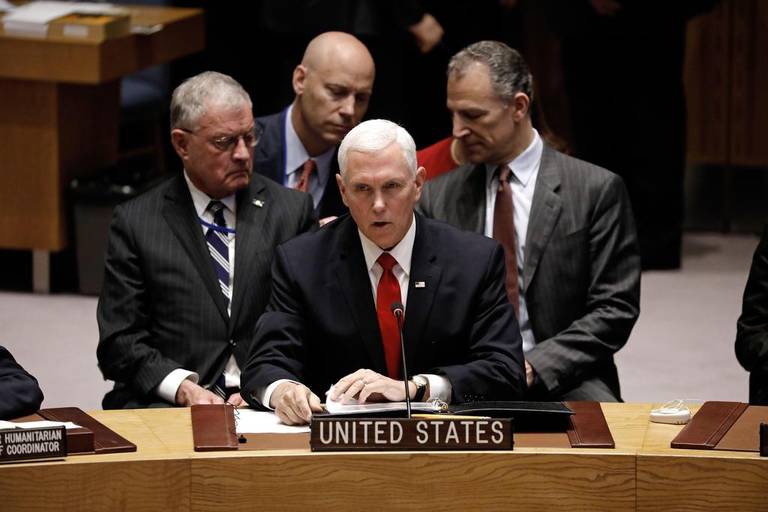
US VP Mike Pence called on the UN to recognize Guaido as Venezuela’s president. (EFE)
By Ricardo Vaz | Venezuelanalysis | April 11, 2019
Caracas – The United States pressured the United Nations to recognize self-proclaimed “Interim President” Juan Guaido during a Security Council (UNSC) meeting on Wednesday.
US Vice President Mike Pence told the UNSC that “the time has come” for the UN to recognize Guaido as Venezuela’s “legitimate president” and accept the latter’s representative to the world body. He added that the US would circulate a resolution to this effect, but offered no details on its timetable. A previous US resolution at the UNSC was vetoed by Russia and China on February 28.
Pence went on to reiterate the warning that “all options are on the table” to oust the Maduro government. “This is our neighborhood,” he told reporters afterward, calling on Russia to cease its support to the Maduro government.
Venezuela’s UN representative, Samuel Moncada, slammed what he called a “clear move to undermine” Venezuela’s rights, adding that his legitimacy depended on UN recognition and not on the declarations of the US vice president.
Russian ambassador Vassily Nebenzia accused the US of causing Venezuela “billions of dollars in losses” as a result of sanctions.
“[The US] deliberately provokes a crisis in Venezuela in order to change a legitimately elected leader for a US protege,” Nebenzia said in his speech.
Chinese representative Liu Jieyi likewise affirmed that Venezuelan affairs should be handled internally and criticized the imposition of sanctions, while his South African counterpart, Jerry Matjila, called for the UNSC to take a “constructive approach.”
Wednesday’s UNSC meeting came on the heels of a session at the Organization of American States (OAS) which approved Guaido’s appointment, Gustavo Tarre, as a representative to the body “until new elections are held.” The proposal had 18 votes in favor, 9 against, six abstentions and one absence.
Venezuelan authorities denounced the move as a violation of international law and of the OAS charter. The Foreign Ministry reiterated that Venezuela is due to leave the OAS on April 27, having started the process two years ago. Caracas denounced meddling in its internal affairs after the OAS had repeatedly tried to apply its democratic charter. However, it never managed to secure the necessary 24 votes.
Diplomatic battles surrounding Guaido’s recognition have extended to the International Monetary Fund (IMF). According to Bloomberg, the IMF cut off Caracas’ access to almost US $400 million in special drawing rights (SDR). While the IMF has shown no signs of recognizing Guaido, and lists Finance Minister Simon Zerpa as Venezuela’s representative, sources told Bloomberg that a government must be recognized by a majority of the Fund’s members to access its SDR reserves.
Venezuela remains mired in a deep economic crisis that has seen its international reserves shrink to around $9 billion. The cash crunch has been further compounded by US and allies freezing Venezuelan assets held abroad. In one such case, the Bank of England has refused to repatriate an estimated $1.2 billion worth of Venezuelan gold held in its vaults.
International tensions have also flared around the issue of humanitarian aid, with US and Venezuelan opposition ultimately failing to force an estimated $20 million worth of aid across the Venezuela-Colombia border on February 23. The operation faced strident criticism from international agencies such as the United Nations and the Red Cross, who refused to take part in the “politicization” of aid.
During Tuesday’s UNSC meeting, UN aid chief Mark Lowcock stated that Venezuela is facing a “very real humanitarian problem” and talked about the need to step up UN efforts in the Caribbean country. UN Secretary General Antonio Guterres later tweeted that the UN estimates there are 7 million people in need of aid in Venezuela, and that the UN is working to increase its assistance “in line with the principles of humanity, neutrality, impartiality and independence.”
UN agencies have increased their work in Venezuela in recent months, most recently via an agreement between Caracas and the UN’s Central Emergency Resource Fund for US $9.2 million to address the health and nutritional impacts of the country’s severe economic crisis. President Maduro has also appealed for UN assistance in countering US sanctions to bring medicines and medical equipment to Venezuela.
Likewise, the International Federation of the Red Cross (IFRC) recently announced a scaling up of its activities in Venezuela, doubling its annual country budget to $60 million as part of an agreement with the Venezuelan government.
Maduro met a Red Cross commission headed by IFRC President Peter Maurer on Tuesday to coordinate the agency’s work in Venezuela. Maurer had previously met Foreign Minister Jorge Arreaza to “strengthen cooperation agreements.”
Over 450 Refugees Left Syria’s Rukban Camp in Past 24 hours – Russian Military
Sputnik – 11.04.2019
MOSCOW – More than 450 refugees have left the Rukban camp in Syria through the humanitarian corridor in the past 24 hours, Maj. Gen. Viktor Kupchishin, head of the Russian centre for Syrian reconciliation, said Thursday.
“A total of 459 refugees left the Rukban camp through provided humanitarian corridor in the past 24 hours”, Kupchishin said at a daily news briefing. The Russian general added that almost 2,300 people have been able to leave the camp and reach the territory controlled by the Syrian authorities since 19 February 2019.
Russia and Syria have repeatedly tried to draw the attention of the international community to the deplorable conditions at the camp, which houses more than 40,000 internally displaced people, mostly women and children. Both Moscow and Damascus have criticized the United States over its reluctance to allow people to leave the camp, which lies in a US-controlled zone near its unauthorized military base in At Tanf.
Russian Ambassador to the UN Vassily Nebenzia said at a meeting of the UN Security Council on Tuesday that Moscow intends to continue negotiations with the United Nations, the United States and Jordan on the Rukban refugee camp.
Nebenzia pointed out that tens of thousands of internally displaced persons in the camp are being kept on “humanitarian drip” in unacceptable conditions and the vast majority of them wishes to leave the settlement and return to their places of origins.
Russia, the ambassador noted, had already opened up two humanitarian corridors to allow the passage of refugees from Rukban to chosen places of residence, including Latakia, Homs, Palmyra, suburban Damascus and Aleppo, among others.
On Sunday, Jordanian Foreign Minister Ayman Safadi said Amman is ready to cooperate both with Russia and the United States in a bilateral and trilateral format in order to reach an agreement on the resettlement of the inhabitants of Rukban camp.
Arab Spring returns home to uncertain welcome
By M. K. BHADRAKUMAR | Indian Punchline | April 12, 2019
The Arab Spring has returned to the Middle East after nearly six years in exile. It was in July 2013 that reversing the tide of democracy in Egypt that swept away the dictatorship of Hosni Mubarak, army chief General Abdel Fattah el-Sisi led a coalition with the backing of Saudi Arabia and the UAE to remove the elected President of Egypt, Mohamed Morsi, from power and suspended the the country’s constitution of 2012.
The Arab Spring never quite recovered from that trauma. There is a nifty aphorism of obscure origin that ‘History does not repeat itself but it often rhymes.’ The return of the Arab Spring to Algeria and Sudan in the recent weeks fits into that description. The similarity with the past lies in the undeniable fact that the Arab Spring is riding the wave of anti-regime protests in both Algeria and Sudan, triggered spontaneously by enormous public hatred of the regimes for their brutal repression, corruption, indifference to poverty and the intolerable conditions of day-to-day life.
In Sudan, the tipping point came four months ago over the government decision to triple the price of bread. In Algeria, the proverbial straw that broke the camel’s back came in February when then President Abdelaziz Bouteflika announced that he would seek a fifth-term in office, whereupon tens of thousands took to the streets.
In the sheer spontaneity of the Arab Spring revolt in Sudan and Algeria, time seemed to stand still since 2013. First in Algeria, after some six weeks of protests, and in Sudan within days, after four months of protests, the dictators got ousted. But in reality, things are never quite the repetition of the past — protests this time around are on a significantly higher scale. Lessons may have been learnt from the tragic example of Egypt where a heroic popular struggle that brought the Muslim Brotherhood and Mohammed Morsi to power ended in the blood-soaked 2013 coup led by General Sisi. The tragic saga of the Arab Spring in Egypt showed that entrenched ruling elites do not relinquish power simply because of militant mass protests.
Thus, both in Algeria and Sudan, there is popular resistance to the all-too-familiar pattern repeating — the army generals stepping in as the apparent saviours to remove the unpopular, detested dictators from power — Algerian President Abdelaziz Bouteflika and Sudanese President Omar al-Bashir — but then, only to usurp power and establish military dictatorships, as had happened in Egypt. In Algeria, the protestors are openly shouting ‘No repeat of the Egyptian scenario.’ In Sudan, the exhortation to the protestors is: ‘Stay put and guard your revolution. To comply with the curfew (imposed by the generals) is to recognise the clone rescue government (led by the army.)’
However, the spectre that is haunting the masses in both Algeria and Sudan is the danger of bloody counterrevolution. Leadership is lacking among protestors and they lack the machinery or cadres to coordinate opposition to military-police repression. Meanwhile, the entrenched elite is co-opting the middle class and trying to lull protestors to sleep with (false) promises of a democratic capitalist future. The military junta in Algeria is promising to convene a constituent assembly to rewrite the constitution, while the counterpart in Sudan has voiced its intention to hold democratic elections in two years.
In Sudan, there is also the added factor of foreign interference. Egyptian President Abdel Fattah el-Sisi openly said this week, “We cannot afford a leadership emerging in … Sudan that tolerates, or even worse condones, militant Islamic activity. This is why … we are keeping a close eye on any possible transition of power in Sudan.” The reference is to the Muslim Brotherhood.
Of course, it is a phoney argument, since the Brothers in Sudan have historically rejected union with the Egyptian branch (forming an alliance instead with the Sudanese Ansar-Ummah political bloc in support of Sudanese independence.) Sisi’s real worry is that if Sudan takes the democratic path, Muslim Brotherhood that has dominated Sudanese politics will surge to take the elected leadership, as had happened in Egypt in 2011, and that would rekindle the clamour for democracy in his country too.
Alex de Waal at the Fletcher School of Law and Diplomacy at Tufts University writing for the BBC assesses that “the cabal (that usurped power in Sudan) is aligned with Egypt, Saudi Arabia and the United Arab Emirates. Meanwhile, Qatar and Turkey have lost out. The new leadership dissolved the ruling National Congress Party and reportedly arrested many veteran Muslim Brothers.”
“They are busy telling Western countries that the Islamists had planned a coup, which needed to be forestalled by the army takeover, and that the protesters demanding democracy are also Muslim Brothers in disguise. It’s not a very convincing story, but it points to future tensions because the Islamists still have a strong following in Sudan.”
Sadly, in the emergent “multipolar world order”, there are hardly any takers for democracy or the Arab Spring — except, arguably, Turkey, Qatar and Iran — especially if it smacks of political Islam The big powers feel cozy with dictatorships. On Wednesday, the US and Britain issued a statement effectively backing the pre-emptive military coup in Sudan. At a meeting with Sisi on April 9 (who was on an official visit to the US at the invitation of President Trump), US Secretary of State Mike Pompeo thanked the dictator “for his leadership in advancing Egypt’s and the region’s security and stability, including through counterterrorism efforts and countering the Iranian regime’s malign influence.”
Featured Video

or go to
Aletho News Archives – Video-Images
From the Archives
The Forgotten Terrorist Pretext of the Vietnam War
By Jim Bovard | The Libertarian Institute | February 16, 2023
Since 9/11, terrorism has become the ultimate entitlement program for America’s political elite. Whether it is illegally spying on Americans or blowing Somali dissidents to pieces, invoking terrorism provides all the cover needed for Washington policymakers. But the disastrous results of granting politicians a blank check to fight terrorism should have been undeniable almost 60 years ago.
Back in the 1960s, terrorism was what the communists did. Anti-terrorist moral fervor and ideological blinders propelled the U.S. into its biggest foreign policy blunder since World War II. … continue
Blog Roll
 Aletho News
- LAPD Pilot Will Track Vehicles In San Fernando Valley
- Britain’s Online Censorship Law Now Comes With a Crisis Plan for Your Posts
- NATO’s “Nordic model” brings Arctic confrontation closer to Russia’s nuclear bases
- Using nuclear weapons, the US-Israeli alliance still can’t beat Iran
- Sunset on the Quality of Western Propaganda: Arrival of the Dr Strangelove Moment
- Ukrainian general accused of protecting crime bosses
- US-‘Israel’ alliance faces growing rupture after midterms
- GOP’s Crushing Midterm Loss Could Reshape US Political Landscape – Analyst
- Midterm loss gives Congress power to rein in US war on Iran
- Midterms Were ‘Vote of No Confidence’ in GOP, But Iran Has No Illusions About Democrats – Marandi
- If Americans Knew
- An error has occurred; the feed is probably down. Try again later.
- No Tricks Zone
- New Study: The Net Fossil Fuel Contribution To Rising Atmospheric CO2 Has Been Zero For 500 Years
- Germany’s Green Energy Transition Becoming Increasingly Expensive…Another 6 Trillion Euros!
- Sudden Stratospheric Warming, Powerful El Niño Combination May Lead To Extreme Europe Cold, Energy Crisis!
- Two New Studies Find Thwaites Glacier Melt Cannot Be Driven By Human Activity Or A Warming Ocean
- E-Cars Reduce CO2 Emissions By Only 41% Compared To Internal Combustion Engine Vehicles
- Predictions Made By Renowned Climate Professor Over Past Decades Have Been Proven To Be Poor
- New Study Suggests Large Regions Of The Pacific Ocean Have Been Cooling For The Last 80 Years
- Germany’s Green Energy Debacle: High Energy Costs Force Kahla Porzellan to Close After 182 Years!
- New Study: 50 Years Of The Most Aggressive ‘Net Zero’ Policies Can Only Affect The Global Climate By 0.03°C
- US September “Heat” Was No Record…Many Records Set Decades Ago

