Like America With Russiagate, India Is Now Obsessed With Pakistangate
By Andrew Korybko | EurasiaFuture | 2019-04-11
The Indo-American Strategic Partnership has rapidly progressed to such a point that the South Asian state is now copying some of the same conspiracy theories as its new patron, though instead of India being obsessed with suspected Russian interference in its elections like America was, its people can’t stop talking about its imaginary Pakistani variant.
Pakistangate
Pakistani Prime Minister Khan made global headlines earlier this week when he said that it might be easier for his country to clinch peace talks with India and resolve the Kashmir Conflict if Modi wins re-election after his country’s month-long electoral process concludes at the end of May. This took many Indians completely off guard who had hitherto been preconditioned by none other than the ruling BJP itself to think that Pakistan was “meddling” in their elections in order to support the opposition Congress party and their coalition allies. The Pakistani leader explained his initially surprising position by rationally noting how it would be less likely that right-wing forces would oppose any BJP-led peace talks unlike the spoiling effect they could have if left-leaning Congress attempted to initiate the same, which makes sense upon further contemplation and is actually a very wise observation.
From -Gate To -Gate
Instead of being interpreted as such, however, India’s “confirmation bias” on all sides caused it to continue cannibalizing itself over the entirely speculative issue of “who Pakistan really supports”, with practically all parties refusing to believe that their neighbor is just sitting on the sidelines watching in awe as the Indian political class tears itself apart over this issue and discredits their claim to being the self-professed “world’s largest democracy”. Interestingly, what’s unfolding in India at the moment with Pakistangate is very similar to what has been taking place in its military-strategic partner over the past couple of years with Russiagate. This suggests that the vassal state is copying some of the same conspiracy theories as its new patron, including the role that elements of its permanent military, intelligence, and diplomatic bureaucracies (“deep state”) are playing in this process.
“Deep State” Meddling
Democratic-friendly elements of the American “deep state” essentially entrapped Carter Page, after which they consequently used this false flag as the pretext for “justifying” a far-reaching FISA surveillance operation against the entire Trump campaign which then sought to exploit its “six degrees of separation” from Russia to concoct a weaponized narrative that ultimately failed to prevent him from winning the election and then later getting him overthrown through a de-facto coup. Something along the same lines happened with the BJP-friendly elements of the Indian “deep state” that “passively facilitated” the Pulwama incident which was later blamed on Pakistan and used as the pretext for “justifying” a so-called “surgical strike” against it that also miserably failed in what it sought out to do, though it nevertheless succeeded in making Indians hysterical about anything to do with Pakistan.
Witch Hunts
The BJP has even gone as far as to imply that all dissidents who disagree with its official version of events are treasonous, which is reminiscent of how the then-ruling Democrats suggested that anyone supporting Trump was either under the influence of “Russian propaganda” or a “Russian bot” if they were expressing their views in cyberspace. Just as Russia became a convenient scapegoat for the pro-incumbent elements of the American “deep state” to centralize their power behind the scenes and meddle in their own country’s elections, so too has Pakistan been abused to serve the same purpose vis-a-vis the pro-incumbent elements of the Indian “deep state”, with both of their permanent bureaucracies presently in the process of merging their narratives into a geopolitically weaponized one ridiculously alleging that Russia and Pakistan are jointly waging “hybrid wars” across the world.
Concluding Thoughts
It therefore shouldn’t be surprising that India’s “deep state” is copying its American counterpart’s Russiagate conspiracy theory and remixing it with a national touch to produce Pakistangate in pursuit of the exact same purpose of remaining in power, though just like with its inspiration, this might ultimately end up backfiring against its practitioners since it’s impossible to control chaotic processes once Pandora’s Box has been opened. In any case and regardless of the eventual electoral outcome, the Indian and American “deep states” will continue to converge into a single unipolar shadow entity dedicated to the shared objective of stopping multipolarity, using the “bonding experience” of their respective manufactured -gate conspiracies to accelerate this ongoing process and ensure that the Indo-American Strategic Partnership is one of the Eastern Hemisphere’s most geopolitically disruptive developments this century.
Turkey Confirms Interest in Russian Su-35, Su-57 If US Denies It the F-35
By Andrei Martyanov | Reminiscence of the Future | April 10, 2019
It is really fascinating to observe the whole process but Turks seem to be in full reactive armor mode and refuse to yield to US pressure on the issue of F-35, which is, by default, the issue of S-400.
Turkey warned on Wednesday that it could buy jets and additional air defense systems from Russia if it cannot get Patriot missile shields and F-35 jets from Washington, raising the prospect of ever deeper defense ties between Moscow and a NATO member.
President Tayyip Erdogan’s existing plans to buy Russian S-400 missile defenses have already alarmed the United States, which says they are not compatible with NATO systems and would compromise the security of F-35 jets Turkey is due to receive.
Washington has offered Ankara both carrot and stick in response, proposing to sell it the Raytheon Co. Patriot systems instead of the S-400s, while at the same time warning of sanctions and a halt in the F-35 fighter jet sales if the Russian deal goes ahead.
Turkey has shown no sign of giving ground and Erdogan, who held talks with President Vladimir Putin in Moscow this week, was quoted on Wednesday as saying the July date for delivery of the first S-400s could even be brought forward.
Foreign Minister Mevlut Cavusoglu also reiterated Turkey’s stance that the S-400 purchase was a done deal and that it would meet its defense needs from elsewhere if necessary.
“If the United States is willing to sell, then we’ll buy Patriots. However, if the United States doesn’t want to sell, we may buy more S-400s or other systems,” Cavusoglu told Turkish broadcaster NTV.
“If the F-35s don’t work out, I will again have to procure the jets I need from elsewhere … There are (Russian) SU-34, SU-57 and others. I will absolutely meet my needs from somewhere until I can produce it myself,” he said.
My main question here is if Turkey knows that F-35 is a…. turkey? I am pretty sure Turks do. Of course, behind all this back-and-forth on S-400 are things much more substantial than even top-notch air defense for Turkey—namely massive economic developments in Eurasia.
It is also obvious that Turks are now in the bargain mode with Russia across the whole spectrum of issues — gas, nuclear power, military, tourism, agriculture, to name a few — and that could be indicative of a tectonic shift in Turkey’s geopolitical orientation but we cannot be sure 100% yet.
On F-35 issue, however, one should not discount the possibility of Turks getting off at the last opportunity from this program in order for a bigger, better thing. This thing are Su-35 of latest modifications and Su-57 which is hitting serial production in 2020 and China expressing interest in this aircraft while already operating full Russian versions of Su-35.
And so the drama is being played out in a front of our very own eyes (and ears). Turkey is getting S-400 (for warm-up), now what will Greece do? Who knows, but implications are enormous for Turkey, NATO and, of course, the United States.
The US knows that this could be bad, very bad but with Trump being surrounded with neocons and Israel having very serious issues with Turkey, who said that the White House will not continue with self-defeating policies in general, and towards Turkey in particular because of Israel— you may see it for yourself.
Most likely Trump and his “court” of Israeli-firsters, aided by US Congress fully corrupted and bought by Israeli lobby, will continue to self-destruct to make Israeli masters feel better, and situation with Turkey is one such example.
So, here is the news of today and for now, at least, it seems the contract will go ahead but, again, knowing that in this region words mean very little we just have to wait to see how it will play out to the very end. Fascinating!
After Decades of Refusing Egypt the F-15, US Demands Cairo Terminates Plans to Acquire Russia’s Su-35
Pompeo threatens Egypt, is looking at CAATSA sanctions
Military Watch | April 9, 2019
In response to Egypt’s plans to modernise its Air Force with acquisition of an estimated two dozen Russian Su-35 ‘4++ generation’ air superiority fighters, the United States has issued a blunt warning that such purchases would result in American economic sanctions against Cairo.
Officials stated regarding the purchase: “In terms of the expanding Russian influence in the region, that’s obviously something which we are quite concerned. We don’t see a lot of material benefits to engagements with the Russians… We just would encourage the Egyptians to turn more toward the West, toward the United States.”
This was closely followed by a statement from State Secretary Mike Pompeo, who said regarding the sale: “We have made clear that systems were to be purchased that… would require sanctions on the regime,” Pompeo told the Senate Committee on Appropriations. “We have received assurances from them, they understand that, and I am very hopeful they will decide not to move forward with that acquisition.”
Egypt has extensively modernised its military capabilities since the coming to power of a new administration in 2013, which overthrew a strongly Western aligned Islamist government that year. The overthrow led the U.S. to freeze arms shipments to the country, which in turn was a considerable factor influencing Cairo to turn away from Washington for future arms purchases.
However, a history of extensive and in the view of many excessive restrictions on American arms sales to Egypt were also reportedly at play in forcing Egypt away from American weapons – in particular jet aircraft.
Israel and the Saudis could buy F-15s, but not the Egyptians
Since abandoning its defence ties to the Soviet Union under President Anwar Sadat in the mid 1970s Egypt has repeatedly sought to acquire high end air superiority fighters – namely the American F-15 Eagle. While these aircraft were sold to Saudi Arabia and Israel in large numbers however, Egypt was restricted to purchasing the cheaper and lighter jets such as the F-16 – ensuring a balance of power which favoured the Western Bloc’s more reliable clients.
Furthermore, Egypt was the only major operator of the F-16 denied modern AIM-120 air to air missiles – meaning its aircraft would face an overwhelming disadvantage in combat with those of any other U.S. client.
Egypt’s move to upgrade its aerial warfare capabilities began with acquisition of the S-300V4 surface to air missile system and 45 MiG-29M medium weight multirole fighters. These were accompanied by purchases of complementary shorter ranged air defence platforms, and advanced long range air to air missiles such as the R-77 and extended range R-27 variants.
With high end heavy air superiority fighters today manufactured only by the United States, Russia and China, of which only the first two offer them for export, it was to be expected that Egypt would turn to Russia for such systems due to the United States’ refusal to provide them.
While the pretext for sanctions against Egypt is that the fighter purchase would provide funds to a U.S. adversary, with the contract estimated at $2 billion, the Su-35 in Egyptian hands also overturns the regional balance of power the United States has for so long succeeded in maintaining.
The fighters are capable of surpassing any other platforms currently deployed in the Middle East or Africa in their air to air combat capabilities, including the advanced Algerian Su-30MKA and Saudi F-15SA, and are also capable of deploying hypersonic R-37M ‘AWACS killer’ missiles.
These platforms retain a 400km engagement range and pose a major threat to support aircraft of Egypt’s potential adversaries such as the America and Saudi Saudi E-3 Sentries or Israeli Eitam AWACS platforms. Ultimately whether Egypt will yield under American pressure remains to be seen, but given its economy’s fragility and heavy reliance on the Western Bloc this remains a considerable possibility.
Who Is Killing Whom in the Middle East? Blaming Iran Might be an Excuse for War
By Philip M. GIRALDI | Strategic Culture Foundation | 11.04.2019
Newsweek is reporting a story regarding how Iran “was responsible for the deaths of at least 608 American troops in Iraq between 2003 and 2011.” The account is sourced to a newly revised estimate prepared by analysts at the Pentagon that was discussed by Special Representative for Iran Brian Hook at a State Department press briefing on April 2nd. According to Hook, Tehran is now being blamed for 17 per cent of all US military deaths because it supplied weapons to the several Shiite militias that were opposing the US invasion, occupation and subsequent presence in the country.
Hook also stated that the American casualties are in addition to the “thousands” of Iraqi troops and civilians that were killed in attacks initiated by what he referred to as the Iranian proxy forces. Hook noted that the new number is higher than the 2015 confirmed death total of 500 that was reported by then Chairman of the Joint Chiefs of Staff General Joseph Dunford, who qualified his estimate by saying “We were not always able to attribute the casualties that we had to Iranian activity, although many times we suspected it was Iranian activity, even though we did not necessarily have the forensics to support that.”
There is little doubt that Tehran provided weapons to Shiite militias in Iraq after the invasion of the country by American forces in April 2003 and the defeat and replacement of the Saddam Hussein regime. The US was occupying the country at the time and Shiites were a repressed majority of the population given the fact that Saddam ruled through his Sunni minority.
The most controversial and lethal weapons used by the Shiite and Sunni resistance to the United States were the Improvised Explosive Devices or IEDs, subsequently also referred to as Explosively Formed Penetrators or EFPs which were capable of penetrating the armor on US military vehicles. They first appeared in Iraq in the summer of 2004, but they were initially mostly used by Sunni insurgents, not by the Shiites.
Now that the US occupation has ended, Iran and Iraq enjoy a close relationship that is based on their common Shiite religion. The former militiamen are now referred to as Popular Mobilization Forces, which were key to the eventual defeat of ISIS. The United States, which retains a major military base inside Iraq, continues to rail against Iran. During the briefing, Hook said “We are imposing costs on the [Iranian] regime for behaving as an outlaw expansionist regime. The regime is weaker today than when we took office two years ago. Its proxies are also weaker. Unless the regime demonstrates a change in policy and behavior, the financial challenges facing Tehran will mount.”
There are several problems with the Hook analysis, if that is actually what it was. The United States government has been arguing since 2005 that Iran is “interfering” in neighboring Iraq, combined with allegations about “they are killing our soldiers” to make sure that Tehran continues to be everyone’s recognizable regional enemy. Specific claims by generals and US politicians were made between 2005 and 2007 regarding Iranian involvement in the production of the shaped charges, which were increasingly exacting a bloody toll of US and allied military personnel.
But the claims being made by the Bush Administration, by Congress, and by the media regarding Iranian support of militants in Iraq had a number of things in common: they were generic and lacking in specificity, they were based on possibly unwarranted assumptions about Iranian interactions with other players in the region, they played fast and loose with statistics, and they seldom provided actual verifiable evidence to back up the assertions being made. One might also point out that nearly all the reports were derivative in that they build on each other to develop credibility, much like the reports about Iraq in 2002.
It has also been noted that the arguments about Iranian involvement are logically inconsistent. The Iraqi insurgency in the period 2004-2006 was largely Sunni. That the Iranians would be supplying the Sunnis or that the Sunnis would even seek such assistance does not appear probable. In an April 2007 briefing Major General William Caldwell explained, “We have, in fact, found some cases recently where Iranian intelligence services have provided to some Sunni insurgent groups some support.” Three uses of “some” in one sentence suggest a degree of uncertainty. Even the relatively tame media at the briefing were skeptical, asking “Do the Iranians support all the militias in Iraq?”
The fact that the EFP is very simple to make also argues against a largely Iranian provenance. The EFP or variations thereof has been around for a long time. It was reportedly used under its old name “shaped charge” by the French resistance against the Germans and by the Irish Republican Army against British armored vehicles and it has been used extensively by both Hezbollah and Hamas against the Israelis.
The case against Iran basically relies on a basic argument that the EFP is actually a sophisticated weapon that has to have its copper disk machined in a weapons shop that is accustomed to milling metal to the finest tolerances. According to those who believe in an Iranian hand in EFP attacks, it is not possible that the weapons are being produced by Iraqis without Iranian assistance but the fact is that the Iraqis are more than capable of making the weapon. Iraq had a large and relatively sophisticated military prior to 2003. It had its own weapons shops and ordnance experts, many of whom were Sunnis and many of whom became unemployed in the spring of 2003 when the army was disbanded.
So Iran’s EFP weapon of choice that, according to the Pentagon, has killed 608 Americans turns out to be not that hard to make and not uniquely Iranian. But the real argument against Brian Hook’s numbers is the assumption made by the government analysts that supplying weapons, even if and when the end user can be demonstrated, makes one responsible for who gets killed as a result. Since the US is the world’s leading arms manufacturer, that argument leads down a slippery slope as “Made in USA.” weapons are likely featured in every conflict.
Also bear in mind that the United States in Iraq was an invading army in what became a guerrilla war in which that country’s civilians ultimately constituted most of the victims. By one estimate, 460,000 Iraqis died, many by US-made ordnance. To cite one other more recent example of what that measure of accountability might mean, the United States could be considered responsible for the deaths of tens of thousands civilians in Yemen, 5,000 in 2018 alone, as the Saudis are using US supplied weapons. And there are a lot of other instances of American made weapons winding up in all kinds of places, including the arsenals of ISIS and al-Qaeda. Al-Qaeda in its war against the Russians in Afghanistan relied largely on American weaponry. Some of those weapons are still being used to kill American rather than Russian soldiers.
Since the United States government is selectively charging Iran with offenses that might well be exploited by neoconservatives named Bolton and Pompeo to initiate a war it should be more careful in how it attempts to frame its arguments. Iran did not kill those 4,424 American soldiers who died in Iraq. President George W. Bush, Vice President Dick Cheney and the band of psychopaths at the Pentagon and National Security Council did that when they initiated a chain of events that began with attacking a country that they knew posed no threat against the United States. The bloody consequences of that action continue to this day.
Egypt pulls out of anti-Iran alliance envisioned by US, allies: Report
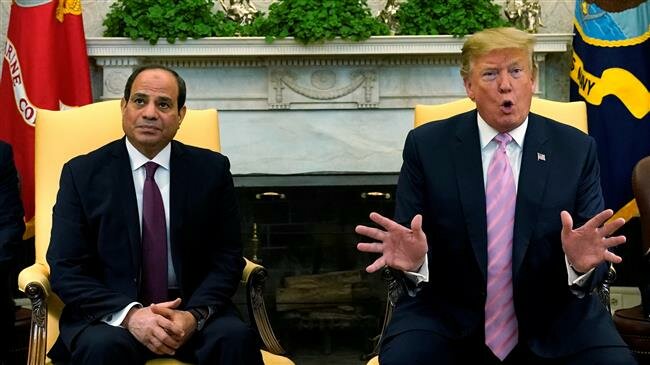
US President Donald Trump meets with his Egyptian counterpart, Abdel Fattah el-Sisi, at the White House in Washington on April 9, 2019. (Photo by Reuters)
Press TV | April 11, 2019
Egypt has reportedly turned its back on a US-led initiative to establish a NATO-style alliance of Arab countries primarily aimed at countering Iran out of concerns that such a coalition could increase tensions with the Islamic Republic, among other reasons.
Four sources familiar with the matter told Reuters on Thursday that Cairo had informed the US and the members of what is to be called the Middle East Strategic Alliance (MESA) of the withdrawal plan ahead of their Sunday’s meeting in the Saudi capital, Riyadh.
One of the sources, speaking on condition of anonymity, said that Egypt had not sent a delegation to the Riyadh event.
An Arab source stressed that Egypt had pulled out of the so-called “Arab NATO” because of its doubts about the seriousness of the proposal as well as the danger that such an Arab front would increase tensions with Tehran.
Other reasons were uncertainty about whether US President Donald Trump will win a second term in 2020 and whether his successor may scrap the initiative to form an anti-Iran alliance, the Arab source added.
Reuters described Cairo’s move as a blow to the Trump administration’s anti-Iran strategy.
A Saudi source also confirmed problems with the plan, saying, “It’s not moving well.”
Meanwhile, two other sources emphasized that the remaining MESA members were moving ahead with the initiative and would press Egypt diplomatically to revoke its withdrawal from the anti-Iran group.
“We all want them back,” said one of the sources.
The Arab source, however, noted that Egypt could not be convinced to return to the so-called “Arab NATO,” which is comprised of Jordan and six Persian Gulf Arab countries, including Saudi Arabia, the United Arab Emirates, Bahrain, Kuwait, Oman and Qatar.
Egyptian officials have not yet commented on the report.
The alliance was first proposed by Saudi Arabia back in 2017 in a bid to counter Iran as well as Russia and China, according to a classified White House document reviewed by Reuters last year.
It has, however, faced several obstacles such as a diplomatic standoff between Qatar and a Saudi-led quartet of countries and the fallout of the state-sponsored killing of dissident Saudi journalist Jamal Khashoggi.
The problems have delayed a summit in the United States, which would feature the signing of a preliminary accord on the anti-Iran alliance.
The report about Cairo’s withdrawal plan came following a meeting between Egyptian President Abdel Fattah el-Sisi and Trump in Washington.
Before the meeting, Trump had said he would exchange views with Sisi on security issues, but it was not clear whether they discussed the MESA issue.
The US and its allies in the Persian Gulf view regional powerhouse Iran as a common “threat.” They constantly accuse the Islamic Republic of “regional interference,” a claim Tehran vehemently rejects.
Trump – who came to office in early 2017 with a highly belligerent anti-Iran agenda – has been pressing its Arab allies to act on the Saudi initiative and move to form the NATO-like military alliance.
In parallel, the US president has also been encouraging the Arabs to step up their attempts towards normalization with the regime in Israel in favor of a coalition against Iran.
In February, a controversial US-organized summit in Warsaw, Poland, brought together Israeli Prime Minister Benjamin Netanyahu and representatives from a number of Arab states, including Oman, Morocco, Saudi Arabia, the United Arab Emirates, Bahrain, Qatar, Jordan, Egypt, Tunisia and Kuwait, among other participants.
On the sidelines of that event, Netanyahu said the Arab countries participating in the Warsaw forum were “sitting down together with Israel in order to advance the common interest of war with Iran.”
Tehran has also repeatedly warned the Persian Gulf littoral states against the US’s divisive policies in the Middle East, saying the planned Arab alliance would merely be a tool for the US to fuel tensions in the region and advance its own agenda there.
Nasrallah Warns: US Moves Will Not Remain Without a Response
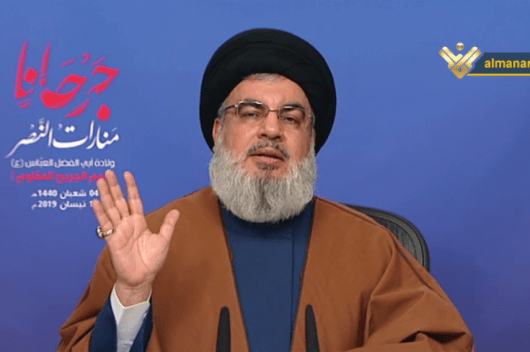
Al-Manar – April 10, 2019
Hezbollah Secretary General Sayyed Hasan Nasrallah stressed that victories achieved in Lebanon are not the result of US and its allies’ tenders, indicating that the US sanctions and measures against Iran and its allies in the region “will not remain without a response.”
In a televised speech commemorating the day of Resistance Wounded Fighters, Sayyed Nasrallah emphasized that the security and peace “we are enjoying were made by our men, women, detainees and wounded, and these terrorists do not have the right to show that they are the ones who gave us stability.”
Sayyed Nasrallah considered that the US is humiliating an entire nation for the sake of terrorist ‘Israel’ and terrorist groups which it’s providing all facilities to.
As he voiced support to the Iranian Revolutionary Guards, His eminence condemned and decried the US decision to classify the IRGC as a “terrorist organization,” saying the US insolence and folly set a precedent. “This decision shows that the US audacity and folly went beyond limits.”
“Blacklisting the IRGC is an evidence that it is strong and not weak and this is an expected move by the Great Satan,” Sayyed Nasrallah said, adding that it was also a proof of the US failure and fiasco in the region.
His eminence dismissed reports about possible sanctions against Speaker Nabih Berri and other Hezbollah allies as “mere intimidation.”
We’ll Respond at the Right Time
The Hezbollah S.G. stressed that the Revolutionary Guards has a great role in defending the peoples of the region and had sacrificed a large number of martyrs and wounded for the sake of people of our region, indicating that it occupies a central, advanced, and the most influential place regionally.
“Until now we have only settled with condemnation, denouncement, patience, and managing the situation calmly in the face of sanctions and terror lists, but our patience does not mean that we, the axis of resistance, do not have the cards of strength,” Hezbollah’s S.G. warned, indicating that options remain open.
“It seems that the US blacklists will be prolonged. Our choices are open but we will act calmly, with a cool head and at the right time, in all battlefields and arenas,” Sayyed Nasrallah said. It is our natural right and ethical, religious and humanitarian duty to confront all those who might threaten our country, resistance and achievements through their sanctions and measures, he added.
Sayyed Nasrallah expressed his solidarity and support to the Iranian people who have been plagued by floods which hit Iranian areas. He said that Trump, who is bragging about humanitarianism, is blocking aid for Iranians suffering from the hurricane, expressing gratitude to all humanitarian efforts to collect aid to flood victims in Iran.
Yemen’s Steadfastness Protects the Palestinian Cause
Regarding the war on Yemen, His Eminence pointed out that four years have passed on the war and no one sees that the unarmed and oppressed people who are still steadfast and growing stronger are still fighting armies, pointing out that the war on Yemen is an American-Saudi-British-Israeli aggression.
Sayyed Nasrallah said that had Bin Salman won in Yemen war, he would have forced the Palestinians to sign on the deal of the century, stressing that Yemeni’s steadfastness throughout these years have protected the Palestinians. “What would have happened to Gulf countries and leaderships had the authoritarian Bin Salman won the war on Yemen?” he wondered, “he would have been presented as the great historical leader and victory will be presented in a misleading way.”
The Hezbollah leader indicated that there was an American insistence by Trump personally to continue the war on Yemen, pointing out that the steadfastness of the Yemeni people protects the Palestinian cause and Palestine and every occupied Arab land.
US Move to Blacklist Hezbollah Allies a Scarecrow
Sayyed Nasrallah briefly addressed the internal situation. He criticized what he called the US provocative policy of instigating strife in Lebanon, pointing out that it was continuing despite the failure of Pompeo’s recent visit.
He pointed that it was surprising that some Lebanese in Washington were working on blacklisting Hezbollah’s allies and friends in Lebanon. “The US move of blacklisting Hezbollah allies in Lebanon is just a scarecrow till now. There is not a single indication about an intention to place Nabih Berri and other allies on the terror list and we sense that there are Lebanese in Washington who are working in this direction, but so far this remains an intimidation campaign. When the matter reaches our allies, this means that they are targeting all our people.”
Unity, Resistance Only Way for a Free Lebanon
As for Lebanese concerns that Trump’s decision on the Golan Heights might affect the status of the Shebaa Farms and the Kfarshouba Hills, Sayyed Nasrallah said: “Our territorial border is linked to our national will and not to Trump’s decision.”
“We were killed and wounded and massacres were committed in our villages and cities through Israel’s aggression and the US support. Our peace, security and achievements were made by our people, martyrs and wounded. The achievements that were made in Lebanon are not from the blessings of America.”
Sayyed Nasrallah stressed the importance of the current spirit of cooperation among the political forces in addressing the current situation regardless of any tensions here or there. “Lebanese should choose between keeping Lebanon in the safe zone or responding to those who are leading it towards sedition,” Sayyed Nasrallah said, adding that the only way for keeping Lebanon free, sovereign and stable is through unity and resistance.
“I voice my support to Speaker Nabih Berri who has repented in Doha in front of the world’s parliamentarians to say the truth with a loud voice and show everyone the path of salvation: unity and resistance,” his eminence said.
Sayyed Nasrallah began his speech by hailing all wounded fighters who suffered and sacrificed themselves for the sake of this nation, saying: “thanks to your sacrifices, we are enjoying victories, security and the power of deterrence. The enemy doesn’t dare to wage any war because of your wounds and sacrifices.”
He said there was no place for neutrality in the battle of truth and in defending the oppressed.
Throughout his speech, Sayyed Nasrallah recalled the martyrdom anniversary of Sayyed Mohammad Baqer Al-Sadr and his sister, and hailed his enormous intellectual achievements.
Russiagate-pushing Democrats call AG Barr’s ‘spying’ claim conspiracy theory

Senate Minority Leader Chuck Schumer (D-New York) © Reuters / Joshua Roberts
RT | April 10, 2019
The very same congressional Democrats who maintain ‘Russiagate’ was real are denouncing Attorney General William Barr’s claim there was improper surveillance of the Trump campaign as a conspiracy theory.
Senate Minority Leader Chuck Schumer (D-New York) demanded of Barr to retract his statement, made earlier on Wednesday, that “spying did occur” during the 2016 presidential campaign. Barr “must retract his statement immediately or produce specific evidence to back it up. Perpetuating conspiracy theories is beneath the office of the Attorney General,” Schumer tweeted.
House Democrats were also pushing the “conspiracy theory” talking point on Wednesday, with Judiciary Committee chair Jerry Nadler (D-New York) contrasting it to what he said was fact of Russiagate, and Intelligence Committee chair Adam Schiff (D-California) calling it “another destructive blow to our democratic institutions.”
Though he was supposed to testify about the Department of Justice’s 2020 budget, Barr found himself answering questions about the report by Special Counsel Robert Mueller, which he said showed no evidence of collusion between the Trump campaign and Russia. Unwilling to give up the conspiracy theory they’ve pushed for almost three years, Democrats are demanding Barr release the full, unredacted Mueller report.
“I don’t trust Barr, I trust Mueller,” Speaker of the House Nancy Pelosi (D-California) told AP.
“He is acting as an employee of the president,” said House Majority Leader Steny Hoyer (D-Maryland). “I believe the Attorney General believes he needs to protect the president of the United States.”
Barr raised alarms among the Democrats when he told the Senate Appropriations Subcommittee meeting that he believed “spying” – which he later rephrased as “inappropriate surveillance” – into the Trump campaign did take place, and that he intended to investigate that fully.
“I am not saying that improper surveillance occurred; I’m saying that I am concerned about it and looking into it, that’s all.”
Earlier in the day, President Donald Trump had described the Mueller investigation – and its FBI predecessor – as an “attempted coup,” saying it was based on the uncorroborated ‘Steele Dossier.’ The dossier was produced by a former British spy for a US-based opposition research firm on contract to the Hillary Clinton campaign.
It has been confirmed, however, that the Trump campaign was subjected to FBI surveillance – via former adviser Carter Page – under a FISA warrant secured in October 2016. The warrant application relied largely on the Steele dossier, according to the House Republican memo made public in February 2018. Subsequent revelations have only reinforced the memo’s conclusions.
In September 2018, Trump ordered all documents pertaining to the Page FISA application to be declassified and made public – only to relent within days due to complaints by unnamed “allies” who feared they might get burned by the revelations. The documents remain classified to this day.
See Also:
‘Spying did occur’ by intelligence agencies on Trump campaign – AG Barr
Unaccountable Media Faced with Dilemma in Next Phase of Deep State-gate
By Ray McGovern | Consortium News | April 10, 2019
Readers of The Washington Post on Monday were treated to more of the same from editorial page chief Fred Hiatt. Hiatt, who won his spurs by promoting misleading “intelligence” about weapons of mass destruction in Iraq and suffered no consequences, is at it again.
This time he is trying to adjust to the fading prospect of a Deus ex Mueller to lessen Hiatt’s disgrace for being among the most shameless in promoting the Trump-Russia collusion narrative.
He is not giving up. When you are confident you will not lose your job so long as you adhere to the agenda of the growing Military-Industrial-Congressional-Intelligence-Media-Academia-Think-Tank complex (MICIMATT if you will), you need not worry about being a vanguard for the corporate media. It is almost as though Hiatt is a tenured professor in an endowed chair honoring Judith Miller, the New York Times reporter who perhaps did most to bring us Iraqi WMD.
In his Monday column Hiatt warned: “Trump was elected with the assistance of Russian spies and trolls, which he openly sought and celebrated. But he did not (or so we are told) secretly conspire with them.” In effect, Hiatt is saying, soto voce: “Fie on former (now-de-canonized) Saint Robert of Mueller; we at the Post and our colleagues at The New York Times, CNN et al. know better, just because we’ve been saying so for more than two years.”
Times executive editor Dean Baquet said, about the backlash to the Times‘ “collusion” coverage: “I have no regrets. It’s not our job to determine whether or not there was illegality.” CNN President Jeff Zucker said: “We are not investigators. We are journalists.” (One wonders what investigative journalist Bob Parry, who uncovered much of Iran-Contra and founded this site, would have thought of that last one.)
Going in Circles
Hiatt’s circular reasoning is all too familiar. It is the kind a former director of national intelligence excels at when he’s not lying, sometimes under oath. For instance, James Clapper was hawking his memoir at the Carnegie Endowment last year when he was confronted by unexpectedly direct questions from the audience.
Asked about the misleadingly labeled, rump “Intelligence Community Assessment” (ICA) of Jan. 6, 2017, which he orchestrated, and which blamed Russia for interfering in the 2016 election, Clapper gave an ipse dixit response: The ICA simply had to be correct because that’s what he had told President Barack Obama and President-elect Donald Trump.
In fact, that “Intelligence Community Assessment” stands out as the most irresponsible, evidence-free and at the same time consequential crock of intelligence analysis since the National Intelligence Estimate of Oct. 2001 claimed there was WMD in Iraq. Recall that that one was shaped by out-and-out fraudulent intelligence to “justify” an attack on Iraq six months later.
Sen. Jay Rockefeller (D-WV), as chair of the Senate Intelligence Committee, described the main thrust of the committee’s five-year bipartisan report, stating, “In making the case for war, the [Bush] Administration repeatedly presented intelligence as fact when in reality it was unsubstantiated, contradicted, or even non-existent.”
Hiatt was one of the media’s major offenders, feeding on what the Cheney/Bush folks told him. When no “weapons of mass destruction” were found in Iraq, Hiatt conceded during an interview with The Columbia Journalism Review that, “If you look at the editorials we write running up [to the war], we state as flat fact that he [Saddam Hussein] has weapons of mass destruction … If that’s not true, it would have been better not to say it.” [CJR, March/April 2004] As Parry wryly observed at the time in a piece calling for Hiatt’s dismissal, “Yes, that is a common principle of journalism, that if something isn’t real, we’re not supposed to confidently declare that it is.”
The Morning After
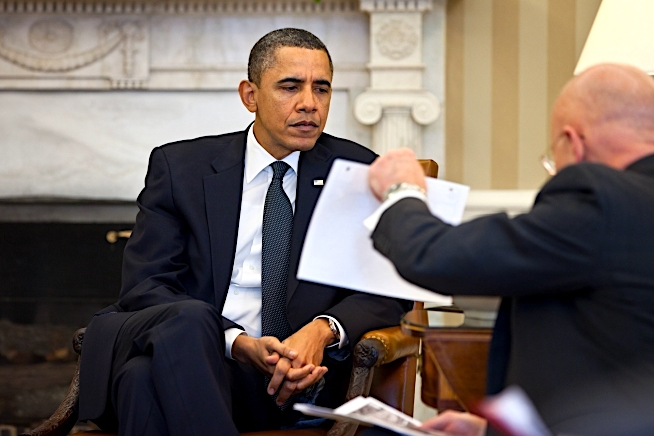
Clapper: After WMD failure, promoted by Obama. (White House Photo/ Pete Souza)
The media set the prevailing tone the day after the ICA was published. The banner headline atop page one of the Times read: “Putin Led Scheme to Aid Trump, Report Says.” That put in motion more than two years of Dick Cheney-like chicanery in the media.
Buried inside the Times that same day was a cautionary paragraph written by staff reporter Scott Shane who noted, “What is missing from the public report is what many Americans most eagerly anticipated: hard evidence to back up the [three] agencies’ claims that the Russian government engineered the election attack. That is a significant omission.” Indeed it was; and remains so.
(Sadly, Shane was then given his marching orders and fell in line with many other formerly reputable journalists in what has been the most miserable performance by the mainstream media since they helped pave the way for war on Iraq.)
Clapper and Hiatt are kindred souls when it comes to the “profound effect” of Russian election interference. In his column, Hiatt asserted as flat fact that: “Trump was elected with the assistance of Russian spies and trolls …” At the Carnegie event in November, Clapper opined:
“As a private citizen, understanding the magnitude of what the Russians did and the number of citizens in our country they reached and the different mechanisms that, by which they reached them, to me it stretches credulity to think they didn’t have a profound impact on election on the outcome of the election.”
Hiatt: Captain of Cheerleaders
Hiatt emulated peppy, preppy cheerleader George W. Bush in leading Americans to believe that war on Iraq was necessary. Appointed Washington Post editorial page editor in 2000, he still runs the page — having not been held accountable for gross misfeasance, if not malfeasance, on Iraq. Shades of Clapper, whom President Obama allowed to stay on as director of national intelligence for three and a half years after Clapper lied under oath to the Senate Intelligence Committee about NSA surveillance of U.S. persons.
That Obama appointed Clapper to lead the investigation into Russian interference in the 2016 election speaks volumes. Clapper claims to have expertise on Russia and has made no effort to disguise his views on “the Russians.” Two years ago, he told Chuck Todd on Meet the Press:
“… in context with everything else we knew the Russians were doing to interfere with the election, and just the historical practices of the Russians, who are typically, almost genetically driven to co-opt, penetrate, gain favor, whatever, which is a typical Russian technique … we were concerned.”
It beggars belief that Obama could have been unaware of Clapper’s bizarre views on “the Russians.” Clearly, Obama was bowing yet again to pressure from powerful Deep State actors arguing that Clapper was the ideal man for the job.
And there is now documentary evidence that, from the Deep State point of view, indeed he was. In the text exchanges between discredited FBI sleuth Peter Strzok and his girlfriend, Lisa Page, a lawyer working for the FBI Deputy Director Andrew McCabe, it seems clear that Obama wanted to be kept apprised of the FBI’s behind-the-scenes machinations. In a Sept. 2, 2016 text to Strzok, Page writes that she was preparing talking points because the president “wants to know everything we’re doing.”
A Sweaty Pate?
Clapper is aware now that he is going to have to sweat it out. He may believe he can ignore White House press secretary Sarah Sanders, who has said that he and other former intelligence officials should be investigated after special counsel Mueller did not establish collusion between the Trump campaign and Russia.
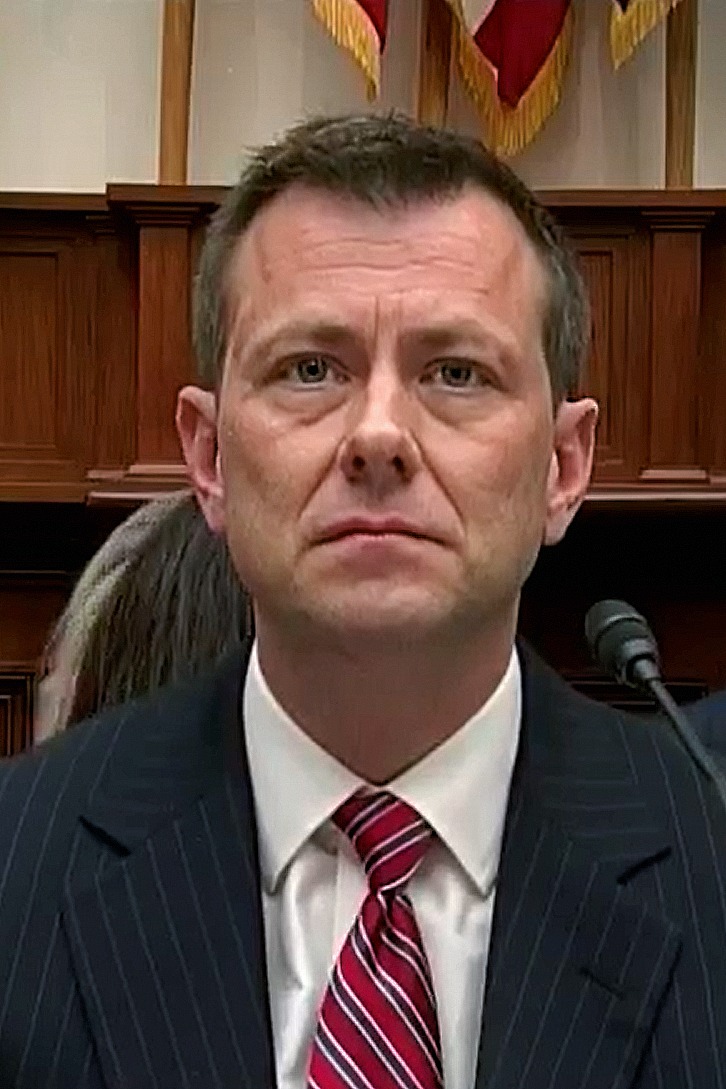
Strzok: Will he be on Nunes’s list? (Wikipedia)
But recent statements by members of the House and Senate intelligence committees cannot be dismissed so easily. In his media appearances, the supremely confident, hero-of-many-liberals Clapper has been replaced by a squirming (but-Obama-made-me-do-it) massager of facts. He may find it harder this time to avoid being held accountable.
Devin Nunes (R-CA), the House Intelligence Committee ranking member, has gone on the offensive, writing Friday that committee Republicans “will soon be submitting criminal referrals on numerous individuals involved … in the abuse of intelligence for political purposes. These people must be held to account to prevent similar abuses from occurring in the future.”
On Sunday, Nunes told Fox News he’s preparing to send eight criminal referrals to the Department of Justice this week concerning alleged misconduct during the Trump-Russia investigation. This will include leaks of “highly classified material” and conspiracies to lie to Congress and the Foreign Intelligence Surveillance Act (FISA) court. It’s no-holds-barred for Nunes, who has begun to talk publicly about prison for those whom DOJ might indict and bring to trial.
Nunes’s full-speed-ahead offensive is being widely ignored in “mainstream” media (with the exception of Fox), giving the media the quality of “The Dog That Did Not Bark in the Night.” The media has put its ducks in a row, such as they are, to try to rip Attorney General William Barr apart this coming week when he releases the redacted text of the Mueller report that so disappointed the Democratic Party/media coalition.
But how will they cover criminal referrals of the “heroes” who have leaked so much to them, providing grist for their Russia-gate mill? They will likely find a way, eventually, but the media silence about Nunes is depriving oxygen to the story.
On Sunday, Nunes said,
“They [the Democrats] have lied multiple times to the American people. All you have to do is look at their phony memos. They have had the full support of the media, 90 percent of the media in this country. They all have egg on their face. And so the fact of the matter remains, is there going to be — is justice going to be served or is justice going to be denied? And that’s why we’re sending over these criminal referrals.”
Nunes is, of course, trying to project an image of confidence, but he knows he is fighting uphill. There is no more formidable foe than the MICIMATT, with the media playing the crucial role in these circumstances. How will the American people be able to see egg on anyone’s face if the “mainstream media” find ways to wipe it off and turn the tables on Nunes, as they have successfully done in the past?
Though the Democrats now control the House, they have lost some key inside-the-Deep-State allies.
By all appearances, House Democrats still seem to be banking on help from the usual suspects still on duty in the FBI, CIA, and the Justice Department. Lacking that they seem ready to go down with the Schiff—Rep. Adam Schiff of California, perhaps the most virulent Russia-gater that there’s been.
Clapper is no longer in a position to help from the inside, and there’s no knowing how his sleepy replacement, Dan Coates, will react, if and when he wakes up long enough to learn chapter and verse about the machinations and dramatic personae of 2016.
Of course, there is a new sheriff in town running the Department of Justice. Attorney General William Barr, for better or ill, is a far cry from Jeff Sessions, who let himself be diddled into recusing himself. He’s not Rod Rosenstein either, whose involvement in this affair may have already earned him a prominent place on Nunes’s list of referrals.
What Did Obama Know, and When Did He Know It?
On top of this, Sen. Rand Paul (R, KY) has called for an investigation into the origins of Mueller’s probe, including on the dicey question of how witting President Obama was of the Deep State chicanery during the last months of his administration. Page did tell Strzok in that Sept. 2, 2016 text that the president “wants to know everything we’re doing.”
Sen. Paul has also tweeted information from “a high-level source” that it was former CIA Director John Brennan who “insisted that the unverified and fake Steele dossier be included in the Intelligence Report… Brennan should be asked to testify under oath in Congress ASAP.”
Vying for Media Attention
If, as expected, Nunes discloses the names of those being criminally referred to DOJ, and Barr releases a redacted text of the Mueller report, the “mainstream” media will have a fresh challenge on their hands. The odds would seem to favor the media covering the Democrats’ predictable criticism of Barr — and perhaps even of Mueller, now that he has been defrocked.
The Post’s Hiatt should be counted on, as always, to play a leading role.
At the same time, there are signs the America people are tired of this. It would be difficult though for the media to avoid reporting on criminal referrals of very senior law enforcement and intelligence officials. Given the media’s obvious preference for siding with the intelligence agencies and reporting on Russia-gate rather than Deep-State-gate, it would be even harder for the media to explain why these officials would be in trouble.
Things appear to be unraveling but, as always, much will depend on whether the media opts to remain the “dog that didn’t bark,” and succeeds again in hoodwinking too many people.
Ray McGovern works with Tell the Word, a publishing arm of the ecumenical Church of the Saviour in inner-city Washington. He was a CIA analyst for 27 years and prepared the President’s Daily Brief for Presidents Nixon, Ford, and Reagan. He is on the Steering Group of Veteran Intelligence Professionals for Sanity (VIPS).
Don’t expect US-Iran war before 2021
By M. K. BHADRAKUMAR | Indian Punchline | April 10, 2019
There is no reason to disbelieve the boast by Israeli Prime Minister Benjamin Netanyahu claiming credit personally for US President Donald Trump’s decision to designate Iran’s elite Islamic Revolutionary Guards (IRGC) as a “foreign terrorist organisation” under American law. It is common knowledge that all major decisions and most minor decisions by Trump regarding the West Asian situation are dictated by Israel’s interests.
Deep-pocketed Jewish billionaires such as Sheldon and Miriam Adelson, far-right Christian evangelicals and the well-known Israeli lobby wield enormous influence over Trump whose son-in-law Jared Kushner is also known to be an ardent Zionist who has funded West Bank settlements. Both decisions by Trump in recent weeks — granting US recognition to the illegal Israeli annexation of Syria’s Golan Heights region as well as yesterday’s move against Iran’s IRGC — are to be seen as motivated by the desire to bolster Netanyahu’s campaign seeking a fresh term in Israel’s parliamentary election on April 9.
The Pentagon and the State Department had reportedly expressed misgivings over Trump’s decision branding IRGC as a terrorist organisation. Indeed, Trump’s announcement on April 8 says clearly that the US state department will take the lead role in implementing this decision. Trump avoided voicing any intention to confronting the IRGC militarily and instead underscored his decision is to impose economic sanctions against the Iranian security organisation.
Considering that the IRGC has a long reach in the economic arena, especially in vital sectors such as energy, telecommunications, etc., in effect, Trump’s decision amounts to an extension of the US sanctions against Iran. Therefore, as Trump put it, the decision becomes a template of his “maximum pressure” strategy against Iran, which has been under implementation.
Tehran’s reaction has been surprisingly restrained under the circumstances. To be sure, Tehran has retaliated by naming the US Central Command (which is headquartered in Doha and covers the so-called Greater Middle East stretching from the Levant to Central Asia) as a terrorist organisation. Interestingly, Iranian reports highlighted that it is a “tit-for-tat” measure — that is, a move Iran had no choice but to make. The overall mood is one of resignation that the Trump administration is under the Israeli spell and has taken a step that is not exactly in American interests.
There have been no threatening statements from Tehran directed at the US, either. In a highly nuanced remark, the influential chairman of the National Security and Foreign Policy Commission of the Iranian Parliament, Heshmatollah Falahatpisheh hastened to clarify that Iran’s measures against the US Central Command, in response to US anti-IRGC move, is defensive, not a declaration of war.
Again, Iran’s powerful Supreme National Security Council, which is the apex executive body on foreign and security policies, has also restricted itself to saying in a statement, “Undoubtedly, the US regime will bear all the responsibilities for the dangerous consequences of its adventurist move.” This must be noted carefully as a signal to the US defence and security establishment.
Most important, Iran’s Supreme Leader Ayatollah Ali Khamenei estimated Trump’s move as only to be expected, given the IRGC’s pivotal role in countering Iran’s enemies. He said the US move will fall flat. The head of Iran’s Revolutionary Guards, Gen. Mohammad Ali Jafari was quoted as saying, “This U.S. move was quite laughable since the Revolutionary Guards are in people’s hearts … The Revolutionary Guards will increase its defensive and offensive capabilities in coming year.”
On the political plane, however, Tehran will step up its “resistance”. More Iranian support for Hamas can be expected. Similarly, the US move, coming hot on the heels of recognising the Israeli occupation of the Golan Heights, will only further further consolidate the “resistance”. The known unknown is going to be the impact on Afghanistan. Tehran has links with the Taliban. But it has been voicing strong backing for President Ashraf Ghani’s insistence that the peace talks should be “Afghan-led, Afghan-controlled.” Iran’s overriding concern is the stability of Afghanistan and the welfare of the Shi’ite communities. Conceivably, the US must be factoring in the imperative need to discourage Iran from playing a spoiler role in Afghanistan.
Among the Iranian security agencies, it is the IRGC that is in the driver’s seat in steering policies in Syria, Iraq and Afghanistan. The point is, the US Central Command and the IRGC (plus various Iran-backed militia forces) “co-habitate” these theatres. It is inconceivable that the US would precipitate any hostile moves against the IRGC that draw forth retaliation and jeopardise the safety and security of American personnel. Iran has the capacity to infect pain and give sleepless nights to the US personnel deployed under the Central Command and, to be sure, the Pentagon and the CIA are well aware of that.
We may, therefore, expect a tacit understanding by the two antagonistic parties to stay out of each other’s path. Of course, that is easier said than done, since these are high kinetic theatres witnessing acute confrontation. But then, the US-Iran tango has a 40-year history of shadow boxing.
Some shrill rhetoric can be expected from the US side, especially from US secretary of state Mike Pompeo and National Security Advisor John Bolton. Both are stridently “anti-Iran”. Bolton had been in the payroll of Iranian dissident groups based in the West. Both Pompeo and Bolton are passionately devoted to serving Israeli interests. But, in the final analysis, it is Trump — and Trump alone — who matters.
Quite obviously, Trump will be extremely wary of getting into a shooting war with Iran. Trump knows only too well that a war with Iran will have regional ramifications and can hurt his presidency. His game plan through this year and the next will be to ensure that his “maximum pressure” strategy deters Iran from causing any serious political embarrassment during his campaign, which is due to start later this year, for his re-election bid in 2020.
Suffice to say, Trump’s IRGC designation is unlikely to lead to any shooting war with Iran — till end-2020, at least. Having said that, there will be no let-up in Tehran’s pursuit of “resistance” in Syria and Iraq. And, given the pivotal role of the IRGC in Iran’s foreign and security policies, any form of direct engagement politically or at the diplomatic level between Washington and Tehran can be ruled out. Having said that, make no mistake that the US’ regional strategies in Syria and Iraq will come under severe challenge. To be sure, a strategic stalemate is Israel’s objective too as the guarantee against US retrenchment from the Middle East.
Putin Derangement Syndrome After Mueller
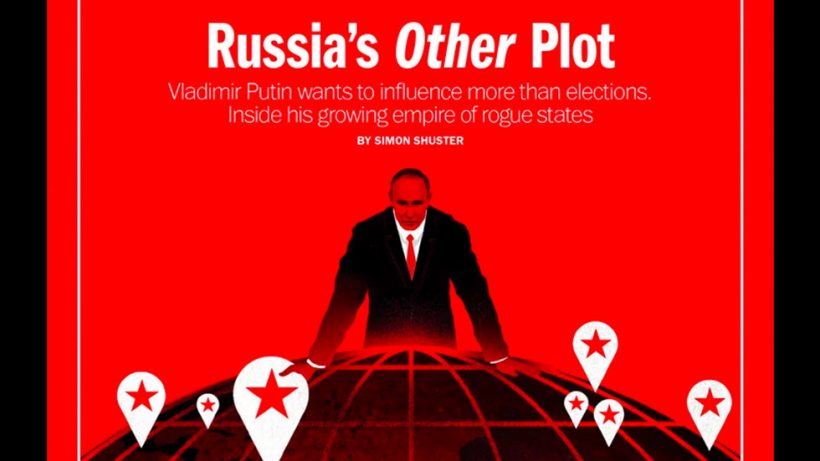
© Time Magazine
By Patrick ARMSTRONG | Strategic Culture Foundation | 09.04.2019
The West – its governments and its governments’ scribes – are obsessed with Russian President Vladimir Putin. “Obsessed” is probably too weak a word to describe the years of impassioned coverage, airy speculation and downright nonsense. He is the world’s leading cover boy: military hats, Lenin poses, imperial crowns, scary red eyes, strait-jackets, clown hats; anything and everything. He’s the avatar of Stalin, he’s the avatar of the Tsars, he’s the Joker, he’s Cthulhu, he’s Voldemort, he’s Satan. He’s the palimpsest for the New World Order’s nightmares. Putin is always messing with our minds. He weaponises information, misinformation and sexual assault accusations. Childrens’ cartoons, fishsticks, Pokemon and Yellow Vests, “Putin’s warships” are lurking when they aren’t stalking; “Putin’s warplanes” penetrate European airspace; “Putin’s tanks”, massing in 2016, massing in 2018, still massing. His empire of rogue states grows. All Putin, all the time.
In an especially imbecilic display in 2015, Western reporters (unable to find his website) thinking he hadn’t been seen for several days started a contest of speculation about coups, death, wars, plastic surgery, secret births and other nonsense; when he “re-appeared”, the story went down the Memory Hole.
For some reason, Americans personalise everything. In meetings with US intelligence agencies I was always fascinated how they would reduce every complicated reality to a single individual. But it isn’t Saddam, or Assad, or Qaddafi, or Osama, or Aidid, or Milosevic, or Maduro, or Castro or any of the other villains-of-the-day, it’s a whole country: these people got to the top for good reasons. Removing the boss makes some difference but never all the difference. They go but they never leave a Washington-friendly country behind and Washington does it all over again somewhere else. This peculiar blindness drives Putin Derangement Syndrome and has infected everybody else.
But Putin is much worse than the others. The other enemies had relatively weak countries but Russia could obliterate the USA. But worse, Putin’s team has steadily become more powerful and more influential. And worst of all, he’s still there: huffing and puffing has not blown him down, sanctions strengthen the economy and there is nothing to suggest he won’t be succeeded by someone who carries on the same policies. It’s a whole country, not just one man.
Vladimir Putin is the biggest man on earth.
Except that he’s short and can’t hide it. He’s a megalomaniac because he’s short; he’s trying to prove his bigness; napoleon complex says some shrink. Just another in a long list of crackpot “expert” opinions. From a list I complied in 2015: Asperger’s Syndrome, cancer of the spinal cord, personality disorders, gayness, Parkinson’s Disease, psychopath, people don’t like him so animals have to, sinister, lonely life, fears his own people, envious of Obama. Remember the “gunslinger walk”? Oh, in case you hadn’t heard, he was in the KGB and that explains everything: “Once a KGB man, always a KGB man”. Nothing is too absurd.
But laughing has passed – Putin Derangement Syndrome has become dangerous.
In 2016 Hillary Clinton lost a sure-fire election to Donald Trump and, looking for an excuse, jumped on the Russia claim. Putin Derangement Syndrome was ramped up to a much more dangerous level. War-level dangerous.
A popular actor made a video to tell us we were at war. “Warfare” says Haley, “act of war” said John McCain, could be says Cheney, 911 says Clinton, disappointed CIA guy agrees, Pearl Harbor says Nadler. Diplomatic expulsions and sanctions and more sanctions. These are much more serious than gassy op-eds about Putin’s gait or fish weights, these are actions: actions have consequences. Moscow doesn’t find war talk very funny.
Clinton’s victory was 99% certain until it wasn’t and excuses were needed. Clinton went through a lot of them but “Russian interference” was always the big one.
That strategy had been set within twenty-four hours of her concession speech. [9 November 2016] Mook and Podesta assembled her communications team at the Brooklyn headquarters to engineer the case that the election wasn’t entirely on the up-and-up. For a couple of hours, with Shake Shack containers littering the room, they went over the script they would pitch to the press and the public. Already, Russian hacking was the centerpiece of the argument. (From Shattered, quoted here.)
In What Happened, Clinton also says Russian President Vladimir Putin’s support for Trump was driven by his own anti-women sentiment, stacking the deck against her: “What Putin wanted to do was… influence our election, and he’s not exactly fond of strong women, so you add that together and that’s pretty much what it means.” At press events for her memoir, Clinton continues to warn Americans against Russia’s power over Trump and the country. “The Russians aren’t done. This is an ongoing threat, and that is one of the reasons why I wrote the book and one of the reasons I’m talking about it,” she said on Sunday at Southbank Centre’s London Literature Festival. (Newsweek)
Her claim is, to put it mildly, unproven; the so-called “all 17 agencies” report notwithstanding. (The first premise that it was hacked is here disproved: downloaded by someone in the building). Her accusation moved Putin Derangement Syndrome away from the realm of mere craziness into war talk. Taking the hint, Western politicians, under attack for their lacklustre performances, were happy to push the blame onto Putin. He’s attacking democracy! Western media weighed in until it became completely accepted by some people that anything that spoiled the happy complacency of the Western world must be a result of Putin’s interference: gilets jaunes, “assistance provided to far-right and anti-establishment parties”, he’s the poster boy of the dreaded populism, his populist tentacles reach Hungary and Italy. And the next thing we knew, Putin was mucking around in everybody’s votes: Brexit; Catalonia; Netherlands; Germany; Sweden; Italy; EU in particular and Europe in general; Mexico; Canada. Newsweek gives a helpful list. Sometimes he loses elections: Germany, Ukraine but he goes on, unstopping. But his greatest triumph was said to have been in the US election: he “won” because Donald Trump was his willing puppet.
(None of these “experts” ever seem to wonder why Putin’s influence, so decisive far away, is so ineffective in Ukraine or Georgia. But then, it’s not actually a rational, fact-based belief, is it?)
The entire ramshackle construction is collapsing: if Mueller says there was no collusion then even the last ditch believers will have to accept it: Robert Mueller Prayer Candles are out of stock, time to toss the other tchotchkes, it wasn’t a Mueller Christmas after all. Clinton’s fabrication had two parts to it: 1) Putin interfered/determined the election 2) in collusion with Trump. When the second part is blown up, so must the first be. And then what will happen to all the loyal little allies crying “ours were interfered with too”!? The two halves of the story had the same authors and the same purpose: if one dies, so must the other. Now that Trump is secured from the obstruction charges that hung there as long as Mueller was in session, he is free to declassify the background documents that will show the origin, mechanics, authors and extent of the conspiracy. And he has said he will. In the process, both halves of the story will be destroyed: they’re both lies.
(For those who now realise there is something they have to catch up on: Conrad Black has a good exposition of the overall conspiracy and here is a quick round-up of the mechanics of the conspiracy. This may show its very beginning, three years ago).
Will the exposure of the plot and the plotters end the war-talk stage of Putin Derangement Syndrome? In a rational world, it would (but can its believers be embarrassed by the exposure of their credulity? Can they be made to think it all over again from the beginning?). It is true that Russia stands in the way of the neocons and liberal interventionists who have been guiding Washington this century, but that hardly means that Putin is the enemy of the American people. Because, properly considered, it’s the neocons/liberal interventionists and their endless wars burning up lives, money and good will that are the enemies of Americans; in that respect Putin (unintentionally) stands with the true best interests of the American people. But the propaganda is so strong and the hysteria so unrestrained, that anyone who suggests that blocking the war party is in the best interests of Americans would be run out of town on a rail. (As the attacks on Tulsi Gabbard show.) The USA is far down the rabbit hole. (Although I should say US elites: a Rasmussen poll shows that slightly more Americans think Clinton colluded with a foreign power than think Trump did. Considering the news coverage of the last two and a half years, that’s a very interesting finding.)
So, the sad conclusion is that Putin Derangement Syndrome will probably endure and the best we can hope for is that it is dialed down a bit and the “act of war” nonsense is quietly forgotten. Derangement was strong before the interference/collusion lie and it will exist as long as Putin does: the war party is too invested in personalities ever to realise that it’s Russia, not its president, that’s the obstacle. Let alone ever understand that much of what Moscow does is a pushback against Washington’s aggression.
Let The Onion have the last laugh at this dismal matter:
“What the hell? I worked so hard on this—if I wasn’t colluding with the Trump campaign, who the hell was I colluding with?” said the dumbfounded Russian president, growing increasingly angry as he scrolled through his email inbox and recounted his numerous efforts at covert communication with individuals who he had thought were high-ranking Trump officials, but now he suspected were bots or anonymous internet trolls.”
Venezuela sabotage, evil Russians: 5 times video games were just blatant US war propaganda

© AFP / Frederic J. Brown
RT | April 9, 2019
It’s long been known that Hollywood works hand-in-glove with the CIA to produce entertainment imbued with unsubtle pro-US messaging — but the use of video games as propaganda, while as common, is less talked about.
A producer for Venezuela-based news outlet Telesur tweeted a video on Monday showing clips from the 2013 game ‘Call of Duty: Ghosts’ which appear to foreshadow massive electricity blackouts which left Venezuela’s capital city Caracas in almost total darkness in March.
In the game, US special forces are seen on a “mission” to cause a blackout by installing a virus onto a computer at the Guri Hydroelectric Dam — the very same location where a major failure caused the recent blackouts, which the Venezuelan government blamed on the US. The game’s creator said in 2014 that the Activision publishing company brought in “outside help” to produce the game, including “military advisers” and planners from the Department of Defense.
Here’s a look at some other games that don’t exactly do ‘subtle’ when it comes to pro-US propaganda.
Regime change in Bolivia!
US special forces are back in ‘Ghost Recon: Wildlands (2017)’, but this time the setting is Bolivia, where a brutal Mexican drug cartel called Santa Blanca are propping up another bad government. The good Americans, working for the CIA, must infiltrate Bolivia on the side of the harmless rebels to protect and liberate the innocent villagers we see dotted around the Bolivian landscape.
Depose the Venezuelan dictator…
Off to Venezuela again for the 2006 game ‘Mercenaries 2: World in Flames,’ where the goal is to oust “a power-hungry tyrant [who] messes with Venezuela’s oil supply, sparking an invasion that turns the country into a war zone.”
The game, developed by Pandemic Studios (which has also developed training aids for the US military), is set in what the makers called a “fully destructible Venezuela” and was criticized upon its release by the government of Hugo Chavez which said it was an attempt to drum up support for a real invasion.
US Army-funded recruitment tool
America’s Army is the “official” US Army game which “provides young Americans with a virtual web-based environment in which they can explore an army career.” AA was developed and offered for free as part of a post-9/11 campaign to help recruit new members to the military. It was revealed in 2009 through Freedom of Information Act requests that the game cost American taxpayers $33 million over eight years.
Evil Russians on the eastern front
Turning to World War 2, the 2013 game ‘Company of Heroes 2’ caused controversy in Russia over the presence of unnecessarily brutal Russian characters who killed for the fun of it. In one instance, the evil Russians even burn down civilian homes. Popular Ukrainian games blogger and developer told gaming website Polygon that the game “manages to use almost every single Russia-related trope” and that the missions even inexplicably show Soviet soldiers “killing more of their own people than the enemy.” The American characters, unsurprisingly, were depicted in a far more positive light.
‘Culture of consent’
Former associate professor of communication and journalism at Suffolk University in Boston, Nina Huntemann, wrote in a 2010 paper that video games are a vital part of US government efforts to create a “culture of consent” for war.
“The people need to consent to our government participating in war. To do that, we need a whole process of teaching us from childhood that killing is a legitimate mode of conflict resolution.”
This “soft propaganda,” she added, helps persuade the public by telling stories with universal appeal “where the sides of “good” and “evil” are unquestionable.”
It’s no secret that the earliest forms of digital gaming were heavily funded by military spending — not only for the purposes of propaganda but also to develop tools to train recruits. Historian Nick Turse told the Guardian in 2012 that by the late 1990s, the US Army was pouring tens of millions of dollars into the Institute of Creative Technologies at the University of Southern California, “specifically to build partnerships with the gaming industry and Hollywood.”
Video games and reality have become so intertwined that in 2010, when a United Nations investigator called for a halt to CIA-directed drone strikes in Afghanistan and Pakistan, he warned that killings ordered from afar could lead to a “Playstation mentality.”
But if any more proof was needed that the US government sees video games as the perfect tool for soft propaganda, look no further than former CIA director William Colby, who upon retiring from that job, went to work for video game company Activision to develop “spy thriller video games.”
Featured Video

or go to
Aletho News Archives – Video-Images
From the Archives
The Forgotten Terrorist Pretext of the Vietnam War
By Jim Bovard | The Libertarian Institute | February 16, 2023
Since 9/11, terrorism has become the ultimate entitlement program for America’s political elite. Whether it is illegally spying on Americans or blowing Somali dissidents to pieces, invoking terrorism provides all the cover needed for Washington policymakers. But the disastrous results of granting politicians a blank check to fight terrorism should have been undeniable almost 60 years ago.
Back in the 1960s, terrorism was what the communists did. Anti-terrorist moral fervor and ideological blinders propelled the U.S. into its biggest foreign policy blunder since World War II. … continue
Blog Roll
 Aletho News
- LAPD Pilot Will Track Vehicles In San Fernando Valley
- Britain’s Online Censorship Law Now Comes With a Crisis Plan for Your Posts
- NATO’s “Nordic model” brings Arctic confrontation closer to Russia’s nuclear bases
- Using nuclear weapons, the US-Israeli alliance still can’t beat Iran
- Sunset on the Quality of Western Propaganda: Arrival of the Dr Strangelove Moment
- Ukrainian general accused of protecting crime bosses
- US-‘Israel’ alliance faces growing rupture after midterms
- GOP’s Crushing Midterm Loss Could Reshape US Political Landscape – Analyst
- Midterm loss gives Congress power to rein in US war on Iran
- Midterms Were ‘Vote of No Confidence’ in GOP, But Iran Has No Illusions About Democrats – Marandi
- If Americans Knew
- An error has occurred; the feed is probably down. Try again later.
- No Tricks Zone
- New Study: The Net Fossil Fuel Contribution To Rising Atmospheric CO2 Has Been Zero For 500 Years
- Germany’s Green Energy Transition Becoming Increasingly Expensive…Another 6 Trillion Euros!
- Sudden Stratospheric Warming, Powerful El Niño Combination May Lead To Extreme Europe Cold, Energy Crisis!
- Two New Studies Find Thwaites Glacier Melt Cannot Be Driven By Human Activity Or A Warming Ocean
- E-Cars Reduce CO2 Emissions By Only 41% Compared To Internal Combustion Engine Vehicles
- Predictions Made By Renowned Climate Professor Over Past Decades Have Been Proven To Be Poor
- New Study Suggests Large Regions Of The Pacific Ocean Have Been Cooling For The Last 80 Years
- Germany’s Green Energy Debacle: High Energy Costs Force Kahla Porzellan to Close After 182 Years!
- New Study: 50 Years Of The Most Aggressive ‘Net Zero’ Policies Can Only Affect The Global Climate By 0.03°C
- US September “Heat” Was No Record…Many Records Set Decades Ago

