Whose Interests Are Served by the US Occupation of East Syria: America’s or Israel’s?
By Mike Whitney • Unz Review • March 11, 2019
What is Israel’s stake in east Syria? Has Israel influenced Washington’s decision to maintain a long-term military presence in Syria? How does Israel benefit from the splintering of Syria into smaller statelets and from undermining the power of the central government in Damascus? Did Israel’s regional ambitions factor into Trump’s decision to shrug off Turkey’s national security concerns and create an independent Kurdish state on Syrian sovereign territory? What is the connection between the Kurdish independence movement and the state of Israel?
The Pentagon does everything in its power to conceal the number and location of US military bases in a war zone. That rule applies to east Syria as well, which means we cannot confirm with absolute certainty how many bases really exist. Even so, in 2017, a Turkish news agency, “Anadolu Agency published an infographic on Tuesday showing 10 locations in which US troops were stationed. Two airbases, eight military points in PKK/PYD-controlled areas.”
According to a report in Orient.Net : “The 8 military sites, according to the agency, host military personnel involved in coordinating the aerial and artillery bombardments of US forces, training Kurdish military personnel, planning special operations and participating in intensive combat operations.” (“AA’s map of US bases in Syria infuriates Pentagon”, orient.net )
The location of these bases is unimportant, what is important is that there has been no indication that Washington has any plan to close these bases down or to withdraw American troops. In fact, as the New York Times reported just weeks ago, the number of US troops has actually increased by roughly 1,000 since Trump made his withdrawal announcement in mid-December. We think that is especially significant in view of Trump’s surprising comments last week, that he now agrees “100%” with maintaining a military presence in Syria. His sudden reversal shows that the opponents of the “withdrawal plan” have prevailed and the US is not going to leave Syria after all. It’s also worth noting that Trump administration has made no effort to implement the “Manbij Roadmap” which requires the US to coordinate its withdrawal with the Turkish military in order to maintain security and avoid a vacuum that could be filled by hostile elements. Ankara and Washington agreed to this arrangement long ago in order to expel Kurdish militants (who Turkey identifies as “terrorists”) from the area along the border. It appears now that Trump will not honor that deal, mainly because Trump intends to be in Syria for the long-haul.
But, why? Why would Trump risk a confrontation with a critical NATO ally (Turkey) merely to hold a 20 mile-deep stretch of land that has no strategic value to the United States? It doesn’t make sense, does it?
Now in earlier articles we have argued that influential think tanks, like the Brookings Institute, have played a critical role in shaping Washington’s Syria policy, and that indeed is true. Just take a look at this short excerpt from a piece by Brookings Michael E. O’Hanlon titled “Deconstructing Syria: A new strategy for America’s most hopeless war”. Here’s an excerpt:
“… the only realistic path forward may be a plan that in effect deconstructs Syria…. the international community should work to create pockets with more viable security and governance within Syria over time… The idea would be to help moderate elements establish reliable safe zones within Syria once they were able…. Creation of these sanctuaries would produce autonomous zones that would never again have to face the prospect of rule by either Assad or ISIL….
The interim goal might be a confederal Syria, with several highly autonomous zones… The confederation would likely require support from an international peacekeeping force… to help provide relief for populations within them, and to train and equip more recruits so that the zones could be stabilized and then gradually expanded.” (“Deconstructing Syria: A new strategy for America’s most hopeless war”, Michael E. O’Hanlon, Brookings Institute)
Strategic planners and think-tank pundits have long sought to break up Syria, that’s old news. What’s new is the emergence of powerful neocons operating in the White House and State Department (John Bolton, Jared Kushner, Mike Pompeo) who, we suspect, are using their influence to shape policy in a way that is sympathetic to Israel’s regional ambitions. It’s worth noting, that Zionist plans to dismember surrounding Arab states to ensure Israeli superiority, date back more than 30 years. The so called Yinon plan was a fairly straightforward strategy to balkanize the Middle East’s geopolitical environment to enhance Israeli regional hegemony while “A Clean Break” was a more recent adaptation which emphasized “weakening, containing or even rolling back Syria” and “removing Saddam Hussein from power in Iraq.” In any event, many right-wing Israelis seem to think that chopping up sovereign Arab states into smaller bite-sized pieces, governed by tribal leaders or Washington’s puppets, will unavoidably boost Tel Aviv’s power across the Middle East.
But how does the US military occupation of east Syria fit in with all this?
Well, the US occupation effectively creates an independent Kurdish state in the heart of the Arab world which helps to weaken Israel’s rivals. That’s why some have referred to emerging Kurdistan as a “second Israel”. Here’s how Seth Frantzman, a research associate at the Rubin Center for Research in International Affairs in Herzliya, explains it:
“Israel would welcome another state in the region that shares its concerns about the rising power of Iran, including the threat of Iranian-backed Shia militias in Iraq,” says Frantzman. “Reports have also indicated that oil from Kurdistan is purchased by Israel.” (“Why Israel supports an independent Iraqi Kurdistan”, CNN)
While its true that Kurdish oil may provide an added incentive for long-term occupation, the real goal is to block a “land corridor” from opening (that would connect Beirut, to Damascus, to Baghdad to Tehran) and to further undermine Iran’s growing influence in the region. Those are the real objectives. In fact, US military operations in Syria are actually part of a broader campaign directed at Iran, a campaign that undoubtedly has the full support of neocons Pompeo and Bolton.
Check out this lengthy quote from a piece by Rauf Baker at The Begin-Sadat Center for Strategic Studies which helps to put the whole Israel-Kurdistan issue into perspective:
“Since declaring “Rojava” in northern and northeastern Syria in 2013, the Democratic Union Party (PYD) and its military arm, the People’s Protection Units (YPG), both of which are linked to the PKK, have built a uniquely viable entity amid the surrounding bedlam. (Note: The PKK, is on the State Departments list of terrorist organizations and has been conducting a war on Turkey for more than 3 decades.)
The ancient proverb “the enemy of my enemy is my friend” could be useful to Israel in this grim scenario. The Syrian regime continues to uphold its traditional anti-Israel stance, and is in any case largely dependent on Iran, Hezbollah, and the other Shiite militias, all of which want Israel destroyed….
The Syrian Kurdish parties opposing PYD are openly linked to Ankara, which is ruled by a president, Recep Tayyip Erdoğan, who is obsessed with power and whose ideology considers the entire State of Israel to be illegitimately occupied by Jews. Moreover, he has recently established a rapprochement with Tehran – a worrying development…
Iran is now closer than ever to securing a land corridor that will connect it to the Mediterranean through Iraq, Syria, and Lebanon. This corridor will expand its sphere of influence from the Strait of Hormuz in the east to the Mediterranean in the west, and will ensure that Israel is surrounded by land and sea…
Should Israel strengthen its relationship with the Syrian Kurds, its gains would extend beyond strategic, political, and security benefits. Rojava’s natural resources, especially its oil, can contribute to Israel’s energy supply and be invested in projects such as an oil pipeline through Jordan to Israel. US troops are stationed at several military bases in Rojava, which could offer an alternative to Incirlik Air Base in Turkey...
It appears abundantly clear that the Kurds are the most qualified, if not the only, candidate in Syria on which Israel can count for support… Israel should act swiftly to support the emerging Kurdish region in Syria...
It is very much in Israel’s interest to have a reliable and trustworthy friend in the new Syria. If Jerusalem hopes, together with its ally in Washington, to prevent Tehran from establishing its long-sought land corridor, it will need to strengthen its influence in the Syrian Kurdish region to serve as a wall blocking Iran’s ambitions.” (“The Syrian Kurds: Israel’s Forgotten Ally”, Rauf Baker, BESA Center)
So, the question is: Whose interests are really served by the US occupation of east Syria: America’s or Israel’s?
US Wants India to Stop Oil Trade With Venezuela – Special Envoy Abrams
Sputnik – 10.03.2019
US Special Envoy for Venezuela Elliott Abrams confirmed that Washington is pressing India to stop buying Venezuelan oil.
“We say you should not be helping this regime, you should be on the side of the Venezuelan people”, Abrams told Reuters, adding that the White House had given the same message to other governments.
Previously, Bloomberg suggested that Caracas shipped 620,000 barrels a day to India in the first half of February, which is 66% more than the average daily shipments a month earlier.
In response, Indian Ministry of External Affairs spokesman Raveesh Kumar stated that New Delhi would ignore US pressure and continue its trade with Venezuela.
Addressing the political crisis in the Latin American country earlier in February, US National Security Adviser John Bolton had warned that “nations and firms that support Venezuelan President Nicolas Maduro’s theft of Venezuelan resources will not be forgotten”.
Washington introduced sanctions against Venezuelan state oil company PDVSA in January, blocking $7 billion in PDVSA assets and pressuring companies to cut ties with the firm until 11 March. The deadline, however, was later extended until 10 May.
The decision was made after opposition leader Juan Guaido declared himself the country’s interim president. The United States immediately recognised him as head of Venezuela, with many of its allies following the suit; however, Russia, China, Mexico, Turkey and a number of other countries have supported Nicolas Maduro as Venezuela’s only legitimate president.
US Stealth War on Venezuela
By Finian Cunningham | Sputnik | March 9, 2019
As Venezuela’s nationwide crippling power outage goes into days, rather than hours, the suspicion grows that the South American country has been hit with a mass attack by the United States.
When US President Donald Trump and other senior White House officials earlier bragged that “all options are on the table” for Washington’s regime change objective in Venezuela, it has to be assumed now that one of those options included a devastating cyber sabotage of the country’s power infrastructure.
For its part, the government of President Nicolas Maduro is convinced that the US is waging an “electrical war” and is behind the latest power outages. Washington and its anointed Venezuelan opposition figure Juan Guaido claim that the disruption is the result of “incompetent management” of the country by Maduro’s socialist government.
Venezuela’s 31 million population is reportedly used to the inconvenience of frequent power cuts. The country’s economic turmoil over recent years due to declining revenues for its oil exports as well as — perhaps the main factor — US sanctions, has hampered normal administration, thus leading to recurring power outages and other consumer shortages.
However, the scale of the latest blackouts indicate an unprecedented damage to the country’s power infrastructure.
At first, the Venezuelan government was promising that electricity supplies would be resumed “within hours” after the initial blackout which happened Thursday. That resumption has apparently not been achieved yet by the authorities — several days later.
The entire country appears to have been paralyzed. The public transport systems of trains and airports have been shut down. Without electricity to operate fuel pumps, cars and other traffic have also ground to a halt.
At night, Caracas the capital and other major cities are hooded in darkness without house and street lights and other basic services.
Hospitals are reportedly struggling to maintain life-saving operations, such as ventilators for newborn babies.
It is no exaggeration to say that lives will be lost as a result of the far-reaching power cuts.
The nationwide scale and duration of the outages strongly suggest that the disruption has been caused by deliberate sabotage — as the Venezuelan government says.
There doesn’t appear to be any hard proof of how the purported sabotage was carried out. But a reasonable conjecture would be that some form of cyber attack was launched on the Venezuelan power grid.
That might explain why it is taking so long to isolate and rectify the problem.
Washington’s rapid reaction to the latest power calamity is suggestive of a premeditated act. Politicians like Senator Marco Rubio who has been leading the regime-change campaign did not skip a beat to immediately proclaim the outages as “evidence” of the Maduro government’s mismanagement and illegitimacy. This line was also quickly chimed by the US-backed opposition figure Guaido, whom Washington has arbitrarily and illegally designated as the “recognized president” of Venezuela.
Guaido further hinted at the colossal blackmail tactic being played.
He declared that “the lights will come back on when the usurper Maduro is overthrown”.
The tactic here is therefore to inflict as much hardship and misery on Venezuelans — from systematic power cuts — and then tell them “the price” for relief is to topple President Maduro. That is in spite of Maduro having been elected last year by a huge majority in free and fair elections.There are several other reasons which point to the US using a “stealth war” strategy.
We know that the Americans have serious cyber-attack capabilities.
Only a few years back, the US launched a mass attack on Iranian infrastructure with the so-called Stuxnet computer virus. At the time, the Americans even publicly boasted about perpetrating that sabotage.
The irony is that the US and its NATO allies continually accuse Russia of attempting to knock out civil infrastructure in their countries.
Such cyber stealth is part of the supposed “hybrid war” that Moscow has developed to target “Western democracy”. Lurid claims have often been made in Western news media about Russia aiming to decimate power and transport systems through computer hacking.
Moscow has denied all such claims as provocative slander. No doubt Russia has developed its own cyber weapons, as many other states have, as part of a modern arsenal against would-be enemies. But Western allegations against Moscow are more likely to be what the psychologists call “projection of their guilt” in having the capability and actually deploying cyber weapons. Venezuela would seem to be a present case in point.
A US conventional military attack on Venezuela — one of the infamous “options on the table” — would be unfeasible and messy for Washington.
Venezuela has well-equipped and robust armed forces. Those forces have shown their mettle recently by remaining loyal to the government and nation’s constitution, despite immense intimidation and bribes issued by Washington and its opposition surrogates. The Trump administration has no doubt realized that any military adventurism in South America would be met with a fierce and potentially humiliating response.
Secondly, Russia last week announced that it would not tolerate any American military intervention in Venezuela, with whom Moscow is a firm ally.
The solid military defense of Venezuela, the steadfastness of its army and the majority of civilians in support of Maduro, as well as its Russian ally, probably persuaded the Americans to take the stealth war option — in the form of sabotaging the country’s power grid.
The added advantage of this option is “plausible deniability” for the Americans. A military attack on Venezuela could have incurred major political and legal problems as the world would have witnessed a gratuitous aggression.
By crippling the country through cyber attacks on its civilian power supply, Washington can use deception to hide its dirty hands. Better still, it can lay the blame on “mismanagement” by the Maduro government.
A conventional military intervention by the Americans would also have mobilized Venezuelans to defend their country from what would be seen by them as imperialist aggression.
By contrast, the abstract method of stealth aggression will throw many Venezuelans into doubt about who just is the perpetrator. They may even be convinced by Washington and its orchestrated opposition puppet, and hence blame President Maduro for their latest travails.
Stealth war may be hard to discern. Nevertheless, it is still a monstrously criminal act of aggression.
READ MORE:
Cabinet Minister Says Venezuela’s Blackout May Be Caused by US Cyberattack
Intelligence Contractors Make New Attempt To Provoke Tensions With North Korea
By William Craddick | Disobedient Media | March 8, 2019
It’s the second, but no less ludicrous, attempt in one week to sway the opinion of the public and President Donald Trump against the concept of denuclearization and peaceful dialogue with North Korea.
A March 8, 2019 report from National Public Radio (NPR) follows another by NBC News with sensational and misleading claims that satellite imagery released by private corporations with contractual ties to government defense and intelligence agencies show imminent preparations by the Democratic People’s Republic of Korea (DPRK) to engage in missile testing or the launch of a satellite from their facilities in Sanumdong, North Korea. An examination of the photos provided shows absolutely no indication of such activity.
I. Satellite Footage Of Sanumdong Facility Shows No Sign Of Imminent Launch
Images provided to NPR by private contractor DigitalGlobe consist of two low resolution images, one of a building in the Sanumdong complex and the other of a train sitting along a rail line. In neither photo is there any discernible amount of unusual activity.

Credit: Image ©2019 DigitalGlobe, Inc. Graphic: Alyson Hurt/NPR
The first image of a “production hall” bears a striking resemblance to a similar photo run by the Washington Post in July 2018 where unnamed intelligence officials claimed that North Korea was building one or possibly two liquid fueled ICBMs which appear to have never materialized or been used in any launch. The claims came one month after President Trump met with Chairman Kim Jong Un in Singapore for a historic summit between the United States and the DPRK.
NPR claims that the imagery shows “vehicle activity” occurring around the facility. Yet close inspection shows that the “activity” consists of a few inert vehicles, which appear to be a white pickup and white dump truck or flatbed parked in a permanent position next to piles of metal. The scene does not appear to be different from any number of sleepy yards of businesses that can be examined by members of the public on Google Maps.

Credit: Image ©2019 DigitalGlobe, Inc. Graphic: Koko Nakajima/NPR
The second image, according to NPR, shows rail cars sitting “in a nearby rail yard, where two cranes are also erected.” The photo simply shows a train car sitting inert with empty flatbed cars and hopper cars that are either filled with coal or empty. A second rail line similarly holds a number of hoppers and flatbed cars. Hopper cars in particular are totally unsuitable for the transportation of military technology such as missiles.
The tracks in the lower left corner are covered in snow, meaning that the train sat for many months through the winter or was backed into its position. Considering that US and international sanctions have caused an extreme scarcity of fuel in the DPRK it is likely that the trains have not moved for quite some time, unless their diesel engines were converted to burn coal or wood.
In short, there is absolutely no indication that several low resolution photos of a facility in North Korea have any activity in them outside of a few rusting vehicles that have sat without moving for some time.
II. NPR’s Sources Of Satellite Imagery Are Contractors For The CIA And Pentagon
The report by NPR lists two sources of satellite imagery – DigitalGlobe, Inc. and Planet Labs, Inc. As Disobedient Media has previously reported, DigitalGlobe is an American vendor of satellite imagery founded by a scientist who worked on the US military’s Star Wars ICBM defense program under President Ronald Reagan. DigitalGlobe began its existence in Oakland, CA and was seeded with money from Silicon Valley sources and corporations in North America, Europe and Japan. Headquartered in Westminster CO, DigitalGlobe works extensively with defense and intelligence programs. In 2016, it was revealed that DigitalGlobe was working with CIA chipmaker NVIDIA and Amazon Web Services to create an AI-run satellite surveillance network known as Spacenet.
Planet Labs is a private satellite imaging corporation based in San Francisco, CA that allows customers with the money to pay for an opportunity to gain access to next generation surveillance capabilities. In February 2016, Federal technology news source Nextgov noted a statement from former CIA Information Operations Center director and senior cyber adviser Sue Gordon that Planet Labs, DigitalGlobe and Google subsidiary Skybox Imaging were all working with the Pentagon’s National Geospatial-Intelligence Agency (NGA) to provide location intelligence. Planet Labs’ own website also lists press releases detailing past contracts for subscription access to high resolution imagery with the NGA.
The pervasive involvement of intelligence agencies and defense contractors in attempts to undermine negotiations with North Korea does not create confidence in the already shaky claims made by NPR regarding alleged preparations by the DPRK to participate in a missile launch. These contentions are not supported in substance by any tangible facts. As claims and pressure continue to build on President Donald Trump to abandon the peace process, there are multiple factions of the United States government who are running a real risk of behaving in manners which could be interpreted as open sedition or refusal to carry out the stated goals and policies of the President.
US military truck carrying missiles crashes in Idaho

Press TV – March 10, 2019
Police in the US state of Idaho were forced to close down a highway after a semi-truck carrying missiles for the military crashed.
According to state police, the truck veered off the main road at a rest stop along I-90 in northern Idaho on Friday night as the driver attempted to use the interstate on-ramp.
The 50-year-old man at the wheel lost control of the truck and accidentally drove into a hazardous materials containment area and disabled his vehicle by driving over a snowbank at the end of the hazmat area.
No one was hurt in crash but police had to completely shut down the road for four miles as a precaution, because the truck was transporting 16 missiles, each one weighing 900kg (2,000lbs).
The driver was cited for inattentive driving.
The US military has a long history of botched transportation of dangerous weapons and military equipment.
In November 2015, an astonishing video surfaced showing an armored escort vehicle colliding into a nuclear warhead loaded into a truck near Malmstrom Air Force Base in Montana.
The escort vehicle was speeding behind the truck but the driver failed to react in time and ended up driving into it.
More recently, in February this year, a truck hauling a shipment of US Navy-owned military munitions crashed into two commercial trucks on US Highway 212 in southeastern Montana.
The US Air Force sent a six-member disposal unit to the scene, who then used 58kg of explosives to detonate 60 hazardous munitions that were damaged. The unit recovered 420 other projectiles.
In late January, two US military vehicles crashed in New Mexico, injuring all 9 personnel onboard, two of them critically.
The US military has been blamed for similar incidents abroad, notably in Germany and Japan.
Russia’s Oil Product Exports To U.S. Surge Amid Sanctions On Venezuela
By Tsvetana Paraskova | Oilprice.com | March 8, 2019
Russian exports of oil and oil products to the United States surged in the last week of February to their highest level since 2011, with Russia taking advantage of the Venezuelan collapse, Russian news outlet RBC reports, quoting investment bank Caracas Capital Markets as saying in a note to clients.
At least nine tankers delivered 3.19 million barrels of oil and oil products of Russian origin to U.S. ports in the week February 23 to March 1, according to Caracas Capital Markets, which specializes in Venezuela. These 3.19 million barrels is the largest volume of Russian oil deliveries “we have seen since 2011,” Russ Dallen, Caracas Capital Markets Managing Partner, wrote in the note, as carried by RBC.
Most of the Russian oil deliveries were naphtha and fuel oil, and tankers from Novorossiysk and St Petersburg, among others, shipped the oil products to U.S. ports, Caracas Capital said, citing the U.S. database of shipping documents.
The rise in Russian oil shipments to the U.S. is the result of the U.S. markets adapting to the loss of Venezuelan oil, RBC quoted the bank as saying.
Ironically, Russia—the staunchest supporter of Nicolas Maduro’s regime in Venezuela—is benefiting in the U.S. oil market from the U.S. sanctions on Maduro’s government, on the state oil firm PDVSA, and on the Venezuelan oil industry.
Meanwhile, Venezuela’s crude oil exports to the U.S. are dropping.
U.S. crude oil imports from Venezuela slumped to just 83,000 bpd in the week to March 1, compared to 208,000 bpd in the previous week, according to EIA’s preliminary data on crude oil imports by top 10 countries of origin, ranked based on 2017 data.
The U.S. sanctions on Venezuela are also prohibiting U.S. exports of naphtha to the Latin American country which uses the product to dilute its heavy crude. But Russia’s Rosneft is said to be coming to the rescue with shipments of heavy naphtha to Venezuela expected in the next few weeks, Bloomberg reported earlier this week, citing shipping reports and a source with knowledge of the plans.
If US sanctions Turkey, can India be far behind?
By M. K. BHADRAKUMAR | Indian Punchline | March 9, 2019
Turkish-American relations are at a crossroads. Unlike the past history of their troubled relationship which saw hiccups but the two NATO allies moved on eventually, this time around, they are barreling toward a clash.
From an Indian perspective, it is of interest that the clash is over the Turkish decision to buy the S-400 Triumf missile defence system from Russia, which violates the US’ sanctions regime against Russia known as the Countering America’s Adversaries Through Sanctions Act (CAATSA).
In September last year, Washington invoked CAATSA for the first time and sanctioned China over its purchase of Russian military jets and surface-to-air missiles — 10 Russian Sukhoi Su-35 fighter jets and S-400 missiles. Will it be Turkey’s turn now? And if Turkey gets sanctioned, can India be far behind?
The US had explicitly warned India against going ahead with the S-400 Triumf deal with Russia. But India went ahead, nonetheless, last October. (The deal is estimated to be worth at least $5.4 billion.) But while Delhi went about its decision tactfully, Ankara is openly defiant. The Turkish President Recep Erdogan stated on Wednesday in a TV interview,
“We signed a deal with Russia for the purchase of S-400, and will start co-production. It’s done. There can never be a turning back. This would not be ethical, it would be immoral. Nobody should ask us to lick up what we spat. Later, we may perhaps go for the S-500s as well, after the S-400.”
The US probably never ever heard such spiteful words from a key NATO ally. Erdogan also warned that the U.S. should not try to “discipline” Turkey through trade measures. If it did, he emphasised, Turkey has its own measures prepared. One of the trade measures he alluded to is the US’ intention to exclude Turkey from the generalised system of preferences (GSP).
Interestingly, while notifying the US Congress last week regarding his intention to remove the GSP benefits to them in trade, President Trump bracketed India with Turkey. India downplayed Trump’s move, saying the GSP benefits are only marginally affecting India’s exports to the US. But Erdogan apparently plans to retaliate.
The Pentagon has sharply reacted to Erdogan’s remarks, warning Turkey of “grave consequence in terms of our military relationship.” Gen. Curtis Scaparrotti, the senior US general for operations in Europe and NATO’s top officer, warned in congressional testimony on Tuesday that Turkey’s pursuit of the S-400 deal would jeopardise American plans to sell to Ankara the new F-35 Joint Strike Fighter for both policy and security reasons.
“My best military advice would be that we don’t then follow through with the F-35, flying it or working with an ally that’s working with Russian systems,” Scaparrotti told the Senate Armed Services Committee in testimony. According to a Reuter report, he hinted at concerns that Turkey’s using both the S-400s and the F-35 could provide Russia with valuable information on how to defeat the tech-heavy jet slated to become a signature fighter for NATO countries and their partners.
However, Turkey is not backing down. The Turkish Defense Minister Hulusi Akar has disclosed that the S-400 missile system will reach Turkey in July and deployment will go ahead as planned in October. The space for diplomatic manoeuvring is shrinking and, clearly, the chances for imposition of US sanctions against Turkey under CAATSA are increasing.
Of course, if Washington imposes sanctions against its key NATO ally, it is going to be highly problematic to exempt India from similar punitive measures for committing the very same offence. Interestingly, like Erdogan, Modi is also getting a very bad press in the US lately. They are the kind of ultra-nationalists that the US regards as hindrances to its regional strategies.
The Turks harbour the suspicion that the failed coup in July 2016, which was masterminded by the Turkish Islamist preacher Fetullah Gulen living in Pennsylvania in exile for the past two decades, had covert American support.
Last week, incidentally, US First Lady Melania Trump visited a pre-kindergarten class in Oklahoma, which Ankara believes is linked to supporters of Gulen. Turks believe that the White House was taunting Erdogan.
President Trump’s detractors in the US and in Europe used to berate him for empathising with “strong men” like Erdogan or Vladimir Putin. But as it turns out, the US finds such world leaders irksome in their zeal to uphold strategic autonomy in their foreign and security policies. The US media has been highly critical of Modi too in the recent months.
But US attempts to undermine these nationalist leaderships have run into headwinds since leaders like Erdogan and Putin happen to enjoy mass support in their respective countries. For sure, Washington will be keenly watching the outcome of the upcoming parliamentary election in India in April-May where Modi is seeking a renewed mandate.
As for India, what emerges at the end of the 5-year term of the Modi government is that under his watch India’s relations with the US have been pragmatic and based on limited common interests — shared notions of countering the rise of China and Islamism — and that too, without undermining India’s strategic autonomy. The US seems disappointed that Modi failed to fulfil their high expectations of him as a strategic partner. A sense of frustration is palpable among the US’ lobbyists in India as well.
At any rate, the Modi government continues to negotiate big weapons deals with Russia, disregarding the CAATSA. Last week, PM Modi inaugurated a massive Russian-Indian joint venture, which will reportedly produce about 7,50,000 AK-203 rifles, the most recent version of the famous AK-47 rifles for the use of the Indian armed forces as the standard assault rifle for decades to come. Again, on Friday, Delhi inked a defence deal worth over $3 billion with Moscow for the lease of a nuclear-powered attack submarine from Russia. It cannot be lost on Washington that the Modi government expedited these mega deals with Russia even as its term in office is ending, while US arms vendors have been kept waiting.
All in all, the S-400 which is one of the world’s most advanced AMB systems, is fast acquiring the reputation of a Russian “geopolitical missile” targeted at the US. If the US proceeds with sanctions against Turkey on account of the S-400 deal, it will have deleterious downstream impact on many geo-strategic templates.
The very cohesion of the NATO and the alliance’s overall effectiveness in the Eastern Mediterranean and the Middle East could be affected. Similarly, the US also eyes India as a potentially big customer for American weaponry and will be shooting at its own feet if it were to sanction India. Suffice to say, paradoxically, any US sanctions may only increase Turkey or India’s dependence on Russia for sourcing advanced weaponry, which of course would defeat the very purpose of the CAATSA.
Trump and the Gordian Knot, Year Two
By Patrick ARMSTRONG | Strategic Culture Foundation | 09.03.2019
About a year ago I advanced the theory that US President Trump understood that the only way to “Make American Great Again” was to disentangle it from the imperial mission that had it stuck in perpetual wars. I concluded that his statements implied that he believed that
1) the post 9/11 military interventions did nothing for American security;
2) foreign interventions impoverish the country;
3) the alliance system is neither useful nor a good deal for the country;
4) Russia is not the once and future enemy.
I further argued that he understood that the Gordian Knot of entanglements could not be cut from the American end because Americans were too wedded to the idea that the USA was “the indispensable nation” or too complacently accepting of the conceit that it had a moral obligation to set the world aright. (Gallup has just revealed that Americans greatly overestimate the respect and affection the rest of the world holds for them.) In any case “The Swamp” was too entangled in the war business ever to change. I speculated that he understood that the cutting could only come from the other side.
In short I saw method in Trump’s boorishness and well-displayed contempt for Washington’s allies.
So what do we find thirteen months later? Well, of course, one year is not nearly enough time to cause American allies to quit. Washington has not pulled out of NATO and no one has left it, the wars continue, the bases remain; but the Knot is loosening a bit. Despite very strong pressure from Washington, Ankara is going ahead with its S-400 purchase and Berlin is determined to complete Nord Stream. Washington has made its opposition plain – and with menaces – but these two important allies persevere in their contumacy.
Recently more cracks widened. Secretary of State Pompeo at Warsaw, trying to get everyone on board with attacking Iran: “Sadly, some of our leading European partners have not been nearly as cooperative. In fact, they have led the effort to create mechanisms to break up our sanctions.” Vice President Pence at the Munich conference all but ordering the allies to get on board with Washington’s leadership, to stop buying weapons from “our adversaries” and equating opposition to Washington’s stand on Iran with anti-Semitism.
These efforts fell flat. Even The Economist called the Warsaw effort “shambolic” and a number of invited key players sent lower-ranking substitutes. So unenthusiastic was the response that the meeting had to be rebranded as about security in the Middle East rather than about making war on Iran. So, altogether, a bust: the whistle blew but the dogs didn’t come. But worse, Pence’s speech at Munich, praising Trump in every paragraph and threatening allies, fell completely flat with almost no applause. German Chancellor Merkel, speaking for the opposition (lots of applause) demurred. NPR sums up the two meetings:
First, in Warsaw, Poland, the U.S. organized a conference seeking to marshal international outrage over Iran, and Vice President Pence urged France, Germany and the U.K. to abandon the Iran nuclear deal, accusing them of concocting a “scheme” to continue to [do] business with Iran. Top European allies trying to keep the nuclear deal alive declined to send top-level diplomats to the conference.
Then on Saturday, in Munich, German Chancellor Angela Merkel addressed the security conference with several critiques of U.S. foreign policy – and received a sustained standing ovation.
So, a failure for Washington but, if you agree with my theory, a success for Trump’s scheme.
Merkel devoted some time in her speech to Russian gas supplies, pointing out that in the Cold War, both Germanys reliably received gas from Moscow, thereby reminding Pence, if he was listening, of Disagreement Number Two – Nord Stream. We had earlier been reminded of Disagreement Number One which was the unilateral American rejection of the JCPOA. Washington has sanctioned Tehran; the repellent CAATSA (in fairness, not Trump’s doing) means that anyone who trades with someone Washington dislikes will also become a target of Washington’s sanctions. In reaction, Germany, France and the UK have developed a Washington-independent payment system. How effective it will be remains to be seen but it is undeniably a rebellion against Washington’s fiat.
And now we come to Disagreement Number Three: Washington’s rejection of the INF Treaty. Negotiated in 1987 between the USA and the USSR, it eliminated all land-based missiles with ranges between 500 and 5500 km. The Treaty had been preceded by large demonstrations across Europe against the deployment of American missiles. Washington’s excuse is that Russia has violated the Treaty (Theodore Postol has convincingly argued that, whatever Russia may have done, the USA did violate it). Some see it as the latest target of Washington’s dismantling of the arms control treaties of the Cold War, although one cannot rule out the possibility that this is Trump’s opening position to get a new INF Treaty with Russia and China. But it could put the Europeans on Moscow’s target list if the US puts intermediate range missiles into Europe. (The European protests were a causative factor of the original treaty.) In her Munich speech, Merkel called the cancellation “very bad news” and the former head of the NATO Military Committee, Harald Kujat, flatly called it “a betrayal of the security of the European allies“. The full ramifications of this latest trampling of allies’ interests have not been felt but the Atlantic Alliance will not be stronger for it. And I doubt allies will be any happier with Pompeo’s latest blank war cheque.
Even in Korea, where Trump’s new foreign policy has had, perhaps, its greatest success, we see a touch of the same thing. The two Koreas and China are moving forward whatever Washington does or, as in the Hanoi meeting doesn’t, do.
The economic integration plans are moving forward even before the nuclear issue has been resolved, the sanctions have been lifted, or a formal treaty ending the war has been signed. The entire region appears to be breaking out of Washington’s orbit and charting a new course on its own.
Two things seem pretty clear: the Trump Administration is alienating its allies and it doesn’t seem to care very much that it is. Washington has always overborne its allies but it has usually been more polite and discreet about it. Today there is no attempt to hide it: Trump & Co brusquely tell them our way or else.
Will Washington’s contempt and indifference make Europe start to look east?
Donald Trump and his “America First” attitude has thereby afforded Europeans some space to maneuver and establish some level of autonomy, resulting in increasing synergies with Moscow and especially Beijing.
Or will Europe swallow the insults? Will it stand on its “own two feet“? Or have its feet atrophied? We don’t know yet: there is talk, but talk is cheap and easy.
My question remains: we see the alienation but is it deliberately-caused or is it not? Is Trump behaving in a boorishly unilateral way to force his allies to break the imperial connection, or is it just the habitual “America First” style now crudely stripped of the earlier politesse?
(Which is not to say that they’re aren’t some significant inconsistencies in Trump’s foreign policy and, on closer examination, these exceptions become very confusing and inconsistent themselves. I will take up this question separately.)
US Embassy Employee Tried to Carry Mortar Shell in Luggage at Moscow Airport
Sputnik – 09.03.2019
The Russian Foreign Ministry has announced that it expects the US Department of State to explain the actions of one of its employees after a mortar shell was found in the luggage of a US embassy worker in Moscow’s Sheremetyevo International Airport.
Following the discovery of a mortar shell in the luggage belonging to a US embassy employee at the Sheremetyevo International Airport in Moscow, the Russian Foreign Ministry described this incident as an attempt to stage a provocation.
“It seems that the United States is trying to test Russia’s security capabilities not just from without, by regularly sending their warships and aircraft on provocative raids near our borders, but from within as well, even by using their embassy employees”, the ministry officials told Sputnik.
The incident occurred in the morning of 9 March when an object resembling a mortar mine was found during the screening of luggage belonging to a US embassy employee at the Sheremetyevo International Airport in Moscow.
“Bomb disposal experts who arrived at the scene confirmed that the object is indeed a mortar shell fitted with a detonator but devoid of explosive material, even though traces of explosives were present inside its casing”, the ministry explained.
The culprit himself reportedly claimed that he bought the dud shell as a souvenir for his “private collection”.
According to foreign ministry officials, the man managed to board another flight to New York and safely left Russia, without the mortar shell.
The Russian Foreign Ministry also noted that the American embassy was immediately notified of this incident by police and expressed hope that the embassy will explain the actions of their employee.
The ministry also remarked that considering the level of attention airport security gets in the United States after the 9/11 terrorist attacks, the embassy worker had to realize that “a mortar shell in the luggage is very serious”, which means that he “made this move deliberately”.
Gabbard’s Pro-INF Bill Has ‘No Chance’ Due to Military-Industrial Complex Lobby
Sputnik – March 8, 2019
In a last-ditch effort to keep the US from exiting the Intermediate-Range Nuclear Forces Treaty (INF), Democratic Party presidential hopeful Tulsi Gabbard introduced a draft bill to Congress which would prevent the authorization of government funds for the testing, procurement or deployment of any missile prohibited under the treaty.
Congress released the full text of Gabbard’s bill, dubbed the INF Treaty Compliance Act of 2019, this week, with the proposed legislation originally introduced by the Hawaii congresswoman in mid-February for deliberation by the House Armed Services Committee.
Gabbard had earlier described Trump’s decision to pull out of the 1987 treaty as a “reckless” move which could exacerbate “a new Cold War” with Russia. The bill has now been cosponsored by six Democratic lawmakers, including Ilhan Omar, James McGovern, Mark Pocan, Barbara Lee, Raul M. Grijalva, Eleanor Holmes Norton and Alexandria Ocasio-Cortez.
Despite the bill’s positive goal of preserving the global strategic balance and preventing a new arms race, Russian observers fear it has little chance of passing, notwithstanding the Democrats’ recently won majority in the House.
Dr. Sergei Sudakov, a professor at the Russian Academy of Military Science research center in Moscow, argues that the bill won’t pass since it doesn’t have the lobbying support from arms manufacturers.
“Obviously, with the termination of the INF Treaty, the US military-industrial complex will receive additional orders. This doesn’t mean that the Gabbard initiative is in vain, however. It’s possible that the discussion of the bill will cause a public resonance which will prevent the implementation of some of the lobbyists’ plans,” he said.
For his part, Konstantin Blokhin, a fellow at the Russian Institute of Strategic Studies think tank, said that the US exit from the INF was predestined before Trump ever stepped into office, with the Pentagon looking for any excuse to allocate funding for the development of new missile systems banned under the treaty, which restricts ground-based missiles in the 500-5,500 km range.
“Gabbard’s bill has no chance. No matter how Congress votes, Trump is against preserving this treaty. He simply won’t sign it,” the analyst said.
At the same time, Blokhin argued that individual politicians like Gabbard were “on the periphery within the US political elite,” with a normalization of relations with Russia out of the question for the political mainstream, Democrat or Republican, while most ordinary Americans are concerned with domestic politics.
Pavel Podlesny, a researcher at the Moscow-based Institute for US and Canadian Studies, was similarly pessimistic. “It’s in the interest of the current administration, and the overwhelming majority of lawmakers in Congress, to unleash a new cold war. They are confident that this is the most effective way to damage Russia and take it out of the running of global players. Moreover, opponents of this view are sometimes classified as ‘Russian agents’,” he said.
Last month, NBC smeared Gabbard over her “pro-Russian” positions on issues like the war in Syria and accused her of being the Kremlin’s “crush” due to fair media coverage of her campaign by Sputnik and RT. Commenting on the scandal, Podlesny said the smear campaign was just “a bluff.”
“There are no pro-Russian politicians in the US. People like Gabbard, in my opinion, have a more sensible understanding of the world than the ruling elite. They understand that without Russia, Washington will not be able to solve key global problems. Gabbard is disliked for having an independent position. I think that this can help her get quite a bit of support from voters,” the observer concluded.
President Trump announced the US intention to withdraw from the INF Treaty late last year, with Washington formally starting the six-month procedure suspending US obligations under the treaty on February 2.
The US has claimed that it made the decision due to treaty violations by Moscow with the ground-launched 9M729 cruise missile, which Washington claims has a range in excess of 500 km. The Russian Defence Ministry debunked the claims at a press briefing in January.
Moscow, for its part, has accused the US of deploying dual use missile defence system launchers in Poland and Romania which are said to be capable of firing nuclear-armed Tomahawk missiles. Earlier this week, Russian President Vladimir Putin warned that the US withdrawal from the INF was “a direct step toward the destruction of the entire system of agreements in the field of international security.”
Over 30 New York scholars and activists spied on by former Mossad agents

Palestine Legal | February 28, 2019
NEW YORK — Palestine Legal confirmed today that a 2017 attempt to scare New Yorkers believed to support boycotts for Palestinian rights with bogus ‘cease and desist’ letters was the work of ex-Mossad agents. The Mossad is Israel’s foreign spy agency.
The New Yorker’s Adam Entous reported on how a private Israeli intelligence firm called Psy-Group spied on supporters of Palestinian rights. “The company said that its operatives drew up lists of individuals and organizations to target,” wrote Entous.
The article profiles UC Berkeley lecturer Hatem Bazian, who was targeted by Psy-Group along with eight other Palestinian rights activists.
Before expanding to California, the campaign initially targeted boycott supporters on college campuses in New York, according to the article.
One such attempt was the now-defunct blacklist website outlawbds.com, whose operatives sent dozens of fake letters threatening students, professors and grassroots activists with “legal proceedings” if they did not “cease and desist” from supporting boycotts, divestment and sanctions (BDS) for Palestinian rights. The New Yorker article identifies Psy-Group as the operators of the site.
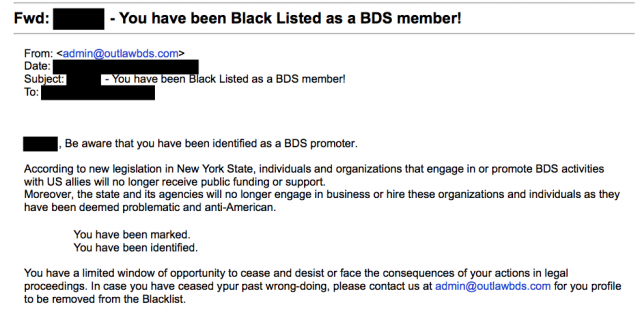
Screenshot of Psy-Group email
“It’s scary to think that ex-Mossad agents were behind this spying,” said senior staff attorney Radhika Sainath, who advised over 30 individuals targeted by the letters. “The Mossad itself has a history of surveilling, sabotaging and assassinating Palestinian activists around the world.”
The people targeted by former Israeli intelligence agents with Psy-Group include faculty at Columbia University, New York University, multiple City University of New York (CUNY) campuses as well Black, Jewish, and Palestinian volunteers from groups such as Adalah-NY and Jewish Voice for Peace.
“It is disgraceful that professors and students in American public universities are being spied on and intimidated by the former agents of a foreign nation,” said CUNY professor Sarah Schulman, who was targeted by Psy-Group. “Fortunately, the commitment of grassroots Americans to Palestinian rights is increasing everyday, and no level of threatening covert operations can stop it.”
Though outlawbds.com and Psy-Group no longer exist, the tactics and methods they employed —anonymous blacklisting websites, fake profiles used to target or influence people, and smear campaigns—are all still in use by other anti-Palestinian groups, some of which potentially share information with the Israeli government. The largest example is the blacklist site Canary Mission, which has targeted hundreds of students and faculty who advocate for Palestinian rights.
While it is unclear what relationship Psy-Group had with active Israeli intelligence or government agencies, coordinating with a foreign government to secretly spy on people in the US may violate federal laws. The Israeli government has itself encouraged and funded such activities to covertly undermine the movement for Palestinian rights.
Featured Video

or go to
Aletho News Archives – Video-Images
From the Archives
How the CIA Spawned Google
By Svetlana Ekimenko – Sputnik – 05.02.2025
American tech giant Google has faced regulatory scrutiny on numerous occasions amid accusations of antitrust violations. Google’s relationship with the CIA, ranging from early financial support to collaborative efforts have been decried as undermining privacy rights and free speech in the digital landscape.
Google’s creation played a crucial role in the US intelligence community’s scheme to attain global dominance by controlling information. … continue
Blog Roll
 Aletho News
- Would President Vance really ditch Israel?
- LAPD Pilot Will Track Vehicles In San Fernando Valley
- Britain’s Online Censorship Law Now Comes With a Crisis Plan for Your Posts
- NATO’s “Nordic model” brings Arctic confrontation closer to Russia’s nuclear bases
- Using nuclear weapons, the US-Israeli alliance still can’t beat Iran
- Sunset on the Quality of Western Propaganda: Arrival of the Dr Strangelove Moment
- Ukrainian general accused of protecting crime bosses
- US-‘Israel’ alliance faces growing rupture after midterms
- GOP’s Crushing Midterm Loss Could Reshape US Political Landscape – Analyst
- Midterm loss gives Congress power to rein in US war on Iran
- If Americans Knew
- An error has occurred; the feed is probably down. Try again later.
- No Tricks Zone
- New Study: The Net Fossil Fuel Contribution To Rising Atmospheric CO2 Has Been Zero For 500 Years
- Germany’s Green Energy Transition Becoming Increasingly Expensive…Another 6 Trillion Euros!
- Sudden Stratospheric Warming, Powerful El Niño Combination May Lead To Extreme Europe Cold, Energy Crisis!
- Two New Studies Find Thwaites Glacier Melt Cannot Be Driven By Human Activity Or A Warming Ocean
- E-Cars Reduce CO2 Emissions By Only 41% Compared To Internal Combustion Engine Vehicles
- Predictions Made By Renowned Climate Professor Over Past Decades Have Been Proven To Be Poor
- New Study Suggests Large Regions Of The Pacific Ocean Have Been Cooling For The Last 80 Years
- Germany’s Green Energy Debacle: High Energy Costs Force Kahla Porzellan to Close After 182 Years!
- New Study: 50 Years Of The Most Aggressive ‘Net Zero’ Policies Can Only Affect The Global Climate By 0.03°C
- US September “Heat” Was No Record…Many Records Set Decades Ago

