U.S. Tells Iran’s Oil Customers Not To Expect New Waivers
By Tsvetana Paraskova | Oilprice.com | February 7, 2019
Iran’s oil customers should not expect new U.S. waivers in May, the U.S. Special Representative for Iran, Brian Hook, said this week, urging buyers to stop importing Iranian oil.
“What we have announced is the policy to get to zero imports of Iranian crude as quickly as possible. We are not looking to grant any future waivers or exceptions to our sanctions regime, whether it is oil or anything else,” Hook told Japanese public broadcaster NHK while on a visit to Japan.
When it re-imposed sanctions on Iran last November, the U.S. granted waivers to eight countries so they could continue purchasing oil from Iran at reduced rates until early May 2019.
Some of those buyers, including the four major Asian buyers of Iranian oil—China, India, Japan, and South Korea—have recently resumed buying limited volumes of Iranian crude oil, after a period of around a month and a half in which they had to clarify how much and under what conditions they would purchase oil from Iran.
Earlier this week, Iran criticized Italy and Greece for not buying Iranian oil despite the fact that they had obtained waivers to do so.
The U.S. Administration has not officially said that no waivers will be issued, but officials have said that the goal is to drive Iranian exports to zero. Analysts, however, believe that there will be a direct correlation between the U.S. Iran waivers policy and the price of oil at the time Washington decides.
Despite the fact that the U.S. is not looking to grant any waivers to Iranian oil customers when the current ones expire in early May, it shouldn’t be taken for granted that no waivers will be issued, Hook and analysts hinted last month.
“We did not want to lift the price of oil, and we were successful doing that. So when the president left the deal it was trading at $74. When our sanctions went back into effect, and we had taken off a million barrels of Iranian crude, oil was at $72,” Hook said at Atlantic Council’s 2019 Global Energy Forum in Abu Dhabi in mid-January.
Trump’s Syria ‘Pullout’ Aimed at Aggressing Iran

By Finian CUNNINGHAM | Strategic Culture Foundation | 09.02.2019
US President Donald Trump again this week portrayed his plan to pull troops out of Syria as a “victory homecoming” and “an end to endless wars”. Then, in stepped Secretary of State Mike Pompeo to clarify what’s really going on: it’s a “tactical change” to put Iran in the crosshairs.
The purported pullout is not a return of US military from the Middle East, as Trump has been trumpeting with self-congratulations. It’s more a reconfiguration of American military power in the strategically vital region, and in particular for greater aggressive leverage on Iran.
In his State of the Union speech to Congress this week, Trump talked about giving a “warm welcome home to our brave warriors” from Syria. Supposedly it was “mission accomplished” for the US in defeating the ISIS terror group in that country.
It should be pointed out that ISIS would not have been in Syria or Iraq if it were not for criminal American military interventions, covert and overt, in those countries.
In any case, Trump was proclaiming America “victorious”, and so it was time, he said, to follow up on his order given in December for the 2,000 or so troops (illegally present) in Syria to withdraw.
The day after his nationwide address, Trump reiterated the theme of glorious homecoming at a forum of the Global Coalition to Defeat ISIS, held in Washington DC. This was a two-day gathering of dozens of US allies who have been attacking Syrian territory in the name of fighting terrorists (terrorists that many of these same coalition members, such as Saudi Arabia and Turkey, have been covertly sponsoring.)
“We look forward to giving our warriors a warm welcome home,” Trump again told delegates after informing them that the ISIS caliphate had been virtually destroyed by US forces and partners.
His top diplomat Mike Pompeo, however, assured the gathering that the US was still “leading the fight against terror” and that the planned troop withdrawal from Syria was only a “tactical maneuver”. He said that what Washington wanted was for more regional partners to take over military operations from the US.
When Trump first made the announcement of a troop withdrawal from Syria on December 19, there was immediate pushback from military figures in the Pentagon and politicians in Washington. Together with a proposed drawdown of US forces in Afghanistan by Trump, it was construed that the president was signaling a wholesale retreat from the region.
Since the “surprise” announcement by Trump, lawmakers within his Republican party have been doubling down to prevent any pullout from Syria or Afghanistan. This week, the US Senate voted through legislation to block any abrupt withdrawal, claiming that, contrary to Trump’s assertions, ISIS has not been defeated and still poses a national security threat.
The Pentagon has also been warning of a “resurgence” of ISIS in Syria and Iraq if US forces were to pull out. A Department of Defense document published this week quoted Pompeo. “Following the president’s announcement in December 2018 to withdraw troops from Syria, Secretary of State Mike Pompeo stated that the policy objectives of defeating ISIS and deterring Iran had not changed.”
In other words, the Pentagon is busily rationalizing for entrenchment in the region, not for a retreat.
Last month, while on a nine-nation tour of the Middle East, Pompeo was at pains to emphasize to America’s Arab client regimes that Trump’s pullout from Syria was a reorganization of military forces, not an overall withdrawal. During his tour, Pompeo renewed Washington’s project to create an “Arab NATO” for the region, with the top priority being to contain Iran. According to Radio Free Europe, he said, “the United States is redoubling efforts to put pressure on Iran.”
Next week, the US has organized a conference to be held in Poland which is dedicated to intensifying international pressure on Iran. The indications are that senior European Union officials will not attend the summit as it is stoking tensions with Tehran at a time when the EU is striving to save the nuclear accord with Iran.
However, the conference in Poland testifies to ramped up efforts by Washington to isolate Iran internationally and provoke instability in the country for regime change. Since Trump walked away from the internationally-backed nuclear accord last year, his administration has been piling on the aggressive rhetoric towards Iran, in particular from his national security advisor John Bolton, as well as Pompeo.
This obsession to confront Iran would explain the real significance of Trump’s supposed pullout plans in Syria and Afghanistan. Both countries have been utter failures for US imperialism. They are a dead loss, despite the self-congratulatory nonsense spouted by Trump.
What the White House is intent on doing, it seems, is redirecting its military forces in the region away from dead-end causes for a more aggressive stance towards Iran. Pompeo’s “clarifications” about Trump’s troop withdrawal makes it clear that what is going on is not a scaling down of American military power in the region, but a reconfiguration.
Trump himself has indicated that too. In a recent interview with the CBS channel, Trump said that US forces would be reassigned from Syria to Iraq where the Pentagon has several large military bases. He explicitly said that the US forces in Iraq would be used to “keep a watch on Iran” and the wider region.
Trump’s braggadocio immediately got him into hot water with the Iraqis. Iraqi President Barham Salih fulminated that the 5,000 or so US troops in his country were there strictly for the purpose of combating terrorism, not for “watching Iran” or any other neighboring country. Other Iraqi lawmakers have been so incensed by Trump’s comments that they are calling for the presence of US forces to be terminated.
Thus, the apprehensions among the bipartisan War Party in Washington and some at the Pentagon regarding Trump’s purported troop pullout from Syria and Afghanistan are misplaced. Trump is not “ending the endless wars” that feed American imperialism and its war-machine economy.
Far from it. The Condo King is simply moving the Pentagon’s real estate around the region in order to get a better view of the planned aggression towards Iran.
As US Laments Human Rights in Venezuela, US-Allied Colombia Descends into Drug-fueled Humanitarian Crisis
By Whitney Webb | MintPress News | February 8, 2019
BOGOTÁ, COLOMBIA – Several troubling situations are currently playing out across Colombia, yet the country’s continuing downward spiral into drug-fueled and politically-motivated violence has caused little concern in Washington, offering yet another clear indication that the U.S.’ current posturing on Venezuela is hardly motivated by concerns about “democracy,” “human rights,” or the welfare of the Venezuelan people.
This, of course, can hardly be considered surprising, given that Colombia is a top U.S. ally whose government has long been closely aligned with Washington’s interests. However, although the lack of U.S. government or media attention to Colombia may effectively hide it from the American public, the country is becoming increasingly lawless, with cocaine production reaching new record levels and the government sanctioning the mass murder of the country’s largest indigenous group. Not only that but since Colombia’s new president, Iván Duque, came to power late last year, the number of indigenous social leaders who have been murdered has spiked to the highest levels in over a decade.
Ultimately, the lack of media coverage of Colombia’s humanitarian crises, which have large implications for the Americas as a whole, is a telling example of how such crises are regularly weaponized by governments and media to exclusively target governments it wishes to pressure or overthrow, while turning a blind eye to those same or worse acts when committed by an allied nation.
An absurdly double standard
Though it was Barack Obama who first deemed Venezuela a “national security threat” and re-initiated draconian sanctions against the oil-rich nation, the Trump administration has greatly increased the sanctions targeting Venezuela, often citing its government’s alleged participation in illegal drug trafficking as justification for doing so. However, the U.S. has offered little in the way of concrete evidence to back up those allegations.
During this same period, moreover, the Trump administration has expressed little concern for the booming illicit drug trade in neighboring Colombia, which has broken records for cocaine production for the last two years in a row. Though the Colombian government and military have been repeatedly tied to the country’s drug trade, the Trump administration – like previous U.S. administrations – hasn’t lifted a finger.
According to UN figures released last September, Colombia’s cocaine production has again broken records, with the country producing an estimated 1,379 tons of cocaine in 2017, the latest year for which such statistics exist. That figure is a 31 percent increase in cocaine production from 2016. 2016 itself was a record-breaking year with cocaine production gaining by 50 percent over 2015 levels.
Though Trump had threatened to decertify former Colombian President Juan Manuel Santos’ government over the rapid growth of cocaine production, he ultimately gave Colombia a pass in the U.S.’ annual determination of countries considered to be “major drug transit or major drug producing” areas “because the Colombian National Police and Armed Forces are close law enforcement and security partners of the United States in the Western Hemisphere.”
The document also described Venezuela, along with its regional ally Bolivia, as “countries that have failed demonstrably during the previous 12 months to adhere to their obligations under international counternarcotics agreements” despite the fact that Bolivia had the fewest illegal coca crops of any South American country that year.
Since getting a free pass from the Trump administration, Colombia’s current president, Iván Duque, has signaled his hopes to revive a failed, U.S.-backed program to indiscriminately spray suspected coca fields with the infamous Monsanto product glyphosate to reduce cocaine production.
Though the U.S. government and Western media have traditionally placed the blame on leftist guerillas in Colombia, like the FARC, the 2016 peace deal that saw the FARC abandon the drug trade has removed this convenient scapegoat and highlighted the long-standing role of the Colombian military and prominent right-wing politicians in cocaine production.
In fact, the United Nations Drug Control Program (UNDCP) has described the Colombian military — which has been armed and trained for decades by the U.S. under the Clinton era policy known as “Plan Colombia” — as being among “the biggest heroin and cocaine trading institutions.”
The Colombian government has also been intimately involved, particularly during the presidency of Álvaro Uribe, who allegedly served as the “head of Colombia’s paramilitary groups” both before and while in office. Uribe was once ranked by the U.S. Defense Intelligence Agency “on a list of 104 important narco-traffickers contracted by the Colombian narcotics cartels.”
There are also indications of the U.S. government’s own involvement in the Colombian cocaine trade. For example, Colombia’s most notorious drug trafficker, Pablo Escobar, at one point worked for the U.S. Central Intelligence Agency, according to Escobar’s own children. Escobar allegedly sold cocaine for the CIA to help the U.S. government finance its fight against communism and left-wing governments in Latin America.
As pointed out in the book Cocaine, Death Squads and the War on Terror: U.S. Imperialism and Class Struggle in Colombia, the U.S.’ anti-drug efforts in Colombia were never intended to eradicate cocaine, but instead alter the market share by ensuring that allies of the U.S. in Colombia – the Colombian government, paramilitaries and the wealthy elite who are favorable to U.S. business interests – could monopolize the drug trade with no competition from outsiders. Thus, it should hardly shock anyone that the U.S. continues to turn a blind eye to the country’s booming illegal drug trade and its associated violence, even as it continues to break records year after year.
Erasing the erasure of the Wayuú
As the long-standing, U.S.-backed plan to oust the Chavista regime in Venezuela has unfolded, Maduro’s government has been called out in Western media for “starving his own people,” despite the fact that U.S. sanctions imposed on Venezuela are a driving factor behind the country’s economic crisis. However, since 2011, Colombia has been the site of ongoing genocide against the country’s largest indigenous group – the Wayuú – in the country’s Guajira region, after the Colombian government diverted their only source of water to support the operations of the country’s – and continent’s – largest coal mine.
The suffering of the Wayuú, who have reported the deaths of at least 14,000 children due to the lack of clean water, has gone unreported by the same outlets that routinely raise concern about lack of essential goods in Venezuela. The Wayuú, who comprise around 20 percent of Colombia’s entire indigenous population and 48 percent of the Guajira region’s total inhabitants, are now on the brink of dying out completely seven years after the Ranchería river – their community’s only freshwater source – was diverted by the government-constructed Cercado dam in order to service the water needs of the Cerrejón coal mine.
An estimated 37,000 Wayuú now suffer from severe malnutrition, as they can no longer grow crops or raise livestock without a freshwater source. Each person in the community now lives off of less than 0.7 liters (24 oz.) of water a day while the Cerrejón mine guzzles more than 2.7 million liters of water in a 24-hour period – most of which is used to improve mine “visibility” by minimizing dust pollution. Despite the clear impact of the dam and mine on the humanitarian crisis facing the Wayuú, the Colombian government and supportive Western media have blamed “climate change” and weather patterns like El Niño for the situation.
The most likely reason for the erasure of the slow genocide of the Wayuú from Western media is the fact that the Cerrejón mine is a largely a U.S.-backed operation, as the mine was originally founded by ExxonMobil and is now owned by a consortium of largely Western mining companies such as Anglo American and BHP Billiton. These same mining companies often work with right-wing paramilitary groups — who are also closely connected to the Colombian government — and who repeatedly threaten the lives of Wayuú who speak up about their people’s suffering, including their chief legal advocate, Javier Rojas Uriana.
Notably, the Colombian Wayuú have been immigrating to the Wayuú community in Venezuela in order to avoid the slow death caused by malnutrition, lack of water, and waterborne illnesses from the polluted water from the community’s remaining wells. The Venezuelan Wayuú have been largely supportive of Chavismo and have backed the Maduro-led government, referring to U.S.-backed opposition protests as violent riots “intended to create chaos.” The Huffington Post noted in 2017 that the Wayuú’s support for Maduro had largely been erased by the Western media because it “does not match up with the media’s anti-Venezuelan government narrative.”
Liquidating social leaders, activists, human-rights advocates
While the fate of the Wayuú (and thus 20 percent of the country’s entire indigenous population) continues to hang in the balance, the plight of Colombia’s indigenous peoples has grown even worse since the recent inauguration of Colombian President Iván Duque.
Despite Duque’s having come to power just last August, El Tiempo recently reported that the murders of indigenous leaders in the country have spiked to levels unseen in over a decade since Duque became Colombia’s president. According to data cited by El Tiempo, 120 indigenous social leaders – as well as human-rights defenders — have been murdered in cold blood during Duque’s first 100 days in office.
Though the murder of social leaders by right-wing paramilitary groups has a standing problem in Colombia’s recent history, this level of targeted murder represents a spike over recent years — in which 226, 159, and 97 such murders occurred over the course of the entire years of 2018, 2017 and 2016, respectively. Notably, the Venezuelan government of Nicolás Maduro has been routinely accused by Western media of murdering opposition activists; yet, those same outlets have been silent on Colombia’s recent spike in activist murders.
Despite the jump, Duque’s government has expressed little concern. This is hardly surprising when one considers that Duque is the hand-picked successor and protégé of Álvaro Uribe, the former Colombian president who was once “the head of Colombia’s paramilitary groups,” according to former paramilitary group commanders of the right-wing death squad AUC, which has been funded by several prominent U.S. corporations.
Uribe, who was Colombia’s president from 2002 to 2010, and was a close ally of George W. Bush, was also personally implicated in organizing a massacre conducted by a right-wing paramilitary group; and his cousin, Colombian politician Mario Uribe, was charged with mobilizing right-wing death squads in the country to help secure Uribe’s presidential victory in 2002. Uribe’s brother was also arrested for founding a right-wing paramilitary group in 2016.
Under Uribe’s presidency, the Colombian military massacred thousands of civilians — such as in the “false positives” scanda,l where the Colombian military dressed up an estimated 5,000 civilians in guerilla clothing and killed them in cold blood, subsequently gaining a bonus from Uribe’s government for the sinister act. It should be no surprise then that, under Uribe, the murder rate of indigenous leaders and human-rights activists reached its all-time high at 1,912 murders in 2003.
Given Duque’s close relationship to Uribe, it is also little surprise that paramilitary groups have endorsed Duque following his election and have vowed to “exterminate” Duque’s opposition, calling prominent Colombian progressives “military targets.”
What to expect if US gets its way in Venezuela
If Washington’s publicly stated concerns about “human rights” and the welfare of a country’s people in Venezuela were genuine, it would be equally critical of Colombia’s government, given the numerous troubling situations currently unfolding in that country. Instead, the dichotomy between Washington’s relationship with Venezuela and Colombia is yet another clear example that the public justifications for the U.S.’s Latin America policy are little more than window dressing for the U.S.-backed expansion of neo-fascist governments throughout Latin America.
Indeed, if Juan Guaidó – the self-declared, U.S.-backed “president” of Venezuela – manages to seize power in the country, the current state of affairs in Colombia is a telling harbinger of what would likely manifest should Nicolás Maduro be overthrown and replaced with the same type of government that the U.S. has either backed or installed in several Latin American countries over the last few decades, and particularly in recent years.
Whitney Webb is a staff writer for MintPress News and has contributed to several other independent, alternative outlets. Her work has appeared on sites such as Global Research, the Ron Paul Institute and 21st Century Wire among others. She also makes guest appearances to discuss politics on radio and television. She currently lives with her family in southern Chile.
Hopes Fade for EU to Rescue Iran Via Banking Scheme to Bypass Sanctions – but Was It Ever a Serious Plan?
By Martin JAY | Strategic Culture Foundation | 08.02.2019
At the end of September, the European Union unveiled plans to help Iran bypass sanctions imposed by the US, so that it could sell oil and even trade with EU countries. The move followed Trump finally losing his patience over the so-called Iran Deal – a treaty drafted by Barak Obama which effectively prevented Iran from developing nuclear weapons in return for opening up Iran’s economy to the West and unblocking funds held outside of the country – which he dismisses as a bad deal for American interests in the region.
In reality, Trump’s real problem with the Joint Comprehensive Plan of Action (JCPA), is the same one which vexed America’s two strongest allies in the Middle East, which is that it did nothing to curtail Iran’s real strength against any external threat: its ballistic missiles program.
And so, to appease these two partners, who felt betrayed by Obama, sanctions were imposed against Iran – along with secondary sanctions, imposed via other countries (although this has not been as successful as Trump would have hoped) – and a new ‘war’ against Iran began, aimed at largely toppling its moderate government, while Saudi Arabia gains time to move ahead with its own ballistic missile program.
A key part of spurring a downfall of the present regime in Tehran, was both secondary sanctions wielded against Turkey, China and India, threatening them against buying Iran’s cheap oil, along with forcing the EU to stop trading altogether with Tehran. At one point, Trump’s plan looked like it was working with Europe as all the main investors inside Iran packed their bags and promptly left Iran within weeks of his sanctions plan being announced.
But there was great optimism about Iran finding a clever go-around and still sell its oil to EU governments as well as foster trade with European companies who were not afraid of the threats from the US via its banking system to shut companies off from the US market.
The European Union’s own foreign policy damsel, Federica Mogherini, who stole a lot of the credit for the Iran Deal being signed in the first place (when in reality the Iranians humored her with this idea all along) had a plan. She soon announced that a new banking system to be called INSTEX would be created specifically to allow EU governments and companies to trade with Iran. Although on paper it seemed pretty simple, there were warnings from experts that it might be a difficult task to pull off, given the complexities of international banking, not to mention international laws; moreover, the EU has no real track record of pulling off anything so bold as this before as the so-called ‘foreign policy’ initiatives it has are largely grand ideas on paper – fantasies of what it might be one day rather than the present day European External Action Service which employs over a 100 ‘ambassadors’ who largely live in Djin palaces and keep the dream alive around the world in exotic locations whose governments are happy to give Brussels the cash-for-hegemony deal anytime.
Sadly, it seems that Mogherini’s plan for the banking scheme which was to send a clear signal to Trump as well as keep the Iran Deal alive, is folly and delusional – given that, for Mogherini and her colleagues, the Iran Deal is seen as their great success to exercise EU foreign policy into concrete terms and to create the first ever international treaty drafted by Brussels. It is more or less sacrosanct and considered to be a treaty which now can be used to exert EU hegemony against Trump’s new world order which they consider geopolitical heresy.
Yet the Iran Deal has so much fake news and false prophesies – like Trump’s claims that the Iranians got 150 billion dollars from it, when in reality they only got just over 30 and it was their money in the first place – and the EU’s idea seems just that. Just more fake news.
For the first time, there are growing doubts about both whether it can be pulled off and whether it was a genuine offer in the first place as Brussels appears to be at odds with the giants of the EU, who are cranking up the sanctions to new levels.
Just recently, France’s foreign minister warned Tehran of new sanctions if Tehran would not agree to curbs its ballistic missiles program, regardless of the fact that ballistics were never part of the Iran Deal. France, a founding member of the European Union itself and a country with real clout in Brussels seems to be at odds with the EU’s plans, to say the least. Or was the Brussels plan the real deal in the first place?
Concurrent to this, are also the first real signals from Tehran that it doubts the EU’s sincerity in the draft banking plan. Politicians there, feeling the heat from sanctions and living with daily rumours of a possibility of a military coup engineered by the charismatic, anti-US military figure Qasem Soleimani, are starting to cry foul.
In reality, we shouldn’t get too excited about the scheme, as Tehran clearly isn’t holding out too much hope. In addition to there being many doubts about whether European firms will sign up to it, even if it gets off the ground it will only appeal to smaller companies that are flying under the US radar anyway. Additionally, earlier hopes that it could be used to sell Iran’s oil to Europe, have been dashed.
The EU is living in dangerous times. With its own elections this May expected to give record wins to nationalist, populist parties – in particular in France – it is facing its worst ever credibility crisis, which explains the fear mongering led by President Macron with his latest Brexit speech. But if Brussels can’t deliver on Iran’s rescue package, then it won’t matter if far right parties dominate the European parliament, signaling the demise once and for all, of the EU as we know it. Brussels will never be taken seriously again around the world where it practices its fake hegemony as no one will forget the farce of the EU and the Iran Deal. INSTEX may well be the sword that the EU falls on, certainly on the world’s stage, when the hype dies down and it is dispatched to the press room floor as folly for a wannabee superpower.
Russia Insists US Forces Withdraw from Tanf Area in Syria: Ministry
Al-Manar | February 8, 2019
The Russian Foreign Ministry insists that US forces withdraw from the 55-km security zone surrounding its Tanf military base, which includes the Rukban refugee camp, the ministry said in a statement late on Thursday.
On February 6, the second humanitarian convoy was sent to the camp by the UN and the Syrian Arab Red Crescent, with the Russian side’s assistance. The first aid convoy was unable to reach its destination, as it was stopped by US-controlled militant groups.
Commenting on the developments, the Russian Foreign Ministry said Moscow’s position on the camp and the delivery of humanitarian cargo there remains unchanged.
“We need to eliminate the root cause – the unlawful US military presence on the Syrian land within the 55-km security perimeter which includes the camp,” the ministry said.
According to Russian diplomats, the camp, which is currently home to over 40,000 people, will receive over 1,000 tons of humanitarian cargo, including food, clothes, medicines and other essential goods. Besides, it is planned to vaccinate about 10,000 children against tuberculosis, polio, hepatitis and other diseases.
“Once the effort is complete, we expect [to receive] from UN officials a detailed report on measures taken and information containing practical proposals on closing the camp and evacuating its residents,” the ministry added.
According to the statement, Rukban is not the only refugee camp whose residents found themselves in a dire humanitarian situation. The Russian Foreign Ministry requests relevant organizations and the international community to examine the situation in Al-Hawl, a camp for internally displaced persons on the outskirts of an eponymous city in Syria’s al-Hasakah governorate where over 30 children died since the start of the year.
“According to information that we are receiving, including from the UN, it [the camp] houses about 33,000 people. The vast majority of them – or about 23,000 people – arrived in December 2018 from the Deir Ezzor governorate, fleeing the military operation conducted by the US and its allies against the ISIL terrorist group [outlawed in Russia] in the city of Hajin, which entailed numerous casualties among the civilian population,” the ministry said.
Who’s afraid of intra-Afghan dialogue?

Opening of two-day talks of Taliban and Afghan opposition leaders at the President Hotel in Moscow on February 5, 2019 (Photo by Yuri KADOBNOV / AFP)
By M. K. BHADRAKUMAR | Indian Punchline | February 7, 2019
The two-day conference of mainstream Afghan politicians and Taliban representatives in Moscow on February 5-6 becomes a landmark event in the peace process.
Principally, it signifies the commencement of the ‘intra-Afghan dialogue’, a process that was struggling to be born. This process can be expected to galvanise the Afghan peace talks. Some of the most senior and influential Afghan leaders actively participated in the Moscow conference, including former President Hamid Karzai, stalwarts of the erstwhile Northern Alliance Atta Muhammad Nur, Yunus Qanooni and Muhammad Mohaqiq, Ahmad Wali Massoud and former National Security Advisor Hanif Atmar.
The embittered Afghan government led by President Ashraf Ghani has been reduced to a rump. It has censured the event in Moscow, but its own growing isolation is self-evident. Ghani is now openly critical of the dynamics of the US-Taliban talks, won’t associate with any ‘intra-Afghan dialogue’ and threatens to reject any peace formula that is reached without him.
Ghani’s mindset is — ‘After me the Deluge.’ His preoccupation is about his own political future. Simply put, panic (that he is at the end of the road) is mixing with bewilderment (that he is in reality so easily expendable) and anger (that the US is inexorably disengaging from him). In fact, President Donald Trump’s State of the Union address on Tuesday completely omitted any reference to the Kabul set-up, leave alone Ghani himself.
The stunning outcome of the Moscow conference in the nature of a Joint Declaration highlights that the native Afghan genius for consensus-making has far from extinguished and can still provide the alchemy for reaching a peace settlement.
The key elements of the ‘nine point approach’ outlined in the Joint Declaration are the agreement on the ‘values’ that effectively provide the guiding principles of a post-settlement order — an Islamic system; an inclusive polity; a broad-based government with representation for all ethnic groups; assertion of national sovereignty; scrupulous neutrality vis-a-vis regional and international conflicts; adherence to Afghan national and religious values; and a unified and single policy.
The three striking templates of the document are the demand for the ‘complete withdrawal of foreign forces’, the political commitment to protect the rights of women and the entire people, and the openness to seeking international assistance for Afghan reconstruction. Taken together, the joint declaration gives the blueprint of the terms of an Afghan settlement.
Russia has been the patron behind the conference kickstarting an ‘intra-Afghan dialogue’. Conceivably, Russia took such an initiative in tandem with Pakistan — and, possibly, with Iran and China as well. Importantly, Russian diplomacy was successful in getting an impressive array of Afghan politicians cutting across the spectrum of opinion to come on board. The new platform is destined to gain traction and provide an enduring underpinning for peacemaking and reconciliation in Afghanistan.
Inevitably, the dialectic involving the US-Taliban talks and the new platform of ‘intra-Afghan dialogue’ will be crucial. Ideally, they should be mutually reinforcing. But life is real. Much depends on the US’ intentions. Washington cannot but be aware that the Ghani government lacks legitimacy and an interaction between it and the Taliban (assuming the latter agrees to it) is increasingly meaningless.
On the other hand, Ghani also enjoys the covert backing of the hardline elements within the US establishment some of whom are unhappy with Trump’s outlook of putting to sudden death America’s ‘endless wars’.
Ideally, therefore, it is in the US interest to widen the gyre of the peace process that has begun in Moscow and create synergy for Washington’s direct engagement with the Taliban, which is proceeding on a parallel track. The regional and international opinion will be supportive of such a constructive approach.
However, for this to happen, the US too should have a unified policy. There are disturbing signs that the US military-industrial complex is far from done with the ‘endless war’ in Afghanistan. Trump himself is buffeted by cross currents. He vaguely sounded placatory in his address to the US Congress on Tuesday by hinting at the need of continued counterterrorist operations with a reduced military presence.
Whereas, the resounding message out of the Moscow conference is that mainstream Afghan opinion identifies with the Taliban’s longstanding demand for complete vacation of foreign occupation in lieu of commitment that no extremist group will be allowed to operate out of Afghan soil. The US should heed this profound Afghan craving for national independence and sovereignty.
Indeed, the Moscow conference underscored that the Afghan conflict is at its core a fratricidal strife (which foreign powers took advantage of) and it can be ended only through a genuine, free-wheeling intra-Afghan dialogue. The Russians have shown that just by being an honest broker, the Americans could as well have kickstarted the intra-Afghan dialogue a long time ago — arguably, even when the late Richard Holbrooke was around. So much destruction and suffering and loss of lives could have been spared if only there was sincerity of purpose.
The Moscow conference has exposed the self-serving Western notion that the Afghans are inherently incapable of molding the destiny of their nation. That such an impressive outcome of consensus-making was possible when Afghans were left to confabulate among themselves for two days only goes to show that the so-called international community is more the problem than the solution.
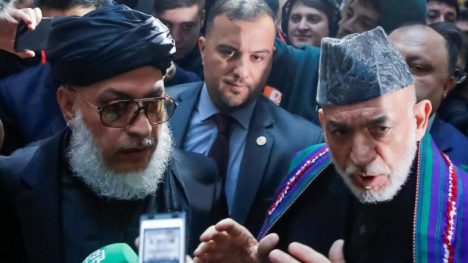
(Former Afghan president Hamid Karzai (R) and Head of Political Office of the Taliban Sher Mohammad Abbas Stanikzai briefing the media at the Moscow conference, February 5, 2019)
The Moscow conference agreed that ‘intra-Afghan dialogue must continue on regular basis’ and that the next session be held in Doha, Qatar, ‘as soon as possible.’ The next round of the US-Taliban talks is also due to take place in Doha in February focusing on the interim government and ceasefire. Several top participants at the Moscow conference voiced support for the formation of an interim government. The time has come to address the issue.
The big question is whether the US is willing to let go of Afghanistan, finally. Admittedly, the geopolitics of Afghanistan becomes a compelling factor for the Pentagon, which is keen to retain the military bases in the emerging New Cold War conditions. Besides, there is no dearth of potential deal breakers. Persuading the present rulers in Kabul to make way is going to be a tough challenge. Ghani’s hope lies in offering the Taliban a few slots in his government. But that formula won’t work.
The US should not encourage Ghani’s vaulting ambition to wield power for a foreseeable future. Conditions were far more complicated in 2001 when the Northern Alliance government led by Burhanuddin Rabbani was persuaded to step down and an interim government led by Karzai took over in Kabul at the insistence of Washington.
On the other hand, the Moscow conference has shown that inter-Afghan amity and reconciliation is a realistic goal. Karzai can still play a leadership role in any orderly transition in Kabul. Karzai led the way at the Moscow conference.
US federal judge dismisses lawsuit against BDS supporters
MEMO | February 7, 2019
Pro-Israeli groups have suffered a major defeat in a US court after a federal judge dismissed a lawsuit against the American Studies Association’s (ASA) resolution to endorse the call to boycott Israeli academic institutions as part of the Boycott, Divestment, and Sanctions (BDS) movement.
On Monday a district court in Washington threw out the lawsuit against ASA, which is the oldest scholarly organisation devoted to the interdisciplinary study of US culture and history. The federal judge ruled that the anti-BDS plaintiffs were unable to explain how they were injured by the boycott, a requirement for the lawsuit to go forward.
The ruling is a significant victory for human rights campaigners and a blow to efforts by Israel lobby groups to use courts to harass, intimidate and silence supporters of Palestinian rights in US universities – a tactic known as lawfare. It’s also a major boost for Americans sacked from their jobs on the back of anti-BDS legislation, denounced by critics as unconstitutional.
Pro-Israeli group, the Louis D. Brandeis Centre, filed a lawsuit against ASA in April 2016 over its resolution to boycott Israeli academic institutions. The lawsuit argued that in adopting the resolution, which was voted on by an overwhelming democratic majority, the ASA operated beyond its corporate charter and caused the plaintiffs to “suffer significant economic and reputational damage.”
In the court’s 20-page ruling, US District Judge Rudolph Contreras wrote that the pro-Israeli group had “danced around key issues” and was unable to show that they had suffered enough monetary damages to warrant a federal case.
The judge found that at most, the individual plaintiffs could seek damages of a few hundred dollars to cover membership dues they allege were misappropriated, but they would have to find some other venue to pursue their claims.
Radhika Sainath, senior attorney with the civil rights group Palestine Legal, summed up the court’s judgement saying that “the court basically said, in no uncertain words, that the plaintiffs suing ASA lied when they claimed to have ‘suffered significant economic and reputational damage’.”
“But, as the court explained, ‘nowhere’ in the lawsuit could the plaintiffs explain what that damage was. It didn’t pass the smell test,” she added.
One of the four co-defendants, Dr Stephen Salaita, an outspoken advocate of Palestinian rights who was fired from the University of Illinois at Urbana-Champaign for tweets criticising Israel’s 2014 assault on Gaza, said after the verdict: “I’m thrilled that this baseless case has been dismissed. It served no purpose other than persecuting those who dare to criticise Israeli policy and seek to end the occupation through peaceful means,”
Another co-defendant Wesleyan University Professor Kehaulani Kauanui denounced the lawsuit as a politically motivated attempt to suppress free speech. “The Brandeis Centre did not hold back its clear intent to punish me for standing up in solidarity with Palestinians and to deter others. They don’t call it lawfare for nothing.”
The court’s decision comes in the context of a broader federal assault on BDS for Palestinian human rights. On Tuesday, the US Senate passed a measure that would criminalise politically motivated boycotts of Israel across the US.
US blocks UNSC criticism of Israel’s expulsion from Hebron of international monitors
MEMO | February 7, 2019
The US blocked a draft United Nations Security Council statement yesterday from issuing a statement that would have expressed concerns over Israel’s decision to expel the international observatory task force that has been monitoring the situation in the occupied West Bank city of Hebron for 20 years.
The 15-member UN Security Council discussed Israel’s decision behind closed doors at the request of Kuwait and Indonesia, which also drafted the statement. Such a statement has to be agreed unanimously.
UN diplomats said that the US had blocked the statement saying that they did not believe a council statement on the issue was appropriate.
The draft statement, seen by Reuters, would have also recognised the importance of the Temporary International Presence in Hebron (TIPH) and its “efforts to foster calm in a highly sensitive area and fragile situation on the ground, which risks further deteriorating.”
The proposed statement also intended to express the Security Council’s “regret” about Israel’s “unilateral decision” to eject the force from occupied Hebron and call for “calm and restraint”.
The TIPH was set up after a Jewish settler, Baruch Goldstein, massacred 29 Palestinians in 1994 at the Ibrahimi Mosque during the holy month of Ramadan.
Israeli Prime Minister Benjamin Netanyahu said last week he would not renew the mandate of TIPH accusing the observers of unspecified anti-Israel activity. His decision heightened Palestinian concerns over their safety. Palestinian residents of Hebron regularly come under attack from illegal settlers and Israeli occupying forces. They often say that they are living under an apartheid Israeli system. The Old City of Hebron is completely divided through the presence of barriers, closures, military zones and settlements, to accommodate some of Israel’s most extreme settlers.
The Palestinian Authority (PA) echoed the concerns and called for a UN protection force to ensure the safety of Palestinians until Israel ends its “belligerent occupation”. The UN should “guarantee the safety and protection of the people of Palestine” until “the end of Israel’s belligerent occupation,” said Palestinian official Saeb Erekat.
Pompeo: America ‘obligated’ to fight ‘Hezbollah’ in Venezuela to save ‘duly elected’ Guaido
RT | February 7, 2019
Straining to explain Washington’s eagerness for regime change in Caracas, Secretary of State Mike Pompeo said Cuba was already occupying Venezuela, misunderstood how democracy works, and claimed Iran had a presence in the country.
While navigating extremely delicate issues like international diplomacy for most world leaders requires finesse and sophistication, Pompeo opted for a more ham-fisted approach in an interview with Fox Business on Wednesday. Weaving together a loosely-knit narrative of garish moralizing and lists of countries on America’s naughty list, President Donald Trump’s chief diplomat attempted to help American audiences understand what the State Department is doing in Venezuela.
After making the expectant accusations of Russian and Chinese interference in Venezuela, Pompeo decided to mobilize his go-to excuse for US meddling – Iran!
“People don’t recognize that Hezbollah has active cells — the Iranians are impacting the people of Venezuela and throughout South America,” adding that “We have an obligation to take down that risk for America.”
It might seem that Pompeo merely has trouble with geography, having recently shared a bizarre map on Twitter that featured the non-existent countries of East and West Turkey, among other things. However, in the course of the interview, he also made several other puzzling declarations, such as referring to self-declared Venezuelan leader Juan Guaido as having been “duly elected,” even though the Washington-backed politician never even ran for president.
When asked why the issue was so important for “our hemisphere,” Pompeo answered that “American values are at stake,” in Venezuela. He believes US interference in internal affairs of Venezuela is an “obligation,” although last year he waxed concerned about alleged foreign interference in US elections.
US sanctions, he went on to explain, “aren’t aimed at the Venezuelan people,” but are instead aimed at “a really good outcome.” Though it was Pompeo who openly argued that US sanctions against Iran were intended to effect regime change by starving its citizens, he tried to argue that in Venezuela US sanctions are “for the good” of the Venezuelan people because they are against the “evil Mr Maduro.”
UN-appointed human rights expert Idriss Jazairy has a different opinion on the matter. While failing to spell out who is good and who is evil, he did point out that the sanctions against Venezuela may “lead to starvation and medical shortages.”
Just in case these helpful sanctions packages don’t end up being “really good” enough, the US is not ruling out plan B: military invasion. A few days ago, Trump told CBS a military option was still on the table, despite overwhelming opposition on both sides of the Venezuelan crisis.
Pompeo brushed off rumors of a possible US invasion, saying the US technically can’t invade Venezuela because “Cuba already did” and has been secretly controlling the country “for an awful long time.”
Hillary Clinton: Trump’s INF Treaty Withdrawal is “Gift to Putin”
Sputnik – 07.02.2019
Last week, US Secretary of State Mike Pompeo announced that Washington would suspend its obligations under the Intermediate-Range Nuclear Forces (INF) Treaty and begin a six-month withdrawal process. The following day Russian President Vladimir Putin stated that Moscow was providing a mirror response.
Former Democratic presidential candidate Hillary Clinton has slammed the Trump administration’s decision to pull out from the INF Treaty as a “gift to [Vladimir] Putin”.
Speaking at an event hosted by Georgetown University’s School of Foreign Service and its Institute of Politics and Public Service on Wednesday night, she claimed that the current administration withdrew “without really holding Putin accountable for his cheating on the treaty”.
“I think there is agreement, it started in the Obama administration, that the Russians were not only developing intermediate-range capacity, but deploying it — and so, when that happens… it seems to me that you want to do some public diplomacy. We clearly have pictures and we clearly know a lot about their cheating, and we should have done a better job in making it abundantly clear, not only to the American people but the Russian people, and Europeans, and others who are on the front lines, that the Russians were evading responsibilities in the INF”, Clinton said.
She went on to tell the crowd that instead of demanding talks on the matter, the US decided to pull out, and claimed that Russia was going “to go forward and develop even more of these” weapons.
Looking at the situation from a global perspective, Clinton suggested that the world could face some bleak prospects following the collapse of the landmark treaty:
“It increases the unpredictability, and I believe the danger, that can come from throwing around more missiles and weapons of all kinds, but particularly nuclear ones, within the European theatre. […] The last thing the world needs right now is a nuclear arms race”.
Last week, US Secretary of State Mike Pompeo announced that Washington would be suspending its obligations under the INF Treaty starting on 2 February.
He further said that the accord would be entirely terminated if Russia doesn’t meet Washington’s demands regarding the alleged treaty violations, namely to destroy all ground-based 9M729 missiles and their launchers, as well as other associated equipment that purportedly breached the agreement.
Pompeo stated that Russia has six months to save the deal while the US goes through the process of withdrawing from it.
Shortly after the withdrawal announcement, Russian President Vladimir Putin held a meeting with Foreign Minister Sergei Lavrov and Defence Minister Sergei Shoigu, during which the head of state said that Moscow was suspending its obligations under the INF Treaty in response to Washington’s move. While saying that Moscow was still open to negotiations, President Putin instructed the ministers not to initiate talks on the matter.
In addition, President Putin stressed that the use of target rockets and the deployment of Mk 41 launchers in Europe since 2014 by the United States was a direct violation of the arms control treaty and reiterated that Moscow had been fully complying with the agreement.
Putin further emphasised that notwithstanding reciprocal measures, Russia should not and would not be drawn into an arms race.
In December, the US gave Russia a 60 day warning about withdrawing from the treaty, asking Moscow to return compliance by destroying the missiles that allegedly violate the treaty. The 60 days were up at the beginning of February.
The United States has repeatedly accused Russia of violating the 1987 treaty with the development of its 9M729 ground-based missile systems (known as the SSC-8 under US classification), which Washington claimed had a range of over 1,000 km, while the agreement bans missiles with ranges between 500 and 5,500 km.
Moscow has vehemently denied the claims, citing a lack of proof, and stressed that the range of these weapons was 480 km, which is in full compliance of the INF.
The INF Treaty was signed by the Soviet Union and the US, and envisages the destruction of all nuclear-armed ground-launched ballistic and cruise missiles with ranges between 500 and 5,500 kilometres (about 300 to 3,400 miles).
Finally, Washington is Now Law-Bound to Compensate its Victims!

By Grete Mautner – New Eastern Outlook – 07.02.2019
Since most of us are aware of the way Washington approaches its alleged fight against terrorism, murdering tens of thousands of civilians in the process, it seems that the relatives of all those who perished under American bombs in Afghanistan, Iraq and Syria may finally get their day in court. To be specific, it has recently been reported that a US court found Damascus liable in the death of American journalist Marie Colvin, who was killed during the shelling of Baba Amr district of Homs back in 2012.
It was stated that Judge Amy Berman Jackson of the US District Court for the District of Columbia chose to double the typical compensation that the relatives of the deceased journalist would receive, bringing it up to 302.5 million dollars.
This decision was made in spite of the fact that in his interview for NBC News, Syria’s president Bashar Assad made it clear that:
“It’s a war and she came illegally to Syria. She worked with the terrorists, and because she came illegally, she’s been responsible of everything that befalls on her.”
As most of you must be aware, the US legal system is based on the so-called common law principle that America inherited from the United Kingdom. In this situation it’s only natural to ask: could the above mentioned US District Court decision force Washington to pay billions of dollars in compensations to the families of those who are being unscrupulously referred to in the West as “collateral damage”? As it’s pretty clear for everyone that a precedent has been set. Moreover, on numerous occasions, US authorities would be forced to officially describe a great many of the air raids they launched as erroneous, thus taking full responsibility for the civilian death toll those attacks inflicted.
And the number of such air strikes is growing by the day! Thus, in Afghanistan alone, there’s been an unprecedented increase in the number of civilians killed by the US Air Force, while Washington pretends to be interested in negotiations with the Taliban. Over the last two months, at least 10 of such erroneous strikes were reported, resulting in 68 people perishing. Over the last two weeks alone, some 35 peaceful Afghan citizens would die in the course of US air raids. A lot of attention should be paid to the most recent incident when a US military drone murdered 16 civilians in a single attack in the Afghan province of Helmand in late January. On the next day, the funeral procession organized by the relatives of the victims of the first strike came under fire of yet another US drone, which resulted in 13 more people perishing. So far, the Pentagon failed to provide any intelligible comment on the bloodbath its people created, while only making a remark that it was going to launch an investigation. However, as it became evident from hundreds of similar investigations, nobody in the US armed forces is ever going to be held accountable for such crimes.
In Syria, similar air raids have become a daily occurrence. For instance, as it’s been reported by the Kurdish TV-channel Rudaw, a recent air strike launched by the Pentagon in the Deir ez-Zor Governorate resulted in numerous civilian casualties, including women and children.
This attack took place on January 23, when local refugees would try to flee advancing militant groups, when they were hit by the US Air Force. A week later, 11 civilians perished in yet another attack launched by the US-led coalition in the same province. Earlier, in mid-December, a similar strike in Deir ez-Zor left 17 civilians dead.
To make the matters worse, the US-led coalition has been repeatedly accused of using white phosphorus munitions in its attacks against residential areas; which resulted in Syrian authorities filing a request to the UN last year so this blatant violation of international law would be properly investigated.
On January 19, Syria’s officials demanded the United Nations to put an end to the onslaught that the US-led coalition has been carrying on for months across numerous Syrian towns.
However, Syria, Afghanistan and Iraq are not the only states that fell victims of the unscrupulous bombing raids of the US armed forces.
So it’s safe to say that countless lawyers across different countries may now have their hands full of work, filing lawsuits to numerous US courts to represent the families where people felt victims to American bombs.
If the family of Mary Colvin alone managed to receive 300 million dollars in compensation, it’s safe to say that the sky is the limit if those lawsuits start piling up across all of the US District Courts.
Grete Mautner is an independent researcher and journalist from Germany.
US Sanctions Against Syria, Iran is ‘Economic Terrorism’ – Moscow
Sputnik – 07.02.2019
According to Deputy Foreign Minister Sergei Ryabkov, Moscow and Tehran will be advancing ways in which to defend their economies from US sanctions.
“We must — and many have already spoken about this, including our ambassador in Tehran — complete the transition process of economic interaction in the national currency as the best way to protect ourselves from the US abusing the role of the dollar”, Ryabkov told reporters on Thursday.
He also slammed Washington for the sanctions imposed on Damascus.
“There are ways to minimise the consequences of US sanctions, and these ways will be improved. There are alternative partners and formats, they need to be strengthened. I am sure that in the case of Syria, Russian-Syrian relations will only continue to ascend; neither the United States nor anyone else will interfere with this. And I agree that the US sanctions are economic terrorism”, the deputy minister stressed.
The statement by the Russian diplomat comes just a day after the US Senate voted to expand economic sanctions on Syria and to condemn President Donald Trump for announcing a full US troop withdrawal from that country.
Last November, a second package of US sanction against Tehran came into effect following the US withdrawal from the Joint Comprehensive Plan of Action (JCPOA) — the Iran nuclear deal — in May, 2018. The sanctions are aimed at exercising maximum pressure on Iran and forcing it to negotiate a new deal.
Featured Video

or go to
Aletho News Archives – Video-Images
From the Archives
How the CIA Spawned Google
By Svetlana Ekimenko – Sputnik – 05.02.2025
American tech giant Google has faced regulatory scrutiny on numerous occasions amid accusations of antitrust violations. Google’s relationship with the CIA, ranging from early financial support to collaborative efforts have been decried as undermining privacy rights and free speech in the digital landscape.
Google’s creation played a crucial role in the US intelligence community’s scheme to attain global dominance by controlling information. … continue
Blog Roll
 Aletho News
- Kafr Qasim at 70: The massacre Israel still hasn’t owned up to
- Would President Vance really ditch Israel?
- LAPD Pilot Will Track Vehicles In San Fernando Valley
- Britain’s Online Censorship Law Now Comes With a Crisis Plan for Your Posts
- NATO’s “Nordic model” brings Arctic confrontation closer to Russia’s nuclear bases
- Using nuclear weapons, the US-Israeli alliance still can’t beat Iran
- Sunset on the Quality of Western Propaganda: Arrival of the Dr Strangelove Moment
- Ukrainian general accused of protecting crime bosses
- US-‘Israel’ alliance faces growing rupture after midterms
- GOP’s Crushing Midterm Loss Could Reshape US Political Landscape – Analyst
- If Americans Knew
- An error has occurred; the feed is probably down. Try again later.
- No Tricks Zone
- New Study: The Net Fossil Fuel Contribution To Rising Atmospheric CO2 Has Been Zero For 500 Years
- Germany’s Green Energy Transition Becoming Increasingly Expensive…Another 6 Trillion Euros!
- Sudden Stratospheric Warming, Powerful El Niño Combination May Lead To Extreme Europe Cold, Energy Crisis!
- Two New Studies Find Thwaites Glacier Melt Cannot Be Driven By Human Activity Or A Warming Ocean
- E-Cars Reduce CO2 Emissions By Only 41% Compared To Internal Combustion Engine Vehicles
- Predictions Made By Renowned Climate Professor Over Past Decades Have Been Proven To Be Poor
- New Study Suggests Large Regions Of The Pacific Ocean Have Been Cooling For The Last 80 Years
- Germany’s Green Energy Debacle: High Energy Costs Force Kahla Porzellan to Close After 182 Years!
- New Study: 50 Years Of The Most Aggressive ‘Net Zero’ Policies Can Only Affect The Global Climate By 0.03°C
- US September “Heat” Was No Record…Many Records Set Decades Ago

