US Treasury to Foreigners: No More Venezuelan Oil Transactions
teleSUR | February 2, 2019
The United States Treasury Department announced Friday that non-U.S. companies that buy Venezuelan oil through the U.S. financial system or U.S. commodity brokers, will not be allowed to carry out any purchase after April 28.
“Transactions to purchase petroleum and petroleum products from PDVSA or any entity in which PDVSA owns, directly or indirectly… and that involve U.S. persons or any other U.S. nexus… must be wound down by April 28, 2019,” the U.S. Treasury states in a note, adding that “U.S. person employees and contractors of non-U.S. companies located in a country other the U.S. or Venezuela are authorized to engage in certain maintenance or wind-down transactions with PDVSA, or any entity in which PDVSA owns, directly or indirectly… through Mar. 29, 2019.”
The U.S. Treasury release follows the U.S. sanctions imposed, on Jan. 27, on the Venezuelan state-owned oil company, Petroleos de Venezuela (PDVSA). As a consequence, Venezuela’s oil revenues obtained from sales to the U.S. market will be confiscated de facto.
Since most of the international oil trade is done in dollars, the United States is able to continue economic warfare against Venezuela, a country whose income comes mainly from oil exports.
Before President Donald Trump’s measures were put in place against Venezuela, the U.S. was the destination of 40% of Venezuela’s oil exports.
The sanctions affect some US$7 billion in PDVSA assets and will cause other US$11 billion in losses for the Venezuelan company throughout the next year.
Why the War on Conspiracy Theories Is Bad Public Policy
By Kevin Barrett • Unz Review • February 1, 2019
A Review of Conspiracy Theories and Other Dangerous Ideas by Cass Sunstein (based on an earlier paper co-authored with Adrian Vermeule); In Defense of Troublemakers: The Power of Dissent in Life and Business by Charlan Nemeth; and Conspiracy Theories and the People Who Believe Them, edited by Joseph E. Uscinski
On January 25 2018 YouTube unleashed the latest salvo in the war on conspiracy theories, saying “we’ll begin reducing recommendations of borderline content and content that could misinform users in harmful ways—such as videos promoting a phony miracle cure for a serious illness, claiming the earth is flat, or making blatantly false claims about historic events like 9/11.”
At first glance that sounds reasonable. Nobody wants YouTube or anyone else to recommend bad information. And almost everyone agrees that phony miracle cures, flat earthism, and blatantly false claims about 9/11 and other historical events are undesirable.
But if we stop and seriously consider those words, we notice a couple of problems. First, the word “recommend” is not just misleading but mendacious. YouTube obviously doesn’t really recommend anything. When it says it does, it is lying.
When you watch YouTube videos, the YouTube search engine algorithm displays links to other videos that you are likely to be interested in. These obviously do not constitute “recommendations” by YouTube itself, which exercises no editorial oversight over content posted by users. (Or at least it didn’t until it joined the war on conspiracy theories.)
The second and larger problem is that while there may be near-universal agreement among reasonable people that flat-earthism is wrong, there is only modest agreement regarding which health approaches constitute “phony miracle cures” and which do not. Far less is there any agreement on “claims about 9/11 and other historical events.” (Thus far the only real attempt to forge an informed consensus about 9/11 is the 9/11 Consensus Panel’s study—but it seems unlikely that YouTube will be using the Consensus Panel to determine which videos to “recommend”!)
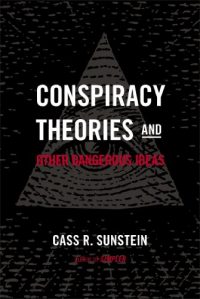
YouTube’s policy shift is the latest symptom of a larger movement by Western elites to—as Obama’s Information Czar Cass Sunstein put it—“disable the purveyors of conspiracy theories.” Sunstein and co-author Adrian Vermeule’s 2008 paper “Conspiracy Theories,” critiqued by David Ray Griffin in 2010 and developed into a 2016 book, represents a panicked reaction to the success of the 9/11 truth movement. (By 2006, 36% of Americans thought it likely that 9/11 was an inside job designed to launch wars in the Middle East, according to a Scripps poll.)
Sunstein and Vermuele begin their abstract:
Many millions of people hold (sic) conspiracy theories; they believe that powerful people have worked together in order to withhold the truth about some important practice or some terrible event. A recent example is the belief, widespread in some parts of the world, that the attacks of 9/11 were carried out not by Al Qaeda, but by Israel or the United States. Those who subscribe to conspiracy theories may create serious risks, including risks of violence, and the existence of such theories raises significant challenges for policy and law.
Sunstein argues that conspiracy theories (i.e. the 9/11 truth movement) are so dangerous that some day they may have to be banned by law. While awaiting that day, or perhaps in preparation for it, the government should “disable the purveyors of conspiracy theories” through various techniques including “cognitive infiltration” of 9/11 truth groups. Such “cognitive infiltration,” Sunstein writes, could have various aims including the promotion of “beneficial cognitive diversity” within the truth movement.
What sort of “cognitive diversity” would Cass Sunstein consider “beneficial”? Perhaps 9/11 truth groups that had been “cognitively infiltrated” by spooks posing as flat-earthers would harbor that sort of “beneficial” diversity? That would explain the plethora of expensive, high-production-values flat earth videos that have been blasted at the 9/11 truth community since 2008.
Why does Sunstein think “conspiracy theories” are so dangerous they need to be suppressed by government infiltrators, and perhaps eventually outlawed—which would necessitate revoking the First Amendment? Obviously conspiracism must present some extraordinary threat. So what might that threat be? Oddly, he never explains. Instead he briefly mentions, in vapidly nebulous terms, about “serious risks including the risk of violence.” But he presents no serious evidence that 9/11 truth causes violence. Nor does he explain what the other “serious risks” could possibly be.
Why did such highly accomplished academicians as Sunstein and Vermuele produce such an unhinged, incoherent, poorly-supported screed? How could Harvard and the University of Chicago publish such nonsense? Why would it be deemed worthy of development into a book? Why did the authors identify an alleged problem, present no evidence that it even is a problem, yet advocate outrageously illegal and unconstitutional government action to solve the non-problem?
The too-obvious answer, of course, is that they must realize that 9/11 was in fact a US-Israeli false flag operation. The 9/11 truth movement, in that case, would be a threat not because it is wrong, but because it is right. To the extent that Americans know or suspect the truth, the US government will undoubtedly find it harder to pursue various “national security” objectives. Ergo, 9/11 “conspiracy theories” are a threat to national security, and extreme measures are required to combat them. But since we can’t just burn the First Amendment overnight, we must instead take a gradual and covert “boil the frog” approach, featuring plenty of cointelpro-style infiltration and misdirection. “Cognitive infiltration” of internet platforms to stop the conspiracy contagion would also fit the bill.
It is quite possible, perhaps even likely, that Sunstein and Vermeule are indeed well-informed and Machievellian. But it is also conceivable that they are, at least when it comes to 9/11 and “conspiracy theories,” as muddle-headed as they appear. Their irrational panic could be an example of the bad thinking that emerges from groups that reflexively reject dissent. (Another, larger example of this kind of bad thinking comes to mind: America’s disastrous post-9/11 policies.)
The counterintuitive truth is that embracing and carefully listening to radical dissenters is in fact good policy, whether you are a government, a corporation, or any other kind of group. Ignoring or suppressing dissent produces muddled, superficial thinking and bad decisions. Surprisingly, this turns out to be the case even when the dissenters are wrong.
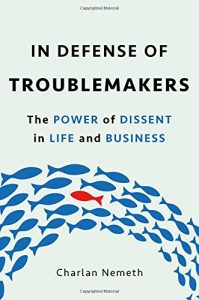
Scientific evidence for the value of dissent is beautifully summarized in Charlan Nemeth’s In Defense of Troublemakers: The Power of Dissent in Life and Business (Basic Books, 2018). Nemeth, a psychology professor at UC-Berkeley, summarizes decades of research on group dynamics showing that groups that feature passionate, radical dissent deliberate better, reach better conclusions, and take better actions than those that do not—even when the dissenter is wrong.
Nemeth begins with a case where dissent would likely have saved lives: the crash of United Airlines Flight 173 in December, 1978. As the plane neared its Portland destination, the possibility of a problem with the landing gear arose. The captain focused on trying to determine the condition of the landing gear as the plane circled the airport. Typical air crew group dynamics, in which the whole crew defers to the captain, led to a groupthink bubble in which nobody spoke up as the needle on the fuel gauge approached “E.” Had the crew included even one natural “troublemaker”—the kind of aviator who joins Pilots for 9/11 truth—there almost certainly would have been more divergent thinking. Someone would have spoken up about the fuel issue, and a tragic crash would have been averted.
Since 9/11, American decision-making elites have entered the same kind of bubble and engaged in the same kind of groupthink. For them, no serious dissent on such issues as what really happened on 9/11, and whether a “war on terror” makes sense, is permitted. The predictable result has been bad thinking and worse decisions. From the vantage point of Sunstein and Vermeule, deep inside the bubble, the potentially bubble-popping, consensus-shredding threat of 9/11 truth must appear radically destabilizing. To even consider the possibility that the 9/11 truthers are right might set off a stampede of critical reflection that would radically undermine the entire set of policies pursued for the past 17 years. This prospect may so terrify Sunstein and Vermeule that it paralyzes their ability to think. Talk about “crippled epistemology”!
Do Sunstein and Vermeule really think their program for suppressing “conspiracy theories” will be beneficial? Do YouTube’s decision-makers really believe that tweaking their algorithms to support the official story will protect us from bad information? If so, they are all doubly wrong. First, they are wrong in their unexamined assumption that 9/11 truth and “conspiracy theories” in general are “blatantly false.” No honest person with critical thinking skills who weighs the merits of the best work on both sides of the question can possibly avoid the realization that the 9/11 truth movement is right. The same is true regarding the serial assassinations of America’s best leaders during the 1960s. Many other “conspiracy theories,” perhaps the majority of the best-known ones, are also likely true, as readers of Ron Unz’s American Pravda series are discovering.
Second, and less obviously, those who would suppress conspiracy theories are wrong even in their belief that suppressing false conspiracy theories is good public policy. As Nemeth shows, social science is unambiguous in its finding that any group featuring at least one passionate, radical dissenter will deliberate better, reach sounder conclusions, and act more effectively than it would have without the dissenter. This holds even if the dissenter is wrong—even wildly wrong.
The overabundance of slick, hypnotic flat earth videos, if they are indeed weaponized cointelpro strikes against the truth movement, may be unfortunate. But the existence of the occasional flat earther may be more beneficial than harmful. The findings summarized by Nemeth suggest that a science study group with one flat earther among the students would probably learn geography and astronomy better than they would have without the madly passionate dissenter.
We could at least partially solve the real problem—bad groupthink—through promoting genuinely beneficial cognitive diversity. YouTube algorithms should indeed be tweaked to puncture the groupthink bubbles that emerge based on user preferences. Someone who watches lots of 9/11 truther videos should indeed be exposed to dissent, in the form of the best arguments on the other side of the issue—not that there are any very good ones, as I have discovered after spending 15 years searching for them!
But the same goes for those who watch videos that explicitly or implicitly accept the official story. Anyone who watches more than a few pro-official-story videos (and this would include almost all mainstream coverage of anything related to 9/11 and the “war on terror”) should get YouTube “suggestions” for such videos as September 11: The New Pearl Harbor, 9/11 Mysteries, and the work of Architects and Engineers for 9/11 Truth. Exposure to even those “truthers” who are more passionate than critical or well-informed would benefit people who believe the official story, according to Nemeth’s research, by stimulating them to deliberate more thoughtfully and to question facile assumptions.
The same goes for other issues and perspectives. Fox News viewers should get “suggestions” for good material, especially passionate dissent, from the left side of the political spectrum. MSNBC viewers should get “suggestions” for good material from the right. Both groups should get “suggestions” to look at genuinely independent, alternative media brimming with passionate dissidents—outlets like the Unz Review!
Unfortunately things are moving in the opposite direction. YouTube’s effort to make “conspiracy videos” invisible is being pushed by powerful lobbies, especially the Zionist lobby, which seems dedicated to singlehandedly destroying the Western tradition of freedom of expression.
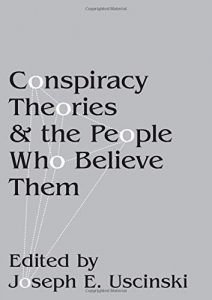
Nemeth and colleagues’ findings that “conspiracy theories” and other forms of passionate dissent are not just beneficial, but in fact an invaluable resource, are apparently unknown to the anti-conspiracy-theory cottage industry that has metastasized in the bowels of the Western academy. The brand-new bible of the academic anti-conspiracy-theory industry is Conspiracy Theories and the People Who Believe Them (Oxford University Press, 2019).
Editor Joseph Uscinski’s introduction begins by listing alleged dangers of conspiracism: “In democracies, conspiracy theories can drive majorities to make horrible decisions backed by the use of legitimate force. Conspiracy beliefs can conversely encourage abstention. Those who believe the system is rigged will be less willing to take part in it. Conspiracy theories form the basis for some people’s medical decisions; this can be dangerous not only for them but for others as well. For a select few believers, conspiracy theories are instructions to use violence.”
Uscinski is certainly right that conspiracy theories can incite “horrible decisions” to use “legitimate force” and “violence.” Every major American foreign war since 1846 has been sold to the public by an official theory, backed by a frenetic media campaign, of a foreign conspiracy to attack the United States. And all of these Official Conspiracy Theories (OCTs)—including the theory that Mexico conspired to invade the United States in 1846, that Spain conspired to sink the USS Maine in 1898, that Germany conspired with Mexico to invade the United States in 1917, that Japan conspired unbeknownst to peace-seeking US leaders to attack Pearl Harbor in 1941, that North Vietnam conspired to attack the US Navy in the Gulf of Tonkin in 1964, and that 19 Arabs backed by Afghanistan, Iraq, Iran, and everybody else Israel doesn’t like conspired to attack the US in 2001—were false or deceptive.
Well over 100 million people have been killed in the violence unleashed by these and other Official Conspiracy Theories. Had the passionate dissenters been heeded, and the truths they told about who really conspires to create war-trigger public relations stunts been understood, none of those hundred-million-plus murders need have happened.
Though Conspiracy Theories and the People Who Believe Them generally pathologizes the conspiracy theories of dissidents while ignoring the vastly more harmful theories of official propagandists, its 31 essays include several that question that outlook. In “What We Mean When We Say ‘Conspiracy Theory’ Jesse Walker, books editor of Reason Magazine, exposes the bias that permeates the field, pointing out that many official conspiracy theories, including several about Osama Bin Laden and 9/11-anthrax, were at least as ludicrously false and delusional as anything believed by marginalized dissidents.
In “Media Marginalization of Racial Minorities: ‘Conspiracy Theorists’ in U.S. Ghettos and on the ‘Arab Street’” Martin Orr and Gina Husting go one step further: “The epithet ‘conspiracy theorist’ is used to tarnish those who challenge authority and power. Often, it is tinged with racial undertones: it is used to demean whole groups of people in the news and to silence, stigmatize, or belittle foreign and minority voices.” (p.82) Unfortunately, though Orr and Husting devote a whole section of their article to “Conspiracy Theories in the Muslim World” and defend Muslim conspiracists against the likes of Thomas Friedman, they never squarely face the fact that the reason roughly 80% of Muslims believe 9/11 was an inside job is because the preponderance of evidence supports that interpretation.
Another relatively sensible essay is M R.X. Dentith’s “Conspiracy Theories and Philosophy,” which ably deconstructs the most basic fallacy permeating the whole field of conspiracy theory research: the a priori assumption that a “conspiracy theory” must be false or at least dubious: “If certain scholars (i.e. the majority represented in this book! –KB) want to make a special case for conspiracy theories, then it is reasonable for the rest of us to ask whether we are playing fair with our terminology, or whether we have baked into our definitions the answers to our research programs.” (p.104). Unfortunately, a few pages later editor Joseph Uscinski sticks his fingers in his ears and plays deaf and dumb, claiming that “the establishment is right far more often than conspiracy theories, largely because their methods are reliable. When conspiracy theorists are right, it is by chance.” He adds that conspiracy theories will inevitably “occasionally lead to disaster” (whatever that means). (p.110).
I hope Uscinski finds the time to read Nemeth’s In Defense of Troublemakers and consider the evidence that passionate dissent is helpful, not harmful. And I hope he will look into the issues Ron Unz addresses in his American Pravda series.
Then again, if he does, he may find himself among those of us exiled from the academy and publishing in The Unz Review.
Putin meeting with Foreign Minister Lavrov and Defence Minister Shoigu on INF Treaty
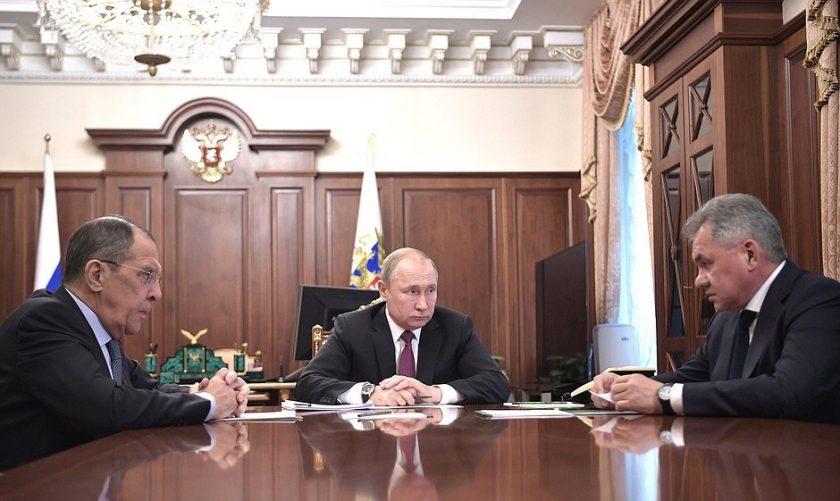
Russian President Vladimir Putin with Foreign Minister Sergei Lavrov (left) and Defence Minister Sergei Shoigu.
The Kremlin, Moscow | February 2, 2019
President of Russia Vladimir Putin: Foreign Minister Sergei Lavrov, please provide an update on the Treaty on the Elimination of Intermediate-Range and Shorter-Range Missiles, and the disarmament dossier in general. What is going on in terms of limitation of offensive arms?
Foreign Minister Sergei Lavrov: Mr President,
Regarding the Intermediate-Range Nuclear Forces Treaty, as you know, it has been in force since 1988. It had an indefinite term. According to the information at our disposal, the United States has been violating the Treaty since 1999, when it started testing combat unmanned aerial vehicles that have the same characteristics as land-based cruise missiles banned by the Treaty.
The United States went on to use ballistic target missiles for testing their missile defence system, and in 2014 they began the deployment in their missile defence system positioning areas in Europe of Mk 41 vertical launching systems. These launchers are fully suitable as they are for Tomahawk intermediate-range attack missiles.
Vladimir Putin: And this is an outright violation of the Treaty.
Sergei Lavrov: This is an outright violation of the Treaty. Launchers of this kind have already been deployed in Romania, and preparations are underway to deploy them in Poland, as well as Japan.
Another matter of concern for us is that only recently, just a year ago, the United States in its 2018 Nuclear Posture Review set the task of developing low-yield nuclear weapons, and it is probable that intermediate-range missiles will serve as a means of delivery for these weapons. It was also announced only recently that this provision of the US nuclear doctrine is beginning to materialise with missiles of this kind entering production.
In October 2018, the United States officially declared its intention to withdraw from the Treaty on the Elimination of Intermediate-Range and Shorter-Range Missiles. We did everything we could to save the Treaty considering its importance in terms of sustaining strategic stability in Europe, as well as globally. The last attempt of this kind was undertaken on January 15, when the US finally agreed to our request for holding consultations in Geneva.
In coordination with the Defence Ministry, we proposed unprecedented transparency measures that went far beyond our obligations under the INF Treaty in order to persuade the US that Russia was not in violation of this essential instrument. However, the US torpedoed these proposals. Instead, the US presented yet another ultimatum. It is obvious that we cannot accept it since it contradicts the INF Treaty in both letter and spirit.
The US announced that it was suspending its participation in the INF Treaty, launched the official withdrawal from it, and said that it will no longer consider itself restricted by the INF Treaty. As far as we can see, this means that the US will make missiles in addition to engaging in research and development activities that have already been factored into the current budget.
There is no doubt that these developments make things worse overall in the sphere of nuclear disarmament and strategic stability. It all started with the 1972 Anti-Ballistic Missile Treaty, when the US decided to withdraw from it in 2002, as you know all too well. This was done despite numerous initiatives by the Russian Federation at the UN General Assembly to save the ABM Treaty. The UN General Assembly passed a number of resolutions supporting the ABM Treaty. However, this did not stop the United States from withdrawing from it.
As a partial replacement for the ABM Treaty, the US and Russia signed a joint declaration that same year, 2002, on new strategic relations with a promise to settle all issues related to the so-called third positioning area of the missile-defence system being deployed in Europe at the time. The declaration provided for holding consultations as a way to reach common ground. This did not happen due to the unwillingness of the United States to take up Russia’s concerns in earnest.
In 2007, we made another gesture of good will at your instructions by coming forward with an initiative that consisted of working together to resolve the problems related to US missile defence system’s third positioning area in Europe. Once again, the US backed out of this proposal.
However, at the Russia-NATO Summit in Lisbon in 2010, we once again called for Russia, the US and Europe to work together on a continental missile-defence system. This call was not heeded. Nevertheless, two years later, in 2012, at the NATO Summit in Chicago it was NATO that called for dialogue with Russia on missile defence. However, all this good will boiled down to the US insisting that we simply come to terms with their missile defence approach, despite all the obvious risks and threats to our security posed by this approach.
Let me remind you that in 2013 Russia once again called on the US Department of State to open consultations, and came forward with concrete proposals. There was no reply. And in 2014, the United States brought the dialogue on missile defence to a halt and declared the intention to deploy its positioning areas in Europe and Asia, while also strengthening other systems, including in Alaska and on the east coast.
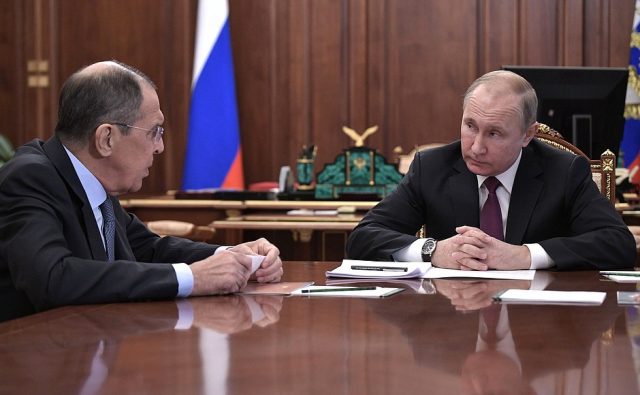
With Foreign Minister Sergei Lavrov.
Talking about other essential international security and strategic stability instruments, the approach adopted by the United States to performing its commitments under the universal Treaty on the Non-Proliferation of Nuclear Weapons has been a matter of concern for Russia. In fact, despite numerous reminders on our part, the United States commits serious violations of the Treaty in its actions within NATO. The Treaty commits nuclear powers to refrain from transferring the corresponding nuclear technologies.
Despite these provisions, NATO engages in so-called joint nuclear missions whereby the United States together with five NATO countries where US nuclear weapons are deployed conduct nuclear weapons drills with countries that are not part of the five nuclear-weapons states. This is a direct violation of the Non-Proliferation Treaty.
Another treaty that had a special role in removing the threat of nuclear war, or, to be more precise, whose preparation was a source of hope for addressing these threats, was the Comprehensive Nuclear-Test-Ban Treaty [CTBT]. The United States did not ratify it even though doing so was among Barack Obama’s campaign promises when he ran for president.
Right now, this instrument is completely off the radar, since the United States has lost all interest in any consultations on joining this Treaty. Being a party to the CTBT and acting in good faith, Russia holds special events at the UN General Assembly every year in order to promote the Treaty and mobilise public opinion in favour of its entry into force, which requires the United States to join it, among other things.
Apart from the INF Treaty, there is the Strategic Offensive Arms Treaty [START] that remains in force. It is also essential for preserving at least some measure of strategic stability and global parity. It is also under threat, since its effective functioning has come into question after the recent move by the United States to remove from accountability under the treaty 56 submarine based Trident launchers and 41 heavy bombers by declaring them converted into nun-nuclear.
This is possible under the treaty, but the other party has the right to make sure that once converted these weapons cannot be reconverted back into nuclear arsenals.
Vladimir Putin: An inspection has to be carried out.
Sergei Lavrov: Yes, an inspection. And there have to be technical means to persuade us that these systems cannot be reconverted and returned into the nuclear arsenal.
We have been holding talks since 2015 to make sure that the United States complies with its obligations on this matter. So far, there have been no results. The technical solutions we have been offered so far cannot persuade us that more than 1,200 warheads, which is an enormous amount, cannot be returned to the nuclear arsenal. Unfortunately, repeated proposals by Russia to launch talks on extending the Strategic Offensive Arms Treaty beyond 2021, when its first term is set to expire, have fallen on deaf ears in the United States. All we hear is that the decision on the New START has yet to be taken.
All in all, the situation is quite alarming. Let me reiterate that the decision taken by the United States on the INF Treaty is of course a matter of serious concern for the entire world, especially for Europe. Nevertheless, the Europeans followed in the footsteps of the United States with all NATO members speaking out in explicit support of the position adopted by the United States to refrain from any discussions on mutual concerns. All we hear are groundless ultimatums requiring us to take unilateral measures without any evidence to support unfounded accusations.
Vladimir Putin: Thank you.
Mr Shoigu, what is the Defence Ministry’s view on the current situation? And what do you propose in this regard?
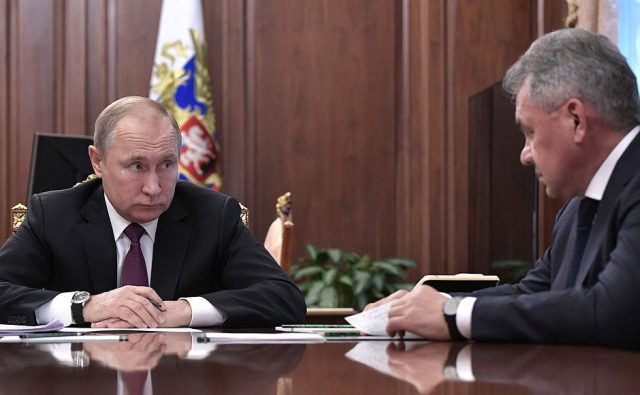
With Defence Minister Sergei Shoigu.
Defence Minister Sergei Shoigu: Mr President, it is obvious to us, despite the murky language that we hear, that apart from openly conducting research and development on the production of intermediate-range and shorter-range missiles, there have been actual violations of the INF Treaty, and this has been going on for several years. To put it simply, the United States has started producing missiles of this kind.
In this connection, we have the following proposals regarding retaliatory measures.
First, we propose launching in the coming months research and development, as well as development and engineering with a view to creating land-based modifications of the sea-based Kalibr launching systems.
Second, we propose launching research and development, followed by development and engineering to create land-based launchers for hypersonic intermediate-range and shorter-range missiles.
We ask you to support these proposals.
Vladimir Putin: I agree. This is what we will do. Our response will be symmetrical. Our US partners announced that they are suspending their participation in the INF Treaty, and we are suspending it too. They said that they are engaged in research, development and design work, and we will do the same.
I agree with the Defence Ministry’s proposals to create a land-based version of the Kalibr launchers and work on a new project to develop a land-based hypersonic intermediate-range missile.
At the same time, I would like to draw your attention to the fact that we must not and will not let ourselves be drawn into an expensive arms race. I wanted to ask you, would it be possible to finance these initiatives using the existing budget allocations to the Defence Ministry for 2019 and the following years?
Sergei Shoigu: Mr President, we closely studied this matter, and will propose adjustments to the 2019 budget in order to be able to carry out these initiatives within the limits set by the state armaments programme and the defence procurement orders for 2019 without going over budget.
Vladimir Putin: This should not entail any increases in the Defence Ministry’s budget.
Sergei Shoigu: Yes.
Vladimir Putin: Good.
In this connection, there is one more thing I wanted to ask you. Every six months we hold meetings in Sochi to discuss the implementation of the state defence order with the commanders of the Armed Forces and the defence sector representatives.
Starting this year, I propose modifying this format. I want to see how efforts to deploy our systems are progressing. This refers to the Kinzhal hypersonic air-launched ballistic missile, the Peresvet combat laser weapon, which has already been delivered to the army, and the Avangard system, which is now in serial production, having completed the test phase. I want to see how the production of the Sarmat missile is advancing alongside preparations for placing it on combat duty.
Several days ago, you reported to me on the completion of a key stage in testing the Poseidon multipurpose strategic unmanned underwater vehicle. We have to look at how these efforts are advancing.
We are aware of the plans by some countries to deploy weapons in outer space. I want to hear a report on how this threat can be neutralised.
There is another important topic I wanted to raise with both the Foreign Ministry and the Defence Ministry.
For many years, we have been calling on numerous occasions for holding meaningful disarmament talks on almost all aspects of this matter. In recent years, we have seen that our partners have not been supportive of our initiatives. On the contrary, they always find pretexts to further dismantle the existing international security architecture.
In this connection, I would like to highlight the following considerations, and I expect the Foreign Ministry and the Defence Ministry to use them as guidance. All our proposals in this area remain on the table just as before. We are open to negotiations. At the same time, I ask both ministries not to initiate talks on these matters in the future. I suggest that we wait until our partners are ready to engage in equal and meaningful dialogue on this subject that is essential for us, as well as for our partners and the entire world.
Another important consideration I would like to share with the senior officials of both ministries. We proceed from the premise that Russia will not deploy intermediate-range or shorter-range weapons, if we develop weapons of this kind, neither in Europe nor anywhere else until US weapons of this kind are deployed to the corresponding regions of the world.
I ask the Foreign Ministry and the Defence Ministry to closely monitor developments and promptly submit proposals on ways to respond.
Russia Suspends INF Deal With US, Putin Directs Ministers Not to Start New Talks
RT | February 2, 2019
President Vladimir Putin says Moscow is halting its participation in the Cold War-era INF nuclear agreement after Washington’s decision to suspend it. Russia will develop missiles previously forbidden under its terms.
“Ours will be a mirror response. Our US partners say that they are ceasing their participation in the treaty, and we are doing the same,” the Russian president said in Moscow on Saturday in reference to the Intermediate-Range Nuclear Forces Treaty (INF).
“They say that they are doing research and testing [on new weapons] and we will do the same thing,” Putin said during a meeting with Foreign Minister Sergey Lavrov and Defense Minister Sergey Shoigu.
The Russian leader emphasized that while Moscow’s offers on modernizing the 1987 treaty and making it more transparent “are still on the table,” no more talks should be initiated with the Americans to try and save it.
“Let’s wait until our partners mature sufficiently to hold a level, meaningful conversation on this topic, which is extremely important for us, them, and the entire world,” Putin said.
In December, the Trump administration threatened to quit the agreement, which limits nuclear and conventional land-launched missiles with a range between 500 and 5,500km within 60 days, unless Russia stopped allegedly violating it with its 9M729 missile, which Washington claims exceeds the permitted range.
Moscow denied that it had broken the treaty, and offered additional mutual inspections during failed talks in Geneva last month. On February 1, Washington officially confirmed that the bilateral agreement signed by Mikhail Gorbachev and Ronald Reagan will be suspended for 180 days. Washington also signaled intentions to entirely withdraw from it afterwards.
‘US directly violated INF’
During the meeting in front on the cameras on Saturday, Lavrov insisted that Moscow “attempted to do everything we could to rescue the treaty.” This included “unprecedented steps going far beyond our obligations,” he said, accusing Washington of systematically undermining the INF Treaty at least since the late 1990s.
In particular, Washington started “testing drones that matched the characteristics” of ground-based cruise missiles banned in the treaty.
Later, the US “installed MK 41 launching systems for the defense shield in Europe that can be used to fire mid-range Tomahawk cruise missiles without any modification.”
“This is a direct a violation of the INF,” Putin interjected.
“Such launchers have already been completed in Romania, more are scheduled to be put into service in Poland and Japan,” Lavrov said.
Shoigu went further, saying that despite vague formulations the US has barely concealed that it is “not just conducting research on short and medium-range missiles.”
To put it simply, the US has already begun producing these rockets.
Putin said the collapse of the INF is not a one-off, but marks a deliberate policy by Washington that could imperil the landmark New START treaty, which expires in 2021.
“Over many years, we have repeatedly suggested staging new disarmament talks, on all types of weapons. Over the last few years, we have seen our initiatives not supported. On the contrary, pretexts are constantly sought to demolish the existing system of international security,” President Putin said.
Goodbye ‘Freedom and Democracy’ – Hello ‘Rules-based International Order’
By Paul Carline | OffGuardian | February 2, 2019
The banner and the clarion call of western countries, and their own asserted legitimation – especially when they are engaging in illegal wars and coups – used to be “freedom and democracy”: the precious gift they were generously and selflessly offering to a backward world – or one allegedly in the ‘chains’ of Socialism/Communism. There was “Radio Free Europe”, for example, pushing out western liberal propaganda, primarily against the countries of the former Soviet Union.
The Washington-based “Freedom House” organisation, which claims to be independent, has around 150 staff members in Washington and in ‘field offices’ around the world. Its President is Michael J. Abramowitz, who before joining Freedom House in 2017, was director of the US Holocaust Memorial Museum’s Levine Institute for Holocaust Education. Before that, he was National Editor and then White House correspondent for the Washington Post. He is a member of the Council on Foreign Relations and a former fellow at the German Marshall Fund and the Hoover Institution. He is also a board member of the National Security Archive. The Board of Trustees is chaired by Michael Chertoff, Secretary of Homeland Security under George W. Bush and co-author of the USA Patriot Act.
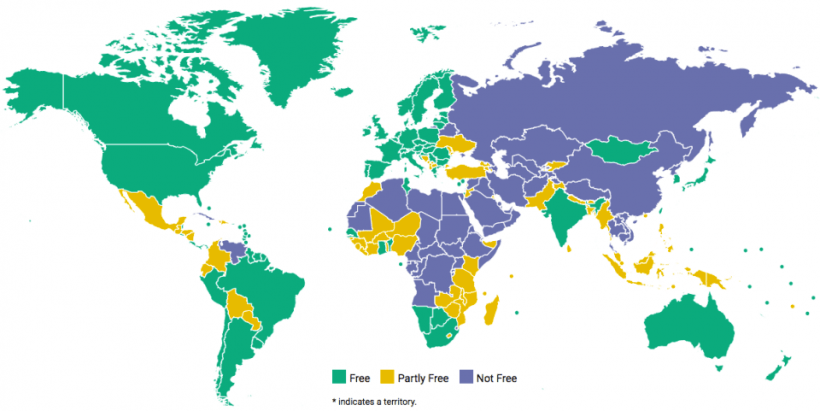
Since 1972, Freedom House, whose website sports a warm endorsement by none other than Francis Fukuyama, has produced an annual “Freedom in the World” global map (above), which divides the world into countries which are either “free”, “partly free”, or “not free”. The allegedly “free” countries are coloured green, the “partly free” ones a kind of muddy yellow, and the “not free” ones blue.
Its analysis of “freedom” covers “the electoral process, political pluralism and participation, the functioning of government, freedom of expression and belief, rights of association and organization, the rule of law, and personal autonomy and individual rights”. The word ‘democracy’ is not used in the ratings system, nor is it defined anywhere, but the 2018 analysis is headlined “Democracy in Crisis”.
According to Freedom House, in 2018 45% of the world (by country) or 39% (by population) was “free”, 30% (country) or 24% (population) was “partly free”, and 25%/37% “not free”. Countries are rated on a percentage points system. Sweden, which last year joined in the NATO ‘war games’ – despite not being a NATO member – is given a full 100 points, Canada 99, Uruguay 98, both Chile and the UK 94, France a completely undeserved 90, the USA 86 and Israel an unreal 79. By contrast, China scores 14, Iran 17, and Russia a mere 20, while Tibet and Syria are granted only 1 point each (no bias there). Almost incredibly, Ukraine scores 62 – allowing it to be rated as “partly free”! Very oddly, the FAQ section is available in only two languages – English and Ukrainian!
I suspect that the statement by Freedom House’s President, Michael J. Abramowitz, to the effect that: “A quarter-century ago, at the end of the Cold War, it appeared that totalitarianism had at last been vanquished and liberal democracy had won the great ideological battle of the 20th century”, must induce wry smiles – if not outright anger – in many Off-Guardian readers. Abramowitz predictably refers to “the rise of populist leaders who appeal to anti-immigrant sentiment and give short shrift to fundamental civil and political liberties” and describes “newcomer Emmanuel Macron” as a “centrist” who “handily” (interesting choice of words!) won the French presidency.
Depressingly predictable is his comment on China and Russia, which he labels “the world’s leading autocracies” and which he asserts “have seized the opportunity not only to step up internal repression but also to export their malign influence to other countries, which are increasingly copying their behaviour and adopting their disdain for democracy” (emphasis added; no mention of the massive ‘disdain for democracy’ in the USA, UK, and numerous members of the EU).
According to Abramowitz, “Democratic governments allow people to help set the rules to which all must adhere, and have a say in the direction of their lives and work!” If that were true, there would be lots of direct democracy in all those “free” countries. It’s true that there is some ‘direct democracy’, e.g. popular initiatives and referendums, in a few states of the USA and in a few European countries – with Switzerland far and away the best example, followed by Germany at the regional and local levels, thanks to the efforts over decades of its leading pro-democracy organisation “Mehr Demokratie”, which has been trying to have direct democratic rights established also at the national level, which would really allow the people to “help set the rules”. Germany’s “Basic Law” (it doesn’t have a proper constitution for reasons which I cannot go into here but which will be known to many) actually states: “All power derives from the people” (Article 20) and “State power is exercised by the people in elections and referendums” (emphasis added) – but successive governments have refused to enact the laws that would allow state-level referendums, presumably because they fear the “people power” that is the literal meaning of ‘democracy’.
Given subsequent developments, Kofi Annan’s 2001 Nobel Peace Prize acceptance speech now strikes a sour note:
“The obstacles to democracy have little to do with culture or religion, and much more to do with the desire of those in power to maintain their position at any cost. This is neither w new phenomenon nor one confined to any particular part of the world. People of all cultures value their freedom of choice and feel the need to have a say in the decisions affecting their lives”
In the 2002 UNDP World Development Report, Annan re-affirmed the true nature of democracy in these words:
“True democratization means more than elections. People’s dignity requires that they be free – and able – to participate in the formation and stewardship of the rules and institutions that govern them”.
According to Abramovitch’s definition, and that of Kofi Annan, there is zero genuine democracy in the U.K. (a purely representative system – especially one still using an outdated and wholly disreputable FPTP system, with rare referendums arranged by the government, which sets the question – is not a legitimate form of democracy).
We may also ask, in parenthesis as it were, who – if not the electorates – is “helping to set the rules”, for example in Europe specifically. As of July 2017, there were 11,327 registered lobby organisations in the EU, employing some 82,096 people – the equivalent of 50,326 full-time personnel – of which nearly 7,000 have access to the Parliament. In Germany there are around eight lobbyists – representing ‘outside’ interests – for every member of the national parliament – and the lobby registers are voluntary. Only seven countries (France, Ireland, Lithuania, Austria, Poland, Slovenia and the UK) have passed any laws on lobbying.
What is extremely interesting and telling is the general absence of references to ‘freedom and democracy’ by our so-called ‘leaders’. Those words have been replaced in the political lexicon by the now clearly favoured expression “the rules-based international order” – which doesn’t have quite the same ring, or the same connotations, as “freedom and democracy”.
One is forced to ask: whose order? whose rules? If Abramowitz is correct, and since we are privileged enough to live in a country which, if we are to believe its FH rating, is little short of perfect, we the people must have been involved in setting those rules. We should at least have been told what they mean! For example, what does ‘international’ mean in this context? It suggests a global compact – but when it is used it specifically excludes certain countries and regimes which we are led to believe are not part of, or indeed are allegedly trying to undermine, this new ‘order’.
Although the word ‘international’ is often taken to be a synonym for ‘global’ or ‘universal’, its literal meaning is ‘between nations’. The UN has of course long promulgated and endorsed all kinds of ‘universal’ rules (the ICC rules on aggression for instance) – many of which are routinely flouted by the countries which most loudly lay claim to being ‘democracies’ and loyal observers of the “rules-based international order”.
But we are now seeing a new type of literally ‘inter-national’ agreements being made in Europe, often merely between two governments at a time (with no democratic endorsement by either parliaments or people) and where the suspicion is that this is a new way of hiding from the general public what is really going on in Europe – specifically the step-by-step implementation of the “United States of Europe” project which dates from at least 1946.
There seems to be an undue haste to complete the creation of a unified military establishment that would not be answerable to the individual nation states which are contributing their forces (and infrastructure!) and which would also appear to include a much closer working relationship between military and police forces. Does the urgency have to do with the level of chaos in Europe and the threat – now materialised in the form of the “Yellow Vest” protests – of widespread civil unrest and potentially public revolt?
So Prime Minister Theresa May can pretend to the public that the ‘Brexit’ approved by a majority of voters will take place i.e. that Britain will “come out of” the EU, while at the same time, and largely in secret or behind closed doors in completely undemocratic meetings, the government is committing the entire UK military establishment, step by step, to the new ‘unified European defence establishment’. The UK enters into a special relationship with France (and thereby with the EU). France and Germany have just signed a new treaty – the Aachen Treaty – so does the UK automatically acquire the special relationship with Germany? And will this “two-step” approach eventually link all willing states (one could imagine Hungary, perhaps Italy and Greece also, not being so willing) in the ‘new European order’?
In struggling to understand the “rules-based international order” I found this definition by the RAND Corporation very helpful:
Since 1945, the United States has pursued its global interests through creating and maintaining international economic institutions, bilateral and regional security organizations, and liberal political norms; these ordering mechanisms are often collectively referred to as the international order.
In recent years, rising powers have begun to challenge aspects of this order. This report is part of a project, titled “Building a Sustainable International Order,” that aims to understand the existing international order, assess current challenges to the order, and recommend future US policies with respect to the order.
This report is the first of those and reflects the project team’s attempt to understand the existing international order, including how US decision makers have described and used the order in conducting foreign policy, as well as how academics have assessed the mechanisms by which the order affects state behaviour.
When discussing policy responses to a fraying international order, the first challenge is to understand what we mean by the term. Order has various meanings in the context of international politics, and specific orders can take many forms.1 For the purposes of this project, we conceive of order as the body of rules, norms, and institutions that govern relations among the key players in the international environment. An order is a stable, structured pattern of relationships among states that involves some combination of parts, including emergent norms, rulemaking institutions, and international political organizations or regimes, among others.
– RAND Corporation 2016, Understanding the Current International Order
This more recent observation was both insightful and amusing:
“The rules-based international order is being challenged, quite surprisingly, not by the usual suspects, but by its main architect and guarantor, the US,” Donald Tusk, the president of the European Council, said as the summit meeting got underway in Quebec’s picturesque resort town of La Malbaie on the banks of the St. Lawrence River.
The trans-Atlantic rift manifested itself in a behind-the-scenes debate about the wording of the traditional summit communiqué. The American side objected to including the phrase “rules-based international order,” even though it is boilerplate for such statements, according to two people briefed on the deliberations. The Europeans and Canadians were pushing back, but it remained unclear whether the Trump administration would ultimately sign the statement or be left on its own.
– NYT June 8, 2018 Michael D. Shear
So the ‘rules-based international order’ is, in reality, the expression of America’s “global interests”. Other parties – such as British and other governments – may be allowed to put on the mask of the Eagle, whilst claiming to be on the side of justice, truth, human rights … and yes, democracy. And since it’s a US construct, the US and its allies can feel free to ‘make it up as they go along’.
India wades into Afghan peace talks

(Russian Foreign Minister Sergey Lavrov greeting Taliban officials at Moscow peace conference, November 2018)
By M. K. BHADRAKUMAR | Indian Punchline | February 1, 2019
The Ministry of External Affairs spokesman’s remark on Thursday in New Delhi that “it is important that the presidential election in Afghanistan takes place as per the schedule” is the first major Indian comment on the current peace talks in Qatar between the United States and the Taliban.
Whether that was an off-the-cuff remark or not remains unclear, but if it has been a considered statement, it puts India at odds with the peace talks in Qatar, which is working toward commencing the intra-Afghan dialogue, forming an interim government in Kabul and declaring a nation-wide ceasefire. Arguably, India’s strong advocacy of the charade of a presidential election in Afghanistan at this juncture is tantamount to the debunking of what is happening at the Qatar talks.
The point is, the Indian stance is virtually identifying with the ‘rejectionist’ camp of Afghan opinion, which fears that the reconciliation with the Taliban will mean the end of the road for them. This camp principally consists of President Ashraf Ghani and his circle – his newfound associate Amrullah Saleh, in particular – who are justifiably nervous about their own political future if the peace talks at Qatar advance toward the formation of an interim government.
But why should India try to bolster their career prospects? It may create misperceptions that India has ulterior motives. Clearly, the conditions in Afghanistan do not allow the holding of the presidential election. Even if the election is held, its credibility will be in serious doubt. The result of the election is almost inevitably going to be hotly contested. Quite obviously, the recent parliamentary election tells a sordid story. The political legitimacy of the “victor” in any presidential election will remain highly suspect. Even Ghani’s government was formed 5 years ago only after protracted efforts by the US to work out a compromise formula of power sharing.
In fact, much of the present crisis in Afghanistan is to be directly attributed to the weak government in Kabul that lacked political legitimacy and popular support, and to its leadership that is widely perceived as an American concoction. What is the point in repeating such a futile experiment? As it is, Afghanistan is hopelessly fragmented and another Ghani as its next figurehead and another puppet regime in Kabul can only spell doom for the country.
The fact of the matter is that the Afghan government is not at all representative of the nation. The latest Russian initiative to convene a conference of the Taliban representatives and prominent Afghan politicians in Moscow next week underscores the political undercurrents in Afghanistan today. Reuters has quoted a Russian official as saying, “Senior Taliban leaders and prominent Afghan politicians will travel to Moscow for a day-long summit. At this sensitive stage, it was best to not have Afghan government officials at the table.”
Interestingly, the Afghan personalities who may take part in the conference in Moscow on this coming Tuesday include former President Hamid Karzai. Whatever the Russian motivations might be in taking such an initiative, it only highlights that Ghani’s camp is fast becoming irrelevant to any serious intra-Afghan dialogue involving the Taliban and other Afghan groups.

(Pakistan Foreign Minister Shah Mehmood Qureshi with Russian Special Representative on Afghanistan Zamir Kabulov, Islamabad, Jan 29, 2019)
It goes without saying that the Russian initiative is in tandem with Pakistan following the visit by the Russian special representative on Afghanistan Zamir Kabulov to Islamabad on January 29. Ironically, Russia is facilitating the first round of intra-Afghan dialogue with Pakistan’s tacit support and Taliban’s readiness to participate in it. Ghani is not going to like that he has been bypassed and ignored. But then, if the international community has not so far questioned his locus standii, it was out of decorum and/or courtesy, but a time has come when Russians obviously decided that enough is enough.
Ghani was entirely an American creation and he lacks a support base. His tactic is to gather around him a cabal of figures who, like him, also stand to lose in peace settlement. He may try to be a ‘spoiler’ but ultimately, he will be overtaken by events and cast aside. Simply put, he is of no more use to the Americans who will discard him sooner rather than later. The case of Saleh is equally pathetic. The Americans built up Saleh for certain specific assignments related to security and they may cut him loose once he ceases to be of use to them. Unsurprisingly, Ghani and Saleh are now left with no option but to blow the nationalist bugle to rally support among patriotic Afghans, but that won’t impress anybody – neither the Afghans nor the international community.
Why should India get embroiled in the shenanigans of the ‘rejectionist’ camp in Kabul? True, the Modi government too would have a sense of ‘betrayal’ – that after having been the US’ loyal supporter in Afghanistan, India finds itself in a cul-de-sac. But the fault lies entirely with Delhi. The Modi government viewed Afghanistan through the prism of India-Pakistan tensions and Kashmir and the zero sum mindset has damaged Indian interests and brought about the current isolation.
Without doubt, President Trump intends to withdraw the troops from Afghanistan. And without American support, the roof will come crashing down on the head of Ghani, Saleh, et al, within no time. Delhi should be realistic about its capabilities and, more importantly, be mindful of its limitations. Does India have the grit and the resources to swim against the current? Only fools rush in where angels fear to tread.
Let bygones be bygones. Delhi should not compound the folly. The prudent thing will be to refrain from being a ‘spoiler’ at this sensitive juncture. Let the peace talks proceed ahead. What is needed on India’s part is strategic patience. Its Manichean fear that Pakistan is about to conquer Kabul has no basis. Pakistan knows Afghans only too well not to harbor any such illusions.
On the other hand, Afghanistan is India’s neighbor and there is abiding goodwill toward our country on the part of the Afghan people. A new beginning is always possible and India can safeguard its core interests by building bridges with the new regime.
Your Complete Guide to the NY Times’ Support of US-Backed Coups in Latin America
By Adam H. JOHNSON | TruthDig | January 29, 2019
On Friday, The New York Times continued its long, predictable tradition of backing U.S. coups in Latin America by publishing an editorial praising Donald Trump’s attempt to overthrow Venezuelan President Nicolas Maduro. This will be the 10th such coup the paper has backed since the creation of the CIA over 70 years ago.
A survey of The New York Times archives shows the Times editorial board has supported 10 out of 12 American-backed coups in Latin America, with two editorials—those involving the 1983 Grenada invasion and the 2009 Honduras coup—ranging from ambiguous to reluctant opposition. The survey can be viewed here.
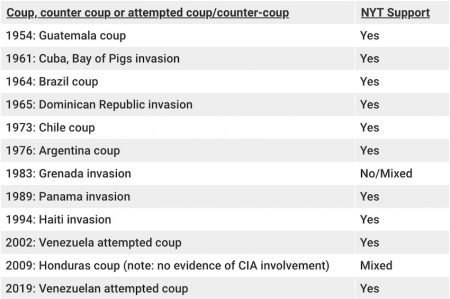
Covert involvement of the United States, by the CIA or other intelligence services, isn’t mentioned in any of the Times’ editorials on any of the coups. Absent an open, undeniable U.S. military invasion (as in the Dominican Republic, Panama and Grenada), things seem to happen in Latin American countries entirely on their own, with outside forces rarely, if ever, mentioned in the Times. Obviously, there are limits to what is “provable” in the immediate aftermath of such events (covert intervention is, by definition, covert), but the idea that the U.S. or other imperial actors could have stirred the pot, funded a junta or run weapons in any of the conflicts under the table is never entertained.
More often than not, what one is left with, reading Times editorials on these coups, are racist, paternalistic “cycle of violence” cliches. Sigh, it’s just the way of things Over There. When reading these quotes, keep in mind the CIA supplied and funded the groups that ultimately killed these leaders:
- Brazil 1964: “They have, throughout their history, suffered from a lack of first class rulers.”
- Chile 1973: “No Chilean party or faction can escape some responsibility for the disaster, but a heavy share must be assigned to the unfortunate Dr. Allende himself.”
- Argentina 1976: “It was typical of the cynicism with which many Argentines view their country’s politics that most people in Buenos Aires seemed more interested in a soccer telecast Tuesday night than in the ouster of President Isabel Martinez de Perlin by the armed forces. The script was familiar for this long‐anticipated coup.”
See, it didn’t matter! It’s worth pointing out the military junta put in power by the CIA-contrived coup killed 10,000 to 30,000 Argentines from 1976 to 1983.
There’s a familiar script: The CIA and its U.S. corporate partners come in, wage economic warfare, fund and arm the opposition, then the target of this operation is blamed. This, of course, isn’t to say there isn’t merit to some of the objections being raised by The New York Times—whether it be Chile in 1973 or Venezuela in 2019. But that’s not really the point. The reason the CIA and U.S. military and its corporate partisans historically target governments in Latin America is because those governments are hostile to U.S. capital and strategic interests, not because they are undemocratic. So while the points the Times makes about illiberalism may sometimes be true, they’re mostly a non sequitur when analyzing the reality of what’s unfolding.
Did Allende, as the Times alleged in 1973 when backing his violent overthrow, “persist in pushing a program of pervasive socialism” without a “popular mandate”? Did, as the Times alleged, Allende “pursue this goal by dubious means, including attempts to bypass both Congress and the courts”? Possibly. But Allende’s supposed authoritarianism isn’t why the CIA sought his ouster. It wasn’t his means of pursuing redistributive policies that offended the CIA and U.S. corporate partners; it was the redistributive policies themselves.
Hand-wringing over the anti-democratic nature of how Allende carried out his agenda without noting that it was the agenda itself—not the means by which it was carried out—that animated his opponents is butting into a conversation no one in power is really having. Why, historically, has The New York Times taken for granted the liberal pretexts for U.S. involvement, rather than analyzing whether there were possibly other, more cynical forces at work?
The answer is that rank ideology is baked into the premise. The idea that the U.S. is motivated by human rights and democracy is taken for granted by The New York Times editorial board and has been since its inception. This does all the heavy lifting without most people—even liberals vaguely skeptical of American motives in Latin America—noticing that a sleight of hand has taken place. “In recent decades,” a 2017 Times editorial scolding Russia asserted, “American presidents who took military action have been driven by the desire to promote freedom and democracy, sometimes with extraordinary results.” Oh, well, good then.
What should be a conversation about American military and its covert apparatus unduly meddling in other countries quickly becomes a referendum on the moral properties of those countries. Theoretically a good conversation to have (and one certainly ongoing among people and institutions in these countries), but absent a discussion of the merits of the initial axiom—that U.S. talking heads and the Washington national security apparatus have a birthright to determine which regimes are good and bad—it serves little practical purpose stateside beyond posturing. And often, as a practical matter, it works to cement the broader narrative justifying the meddling itself.
Do the U.S. and its allies have a moral or ethical right to determine the political future of Venezuela? This question is breezed past, and we move on to the question of how this self-evident authority is best exercised. This is the scope of debate in The New York Times—and among virtually all U.S. media outlets. To ante up in the poker game of Serious People Discussing Foreign Policy Seriously, one is obligated to register an Official Condemnation of the Official Bad Regime. This is so everyone knows you accept the core premises of U.S. regime change but oppose it on pragmatic or legalistic grounds. It’s a tedious, extortive exercise designed to shift the conversation away from the United States’ history of arbitrary and violent overthrows and into an exchange about how best to oppose the Official Bad Regime in question. U.S. liberals are to keep a real-time report card on these Official Bad Regimes, and if these regimes—due to an ill-defined rubric of un-democraticness and human rights—fall below a score of say, “60,” they become illegitimate and unworthy of defense as such.
While obviously not in Latin America, it’s also worth noting that the Times cheerled the CIA-sponsored coup against Iran’s President, Mohammad Mossadegh, in 1953. Its editorial, written two days after his ouster, engaged in the Times’ patented combination of victim-blaming and “oh dear” bloviating:
- “The now-deposed Premier Mossadegh was flirting with Russia. He had won his phony plebiscite to dissolve the Majlis, or lower House of Parliament, with the aid of the Tudeh Communists.”
- “Mossadegh is out, a prisoner awaiting trial. It is a credit to the Shah, to whom he was so disloyal, and to Premier Zahedi, that this rabid, self-seeking nationalist would have been protected at a time when his life would not have been worth the wager of a plugged nickel.”
- “The Shah … deserves praise in this crisis. … He was always true to the parliamentary institutions of his country, he was a moderating influence in the wild fanaticism exhibited by the nationalists under Mossadegh, and he was socially progressive.”
Again, no mention of CIA involvement (which the agency now openly acknowledges), which the Times wouldn’t necessarily have had any way of knowing at the time. (This is part of the point of covert operations.) Mossadegh is summarily demonized, and it’s not until decades later the public learns of the extent of U.S. involvement. The Times even gets in an orientalist description of Iranians, implying why a strong Shah is necessary:
[The average Iranian] has nothing to lose. He is a man of infinite patience, of great charm and gentleness, but he is also—as we have been seeing—a volatile character, highly emotional, and violent when sufficiently aroused.
Needless to say, there are major difference between these cases: Mossadegh, Allende, Chavez and Maduro all lived in radically different times and championed different policies, with varying degrees of liberalism and corruption. But the one thing they all had in common is that the U.S. government, and a compliant U.S. media, decided they “needed to go” and did everything to achieve this end. The fundamental arrogance of this assumption, one would think, is what ought to be discussed in the U.S. media—as typified by the Times’ editorial board—but time and again, this assumption is either taken for granted or hand-waved away, and we all move on to how and when we can best overthrow the Bad Regime.
For those earnestly concerned about Maduro’s efforts to undermine the democratic institutions of Venezuela (he’s been accused of jailing opponents, stacking the courts and holding Potemkin elections), it’s worth pointing out that even when the liberal democratic properties of Venezuela were at their height in 2002 (they were internationally sanctioned and overseen by the Carter Center for years, and no serious observer considers Hugo Chavez’s rule illegitimate), the CIA still greenlit a military coup against Chavez, and the New York Times still profusely praised the act. As it wrote at the time:
With yesterday’s resignation of President Hugo Chávez, Venezuelan democracy is no longer threatened by a would-be dictator. Mr. Chávez, a ruinous demagogue, stepped down after the military intervened and handed power to a respected business leader, Pedro Carmona.
Chavez would soon be restored to power after millions took to the streets to protest his removal from office, but the question remains: If The New York Times was willing to ignore the undisputed will of the Venezuelan people in 2002, what makes anyone think the newspaper is earnestly concerned about it in 2019? Again, the thing that’s being objected to by the White House, the State Department and their U.S. imperial apparatchiks is the redistributive policies and opposition to the United States’ will, not the means by which they do so. Perhaps the Times and other U.S. media—living in the heart of, and presumably having influence over, this empire—could try centering this reality rather than, for the millionth time, adjudicating the moral properties of the countries subject to its violent, illegitimate whims.
European firms ‘won’t dare’ use new EU payment system for trade with Iran out of fear of US
RT | February 1, 2019
A new mechanism to allow “legitimate trade” with Iran, which was set up by France, Germany, and the UK this week, doesn’t change anything for European companies, according to independent journalist Luc Rivet.
He told RT that European companies and others cannot feel confident that they could do business with Iran without being subject to US sanctions.
“I don’t know what companies will make use of that mechanism to sell to Iran,” he said, adding that it’s very dangerous for the companies if they are caught working in Iran.
Europe mentions that medical equipment could be sold through this way, says Rivet.
“Who produces this equipment? You think that Siemens will sell to Iran? Never, because they sell to America many other things as well… And Siemens is afraid of losing the American market.”
He explained that an “incredible number of companies” won’t have anything to do with Iran, including the banking sector, the oil and gas sector, and others.
Even small companies will hesitate to sell anything to Iran at risk of being caught, according to Rivet. They can do that through other channels, like via Turkey, he said.
The journalist added: “It’s much easier for Chinese and Russian companies to make deals with Iran. The Europeans are scared in an incredible way. The companies are afraid by ricochet of being in the eye of the storm with the Americans.”
“That’s very dangerous for European companies,” he repeated, adding: “I don’t know anybody who will dare to go with this Instex system.”
Mueller claims evidence shared with Russian firm’s defense leaked to ‘discredit investigation’
RT | January 31, 2019
In an apparent bid to shield his case against alleged Russian trolls from legal challenge, special counsel Robert Mueller claimed some evidence previously provided was hacked and published to discredit his probe.
On Wednesday, Mueller filed a motion to oppose discovery in case against Concord Management and Consulting LLC, which he indicted last February on charges of running the Internet Research Agency, also known as the “St. Petersburg troll factory.”
“Sensitive” evidence in the case cannot be turned over to Concord’s lawyers, because that would make it accessible to their clients in Russia – and back in October, Mueller claimed, someone claimed to have hacked Concord’s computers and posted evidence previously handed over online “as part of a disinformation campaign aimed (apparently) at discrediting ongoing investigations into Russian interference in the US political system.”
It was that claim that got the attention of the media and the ‘Russiagate’ crowd.
What Mueller actually alleges is less headline-worthy and far more tenuous. Namely, on October 22 last year, a Twitter account @HackingRedstone claimed to have gained “access to the Special Counsel Mueller’s probe database as we hacked Russian server with info from the Russian troll case Concord LLC v. Mueller,” offering “all the files Mueller had about the IRA and Russian collusion.”
According to a footnote in the filing, Mueller’s team was informed of this by an unnamed reporter. However, the Twitter account referenced comes up as suspended, and aside from that notice there are no entries for it in the Internet Archive, making Mueller’s claim impossible to independently verify.
The webpage allegedly linked in the tweet is said to have contained “file folders with names and folder structures that are unique to the names and structures of materials… produced by the government in discovery.”
Of the 300,000 files on the site, “over 1,000” matched the hashtag values of documents provided by Mueller to Concord, the filing said. Mueller argued these must have been obtained from Concord, because the FBI “found no evidence” that US government servers fell victim to any hack involving the files. Somewhat confusingly, the filing argued that many other file names used a reference to the Relativity database, which the US government “has not used” to store materials related to this case.
Concord’s lawyers have informed the court that the company’s computers have not been hacked, but Mueller’s filing accused them of lying, saying that the webpage contained “actual discovery materials from this case.”
Because the webpage – which the FBI says was registered to an IP address in Russia – also contained “numerous irrelevant files,” whoever created the page wanted to make it appear as if the dump was the sum total of Mueller’s evidence on “Russian collusion,” and therefore amounted to “an apparent effort to discredit the investigation,” according to the filing.
To wit, Mueller is making an assertion based on a tweet and a webpage – that currently do not exist – to argue that it should not disclose further “sensitive” evidence to defendants in a Russiagate case.
The original indictment of Concord was seen as a major coup for Mueller – the first charges against actual Russians in his open-ended probe of the 2016 US election at that point – but it quickly turned into a headache, when the company’s US lawyers chose to contest the charges and file motions for discovery.
While the indictment against the Internet Research Agency is one of the few results of Mueller’s probe that actually involve Russia, the court prospects of the case were in doubt from the start. All the individuals accused under it are Russian citizens, and Russian Constitution does not allow extradition of its nationals, which means getting the suspects to actually stand trial would be difficult.
Featured Video

or go to
Aletho News Archives – Video-Images
From the Archives
How the CIA Spawned Google
By Svetlana Ekimenko – Sputnik – 05.02.2025
American tech giant Google has faced regulatory scrutiny on numerous occasions amid accusations of antitrust violations. Google’s relationship with the CIA, ranging from early financial support to collaborative efforts have been decried as undermining privacy rights and free speech in the digital landscape.
Google’s creation played a crucial role in the US intelligence community’s scheme to attain global dominance by controlling information. … continue
Blog Roll
 Aletho News
- Kafr Qasim at 70: The massacre Israel still hasn’t owned up to
- Would President Vance really ditch Israel?
- LAPD Pilot Will Track Vehicles In San Fernando Valley
- Britain’s Online Censorship Law Now Comes With a Crisis Plan for Your Posts
- NATO’s “Nordic model” brings Arctic confrontation closer to Russia’s nuclear bases
- Using nuclear weapons, the US-Israeli alliance still can’t beat Iran
- Sunset on the Quality of Western Propaganda: Arrival of the Dr Strangelove Moment
- Ukrainian general accused of protecting crime bosses
- US-‘Israel’ alliance faces growing rupture after midterms
- GOP’s Crushing Midterm Loss Could Reshape US Political Landscape – Analyst
- If Americans Knew
- An error has occurred; the feed is probably down. Try again later.
- No Tricks Zone
- New Study: The Net Fossil Fuel Contribution To Rising Atmospheric CO2 Has Been Zero For 500 Years
- Germany’s Green Energy Transition Becoming Increasingly Expensive…Another 6 Trillion Euros!
- Sudden Stratospheric Warming, Powerful El Niño Combination May Lead To Extreme Europe Cold, Energy Crisis!
- Two New Studies Find Thwaites Glacier Melt Cannot Be Driven By Human Activity Or A Warming Ocean
- E-Cars Reduce CO2 Emissions By Only 41% Compared To Internal Combustion Engine Vehicles
- Predictions Made By Renowned Climate Professor Over Past Decades Have Been Proven To Be Poor
- New Study Suggests Large Regions Of The Pacific Ocean Have Been Cooling For The Last 80 Years
- Germany’s Green Energy Debacle: High Energy Costs Force Kahla Porzellan to Close After 182 Years!
- New Study: 50 Years Of The Most Aggressive ‘Net Zero’ Policies Can Only Affect The Global Climate By 0.03°C
- US September “Heat” Was No Record…Many Records Set Decades Ago

